Hasbro climbs after profit tops estimates on Frozen 2 toys #ศาสตร์เกษตรดินปุ๋ย

#ศาสตร์เกษตรดินปุ๋ย : ขอบคุณแหล่งข้อมูล : หนังสือพิมพ์ The Nation

https://www.nationthailand.com/business/30381971?utm_source=category&utm_medium=internal_referral

Hasbro climbs after profit tops estimates on Frozen 2 toys

Feb 11. 2020
Hasbro's Baby Alive in an arranged photo on July 21, 2019. MUST CREDIT: Bloomberg photo by Tiffany Hagler-Geard.

Hasbro’s Baby Alive in an arranged photo on July 21, 2019. MUST CREDIT: Bloomberg photo by Tiffany Hagler-Geard.
By Syndication Washington Post, Bloomberg · Kelly Gilblom 

Hasbro posted earnings that topped analysts’ estimates as toys based on Frozen 2 and Star Wars helped it overcome the fallout from President Donald Trump’s trade war with China. The shares jumped in early trading.

Excluding some items, profit of $1.24 a share far outpaced the 88-cent average projection. Revenue rose 3% to $1.43 billion, the Pawtucket, Rhode Island-based toymaker said Tuesday. That was shy of estimates for $1.44 billion.

Hasbro has bounced back after the threat of tariffs weighed on the third quarter, disrupting the company’s supply chain and leading some retailers to cancel shipments. It has been working to diversify its supply chain to reduce its reliance on sourcing in China.

On an earnings call with analysts Tuesday, Chief Financial Officer Deborah Thomas said the coronavirus has disrupted Hasbro’s supply chain and commercial operations in China. She said the impact on its business to date is small, though it’s difficult now to quantify the potential magnitude.

Shares of Hasbro rose as much as 9.3% in premarket trading before paring some of the gain. The stock had dropped 4.5% this year through Monday’s close after advancing 30% last year.

Revenue in the entertainment, licensing and digital segment rose 22% last year. Hasbro recently completed a $4 billion, all-cash purchase of British production and distribution company Entertainment One Ltd., giving it access to new content with brands like Peppa Pig and PJ Masks.

Magic: The Gathering Arena and the Transformers: Bumblebee film helped drive entertainment and licensing revenue. Analysts forecast Hasbro bested its rival Mattel Inc. over the holiday season, with a strong showing from Frozen and Star Wars branded products.

Daimler CEO promises fresh approach after bumpy start in role #ศาสตร์เกษตรดินปุ๋ย

#ศาสตร์เกษตรดินปุ๋ย : ขอบคุณแหล่งข้อมูล : หนังสือพิมพ์ The Nation

https://www.nationthailand.com/business/30381970?utm_source=category&utm_medium=internal_referral

Daimler CEO promises fresh approach after bumpy start in role

Feb 11. 2020
Ola Kaellenius, chief executive officer of Daimler, speaks with journalists during the automaker's annual press conference in Stuttgart, Germany, on Feb. 11, 2020. MUST CREDIT: Bloomberg photo by Alex Kraus.

Ola Kaellenius, chief executive officer of Daimler, speaks with journalists during the automaker’s annual press conference in Stuttgart, Germany, on Feb. 11, 2020. MUST CREDIT: Bloomberg photo by Alex Kraus.
By Syndication Washington Post, Bloomberg · Christoph Rauwald

Ola Kallenius got off to a shaky start at the helm of Daimler, presiding over three profit warnings since last May as legal costs, tariff threats and swollen development spending marred his coronation after he took over from longtime boss Dieter Zetsche.

The new chief executive officer sought to draw a line under the turbulent period at the German luxury-car maker on Tuesday when he tempered a drastic cut in the dividend with the promise of a brighter year ahead.

The 50-year-old executive vowed to deliver “significantly” higher profit by squeezing out costs and capping investments, while committing to a more decisive push into electric cars. Daimler will also review non-core operations to channel more money into automaking.

“This company is going to change fundamentally,” Kallenius told investors near Daimler’s home base in Stuttgart, Germany. While it won’t be easy, “we will work 24/7 to make this happen, to make this somewhat of a turning point.”

Investors drove the shares up as much as 4% on the earnings optimism before retreating as the session wore on. The stock was down 0.4% to 42.88 euros at 2:12 p.m. in Frankfurt.

“The tone from CEO Kallenius was uncompromising, suggesting a united and concerted effort to turn Daimler around,” Redburn analyst Timm Schulze-Melander said in a note. “However, a quick top-down glance suggests things may be far from straightforward.”

Nine months into the job, the Swedish executive has struggled to make headway on a planned restructuring push. Earnings before interest and taxes slumped by 61% in 2019, hampered by production hiccups and ballooning expenses to fix diesel vehicles.

The problems aren’t going away. Fresh allegations of diesel-cheating, years after the scandal broke at competitor Volkswagen, have burdened Daimler with mounting recall and legal costs. And the company, which was slower than VW to electrify its fleet, now faces rising competition from Tesla Inc., which plans to build a factory outside Berlin.

With a market value of about 46 billion euros ($50 billion), Daimler is worth less than half of the much-smaller Tesla, and is the worst performer on Germany’s benchmark DAX index this year.

Still, there is cause for optimism, according to Harald Hendrikse, an analyst with Morgan Stanley. Daimler should see a trough in profit margins this year, and he’s confident free cash flow bottomed in 2019 given the newfound investment discipline and the two-thirds drop in the dividend, which brought the payout to its lowest point since 2010, when it was eliminated in the wake of the the global financial crisis.

“Management is improving the decision-making,” Hendrikse said. “Daimler metrics should improve from here.”

While Kallenius expects the efficiency measures to unleash a turnaround, the CEO faces outside obstacles to contend with as well — everything from the persistent threat of higher tariffs to the coronavirus outbreak in its largest market, China.

The profit rebound will be slowed by restructuring costs totaling about 2 billion euros through 2022, according to Chief Financial Officer Harald Wilhelm. And luxury unit Mercedes-Benz has a challenge meeting stricter European Union emission tests that come with the threat of hefty fines, Kallenius said.

Mercedes-Benz average fleet emission stood at 137 grams last year, much higher than the 95-gram limit stipulated under European rules that start taking effect this year.

“I cannot guarantee” that Mercedes-Benz will comply with EU emission rules, “but we should be within striking distance,” Kallenius said.

Job cuts are a critical component of Kallenius’s effort to make the manufacturer leaner. While Daimler didn’t detail any new personnel changes, the carmaker said last year it would eliminate more than 10,000 positions worldwide, using voluntary measures such as early retirement and attrition. On Tuesday, Kallenius said the savings on labor will top 1.4 billion euros ($1.5 billion) by 2022.

He also said that while the heavy-trucks division remains a core business, a new group structure introduced last year keeps Daimler’s options open should the management board change its mind in the future about deeper structural changes within its organization.

Alongside moves to rein in spending, Kallenius has outlined plans to introduce more than 20 new plug-in hybrid and fully-electric Mercedes cars by 2022.

Mercedes-Benz will unveil a fresh iteration of its S-Class flagship sedan this year and roll out the EQA, a compact electric SUV that will flank the slightly larger EQC and the EQV minivan. The brand plans to quadruple the share of plug-in hybrids and fully electric vehicles in its deliveries this year, the company said.

Kallenius also confirmed Daimler will cull the slow-selling Mercedes X-Class pickup truck.

It’s a big list, and for many investors, the case is the CEO’s to prove.

“Self-help measures are only expected to slowly improve profitability,” said Marc-Rene Tonn, an analyst with Warburg Research. “We would like to see some evidence that the targeted improvements will ultimately be sufficient to lift earnings before granting early praise for the measures.”

Coronavirus hits the conference circuit, prompting cancellations, special precautions #ศาสตร์เกษตรดินปุ๋ย

#ศาสตร์เกษตรดินปุ๋ย : ขอบคุณแหล่งข้อมูล : หนังสือพิมพ์ The Nation

https://www.nationthailand.com/business/30381969?utm_source=category&utm_medium=internal_referral

Coronavirus hits the conference circuit, prompting cancellations, special precautions

Feb 11. 2020
By The Washington Post · Jeanne Whalen

Coronavirus has already closed countless factories in China and grounded flights to and from the country. Now it’s hitting the global conference circuit, too.

Several big tech companies are pulling out of the telecom industry’s largest annual meeting in Barcelona later this month, citing worries about a virus that has killed more than 1,000 people worldwide. Many Chinese researchers are unable to attend a major artificial-intelligence gathering in New York this week, and a number of conferences in Asia have been canceled or postponed.

Conferences and industry events are big business, generating more than $1 trillion in spending each year on meeting venues, catering, hotels and travel, according to the Events Industry Council.

The vast majority of coronavirus cases so far have been inside China, where there have been more than 41,000 infections compared with 319 across the rest of the world. But uncertainty about how the virus will spread has business travelers on high alert. The story of a British businessman who appears to have passed the virus to people in at least three countries has fueled concerns.

IACC, an industry association representing conference venues, held an emergency webinar last week for members seeking advice on how to handle the virus, according to IACC chief executive Mark Cooper. About 400 organizations participated, he said, and questions covered disinfectant to whether the coronavirus could be considered a situation beyond their control that would trigger force majeure clauses in contracts and allow cancellations.

“It is absolutely a situation that is making the meetings and conference industry stand up, react and prepare,” Cooper said.

Alzheimer’s Disease International’s annual meeting in Singapore, two Australian Grains Industry conferences in China and Vietnam and Art Basel Hong Kong are among the canceled or postponed conferences in Asia.

Cooper said he did not know of entire conferences being canceled in Europe or the United States, but he added that in some cases, big attendees are pulling out.

“Ericsson has thousands of visitors in its hall each day and even if the risk is low, the company cannot guarantee the health and safety of its employees and visitors,” the Swedish telecom company said in a statement as it backed out of MWC Barcelona, a major industry event set to begin Feb. 24.

Amazon, Sony, the South Korean cellphone maker LG and the semiconductor company Micron said they are pulling out of MWC Barcelona because of the virus. LG was planning to bring hundreds of employees to the gathering but ultimately decided “not to put them in that situation,” said Frank Lee, an LG spokesman. The company has also canceled all unnecessary business travel, he said.

GSMA, the industry group that organizes the annual event, said there are still 2,800 exhibitors coming. Among them are Huawei and ZTE, two Chinese telecom equipment makers that have put “preventive measures” in place to stop employees from spreading the virus, GSMA said.

To try to reassure attendees, GSMA published a list of precautions it is taking: Travelers from China’s Hubei province, where more than 900 people have died of the virus, will not be permitted to attend, and travelers from China will need to prove that they have been outside of China for 14 days before the conference. Attendees will have their temperatures screened and will be asked to certify that they’ve had no contact with an infected person.

Organizers will disinfect microphones between each speaker, step up cleaning and disinfection of handrails, doorknobs, touch screens and bathrooms, and double the number of on-site medical personnel, GSMA said.

It will also advise “all attendees to adopt a no-handshake policy,” the group said in a statement.

Integrated Systems Europe, an annual gathering of the audiovisual industry, said about 50 Chinese companies have withdrawn from this week’s meeting in Amsterdam “due to travel restrictions and flight cancellations.” A few non-Chinese companies have also backed out.

Like the Barcelona event, the Amsterdam gathering is advising against handshakes. “A simple verbal greeting or fist bump will do,” the organizers said.

T-Mobile wins court approval for $26.5 billion Sprint takeover #ศาสตร์เกษตรดินปุ๋ย

#ศาสตร์เกษตรดินปุ๋ย : ขอบคุณแหล่งข้อมูล : หนังสือพิมพ์ The Nation

https://www.nationthailand.com/business/30381968?utm_source=category&utm_medium=internal_referral

T-Mobile wins court approval for $26.5 billion Sprint takeover

Feb 11. 2020
By Syndication Washington Post, Bloomberg · David McLaughlin, Erik Larson, Scott Moritz

T-Mobile US won court approval for its $26.5 billion takeover of Sprint Corp., defeating a state-led lawsuit that sought to block the industry-altering wireless deal.

The decision by a district judge in Manhattan is a huge win for T-Mobile and its owner Deutsche Telekom, as well as SoftBank Group, Sprint’s parent. The combined company, which will operate under the T-Mobile name, will have a regular monthly subscriber base of about 80 million — in the same league as AT&T Inc., which has 75 million subscribers, and Verizon Communications Inc., which has 114 million.

After the merger, T-Mobile will have more spectrum — the frequencies through which wireless signals are transmitted — than any other carrier. This larger capacity will give the combined company an advantage as the industry transitions to the next generation of wireless technology, the much-faster 5G standard.

The ruling comes almost two years after the deal was first announced. The states’ lawsuit was the last major hurdle to the deal after it secured the blessing of regulators at the Federal Communications Commission and Justice Department’s antitrust division. It still needs approvals from California’s utility board and a federal judge in Washington who must sign off on the Justice Department settlement.

News of the pending court approval was reported late Monday. Deutsche Telekom shares rose as much as 4.6% to 15.54 euros in Frankfurt on Tuesday, its highest price since November. Shares of Sprint soared 61% to $7.72 in pre-market trading in New York after closing at $4.80 Monday in New York. T-Mobile rose as much as 7.7% to $91.02.

The deal is also a victory for Dish Network Corp. co-founder and Chairman Charlie Ergen, who is buying assets from the two carriers to set up a new wireless network. With his company’s core satellite TV business in decline, Ergen has amassed a trove of airwaves to build a state-of-the-art network.

To win federal approval, T-Mobile and Sprint had agreed to sell multiple assets to Dish in order to create a new fourth competitor. The new Dish wireless network will start life with about 9 million subscribers.

T-Mobile and Sprint haven’t renewed the merger agreement since it lapsed on Nov. 1. And while there have been “not hostile” discussions of several issues, including price, T-Mobile has suggested there could be new terms.

T-Mobile Chief Executive Officer John Legere said last week he was still optimistic that the deal would go through, though the terms could change. If the agreement needs to be amended, “including possibly price, we would handle that very swiftly after the deal was approved,” he said.

As far as negotiation leverage goes, Sprint’s in a tough spot, said Walt Piecyk, an analyst with LightShed Partners. “Sprint has no alternative but to take whatever DT and T-Mobile offers them,” he said. “There’s really nothing else they can do.”

T-Mobile and Sprint had been the most aggressive U.S. wireless companies in terms of price competition in recent years, forcing AT&T and Verizon to follow moves like ending service contracts and adopting unlimited data plans. The proposed combination came under fire from lawmakers and consumer advocates who said it would lead to higher prices and fewer services, especially for poor and rural consumers.

The companies had pursued a combination for several years, but a proposed deal was twice rejected as anti-competitive under the previous administration. After the FCC approved the deal, the all-Democratic group of attorneys general filed suit. The Justice Department then gave its approval, leading to a rare split between states and the federal government over antitrust enforcement.

“This is exactly the sort of consumer-harming, job-killing mega-merger our antitrust laws were designed to prevent,” New York Attorney General Letitia James said at the time.

Legere tried to address these concerns by promising to not raise prices for three years. He is credited with helping to remake T-Mobile into an industry maverick, and pitched the Sprint takeover as a way to compete against industry leaders Verizon and AT&T.

Legere announced in November that he will be handing off the job to Chief Operating Officer Mike Sievert in May, but plans to remain on the combined company’s board.

One of their central pitches was that the deal would advance the introduction of 5G. The companies pledged to FCC Chairman Ajit Pai in May that they would deploy a 5G network covering 97% of the U.S. population within three years and 99% within six.

Germany is one of the biggest Brexit losers #ศาสตร์เกษตรดินปุ๋ย

#ศาสตร์เกษตรดินปุ๋ย : ขอบคุณแหล่งข้อมูล : หนังสือพิมพ์ The Nation

https://www.nationthailand.com/business/30381985?utm_source=category&utm_medium=internal_referral

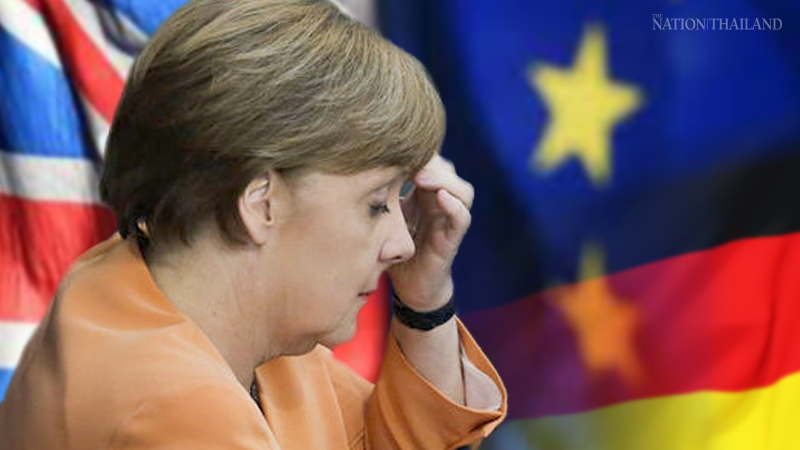
Germany is one of the biggest Brexit losers

Feb 12. 2020
By  Syndication Washington Post, Bloomberg Opinion · Andreas Kluth · OPINION, OP-ED 
A somber feeling is spreading among Germany’s elites as the long-term implications of Brexit sink in. Of the European Union’s 27 member states, Ireland obviously has the most to fear from the U.K.’s departure. But Germany may be second. That’s because Brexit changes not only the remaining EU but also Germany’s role within it – and in ways the Germans have for half a century been trying to avoid.

European integration, starting in the 1950s, was for West Germany a way of atoning for its own nationalist and belligerent past. Its citizens were eager to subsume part of their identity in a “post-nationalist,” rules-based, non-militarist and largely mercantile entity, in return for being accepted again by their neighbors. Occupied by three of the Allied Powers, they didn’t have full national sovereignty, so they didn’t worry about ceding more of it to Brussels.

To move this European project forward, the Germans relied on different kinds of support from the Allies. To build the structures that later became the EU, they needed France. The French, however, especially under President Charles de Gaulle, saw “Europe” differently: as reconciliation with Germany, yes, but also as a new vector to project French power, the better to keep the mightier “Anglo-Saxons” at bay.

Those Anglo-Saxons were of course the U.S. and the U.K., the other two powers the West Germans needed. The U.S. protected them against the Soviets, and kept international order generally. And the Brits were basically a smaller, more familiar – and European – version of the Americans, and thus a welcome counterweight against the French.

In fact, German Francophilia was always less a phenomenon than a policy, imposed top-down; by contrast, German Anglophilia spread from the bottom up (even if it wasn’t often reciprocated). It helped that the Brits after the war competently ran and rebuilt northwestern Germany – the ancestral homelands, as Germans noted tongue-in-cheek, of the Anglo-Saxons and the Hanoverian kings of England. Once the Beatles showed up in Hamburg, it was basically love all the way.

The West Germans also had political motivations for wanting to hug the U.K. inside the European club, against the stubborn resistance of de Gaulle. Germany and France have always had clashing economic traditions. The French one, called dirigisme, is based on state intervention and looks askance at free markets and free trade. The German one, called ordoliberalism, is based on restricting the state to narrow functions (such as antitrust) and otherwise leaving markets and trade pretty free.

The Germans thus saw the Brits, like the Dutch, as more naturally aligned in values than the French. Having the U.K. in the club meant that the “north” could gang up in the Council of Ministers (the body in Brussels where member states decide policy). And it did. A fluid “Nordic” bloc has usually had enough votes to veto “southern” ideas it didn’t like, even as the European club expanded its membership. Projects driven primarily by the Brits and Germans include the single market, rigorous competition policy and liberal trade deals. Projects they successfully prevented (at least until now) include a European “industrial policy,” which tends to be French code for coddling national champions.

Brexit means that the center of gravity in the EU has now shifted southeast, in the European Parliament but above all in the Council. With the U.K., the north (defined as Germany, Sweden, Denmark, Finland, Ireland and the Netherlands) had a blocking minority of 36.8%. Without the U.K., that share has dropped to 27.8%, too small for a veto. Even when Austria and the Baltics are included, the north can now be overruled.

Other fault lines crisscross this political geography that are just as treacherous for Germany. They run not only between north and south but also between west and east. For example, the Visegrad four (Poland, the Czech Republic, Slovakia and Hungary) have joined to reject the EU’s migrant policy, which they see as dictated by Germany after the refugee crisis of 2015, and they’ve rallied support from Germany’s traditional partners, such as Austria. Depending on the issue, other alliances are constantly taking shape, often aimed against the largest member state, Germany.

Geographically and politically, Germany thus finds itself, once again, squeezed in the uncomfortable middle. Historically, this tension is known the German Question and has repeatedly led to troubles. Owing to its “awkward scale,” as one former West German chancellor put it, Germany was always either too weak (in the 17th and 18th centuries) or too strong (in the late 19th and early 20th) for the continent to be stable. Other powers either ganged up against it or were dominated by it. As the writer Thomas Mann memorably put it, the continent is forever condemned to choosing between “a German Europe” or “a European Germany.”

Having the U.K. in the EU mitigated that dilemma. Britain was weighty enough – economically, demographically, militarily – to balance Germany, France and the continent. And nobody was happier about being balanced than the Germans, for the last thing they want is to be forced to lead, knowing that this will invariably rekindle old resentments against them. Brexit means that balance is gone again. The German Question is back.

The Brits shouldn’t have been surprised that Germany wasn’t more forthcoming during Brexit negotiations; for Germans, the cohesion of the EU, and the relationship with France, simply takes precedence. Nonetheless, many Germans have regrets. Some are pushing for a German-British Friendship Treaty to complement whatever deal the EU and the U.K. come up with. Unspoken is an almost primal plea: Dear Brits, please don’t leave us continentals to ourselves.

U.N. warns that runaway inequality is destabilizing the world’s democracies #ศาสตร์เกษตรดินปุ๋ย

#ศาสตร์เกษตรดินปุ๋ย : ขอบคุณแหล่งข้อมูล : หนังสือพิมพ์ The Nation

https://www.nationthailand.com/business/30381996?utm_source=category&utm_medium=internal_referral

U.N. warns that runaway inequality is destabilizing the world’s democracies

Feb 12. 2020
By The Washington Post · Christopher Ingraham 
Runaway inequality is eroding trust in democratic societies and paving the way for authoritarian and nativist regimes to take root, according to a dire new report from the United Nations.

The findings note that solutions – including robust social safety nets, an active redistribution of wealth and the protection of workers rights – “have been recommended for decades” and are well within the capacity of the world’s wealthy nations.

But in many countries, including the United States, such initiatives have been blocked by “economic elites” because they inevitably challenge the interests of certain individuals and groups, the report says, affecting the balance of power in nations that pursue greater economic redistribution.

The broad contours of income and wealth inequality in the United States are, at this point, well-known. The top 1% of households have roughly doubled their share of the nation’s wealth since 1980, leaving less behind for everyone else. The 400 richest Americans now have significantly more money than the 150 million Americans in the bottom 60% of the distribution.

In the past several decades, paychecks of rank-and-file workers have stagnated even as they have delivered on the growing profits demanded by their bosses and shareholders. As the U.N. report notes, the average compensation for a chief executive at a Standard & Poor’s 500 company was $14.5 million in 2018, while the average production and nonsupervisory worker took in about $40,000.

Defenders of the economic status quo have argued, at times, that inequality is probably not rising all that much. But even if it is, it may well be the inevitable byproduct of a capitalist society and, in fact, it might actually be good. Economic inequality, in this view, is simply the price of paying a fair remuneration to the people who produce the iPhones and the cool apps and the free shipping that all of us – even the less fortunate – are now able to enjoy.

The U.N. report notes, however, that rampant inequality is harmful even to people at the top of income and wealth distributions. Unequal societies “grow more slowly and are less successful at sustaining economic growth,” as numerous studies have shown. As economic conditions deteriorate in lower and middle classes, we may get to a point where a critical mass of the population can no longer afford the iPhones and cool apps and free shipping that are driving our economy, causing a recession. In the end, the trouble with capitalism may be that eventually you run out of other people’s money.

The U.N. report is unusually clear-eyed on the power dynamics underlying today’s inequality struggles. “People in positions of power tend to capture political processes, particularly in contexts of high and growing inequality,” the report states. “Efforts to reduce inequality will inevitably challenge the interests of certain individuals and groups. At their core, they affect the balance of power.”

This observation is extremely useful for understanding the current debate. The winners of the modern, winner-take-all economy often protest that the distribution of money is not a zero-sum game. The rank-and-file may be getting a smaller piece of the American pie, but if that pie is much bigger than it used to be, they may still be better off than they were 40 years ago.

But while preaching nonzero sum thinking, those winners have also taken a ruthlessly zero-sum approach to rewriting the rules of the economy to their own benefit. Corporations and their wealthy leaders have lobbied extensively, and successfully, to reduce their tax burdens, weaken the social safety net, undermine the power of their workers and increase their influence in the policymaking process. The net result has been a massive transfer of wealth and power from the poor and middle class to those at the top.

When the rich shape a country’s institutions in their own image and to their own benefit, it’s little wonder that trust in those institutions declines, as it has in the United States. That lack of trust creates a vacuum for authoritarian and nativist regimes to take root, according to the United Nations. “The central message of populist movements has historically been that the common people are being exploited by a privileged elite, and that radical institutional change is required to avoid such exploitation,” according to the report.

But research shows the history of populist regimes since 1990 has primarily been one of corruption, self-dealing, worsening inequality and political violence.

Policymakers have known how to avoid this dire outcome for decades, according to the U.N. report. Leveling the playing field would involve strengthening the minimum wage, reinforcing the social safety net and ensuring universal access to health care in places that currently lack it. It’s really that simple, and wealthy countries like the United States have plenty of economic capacity and technical know-how to pull it off.

But putting those policies in place would require redistributing a lot of wealth downward, via a mechanism like a wealth tax or some other form of increased taxation on the wealthy. And the individuals and institutions currently hoarding the country’s riches have rightly identified those policies as a threat to their interests.

U.S. stocks close at fresh high; Treasuries slip #ศาสตร์เกษตรดินปุ๋ย

#ศาสตร์เกษตรดินปุ๋ย : ขอบคุณแหล่งข้อมูล : หนังสือพิมพ์ The Nation

https://www.nationthailand.com/business/30381995?utm_source=category&utm_medium=internal_referral

U.S. stocks close at fresh high; Treasuries slip

Feb 12. 2020
By Syndication Washington Post, Bloomberg · Todd White

U.S. stocks fought off a late-session swoon to close at fresh heights Tuesday amid reports that the Federal Trade Commission is looking into acquisitions by some of the country’s biggest tech companies.

The S&P 500 Index faded from session highs after the FTC news, with Facebook and Microsoft among the decliners. Health-care and consumer-discretionary shares led the day’s advancers. The Dow Jones Industrial Average and Nasdaq 100 were little changed. Ten-year Treasury yields rose, while the dollar dropped for the first time in five sessions.

Investors have been more bullish lately despite the coronavirus outbreak, signaling some confidence that central banks could ease policy if growth slows. In remarks to Congress on Tuesday, Federal Reserve Chairman Jerome Powell, while positive about the American economic outlook, said the central bank is keeping a close eye on fallout from the epidemic, which continues to disrupt travel and trade.

“With fundamentals strong, a robust employment situation and inflation on track, Powell’s cautiously optimistic stance isn’t too surprising, especially since coronavirus fears and trade tensions are at bay,” said Mike Loewengart, vice president of investment strategy at E-Trade Financial. “What remains to be seen is the lasting effect of the coronavirus on global growth, which is already tepid.”

Oil bounced back from Monday’s swoon and gold fell. Bitcoin surged back above $10,000. European and Asian equity benchmarks closed higher.

– – –

Here are some key events coming up:

– Earnings season continues with reports including MGM Resorts International and Softbank on Wednesday; Thursday will bring Alibaba, Nissan, Credit Suisse, Airbus, Nestle and AIG.

– A key contest for Democratic presidential hopefuls unfolds Tuesday, when New Hampshire holds a primary vote.

– Thursday sees a gauge of underlying U.S. inflation, the core consumer price index. It is forecast to increase to 0.2% in January, a faster pace than in December.

– China and the U.S. on Friday lower tariffs on billions of dollars of respective imports as part of the trade deal signed last month.

– – –

These are the main movers in markets:

Stocks

– The S&P 500 Index increased 0.2%, to 3,357.77, as of 4:02 p.m. New York time, the highest on record.

– The Stoxx Europe 600 Index advanced 0.9%, to 428.48, the highest on record.

– The MSCI Asia Pacific Index rose, 0.6%, to 169.93.

– The MSCI Emerging Market Index climbed 1.1%, to 1,098.98.

Currencies

– The Bloomberg Dollar Spot Index declined 0.2%, to 1,205.58, the first retreat in a week and the largest drop in more than a week.

– The British pound rose 0.3%, to $1.2956, the biggest rise in more than a week.

– The euro rose 0.1%, to $1.0919, the first advance in more than a week.

– The Japanese yen was little changed at 109.79 per dollar.

Bonds

– The yield on 10-year Treasuries advanced two basis points, to 1.59%.

– Germany’s 10-year yield rose two basis points, to -0.39%.

– Britain’s 10-year yield increased one basis point, to 0.569%.

Commodities

– West Texas Intermediate crude advanced 0.9%, to $50 a barrel.

– Gold weakened 0.2%, to $1,568.25 an ounce, the first retreat in a week.

– LME copper increased 0.1%, to $5,667 per metric ton.

Robot analysts outwit humans on investment picks, study shows #ศาสตร์เกษตรดินปุ๋ย

#ศาสตร์เกษตรดินปุ๋ย : ขอบคุณแหล่งข้อมูล : หนังสือพิมพ์ The Nation

https://www.nationthailand.com/business/30381989?utm_source=category&utm_medium=internal_referral

Robot analysts outwit humans on investment picks, study shows

Feb 12. 2020
By  Syndication Washington Post, Bloomberg · Vildana Hajric
They beat us at chess and trivia, supplant jobs by the thousands, and are about to be let loose on highways and roads as chauffeurs and couriers.

Now, fresh signs of robot supremacy are emerging on Wall Street in the form of machine stock analysts that make more profitable investment choices than humans. At least, that’s the upshot of one of the first studies of the subject, whose preliminary results were released in January.

Buy recommendations peddled by robo-analysts, which supposedly mimic what traditional equity research departments do but faster and at lower costs, outperform their flesh-and-blood counterparts over the long run, according to Indiana University professors.

“Using this type of technology to make investment recommendations or to conduct investment analyses is going to become increasingly important,” Kenneth Merkley, an associate professor of accounting and one of the authors, said by phone.

Whether getting stock calls right is a critical mission of human analysts is debatable. Wall Street research departments serve a variety of functions, among them connecting investors with company executives and gathering earnings and other corporate data. While their buy, sell and hold recommendations still garner attention and can move stocks, the number of clients premising investment decisions off them is probably limited.

The study looked at a small and still largely experimental branch of fintech, firms founded on the premise that digital technology does a better job than humans in making equity recommendations. While all analysts use computers, a handful of start-ups has been seeing if programs can handle every aspect of the stock-picking process.

One firm whose data was in the study, New Constructs, uses robo-analysts to collate everything from income statements and balance sheets to the footnotes at the bottom of reports to push out picks, according to its chief executive officer, David Trainer.

“We’re not doing sentiment, we’re not doing momentum, we’re not doing what I would call all these sexy, short-term metrics,” Trainer said in a phone interview. “We can give them good, old-fashioned analytical rigor to insert in their process at little to no cost.”

Trainer’s clients — quant funds, consulting firms, IRAs and asset managers, among others — can buy access to the services for anywhere from about $10 to $15,000, he said, depending on the type of research.

The Indiana University study analyzed more than 76,000 reports issued by seven different robo-analyst firms between 2003 and 2018. Among the findings were that automated services are more likely to produce sell ratings (as opposed to holds and buys) than traditional firms. They also revise their reports more frequently and may be better at accounting for large and complex corporate disclosures, including filings with the Securities and Exchange Commission.

The authors compared the robo-analyst recommendations to those of traditional analysts part of the Institutional Brokers’ Estimate System. They omitted holds in their long-term analysis as those recommendations are less actionable, according to Merkley.

Because robo-analysts don’t exhibit any biases and aren’t subject to conflicts of interest, they produce a more balanced distribution of ratings, the authors, who also included Braiden Coleman and Joseph Pacelli, claimed. Whereas traditional analysts actively work on maintaining relationships with company management, robots aren’t beholden to the same conventions. Their calls may not get the same pop as humans’ at first, but the recommendations can generate “substantial returns for individual investors,” they said.

Besides New Constructs, the researchers analyzed recommendations from firms including Minkabu, Rapid Ratings and TheStreet.com that overlapped with those of traditional analysts.

Out of the total pool of outstanding robo-analyst recommendations, more than 30% represented buy ratings compared with 47% from traditional analysts (the overall number of outstanding recommendations from traditional analysts was five times the robots’). About a quarter of recommendations from the machines fell into the sell category, compared with 6% from humans.

Traditional analysts have been under pressure recently — machines have been doing a bigger share of the work while investors increasingly pile into passive funds. In the next decade, automation could reduce headcount on Wall Street and the banking industry by about 200,000, according to Wells Fargo Securities.

“What we’re seeing is that research budgets at these banks are being constrained, the value proposition of sell-side equity research is being reconsidered — for us, this industry is ripe for disruption,” said Merkley. “Technology is one of those disruptions because you can do things probably at lower cost and greater scale.”

Robo-analysts differ from their better-known counterparts, robo-advisers — shops like Betterment that use algorithms to provide automated financial planning services. But whatever their form, skepticism abounds on Wall Street. Opponents argue that machines are unable to parse nuanced discussions on earnings calls or have conversations with company management. New Constructs’ Trainer says the opposite is true — robots can analyze huge amounts of data, including transcripts of conversations, at much faster paces.

But, “as long as there’s still people that need human interaction, that need to talk to management and talk about the industry and perform that function for the buy-side, the sell-side will still be around,” said Merkley.

Fed Chair Powell warns Congress that $1 trillion budget deficits are unsustainable #ศาสตร์เกษตรดินปุ๋ย

#ศาสตร์เกษตรดินปุ๋ย : ขอบคุณแหล่งข้อมูล : หนังสือพิมพ์ The Nation

https://www.nationthailand.com/business/30381984?utm_source=category&utm_medium=internal_referral

Fed Chair Powell warns Congress that $1 trillion budget deficits are unsustainable

Feb 12. 2020
Fed Chair Powell

Fed Chair Powell
By The Washington Post · Heather Long · BUSINESS, CONGRESS, US-GLOBAL-MARKETS

WASHINGTON – Federal Reserve Board Chair Jerome Powell told Congress on Tuesday that now would be a good time to reduce the federal budget deficit, which is expected to top $1 trillion this year.

“Putting the federal budget on a sustainable path when the economy is strong would help ensure that policymakers have the space to use fiscal policy to assist in stabilizing the economy during a downturn,” Powell said in testimony to the House Financial Services Committee.

In past recessions, the Fed has played a large role in reviving the economy by sharply cutting interest rates. But Powell has been warning lawmakers that the central bank won’t have much ammunition left to fight the next downturn because interest rates are so low (the benchmark rate is just below 1.75 percent, far below rates above 5 percent in the past).

More government spending is likely to be needed to aid the economy in the next recession.

The Fed chair’s warning comes as the U.S. federal debt has grown by about $3 trillion since President Donald Trump took office, and the president’s latest budget proposal submitted this week would add another $5 trillion to the debt over the coming decade. Economists worry that so much U.S. government debt can dampen private investment by driving investors to buy public bonds instead of private ones.

“A more sustainable federal budget could also support the economy’s growth over the long term,” said Powell, who spent time before he joined the Fed educating Congress about the debt limit as a Bipartisan Policy Center scholar.

Trump blasted Powell, tweeting in the middle of the congressional hearing that the Fed chair was keeping interest rates too high.

“When Jerome Powell started his testimony today, the Dow was up 125, & heading higher. As he spoke it drifted steadily downward, as usual, and is now at -15. Germany & other countries get paid to borrow money. We are more prime, but Fed Rate is too high, Dollar tough on exports,” Trump wrote on Twitter.

The United States has never had a negative interest rate. When asked about that possibility on Tuesday, Powell said that’s “not a tool we are looking at.” Economists widely view negative interest rates as only worth doing when the economy is in a terrible situation. Trump keeps calling for lower interest rates to further boost growth and the stock market.

For now, the Fed chair does not see any signs of a recession on the horizon. He told Congress that the U.S. economy is in a “very good place” and has remained “resilient” to numerous punches in recent months. He expects growth to remain solid, although he said the coronavirus is a major unknown for the economy.

“We know that there will be some – very likely – be some effects on the United States” from the coronavirus, Powell said, but he was hesitant to predict how big of an impact it will have on the economy.

“I think it’s too early to say. We have to resist the temptation to speculate on this,” Powell said. He reiterated that the Fed is “closely monitoring” the situation for possible “disruptions in China that spill over to the rest of the global economy.”

Powell stressed to Congress that his concerns for the economy are more long term. In addition to reducing the deficit, he once again said there is a great need to invest in programs to get more people back to work and to boost productivity.

“Finding ways to boost labor force participation and productivity growth would benefit Americans and should remain a national priority,” Powell said.

The share of working-age Americans who are in the labor force is at its highest rate in more than a decade, according to a Labor Department report Friday, but it remains well below most of the nation’s competitors.

Powell’s fairly positive assessment of the U.S. economy was echoed by other Fed leaders this week.

“Policy is in a good place. The economy is in a good place,” San Francisco Fed President Mary Daly said in a speech Monday in Ireland.

Daly was also careful to lower concerns about the effect of the coronavirus on the U.S. economy so far.

“For now I’m watching the coronavirus carefully to see if it has any longer-term effects on the economy or deeper effects than we’ve penciled in right now,” Daly said. “But to date, none of those have materialized.”

Philadelphia Fed President Patrick Harker said Monday that the negative effects on China were “something to watch.”

The U.S. economy is heavily driven by consumer spending, which remains healthy. Other economies are more dependent on trade, which is starting to be affected by the shutdown of many factories in China.

U.S. household debt exceeds $14 trillion for the first time #ศาสตร์เกษตรดินปุ๋ย

#ศาสตร์เกษตรดินปุ๋ย : ขอบคุณแหล่งข้อมูล : หนังสือพิมพ์ The Nation

https://www.nationthailand.com/business/30381977?utm_source=category&utm_medium=internal_referral

U.S. household debt exceeds $14 trillion for the first time

Feb 11. 2020
By  Syndication Washington Post, Bloomberg · Alex Tanzi · BUSINESS, PERSONAL-FINANCE

Americans increased their borrowing for the 22nd straight quarter as more households took out loans to buy homes or refinance existing mortgages, according to a report released Tuesday from the Federal Reserve Bank of New York.

Total U.S. household debt rose by $601 billion in the fourth quarter, or 1.4%, surpassing $14 trillion for the first time, the New York Fed’s quarterly household credit and debt report showed. That’s $1.5 trillion above the previous peak in the third quarter of 2008. Overall household debt is now 26.8% above the second-quarter 2013 trough.

Mortgage borrowing rose by $120 billion to $9.56 trillion. The rate for a 30-year mortgage has fallen by about 100 basis points over the past year, adding to home purchasers’ buying power. For example, a $500,000, 30-year loan costs about $300 less per month.

“Mortgage originations, including refinances, increased significantly in the final quarter of 2019,” Wilbert Van Der Klaauw, vice president at the New York Fed, said in a statement.

Mortgage loans for young adults age 18 to 29 rose to a the highest level since the third quarter of 2007. Originations for 30-year-olds rose to $210.1 billion last quarter — the highest level since the end of 2005.

Total debt for people ages 18 to 29 rose to a record $1.04 trillion.

Student debt increased to $1.51 trillion from $1.46 trillion at the end of 2018. More than $100 billion in student debt is held by those age 60 and over. Auto loans rose to $1.33 trillion, while credit card debt rose to a record $930 billion.

Auto debt, which has risen for 35 consecutive quarters, increased $16 billion from the previous quarter. Almost 5% of auto loans are 90 days of more delinquent. This is the highest percentage since the third quarter of 2011.

Credit card delinquencies rose to 8.36% an 18-month high.

Among student debt, one in nine borrowers were 90+ days delinquent or in default in 2019, and this figure may be understated. About half of student loans are currently in deferment, in grace periods or in forbearance and therefore temporarily not in the repayment cycle. Once these loans enter that cycle, delinquency rates are projected to be roughly twice as high, according to the Fed report.