ONYX signs second Amari management deal in China #ศาสตร์เกษตรดินปุ๋ย

#ศาสตร์เกษตรดินปุ๋ย : ขอบคุณแหล่งข้อมูล : หนังสือพิมพ์ The Nation

https://www.nationthailand.com/property/30380481?utm_source=category&utm_medium=internal_referral

ONYX signs second Amari management deal in China

Jan 13. 2020
By THE NATION

ONYX Hospitality Group, a major hotel management company in the region, on Monday (January 13) announced the signing of an agreement with Base Construction Co Ltd, the owner and developer of its new headquarters Hangzhou East Bay Base, for the management of Amari East Bay Hangzhou, in the Qiantang district of Hangzhou city in Zhejiang province, east China.

This will be ONYX Hospitality Group’s second Amari in China. Scheduled to open in 2021, Amari East Bay Hangzhou will occupy levels 33 to 47 of Hangzhou East Bay’s main building, the tallest skyscraper in the new area of Qiantang.

Located along the riverbank area of the Xiasha subdistrict, Hangzhou East Bay is in close proximity to the Qiantang River, neighbouring the industrial development zone.

With the start of the city’s east expansion development strategy and the infrastructure of Greater Jiangdong, the area along the eastern border of Hangzhou is gradually being transformed into one of the city’s major districts.

As one of the key infrastructures in the development zone, East Bay headquarters Base will be home to enterprise headquarters, creative industries, commercial buildings, conference centres, a water park and walking streets.

The headquarter building, in which Amari East Bay Hangzhou will be located, is situated in the Xiasha Wetland area, encompassing the interchangeable ring entrance in the south and sitting on more than 50 hectares of wetland landscape park where the most scenic views of the river can be enjoyed.

The area will also play a major role in attracting investments, leading and driving the development of the region.

The lobby of Amari East Bay Hangzhou will be nestled on the on 47th floor, approximately 200 metres from the ground, embracing a panoramic view of the Qiantang River and the riverbank wetland. Guests can enjoy an “amidst the clouds” experience in this tallest hotel in Qiantang New District.

It will feature 316 rooms that include guestrooms, executive suites and deluxe suites.

A wide range of facilities, including an all-day dining outlet, a Chinese restaurant, lobby bar, executive lounge, multi-function room, fitness centre, swimming pool, kids club and Thai-inspired spa will be offered, providing a wide range of experiences for both business and leisure travellers.

The hotel will combine a contemporary Thai-inspired design with touches reflecting the art and culture of Hangzhou, building a magnificent life gallery for a luxury sojourn.

Douglas Martell, president and chief executive officer of ONYX Hospitality Group, said: “Amari East Bay Hangzhou will be our second Amari in China. As the flagship brand of ONYX Hospitality Group, Amari is a fast-expanding full-service hotel and resort brand originated in Thailand with presence across Asian destinations such as the Maldives, Sri Lanka, Malaysia and Laos. It is our honour to partner with Hangzhou East Bay Base Construction Co Ltd, in introducing a new flagship hotel that embodies the essence of the Amari brand, providing guests with a contemporary Thai experience in this dynamic city”.

Hangzhou East Bay Headquarters Base Construction Co Ltd expressed their optimism towards this deal.

Upon completion, the Hangzhou East Bay Headquarters Base will become a national first-class facility, the province’s leading dual-core headquarters base, as well as a base for the Zhejiang business enterprise that emphasises “pioneer and innovation”.

The firm believes that, with the exceptional brand essence and the professional hotel management expertise and experience of ONYX Hospitality Group, the new Amari East Bay Hangzhou will shine as one of the most unique high-end business hotels in the region, which will help promote East Bay headquarters base in becoming the social and business hub of the area in the decades to come.

Based in Bangkok, ONYX Hospitality Group has a growing regional portfolio of 50 operating properties across three core brands in eight markets. The Group has a robust development pipeline of 25 new properties in markets such as China, Malaysia and Laos, and has set a target of having 99 hotels open by 2024 as part of its journey towards being the best medium-sized hospitality player in the region.

Grab ties up with Chubb to offer travel insurance purchase on its app #ศาสตร์เกษตรดินปุ๋ย

#ศาสตร์เกษตรดินปุ๋ย : ขอบคุณแหล่งข้อมูล : หนังสือพิมพ์ The Nation

https://www.nationthailand.com/business/30380473?utm_source=category&utm_medium=internal_referral

Grab ties up with Chubb to offer travel insurance purchase on its app

Jan 13. 2020
Grab has collaborated with insurer Chubb to launch a travel insurance product for Grab's Singapore customers, both companies said on Monday.PHOTO: SCREENGRAB FROM GRAB

Grab has collaborated with insurer Chubb to launch a travel insurance product for Grab’s Singapore customers, both companies said on Monday.PHOTO: SCREENGRAB FROM GRAB
By The Straits Times

SINGAPORE – Grab is making its first foray into the consumer insurance business in a tie-up with Chubb offering travel insurance to its Singapore customers.

Starting on Monday (Jan 13), a new insurance tile has been added on the Grab mobile app for the purchase of the product, called Travel Cover, at $2.50 a day covering any destination globally.

Travel Cover will be rolled out to other Grab markets in South-east Asia in the coming months, the partners said in a joint release on Monday. The product is distributed by GrabInsure Insurance Agency, Grab Financial Group’s insurance platform.

Tom Duncan, head of insurance at Grab, said Travel Cover is an example of how Grab leverages its GrabInsure platform to deliver “on-demand” insurance products.

“We will continue to work closely together (with Chubb) to expand the product offering and address the differing consumer needs across the region,” he added.

Scott Simpson, country president of Chubb in Singapore, said: “Our partnership with Grab allows us to develop more customer-centric insurance solutions that align with the varied lifestyles of consumers.”

Grab’s “super app” in Singapore has grown from ride-hailing to payment services, food delivery, package delivery, hotel bookings, show ticket purchases and on-demand video streaming.

An earlier tie-up with Chubb offered Grab users free travel insurance covering personal accidents and flight delays with hotel bookings made through the Grab app.

To celebrate the launch of Travel Cover, the first 20,000 customers can purchase the product at a discounted price of $1a day till Feb 29 for trips within the Asia Pacific region, said the companies.

Egat looking at energy innovation joint venture #ศาสตร์เกษตรดินปุ๋ย

#ศาสตร์เกษตรดินปุ๋ย : ขอบคุณแหล่งข้อมูล : หนังสือพิมพ์ The Nation

https://www.nationthailand.com/business/30380368?utm_source=category&utm_medium=internal_referral

Egat looking at energy innovation joint venture

Jan 13. 2020
By THE NATION

The Electricity Generating Authority of Thailand (Egat) will in June pitch to the Cabinet a plan for an energy innovation joint venture with private partners.

Egat governor Viboon Rerksilathai said Egat proposes to hold a 40-per-cent stake in the venture, with the Ratch Group and Electricity Generating Public Co Ltd holding 30 per cent each.

The state agency’s board approved the plan last month.

The venture, expected to have registered capital of Bt600 million, will be involved in the development of a smart city and smart grid. Some of its capital will be invested in startups via Innospace (Thailand).

AOT launches fresh round of bidding for Don Mueang concession #ศาสตร์เกษตรดินปุ๋ย

#ศาสตร์เกษตรดินปุ๋ย : ขอบคุณแหล่งข้อมูล : หนังสือพิมพ์ The Nation

https://www.nationthailand.com/business/30380369?utm_source=category&utm_medium=internal_referral

AOT launches fresh round of bidding for Don Mueang concession

Jan 13. 2020
By THE NATION

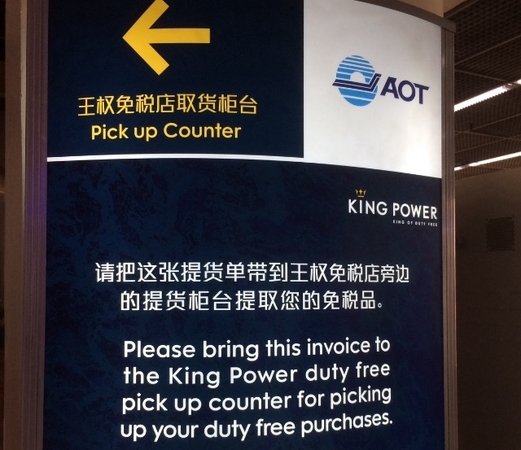
Airports of Thailand (AOT) will sell again bid documents for the concession to run a duty-free pick-up counter service at Don Mueang International Airport, AOT president Nitinai Sirismatthakarn said.

The documents will be available on January 20, he added.

AOT recently cancelled the previous bidding as King Power Group was the only company to pick up the tender documents.

He added that AOT had not revised any details in the documents for this fresh round of bidding.

If King Power turns out to be the only company picking up the bid documents, AOT will go ahead with the bidding process because it would show that no one else was keen to bid for the concession.

Last month the AOT board agreed to grant King Power Duty Free Coa duty-free concession at Don Mueang International Airport.

King Power was the lone bidder for this concession, which will be valid from October 1, 2022 to March 31, 2033.

Samsung’s market cap rises to world’s 18th #ศาสตร์เกษตรดินปุ๋ย

#ศาสตร์เกษตรดินปุ๋ย : ขอบคุณแหล่งข้อมูล : หนังสือพิมพ์ The Nation

https://www.nationthailand.com/business/30380455?utm_source=category&utm_medium=internal_referral

Samsung’s market cap rises to world’s 18th

Jan 12. 2020
(Yonhap)

(Yonhap)
By The Korea Herald/ANN

Blue chip Samsung Electronics, listed on South Korea’s main bourse Kospi, hit a record high last week pulling its market cap to the top 20 global list.

The tech giant is expected to extend its winning streak on a widely optimistic forecast of its 2020 performance on the back of the recovering semiconductor market, according to industry sources.

According to Bloomberg’s data, the total market valuation of Samsung as of Thursday last week came at $301.6 billion, the 18th-highest worldwide. This is 10 notches up from the 28th position earlier last year when it was $206.5 billion.

During this period, the stock price of Samsung has jumped 51 percent from 38,750 won a year ago to 58,600 won. By Thursday, the stock price of the Korean tech firm reached a high of 58,600 won, breaking its previous record of 57,520 won set in November, 2017, when the semiconductor super-cycle reached its zenith.

The stock price further rose higher to 59,500 won on Friday. The market cap of the company is currently at 355.2 trillion won.

The latest increase in its market cap allowed the company to surpass that of AT&T ($281.7 billion), Intel ($256 billion) and Verizon ($243.9 billion).

The stock’s performance has been largely backed by foreign investors. During Jan. 1-10, foreign buyers have acquired 626.8 billion won worth stocks, while buying its preferred shares amounting to 26.9 billion won.

The latest turnaround came after memory chip prices began to recover.

The company’s operating profit in the fourth quarter last year is estimated to reach 7.1 trillion won. The recent easing of trade tensions between the US and China and increasing demand for smartphones and data servers are expected to help Samsung gain ground in the future.

According to market watchers, its stock price could reach possibly as high as 67,931 won. According to a report by IBK Securities, Samsung’s operating income this year could reach some 58.8 trillion won.

From 2018-19, Samsung’s share price has declined since the end of semiconductor supercycle. Its net profit in 2019 decreased by 52.9 percent to go down to 27.7 trillion won, marking the lowest since 26.4 trillion won in 2015.

By Shim Woo-hyun (ws@heraldcorp.com)

International issues to influence baht rate this week #ศาสตร์เกษตรดินปุ๋ย

#ศาสตร์เกษตรดินปุ๋ย : ขอบคุณแหล่งข้อมูล : หนังสือพิมพ์ The Nation

https://www.nationthailand.com/business/30380477?utm_source=category&utm_medium=internal_referral

International issues to influence baht rate this week

Jan 13. 2020
The Bank of Thailand will hold a press conference tomorrow on the monetary policy and baht exchange rate situation, amid concerns of the baht remaining strong.

The Bank of Thailand will hold a press conference tomorrow on the monetary policy and baht exchange rate situation, amid concerns of the baht remaining strong.
By The Nation

The next round of US-China trade negotiations, the Middle East situation and key economic data will affect the baht’s value this week, says Kasikornbank (KBank).

The Bank of Thailand will hold a press conference tomorrow on the monetary policy and baht exchange rate situation, amid concerns of the baht remaining strong.

Last week, the baht moved within a tight range early in the week before hitting a one-month low of Bt30.37 to the US dollar in line with weak regional currencies amid concerns over rising tensions in the Middle East, after Iran attacked US troops in Iraq in response to the US airstrike on January 3, according to KBank report.

However, the baht pared losses somewhat later in the week, as US announced economic sanctions instead of military actions against Iran, which helped calm market concerns over the situation in the Middle East.

Meanwhile, the market shifted its focus to preparations for the signing of the first phase of the US-China trade deal around mid-January.

On Friday (January 10), the baht closed at Bt30.23 to the dollar, versus Bt30.15/USD reported on Friday (January 3).

During the week January 13-17, KBank expects the baht will move within a range of Bt30.00-30.40/USD. Key factors to be monitored closely include signals for subsequent phases of the US-China trade talks, issues surrounding Brexit and the situation in the Middle East. The US economic data to be released during the week include consumer price index, producer price index, retail sales, housing starts, and industrial production data for December 2019, plus the NAHB Housing Market Index, NY Fed Empire State Manufacturing survey, Philly Fed Business Outlook survey and Preliminary Consumer Sentiment survey for January 2020. In addition, market participants may monitor China’s fourth-quarter GDP report for 2019 and December 2019 economic data.

Telework use is rising, but civil servants are restricted #ศาสตร์เกษตรดินปุ๋ย

#ศาสตร์เกษตรดินปุ๋ย : ขอบคุณแหล่งข้อมูล : หนังสือพิมพ์ The Nation

https://www.nationthailand.com/business/30380463?utm_source=category&utm_medium=internal_referral

Telework use is rising, but civil servants are restricted

Jan 13. 2020
By The Washington Post · Lisa Rein 

Telework use is rising, but civil servants are restricted. WASHINGTON = About a quarter of workers at U.S. companies now dial into meetings, consult with clients and do a multitude of other tasks from their laptops at home, as employers seek to cut real estate costs and keep their staffs content in a red-hot job market.

The federal government, though, is calling its employees back to the office.

After a big push toward telework in the Obama administration, President Donald Trump’s government is scaling it back at multiple agencies on the theory that a fanny in the seat prevents the kind of slacking off that can happen when no one’s watching.

The about-face began at the Agriculture Department in 2018, after Secretary Sonny Perdue was angry to discover that an employee he needed to meet with was working from home, according to three administration officials. In response, he slashed by half a robust program used by tens of thousands of employees.

A USDA spokesperson, who acknowledged the program had been dialed back, said the Perdue story was “inaccurate” but would not elaborate.

The Education and Interior departments and the Environmental Protection Agency, as well as parts of Commerce and Health and Human Services departments, soon followed.

The Department of Veterans Affairs, where telework is popular in the benefits division, is pushing for restrictions in contract talks. The Social Security Administration abruptly canceled a 6-year-old pilot program for 12,000 operations employees in November, citing “increased wait times and unacceptable delays” to customer service.

Trump’s war on telework represents a milestone in how his administration is changing the culture of the federal government as it seeks more accountability from employees – and moves to weaken their unions. Employees are chafing at their lost freedom, but the managers reining them in say that, in the long run, taxpayers benefit. Overall, data on productivity is inconclusive, workplace experts say.

“Agencies have been digging deep to say, ‘The way of work in our agency – is it achieving mission, service and stewardship objectives?’ Particularly when it comes to service, we have to ask the question, ‘What is the best modality for delivering service?’ ” Margaret Weichert, deputy director for management at the Office of Management and Budget, said in an interview. “Telework is not proving the most effective way of delivering.”

Employees report they are more productive at home and suspect the administration of other motives. Scaling back telework is “a subtle way of getting rid of old-timers,” said Uylaine Barringer, 69, a compliance assistance coordinator for the EPA’s hazardous waste program in Chicago.

Barringer lives on three acres in the small town of Princeton, Illinois, 120 miles from the city, where she also cares for retired Chicago police horses.

For years she worked four 10-hour days each week – home two days, trekking downtown two others and taking off Fridays, which she reserved for grooming the horses and seeing the veterinarian, as well as for her own medical appointments after surviving cancer.

But last summer, the EPA scaled back telework to two days a month for employees with her schedule. She made the difficult decision to move up her planned retirement by a year, to Jan. 20. It will cost her several hundred dollars a month in pension credits. “It’s a job that I really enjoy,” she said. “I know the program inside and out. But it wasn’t tenable.”

– – –

The Census Bureau’s American Time Use Survey found that 24 percent of private-sector employees teleworked at least some of the time in 2018, a steadily growing share despite retreats in recent years by companies such as Yahoo and IBM.

Alexander Alonso, chief knowledge officer for the Society for Human Resource Management, which tracks workplace trends, said the option to work from home is a “huge” tool in recruiting and maintaining talent.

In the government, though, “I think they want to discourage federal employment and make it less attractive,” said Rep. Gerald Connolly, D-Va., co-sponsor of a 2010 law that prods agencies to allow telework to save on energy and commuting costs. “It’s sort of a Neanderthal move by the administration.”

Working from home has grown steadily in the past decade and is a go-to alternative on snow days.

About 43 percent of the 2.1 million civil servants were eligible for one or more days a week of remote work in fiscal 2017, the last year for which data is available from the Office of Personnel Management. That’s down from 44 percent in fiscal 2015. An OPM spokesperson said telework has remained stable in the Trump administration, but the agency’s annual report to Congress notes that agencies have trouble collecting accurate data.

By private-sector standards, the recent federal retreat would hinder the government’s ability to participate in a knowledge-based economy in which collaboration among far-flung employees is now the norm. Some technology companies have abandoned the bricks-and-mortar office altogether.

The backtrack has upended child-care schedules, raised commuting costs and led some like Barringer to quit because their office is too far to drive to daily. It also could make the government less competitive in recruiting and keeping employees. And with many federal offices redesigned to fit fewer people, it’s unclear if there’s room for them now.

The rollback comes as the White House advances a crackdown on federal employee unions after a successful court battle last year over a series of executive orders. They give management an upper hand in collective bargaining and limit union duties on the job.

Agencies are reopening and renegotiating contracts that in the Obama era had renewed automatically. Restricting telework is a high priority.

“It’s doctrinal. It’s punitive,” said David Cann, director of field services and education at the American Federation of Government Employees, the largest union.

“When Trump came in, federal employees understood they were the ‘swamp’ to this administration and it would be tough on them,” Cann said. “But we have yet to hear from any agency that telework is imparting any harm.”

Some agencies have continued to support telework, including the Patent and Trademark Office and the Defense Department, where a third of the 366,000 civilians eligible used the option in fiscal 2017, the last year data was collected.

The General Services Administration, which shrunk its Washington headquarters during a 2013 renovation, continues to shed leased office space and requires employees to reserve desks when they come in.

GSA “relies on telework to attract and retain a talented workforce,” a spokesperson said in an email, touting the agency’s continuity of operations during a disaster or bad weather. About 85 percent of GSA employees telework multiple days a week.

– – –

Those on either side of the divide have little data to back up their case, workplace experts say. Most research does not account for whether employees were strong or weak performers to begin with, skewing results. Studies tend to lump multiple jobs together.

The Government Accountability Office found similar obstacles in a 2016 report that found few quantifiable results from expanding telework. Agencies could not back up their claims that it benefited them.

Today they do not back up claims that it’s hurting them, but they appear to be changing course based on a gut feeling that productivity is suffering.

At the USDA, where multiple days a week of remote work were common, employees now must show up at the office four days a week.

“USDA’s telework policy is designed to be responsible to the taxpayers and responsive to the customers who depend on our services,” a spokesperson said in a statement, citing “longstanding concerns about the previous policy.” In cases where offices do not have enough space to accommodate employees, supervisors can approve more work from home.

Social Security set off a furor in the fall when Commissioner Andrew Saul canceled a popular telework pilot program that let employees work remotely up to three days a week.

Spokesman Mark Hinkle said the program had “little or no controls to ensure” that it was properly evaluated and that front-line employees were needed in the office to stanch growing wait times and delays to service.

“Given our current service challenges and lack of data on [the policy’s] impact on public service, now is not the time to experiment with working at home,” Hinkle said in an email.

But employees and unions, backed by Democratic lawmakers, mounted a successful campaign on Capitol Hill to restore the program, blaming management for failing to track its effectiveness.

“If you’re data driven, why would you come back years later and say, ‘We’re not gauging if we’re successful in this pilot?’ ” asked James Muhammad-Mason, a debt specialist in the Chicago office who worked from home one day a week.

He said he was more focused that day and not distracted by “office banter.”

“The real reason they took it away? ‘Federal employees are lazy. Why would you let them work more from home?’ ” Muhammad-Mason said, mocking a popular attack on government workers. “If you have a problem with certain employees, you need to address it.”

The pushback worked. The spending deal that Trump signed in December requires the agency to come up with a plan within 60 days to reinstate the program.

The Education Department, where 94 percent of the workforce was eligible for multiple telework days a week, surveyed employees last summer, nine months after slashing telework to one day a week.

The results were universally negative, according to a copy of the survey obtained by The Washington Post.

Sick leave and vacation requests grew. A majority of employees reported no increased productivity, collaboration or communication with colleagues when they returned to the office – the stated reason telework was cut. And two-thirds of employees said they were considering leaving.

The department acknowledged that “a significant number of employees and managers are still adjusting to the change.” But Secretary Betsy DeVos decided to continue the agency’s “efforts to achieve the intended outcomes of improved collaboration and productivity” and limit working from home.

Ministry vows to help tap domestic and overseas markets for Thai fruit #ศาสตร์เกษตรดินปุ๋ย

#ศาสตร์เกษตรดินปุ๋ย : ขอบคุณแหล่งข้อมูล : หนังสือพิมพ์ The Nation

https://www.nationthailand.com/business/30380453?utm_source=category&utm_medium=internal_referral

Ministry vows to help tap domestic and overseas markets for Thai fruit

Jan 13. 2020
File Photo: Thai fruits; durian, mangosteen, longkong, mango  and rambutan.

File Photo: Thai fruits; durian, mangosteen, longkong, mango and rambutan.
By The Nation

The Commerce Ministry is getting ready for this year’s fruit harvest and has pledged to help Thai farmers sell their farm products both in the domestic and export markets.

Despite the shadow of a drought, a large fruit output is expected this year, said Whichai Phochanakij, director-general of the Internal Trade Department.

The department will facilitate trade in Thai fruits such as durian, mangosteen, longan, longkong, lychee and rambutan with a budget of Bt396 million, he said.

The department will match major buyers with 20,000 farmers and will collaborate with retailers, department stores and Blue Flag chain stores to sell at least 50,000 tonnes of fruit.

The department would hold promotion sales of fruit in both the domestic and overseas markets, aiming to sell more than 20,000 tonnes of fruit, he noted.

They would also arrange total loans of Bt1.5 billion at 3 per cent interest to provide liquidity to traders for six months. Another 3 per cent interest subsidy would be allocated to support funding for upgrading their factories and facilitating organic farm certification, he said. Each trader could get a loan of up to Bt10 million.

The department will also help farmers to select middlemen from China who come to Thailand to buy fruits for sale later in the Chinese market.

The farmers and labourers would be trained in post-harvest handling to maintain the high quality of farm products and reduce losses.

Middlemen from China found cheating farmers as in the previous years will be put on the blacklist.

The department will also collaborate with four airliners to allow each passenger to take up to 20 kilograms of fruit on board without fee, he added.

How U.S. sanctions are paralyzing the Iranian economy #ศาสตร์เกษตรดินปุ๋ย

#ศาสตร์เกษตรดินปุ๋ย : ขอบคุณแหล่งข้อมูล : หนังสือพิมพ์ The Nation

https://www.nationthailand.com/business/30380441?utm_source=category&utm_medium=internal_referral

How U.S. sanctions are paralyzing the Iranian economy

Jan 12. 2020
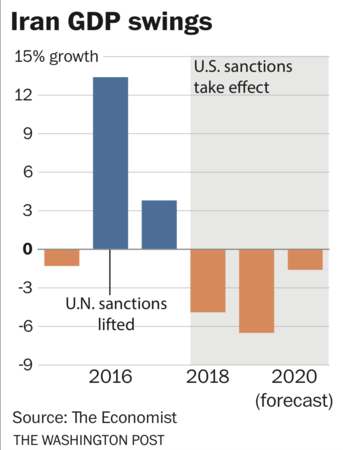
Iran GDP swings
Photo by: The Washington Post — The Washington Post

Iran GDP swings Photo by: The Washington Post — The Washington Post
By The Washington Post · Rick Noack, Armand Emamdjomeh, Joe Fox 

The Trump administration announced more sanctions Friday on Iran, marking the latest move in a series of financial U.S. punishments that have left the Iranian economy reeling and its citizens under extreme pressure.

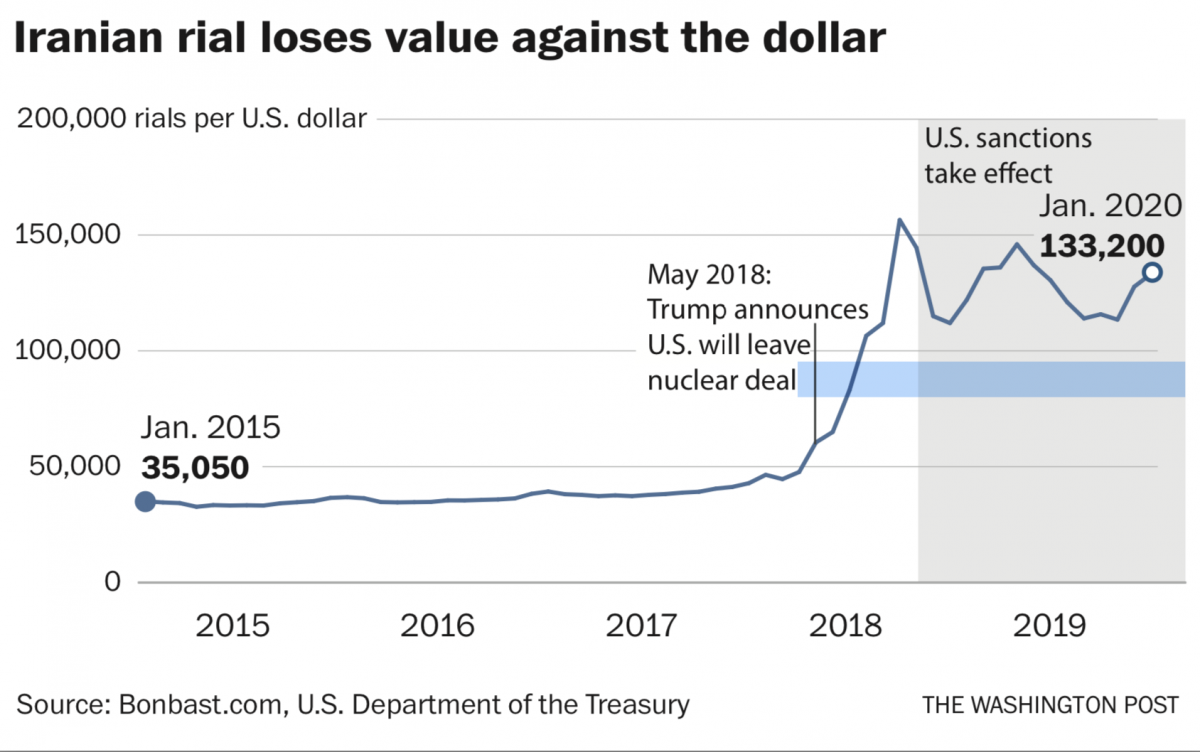
         ranian rial loses value against the dollar Photo by: The Washington Post — The Washington Post

ranian rial loses value against the dollar Photo by: The Washington Post — The Washington Post

+++The latest U.S. sanctions will target Iran’s metal industries, as well as eight senior military and national security officials. The new penalties came after the U.S. killing of a top Iranian commander in Baghdad last week, which triggered retaliatory Iranian strikes Wednesday on bases housing U.S. military personnel in Iraq.

Within three years, cautious hopefulness on improving U.S.-Iranian relations has turned into escalating hostility – with ordinary Iranians saying they once again will bear the brunt of a U.S. return to sanctions.

“Every single day, as soon as people open their eyes, they face a dark and vague future,” wrote Iranian musician Mehdi Rajabian, 30, an independent protest artist and frequent critic of the Iranian regime, in a text message in response to the latest U.S. sanctions announced on Friday.

When the Iran nuclear deal was reached in 2015, then-President Barack Obama welcomed it as being “not built on trust,” but rather “on verification.” The agreement – one of his signature foreign policy achievements – was implemented in early 2016.

Suddenly and largely unconstrained by international sanctions, foreign companies flocked into the country. Whereas Iran’s real gross domestic product growth rate stood at -1.3% in 2015, it surged to +13.4% in 2016.

But President Donald Trump’s election in November 2016 and his new policy directives upended that. Iran’s real GDP growth rate tumbled.

Throughout his campaign, Trump had argued the United States should leave the Iran agreement, calling it a “terrible one for the United States and the world. It does nothing but make Iran rich and will lead to catastrophe,” he tweeted in 2015.

On May 8, 2018, Trump followed through, announcing that the United States would abandon the deal. “It didn’t bring calm, it didn’t bring peace, and it never will,” he said. Trump’s supporters argued that Iran had deceived the international community and that it continued to destabilize the Middle East undeterred, via proxies in Yemen, Lebanon, Syria and other parts of the region.

Other Western parties to the deal – Germany, France and Britain – countered that stopping Iran’s regional interference was never its aim and that their own intelligence suggested Iran was in compliance with the agreement. All signatories apart from the U.S. stuck to the agreement. Europe announced it would establish a mechanism to shield companies willing to continue trading with Iran from reinstated U.S. sanctions.

Once key U.S. sanctions were reinstated by November 2018, however, the Europeans’ announcement had little impact. The Iranian rial continued to rapidly lose value against the dollar.

The Trump administration’s threat to also impose sanctions on countries that purchased Iranian oil hit Iran especially hard. Iran’s oil exports plummeted after the sanctions took effect.

Initially, the United States agreed to grant some of Iran’s customers a six-month waiver, meaning they could continue to import Iranian oil without fear of U.S. sanctions. In the following months, Iranian oil exports began to increase as a result of the exemptions.

Once the waivers expired in May 2019, Iranian exports fell to new lows.

There have been signs of recent frustration between Tehran and the European Union, too. Iranian officials have blamed their European counterparts for supposedly being too slow in implementing measures to shield companies from U.S. sanctions.

In response to the U.S. killing of Maj. Gen. Qasem Soleimani, commander of Iran’s elite Quds Force, Tehran doubled down by announcing on Sunday that it was suspending its commitments under the nuclear deal.

For now, the European Union has resisted U.S. pressure to declare the nuclear deal dead, saying instead that it will “spare no effort” to keep it alive.

A key question, however, is whether additional sanctions would even have a significant impact. Analysts say existing U.S. sanctions have left little leeway for Iran, which saw the cost of basic goods skyrocket over the past year.

Over the course of one year, the price of beef and veal has risen from the equivalent of $5.20 per kilogram to $7.70, and the cost of milk has gone up from $0.3 per liter to $0.5.

Iranian government leaders “keep telling us to be strong and endure the pressures, but we can already hear the sound of our bones breaking,” Shiva Keshavarz, a 22-year-old accountant, told the Associated Press last summer.

Since then, living conditions have only gotten harsher for many Iranians, who “struggle to survive,” wrote Rajabian, the musician.

FAA proposes $5.4 million fine for Boeing over defective 737 Max wing parts #ศาสตร์เกษตรดินปุ๋ย

#ศาสตร์เกษตรดินปุ๋ย : ขอบคุณแหล่งข้อมูล : หนังสือพิมพ์ The Nation

https://www.nationthailand.com/business/30380404?utm_source=category&utm_medium=internal_referral

FAA proposes $5.4 million fine for Boeing over defective 737 Max wing parts

Jan 11. 2020
File Photo:Getty Images

File Photo:Getty Images
By The Washington Post · Ian Duncan 

FAA proposes $5.4 million fine for Boeing over defective 737 Max wing parts.The Federal Aviation Administration said Friday that it was seeking to penalize Boeing $5.4 million over allegations that it wrongly told the agency that defective wing parts were safe to use on its 737 Max jets.

The proposed penalty is on top of a $3.9 million penalty the agency issued in December over the same issue in older generation 737s.

The parts are called “slat tracks” and are used to guide parts of the wing that help the plane take off and land.

The FAA accused Boeing of doing too little to oversee its suppliers and then submitting aircraft to the agency for final safety approvals despite determining that the parts had failed a strength test. The problem affected 178 Max jets, the FAA said.

Boeing has 30 days to review the new fine.

The proposed penalty comes as Boeing faces ongoing scrutiny over the development of the Max, which was involved in two deadly crashes in a span of five months between 2018 and early 2019 that killed 346 people. The plane was grounded shortly after the second crash and is still under safety review by American and international regulators.

Boeing did not immediately respond to a request for comment on the new proposed penalty. In a statement issued after the first one, the company said any affected Max planes would be reviewed before the plane is cleared to fly again.

Boeing also said it has “not been informed of any in-service issues related to the slat tracks themselves.”

The lengthy safety review after the crashes led to the ouster of Boeing chief executive Dennis Muilenburg last month and prompted the company to announce that it would halt production of the Max.

Boeing came under renewed criticism this week after it disclosed internal emails late Thursday that showed employees disparaging regulators and striving to minimize training requirements for the Max.

The FAA has also faced questions over its relationship with Boeing, with some lawmakers accusing the agency of being excessively cozy with the company. But in recent months, the agency has sought to demonstrate that it is using its powers to hold Boeing accountable, including by proposing the first fine in December.

Boeing also had 30 days to review that penalty, and the company and the FAA didn’t immediately respond to a request for comment about the outcome of that review.

At a congressional hearing in December, a former Boeing manufacturing manager testified that factory workers faced extraordinary pressure as the company sought to deliver the new Max to its customers. As Boeing pushed to make more planes each month, the former manager said the result was a “factory in chaos.”

Democratic lawmakers have accused the company of putting its financial ambitions ahead of safety, but the company said there was no indication any manufacturing issues contributed to the two crashes.

Also Friday, the FAA said it was proposing to levy a $3.92 million fine against Southwest Airlines, alleging that the company had incorrectly calculated weight and balance information on more than 21,000 flights.

That information is used to determine how the plane should be loaded, the FAA said, including how many passengers and fuel can be carried and where cargo should be put.

In a statement, Southwest said the problem occurred when the airline was transferring data from one computer system to another in the spring of 2018 and that it had since strengthened its process for managing the information.

“Southwest Airlines will continue working with the FAA to demonstrate the effectiveness of our controls and processes and seek to achieve an effective and appropriate resolution to this proposed penalty,” the company’s statement read in part.