Boeing’s departing CEO leaves company with $62 million amid 737 Max supplier layoffs #ศาสตร์เกษตรดินปุ๋ย

#ศาสตร์เกษตรดินปุ๋ย : ขอบคุณแหล่งข้อมูล : หนังสือพิมพ์ The Nation

https://www.nationthailand.com/business/30380403?utm_source=category&utm_medium=internal_referral

Boeing’s departing CEO leaves company with $62 million amid 737 Max supplier layoffs

Jan 11. 2020
File Photo: Getty Images

File Photo: Getty Images
By The Washington Post · Aaron Gregg, Douglas MacMillan 

Boeing’s departing CEO leaves company with $62 million amid 737 Max supplier layoffs. Boeing’s outgoing chief executive, who was terminated last month for his handling of the 737 Max crisis, will exit the company with more than $62 million, the company said in a filing on Friday.

The airplane manufacturer said Dennis Muilenburg forfeited a severance package worth $14.6 million. However, he is contractually obligated to receive equity and pension benefits valued at $62.2 million, the company said. In addition, Muilenburg also retains stock options currently worth about $18.5 million.

Boeing announced the details of Muilenburg’s exit package on the same day Spirit AeroSystems, one of the largest suppliers of the 737 Max, sent layoff notices to roughly 2,800 employees at its Wichita plant, citing “ongoing uncertainty” involving Boeing’s 737 Max jet, airplane parts supplier.

About half of Spirit’s annual revenue comes from supplying parts for the Max, which has been grounded for 10 months following two fatal crashes. In December, Boeing announced it would indefinitely halt production of the Max beginning in January.

The firing of Muilenburg, who had worked for Boeing for more than three decades, was a desperate attempt by the company to win back the trust of regulators and the public after crashes of its 737 Max aircraft led to the deaths of 346 people and accusations that Boeing had misled regulators and its customers.

His successor as CEO, David Calhoun, stands to receive a compensation package valued at $28 million, including a long-term incentive award of $7 million if he reaches a number of milestones, including the “full safe return to service” of the 737 Max, Boeing said on Friday.

The company also said Kevin McAllister, an executive fired last year after a rocky tenure overseeing the commercial plane division, will receive a lump sum of $14.75 million to compensate him for a pension he forfeited when he left General Electric in 2016.

The rich compensation of Boeing’s executives contrasts with the economic challenges now facing rank-and-file workers affected by the 737 Max grounding.

Spirit said in a news release that Boeing has not told it how long the production suspension will last, or given it any information about what future production rates might look like. Boeing, in turn, is waiting for word from the Federal Aviation Administration on when the planes will be cleared to fly again.

“The difficult decision announced today is a necessary step given the uncertainty related to both the timing for resuming 737 MAX production and the overall production levels that can be expected following the production suspension,” Spirit AeroSystems president and chief executive Tom Gentile said in a statement.

The company expects to conduct further layoffs “later this month” at two factories in Oklahoma. More layoffs could follow after that, the company warned.

Regulators have concluded that equipment flaws played a role in a pair of deadly plane crashes of the 737 Max that killed 346 people in Indonesia and Ethiopia. For more than a year, Boeing has been working on a set of fixes designed to make the plane safer. But the timeline for clearing the plane to fly again has continually been pushed back as more technical problems were discovered.

The Spirit layoffs are the most significant job market impact yet from more than a year of upheaval in Boeing’s commercial airplanes division. The engineers, machinists and other tradesmen who work on Boeing’s assembly lines have been somewhat insulated from the turmoil because Boeing kept its production line open throughout the extended grounding, hoping the FAA would quickly deem the planes flightworthy.

It wasn’t until December that the Chicago-based aerospace giant announced it would stop producing the 737 Max in January.

Boeing still does not anticipate any layoffs or furloughs, a company spokesman said Friday. But hundreds of suppliers spread across the U.S. have no such assurance. Moody’s ratings agency identified 24 companies with varying levels of exposure to the crisis, including General Electric, Honeywell and numerous specialized providers.

“Boeing’s late-December directive to cease deliveries changed everything,” Moody’s analysts wrote in a note to investors.

Boeing has described its production halt as “the least disruptive decision to maintaining long-term production system and supply chain health,” and pledged to work with suppliers to lessen the impact when possible.

“We regret the impact this has had on Spirit AeroSystems,” a Boeing spokesman said Friday. “We remain focused on safety and quality as we assess our production needs, and are working with all of our suppliers to ensure production system stability to support the 737 MAX return to service.”

A representative from the International Association of Machinists, a union that represents Spirit workers in Wichita, pledged to look for ways to lesson the impact on workers.

“Machinists members and their families in this community have some tough decisions in front of them,” Cornell Beard, president and directing business representative of the union’s Wichita district, said in an email.

Rep. Rick Larsen, D-Wash., chairman of an aviation subcommittee and whose district includes a major Boeing factory, said Spirit’s announcement took the disruption from the continued grounding to another level.

“It’s getting to the point where it’s not just a delay, or produce and put pieces aside until the thing gets built, now it’s really starting to attack people in terms of making them move or just totally laying them off,” he said. “That’s frustrating, it disheartening, it’s disconcerting.”

Maryland looks to pioneer taxes on digital advertising #ศาสตร์เกษตรดินปุ๋ย

#ศาสตร์เกษตรดินปุ๋ย : ขอบคุณแหล่งข้อมูล : หนังสือพิมพ์ The Nation

https://www.nationthailand.com/business/30380402?utm_source=category&utm_medium=internal_referral

Maryland looks to pioneer taxes on digital advertising

Jan 11. 2020
By The Washington Post · Erin Cox 

ANNAPOLIS, Md. – Two powerful Maryland politicians want that ad chasing you around the Internet to pay the state for the privilege of collecting your data.

Maryland’s current and former Senate presidents have proposed a novel way to pioneer taxes on targeted digital advertising, a plan they estimate could deliver more than $100 million per year to help pay for a sweeping education overhaul.

In what appears to be first-in-the-nation legislation, social media companies such as Facebook and Google would face as much as a 10 percent tax on the revenue from digital ads that target Maryland IP addresses.

It’s part of new Senate President Bill Ferguson’s effort to tap untaxed corners of the modern economy, and he deployed one of the state’s most savvy political minds to get it passed: his predecessor, Senate President Emeritus Thomas Mike Miller Jr.

“I figure it’s better the Russian trolls help fund education than property tax, or income tax, or sales tax,” Miller, D-Calvert, said in an interview, referring to the Kremlin’s use of social media platforms to interfere in the 2016 election. Miller, who ended his 33-year tenure in power this week, has forced some of Maryland’s most controversial policies into law, most recently the legalization of casinos.

The proposal comes as big technology companies face increasing global and domestic pressure to submit to regulation.

The Maryland legislation would apply broadly to the most ubiquitous forms of online advertising: banner ads, pop-up ads in the middle of websites and search engine ads – including the ones tailored from a user’s browsing history.

The details of administering Maryland’s proposed tax would be determined by the state’s tax collector, but the legislation relies on self-reporting from tech companies.

Maryland leaves it up to companies to report how much revenue the firms earn from digital ads on devices that either have an Internet Protocol address in the state or “is known or reasonably suspected” to be used here. If that revenue exceeds $1 million, the legislation would require companies to file a state tax return estimating how much they owe in digital advertising taxes. The companies would have to keep records of advertising sales.

Ferguson, the Baltimore Democrat who drafted the plan, said he was inspired by economist Paul Romer, a Nobel laureate who suggested earlier this year that such a tax could use market forces to shift tech companies’ business models – creating a disincentive for profiting off the collection of private data.

The proposal, Ferguson said, could both fund a sizable chunk of the education changes he’s championing and put “some guideposts around the intrusive aggregation of data of individual Marylanders.”

“It’s an assessment on the platforms for the use of Marylanders’ data, for which, right now, companies are not paying a cost to access,” he said.

Internet advertising is big business: The Interactive Advertising Bureau reported 2018 digital ad revenue exceeded $100 billion nationwide, and it grew 21.8 percent from 2017.

Representatives of Facebook and Google declined to comment on the legislation.

It was not immediately clear whether the legislation would apply to other online platforms that host digital ads, such as The Washington Post.

Companies with less than $100 million of annual, global online advertising revenue would be exempt. The graduated tax rate would climb from 2.5 percent for firms with $100 million in online sales to 10 percent for those with $15 billion in global advertising revenue.

The approach also raised questions about the limits of taxing Internet commerce. While other states have expanded their sales taxes to apply to digital products such as streaming services or music downloads, it appears none has created a new tax for digital advertising, according to Maryland tax experts and others.

Robert Callahan, a senior vice president for the Internet Association, which represents many big tech firms, said in a statement: “while we are still reviewing the proposal, we have serious initial concerns. The bill appears to stand on questionable legal footing and unfairly discriminate against a single segment of the advertising sector.”

The Internet Tax Freedom Act, originally passed in 1998 and reinstated several times, sets limits on the taxation of Internet access and bars taxation on certain things, such as taxes on emails.

Ferguson and other state lawmakers are searching for a way to raise money to pay for a $4 billion per year revamping of public schools, a set of proposals known as the Kirwan recommendations. Ferguson and his counterpart in the House of Delegates, Speaker Adrienne Jones, D-Baltimore County, pledged not to hike property, income or sales tax rates to pay for them.

Republican Gov. Larry Hogan, who has derided the school changes as “pie-in-the-sky” and too costly, declined to comment on the prospect of taxing targeted digital ads.

“If or when the legislature finally releases a detailed plan to pay for Kirwan’s massive price tag, we will certainly take a look at it,” Hogan spokesman Michael Ricci said in an email. “The question remains: where is all the money coming from?”

Apple’s case against the FBI is stronger than ever #ศาสตร์เกษตรดินปุ๋ย

#ศาสตร์เกษตรดินปุ๋ย : ขอบคุณแหล่งข้อมูล : หนังสือพิมพ์ The Nation

https://www.nationthailand.com/business/30380427?utm_source=category&utm_medium=internal_referral

Apple’s case against the FBI is stronger than ever

Jan 12. 2020
By Syndication Washington Post, Bloomberg Opinion · Stephen L. Carter · OPINION 

As 2020 dawns, we’re mired in another privacy-vs.-security dispute between Apple and the federal government.

Once again, the Department of Justice is demanding that the company break into a locked iPhone. Once again, the company is resisting. And once again, the rest of us are silent, worried spectators in a game of “Whom do you trust?”

In particular, the Federal Bureau of Investigation wants Apple’s help in unlocking two phones belonging to Mohammed Saeed Alshamrani, the Saudi Air Force trainee who killed three people last month at Pensacola Naval Air Station. Apple says it has turned over all the data it possesses but refuses to go further and create a backdoor past the encryption that protects its devices.

Presumably the issue is headed for the courts.

We’ve traveled this road before – and the path is instructive. In 2016, the FBI demanded that Apple develop special software that would allow it to unlock an iPhone 5C used by Syed Rizwan Farook, one of two shooters in a terror attack that killed 14 people in San Bernardino. When Apple refused, the government obtained a court order. Most of big tech weighed in on Apple’s side. Before the company’s appeal could be heard, however, the FBI surprised everybody with the announcement that it had unlocked Farook’s phone.

The DOJ’s inspector general later found that the FBI had not exhausted all possibilities before taking Apple to court. In particular – and it’s important to follow the rabbit down the hole here – the FBI’s Cryptographic and Electronic Analysis Unit had not asked for the assistance of the Remote Operations Unit of the Technical Surveillance Section of its own Operational Technology Division.

This mouthful of alphabet-soup matters because, as it turns out, the head of the Remote Operations Unit knew of a “vendor” that was “almost 90% of the way” to finding a way to break into a locked iPhone. Upon learning of this, the department invited the vendor to demonstrate the capability. The next day, the suit against Apple was dropped.

Presumably in-house communications have been better this time around. Even so, one can understand why the FBI is back to asking Apple for help. Back in 2016, techies agreed that whatever trick DOJ used would work only once. Apple would find out how the unnamed vendor broke the encryption, and close that vulnerability in the next generation of phones. Besides, Farook’s device was an iPhone 5. As as security goes, that’s practically the horse-and-buggy days. Quite likely, then, none of those alphabet-soup players have yet figured out how to break defeat the encryption on the newer devices.

Why does Apple continue to resist? And why do so many of us, notwithstanding our fears about terrorism, think Apple is right?

Here’s one reason: The company does not currently have a means of breaking into a locked phone. Forced to develop one, Apple would most likely create a software update that, once sent to the device, would allow the phone to be unlocked through some means other than a password (or facial recognition or fingerprint).

But the mere existence of such a technology is inconsistent with the basis on which the phone is sold. The company proudly trumpets its own inability to recover data from a locked iPhone once the user has exhausted 10 tries at entering the password. The value of this encryption is priced into the device.

Even if we assume that the value of this feature to the consumer is quite small – perhaps no more than one percent of the sale price – the total value is quite considerable to Apple. In the 12 months ended September 28, 2019, Apple’s total revenue from selling iPhones was a bit over $142 billion. Thus a one percent security premium would come to $1.4 billion – not pocket change even for a company whose market cap is currently thirteen figures.

Even if the value of the encryption to the buyer is only one half of one percent of the price of the phone, the loss to Apple is $700 million. If, on the other hand, you think the value of the security component is greater than one percent – very much my own suspicion – well, you can do the arithmetic.

In any case, lots of users are attracted to the notion that the Apple does not possess any secret way into the iPhone. (I certainly am.) The government, aware of this concern, insists it’s not asking Apple to create a backdoor; it only seeks a way to extract all the data on a pair of phones. This bizarre bit of linguistic legerdemain is meaningless. To borrow from one of my mentors, you can call it Thucydides or you can call it banana peel, but it’s a backdoor all the same. Whatever the label, software that enables recovery of data without the password would mean a lot less privacy for users.

Still, perhaps you’re wary of absolutes; maybe you believe that in a particular case, the need to prevent crimes – particularly acts of terrorism – should outweigh the individual’s right to privacy. Fair enough. But do ask yourself this: Does history teach that the federal government, once in possession of a surveillance tool, will remain discreet and humble in its use?

Sadly, the record isn’t good. That’s why we’re back here again. And why this time around, the fight will likely be to the finish.

– – –

Stephen L. Carter is a Bloomberg Opinion columnist. He is a professor of law at Yale University and was a clerk to U.S. Supreme Court Justice Thurgood Marshall. His novels include “The Emperor of Ocean Park,” and his latest nonfiction book is “Invisible: The Forgotten Story of the Black Woman Lawyer Who Took Down America’s Most Powerful Mobster.”

U.S. hospital bankruptcies leave sick and injured nowhere to go #ศาสตร์เกษตรดินปุ๋ย

#ศาสตร์เกษตรดินปุ๋ย : ขอบคุณแหล่งข้อมูล : หนังสือพิมพ์ The Nation

https://www.nationthailand.com/business/30380432?utm_source=category&utm_medium=internal_referral

U.S. hospital bankruptcies leave sick and injured nowhere to go

Jan 12. 2020
Photographer: Cory Clark/NurPhoto via Getty Images
By Syndication Washington Post, Bloomberg · Lauren Coleman-Lochner, Jeremy Hill 

Hospital bankruptcies leave sick and injured nowhere to go. A quiet crisis is unfolding for U.S. hospitals, with bankruptcies and closures threatening to leave some of the country’s most vulnerable citizens without care.

As a gauge of distress in the health-care sector has soared, at least 30 hospitals entered bankruptcy in 2019, according to data compiled by Bloomberg. They range from Hahnemann University Hospital in downtown Philadelphia to De Queen Medical Center in rural Sevier County, Arkansas and Americore Health LLC, a company built on preserving rural hospitals.

There’s more distress to come. Already this week, the bankrupt owner of St. Vincent Medical Center in Los Angeles said it plans to shut the facility after a failed sale attempt.

The pressures on the sector are as tangled as the health-care system itself.

Americans are fleeing rural areas in favor of urban centers, reducing the demand for hospital services in already struggling communities. In both cities and towns, many hospitals that care for impoverished citizens often rely heavily on government payments that reimburse less than private insurers and may fail to cover rising costs.

The American Hospital Association, an industry group, calculated that payments from Medicare and Medicaid, the federal programs for the elderly and poor, lagged costs by $76.6 billion in 2018. Hospitals are also losing key income as more profitable procedures move to lower-cost outpatient centers.

If that weren’t enough, with both Republicans and Democrats making a political football out of health care ahead of the 2020 presidential election, significant policy change could be near.

“How are you supposed to craft a business plan if you don’t know if you’re going to have an America with Medicare for all, or a complete repeal of the Affordable Care Act, or a million options in the middle?” said Sam Maizel, a partner with the Dentons US law firm who focuses on health-care restructuring. “If you knew Elizabeth Warren was going to get elected, you’d be writing a very different business plan.”

Even before the election, the current system is being challenged, according to Georgetown University health-care policy professor Edwin Park. The Trump administration is trying to tighten eligibility rules for Medicaid, while a rule proposed late last year could also cut billions of dollars in supplemental payments to hospitals, he said. In a closely watched case, a district judge in Fort Worth, Texas is weighing whether Obamacare can survive after an appeals court ruled that its broad mandate requiring people to have health insurance was unconstitutional.

The usual playbook for managing distress doesn’t readily apply. Shutting down a hospital isn’t the same as boarding up a storefront. Hospitals are not only major employers, their closures often leave the most vulnerable patients bereft. Bankruptcy judges tend to push back on approving hospital closings in ways they wouldn’t for a retailer, said Andrew Sherman, head of restructuring at law firm Sills Cummis & Gross.

In May, a 25-bed hospital in Sevier County, Arkansas shut down after sliding into such financial disrepair that a receiver was appointed, local newspaper The De Queen Bee reported. For many of the county’s 17,000 residents, the hospital’s emergency room provided the only such services within an hour’s drive, court papers show. In suburban Chicago, Westlake Hospital was losing more than $1 million a month before it commenced a liquidation bankruptcy in August, sapping that community of about 550 jobs and 230 hospital beds.

“In a typical restructuring you’re dealing with widgets,” Sherman said. “In a health-care restructuring you’re dealing with people’s lives.”

In many rural areas, the population just isn’t large enough to justify keeping the lights on, according to Bloomberg Intelligence analyst Mike Holland. Morgan Stanley analysts led by Vikram Malhotra in 2018 found that 8% of U.S. hospitals were at risk of closing and another 10% were considered weak. AHA statistics released Tuesday show the number of U.S. hospitals fell by 64 to 6,146 in 2018, the most recent year available.

There’s little reason to believe the situation has improved. The Polsinelli TrBK Health Care Services Distress Index, which tracks bankruptcy filings in the health-care sector, had nearly quadrupled as of the third quarter. The index uses 2010 as its benchmark year.

“Most of the cases we see, you’re struggling to survive on a cash basis to try to get to a sale process,” Sherman said. “People need to understand that these hospitals will continue to falter. Communities are going to have to inject more money if they want to maintain health care.”

Some of the more recent closings are the result of large health systems weeding out weaker facilities. That’s the case with hospitals run by Community Health Systems Inc. and its spin-off, Quorum Health Corp.

Quorum’s revenues have been falling since it separated from Community Health in 2016. After bleak third-quarter results, the company said it would ask lenders to modify its debt agreements and reiterated a warning that it may not be able to stay afloat. Its shares and bonds plunged in the aftermath.

Late last year, KKR & Co. offered to take the company private at $1 a share in a deal that may help it refinance and stave off deeper distress.

Community Health, meanwhile, has piled up about $5 billion in losses in recent years as it labors under more than $13.5 billion in debt. A concentration of rural hospitals dependent on Medicare and Medicaid hurts Community Health, BI’s Holland said. Expanded insurance coverage under the 2010 Affordable Care Act, or Obamacare, also means more people are getting care earlier and not ending up in the company’s hospitals, he said, or are being directed to lower-cost outpatient facilities.

“It’s a problem now for hospitals to have sufficient inpatient revenues,” said Eileen Appelbaum, co-director of the Center for Economic and Policy Research.

A representative for Community Health said in a statement that factors including its recent refinancing, asset sales and a program to increase margins have positioned the company to continue to improve its operating performance.

A representative from Quorum didn’t respond to a request seeking comment, while KKR declined to comment.

While rural hospitals are most at risk of failing, the controversial shutdown of Philadelphia’s Hahnemann University Hospital could invite more disruption in urban centers, Appelbaum said.

Private-equity investor Joel Freedman bought Hahnemann in early 2018, but failed to revitalize the money-losing hospital and shut it after a trip through bankruptcy. Excluded from the filing, however, was its prime real estate in the heart of the city, which was separated into another entity.

Freedman didn’t respond to requests for comment.

Despite the successful 2006 acquisition of HCA Healthcare Inc. by a consortium that included Bain Capital LP and KKR, private equity has found it isn’t easy to make money running hospitals, Appelbaum said. The Hahnemann case may provide a new template, she said, calling the transaction “proof of concept” that if a hospital isn’t profitable, you can shutter it and sell the real estate.

“Hahnemann is a safety-net hospital in a gentrifying area,” Appelbaum said. “Probably every major city in America has safety-net hospitals in gentrifying areas, where the real estate is so much more valuable than the hospital to the private-equity company.”

UTCC set to lower Thai economic, export growth projections #ศาสตร์เกษตรดินปุ๋ย

#ศาสตร์เกษตรดินปุ๋ย : ขอบคุณแหล่งข้อมูล : หนังสือพิมพ์ The Nation

https://www.nationthailand.com/business/30380399?utm_source=category&utm_medium=internal_referral

UTCC set to lower Thai economic, export growth projections

Jan 11. 2020
 Thanavath Phonvichai,  left

Thanavath Phonvichai, left
By THE NATION

The University of Thai Chamber of Commerce (UTCC) will revise downward its forecast of the country’s economic growth this year from the previous prediction of 3.1 per cent, due to a number of emerging negative factors, said Thanavath Phonvichai, director of Centre of Economic and Business Forecasting on Friday (January 10).

UTCC will also lower export growth forecast from 1.8 per cent for 2020, he added.

The drought is expected to cause an economic contraction of 0.03 per cent, totalling Bt8 billion to Bt10 billion.

An escalation of the US-Iran conflict could spike crude price to between US$75-80 per barrel from around US$65 per barrel, he said. A price hike of Bt1 per litre in all fuel types would mean that Thai consumers will have to shoulder an additional living cost of Bt2.1 billion monthly.

Regarding the strengthening baht, he said its appropriate value should be Bt31 per US dollar.

On January 7, Ghanyapad Tantipipatpong, chairwoman of Thai National Shippers’ Council said the council expected zero or a 1 per cent growth in Thai exports this year from 2019.

The forecast was based on the assumption of the average baht value at Bt30.5 per US dollar. The baht was at Bt30.17 per US dollar as of January 6.

If the Thai currency strengthens beyond that level, exports this year may contract by 5 per cent, she said.

Women outnumber men in the American workforce, for only the second time in history #ศาสตร์เกษตรดินปุ๋ย

#ศาสตร์เกษตรดินปุ๋ย : ขอบคุณแหล่งข้อมูล : หนังสือพิมพ์ The Nation

https://www.nationthailand.com/business/30380400?utm_source=category&utm_medium=internal_referral

Women outnumber men in the American workforce, for only the second time in history

Jan 11. 2020
Photo by: The Washington Post — The Washington Post

Photo by: The Washington Post — The Washington Post
By The Washington Post · Rachel Siegel

Women outnumber men in the American workforce, for only the second time in history.

Photo by: The Washington Post — The Washington Post

Photo by: The Washington Post — The Washington Post

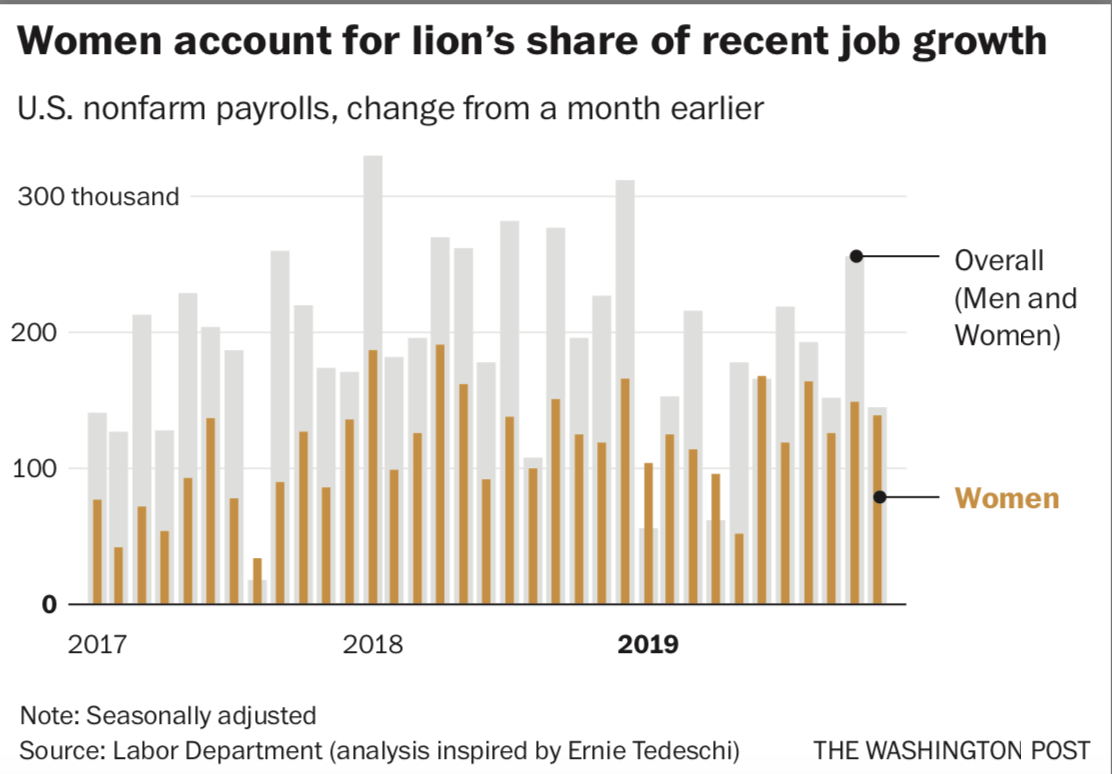
For just the second time in history, women outnumbered men as the majority of the U.S. paid workforce, buoyed by fast job growth in healthcare and education over the past year, as well as the ongoing tight-labor market.

At first glance, the shift is tiny and easy to miss: Women worked 50.04 percent of payroll jobs in December, up from 49.99 percent the prior month. But the figure reflects a larger, ongoing trend. Of the 145,000 jobs picked up in December throughout the economy, women won most of them – 139,000, according to Labor Department data.

“Why is today a milestone? It’s a milestone because it’s really heralding the future and not just telling us where we are today,” said Betsey Stevenson, a professor of public policy and economics at the University of Michigan and an Obama administration economic adviser.

Indeed, women’s share of the workforce has been growing steadily for the past few years. Zooming out, looking at all workers, including farm workers and those self-employed, men still outnumber women. But women have been joining the workforce at a faster pace than men since 2018. Economists say this narrowing in the gender gap comes as women have been getting college degrees in larger numbers than men, which has radiated out to the job market as they reach higher ranks in the office.

“As women get into more senior positions, it creates more space to hire more women and brings more equality into management decisions,” Stevenson said. “It’s one of those things that’s self-reinforcing and keeps on going.”

Industries that have long attracted larger numbers of women, like education and healthcare, are growing at a much faster pace than male-dominated industries like manufacturing and construction. At the same time, with the unemployment rate hovering at a 50-year-low, just 3.5 percent, all workers have more leverage than ever to to negotiate their own work schedules and salaries, which is often a top priority for parents.

The first time the share of women in the workforce crossed over 50 percent was back in early 2010 in the aftermath of the Great Recession, which was a time of tremendous volatility in the labor market. Men were losing jobs at a much greater pace, as industries like manufacturing and construction struggled. That left more women working while men hoped to return.

Now, there’s a more permanent dynamic in play. Women are dominating sectors that are growing the fastest. Health care in particular was one of a few sectors that added more jobs in 2019 than 2018, Stevenson said. Also, jobs in education and health services outnumber jobs in male-dominated goods production sectors; mining, construction, transportation and warehousing saw a slow down in hiring last year. And women still dominate service sector jobs, which is 84 percent of non-farm payroll jobs in the country.

A big difference between now and ten 10 years ago is that women today are getting a boost from technology that has opened the door to jobs that used to be considered men-only. Julia Pollak, labor economist at ZipRecruiter, pointed to transportation jobs: For decades, cab drivers were almost exclusively male. But apps and other platforms help bring women into the driver’s seat.

“Women who might have felt less safe as taxi drivers before, waiting around for some man to wave them down, now have the protection of an app where people can be identified if something goes wrong,” Pollak said.

Plus telecommuting and parental leave policies are becoming more common in the private sector, as employees are competing to hire and keep talent in this hot jobs market.

Stacey Ferguson, 42, worked in corporate law and government for 10 years before she left to start her own digital marketing company in 2012. A year and a half ago, she took a marketing job that allowed her to work remotely full-time. Ferguson, who has three kids and lives in suburban Maryland, said her entire team works out of the office, which helps cement a culture where “everyone is in the same boat.”

That’s a stark shift from her time practicing law which wasn’t as family friendly, she said. Plus, cultural norms around working from home have drastically changed over the years.

“The biggest thing is the mindset,” Ferguson said. “Trying to work remotely ten years ago was received very differently than it is now…There’s just a general loosening of the typical corporate guidelines and restrictions.”

Liz Cook just nabbed a full-time job in November, working as a data analyst for The Mom Project, which helps women workers find jobs. Cook left her job as a prosecutor in 2011 to spend more time with her children. And until recently, she’d had trouble getting back into the workforce with the gap on her resume, despite having a law degree.

“Perhaps [employers] are more willing to overlook gaps in resumes, or there’s a cultural shift and they’re more willing to bring moms or women in,” said, Cook, 36, who needed to return to work to pay off student loans.

The data on women in the workforce was tucked into an otherwise steady jobs report, as the unemployment rate remained at a strong 3.5 percent, unchanged from November and at a 50-year low. The Department of Labor data showed gains in retail and health care, while mining jobs slipped. Manufacturing jobs, which analysts have been closely monitoring during Trump’s protracted trade war, changed little in December.

The December jobs report continued a 10-year streak of strong labor market growth since the Great Recession. President Trump’s Director of the National Economic Council touted the continued strong jobs numbers, acknowledging the growth of women in the workforce.

“This stuff will translate in the election, I’m surprised the Democrats are so pessimistic painting a picture of a deep recession,” Kudlow said in an interview. “The key point here is 3.5 percent unemployment continues, and that is a very low number historically and shows you still have a healthy economy and healthy job market.”

Average hourly earnings rose by a mere 0.1 percent in December, meaning over the past year, wage growth is at 2.9 percent.

Economists say wages are not growing as fast as they should be, especially for those who aren’t seeing a boost from state and local minimum wage increases. Many businesses are still pulling back on investment and say Trump’s truce with China does little to assuage their anxiety. Plus, Democratic leaders and presidential hopefuls caution that Trump’s economic and trade agenda could eventually stymie the growth.

Diane Swonk, chief economist for the accounting firm Grant Thornton, said the disappointing wage growth reflects “an economy where you can get a job, but it’s harder to get a raise.” Swonk said it’s possible wage growth figures for the start of 2020 could be ever harsher because wages for 2019 peaked in February.

Analysts have also been concerned about transportation and warehousing, with transportation in particular affected by the economy’s manufacturing slowdown. But those numbers didn’t change all that much.

Average monthly jobs gains for all of last year were 176,000, compared to 223,000 in 2018. But Mark Hamrick, senior economic analyst for Bankrate, said the decrease shouldn’t come as a surprise. December’s figures didn’t reveal “anything that rocked our world,” he said.

“Expansions don’t last forever, and this one probably is getting a little long-toothed, but it’s not on life support,” Hamrick said.

Analysts predicted around 150,000 new jobs for the month and forecast a steady unemployment rate of 3.5 percent. Those estimates were significantly less than the 256,000 jobs added in November, although those figures also accounted for thousands of General Motors workers who returned to the workforce after a lengthy strike.

The jobs figures come as President Trump touts the economy’s strength as one of his administration’s top achievements. In 2019, the unemployment rate in particular hit lows not seen 50 years. The Dow Jones industrial average has gained about 45 percent since Trump took office, and fears of a recession have largely faded. The Federal Reserve cut interest rates three times last year, helping to sustain an 11-year-old economic expansion. And last month, the United States and China reached a “phase one” trade deal that is set to be signed on Jan. 15.

Stocks fall, dollar declines ,bonds rise after jobs report #ศาสตร์เกษตรดินปุ๋ย

#ศาสตร์เกษตรดินปุ๋ย : ขอบคุณแหล่งข้อมูล : หนังสือพิมพ์ The Nation

https://www.nationthailand.com/business/30380398?utm_source=category&utm_medium=internal_referral

Stocks fall, dollar declines ,bonds rise after jobs report

Jan 11. 2020
File Photo/Getty Images

File Photo/Getty Images
By Syndication Washington Post, Bloomberg · Randall Jensen, Sarah Ponczek 

U.S. stocks fell from records, while Treasuries rose after the latest jobs report delivered mixed signals on the strength of the economy. The dollar declined versus major currencies.

The S&P 500 dropped for the first time in three days after hiring data fell short of estimates and wage growth was the weakest in more than a year. The benchmark still notched a weekly advance as the situation in the Middle East held a tenuous calm. Boeing Corp. slumped, helping to pull down the Dow Jones Industrial Average.

Treasuries pushed higher as the wage figures erased any inflation worries. Futures traders maintained the amount of easing they expect from the Federal Reserve.

The jobs data ultimately did little to alter investor views on the strength of the economy or the Fed’s next step. With stocks near all-time highs, markets continue to look past the flare-up in tensions with Iran and focus on the potential for a pickup in global economic growth.

“This is the opposite of a game-changer. It’s very consistent with everyone’s views going into this report, the Fed stays on hold and the economy is slowing down,” said Nela Richardson, an investment strategist at Edward Jones. “We’re consistent on the overall view the Fed stays pat on short-term rates this year. If anything, this report tilts the Fed a little bit towards being more accommodative, not less.”

Elsewhere, European shares rose, while bonds in the region advanced. Gold gained, while West Texas oil dropped below $60 a barrel.

These are moves in major markets:

Stocks

–The S&P 500 Index fell 0.3% as of 4 p.m. New York time.

–The Dow Jones Industrial Average dropped 0.5%.

–The Stoxx Europe 600 index fell 0.1%.

–Germany’s DAX index gained 0.3%.

Currencies

–The Bloomberg Dollar Spot index fell 0.1%.

–The British pound dropped 0.1% at $1.3059.

–The euro rose 0.1% at $1.1112.

–The Japanese yen was little changed at 109.50 per dollar.

Bonds

–The yield on 10-year Treasuries fell three basis points to 1.82%.

–Britain’s 10-year yield fell five basis points to 0.773%.

–Germany’s 10-year yield declined two basis points to -0.198%.

Commodities

–West Texas Intermediate crude dropped 0.9% to $59.05 a barrel.

–Gold rose rose 0.4% at $1,560.30 an ounce.

Hedge fund PointState stops clients from cashing out in full #ศาสตร์เกษตรดินปุ๋ย

#ศาสตร์เกษตรดินปุ๋ย : ขอบคุณแหล่งข้อมูล : หนังสือพิมพ์ The Nation

https://www.nationthailand.com/business/30380393?utm_source=category&utm_medium=internal_referral

Hedge fund PointState stops clients from cashing out in full

Jan 11. 2020
By Syndication Washington Post, Bloomberg · Suzy Waite 
PointState Capital, the macro hedge fund started by former traders for billionaire Stan Druckenmiller, is blocking investors from getting all their cash back when they ask to pull money from the firm.

Clients who withdrew their investments at the end of last year will get 88% back in cash, according to a letter to investors seen by Bloomberg. The remaining 12% will be distributed as shares in new vehicles created to hold assets with “somewhat limited liquidity” that could take time to sell. Redemptions on March 31 or later may be subject to similar terms, the letter states.

“We’ve concluded that this is the most appropriate way to fairly and equitably balance the interests of all of our investors,” the letter states. PointState has a “high degree of confidence” in the assets being transferred.

The cash freeze is a fresh blow for PointState. Its main fund has failed to recover from its 2018 losses, when it dropped 19%. The fund finished 2019 on a high, up 3% in December, though performance for the year was flat to slightly down, depending on share class, according to a person with knowledge of the matter. The firm has rarely opened to new money since it began trading in 2011, but was meeting investors in November to raise fresh cash. Its assets under management have nearly halved from a peak of $10 billion.

PointState has suffered a number of senior departures, including co-founder Josh Samuelson and portfolio manager Greg Ley.

A spokesman for New York-based PointState declined to comment.

During the depths of the financial crisis, many hedge funds put hard-to-shift assets into so-called side pockets to buy time to raise cash as clients stampeded toward the exit.

These “special purpose vehicles” are designed to give fund managers time to get the best price for assets, rather than dump them in a fire sale to satisfy redemption requests. More than a decade later, billions of dollars of the assets remain to be sold.

SoftBank-backed Oyo firing thousands across China and India #ศาสตร์เกษตรดินปุ๋ย

#ศาสตร์เกษตรดินปุ๋ย : ขอบคุณแหล่งข้อมูล : หนังสือพิมพ์ The Nation

https://www.nationthailand.com/business/30380392?utm_source=category&utm_medium=internal_referral

SoftBank-backed Oyo firing thousands across China and India

Jan 11. 2020
By Syndication Washington Post, Bloomberg · Saritha Rai, Lulu Yilun Chen
Oyo Hotels is firing thousands of staff across China and India, people familiar with the matter said, adding to growing signs of trouble at one of the largest startups in SoftBank Group Corp.’s portfolio.

The company has let go of 5% of its 12,000 employees in China partly due to non-performance, while dismissing 12% of its 10,000 staff in India, one of the people said. It plans to shed another 1,200 in India over the next three to four months, the person added. Oyo is undergoing a restructuring, trimming redundancy in China and India, leading to thousands of dismissals, according to the people, who requested not to be named because they aren’t authorized to talk to media.

“We continue to be one of the best places to work for and one of the key reasons for this has been our ability to consistently evaluate, reward and recognize the performance of individuals in a meritocratic manner, and enable them to improve their performance,” Oyo said in a statement.

Oyo’s downsizing is another setback for Masayoshi Son’s SoftBank, whose portfolio has been buffeted by recent trouble at WeWork and slumping share prices at Slack Technologies Inc. and Uber Technologies Inc. The billionaire has called for greater financial discipline among the founders in his portfolio, spurring job cuts at smaller outfits such as Zume Pizza Inc. Other SoftBank investees, including Getaround, Wag Labs Inc., Fair and Brandless Inc., have had to cut staff or changed business models once it became apparent revenue and profits were not living up to their once-grand ambitions.

Adding to Oyo’s challenges, hotel owners in China have been protesting in front of the company’s offices, accusing the startup of violating contractual agreements. The growing turmoil may complicate SoftBank’s efforts to raise a successor to the Vision Fund, the world’s largest pool of startup investments.

Oyo will “enhance communications with hotel owners and develop owner loyalty” this year, the company said in the statement. “We will launch the VIP owner program, and contact owners regularly, to ensure that the interests and needs of theirs and ours are equally taken into account.”

Son has been a keen supporter of Oyo founder Ritesh Agarwal, helping fund the hotel company’s fast international expansion. Oyo had been growing at a rapid clip, but its reputation has suffered due to customer complaints about bad experiences along with grievances about poor or unfair treatment from several of the more than 20,000 hotel owners in its chain.

“Oyo is one of SoftBank’s current crown jewels,” said Michael Norris, research and strategy manager at Shanghai-based consultancy AgencyChina. “Issues in China, Oyo’s largest market, continues the Vision Fund’s woes.” It would make raising a similar-sized second Vision Fund a challenge, he added.

SoftBank’s Vision Fund has so far invested about $1.5 billion in Oyo, pushing its valuation to $10 billion. The company also counts Airbnb Inc., Sequoia Capital and Lightspeed Venture Partners as backers. It promoted its real estate business chief, Rohit Kapoor, to CEO for India and South Asia in December to shake up the business.

In its aggressive effort to acquire market share, Oyo offered hotel stays for as cheap as $4 a night, according to one person familiar with its practices. The company also stocked up on rented room inventory by signing exclusive deals and guaranteeing income to hotel owners. It’s now allegedly reneging on those guarantees, the cause of the protests outside its Chinese offices, one person said.

German activist forces Siemens to look at coal contracts #ศาสตร์เกษตรดินปุ๋ย

#ศาสตร์เกษตรดินปุ๋ย : ขอบคุณแหล่งข้อมูล : หนังสือพิมพ์ The Nation

https://www.nationthailand.com/business/30380389?utm_source=category&utm_medium=internal_referral

German activist forces Siemens to look at coal contracts

Jan 11. 2020
By Syndication Washington Post, Bloomberg · Oliver Sachgau
Siemens is considering the future of a controversial contract to supply signaling systems to a new Australian coal mine under pressure from environmental activists, who staged German-wide protests against the company on Friday.

Chief Executive Officer Joe Kaeser met with Fridays for Future activist Luisa Neubauer in Munich, and the company plans to announce a decision by Monday.

Climate protesters, inspired by Swedish activist Greta Thunberg, have been targeting Siemens for months. Their goal was to prod the icon of German industry into joining a list of 60 companies that have pledged not to work with Adani Power Ltd. on the planned Carmichael coal mine in Queensland, Australia.

With large-scale bush fires in Australia gaining worldwide attention, pressure on Siemens intensified in recent weeks, prompting CEO Kaeser to say on Twitter that he is taking the concerns “seriously” and would review the contract.

“I just can’t understand how people who know what’s happening in the world and know what Australia looks like right now, how they could still do this,” Matylda Bobnis, another Friday’s for Future activist, said as more than 100 fellow demonstrators rallied outside Siemens’s headquarters in Munich — one of 40 protests around Germany.

The Carmichael mine was approved by the Queensland state government in June after years of struggles. Siemens won the contract to supply rail signaling systems in December, but protesters want the company to renege on the agreement.

“We want to show Siemens that we’re not going to stand by and let them just do this,” said Bobnis. “The company brags about being climate neutral by 2030, while on the other hand they’re evaluating such an environmentally damaging deal.”