Vietnam extends visa waiver for nationals of 8 countries #ศาสตร์เกษตรดินปุ๋ย

#ศาสตร์เกษตรดินปุ๋ย : ขอบคุณแหล่งข้อมูล : หนังสือพิมพ์ The Nation

https://www.nationthailand.com/business/30379659?utm_source=category&utm_medium=internal_referral

Vietnam extends visa waiver for nationals of 8 countries

Dec 20. 2019
Foreign tourists in HCM City. — VNS Photo Thu Hằng

Foreign tourists in HCM City. — VNS Photo Thu Hằng
By Viet Nam News

405 Viewed

HCM CITY — Vietnam will extend visa waivers for citizens of Russia, Japan, South Korea, Denmark, Norway, Sweden, Finland and Belarus until December 31, 2022, the Vietnam National Administration of Tourism has announced.

A resolution passed at the Government regular meeting for November said citizens of these eight countries need not apply for a visa regardless of passport type if the duration of their stay does not exceed 15 days.

The visa exemption for these countries, first introduced in 2015, would have expired at the end of this year.

Russia, South Korea and Japan are top source markets for Vietnam’s tourism sector, according to the tourism administration.

South Korea and Japan are the second and third largest markets behind China.

Last year, the number of South Koreans visiting Vietnam rose by 44 per cent to nearly 3.5 million.

The number of Japanese visitors was 800,000, up 3.6 per cent.

Vietnam received nearly 16.3 million foreign visitors in the first 11 months of the year, up 15.4 per cent year-on-year, according to the General Statistics Office. — VNS

U.S. stocks resume record-setting year-end rally #ศาสตร์เกษตรดินปุ๋ย

#ศาสตร์เกษตรดินปุ๋ย : ขอบคุณแหล่งข้อมูล : หนังสือพิมพ์ The Nation

https://www.nationthailand.com/business/30379656?utm_source=category&utm_medium=internal_referral

U.S. stocks resume record-setting year-end rally

Dec 20. 2019
File Photo: Getty Images

File Photo: Getty Images
By Syndication Washington Post, Bloomberg · Jeremy Herron, Claire Ballentine 

306 Viewed

U.S. stocks bounced back to claim fresh records as investors chased gains that have added more than $5 trillion to valuations this year. Oil topped $61 a barrel and Treasuries edged higher.

After dipping Wednesday, the S&P 500 index on Thursday pushed past 3,200 for the first time, led by tech, health-care and communications shares. The benchmark is up more than 7% in the fourth quarter and 27% so far this year. Data showing that jobless claims fell less than forecast did little to alter views on the health of the economy. Markets ignored the impeachment of President Donald Trump. The dollar steadied against its major peers. China said it was in close contact with the U.S. to sign the initial trade deal announced last Friday.

Treasuries bucked a sell-off in sovereign bonds from London to Tokyo as monetary decisions rolled out. Sweden’s central bank raised its benchmark to end half a decade of sub-zero interest rates, a move that will provide a test case for global counterparts with negative borrowing costs.

“We’ve been up like six of the last seven days so tactically we are overbought,” said Alec Young, managing director of Global Markets Research at FTSE Russell. “People know the seasonals are good, they know the macro situation has improved in terms of global growth and the trade situation. The concern is that a lot of this is already reflected in the market.”

With few new catalysts on the horizon to revive the equity rally and details of the trade deal remaining vague, equity traders appear to be in a holding pattern. Central banks likewise seem to be on hold, with policy makers in Japan, Taiwan, Norway and the U.K. leaving interest rates unchanged on Thursday.

Elsewhere, the pound fell, adding to worst two-day plunge since July. The Stoxx Europe 600 index advanced. Earlier in Asia, equities dipped in Tokyo, Sydney and Hong Kong while they edged higher in Seoul. Stocks in China were unchanged after erasing the day’s losses as the central bank injected more liquidity before a year-end cash squeeze.

Here are some key events to watch for this week:

-Revised U.S. GDP data are due Friday.

-Friday also brings quadruple witching in the U.S., the simultaneous expiration date of stock index futures, stock index options, stock options and single stock futures. Expect elevated trading volume, particularly in the last hour of the session.

These are the main moves in markets:

Stocks

-The S&P 500 index climbed 0.4% to 3,205.28 as of 4:01 p.m. New York time, the highest on record. The index closed at 3,205.97, up 0.45 per cent.

-The Dow Jones Industrial Average advanced 0.5% to 28,376.21, the highest on record with the biggest gain in a week. it closed at 28,376.96, rising 0.5 per cent. While Nasdaq was up 0.67 per cent at 8,887.22, reaching fresh record high.

-The Stoxx Europe 600 index increased 0.2% to 415.07.

-The MSCI Emerging Market index declined 0.2% to 1,106.68, the first retreat in more than a week and the biggest drop in more than two weeks.

-The MSCI World index of developed countries advanced 0.3% to 2,340.84, the highest on record.

Currencies

-The Bloomberg Dollar Spot index dipped 0.1% to 1,195.23.

-The British pound decreased 0.5% to $1.3014, the weakest in more than two weeks.

-The euro gained 0.1% to $1.1124.

-The Japanese yen appreciated 0.2% to 109.30 per dollar, the strongest in more than a week on the largest rise in more than two weeks.

Bonds

-The yield on 10-year Treasuries dipped less than one basis point to 1.91%.

-The yield on two-year Treasuries declined one basis point to 1.62%.

-Germany’s 10-year yield advanced one basis point to -0.24%, the highest in six weeks.

Commodities

-West Texas Intermediate crude gained 0.5% to $61.22 a barrel, the highest in seven months.

-Gold strengthened 0.3% to $1,479.15 an ounce, the highest in six weeks.

SEC looking at setting up bourse for SMEs, startups #ศาสตร์เกษตรดินปุ๋ย

#ศาสตร์เกษตรดินปุ๋ย : ขอบคุณแหล่งข้อมูล : หนังสือพิมพ์ The Nationhttps://www.nationthailand.com/business/30379649?utm_source=category&utm_medium=internal_referral

SEC looking at setting up bourse for SMEs, startups

Dec 20. 2019
By THE NATION

901 Viewed

The Securities and Exchange Commission (SEC) will discuss with SME startup PE VC the drawing up of guidelines for setting up a bourse only for small and medium enterprises (SMEs) and startups.

Discussions will also cover the qualifications of stock investors in this planned market, SEC assistant secretary-general Jomkwan Kongsakul said.

The SME startup, PE VC, is made up of representatives from state and private agencies.

The new market for SMEs and startups will be under SEC regulations. As its name suggests, only SMEs and startups will be eligible to list on the market.

Retail investors can invest in this market but their investment amount might be capped.

The results of the discussions will be presented to the SEC board and be a part of a public hearing later. The establishment of this market will need permission from the Finance Ministry.

Credit Suisse predicts moderate gains for investors in 2020 #ศาสตร์เกษตรดินปุ๋ย

#ศาสตร์เกษตรดินปุ๋ย : ขอบคุณแหล่งข้อมูล : หนังสือพิมพ์ The Nation

https://www.nationthailand.com/business/30379636?utm_source=category&utm_medium=internal_referral

Credit Suisse predicts moderate gains for investors in 2020

Dec 19. 2019
Ray Farris

Ray Farris
By THE NATION

1,439 Viewed

Investors will likely contend with unforeseen events and market swings in 2020, but the global economy and risk assets should prove resilient, according to the Credit Suisse Investment Outlook 2020.

Credit Suisse forecasts the global economy will grow at a moderate rate of 2.5 per cent, suggesting recession is unlikely.

Amid softer growth, Credit Suisse expects modest single-digit returns in the equity markets.

A polarised US presidential campaign, margin pressure, high corporate debt, and fewer interest rate cuts by major central banks – not to mention unexpected political developments – are likely to test investor nerves in 2020, Credit Suisse said.

Even if the US-China trade war eases and Brexit uncertainty diminishes, investing throughout 2020 will require portfolio diversification tilted towards areas of extra return.

Credit Suisse expects moderate economic growth, accommodative liquidity conditions and easing geopolitical tensions. As the US-China trade war subsides, business sentiment should improve, lifting growth-oriented sectors and stocks, it predicted.

Ray Farris, chief investment officer, South Asia at Credit Suisse, said: “We believe that the global economy and markets will continue to show considerable resilience in the face of challenges. In the Asia Pacific, the outlook for the more advanced countries of North Asia remains subdued due to weakness in Chinese trade, with growth of just over 2 per cent. The outlook for Hong Kong will depend strongly on local political developments. Economic growth remains far stronger in much of Southeast Asia, which has more catch-up potential and is less integrated into China-based supply chains. Some countries, most prominently Vietnam, stand to benefit as production continues to shift in their direction.”

“In Thailand, we think the baht should soften to 30.50 over the next several months as relaxation of foreign exchange controls works to generate new outflows from the country. For equities, we have a neutral view as weak growth environment is being offset by low interest rates.”

The outlook for the major economies and currencies:

➤ United States: Credit Suisse expects slower GDP growth for the US economy in 2020 at 1.8 per cent, accompanied by rising core inflation. The US dollar should remain supported but weaken in the course of the year as its interest rate advantage over most G10 currencies wanes.

➤ Euro-zone: Monetary policy is unlikely to ease further, but resilient credit growth should support ongoing economic expansion, with GDP growth forecast at 1 per cent. Fiscal stimulus and diminishing Brexit uncertainty should support the EU.

➤ Asia: A US-China trade deal would likely push the yuan higher and exert some upward pressure on other Asian currencies. Asia is likely to benefit from an improvement in global industrial growth momentum in early 2020 and keep full year growth of 5.3 per cent close to 2019’s 5.4 per cent. We expect the current industrial production slump to bottom in December and begin to recover in the first quarter of 2020. This should work to boost regional exports, improve some countries’ trade balances, and encourage capital flows into the region.

➤ Thailand: The surge in Thailand’s current account surplus to $9.1 billion in the third quarter of this year from $3.8 billion in last year’s third quarter, is the core source of the baht’s strength and looks likely to continue.

However, Credit Suisse expects the Bank of Thailand’s liberalisation of its foreign exchange controls to offset much of this by creating new Thai outflows into foreign currencies.

The key risk Credit Suisse sees to its forecasts is that Thailand’s current account surplus remains large and these measures do not spur significant new outflows.

Outlook for financial markets:

➤ Equities outlook

Equities continue to offer an attractive return advantage over low-yielding bonds. On a sector level, IT is preferred as one of the few high-growth sectors. Financials are also attractive, as the expected improvement in the cyclical outlook will likely trigger a further rotation into that sector in the first half of 2020, Credit Suisse said.

“We believe that a turnaround in the performance of Asian equities is likely in the coming months. We prefer North Asian markets, in particular China, over South Asian ones to take exposure to potential cyclical recovery, Credit Suisse said.

➤ Thailand: Earnings for the third quarter contracted 14 per cent year on year, pushing the numbers for the first nine months to 20 per cent below 2018 for the same period.

“The main factor behind disappointing results has been the lagging economy. Although the government implemented a mini-stimulus package in August-September, the amounts involved were modest, and headwinds from the external sector remained intense,” Credit Suisse said.

“We believe there is further downside risk to market’s expectations of 8.7 per cent EPS [earnings per share] growth for 2020. Though valuation is not cheap either with 2020 P/E [price to earnings] at 15.2 times, ample domestic liquidity and dividend yield of 3 per cent could provide support on the downside.”

➤ Fixed income

“We expect Asian high-yield corporates to be supported by more accommodative policies. Monetary policy is also likely to remain accommodative. The greater-than-7 per cent yield of Asian high-yield bonds remains attractive relative to developed markets and is not expensive compared to its 10-year average.

“We forecast Asia high-yield to deliver 6 per cent total return in the next 12 months,” Credit Suisse said.

➤ Commodities outlook

“Commodities have been on diverging paths this past year, with the industrial production slowdown weighing on cyclical commodities in particular. Going forward, this divergence is expected to diminish. While gold prices are likely to consolidate, oil prices may face a period of weakness before recovering eventually,” Credit Suisse said.

➤ Alternative investments

“In alternative investments, most real estate investments should continue to deliver moderately positive returns. Direct real estate is favoured, as lower interest rates do not yet appear to be fully reflected in the price,” Credit Suisse said.

John Woods, chief investment officer for Asia Pacfic at Credit Suisse, said: “In an environment of lower-for-longer yields, a multi-asset framework allows investors to take advantage of pockets of value in low-risk markets, while increasing expected returns by investing in equities and seeking out less conventional fixed-income investments. We believe such an approach will prove rewarding in 2020.”

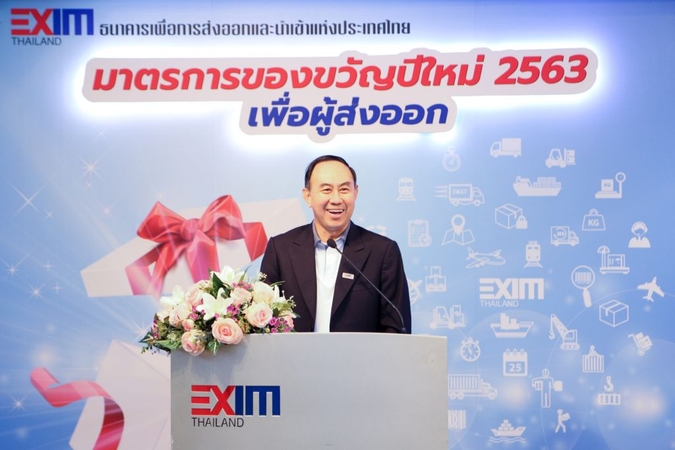
Export-Import Bank of Thailand launches New Year schemes to help SMEs #ศาสตร์เกษตรดินปุ๋ย

#ศาสตร์เกษตรดินปุ๋ย : ขอบคุณแหล่งข้อมูล : หนังสือพิมพ์ The Nation

https://www.nationthailand.com/business/30379629?utm_source=category&utm_medium=internal_referral

Export-Import Bank of Thailand launches New Year schemes to help SMEs

Dec 19. 2019
1,544 Viewed

In making the announcement, the bank’s president Pisit Serewiwattana noted that the 2019 global economic and trade expansion at 10-year low rates of 3.0 per cent and 1.1 per cent respectively and the prevailing low inflation and interest rates have dampened Thailand’s international trade.

Coupled with the rising number of global players from new frontier markets who have been able to build up their own production bases, the increasing number of workers-turned-entrepreneurs and the greater role of online trade, exporters now have to bear higher costs in addition to those incurred on improvement of product and service quality to meet international standards that involve increasing rules and regulations, while also aiming to boost their competitiveness amid the intensifying risks from global economic and political uncertainties.

Exim Thailand has therefore launched new product programmes called “Liquidity Enhancement for Exporters” and “ Relieving Debt Burden for Clients” to support SME exporters, both new and existing clients in all sectors, so that they have higher business liquidity and lower debt burden in the face of possible decreases in purchase orders against fixed monthly costs and expenses. This allows them to drawdown revolving credit to meet the incoming orders and develop their products and services for higher value added and higher competitive edge to cope with global market uncertainties going into 2020.

Exim Liquidity Enhancement for Exporters is aimed at supporting SMEs that are exporters, importers for export-oriented producers, and producers for exporters. They are offered short-term and long-term loan choices to reduce their debt repayment burden and enhance their business liquidity with higher working capital to fund their export activities or improvement of their machinery, factories and manufacturing technology.

Each loan carries a maximum 7-year tenor, credit line of up to Bt20 million per borrower, and an interest rate of 3.99 per cent per annum for years 1-2. It can be secured by a letter of guarantee from Thai Credit Guarantee Corporation (TCG) in conjunction with other collateral assets. Moreover, no TCG credit guarantee fee is chargeable up to four years and total credit approval is targeted at Bt2 billion.t

Exim Relieving Debt Burden for Clients, meanwhile, aims to support SME clients who do not require additional credit facilities but reduction of installment repayment of short-term and long-term loans. For long-term loan clients, a loan rescheduling can be approved for up to two years. In case of rescheduling for not more than one year, the bank will grant a reduction of interest rate by 0.125 per cent per annum.

As for short-term loan clients, an increase in loan drawdown proportion and reduction of interest rate will be granted. Each client may drawdown up to 95 per cent of L/C value and 85 per cent of P/O value and have interest rate cut down by 0.125 per cent per annum for one year. The total support amount is targeted at Bt4 billion.

Both schemes are available from December 2019 until 31 December 2020.

Approximately Bt15.7 billion is expected to be injected into the economic system to create 5,200 job opportunities, increase liquidity and relieve debt burden for more than 750 SME exporters. This will enable SMEs in the export value chain to carry less debt burden and lower operating costs, as well as to develop their products and services for higher competitive advantage.

The Exim president added that exports of countries in several regions around the world have currently tended to contract in line with global economic slowdown and as repercussion from the trade war. Thai exports in 2019 have been shrinking for the first time in four years, predicted at 2.0 per cent, which is however still lower than those of such countries as South Korea at 10.7 per cent since early 2019, Indonesia at 7.8 per cent, Malaysia at 5.0 per cent and Japan at 4.6 per cent. Thai exports in 2020 are forecast to expand by 0-2 per cent.

In view of this, Exim Thailand has rolled out schemes toward the end of 2019 to assist Thai exporters, particularly SMEs who are the key to driving Thai export and economic growth, in running their businesses with adequate liquidity and ongoing development to ensure their competitive potential under the increasing international trade barrier circumstances. They are expected to be part of the stimulators of Thai export recovery in 2020 based on many strengths, including high resilience of Thai goods.

Some Thai foods and electrical appliances can also penetrate the Japanese market, especially those serving the Olympic Games to be hosted by Japan in 2020. Approximately 50 per cent of Thai exports today go to new frontier markets like India, Vietnam, Hungary, Poland, Nigeria, Morocco and Mexico.

Five products worth buying online

#ศาสตร์เกษตรดินปุ๋ย : ขอบคุณแหล่งข้อมูล : หนังสือพิมพ์ The Nation

https://www.nationthailand.com/lifestyle/30379622?utm_source=category&utm_medium=internal_referral

Five products worth buying online

Dec 19. 2019
Photo: GettyImages

Photo: GettyImages
By THE NATION

331 Viewed

Like elsewhere in the world, Thai shoppers are moving to shopping online, taking advantage of the improved services, a broader variety of payment options including credit card, e-wallet and cash on delivery, fast shipping and the emergence of new online retailers.

Better value is also an important factor and a survey by Priceza.com conducted between January and November revealed the top five products that are cheaper in online shops than in traditional retailers.

1. Smart phones

Smart phones sold via online shops can be up to 20-per-cent cheaper than in traditional shops, and prices of older models will come down faster when new ones hit the market. Statistics show that with the exception of the iPhone, all brands of smart phones sold through online shops drop their prices within 2-3 months after new models are announced.

2. IT gadgets

These products include smart watches, headphones, speakers, IoT and smart devices. Online shops often provide discount codes for these products to boost sales during festivals as they are among top choices for gifts.

3. Baby products

These products include diapers, formula, milk bottles, breast pumps and baby clothes. Some brands even have their own online shops to distribute products to consumers without the middleman.

4. Gift vouchers and cash cards

These are also among the top choices for gifts and rewards in special activities such as office games and parties. Many establishments including Central Department Store and Starbucks sell their gift vouchers for cheap online to attract customers to spend at their store.

5. Cosmetics and skincare products

Branded cosmetics sold online often carry 30- to 40-per-cent discounts on the label price while those sold over the counter see only 10-15-per cent discounts. These products also include sunscreen and perfumes.

Amid 737 Max crisis, Boeing faces a key test of its spacecraft designed to fly NASA’s astronauts

#ศาสตร์เกษตรดินปุ๋ย : ขอบคุณแหล่งข้อมูล : หนังสือพิมพ์ The Nation

https://www.nationthailand.com/business/30379627?utm_source=category&utm_medium=internal_referral

Amid 737 Max crisis, Boeing faces a key test of its spacecraft designed to fly NASA’s astronauts

Dec 19. 2019
Chris Ferguson, Boeing's director of Starliner crew and mission systems and a former NASA astronaut, fist bumps NASA commercial crew astronaut Suni Williams as astronauts Nicole Mann and Bob Behnken look on. The spacecraft that will one day carry them into space undergoes a critical test on Friday. MUST CREDIT: Washington Post photo by Jonathan Newton

Chris Ferguson, Boeing’s director of Starliner crew and mission systems and a former NASA astronaut, fist bumps NASA commercial crew astronaut Suni Williams as astronauts Nicole Mann and Bob Behnken look on. The spacecraft that will one day carry them into space undergoes a critical test on Friday. MUST CREDIT: Washington Post photo by Jonathan Newton
By The Washington Post · Christian Davenport 

177 Viewed

CAPE CANAVERAL, Fla. – Boeing has been under siege for months after two of its 737 Max aircraft plummeted from the sky killing 346 people. Members of Congress are accusing the industry stalwart of putting profits over safety. A whistleblower testified that schedule pressure created a “factory in chaos.”

Even Jim Chilton’s part of the company – the space division – was the subject of a searing watchdog report last month that found it had received hundreds of millions of dollars in “unnecessary” payments stemming from an unusually cozy relationship with NASA. For Boeing, the timing of the report couldn’t have been worse, coming as it was preparing to fly a key test of its Starliner space capsule, designed to fly NASA’s astronauts to the International Space Station.

That launch is now scheduled for 6:36 a.m. Friday from Cape Canaveral, and while no astronauts will be on board, the first launch of its new spacecraft has taken on a far greater importance for Boeing than just a test. It’s a shot at a bit of redemption.

A successful launch would be a moment of triumph amid the tumult that has dogged the company the past year and the news this week that it will halt production on its troubled 737 Max airplane in January, a decision that could not only harm Boeing’s bottom line but send shock waves through the economy.

Friday’s launch also comes as Boeing, long one of the major dominant players in space, now faces increased competition from a growing space industry, including from rivals such as Elon Musk’s SpaceX and Jeff Bezos’ Blue origin. (Bezos owns The Washington Post.)

So in the face of the critical report from NASA’s Inspector General last month, Chilton, a soft-spoken engineer who has risen through the ranks during a 35-year career at Boeing, fired off an email to his staff.

He reminded the team that it was building on a heritage that stretched to the dawn of the Space Age: “We have been part of every NASA human spaceflight from – from Mercury, Gemini and Apollo to the space shuttle and [the International Space Station] – and we’re proud to continue that unwavering partnership.”

And he issued an emotional call to arms, both defending the company and its workforce while also pushing back against critics and competitors. The email, a copy of which was obtained by The Post, is part of a broader strategy inside Boeing to fight back aggressively that includes a radio ad playing in Washington touting the flight, saying it “is paving the way for the new age of space exploration.”

“Let’s not allow this inaccurate report or the critical media coverage it’s generating to become a distraction,” Chilton wrote. “Our Starliner teammates have put their hearts and souls into developing a spacecraft that we can all be proud of, and they need all the support they can get from our broader space and launch team in the countdown to first flight.”

If successful, the flight would be a critical step toward helping NASA restore human spaceflight from United States soil. Since the space shuttle was retired in 2011, NASA has been unable to fly people to space. Instead, it has had to pay Russia as much as $84 million a seat to take its astronauts to the space station about 240 miles above Earth.

In 2014, NASA embarked on a risky experiment, awarding contracts to Boeing and SpaceX to develop spacecraft capable of human spaceflight. As part of what’s called the “commercial crew program,” NASA awarded Boeing $4.2 billion and SpaceX $2.6 billion to build capsules capable of flying at least four NASA astronauts.

The first flights with people on board were originally scheduled for 2017. But both companies have suffered delays and setbacks. In March, SpaceX successfully launched its Dragon capsule to the space station and returned it successfully. But weeks later the spacecraft exploded during a test of its emergency abort engines, a problem the company says is now fixed.

Boeing also has had a host of problems – from a propellant leak last year to a problem with its parachute system during a test of its abort engine last month.

But now it says it is on track, and now NASA hopes the launches with humans will happen sometime next year.

“I’m happy to announce we’re go for launch,” NASA Deputy Administrator Jim Morhard told reporters last week.

At a press briefing on Tuesday, John Mulholland, Boeing’s commercial crew program manager, said “the spacecraft is in really good shape” and that the company was “looking forward to a short and successful mission.”

If all goes well Friday, the first flight with people, scheduled for sometime next year, will carry into space two NASA astronauts, Nicole Mann and Mike Fincke, as well as Chris Ferguson, a former NASA astronaut who now works for Boeing.

“We consider this a dress rehearsal for the first flights with crew members on board,” said Pat Forrester, the chief of NASA’s astronaut office. “I don’t think there’s anybody in the office, as they’ve gone about their work, who hasn’t thought about about Chris and Nicole and Mike.”

Mercedes reaches $20 million settlement with federal auto safety agency

#ศาสตร์เกษตรดินปุ๋ย : ขอบคุณแหล่งข้อมูล : หนังสือพิมพ์ The Nation

https://www.nationthailand.com/business/30379612?utm_source=category&utm_medium=internal_referral

Mercedes reaches $20 million settlement with federal auto safety agency

Dec 19. 2019
By The Washington Post · Ian Duncan 

580 Viewed

Mercedes-Benz has agreed to pay $13 million to the nation’s top highway safety regulator to resolve an investigation into how the luxury German automaker handled recalls on defective cars.

The company also faces $7 million in additional penalties if it doesn’t meet the terms of a settlement with the government.

The U.S. National Highway Traffic Safety Administration began the investigation that led to the settlement last year. The agency concluded that Mercedes missed deadlines in the recall process on multiple occasions.

It’s the first penalty the agency has issued to an automaker under the Trump administration.

“The agency’s reporting requirements help ensure that consumers are protected and given important information about how to get recalls repaired,” said James Owens, the NHTSA’s acting administrator.

“These laws are critical to ensure NHTSA’s ability to provide oversight, and we expect manufacturers to follow their legal obligations to the agency and to consumers in carrying out safety recalls,” he said.

Robert Moran, a spokesman for the company’s U.S. operation, MBUSA, said Mercedes did not believe it had done anything deliberately wrong.

“But unfortunately we missed some deadlines in informing the agency of the measures we had taken in fulfilling their requirements,” Moran said in an email. “We agreed to resolve this matter in an effort to answer NHTSA’s questions and move forward. In all cases, however, MBUSA had announced the recalls, provided consumers with information and launched the recalls as soon as possible.”

NHTSA investigators looked at how Mercedes handled recalls between 2016 and 2018, in which time it reported 101 safety-related defects or problems complying with federal rules.

In six of those cases, the agency found that Mercedes did not mail notices to customers within 60 days, a deadline set by federal rules – overshooting by 20 days in one case. It found dozens of other paperwork problems and questioned how well a Mercedes vehicle lookup tool worked.

The settlement requires Mercedes to have quarterly oversight meetings with the NHTSA. The settlement will remain in force for at least a year.

The agency considered investments Mercedes had made in an automated recall tool, new staff members it hired, and training it conducted in determining the size of the penalty, according to the settlement agreement.

Jason Levine, director of the Center for Auto Safety, said that he was glad to see the settlement and that NHTSA ought to be doing more to routinely monitor recall programs.

“One can only hope that this is the beginning of a renewed effort by the government to remember that its job is to ensure compliance with the law by car manufacturers and to use all of the enforcement tools at its disposal to do so,” he said.

Last year, the Transportation Department’s internal watchdog faulted the NHTSA’s oversight of the recall process. The watchdog issued six recommendations that it now lists as having been closed.

The settlement with Mercedes is the largest the NHTSA has issued since a $40 million agreement with BMW in 2015. In that case, BMW had to pay $10 million up front and commit to spending $10 million to come into compliance with auto safety rules.

That same year, Fiat Chrysler was issued a pair of penalties totaling $175 million, and Takata, whose air bags are believed to have caused multiple deaths, was penalized $200 million – the largest penalty the agency had ever issued.

The problems at Takata affected tens of millions of air bags, which the auto industry is still working to resolve. NHTSA data shows that Mercedes has the lowest recall completion rate of any automaker, at 33%.

“Mercedes-Benz USA, like most U.S. auto companies, is replacing Takata air bags on a schedule that is coordinated with NHTSA,” Moran said. “While we are not aware of any customers who have experienced the Takata inflater malfunction in any of our vehicles anywhere in the world, we are following NHTSA’s protocol in replacing these inflaters.”

Pot stock short-sellers net almost $1 billion in 2019

#ศาสตร์เกษตรดินปุ๋ย : ขอบคุณแหล่งข้อมูล : หนังสือพิมพ์ The Nation

https://www.nationthailand.com/business/30379610?utm_source=category&utm_medium=internal_referral

Pot stock short-sellers net almost $1 billion in 2019

Dec 19. 2019
By Syndication Washington Post, Bloomberg · Kristine Owram
403 Viewed

Short-sellers are winning big this year with expensive bets against pot stocks.

Cannabis bears have cleared $993 million in mark-to-market gains so far in 2019, even after losing $132 million this month as stocks bounced off their lows, according to data from financial analytics firm S3 Partners.

Short exposure to the sector grew by $843 million or 35% in 2019, with most of that concentrated in 20 companies, S3 said in a report Wednesday.

The investor frenzy that had characterized the cannabis industry in 2018 quickly faded this year as companies missed earnings expectations and the regulatory landscape proved to be more difficult than expected. Since March, pot stocks are down by about two-thirds, and capital markets have largely frozen for all but the strongest names.

Pot stocks are now among the most expensive to short, with an average borrow fee of 31% for the 20 that are most shorted. Despite that, “the sector has surprisingly been immune to short squeezes,” wrote Ihor Dusaniwsky, managing director of predictive analytics at S3.

“A prolonged cannabis sector rally will be bolstered with a flurry of short covering as the high cost of short financing (stock borrows) coupled with mark-to-market losses will result in multi-security short squeezes,” he said.

Uber to pay $4.4 million to victims of alleged gender discrimination

#ศาสตร์เกษตรดินปุ๋ย : ขอบคุณแหล่งข้อมูล : หนังสือพิมพ์ The Nation

https://www.nationthailand.com/business/30379609?utm_source=category&utm_medium=internal_referral

Uber to pay $4.4 million to victims of alleged gender discrimination

Dec 19. 2019
By The Washington Post · Faiz Siddiqui 

501 Viewed

Uber will pay $4.4 million to victims of alleged gender discrimination and strengthen its defenses against sexual harassment, government officials announced Wednesday.

The settlement addresses claims arising from a probe opened by the U.S. Equal Employment Opportunity Commission in 2017 into Uber’s workplace culture. The EEOC found reasonable cause to believe “Uber permitted a culture of sexual harassment and retaliation against individuals who complained about such harassment,” according to the agency.

Uber voluntarily agreed to settle the claims with independent monitoring over its workplace culture and the establishment of a victims’ compensation fund.

“We’ve worked hard to ensure that all employees can thrive at Uber by putting fairness and accountability at the heart of who we are and what we do,” Uber’s Chief Legal Officer Tony West said in a statement. “I am extremely pleased that we were able to work jointly with the EEOC in continuing to strengthen these efforts.”

The investigation was initiated after public attention turned to Uber’s workplace culture amid a series of scandals in 2017, including a viral blog post from then-employee Susan Fowler that alleged a culture of sexual harassment and discrimination. Some of those allegations helped result in the ouster of then-chief executive Travis Kalanick.

“This agreement holds Uber accountable, and, going forward, positions the company to innovate and transform the tech industry by modeling effective measures against sexual harassment and retaliation,” EEOC Commissioner Victoria Lipnic said in a statement.

As part of the agreement, Uber agreed to let an outside official monitor its workplace. It will also establish a fund of $4.4 million to issue payouts to those who the EEOC finds experienced sexual harassment, retaliation or both with the company over a period beginning in 2014.

The EEOC said Uber had agreed to establish a mechanism for identifying workers who have been subject to multiple harassment complaints and for managers who did not respond to such complaints in a timely manner. It is also updating workplace policies in an effort to prevent gender discrimination, and focusing special attention on issues of sexual harassment and retaliation in forums such as exit interviews.

The EEOC said that women who worked at Uber from 2014 through June 30 will be informed of the agreement, and that those with claims can submit a report from which the agency will determine whether they’re eligible for compensation.

Uber pointed to numerous workplace changes it has instituted since 2017 under the helm of its new CEO, Dara Khosrowshahi.

The company said it established a new leadership team, eliminated a mandatory arbitration requirement for claims of sexual harassment and assault, and worked to institute a new culture guided by a mantra: “We do the right thing. Period.”

Separately, Uber this month released its first transparency report detailing the scope of its sexual harassment and assault problem on the app, pledging improvements to the platform. The report found that there were 464 reports of alleged rape between 2017 and 2018 and nearly 6,000 reports of sexual assault.

The company has been dogged by allegations that it turned a blind eye to riders’ safety problems and has been scolded for its treatment of drivers, especially in the wake of its May initial public offering.