
Airlines start to scrap U.K. flights following new lockdown #SootinClaimon.Com

#SootinClaimon.Com : ขอบคุณแหล่งข้อมูล : หนังสือพิมพ์ The Nation.

Airlines start to scrap U.K. flights following new lockdown

InternationalJan 06. 2021

By Syndication Washington Post, Bloomberg · Christopher Jasper, Charlotte Ryan, Richard Weiss

Airlines kicked off 2021 by shrinking their already meager U.K. schedules, prompted by a new coronavirus lockdown and the prospect of further restrictions on travel abroad.

easyJet PLC, Britain’s biggest discount carrier, pared back its flying program to prioritize essential connections between key U.K. cities and “a small number of international routes.” British Airways said it’ll keep crucial links open, while TUI AG on Tuesday halted all package holiday tours from the U.K. through mid-February, when the new lockdown is set to end.

A spokeswoman for Wizz Air Holdings Plc, which has been adding U.K. bases in an effort to emerge stronger from the pandemic, said it will review capacity to ensure that it remains appropriate to demand.

The fast-spreading virus strain that’s driven up U.K. case counts has also dashed airline-industry hopes of relief from 2020’s unrelenting downturn. Prime Minister Boris Johnson late Monday announced a new coronavirus lockdown that will keep most people at home until mid-February, when vaccines being rolled out are able to stem the worst infection rates since the start of the outbreak.

EasyJet had already reduced its schedule for next week by one-third and Ryanair Holdings Plc, Europe’s biggest discounter, by two-thirds, said John Grant, senior analyst at travel data provider OAG.

“Last night’s news will see those numbers go down further,” Grant said in an email. “Whilst the news is no surprise and most airlines and airports had been expecting this to happen, it is nevertheless another setback to the recovery.”

IAG SA-owned British Airways is reviewing its plans, a spokesman said.

TUI, the German tour operator with a large base of British customers, had already culled most of its U.K. program, with only some destinations including St. Lucia, Cuba and Aruba served. These trips have now been canceled.

Further restrictions on international travel are in the works, including talks with authorities in Scotland, Wales and Northern Ireland on coordinated curbs, U.K. Cabinet Office Minister Michael Gove said on LBC Radio.

The plans include requiring arriving passengers to present a negative coronavirus test, the Times newspaper reported, citing an unnamed former Downing Street official.

Johnson said late Monday that people should stay home as Britain wrestles with the fast-spreading strain. The government forbid all leisure travel and advised U.K. residents to check with carriers on arrangements for returning.

Some European Union countries are considering revising restrictions placed last month when the U.K. mutation began to receive attention.

Hungary lifted its flight ban with the U.K., while Swiss aviation authorities said that a Dec. 23 decision to bar incoming travel from Britain except for returning residents will be reviewed Wednesday.

A $6.2 billion (4.6 billion-pound) aid package for businesses announced on Tuesday is geared toward smaller concerns and airlines won’t be eligible. Industry group Airlines UK called on the government for further support.

Disruption to carriers is unlikely to be as great as that suffered last spring, when fleets were grounded across the world. Luton, England-based easyJet, which has operations across Europe, said the impact might be similar to a month-long lockdown in November, though schools remained open then.

Ryanair, with its large presence at London Stansted airport, said Tuesday that passenger traffic tumbled 66% during 2020. Even in December, the Dublin-based company was operating only 22% of its usual schedule. Wizz separately posted a 58% decline in annual traffic.

While airlines were braced for near-term disruption, the effects of the new lockdown would be magnified if it were to cause the industry to miss a second high season after last summer’s collapse, said HSBC analyst Andrew Lobbenberg.

“The next six weeks won’t be a make or break for any of the major airlines but several would be challenged if the summer recovery doesn’t happen,” Lobbenberg said. “At some stage in March and April they are going to want to see those inflows for summer bookings.”
Germany restricts movement as pressure mounts to contain covid #SootinClaimon.Com

#SootinClaimon.Com : ขอบคุณแหล่งข้อมูล : หนังสือพิมพ์ The Nation.

Germany restricts movement as pressure mounts to contain covid

InternationalJan 06. 2021

Chancellor Angela Merkel's

Chancellor Angela Merkel’s

By Syndication Washington Post, Bloomberg · Arne Delfs

Germany extended its lockdown and tightened restrictions as pressure mounts on Chancellor Angela Merkel’s government to contain the coronavirus spread and speed up vaccinations.

Merkel and state leaders agreed on Tuesday to limit nonessential travel to 9.3 miles (15 kilometers) for people living in areas with more than 200 cases per 100,000 people, according to a person familiar with the discussions.

The restrictions will affect many of Germany’s major cities, particularly in the hard-hit states of Bavaria and Saxony. Nuremberg, Dresden, Potsdam and dozens of others have incidence rates above the 200 threshold. Berlin, Frankfurt and Munich are below that level, according to the RKI public health institute.

Private gatherings will be limited to one person from another household, with children no longer exempt from the rules. Nonessential stores and leisure facilities will remain shuttered in Europe’s largest economy until at least Jan. 31, according to the person.

Weeks into a hard shutdown, contagion rates are still more than double the level the government has determined to be manageable, and there was broad consensus that action was needed. Merkel is set to announce the new rules after a video conference with the heads of the 16 federal states. Officials are still debating what to do with schools and day-care facilities.

With hundreds dying each day, political tensions threaten to escalate further amid a rising tide of criticism over the government’s strategy to distribute a coronavirus vaccine. A national election is due in September and top officials from the Social Democrats — the junior partner in the ruling coalition — attacked Health Minister Jens Spahn, a leading figure in Merkel’s Christian Democrats, over apparent delays.

Finance Minister Olaf Scholz — the SPD’s chancellor candidate — on Monday presented Spahn with a lengthy list of questions about why vaccinations are not happening faster, Bild newspaper reported. The crisis is set to be discussed at a cabinet meeting on Wednesday.

Merkel has been drawn into the controversy after Bild published a June letter from Spahn that indicated the German leader was behind the strategy to hand off vaccine procurement to the European Commission.

Europe has become an epicenter of the pandemic since cases began ticking up again in October, with more than 400,000 coronavirus-related deaths and 17.3 million infections. Growing concern around Europe over diminishing hospital capacity and rapidly rising death rates has already prompted sharper measures in several countries in the region.

Italian Prime Minister Giuseppe Conte extended a ban on people moving around the country through mid-January, while British Prime Minister Boris Johnson shut England’s schools and ordered people across the country to stay at home. In France, the government is seeking to speed up its vaccination rollout after a slow start.

Merkel is coming under increasing scrutiny over her decision in the summer to task the European Union with negotiating with drug companies, a move critics say slowed down the process and reduced the quantity of jabs available.

Officials in Merkel’s administration have said they are seeking to accelerate the production and distribution of vaccines. In addition to the shot jointly developed by Germany’s BioNTech SE, the approval of others by European health authorities should help accelerate the rollout.

According to the latest data from the RKI public health institute, about 317,000 people had been immunized in Germany through midday Tuesday, just under 0.4% of the population. That compares with around 1.4% in the U.S. and Britain, which both began vaccinating several weeks earlier, and about 0.2% in Italy and Spain.

After initially supporting an alliance with France, Italy and the Netherlands, Spahn has defended Germany’s decision to buy and distribute vaccines simultaneously among EU members. He said it was fairer for the smaller countries that wouldn’t have been able to negotiate on equal terms with manufacturers.

Spahn told ARD television Tuesday that there wouldn’t be any magical solutions overnight. “We have to be realistic,” he said. “This won’t be done quicker than around the summertime in many countries in the world.”

Trump supporters protesting election results begin demonstrating in D.C. #SootinClaimon.Com

#SootinClaimon.Com : ขอบคุณแหล่งข้อมูล : หนังสือพิมพ์ The Nation.

Trump supporters protesting election results begin demonstrating in D.C.

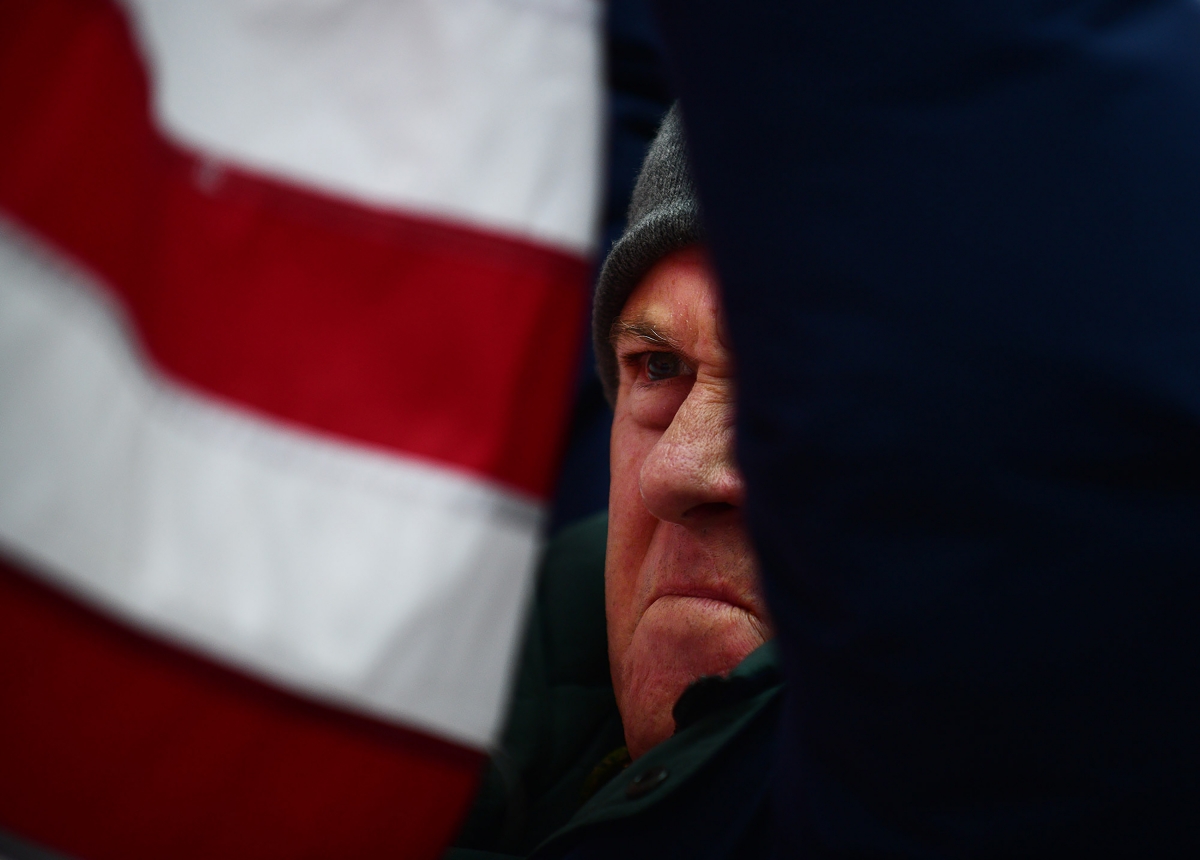
InternationalJan 06. 2021Supporters of President Donald Trump gather at Freedom Plaza on Tuesday. MUST CREDIT: Washington Post photo by Matt McClain.Supporters of President Donald Trump gather at Freedom Plaza on Tuesday. MUST CREDIT: Washington Post photo by Matt McClain.
By The Washington Post · Marissa J. Lang, Emily Davies, Peter Hermann, Jessica Contrera

WASHINGTON – One day before Congress votes to certify that Joe Biden won the presidential election, Trump supporters who refuse to accept the reality of his defeat were demonstrating in Washington again. The city is bracing for potentially violent protests promoted by President Donald Trump himself.

All Tuesday afternoon, people bundled against the cold but many free of masks arrived in downtown Washington for what they see as a last stand for Trump, who has continued to falsely assert that the election was stolen from him.

Although many Republican lawmakers, all 10 living former defense secretaries and election officials across the country have said Trump should stop attempting to overturn the results of the election, his refusal to do so has energized his followers. One Wednesday demonstration has a National Park Service permit for up to 30,000 people. Trump said on Twitter that he will speak at 11 a.m. Wednesday, and he praised those who were echoing his inaccurate version of events in the streets.

“They won’t stand for a landslide election victory to be stolen,” he said Tuesday evening.

For hours, speakers turned election conspiracy theories into winding speeches, closed their eyes to pray and shared discount codes for MyPillow, a company owned by a Trump ally.

They ranted against the need for masks, vaccines, and precautions against a virus that has killed more than 355,000 Americans.

“I’m going to give everyone three action steps . . . turn to the person next to you and give them a hug,” one speaker exhorted the crowd. “Someone you don’t know . . . it’s a mass-spreader event! It’s a mass-spreader event!”

A supporter of President Donald Trump waves his flag while joining fellow supporters at Freedom Plaza to protest the results of the election. MUST CREDIT: Photo by Astrid Riecken for The Washington Post.

A supporter of President Donald Trump waves his flag while joining fellow supporters at Freedom Plaza to protest the results of the election. MUST CREDIT: Photo by Astrid Riecken for The Washington Post.

D.C. Police are not enforcing the District of Columbia’s mask mandate, despite the growing coronavirus surge. The city is averaging 233 new coronavirus cases daily, and hospitalizations are up 12% compared with last week. The Washington region set a daily record for new coronavirus infections Friday.

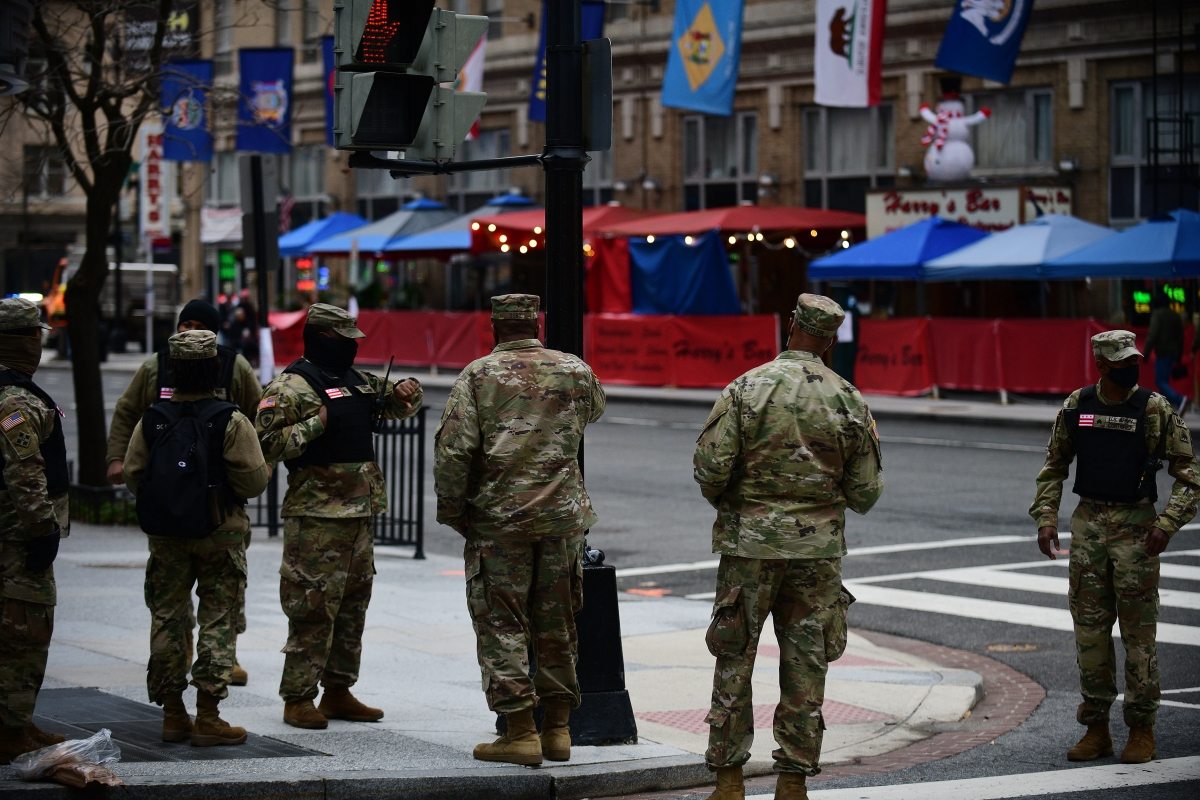
Local law enforcement will instead focus on arresting anyone who is unlawfully armed, while the National Guard works to manage crowds and block streets. D.C. police said that shortly before 2 p.m. Tuesday, officers pulled over a North Carolina bus for a traffic violation. Police said one person inside, who has not yet been identified, possessed two firearms – a rifle and a semiautomatic handgun, along with a large magazine.

In recent weeks, right-wing groups have used the conservative social media site Parler and the encrypted messaging app Telegram to discuss how to sneak guns into the city, where there are laws banning openly carrying firearms and prohibiting such weapons on federal lands and near protests.

Recent pro-Trump protests ended in violent skirmishes. In December, members of the Proud Boys, a male-chauvinist organization with ties to white nationalism, spent hours attempting to reach activists in Black Lives Matter Plaza, being repeatedly blocked by police. Later in the evening, four people were stabbed amid a crowd of Proud Boys and Trump supporters outside Harry’s Bar, which has become a Proud Boys gathering spot.

When the leader of the Proud Boys, Enrique Tarrio, returned to D.C. for this week’s events, he was arrested. D.C. police took him into custody Monday afternoon on a warrant charging him with burning a Black Lives Matter banner taken from a historically Black church during the December demonstration.

He faces a misdemeanor charge of destruction of property and two felony counts of possessing large gun magazines at the time of his arrest.

On Tuesday afternoon, Tarrio appeared in D.C. Superior Court, where he pleaded not guilty. A judge released him but barred him from the city, pointing to his social media posts in which he threatens to set fire to more signs. Tarrio could be arrested if he is seen in D.C.

Later, the crowds in Freedom Plaza would turn his name into a chant: “En-ri-que!”

They cheered for a Michigan lawmaker, a pastor who told them it was “time for war,” and a man wearing a patch representing the far-right armed group Three Percenters, who told them to “fight, fight, fight.”

D.C. National Guard arrives at 12th Street near Hotel Harrington, a popular hangout for Pro-Trump supporters and Proud Boys. MUST CREDIT: Photo by Astrid Riecken for The Washington Post.

D.C. National Guard arrives at 12th Street near Hotel Harrington, a popular hangout for Pro-Trump supporters and Proud Boys. MUST CREDIT: Photo by Astrid Riecken for The Washington Post.

Arielle Early, 17, flew from Northern California after she saw Trump’s tweets calling for demonstrators to come to the nation’s capital.

“What I love about Trump is that he rallies people to come here and fight,” she said.

Early said she dropped out of school in 2017 after being bullied for supporting Trump. On Instagram, she found a community of like-minded young Trump die-hards. She plans to meet with those virtual friends this week in Washington.

Diane Marney, a real estate agent who lives in Wyoming, said she sees this week’s demonstrations as the single most important event in her lifetime. She worries about what a Biden administration will mean for her son, who works in a coal mine. She compared her decision to come to D.C. to her grandson’s decision to serve in the military.

“I want to do the same as him,” she said. “Just not with a gun.”

An afternoon rainstorm sent some demonstrators scurrying toward their hotels, but hundreds remained as streetlights flicked on over a sea of Trump flags, yellow “Don’t Tread on Me” banners and signs that read “Mask Free Zone.”

One man held a wood carving that resembled a can of Twisted Tea. Chris Bouland, 43, said it represented the viral video of a Black man at a gas station who hit a White man in the face with a can after the man would not stop calling him the n-word. The beverage then exploded, sending tea flying. The video has been shared countless times, set to music and remixed.

Bouland, who traveled from Arkansas, said the video reminded him of his fellow Trump supporters.

“You know, if you mess with us, you don’t want to open that can of a– whooping,” he said.

He and his wife, Jo, are planning to wake up early Wednesday to be there for Trump’s expected 11 a.m. speech at the Ellipse.

“We’re not backing down,” she said as Chris Bouland nodded.

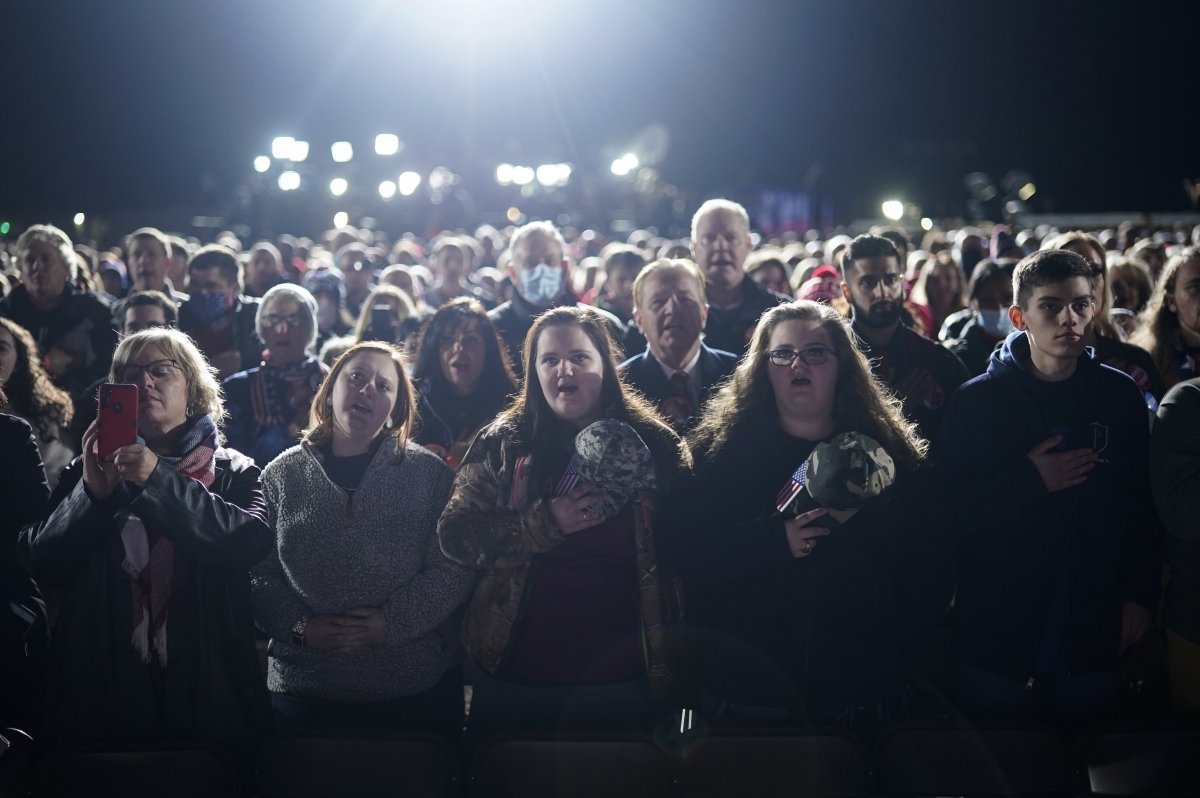
Behind them, the crowd of hundreds at Freedom Plaza began to recite the Pledge of Allegiance.

“This is not about Democrats versus republicans, or Trump versus Biden,” Jo Bouland said. “This is about good versus evil. This is about saving our country.”

Biden taps more Obama alums for key foreign policy jobs #SootinClaimon.Com

#SootinClaimon.Com : ขอบคุณแหล่งข้อมูล : หนังสือพิมพ์ The Nation.

Biden taps more Obama alums for key foreign policy jobs

InternationalJan 06. 2021Joe BidenJoe Biden

By The Washington Post · John Hudson

WASHINGTON – President-elect Joe Biden plans to name several former Obama administration officials to senior jobs at the State Department and National Security Council in the coming days, adding more experienced and well-connected Democratic staffers to the country’s sprawling national security bureaucracy.

For deputy secretary of state, Biden will nominate Wendy Sherman, the chief U.S. negotiator of the Iran nuclear deal under the Obama administration and the former No. 3 official at the State Department, according to three people familiar with the decision.

The nomination for the No. 3 job at the State Department, undersecretary for political affairs, is expected to go to Victoria Nuland, who served as spokesperson for the department under Secretary of State Hillary Clinton and was the top U.S. diplomat for Europe under Secretary of State John Kerry, two people familiar with the decision said.

At the National Security Council, Biden is expected to give the job of deputy national security adviser to Jon Finer, a former Washington Post reporter who worked in a number of jobs in the Obama administration that culminated in his role as director of policy planning at the State Department. After leaving the administration, he worked at the Council on Foreign Relations and joined a private equity firm co-founded by the father of Antony Blinken, Biden’s nominee for secretary of state.

Biden also plans to name Amanda Sloat as senior director for Europe on the NSC. The former Brookings Institution fellow served as a deputy assistant secretary of state for Southern Europe and Eastern Mediterranean affairs at the State Department.

Biden’s picks were first reported by Politico. A Biden transition spokesman declined to comment. The people familiar with the decisions spoke about them on the condition of anonymity because they were not authorized to speak to the news media.

Sherman, a professor at Harvard’s John F. Kennedy School of Government and a senior counselor at Albright Stonebridge Group, played a prominent role in defending the Iran nuclear deal to a skeptical Congress.

Republicans are expected to grill Sherman on her involvement in the deal, which they uniformly opposed, while Democrats underscore that the agreement kept a lid on Tehran’s nuclear program – restrictions that fell apart only after the Trump administration withdrew from the deal.

She also has experience negotiating with North Korea, which has continued to advance its nuclear weapons program despite the Trump administration’s efforts to broker a denuclearization agreement.

Nuland, a prominent Russia hawk, advocated for sending lethal aid to Ukraine during her time in the Obama administration. During the George W. Bush administration, she served as deputy national security adviser to Vice President Richard B. Cheney.

Maryland may withhold vaccine allotments from hospitals with excess supply, Hogan says #SootinClaimon.Com

#SootinClaimon.Com : ขอบคุณแหล่งข้อมูล : หนังสือพิมพ์ The Nation.

Maryland may withhold vaccine allotments from hospitals with excess supply, Hogan says

InternationalJan 06. 2021Anna DaSilva, a medical clinic supervisor, receives her shot as Montgomery County administered 4,000 doses of the Moderna vaccine to healthcare workers and first responders on Dec. 30 in Silver Spring. MUST CREDIT: Washington Post photo by Bill O'Leary.Anna DaSilva, a medical clinic supervisor, receives her shot as Montgomery County administered 4,000 doses of the Moderna vaccine to healthcare workers and first responders on Dec. 30 in Silver Spring. MUST CREDIT: Washington Post photo by Bill O’Leary.

By The Washington Post · Erin Cox, Rebecca Tan, Lola Fadulu

Gov. Larry Hogan announced Tuesday that he will deploy the Maryland National Guard to help local health departments inoculate medical workers and that he may withhold future vaccine allotments from hospitals that have not used most of their available supply.

The governor, a Republican, said any hospital, contractor, pharmacy or health department that has not used 75% of its supply might not receive additional doses of the vaccine. Hogan identified hospitals that have been slow to administer it, some of which have used less than 20% of their supplies.

The state would send unused doses to places where they could be distributed quickly, he said.

“No doses should be sitting in freezers while others are waiting,” Hogan said during a news conference. “Either use the doses you have been allocated or they will be redirected.”

He laid out the most detailed timeline yet for when other priority groups could receive vaccinations.

Teachers were moved into the next eligible group, which includes people age 75 and over. Hogan estimated that they could receive vaccinations at the end of January. The next group, expected to get vaccines in early March, includes people over 65 and those deemed essential workers, such as grocery store employees.

Hogan said he will not wait for all medical professionals to be inoculated before moving on to other priority groups.

The governor noted progress in the state’s distribution of vaccines, but he said the rollout will take months, with 30% of the state’s population of about 1.8 million likely to be inoculated by the end of May.

Virginia Gov. Ralph Northam, a Democrat, plans to discuss vaccine distribution in his state during a Wednesday news conference.

Vaccine distribution continued across the region Tuesday as the seven-day rolling average of new infections in the District of Columbia, Maryland and Virginia stood at 7,421 – the third consecutive record-setting day.

Baltimore Mayor Brandon Scott, a Democrat, said his city will begin this week to vaccinate first responders and health-care workers not affiliated with hospitals.

The city received 2,600 doses of the Moderna vaccine from state officials last week. Health Commissioner Letitia Dzirasa said officials are unsure of how many more doses the city will receive through next week.

“There’s still a very limited supply,” she said, urging members of the public to be patient.

Maryland data shows that 1.5% of people in the Baltimore region have been vaccinated, compared with 0.7% vaccination rate in the state’s Washington suburbs.

Montgomery County Health Officer Travis Gayles said late Monday that the discrepancy might be because more Montgomery health-care workers have been vaccinated in D.C. or other jurisdictions but have not reported it to the state health department. He also acknowledged that at hospitals, which received the first batches of the vaccine from the federal government, not everyone who is eligible has agreed to take the vaccine.

“If we’re honest, there are some folks who are still taking a wait-and-see approach,” he said.

While hospitals have received doses directly from the federal government, local governments have had to wait for allotments from state authorities. This is “an additional layer of time” in the distribution process, Gayles said. The county, for example, learned Saturday that it would be receiving a new batch of doses Tuesday.

“We’re at the mercy of getting that information from the state and the state is at the mercy of getting the information from the federal government,” he said. “It’s our biggest obstacle.”

Of the 4,300 doses that Montgomery has received, 86% had been administered by Monday night, Gayles said. The county has planned six more vaccine clinics to administer the new batches, but with more than 50,000 people in the county’s top priority group, it will be some time before vaccinations begin for those in the next category, which includes people 75 and older.

Gayles said the county is not aware of vaccines expiring because of a lack of demand. In such a situation, the health department has told pharmacies to inform county officials, who would then identify a cohort of priority group members to receive the vaccine.

The greater Washington region reported 6,595 new infections and 118 virus-related fatalities Tuesday. D.C. had 262 new cases and four deaths; Virginia had 4,377 cases and 59 deaths; and Maryland had 1,956 cases and 55 deaths.

Virus-related hospitalizations were up 12% from last week in D.C.; up 8% from last week in Virginia; and up 3% from last week in Maryland, according to The Washington Post’s tracking of data.

D.C. has administered 16,989 of the 40,075 doses delivered, according to city data that includes reports from 58% of providers. Virginia has administered 103,083 doses, and Maryland has administered 76,916 doses.

Analysis: Trump roadshow whines to a close with last hurrah #SootinClaimon.Com

#SootinClaimon.Com : ขอบคุณแหล่งข้อมูล : หนังสือพิมพ์ The Nation.

Analysis: Trump roadshow whines to a close with last hurrah

InternationalJan 06. 2021President Donald Trump speaks during a rally on Monday in Dalton, Ga. MUST CREDIT: Washington Post photo by Jabin BotsfordPresident Donald Trump speaks during a rally on Monday in Dalton, Ga. MUST CREDIT: Washington Post photo by Jabin Botsford

By The Washington Post · Anne Gearan

DALTON, Ga. – President Donald Trump’s first words at a slick, theoretically scripted get-out-the-vote political rally on behalf of Georgia’s Republican Senate candidates were neither scripted nor on behalf of the candidates.

They were about President Trump.

“I want to thank you very much. Hello, Georgia. By the way, there’s no way we lost Georgia,” Trump began Monday night, after the treacly Lee Greenwood anthem “God Bless the U.S.A.” faded out. “There’s no way.”

Then it was on to familiar themes of grievance and defiance and familiar falsehoods, though with notes of melancholy, and perhaps resignation, some two months after President-elect Joe Biden’s victory was sealed.

What may be Trump’s final signature political rally as president felt like a grasping, wistful last hurrah. If this was the last stop on the Trump roadshow, it ended not with a bang but a whine.

“We won everything, and we won it now a second time,” Trump said, after a long digression about his 2016 victory. “I hate to bore you with that expression.”

He still gave the mostly maskless crowd at a rural airstrip a show – with a Marine One flyover, a booming sound system playing the Trump campaign playlist, warm-up red meat from Donald Trump Jr. and campaign surrogate Kimberly Guilfoyle, and a closing appearance from daughter and adviser Ivanka Trump.

In between, the hour-plus was filled with all the Trump iconoclasm, now no longer shocking. Baseless conspiracies! Dozens of easily disproved false claims! Internecine grudges! Casting out enemies! Threatening loyalists! Inviting an adherent of the QAnon conspiracy theory onstage! And throughout, Trump’s song to himself – the only theme music that has ever mattered.

“So somebody came up to me today, Kelly, and they said, ‘Sir, you’re way up in four years! Nobody can come close to me!’ ” Trump said, as the only current candidate onstage, Sen. Kelly Loeffler, stood by.

“I said, ‘ I’m not interested in four years, I’m interested in, like, eight weeks ago,’ ” Trump said to laughter.

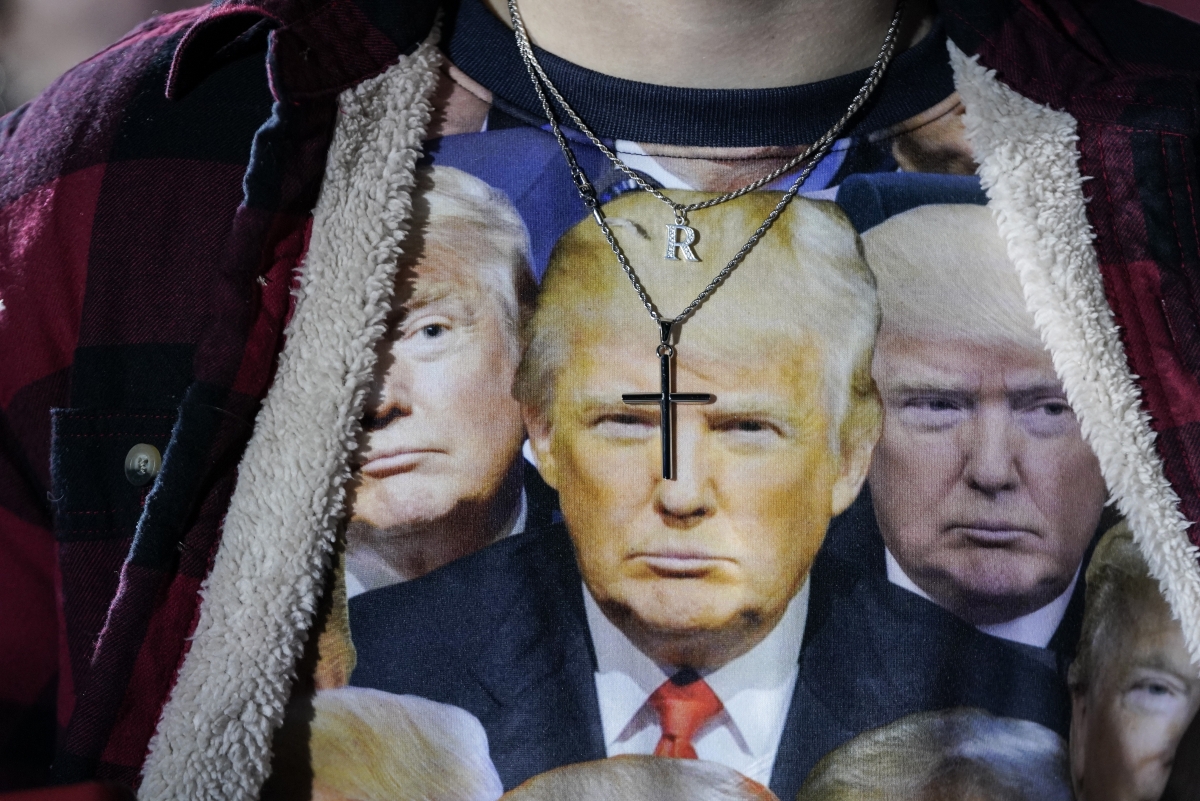
A supporter wears a Trump shirt as President Donald Trump speaksduring a rally on Monday in Dalton, Ga. MUST CREDIT: Washington Post photo by Jabin Botsford

A supporter wears a Trump shirt as President Donald Trump speaksduring a rally on Monday in Dalton, Ga. MUST CREDIT: Washington Post photo by Jabin Botsford

Over and over, Trump returned to his own election and a multistate list of grievances and debunked claims of fraud. A steady stream of rallygoers made their way to the buses as Trump gave a blow-by-blow riff about alleged ballot counting irregularities in Pennsylvania, which is of course a long way from northwest Georgia.

Seemingly aware that he was straying from the purpose of his appearance, Trump more than once observed that he was only trying to warn against election fraud during the Georgia runoff elections Tuesday, which will determine whether Republicans hold the Senate.

“That’s why I’m here,” Trump said. “I don’t want to do rallies for other people.”

Most in the crowd appeared to share Trump’s view about the real star of the show.

Three hours before Trump’s scheduled remarks alongside Loeffler, thousands of people sat side by side in folding chairs or stood close together on the tarmac, despite public health advice to avoid close contact with others, even outdoors. The other Republican Senate candidate, David Perdue, appeared by video after a close contact with a staffer who had tested positive for the potentially deadly viral disease.

The venue was decked as for a Trump rally, with giant red, white and blue electronic signs that flashed the name “Trump” in large letters in between exhortations to vote in the runoff the following day. Smaller signs bore the Republican Senate candidates’ names.

Many in the crowd wore red “Make America Great Again” ball caps. A few were wrapped in capes or blankets printed with Trump’s face. One guy had a giant red foam MAGA hat with a thatch of fake orange hair.

The president issued what once would have been a remarkable threat to his running mate, Vice President Mike Pence, who will preside over the congressional certification of the election results on Wednesday, saying he hopes Pence “comes through” with unspecified (and impossible) action that overturns the results.

“Of course if he doesn’t come through, I won’t like him so much,” Trump said as the crowd laughed.

He also raised the stakes in his feud with former ally Gov. Brian Kemp and Georgia’s top election official, Secretary of State Brad Raffensberger. He blames the fellow Republicans for allowing his loss in the state.

“I’m going to be here in a year and a half and I’m going to be campaigning against your governor and your crazy secretary of state,” he said to cheers.

Although he remained defiant and insisted that nothing he said should be considered a concession to defeat, Trump also appeared slightly at a loss.

He marveled that Biden, who was also campaigning in the state Monday, could be president when “he can’t talk”; Biden has struggled with a lifelong stutter. Trump also mocked Biden’s small motorcade and small traveling footprint, which is by design as a pandemic precaution.

Supporters wait for President Donald Trump at Monday's rally. MUST CREDIT: Washington Post photo by Jabin Botsford

Supporters wait for President Donald Trump at Monday’s rally. MUST CREDIT: Washington Post photo by Jabin Botsford

Trump also called the Georgia candidates the “last line of defense,” and said that without Loeffler and Purdue, no one could stop the Democrats’ agenda. That was a tacit nod to the reality that since he has lost and Pence will no longer be a deciding vote in the Senate, victories by Democrats in both Georgia Senate elections would put Republicans out of power entirely.

He promised to help Republicans regain control of the House in 2022 and to return to the state to campaign for Rep. Marjorie Taylor-Greene, the newly elected Republican who has espoused baseless QAnon theories about a sprawling government conspiracy.

“Of course, if I didn’t win, you probably wouldn’t want me,” Trump said, his playful tone tinged with rue – and bile. “You know, an awful big difference between losing and winning and having it stolen.”

Jeff Mitchell, 58, of Canton, Ga., and some friends from Florida were at the rally to see Trump. His buddies, who cannot vote in the runoff election, had stopped en route to pro-Trump demonstrations in Washington on Wednesday.

Mitchell said before the event that he can “accept defeat” if Trump lost fair and square, but he said he believes Trump has been treated unfairly. Mitchell, sounding resigned, also suggested Trump is a victim of circumstance.

“You had a perfect storm. The covid, the mail-in ballots and the hatred for Trump,” he said.

Trump’s speech included his standard gibes at the media, which he claimed does not report on election fraud or on his accomplishments. The crowd cheered, but without the thunder that used to accompany the president’s populist attacks.

The crowd appeared underwhelmed when, near the close of the event, Trump mused about what he considers one of those accomplishments. Although he did not seal a disarmament deal with North Korea’s dictator, Trump cast the gambit in his usual, highly personalized, terms.

“I got along very well with Kim Jong Un,” Trump mused, the past tense not lost on anyone. “I don’t think that Joe’s going to, based on what I’ve heard.”

By the end, with the music booming and Trump’s armored limousine idling to drive him the short distance to his presidential helicopter, Trump wandered the stage for a few awkward moments.

He tacked one way, pumping his fist, then the other, a sort of grimace on his face.

EU Seeks Up to 300 Million More Pfizer-BioNTech Doses #SootinClaimon.Com

#SootinClaimon.Com : ขอบคุณแหล่งข้อมูล : หนังสือพิมพ์ The Nation.

EU Seeks Up to 300 Million More Pfizer-BioNTech Doses

InternationalJan 06. 2021

By Syndication Washington Post, Bloomberg · Naomi Kresge, John Follain

The European Union is negotiating with Pfizer and BioNTech on a deal that could double their supply of covid-19 vaccine to the region, according to people familiar with the talks.

The new contract would include 100 million doses, as well as an option for as many as 200 million more, said the people, who asked not to be identified because the talks are private.

Governments across the EU face growing questions over the slow pace of their vaccine rollouts, and shots from other drugmakers such as AstraZeneca won’t be available for weeks at the earliest.

The attempt to secure more of the Pfizer-BioNTech vaccine comes less than a week after the 27-member bloc boosted its original 200 million-dose order to 300 million. If the option in the new agreement were exercised, it would lift the total doses to 600 million, enough to vaccinate two-thirds of the bloc’s population based on a two-dose regimen.

In premarket trading, BioNTech American depositary receipts rose 2%, with Pfizer showing little change.

Member countries have pressured the EU to secure more doses as the pandemic’s death toll rises, lockdowns lengthen and leaders worry about containing a new, more contagious strain of the virus that has emerged in the U.K.

While the EU has signed deals with a range of companies for access to almost 2 billion doses, only the Pfizer-BioNTech shot has thus far won approval from its regulator. A decision on a similar vaccine from U.S. biotech Moderna Inc. could come on Wednesday. However, the EU has locked up less of that shot, with a contract for as many as 160 million doses.

“We are in talks about whether and how we can provide further vaccine doses from Europe for Europe this year,” BioNTech Chief Executive Officer Ugur Sahin said in an e-mailed statement.

No agreement has been reached and the numbers could still change. A Pfizer spokesman declined to comment. A BioNTech spokeswoman declined to comment on the number of doses involved.

The European Commission is examining with BioNTech and Pfizer whether there is a way to increase supply beyond the initially contracted 300 million doses, Stefan De Keersmaecker, a health-policy spokesman, said Monday. He declined to comment Tuesday about the details of the extra shots being sought.

Pfizer and BioNTech are pursuing all their options to boost production capacity for the vaccine beyond the 1.3 billion doses originally planned for this year, Sahin said in an interview last month. The CEO said he was confident that would be possible, saying the partners would probably know by January or February whether and how many additional doses they would be able to offer.

European leaders have also come under fire for how the existing doses have been distributed. In France, administrative red tape and a lack of nursing home staff hobbled the early days of the vaccine campaign. Meanwhile, German Chancellor Angela Merkel is being criticized for tasking the EU with centralized negotiations instead of striking out on her own sooner to get more of the vaccine for Germany itself.

Swelling Iraqi oil sales mean trouble for OPEC+ output talks #SootinClaimon.Com

#SootinClaimon.Com : ขอบคุณแหล่งข้อมูล : หนังสือพิมพ์ The Nation.

Swelling Iraqi oil sales mean trouble for OPEC+ output talks

InternationalJan 06. 2021

By Syndication Washington Post, Bloomberg · Anthony Di Paola

Iraq boosted crude exports in December and may have exceeded its OPEC+ output quota, which could complicate talks on Tuesday between major producers over whether to boost oil supplies.

Crude shipments from Iraq, the largest producer in the Organization of Petroleum Exporting Countries after Saudi Arabia, rose 4% last month to 3.26 million barrels a day, according to tanker-tracking and port-agent data compiled by Bloomberg.

OPEC and its allies such as Russia are weighing recent price gains against fresh coronavirus lockdowns that could stifle energy demand as they try to determine whether to increase oil output next month.

The OPEC+ alliance, led by Riyadh and Moscow, agreed in early December to pump an extra 500,000 barrels a day in January, and it’s meeting this week to consider an increase of the same size in February. The talks were meant to conclude on Monday, but will drag on amid an impasse between Russia, which wants to boost output, and others who believe production should remain unchanged next month.

As OPEC+ members begin opening their taps, more will end up exceeding their quotas, said Bob McNally, president of consultant Rapidan Energy Group and a former White House official. For now, Russia and Iraq are “by far” the biggest quota-busters, he said to Bloomberg Television.

Iraq, mired in an economic crisis, has angered the Saudis by pumping above its cap on several occasions since OPEC+ agreed to cuts in April. Baghdad is siding with Riyadh during this week’s meeting, however, in urging the group not to hike supply further in February.

Oil prices rallied after the cartel started its cutbacks, but still fell about 25% during 2020. Brent crude dropped a second day on Tuesday, sliding 0.5% to $50.85 a barrel by 3:09 p.m. in Singapore.

Iraqi Oil Minister Ihsan Abdul Jabbar said in December that his nation would respect its production cap even as it raised exports over the course of the month.

Baghdad’s quota was about 3.8 million barrels a day in December, before accounting for compensation cuts that it promised for the earlier breaches. Iraq pumped 3.86 million barrels daily in November, according to a Bloomberg survey, when exports were 3.13 million barrels a day. A survey showing OPEC’s December production will be published later this week.

Although exports aren’t a direct gauge of production, they do shed light on a country’s actual output. Iraq can consume as much as 650,000 barrels a day of crude in its refineries and often uses oil in power plants. To have met its quota last month, Iraq would have had to curb domestic use or sell crude held in storage.

Exports from neighboring Iran also rose in December, reaching the highest level since March, according to tanker-tracking data. Iran is exempt from an OPEC+ production limit, however, due to U.S. sanctions. Oil Minister Bijan Namdar Zanganeh said in mid-December that his country planned to roughly double production in the next year to 4.5 million barrels daily as it anticipates a loosening of sanctions after Joe Biden becomes president.

Russia has breached its output targets as well, according to data from the International Energy Agency. Moscow’s compliance with the OPEC+ deal has averaged 95%, meaning it has pumped about 100,000 barrels a day above its limit.

“For some reason, Russia and Iraq have been given a little bit of leeway to lag,” McNally said. He sees “no sign really of them coming into full compliance soon, much less making up for their owed barrels.”

Markets brace for greater chance of blue wave in Georgia #SootinClaimon.Com

#SootinClaimon.Com : ขอบคุณแหล่งข้อมูล : หนังสือพิมพ์ The Nation.

Markets brace for greater chance of blue wave in Georgia

InternationalJan 06. 2021A supporter holds a A supporter holds a “VOTE” flag at a campaign event for Raphael Warnock, U.S. Democratic Senate candidate, in Riverdale, Ga., on Jan. 4, 2021. MUST CREDIT: Bloomberg photo by Elijah Nouvelage

By Syndication Washington Post, Bloomberg · Katherine Greifeld

While the relentless spread of the coronavirus drove the equity market lower on Monday, there were also signs investors are preparing for a greater possibility that Democrats will gain control of the U.S. Senate.

A Goldman Sachs basket tracking stocks that should benefit from Democratic Party policies performed better than those expected to be harmed. And even as the S&P 500 dropped, the Invesco Solar ETF — thought to benefit from President-elect Joe Biden’s energy policy — rose more than 2%. Bond-market inflation expectations climbed to the highest since 2018, and options traders piled into protection against rising yields.

Underlying the moves was the belief that if Democrats prevail in Tuesday’s runoff elections in Georgia and take control of the Senate, Congress will deliver a bigger emergency aid package than it would under a divided government. That scenario could drive inflation higher, the thinking goes, pushing up Treasury yields and breathing life into economically sensitive stocks. Though all major indexes fell on Monday, cyclical sectors like energy and consumer discretionary stocks outperformed.

“Democratic control of the Senate should be viewed as increasing the risks of higher inflation,” said Sameer Samana, senior global market strategist at Wells Fargo Investment Institute. “Higher inflation expectations may portend better pricing power for a lot of cyclical businesses that we see playing a much larger role in 2021.”

Yet a too-quick pickup in inflation also could put upward pressure on interest rates and hasten the withdrawal of Federal Reserve stimulus. The 10-year break-even rate — a proxy for expected consumer price increases based on yields on inflation-linked Treasuries — rose to 2.01% Monday, a level last seen more than two years ago, data compiled by Bloomberg show.

Meanwhile, supply disruptions stemming from the pandemic caused manufacturers’ input prices to climb last month at the fastest pace since 2018 and their selling prices to soar at the quickest rate since 2011, IHS Markit said in its purchasing managers index report on Monday.

“With the Fed likely to keep rates near zero, the yield curve could steepen significantly” if the Democrats sweep the Georgia elections and follow through with tax proposals, Dennis DeBusschere, head of portfolio strategy at Evercore ISI, said in a note to clients on Monday. “The yield curve is likely to steepen as the economy normalizes, supported by strong housing and the negative real rate backdrop.”

Anxiety over a blue sweep of Congress that allows Biden to “aggressively” implement higher taxes to pay for fiscal aid could help explain why stocks sank on Monday, DeBusschere wrote.

Some options traders are evidently bracing for such a scenario. Near-term put spreads on the $19 billion iShares 20+ Year Treasury Bond ETF (ticker TLT) and the $58 billion iShares Russell 2000 ETF (ticker IWM) were in high demand on Monday. Those moves “appear to be positioning for a Dem sweep in Georgia,” Susquehanna International Group co-head of derivatives strategy Chris Murphy wrote in a note Monday.

The runoffs in Georgia were triggered after no candidates for the state’s two Senate seats clinched a majority of the vote. Predictions markets are expecting a close race, with trading on PredictIt.com signaling the probability of a Democratic-controlled Senate has risen to 48% from just 25% two weeks ago. The implied probability of a Republican Senate has dropped to 53% from 76% in late December.

A measure of calm returned to the market on Tuesday, with S&P 500 futures up 0.2% at 5:59 a.m. in New York and the Cboe Volatility Index down a fraction. That gauge, known as the VIX, jumped as much as 6.4 on Monday to 29.19 — the highest on a closing basis since the day after Election Day in November.

The toss-up nature of the race has inflated the S&P 500’s 30-day implied volatility relative to its realized volatility — a spread that should collapse in the aftermath of the vote, Murphy wrote. The runoff elections — and the potential for contested results that could delay the determination of who won for days — “is the major event propping up implied volatility,” he said.

“I would expect implied volatility levels to decrease — as well as an increase in realized volatility around that event — and the ratio above to compress after that event,” he wrote.

Death of Chinese tech worker fuels anger over brutal hours #SootinClaimon.Com

#SootinClaimon.Com : ขอบคุณแหล่งข้อมูล : หนังสือพิมพ์ The Nation.

Death of Chinese tech worker fuels anger over brutal hours

InternationalJan 06. 2021

By The Washington Post · Eva Dou

She was in her early 20s, and she was working hard to help to win market share for a tech company run by China’s second-richest man.

The employee, named Fei, collapsed in the wee hours of Dec. 29 after a long shift working at online deals giant Pinduoduo, the company said. She passed away after six hours of first-aid treatment.

Though the cause of death hasn’t been confirmed, Fei’s fate has reignited scrutiny of brutal work schedules and vast inequalities in the Chinese tech industry, whose power and wealth are attracting growing public criticism and pushback from regulators. Online discussions about Fei’s death racked up hundreds of millions of views this week, while Shanghai labor regulators told local media they had sent a team to investigate Pinduoduo’s labor contracts and work hours.

Fueling the public anger, a Pinduoduo social media account originally said grass-roots employees faced a “trade-off of life for money,” a statement the company later denounced as an unauthorized opinion of an outsourced marketing worker.

“We are heartbroken by Fei’s death and feel deeply for her family,” Pinduoduo later said in a statement, using the employee’s first name. “She was popular among her peers and valued by her colleagues. Our team has been accompanying the family all this time and providing every assistance that her family needs.”

Reached by phone, a staff member of the labor protection department of Shanghai’s Changning district said officials were investigating the case but could not release any detail at this stage.

Rui Ma, a San Francisco-based tech analyst, said there has been discontent for years over harsh work schedules in China’s high-tech industry, but the anger has deepened as the so-called “996” schedule – short for 9 a.m. to 9 p.m., six days a week – has remained entrenched, despite the industry’s growing stature and resources.

“The outrage only reached a crescendo in the last few years,” she said. “If you want to work in this industry, it does not feel like there are many options to opt out of 996.”

The 996 schedule is technically illegal under China’s labor law, which limits the number of overtime hours for employees and requires overtime pay, said Aidan Chau, a researcher at China Labor Bulletin. But there has been little enforcement, and Chinese Internet companies widely require 996 work hours.

“Every Internet company is not abiding by the law,” Chau said.

Amid the criticism, some Internet companies are shifting to alternating six-day and five-day workweeks, a system dubbed “big and little weeks,” according to state-run broadcaster CGTN.

The public-relations crisis for Pinduoduo comes at a time when China’s Internet giants are feeling the harshest pressure from the government since the industry’s inception, as their growing power threatens vested interests and state control of key sectors. Pinduoduo’s larger rival Alibaba was put under anti-monopoly investigation last month, a fall from favor that sent shock waves through the business community. The probe followed Beijing’s decision to scuttle the IPO of Alibaba’s financial services spinoff Ant Group, after Alibaba’s founder Jack Ma angered the government with criticism of the country’s banking system.

Jack Ma – who has previously endorsed the 996 work culture – has been conspicuously missing from public events in recent weeks.

Pinduoduo’s founder Colin Huang became China’s second-richest person last year, surpassing Jack Ma, according to the Forbes real-time billionaires list. Founded in 2015 as a Groupon-like deals platform, Pinduoduo quickly took off, filling the low-end e-commerce segment that Alibaba was shifting away from in response to public pressure over counterfeit products on its platforms.

The details of Fei’s death reflected the harsh conditions for employees behind China’s glitzy Internet empires. According to Pinduoduo, she had collapsed after leaving work at 1:30 a.m. The company said she had written on her internal account that she was helping Pinduoduo to win market share in Xinjiang, in China’s northwest.

In response to the public outrage, Pinduoduo released a statement in which it quoted the deceased employee’s father thanking the company for its help. It also originally denied the “life for money” post, leading the social media platform Zhihu to make an unusual public statement confirming a Pinduoduo account had posted and then deleted the comment – an indication the controversy had reached a level where even peripherally involved companies felt compelled to respond.

Online, Fei’s case prompted others to write about their own experiences of overwork.

“From the Pinduoduo case, I have seen more than the death of one young woman, but the breaking of a family and the helplessness of tens of millions of IT workers who are on the brink of death but have kept quiescent due to capitalist manipulation,” one Chinese business executive who only identified himself by his surname, Li, wrote on Zhihu on Tuesday.

China’s powerful state-run TV broadcaster CCTV also indirectly criticized Pinduoduo on Monday. Without naming the company, it said in a post on Weibo that companies can’t have workers “exchange their lives for money.”

A number of Chinese companies have faced public accusations of employee deaths from overwork over the years. In 2006, the death of a 25-year-old Huawei engineer who had been working around-the-clock sparked public backlash, pushing the telecommunications giant to stop encouraging a “mattress culture,” where engineers worked through the night, napping on mattresses on the ground.