Migrant caravans head to U.S. border, giving Biden an early test
InternationalDec 10. 2020Residents inspect destroyed houses in the coastal neighborhood of El Muelle after Hurricane Iota made landfall in Bilwi, Nicaragua, on Nov. 20, 2020. MUST CREDIT: Bloomberg photo by Carlos Herrera.
By Syndication Washington Post, Bloomberg · Michael McDonald, Eric Martin
President-elect Joe Biden says his priorities when he takes office next month will be the pandemic and economic recovery, but he’s facing another crisis that won’t wait: a wave of desperate migrants on his southern border.
Two ruinous hurricanes that wrecked and flooded swathes of Central America last month have increased the number of families planning a risky journey northward. And after a year of travel bans and soaring unemployment, demand to reach the U.S. was already high.
“There are going to be caravans, and in the coming weeks it will increase,” said Jose Luis Gonzalez, coordinator of the Guatemala Red Jesuita con Migrantes, a non-governmental organization. “People are no longer scared of the coronavirus. They’re going hungry, they’ve lost everything and some towns are still flooded.”
Biden has pledged to abolish many of the migration policies of President Donald Trump, including prolonged detention and separation of families, which were designed to deter illegal migration. This encourages more impoverished Central Americans to make the trip and test the Biden administration, said Gonzalez.
“When there is a change in government in the U.S. or Mexico, caravans start to move because they are testing the waters to see how authorities respond,” he said. “What they see is that the one who said he was going to build a wall and hated Latinos is on his way out.”
On social media, announcements are circulating for caravans, groups of migrants traveling together, leaving San Pedro Sula, Honduras’s second-largest city, which was hit by both storms. The first caravan is scheduled to leave in the coming days and the second in mid-January.
Biden’s advisers are hoping to shift away from Trump’s policies without signaling that the border has been flung open, according to people familiar with the planning. They know that swift, sweeping changes will spur more people to attempt the journey to the U.S.
“President-elect Joe Biden will restore order, dignity and fairness to our immigration system,” said Ned Price, a spokesman for Biden’s transition. “At its core, his immigration policy will be driven by the need to keep families together and end the disastrous policy of family separation.”
A senior Mexican foreign ministry official said migration is likely to remain one of the main challenges in the U.S.-Mexico relationship, adding that Mexico will continue to promote cooperation for development to address its root causes and plan to handle it together with partners in the region.
Hurricanes Eta and Iota were part of a record-setting Atlantic season with 30 named storms. Eta alone caused $5 billion worth of damage across the region and affected 3 million people, flooding homes and damaging roads, bridges and crops throughout Nicaragua, Honduras, Guatemala and El Salvador. Governments are still tallying damages from Iota and water has yet to subside in some towns. The countries were already reeling from the economic slump caused by months of Covid-19 lockdowns.
Victor Espinal, 31, whose home in La Lima, Honduras was flooded by both storms, says he is planning to join one of the caravans. He was laid off at the Chiquita banana packing plant where he worked for eight years, after it flooded, and is afraid he won’t find work again soon.
The house where he lived with his wife, two children and his mother-in-law is now empty, and their mud-soaked mattresses and damaged belongings lay in the street outside.
“There’s nothing for me here now,” he said. “The walls are all that’s left and there isn’t a single piece of furniture, not even a plate to eat off of. I’m not one to cry, but when I returned home I felt like crying. I see memes that say material goods aren’t important, but they are important because people work their whole lives for them and in 15 days, it’s all gone.”
Last month, Guatemala’s president, Alejandro Giammattei, said that without help from rich countries, his citizens and those of surrounding countries would flee.
“If we don’t want hoards of Central Americans looking to move to other countries with better living conditions, we have to make a wall of prosperity in Central America,” he said at an event in Honduras with the Central American Bank for Economic Integration.
Migration from Central America toward Mexico and the U.S. spiked after Hurricane Mitch in 1998 and Hurricane Stan in 2005. Other weather events have also forced Central Americans to abandon their countries in recent years. A study by Inter-American Development Bank showed migration from El Salvador doubled after a severe drought in 2014-15 that hurt corn production.
“The problem in El Salvador and with all these Central American countries is that they’re highly vulnerable to climate events — hurricanes but also extreme droughts,” said IDB Economics Principal Adviser Ana Maria Ibanez. “There is a relationship between migration and extreme weather events.”
As a candidate, Biden called for a $4 billion aid package for Central America and said his administration would address the climate crisis facing the region.
As vice-president to Barack Obama in 2014, Biden led the strategy on confronting the wave of undocumented migrants from Central America. He has a long history of working in Latin America as chairman and ranking member of the Senate foreign relations committee, including the creation of Plan Colombia to combat drug cartels and leftist guerrillas two decades ago.
Biden faces a changed world and no end of foreign policy challenges from China to Iran
InternationalDec 10. 2020Members of the Hashd al-Shaabi militia watch as photos featuring Qasem Soleimani and Abu Mahdi al-Muhandis are unveiled in Karrada, Baghdad, on Jan. 20. MUST CREDIT: photo for The Washington Post by Emilienne Malfatto.
By The Washington Post · Karen DeYoung
WASHINGTON – President-elect Joe Biden has received no shortage of advice on how to fill the yawning gap between his “America’s back!” mantra and the challenges facing a world that has undergone major changes since he last served in the White House.
Biden should concern himself less with human rights in China than with finding issues open to American-Chinese cooperation, foreign policy doyen Henry Kissinger counseled. Let Russia win in Syria, advised Aaron Stein, Middle East director of the Foreign Policy Research Institute.
Progressive groups have called on Biden to cancel major weapons programs and get rid of the Trump-era Space Force. Brazil’s environment minister suggested that if Biden wants to save the Amazon, he should pay for it by buying Brazilian carbon credits. NATO’s secretary general has warned against leaving Afghanistan without an allied agreement.
Biden has set out some big principles – pay close attention to the interplay between domestic and international priorities, consult with allies and participate in international institutions, elevate climate to the top of the agenda – along with plans for first-day reversals of some of President Donald Trump’s more egregious departures from historical norms on issues such as immigration.
But on a host of matters in between, Biden faces competing priorities, congressional hurdles and wary, if welcoming, allies. In some cases, such as with North Korea and Venezuela, the most daunting obstacle to foreign policy success is the one that has bedeviled several presidents before him. There are no good options.
The fight against the coronavirus and righting the economy are likely to consume much of the new president’s first-year emphasis and energy. Biden is “inheriting a country in crisis,” said Ellen Laipson, director of the International Security Program at George Mason University.
“Between the pandemic and not traveling and economic pain, it’s not going to be an easy time for the foreign policy crowd. They’re going to have to wait their turn,” she said.
Some issues will not wait.
New START, the only remaining arms control treaty between the United States and Russia, is set to expire two weeks after Biden’s inauguration. The five-year extension Biden has said he plans to offer will give his administration some breathing room to deal with problems that have worsened over the past four years, including Russia’s development of new strategic and nonstrategic weapons not covered in any arms deal, competition in space-based weaponry and cyber aggression.
Russian President Vladimir Putin will doubtless seek relief from sanctions imposed by President Barack Obama and Trump, Stephen Sestanovich, senior fellow for Russian and Eurasian studies at the Council on Foreign Relations, said in a council podcast last week. But Biden, if so inclined, “is likely to find them very hard to dismantle without backtracking on key issues that led to sanctions in the first place,” including Russia’s annexation of Crimea and military aggression in Ukraine, and poison plots against Kremlin enemies.
Although Biden is likely to seek Russian cooperation on Iran and climate change, “it will take a lot of dialogue, particularly on Ukraine, to see if there’s any give on the Russian side that could justify lifting sanctions,” Sestanovich said.
On Iran, powerful bipartisan forces in Congress oppose Biden’s plan to reenter the nuclear deal from which Trump withdrew. Under the agreement, Iran curtailed its uranium enrichment and allowed strict international monitoring of its nuclear program in exchange for the lifting of economic sanctions.
As Obama and Vice President Biden maintained when the deal was signed in 2015, and the president-elect has now said, the nuclear agreement was designed to be a starting point to remove an immediate threat of an Iranian nuclear weapon and set the stage for further negotiations over stemming the Islamic Republic’s proxy wars and missile development.
Trump argued that those things would never happen, and his departure from the deal ensured that they did not during his administration. Biden’s challenge, beyond dealing with political opposition at home, is how to reenter negotiations with an Iran that portrays itself as the aggrieved party and has expressed no interest in dealmaking beyond the original terms of the agreement.
In the interlocked web of national security issues, Biden must also balance U.S. relationships with the rest of the Middle East, where Israel and Arab countries are likely to object to any outreach toward Iran.
Biden said in October that he will “reassess” the relationship Trump cultivated with Saudi Arabia, “end U.S. support for Saudi Arabia’s war in Yemen, and make sure America does not check its values at the door to sell arms or buy oil.” Those initiatives are likely to find favor with Congress, which saw Trump veto anti-Saudi legislation.
Biden remains committed to ensuring Israel’s security and does not plan to reverse Trump’s recognition of Jerusalem as the Israeli capital and annexation of the Golan Heights. But his opposition to new settlements on occupied land and commitment to a two-state solution with the Palestinians may have less resonance amid new Arab normalization deals with Israel.
At the same time, Biden’s ability to make progress with Iran is an important aspect of his goal to reestablish trans-Atlantic ties with Britain, France and Germany – all still parties to the Iran nuclear deal – and the rest of Europe.
Europe is embroiled in its own problems with the pandemic and rule-of-law rejectionists in countries such as Hungary and Poland, whose leaders Trump embraced. Leading allies are pleased that Biden is a committed trans-Atlanticist who shares their values and has pledged to repair traditional U.S. ties.
But they remain wary about potential contradictions between his vows to reinvigorate U.S. manufacturing and agriculture, and what they hope is an end to Trumpian trade threats and tariffs.
Although Biden has pledged to retain the tens of thousands of U.S. troops who are based as deterrents in Europe, as well as in Japan and North Korea, he also wants to end major deployments to overseas wars, limiting the U.S. presence to relatively small counterterrorism forces of 1,500 to 2,000 to protect the homeland.
That leaves open a lot of questions of interest to NATO and European allies who share responsibility with troops in Afghanistan and Iraq, as well as in Africa.
Biden will take over a world in which the United States, although still a great power, is not necessarily the sole dominant one. “But the passing of U.S. dominance need not mean the end of U.S. leadership,” Jake Sullivan, Biden’s choice as national security adviser, argued in a 2018 essay in Foreign Affairs magazine.
“That is, the United States may not be able to direct outcomes from a position of preeminent economic, political, and military influence,” Sullivan wrote, “but it can still mobilize cooperation on shared challenges and shape consensus on key rules. In the years ahead, although Washington will not be the only destination for countries seeking capital, resources, or influence, it will remain the most important agenda-setter.”
One place where Biden hopes to lead the democratic world in confronting China. Although European allies have sought coordination with the United States on China, U.S. partners in Asia, where neighborhood peace and economies are far more dependent on a smooth relationship with Beijing, are concerned about his intentions.
Biden has not committed to any particular action vis-a-vis China, including the lifting of Trump tariffs or revision of still unrealized trade deals, all of which he has said he will review in terms of how they affect U.S. workers and the economy.
He has called for “pushing back” on “China’s deepening authoritarianism, even as we seek to cooperate on issues where our interests are aligned,” and called on the United States to “speak out” on oppression against Hong Kong and Uighur Muslims.
He has broadly pledged to ensure that China follow international maritime and territorial norms, and said that the United States will greatly increase its diplomatic presence in regional organizations where Trump has largely ceded influence.
Although the Trump administration has beaten the drum against Chinese expansionism and aggression in increasingly bellicose terms, Biden has emphasized a somewhat different approach. He has said he will use the power of U.S. leadership – and a revitalized U.S. economy – to mobilize a more unified global stand against China on all fronts.
“Most important is that we lead once again by the power of our example. America’s commitment to universal values sets us apart from China,” Biden said in written responses to questions posed last summer by the Council on Foreign Relations. “That is how to project a model that others want to emulate, rather than following China’s authoritarian path.”
Deutsche Bank leans on traders as corporate bank outlook cut
InternationalDec 10. 2020Christian Sewing , chief executive officer of Deutsche Bank, at the Frankfurt Finance Summit in Frankfurt, Germany, on June 22, 2020. MUST CREDIT: Bloomberg photo by Peter Juelich.
By Syndication Washington Post, Bloomberg · Steven Arons
Deutsche Bank said a trading rally that lifted revenue this year continued into the fourth quarter and will help boost growth through 2022, as Chief Executive Officer Christian Sewing relies increasingly on the investment bank for his turnaround plan.
Sewing on Wednesday increased his outlook for the business, saying it will generate 8.5 billion euros ($10.3 billion) of revenue in two years’ time, 600 million euros more than targeted. But headwinds from negative interest rates forced the CEO to cut the forecast for the corporate bank — a centerpiece of his strategy — and lower the group revenue target slightly, to 24.4 billion euros from 24.5 billion euros.
The bigger role for the investment bank — first reported by Bloomberg on Friday — underscores Sewing’s increasing reliance on a trading business he had initially planned to cut back even further, as profit from lending is being eroded by Europe’s negative interest rates. Fixed-income trading is now a bigger revenue contributor than when former investment bank head Anshu Jain took over as co-CEO in 2012.
“We have really underestimated the potential in those businesses where we want to be strong,” Sewing said in a Bloomberg TV interview. “I do believe that a good part of the outperformance we have seen in 2020 is sustainable.”
Deutsche Bank rose 0.9% at 11:56 a.m. in Frankfurt trading. The stock has gained 38% this year, the best performer among the large European lenders. It’s down about 16% since Sewing took over in April 2018.
Trading grew 10% in October and 23% in November from a year earlier, the lender said in a presentation. Deutsche Bank now expects 9.1 billion euros in revenue at the investment bank for 2020, which translates into about 1.7 billion for the fourth quarter, compared with 1.5 billion euros a year ago. The top line is expected to decline next year when market conditions normalize.
Sewing is counting on the additional revenue from trading to help offset 1.2 billion euros in new headwinds from negative interest rates, which hit the corporate bank the hardest. The unit was initially the centerpiece of Sewing’s strategy when he unveiled it in July of last year. Since then, he’s had to adjust revenue expectations twice because of the rate environment, forcing him to rely more on the trading business he had planned to cut back even further.
Germany’s largest lender also gave a goal for net income for the first time since unveiling the new strategy, targeting 4.5 billion euros by 2022, as it steps up cost reductions in the wake of the pandemic. Germany’s largest lender expects to lower its 2022 adjusted costs by 300 million euros more than previously announced, to 16.7 billion euros.
Sewing, a former corporate banker, last year announced Deutsche Bank’s biggest restructuring in at least two decades, exiting equities trading and focusing on businesses where the bank says it has a leading position. He’s cutting 18,000 jobs, or a fifth of the workforce, after several failed turnaround efforts under his predecessors.
By The Washington Post · Adam Taylor · WORLD, EUROPE
It was more than four years ago, back in the heady summer of 2016, that Britain voted to leave the European Union. At the time it seemed like a simple decision about the country’s place in the world. Time has proved otherwise.
Britain’s efforts to depart have involved endless negotiations over arcane details. Two British leaders resigned amid the fallout, contesting bitter intraparty rivalries. And the country’s economy is set to decline nearly 10 percent in 2020 in the face of intertwining sources of uncertainty: Brexit and the coronavirus pandemic.
After all this time, Brexit is finally happening. At the end of the year, the negotiations set in motion by the 2016 vote are due to finish. At the end of a winding journey, it’s time to look back and ask:
What on Earth just happened? And did anyone get what they wanted?
– So, what is Brexit exactly?
Brexit, a portmanteau of “Britain” and “exit,” became a popular term to describe the movement to pull Britain out of the E.U. in 2012, with origins in a long-standing drive to cut Britain’s ties to Europe.
Britain joined European Economic Community, the precursor to the E.U., in 1973. But as the body expanded its scope and powers, it became increasingly controversial in Britain. Some argued that E.U. legislation and rules were holding the country back.
The issue of Britain’s membership in the European Union had been divisive within the center-right Conservative Party for decades. These divisions led to the downfall of Prime Minister Margaret Thatcher in 1990 after pro-Europe members of Parliament ousted her.
– Why did Britain hold a referendum?
In 2015, Prime Minister David Cameron pushing for a second term. But he was concerned that divisions over the E.U. could send his ruling Conservative Party back to its role as the opposition, where it was stuck from 1997 to 2010.
The United Kingdom Independence Party (UKIP) was siphoning off support for the Conservatives by running on an explicitly pro-Brexit platform. Polls showed growing support for UKIP and some Conservative figures had defected to the upstart party.
Cameron favored remaining in the E.U., but wanted to give Brexit-backers a reason to support him. So he promised to hold a referendum on the issue if he won the election. At the time, most polling suggested that “remain” would win such a vote. Cameron won reelection comfortably.
But after the date of the referendum was set – June 23, 2016 – the polling began to narrow substantially as popular Conservative figures like Boris Johnson backed Brexit amid a global wave of populism. The “Remainers” eventually lost the vote by a 52-to-48 split. Cameron resigned the morning after the results were announced.
– Why did it take so long to leave the E. U.?
There was no preexisting playbook for a country looking to drop out of the E.U.; it had never been done. Before they could even start planning their future relationship, Britain had to negotiate a withdrawal agreement spelling out the terms of its departure – in negotiation with a 26 nation bloc in which every government has a veto.
Just as tricky were the politics at home. Britain voted in favor of Brexit, but it was never clear what exactly that meant. Some argued that Britain could pursue a “soft Brexit” and seek a close relationship like Norway, an outsider that is essentially bound by many E.U. rules. Others railed against that course as outside the spirit of Brexit and urged a clean break – a “hard Brexit.”
To make matters worse, Britain’s Supreme Court decided in Jan. 2017 that Parliament must have a say on any Brexit deal. Cameron’s successor, Theresa May, tried to reach a compromise in-out deal, but it was voted down in Parliament three times before she eventually resigned.
– What aspects of Brexit have led to the biggest disagreements?
More than three years after Britain voted for Brexit, in July 2019, Johnson, an idiosyncratic though popular politician who had personally backed Brexit, succeeded May.
He quickly pushed for a new election, in which he won a comfortable majority in Parliament. The new prime minister was able to get his withdrawal agreement through Parliament in January 2020, which resulted in the long-awaited “Brexit Day” on Jan. 31 – when Britain formally Brexited.
In many ways, however, the sense of ending was a mirage: Britain may have negotiated its E.U. departure, but it had yet to reach the more important agreement on its future relationship with the bloc. The country entered into an 11-month transition period in which it could negotiate a future trade deal with Europe.
Many of the problems about future relationship have lingered, unresolved. Even this month, there have been significant arguments over fishing rights and other topics.
The largest debate lingers over the Irish border, across which seamless travel from Northern Ireland to Ireland and vice versa is permitted. If trading rules between Northern Ireland do not align with those of Ireland, an E.U. member state, it could result in the need for a hard border – a potential breach of the Good Friday Agreement that some fear could lead to sectarian violence.
– What is a no-deal Brexit?
Johnson’s government has taken a hard line negotiating style, at one point even suggesting that it would might withdraw from elements of the withdrawal agreement – in potential violation of international law – in a dispute over the Irish border.
The British prime minister has also toyed with the idea of a “no deal” Brexit, under which Britain would leave the E.U. at the end of this year when the transition period ends. Under this scenario, Britain would revert to World Trade Organizations for goods from Europe at its border – a chaotic scenario that could disrupt international trade.
Economists suggest such a scenario would be an economic disaster for Britain, but it would hurt E.U. nations too. In October, Johnson said the country needed to prepare to leave the E.U. without a trade deal with “high hearts and with complete confidence.”
– What long-term effects might Brexit have?
It is hard to say. Britain has struggled economically since the 2016 vote, but the effects of Brexit have been overshadowed by the pandemic. Likewise, Johnson’s ambitious plans for a “Global Britain,” free of E.U. involvement, have sputtered amid a disaster that has killed more than 60,000 people.
Some pro-Brexit voices have argued that short-term economic pain was always likely and that the benefits will come in time. Some British officials have pointed to the country’s speedy approval of the Pfizer vaccine as proof of how the country was held back by European bureaucracy, although critics quickly pointed out that the approval was granted under E.U. rules.
In the years since the Brexit vote, polling agencies have asked the public regularly how it would vote in a second referendum. Most recent polls have revealed a nation divided, with most polls suggesting a small but consistent majority preferring to stay in the E.U. Even as Brexit ends, the debate about it will continue.
HBO Max, Peacock Users Surge as Streaming Wars Heat Up
InternationalDec 09. 2020AT&T Chief Executive Officer John Stankey, speaking at an investment conference Tuesday, said HBO Max has added about 4 million new users in less than three months, putting activations at 12.6 million. MUST CREDIT: Bloomberg photo by Gabby Jones
By Syndication Washington Post, Bloomberg · Scott Moritz, Gerry Smith
AT&T’s HBO Max and Comcast’s Peacock saw a surge in sign-ups in recent months, an indication they’re gaining some momentum in an uphill fight against Netflix and Walt Disney.
AT&T Chief Executive Officer John Stankey, speaking at an investment conference Tuesday, said HBO Max has added about 4 million new users in less than three months, putting activations at 12.6 million.
Peacock, meanwhile, has attracted about 26 million sign-ups since its launch, Comcast said Tuesday. That’s up from 22 million announced in October. But the service is free with ads, making it difficult to compare with HBO Max and other streaming platforms.
The two media conglomerates are playing catch-up in a streaming industry with more entrenched players, including Netflix, Disney and Amazon.com. Netflix has 65 million subscribers in the U.S. alone, and many more overseas. And Disney has a trio of services — Disney+, Hulu and ESPN+ — that it sells as a bundle.
But an influx of new programming is giving HBO Max a boost. Shows like “The Undoing” and “The Flight Attendant” have helped fuel an “incredible pace” of customer gains, Stankey said in the presentation. It’s also bolstered the amount of time viewers spend with the service, a measure that’s up about 36% in the past 30 days.
The subscriber update comes just days after AT&T shocked Hollywood by announcing plans to put all its 2021 Warner Bros. movies on HBO Max at the same time they debut in theaters.
The shift in strategy created some blowback for AT&T. Director Christopher Nolan, who has a long relationship with the studio, criticized the plan on Monday, describing it as a betrayal of filmmakers. He also slammed HBO Max as an inferior streaming service.
Stankey used his presentation Tuesday to help justify the decision to have big-budget movies debut on HBO Max at the same time they open in theaters.
“It’s really important that we have a direct relationship with consumers,” Stankey said. With the pandemic shutting down theaters and disrupting TV-show production, “it’s important that these new distribution platforms scale faster for fear of being left behind,” he said.
Comcast’s Universal studio has made similar efforts to shorten the theatrical window — the amount of time a movie plays exclusively at cinemas — though it hasn’t taken as drastic a step as AT&T. In its presentation, the company said that shorter film windows will add value to its operations, but stressed that theaters remain a critical part of the business.
Comcast also has less riding on Peacock than AT&T does with HBO Max. Though Peacock generates ad revenue, it isn’t seen as an integral part of the cable giant’s business. For now, the service — launched nationally in July — is mostly a way to attract customers who may also use the company’s broadband services.
At AT&T, HBO Max is more central to its efforts to adapt to cord cutting — including people getting rid of the traditional HBO network. In its early months, the service got off to a slow start. It’s more costly than the other major streaming platforms, and confusion over its use of the existing HBO brand may have kept some potential customers away. Stankey said the recent sign-ups show that HBO Max is building a base of users that will only grow when big movies start hitting the service.
“The models that we’re putting in place are going to give us tremendous flexibility,” Stankey said. “That’s the only way we’re gonna survive in this economy, in this market structure, moving forward.”
Despite trade war, China-U.S. farm ties are stronger than ever
InternationalDec 09. 2020A combine harvester reaps in an aerial image taken over Princeton, Ill., on Sept. 29, 2020. Through the trade war and open hostilities at the highest political levels, pig farmers in China and crop farmers in the U.S. have become increasingly interdependent. MUST CREDIT: Bloomberg photo by Daniel Acker
By Syndication Washington Post, Bloomberg
Measured by the bushel, the U.S.-China relationship has never been stronger.
Through the trade war and open hostilities at the highest political levels, pig farmers in China and crop farmers in the U.S. have become increasingly interdependent. Already America’s biggest customer of soybeans and sorghum, for this season China bought an unprecedented 11.2 million metric tons of corn, up nearly 1,300% compared with pre-trade war purchases.
For the moment, both sides seem happy. The American imports have helped China feed its hog herd, which is recovering faster than expected after the African swine fever outbreak created a shortage of the country’s most staple protein. Meanwhile, U.S. farm profits are at a seven-year high, riding China’s demand and additional support from federal aid to agriculture.
China’s bought nearly 30 million metric tons of U.S. soybeans, the most for this point in the season since 1991 and 57% of America’s export sales. For sorghum, which is also a substitute for corn, China accounts for 80% of sales. Corn purchases, once negligible, rocketed to almost 30%.
“American agriculture has to be careful of putting too many eggs in the China basket,” says Tom Vilsack, who served as agriculture secretary from 2009 to 2017 and has emerged as a leading candidate for the position under President-elect Joe Biden. MUST CREDIT: Bloomberg photo by Andrew Harrer
But the deeper reliance is tenuous. As the trade war showed, that market can quickly evaporate, and experts warn that any number of geopolitical events – an incident in the South China Sea, for example, or further activity in Hong Kong – could end with another chill on Chinese imports.
“American agriculture has to be careful of putting too many eggs in the China basket,” said Tom Vilsack, who served as Agriculture Secretary from 2009 to 2017 and has emerged as a leading candidate for the position under President-elect Joe Biden. “I think the lesson that should be learned from the last couple of years is the need for American agriculture to continue to diversify so there’s always somewhere else the products can go, other than the storage bins.”
For now, purchases are so big that traders are even drawing parallels with the Soviet era’s “Great Grain Robbery,” another huge agricultural trade at a time of tensions between superpowers. Overall, the U.S. has nearly exhausted its export capacity.
“We are loading boats as fast as we can,” Gregg Doud, the U.S. Trade Representative’s chief negotiator for agriculture, said in an interview with Bloomberg at the end of October. “North of 95% of what can possibly be done in 2020 is already booked, and a huge chunk of that is soybeans to China.”
The farm belt, which voted overwhelmingly for the reelection of President Donald Trump, is waiting to see how Biden will approach trade negotiations with China. Trump’s North American and Chinese trade deals, plus covid-linked farm aid, have sustained the agricultural economy, said Jim Putnam, who grows corn and soy in Minnesota. “I was never a big Trump fan but he did get the Chinese attention with Phase 1,” he said. “I hope that the Biden administration can keep things going.”
Even if relations improve, China’s appetite for American crops reflects a combination of factors that won’t remain static: the strength of China’s post-Covid economy, the unanticipated consequences of the African swine fever recovery, and the limitations on the country’s own corn production.
When the disease killed roughly half the country’s herd after China first reported outbreaks in 2018, traders projected a five-year timeline for recovery. It’s been far faster. The herd is now at 80% of its pre-disease levels.But the industry has changed. Multi-story “hog hotels” and large industrial producers have replaced the backyard farms where pigs grew fat on table scraps. The more professional operations mean hogs are eating more corn, soybean meal and other feed grains.
“Everybody focuses on soybean trade, but as the Chinese livestock industry is professionalizing their feeding practices, it means not only the soybean meal demand will grow, but it also means the corn demand grow as well too,” Greg Morris, president of Archer-Daniels-Midland Co.’s Ag Services and Oilseeds unit, said at a recent investment conference.
Trump has taken credit for the deal that resolved the two-year long trade war and required China to increase purchases of agricultural goods by 52% from 2017. As of the end of October, China had met 71% of the $36.5 billion target based on exports through August and sales scheduled for import by Dec. 31, according to the USTR.
Others are skeptical about the influence of the trade deal.
“China doesn’t adhere to trade policies because they’d like to, it only happens when there is a need,” said Dan Basse, president of Chicago-based consulting firm AgResource. “I think China would have bought the same amount of grain relative to having a phase one agreement or not.”
China has already bought so much corn from the U.S. and Ukraine, traditionally its biggest supplier, that imports this year exceeded for the first time the 7.2 million ton quota set by the World Trade Organization. The USDA’s Foreign Agriculture Services expects China’s purchases to triple to 22 million tons this season. Those are the projections that will inform U.S. farmers as they decide how to allocate their land for the 2021 growing season.
Behind closed doors, American executives worry that they’re at a disadvantage. China closely guards the status of its reserves, and only its state-owned enterprises understand the full scale of the country’s demand. Typhoons in the northeast could have done serious damage to the country’s harvest or, as its agriculture minister said, this year could see a bumper crop. The amount of corn subject to lower tariffs is also opaque.
Les Finemore, chief investment officer at commodity hedge fund Imbue, drew a parallel with what’s known as the Great Grain Robbery of the 1970s. Hiding a severe domestic crop failure, Soviets bought millions of tons of American wheat in frenzy, driving global prices higher and heavily contributing to inflation in the U.S.
In China, the goal is self-sufficiency. President Xi Jinping visited a corn farm in Jilin in July, urging local authorities to protect the fertile soil in the region. If the country can improve its yield by 2.5% per year, it could meet domestic demand by 2029, according to Xu Weiping, a chief analyst with the agriculture ministry. The country is reallocating land from non-grain crops to corn. ChemChina also acquired Syngenta in 2017, and plans to use genetically modified crops and other technologies to help get the country to 90% self-sufficiency.
Even if the political relationship sours, China has been developing its global supply chain. As part of its Belt-and-Road Initiative, it has heavily invested in Brazil, the world’s top producer of soybeans, and in the Black Sea region. It has also developed its own commodity-trading powerhouse, with the acquisition of Noble Group’s agriculture arm and Dutch grain trader Nidera BV, now merged and renamed Cofco International Ltd. Despite the jumps in purchases, the scars of the trade war remain. Tariffs are still in place, a challenge the Biden administration will eventually have to deal with, said Joseph Glauber, a former USDA chief economist. The new president will also have to tackle issues such as intellectual property and business practices, which remain on the table.
Any sticking points over any of those issues could stress agricultural trade, as China’s tension with Australia is once again making clear. What began in 2018, when Canberra barred Huawei Technologies Co. from building its 5G network on national security concerns, has snowballed; this year, China moved to block imports of barley, wine, sugar, lobster, coal and copper ore.
“The issue has never really been about agricultural trade,” said Glauber. “The bigger issues have been outside of agriculture, and I think those are going to be the tough ones.”
Biden lays out plan to combat covid in first 100 days, including requiring masks on interstate buses, trains
InternationalDec 09. 2020President- elect Joe Biden introduces his health team at the Queen in Wilmington, Del., on Tuesday, Dec. 8, 2020. MUST CREDIT: Washington Post photo by Demetrius Freeman
By The Washington Post · Amy Goldstein
President-elect Joe Biden Tuesday laid out a three-point plan to begin defeating the coronavirus pandemic during his first 100 days in office, saying he will sign an executive order the day he is sworn in to require Americans to wear masks on buses and trains crossing state lines, as well as in federal buildings.
Biden also pledged to distribute at least 100 million vaccines during that time, singling out educators, who he said should get shots “as soon as possible” after they are given first, under current plans, to health workers and peoPerfectple who live and work in long-term care facilities. He did not specify whether he meant 100 million doses or vaccinating that many people; the two vaccines nearing approval both require two doses.
The other goal of his 100-day plan, Biden said, is to enable “the majority of our schools” to reopen within that time horizon and to remain open. He called on Congress to devote the funding needed to make it safe for students and teachers to return to classrooms.
The president-elect set out these initial priorities for the pandemic he regards as his top priority in remarks in Wilmington, Del., during which he introduced six members of the team he has chosen to lead the government’s response and to pursue other changes to the nation’s health-care system.
They include California Attorney General Xavier Becerra, a Democrat, his nominee as secretary for the Department of Health and Human Services – a former 12-term House member who is the first Latino and the first top state legal official ever chosen for that role.
Biden has said often and urgently that Americans should wear masks, and he reiterated Tuesday that he would work with mayors and governors, encouraging them to impose mandates regarding face-coverings in their jurisdictions. But his remarks were the first time he committed to signing an executive order to require masks “wherever possible” in venues under federal authority.
His vaccine goal came a day after The Washington Post reported that federal officials may be unable buy more than their first 100 million vaccine doses from Pfizer and BioNTech, the drug companies whose vaccine is first in line for federal clearance, until late June or July, because other countries have been buying it. Like Pfizer, Moderna has already contracted to deliver its first 100 million doses to the U.S. government. Doses of both vaccines will become available as soon as they are cleared by federal regulators.
Biden did not specifically address the possibility that fewer doses may be available for the first months of next year than has been anticipated.
He acknowledged that those actions will not end the pandemic, saying “we will still have much to do in the year ahead, and sadly, much difficulty, too. We will be far, far from done.”Yet,” he said, “it is possible that after 100 days, we will be much farther along in the fight against the pandemic.”
Biden’s appearance at the Queen auditorium was the third Tuesday in a row on which he used the stage to introduce his nascent team. But this was the first time he broached specific policies – one indication of the primacy with which he regards controlling the escalating pandemic, which has infected at least 15 million people in the United States and killed at least 284,000.
Biden called covid-19, the illness caused by the coronavirus, “a mass casualty event,” pointing out that, for last week, it was the nation’s leading cause of death.
The president-elect portrayed the half-dozen appointees for senior roles in the White House and at HHS as “world class experts at the top of their fields. Crisis tested.” And he said his administration will accelerate testing for the virus, improve the supply chain to provide protective gear, and distribute the vaccine that is on the cusp of becoming available to the first members of the public.
But health policy and public health specialists regard Becerra, and others on the team as talented and skillful, but not entirely steeped in what one called “boots-on-the-ground experience” running a complex health care organization.
In addition to Becerra, Biden introduced Jeff Zients, co-chairman of his presidential transition and a former leader of President Barack Obama’s national economic council, as the White House’s coordinator of the pandemic response. Vivek Murthy, a co-chair of the transition’s covid-19 advisory board, will return as surgeon general, a role he held during the latter part of Obama’s tenure and the first months of the Trump administration.
Rochelle Walensky, an infectious-disease specialist and professor of medicine at Harvard Medical School, will be the next director of the Centers for Disease Control and Prevention. Marcella Nunez-Smith, another co-chair of the advisory board, will lead a covid-19 equity task force to focus on the disproportionate impact the virus has had on racial and ethnic minorities.
The president-elect also introduced a familiar figure who is remaining in the job he has held for nearly four decades: Anthony Fauci, director of the National Institute of Allergy and infectious-disease who is adding to his title chief medical adviser on covid-19.
Becerra will be the only one of those to require Senate confirmation- and is already being targeted by some Republicans who question his qualifications and his previous support for a single-payer health care system called Medicare-for-all.
The Biden transition and others close to Becerra have been working hard to play up his long-standing commitment to improving access to affordable health-care as a senior House member and as attorney general of the nation’s most populous state.
In his current role since 2017, Becerra has led the Democratic opposition to a lawsuit attempting to overturn the Affordable Care Act. His office has focused on Medicaid fraud and won a major settlement against a large health system it accused of anti-competitive practices. In an unusual twist in which California’s attorney general can sponsor state legislation, he was behind a successful recent bill that deters pharmaceutical companies from blocking lower-price genetic drugs.
In the House for two dozen years, Becerra sat on the Ways and Means Committee, which has jurisdiction over large government health insurance programs and took a leading role in promoting and messaging the ACA and fighting Republican efforts to repeal the law. But he was known on Capitol Hill more for his interest in immigration policy than health care.
“Becerra’s a bright guy. I’m not arguing that,” said Sen. Bill Cassidy, R-La., a physician. “But that’s not to say he knows anything about health care.”
Speaking by video during the event,Becerra said HHS’ mission “has never been as vital or as urgent as it is today . . . tackling the pandemic, saving lives, keeping us healthy should be our calling card.”
Competing events highlight Trump, Biden’s different approaches to pandemic
InternationalDec 09. 2020President Trump signs an executive order for “Ensuring Access to United States Government COVID-19 Vaccines” during an Operation Warp Speed Vaccine Summit at the White House complex on Tuesday. MUST CREDIT: Washington Post photo by Jabin Botsford
By The Washington Post · David Nakamura
The nation’s top infectious-disease expert was a notable no-show at President Donald Trump’s coronavirus vaccine summit at the White House on Tuesday. Anthony Fauci told colleagues that he had a scheduling conflict, so he wasn’t seated among the government health officials in the Southcourt Auditorium.
Which made it all the more jarring when he popped up via video message on the jumbo screen at a health-related event with President-elect Joe Biden in Wilmington, Del., at the same time.
“I believe, as you do, that in the fight against the pandemic, we must lead with science,” said Fauci, who for months has largely been sidelined by Trump over his implicit critiques of the president’s efforts to play down the threat of a virus that has killed at least 284,000 Americans.
Fauci’s remarks were pretaped, and he explained that he was not able to attend Biden’s introduction of his new health team – on which Fauci will serve as Biden’s “chief medical adviser” – because he was participating in a ceremony for a colleague at the National Institutes of Health who won the Nobel Prize for medicine.
But his appearance was another stark illustration of the discomforting split screen taking place as Trump seeks to maintain power by leveling baseless accusations of voter fraud while Biden works to assemble his administration – all against the backdrop of a global health and economic crisis.
Since losing the election, Trump has sought to undermine Biden’s transition. Trump reportedly has told aides he is considering holding a rally in Florida on Inauguration Day to announce his intention to run again in 2024 and draw attention away from Biden.
The competing events on Tuesday foreshadowed such a scenario.
It is not clear which of the two men first scheduled their events for Tuesday afternoon. Biden aides said the health-care team rollout was being planned since last week. The White House had listed the vaccine summit on week-ahead guidance to reporters on Sunday. In any case, the effect of the simultaneous appearances was to offer a contrasting message about the state of the pandemic, further muddying public perceptions.
Trump boasted of a vaccine whose imminent distribution will “quickly and dramatically reduce deaths and hospitalizations. And within a short period of time, I think we want to get back to normal.” Yet even as the federal government is preparing to authorize a vaccine developed by Pfizer, severe supply and distribution challenges remain amid reports that the Trump administration declined an opportunity to buy 100 million addition doses of the company’s vaccine last summer – creating a potential shortfall in the spring.
Biden and his aides, by contrast, expressed optimism but made clear that the road ahead will require more diligence and, perhaps, sacrifice from the public.
“A key piece of our ongoing work is communicating consistently with the American people,” Fauci said in his video message to Biden and Vice President-elect Kamala Harris. “Whether it’s maintaining social distancing and not congregating indoors, or the hundred-day challenge you described on masking, or to get as many people vaccinated as possible – these actions are bold but doable and essential to help the public avoid unnecessary risks.”
Fauci also appeared via video during the White House summit, ahead of Trump’s appearance. The president did not mention him while thanking numerous aides during his remarks. Two senior administration officials said some government scientists were wary of attending the White House event, worried it could come off as propaganda.
Executives from Pfizer and Moderna, the companies seeking federal government approval for their coronavirus vaccines this month, turned down White House invitations to participate, according to reports.
Trump has, without evidence, accused the companies of withholding news of success in vaccine trials until after the election in an effort to undermine his reelection chances. Company representatives have stated they have sought to avoid politicizing the vaccine issue.
In his remarks, the president boasted about Operation Warp Speed, his administration’s program to help develop and distribute a vaccine in record time.
“It’s a monumental national achievement,” Trump said. “Before Operation Warp Speed, the typical time could be infinity. We’re getting thing done at a level nobody has ever seen before. We have the gold standard of vaccines done in less than nine months.”
Yet as Trump took a victory lap, he contributed again to what experts have called an “infodemic” of falsehoods and disinformation that has hampered efforts to control the spread of the virus. When a reporter asked why no Biden aides had been invited to participate in the summit, Trump repeated his baseless assertions that he deserves to be declared winner of the election because of rampant fraud.
Election officials in the states, including some Republicans, have said there is no such evidence.
“We’re going to have to see who the next administration is because we won in those swing states,” Trump said. “Hopefully, the next administration will be the Trump administration because you can’t steal hundreds of thousands of votes. You can’t have fraud and deception and all of the things that they did.”
Trump also was asked why he is holding the traditional White House holiday parties this month despite guidance from the Centers for Disease Control and Prevention to limit indoor gatherings and curtain travel amid the spike in virus infections. Masks have not been required, according to guests.
“I would say that I look out at the audience at those parties, and we have a lot of people wearing masks, and I think that’s a good thing,” Trump said before moving on to another question.
In Wilmington, Del., the Biden event was proceeding with a more sober tone. Concluding his videotaped message, Fauci, 79, called the pandemic the toughest public health crisis he has dealt with in his 36 years at the helm of NIH’s infectious-disease division.
“The road ahead will not be easy,” he said. “We have got a lot of hard and demanding work to do in the next year. But as we have done through previous crises, I know we can get through this pandemic together as a nation.”
White House pushes Senate GOP to include $600 stimulus payment in relief package
InternationalDec 09. 2020President Trump, right, meets with Republican leadership, including Senate Majority Leader Mitch McConnell, R-Ky., center, and Rep. Kevin McCarthy, R-Calif., left, at the White House on March, 1, 2017 in Washington, MUST CREDIT: Washington Post photo by Bill O’Leary.
By The Washington Post · Jeff Stein, Mike DeBonis
WASHINGTON – White House officials are asking Senate Republican leaders to include stimulus checks worth $600 in the emergency economic relief package being debated in Congress, according to two people who spoke on the condition of anonymity to share details of private deliberations.
Senate Majority Leader Mitch McConnell, R-Ky., did not include a second round of stimulus payments in the relief proposal that he released last week. Senior Republican members of Congress are listening to White House officials’ push for the stimulus checks, the two people said, a provision also broadly supported by congressional Democrats.
President Donald Trump has privately indicated a willingness to send another round of stimulus checks of as much as $2,000, according to one person in direct communication with the president. Congress in March approved a round of $1,200 stimulus checks that the Treasury Department disbursed to more than 100 million American families in a matter of weeks.
A second round of stimulus checks was left out of the $908 billion bipartisan framework unveiled last week by a group of moderate senators hoping to break the months-long impasse over stimulus negotiations. Sens. Josh Hawley, R-Mo., and Bernie Sanders, I-Vt., have been pushing for the checks to be included in the final package, with Sanders going as far as saying he will vote against the relief legislation unless they are approved. Trump’s name was printed on the first round of stimulus checks sent during the spring and summer.
“While the amount is yet to be determined, direct payments to American workers continue to be a high priority of the president’s,” a White House spokesman said in a statement.
Treasury Secretary Steven Mnuchin issued a statement Tuesday evening saying the White House has made a $916 billion proposal to Congress on what it would seek in the new deal. The short statement did not specifically mention the stimulus checks, though White House officials had made clear their interest in the payments to congressional offices.
Lawmakers are working this week to reach agreement on a variety of divisive policy questions, including how to apportion aid to state and local governments, and a liability shield to grant legal immunity to firms over coronavirus-related lawsuits. A number of critical emergency aid programs are set to expire if Congress does not act, including unemployment benefits for more than 12 million people and a federal eviction moratorium. Congress is expected to approve a one-week “continuing resolution” this week to avert a shutdown of the federal government after Dec. 11.
The urgency of negotiations has led to a flurry of activity on Capitol Hill. Sen. Susan Collins, R-Maine, one of the leaders of the $908 billion framework, acknowledged support for a second round of stimulus payments but said the group’s effort was more narrowly aimed at those in need.
“I know there’s considerable public support for it, but right now we’re targeting struggling families, failing businesses, health-care workers, and we don’t have a stimulus check to every single person, regardless of need,” Collins told reporters.
Hawley expressed frustration Tuesday about negotiators being “pretty dug in on the idea of not including checks.” He added: “I see them saying things like, ‘This is an emergency relief bill.’ I don’t know what’s more of an emergency than working people and families who are having to get into food lines. . . . I don’t understand that logic at all.”
Sen. John Thune of South Dakota, the second-ranking Senate Republican, told reporters that “there is also considerably more opposition” to the stimulus payments, adding: “If something else falls out, maybe that falls in. But at this point, it’s not a part of the discussion at this point. But it could be.”
Senate Minority Leader Charles Schumer, D-N.Y., told reporters Tuesday that many Democrats support the stimulus payments but that they should be added to the $908 billion framework, rather than included in exchange for another provision. Sen. Richard Durbin of Illinois, the second-highest-ranking Senate Democrat, told reporters that it would be hard to include the checks without cutting other priorities from the package, given Republicans’ insistence on keeping the bill’s price tag below $1 trillion.
The stimulus checks have divided economists as well as lawmakers. Some economists point out that millions of stimulus checks were received by families that are prospering economically and have not lost jobs or suffered pay cuts, arguing that they were poorly targeted for the current crisis. Other economists have said that the checks helped stabilize a turbulent economy and reached many people struggling economically who were denied unemployment benefits or other forms of social insurance. An August analysis by the Urban Institute, a centrist think tank, found that additional stimulus checks would keep 6.3 million people out of poverty.
House Democrats have included more generous versions of the $1,200 stimulus checks in their stimulus proposals.
A spokesman for McConnell declined to comment on the White House push for more stimulus checks.
A $4.5 billion Trump food program is running out of money early, leaving families hungry and food assistance charities scrambling
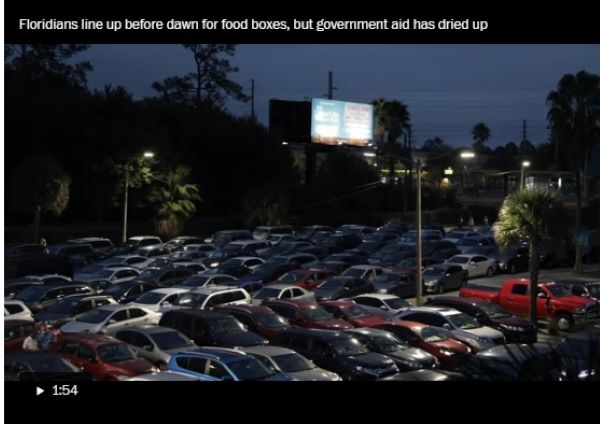
InternationalDec 09. 2020Dozens of vehicles wait to receive food at the Seasons Florida Resort in Kissimmee on Saturday, part of a food drive for Disney cast members and other tourism workers who have been furloughed or laid off. MUST CREDIT: Photo by Eve Edelheit for The Washington Post.
By The Washington Post · Laura Reiley, Greg Jaffe
KISSIMMEE, Fla. – Only weeks before the holidays, a $4.5 billion food program that has kept millions of Americans fed through the pandemic is running out of money.
The Farmers to Families Food Box program, a staple of food lines across America, was launched by the Trump administration in May to support struggling farmers and feed jobless Americans battered by the pandemic. It was supposed to provide food support through the end of the year. But because of soaring demand and a shortage of federal money, it is ending a month early in many regions of the country, leaving tens of thousands of families without a critical supply of food.
Anti-hunger experts warned that several other federal food programs are also set to expire, causing food banks across the country to lose about 50% of the food they receive from the Agriculture Department, even as food banks report an average 60% increase in need.
The program has gone through four rounds of funding since it began this spring: $1.2 billion in contracts were awarded in the first round, $1.76 billion in the second, and $1 billion in the third. The fourth round was cut to $500 million. The USDA, in a statement, acknowledged that the amount of funding in that last round, which covered November and December, “resulted in some non-profits being unable to participate and fewer box deliveries.”
But the USDA added that many nonprofit organizations chose to receive the boxes at a higher rate earlier in the program with the understanding that this would deplete supplies for the last two months of the year. But multiple nonprofit organizations interviewed by The Washington Post said they were not apprised of the limited food resources for this round.
“The needs are beyond what we can comprehend,” said Lawdia Kennedy, who oversees a biweekly food drive in suburban Atlanta. “We had three truckloads scheduled for Saturday and they just vanished. Six states are right now being told there will be no food, right before Christmas. It’s hard to put into words what this means for the families I serve.”
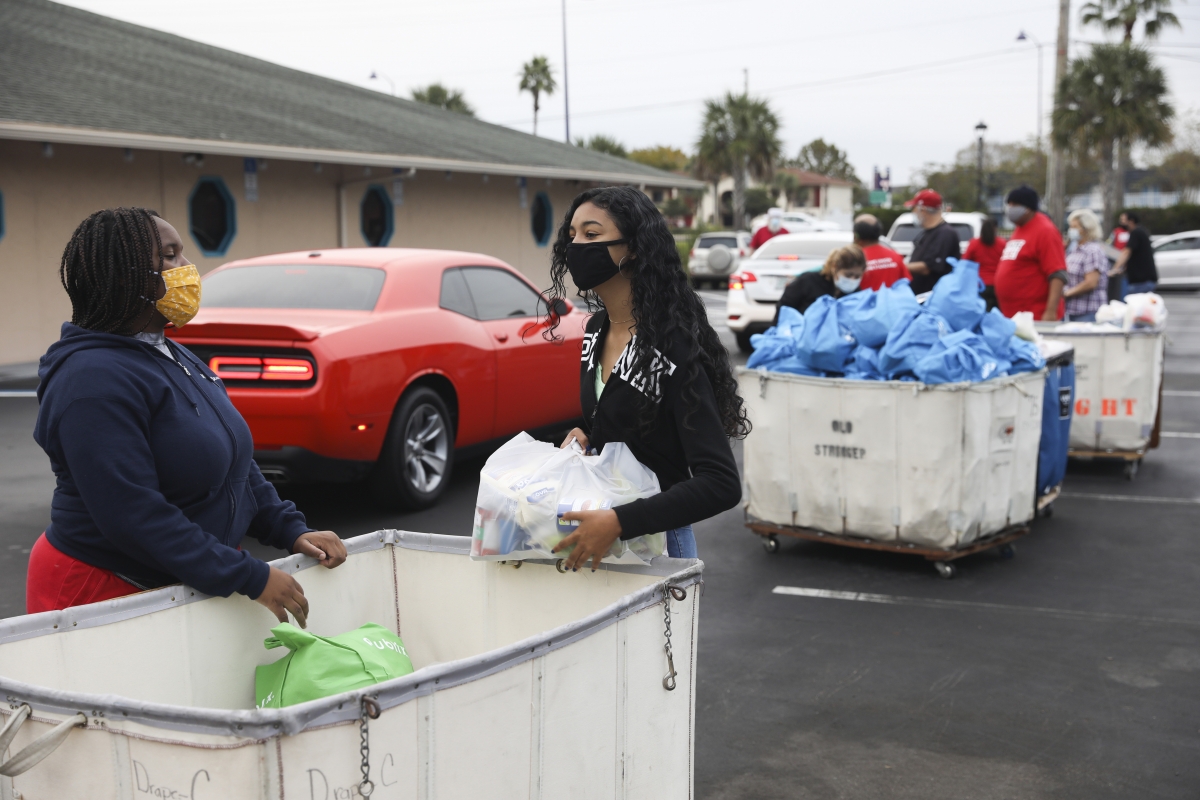
Volunteers Kyla Smith, left, and Kendra Rodriguez wait to hand out food at the Seasons Florida Resort in Kissimmee. MUST CREDIT: Photo by Eve Edelheit for The Washington Post.
Kennedy, who runs a nonprofit called Queen Material Community Center, scrambled unsuccessfully to find an alternative source of food. “I’ve been telling people that [the food drive] is postponed and might happen next weekend,” she said, “but that hope is turning into a lie.”
Likewise, the Los Angeles Regional Food Bank has seen “a huge decrease” in the number of boxes it receives from the program, according to David May, director of marketing and communications. “We are currently receiving 100,000 pounds of [boxes] per week, while we were receiving 3 million pounds per week during the summer,” May said.
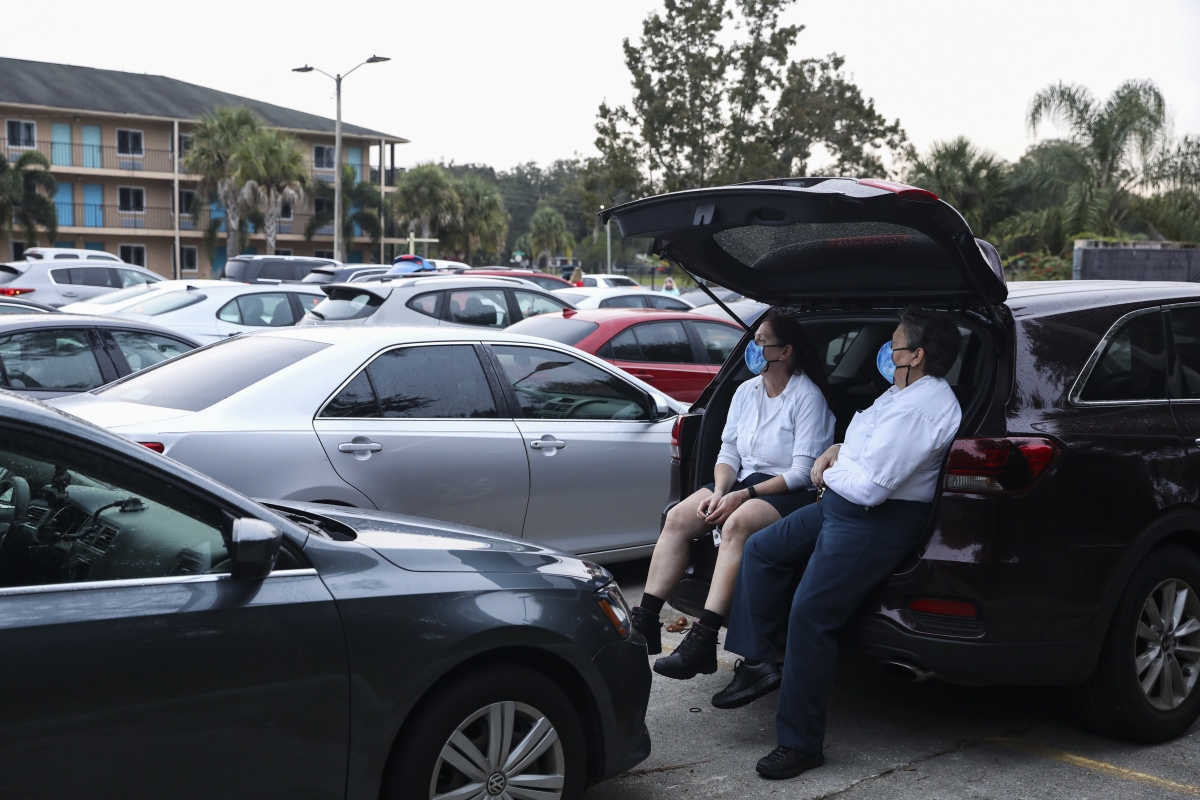
In Florida, the shortfall in the Farmers to Families program was evident Saturday in the parking lot of a shuttered motel about a dozen miles from Disney World. At 6:45 a.m., Yrais Vinana sat in her car, engine off, surrounded by hundreds of laid-off workers who had begun queuing up before dawn for food.
Canned and dry goods and corn were handed out at the Seasons Florida Resort in Kissimmee on Saturday. MUST CREDIT: Photo by Eve Edelheit for The Washington Post.
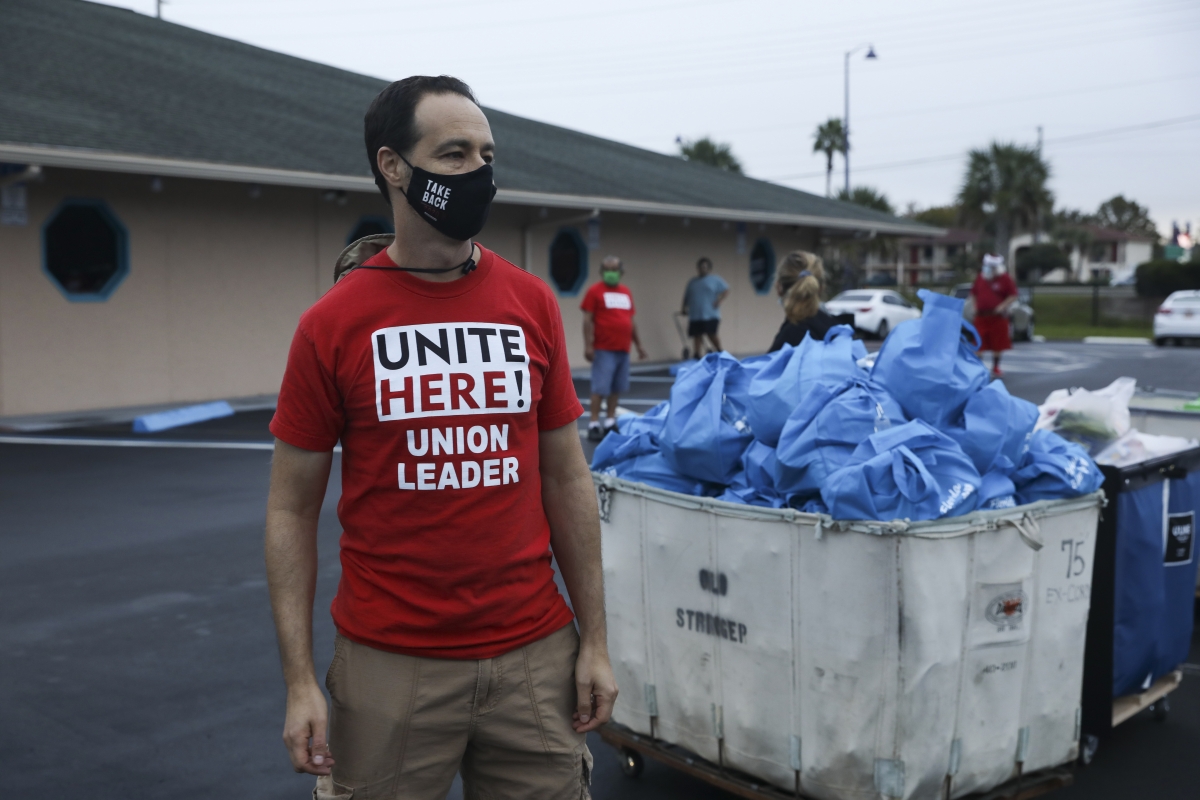
Until this past week, the food drive, run by the Society of St. Andrew, an anti-hunger charity, and the Unite Here Local 737 union, had distributed $155,805 worth of Farmers to Families food boxes every Saturday. For the past two months, Vinana, who is on furlough from her custodial job at Disney’s Grand Floridian property, could count on receiving one or two 32-pound boxes of food that typically included fresh fruit, milk, meat and cheese – enough to feed her family for three or four days. In Florida, the USDA contracted with Oakes Farms, a major food distributor, to supply the boxes each week.
This past Saturday was different. Instead of boxes of fresh food paid for by the federal government, the union dipped into its savings and raised money on Facebook to buy ramen, canned vegetables and Goya beans at Walmart.
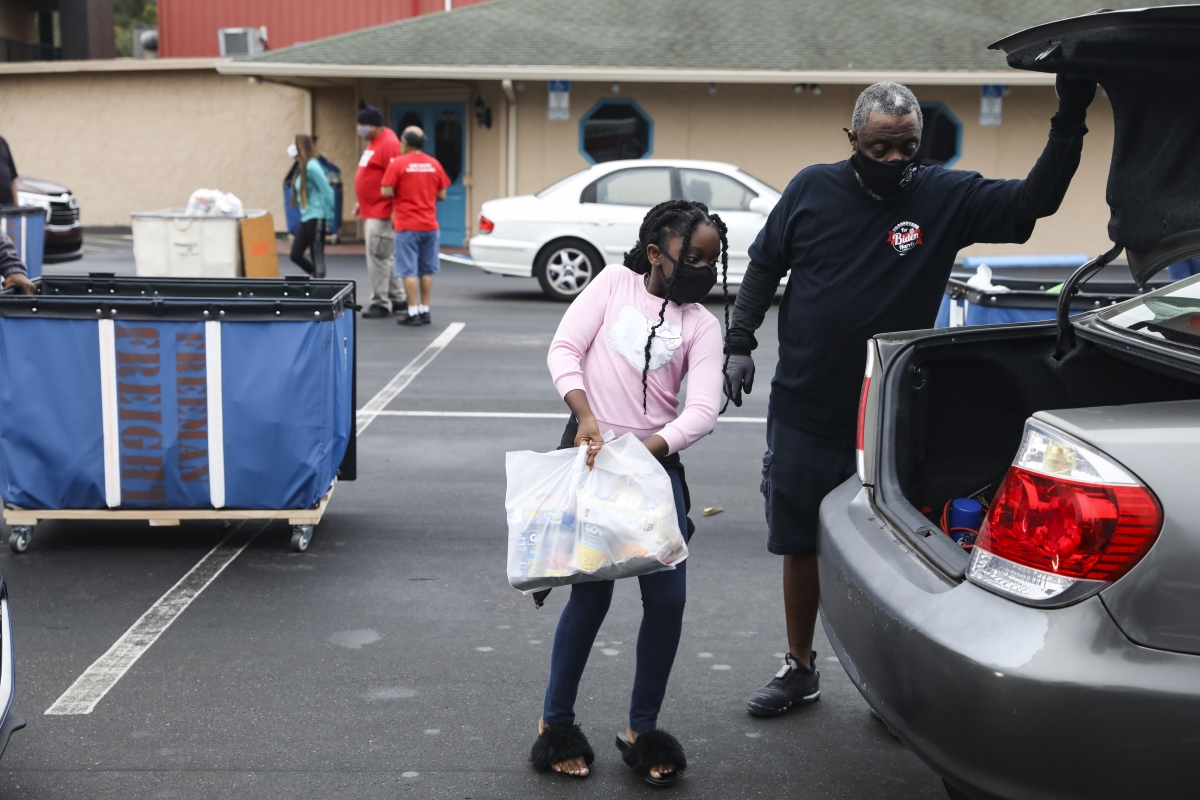
When the line began moving around 7 a.m., trunks popped open and volunteers, many of whom were also laid-off Disney workers, tossed in the plastic bags of food.
“One bag per car, no exceptions,” yelled Jeremy Haicken, president of Unite Here Local 737. Almost under his breath, he added, “People can’t believe the government promised food and reneged.”
Trunk lids slammed. Masked volunteers called out, “Have a good one!” Vinana exited the parking lot and turned onto a gritty stretch of highway lined with mini-golf courses, massage parlors, escape rooms, pawnshops and “family fun centers.” She and others in the food line wouldn’t realize how paltry this week’s assistance was until they unpacked their bags at home.
– – –
The Farmers to Families Food Box program began in May in response to the coronavirus pandemic, the crippling recession and the giant food lines forming across the country. It launched amid great fanfare and with the backing of President Donald Trump’s daughter Ivanka.
The program paid large food distributors to supply food boxes to nonprofits running food lines across the country. The smaller $500 million award for the program’s fourth phase has left some communities that took part in the spring and summer without a critical source of food this winter. The Adirondack region of New York, for example, received food for the first three rounds but was not selected for the final round, according to John Bernardi of the United Way of the Adirondack Region.
“That left a palpable void. The turnout had been unbelievable through the spring and summer. The boxes were really outstanding, with fresh food, meat and dairy,” Bernardi said. “This has left the food pantries overwhelmed.”
Fernaly Nazaire, 7, brings donated food to cars at the Seasons Florida Resort in Kissimmee. MUST CREDIT: Photo by Eve Edelheit for The Washington Post.
Other regions received funding for the most recent round, but it wasn’t enough to sustain them through the end of the year. Oakes Farms, a major Florida-based farming and food distribution company, was awarded $68 million in late October to supply food boxes in Florida, Georgia, South Carolina, North Carolina, Kentucky and the Virgin Islands. Two weeks into the program, Oakes officials said they realized that the money was not going to last, said Steve Veneziano, the company’s vice president. Veneziano said he and other Oakes executives assumed that the USDA would supply extra funds to meet the growing need in December. But the cash never came.
“We just didn’t know until it was too late,” he said. “The demand was just so overwhelming. We really needed two to two and a half times the award. We could’ve easily spent $150 million.”
The impact of that shortage quickly rippled through the Southeast last week as Veneziano called the food drives he was scheduled to supply to tell them that there was no money left for food. One of the first calls he made was to Kelly Stainner, who as program coordinator for the Florida chapter of the Society of St. Andrew is one of Oakes’s largest customers. Stainner’s group is responsible for distributing about 10,000 Oakes-supplied food boxes each week to nonprofit partners such as the Unite Here 737 local, which runs the Kissimmee food distribution site.
“Is there anything you can do?” Stainner recalled several of her partners asking her.
“I’ve tried. I’ve begged,” she told them. “There’s just no money.”
Kelly Madison, left, and Lori Mannel wait for food at the Seasons Florida Resort. MUST CREDIT: Photo by Eve Edelheit for The Washington Post.
The shortfall in funds also took Mary Diez-Castillo, vice president of Vision Community Outreach in Hialeah, Fla., completely by surprise. She was supposed to get 12,000 boxes last week from Oakes, but instead got zero. “We were getting 5 to 6 tractor trailers a day,” she said. “We fed 275,000 people in the month of November. We set up in shopping centers, in parks, in all the cities around here.”
The bad news sent her searching for alternatives. She cold-called 27 produce companies asking for donations and pivoted briefly to Mac Edwards Produce in the Doral area. But it, too, ran out of food money on Nov. 30.
“We are a nonprofit, run by volunteers with no salaries,” she said as she drove Friday to South Florida in search of food.
Like Haicken and Local 737, she is committed to continuing to provide food to laid-off workers until Congress passes a new relief bill, which could provide additional, emergency funding for the USDA food program. “We thought this would run until Dec. 31,” she said. “We’ll keep insisting. We won’t give up.”
The unexpected shortfall in the Farmers to Families Food Box program could be the first of several hits facing food banks across the country this winter.
The Food Purchase and Distribution Program, a component of the Trump administration’s aid to farmers who were suffering from the trade war with China, allocated $7.1 billion for direct food purchases for food assistance. The initiative bought commodity foods directly from farmers and distributed those goods to food banks. It ends Dec. 31.
These two programs alone accounted for 1.7 billion of the 5 billion meals distributed by Feeding America, a nationwide network of more than 200 food banks, said Claire Babineaux-Fontenot, the organization’s chief executive.
In total, food banks across the country are poised to lose about half of the food they have been receiving free from the federal government, Babineaux-Fontenot said.
Unite Here Local 737 President Jeremy Haicken helps out at Saturday’s food drive at the Seasons Florida Resort in Kissimmee. MUST CREDIT: Photo by Eve Edelheit for The Washington Post.
Forty percent of people turning to American food banks have never relied on them before, she added. Many of these newcomers, who are unfamiliar with other federal food assistance programs, turn first to the food lines that depend on the food box program for help. Based on estimates of increased unemployment and poverty, food insecurity could rise from 35 million at the start of 2020 to 50 million people by year’s end.
Currently, about $236 million in USDA funding is available for states to spend as part of the Emergency Food Assistance Program, a much smaller federal program that provides low-income Americans with emergency food assistance at no cost. But it is unclear how, or how swiftly, states could utilize these funds to make up for the loss of food boxes or other federal aid.
Of all the federal programs, the shortfall to the Farmers to Families Food Box program is perhaps the most urgent, because it is hitting families now. Peter Sharma, the owner of the Seasons Florida Resort in Kissimmee, which opened its parking lot to the weekly food drive, watched on Saturday morning as the union volunteers organized 20-bushel laundry bins full of the hastily assembled food bags.
The hotel has been closed since March, Sharma’s 24 employees furloughed.
Sharma recently put his house on the market to raise money to pay his annual tax bill. If it sells, he and his wife plan to move into his empty motel and wait for the tourists to return, hopefully by this summer.
Most weeks he asks the union to set aside some of the USDA food boxes for his furloughed employees. This week they would have to get by with the union-purchased plastic bags of beans and ramen.
“This is a herculean effort,” he said, watching the line move. “These people, they’re not the homeless. They’re working. They’re your neighbors.”

 Residents inspect destroyed houses in the coastal neighborhood of El Muelle after Hurricane Iota made landfall in Bilwi, Nicaragua, on Nov. 20, 2020. MUST CREDIT: Bloomberg photo by Carlos Herrera.
  Members of the Hashd al-Shaabi militia watch as photos featuring Qasem Soleimani and Abu Mahdi al-Muhandis are unveiled in Karrada, Baghdad, on Jan. 20. MUST CREDIT: photo for The Washington Post by Emilienne Malfatto.
  Christian Sewing
, chief executive officer of Deutsche Bank, at the Frankfurt Finance Summit in Frankfurt, Germany, on June 22, 2020. MUST CREDIT: Bloomberg photo by Peter Juelich.
Christian Sewing
, chief executive officer of Deutsche Bank, at the Frankfurt Finance Summit in Frankfurt, Germany, on June 22, 2020. MUST CREDIT: Bloomberg photo by Peter Juelich. 
 AT&T Chief Executive Officer John Stankey, speaking at an investment conference Tuesday, said HBO Max has added about 4 million new users in less than three months, putting activations at 12.6 million. MUST CREDIT: Bloomberg photo by Gabby Jones
  A combine harvester reaps in an aerial image taken over Princeton, Ill., on Sept. 29, 2020. Through the trade war and open hostilities at the highest political levels, pig farmers in China and crop farmers in the U.S. have become increasingly interdependent. MUST CREDIT: Bloomberg photo by Daniel Acker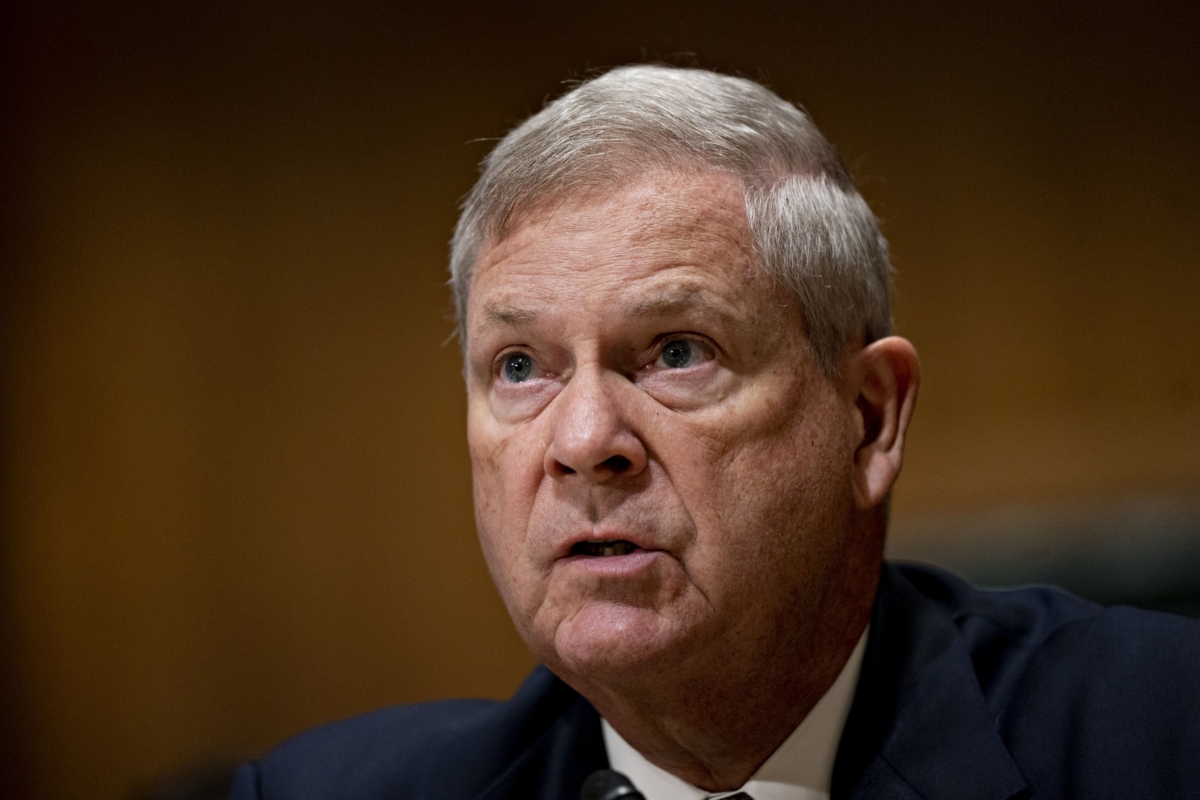
 President- elect Joe Biden introduces his health team at the Queen in Wilmington, Del., on Tuesday, Dec. 8, 2020. MUST CREDIT: Washington Post photo by Demetrius Freeman
  President Trump signs an executive order for “Ensuring Access to United States Government COVID-19 Vaccines” during an Operation Warp Speed Vaccine Summit at the White House complex on Tuesday. MUST CREDIT: Washington Post photo by Jabin Botsford
  President Trump, right, meets with Republican leadership, including Senate Majority Leader Mitch McConnell, R-Ky., center, and Rep. Kevin McCarthy, R-Calif., left, at the White House on March, 1, 2017 in Washington, MUST CREDIT: Washington Post photo by Bill O’Leary.
  Dozens of vehicles wait to receive food at the Seasons Florida Resort in Kissimmee on Saturday, part of a food drive for Disney cast members and other tourism workers who have been furloughed or laid off. MUST CREDIT: Photo by Eve Edelheit for The Washington Post.