All eyes on Britain for western world’s first covid shots #SootinClaimon.Com

#SootinClaimon.Com : ขอบคุณแหล่งข้อมูล : หนังสือพิมพ์ The Nation.

All eyes on Britain for western world’s first covid shots (nationthailand.com)

All eyes on Britain for western world’s first covid shots

InternationalDec 09. 2020

By Syndication Washington Post, Bloomberg · Emily Ashton, Corinne Gretler

Britain’s National Health Service launched what it has called the biggest immunization campaign in its history, starting covid vaccinations across the country.

People over 80 are at the front of the line for the shot made by Pfizer Inc. and BioNTech SE on Tuesday, with tens of thousands expected to get vaccinated in the coming days. The U.K. is the first western nation to begin its program, having approved the jab last week.

Margaret Keenan, who’s due to turn 91 next week, was the first person to get the vaccine at about 6:30 a.m., according to a statement. Receiving a shot at a hospital in Coventry was “the best early birthday present I could wish for,” Keenan said, because it meant she’d be able to spend time with her family and friends in the new year after being on her own for most of 2020.

“At the moment I don’t know how I feel — just so strange and wonderful, really,” she told reporters. “This is for a good cause, so I’m so pleased to have it done.”

Prime Minister Boris Johnson hailed a “huge step forward” in the fight against the coronavirus, which has infected more than 1.7 million people and killed more than 61,000 people in Britain. The U.K.’s speedy clearance of the vaccine has drawn criticism from experts in the U.S. and Europe, though domestic regulators say they’ve put safety first.

The stakes are high for Johnson’s government after missteps earlier in its handling of the pandemic, with the U.K. recording Europe’s highest death toll from the virus and reeling from the economic fallout of repeated lockdowns. Now it faces the logistical challenge of rolling out the vaccine to a country of 67 million people, amid concern that end-of-year holidays could spur a new wave of infections.

“It’s important for people to understand that the virus is, alas, still rising in some parts of the country,” Johnson told television reporters. “We can’t afford to relax now.”

As the program ramps up in the weeks ahead, Britons should continue to follow the social distancing rules in their area, the prime minister said. Some 99% of England’s population are currently in the top two tiers of restrictions — with many regions forced to close pubs and restaurants — as the government attempts to curb the spread of the virus.

Fifty hospitals are initially taking part in the vaccination campaign and have started scheduling over-80s for shots and working with care-home providers to book their employees into vaccination clinics. Around 800,000 doses are expected to be available in the first week, with as many as 4 million available by the end of the year, according to NHS Providers, which represents hospitals.

Any appointments not used for these groups will be available for health-care workers at highest risk of serious illness from covid-19, NHS England said. All those vaccinated will need a second shot 21 days after the initial jab.

A number of community-based family doctors will start vaccinations next week, before mass vaccination centers — based in sporting venues and conference centers — are brought online when further supplies of the vaccine become available.

Despite surveys showing sizable portions of the population are skeptical about the benefits of a vaccine or worried about safety, there’s no need for concern, Johnson said.

“I would say to all those who are scared: Don’t be,” he said. “There is nothing to be nervous about.”

The U.K. has struck deals for 357 million vaccine doses from seven makers, including the Pfizer-BioNTech collaboration. It plans to combine that shot with one from AstraZeneca Plc and the University of Oxford in trials next year, according to the U.K. Vaccine Taskforce.

When asked what went through her mind when she found out she was going to be the first to get the Pfizer shot, Keenan said she “thought it was a joke.”

“I’m happy it’s happened, and hopefully it’ll help other people come along and do as I did, and try and do the best to get rid of this terrible thing,” she said.

covid blunders in Latin America sow fears of more mistakes on vaccines #SootinClaimon.Com

#SootinClaimon.Com : ขอบคุณแหล่งข้อมูล : หนังสือพิมพ์ The Nation.

covid blunders in Latin America sow fears of more mistakes on vaccines (nationthailand.com)

covid blunders in Latin America sow fears of more mistakes on vaccines

InternationalDec 09. 2020Doctors and nurses work to resuscitate a patient in the covid-19 intensive care unit at the Emilio Ribas Institute of Infectious Disease hospital in Sao Paulo, Brazil, on Dec. 4, 2020. MUST CREDIT: Bloomberg photo by Jonne RorizDoctors and nurses work to resuscitate a patient in the covid-19 intensive care unit at the Emilio Ribas Institute of Infectious Disease hospital in Sao Paulo, Brazil, on Dec. 4, 2020. MUST CREDIT: Bloomberg photo by Jonne Roriz 

By Syndication Washington Post, Bloomberg · Andrea Navarro, Julia Leite, Simone Preissler Iglesias

One afternoon a couple months ago, hijackers commandeered a truck just east of Mexico City and hauled off its cargo. It wasn’t cash or jewelry but doses of ordinary flu vaccine so scarce in Mexico this year that there’s a black market for it in what many worry is an omen for covid-19 vaccination.

In Brazil, the region’s other behemoth, President Jair Bolsonaro, who belittles masks, is vowing not to get a covid vaccine, causing health officials to worry that his loyal supporters might follow suit. In Bolivia, the government has approved ingesting chlorine dioxide — bleach — against the virus, widely considered useless and dangerous.

Arguably, no region in the world has been hit as hard by the virus as Latin America. At the best of times, its health systems are wobbly. This pandemic year, with Brazil registering the world’s second-highest covid death toll and Mexico the highest case-fatality ratio, they’re unraveling, aggravating rising inequality, crime, economic decline and public mistrust. With 8% of the globe’s population and 30% of its covid deaths, Latin America is facing the pandemic’s next phase — mass vaccination — with alarm.

“Vaccine distribution will be complicated in developed countries but in Latin America you have to add a lack of transparency, lack of governance and corruption,” said Sergio Litewka, director of global bioethics at the University of Miami. “Will the same people who were incapable of handling the pandemic be able to handle the vaccine?”

There are problems that will affect all countries. Pfizer Inc. just announced that supply chain snags will halve this month’s distribution from original plans. INTERPOL has issued a global alert saying organized crime networks are targeting covid-19 vaccines, both physically and online, around the globe.

But Latin America, apart from a couple countries, appears more vulnerable than other regions. The virus has set back decades of gains in democracy and equality, and nearly tripled the number facing food insecurity. Given how poorly the region has fared over the past nine months and the ultracold equipment needed to store and transport two of the proven vaccines, many of its health leaders expect it to lag behind, with the risk of more virus waves still ahead.

A worker checks a refrigerated container carrying Sinovac Biotech coronavirus vaccines at Guarulhos International Airport in Sao Paulo, Brazil, on Nov. 19, 2020. MUST CREDIT: Bloomberg photo by Jonne Roriz

A worker checks a refrigerated container carrying Sinovac Biotech coronavirus vaccines at Guarulhos International Airport in Sao Paulo, Brazil, on Nov. 19, 2020. MUST CREDIT: Bloomberg photo by Jonne Roriz

Of the three vaccine front-runners, Pfizer’s and Moderna Inc.’s have shown 95% effectiveness but their costs and the temperature requirements might prove prohibitive. That leaves AstraZeneca Plc. The shot developed with the University of Oxford accounts for more than 40% of the supplies going to lower- and middle-income nations, based on deals tracked by London-based research firm Airfinity Ltd.

Health ministries across the region say they are gearing up with equipment, distribution points and plans to mobilize the military. Some have deals with big drug companies, most are part of Covax, a World Health Organization endeavor to help less well-off countries obtain vaccines speedily and at low prices.

But many in the know are worried.

Jorge Martin Rodriguez, professor of public health policy at Javeriana University in Bogota, says it will probably be 2022 or 2023 before Colombia is protected, something many don’t seem to realize.

“That hasn’t been mentioned much and it’s something to which we need to bring awareness,” Rodriguez said in a phone interview. “The risk will fall only when we reach herd immunity, ideally through vaccination.”

He estimates 45% of the population will acquire immunity through vaccine or infection next year, meaning restrictions will need to remain.

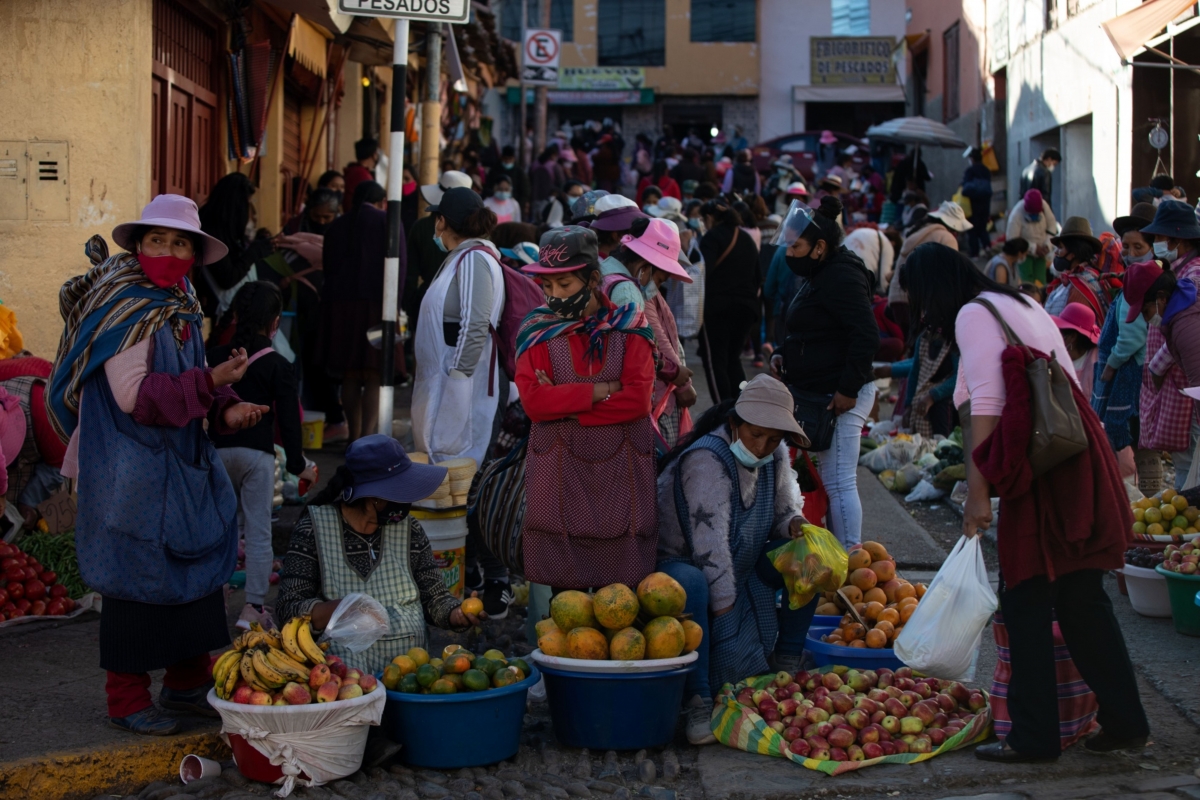
Vendors wear protective masks at a market in Cusco, Peru, on Oct. 13, 2020. MUST CREDIT: Bloomberg photo by Jonne Angela Ponce

Vendors wear protective masks at a market in Cusco, Peru, on Oct. 13, 2020. MUST CREDIT: Bloomberg photo by Jonne Angela Ponce

Mexico and Argentina signed a deal in August with Astra through billionaire Carlos Slim’s foundation to fund the production of as many as 250 million doses. Brazil is hosting phase 3 trials for Pfizer, AstraZeneca, Sinovac and Janssen.

In theory, Brazil should fare better vaccinating its 210 million people than it did containing the disease. According to a dozen health experts consulted, its five-decade-old immunization program, which operates 35,000 outposts, is in sturdy shape. Even in this difficult year, the government reached 90% of the people it intended to with the annual flu shot.

Vice President Hamilton Mourao said on Monday the country should vaccinate 150 million people by the end of 2021. The government, which is mostly relying on the AstraZeneca shot, is now also in talks to purchase 70 million doses from Pfizer.

But recent mishaps are causing concern. Last month, it was reported that there were almost 7 million high-quality coronavirus tests sitting unused in a Sao Paulo airport, with most of them set to expire by January.

“I had no idea that was even there,” said Carlos Lula, health secretary of the northern state of Maranhao and president of Conass, the association of the country’s state secretaries. “We had been pleading with the health ministry for more tests.”

Like the U.S., Brazil is a federal system and the central government may or may not play a major role in health care. Governors implemented measures as they saw fit, asking the country’s supreme court to ensure Bolsonaro would not overrule them in his push to get people back to work. As a result, the virus behaved differently across the nation’s 27 states, a first wave that folded into a second in what some have described as a “tsunami” of infections.

Talks between the health ministry and states remain stalled and there are disagreements over whether to use the Chinese vaccine, CoronaVac, which Sao Paulo state says will begin to be deployed on Jan. 25. The expectation is that Brazil will need more than one vaccine to cover the whole country.

“We’ll have to get creative — applying vaccines at home, in drive-throughs, churches, stadiums,” said Juarez Cunha, the head of the Brazilian Society of Immunization. “We’ve done it before, and we’ll have to do it again.”

In next-door Argentina, Adolfo Rubinstein, a former health minister, said he doesn’t expect mass vaccination across Argentina until the second half of 2021 partly because of the need for the low-temperature freezers.

“There aren’t so many freezers available, particularly in the most distant, rural areas,” he said. Noting that winter, along with its spike in cases, will start in the Southern Hemisphere as vaccine distribution begins, he added, “It’s very likely that, starting in April, you’ll start to see a new outbreak of cases.”

AstraZeneca is among the pharma companies supplying Covax, the WHO effort, which will accelerate the production of Astra or Novavax shots for low- and middle-income nations, priced at a maximum of $3 per dose. Sanofi and partner GlaxoSmithKline have also signed on. As the shots become available, Covax will distribute them at the same rate until all countries have enough doses to cover 20% of their populations.

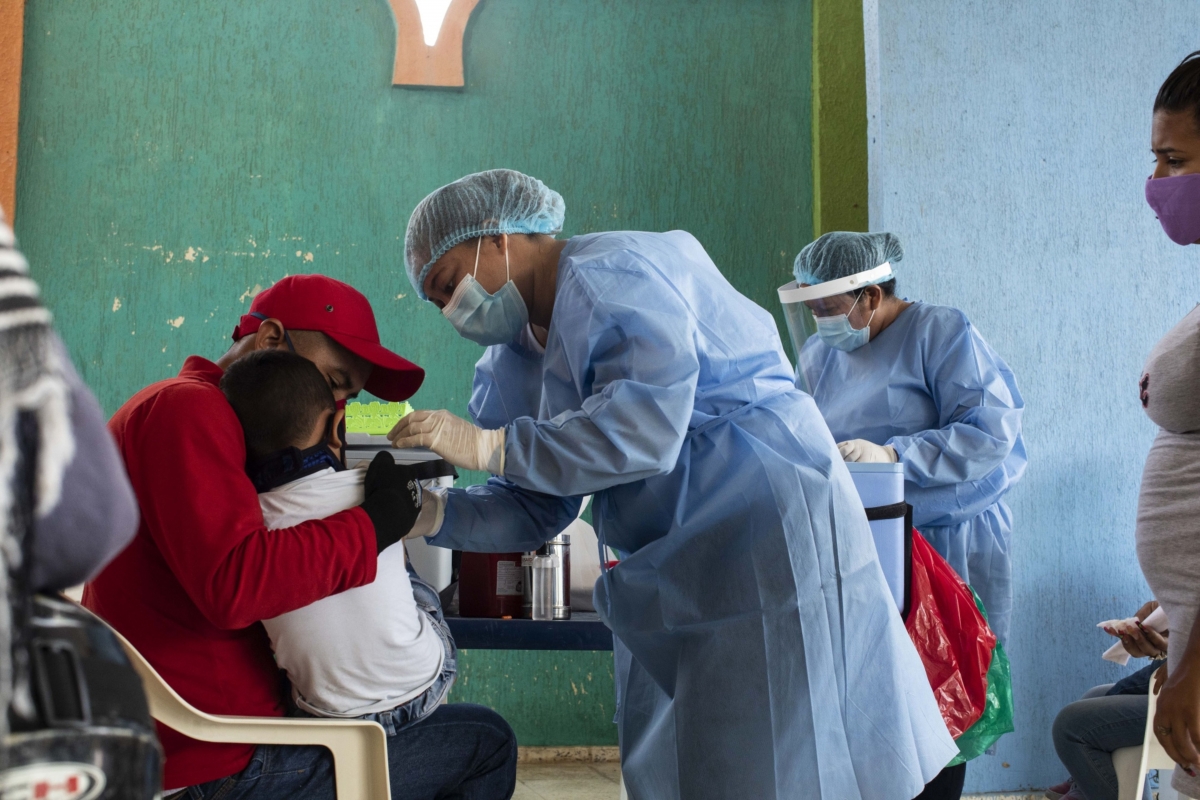
Health-care workers of the San Jose Hospital mobile unit treat Venezuelan migrants at a closed school in Maicao, La Guajira, Colombia, on Oct. 1, 2020. MUST CREDIT: Bloomberg photo by Nicolo Filippo Rosso

Health-care workers of the San Jose Hospital mobile unit treat Venezuelan migrants at a closed school in Maicao, La Guajira, Colombia, on Oct. 1, 2020. MUST CREDIT: Bloomberg photo by Nicolo Filippo Rosso

In Mexico, the government says more flu shots will be available in the coming weeks, blaming the slow deployment on one of the largest producers, Sanofi Pasteur Inc. Sanofi says its supply chain was affected by the pandemic.

“It’s been a complete failure, there are no flu vaccines,” said Francisco Moreno, head of internal medicine at ABC Medical Center in Mexico City. “Mexico is gearing up for another disaster because we couldn’t control the covid pandemic and we didn’t prepare the population against the flu.”

There are a couple bright spots in the region.

Uruguay has the lowest infection and mortality rates in South America thanks to one of the best health-care systems and widespread adoption of voluntary social distancing policies. The country of 3.5 million closed its borders early and plans to keep them closed over the Christmas tourism season. President Luis Lacalle Pou said the government expects to have a vaccine available as soon as April.

And in Chile, which had some tough covid months, Josefina Bascunan, head of academic, research and strategic alliances at Hospital del Trabajador in Santiago, said the flu vaccine went well this year and she believes the government can put in place a strong coronavirus vaccination strategy.

More typical however, is Peru, which has suffered mightily under covid despite stringent lockdown efforts and now looks to vaccination with concern.

Victor Zamora, a recent health minister, said congress – which recently impeached a president – hasn’t yet debated legislation to fast-track the approval for new vaccines. He added that 70,000 nurses and a great deal of equipment need to be mobilized.

“You can’t expect this fragmented, bureaucratic, slow, politicized state to guarantee you modern, executive logistics,” he said by telephone. “I’d prefer the private sector do it even if it costs more money. Just in masks and gowns in the public sector, there is enormous loss because of theft, corruption and mismanagement.”

“If the private sector can get a Coca-Cola to the remotest point on this map of Peru, and I can’t get there with a paracetamol, we’re doing something wrong and they’re doing something right.”

Merkel is losing her touch at the worst possible time #SootinClaimon.Com

#SootinClaimon.Com : ขอบคุณแหล่งข้อมูล : หนังสือพิมพ์ The Nation.

Merkel is losing her touch at the worst possible time (nationthailand.com)

Merkel is losing her touch at the worst possible time

InternationalDec 09. 2020German Chancellor Angela Merkel, followed by Hungarian Prime Minister Viktor Orban, in Berlin on Feb. 10, 2020. MUST CREDIT: Bloomberg photo by Krisztian BocsiGerman Chancellor Angela Merkel, followed by Hungarian Prime Minister Viktor Orban, in Berlin on Feb. 10, 2020. MUST CREDIT: Bloomberg photo by Krisztian Bocsi 

By Syndication Washington Post, Bloomberg · Arne Delfs

At a critical juncture for Germany and the European Union, Angela Merkel is faltering.

In the final months of her 16-year tenure, the German chancellor is within touching distance of a historic budget settlement that would underpin the recovery from the pandemic, bind the EU closer together and accelerate the shift to a carbon-neutral future. It’s threatening to slip through her fingers.

For years, Merkel has allowed rule-of-law violations in Hungary and Poland to fester. Now they could derail the $2.2 trillion (1.8 trillion-euro) budget and jointly funded recovery package that was supposed to be the centerpiece of Germany’s EU presidency. To make matters worse, the dispute with the U.K. over post-Brexit trade ties is overshadowing preparations for Thursday’s crucial EU summit and raising the risk of another economic shock.

With negotiations hamstrung by restrictions on face-to-face meetings, Merkel’s European allies are talking about pressing ahead with the recovery fund without the two eastern holdouts. That would open a breach at the heart of the EU, fuel concerns that more member states could ultimately follow Britain’s exit, and interrupt the reintegration of former Communist states that has been a leitmotif throughout the chancellor’s political career.

“We had imagined our presidency differently,” Merkel told European lawmakers last week. “The presidency is marked by the pandemic. That’s just the way it is, and you have to take things as they are.” Dissenters within her party say the chancellor should also shoulder some of the blame.

Inside the concrete edifice of Berlin’s chancellery, Merkel has been switching between crisis meetings over the mounting number of covid-19 cases in Germany and phone calls with EU leaders aimed at finding ways forward, according to an official, who asked not to be identified discussing internal deliberations.

Normally, her spokesman Steffen Seibert issues a statement after such conversations, but during the budget crisis, there’s been little communication — a sign of just how sensitive the issue has become. Even when French President Emmanuel Macron mentioned he’d be speaking to the chancellor on Monday, Seibert refused to comment.

In an effort to resolve the stalemate, Merkel is resorting to an old trick, said the official familiar with her thinking. She tries to get herself into the mind-set of her opponent to understand their weaknesses and find an opening for a compromise.

The threat of EU funds drying up is one obvious pressure point, but for Hungary’s Viktor Orban and his Polish counterpart Mateusz Morawiecki, there’s more at stake, including national identity and a cultural agenda that collides with EU principles. That’s tough for the notoriously pragmatic German leader to crack.

Making Merkel’s position more difficult is that she let Orban flout the rules for years without suffering any consequences, his party Fidesz even remained a member of the same European grouping as Merkel’s Christian Democrats. During the refugee crisis of 2015, which marked a watershed in Merkel’s relationship with German voters, Orban refused to take on Hungary’s allotment of migrants even when threatened with a cut in EU funding. And he ultimately suffered no repercussions.

This time it’s not just the EU’s moral authority at stake, this fight is about its economic and political future. And the chancellor’s normally unflappable demeanor is starting to show the strain.

Her frustration was evident when she addressed European parliamentarians last week on the results of the German presidency. She bemoaned her lack of progress and unusually complained about the demands put on her.

“There are those who tell me: don’t make a compromise here and don’t change a single comma there. And then the same people tell me: but please come back with a result,” the 66-year-old chancellor said. “Without compromise from all sides, this won’t work.”

Back home in Germany, some in her political movement are suggesting the chancellor carries some of the responsibility for her problems. In the Christian Social Union — the Bavarian sister party of Merkel’s Christian Democrats — many officials say she misjudged support for the recovery fund and put Germany into an untenable position, just like she did with her open-door refugee policy.

EU leaders should have known that the connection between the budget and democratic standards would provoke a hard confrontation, according to Alexander Dobrindt, leader of the CSU caucus in the Bundestag.

Her most prominent critic is Ralph Brinkhaus, who leads the CSU and Merkel’s Christian Democratic Union in Germany’s lower house. Brinkhaus spent political capital persuading conservatives in their party to support the EU’s controversial joint-debt plan only to see the agreement among leaders fall apart.

When the recovery fund was agreed in July, Merkel was also winning plaudits for the low rate of infection during the first wave of the coronavirus pandemic. But the country has been hit much harder during the fall and Merkel’s partial lockdown policy has come in for heavy criticism while failing to bring the virus under control.

That’s another point of friction for German conservatives — already on edge as they struggle to chart a path for the post-Merkel era. The country’s soft shutdown is costing the federal government at least 15 billion euros a month to support affected bars, gyms and cinemas.

At a meeting in November, state leaders rejected and openly criticized the chancellery’s push for harsher restrictions, including limiting kids to one playmate. By proposing measures that were too ambitious for the states to accept, Merkel wound up empty-handed, delaying a longer term strategy and leaving Germany most likely facing tighter curbs.

Tension in the ranks over the disjointed strategy erupted at a closed-door meeting of CDU leadership last week. Volker Bouffier — the state premier of Hesse, home of the Frankfurt financial center — shouted down Brinkhaus over his criticism of the lack of state financing for pandemic support.

“Let me make it clear we are no longer willing to watch your grandstanding,” he said, while Merkel sat quietly as the exchange unfolded, according to an official familiar with the meeting. A spokesman for Bouffier didn’t respond to a request for comment.

Her pending departure from the political scene after elections in the fall is also playing into her fading authority. Markus Soeder, the Bavarian premier who’s the front-runner to succeed her, has grabbed the coronavirus spotlight. He preempted harsher national rules by implementing a state of emergency starting Wednesday, including a strict curfew in hard-hit areas.

At a meeting with Merkel last week, which extended national curbs to Jan. 10, he slammed the current approach as too timid.

“The question is whether we can keep the country in this kind of half-sleep all the time, or whether we will have to think again at some point to take a very clear and consistent deeper approach in some places,” he said.

Merkel shot him an irritated look, but her own plans for tougher measures on a national level had been shot down by state premiers in November. They both knew she was powerless to change things.

Women in Asia often abused online but find limited recourse: UN Women study #SootinClaimon.Com

#SootinClaimon.Com : ขอบคุณแหล่งข้อมูล : หนังสือพิมพ์ The Nation.

Women in Asia often abused online but find limited recourse: UN Women study (nationthailand.com)

Women in Asia often abused online but find limited recourse: UN Women study

InternationalDec 08. 2020

By The Daily Star

Civil society activists say that women commonly face online violence in Asian countries but for many victims, fear and distrust make reporting these attacks to authorities “often the last resort,” a new UN Women study has found.

Countries should respond by strengthening prosecutions and sanctions against perpetrators and increasing efforts to correct the gender inequality and misogynistic norms in society that drive the violence, the report says.

The report — “Online Violence against Women in Asia” — focused on situations in India, Malaysia, Pakistan, the Philippines and Republic of Korea. It was funded by the Government of the Republic of Korea.

It is set to be released today at the Online Violence against Women in Asia Cyber Café event, organised as part of the United Nations Secretary-General’s annual 16 Days of Activism against Gender-based Violence (November 25 to December 10).

The report was done before the COVID-19 pandemic but is even more relevant now when lockdowns have pushed so much of communication, business and services online, possibly increasing the risk of online attacks against women.

The report says the violence includes digital voyeurism, morphing of women’s bodies into composite images, harassment of women over clothing and behaviour deemed “inappropriate,” dissemination of rape video footage, and live-streaming of child sexual abuse.

It says people with limited digital skills — mostly women and girls  — are more at risk. Also at risk of sexual exploitation, it says, are children who are now spending more time online.

Civil society activists interviewed by the researchers said victims preferred to confide in friends, work colleagues and civil society organisations and “rarely or never” report attacks to the authorities.

“Fear of reprisals from perpetrators, lack of confidence in police, the high cost of civil legal action and a lack of confidence in the judicial process are significant barriers to complaining to authorities,” the report says.

The report says that according to activists, online violence against women “is a low priority for the police and prosecutors, and there is an unhealthy level of victim blaming.”

It further says specific legal provisions are needed to respond to online violence against women, including specialised courts and specially trained investigators and prosecutors.

Governments also need to do more to educate people about proper Internet etiquette, toxic online behaviour, and the prohibition of online violence against women, the report says.

“Online presence, an essential during the COVID-19 pandemic, is crucial for obtaining and maintaining a job, accessing information, exercising democratic rights, having a voice, getting an education and conducting commercial transactions,” said Sarah Knibbs, UN Women Deputy Regional Director for Asia and the Pacific.

 “For the survivor, reporting the attack requires courage and confidence that the system will protect and support to see her through the process. It is imperative that online violence receive the same legal treatment as other forms of violence. If offline sexual harassment and stalking are crimes, online harassment and cyberstalking should similarly be criminalised.”

Cambodian court to start hearing Wanchalerm case today #SootinClaimon.Com

#SootinClaimon.Com : ขอบคุณแหล่งข้อมูล : หนังสือพิมพ์ The Nation.

Cambodian court to start hearing Wanchalerm case today (nationthailand.com)

Cambodian court to start hearing Wanchalerm case today

InternationalDec 08. 2020

By The Nation

A Cambodian court will begin hearings on Tuesday into the disappearance of Wanchalearm Satsaksit, a Thai activist and political exile, who disappeared from Phnom Penh in the middle of the year.

Thanee Saengrat, director-general of the Department of Information and spokesman of the Ministry of Foreign Affairs, said Thai authorities have coordinated closely with their Cambodian counterparts as soon as they had learned of Wanchalearm’s disappearance in June 2020.

The Royal Thai Embassy in Phnom Penh had sent a letter to the relevant authorities in Cambodia requesting cooperation to investigate the matter after hearing the news, Thanee said.

The Ministry of Foreign Affairs is concerned about the well-being of Wanchalearm which is considered an important mission of the ministry to provide consular assistance to Thai people in foreign countries in distress as well as coordinating and giving advice to Wanchalerm’s sister, Sitanan Satsaksit, Thanee said.

Recently, the ministry facilitated through the Department of Consular Affairs and the Royal Thai Embassy in Phnom Penh for Wanchalerm’s sister to travel to Cambodia to provide information to the judge after receiving an invitation from the Phnom Penh Civil Court.

“Thai authorities cannot express any opinion on the case since it is under investigation in Cambodia,” Thanee said.

On Tuesday, the Cambodian court will arrange a preliminary examination for the first time in the case of Wanchalerm.

The spokesperson for the Ministry of Foreign Affairs stated that Thailand was committed to the rule of law and human rights principles in accordance with its obligations and related international laws to which Thailand was a partner.

“The Thai government has a constitutional duty to protect and oversee the interests of all Thais.

“The Thai government has made every effort to facilitate through the relevant government agencies so that the legal process can go well in the search for Wanchalerm,” Thanee said.

Pfizer tells U.S. officials it cannot supply additional vaccine until late June or July #SootinClaimon.Com

#SootinClaimon.Com : ขอบคุณแหล่งข้อมูล : หนังสือพิมพ์ The Nation.

Pfizer tells U.S. officials it cannot supply additional vaccine until late June or July (nationthailand.com)

Pfizer tells U.S. officials it cannot supply additional vaccine until late June or July

InternationalDec 08. 2020

By The Washington Post · Laurie McGinley, Yasmeen Abutaleb, Carolyn Y. Johnson

WASHINGTON – Pfizer has told the Trump administration that it cannot provide additional doses of its coronavirus vaccine until late June or early July because other countries have rushed to buy up its supply, according to individuals familiar with the situation.

That means the U.S. government will have 100 million doses of the two-shot Pfizer vaccine purchased earlier this year – far fewer than it initially planned – raising questions about whether it can keep to its aggressive schedule to vaccinate most Americans by late spring or early summer.

Trump administration officials denied that there would be availability problems in the second quarter, citing other vaccines in the pipeline, but others said problems are possible.

“I’m not concerned about our ability to buy vaccines to offer to all of the American public,” Gen. Paul Ostrowski, who oversees logistics for Operation Warp Speed, the government’s initiative to expedite vaccine development, said in an interview Monday. “It’s clear that Pfizer made plans with other countries. Many have been announced. We understand those pieces.”

But several officials knowledgeable about the contracts said that if there is a Pfizer shortfall for the second quarter, supplies from other companies may be insufficient to fill the gap, depending on which other vaccines have been authorized by then.

Pfizer officials had urged Operation Warp Speed to initially purchase 200 million doses, or enough for the two-shot regimen for 100 million people last summer, according to people knowledgeable about the issue who spoke on the condition of anonymity because they were not authorized to discuss the situation. But the Warp Speed officials declined, opting instead for 100 million doses, or enough for 50 million people, they said.

“Anyone who wanted to sell us . . . without an [FDA] approval, hundreds of millions of doses back in July and August, was just not going to get the government’s money,” said a senior administration official.

When federal officials recently approached Pfizer to buy another 100 million doses for the second quarter of next year – after the company released data showing the shots to be remarkably effective – Pfizer said the company would be able to provide only 50 million doses in the second quarter of the year, and another 50 million doses in the third quarter, the individuals said. That’s because other countries have ordered the vaccines, they said.

President Donald Trump is expected to sign an executive order on Tuesday that would prioritize vaccinating Americans before providing doses to other countries, according to a senior administration official who spoke on the condition of anonymity because he was not authorized to speak about the plans. Fox News first reported the executive order. It is not clear whether the order is related to the Pfizer supply issue or whether the president can prevent an American company from fulfilling lawful contracts with other countries. The order will be announced as part of a White House “vaccine summit” designed to highlight the administration’s accomplishments on vaccines.

“The executive order reaffirms to the American people that we are going to put America first,” said a senior administration official, who spoke on the condition of anonymity because he was not authorized to discuss the issue publicly.

The vaccine by Pfizer and German biotech firm BioNTech is expected to receive emergency authorization from the Food and Drug Administration in the next several days, and Moderna’s is lined up for clearance shortly after that. Shipments of the vaccines will begin within 24 hours of the approvals, federal officials have said.

Warp Speed officials hope other companies with promising vaccine candidates – including Johnson & Johnson – will provide what’s needed, but some of those companies are still conducting late-stage clinical trials, while others have not started them.

That means there are several weeks to months before the companies are ready to submit an application to the FDA for emergency authorization. One of the companies, AztraZeneca recently reported vaccine data that was encouraging, but experts raised questions about the data and what it meant about the efficacy of the vaccine.

Moncef Slaoui, chief science adviser to Warp Speed, said in an interview Monday that the U.S. government strategy was to spread its risk widely over many different types of vaccines from different manufacturers. He declined to comment on negotiations with any company, including Pfizer. But he said he did not believe there would be any kind of vaccine “cliff,” from which the available doses would fall sharply.

Slaoui said that Johnson & Johnson was likely to report trial results in early January and be ready to ship doses in February, if its vaccine is authorized. He predicted that AstraZeneca’s trial would report results in late January or early February and potentially begin providing doses that month.

“Specifically this means we can have more Moderna vaccine doses, more Pfizer vaccine doses, more Johnson & Johnson vaccine doses and AstraZeneca doses for the foreseeable future,” Slaoui said. “We could have all of them. And for this reason, we feel confident we could cover the needs without a specific cliff. . . . We have planned things in such a way as we would indeed avoid a cliff.”

The contract that Pfizer signed with the government in July was to deliver 100 million doses of vaccine, and it contained an option to request up to an additional 500 million doses. Those doses will begin being shipped to communities across the country within 24 hours of FDA approval, which could come as early as this week.

“Pfizer shall inform the Government of appropriate lead times based on purchase of raw materials, capacity reservation and other factors, and Pfizer and the Government shall mutually agree on an appropriate estimated delivery schedule,” the contract states.

“Recognizing the urgency of the need, our manufacturing teams have been working round-the-clock so we can bring the vaccine to the world as quickly, efficiently and equitably as possible,” Pfizer spokeswoman Amy Rose said.

Additional doses would be “subject to a separate and mutually-acceptable agreement,” she said, and the company would not comment on confidential negotiations that might be taking place with the U.S. government.

No agreements with Moderna beyond its initial contract have been announced, but the U.S. has the option to purchase 400 million additional doses, at a cost of $16.50 per dose.

Christmas could lead to more coronavirus spread than Thanksgiving, Fauci says #SootinClaimon.Com

#SootinClaimon.Com : ขอบคุณแหล่งข้อมูล : หนังสือพิมพ์ The Nation.

Christmas could lead to more coronavirus spread than Thanksgiving, Fauci says (nationthailand.com)

Christmas could lead to more coronavirus spread than Thanksgiving, Fauci says

InternationalDec 08. 2020

By The Washington Post · Reis Thebault, Teo Armus, Marisa Iati

Anthony Fauci, the country’s leading infectious-disease expert, warned Monday that Christmas celebrations could facilitate the spread of the virus even more than Thanksgiving, because Christmas gatherings often start several days before the holiday and continue through New Year’s.

Fauci said Christmas gatherings often start several days before the holiday and continue through New Year’s. Health officials are scrambling to apply the lessons from a Thanksgiving holiday weekend in which millions defied pleas not to travel.

And although vaccines appear to be around the corner, Fauci said a measurable decline in deaths is likely to take at least several weeks after health-care workers and nursing-home residents start being inoculated.

“But it will come, I’ll guarantee you,” he said. “If we get the appropriate people vaccinated, we do it on time and then we go to the next level, there’s no doubt that vaccine is going to be able to turn this around.”

Later in the day, Fauci said he was willing to get his coronavirus vaccine in front of cameras to allay concerns about the vaccines’ safety.

“I’d be more than happy to do it publicly,” he told “CBS Evening News” anchor Norah O’Donnell during an interview hosted by the Milken Institute.

Fauci on Monday also praised the stay-at-home orders that took effect in most of California this weekend as a crush of coronavirus infections brought the state’s hospital system to its knees.

Fauci, director of the National Institute of Allergy and Infectious Diseases, said he has told state health authorities that he agreed with their decisions.

“I said, ‘You know, you really don’t have any choice,’ ” Fauci said on CNN. “When you have the challenge to the health-care system, you’ve got to do something about that.”

In other developments:

– Pfizer has told the Trump administration it cannot provide additional doses of its coronavirus vaccine until late June or early July, sources say. That means the U.S. government will have 100 million doses of the Pfizer vaccine that it purchased earlier this year – far fewer than it initially planned – raising questions about whether it can keep to its aggressive schedule to vaccinate most Americans by late spring or early summer.

Trump administration officials denied there would be availability issues in the second quarter, citing other vaccines in the pipeline, but others said problems are possible.

– The Los Angeles public school district, the second-largest in the United States, will revert to online learning for the rest of the semester.

– Millions of Americans who lost their jobs during the pandemic have fallen thousands of dollars behind on rent and utility bills.

– Leaders of the largest U.S. corporations expect sales to ramp up in the next six months, signaling rising optimism about the nation’s economy.

Restaurant closings top 110,000 with industry in ‘free fall’ #SootinClaimon.Com

#SootinClaimon.Com : ขอบคุณแหล่งข้อมูล : หนังสือพิมพ์ The Nation.

Restaurant closings top 110,000 with industry in ‘free fall’ (nationthailand.com)

Restaurant closings top 110,000 with industry in ‘free fall’

InternationalDec 08. 2020A A “Closed Forever” sign is displayed on Louis’ Restaurant, an 83-year-old diner that closed permanently this year in San Francisco, Calif. Photographed Aug. 5, 2020. MUST CREDIT: Bloomberg photo by David Paul Morris 

By Syndication Washington Post, Bloomberg · Carolina Gonzalez

More than 110,000 restaurants have closed permanently or long-term across the country as the industry grapples with the devastating impact of the covid-19 pandemic. And more pain is ahead, with a potential shutdown of indoor dining in New York City just as the temperatures drop.

The nationwide tally — representing one in six U.S. eateries — is among the findings of a survey released Monday by the National Restaurant Association. The figure was up from about 100,000 shutdowns in a September survey. The Washington-based trade group shared the latest results with Congressional leaders in an attempt to secure financial support for a sector rocked by rising costs and falling sales.

“The restaurant industry simply cannot wait for relief any longer,” Sean Kennedy, executive vice president of public affairs at the association, said in a letter to Congress. “What these findings make clear is that more than 500,000 restaurants of every business type — franchise, chain and independent — are in an economic free fall.”

As people continue to stay and eat at home and new indoor dining bans emerge across the country, restaurateurs have struggled to keep up sales, with many of the hardest-hit areas in states such as New York and Illinois. Almost 90% of full-service restaurants in the survey reported declines, with revenue falling 36% on average.

Expenses are also climbing amid the pandemic, with 59% of operators saying their total labor costs as a percentage of sales are higher than they were pre-pandemic.

The industry has pleaded for aid, with many pinning their hopes on the Restaurants Act, which would establish a $120 billion fund to help restaurants, as well as a second draw of the Paycheck Protection Program.

In the meantime, the sector faces dire prospects. Thirty-seven percent of operators say it is unlikely their restaurant will still be in business six months from now if there are no additional government relief packages, according to the survey. More than one in three operators are considering temporarily closing until conditions improve.

With covid cases on the rise, New York Gov. Andrew Cuomo, D, said indoor dining would be shut down in New York City and reduced across the rest of the state if the regional hospitalization rate has not stabilized after five days.

The pain is felt among publicly traded chains as well as independent establishments. An S&P index of restaurant stocks fell as much as 1.3% Monday, with Dave & Buster’s Entertainment Inc., BJ’s Restaurants Inc. and Cheesecake Factory Inc. among the biggest decliners. Each have relatively large exposure to California, which continues to be rattled by lockdowns, wildfires and forced power outages.

“It’s hard to look past the current very difficult restaurant industry sales and traffic trends for rays of industry sunshine,” Telsey Advisory Group analyst Bob Derrington wrote in a note. He expects sales trends to remain “volatile” into 2021 as more states and municipalities are “once again cracking down on social gatherings including dining in bars and restaurants.”

Millions of Americans are heading into the holidays unemployed and over $5,000 behind on rent #SootinClaimon.Com

#SootinClaimon.Com : ขอบคุณแหล่งข้อมูล : หนังสือพิมพ์ The Nation.

Millions of Americans are heading into the holidays unemployed and over $5,000 behind on rent (nationthailand.com)

Millions of Americans are heading into the holidays unemployed and over $5,000 behind on rent

InternationalDec 08. 2020Tenants of the Woodner on 16th Street NW in Washington D.C. protest unsafe living conditions during the coronavirus crisis and ask for rent to be canceled on May 28, 2020. MUST CREDIT: Washington Post photo by Katherine FreyTenants of the Woodner on 16th Street NW in Washington D.C. protest unsafe living conditions during the coronavirus crisis and ask for rent to be canceled on May 28, 2020. MUST CREDIT: Washington Post photo by Katherine Frey 

By The Washington Post · Heather Long

WASHINGTON – Millions of Americans who lost their jobs during the pandemic have fallen thousands of dollars behind on rent and utility bills, a warning sign that people are running out of money for basic needs.

Nearly 12 million renters will owe an average of $5,850 in back rent and utilities by January, Moody’s Analytics warns. Last month, 9 million renters said they were behind on rent, according to a Census Bureau survey.

Economists say the data underscores the deepening financial disaster for many families as the pandemic continues to shut off work opportunities, lending new urgency to negotiations over a second round of stimulus that could reinstate federal unemployment insurance and rental assistance, among other forms of aid.

On Monday, lawmakers were working to release an outline of the latest $908 billion bill, which has some bipartisan support. The deal would restart $300 in weekly federal unemployment in January running through April, although details are still being worked out, congressional aides said.

The stakes are high for some 20 million Americans receiving some kind of unemployment aid, who have seen weekly checks dwindle since August, making it harder to pay bills. About 12 million unemployed are slated to have their benefits cut off entirely at the end of the year unless lawmakers act before then.

With coronavirus cases at all-time highs, the economic recovery has stalled and job opportunities remain scarce. Only 245,000 jobs came back in November, the slowest pace since the recovery began. Restaurants and retailers cut jobs, and more small businesses are closing, data show.

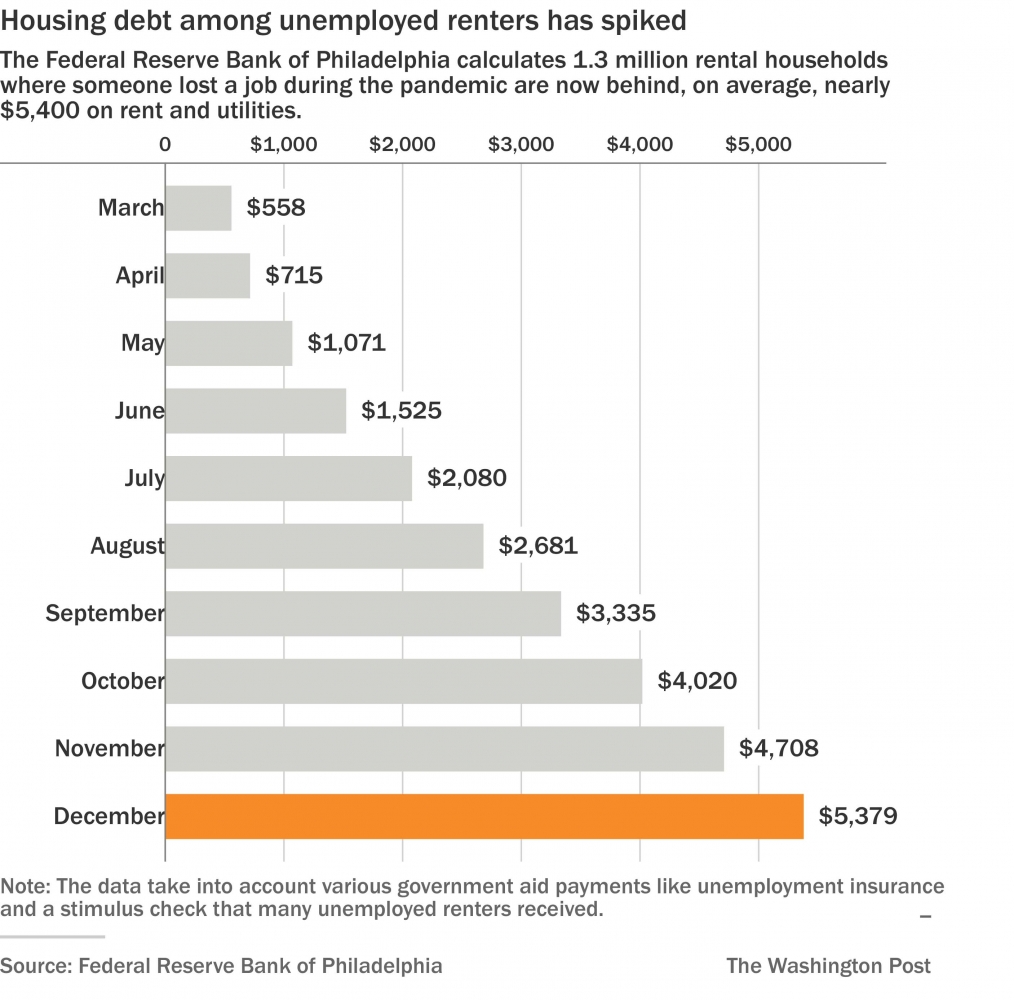
The numbers of those behind on rent and utilities were especially high for families with children, with 21% falling behind on rent, and among families of color. About 29% of Black families and 17% of Hispanic renters were behind, the Census Bureau reported. A separate analysis by the Federal Reserve Bank of Philadelphia, looking at people who had jobs before the pandemic, found 1.3 million such households are now an average of $5,400 in debt on rent and utilities, after those people had lost jobs and their family’s income plunged.

“The tidal wave is coming. It’s going to be really horrible for people,” said Charlie Harak, a senior attorney at the National Consumer Law Center. “The number of people who are now 90 days behind and the dollars they are behind are growing quite significantly.”

Nashville, Tenn., mother Nikki Cornwell is $4,000 behind on rent and fears she will be evicted right after Christmas. Her water was shut off on Monday. Her landlord filed the paperwork already, and her court date is set for Jan. 5 – just after the federal eviction moratorium is set to expire.

“I am behind on my rent. I will get evicted soon with my kids who are in virtual school and need internet,” said Cornwell, who lives with her mom and two kids. “I’ve had bad moments, but never anything like this.”

Cornwell, 36, lost her job in March at a factory that packages tea. She contracted the coronavirus in May. One fearful night she called 911 because she felt she couldn’t breathe. She has mostly recovered but still can’t smell anything. She had a job offer last month, but it got rescinded as coronavirus cases soared and the company decided to pull back on hires. She was getting $275 a week in unemployment, but that just ended. She has pawned jewelry and her son’s beloved PlayStation to pay for food.

“This is like a Charles Dickens novel,” said Mark Wolfe, executive director of the National Energy Assistance Directors’ Association. “It’s an evolving story of how people at the bottom are suffering.”

Many unemployed Americans were able to delay paying rent this fall under eviction moratoriums. But those protections end soon, and landlords and utilities are eager to get paid, because they have their own bills and taxes to pay. Economists warn low-income families won’t be able to suddenly pay back three to six months of rent at once.

The federal eviction moratorium is slated to end on Dec. 31, even as coronavirus cases spike and the economic recovery fizzles. Researchers at the Philadelphia Fed say even their conservative forecast warns evictions will spike 50% higher next year.

Shelbie Selewski is $2,100 behind on rent and utilities after losing her job as a medical receptionist in Macomb County, Mich. Her landlord has taped eviction papers to her door three times, and her electricity was shut off in September – on her son’s third day of virtual kindergarten. She begged friends and relatives for help to get the electricity back on, but bills are piling up again.

Selewski, 29, receives $200 a week in unemployment and recently sold the family’s TV and PlayStation 4 to prevent another utility shut-off. Her new baby was born with a collapsed lung, putting the infant at high risk during the pandemic. She and her fiance have not been able to find jobs.

“It has been the worst year ever. I’ve watched everything I’ve worked for go away,” Selewski said. “Every time I paid something and felt some peace, it felt like I got a utility shut-off notice three days later.”

Landlords and utilities increasingly worry they will have to eat this debt. Meanwhile, struggling families like the Selewskis fear no one will rent to them again after an eviction in which they were so far behind on rent. Bad credit can hurt families for years.

Amid those pressures, renters and landlords are urging Congress to approve bigger unemployment payments and another round of $1,200 stimulus checks, which would go a long way toward helping alleviate the debt burden on the unemployed. Many families say they fell behind on bills this fall after the extra $600-a-week unemployment payments ended in late July.

“The longer employment stays suppressed, and people stay out of work, it will make it even harder to catch up on the debt and dig yourself out of that hole,” said Davin Reed, community development economic adviser at the Federal Reserve Bank of Philadelphia.

So far, however, Republican and Democratic leaders in Congress remain far apart on a stimulus deal, which they have been debating since July. A bipartisan compromise unveiled last week includes $25 billion for rental housing assistance, but a package released by Senate Majority Leader Mitch McConnell, R-Ky., did not include any money for housing or utilities. The House Democrats’ Heroes Act includes $50 billion specifically for low-income renters.

“It’s much better for Congress to err on the side of helping too much than too little,” said Mark Zandi, chief economist at Moody’s Analytics. “There’s nothing scarier than losing your home, especially in January with a pandemic out of control. That would be overwhelming.”

Zandi predicts as much as $70 billion in unpaid debt by January, a painful amount that renters, landlords and utility companies will have to sort out. But he thinks the bigger damage to the economy could come from Americans watching people get evicted in early 2021 – a sign the federal government no longer cares.

“The economic damage created by this pandemic will be many times more severe if we lose faith that the government has our back,” Zandi said, adding that it could trigger a drop in consumer confidence.

Data from the Mortgage Bankers Association shows $9 billion in rent wasn’t collected in the third quarter. Without that money, landlords are struggling to pay property taxes, insurance and other upkeep costs, adding more strain to the economy.

Utility data is showing equally alarming signs of strain. New Hampshire has seen a 66% jump in the number of families who are 90 days or more behind on utility payments compared with 2019. Pennsylvania has seen a 67% increase over the last year in the number of households in arrears, according to data compiled by NEADA.

Pennsylvania utilities now have an arrearage balance of $721 million, up from $433 million last year. Massachusetts shows $754 million, up from $508 million a year ago.

“For families struggling right now and trying to get back on their feet, we have to find a way to write off this debt,” Wolfe said.

NEADA is asking for $10 billion in additional Low Income Home Energy Assistance Program funding to help low-income families pay their utilities this winter. The House bill, the most generous so far, had $4.5 billion.

Cornwell and Selewski check the news daily for any sign that additional help may be on the way. Both women have sought aid from church groups, friends and local government agencies, a piecemeal system of help that is still leaving them thousands of dollars behind on critical bills.

“We didn’t cause any of this, but it feels like Congress is saying you are on your own to deal with this,” Cornwell said.

Asian American leaders press Biden for more diverse Cabinet picks #SootinClaimon.Com

#SootinClaimon.Com : ขอบคุณแหล่งข้อมูล : หนังสือพิมพ์ The Nation.

Asian American leaders press Biden for more diverse Cabinet picks (nationthailand.com)

Asian American leaders press Biden for more diverse Cabinet picks

InternationalDec 08. 2020Neera Tanden, President-elect Joe Biden's pick to lead the Office of Management and Budget, speaks last week in Wilmington, Del. MUST CREDIT: Washington Post photo by Demetrius FreemanNeera Tanden, President-elect Joe Biden’s pick to lead the Office of Management and Budget, speaks last week in Wilmington, Del. MUST CREDIT: Washington Post photo by Demetrius Freeman 

By The Washington Post · Amy B Wang

WASHINGTON – Members of the Congressional Asian Pacific American Caucus are scheduled to meet virtually with President-elect Joe Biden’s transition team Monday to express their growing concern that there will be insufficient Asian American representation in top-tier spots in Biden’s administration.

Biden’s team has prided itself on rolling out a diverse set of candidates with each Cabinet and personnel announcement, but most of the senior, highly visible leadership roles have gone to White candidates, including Janet Yellen as treasury secretary, Antony Blinken as secretary of state, Ron Klain as White House chief of staff and Jen Psaki as White House press secretary.

That has not gone unnoticed by CAPAC, as well as Asian American Pacific Islander (AAPI) advocacy groups. Of Biden’s Cabinet-level picks so far, only one is of Asian American descent: Neera Tanden, whose parents immigrated from India, was chosen to serve as director of the White House Office of Management and Budget.

Asian Americans are not alone in pressing Biden for representation in his Cabinet. Black and Latino leaders have also voiced concern that his long-promised diversity has mostly shown up in secondary positions, and Biden is meeting Tuesday with the NAACP board in part to discuss such issues.

When Tanden’s nomination was announced last Monday, CAPAC’s chair, Rep. Judy Chu, D-Calif., said she was thrilled, praising Tanden as a “strong, experienced leader” and noting that if confirmed, she would be the first woman of color to lead the OMB, a critical agency that helps shape administration priorities.

But Tanden, who heads the Center for American Progress, a liberal think tank, has already been criticized as too partisan by several Republican senators, and Chu and others worry privately that she will be treated as a “sacrificial lamb” who may not be confirmed. Tanden’s nomination will be especially precarious if Democrats do not win both Senate seats in Georgia’s Jan. 5 special election, leaving Republicans in control of the Senate.

Vivek Murthy, a physician of Indian descent, was reportedly a candidate to lead the Department of Health and Human Services, but he was instead asked to reprise his role as U.S. surgeon general, a job he held during the Obama administration.

Chu and other CAPAC members said they support efforts to elevate the surgeon general job to a Cabinet-level position. But in the meantime, they say, the surgeon general spot is no substitute for a higher-level post.

“That is a position that is very important, but one doesn’t even directly report to the president – it’s part of HHS,” said Rep. Grace Meng, D-N.Y., the first vice chair of CAPAC. “Our call remains that we have AAPIs at the highest levels in the Cabinet, just like every administration in recent history.”

Since Bill Clinton’s administration, there has always been at least one AAPI Cabinet member. The Obama administration had a record three AAPI Cabinet secretaries, while the Trump administration has included two – Transportation Secretary Elaine Chao and Nikki Haley, the former ambassador to the United Nations.

More broadly, AAPI activists contend that Biden should honor one of the central promises of his campaign – to move beyond President Trump’s hostility to diversity and build a government that looks like America. AAPIs make up about 7 percent of the U.S. population, and Asian American voters were critical to Biden’s victory in states like Georgia, which had not voted for a Democratic presidential candidate since 1992.

Biden has recognized that numerous civil rights groups are pressuring him on diversity, promising that in the end they will be satisfied with his picks.

“Their job is to push me,” he told CNN’s Jake Tapper last week. “Every special interest – and I don’t say that in a negative way – every advocacy group out there is pushing for more and more and more of what they want. That’s their job.”

He added, “My job is to keep my commitment, to make the decisions. And when it’s all over . . . you’ll see the most diverse Cabinet, representative of all folks – Asian Americans, African Americans, Latinos, LGBTQ, across the board.”

Civil rights leaders are not so sure. Two weeks ago, 19 members of CAPAC sent a letter to Biden’s transition team urging that AAPIs be chosen for at least 7 percent of Cabinet-level and other positions, reflecting their proportion of the U.S. population.

The letter also noted that AAPIs represent the fastest-growing segment of the U.S. electorate, and that they had turned out in record numbers in the November election to support Biden over Trump by a roughly 2-to-1 margin.

A similar letter from the AAPI Victory Fund, a super PAC that was the second national group to endorse Biden in the Democratic primary, was more pointed.

“Given the enormous contributions of AAPI voters in electing you and Vice President-elect Kamala Harris – I dare say pivotal in several battleground states – it would be deeply disappointing if several AAPIs are not nominated to serve in your Cabinet,” wrote Shekar Narasimhan, the group’s founder and chairman.

Narasimhan noted that the Victory Fund had endorsed Biden at a time when two other AAPI candidates were still in the race – Rep. Tulsi Gabbard (D-Hawaii) and businessman Andrew Yang – “with the knowledge that many in the AAPI community would be upset.”

“Our meeting was at a moment in the campaign, in the middle of the January, when it was not looking particularly good” for Biden’s campaign, Narasimhan said in an interview.

After Biden made the case that he would be the best candidate to represent AAPI interests, the super PAC got behind him and eventually helped him raise more than $11 million for the his campaign, as well as organizing more than 5,000 volunteers to work on get-out-the-vote efforts for Biden and later Harris.

In exchange, Narasimhan said Biden “emphatically” assured them AAPIs would have representation at the top levels of his campaign – including a “visible” AAPI person as co-chair of his campaign – and then in his transition and government.

“Our community looks up and says, ‘Who’s there?’ And we should be able to point to that person and say, ‘They’re there,’ ” Narasimhan said. “We made that ask several times during the course of the campaign. Should I say I’m disappointed it didn’t happen? Hell yes, of course. These may sound rhetorical and symbolic, but to our community they damn well matter.”

That sentiment was shared by others.

“Our communities are growing at a point where not being taken seriously is something that is of concern,” said Madalene Mielke, president of the Asian Pacific American Institute for Congressional Studies (APAICS). “It’s to make a better government. It’s not just for the sake of representation.”

Mielke cited former congressman Norman Mineta, D-Calif., a Japanese American whose family was sent to an internment camp when he was 10 years old and who later served as President George W. Bush’s transportation secretary. Mineta has said his personal story, which he recounted to Bush at Camp David in early 2001, was a big reason Bush spoke out strongly against racially profiling Muslims after the Sept. 11, 2001, terrorist attacks.

“Those are the kinds of experiences that AAPIs have gone through in their history here,” Mielke said. “And to not have an Asian American who can talk about their unique lived experiences in this way, it doesn’t provide a full American experience for an administration that is supposed to be diverse and inclusive.”

CAPAC’s scheduled meeting with the Biden team comes after other civil rights groups have said they are dissatisfied not only with the lack of diversity in Biden’s Cabinet-level picks, but with how some of those decisions have been handled.

Last week, the Congressional Black Caucus, along with a half-dozen civil rights groups, urged Biden to appoint more African American candidates to top positions.

On Thursday, members of the Congressional Hispanic Caucus criticized the treatment of Gov. Michelle Lujan Grisham, D-N.M. – who was reportedly a front-runner for HHS secretary but now appears to be out of the running – and said more Latinas should be named to the administration.

Meanwhile, several Asian American groups have sent lists of prospects to Biden’s transition team, some as early as the summer. They have included such figures as Sen. Tammy Duckworth, D-Ill., for defense secretary; David Kim for transportation secretary; Julie Su or Chris Lu for labor secretary; Yang for commerce secretary; and Katherine Tai for U.S. trade representative.

Kim and Su hold Cabinet positions in California, and Lu is a former deputy U.S. labor secretary. Tai is chief trade counsel for the House Ways and Means Committee.

But with six weeks to go until the inauguration, there is growing concern that few of those recommendations are being seriously considered for prominent spots.

The top Cabinet posts are generally seen to be secretary of state, defense and treasury, along with the attorney general. Of those, two – defense secretary and attorney general – remain to be filled.

Duckworth, like other current lawmakers, may face an additional challenge, since Biden is unlikely to pluck members from the Senate or House given the narrow partisan margin in both chambers.

If Biden’s Cabinet does not include any AAPI secretaries, it would be the first time that has happened in more than 20 years.

Chu said she has been trying to ascertain from transition leaders who is a “realistic” candidate, as opposed to being mentioned solely to give the appearance that Biden’s team is trying to assemble a diverse administration. “We wanted to make sure that the conclusion was that that person would be appointed,” she said.

Biden spokesman Jamal Brown said in a statement that the transition team is working to build an administration that looks like America, and he noted that Harris is the first woman of Black and South Asian descent to be vice president-elect.

Asian American leaders express pride in Harris’s historic election, but they also chafe at the idea that her presence might give the transition team a pass on naming other AAPIs to Cabinet positions.

“We’re thrilled that she’s vice president-elect. She’s been an amazing advocate for the AAPI community,” said Gregg Orton, national director of the National Council of Asian Pacific Americans, another group that has sent Biden a list of AAPI candidates. “But no, I’m challenged by this idea that that should be enough. I guess I would simply refute it.”