InternationalNov 28. 2020Maria Mercedes Bejarano, 73, walks on her knees in prayer up the aisle of Washington National Cathedral during a special four-hour vigil on the day after Election Day. The District of Columbia cathedral has otherwise been closed to the public since the spring due to the pandemic. MUST CREDIT: Washington Post photo by Michelle Boorstein
By The Washington Post · Sarah Pulliam Bailey · NATIONAL, RELIGION
WASHINGTON – During the month before Christmas, Washington National Cathedral typically transforms into a sparkling, bustling destination with choral performances and a live Nativity. But since coronavirus shut its regular services to the public earlier this year, its staff has been transforming its massive sanctuary into a digitally attractive space, and they’re having some success.
Like many houses of worship, the cathedral has seen a surge in online viewers, giving it even more national and global reach. On an average week, it has at least 6,000 people watch its Sunday service, sometimes twice the number that would fit in person. On any given Sunday morning, it will see people join from Ireland and Barbados. Its Easter service had 50,000 live views.
The burgeoning digital audience has also translated into an increase in online donations, which are up 260 percent this year. All that has eased somewhat the otherwise gaping loss – both spiritual and practical – created by the absence of in-person worshipers and visitors. Because the cathedral relies on outside groups to rent the space to support its staff and upkeep, it has taken a significant financial hit, facing a net $5 million shortfall in revenue and laying off 15 percent of its staff.
Christmas usually brings Washington National Cathedral its biggest foot traffic of the year, with families packing the nave for Messiah services and light shows with fake snow falling from 100-foot ceilings. This year, the only times its nave has been used for public use was for election prayer services, a handful of small weddings, school chapel services and funerals, as well as several American Red Cross blood drives. On Dec. 20, the cathedral will hold a virtual concert, and on Christmas Eve, it will hold an online nativity-themed service that will broadcast its animals from the Bishop’s Garden on its grounds.
“It’ll be more solitary and somber for many folks,” said cathedral Dean Randolph Hollerith. “Online worship is no substitute for being in person, but there is power in gathering together in a virtual community.”
The cathedral is the seat of the presiding bishop of the national Episcopal denomination, Michael Curry. Curry, who lives in North Carolina, typically visits the cathedral during the month leading up to Christmas, but he won’t be traveling this year.
Curry said he has been stalling before finalizing his Christmas cards this year because he has been wrestling with how the holiday season is typically joyful. This time, he wants people to remember a Bible verse from John in the Gospels where he writes, “The light shines in the darkness, and the darkness has not overcome it.”
“We don’t pretend the darkness isn’t real. People are dead, people are sick, we are fragmented and polarized. But the lightness shines in the darkness,” he said. “That is a message of Christmas.”
Many churches won’t be adorned with poinsettias the same way this year, Curry said, but perhaps it’s a chance for people to reflect on the core meaning of the holiday.
“The truth of Christmas may be more profoundly true for us because everything else has been stripped away,” he said. “We are not helpless. We are not alone. There’s a God that cares enough to come into this world.”
Like many churches, the pandemic forced cathedral staff to make improvements in order to provide better online worship services, Hollerith said. Before the pandemic, the cathedral’s sound system was so dated that it relied on a VHS player, a recording system requiring tape instead of digital formats. But the pandemic has forced the 127-year-old cathedral to rethink its future as a local, national and international institution beyond its flying buttresses.
Now they offer coffee hour Zoom calls for people joining nationally or internationally. Hollerith said that on Sundays when he watches from home, he is delighted to see the people commenting on YouTube or Facebook, saying hello to each other from around the world.
“Now we’re going to need to pay as much attention and time and energy into the digital experience as we do the experience in person,” he said.
Last year for Thanksgiving, cathedral staff collected an estimated 20 tons of food to provide Thanksgiving dinners to local families. This year, it raised money to provide 1,400 families with gift cards to purchase Thanksgiving dinner. In December, it plans to provide Christmas gifts to 400 kids.
Historically, the country’s second-largest cathedral has played a central role in national ceremonies, including presidential inaugurations. Church officials plan to work with the incoming Biden administration, which is planning a scaled-back version.
By Syndication Washington Post, Bloomberg · Alex Morales, Emily Ashton · WORLD, EUROPE
Prime Minister Boris Johnson warned of “long months ahead” in the fight against coronavirus, as his government put most of England into the highest two tiers of new restrictions when a lockdown lifts next week.
London will be placed in tier 2, avoiding the toughest rules from Dec. 2 and allowing pubs, restaurants and bars to open — but restricting alcohol to being served as part of a meal. Cities including Birmingham and Manchester were placed in the toughest tier 3, in which pubs and restaurants must close except for takeaway. Households will not be allowed to mix indoors in either tier.
“What we want to avoid is relaxing now too much, you know, taking our foot off the throat of the beast now,” Johnson said in a televised news conference Thursday. “There is a substantial relaxation across all tiers but we’re not abandoning the fight yet, of course not, because we still, as I say, have long months ahead.”
The regional three-tier system is tougher than before England entered a four-week partial lockdown this month. Ministers want to make sure they have some control of the virus’s spread before people are allowed a further five-day relaxation of the rules during the Christmas holidays.
Communities Secretary Robert Jenrick said Friday there’s a chance regions could move up or down the tiers on Dec. 16, when the categorizations will be reviewed based on the latest data. Speaking on BBC radio, he urged people to “abide by the rules and work hard at it” if they want fewer restrictions.
Johnson’s scientific advisers warned people not to take risks and to avoid endangering their elderly relatives over Christmas.
“Would I encourage someone to hug and kiss their elderly relatives? No, I would not,” England’s Chief Medical Officer Chris Whitty said at the news conference. Don’t hug a relative “if you want them to survive to be hugged again.”
Johnson’s government is trying to balance the risks of the virus again getting out of control with the need to support an economy going through its worst slump in 300 years. Virus cases have surged across the U.K. in the fall, and the prime minister’s scientific advisers are trying to chart a course that prevents the state-run National Health Service from being overwhelmed.
But the premier also faces a rebellion from members of his Conservative Party angry about the restrictions imposed on their districts. Influential Tory MP Graham Brady said he will oppose the new measures when they are put to a vote in Parliament next week.
“The policies have been far too authoritarian,” he told the BBC on Thursday. “There has got to be a real danger that if these restrictions aren’t lifted very, very soon there will be a lot of businesses that simply won’t reopen.”
Some 41% of England — or 23 million people — will be in tier 3, including large swaths of the northeast, northwest, and the Midlands. Bristol, in the southwest, and the southeast county of Kent are also included.
Another 57% of England, or 32 million people, will be in tier 2, including much of southern England and the northwest region of Liverpool which has pioneered mass testing. Only Cornwall, the Isle of Wight and the Isles of Scilly are in the lowest tier 1.
Johnson said he wants other parts of the country to “replicate” Liverpool’s success with testing, pledging to roll out the system to all tier 3 areas as fast as possible. He also suggested the goal is a system that allows people more freedom if they can show they don’t have coronavirus.
“Testing on this scale is untried, but in due course if it works, where people test negative it also may be possible for families and communities to be released from certain restrictions,” he said.
Business Minister Nadhim Zahawi later told the BBC that Johnson was referring to people who had been advised to self-quarantine because they’d been in close contact with a covid-19 case.
But the Telegraph newspaper reported this month ministers have asked companies that make passports to provide certificates showing travelers aren’t carrying the coronavirus. Bank note and passport-maker De La Rue Plc said Wednesday it’s in “early discussion” with governments “regarding COVID-19 immunity certification schemes.”
De La Rue Chef Executive Officer Clive Vacher told Bloomberg governments and companies are yet to make a final decision, declining to say if the U.K. is one of the countries.
Under the new three-tier system, the general requirement for people to stay home will end, and shops, gyms and hairdressers will reopen. But in all areas, people will be urged to continue to work from home if they can.
The announcement triggered an immediate push back from the hospitality industry, 98% of which is covered by the top two tiers in England, according to trade body UKHospitality. That will wipe out an estimated £7.8 billion of trading compared to last year if the restrictions last all of December, it said.
“We still have not seen any evidence that hospitality venues — which have invested great time effort and money to making their spaces Covid-secure — are a problem,” UKHospitality Chief Executive Kate Nicholls said in a statement. The new system is a “huge blow” and “it seems unfair and arbitrary that hospitality is being dealt such a harsh hand,” she said.
The threat to business angered Tory MPs who had lobbied ministers to keep their areas out of the highest tiers.
The coronavirus restrictions are “destroying lives and livelihoods,” Conservative MP Richard Drax said in a statement. “We need a new strategy based on common sense, not fear and more fear.”
Health Secretary Matt Hancock said the government will review which region is in each tier on Dec. 16, based on infection rates and pressure on the National Health Service, and then every week after that.
Johnson said he’s “convinced” that with a vaccine on the way, “by April things genuinely will be much, much better.”
But Chief Scientific Officer Patrick Vallance injected a note of caution, warning that while three different vaccines have recently revealed positive trial results, they still need regulatory approval.
“This is going to take months into spring, before we start to get significant degrees of vaccination to create protection,” he said.
Hong Kong integration with China is a ‘great thing,’ Lam aide says
InternationalNov 28. 2020Bernard Chan. MUST CREDIT: Bloomberg photo by Justin Chin
By Syndication Washington Post, Bloomberg · Karen Leigh, Kari Lindberg · WORLD, ASIA-PACIFIC
A top adviser to Hong Kong’s leader said integration with mainland China was a “great thing” for many people in the city, days after Chief Executive Carrie Lam spoke of a future tied to Beijing in her annual policy address.
“As a whole, Hong Kong needs China to retain our current status and Hong Kong can’t survive on our own,” said Bernard Chan, the convener of Lam’s advisory Executive Council, told Bloomberg TV on Friday. “We need China.”
“Economically Hong Kong is very much a part of China now,” Chan said. “We need China to help us under this very difficult time.”
His comments came after China earlier this month enabled the Hong Kong government to expel lawmakers deemed insufficiently loyal. That allowed Lam to immediately eject four pro-democracy politicians, a move that triggered the mass resignation of the entire opposition and led to criticism from foreign governments including the U.S.
Lam on Wednesday delivered a two-hour address to a legislative chamber in which she defended the central government’s moves to exert greater political control over the Asian financial hub in the wake of mass protests last year, including Beijing’s imposition of sweeping national security legislation that has all but stamped out what remained of the demonstrations.
“China has been repeatedly focused on those couple of red lines, so long as Hong Kong doesn’t pass these red lines they are more than happy and they are willing to leave Hong Kong alone,” Chan said. “And those red lines are clear — you don’t ask for Hong Kong independence and you don’t try to destabilize China, these are the red lines.”
Christmas, covid imperil food supply in Brexit Britain
InternationalNov 28. 2020A truck on the dockside at the major British port of Felixstowe, England. MUST CREDIT: Bloomberg photo by Chris Ratcliffe
By Syndication Washington Post, Bloomberg · Deirdre Hipwell, Megan Durisin · BUSINESS, WORLD, EUROPE
A scarcity of warehouse space because of Christmas demand and the pandemic is putting Britain at risk of shortages of some food products as it prepares to leave the European Union’s single market.
Shelves stand almost empty in the pasta and sauces section of a Morrisons supermarket in on March 18, 2020.MUST CREDIT: Bloomberg photo by Simon Dawson
With five weeks to go before the end of the Brexit transition period, large manufacturers and industry groups are warning that the capacity of the food supply chain is at its peak and can’t withstand any further shocks.
Unilever, the maker of Ben & Jerry’s ice cream and Hellmann’s Mayonnaise, said it is building up stock of key lines but “warehouses are absolutely full.” Like rival Nestle, the maker of Kit Kats and Nescafe coffee, maintaining supply of finished products and ingredients is now the priority as talks between Britain and the E.U. on a trade deal remain deadlocked. Yet that’s “with stock building more difficult at this busy time of year,” Nestle said.
“The flexibility we had in March to respond to Covid-19 demands to move stock around doesn’t exist at this time of year,” Unilever said by email. “We need governments on both sides to do whatever is needed to keep the ports and roads open for smooth and consistent supply routes.”
There have been numerous warnings about potential Brexit disruption from companies and even U.K. ministers, such as lines of trucks on the highway regardless of whether there’s a trade deal or not. The trouble is that the latest contingency planning couldn’t come at a worse time as Christmas goods take up storage space.
People in the food industry say it’s likely there could be some shortages of key brands and ingredients made in the E.U., which supplies Britain with everything from tinned tomatoes and olives to wine and baby food in foil pouches. Even with an accord, some food prices are also likely to rise.
More companies are trying to recruit extra logistics workers to ensure ports can cope with increased demand for unloading and storing supplies. Others, including Unilever, have been beefing up U.K.-based manufacturing.
The Food and Drink Federation is concerned about the ability of businesses to stockpile at a time when “we don’t have an abundant amount of food safe warehouses,” said Dominic Goudie, head of international trade at the organization. Britain “won’t run out of food,” but there could be sporadic shortages of certain products and brands, he said.
More than four years after the U.K. voted to leave the borderless market it joined in 1973, the country has yet to agree the terms of its future relationship with its biggest trading partner. The delays have left companies struggling to address the uncertainty.
For example, it’s hard to know how to stock supplies of the right packaging when labeling requirements post-Brexit are still not clear, Goudie said. That will particularly hit goods supplied to Northern Ireland, which will still be bound by the single market rules when the transition period ends, he said.
“Stockpiling of food packaging is a critical component of any supply chain,” Goudie said. “But we still have technical questions that need to be answered about what exactly you must put on the packaging.”
Business groups say failing to reach a new deal would be disastrous for the economy, whose parlous state because of the virus was laid bare by Chancellor of the Exchequer Rishi Sunak this week.
Goudie pointed to the current congestion of containers at the English port of Felixstowe as a worrying snapshot of what could lie ahead for food deliveries post Brexit. Some of his federation’s members have had goods rerouted to other ports in the U.K. and on the continent.
“They are now struggling to find road haulers to transport the products they need and are facing huge added costs to do this,” Goudie said. “Felixstowe is now directly impeding their ability to be ready for Jan. 1.”
Food and drink manufacturers, though, have shown their ability to adapt as consumer demand patterns changed with the coronavirus pandemic. The U.K. also produces 55% of the food it consumes, according to government figures, and ministers are working with the industry to ensure people have the supplies they need.
“The UK has a highly resilient food supply chain,” a government spokesperson said in a statement. “As a responsible government we continue to make extensive preparations to ensure we are ready for a range of scenarios at the end of the year, including mitigating the impact on border flows.”
Spanish foods importer Brindisa has placed orders for an extra $467,000 (350,000 pounds) of its best-selling items, including canned tuna and olive oil, said Heath Blackford, managing director of its wholesale division. The shipments will arrive in mid-December and should guard against potential disruptions in January.
Recruitment company Manpower Group Inc., meanwhile, is fielding inquiries from companies looking for staff to work in every part of their supply chains.
Demand for stock analysts, warehouse pickers and packers, and forklift truck and crane drivers to take containers off ships in ports is “through the roof,” said Jason Greaves, Manpower’s brand leader and operations director. “In every area there are skills shortages,” he said. “Who would have ever thought that Brexit, the pandemic and Christmas would hit us all at once?”
By Syndication Washington Post, Bloomberg · Sarah Frier · BUSINESS, TECHNOLOGY
New York-based businesswoman Ruth Harrigan usually sells her honey and beeswax products in souvenir shops. But with covid-19 pausing tourism, she’s been almost entirely dependent on Facebook ads to drive online sales. On Nov. 11, this new financial lifeline was abruptly cut when the social media company blocked her HoneyGramz ad account for violating its policies. She couldn’t imagine what about her tiny honey-filled gifts would have triggered the problem.
Friends told Harrigan to just wait a couple of days and the problem might resolve itself. She waited, until she lost an estimated $5,000 in revenue.
“I was getting a little anxious thinking, ‘Oh my God, Black Friday is around the corner, most of my sales for the year happen in November and December and that’s it,'” she explained. “I said, ‘If I’m shut down any longer than this, it’ll cripple me.'”
Harrigan is one of millions of small business advertisers who have come to rely on Facebook because the coronavirus has shut down many traditional retail channels. The social media giant has provided new sales opportunities for these entrepreneurs, but also exposed them to the company’s misfiring content-moderation software, limited options for customer support and lack of transparency about how to fix problems.
Facebook’s human moderators have focused on election and covid-19 misinformation this year, so the company has leaned more on artificial intelligence algorithms to monitor other areas of the platform. That’s left many small businesses caught in Facebook’s automated filters, unable to advertise through the service and frustrated because they don’t know why.
The same weekend Harrigan’s account went down, Ivonne Sanchez, who runs a permanent makeup clinic in Ottawa, found her ads were blocked too, for what Facebook said was a “policy violation.” Her business, which had to shut down between March and June for the pandemic, was relying on Facebook to recover financially. The account was restored the next day without explanation, but “in the middle of a crucial shopping season, it left us shaken,” she said. “This experience makes us very nervous about investing dollars into a system that is operated seemingly by a bot.”
Even if an ad account gets restored, businesses lose crucial momentum. Facebook’s advertising algorithm takes a couple of weeks to figure out which users may be interested in an ad, to refine the targeting. Jessica Grossman, chief executive officer of digital marketing firm In Social, said when her clients get hit, the hardest part is telling them their campaigns have to start over and their money won’t go as far.
“Facebook almost doesn’t realize the impact of their own algorithm and what that means,” Grossman said. There seemed to be no logic to the account bans imposed on In Social’s clients, she added. A pizza vending machine company, a reusable water bottle company, a coffee delivery service, a business coach and a hair weave company were all suspended.
“We know it can be frustrating to experience any type of business disruption, especially at such a critical time of the year,” Facebook said in a statement. “While we offer free support for all businesses, we regularly work to improve our tools and systems, and to make the support we offer easier to use and access. We apologize for any inconvenience recent disruptions may have caused.”
Facebook often touts its commitment to small businesses, as it defends its ever larger hold over their economic future. On a recent earnings call, CEO Mark Zuckerberg said this was a “major focus” that’s “more important now than ever” as covid-19 shifts commerce online. During a July ad boycott by major brands, Facebook’s revenue still grew, bolstered by small businesses rushing online to try to survive. The company added more tools this year for small businesses to sell directly to customers through its site, hoping these virtual shops become advertisers, too.
But while business owners agree that Facebook is a lifeline during the pandemic, they say it’s also an unreliable partner. Facebook’s ban on political ads around the U.S. election, for instance, affected companies that have no connection to politics, like a business selling bracelets to benefit refugees. A seed company was also blocked for sharing a picture of Walla Walla onions — which were “overtly sexual,” according to Facebook’s AI.
The company’s policies against cryptocurrency frequently trapped ads from a solar roof company, Human SOLR, because some of the acronyms used by the business are similar to cryptocurrency tokens. After that issue was resolved, Human SOLR’s ads were banned again for using phrases like “see if your roof qualifies.” Facebook’s software guessed the company was selling financial products, which are more regulated. After enough flags on the account, Brett Lee, who runs the business, gave up on Facebook ads. “My business is at a complete standstill,” said Lee, based in St. George, Utah. “My employees’ lives are at a standstill.”
GFP Delivered, a Chicago-based produce company advertising a way for people to avoid the grocery store during covid-19, had its Facebook ads shut down for two months without clear explanation, according to owner George Fourkas. He said he was able to fix the problem only after reaching out to old college friends who work at Facebook.
Yaniv Gershom, co-founder of digital marketing firm 4AM Media, said he had to cut 12 jobs partly because of Facebook ad account bans, which have lasted almost six months. “They give you zero feedback,” he added. “The only people who are OK are massive spenders who get a Facebook rep that can escalate issues and find out what’s wrong.”
In some cases, the business impact is hard to quantify. Matt Snow, co-founder of an apparel business called Boredwalk, said Facebook’s automated systems inadvertently flagged 40% of his company’s product catalog as unsafe late last month. That left Snow targeting the wrong products to potential customers. He eventually noticed and quickly resolved the issue with a Facebook sales manager, but Snow doesn’t know how long the products were banned, or even which other items were being advertised in their place. “Facebook is very black box about all their internal machinations,” he said.
Facebook has been automating content moderation for years, a transition it highlights in a quarterly report detailing how much content the company removes. In more nuanced categories such as “hate speech,” Facebook removed almost 95% of violating posts automatically in the third quarter, up from just 53% two years ago.
But that increase comes with more corrections. Facebook removed 22 million posts for hate speech in the third quarter, more than 3 times as many as a year earlier. The number of posts it later restored jumped by 40%.
Advertisers have been particularly hurt by these automated decisions in recent months. “It just exploded. They turned up the AI recently — somebody changed something — and all of the sudden everybody was getting shut down,” said Justin Brooke, founder of Adskills.com, which teaches businesses how to market on Facebook. “What are these small businesses going to do? They’ve got families to feed.”
One of Brooke’s own Facebook ads has a small written disclaimer saying it wasn’t open to those trying to sell adult content. That got flagged and taken down. Facebook’s automated explanation? The post didn’t follow the company’s community standards on “nudity/sexual activity.”
The over-reaction by Facebook’s AI is a side effect of the company taking more responsibility for the content on its platform, according to Guy Rosen, Facebook’s vice president of integrity. “As we take more action, we remove more content, there’s more opportunities also for those to be in error,” he said during a recent press call.
That’s what HoneyGramz’s Harrigan was told happened to her account. She eventually got desperate enough to Google names of Facebook employees who might help. She found Rob Leathern, the company’s director of ad products, and sent him a message on Twitter. Miraculously, he responded. A few hours later, Facebook sent an email restoring her account.
“They just said they turned it off in error,” Harrigan said. “They didn’t give me any feedback. They just reset the whole thing as if it never happened.”
But Harrigan won’t forget. She printed off the email and pinned it to her office whiteboard. “It was really, really scary,” she said.
PlayStations are hot with consoles drawing rare shopping crowds
InternationalNov 28. 2020A GameStop store in Tampa, Fla., on Nov. 27, 2020. MUST CREDIT: Bloomberg photo by Eve Edelheit
By Syndication Washington Post, Bloomberg · Carolina Gonzalez, Richard Clough · BUSINESS
Good luck finding a PlayStation 5.
The newest video-game console from Sony Corp., alongside rival Microsoft Corp.’s updated Xbox, are arguably the hottest items this Black Friday as shoppers line up in person or swarm retailers’ websites hoping to snag one. GameStop Corp., one of the few retailers to do a brick-and-mortar release, saw shoppers line up as early as Thursday — some even set up tents — at locations from Norfolk, Va., to Salinas, Calif.
“There’s always an item, or a few items, people can’t find. The big hot item this year is Sony PlayStation 5 and Xbox from Microsoft,” Joseph Feldman, senior managing director and assistant director of research at Telsey Advisory Group, said in a Friday morning interview. “Those are the two new items that I keep hearing people ask for, especially at Best Buy and GameStop, and you just can’t find them right now.”
A highly coveted product is just what retailers need this holiday season. After a brutal year of economic lockdowns and retail distress, stores are hoping that pent-up demand can rejuvenate the industry even as new waves of Covid-19 sweep across the country. Health concerns notwithstanding, a big-selling item can draw shoppers who may end up buying other gifts, too, while browsing in-store or online.
To limit crowds, Best Buy chose to release the newest consoles only on its website, a decision that retail analyst Neil Saunders called “a miss,” given soaring demand.
“Best Buy could have done something creative with outside collection to manage the crowds,” he said.
Still, the shares are outpacing the market this year as Best Buy benefits from the remote-working and home-schooling trends during the pandemic.
“Best Buy is trading so well right now that they can afford to be picky,” Saunders said. The company’s shares are up about 29% year to date.
Google searches for gaming products were up again this week, according to a note from Baird Equity Research. Interest for “World of Warcraft” was up 96% after the launch of its latest expansion pack, while “FIFA Ultimate Team” was up 43% this week. The term “gaming headset” also saw a consistent increase in internet searches, up 24% week over week.
With all the interest in gaming, the new consoles are sure to draw crowds wherever they release. But there’s one reliable way to get your hands on them without lining up — pay resale. The consoles, which retail around $400 to $500 apiece, are selling for more than $1,000 on eBay.
Black Friday is here – and it’s completely different
InternationalNov 28. 2020Black Friday shoppers come and go from a Target store in Falls Church, Va., on Friday. MUST CREDIT: Photo for The Washington Post by Amanda Andrade-Rhoades
By The Washington Post · Abha Bhattarai · BUSINESS, RETAIL
Black Friday sales are in full swing, but Trisha Stuart is unimpressed. The 55-year-old finished her shopping weeks ago – and did it all online.
A man has his temperature checked before entering an Apple store at Tysons Corner Center in Tysons, Va., on Friday. MUST CREDIT: Photo for The Washington Post by Amanda Andrade-Rhoades
She spent far less than usual – about $200 on an air fryer for her husband and gift cards for their four adult children – because, she said, “covid has put us on edge.” The retired nurse from Green Valley, Ariz., isn’t traveling this year. And when she does leave the house, she says, it’s mostly to pick up groceries; buying new clothes or housewares feels extravagant during these grim times.
Stuart is like millions of Americans who have tempered their spending since the coronavirus pandemic swept the country and set off a recession: More than 20 million Americans are collecting some form of unemployment benefits. Retailers, in turn, have had to reimagine the most important shopping season of the year with public health in mind. The Black Friday “doorbusters” they once dangled to draw crowds have largely shifted online, and in-store offers are being staggered to allow for social distancing.
Americans spent a record $5.1 billion online on Thanksgiving Day, which is 22% higher than last year but lower than projected, according to Adobe Analytics. Because so many consumers started their holiday shopping in October and early November, Black Friday week just doesn’t hold the same frenetic appeal, analysts say. Adobe expects overall online sales to grow 33%, to $189 billion, this holiday season.
It is unclear, they said, exactly how the holiday season will play out, especially at a time when coronavirus cases are rising at an alarming rate.
“There are so many unknowns – the economy, covid, unemployment – that could impact how willing customers are to spend this year,” said Scott Stuart, no relation to Trisha Stuart and chief executive of the Chicago-based Turnaround Management Association, a group that represents restructuring professionals. “We can’t lose sight of the fact that, fundamentally, everything has changed. Will there be more stimulus money? Will people be shy about spending? We just don’t know.”
Analysts and shoppers across the country reported lines to get into some stores, such as Best Buy, Lululemon and Bath & Body Works. But department stores and apparel chains, they said, remained largely empty on Friday.
“It’s definitely not as busy as last year,” said Todd Putt, a spokesman for Tysons Corner Center in Virginia, one of the country’s busiest shopping malls. “A lot of sales have already been going on for a while so people don’t feel the same pressure to come out and shop on Black Friday,”
At a Walmart Supercenter in Northwest Washington, the mood early Friday morning was decidedly calm. Signs at the entrance promised “Black Friday Deals for Days” and, indeed, the country’s largest retailer has been rolling out seasonal discounts online and in stores for weeks. Inside, there appeared to be little urgency among the shoppers as they browsed $7 children’s jeans and $49 cookware sets, which were also being offered online. An employee in a neon vest twirled a large plastic candy cane to direct the occasional customer down the store’s one-way aisles.
“No crowds,” said a worker taking a cigarette break outside the store. “A lot of people are shopping online.”
It was a similar story a few miles away at the Macy’s in downtown Washington, where a side lane had been blocked off for curbside pickups. Employees far outnumbered shoppers inside the store.
Beatrice Mintah stopped in for a $30 comforter set around 7 a.m. after finishing her shift as a health-care aide. “I just picked it up and now I’m leaving,” the 39-year-old said, adding that she typically shops online. “This is it for today because of the pandemic.”
The National Retail Federation this week projected healthy gains in holiday spending – 3.6 to 5.2% compared with the 3.5% average recorded the past five years – driven in part by grocery sales. The estimate suggests Americans will spend $755 billion to $767 billion.
But despite the rosy outlook, the trade group acknowledges there could be some bumps for an industry that was hurting even before the pandemic. Dozens of major brands have filed for bankruptcy this year, and many more have announced sweeping store closures and layoffs. Apparel stores and mall chains, which typically rely on holiday sales for a major chunk of their profits, have been among the hardest hit.
“It’s hard to quantify such uncertainty,” chief economist Jack Kleinhenz said on a call with reporters this week. The latest forecast, he said, is “part science, part judgment and, of course, part luck.”
Still, retailers are pinning their hopes on an early online shopping season that they hope will help make up for months of lost sales. Walmart and Target kicked off holiday sales earlier than ever, in October. Others, such as Best Buy, Amazon and Nordstrom, started offering Black Friday deals online on Sunday. (Jeff Bezos, the founder and chief executive of Amazon, owns The Washington Post.)
The shopping event looks different in-store, too. Store layouts have been reconfigured – wider walkways, one-way aisles – to discourage browsing. Target is allowing shoppers to circumvent front-door lines by reservation. There are new rules regarding masks, maximum occupancies and temperature checks.
It’s all added up to a subdued Black Friday at malls and strip centers across the country. In Sunrise, Fla., Renee Sainten arrived an hour early for her 10 a.m. shift at the mall, expecting large crowds and an overflowing parking lot. After a decade of working the busy holiday season at Sawgrass Mills outlet mall, she thought she knew what to expect.
She was shocked when she saw how empty it was.
“It’s usually so crowded, even on a regular weekend, that cars are parked on the grass,” said Sainten, 37, who works at the watch chain Tourneau. “Today I found a spot right in the front of the mall and thought, ‘Wow, is it really Black Friday?’ “
But long-held traditions can be hard to give up. In Clermont, Fla., Jacob Burlingame got in line outside GameStop on Wednesday evening, hoping to snag a PlayStation 5 when the store opened at 7 a.m. on Black Friday. The console, which sells for $499, has been sold out for weeks.
He put Thanksgiving plans with his girlfriend on hold, and spent two nights on the pavement, reading “Kingdom Keepers” and eating cheeseburgers from the McDonald’s Dollar Menu.
It’s been a tough year for Burlingame: His grandmother died of covid-19, and he lost his job at Disney World during the pandemic. He works remotely now, handling customer service for a local bank, and said he hoped a PlayStation 5 would help liven up his time at home.
“I wore a mask and staked out my spot for 33 hours,” said Burlingame, 25. “It was the one thing I was really looking forward to.”
But in the end, he didn’t get a PlayStation 5. Although the company’s flier had promised at least two PlayStation 5 consoles per store, workers told him they only had one.
Burlingame went home empty-handed on Friday morning. He put his Thanksgiving turkey in the oven and said it was time for Plan B: Shopping online.
Lia Dangelico has spent the past several months working from home – and buying online.
She plans to spend about $1,250 on holiday gifts this year, about $200 more than she did a year ago, because she won’t be traveling to see family.
“We always try to make it really special, but this year, since we won’t be together, I want everyone to feel extra special and loved,” said Dangelico, a communications director for a trade association in Springfield, Va. “We’re also super lucky to have secure jobs, so with so much staying in and no travel, we haven’t spent as much this year.”
The 33-year-old says she buys from small businesses, Black-owned shops and secondhand retailers when she can. She’s spent much of the pandemic stocking up on comfort items like incense, candles and a meditation cushion, and is considering buying a treadmill because she canceled her gym membership in the spring. Mostly, though, she’s been buying gifts for her eight siblings.
“It doesn’t make up for not being together,” she said. “But it just feels better.”
In El Paso, Dominique Olsson, 32, says she’s keeping things simple this Christmas: She’s already ordered T-shirts for her parents, a framed map for her husband and necessities like clothing and a step stool for her 2-year-old son.
“Our financial situation hasn’t changed much – my husband is military, I’m prior military – so there hasn’t been a fear of where our next check will come from,” Olsson said. “But still, I’m not trying to spend very much this year. We just never know what might happen.”
Early in the pandemic, she and her husband canceled family trips to Sweden and St. Louis. But even as they’ve adjusted to the pandemic, she says, she’s choosing more practical gifts this year. Olsson is helping her sister with a car payment and got her three nieces and nephews a six-month subscription to Little Passports, which offers educational activities they can do at home.
“We still want to do something for our family, but we want to make it more personal than just buying things,” she said. “I’m usually conservative with money anyway, but this year that feels even more important.”
Prominent Iranian nuclear scientist killed in ambush attack, bringing threats of revenge
InternationalNov 28. 2020A U.S. soldier walks past a wall burned in the Iranian airstrike at the Ain Al-Asad base near Anbar, Iraq, on January 13, 2019. MUST CREDIT: Photo for The Washington Post by Emilienne Malfatto
By The Washington Post · Kareem Fahim, Joby Warrick, Miriam Berger · WORLD, MIDDLE-EAST
ISTANBUL – One of Iran’s most prominent and well-guarded nuclear scientists was killed Friday in a daytime ambush on a rural road outside Tehran, an attack Iran’s foreign minister blamed on Israel and that sharply raised regional tensions in the closing weeks of the Trump administration.
The scientist, Mohsen Fakhrizadeh, was seen as a driving force behind Tehran’s disbanded effort to build a nuclear weapon nearly two decades ago. His role in Iran’s current programs – reactors and uranium enrichment – was less direct and analysts said the killing would likely have a limited impact on Tehran’s nuclear capabilities.
It also underscored one of the many challenges ahead for the Biden administration as it looks to reset U.S. policies toward Iran after President Donald Trump’s “maximum pressure” campaign.
Iran’s foreign minister, Mohammad Javad Zarif, described the attack the work of “state terror” and implicated Israel as having a possible role. Officials in Israel had no comment.
The attack – which Iranian news agencies said involved a car bomb and gunmen – recalled the shadowy killingsof Iranian nuclear scientists a decade ago and exposed holes in Iran’s security and intelligence agencies.
Just this year, it was the third high-profile attack to shake Tehran’s leadership.
In January, a U.S. drone strike in Baghdad killed Maj. Gen. Qasem Soleimani, Iran’s most powerful military commander and head of its special-operations forces abroad. And in August, Israeli agents acting on behalf of American officials assassinated a senior al-Qaida official in Tehran, according to a U.S. official.
Fakhrizadeh was once at the pinnacle of Iran’s nuclear program, including an effort to develop nuclear arms that U.S. intelligence says was scrapped in 2003. But his latest role was less directly involved in Iran’s nuclear sites, which include extensive centrifuge labs to enrich uranium.
While Fakhrizadeh had been a key figure in Iran’s bomb program, “that work is all in the past, and there is no reason to expect that if Fakhrizadeh is gone it would have any effect on Iran’s current nuclear program,” said Paul Pillar, a 28-year veteran of the CIA and a senior fellow at Georgetown University’s Center for Security Studies.
Analysts said the timing of the attack appeared linked to the impending change of U.S. administrations.
Trump – who withdrew the United States from a nuclear pact that Iran struck with world powers five years ago – has ramped up sanctions and other pressures on Tehran since walking away from a deal with world powers aimed at reining in Tehran’s nuclear program. Biden has pledged to work more closely with allies on Iran policies and work to rejoin the nuclear agreement.
Iran has recently increased its stockpile of enriched uranium since the Trump administration pulled out of the 2015 nuclear deal. Iran has insisted that the enriched uranium is intended only to power its nuclear energy plants and a research reactor. Iran’s foes counter that it puts the nation closer to producing warhead-grade material.
The Biden team also did not have an immediate comment. U.S. officials had no immediate comment, but Trump retweeted veteran Israeli journalist Yossi Melman, who described the attack as a “major psychological and professional blow for Iran.”
“The operation reflects thinking of those in the Netanyahu government – and/or the Trump administration – who see these next few weeks as their last chance to make relations with Iran as bad as possible, in an effort to spoil the Biden administration’s efforts to return to diplomacy with Tehran,” said Pillar, referring to Israeli Prime Minister Benjamin Netanyahu.
A Middle Eastern intelligence official said Israel was behind the attack. “There was an opportunity and it was taken,” the official said.
Former CIA director John Brennan, a strong Trump critic, tweeted that the attack was “a criminal act & highly reckless.”
“It risks lethal retaliation & a new round of regional conflict,” he wrote. “Iranian leaders would be wise to wait for the return of responsible American leadership on the global stage & to resist the urge to respond against perceived culprits.”
Accounts of Fahkrizadeh’s killing indicated his movements were being tracked and the attack was coordinated.
The semiofficial Tasnim news agency said that the attack began with a car bomb that detonated in the path of Fakhrizadeh’s vehicle. Then “terrorists started shooting,” it reported.
But Brig. Gen. Amir Hatami, Iran’s defense minister, described a different chain of events in an interview with Iranian state television, saying the attack started with gunmen opening fire on Fakhrizadeh’s car. A pickup truck about 50 feet away exploded a short time later, he said. The gunfire continued, wounding the scientist and two of his bodyguards.
Fakhrizadeh later died at the hospital, the minister said.
A gray sedan, its windshield riddled by bullet holes, was shown in photos taken by Iranian news agencies at the scene of the attack.
The killing spurred calls from Iranian officials for accountability, or revenge.
“Terrorists murdered an eminent Iranian scientist today,” Zarif, Iran’s foreign minister, wrote on Twitter.
Iran has accused Israel and the United States of carrying out similar deadly attacks on nuclear experts in the past.
“This cowardice – with serious indications of Israeli role – shows desperate warmongering of perpetrators,” Zarif tweeted about the death of Fakhrizadeh. He said Iran calls on the international community, especially the European Union, “to end their shameful double standards & condemn this act of state terror.”
Hossein Dehghan, a former member of Iran’s paramilitary Revolutionary Guard and adviser to Iran’s supreme leader, wrote on Twitter: “We will descend like lightening on the killers.”
Fahkrizadeh “was one of the key individuals behind Iran’s nuclear program in the post-revolution era” and was deeply involved in shaping “the weapons phase of the program,” said Ariane Tabatabai, a Middle East fellow at the German Marshall Fund.
“This is very significant politically and symbolically. It again exposes the deep flaws in Iran’s internal security. This is one of many incidents involving Iran’s nuclear program this year and one of several targeted killings on Iranian soil or affecting high level Iranians,” she said.
Fakhrizadeh was widely regarded as the brains behind Iran’s nuclear program, including Tehran’s clandestine efforts to develop a nuclear bomb in the early 2000s. The physics professor, believed to be about 60 years old, has been identified by intelligence officials as the head of the Amad Plan, the secret nuclear weapons research program that sought to develop as many as six nuclear bombs before Iranian leaders ordered a halt to the program in 2003.
After the weapons program ended, he continued to supervise successor organizations that continued to employ many, if not most, of the Amad project’s scientists in conducting nuclear-related research, U.S. and Israeli analysts believe.
The current program is “now more focused on maintaining and developing nuclear weaponization capabilities rather than building the weapons themselves, said David Albright, president of the Institute for Science and International Security, a Washington nonprofit that tracks nuclear-weapons proliferation.
He called the attack on Fakhrizadeh a “shocking and disturbing development.”
Formerly a reclusive figure rarely seen in public, Fakhrizadeh has more recently allowed himself to appear on official Iranian websites, including during events held by Iran’s supreme leader, Ayatollah Ali Khamenei. Albright said the increased visibility “may have made him more vulnerable, making his movements easier to track.”
Targeted attacks between 2010 and 2012 killed at least four researchers and others with links to Iran’s nuclear program. Tehran accused Israel and the United States of masterminding the attacks as part of a covert war. U.S. officials have denied any role, and Israel has not commented.
In 2011, Darioush Rezaeinejad, an electrical engineer doctoral student whose work involved nuclear applications, was gunned down outside his Tehran apartment.
In 2012, motorcycle riders attached a magnetic bomb that tore apart a car carrying Mostafa Ahmadi Roshan, a nuclear scientist working at Iran’s main uranium-enrichment facility in Natanz. Roshan, 32, had planned to attend a memorial for another nuclear researcher, Tehran University professor Masoud Ali Mohammadi, who was killed in a similar pinpoint blast in 2010.
An Iranian man convicted in the Mohammadi attack, who Iran claimed was trained by Israel’s Mossad spy agency, was hanged in 2012.
InternationalNov 27. 2020Karen James embraces her daughter Olivia James, 7, during a break from school and work at their home in Alexandria, Va. MUST CREDIT: Photo for The Washington Post by Amanda Andrade-Rhoades
By The Washington Post · Hannah Natanson, Laura Meckler · NATIONAL, HEALTH, EDUCATION, HEALTH-FEATURES
Sophia Sanchez, age 9 and stuck in perpetual Zoom school, is crying a lot lately.
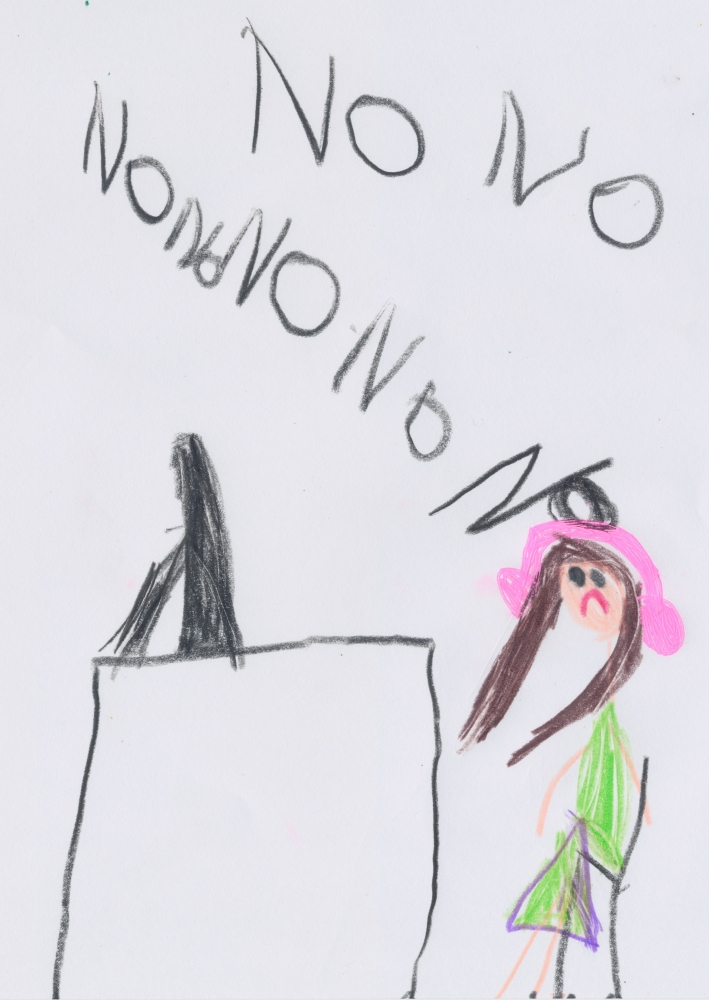
Hannah Hopkins, 9, who attends fourth-grade in Lexington, Ky., drew this picture to capture how she thinks the coronavirus has affected life in the United States. MUST CREDIT: Courtesy of Hannah Hopkins
Her mother and sister rush in and ask what went wrong. Did the Internet go out again? Is her computer plugged in? Is the math too confusing? Sophia can’t really answer. She’s too upset, wondering whether she’ll ever learn new things again, fearing she’ll fail the fourth grade and, more than anything, missing her friends. She hasn’t seen a single friend since March, when she was in third grade.
“So I just get really angry and frustrated,” she said. “I cry.”
Some children are doing fine with remote school; some even prefer it. But many others are like Sophia: They are suffering emotionally, mentally and even physically from so many hours, often alone, in front of a computer screen.
To gauge the struggle, The Washington Post asked parents nationwide to share stories and artwork produced by youths participating in the mandatory home-school experiment, garnering more than 60 responses from families living in 18 states.
School-age children are losing interest in food. They are complaining of back pain and burning eyes. They are developing feelings of depression.
It is unsurprising, even predictable, experts say, and likely to get worse the longer school campuses throughout the country remain shut down.
“The strain on kids is enormous,” said Matthew Biel, chief of the child and adolescent psychiatry division at Georgetown University School of Medicine. “Your 7-year-old wants to be recognized when they raise their hand. Oftentimes doesn’t happen on Zoom. They want to be able to make a comment, make a joke with a peer – can’t do that, no chatting allowed. Wants to be able to get up and walk around the classroom and move – can’t do that, we need to see your face on screen.”
He said it can be particularly hard for children with special needs, developmental delays or social struggles, but it can also be challenging for youths who simply crave friendship and the comfort of school rituals.
Especially for younger children, Biel said, the only way to express shock, sadness and displeasure is through emotional, sometimes violent outbursts and tantrums. And, although parents across the United States are rushing to reassure their children, they cannot provide the one answer that would help most – telling children when the pandemic will be over.
“This is just how life is now,” Biel said. “None of us can really share with our kids when it is going to end. We don’t know.”
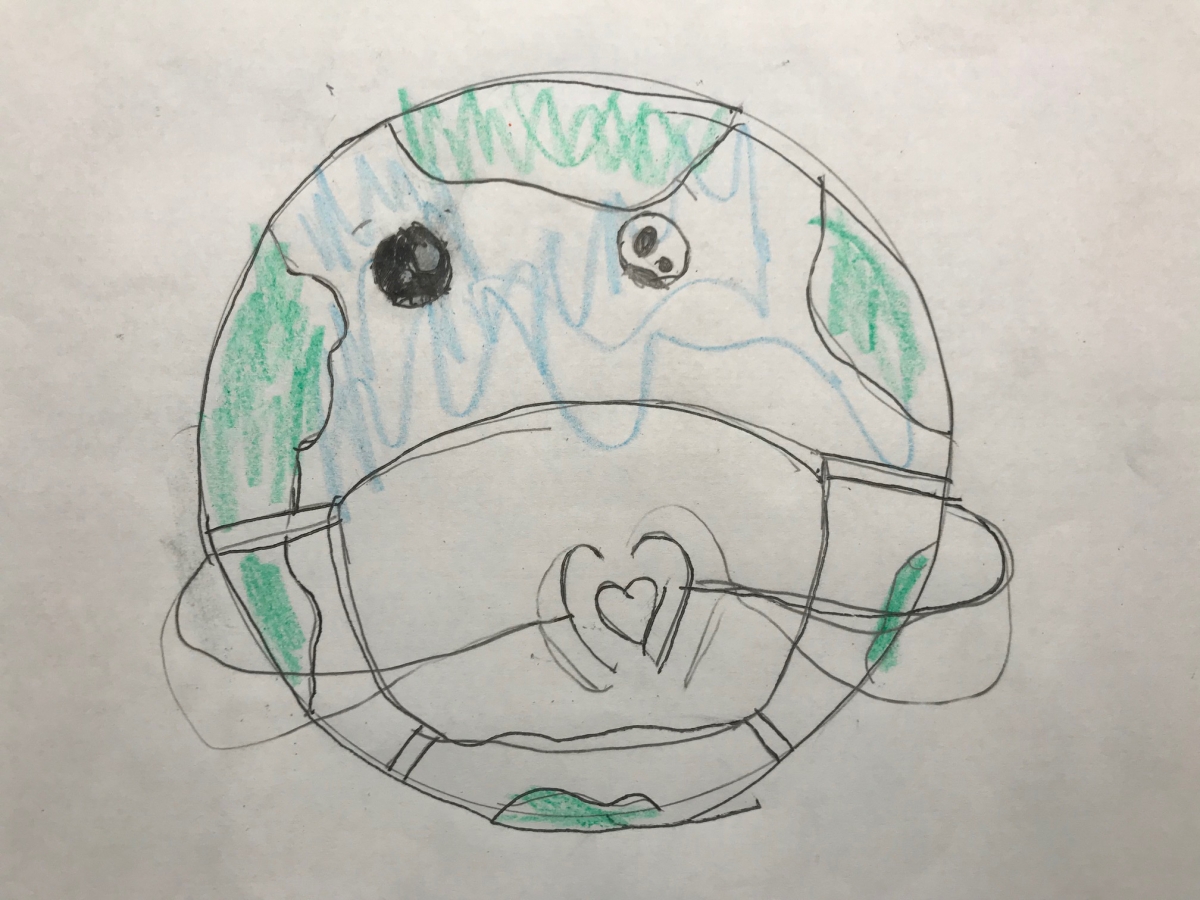
Toby Weissbratten, who attends second-grade in Ashburn, Va., drew this picture of a globe wearing a mask to show how the novel coronavirus pandemic has reshaped the world. MUST CREDIT: Courtesy of Toby Weissbratten
For Creedence Peterson, the school day has become a lesson in discomfort.
It starts when the 12-year-old pulls on his uniform: white button-down shirt, gray slacks, blazer and tie, as mandated by his New York City private school. Then he sits down on his bed, where he will spend the next six hours attending an almost unbroken string of Zoom classes.
Immediately, the waistband cuts into his stomach. The blazer feels hot.
Two hours in, his neck starts to bother him. His muscles feel strained, stretched. Holding his head in the same position for so long is unnatural, just plain wrong.
But the worst is when his eyes start to water and itch, which they almost always do. Creedence rubs them, and that helps, but within seconds they hurt worse. Soon they’re bloodshot, so ghastly looking that his parents at one point tested him for pinkeye – but no, it was just from staring at a screen for so long.
One room over, his 8-year-old sister, Piper, who attends Zoom classes while in her bedroom, usually starts feeling lightheaded at Hour 3. Her eyes begin burning around then, too. She takes every one of the “stretch breaks” her school offers, but what she would really like to do is run out to the playground for a game of tag.
That, Piper is sure, would make her feel better – or at least closer to how she used to feel before the pandemic, back when she woke up every morning feeling happy. There wasn’t a particular reason, she said. She just remembers being excited for the day.
That almost never happens now. Instead, “you get frustrated and furious,” Piper said. “Like, you don’t want to look at a screen. You don’t want to be at online school. You start crying.”
Creedence said he is just as frustrated as his sister. He would like to complain about school to his friends – in online chats, because he can’t see them in person – but so many of his friends have moved away. There was the family that left for Florida, and the twins, once his best friends, who now live in the Hamptons. Their parents decided they didn’t like New York anymore, Creedence said.
Piper misses her soccer team. Creedence misses the doughnut shop across the street, which recently shut down because of a lack of customers.
When things get too sad or weird, the siblings like to lose themselves in video games. The nice thing about a video game, Creedence said, is that it lets you shape the world the way you want it to look – or, he clarified, the way you need it to look.
But as soon as he closes the console, the same fear surges back.
“We might never be able to go back to some of our favorite restaurants, because they closed down, and we might never really see our friends again, because they moved away,” Creedence said. “This may never get back to normal.”
Karen James works in late October while her daughter Olivia attends virtual school at their home in Alexandria, Va. MUST CREDIT: Photo for The Washington Post by Amanda Andrade-Rhoades
At the start of the school year, Karen James tried to make things as normal as she could for her 7-year-old daughter, Olivia Gabriela James. She took first-day-of-school photos and dressed her up in nice school clothes. Olivia was right on time to her at-home workstation, in the dining room of the family’s home in Alexandria, Va.
But as time went by, James found there were holes she could not fill. Sometimes the mother felt helpless.
“Hands tied, I can’t change anything myself,” she thought. “And I’m doing the best that I can. Right? Which on some days doesn’t seem good enough.”
A single mom, James had to balance helping her daughter with her own demanding work-from-home responsibilities.
Olivia complained about technology (“It’s glitchy”) and missing her friends (“It’s really hard”). She longed to be in the same room with her teacher. The death of George Floyd added a layer of pain that Olivia, who is Black, is barely able to process. The second-grader glimpsed some of the news footage, and her mother felt forced to talk with her about injustices years before she would have liked.
“George Floyd died, and it just made me really sad, upset,” Olivia said. She knows exactly what happened. “The officer put his knee in his neck so he couldn’t breathe.”
The hardest blow came just before Olivia’s birthday, on Aug. 2, when James had to tell Olivia that her grandfather would not be coming to the house for her party. He comes every year, so when James told her daughter that he wouldn’t be showing up this year, she feared Olivia would think it was a trick, setting up some kind of super-special surprise.
“No, baby, really, this time Grandpa can’t come from Florida,” she told her. “It’s real.”
Olivia was in tears. So was her grandfather, leaving Jones forced to comfort both her father and daughter.
“I just think about the long term and how it will affect her academically as well as emotionally, and I try to give as many hugs and kisses and support as I can,” James said. “And I tell her, you know, we’re all doing this, like everyone in America this is happening to right now. But I wonder sometimes, you know – am I just talking over her head? So [I] just try to love on her, the best I can.”
Luke Pages, 12, who attends sixth-grade in Gaithersburg, Md., drew this picture to show how he thinks the novel coronavirus pandemic has reshaped his life. MUST CREDIT: Courtesy of Luke Pages
Luke Pages, 12, has a lot of trouble guessing how his days are going to go.
Not because of online school – that’s predictable. He knows how many 15-minute screen breaks to expect. He knows he will be taught by seven teachers over the course of the week. And he knows exactly how tired he will be – and how much his head will hurt – by the third Zoom class.
The uncertainty is due to his constantly shifting emotions.
“Emotions” is not a word Luke used a lot pre-coronavirus. The sixth-grader, who lives in Gaithersburg, Md., with his parents and little brother, Ethan, never spent time thinking about how he was feeling before. The answer was almost always “good.”
He is still happy, sometimes. But that sense of well-being has an expiration date now, and he never knows how long it will last. On good days, an hour. On not-so-good days, 10 minutes.
On the most stressful days, he just starts crying and can’t stop.
Ethan Pages, 10, who attends fifth-grade in Gaithersburg, Md., drew this picture to capture how he feels most of the time since the pandemic began. MUST CREDIT: Courtesy of Ethan Pages
“I don’t know why,” Luke said. “It’s like a roller coaster of emotions.”
Ethan, who is in fifth grade, has come up with his own words to describe what is happening inside his head. “Big feelings,” he calls it.
“I am feeling very sad and angry,” Ethan said. “Sad because I can’t see my friends and the people I miss. Angry because I have to see the same people, including my annoying brother.”
He also wishes he could see his teachers in person. Watching them on Zoom is “fine,” but the 10-year-old sometimes feels as if his teachers are not really his teachers – and he’s not a real fifth-grader – because he has never actually set foot in a classroom.
Ethan has questions about his lessons, and he doesn’t know how to put them into words that will make sense in an online chat or an email, which is the only way to win private time with the teacher. He would like to walk up to his teacher and explain his confusion with his hands. Sometimes, especially when school is hard, he closes his eyes and imagines doing that.
Luke, meanwhile, daydreams about something he always took for granted – the several-minute slices between every lesson. Back in real school, that is when he walked the hallways with his friends, headed for the next classroom. He can’t remember what they talked about – just random stuff, probably. Now, he can’t even see his friends’ faces, because not everybody likes to turn their cameras on for Zoom class.
Although the rest of his emotions have gone haywire, the 12-year-old said there is one feeling he can always count on: The end of every school day brings the same exhaustion and disappointment. If Luke could just go play football with his best friend after school, the way he used to, that might make him feel better. Instead, he’s developed a mantra.
“We’re all in this together,” he tells himself. “We will get through it.”
Annabelle Lisberg, 5, who attends kindergarten in Montclair, N.J., drew this picture to represent her feelings about online learning. MUST CREDIT: Courtesy of Annabelle Lisberg
Sophia Sanchez in Los Angeles knows who she would like to tell about everything going wrong with her life – her best friend, Sofia, who shares her name and whom she has known since first grade. Before the pandemic, she and Sofia were working on an illustrated book about a spy. They drew side by side at recess, unfolding new details of the plot with every picture. And they talked – about school, what was happening that day, how it made them feel.
Sofia is the only friend Sophia has spoken to since school shut down. But her mother doesn’t have Sofia’s mother’s number, so Sophia messages Sofia through the chat function of an online game they both play. It’s OK, Sophia said, but it doesn’t really feel like she’s talking to her best friend.
If the coronavirus were somehow gone tomorrow, that’s who Sophia would want to see first. She would march straight back to normal school. She would head for the monkey bars, where she would race Sofia, just like before.
By The Washington Post · No Author · ENTERTAINMENT, SPORTS, VIDEO-GAMES
Odds are that any video game fan would appreciate the new PlayStation 5 or Xbox Series X, if you can find one. The next-gen systems make an obvious-but-expensive gift for anyone who loves video games, but aside from tracking down the latest, greatest and priciest consoles, finding a good gift for a gamer can be tricky if you’re not familiar with gaming.
Yeah, sure, you could hedge and buy a gift card to let the recipient pick out whatever they want, but purchasing a specific gift for the game enthusiast in your life better shows you understand and care for their passion. And that can be a gift as valuable as the present itself.
So, Step 1: Engage with your gamer. Find out what platform they use (is it a PC or a console like a PlayStation? Or do they mainly play on their smartphones?) and what types of games they like to play. Once you know those key factors, you can start figuring out how your gift can make their experience better based on how they like to interact with games.
Identifying age-appropriate options is easy, but understanding how the player approaches their passion is a little more nuanced. The gifts they may enjoy most likely hinge on how they like to spend their time gaming. Below are some broad types and some specific characteristics to define different types of gamers, as well as some gift ideas that may fit well for those in that category. And if you do opt for the PS5/Series X/S route, the video below can help you decide which is the best fit.
– – –
Are they competitive?
If they approach gaming like they would a sport, you may want to look into adopting a similar take on gifting. Look into ways you can help them improve their skills and win through better equipment.
Suggestions:
– A customizable controller
There’s nothing bad about the standard controllers that ship with consoles – heck, the PS5′s DualSense is revolutionary – but truly competitive players may like a chance to shape their handset to best suit their play, whether in the form of a modified, re-mappable controller or an amped-up keyboard and mouse.
The first aspect to consider is the number of inputs. Modern games can be complex with more commands than there are buttons on standard controllers. A gaming mouse with buttons on side (in addition to the standard scroll wheel and left/right top buttons) puts more commands at your finger tips. Likewise, adding some back buttons to a console controller not only adds more moves to a player’s menu, it can put actions in an easier-to-reach position. Many of these options are also made with materials that tend to be more durable than stock hardware.
Be sure to check out the individual features for each controller, as they are not universal and your gamer may have a preference in how the buttons are laid out.
Xbox Elite Controller Series 2: Adjustable thumb-stick tension, hair-trigger locks and a snug-and-comfy rubber grip offer a serious upgrade on the standard Xbox controller you can use on the Xbox One, Series X/S or on PCs using Windows 7 or later. ($179.99 through Microsoft Store)
Scuf Impact/Prestige: Super customizable, the Impact lets you tinker with pretty much every major feature to get the most out of a controller compatible with PS4 and PC. They’ll also work with PS4 games played on a PS5, but not PS5-specific games. (Starting at $149.99 through Scuf) Playing on an Xbox? The Prestige provides the same benefits for Series X/S as well. (Starting at $159.99 through Scuf)
Dualshock 4 Back Button Attachment: Even adding two extra buttons can go a long way and clip-on accessory delivers that help at a super-affordable price for PS4 users. Alas, it does not work with the new PS5 controllers as well. ($29.99 through PlayStation)
Hori Real Arcade Pro.V Kai: Some fighting game competitors prefer the feel of an arcade-like setup that uses a joystick and buttons instead of a controller (where buttons tend to be smaller and closer together), this one, recommended by Wired, provides all you need to get that arcade cabinet feel at home. Note, there are specific models for Xbox and PlayStation, be sure to get the right one. ($169.99 through Amazon)
Razer Deathadder V2 mouse: There are plenty of options for any budget when it comes to good gaming mice, but PC Gamer tops its list with a model that feels good, adds buttons and doesn’t break the bank. You may also want to check out their full list in case another option better aligns with your gamer’s preferences. ($69.99 through Lenovo)
Satisfye ZenGrip for Nintendo Switch and Switch Lite: The Switch consoles can be a pain to hold for long periods of time. The Satisfye grips may seem odd because of the asymmetrical design, but that’s to replicate the movement of extended thumbs on a real controller. There are two versions available for the regular Switch and Switch Lite. You won’t want to go handheld with the Switch without these again. ($28.99 for Switch, $26.99 for Switch Lite through Amazon)
– A better headset
When it comes to cooperative, team-based games, communication is essential. And as games become more immersive, sounds and audio cues have never been more important to fully comprehending an in-game situation. If your teammates can’t hear you, that’s a problem. If you can’t hear an enemy’s footsteps approaching your position, that’s a problem too.
Like anything, headset prices span the spectrum and some budget options (like those found in the series below) yield a great result, even if they don’t have a premium feel or lack some high-end features. If you want to make the most of the next-gen consoles though, be sure to snag a set with 3-D audio abilities.
JBL Quantum series: There are plenty of impressive headsets out there, but the Quantum line delivers a lot of features at a lot of different price points, making for a simple recommendation.
All of the Quantum models from the 300 series ($39.95) and higher offer surround sound and PC software for personalization. While they work with all platforms via a 3.5mm cord, they deliver the best experience when playing on a PC. The higher-end models include active noise cancellation and the top-of-the-line Quantum One ($249.99) even has a head-tracking feature, so if there’s a sound originating in front of you and you turn your head to the right, you’ll hear if in your left ear and quieter or not at all in your right. A directional mic with echo-cancelling features keeps you loud and clear, even if you’re playing in a noisy environment. The best aspect of these sets though is the snug and supple feel when you put one on your head. (Starting at $39.95 through JBL)
– – –
Are they into immersive games that demand a time investment?
If your gamer prefers a lean-back approach with lengthy, story-driven games that emphasize immersive entertainment, you could consider some accessories to improve their overall experience with their games, or even introduce them to new ones.
Suggestions:
Sony Pulse 3-D Wireless Headset: Games can be cinematic experiences, so why not put the audio on par with the stunning visuals? For those that want to experience the PlayStation 5’s 3-D audio at its best, we recommend Sony’s Pulse 3-D wireless headset.
The headset offers clean, bass-y audio, and a similar experience to surround sound – making audio feel as though it’s happening all around you. You may hear an arrow zoom past your ear or an enemy approaching from behind, which further embellishes the realism of the digital worlds you inhabit. It also has excellent dual, noise-cancelling microphones to pick up your voice clearly during party chat. (Starting at $99.99 through PlayStation)
A soundbar: If you want to fill the room with the sounds of the world surrounding your character, enhancing a sound system is a great way to take advantage of the native 3-D sound and Dolby Vision technology in the Xbox Series X/S, or the PS5′s 3-D Tempest AudioTech. The difference between 3-D sound and surround sound is that the former can produce a mass of audio sources that envelop the listener from a number of directions, not just wherever the speakers are located.
The options here aren’t particularly cheap, particularly if you’re trying to please an audiophile/snob, but a pair of more moderately priced soundbar/subwoofer packages (one from Sony priced at $398.99 through Crutchfield and one from Samsung at $397.99) can still unlock the audio potential of the new consoles. If you’re looking for other options, just remember to look for models that utilize Dolby Atmos.
“The Last of Us Part II”: Full of rich storytelling, meaningful combat and a world ripe with both wonder and danger, “The Last of Us Part II” does not disappoint – especially if you enjoyed the first installment. In this new chapter, you play as Ellie, who is older and angrier than the wide-eyed young girl she used to be. Witnessing her evolution is fascinating and heartbreaking, but it’s also a game that surprises in how it handles its wide cast of characters. Be sure the person your buying for can stomach violent content, however. There is no shortage of it. (On sale at $29.99 via Target)
“Spiritfarer”: In “Spiritfarer,” death is not the end – it’s the beginning. This management sim casts you as Stella, a young girl who becomes a ferrymaster for the dead, guiding them to the afterlife. You visit islands to convince spirits to hop aboard, and bring them comfort in their final moments by building them homes on the boat, feeding them their favorite meals, completing their final demands and sometime simply giving them a hug. This heartwarming tale is elevated by gorgeous visuals, as well as excellent platforming and a consistent feeling of discovery during exploration. ($29.99 through Steam, free with a Game Pass subscription through Xbox)
“Assassin’s Creed Valhalla”: Vikings. Need we say more? The newest chapter to the open-world “Assassin’s Creed” franchise puts you in the shoes of Eivor, a Viking leader who forms alliances across England to help their clan settle in the new land. Ubisoft marries old and new concepts, bridging the gap between stealth, combat, role-playing mechanics and lore in the most meaningful way for the series in years. (Starting at $59.99 for the standard edition through Ubisoft)
The Scuf Exo: You’re probably going to think of this as a gaming pillow, and you’re not wrong. And don’t buy this unless your intended recipient is the practical sort that doesn’t care what they look like while playing, because you’ll win no coolness points with this thing. What you do get is support for your wrists, allowing you to lay your hands and the controller on the pillow, which sits on your lap and supports your elbows as well. It eases tension in your shoulders, too, but the biggest aid is in allowing longer use of the PS5 controller, which is as weighty as it is awesome and can cause some strain during long gaming sessions. ($39.99 through Scuf)
– – –
Are they casual or extroverted players?
For a lot of people during the pandemic, and for school kids even before that, gaming has become a go-to way to socialize. Here’s how you can help them get a little more from their casual game sessions.
Suggestions:
“Among Us” (on PC): “Among Us” is a fun and sometimes broken social deduction game about rooting out killers on a spaceship. Its popularity partially stems from the boost it got from content creators playing the game together – not to mention the nearly record-breaking stream of Alexandria Ocasio-Cortez (D-N.Y.) – but another likely factor is that the game is free on mobile devices. That’s a fine way to play, but the optimal experience is on PC, where the game costs $5. It’s a minor upgrade, mostly sparing players of accidentally pressing the wrong button or steering their avatar in the wrong direction on a smaller screen, but it’s well worth the cost of admission. ($5 through itch.io)
Jackbox Party Pack: The Jackbox Party Packs are the easiest way to get a group of people with little to no game experience together for a session – bar none. The only requirement is for one person in the group to own a party pack, and for everyone else to own a phone or computer. Each party pack includes a sampling of minigames, though our recommendation would be to choose a pack with “Quiplash,” which is likely the most intuitive and fun of the bunch. The latest entry is Party Pack 7, though 3 is generally viewed as the gold standard of the bunch (and 4 is great too). (Starting at $12.49 through Jackbox Games)
Discord Nitro subscription: It’s likely that the social player in your life is already spending tons of time on Discord, the voice and chat service primarily geared toward gamers. It’s a great place to organize game sessions, host chats and private streams, and just goof off with friends. It’s a versatile free service by default, but a Discord Nitro subscription ($9.99 per month) – or even the cheaper Discord Nitro Classic package ($4.99 per month) – will open up some new features for power-users, including a higher upload cap and the ability to use custom emotes across servers. (Starting at $4.99 per month through Discord)
– – –
Are they experiential?
Some people enjoy gaming for its ability to approximate an experience they can’t replicate in everyday life. In the current pandemic, that can include things like getting outside, finding safe ways to socialize or seeing parts of the world you can’t currently access.
Suggestions:
Oculus Quest 2: Between an affordable price and the simplicity of just pairing your headset with a modern smartphone, the barrier to entry for virtual reality has never been lower. And while super-deep games aren’t yet the norm for VR (though that’s changing) there are a plethora of apps already on the market that allow users to sink into immersive 3-D experiences. If you want to dive into higher-powered games that require a PC connection, you can also snag the Link cable for an additional $79.99. ($299.99 through Oculus)
“Microsoft Flight Simulator”: The latest entry in Microsoft’s long-running flight simulator series flew under the radar for the wider industry when it was released, but that’s because the game can be tough to run, even on the most beastly PC setups today. But if you know someone who has a hankering for travel and has a decent PC rig, “Microsoft Flight Simulator” is a groundbreaking new project that recreates the entire Earth and all of its airports for travel. It’s a one-of-a-kind title, and the most impressive tech showcase of the year. ($59.99 through Xbox)
– – –
Are they streaming?
The pandemic has further boosted a growing trend of gamers streaming themselves and their gameplay on outlets like Twitch, YouTube and Facebook. If they’re trying to put themselves out there and grow their audience, you can help them put their best foot forward.
Suggestions:
Maono AU-04 USB Microphone Kit: As streamers acquire more and more technical capabilities with their streams, a higher expectation on quality is expected, one that the easy-to-use Maono USB Microphone Kit meets with style. The mic plugs in directly using USB, comes with an adjustable stand and offers industry-level audio capabilities like cardioid recording and high sampling rates. A great entry-level mic if you’re serious about streaming. (Starting at $49.71 per month through Amazon)
Aduro U-Stream Ring Light: The aforementioned heightened expectations of game streams also extend to the picture-in-picture quality of the streamer cams themselves. While several laptops and computers come with cameras capable of streaming at high quality, lighting on your face is the key ingredient to making your face pop. The Aduro U-Stream Ring Light, which comes with an adjustable stand and brightness controller, is one of the less expensive models out there but gets the job done. (Starting at $39.99 per month through Amazon)
Streamlabs: The final step to your streaming success is software that can tie everything together, and Streamlabs more than answers the call. It not only provides standard streaming capabilities like picture-in-picture and direct linking with sites like Twitch, but it also provides search engine optimization services to help your channel acquire more views. The best part? It’s free! (Starting at no cost through Streamlabs)
– – –
Are they nostalgic?
If they like to indulge on classic consoles or play vintage games, there may be a number of ways to recapture that “the time I got an NES for Christmas” feeling with throwback games and platforms.
Suggestions:
Turbo Grafx Mini: The mini-retro-console trend is overshadowed by the big box releases this holiday, but don’t sleep on Konami’s packaging of 16-bit-era classics. Anyone who grew up on gaming in the late last century would at least remember hearing about these games, even if you didn’t play them. With 57 titles, some of them impossible to find on the free market, it’s an incredible value for the retro gamer. You may need some luck to find one, however, as it is largely out of stock. (Normally $99.99 through Amazon)
“Streets of Rage 4”: Remakes and rehashes were huge in 2020, but none of them captured early 1990s arcade nostalgia quite like indie developers Dotemu and LizardCube did with their update to the Sega Genesis series. The core gameplay of “walk right, punch bad guys” is mercifully left alone, peppered with a few tweaks to tighten up the experience. “Streets of Rage 4” offers one of the purest brawling experiences today, a pixel-perfect present for purists. ($34.99 through Best Buy)
“Super Mario 3-D All-Stars”: Nintendo has finally collected three of the most memorable 3-D Mario games into a single package for the Switch: “Super Mario 64,” “Super Mario Sunshine” and “Super Mario Galaxy.” Beyond an HD update, Nintendo did little to update these games, so with all of their original blemishes intact, they’re exactly how you remember them. ($59.99 through Amazon)
“Sonic Mania”: This celebration of the Genesis-era Sonic games combines remixed versions of the original zones with brand new areas like Mirage Saloon and Titanic Monarch Zone. Clever tweaks have been made to the gameplay and level design, done with an incredible attention to detail. With the sleeker, modern sheen that Sega gave to “Mania,” it’s not a stretch to say that this is the best Sonic game ever made. ($19.99 through Best Buy)
Mega Man Legacy collections: It has been more than 30 years since the original “Mega Man” was released on the NES, but these platformers still hold up as a master class in gameplay and level design. Capcom has published several of these comprehensive collections, spanning decades of “Mega Man,” “Mega Man X” and “Mega Man Zero” games. In addition to extra game modes, the cherry on top of these archival compilations are the “museums,” which are packed with sketches, art and other visual materials from the original games. (Prices vary but normally $14.99 through Nintendo)

 Maria Mercedes Bejarano, 73, walks on her knees in prayer up the aisle of Washington National Cathedral during a special four-hour vigil on the day after Election Day. The District of Columbia cathedral has otherwise been closed to the public since the spring due to the pandemic. MUST CREDIT: Washington Post photo by Michelle Boorstein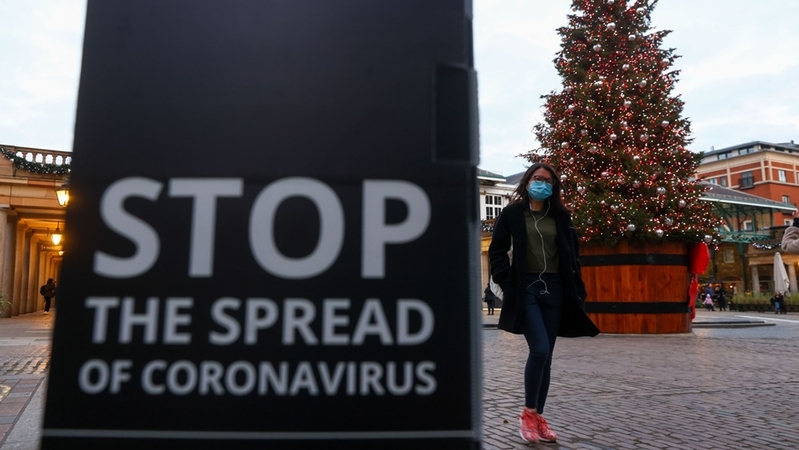
 Bernard Chan. MUST CREDIT: Bloomberg photo by Justin Chin
  A truck on the dockside at the major British port of Felixstowe, England. MUST CREDIT: Bloomberg photo by Chris Ratcliffe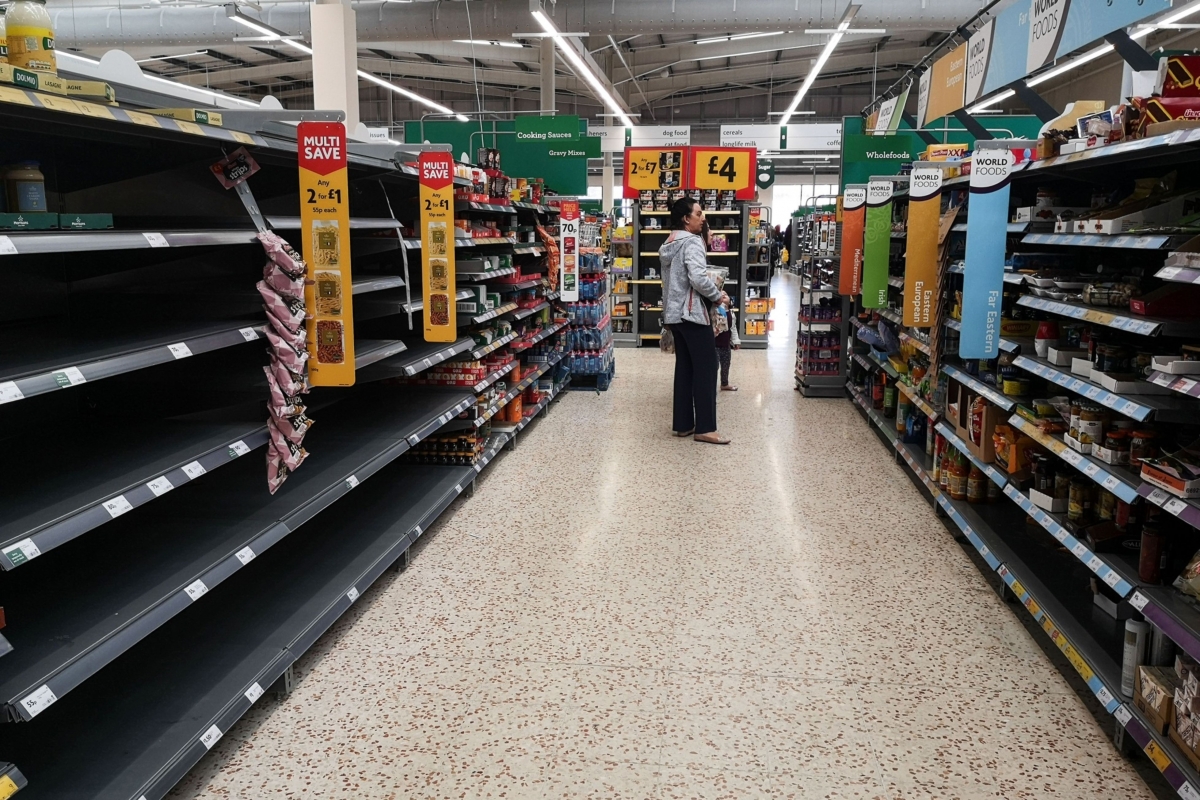

 A GameStop store in Tampa, Fla., on Nov. 27, 2020. MUST CREDIT: Bloomberg photo by Eve Edelheit
  Black Friday shoppers come and go from a Target store in Falls Church, Va., on Friday. MUST CREDIT: Photo for The Washington Post by Amanda Andrade-Rhoades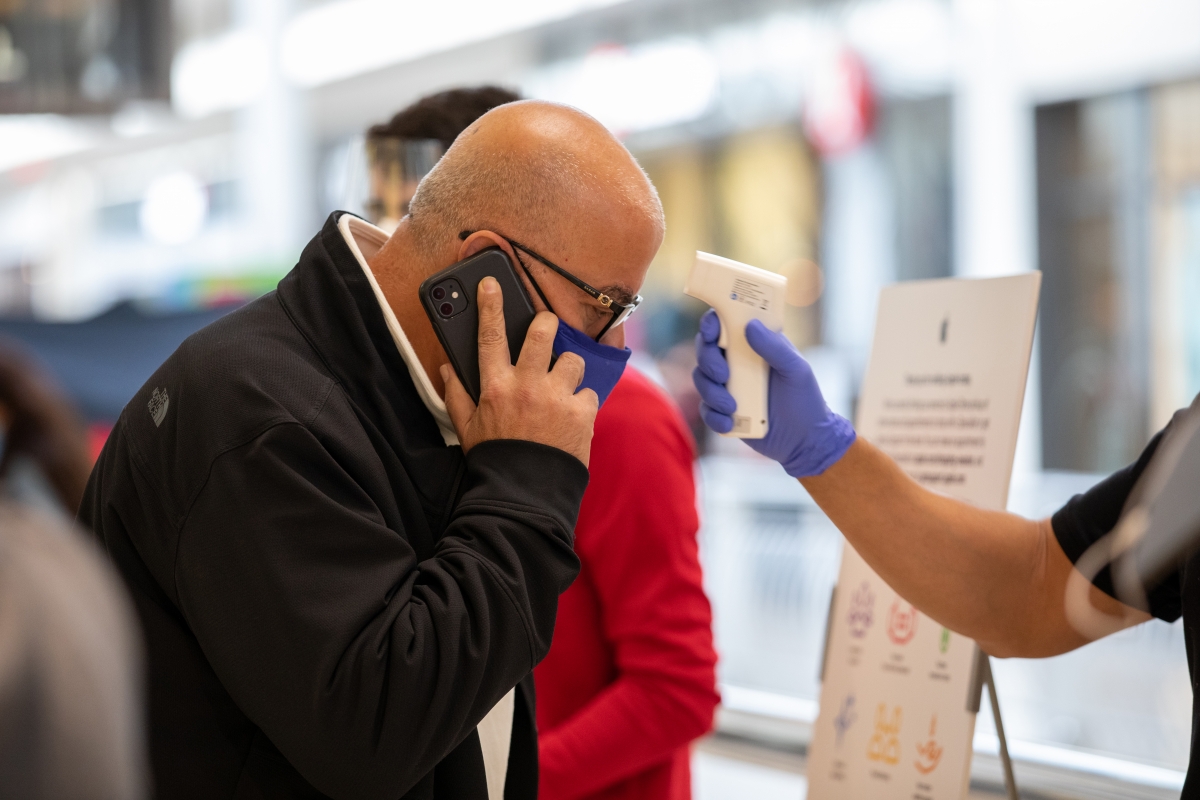
 A U.S. soldier walks past a wall burned in the Iranian airstrike at the Ain Al-Asad base near Anbar, Iraq, on January 13, 2019. MUST CREDIT: Photo for The Washington Post by Emilienne Malfatto
  Karen James embraces her daughter Olivia James, 7, during a break from school and work at their home in Alexandria, Va. MUST CREDIT: Photo for The Washington Post by Amanda Andrade-Rhoades