By The Washington Post · Hannah Knowles · NATIONAL, HEALTH, POLITICS, SCIENCE-ENVIRONMENT Late Friday night, North Dakota’s Republican governor – long resistant to statewide orders on masking and social distancing – acknowledged that his state and country were in dire straits.
Bars, restaurants and event venues would have to cut capacity, Gov. Doug Burgum said in a solemn video posted to social media. Most after-school activities would be put on hold. Starting Saturday, masks must be worn inside businesses, indoors in public spaces and outdoors when social distancing can’t be maintained, backed by potential fines of up to $1,000 for the first offense.
“Our situation has changed, and we must change with it,” the governor said, as the United States breaks records for daily new cases and North Dakota leads in recent infections per capita.
A dark reality is sinking in for officials around the country, with Burgum just the latest leader to announce stiff new restrictions in the face of surging cases and hospitalizations that health experts have been warning about for months. But doctors and health officials worry that the urgency of the escalating crisis has not gotten through to a public weary of pandemic shutdowns. And the push for stronger measures has triggered backlash and legal fights.
Chicago on Thursday became the first major city to announce a renewed stay-at-home advisory. A day later, New Mexico Gov. Michelle Lujan Grisham, a Democrat, reinstated many restrictions, prohibiting on-site dining and requiring nonessential businesses to close their physical locations. Three Western states – California, Oregon and Washington – just urged people to cancel travel that’s not absolutely necessary, and Oregon Gov. Kate Brown, a Democrat, also announced a two-week statewide “freeze” Friday, which included curbing gatherings ahead of Thanksgiving.
A vaccine breakthrough has buoyed hopes – “The cavalry is coming,” as Anthony Fauci, the nation’s top infectious-disease expert, put it – but the country is still facing what officials say could be its grimmest months yet of the pandemic, with tough decisions ahead and thousands of lives in the balance.
Many leaders are leery of stronger measures and economically painful shutdowns, as Democrats and Republicans remain stalled over a new coronavirus stimulus package that could blunt the economic fallout. President Donald Trump on Friday said his administration would not under “any circumstances” resort to a “lockdown.”
“Lockdowns cost lives, and they cost a lot of problems,” the president said at a news conference where officials said they hope to see millions of people immunized against the coronavirus by the end of the year.
A vaccine could be available to the general public as early as April, Trump said, a timeline echoed by experts such as Fauci. But in the meantime, coronavirus cases are soaring to new heights, pushing past 177,000 nationwide on Friday – little more than a week after the country cracked 100,000 daily infections for the first time. The vast majority of states have recorded a single-day high in new cases over the past week, as total infections in the United States approach 11 million. More than 1,300 new coronavirus-related deaths were reported in the United States on Saturday, up more than 200 from last Saturday’s total. Current covid-19 hospitalizations have risen to record heights, too, approaching 70,000.
The stakes are high, and officials are bitterly divided over how to respond in some hard-hit communities.
On Friday, a Texas state appeals court blocked El Paso County Judge Ricardo Samaniego’s stay-at-home order shuttering nonessential businesses in an area where growing coronavirus cases have packed hospitals to capacity and led local officials to call in mobile morgues. County Judge Ricardo Samaniego said the order was necessary to combat a deadly crisis.
But the measures ran afoul of Republican Texas Gov. Greg Abbott’s statewide rules. State Attorney General Ken Paxton hailed the Eighth Court of Appeals’ decision Friday on Twitter, decrying a “tyrant who thinks he can ignore state law” and vowing not to let “rogue political subdivisions try to kill small businesses and holiday gatherings.”
Samaniego was similarly biting in his response, accusing Paxton of gloating as the county suffered. More than half of the patients flooding the county’s health system have the coronavirus, Samaniego told The Washington Post. People are being sent out of state for care.
“Here we are in a really critical situation, he says, people, you can go to Thanksgiving?” Samaniego said of Paxton in an interview Saturday. “Just a complete disregard for our situation.”
Strain on health systems has pushed some states to not just reinstate old restrictions but also contemplate measures they had avoided earlier in the pandemic. In North Dakota, for instance, Burgum’s mask mandate came after rising pressure from health-care workers, as state officials authorized medical professionals to keep working in covid-19 units after testing positive for the coronavirus, if they lack symptoms.
Utah Gov. Gary Herbert, another Republican leader long wary of a sweeping mask order, said Sunday that he was mandating face coverings statewide in public settings and for people within six feet of anyone outside their household. The reversal came after swamped hospitals warned they might have to ration health care.
Some jurisdictions have narrowly staved off new orders and closures – for now. Officials in New York City, an early hot spot in the pandemic, said this past week that the nation’s largest school system could close if the rate at which coronavirus tests came back positive hit 3 percent. Mayor Bill de Blasio tweeted Saturday that the city remained below that benchmark but warned that things could change.
“We MUST fight back a second wave to keep our schools open,” he said.
Many are skeptical that leaders around the country will take serious new measures, amid pushback. The changes announced Friday in Oregon drew an outcry from businesses.
“We were already hearing from members they were concerned about what another shutdown would do to their chances of staying open,” said Jason Brandt, the president of the Oregon Restaurant and Lodging Association, in a statement, saying the new rules “will trigger an unknown amount of permanent closures.”
Veronica Miller, a professor at the UC Berkeley School of Public Health who signed an open letter this summer urging renewed shutdown measures, said she worries public health experts’ strident warnings are not getting through “to that extent that we need.”
“You can just see the graphs, they’re just really over the top, and it’s so much worse, and it’s going to get worse, and I do not see at the national level – I do not see any sense of urgency,” she said.
Thousands of mask-less Trump supporters rally in D.C., falsely claiming president won election
InternationalNov 15. 2020People wave to President Trump’s motorcade Saturday as it drives past Freedom Plaza as supporters gathered for the Million MAGA March in Washington D.C.. MUST CREDIT: Washington Post photo by Matt McClain.
By The Washington Post · Marissa J. Lang, Emily Davies, Michael E. Miller, John Woodrow Cox · NATIONAL, POLITICS WASHINGTON – President Donald Trump’s supporters had celebrated for hours on Saturday, waving their MAGA flags and blaring “God Bless the USA” as they gathered in Washington to falsely claim that the election had been stolen from the man they adore. The crowd had even reveled in a personal visit from Trump, who passed by in his motorcade, smiling and waving.
But that was before the people who oppose their hero showed up and the mood shifted, growing angrier as 300 or so counterprotesters delivered a message the president’s most ardent backers were unwilling to hear: The election is over. Trump lost.
On stark display in the nation’s capital were two irreconcilable versions of America, each refusing to accept what the other considered to be undeniable fact.
In brief but intense clashes, activists spewed profanity and shouted threats, threw punches and launched bottles. On both sides, people were bloodied, and at least 10 were arrested, including four on gun charges.
When darkness fell, the counterprotesters triggered more mayhem as they harassed Trump supporters and set off a large firework just outside a restaurant, prompting police to pepper-spray the instigators.
The earlier demonstrations were urged on by Trump, who refuses to concede to Joe Biden or allow a formal transition to begin. On Saturday morning, as the president’s devotees remained in the District of Columbia to fight for him, he headed to Trump National in the Virginia suburbs for a round of golf.
After a week in which more than 750,000 Americans were diagnosed with the novel coronavirus, almost none of his backers were wearing masks. Among their ranks were white nationalists, conspiracy theorists and far-right activists carrying signs demanding action that was already being taken: “Count the legal votes.”
Trump had thrilled them when his motorcade appeared on Pennsylvania Avenue shortly after 10 a.m., prompting fans to scramble to the side of Freedom Plaza to catch a glimpse.
“He drove right past me. I saw him. He waved right past me,” one man said as he tried to collect himself.
A group of women huddled around a phone, looking at a video of Trump’s appearance near a Walt Whitman quote inscribed in the stone beneath them: “The President is there in the White House for you, it is not you who are here for him.”
Then the appearance of counterprotesters sparked bursts of conflict that could have become far more violent had police not worked to keep the feuding sides separate. When a small group holding bright orange “Refuse Fascism” posters arrived at the edge of Freedom Plaza, they were almost immediately surrounded by Trump fans shouting “USA! USA!” into their faces.
The women leading the tiny march fought their way up 14th Street, repeatedly breaking out of the crowd, only to be engulfed again.
“Trump, pack your s—! You’re illegitimate!” they yelled into their megaphone,
One pro-Trump man attempted to gouge the opposition with a flag bearing the president’s name. Another grabbed a woman’s neon orange poster and hit her with it.
When the women made it to the barrier set up by police across the street, Trump supporters filled the entire intersection, blocking them. Police arrived on bikes and, after several minutes, moved the crowd back. Shortly after, the group began singing the national anthem.
Nearby, on the street beside inscriptions from Abraham Lincoln recognizing the District as a place of freedom, people piled atop a U-Haul truck with a flag of a gun and the words “Come and take it.”
One man, wearing camouflage and a red MAGA hat, waved an American flag attached to a baseball bat.
Later, near Union Station, another altercation broke out.
Roland Biser, a 69-year-old Pentagon employee who had attended a pro-Trump rally, was driving home when he said he saw a young man throw a rock at a group of Trump supporters. The rock grazed a woman, he said, and may have hit someone else.
Biser pulled over as a crowd quickly surrounded the young man and three others with him, all of whom were Black. Nearly a hundred Trump supporters quickly surrounded them before a dozen U.S. Capitol Police officers rushed between them and separated the groups.
As police escorted the four young men away, the crowd taunted them, chanting “USA!”
“I didn’t do anything!” said one of them, who had been handcuffed. The 21-year-old D.C. resident insisted that it was the Trump supporters who had come after him.
A few minutes later, police removed his cuffs off and let him go.
A family of four on Capital Bikeshare bikes – the father with an American flag tied around his neck like a cape – were cut off by a line of counterprotesters as they tried to leave a tense scene outside the Supreme Court about 1 p.m.
“Get out of our city!” a young woman in black yelled.
“You lost, losers!” shouted a man.
The father and his teenage son began to chant “USA!” and raised their fists as police officers surrounded the family and pushed them out of the crowd.
“Why would you bring your kids here? It’s dangerous,” observed a man nearby, a helmet on his head and respirator hanging around his neck.
On a day when the president’s supporters touted a vast array of falsehoods, his spokeswoman, Kayleigh McEnany, offered perhaps the most ludicrous.
“More than one MILLION marchers for President @realDonaldTrump descend on the swamp in support,” she tweeted, vastly exaggerating the crowd size.
The Trump believers had begun gathering at Freedom Plaza Saturday morning hours before the official rally.
“They think we’re stupid,” a young White man with a microphone told the crowd. “They’re underestimating The Donald. They’re underestimating The Donald’s supporters.”
“They’re stupid!” a young White woman replied.
The speakers who addressed the aggrieved legions included Alex Jones, a discredited conspiracy theorist most famous for tormenting the families of school shooting victims, and Marjorie Taylor Greene, a recently elected congresswoman from Georgia who has promoted QAnon, which falsely alleges that famous Democrats belong to a cabal of Satan-worshiping pedophiles.
Among the rallygoers were members of the Proud Boys, an extremist group known for their black-and-yellow garb and endorsements of violence. Some wore flak jackets and helmets. “Stand Back, Stand By,” read some of their shirts, referencing the president’s directive to them during a September debate.
As conservative speakers at Freedom Plaza derided the news media, including Fox News, the Proud Boys marched down Pennsylvania Avenue, leading hundreds in chants of “F— antifa!” and shouting down stray opponents who yelled “Black lives matter!”
“All lives matter!” they screamed back.
Marching with them was District resident Justin Anthony, who waved a satirical sign that read “Sue anyone who did not vote for this great American.”
He led chants to the tune of “Count only Trump votes” and danced around in a large mock police uniform with the name “Officer Pudge” on its badge.
Almost no one got it, he said. They joined in, asked for pictures, cheered.
“It’s crazy,” he said. “Like, they really don’t see how insane this is.”
At midday, along the east end of Freedom Plaza, another lone counterprotester stood on the sidewalk holding a sign that read “Trump is the fraud.” He wore a gray cloth mask.
A succession of Trump supporters approached the curb, unmasked, to offer their opinions of his solitary demonstration.
“Why didn’t your mother abort you?” one screamed. “You’re mentally disturbed, and you’re a coward, and you’re a f—–. I hope you get AIDS.”
“I just feel strongly about the disinformation that’s being peddled on the Internet about fraud in this election,” said the counterprotester, a 40-year-old D.C. man who declined to give his name because he is a federal employee and feared repercussions at work.
A thin film of sweat had formed on his face. An elderly woman in red MAGA gear paused and stared at him, sadly.
“We feel bad for you that you can’t see the truth,” she said.
Vaccine group hits $2 billion 2020 goal for low, middle income nations
InternationalNov 14. 2020A logo at the Pfizer French headquarters in Paris on Nov. 10, 2020. MUST CREDIT: Bloomberg photo by Nathan Laine.
By Syndication Washington Post, Bloomberg · Thomas Mulier, James Paton · WORLD, HEALTH, HEALTH-NEWS
A program that aims to supply low- and middle-income countries with covid-19 vaccines said it has raised more than $2 billion, though it needs another $5 billion for next year.
The vaccine initiative hit its 2020 funding target the same week Pfizer and BioNTech announced positive late-stage trial results showing their shot protects most people from the illness. The European Union, France, Spain, South Korea and the Bill and Melinda Gates Foundation pledged a combined $360 million, according to Gavi, the Vaccine Alliance, the group leading the effort.
Those developments offer “a glimmer of light at the end of the tunnel,” Seth Berkley, chief executive officer of Gavi, told reporters on a call Friday. “The science is moving forward and so is the finance needed to ensure that the science will be available to all.”
Despite the promising signs, Berkley called for caution, saying that important questions remain on efficacy in different groups, duration of protection, safety and production.
Gavi said 94 high-income countries have joined the Covax alliance, which aims to boost access to vaccines in 92 low- and medium-income countries. The program expects more deals in the coming weeks and months following agreements with companies including Sanofi and GlaxoSmithKline, Aurelia Nguyen, managing director of the Covax facility, said on the call.
“Not only is it likely we will need different vaccines for different contexts, there’s also no guarantee any one vaccine will succeed,” she said. “Perhaps more importantly, no single manufacturer has the capacity today to supply the global volume required to ensure that no country is left behind.”
As optimism grows that vaccines will arrive next year, health advocates and poorer nations are concerned that wealthier countries will monopolize supply, which is bound to be limited initially. The U.S. and Europe are in line to get the first doses of the vaccine developed by Pfizer and BioNTech.
Biden win revives hopes for $500 billion boost to IMF firepower
InternationalNov 14. 2020Kristalina Georgieva, managing director of the International Monetary Fund, left, and Ursula von der Leyen, president of the European Commission, in Brussels on Jan. 28, 2020. MUST CREDIT: Bloomberg photo by Geert Vanden Wijngaert.
By Syndication Washington Post, Bloomberg · Eric Martin · BUSINESS, WORLD, US-GLOBAL-MARKETS
Joe Biden’s victory in the U.S. presidential election is reviving hopes of a significant boost to International Monetary Fund resources to help nations fight the global pandemic.
IMF Managing Director Kristalina Georgieva called in March for the Group of 20 biggest economies to back a “sizable” increase in reserve assets called special drawing rights, or SDRs.
That would echo a similar decision in the 2009 financial crisis which was supported by the U.S., the fund’s largest shareholder, when Biden was vice president. President Donald Trump’s administration blocked a proposed $500 billion issuance, criticizing it for failing to target poor countries.
Biden has yet to speak about the proposal, but allies have advocated for it. Former Treasury Secretary Larry Summers, who advised the Biden campaign on economic policy, in October reiterated his prior call for a $1 trillion issuance. Summers is a paid contributor to Bloomberg.
In July, the Democrat-controlled House of Representatives voted for an allocation of at least $2.8 trillion as part of a larger defense appropriations bill now in the Republican-controlled Senate.
“There are many in the Democratic fold writ large who have argued the case for an SDR allocation,” said Mark Sobel, who served at the U.S. Treasury at the time of the 2009 allocation. “While an allocation has its pros and cons, it might be a good way to send a multilateral signal by a new administration.”
The U.S. is the linchpin for approving the move because the nation holds 16.5% of the voting power at the fund’s 24-member executive board, almost three times the sway of any other country. Passage requires 85% of votes, giving America a de facto veto.
The IMF press office declined to comment, referring questions to the Biden campaign. A campaign spokesman didn’t return an email seeking comment.
Advocates of new reserves argue that they would provide billions of dollars to poor countries struggling to pay for health care costs and social spending amid the pandemic.
Opponents, including U.S. Treasury Secretary Steven Mnuchin, counter that because reserves are allocated to all 190 members of the IMF in proportion to their quota, 70% would go to the G-20, with just 3% for the poorest developing nations.
An SDR allocation likely would continue to be opposed by Republicans, said Ted Truman, a longtime Federal Reserve economist who was a counselor to Treasury Secretary Timothy Geithner worked to build support for the last SDR allocation. U.S. backing for that $250 billion increase was debated even among Democrats within the Obama administration.
One concern for critics and some Republicans is that the move would provide funding to governments that the U.S. has tried to cut off from financing.
On example is Iran, which the American government has tried to squeeze over its nuclear program and support for terrorist groups. A global issuance of $500 billion in SDRs would give the nation access to almost $4 billion in IMF lending.
But the U.S. Congress would be less of an obstacle if a total SDR issuance is kept to less than about $650 billion, the current IMF quota of all nations.
A move of that size would only require Biden to consult with Congress, not to receive legislative approval, said Sobel, who also served as a U.S. representative to the IMF at the end of the Obama and start of the Trump administrations before joining the economic think tank OMFIF.
Any SDR allocation should be linked to China and private creditors providing debt relief and transparency, to make sure that reserves don’t simply pay off loans owed to them, Sobel said.
Truman, now at the Peterson Institute for International Economics, compared the reserves to the $1,200 stimulus checks that the U.S. government mailed to some taxpayers earlier this year. While they would go to everyone, and some might not spend them immediately, they would make a big difference to those that need them.
“It has the advantage of being a relatively simple deliverable,” he said. “I would think that it’s a possibility.”
Joe Biden socks and Kamala Harris scrunchies: Washington’s gift shops prepare for a new administration
InternationalNov 14. 2020White House Gifts, where manager Mirian Aquino was setting up a display Friday, is among the Washington, D.C.-area souvenir vendors overhauling their inventory in advance of Joe Biden’s inauguration and move to the White House. MUST CREDIT: Washington Post photo by Michael Robinson Chavez
By The Washington Post · Abha Bhattarai · NATIONAL, BUSINESS, FEATURES, POLITICS, US-GLOBAL-MARKETS, RETAIL, TRAVEL
WASHINGTON – There are socks emblazoned with Joe Biden’s face and wine glasses honoring Kamala Harris.
Though President Donald Trump has yet to concede the presidential race, the wheels of commerce roll on. White House Gifts is lining its shelves with Joe Biden and Kamala Harris merchandise in advance of the inauguration, which in a typical year can generate as much as 20% of its sales. MUST CREDIT: Washington Post photo by Michael Robinson ChavezAlso on sale at White House Gifts in downtown Washington: Biden-Harris candy jars, celebratory hair scrunchies, and plush German shepherds with “First Pet” bandannas honoring Major and Champ. The Donald Trump merchandise, meanwhile, has been moved to the back of the store, marked down 75%.
Every four to eight years, Washington’s gift shops and souvenir stands undergo an overnight transformation. Barack Obama action figures made way for “Make America Great Again” gear in 2016, and now Biden-Harris face masks and T-shirts are pushing MAGA hats to the clearance racks. Sales are typically steady regardless of who’s in the White House, thanks to a dependable stream of political supporters and tourists who want keepsakes from the nation’s capital.
“Whenever you have a change in administration, no matter who it is, there are new customers and all new energy,” said Alesia Jones, vice president of the longtime Washington store. “It’s like you flip a switch and have a completely new store.”
But this year is different. Sales at White House Gifts have fallen 80% since the pandemic took hold in March, and tourism – especially lucrative international travel – ground to a halt. Most of the people who wander in are regional, traveling from Maryland or Virginia. The store, which once had 32 workers, now employs seven.
Still, souvenir sellers around the city say they are hopeful the Biden-Harris win will create enthusiasm for their products. Harris – the country’s first female, Black and Asian vice president – holds a special appeal to girls and women that they’re hoping to capitalize on. White House Gifts is already selling girls’ T-shirts that say “Kamala is my VP” and “That little girl was me,” a reference to Harris’ viral exchange with Biden during a Democratic presidential debate last year. Other shop owners say they’re hoping to replicate the kind of success they’ve had with products commemorating former first lady Michelle Obama and late Supreme Court Justice Ruth Bader Ginsburg.
After a costly mistake in 2016 – in which owner Jim Warlick bought $100,000 worth of Hillary Clinton T-shirts, mugs and wine glasses before the election – executives this time waited until Sunday, one day after Biden was named the winner of the presidential race, to place their orders. Jones says she’s still parsing speeches and appearances by Biden and Harris to pick up on quotes and ideas for new merchandise.
“Each president has their own theme,” said Jones, who said designers typically start creating products six months before an election. “For Trump, it was ‘Make America Great Again’ and ‘Keep America Great’ that kind of took over. This time around, we’re picking up on cues such as Joe Biden’s aviator glasses and, of course, the fact that Kamala Harris is breaking a huge glass ceiling for women.”
The official White House Gift Shop is offering preorders on an official Biden-Harris inauguration coin for $100. Elsewhere on the internet, businesses are selling Biden-scented candles (“a captivating blend of musk and honey” for $25), Harris-themed coloring books ($17) and life-size cardboard cutouts of both ($40). For those on the other side of the political spectrum, there are “Impeach Biden” bumper stickers ($5) and bath mats ($20).
The change in administration, shop owners say, often also means a change in tone. At Chocolate Moose, a novelty gift shop where Trump toilet paper has been the top-seller for four years, owner Michele Crosby said she’s preparing for more earnest products this time around.
“We carry merchandise for every administration but obviously some administrations offer more material than others,” she said. “Trump has definitely been our biggest-selling administration.”
In addition to $8 rolls of toilet paper bearing Trump’s face, other popular items include a squeaky Trump dog toy for $22 and a $15 talking pen with eight catchphrases, including “I don’t wear a toupee” and “Look, I’m really rich.”
Crosby said she isn’t sure what types of Biden-Harris merchandise she’ll stock because vendors have been slow to design, manufacture and ship products during the pandemic. The 42-year-old shop in downtown D.C., has been closed during the pandemic, so the business has shifted to online. Still, Crosby said, about 85 percent of the orders are locals who tend to lean Democratic.
“Covid has put a halt to so much production,” she said. “We’ll try to get what we can.”
Also in question is the upcoming presidential inauguration, which typically generates more than $1 billion for local shops, restaurants and hotels. It’s unclear how many people will show up for the Jan. 20 event during a pandemic and whether there will be the usual gaggle of inaugural balls and receptions that bring thousands of tourists to the area.
“The inauguration is like a Super Bowl for us,” Jones said, making up as much as 20 percent of White House Gifts’ annual sales. “This year we don’t really know how to plan. How many people will come? What will the events look like? Will there be a parade? We just don’t know.”
Some tourism experts, though, say there is reason for optimism. Despite the ongoing pandemic, Maggie Daniels, a professor of tourism at George Mason University, said the Biden-Harris inauguration “will mark the beginning of a significant and lasting boost” to Washington businesses.
“This is perhaps the first time in the history of the United States that the excitement associated with our incoming vice president is as palpable as that of our incoming president,” she said.
Executives at America! sprang into action within minutes of the Biden-Harris win. Managers at the national gift shop chain kicked off a group text to figure out logistics. By Saturday evening, commemorative T-shirts bearing the faces of Biden and Harris were on display at the company’s Baltimore and D.C.-area stores, including the Reagan National Airport and Baltimore-Washington International Marshall Airport and in National Harbor and Alexandria, Va.
As of Tuesday morning, all 13 of the company’s stores were stocked with inauguration T-shirts, coffee mugs, buttons and magnets. Trump merchandise had been relocated to the back.
“Trump was a very successful brand for our stores these past years, and we’re excited to move forward now that we have a new president-elect,” said Tara Towers, vice president of merchandising for the company’s parent company, Marshall Retail Group. “Sales of inauguration T’s have already been really promising, and that momentum will continue until the inauguration.”
“Make America Great Again” baseball caps were the best-selling product during the Trump years. This time around, Towers said the company has two areas of focus: uniting Americans with a new line of red-white-and-blue merchandise and creating Harris-related products geared toward women and girls.
“We want to bring a sense of empowerment to our stores, the idea that the world is full of endless possibility,” she said.
Biden will need to talk tech and tax to fix ties with Europe
InternationalNov 14. 2020President-elect Joe Biden speaks while delivering an address to the nation during an election event in Wilmington, Del., on Nov. 7, 2020. MUST CREDIT: Bloomberg photo by Sarah Silbiger.
By Syndication Washington Post, Bloomberg · Marc Champion · NATIONAL, BUSINESS, WORLD, TECHNOLOGY, POLITICS, NATIONAL-SECURITY, WHITEHOUSE, US-GLOBAL-MARKETS, EUROPE
From NATO to climate change, the relationship between the U.S. and Europe is in dire need of a reboot after four years of President Donald Trump’s abrasive “America First” policies.
Technology-covering 5G networks, digital taxation, privacy rules, cross border data flows and more-may not be the most obvious place to start fixing a transatlantic security alliance formed before the dawn of the Internet. But as Joe Biden heads to the White House, it’s arguably the most urgent, if difficult.
The spread of covid-19 has underscored as never before the dominant role tech companies will play in driving future economic growth, determining the balance of power with China and filling the gaping holes that the pandemic has torn in government budgets either side of the Atlantic.
The U.S. struggle to persuade European governments to follow its lead with blanket bans on Huawei Technologies from 5G networks drew headlines, yet other tech disputes-over how to regulate intercontinental data transfers, or who gets to tax the overseas profits of U.S. tech giants-are just as consequential. Amazon.com Inc. became the latest target this week of European Union competition regulators.
If they’re to meet a rising challenge from China, the Americans and Europeans need to cooperate, set common standards and resolve their tax and other differences, according to Bruce Stokes, director of a transatlantic task force set up by the German Marshall Fund, a think tank based in Washington and Brussels.
“This is the next big crisis in transatlantic relations,” Stokes said. “To be successful in this future technological environment you need brains, money and market, and alone neither the U.S. nor Europe has enough brains, money and market to compete with the Chinese going forward.”
Take the distribution of tech company users, the source of big-data streams so valuable that some have called them the crude oil of the future. Only 235 million, or fewer than 10% of Facebook’s approximately 2.74 billion monthly active users are in the U.S., making international markets essential to the company’s data pool. By contrast, well over 90% of WeChat’s roughly 1.2 billion users live in China.
“If the Teslas of the world are not working with Europe they will have a big market that will disappear,” said Lise Fuhr, director general of the European Telecommunications Network Operators’ Association. “It is still a big, well-educated and diverse market that’s hard to ignore.”
Even so, tech has become a major point of transatlantic division. The Trump administration twice walked away from talks aimed at creating new international rules for setting taxes on trade in digital services, while at the same time threatening a trade war if France, the U.K. or others followed through with plans to set their own.
Finding a new legal framework for transatlantic data transfers is even more urgent, according to Jean-Marc Leclerc, vice-chair of the American Chamber of Commerce in the EU’s Digital Economy Committee.
The European Court of Justice in July struck down the 2015 U.S.-EU Privacy Shield framework for data transfers, in a case that turned on whether the agreement protected the privacy rights of Facebook’s 400 million-plus European users when the company moved their data to servers in the U.S., where protections are weaker. The answer was no.
“It’s extremely important for us,” said Leclerc. “Most of the economy relies on data flows these days, so we are trying to help both sets of governments to find a long-term solution.”
Hitting a transatlantic reset can’t happen until at least January, when Biden is sworn in, and then it won’t be easy. For one thing, there’s no snapback to a time before Trump, especially amid growing calls for so-called “digital sovereignty” in Europe that would reduce dependence on the U.S.
With the exception of 5G and digital tax, the Trump administration didn’t pay much attention to tech in its dealings with the EU for the last four years, but Europe did. The EU prepared new regulations including a Digital Services Act that could impact U.S. companies and further complicate the relationship, according to Fran Burwell, a fellow at the Atlantic Council, a Washington think tank.
Biden will take time to get a team and strategy in place and is likely to be more attentive to the concerns of America’s big tech companies than was Trump. His ability to cut international deals also could be limited by a Senate that’s expected to remain in Republican control. All of which could create the temptation to focus on more traditional transatlantic areas for cooperation.
“They need to be talking right away, because the European train is moving,” Burwell said of leaders in Brussels and Washington. “These digital issues are not a technical backwater anymore. We are talking about the resilience of our systems.”
Biden has made it clear that he sees restoring alliances as a priority. Meanwhile, “companies on both sides are already working together and governments at a less senior level are already working together,” said James Lewis, a former U.S. official at the departments of State and Commerce who now runs the Strategic Technologies Program at the Center for Strategic and International Studies, in Washington.
One example, according to Lewis, is OpenRAN, a telecoms project to broaden access to the Internet being led by U.S., Japanese and European companies. “It’s the reaction to China that will drive them together,” he said.
Still, the U.S. penchant for imposing sanctions even on allies began before Trump and is seen in Europe as a long-term threat to its sovereignty over banking, trade and foreign policy. The dominance of American tech companies like Facebook and Amazon has added to this sense of over-dependence.
In response, the EU started a European Cloud Initiative designed to “secure Europe’s place in the global data-driven economy.” A report by the Brussels-based European Council of Foreign Relations proposed the creation of 11 new tools to strengthen Europe’s economic sovereignty, including a digital currency to obscure the visibility of European financial transactions to the U.S., and an export bank to help European companies trade without fear of U.S. sanctions.
“These are not instruments that you would like to use,” but they’ve become necessary, Carl Bildt, Sweden’s former prime minister, said at the report’s publication in October. “I would declare a digital emergency for Europe if I see how we are lagging behind the Americans and the Chinese.”
Minneapolis violence surges as police officers leave department in droves
InternationalNov 14. 2020A protester screams at a Minnesota State Patrol officer on May 29 in Minneapolis. MUST CREDIT: Washington Post photo by Salwan Georges
By The Washington Post · Holly Bailey · NATIONAL, COURTSLAW, RACE
MINNEAPOLIS – The sound of gunfire has become so familiar across North Minneapolis that Cathy Spann worries she has grown numb to it.
Minneapolis Police Chief Medaria Arradondo, right, kneels as the hearse carrying George Floyd’s body arrives at North Central University for a June 4 funeral. MUST CREDIT: Washington Post photo by Salwan Georges
Day and night the bullets zip through this predominantly Black neighborhood, hitting cars and homes and people. The scores of victims have included a 7-year-old boy, wounded in a drive-by shooting; a woman who took a bullet that came through her living room wall while she was watching television with her family; and a 17-year-old girl shot in the head and killed.
Spann, a longtime community activist who works for the Jordan Area Community Council, cannot recall another time when things were this bad – not even when the city was branded “Murderapolis,” during a spike in violence in the mid-1990s.
The police are not as much a presence as they used to be, Spann said, noting that sometimes when neighbors call 911, officers are delayed in responding or don’t come at all.
“If you want to talk about pandemics, we’re dealing with a pandemic of violence,” Spann said on a recent afternoon, just as word came of two more nearby shootings. “We’re under siege. You wake up and go to bed in fear, because you don’t know what’s going to happen next. . . . And our city has failed to protect us.”
Nearly six months after George Floyd’s death here sparked massive protests and left a wide swath of the city burned and destroyed, Minneapolis is grappling with dueling crises: an unprecedented wave of violence and droves of officer departures that the Minneapolis Police Department warns could soon leave the force unable to respond to emergencies.
Homicides in Minneapolis are up 50%, with nearly 75 people killed across the city so far this year. More than 500 people have been shot, the highest number in more than a decade and twice as many as in 2019. And there have been more than 4,600 violent crimes – including hundreds of carjackings and robberies – a five-year high.
Most of the violence has happened since Floyd’s death on Memorial Day, which some experts attribute in part to the lingering anger over the slaying and the effects of the coronavirus, including job losses and the closure of community centers and other public spaces.
Minneapolis police say they have struggled to respond. They have faced a surge of officer departures in the wake of Floyd’s death and the outcry against police. In June, a city council majority vowed to defund and dismantle the department and replace it with a new agency focused on a mix of public safety and violence prevention – a move that could go before voters in 2021.
Police Chief Medaria Arradondo said more than 100 officers have left the force – more than double the number in a typical year – including retirements and officers who have filed disability claims, some citing symptoms of post-traumatic stress disorder linked to the protests over Floyd’s death.
In a recent meeting with the Minneapolis Charter Commission, which is studying police staffing as part of the city council’s efforts to remake policing, Arradondo told members he had been forced to deactivate several divisions inside the department and put those officers back on patrol because of staffing shortages.
He told the commission the department has about 735 sworn officers – down from the city’s budgeted 888 positions – of which about 500 were on patrol, he said. He warned that dropping below 500 officers on the streets would jeopardize the city’s crime response and that he and Mayor Jacob Frey had started to develop “contingency plans” that would include “triaging calls” for help, something he said he believes will erode public trust further.
“It’s creating a police department that I did not want to have, and that’s one-dimensional,” Arradondo said. “Our core focus is patrols and investigations.”
On Friday, the city council voted to allocate nearly $500,000 for the police department to temporarily hire officers from neighboring law enforcement agencies to help patrol city streets from Nov. 15 until the end of the year.
“Our city is bleeding,” the chief told members of the council on Tuesday. “At this moment, I’m trying to do all I can to stop that bleeding.”
But the plan to hire temporary officers does not address the department’s uncertain future, with even more officers considering departing.
Ron Meuser Jr., a Twin Cities personal injury attorney, said he represents 175 Minneapolis police officers who have left the force or are in the process of filing disability claims that would allow them to leave their jobs permanently, many citing PTSD from recent civil unrest.
One officer said he is in the process of leaving the force after he suffered physical injuries, including cuts and burns, during the days of unrest after Floyd’s death. While inside the city’s 3rd Precinct building as it was overtaken by protesters and subsequently burned, he recorded video messages to his wife and children because he thought he might not make it out alive.
“After that, I wasn’t me anymore,” said the officer, who spoke on the condition of anonymity for fear of retribution. He said he had nightmares. He couldn’t sleep. He had panic attacks.
In training, he had been taught to listen to his body when arriving on a scene, to pay attention when the hairs stood on the back of his neck. Sitting in his squad car, he constantly felt physically sick and found himself unable to focus, second-guessing every decision. He later was diagnosed with PTSD and is receiving treatment.
“I was paranoid. I was anxious. I was depressed,” he said. “This made me into a person who wasn’t good to be a cop.”
Meuser said his firm recently met with another 100 officers who are considering leaving the force, some citing mental exhaustion and fears of further civil unrest, including protests linked to the trial of the four former police officers charged in Floyd’s killing, which is scheduled for March. The officers have expressed a fear that the city will suffer “Portland-style riots during the entire trial,” he said, referring to extended unrest in the Oregon city.
Low morale is rampant, Meuser said, and he expects the exodus could extend to hundreds more officers by summer, perhaps as many as a third of the department’s positions.
“You have a lot of officers come in and say, ‘Why am I doing this?’ They sit there with their spouses and say, ‘Is this worth it?’ “
The absence of officers on the streets has been noticeable, especially in South Minneapolis near where Floyd was killed. Dozens of Minneapolis residents spoke before the city council last month, many complaining of trauma from the constant gunfire and violence and robberies.
“Since the unjustified and unfortunate death of George Floyd, the city council has engaged in rhetoric that has emboldened criminals, the proof of which is in the unprecedented spike in crime,” said George Saad of southwest Minneapolis, describing himself as an immigrant and a “child of war” who came to the city because of its rich diversity. But now Saad says he feels terrorized in his own community, afraid to walk down the street.
“You guys have had years to address any culture problems within the Minneapolis Police Department,” he said. “You have failed to do so. Instead, you embark on a campaign against your own police department, fighting and demonizing an entire internal city organization instead of making it better.”
Karen Forbes, of South Minneapolis, told council members how bullets burst through her living room wall on a recent night, narrowly missing her head. “I have relived that night many times, hearing the sounds of the bullets hitting my radiator and drywall spraying everywhere,” Forbes said.
Like many during the hearing, Forbes questioned the lack of police officers on the street and blamed the city council for pursuing what she described as a “sociology experiment that obviously doesn’t work.” She and others called for a surge of law enforcement into the city.
But it’s not clear that the city can do that: Facing an economic fallout from the coronavirus, Mayor Frey recently unveiled a budget proposal that includes a $179 million budget for police, a nearly $14 million cut from the department’s approved 2020 budget. But Frey has asked the city council to fund three new cadet classes in 2021 – about 104 officers – including one to replace a 2020 class scheduled for this fall that was canceled.
Frey said in a statement to The Washington Post that he remains concerned about “capacity challenges” facing the police department. But he said the new cadet classes would allow the city to “bring in new officers who ascribe to our vision for the department.”
Yet because of the city’s police training policies, members of those cadet classes, if approved by the city council, would not become full-time officers for more than a year.
Lt. Bob Kroll, head of the city’s police union, has said officers face a new level of danger and “intense scrutiny” since Floyd’s death, something that is driving potential recruits away from the profession. Kroll did not respond to requests from The Post for comment.
Arradondo has taken to comparing what is happening now to “the Murderapolis years” in the 1990s as he agonizes over the city’s homicide rate.
“We’re at a critical juncture right now,” the police chief recently told one neighborhood group. “I will move heaven and earth to make sure all of our communities are safe, but I’m going to need resources for that.”
The mayor’s proposed budget boosts funding for the Office of Violence Prevention, a city effort that has put groups of activists on the streets to de-escalate tensions between gang members and other groups that many blame for the escalation in violence. But some residents question whether that’s enough.
In August, community activist Spann and seven other residents from North Minneapolis sued the city, arguing that the declining number of police officers is in violation of the city charter, which requires a minimum number of officers based on population – what they estimate to be a sworn force of at least 743. The city says the case does not have merit because there are enough officers based on the city’s last official census results – in 2010, when Minneapolis was substantially smaller.
The city also downplayed police officer departures, presenting staffing numbers that include more than 90 officers who have been on long-term leave and remain on the payroll. Those officers, a recent court filing from the city pointed out, could still return to full-time status.
“This is fundamentally a political dispute between parties who disagree about policing now in Minneapolis and its future,” assistant city attorney Gregory Sautter wrote in court filings. “Resolution of this dispute would best be served through the political process.”
Arradondo has asked for about $500,000 to hire temporary officers for the rest of the year, and he said he probably will ask for similar funding for temporary officers in 2021 – leading to an angry exchange with city council members questioning why the police department needs more funding while criticizing the department’s overall strategy in dealing with the crime surge.
“With over 70 homicides in our city, what is going to work?” said Jeremiah Ellison, a council member who represents northern Minneapolis. “All I’m hearing is, ‘We don’t need a strategy, we don’t need a plan, shut up and pay us.’ I’m sick of it.”
Steve Fletcher, who represents an area that includes downtown Minneapolis, asked why the department needs money to hire temporary officers “given how much less policing” the city had seen under a department with “the highest funding it has ever had.” Fletcher questioned Arradondo’s spending, prompting an angry response from the normally staid police chief.
“I have 74 people who are no longer alive in this city because they’ve been killed. I’ve got almost 500 people who have been shot and wounded in the city,” Arradondo said, noting that budget debates won’t stop “the bloodshed” in Minneapolis. “It’s not like I’m sitting on a treasure chest of an exuberant amount of money that’s not being utilized.”
Council member Lisa Goodman, who also represents part of downtown, described the contentious back and forth between her colleagues and the police chief as “embarrassing.”
“It’s pretty simple,” Goodman said. “This is an effort just to get a few more feet on the street, and those feet on the street, to a lot of victims, really, really matter.”
The city council voted 7-6 to fund temporary officers in Friday’s city council meeting.
Amid concerns about civil unrest, the city has pointed to its existing mutual-aid agreements with several regional law enforcement agencies. Three times in the past two months, Gov. Tim Walz, D, has deployed members of the Minnesota National Guard and the Minnesota State Patrol to help guard the city, including last month when a judge threw out one of the murder charges against Derek Chauvin, the former Minneapolis police officer who held his knee to Floyd’s neck and is now charged in his killing.
State officials have been wary of commenting on Minneapolis’s dwindling police staff and whether that raises larger public safety issues for the region. But the state has sent in reinforcements before. In 1996, Gov. Arne Carlson, R, angered Minneapolis officials when he ordered dozens of state police officers and other law enforcement officials to the city for two months to help reduce the crime rate, even though the police force at the time was fully staffed.
Last month, several law enforcement agencies, including Minneapolis police, the state patrol and other departments in Hennepin County, began a coordinated effort to stop drag-racing in downtown Minneapolis. More than two dozen people were cited or arrested. The announcement was met with mixed feelings as residents in neighborhoods hard hit by violence wondered why a similar plan of action couldn’t be deployed to stop shootings and carjackings.
“You can put together that team to go address drag racing, but you can’t put that team together to address the fact that young Black and Brown lives are being lost and killed and murdered and maimed over here in north Minneapolis?” Spann asked. “Why do those people matter and we don’t?”
Spann has tried hard to stay strong for her community, a low-income neighborhood of mostly Black residents who are among the poorest in the city. Of the more than 500 people shot in Minneapolis, more than half of the cases happened on the city’s north side.
Spann used to walk around the neighborhood for exercise and to stay in touch with people. But in recent weeks she has been too scared to go to the park, where gun battles are frequent. Inside her house, she tries to keep up, phoning neighbors and residents to make sure they are OK. Sometimes it’s so relentless, so overwhelming, that she just has to sit for a minute in silence and try to calm her nerves.
“This isn’t just my work,” she said. “This is my life.”
She worries about the lasting trauma on the community – how it might manifest in children who have been shot and survived and what effect gunfire and the fear of getting struck by bullets is having. “What is this doing to us as a community, as human beings?” Spann said. “We are all secondary victims.”
Among some Black residents, she said, there have been conflicted feelings about the push to abolish the police. Many have been harassed by officers, but they also live in a neighborhood that on some nights feels like a war zone.
“Why can’t I have police reform? Why can’t I have law and order? Why do I have to pick and choose? I should be able to have both,” Spann said.
In addition to the small boost in temporary outside officers, city council members are considering a public safety pilot program that would partner police with community groups in an attempt to stop the violence on the city’s north side. But Spann has lost confidence in city officials who she said haven’t acted quickly enough to stop the shootings that have terrorized her community.
Neighbors have started talking about patrolling the streets on their own – as they did in May when arsonists set fire to multiple buildings in the area and police and firefighters never came. Spann has reached out to state officials and federal prosecutors to ask what law enforcement agencies can do for them, since she doesn’t believe the city will ask.
By The Washington Post · Hannah Knowles, David A. Fahrenthold, Rosalind S. Helderman · NATIONAL, POLITICS, COURTSLAW President Donald Trump’s faltering legal efforts to challenge the results of the election hit additional hurdles Friday as Republicans contended with setbacks in courtrooms in Michigan and Arizona and another major law firm withdrew from a case.
A state judge in Michigan rejected a request by two Republican poll watchers to delay the certification of the vote count in Detroit, saying he saw no convincing evidence of election fraud at the center where election workers tallied absentee ballots.
Judge Timothy Kenny said the allegations of misconduct, made by the GOP poll watchers and one Detroit election official, were “not credible.” He said the plaintiffs’ demand for an outside audit of the election in Michigan could delay the process so long that the state’s electors might not be selected in time to vote in the electoral college in mid-December, when the president is formally elected. President-elect Joe Biden now leads in Michigan by about 148,000 votes.
To grant the plaintiffs’ request, Kenny said, “would undermine faith in the Electoral System.”
The ruling is the latest in a string of defeats for Trump and his allies, who have sought to undo – or at least delay – Biden’s electoral victory with long-shot lawsuits claiming election irregularities. In Michigan alone, state judges have rejected several efforts to delay certification of the vote count.
A similar suit filed by the Trump campaign in federal court Tuesday is still pending.
State Republicans have also continued to press efforts to question the vote-counting process in Michigan. Two Republican state senators wrote a letter to the state’s secretary of state late Thursday requesting that the results be audited before they are certified.
And Trump remained defiant about his unfounded claims that results around the country were tainted by massive ballot fraud, even after federal and state government officials issued a joint statement Thursday saying this year’s election “was the most secure in American history.”
The president countered in a tweet Friday: “This Election was Rigged.”
Hours later, Edison Research projected that Biden won in Georgia and Trump was victorious in North Carolina, the last states to be called in the race. Biden is now projected to have won 306 electoral votes, matching Trump’s 2016 electoral college victory.
Election officials in Georgia began Friday the laborious process of recounting by hand every one of the nearly 5 million ballots cast in the state’s presidential election. Secretary of State Brad Raffensperger, a Republican, has said that the election was fair and transparent and that he expects the recount to confirm the results, which have Biden ahead by more than 14,000 votes.
Meanwhile, in Arizona, the Trump campaign acknowledged to a judge in a court filing Friday that its lawsuit there would make no difference to the result of the presidential election.
The campaign maintained that two down-ballot races “remain at issue”: a Board of Supervisors seat and a state Senate seat. But attorneys for the Arizona secretary of state, a defendant in the case, said that all claims were almost certainly moot, pending 3 p.m. local time Friday, when Maricopa County expected to finish counting all its ballots.
The suit by the Trump campaign, the Republican National Committee and the state Republican Party had said that “up to thousands” of allegedly mishandled ballots in the state’s most populous county, Maricopa, would “prove determinative” in the presidential election, and sought to delay certification of Arizona’s results until there could be a hand recount of affected votes.
But the scope of the campaign’s legal action was steadily whittled down this week in court, particularly after county officials said fewer than 200 votes for president were at stake. Biden leads by 11,000 votes in Arizona.
In its latest filing Friday, Trump’s team acknowledged that its suit would have no bearing on the outcome of the presidential election in the state, writing that “the tabulation of votes statewide has rendered unnecessary a judicial ruling as to the presidential electors.”
The new filing came a day after a Maricopa County Superior Court judge held a day-long hearing in the matter, in which the judge refused to admit some of the evidence gathered by the campaign, indicating that he found it untrustworthy.
During the hearing, an attorney for the president’s campaign, Kory Langhofer, emphasized that the campaign was not alleging that any fraud took place in the state,a sharp contrast with the “stop the steal” protests that outraged Trump supporters have held in Arizona.
“We’re not alleging that anyone was stealing the election,” Langhofer said, adding later, “The allegation here is that, in what appears to be a limited number of cases, there were good-faith errors in operating machines that should result in further review of certain ballots.”
The Trump campaign’s lawsuit had alleged that poll workers pressed or told voters to press a button on a tabulating machine to cast their ballots, even after those tabulators flagged an apparent “overvote,” in which the machine believed a voter marked two candidates in the same race. If the machine reads two votes in the same race, it will not count a vote for any candidate in that contest.
Tim Murtaugh, a spokesman for the Trump campaign, said in a statement, “We continue to explore President Trump’s options in Arizona.”
“Every state has different laws and therefore different legal approaches,” he added regarding the campaign’s broader legal setbacks. “We are still determined to ensure that every legal vote is counted and every illegal vote is not.”
The courtroom losses came as some prominent law firms have backed away from Trump’s legal efforts.
Porter Wright Morris & Arthur – a large firm headquartered in Columbus, Ohio – had been leading the Trump campaign’s efforts in the key battleground state of Pennsylvania. But two lawyers from the firm filed a motion late Thursday to withdraw from a federal suit challenging the results, just days after the action was initiated.
“Plaintiffs and Porter Wright have reached a mutual agreement that Plaintiffs will be best served if Porter Wright withdraws,” attorneys Ronald Hicks and Carolyn McGee said in their motion.
The firm said Trump’s campaign was “in the process of retaining” other attorneys to represent it. Linda Kerns, a Philadelphia lawyer who is representing Trump in a flurry of lawsuits in Pennsylvania courts, will remain on the case.
Trump’s federal lawsuit in Pennsylvania seeks an emergency injunction preventing state authorities from certifying the election results. It alleges that hundreds of thousands of votes cast in Philadelphia and Pittsburgh are invalid because Trump’s campaign was unable to observe them being counted, which election officials deny.
Secretary of State Kathy Boockvar on Thursday asked the court to dismiss the case, describing it as a “desperate and unfounded attempt to interfere” with the election process.
This week, the Phoenix-based law firm Snell & Wilmer withdrew from representing the Republican National Committee in Arizona. With more than 450 lawyers in 15 cities, the firm is one of the largest in the western United States.
And Jones Day, a prominent Washington-based firm that has represented the Trump campaign since the 2016 election, put out a statement this week emphasizing that it is not representing the campaign in its election challenges.
Instead, the firm has been acting on behalf of the Pennsylvania Republican Party in a case that began before Nov. 3 dealing with the narrow issue of ballots that were postmarked by Election Day but received during a two-day window after the election, as allowed by a state court ruling.
Boockvar has said about 10,000 such ballots were received – too few to affect the outcome of the election in the state, where Biden leads by more than 59,500 votes.
Murtaugh, of the Trump campaign, said in a statement, “Cancel culture has finally reached the courtroom.”
“Leftist mobs descended upon some of the lawyers representing the President’s campaign and they buckled,” he said, adding, “The President’s team is undeterred and will move forward with rock-solid attorneys to ensure free and fair elections for all Americans.”
Trump supporters, counterdemonstrators face off near White House ahead of Saturday rallies in D.C.
InternationalNov 14. 2020Anti-Trump and pro-Trump demonstrators square off at Black Lives Matter Plaza on Friday. MUST CREDIT: Washington Post photo by Ricky Carioti
By The Washington Post · Emily Davies, Marissa J. Lang · NATIONAL, POLITICS, WHITEHOUSE
WASHINGTON — Conservative protesters drawn to Washington D.C. by the planned rallies in support of President Donald Trump’s refusal to accept the results of the presidential election were confronted by D.C. activists and surrounded by police Friday as the nation’s capital prepares for a possibly tense weekend of protest.
Police break up a scuffle between anti-Trump and pro-Trump demonstrators at Black Lives Matter Plaza on Friday. MUST CREDIT: Washington Post photo by Ricky Carioti
Dozens of Trump supporters in red Make America Great Again hats and no masks squared off with masked D.C. activists who arrived to defend art and protest signs on the fence surrounding Lafayette Square – the center of months of racial justice protests. They shouted, holding up their phones to record the interaction for their respective audiences on social media, then eventually dispersed as police officers on bicycles circled the plaza.
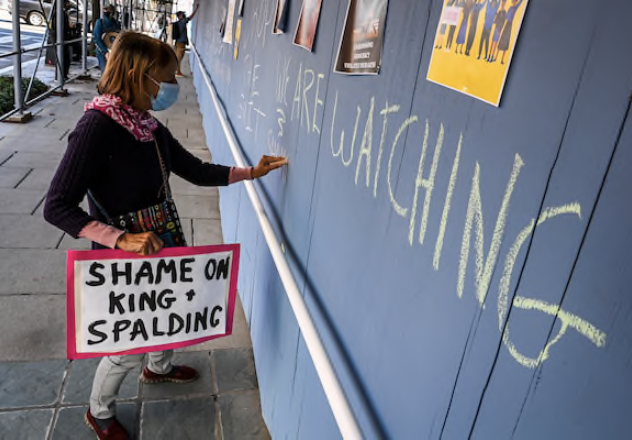
Activist Medea Benjamin writes slogans Friday on the plywood covering the front of an office building at 17th Street and Pennsylvania Avenue, home to King & Spalding law firm, protesting its involvement with Trump’s election lawsuits. MUST CREDIT: Washington Post photo by Bill O’Leary
“As I look at this scene right now, I can’t help but to think how much this is truly the personification of two Americas,” a Black Lives Matter D.C. activist observed as she filmed the scene.
Small confrontations were ongoing through the late afternoon near the White House.
The president called Saturday’s rallies – which have been promoted by far-right media personalities, white nationalists and conspiracy theorists – “heartwarming” in a tweet Friday afternoon.
“I may even try to stop by and say hello,” Trump wrote.
The rallies, including a Women for America First event that received a permit Friday from the National Park Service, are expected to kick off about noon at Freedom Plaza. A “Million MAGA March,” “March for Trump” and a “Stop the Steal” demonstration are also planned.
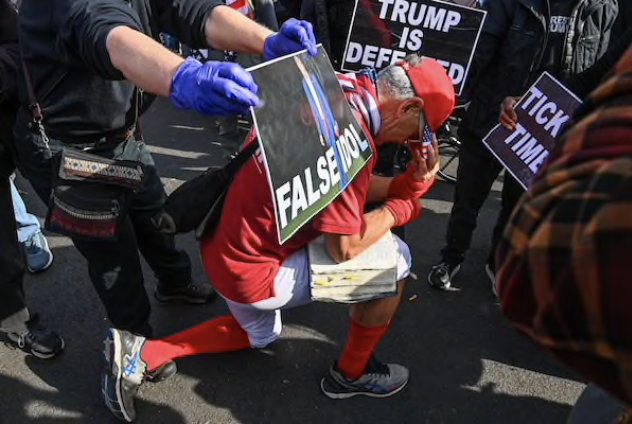
A pro-Trump demonstrator kneels to pray above his Bible as he and other supporters square off with anti-Trump demonstrators at Black Lives Matter Plaza on Friday. MUST CREDIT: Washington Post photo by Ricky Carioti
Counterdemonstrations organized by D.C. anti-fascist and anti-racist groups will gather nearby.
According to the lone permit the Park Service issued, pro-Trump demonstrators will march from Freedom Plaza to the Supreme Court on Saturday afternoon. Rallygoers will also hear from a roster of speakers that includes several lawmakers; former White House aide Sebastian Gorka; Trump ally Matt Schlapp, who is head of the American Conservative Union; and incoming Rep. Marjorie Taylor Greene, R-Ga., who has openly backed QAnon, a baseless conspiracy theory that Trump is leading the fight against a cabal of Satan-worshiping saboteurs who traffic children.
Friday’s confrontations at Black Lives Matter Plaza were the second time in as many months that self-identified Trump supporters had torn down photographs from a memorial honoring Black men and women killed by police.
“It’s horrible because it’s a memorial to the people who died and who didn’t get justice and so to see them stepping on it and being careless about it, it’s just frustrating,” said Nadine Seiler, 55, who has spent weeks tending to the fence and the artwork placed there.
In anticipation of the rallies Saturday, Seiler said she has spent the past few days “quadruple zip-tying” the most meaningful artwork to the fence to prevent it from being removed. Some activists had supported the idea of temporarily removing pieces from the fence to protect them.
Although none of the rallies organizers have announced plans to gather at Black Lives Matter Plaza on Saturday, the square has become a flash point for those who oppose Trump and those seeking to make a stand against D.C.’s liberal activists.
D.C. Mayor Muriel E. Bowser, D, has said city officials are monitoring social media chatter around the planned events and will support “peaceful First Amendment demonstrations.” The mayor also warned out-of-town visitors against bringing firearms to the city, noting D.C. has stricter firearm laws than other parts of the country – and no firearms, with or without a permit, can be brought within 1,000 feet of a protest, according to D.C. law. The Park Service also bans guns at demonstrations.
Videos of a caravan of gun-toting demonstrators led by Infowars founder and conspiracy theorist Alex Jones began to circulate on social media late Thursday as the group made its way through Richmond.
Christoper R. Barron, a spokesman for the Women for America First march, said the group will “welcome all peaceful protesters in support of President Trump” but does not condone violence. Barron declined to comment on the simultaneous pro-Trump rallies planned for Saturday because, he said, organizers were not involved in planning those.
The rallies have garnered support from Fox News host Sean Hannity as well as more fringe figures, including Enrique Tarrio, chairman of the Proud Boys; white nationalist Nicholas Fuentes, who marched in Charlottesville; Jack Posobiec, who promoted the “Pizzagate” conspiracy that led to a 2016 shooting at D.C. pizzeria Comet Ping Pong; Scott Presler, a pro-Trump activist who works with anti-Muslim hate group ACT for America; as well as Jones.
Beginning 6 a.m. Saturday, Constitution Avenue will be closed between 18th Street NW and Pennsylvania Avenue NW. On the other side of the Mall, Independence Avenue will be closed from 14th Street to Ohio Avenue SW. Several main thoroughfares, including New York Avenue and G, H, I and K streets, will be shut down from 9th Street NW to 18th Street NW.
By The Washington Post · Eugene Scott · NATIONAL, POLITICS
ARIZONA-ANALYSIS: President-elect Joe Biden officially won Arizona on Friday, an event that may have been a surprise to some Americans who associate the state with immigration hard-liner Sheriff Joe Arpaio and right-leaning voting blocs such as seniors and Mormons.
The Grand Canyon state turning blue for the first time since 1996 was years in the making. And here are some of the groups that played roles in expanding the former vice president’s lead over President Donald Trump, who most Arizona voters supported in 2016.
– Latino activists
The state’s Latino political community has been working for years to increase turnout among its members – especially after the recent elections of hard-liners on immigration, including former governor Jan Brewer, a vocal supporter of Trump. State laws such as the infamous S.B. 1070 drew national attention to Arizona as a place that would be tough on undocumented immigrants. But Latino activists who viewed their contributions to the state’s economy and culture as fundamental to what made Arizona – and America – great began to register younger voters at higher rates than normal, with the goal of sending more liberal politicians to the state legislature, Congress and ultimately the White House.
Ian Danley, executive director of Arizona Wins, an advocacy organization that coordinates with various political groups, told The Washington Post’s Jose Del Real and Hannah Knowles:
“I think the Republican rule over the last decade in Arizona has done deep damage with them among Latino voters. It has undoubtedly politicized the Arizona Latino community in a way that I don’t think you’ve seen anywhere else in the country. That piece of this is hard to overstate. It was such an important part of our political reality, narrative and culture over the last decade. The movement they have led over a decade is real.”
– White college-grad women
The late senator John McCain, R-Ariz., spent his final days in office being one of the few Republican lawmakers willing to hold the president accountable. Having little to no tolerance for pushback, Trump mocked McCain’s status as a former prisoner of war and chose not to attend the former GOP presidential nominee’s funeral, allegedly calling him a “loser.” So when the lawmaker’s grieving widow, Cindy McCain, a business executive and a former educator, endorsed Biden, she did so with the goal of hoping to connect with Arizona’s women voters.
“I decided to take a stand, and hopefully other people will see the same thing,” Cindy McCain said in September of her endorsement of Biden. “Other women particularly.”
“You may have to step out of your comfort zone a little bit, but Biden is by far the best candidate in the race,” McCain added.
The state’s college-educated white women appeared to have heeded McCain’s challenge. In 2016, most of Arizona’s white women with college degrees gave their support to Trump over Hillary Clinton, the first woman to be a major party nominee. But that was not the case in 2020. Nearly six in 10 – 57 percent – of white women with college degrees in Arizona supported Biden. And the percentage who backed Trump also decreased.
– Independent voters
Arizona has always had a large percentage of independent voters who are not deeply partisan and therefore can swing elections either way based on their support or their sitting out a contest. Nearly a third – 31 percent – of Arizona’s registered voters are independent. And while these voters are not allowed to cast ballots in the primary elections, they made a big dent in the general. Independent voters showed up for Trump in the state in 2016, but more than half swung to Biden this year, reminding Americans that not all former Trump voters are Trump loyalists.
– Changing demographics
Arizona’s popularity as a destination for retirees gives it relatively high number of senior citizens compared with other states. Seniors are one of the most consistent voting blocs and largely lean right, making it easier for GOP candidates to win elections. But the state’s growing Latino population is younger on average, as are the young adults and families moving to Arizona from other states. And these demographics – millennials and Generation Z – overwhelmingly lean left. With millennials being the largest age voting bloc this year – and largely disapproving of Trump – Biden had quite the advantage.


 People wave to President Trump’s motorcade Saturday as it drives past Freedom Plaza as supporters gathered for the Million MAGA March in Washington D.C.. MUST CREDIT: Washington Post photo by Matt McClain.
  A logo at the Pfizer French headquarters in Paris on Nov. 10, 2020. MUST CREDIT: Bloomberg photo by Nathan Laine.
  Kristalina Georgieva, managing director of the International Monetary Fund, left, and Ursula von der Leyen, president of the European Commission, in Brussels on Jan. 28, 2020. MUST CREDIT: Bloomberg photo by Geert Vanden Wijngaert.
  White House Gifts, where manager Mirian Aquino was setting up a display Friday, is among the Washington, D.C.-area souvenir vendors overhauling their inventory in advance of Joe Biden’s inauguration and move to the White House. MUST CREDIT: Washington Post photo by Michael Robinson Chavez
 President-elect Joe Biden speaks while delivering an address to the nation during an election event in Wilmington, Del., on Nov. 7, 2020. MUST CREDIT: Bloomberg photo by Sarah Silbiger.
  A protester screams at a Minnesota State Patrol officer on May 29 in Minneapolis. MUST CREDIT: Washington Post photo by Salwan Georges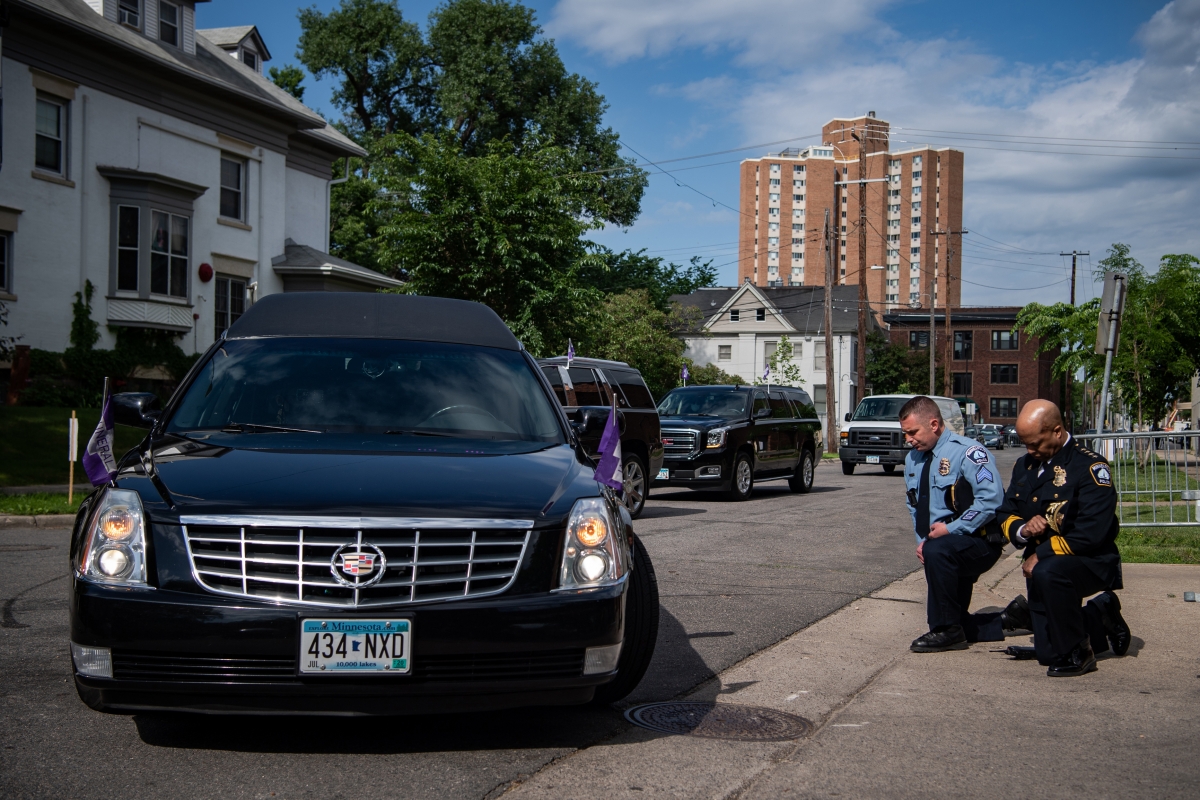
 President Trump
  Anti-Trump and pro-Trump demonstrators square off at Black Lives Matter Plaza on Friday. MUST CREDIT: Washington Post photo by Ricky Carioti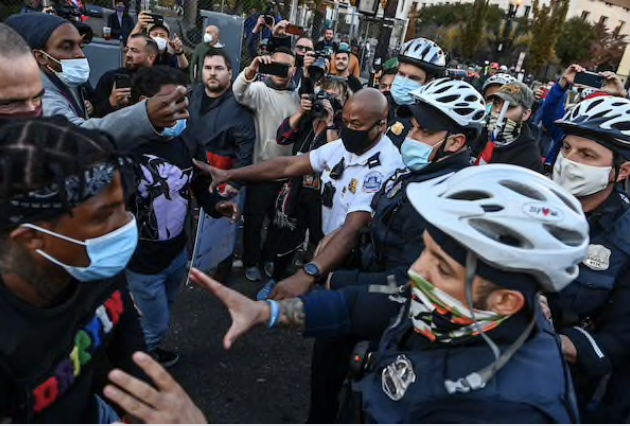
 President-elect Joe Biden
