President-elect Biden announces coronavirus task force made up of physicians and health experts #SootinClaimon.Com

#SootinClaimon.Com : ขอบคุณแหล่งข้อมูล : หนังสือพิมพ์ The Nation.

President-elect Biden announces coronavirus task force made up of physicians and health experts

InternationalNov 09. 2020Former vice president Joe Biden stops by a restaurant in Philadelphia on Tuesday, Nov., 3, 2020. MUST CREDIT: Washington Post photo by Demetrius Freeman
/Photo by: Demetrius Freeman — The Washington PostFormer vice president Joe Biden stops by a restaurant in Philadelphia on Tuesday, Nov., 3, 2020. MUST CREDIT: Washington Post photo by Demetrius Freeman /Photo by: Demetrius Freeman — The Washington Post 

By The Washington Post · Yasmeen Abutaleb

WASHINGTON – President-elect Joe Biden on Monday announced the members of his coronavirus task force, a group made up entirely of doctors and health experts, signaling his intent to seek a science-based approach to bring the raging pandemic under control.

Biden’s task force will have three co-chairs: Vivek H. Murthy, surgeon general during the Obama administration; David Kessler, Food and Drug Administration commissioner under Presidents George H.W. Bush and Bill Clinton; and Marcella Nunez-Smith, associate dean for health equity research at the Yale School of Medicine. Murthy and Kessler have briefed Biden for months on the pandemic.

Biden will inherit the worst crisis since the Great Depression, made more difficult by President Trump’s refusal to concede the election and commit to a peaceful transition of power. The Trump administration has not put forward national plans for testing, contact tracing and resolving shortages in personal protective equipment that hospitals and health-care facilities are experiencing again as the nation enters its third surge of the virus.

“Dealing with the coronavirus pandemic is one of the most important battles our administration will face, and I will be informed by science and by experts,” Biden said in a statement. “The advisory board will help shape my approach to managing the surge in reported infections; ensuring vaccines are safe, effective, and distributed efficiently, equitably, and free; and protecting at-risk populations.”

The United States is recording more than 100,000 new coronavirus cases a day and, on many days, more than 1,000 deaths, a toll expected to worsen during the crucial 10-week stretch of the transition. It remains unclear whether Trump or his top aides will oversee and lead a robust response to the pandemic during the transition, which could further exacerbate the crisis Biden and Vice President-elect Kamala D. Harris inherit.

The 13-member task force also includes former Trump administration officials, including Rick Bright, former head of the Biomedical Advanced Research and Development Authority, who, after being demoted, spoke out against the administration’s approach to the pandemic. Luciana Borio, director for medical and biodefense preparedness on Trump’s National Security Council until 2019, is also on the panel.

The group includes several other prominent doctors:

· Zeke Emanuel, chair of the Department of Medical Ethics and Health Policy at the University of Pennsylvania.

· Atul Gawande, a surgeon at Brigham and Women’s Hospital and a professor at Harvard Medical School who is a prolific author.

· Michael T. Osterholm, director of the Center for Infectious Disease Research and Policy at the University of Minnesota.

· Eric Goosby, global AIDS coordinator under President Barack Obama and professor of medicine at the University of California at San Francisco School of Medicine.

· Celine R. Gounder, clinical assistant professor of medicine and infectious diseases at New York University’s Grossman School of Medicine.

· Julie Morita, executive vice president of the Robert Wood Johnson Foundation, a philanthropy focused on health issues.

· Loyce Pace, president and executive director of the Global Health Council, a U.S.-based nonprofit organization dedicated to global health issues.

· Robert Rodriguez, professor of emergency medicine at the UCSF School of Medicine.

Rebecca Katz, director of the Center for Global Health Science and Security at Georgetown University Medical Center, and Beth Cameron, director for global health security and biodefense on the White House National Security Council during the Obama administration, are serving as advisers to the transition task force.

Task force members will work with state and local officials to craft public health and economic policies to address the virus and racial and ethnic disparities, while also working to reopen schools and businesses, the transition team said in a news release.

Public health experts said Biden should use the transition to provide leadership as the pandemic continues through a deadly stretch and begin communicating a strong national message.

“Clearly from the election outcomes, half the country doesn’t believe we’re in a crisis,” said Kavita Patel, a fellow at the Brookings Institution who worked on health policy in the Obama administration. Biden and Harris “have an incredible platform that can be used for communication. The country needs clear daily briefings that we thought we’d get from the White House coronavirus task force. They have an incredible platform, if not an official platform.”

Biden plans to call Republican and Democratic governors to ask for their help in developing a consistent message from federal and state leaders, according to three Biden advisers who spoke on the condition of anonymity because they were not authorized to speak publicly about these matters. He will urge governors to adopt statewide mask mandates and to provide clear public health guidance to their constituents, including about social distancing and limiting large gatherings.

The task force will have subgroups that focus on issues related to the response, including testing, vaccine distribution and personal protective equipment, according to two people familiar with the plans who spoke on the condition of anonymity to reveal plans that were not yet public.

In his victory speech Saturday, Biden addressed challenges in bringing the pandemic under control.

“We cannot repair the economy, restore our vitality or relish life’s most precious moments – hugging a grandchild, birthdays, weddings, graduations, all the moments that matter most to us – until we get this virus under control,” Biden said. “That plan will be built on a bedrock of science. It will be constructed out of compassion, empathy and concern. I will spare no effort – or commitment – to turn this pandemic around.”

Yet the ambitious plans Biden laid out on the campaign trail are set to collide with political realities. That includes a deeply divided nation in which more than 71 million people voted for Trump and the possibility of having to navigate a Republican-controlled Senate disinclined to support a greater federal role in testing and contact tracing, among other responsibilities now left mostly to the states.

Biden’s most ambitious plans will require significant congressional funding. Senate Majority Leader Mitch McConnell (R-Ky.) has said he would like to pass new coronavirus relief measures during Congress’s lame-duck session, and Congress faces a Dec. 11 government funding deadline. Biden and his team are poised to begin engaging with congressional Democrats on their priorities.

Biden’s most ambitious plans include dramatically expanding testing and building a U.S. public health jobs corps to have 100,000 Americans conduct contact tracing. They also include ramping up production of personal protective equipment and implementing a vaccine distribution plan.

Murthy, who served as the 19th U.S. surgeon general, is a physician whose nomination was stalled in the Senate for more than a year because of his view that gun violence is a public health issue. Three months into the Trump administration, he was replaced as “the nation’s doctor” with more than two years left on his four-year term.

In 2016, he wrote a landmark report on drug and alcohol addiction, which put that condition alongside smoking, AIDS and other public health crises that previous surgeons general addressed. The report called the addiction epidemic “a moral test for America.” Murthy’s office sent millions of letters to doctors asking for their help to combat the opioid crisis.

The son of immigrants from India, he earned medical and MBA degrees at Yale before joining the faculty at Harvard Medical School, where his research focused on vaccine development and the participation of women and minorities in clinical trials.

After leaving his post as surgeon general, he wrote a book on loneliness and social isolation, including their implications for health, that grew out of his conversations with people in clinical practice and as surgeon general.

Several public health officials celebrated Nunez-Smith’s leadership role on the task force. Her research focuses on promoting health and health-care equity in marginalized populations, according to her Yale biography. She has also studied discrimination that patients endure in the health-care system – expertise that many said was welcome in an epidemic that is disproportionately affecting people of color.

Kessler was FDA commissioner from 1990 to 1997, during the George H.W Bush and Clinton administrations. He is well-known for his attempts to regulate cigarettes – an effort that resulted in a loss in the Supreme Court, which ruled that the agency did not have the authority. That prompted Congress to pass a law, enacted in 2009, that explicitly gave the agency that power.

Kessler, a pediatrician and lawyer, worked at the FDA to accelerate AIDS treatments and on food and nutrition issues. He oversaw the FDA’s development of standardized nutrition labels and notably ordered the seizure of orange juice labeled “fresh” because it was made from concentrate. He has written several books on diet, mental illness and other topics, and has served as dean of the medical schools at Yale and UCSF.

– – –

The Washington Post’s Lenny Bernstein and Laurie McGinley contributed to this report.

With pick for treasury secretary, Biden will tip hand about his economic agenda #SootinClaimon.Com

#SootinClaimon.Com : ขอบคุณแหล่งข้อมูล : หนังสือพิมพ์ The Nation.

With pick for treasury secretary, Biden will tip hand about his economic agenda

InternationalNov 09. 2020Lael BrainardLael Brainard 

By The Washington Post · Rachel Siegel

President-elect Joe Biden faces a crucial decision in the coming weeks that could dictate how he plans to run his administration and shepherd the nation’s economy: whom to nominate as treasury secretary.

A leading candidate for the post is Federal Reserve governor Lael Brainard, who served as a senior Treasury Department official in the Obama administration. Brainard has broad policymaking experience, particularly during economic crises, as well as wide respect among international foreign ministries and central banks from her time as the department’s top diplomat.

At the same time, Biden could face pressure from the Democratic Party’s left wing to pick a more liberal figure, someone who could push for aggressive financial overhauls and prove more adversarial to supporters of free trade. Such a nominee, however, could face difficulty winning Senate confirmation if Republicans retain control after two January runoffs in Georgia.

During the campaign, Biden was able to bring together two wings of his party as voters unified to defeat President Donald Trump. But picking Cabinet officials who satisfy both groups will be complicated, especially for a role as crucial to Biden’s economic agenda as treasury chief. Come January, the Biden administration is expected to prioritize a massive stimulus package to shore up the economy’s shaky recovery. Biden also campaigned on tax increases for businesses and some of the wealthiest Americans – issues that the next secretary will have to pursue.

If nominated and confirmed by the Senate, Brainard would be the first female treasury secretary. She would also have the distinction of having served in government during multiple tumultuous economic crises. She was at the department during and in the wake of the global financial crisis, and she has played a major role at the Fed during the coronavirus pandemic. As the coronavirus recession looms large and the pandemic escalates heading into winter, Brainard’s supporters say her career and past work as a financial diplomat make her uniquely qualified to steer a new administration’s economic plan for the country.

“We have been in a regime where there is a sense that cooperating with other countries weakens the U.S. She felt and acted completely differently,” said Eswar Prasad, a professor of trade policy at Cornell University who worked with Brainard at the Brookings Institution. “She’s a master in the art of gentle persuasion rather than using sticks to get people to do the right thing.”

Brainard’s potential nomination, though, would face the Democratic Party’s crosscurrents of economic populism, which Sens. Bernie Sanders, I-Vt., and Elizabeth Warren, D-Mass., tapped into during their primary runs. Some liberal groups have voiced concerns about Brainard’s promotion of free-trade pacts during the Obama administration. But they have not mounted a vigorous effort to undermine her candidacy for the Treasury Department post.

“If she becomes treasury secretary, her policy is going to be Obama 2.0 on trade,” said Peter Gowan, an economic expert at the Democracy Collaborative, a left-leaning think tank.

Brainard declined to comment.

Brainard joined the Fed board in 2014 and, most recently, has played a central role in implementing the Fed’s vast economic response since the coronavirus crisis began. She is the lone Democrat on the Fed board and has bucked her colleagues by consistently dissenting on policies that relax rules on the banking system.

Before joining the Fed, Brainard served as undersecretary for international affairs at the Treasury Department and a top deputy to then-Treasury Secretary Timothy F. Geithner. Brainard led coordination of the Obama administration’s global economic and financial policy, including during Europe’s sovereign-debt crisis.

The new administration will come to office at an extremely fraught time for the nation’s economy. A surge in coronavirus cases has economists and public health officials bracing for a devastating winter. Economists warn that strong gains made in the third quarter could be thwarted by the end of 2020 as the pandemic rages on. It is also unclear whether Congress or the Trump administration will agree on a stimulus deal in the lame-duck session, despite the fact that scores of households and businesses will be strapped to make it until January.

No matter whom Biden chooses, the treasury secretary will be one of his top economic advisers and play an instrumental role in another stimulus deal. The secretary will also work closely with Fed Chair Jerome Powell, especially concerning the Fed’s pandemic lending programs. Those close to Brainard say she has a strong working relationship with Powell. This year, Powell brought Brainard into the Fed’s close inner circle – a group traditionally confined to the Fed chair, vice chair and New York Fed president – that shapes the monetary policy agenda.

Earlier in Brainard’s career, she served as deputy national economic adviser in the Clinton White House during the Asian financial crisis. Between 2001 and 2008, Brainard was vice president and the founding director of the Global Economy and Development program at the Brookings Institution. She received a PhD in economics from Harvard University and taught at the Massachusetts Institute of Technology. Brainard also worked in management consulting at McKinsey & Co.

Brainard, the Fed’s only remaining Obama-appointed governor, has garnered particular praise from the left for her consistent objections to rollbacks of Dodd-Frank banking regulations. Brainard has long maintained that weakening rules for the nation’s banking system, even when the economy is healthy, puts the country’s broader financial system at risk. While votes by the Fed board are typically unanimous, Brainard has issued roughly 20 dissents since 2018 on issues including from capital requirements and bank acquisitions.

Brainard doubled down when the pandemic thrust the economy into a sudden recession this year.

In June, the Fed put new restrictions on how the country’s biggest banks spend capital, ordering them to suspend their stock buyback programs and limit dividend payments to shareholders. Brainard urged for more, calling on her colleagues to block dividend payouts to shareholders, not just limit them.

“I do not support giving the green light for large banks to deplete capital, which raises the risk they will need to tighten credit or rebuild capital during the recovery,” Brainard wrote in her dissent. “This policy fails to learn a key lesson of the financial crisis, and I cannot support it.”

Despite Brainard’s firm stance on regulatory issues, the banking industry is likely to be more comfortable with Brainard as the leader at the Treasury Department. That is especially the case in contrast with a candidate such as Warren.

“There’s a level of familiarity there, even if you disagree with somebody on their policies or their policy proposals,” said Brian Gardner, chief Washington policy strategist at Stifel Financial Corp. “I think there is a general level of comfort that they know her. She’s more of a mainstream type of candidate or nominee. I think the industry by and large is okay with her.”

That could change if Brainard is instead promoted to Fed chair when Powell’s term expires in 2022, giving Brainard a much more focused role overseeing the country’s banking system. After being nominated by Trump, Powell became Fed chair in 2018 and has sided with the Fed’s other Republicans on banking deregulation.

Economists and Fed watchers say Biden is unlikely to replace Powell, who has been the face of the Fed’s pandemic response and who has strong relationships with Republicans and Democrats on Capitol Hill. Biden might also be encouraged to keep Powell at the Fed for the sake of continuity, especially given the economic uncertainty still ahead. At the same time, Powell’s critics on the left say that he has gone too far to ease banking regulations and that Biden should put a Democrat in his place.

Brainard has led the Fed’s attempts to modernize the Community Reinvestment Act, or CRA, which was crafted to encourage banks to lend in low-income neighborhoods. Those efforts have put Brainard and the Fed in conflict with other banking regulators, whose proposals to revamp the historic anti-redlining law have not gotten the central bank’s support.

Sam Bell, founder of Employ America, a left-leaning group that advocates on monetary policy, pointed to Brainard’s work on the CRA as one example of her ability to persuade Powell on certain banking issues, despite her long history of regulatory dissents. Bell said it would be a “total asset” to have a treasury secretary in place who could work effectively with Powell.

“Clearly they have a good relationship, and he has moved to her lane,” Bell said. “She’s someone who’s been able to dissent but still has internal pull on a major policy fight.”

Brainard also cautioned against the Fed hiking interest rates starting in 2015, years into a slow but steady expansion that had Fed leaders speculating on the right time to slow the economy and, as was thought at the time, stave off a rise in inflation despite potential effects on unemployment. The Fed’s gradual rate hikes in subsequent years have since been criticized as undercutting full employment.

The Fed’s approach to inflation and unemployment changed this year through a new framework that signaled the Fed would not raise interest rates to respond to low unemployment. In a speech a few days later, Brainard suggested the old approach risked “an unwarranted loss of opportunity for many Americans.”

Had the Fed’s new framework been in place years ago, Brainard said, “it is likely that accommodation would have been withdrawn later and the gains would have been greater.”

As undersecretary for international affairs in the Obama Treasury Department, Brainard was a crucial negotiator during Europe’s debt crisis, often exerting her influence behind closed doors. The daughter of a Foreign Service officer, Brainard was raised in Poland and Germany during the Cold War and is fluent in German.

Soon, the question may become how Brainard would apply her record to the top post at the Treasury Department. Bank regulation falls largely outside the department’s purview, but its secretary also chairs the Financial Stability Oversight Council, whose mandate is to identify and respond to emerging risks in the country’s financial system. The council could be one avenue through which Brainard could push an agenda intent on rooting out financial hazards.

Brainard has been among the most outspoken Fed leaders urging Congress for more fiscal aid, especially when it comes to narrowing the economy’s racial and gender gaps. Brainard has also emphasized the risks of withdrawing fiscal support too soon and, in turn, laying the foundation for a deeper crisis.

“While the strong bounce-back in activity from the initial devastation of covid-19 was heartening, the recovery thus far has been highly uneven and the path ahead is highly uncertain,” Brainard said last month. “Strong support from monetary policy – if combined with additional targeted fiscal support – can turn a K-shaped recovery into a broad-based and inclusive recovery that delivers better outcomes overall.”

– – –

The Washington Post’s Jeff Stein contributed to this report.

Biden moves fast on virus and economy #SootinClaimon.Com

#SootinClaimon.Com : ขอบคุณแหล่งข้อมูล : หนังสือพิมพ์ The Nation.

Biden moves fast on virus and economy

InternationalNov 09. 2020President-elect Joe Biden visits his family graves at St. Joseph On the Brandywine in Wilmington, Del. on Oct. 18, 2020. MUST CREDIT: Washington Post photo by Demetrius Freeman
/Photo by: Demetrius Freeman — The Washington Post
Location: Washington, United StatesPresident-elect Joe Biden visits his family graves at St. Joseph On the Brandywine in Wilmington, Del. on Oct. 18, 2020. MUST CREDIT: Washington Post photo by Demetrius Freeman /Photo by: Demetrius Freeman — The Washington Post Location: Washington, United States 

By The Washington Post · Matt Viser

WASHINGTON – President-elect Joe Biden and his advisers plan this week to demonstrate a far more assertive strategy against the coronavirus than President Donald Trump’s, and Biden may take a more proactive role in coming weeks in congressional negotiations over an economic stimulus package.

Biden’s proposals, some of which were posted on his new transition website, include aiming to secure funds for ramping up coronavirus testing, acquiring additional protective equipment such as masks and gowns, and investing $25 billion in vaccine manufacturing and distribution.

Biden’s aides, saying they recognize that the United States has one president at a time, nonetheless hope to seize on the momentum from his victory to signal decisive action on the major crises engulfing the nation. That could be complicated, however, by Trump’s refusal to concede and the fact that some states are still finalizing their vote counts.

Biden’s preparations come as some Republicans said they will continue challenging the results showing that Biden has captured the White House. GOP leaders such as Senate Majority Leader Mitch McConnell, R-Ky., have yet to publicly acknowledge Biden’s victory.

In a move that appeared designed to encourage more Republicans to accept the election’s outcome, former president George W. Bush on Sunday announced that he had called Biden, as well as Vice President-elect Kamala Harris, to congratulate them on their win.

“Though we have political differences, I know Joe Biden to be a good man, who has won his opportunity to lead and unify our country,” Bush said in a statement. “I offered him the same thing I offered Presidents Trump and Obama: my prayers for his success, and my pledge to help in any way I can.”

While he said that Trump has a right to pursue any legal challenges, Bush made clear that in his view, “the American people can have confidence that this election was fundamentally fair, its integrity will be upheld, and its outcome is clear.”

Biden made a handful of calls Sunday, according to advisers, but he spent much of the day relaxing with his family. He attended a church service at his local parish, walking through the cemetery where his son Beau, who died in 2015 of brain cancer, is buried, but made no public appearances.

At the same time, his team’s plans for a new administration were moving ahead aggressively. For months, a group of advisers has been running a nascent transition effort, meeting with Trump administration officials and preparing lists of potential staffers. Biden himself, however, has in general not been engaged directly in that process.

“He’s been focused like a laser on the campaign,” said one adviser involved in the transition, speaking on the condition of anonymity to discuss planning efforts. “But it’s going to be a very difficult transition, and we’ll be ready for it.”

The adviser also said that the Biden team is still savoring their candidate becoming president after decades of trying. “We’re enjoying the moment. It’s been years and years and years,” the adviser added. “Next week, and the week after, we’ll be focused on what’s next.”

Still, Biden’s aides said the president-elect recognizes the need to signal to the public that he plans fast action to help a country staggering under a pandemic and an economic free-fall.

Biden is planning to announce a task force on the coronavirus on Monday, led by two advisers who have been consulting with him for months and have helped devise the science-based approach he highlighted during his campaign. His transition team, which unveiled a website and social media accounts Sunday, plans to begin making personnel decisions this week.

Aides do not expect to announce any Cabinet nominations for several weeks, according to an aide familiar with the planning who spoke on the condition of anonymity because they were not authorized to share internal deliberations. Top White House positions, which don’t require confirmation, are typically announced first and Biden’s team expects to follow that model, the aide said.

Some top jobs – including Biden’s pick for White House chief of staff – will probably be made public this week, potentially providing insight into how Biden intends to govern.

Many inside the campaign believe Ronald Klain, a longtime Biden aide who served as chief of staff in the early years of his vice presidency, is a likely choice for White House chief of staff. Other prospects include top adviser Steve Ricchetti, who served as Biden’s chief of staff during President Barack Obama’s second term, and Rep. Cedric Richmond, D-La., a co-chairman of the Biden campaign.

The jockeying for influence and top positions has been underway for weeks, with widespread speculation over various roles and positions. Since Biden was declared the winner Saturday morning, the work has mingled with celebration.

Top aides celebrated at the Wilmington Westin’s restaurant, the River Rock Kitchen, until late Saturday evening. Many wore new black face masks with “46” written on the side, in homage to Biden soon becoming the 46th president.

Friends of Biden’s from across the political spectrum said they expected a more traditional government than the chaos-favoring Trump had assembled.

“I think first of all, his Cabinet will be damn competent. Joe understands the issues, he understands government,” former defense secretary Chuck Hagel said Sunday.

“Will we see some bipartisanship in the Cabinet? Maybe if he can make some of the right fits,” Hagel added. “You will see some bipartisanship in the administration.” Hagel, a Republican from Nebraska, served in the Senate alongside Biden and later joined Obama’s Cabinet.

It’s still unclear whether and when Biden’s transition team will gain access to federal agencies. That process can begin only after the head of the General Services Administration rules that the election results are final, enabling Biden’s transition team to expand its work and gain access to government funds.

Biden officials are prepared for legal action if that administrator – Emily Murphy, a Trump political appointee – delays that decision, according to officials familiar with the matter.

Trump has so far not conceded defeat, continuing to falsely claim that he won the election, and as of Sunday afternoon the GSA had not yet signed the letter needed to start that process, the Biden transition aide said.

Biden allies are hoping the election sets the stage for the president-elect to take on more of a public role, starting this week, in educating Americans about the severity of the virus, after many months of Trump playing down the dangers.

“I think you’ll see a different tone now. I think you’ll even see some governors start to take a different tone now that Mr. Trump is out of office,” Gov. Andrew Cuomo, D-N.Y., said on ABC’s “This Week.” “The political pressure of denying covid is gone. I think you’ll see scientists speak with unmuzzled voices now.”

While Biden’s transition will focus heavily on the coronavirus response, it is also aimed at launching some of his other priorities. The Washington Post reported Saturday night that he was planning a series of executive orders, but his team is also aiming to line up some legislative efforts.

Sen. Mitt Romney, R-Utah, the 2012 Republican presidential nominee, said he had not yet spoken with Biden. But he was one of the only elected Republicans to say that he looks forward to trying to work with the incoming Democratic president.

“Can we find common ground? Yes,” Romney told CNN. “And if Joe Biden works with Republicans in the Senate, he’s going to find that we will be able to find common ground. After all, he’s been there a long time himself. He knows what it takes to get things done in that chamber.”

Beyond resistant Republicans, Biden is likely to face challenges from a fractious Democratic Party. While he was able to unite the party behind the goal of defeating Trump, Democrats are frustrated, and in some cases angry, that their House majority was reduced and that they have not secured a Senate majority.

Control of the Senate is likely to come down to two runoff elections in Georgia that will be decided Jan. 5. Democrats would need to win both races to effectively have control of the Senate, with Harris serving as the tie-breaking vote.

On Sunday, Sen. Elizabeth Warren, D-Mass., a former presidential candidate who drew the support of many liberal voters, suggested it would be a mistake for Biden and other Democrats to reach out to Republicans as they shape their agenda.

“What happens next matters. In the past, efforts to build ‘unity’ and ‘consensus’ in Washington have too often meant turning over the keys to giant corporations and their lobbyists,” Warren tweeted Sunday afternoon. “We can’t let that happen again.”

A leader of the Black Lives Matter movement sent a letter to Biden and Harris urging them to pursue a “well-thought out, community-driven, fully resourced agenda that addresses the particular challenges faced by Black people.”

In the letter, Black Lives Matter co-founder Patrisse Cullors requested a meeting with the president-elect and vice president-elect to “discuss the expectations that we have for your administration and the commitments that must be made to Black people.” She added, “We want something for our vote. We want to be heard and our agenda to be prioritized.”

But several Republicans on Sunday said that the race still needs to go through any recounts and legal challenges before Biden is declared the winner.

“Every legal challenge should be heard,” House Minority Leader Kevin McCarthy, R-Calif., said on Fox News’s “Sunday Morning Futures.” “Then, and only then, [will] America decide who won the race.”

Former governor Chris Christie of New Jersey, a top Trump ally, had a blunt warning for his fellow Republicans, however. “If your basis for not conceding is that there was voter fraud, then show us. Show us,” he said on ABC’s “This Week.” “Because if you can’t show us, we can’t do this. We can’t back you blindly without evidence.”

Sen. Roy Blunt, R-Mo., said on the same program that it “seems unlikely” that vote projections showing Biden as the winner would change, but that it was understandable for Republicans to wait a little longer for state election officials to certify the outcome.

“It’s time for the president’s lawyers to present the facts,” Blunt said.

Blunt, who chairs a bipartisan congressional committee that plans the presidential inaugurations, said some decisions have yet to be made, but at the moment he expects a traditional ceremony.

“We’re moving forward, anticipating an outside, full-scale inauguration that’s easier to scale back than to scale up,” he said. “We’re going to be talking to people this week about that very topic.”

“We’re going to project to the world that democracy works,” Blunt added. “I expect to see both vice president Biden and President Trump on the stage on Inaugural Day. And that will be a powerful message, no matter which one of them is sworn in that day.”

– – –

The Washington Post’s Amy B Wang, Annie Linskey, Sean Sullivan, Felicia Sonmez and Robert Samuels contributed to this report.

Global populists lose their ally in the White House #SootinClaimon.Com

#SootinClaimon.Com : ขอบคุณแหล่งข้อมูล : หนังสือพิมพ์ The Nation.

Global populists lose their ally in the White House

InternationalNov 08. 2020President TrumpPresident Trump 

By The Washington Post · Anthony Faiola, Terrence McCoy, Loveday Morris · WORLD, POLITICS, THE-AMERICAS, ASIA-PACIFIC, EUROPE 
He was their lodestar, the man who brought fringe populists from Hungary to Brazil in from the diplomatic cold, elevating their science-dismissing, migrant-scapegoating, nationalistic message from the balcony of its greatest perch: the White House.

But with President Donald Trump’s narrow election defeat, the globe’s right-wing autocrats and nationalistic movements face a new challenge: how to navigate a world where the most powerful man on Earth is no longer in their corner.

Few are predicting an end to Global Trumpism, the nation-first, people-dividing style of governance with a hint of authoritarianism that began to gain traction in Europe and Asia well before Trump’s 2016 election. President-elect Joe Biden’s tight victory, in fact, could embolden Trump’s global allies to portray his unexpectedly strong showing as anything but a repudiation of their arch-conservative populist ideals. 

Trump’s false, democracy-damaging claims of widespread fraud, meanwhile, could serve as a model for how to handle their own political challenges at home. The precedent of a sitting U.S. president refusing to honor a free and fair vote could embolden more hard-right nationalists, aggrieved by political defeats, to mount similar attempts to cling to power. Or, at the very least, they could mimic the doubt Trump has thrown on the legitimacy of his opponent’s win, inciting their fervent supporters to the streets and compromising the ability of political rivals to effectively lead. 

Some of Trump’s global backers initially rallied to his defense as the U.S. election unfolded. But following his claims on Thursday of a U.S. election being stolen, even some of his most ardent backers appeared to hedge their bets. 

“I am not the most important person in Brazil, just as Trump is not the most important person in the world, as he himself says,” Brazil’s far-right President Jair Bolsonaro – a close Trump ally – said during a Friday event. “The most important person is God. Humility must be present among us.”

Biden’s victory nevertheless presents practical challenges to policies that went unchecked during Trump’s presidency, ranging from destruction in Brazil of the Amazon rainforest under Bolsonaro to democratic backsliding in Hungary and Poland to heavy-handed law enforcement under Philippine President Rodrigo Duterte.

“Trump gave these populists tremendous respectability, the ability to say they were not extremist outsiders, but people who could be invited to and welcomed by the White House,” said Yascha Mounk, a political scientist at Johns Hopkins University who has studied the erosion of liberal democracy worldwide. “But a Trump loss raises the prospect that they will be seen as being on the wrong side of history after all.”

Trump’s four years saw victories and defeats for right-wing nationalists overseas, some of whom embraced his populist former political strategist Stephen Bannon as an adviser and ally. They lost power in Italy and Slovakia and slumped in the polls in Germany. But they secured key victories in Brazil and Poland, with the overt backing of the Trump White House. 

“Trump’s defeat can be the beginning of the end of the triumph of far-right populism also in Europe. Thank you, Joe,” tweeted Donald Tusk, former President of the European Council, who has railed against populism in his native Poland.

Nationalists remain in control of Hungary, where the anti-immigrant Prime Minister Viktor Orban shut down the Budapest campus of an American university over its links to billionaire financier and liberal donor George Soros. But instead of criticizing Orban, Trump’s ambassador, David B. Cornstein, blamed Soros for not establishing better ties with Orban’s right-wing government.

Orban openly supported Trump in a September op-ed. The Democrats’ foreign policy, he said in the pro-government Magyar Nemzet, was built on “moral imperialism.” 

“We were forced to taste it,” he wrote. “It didn’t taste good.”

Biden has described Hungary and Poland as rising “totalitarian regimes” and implied that its leaders were “thugs.” Hungarian lawmaker Gergely Gulyás, the head of Orban’s prime ministerial office, said he was “pessimistic” as votes were coming in Tuesday. He hoped the foreign policy of a new Democratic administration would be “better than the last one.” But he noted that Biden had received donations from Soros. “The starting point is not good,” he said.

Peter Kreko, director of the Budapest-based Political Capital Institute, sees change ahead for Hungary.

“Trump’s presidency meant unconditional support from Washington,” he said. “I think a Joe Biden administration would be much tougher on Hungary, on democratic backsliding and corruption related to Chinese and Russian investments, where Trump just looked away.”

No global leader has barnacled himself more tightly to Trump than Bolsonaro, the formerly fringe politician who won the Brazilian presidency in 2018 by mimicking many of Trump’s campaign tactics. Bolsonaro has made closer relations with the U.S. president the keystone of his foreign policy. He has met with Bannon; he cheered on Trump during his impeachment and, as the election neared, left no doubt where he stood. 

“I hope, God willing, to soon appear at the inauguration of President (Trump) in the United States,” Bolsonaro said late last month. “I don’t need to hide this. It’s from my heart.”

The defeat of Trump, who shares Bolsonaro’s laissez-faire approach to the environment, will make life more difficult for Brazil’s president. Much of the international community has condemned his stewardship of the Amazon rainforest, devastated on his watch by fire and deforestation. The arrival of Biden, who has threatened economic consequences for continued deforestation, brings more pressure.

“If he loses his main partner, his role model – because that’s what Donald Trump is – then he will be all alone,” said Dawisson Belém Lopes, a political scientist at the Federal University of Minas Gerais. “Brazil has become an environmental villain. … It will be a nightmare for Bolsonaro.”

Yet few expect Bolsonaro or other nationalists to abandon their populist politics. If anything, the narrow margin of the U.S. vote showed the brand’s enduring appeal. Analysts expected the results to provide Bolsonaro with a road map for his own campaign for reelection in 2022. 

“All of the social and economic problems that led to the rise of Trump and Bolsonaro, these problems are still here,” said Maurício Santoro, a political scientist at the State University of Rio de Janeiro. “The political system hasn’t reformed itself. We’re talking about a long-form battle over the reform of political systems.”

Some like-minded leaders have jumped to Trump’s aid. The hard-right Slovenian Prime Minister Janez Jansa tweeted: “It’s pretty clear that American people have elected @realDonaldTrump and @Mike_Pence for #4moreyears. More delays and facts denying from (the mainstream media), bigger the final triumph for #POTUS.” 

Bolsonaro’s influential son, Congressman Eduardo Bolsonaro, tweeted Friday that the decision by the “fake news” to take Trump’s Thursday night claims off the air amounted to a left-wing conspiracy against “freedom of expression.”

It’s easy to understand their defense. Populist leaders were able to count on Trump to provide what would once have been unthinkable U.S. support. At times, the stamp of his approval appeared to help them at home.

Poland’s Law and Justice party has stacked the courts with supporters and punished judges who spoke out about changes. It has chipped away at the independence of the media, using state-run channels to churn out pro-government propaganda and attack opponents. Politicians from the ruling party have frequently made discriminatory statements targeting minorities. President Andrzej Duda has described LGBT “ideology” as more destructive than communism in his recent reelection campaign. 

Nevertheless, Trump welcomed Duda in July as the first world leader to visit the White House following the initial wave of the coronavirus pandemic, giving his re-election campaign a boost just days before the squeaker of a vote. Months earlier, the Trump administration had granted him another gift: visa-free travel to the United States for Polish citizens.

Daniel Fried, a former U.S. ambassador to Poland, said veterans of Poland’s Solidarity movement told him Tuesday, “we’re counting on you” to restore democratic values.

“They’re not suggesting that the U.S. needs to fix Polish politics,” Fried said. “But they want to believe that the U.S., the country that in some way saved them, is willing to stand up again for democracy.”

Trump has had his ups and downs with authoritarian Turkish President Recep Tayyip Erdogan, who stands accused of his own shenanigans to remain in power. The American leader at one point threatened to “totally destroy and obliterate” Turkey’s economy over its involvement in Syria, though their mutual search for global allies ultimately led them to a pragmatic embrace. Trump has refrained from sanctioning Turkey over the purchase of a Russian missile system – something Biden might be less shy about.

Trump’s friendly ties with Indian Prime Minister Narendra Modi culminated with an extraordinary 50,000-person rally in Houston last year, and a February jaunt to India by Trump, a time when his host was under fire over violence tied to a law that critics say discriminates against Muslims. Trump praised the Hindu nationalist nonetheless, saying, “He wants people to have religious freedom and very strongly.”

Despite Vice President-elect Kamala Harris’s Indian roots, the new administration may prove less forgiving over Modi’s Hindu nationalist agenda, even as it cultivates the relationship on most other fronts.

In Britain, where the Brexiteers became synonymous with the global wave of isolationism that brought Trump to power, there are some jitters over whether and how Biden will pursue the U.S.-British special relationship with the Trump-friendly Prime Minister Boris Johnson. Some fret that Biden, eager to curry favor with more like-minded leaders on the European continent, might prove tougher to woo into the lucrative trade deal that London needs after it bids farewell to the European Union. 

“But I think, on balance, it would actually be easier for Boris Johnson to deal with Biden,” said the London-based analyst Tony Travers. “The comparisons between Johnson and Trump were always quite off. He is much more of a mainstream European politician than he is like Donald Trump.”

Trump’s early claim of victory amid unfounded accusations of fraud might have done more harm than good to nationalist movements that are seeking to portray themselves as legitimate parties. Jörg Meuthen, leader of the far-right Alternative for Germany, called the move “unnecessary.”

“It doesn’t matter who wins,” he said Wednesday on German television. “We have to work with the U.S. cooperatively.”

Mexico is poised to legalize marijuana #SootinClaimon.Com

#SootinClaimon.Com : ขอบคุณแหล่งข้อมูล : หนังสือพิมพ์ The Nation.

Mexico is poised to legalize marijuana

InternationalNov 08. 2020

By The Washington Post · Marissa J. Lang · WORLD, THE-AMERICAS 
MEXICO CITY – It’s the moment for which advocates of legal marijuana here have been waiting: Mexican lawmakers, working under a court order, have until mid-December to finalize rules that will make the country the world’s largest market for legal pot.

Advocates have long argued that legalization would put a dent in the black market, allow for safe, regulated consumption, create jobs and cut down on crime.

But rather than counting down the days with glee, they’re waging an 11th-hour campaign to change legislation that they say would favor large corporations over small businesses and family-owned farms, while doing little to address the issues at the root of the country’s illegal drug trade.

“The truth is we’re just a few weeks away from the vote and we don’t know what’s going to happen,” said Julio Salazar, a senior lawyer and legalization advocate with the nonprofit group Mexico United Against Crime. “I’m not sure if the initiative being pushed by Congress actually makes things better. It makes a cannabis market for the rich and continues to use criminal law to perpetuate a drug war that has damaged the poorest people with the least opportunities.”

The proposal would allow private companies to cultivate and sell marijuana to the public. But it would limit the number of plants an individual could own to six, and require consumers to register for a government license – a step that advocates say could discourage legal use and leave customers likelier to stay in the illegal market.

It would also require commercial sellers to provide seed-to-sale product tracing, akin to the system used in California, but likely to be far more difficult in rural Mexico.

Ricardo Monreal, the Senate leader of President Andrés Manuel López Obrador’s ruling Morena party, has said lawmakers considered a number of international models for legalization. The current proposal borrows elements from Uruguay, Canada and some U.S. states.

Advocates fear the legislation, if approved as written, will cut Mexican-owned businesses out of a lucrative new market while doing little to loosen the grip of organized crime on the drug trade.

“We want a legal framework that can bring some of these players in from the illegal market into a legal one,” said Zara Snapp, co-founder of the RIA Institute, a Mexico City-based drug policy research and advocacy group. “The purchase price needs to be low enough to undercut the illegal market for consumers. … You also have to make sure there are enough entry points for (growers) to move over.”

If 30 percent of growers can be drawn into the legal market, she said, “that’s 30 percent that are paying taxes and out of the shadows, when before it was zero percent.”

Neither Monreal nor the Senate commission that is overseeing the legislation responded to requests for comment. Monreal has told reporters that no bill would perfectly address advocates’ demands, but ending prohibition is expected to buoy Mexico’s economy and allow small farmers a path out from under the cartels. 

“The most important thing for Mexico and its legislators is that they dare to knock down this decades-old taboo,” Monreal told Reuters this year. The deadline for a vote is Dec. 15.

Marijuana in Mexico has long been the butt of jokes and stereotypes. Snapp hopes the country can overcome that stigma.

“The first time I went to a cannabis expo, there was this Dutch company selling Mexico sativa seeds, and it was crazy to me that there was no way for that to be our intellectual property,” she said. “I hope we can start to see a shift where Mexico can take pride in this.”

Hemp was brought to the country by Spanish colonists in the 16th century for use as a building material. By the 20th century, marijuana was banned throughout Mexico and the lucrative product moved underground. Marijuana cultivation, much of it for export to the United States, bankrolled the organized crime that continues today in the form of the diversified drug cartels now fueling historically high homicide rates.

But a decade ago, prohibition began to soften. Lawmakers decriminalized possession of small amounts of the drug in 2009; then-president Felipe Calderon, who militarized the fight against the cartels, said the measure would allow law enforcement to shift focus from individual users to large-scale drug dealers and smugglers.

Court rulings loosened regulations still further, leading to the Supreme Court ruling in 2018 that found that banning cannabis violated Mexicans’ constitutional rights.

As specialty strains and gourmet cannabis products began to emerge in U.S. states where they were legal, the flow of trafficking flipped: Marijuana grown in the western United States was being smuggled south across the border to consumers willing to pay a premium, according to the U.S. Drug Enforcement Administration.

Today, a lush marijuana field containing hundreds of plants grows in the shadow of the Mexican Senate. Cultivated and tended to by cannabis activists, the protest garden reeks of reefer. It gives advocates a place to light up just steps from where lawmakers will decide how freely they should be allowed to do so.

Despite the steady march toward legalization, attitudes in Mexico around the drug remain fairly conservative. Polls indicate that as many as 60 percent of Mexicans believe marijuana should remain illegal, a finding that lawmakers are expected to take into account.

“Public opinion is important right now because it impacts how politicians think,” Snapp said. “But what the politicians need to remember is that we are not at this point because of public opinion – we are here because the Supreme Court ruled on multiple occasions that any and all Mexicans have the right to the free consumption of cannabis, and inhibiting personal use infringes that right.”

Salazar said advocates want a Mexican solution.

“The legislation being pushed took the worst parts of all the different models,” Salazar said. “They took the consumer registry from Uruguay that is excessive. They included the traceability requirement from the United States, which makes sense over there because regulation is local, but not in Mexico where it would be federal. And we also copied the lack of reparations to help indigenous communities or those most affected by the war on drugs.”

Many of Mexico’s farmers, advocates point out, live in rural areas without reliable access to the internet and other technologies that would be required to adhere to some of the proposed regulations, such as tracking the plant from seed to sale.

“The devil is really in the details of these laws,” said John Walsh, director of drug policy for the Washington Office on Latin America. “There is no one-size-fits-all legalizing solution.

“With Mexico, is this actually going to be an inclusive market shaped to the country’s realities? Or will it be a market controlled by well-heeled, well-financed, well-connected corporations?”

Iran reacts cautiously to Biden presidency as diplomatic window of opportunity appears #SootinClaimon.Com

#SootinClaimon.Com : ขอบคุณแหล่งข้อมูล : หนังสือพิมพ์ The Nation.

Iran reacts cautiously to Biden presidency as diplomatic window of opportunity appears

InternationalNov 08. 2020

By The Washington Post · Louisa Loveluck · NATIONAL, WORLD, MIDDLE-EAST

LONDON – Iran reacted cautiously as former U.S. vice president Joe Biden was named America’s president elect, urging the new administration to overturn Trump-era policies that have left Iran isolated on the world stage as its economy crumbles. 

President Donald Trump’s push to neuter Iran internationally became a defining focus of his foreign policy. Since withdrawing from a landmark nuclear agreement two years ago, a U.S. campaign of “maximum pressure” has seen the administration impose crippling sanctions on Iran and order the killing of its most renowned military strategist. 

On Saturday, President Hassan Rouhani said that approach had been “wrong” and would not succeed. “We hope today’s conditions have shown the sanctioners that their policies have failed in the past three years,” he said, in comments carried by the semiofficial Tasnim news agency. 

“God-willing, the next American president will submit to laws and regulations and will return to their commitments,” he said, in a reference to the nuclear deal signed between the two nations in July 2015. 

Hours later, as media outlets announced that Biden had taken a definitive lead, Rouhani’s deputy, Eshagh Jahangiri, said that he hoped for a change in “destructive U.S. policies.”

“I hope we will see a change in the destructive policies of the United States, a return to the rule of law and international obligations and respect for nations,” he said, according to Iranian state media. 

Biden, who was vice president when the deal was struck, has cast the Trump administration’s Iran policies as reckless, and argued that they have emboldened Tehran instead of weakening it. In promises made ahead of the election, he said that he would offer Iran a “credible path back to diplomacy,” with a potential return to the nuclear deal if it returns to compliance with its original terms.

But the path ahead may be politically difficult. As president, Biden may have to deal with a Republican-majority Senate, where policy toward Iran has often become a divisive and partisan issue. 

“In Tehran there is going to be a big question mark over whether Biden can re-engage with Iran on a diplomatic track,” said Ellie Geranmayeh, a senior policy fellow at the European Council on Foreign Relations.

“Legally he will be able to do that, but politically? Given the optics in Congress, there will be question marks over whether Biden has the stomach to take on the Republican Party on an issue as toxic as Iran.”

This election has been closely watched across Iran, with senior officials depicting the race as revealing deep flaws in American democracy and social media users poking fun at both Washington’s political optics and their own. 

In an interview with Iran’s INSA news agency, Ali Karimi Firuzjayi, a senior parliamentary official, said that America’s ballot had revealed “the disgrace of Western liberal democracy.”

“What a spectacle,” Iran’s supreme leader, Ayatollah Ali Khamenei, tweeted.

And across social media and WhatsApp chat groups, the memes went into overdrive, often with a satirical twist. 

Echoing the blue and red electoral maps splashed across American news sites, one picture showed a former Iranian president Mahmoud Ahmadinejad – whose disputed re-election in 2009 set off huge protests – beside a completely brown U.S. map, showing that he had won all states. 

One video showed Trump swinging his hips at election rallies in time, but to Iranian music. Another showed Americans lining up to vote, with their vox-pops dubbed with clips from the Iranian media’s coverage of its own elections. In Fairfax County, Va., a young blonde woman in a purple fleece is heard explaining in Farsi that her vote will “cut the invasive hands of the foreigners and colonizers.”

As American voters turned out in what appeared to be record numbers Tuesday, senior figures from across Iran’s political and religious establishment insisted that the outcome would not alter the country’s path. 

“Whoever becomes the president of the United States does not affect our policies,” said Khamenei, the supreme leader, in an address marking the 41st anniversary of the seizure of the U.S. Embassy in Tehran that led to a protracted hostage crisis. 

In a radio interview Saturday, Iran’s deputy foreign minister, Abbas Araqchi, insisted that even if the U.S. president changed, its “domineering and bullying policies” would not.

But many across the country were still glued to the results, reflecting just how deeply Washington’s maximum pressure campaign has affected the lives of many ordinary citizens. 

Punishing rafts of U.S. sanctions have created severe medical shortages in Iran as restrictions on the banking sector have made it tough to pay for imports. Food prices have also skyrocketed as goods have disappeared from the shelves. 

Trump’s sweeping immigration restrictions have also divided Iranian families, and dashed the hopes of others who had hoped to study, work or travel in the United States. 

On Monday, the Trump administration announced a new round of sanctions, this time targeting the country’s oil sector. 

In Tehran, a 45-year-old mathematician, Sohrab, said that he hoped a Biden presidency would involve a less “chaotic” approach to the region “so they are more capable of making permanent changes toward stability.”

Ahead of Iranian presidential elections last year, experts said, the Biden administration will have a narrow window of opportunity to try to re-engage the same administration, led by Rouhani, that agreed the nuclear deal in the first place. 

“I think there is cautious interest across the board in Iran to have some sort of sanctions relief from a Biden administration in return for rolling back some of its nuclear activities,” said Geranmayeh.

In comments published Saturday, Iran’s foreign minister, and a key proponent of the 2015 nuclear deal, Mohamed Javad Zarif appeared to indicate that a shift in approach from the Biden administration might allow for a return to diplomacy. 

“There are clear differences between the two campaigns,” he said of the Biden and Trump efforts “During Trump, we witnessed numerous threats from him and his foreign affairs ministry. But what matters to us is not the tone or terms, but the actions.”

As Trump approaches his final months in office, the question now, said Dalia Dassy Kaye, a political scientist at the RAND Corporation, is what moves Trump and Iran now make in the final months of the administration. “There is a very real sense that this has been a very tough time for Iran under this administration,” she said. 

“Now what happens between November and January? What does the Biden team inherit?”

After Trump’s dramatic tilt toward Israel, Biden likely to restore traditional approach #SootinClaimon.Com

#SootinClaimon.Com : ขอบคุณแหล่งข้อมูล : หนังสือพิมพ์ The Nation.

After Trump’s dramatic tilt toward Israel, Biden likely to restore traditional approach

InternationalNov 08. 2020

By The Washington Post · Steve Hendrix · NATIONAL, WORLD, MIDDLE-EAST 
JERUSALEM – Israelis began coming to grips Saturday with the defeat of President Donald Trump, who enjoys widespread support here and whose presidency is seen by many as the friendliest to Israel in history.

President-elect Joe Biden will inherit a Middle East policy that has tilted dramatically toward Israel in the past four years, with the United States moving its embassy to Jerusalem, suspending aid to Palestinians, declaring legal support for Jewish settlements in the West Bank and backing out of the Iran nuclear deal.

Biden could bring U.S. policy back in line with Democratic orthodoxy, for instance by championing a two-state solution to the Israeli-Palestinian conflict and opposing the expansion of West Bank settlements. But analysts say he is unlikely to insist on undoing all of Trump’s initiatives.

Biden has criticized moving the embassy to Jerusalem but said he would not pull it back to Tel Aviv. Instead, many here expect him to rebuild diplomatic relations with the Palestinian Authority by reopening a consulate in East Jerusalem and a Palestinian mission in Washington, D.C. Biden is also likely to resume humanitarian aid to the Palestinians.

“It’s not at all black and white with Biden,” said Michael Oren, a former Israeli ambassador to the United States who has known the incoming president for decades.

Prime Minister Benjamin Netanyahu did not join the cascade of world leaders offering best wishes to Biden on Saturday. But early Sunday he tweeted congratulations to both Biden and Vice President-elect Kamala Harris.

“Joe, we’ve had a long & warm personal relationship for nearly 40 years, and I know you as a great friend of Israel. I look forward to working with both of you to further strengthen the special alliance between the U.S. and Israel.”

The prime minister immediately followed that with a tweet thanking Trump for his policy gifts to Israel. “Thank you @realDonaldTrump for the friendship you have shown the state of Israel and me personally,” he wrote.

Biden is no stranger to Israelis. He was known as a staunch supporter of Israel through his 36 years in the Senate. He calls Netanyahu “my friend” and cites his 1973 encounter with then-Prime Minister Golda Meir as “one of the most consequential meetings” of his life.

As vice president, however, he was a loyal wingman to President Barack Obama, remembered here as a critic. And Biden will take office as the standard-bearer of a Democratic Party viewed as increasingly at odds with Israeli policy.

“Biden is the generation that remembers; he remembers the Six-Day War; he was close enough to feel the history of the Holocaust,” Oren said. “Obama was of a different generation; it was more ideological with him. Biden is not ideological.”

Israelis are perhaps most wary of shifts in Washington’s stance on Iran. Biden was part of the Obama team that reached the Iran nuclear agreement, which lifted sanctions on Tehran in return for restrictions on its nuclear program. Trump’s unilateral withdrawal from it is viewed by security experts here as the greatest of his gifts to Israel. Biden’s promise to offer Iran a “path back to diplomacy” makes many in Israel nervous.

Tzachi Hanegbi, a minister from Netanyahu’s Likud party, warned on Israeli television that Biden’s return to the nuclear accord could lead to war. “If Biden stays with that policy, there will, in the end, be a violent confrontation between Israel and Iran,” Hanegbi said.

Trump’s departure could be keenly felt by Netanyahu on a personal level. The prime minister has touted his close relationship with Trump as a chief political asset, and some of Trump’s actions, such as endorsing Israel’s annexation of the Golan Heights, which was captured from Syria in 1967, were timed to boost Netanyahu’s election prospects.

Some members of Netanyahu’s fractious coalition government have said that Trump’s exit from the White House will devalue Netanyahu’s status as a Trump-whisperer and increase the chances of a no-confidence vote and early elections. Netanyahu’s popularity has plummeted in recent months over his handling of a resurgent coronavirus and a collapsing economy.

In the West Bank, Palestinian leaders hailed Biden’s triumph over Trump, whom they have accused of putting U.S. policy at the service of Israel’s right wing.

“There was nothing worse than the Trump era,” former Palestinian Authority minister Nabil Shaath said in an interview with Turkish media. “Good riddance.”

Trump’s supporters in Israel, however, say his hard-line tactics have taught Palestinians that their history of rejecting peace offers has led them to a diplomatic dead end. Biden, they fear, will take a softer line.

Israeli settlers, who held rallies before the election to pray for Trump’s success, recognize that Biden’s diplomats will be nothing like the current U.S. ambassador from Washington, David Friedman, a longtime champion of the settlement movement.

But settlers like David Elhayani, head of the Yesha Council, an umbrella for Jewish settlements in the West Bank, said the party of the U.S. president doesn’t always matter. It was under Republican George W. Bush that Jewish settlements in the Gaza Strip were abandoned, Elhayani said.

“Under Obama, we built more [settlement] houses than we have under Trump,” he added. “I think Biden is a friend of Israel.”

Some Israelis are hoping that a Biden presidency could help ease the turmoil of recent Israeli politics. Netanyahu is often accused of mimicking Trump’s divisive rhetoric, which has helped stoke divisions in Israeli society. Netanyahu’s son Yair, who has cited Trump as a “rock star” role model, has regularly tweeted vitriolic insults at his father’s critics, including prosecutors pressing corruption charges against the prime minister and protesters clamoring for his ouster.

“Israel is part of the democratic world,” said Mordechai Kremnitzer, senior fellow at the Israel Democracy Institute. “And the way that President Trump has been conducting himself has not exactly been a great example to that world.”

Joe Biden triumphs over Trump, prompting celebration across the U.S. but no concession from the president #SootinClaimon.Com

#SootinClaimon.Com : ขอบคุณแหล่งข้อมูล : หนังสือพิมพ์ The Nation.

Joe Biden triumphs over Trump, prompting celebration across the U.S. but no concession from the president

InternationalNov 08. 2020

By The Washington Post · Toluse Olorunnipa, Annie Linskey, Philip Rucker · NATIONAL, POLITICS 
Joseph Robinette Biden Jr. was elected the nation’s 46th president Saturday in a repudiation of President Donald Trump powered by legions of women and minority voters who rejected his handling of the coronavirus pandemic and his divisive, bullying conduct in office. 

Biden’s victory was the culmination of four years of struggle for Democrats and others who have resisted Trump. It was celebrated by an emotional outpouring in cities coast to coast that ended with a tailgate-style victory party in Biden’s hometown of Wilmington, Del. The election took four days to be resolved after the former vice president was projected to win a series of battleground states, and was clinched by the state where he was born, Pennsylvania. 

Voters also made history in electing as vice president Kamala Devi Harris, 56, a senator from California and daughter of Jamaican and Indian immigrants who will become the country’s first woman, first Black person and first Asian American to hold the No. 2 job.

Trump, who was at his Virginia golf course when Biden was declared the winner, did not concede.

ภาพนี้ไม่ได้ระบุแอตทริบิวต์ alt, ชื่อไฟล์ของไฟล์นี้คือ chrome-capture-7.jpg

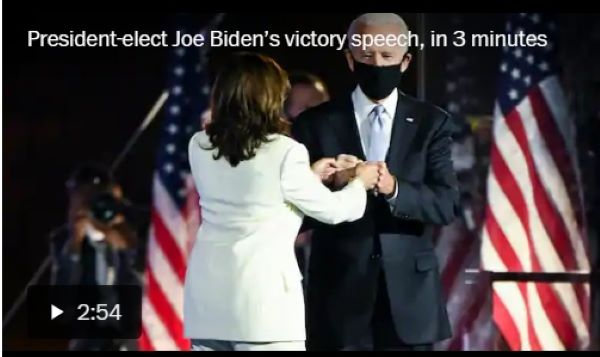
In a prime-time speech to flag-waiving supporters outside the Chase Center in Wilmington, Biden made no mention of Trump’s intransigence, instead offering an olive branch to the president’s supporters and imploring all Americans to “put away the harsh rhetoric,” and end “this grim era of demonization.”

“To make progress, we must stop treating our opponents as our enemy,” Biden said, before referring to the Book of Ecclesiastes. “The Bible tells us that to everything there is a season – a time to build, a time to reap, a time to sow. And a time to heal. This is the time to heal in America.”

Before introducing Biden, Harris acknowledged the history-making reality of her election, saying she stood on the shoulders of trailblazing women and would do her best to join their ranks.

“While I may be the first woman in this office, I will not be the last,” Harris, wearing all white, said to raucous applause. “Because every little girl watching tonight sees that this is a country of possibilities.”

She described Biden as a “healer” and a “tested and steady hand” ready to help shepherd the country through multiple crises.

News of Biden’s victory – and Trump’s defeat – sent thousands of people into the streets for impromptu celebrations in cities including Philadelphia, Atlanta, New York and Washington. The events mirrored some of the mass demonstrations that have taken place across America in the past four years, as diverse groups have protested gun violence, sexual assault, systemic racism, police brutality and Trump’s presidency.

But the joyous outbursts came against a dark backdrop: a bitter and closer-than-expected election that revealed the nation’s deep fissures, and the precedent-shattering attempts by an incumbent president to defy its results.

Trump on Saturday continued to make baseless claims that the election was rigged, assertions that have been echoed by his loyal supporters.

“I WON THE ELECTION, GOT 71,000,000 LEGAL VOTES,” Trump tweeted Saturday afternoon, despite the reality that he was losing the popular vote for a second time and at risk of facing a 306-to-232 electoral college drubbing.

Trump’s allies encouraged his supporters to prepare to protest in the streets, and most Republican leaders remained silent rather than publicly acknowledging the outcome of a free and fair election resulting in their standard-bearer’s defeat.

In a statement shortly after the race was called, Trump defiantly claimed that “this race is far from over” and pledged to challenge the result in the courts until “the rightful winner is seated.”

Biden won three swing states that Trump had claimed in 2016 – Michigan, Wisconsin and Pennsylvania – reconstituting the “blue wall” that had protected previous Democratic nominees. He was projected the winner in Nevada on Saturday, completing his successful defense of all states won by Hillary Clinton in 2016. He also was leading in the formerly Republican terrain of Arizona and Georgia as he boosted Democratic votes across the Sun Belt. By early Saturday, Biden had amassed a record 74.6 million votes, beating Trump by more than 4 million, a margin that was expected to increase once all ballots were certified.

By denying Trump a second term, a country convulsed by health, economic and social crises brought to an end a tumultuous presidency that polarized the nation and was characterized by attacks on undocumented immigrants, political adversaries and, at times, the rule of law.

On Saturday, Biden presented a starkly different vision for governing and vowed to be a president for all Americans, not just those who elected him.

“For all those of you who voted for President Trump, I understand the disappointment tonight,” he said in his only mention of the incumbent. “I’ve lost a couple times, myself. But now, let’s give each other a chance.”

Trump, meanwhile, continued to vent his frustration on Twitter and in a defiant speech from the White House on Thursday night. He and his aides alternately demanded that vote-counting end or continue as they searched for dwindling opportunities for a path to 270 electoral votes. They filed multiple legal challenges over the election in several states.

Voters punctuated the extraordinarily ugly and disruptive campaign season by choosing as Trump’s successor his antithesis – a career Democratic politician who offered himself as a healer with the compassion and empathy he said was needed to usher in an era of civility and restore the soul of America. He won the presidency on the 48th anniversary of his first election to the Senate, on Nov. 7, 1972.

Biden, who will be 78 when he is sworn in Jan. 20, will become the nation’s oldest president and will arrive with nearly a half-century in elected office, including eight years as vice president and 36 years representing Delaware in the Senate. He is also the second Catholic and first Delawarean to be elected president. 

He used his remarks Saturday to cite a popular Catholic hymn, “On Eagles’ Wings,” offering it as a source of solace to those who have lost loved ones to the coronavirus crisis.

Biden said controlling the pandemic would be his first order of business, and announced plans to name a group of scientists and experts to create a plan of action for implementation beginning Jan. 20.

“I will spare no effort – none, or any commitment – to turn around this pandemic,” he said.

Harris’s ascent to one of the nation’s two highest offices marked a particularly momentous occasion in the history of women’s rights and came a century after the 19th Amendment guaranteed all women the right to vote. It also occurred four years after Clinton, the first female presidential nominee of a major political party, lost unexpectedly to Trump.

Since then, a record number of women have been elected to offices across the country, amid the tenure of a president who has insulted women, demeaned their looks and belittled the #MeToo movement against sexual assault.

Biden’s win was powered by a record number of votes by women, with Black women providing an especially large boost, according to preliminary exit polls. More than 90 percent of Black women supported the Biden-Harris ticket, making for the widest margin in any voting bloc in the country.

Harris, who attended Howard University in Washington, is also the first graduate of a historically Black university to be elected to serve in the White House.

While Biden’s path to victory became clearer Wednesday after he secured wins in key battleground states, the apparently narrow margins in several states left the outcome in doubt for days. During that period, Trump sought to shift the race to the courts by alleging fraud but providing no evidence.

Trump has previously declined multiple opportunities to commit to a peaceful transition of power, saying he reserved the right to object to what he has defined as fraud despite the lack of evidence.

Despite Trump’s unprecedented effort to use the vast platform of the presidency to cast doubt on the legitimacy of an American election, the traditional markers of a coming transfer of power began to emerge shortly after Biden was declared the winner.

Former presidents and presidential candidates released statements congratulating the new president-elect; world leaders reached out to express optimism about developing a working relationship; Democratic congressional leaders expressed their support; and, despite pressure from some of Trump’s allies not to legitimize the results, some Republicans also publicly sent their well wishes to the soon-to-be Biden-Harris administration.

“Our democracy needs all of us more than ever,” former president Barack Obama said in a statement offering well wishes on behalf of himself and his wife, Michelle Obama. “Michelle and I look forward to supporting our next President and First Lady however we can.”

Among the Republicans sending statements of support were former Florida governor Jeb Bush, Maryland Gov. Larry Hogan and Sen. Mitt Romney of Utah, the 2012 GOP presidential nominee.

Among the world leaders who swiftly and publicly congratulated Biden on Saturday were British Prime Minister Boris Johnson, Ukrainian President Volodymyr Zelensky and Canadian Prime Minister Justin Trudeau.

“The US is our most important ally and I look forward to working closely together on our shared priorities, from climate change to trade and security,” Johnson said in a statement released on Twitter.

Indian Prime Minister Narendra Modi offered “heartiest congratulations” to Harris, whose mother immigrated to the United States from India, for inspiring “immense pride” for Indian Americans.

Throughout the campaign, Biden pitched himself to voters as a uniter who would restore the nation’s governing norms, respect long-standing institutions and reconnect relationships with international allies that have frayed as Trump embraced autocrats and brushed aside leaders of other democracies.

Unlike in his two other attempts at the White House, in the 1988 and 2008 contests, Biden entered the race at the top of the polls. He crafted a decidedly centrist pitch as many other candidates vied for attention from the energized liberal wing of the Democratic Party.

But his candidacy struggled in the early contests. He placed a dismal fourth in Iowa, then sank to fifth in New Hampshire.

Biden’s chances brightened in Nevada, where he was powered by a more diverse electorate. And then the race moved onto turf far more agreeable to a man who had long worked with Black elected officials and served the first African American president – South Carolina, and its predominantly Black Democratic electorate.

Boosted by support from Rep. James Clyburn, an influential Black Democrat in the state, he rallied to an easy victory, and he replicated it in a host of states over the next few weeks to effectively clinch the nomination just as the nation closed down under the explosion of the coronavirus.

Even in the general election, the campaign tried to maintain a low profile, with Biden avoiding showmanship and making a point to elevate others in the party.

He focused insistently on the coronavirus, keeping a card with an updated death count with him at all times and deploying his own personal story of loss to convey a sense of empathy that he said the president lacked. He hoped that his experience with the death of his first wife and their daughter in a 1972 car accident and the 2015 death from cancer of his son Beau would help him connect with a country in mourning.

Biden’s campaign also reflected his desire to model the guidance of public health officials in minimizing the spread of a virus that has killed more than 237,000 Americans. He wore a mask at all public appearances, at times for entire speeches, unless he was yards from anyone else, and urged Americans to follow suit. Even as the president resurrected mass gatherings, filled with maskless supporters who refused to socially distance, Biden held no large rallies, instead speaking before parking lots full of cars as supporters honked in agreement.

Clinching the nomination early offered advantages, affording Biden time to unite the Democratic Party. He rolled out back-to-back-to-back virtual endorsements by former rivals in which they would appear together on video, events that fostered a sense of Democratic bonhomie after a bruising primary.He worked with Sen. Bernie Sanders (I-Vt.) and his supporters to develop policies, effectively muting the criticism from the left that had hounded Clinton.

Trump used the cooperation as an attack line, saying the “manifesto” that the two wings of the party developed showed that Biden was controlled by the left. To respond, Biden would point to his long record as a moderate. “The party is me. Right now, I am the Democratic Party,” Biden snapped to Trump as the president made a case that the Democratic Party is controlled by its liberal base.

The GOP also tried to weaponize Biden’s authorship of the 1994 crime bill, which critics say led to mass incarceration. Biden never apologized for his role in shepherding the legislation, which also included a 10-year ban on assault weapons. Although the Republican effort appeared to have nominally boosted Trump’s support among Black men, Biden retained the overwhelming backing of non-White voting groups.

Biden’s ascent to the White House reflects a decades-long quest for the presidency and a remarkable rise from his roots in Scranton, Pa., a childhood he often references in his speeches.

His family moved to Delaware when he was a boy, but Biden maintained his ties to his native town. On Election Day, he made a campaign stop at his former home and wrote a note on the living room wall. “From this house to the White House with the grace of God,” Biden wrote.

His first White House campaign ended in 1987 when he bowed out after being accused of plagiarizing. His second, in 2008, ended after a bad showing in Iowa but put him on the path to becoming vice president.

But Biden situated himself as an institutionalist and creature of the Senate, where he served for six terms. He chaired the Senate Foreign Relations and Judiciary committees, overseeing the hot-button Supreme Court confirmation hearings of Robert Bork and Clarence Thomas. His regrets over how Anita Hill was treated as a witness during the latter hearings led him to push to add women to the Judiciary Committee and ultimately to elevate Harris as his vice-presidential pick.

Trump, the third president in American history to be impeached, is set to leave office with a tenuous legacy and a long string of unfulfilled promises. His final months in office aren’t likely to change that, with the country beset by a surging public health crisis. 

His loss all but ensures that he will be the first president since Herbert Hoover to leave office with fewer Americans employed than when he was sworn in. The 6.9 percent unemployment rate in October, while down from the pandemic high of more than 14 percent, is still significantly above the 4.7 percent rate when he took over in January 2017.

The national debt has soared, thousands of troops remain in overseas war zones and the kind of Washington influence-peddling Trump calls “the swamp” has only increased under his watch. Trade deficits persist, and the fence project on the border with Mexico has been neither completed nor, as Trump promised, financed by the Mexican government.

The president’s decision to sign hundreds of executive orders and bypass Congress rather than securing policy changes via legislation means that much of his legacy can easily be overturned. Yet while Biden campaigned on a promise to roll back Trump’s signature legislative victory – a tax cut passed in 2017 – he may not be able to do so if Republicans maintain their Senate majority.

Still, Trump’s term in office will be recorded in history books as turbulent, norm-shattering and consequential on numerous fronts. He was impeached by the House last year for alleged abuse of power and obstruction of Congress after he encouraged Ukraine’s president to investigate Biden and his son Hunter. He was ultimately acquitted by the Senate.

He has cemented his impact on the federal judiciary, appointing more than 200 judges and three Supreme Court justices. Their impact on American life will extend long past Trump’s term.

When Biden is sworn in, he will have an opportunity to leave his own stamp on a country he has served in public office for the vast majority of his adult life. 

“I’ve long talked about the battle for the soul of America. We must restore the soul of America,” he said Saturday. “Our nation is shaped by the constant battle between our better angels and our darkest impulses. And what presidents say in this battle matters. It is time for our better angels to prevail.”

The 2020 Myanmar Election: Resetting the role of civil society organisations #SootinClaimon.Com

#SootinClaimon.Com : ขอบคุณแหล่งข้อมูล : หนังสือพิมพ์ The Nation.

The 2020 Myanmar Election: Resetting the role of civil society organisations

InternationalNov 08. 2020

By The Daily Star

Notwithstanding the second wave of Covid-19 infections, Myanmar is going ahead with its General Election on November 8.

This will be the second election in the post-military era, and it will mark a significant historical event in the country’s recent democratic transformation. While the incumbent National League for Democracy (NLD) is expected to win most of the 424 elected seats, ethnic parties in the states—the provinces of ethnic nationalities—may see better results than in 2015. Unlike 2015, there are some new political parties, which are less aligned with either the military-backed Union Solidary and Development Party (USDP) or the NLD.

Although the electoral outcome is unpredictable, the result is not likely to make a significant difference to current democratisation challenges, which require strengthening civil society to improve institutional and governance systems. The current restricted environment for civil society organisations, especially those advocating for the expansion of human rights and accountability, is almost certain to continue in post-2020 Myanmar. There is a lot of stake for the democratisation of Myanmar and its fragile reform for a more inclusive society.

There are three possible electoral outcomes, and each will shape Myanmar’s legislative agenda differently. Most importantly, the outcome will decide who will be the next president and who will control the administration until February 2026.

In the first possible outcome, the incumbent NLD administration will return with a reduced majority, riding on the national popularity of its leader Aung San Suu Kyi and its dominant online presence to overcome Covid-related campaign restrictions.

The second possible outcome would see the military-backed USDP win by gaining at least 25 percent of elected seats and combining this with the 220 military-reserved seats to control the Union legislature.

In the third possible outcome, the minority nationalities will hold the balance of power in the national legislatures to assert influence over the election of the future president. However, with the recent cancellation of the elections in constituencies from mostly nationality-dominated areas, this outcome seems unlikely.

The unique nature of Myanmar’s political system under the 2008 Constitution means the parliamentary election results have limited influence on future political constellations. Apart from their legislative functions, members of parliament have limited scrutiny on the executive government. While the parliament will elect the president and the vice presidents and confirm the president-nominated judicial and ministerial positions, Myanmar’s parliament operates as a check and balance to the executive. Partly due to its restricted powers within the scope of the 2008 Constitution, but mostly due to party discipline of restraint in making critical comments against their leaders, the current, NLD-dominated parliament has been criticised for not fulfilling its potential to be a public forum to check the NLD-led government’s decisions, especially in protecting the broader rights of the people and ensuring democratic spaces.

In addition to the NLD’s inability to progress key national reform agenda such as peace and constitutional reforms, the erosion of freedom of expression and the failure of local administration changes generated a range of tensions and fragmentation within the civil society over the last five years. In addition, both print media and social media in Myanmar have come under increasing scrutiny that has contributed to self-censorship and silences. Unlike in 2015, there is little expectation that the outcome of this election will offer significant structural changes to address these concerns.

There has been a lot of expectation that civil society organisations (CSOs) could play a positive role in monitoring Myanmar’s elections to ensure the effectiveness and integrity of the democratic process in Myanmar. The local CSOs are also expected to play a significant role in the forthcoming election by conducting observation and public education. There was a highly-celebrated, active and widespread engagement of both local and international CSOs supporting the 2015 election. However, recent political developments indicate their engagement in the 2020 election is likely to be quite restricted. Moreover, space for the CSOs to contribute to political and policy reforms after the election is unlikely to be significantly reduced.

The recent example of the People’s Alliance for Credible Elections (PACE) and the controversial decisions of the Union Election Commission (UEC) demonstrate the current predicament faced by CSOs that are focused on policy or political reforms. PACE is a prominent local group almost exclusively focused on electoral issues. It provided the largest numbers of electoral observers in the 2015 General Election, and both by-elections in 2017 and 2018. Despite its prominent previous involvements in ensuring the integrity of the electoral process, in July 2020, the UEC decided not to give accreditation to PACE for the 2020 Election, citing the lack of association registration and foreign funding. It is worth noting that neither conditions are illegal under the current Association Law. The UEC reversed its decision in a few weeks later, caving to intense public pressure, to allow PACE as one of the local organisations accredited as election observers.

The strange case of the PACE Accreditation echoes the difficulties faced by Myanmar’s CSOs in their endeavours to promote public policies under the NLD-led administration. A general view on this restricted political landscape is that the current government is unnecessarily bureaucratic and only follows the letter of the law in public policy processes. A more pessimistic view, as expressed privately among some local leaders, suggests two key elements of the NLD’s failure of leadership.

The first element entails the government’s desire to reign in the myriad of CSOs, especially those attracting lucrative international funding. It is probably understandable for a legitimate government to establish a justifiable framework to strengthen accountability, sustainability and probity within the sector. The 2014 Association Law stipulates only a voluntary registration and there is no overarching framework concerning CSOs to guide such a systematic CSO reform. Without a comprehensive approach to strengthening the CSO sector, the NLD-led or NLD-appointed authorities have used a seemingly overzealous legalistic style to deter broader democratic reforms.

The second element of this failure relates to the NLD’s perspective on CSOs’ policy criticisms as the political opposition to the government. With an almost dogmatic conviction on the infallibility of its leader, many in the NLD are intolerant to any critical comments. Despite many CSO leaders being former allies in the struggle against the military rule, there is little or no space for policy dialogues or engagement with them. In contrast to the last quasi-military government, which openly accommodated their inputs in policy workshops and reform dialogues, the CSOs have become frustrated with the NLD members with the lack of engagement in policy discussions. This antagonism has led to some student unionists agitating for an election boycott in 2020, partly as an objection to the popularly elected government.

There is no sign of an improved relationship between the broader CSO community and the NLD-led administration in the near future. More importantly, it is unlikely that a returned NLD administration will change its approach to the CSOs. Taking a cue from the current CSO-NLD relationship, it is also unlikely that, in the event of the second possible election outcome, a USDP-Military administration would consider the CSOs as friends, especially concerning human rights-related issues.

In the third possible outcome, in which ethnic nationalities hold the balance of power in the legislature, heated contestations between the military, administrative and legislative institutions could take place. Such an unstable environment might result in politicisation among CSOs, rather than strengthening the sector.

The 2020 General Election should be a critical time to consolidate democratisation, especially in relation to resetting the relationship between CSOs and the political authorities. However, their recent experience in advocacy for political and policy reform under the NLD government and the potential election outcomes indicates such collaboration is not likely to occur or even guarantee the current level of freedom enjoyed by the service-oriented CSOs. There is a need to find another opportunity in the post-2020 elections to re-establish democratic alliance between political forces and CSOs.

Japan to aid two companies moving manufacturing base from China to India #SootinClaimon.Com

#SootinClaimon.Com : ขอบคุณแหล่งข้อมูล : หนังสือพิมพ์ The Nation.

Japan to aid two companies moving manufacturing base from China to India

InternationalNov 08. 2020

By The Island

Japan has agreed to offer financial assistance to two of its companies to diversify their manufacturing base to India as part of its recent initiative to provide subsidies to companies relocating from China.

They are: Toyota-Tsusho and Sumida. The move was announced following Indian Prime Minister Narendra Modi’s meeting with global investors on Thursday. Modi is to follow up Thursday’s round table discussions with one-on-one meetings with the investors, including some marquee Japanese players.

Toyota-Tsusho is looking to set up a rare earth metal facility, and Sumida is for automotive parts.”Work had been going on to seek to get these companies to India, but the Japanese side decided to provide assistance to make the process more attractive for the two companies,” said a government source.India and Japan have been seeking to build a coalition to counter China’s growing dominance and the ties have been strengthened following the outbreak of the Covid-19 pandemic.

Along with Australia, India and Japan had launched supply chain resilience initiative for Indo-Pacific, where the government had also urged Tokyo to expand the coverage of the financial assistance to India.

Japan had announced a $2-billion initiative, unofficially aimed at re-shoring some of its companies as well as diversifying into other markets. While a bulk of the funding is aimed at those entities that shift from China back to Japan, India and Bangladesh are among countries where assistance will be provided.

There are an estimated 30,000 Japanese companies that have production bases in China, which had emerged as the factory to the world, compared with 5,100 in India.

Recently, Japan External Trade Organisation (JETRO) had announced that it would help 10 Japanese companies to get into high-tech projects with Indian companies. The list included the likes of Suzuki and Olympus.

While Suzuki is working on IT infrastructure to develop a transit bus traffic control system in rural areas, Olympus and HCL Technologies are working on technologies to aid doctors.