InternationalNov 02. 2020Visitors watch a tuna auction at the Toyosu Market in Koto Ward, Tokyo, on Nov. 2, 2020, as public viewing was resumed after an about eight-month hiatus. MUST CREDIT: Japan News-Yomiuri
By Syndication Washington Post, The Japan News-Yomiuri · No Author · WORLD, ASIA-PACIFIC Public viewing of tuna auctions resumed on Monday at the Toyosu Market in Koto Ward, Tokyo, about eight months after it was suspended amid the novel coronavirus pandemic.
Business operators handling fisheries products have been hit hard by falling demand in the restaurant industry, but it is hoped that the resumption of public viewing will help revive the wholesale food market.
At 5:55 a.m., a bell rang to set off the tuna auction in the fisheries wholesalers’ building. Visitors were able to look through the glass on the observation deck at many rows of tuna lined up for sale.
“I’m glad we could see auctions with traders using gestures to make their bids,” said a 42-year-old homemaker from Tokyo who was visiting with her two elementary school-age sons.
Last year, about 10,000 people visited the market to view the tuna auctions. Spectators were limited to a maximum total of 120 people for two daily viewings until public viewing was suspended in late February.
Public viewings are currently to be held once a day with a maximum of 27 visitors.
From August on, 13 people, including employees of wholesale companies, have been confirmed to have been infected with the virus at the Toyosu Market. Spectators will also be expected to adopt thorough measures, such as wearing masks and disinfecting their hands.
By Syndication Washington Post, Bloomberg · Ian Sayson, Cecilia Yap · WORLD, SCIENCE-ENVIRONMENT, ASIA-PACIFIC
The world’s strongest storm this year killed at least 16 people in the Philippines, and sent tens of thousands more to evacuation centers, risking coronavirus infection.
Nearly 458,000 people were evacuated mostly in the main island of Luzon, including 177 covid-19 patients and more than 400 medical staff from 10 quarantine facilities, the nation’s disaster risk-monitoring agency said in a report on Monday. Health Secretary Francisco Duque, in a televised briefing, asked local officials to ensure social distancing measures are in place in evacuation centers.
Super Typhoon Goni, the equivalent of a Category 5 hurricane, slammed the eastern portion of the Philippines on Sunday morning and crossed several provinces including near the capital before heading to the South China Sea.
The Philippines’ 18th storm this year is “the strongest landfalling tropical cyclone” in history, according to Jeff Masters, a meteorologist with Yale Climate Connections. The previous record was held by Super Typhoons Meranti and Haiyan, which hit the Philippines in 2016 and 2013 respectively.
Most of the fatalities were in Albay and Catanduanes provinces south of Manila, some of them swept away by raging waters, according to the region’s disaster risk-monitoring agency.
President Rodrigo Duterte conducted an aerial inspection of typhoon-hit areas on Monday afternoon.
More than 65% of homes in Catanduanes, the province where Goni made landfall, were damaged and electricity and telecommunication lines are still down, its Governor Joseph Cua said in a briefing.
Six power plants are shut, and together with felled electric posts and damaged transmission lines, left 125 cities and towns without electricity. The power outage may lead to problems in the cold management of coronavirus test kits and specimen, Duque said.
Thirty-three airports, including Manila’s Ninoy Aquino International Airport, were cleared to resume flights on Monday morning.
Initial damage to infrastructure was estimated at $116 million (5.6 billion pesos), Public Works Secretary Mark Villar said in a televised briefing. It also destroyed 1.73 billion pesos worth of crops, including 69,411 metric tons of rice, adding to the 2 billion-peso damage from Typhoon Molave last week.
The Department of Environment and Natural Resources suspended quarrying operations around Mayon Volcano in Albay province after stockpile that was washed away by floods and lahar buried houses.
Goni moved away from the main Luzon Island Sunday night. Another storm, Atsani, is expected to hit the northern tip of the Philippines later this week, the weather bureau said.
An average of 20 cyclones pass through disaster-prone Philippines every year, which will likely complicate the nation’s fight against the coronavirus as thousands of people stay in cramped evacuation sites. In 2013, Haiyan struck the Southeast Asian nation and killed more than 6,300 people.
“Super Typhoon Goni brings back memories of the devastation caused by Super Typhoon Haiyan,” 350.org Asia Regional Director Norly Mercado said. “In Asia, we are no stranger to intense tropical storms, but now we face a dual threat with covid-19 and climate change.”
By The Washington Post · Susannah George, Sharif Hassan · WORLD, MIDDLE-EAST
KABUL – Gunmen launched a day-long attack on Kabul University Monday, killing at least 19, wounding 22, and taking several students hostage according to the Interior Ministry.
The attack began with an explosion at the gates of the prestigious university campus in west Kabul just before 11 a.m. Monday morning. Thousands of students fled, but a number trapped inside began posting to social media describing seeing classmates gunned down.
“God give patience, my classmates martyred and wounded in front of my eyes, and I am taken hostage,” Qaseem Kohestani, a fourth year student at the university’s public policy school, posted to Facebook.
A law student told The Washington Post that dozens of students and some professors were taken hostage in the attack. The student spoke on condition of anonymity for security concerns.
Police special forces were sent to the scene and by afternoon the Interior Ministry said hundreds of students had been rescued by Afghan security forces. After an assault that lasted over five hours, the Interior Ministry declared the campus secured.
Shortly after the attack began the Taliban issued a statement denying responsibility.
This is the second significant attack targeting civilians in Kabul in recent weeks. Last month a suicide attack on an education center in west Kabul killed 24 people, mostly students, and wounded 70 others. The Islamic State claimed responsibility.
West Kabul, home to many of Kabul’s minority community of ethnic Hazara Shiites, has born the brunt of Islamic State attacks in recent years. The attacks have targeted mosques, shrines, schools, gyms and public gatherings.
Many senior Afghan officials accuse the Taliban of playing a role in attacks claimed by the Islamic State in Afghanistan. The Taliban denies the accusations, but has increased violence in other parts of the country despite ongoing peace talks with representatives of the Afghan republic in Doha.
The peace talks were launched in September and while the two sides continue to meet, they have so far failed to make significant progress.
The latest report from the United Nations Assistance Mission in Afghanistan said overall civilian casualties are down across the country. The report found fewer civilian casualties during the first nine months of 2020 than in any similar period since 2012. Between January and September, 2,117 civilians were killed and 3,822 wounded, a 30 percent drop compared to 2019.
Lee Jae-young, vice chairman of global tech giant Samsung Electronics Co., is expected to emerge as South Korea’s richest stockholder following his father’s death, a market tracker said Monday.
Lee Kun-hee, Samsung Electronics chairman and chief of South Korea’s top conglomerate Samsung Group, died on Oct. 25 at age 78, more than six years after being hospitalized for a heart attack.
The late Samsung chairman has been the country’s richest stockholder for the past 10 years, with his stock value reaching 17.7 trillion won ($15.6 billion) as of Thursday, according to FnGuide.
The younger Lee captured the No. 2 spot with 7.3 trillion won, followed by former Hyundai Motor Group Chairman Chung Mong-koo with 4.5 trillion won.
FnGuide forecast Jae-yong would become the richest stockholder in Asia’s fourth-largest economy with his stock value reaching 11.3 trillion won after inheriting his share of wealth from the late Samsung chairman.
Hong Ra-hee, the wife of the deceased tycoon, would see her stock value soar to 9.1 trillion won from 3.1 trillion won, becoming the second-richest person in the country, it said. Hong currently ranks fifth in the country’s stock-rich rankings.
The late Lee’s two daughters — Boo-jin, chief of Hotel Shilla Co., and Seo-hyun in charge of the Samsung Welfare Foundation — would jointly hold the title of South Korea’s third-richest stockholder with stock value of 5.6 trillion won each, up from the present 14th spot.
FnGuide said Jae-yong and Hong would hold the top and No. 2 positions, respectively, even after paying hefty inheritance taxes.
Samsung heirs are estimated to pay around 10 trillion won in inheritance tax for the late chief’s stock assets.
The two daughters would jointly take the No. 5 spot after Chung Mong-koo and Kim Beom-su, founder and chief of South Korea’s top mobile messenger operator Kakao Corp., with a stock value of 4.3 trillion won, according to FnGuide. (Yonhap)
InternationalNov 02. 2020Under scrutiny: Job intake in the construction, plantation and agriculture sectors will also come in for stricter vetting.
By The Star/ANN
PETALING JAYA: Restrictions on the intake of foreign and expatriate workers moved a notch up with the government wanting vacancies and details, such as pay offered, to be advertised on its official portal first.
Under the latest changes, employers seeking foreign workers through the rehiring programme and wanting to hire expatriates for higher-paying jobs have to advertise over a fixed period of time on the national employment portal, MYFutureJobs.
Interview sessions are to be jointly attended by Human Resources Ministry agencies such as the Social Security Organisation (Socso).
The move, enforced yesterday, is to enable the government to keep close tabs on the unemployment situation in the country with a view to giving locals first priority, the ministry announced.
Besides the expatriate category, job intake in the construction, plantation and agriculture sectors will also come in for stricter vetting.
Human Resources Minister Datuk Seri M. Saravanan said information such as job title, salary offered, academic qualifications or required skills and competencies must be displayed ahead on the portal.
He said there were some employers who had tried to exploit the situation by categorising unqualified foreign workers as expatriates.
“We want to ensure that they are really expatriates, with a salary of at least RM10,000. Some employers pay them a salary of RM3,500 to RM4,000 and call them expatriates. We just want to make sure that employers are not taking advantage of this, ” he said when contacted yesterday.
There are about 2.2 million registered foreign workers in the country.
According to official statistics, the number of expatriates increased by 12.1% to 122,192 last year, with the majority coming from India, followed by China and Japan.
The expatriates were mainly employed in the services (52.9%), information technology (31.6%) and manufacturing (5.9%) sectors.
Saravanan said advertisements on vacancies should not be less than 14 days for the rehiring programme of foreign workers, and 30 days for the application of expatriates.
He said the ministry was, however, prepared to review the need to advertise for high-paying expatriate positions.
“The various business chambers must understand that we are also taking steps to ensure that their rights will be protected, ” he added.
Saravanan said the ministry fully recognised the need for foreign workers or expatriates for certain industries and key posts.
“By no means will we reject such applications, provided there is sufficient justification for such positions to be filled by non-citizens, ” he added.
He said there were many advantages in hiring Malaysians from the pool of experienced and competent local talents in the market.
The minister said the government was very concerned with the unemployment rate in the country, especially with about 300,000 fresh graduates entering the employment market this year.
“All key stakeholders, in particular employers and the relevant associations, have been urged to work with the government in supporting the employment of locals especially in this trying time, ” he said.
On feedback from the Centre for Market Education (CME) and American Malaysian Chamber of Commerce (Amcham) cautioning that the new procedures may lead to reduced foreign direct investments (FDIs) and less interest from multinational corporations, he said it should not be seen as such.
“It is instead a positive move that has the potential to increase FDIs in the future, ” he said.
From Nov 1, any employer and employee using JobsMalaysia will be redirected to the MYFutureJobs portal, which will be a single platform for the ministry to monitor job matching involving locals.
Employers are also required to register and apply through the Integrated Foreign Workers Management System (ePPAX) as a condition of compliance with labour laws for the employment of non-citizen workers.
The government had earlier imposed a moratorium on the intake of new foreign workers until Dec 31,2020.
However, Socso said employers could proceed with expatriate applications as usual.
The envisaged digital agency to be established next year to oversee each ministry’s various systems will be authorized to issue correction advisories to ministries that do not comply with the planned integration of the government’s information systems, according to the agency’s framework obtained by The Yomiuri Shimbun on Saturday.
By giving the agency such authority, the government aims to transfer the work and operation of relevant budgets to the digital agency, which are currently managed vertically without coordination among ministries and agencies.
Through this authoritative command structure, the agency will be tasked with accelerating the digitization of the entire government.
Under the government’s proposal, the envisaged agency will function as a general coordinator to compile policies to realize the integration of the government’s entire information system. It will also oversee the roles currently taken by each ministry. If any ministry does not let go of existing systems, the agency will issue correction advisories, effectively forcing systems to be integrated.
The agency’s authority to issue advisories and make general adjustments from a higher level than the ministries is modeled after the power exercised by the Reconstruction Agency, which is in charge of the reconstruction of areas affected by the Great East Japan Earthquake.
At present, each ministry develops and operates its own systems and servers, leading to a great deal of waste and a lack of uniformity in their specifications, including those used by local governments. This is partially responsible for the delay in the payment of the ¥100,000 cash benefit per person after the outbreak of the novel coronavirus pandemic.
Through the initiative of the agency, the government wants to improve the efficiency of administration and increase convenience for residents.
Whether the digital agency will be a permanent organization or a temporary one with an abolishment date will be discussed in the future.
The agency will also work to consolidate the budgets and personnel of each ministry. Shared systems, such as employees’ attendance records, will be centralized and operated at the agency in the future. Technical staff currently working at each ministry will also be transferred to the digital agency.
The budget for system development will also be changed to a lump-sum allocation to the agency. These are aimed at eliminating duplication of systems and promoting the construction of a unified system.
“If personnel and budgets are stripped away, each ministry will have no choice but to follow the digital agency,” a senior Cabinet Secretariat official said.
The government will also promote the standardization of systems throughout the nation, including those of local governments. The agency will formulate specific policies for the nationwide introduction of shared cloud systems to exchange data online and support a shift to the active use of cloud systems in regional areas.
The agency will also be authorized to oversee the My Number card system. Currently, the relevant work and responsibilities are scattered throughout the Cabinet Secretariat, the Cabinet Office and the Internal Affairs and Communications Ministry, among other offices. The digital agency will also be in charge of devising ideas to enable people to complete administrative procedures simply via their My Number cards.
A department specializing in setting rules for data distribution will likely be established within the agency to prepare for the use of data generated by the digitization of social and economic activities.
The government plans to incorporate a series of policies for the envisaged agency in its basic digital policies to be compiled by the end of the year.
[Philippines] Super Typhoon Rolly batters Bicol, leaving at least 7 dead
InternationalNov 02. 2020RUINED A sport utility vehicle and business establishments are submerged in lahar at the parking lot of Cagsawa Ruins in Barangay Busay, Daraga town, Albay province, after Typhoon “Rolly” sent mud and boulders tumbling down the slope of Mt. Mayon on Sunday. —GEORGE GIO BRONDIAL
By Philippine Daily Inquirer/ANNAt least seven people were killed as Typhoon Rolly (international name: Goni) pounded the Philippines on Sunday, bringing catastrophic winds and dumping intense rains that flooded villages and sent thousands of people fleeing their homes.
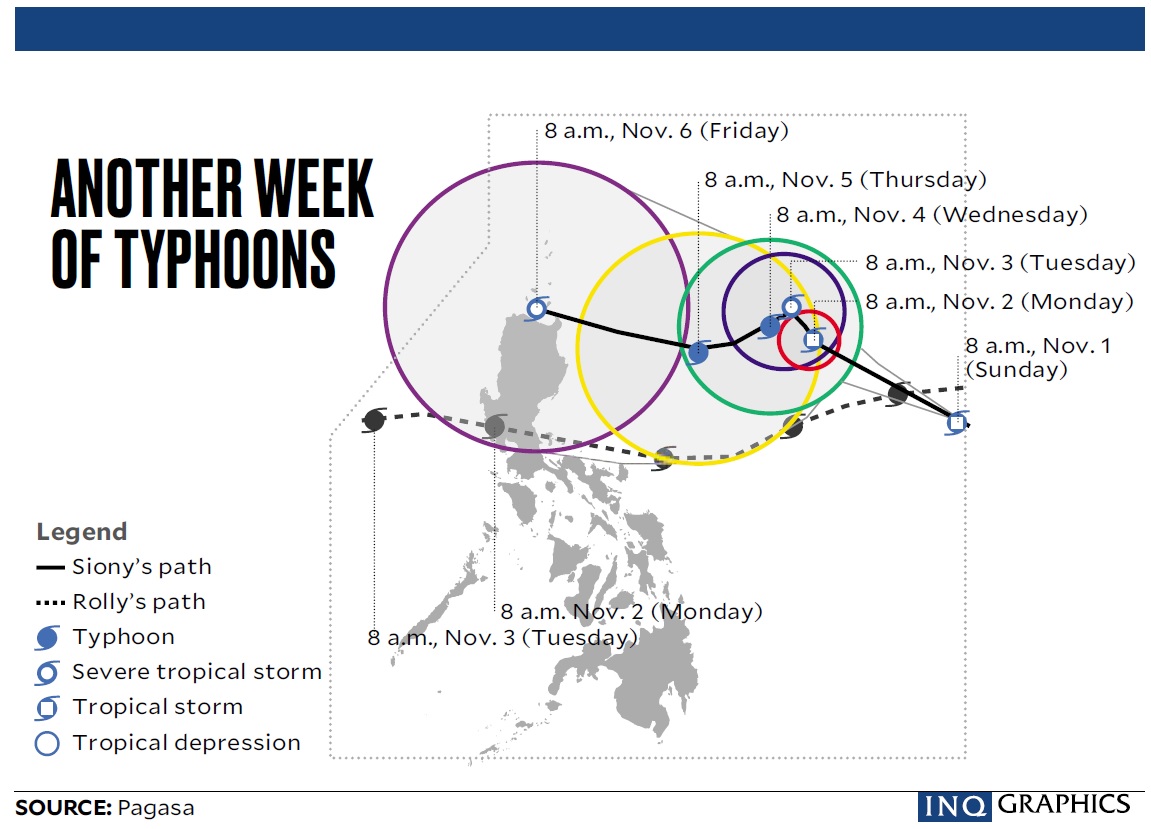
Categorized as a supertyphoon before it slammed into the Philippine landmass, Rolly, carrying winds of up to 225 kilometers per hour and gusts of up to 310 kph, first made landfall in Bato town, Catanduanes province, at 4:50 a.m. before slightly changing course and hitting land a second time in Tiwi, Albay province, at 7:20 a.m.
Rolly was downgraded to typhoon after it struck the Bicol region, where it tore off roofs, toppled trees and power lines, destroyed roads and bridges, made rivers top their banks and flood low-lying areas, and triggered cascades of mud from the slopes of Mt. Mayon that flooded towns below the volcano.
Four killed
At least four people were killed in Albay, according to Gov. Al Francis Bichara. But according to Agence France-Presse, the Office of Civil Defense later issued a statement saying at least seven people were killed.
Two of the victims — a 5-year-old boy and his father — drowned in the town of Oas, while a woman was swept away by volcanic mud in Guinobatan. Another woman was killed by a falling tree in Daraga.
The volcanic mudflow damaged bridges in Daraga and Santo Domingo, cutting off the towns from Legazpi City, Albay’s economic center.
“Albay was battered,” Bichara said, pointing to the devastation caused by the storm as it touched down in several parts of the province, including Tabaco and Malilipot towns.
In Sorsogon province, badly hit were the towns of Donsol, Pilar, and Castilla, according to Gov. Francis Escudero.
Rolly weakened into a typhoon at 8 a.m. and made a third landfall in the vicinity of San Narciso town in Quezon province at noon.
Rolly came a week after Typhoon “Quinta” (Molave) hit the same region of the Philippines. That storm killed 22 people and flooded low-lying villages and farmland, before crossing the South China Sea to Vietnam.
Cedric Daep, director of Albay’s provincial disaster office, said Rolly, which pushed storm signals to No. 5 as it roared toward land on Sunday, was slightly weaker than the strongest typhoons to strike the region: “Rosing” (Angela, 300 kph, November 1995), “Yolanda” (Haiyan, 315 kph, November 2013), and “Reming” (Durian, 320 kph, November 2006).
Of the three storms, Reming was the most destructive, unleashing tons of volcanic mud that buried many villages, killing more than 1,500 people.
Roaring westward
As of 2 p.m. on Sunday, the Office of Civil Defense in Bicol was still trying to determine the extent of typhoon damage in Catanduanes, Albay, Camarines Norte and Sorsogon. Information was coming in slowly because of damage to communication and power lines.
After lashing Bicol, Rolly roared westward, bringing destructive winds and heavy rains as it moved toward Marinduque province and southern Quezon in the afternoon and Batangas and Cavite provinces on Sunday evening.
As of 4 p.m., the storm was located 50 km south-southwest of Tayabas, Quezon, packing maximum winds of 165 kph and gusts of up to 230 kph and moving westward at 25 kph.
The state weather service Philippine Atmospheric, Geophysical and Astronomical Services Administration (Pagasa) said Rolly’s eye was expected to be at 70 km south of Metro Manila between 5 p.m. and 7 p.m. Strong winds were reported across the metropolis toward evening.
Rolly’s approach prompted the evacuation of 2,853 people in Pampanga on Saturday and Sunday. Water was released from overfilling Ipo Dam in Bulacan province on Sunday.
In Laguna province, two villages in Calamba City went under water and authorities evacuated 2,899 people from lakeshore towns on Sunday.
In Quezon, three villages in Lopez and five in San Francisco were flooded as the storm dumped heavy rains.
Local authorities ordered the evacuation of people living in flood-prone parts of Manila, Muntinlupa and Taguig as the storm approached on Sunday.
May weaken
Pagasa said Rolly might weaken as it crossed southern Luzon on Sunday night, but would emerge still a typhoon into the West Philippine Sea.
As of 5 p.m on Sunday, storm signal No. 3 was raised over Metro Manila, southern Zambales, southern Pampanga, southern Bulacan, Rizal, Quezon (including Polillo Islands), Cavite, Laguna, Batangas, Marinduque, northwestern Occidental Mindoro (including Lubang Island), and northern Oriental Mindoro.
The rest of Zambales, Pampanga, Bulacan, southern Tarlac, rest of Occidental Mindoro, Oriental Mindoro, and southern Nueva Ecija were under signal No. 2.
Signal No. 1 was up over mainland Cagayan, Isabela, Apayao, Kalinga, Mountain Province, Ifugao, Abra, Ilocos Norte, Ilocos Sur, La Union, Benguet, Nueva Vizcaya, Quirino, the rest of Aurora, Nueva Ecija, Tarlac, Camarines Sur, Camarines Norte, Burias Island, Romblon and Calamian Islands.
Pagasa warned of storm surge reaching up to 3 meters in the northern coastal areas of Quezon, Metro Manila, Cavite, Bulacan, Pampanga, Bataan, the southern coastal area of Batangas and most of the southern coastal areas of Quezon.
Residents were also warned of possible storm surge in the coastal areas surrounding Laguna de Bay and Taal Lake.
As Rolly blew across Luzon, another cyclone, Tropical Storm “Siony” (Atsani), entered Philippine territory.
Pagasa said Siony slightly intensified and was forecast to move west-northwest at 30 kph.
As of 3 p.m. on Sunday, the new storm was 1,140 km east of Central Luzon, with winds of up 75 kph and gusts of up to 90 kph.
The weather service said Siony was “less likely” to affect any part of the country in the next two to three days.
—Reports from Jhesset O. Enano, Krixia Subingsubing, Mar Arguelles, Rey Anthony Ostria, April Mier-Manjares, Mark Alvic Esplana, Geoerg Gio Brondial, Maricar Cinco, Dexter Cabalza, Carmela Reyes-Estrope, Armand Galang, Joanna Rose Aglibog, Greg Refraccion, Villamor Visaya Jr., Nestor Burgos Jr., Joey Gabieta, Ador Vincent Mayol, Tonette Orejas, AFP, and Reuters
Prime Minister Imran Khan on Sunday announced that his government has decided to grant the “provisional-provincial status” to Gilgit-Baltistan, a part of the erstwhile princely state of Jammu and Kashmir, illegally occupied by Pakistan in 1947.
The Centre has asked Pakistan to immediately vacate from the Indian territory of Gilgit-Baltistan which the Imran Khan government declared as its provisional fifth province on Sunday.
Prime Minister Imran Khan on Sunday announced that his government has decided to grant the “provisional-provincial status” to Gilgit-Baltistan, a part of the erstwhile princely state of Jammu and Kashmir, illegally occupied by Pakistan in 1947.
In a statement issued in New Delhi by the Ministry of External Affairs, spokesperson Anurag Srivastava said: “The Government of India firmly rejects the attempt by Pakistan to bring material changes to a part of Indian territory, under its illegal and forcible occupation.”
The government reiterated that the Union Territories of Jammu and Kashmir and Ladakh, including the area of so-called “Gilgit-Baltistan”, are an integral part of India by virtue of the legal, complete and irrevocable accession of Jammu and Kashmir to the Union of India in 1947.
Srivastava said that the Pakistan government has “no locus standi on territories illegally and forcibly occupied” by it. Such attempts by Pakistan, intended to camouflage its illegal occupation, cannot hide the grave human rights violations, exploitation and denial of freedom for over seven decades to the people residing in these Pakistan occupied territories, he added.
The spokesperson said that instead of seeking to alter the status of these Indian territories, Indian government calls upon Pakistan to immediately vacate all areas under its illegal occupation.
Earlier, Prime Minister Imran Khan during his visit to Gilgit-Baltistan on Sunday said that he had decided to give the provisional province status to the region “keeping in mind the UN Security Council’s resolutions.
“The Khan government is also holding elections in the region, where many activists have called it a Pakistani Army’s fraud to grab and further occupy Gilgit-Baltistan.
Backed by the Pakistani Army, Prime Minister Khan on the occasion did not miss the opportunity to praise the military, which is facing a stiff challenge from the political opposition headed by former Prime Minister Nawaz Sharif.
“Pakistan is secure today because of its armed forces. Our army is the main reason why we have not suffered the same fate as many other Muslim countries,” he bragged.
By The Washington Post · Annie Linskey, Sean Sullivan · NATIONAL, POLITICS Joe Biden remains locked in a bitterly fought race for the presidency, but the Congressional Black Caucus is nonetheless already gathering résumés for jobs in his would-be administration. Pete Buttigieg’s fans are pitching him as ambassador to the United Nations. And Republicans who backed Biden are being eyed for their own possible roles.
As Biden hopscotches around the country in the campaign’s final weekend, his allies are jockeying over Cabinet appointments, ambassadorships and other plum positions, while Biden’s advisers have quietly begun mapping out an administration, according to people familiar with the activities.
That’s igniting tensions among various factions, tensions that are poised to erupt into ferocious fights should Biden win, since the appointments would dictate the direction and shape of a Biden presidency. Liberals, who are demanding rewards after muting their criticism of Biden’s centrism during the campaign, are scrutinizing the records of more-moderate potential picks in hopes of derailing them, while longtime Biden allies are looking for work.
“There are a lot of mouths to feed,” said one person familiar with the dynamic, who spoke on the condition of anonymity to comment frankly. “Finding space for them will be a challenge.”
The stakes are higher than usual. Biden’s appointees, if he wins, will determine the United States’ response to the Trump era – whether it is a return to traditional centrism or a plunge into liberal activism. And they will be tasked with repairing what Democrats see as the severe damage of the Trump era, as many federal agencies have departed from long-held practices and norms.
Biden is also eager to break barriers by appointing African Americans, Latinos and women to high-level posts, according to people familiar with his thinking. Those groups have been instrumental in Biden’s political successes this year or are seen as key to his path to the White House.
“In their early announcements, they’re going to set tones and demonstrate the commitment to the diversity that he cares about – and the priorities that he cares about,” said Hilary Rosen, a Democratic consultant and a close ally of the Biden team. Rosen said Biden’s aides have “cast a very wide net.”
But don’t expect bomb-throwers, she said. “He is not somebody who is coming in to disrupt Washington. He’s coming in to heal Washington,” Rosen added.
This article is based on interviews with 22 Democratic aides, strategists and advisers to Biden’s campaign, as well as outside allies with knowledge of the process, many of whom spoke on the condition of anonymity to share private deliberations that could distract from the campaign’s final push. They stressed that final decisions have not been made and the situation is fluid.
“The Biden-Harris transition team is not making any personnel decisions pre-election,” said Cameron French, a transition spokesman.
Biden’s team hopes to quickly name a White House chief of staff, according to allies with knowledge of the situation. An early favorite is Ron Klain, who was Biden’s chief of staff when Biden was vice president and also served as Obama’s “Ebola czar,” which means he has experience dealing with pandemics.
A second, if less likely, possibility is Rep. Cedric Richmond, D-La., according to two people familiar with the talks. Richmond would be the first African American to be chief of staff, and if he is not chosen, he is likely to be given another role with broad responsibilities in the White House, Biden allies said.
Richmond received a recent boost from Rep. James Clyburn, D-S.C., a highly influential figure in Biden’s orbit, who said in a Washington Post Live interview that Richmond has “one of the best political minds that I’ve encountered” and that he thinks Richmond should have a big role in a Biden administration.
Other top White House staffers also could be named quickly, in part because they don’t require Senate confirmation, unlike Cabinet secretaries and agency heads. Biden allies have floated several possibilities for press secretary, for example, including Symone Sanders, a senior Biden adviser who would be the first African American to hold the job.
If Biden wins, he will face demands from an unusually broad range of political camps, having forged a campaign coalition of Republicans, centrists, liberals and socialists who set aside their differences in an effort to defeat Trump and will want to be represented.
Despite Democrats’ desire not to show arrogance or take a win for granted, competition among them has heated up early amid growing optimism that not only will they capture the White House but they also will win a Senate majority, giving them wide latitude on appointments.
“I’ve seen a ton of names and, you know, for every one of these positions, there are anywhere from five to ten A-plus potential people,” said Sen. Richard Blumenthal, D-Conn. “I think Biden will want diversity as well as excellence in his Cabinet, and people he can trust.”
Some of the biggest fights are over economic posts, given the fierce disagreement between liberals whose power has surged in the Trump era and traditional Republicans who are quietly supporting Biden in the expectation of a steady, business-friendly presidency.
Several organizations have sent letters to Biden transition officials asking them to reinstitute Obama’s policy of banning lobbyists from top jobs, which the transition has largely done (though, unlike Obama’s rules, waivers can be issued).
A particular focus is Biden’s pick for treasury secretary. Federal Reserve governor Lael Brainard is a leading possibility, according to Biden allies; another is Rhode Island Gov. Gina Raimondo, a former finance executive who angered liberals by raising the retirement age and overhauling the pension system in her state. Either would be the first woman to fill the role.
Also mentioned is Roger Ferguson, the president and CEO of the financial firm TIAA, who previously served as vice chairman of the Federal Reserve, who would be the first African American in the job.
All three names upset liberals, who want a potential Biden presidency to aggressively tackle income inequality and similar issues and fear that a centrist would have other priorities.
The Center for Economic and Policy Research, a liberal think tank, has formed a group called the Revolving Door Project, which seeks to torpedo such nominees. “Our relative expertise is researching the problematic people,” said Jeff Hauser, who directs the group, adding that it is “disentangled from long, ongoing interests so that we can be critical of people.”
Hauser and other liberals want Biden instead to name Sen. Elizabeth Warren, D-Mass., or someone who shares her views, as treasury secretary.
But Warren, a fiery liberal, would face opposition from business leaders. And it could be tricky for Biden to pluck Warren from the Senate for any job, since Massachusetts Gov. Charlie Baker, a Republican, would pick her replacement. (Still, Democrats have a supermajority in the state legislature and in theory could write a law requiring Baker to choose a Democrat).
One Biden ally cited three other economists who are well positioned for top economic positions in the White House: Ben Harris, Jared Bernstein and Heather Boushey.
Another priority would be naming individuals to lead the fight against the pandemic, given Biden’s criticism of Trump as having botched the response. Though Biden is unlikely to name a covid-19 “czar,” according to people familiar with the deliberations, he is expected quickly to name a surgeon general and a secretary of health and human services to show urgency.
Jake Sullivan, a top policy adviser to Biden’s campaign who has often been on the campaign trail with him, could be in line for a top job on health issues, said several Biden allies. Sullivan also is mentioned as a potential chief of staff.
Law enforcement jobs could also be extremely high-profile, after Trump’s challenges to an array of legal norms. Xavier Becerra, California’s attorney general, is being floated to head the Justice Department, and Alejandro Mayorkas, a former Obama administration official, could become secretary of homeland security.
Meanwhile, Buttigieg, the former South Bend, Ind., mayor who ran against Biden in the presidential primary and then endorsed him, has charmed Biden and impressed his top lieutenants with crisp appearances on Fox News and local television stations, according to several people familiar with the campaign’s thinking.
Some see Buttigieg as a potential U.S. ambassador to the United Nations, in part because Buttigieg, a former Rhodes scholar, speaks several languages and is one of the party’s most polished communicators.
“I think Mayor Pete Buttigieg impressed virtually everybody, and it’s fairly clear he does not have a clear path forward in Indiana,” said Steve Westly, a top Biden fundraiser, referring to the conservative bent of Buttigieg’s home state. “I think for Biden and the country, I really hope they choose Mayor Pete for a role.”
Over the summer, one of Buttigieg’s top fundraisers, Bryan Rafanelli, made a similar pitch during a virtual fundraiser with Biden’s wife, Jill. “I think I’d love for him to be U.N. ambassador,” Rafanelli said.
Biden’s calculus could be affected by the Senate’s post-election makeup, according to several close allies. If Democrats win a comfortable majority in the chamber – where the GOP holds a 53-47 edge – Biden would have more latitude to weather resistance from Republicans and defections by Democrats.
A narrow majority, or a Senate that stays in Republican hands, might require nominees who appeal to a broader cross section of senators, potentially forcing Biden to decide which positions are worth a fight. As one ally put it, he would have to determine “where you take your bullets.”
Some Biden allies, who like others spoke on the condition of anonymity, cited former national security adviser Susan Rice as someone whose fate could be determined by the Senate balance. Well-regarded in Biden’s orbit and seen as a potential short-lister for secretary of state, Rice has attracted criticism in conservative circles for her comments in the aftermath of the deadly 2012 terrorist attack on a U.S. diplomatic outpost in Benghazi, Libya.
If Republicans control the Senate, the allies said, Biden might not be able to get Rice confirmed, despite his high regard for her. Another name frequently mentioned for secretary of state is Antony Blinken, a longtime Biden foreign policy aide.
The secretary of defense position could also break a barrier, with many close to the process saying Michèle Flournoy, a former department official, is being carefully considered. She would be the first woman to lead the Department of Defense.
For education secretary, Biden’s team is focused on finding someone with experience in primary or secondary education, according to one Biden ally familiar with the search process. Democrats have criticized Trump’s education secretary, Betsy DeVos, for reasons including that she lacks a background as an educator.
One possible Biden pick is Randi Weingarten, the head of the American Federation of Teachers. Weingarten, saying in an interview that she is “fixated” on electing Biden, declined to comment on the speculation.
Weingarten endorsed Warren in her personal capacity during the primary, but she has played a major role in uniting the party, and undertook a 30-plus-day bus tour to support Biden’s candidacy.
Lily García, a former head of the National Education Association, also is being considered, according to two people familiar with the discussions.
The Biden team is also expecting to include Republicans in the administration if he’s elected. “I know for a fact, just because I’m on the transition team, they said they are considering all – not just Democrats, but Republicans and all people as part of the administration,” said Cindy McCain, the widow of Sen. John McCain, R-Ariz.
McCain demurred when asked if she’d be interested in a post. “I’m very superstitious, so let’s get past Tuesday,” she said with a laugh.
InternationalNov 01. 2020Attendees wait to hear former Vice President Joe Biden speak in Detroit on March 9. MUST CREDIT: Washington Post photo by Carolyn Van Houten
By The Washington Post · Holly Bailey · NATIONAL, POLITICS Joe Biden spent the early weeks of 2020 trudging across the frozen landscape of Iowa, wading into crowds to shake the hands of strangers, hug star-struck grandmothers and pose for countless selfies in a grueling quest for support.
Within weeks, there would be no more big rallies, no more hand shaking, no more physical touch – at least not for Biden and most Democrats. An election season, in its most traditional sense, was over, felled by an unpredictable virus that would upend virtually every aspect of normal life, killing nearly a quarter of a million Americans and threatening the health of citizens and of the nation’s economy and its democratic institutions.
Yet the campaign, like American life, has forged ahead in unprecedented ways amid the threat of the coronavirus, which has dangerously surged again in recent weeks. In April, thousands of people across Wisconsin risked their health to cast primary ballots in the early weeks of the pandemic – a preview of the long lines to come even in the final days before the general election.
In early summer, President Donald Trump, 74, resumed his massive campaign rallies against the advice of health experts and sent Republican organizers back into the field, downplaying the risks of covid-19 even after he became infected. Democrats, meanwhile, moved most of their campaigning into the virtual world – hosting organizing events and rallies on Zoom.
When Biden eventually returned to in-person campaigning, his schedule was limited, the guest list sparse. The 77-year-old candidate, who once stood close enough to touch foreheads with voters, now stood far away from them – proof, his advisers said, that he cared enough about Americans to do anything to keep them safe.
– – –
March madness
March 3: In late February, Biden celebrates a comeback victory in South Carolina’s Democratic primary, just as the U.S. reports what was believed to be the country’s first death from the coronavirus. By Super Tuesday, when voters across 14 states hit the polls, leaders scramble to put covid-related protections in place. California adds curbside drop-off to limit exposure. In Virginia, officials scramble to make sure they have enough hand sanitizer and disinfectant wipes.
March 8: With coronavirus cases rising, Sen. Bernie Sanders’s campaign places hand sanitizer dispensers throughout an event in Grand Rapids, Mich., where thousands of unmasked supporters turn out to see him win the endorsement of civil rights leader Jesse Jackson.
March 9: Democrats and Republicans begin to cancel their in-person campaign events amid reports of rising cases. Even when gatherings go forward, precautions are put in place. At one event, a Biden staffer dispenses hand sanitizer to hundreds of people attending a unity rally in Detroit, where the former vice president appeared with former rivals Sen. Kamala Harris, D-Calif., and Sen. Cory Booker, D-N.J.
March 10: Biden and Sanders cancel dueling evening rallies they had planned in Cleveland to await primary results from Michigan and several other states because of the coronavirus.
March 12: Biden and Sanders shutter campaign offices around the country and cancel plans to travel to Arizona for a planned primary debate. The two men later spar in a CNN studio in Washington from podiums spaced six feet apart.
March 14: Biden holds his first virtual event – a town hall with Illinois voters – but it is marred by technical difficulties. The campaign later posts an edited version on YouTube. A few days later, Sanders hosts a virtual “rally,” complete with surrogates and video performances from musical artists, including Neil Young, who was joined by his wife, Daryl Hannah, and his dog, who continually appeared at the bottom of the screen.
April 7: Wisconsin becomes the first state to hold an election amid the pandemic, forcing thousands of people to stand in hours-long lines to cast ballots in person after conservatives on the state Supreme Court blocked a Democratic effort to delay the primary for health reasons.
April 14: Trump hosts his longest coronavirus briefing to date. Trump spent the briefing, which clocked in at about 150 minutes, attacking Democrats and the media over their rhetoric on the virus.
April: Biden begins to host virtual events live-streamed from his basement in Wilmington, Del.
– – –
Summer slowdown
Primaries rolled on across the country, but they were often marred by technical challenges brought on by the coronavirus. In New York, a huge surge in mail-in voters significantly slowed counting, and thousands of ballots were tossed. In Pennsylvania, slow counts left many races undecided for days.
After an initial lull, the Trump campaign began to once again plan in-person events, mocking Biden for “hiding in his basement.”
The president’s inaugural post-pandemic event was a June 20 rally in Tulsa The campaign billed the event as a celebration of the nation reopening for business after weeks of coronavirus-related shutdowns. In a form that would be put into place for every event going forward, guests were asked to sign a waiver to “voluntarily assume all risks” related to attending the event.
In the lead-up to the event, Trump officials bragged about record-breaking applications for tickets. But turnout was lower than expected, marred by thousands of empty seats. In the wake of the event, viewed as an embarrassment inside Trumpworld, the campaign moved away from big rally-style events.
Biden spent much of his summer appearing at events and television interviews filmed at his home. He tried to draw a contrast with Trump by appearing in a mask at nearly every event, even when being interviewed on television.
He did make occasional public appearances. After the killing of George Floyd, Biden visited the site of protests in Wilmington, Del., where he knelt to speak to demonstrators. Soon after, Biden traveled to Philadelphia to deliver his first formal speech since the pandemic, calling out Trump for his divisive rhetoric and urging Americans not to “let our rage consume us.” He spoke to a mostly empty room save a handful of reporters. Biden later traveled to Houston to meet with Floyd’s family ahead of his funeral.
In August, Biden picked Harris as his running mate. Their first appearance was a socially distanced event inside a mostly empty high school gym. Nodding to a crowd of people who gathered outside to catch a glimpse of the Democratic ticket, Biden mourned for a campaign that could have been. “I wish we could talk to everyone outside,” Biden said. “But we’re social distancing and playing by the rules.”
Behind the scenes, the campaign launched an aggressive fundraising operation, meeting with groups of donors in Zoom events featuring high-profile surrogates. By September, Biden’s campaign was outraising Trump.
With much of the country still facing coronavirus-related restrictions, forcing the cancellation of summertime events and limiting some campaign events, Trump voters began to organize their own efforts to show support for the president with boat, tractor and pickup truck parades that often drew hundreds of participants. Biden fans mostly stuck with virtual campaigning, showing support for their candidate online.
– – –
Unconventional conventions
Democrats cancel their in-person convention planned for Milwaukee, unveiling a slickly produced made-for-TV virtual event.
Over the course of the four-day events, the Democrats highlight their party’s diversity, featuring voters from across the country. During the party’s roll-call, a fisherman in Alaska, a nurse in New York and a tribal activist in South Dakota declare their delegation’s support for Biden. Former president Barack Obama urges Americans to make a plan to vote, warning, “Do not let them take away your power. Don’t let them take away your democracy.” Harris introduces herself to voters with a deeply personal speech about her family.
On the last night of the convention, Biden delivered his acceptance speech inside a mostly empty convention center and, afterward, he and Harris and their spouses appeared masked and distanced before a drive-in rally of supporters in their cars. Democratic voters mostly followed along on TV and online, though some local parties in Iowa and Oklahoma hosted events to allow voters to watch Biden’s speech at drive-in movie theaters.
Trump moved the Republican convention from Charlotte, to Jacksonville, Fla., before much of the event was ultimately scrapped because of coronavirus concerns.
The event ultimately had a mix of taped and in-person events featuring several members of the Trump family who spoke from inside an empty Mellon Auditorium in Washington, D.C. Trump appeared every night for “surprise” segments that featured, among other things, an immigration and naturalization ceremony hosted by the president. The attendees later said they were not told that they would be part of the political convention.
In a Rose Garden address, first lady Melania Trump offered her “deepest sympathy” to Americans suffering from the coronavirus. Trump accepted his nomination for reelection at a controversial event on the South Lawn of the White House, promising, “We will make America safer. We will make America stronger. We will make America prouder. And we will make America greater than ever before.”
Experts said the Trump campaign had violated the Hatch Act by using the trappings of the White House for what amounted to a multiday campaign event.
– – –
Fall finale
September: The Trump campaign continues to knock on doors, boasting that its volunteers visit a million homes a week. In yet another symbol of the bifurcated approaches to campaigning, the Biden campaign eschews the practice completely until early October, focusing instead on virtual campaign efforts by phone and text, along with virtual events featuring top surrogates like Harris, who pops up in TikTok videos and taped interviews across the internet with celebrities like actress Mindy Kaling. In battleground states like Wisconsin and Iowa, the Biden campaign sets up “supply centers” for supporters to pick up campaign signs and literature.
Sept. 8: Trump leans into live events, hosting boisterous rallies in airplane hangars across the country. Few attendees wear masks, and there is no social distancing or other safety protocols. On one day in September, Trump hosted events in Florida and North Carolina.
Sept. 18: Supreme Court Justice Ruth Bader Ginsburg dies, sparking a huge outpouring of donations from Democrats to Senate candidates across the country, leading to a record-breaking haul for candidates made through ActBlue, a Democratic organizing app. “In this moment it is vital to give to Senate candidates,” reads an ActBlue fundraising page called “Protect RBG’s Legacy.”
Sept. 29: Biden and Trump meet for their first debate in Cleveland, where members of the Trump family flout rules requiring masks to be worn inside the venue. The next day, Trump travels to Minnesota for events, including a large rally in Duluth that violates the state’s public health rules requiring limited crowd sizes and social distancing rules because of the pandemic. Hope Hicks, one of Trump’s closest advisers, begins to show symptoms of covid-19 on the trip and later tests positive for the coronavirus.
Oct. 1: The Trump campaign announces that the president has been diagnosed with the coronavirus, throwing the campaign into chaos. A day later, the president is hospitalized as questions swirl about when he first knew he was sick and whether proper safety precautions were followed.
Oct. 3: Jill Biden stumps in Minnesota, delivering a scathing attack of Trump’s coronavirus record to an audience standing in hula hoops, spaced six-feet apart. One of the campaign’s most active surrogates, Jill Biden made more than 25 live appearances in October, and her husband visited eight battleground states over the month.
Oct. 6: Biden expands his in-person campaigning, traveling to battleground states including Florida. Standing on the tarmac near his campaign plane in Delaware, Biden was speaking to reporters when his wife, Jill, whispered to him about social distancing and gently moved him back a few steps. “I’m sorry,” he said and continued talking.
Oct. 10: Trump makes his first public appearance since being discharged from Walter Reed National Military Medical Center, addressing a crowd of several hundred people on the South Lawn of the White House. Two days later, he traveled to Sanford, Fla., for his first rally since his coronavirus diagnosis.
Oct. 11: Biden delivers a speech in Gettysburg, using the Civil War battlefield as a backdrop for a speech on American division and discord. “A century and a half after Gettysburg, we should consider again what can happen when equal justice is denied and when anger and violence and division are left unchecked,” Biden said in rural Pennsylvania.
Oct. 21: Obama makes his first appearance on the campaign trail at a drive-in rally, now a hallmark of the Biden campaign. Sanders; Warren; former South Bend, Ind., mayor Pete Buttigieg; and others also hosted in-person, socially distanced events in the final days before Election Day, a sign of the campaign’s shifting strategy in the final stretch.
Oct. 22: At the final debate, Trump and Biden face off from a distance, sparring over the coronavirus, race and the future of the country.
Oct. 27: In his final push, Trump launches an aggressive schedule of large, outdoor rallies across the battleground states – including in Wisconsin, now a covid-19 hotspot. After taking a lap in the presidential limo around a racetrack in La Crosse, Wis., the site of one rally, Trump downplays the threat of the virus, even as the state reports a record 5,262 new cases. “We’re turning the corner. We’re rounding, like this racetrack,” Trump tells several thousand mostly unmasked supporters.
In Omaha, Neb., thousands of Trump supporters are left stranded in freezing temperatures for hours after there were not enough buses to transport people back to their cars after a nighttime airport rally there. Seven people were hospitalized, according to Omaha police.
In the first few weeks of early voting, at least 69 million Americans cast a ballot. It’s a historic figure, equal to roughly half of the total turnout in 2016. The overwhelming demand to vote – reflected in long lines nationwide – highlights the widespread sense of urgency Americans feel. “This is about preserving our democracy,” said one voter in Texas. “This feels like the last thing we have left to preserve civil society.”

 Visitors watch a tuna auction at the Toyosu Market in Koto Ward, Tokyo, on Nov. 2, 2020, as public viewing was resumed after an about eight-month hiatus. MUST CREDIT: Japan News-Yomiuri

 (Yonhap)
  Under scrutiny: Job intake in the construction, plantation and agriculture sectors will also come in for stricter vetting.
 RUINED A sport utility vehicle and business establishments are submerged in lahar at the parking lot of Cagsawa Ruins in Barangay Busay, Daraga town, Albay province, after Typhoon “Rolly” sent mud and boulders tumbling down the slope of Mt. Mayon on Sunday. —GEORGE GIO BRONDIAL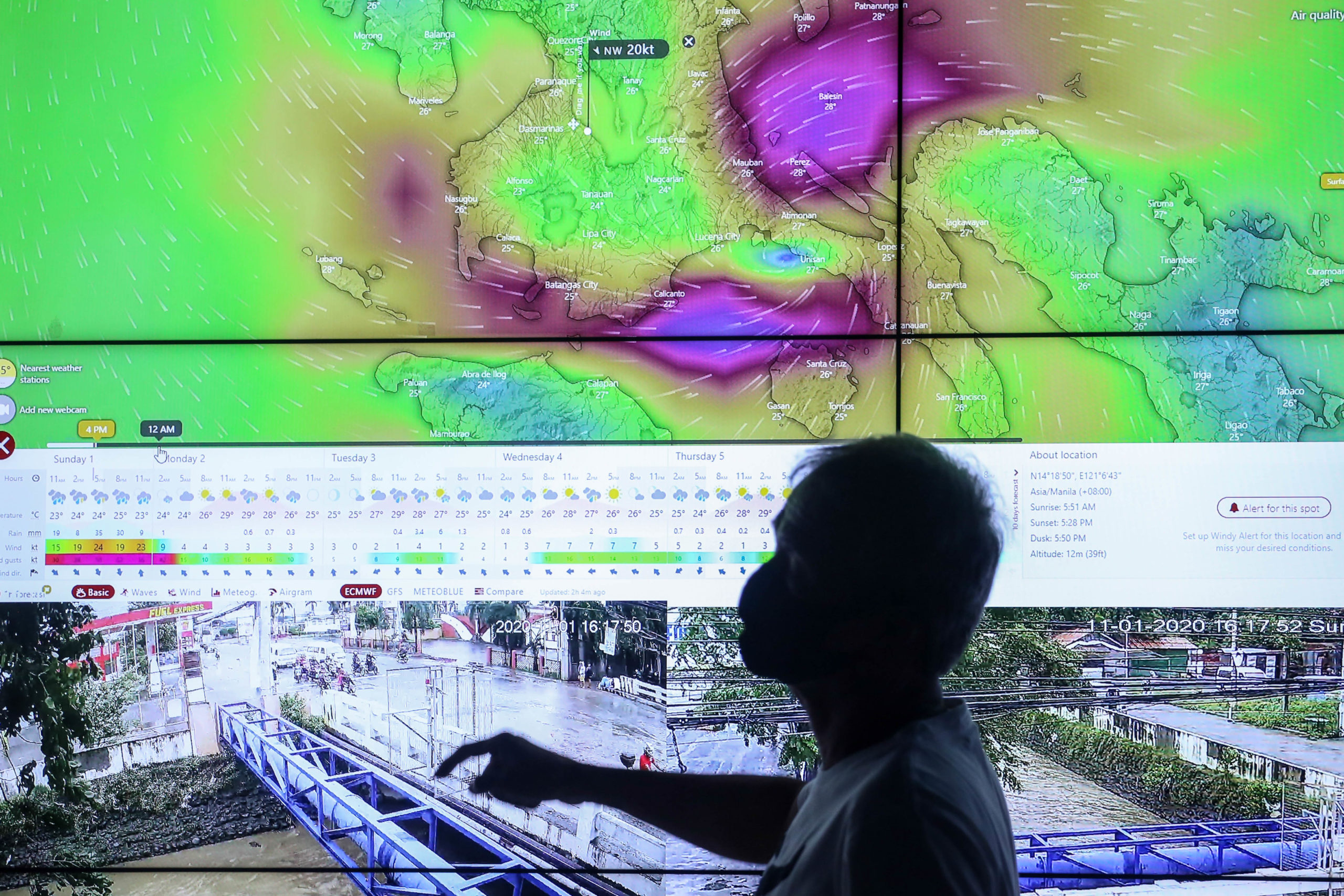



 Attendees wait to hear former Vice President Joe Biden speak in Detroit on March 9. MUST CREDIT: Washington Post photo by Carolyn Van Houten
