World Bank, in one of its reports, projects that Bangladesh will see increased remittance flow and secure eighth position in the world in terms of it in 2020.
WB revealed the prediction in the report titled “COVID-19 Crisis Through a Migration Lens” published on October 29.
According to the projection, two South Asian countries will see increase in remittance flow despite the pandemic.
Bangladesh will gain eight percent more remittance this year, according to the report. The total remittance flow will be USD 20 billion, WB projected.
Mainly, remittance flow will pick up through official and unofficial channels due to restrain in travelling, the report said.
The other South Asian country with increased remittance flow would be Pakistan. It will be in the sixth position with nine percent more remittance flow.
Although, India will be the first on the list in terms of total remittance flow, it’s projected to be nine percent less than the previous year.
South Asia will lose four percent of the total remittance flow compared to last year and the world will lose 14 percent, the WB also mentioned in its projection.
India, United States, Japan and Australia will hold a joint naval exercise from November 3 in the Bay of Bengal, appearing in it for the first time in a decade.
The Indian Navy, in a statement, said yesterday that the 24th edition of Malabar naval exercise is “scheduled in two phases in November. While the first phase involving participation by Indian Navy, United States Navy, Japan Maritime Self Defence Force and Royal Australian Navy (RAN) is set to commence off Visakhapatnam in Bay of Bengal” from November 3 to November 6, the second phase will be held in the Arabian Sea in the middle of next month.
The Malabar series of maritime exercises had commenced in 1992 as a bilateral India-US event and Japan joined it in 2015. The 2020 edition will now witness participation of Australia, the Indian Navy said.
Australia’s presence for the first time is viewed with significance as all the four countries are members of a Quadrilateral Security Dialogue with an eye on China with which India has been involved in a nearly six-month old military standoff in eastern Ladakh, reports our New Delhi correspondent.
The phase-1 of Malabar will see the US coming with a guided-missile destroyer, Australia with a long range frigate with integral MH-60 helicopter, Japan with a destroyer with integral SH-60 helicopter and India with a destroyer, frigate, off-shore patrol vessel, fleet support ship and a submarine, Sindhuraj.
The first phase “would witness complex and advanced naval exercises including surface, anti-submarine and anti-air warfare operations and weapon firing exercises,” the Indian Navy said.
In view of the Covid-19 pandemic, the Malabar exercise will be conducted as a “non-contact, at sea only” event and “will showcase the high-levels of synergy and coordination between the friendly navies which is based on their shared values and commitment to an open, inclusive Indo-Pacific and a rules-based international order,” the Indian navy said.
Authorities on Saturday evacuated nearly 1 million people in the path of the world’s strongest typhoon this year and health officials reminded the public to maintain pandemic safety measures despite being crammed in storm shelters.
Typhoon Rolly (international name: Goni) was raging toward southern Luzon at 25 kilometers per hour, packing sustained winds of 215 kph and gusts of up to 265 kph. It was about 345 km east northeast of Virac, Catanduanes, around 4 p.m. on Saturday.
The Philippine Atmospheric, Geophysical and Astronomical Services Administration (Pagasa) said the typhoon was forecast to hit Catanduanes and the Camarines provinces on Sunday morning and then barrel through Quezon province.
As it moves toward the South China Sea to the west, it will bring heavy to intense rains accompanied by violent winds to Metro Manila, the Southern Tagalog region and Central Luzon, but will weaken after slamming into the Sierra Madre mountains.
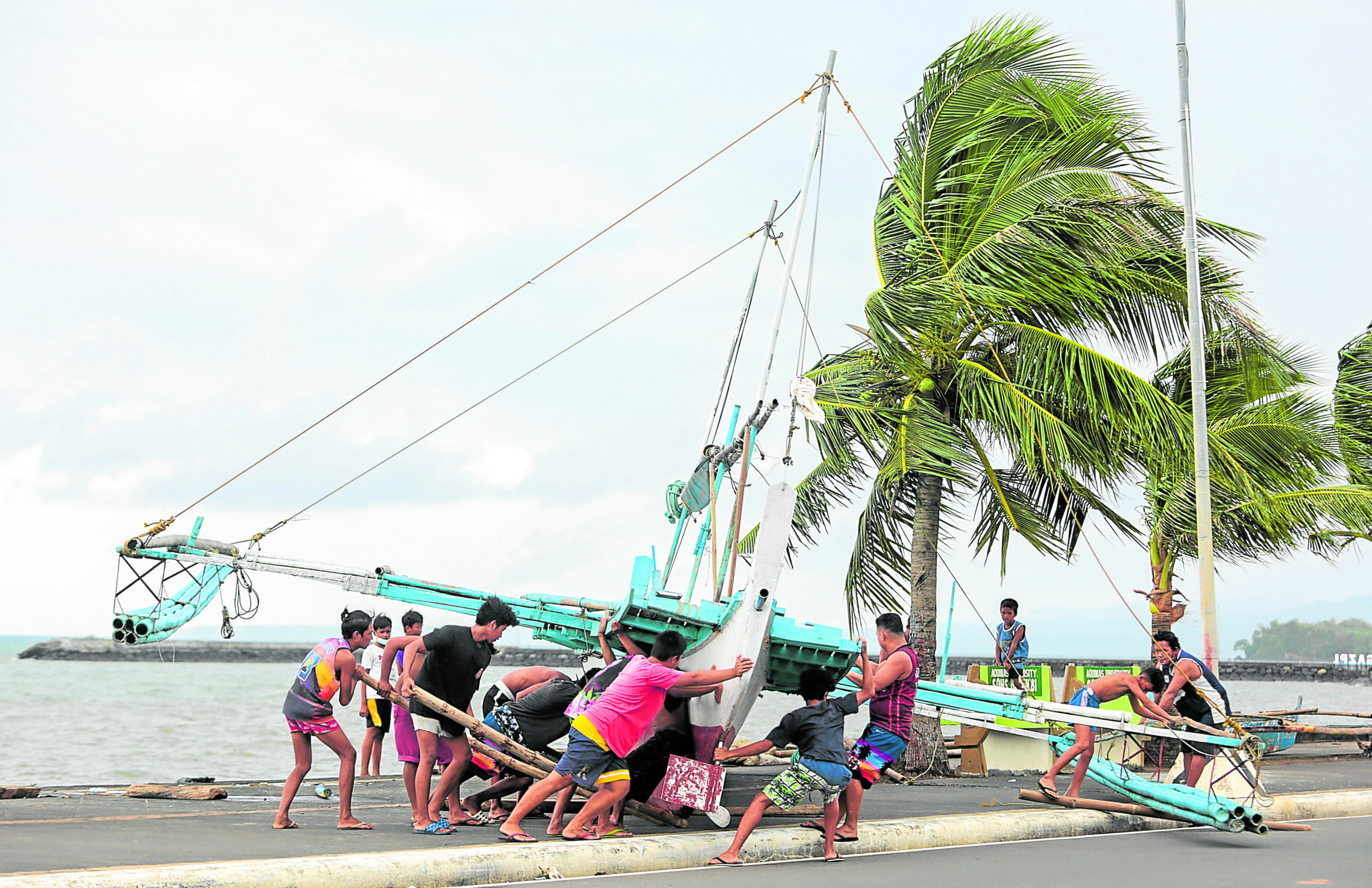
ABOVE THE WATER A group of men raise a boat way above the water on the shores of Legazpi City on Saturday in preparation for Typhoon “Rolly,” (international name: Goni) which is expected to hit nearby Catanduanes province on Sunday with near supertyphoon strength that could generate over 3 meters of storm surges. —MARK ALVIC ESPLANA
Monitor evacuees
Health Undersecretary Maria Rosario Vergeire urged local officials to deploy safety officers who would regularly monitor evacuees who may be crammed in enclosed and tight shelters, which are conducive to the transmission of the new coronavirus that causes COVID-19.
The safety officers will help ensure that evacuees comply with the minimum health standards—physical distancing, wearing masks and washing hands frequently—to prevent increasing the number of infections, she said.
The safety officers will also regularly check COVID-19 symptoms among the evacuees, who will have to be isolated, Vergeire said.
“We are reminding everyone to be vigilant, aware and cautious. We know the risk when people congregate,” she said.
The National Disaster Risk Reduction and Management Council (NDRRMC) said nearly 1 million people had been evacuated by Saturday.
According to Undersecretary Ricardo Jalad, executive director of the NDRRMC, most of the evacuees were from the Bicol region where the Office of Civil Defense had prepared to evacuate 2.5 million people, or about 570,000 families, by early Sunday.
COVID-19 facilities
In Camarines Sur, the provincial government moved about 20,000 families before noon on Saturday.
Camarines Norte officials expected to evacuate at least 35,000 families, or 159,000 people.
In Albay, thousands from villages prone to floods, lahar, landslide and storm surges were evacuated, according to the Provincial Disaster Risk Reduction and Management Council.
Jalad said positive and suspected cases of COVID-19 in “mega” treatment facilities in Metro Manila and nearby Bulacan had been transferred to hospitals and hotels.
He said the tents where they were being housed on the grounds of the Philippine International Convention Center and the Philippine Arena Complex might not survive the typhoon’s winds.
Weather forecaster Ariel Rojas told reporters that the eyewall of the storm would be passing Sunday night or early Monday near Metro Manila, which will experience winds that are strong enough to break trees and damage houses made of light materials.
Pagasa also warned of moderate to high risk of storm surges. In the northern coastal areas of Quezon and Polillo Island, Catanduanes and the Camarines provinces, storm surges of over 3 meters are expected.
Palace: Stay calm
In coastal areas of Manila, Cavite, Bulacan, Pampanga, Bataan, southeastern Batangas and southwestern Quezon, the sea level could rise to up to 3 meters, it said.
Rojas said Rolly will likely not gain supertyphoon strength as it was already close to land.
Pagasa categorizes a storm with sustained winds of 220 kph and above as supertyphoon. Supertyphoon Yolanda (international name: Haiyan), which packed sustained winds of 235 kph and gusts of up to 275 kph when it made landfall in November 2013, left more than 6,000 dead and missing.
Sen. Bong Go said President Duterte was in Mindanao monitoring the typhoon and could quickly fly back to Manila anytime the weather permits.
Presidential spokesperson Harry Roque urged the public to monitor government weather bulletins and to “stay calm yet vigilant … and keep their family members and loved ones dry and safe.”
In Daet, capital of Camarines Norte, a 55-year-old member of a rescue group who wanted to be identified only as Dong, was busy securing the roof of his house on Saturday morning.
He remembers the devastation caused by Typhoon “Rosing” (international name: Angela) which tore through his town 25 years ago as one of the worst typhoons to hit the country since 1945.
Rosing caught them unprepared, Dong said. He had to walk for more than 3 kilometers across flooded streets and toppled trees to reach home after he was trapped in a shop that he was managing.
Keeping animals safe
This time, Dong was not taking any chances and even secured three hens, 10 chicks and eight roosters he was keeping as pets in a room in his house to keep them safe.
“We are preparing because we are in the direct path of Rolly. Whether it is strong or weak, as long as you are in the path of the typhoon, you would really have to prepare,” he said.
Bishops Joel Baylon of Legazpi and Rolando Tria Tirona of Naga asked the faithful to pray for the people’s safety.
Santiago Mella, Daet’s disaster management officer, said the initial evacuation plan was to house one family per classroom but increased the number to three on Saturday because there were too many evacuees.
However, he said barriers would be installed to separate each family as a COVID-19 safety measure.
By late Saturday afternoon, streets in Legazpi City were deserted after small and large businesses were ordered closed by 4 p.m. by Albay Gov. Al Francis Bichara to allow residents to prepare for the typhoon. Shops in Albay will remain closed on Sunday.
Hundreds of residents packed department stores before they closed to buy provisions, particularly food and bottled water.
SM City Legazpi allowed owners of cars and motorcycles to leave their vehicles on its third level parking space free of charge to keep them safe from floodwaters, according to Claire Hariri, the mall’s spokesperson.
In Ligao City, also in Albay, farmers harvested their still to mature rice to save them from the expected floods, said farmer Analyn Parco.
In Nueva Ecija province, rice farmers were advised by the Department of Agriculture to harvest their crops that were 70 percent mature.
In Isabela province, farmer Rolly Nicolas, harvested his still young corn, which he would use to feed his cattle.
Other farmers in province, like Gloria Bartolome, herded cows and carabaos to higher ground away from a river that was swelling due to discharges from the Magat Dam.
—Reports from Nikka G. Valenzuela, Jovic Yee, Patricia Denise M. Chiu, Mar S. Arguelles, Rey Anthony Ostria, Michael Jaucian, Ma. April Mier-Manjares, Delfin Mallari Jr., Villamor Visayas Jr. and Armand Galang
Jokowi condemns Macron’s statements on Islam, calls for global unity
InternationalNov 01. 2020President Joko “Jokowi” Widodo delivers his address at the United Nations General Assembly ,which was broadcasted virtually on Sept. 23. (Presidential Secretariat Press Bureau/Lukas)
By Alya Nurbaiti The Jakarta Post
President Joko “Jokowi” Widodo has condemned a statement made by French President Emmanuel Macron on Islam, calling it insulting and offensive to Muslims the world over.
The President claimed that Macron’s statement could spark division among different faiths at a time when the world needs unity to face the COVID-19 pandemic.
“Freedom of expression should not be exercised in ways that tarnish the honor, sanctity and sacredness of religious values and symbols,” Jokowi said during a virtual press conference on Saturday.
He also condemned the deadly attacks that took place in Paris and Nice.
“Indonesia asks the world to put forward unity and religious tolerance to build a better world.”
He was joined by Vice President Ma’ruf Amin and representatives from various religious organizations after a meeting at the State Palace on Saturday.
Jokowi also regretted Macron’s statement, which linked religion with terrorism, calling it “a big mistake”.
“Terrorism is terrorism. Terrorists are terrorists. Terrorism does not have any connection with any religion,” he said.
Macron has been at the center of global criticism from the Muslim community following his controversial statements insulting Islam and Prophet Mohammad. His comments have sparked protests and calls for a boycott of French products by some Muslim countries.
After advance voting began nationwide, there have been cases where the anonymity of voting has been breached as well as possible instances of voter manipulation and voter suppression.
The Union Election Commission (UEC) announced that advance voting will begin from October 29 to November 5. After two days of advance voting, possible instances of vote manipulation and voter suppression has been reported.
Kyun Yin Village, Pakokku District, Pauk Township saw an altercation between the local villagers and the local election commission.
This altercation arose after villagers claimed that the staff from the polling station were registering votes that were contrary to the wishes of the elderly that had come to vote.
“There were around 40 elderly persons that casted advance votes. Around 25 out of those had issues with voting. Family members wanted to get into polling booths to help but representatives from the other party complained. So the commission (local commission head) member did not address that but instead went inside to help out. When some elders saw this happening, they drew the conclusion that if he is doing that then he is writing in votes for the USDP (Union Solidarity and Development Party). Afterwards, the news that green (USDP) is being voted in instead of red (NLD), against the wishes of the voter, spread in the village. It became a clash with the commission after that,” said Ko Aung Khine Soe from Kyun Yin Village.
The incident between the villagers and comission staff on October 29 in Kyun Yin Village.
Regarding the incident on the night of October 29, members from the election commission and authorities from parties had to defuse the situation and that alleged polling station staff members have their duties put on hold, investigations will be launched and that over 40 votes will be taken as void and allowed to re-vote, according to Pakkoku’s election commission chair U Win Sein.
Mi Kun Chan, a Pyithu Hluttaw candidate from the National League for Democracy (NLD) representing Paung Township, Mon State, said that situations will arise at village-tract levels as the advance voting period is protracted during this election due to Covid-19.
“It is not okay to make the advance voting period long. It is due to COVID-19 and it might be okay in towns but will definitely see daily problems in townships with many village tracts. Local commission staff are carrying things out as most convenient to them. So adding the danger of possible vote theft on top of inept activities from township level commission members mean that there is worry for vote manipulation. Everywhere, there are reports that the elderly are being conned because they don’t know how to vote. And it is a huge trouble to guard the votes overnight. I think that people should just come on November 8 to vote instead of casting advance votes,” wrote Mi Kun Chan on his social media page.
Along with the words, a picture of envelopes given out by the election commission for advance voting was uploaded. The envelopes were not brown to use for voting but general, everyday use envelopes. The UEC had already distributed special envelopes which were brown and had exact specifications of which parliament it was for. The advance ballot from voters will be put inside and glued shut.
Voters and political party members have reported many cases of some envelopes being torn or opened.
USDP issued a statement, also on October 29th, that they had requested for only one person representing one party to follow along with advance voting processes, along with several complaints following several incidents; In (H)North Ward, Thingangyun Township, Yangon Region the People’s Pioneer Party (PPP) found that a huge crowd had gathered on the road outside of the polling station, D|E/8 Nga Moe Yeik San Pya wards saw many of the envelopes taken and cast into the ballot box was open, the 348th ward commission had also needed to announce that open envelopes were to be glued, over 50 NLD supporters gathered near the polling booth so the USDP had to bring 52 men and so on.
Similarly, Magway Region Chief Minister Dr Aung Moe Nyo had also written on his social media page that votes were supposedly being cast by scratching with a pen instead of the designated stamping procedure in places such as Zee Kyun and Kan Hla Kyaung villages.
“Is it purposely made for the vote to be void? Over 60 years old have to vote and they are being asked to doodle instead of stamping,” wrote the Magway Chief. He also uploaded screenshots of people informing of such incidents in his message box.
Also on October 29th, a photo of the advanced ballot box being carried on a NLD endorsed rickshaw in No.20 ward, Aung Theik Di 3 street, South Dagon Township, went viral on social media.
On October 22nd, 58 advance votes that were open arrived in Dagon Township from the military engineering corp, which were decided to be void by the township election commission after discussing with candidates from multiple parties competing in the same township.
Many candidates had also pointed out that a person’s vote is supposed to guarantee anonymity as a personal freedom but it had since disappeared in advance voting.
“What’s for sure is that the vote anonymity had disappeared day one into advance ballot casting. It is not happening in just one place but in many places,” said Pyithu Hluttaw candidate Ko Nay Yan Oo from People’s Party (PP) for Kamaryut Township.
No.38, Section 9 of the election law for both Pyithu and Amyothar Hluttaw(s) dictates that polling stations are to be built in a place where the people can easily access, to protect the anonymity of the voter and to announce in advance the locations of polling stations.
Similarly, no.41 of Section 10 also says that staff responsible for any polling stations must give the voter the ballot paper must be given to the voter after clarifying that the eligibility of said voter is in the list and after the voter had either signed or imprinted a thumbprint on the list.
In no.42, it is also said that if the voter is not able to read or do not understand how to vote, the voter’s biological father, mother, wife, husband, son, daughter, sibling may cast a vote for him or her. If such persons are not available, the in-charge of the polling station must carry out the task. Afterwards, the voter himself/herself must cast the vote into the ballot box.
The polling stations have been allowed to be mobile (in light of the elderly voters and COVID-19), but have taken no precautionary measures to safeguard the anonymity of the voting with commission members standing and watching the voters closely.
Pictures have also been circulated on social media, which showed votes that were being carried in plastic bags due to the lack of ballot boxes.
Questions must be raised to protect the anonymity of the voters and to safeguard instances of vote manipulation.
There are 38 million eligible voters in Myanmar for the 2020 general elections.
Biden leads slightly in Pennsylvania with Florida a toss-up, polls show
InternationalNov 01. 2020Photo by: The Washington Post — The Washington Post
By The Washington Post · Dan Balz, Scott Clement, Emily Guskin · NATIONAL, POLITICS As the presidential race enters its final days, competition remains fierce in two of the most important battleground states, with former vice president Joe Biden holding a slight lead over President Donald Trump in Pennsylvania and the two candidates in a virtual dead heat in Florida, according to two Washington Post-ABC News polls.
Among likely voters in Pennsylvania, Biden is at 51% to Trump’s 44%, and Libertarian Jo Jorgensen is at 3%. Biden was leading by 54% to 45% a month ago. While the shift is slight, Biden no longer holds a statistically significant advantage, given the four-point margin of sampling error that applies to each candidates’ support. Among all registered voters in the Keystone State, Biden is at 49% to Trump’s 45%, with Jorgensen at 3%.
In Florida, Trump is at 50% to Biden’s 48% among likely voters. Jorgensen registers at 1%. Last month, Trump was at 51% and Biden at 47 percent. Among registered voters in Florida, Trump stands at 49 percent with Biden at 47%. Last month among registered voters, Biden was at 48% and Trump at 47%. Those month-to-month shifts are not statistically significant.
Although there are other battleground states in play in these final days, many analysts see Florida and Pennsylvania as holding the keys to the outcome of the election. Trump won both states in 2016, but barely, taking Florida by just over onepercentage point and Pennsylvania by less than one point.
Florida is considered as close to a must-win for the president as there is, because without its 29 electoral votes, his path to the necessary 270 electoral votes becomes significantly more challenging.
Pennsylvania is seen by Democrats as vital to Biden’s hopes of preventing the president from replicating his path four years ago through the heartland. Democrats think a Biden victory in Pennsylvania would signal success in Michigan and possibly Wisconsin as well and mark the restoration of the parts of the party’s blue wall that crumbled in 2016.
Beyond the question of voting intentions, the two polls highlight the competitiveness of the two states and show some improvement for the president over the past month as the campaign has intensified ahead of Election Day on Tuesday.
Disapproval of the president has eased ever so slightly in both states since last month. In Florida, he is now in narrowly positive territory, with 51% of registered voters saying they approve and 47% saying they disapprove. Last month, 47% approved and 51% disapproved.
In Pennsylvania, his ratings remain negative, at 45% approving and 52% disapproving, a negative seven-point margin. Last month, Pennsylvania voters disapproved of Trump by a 12-point margin, so there has been a slight but potentially significant shift in his favor.
Trump’s approval rating on the economy is positive in both states. In Florida, 58% say they approve of the job he is doing with the economy, and 40% disapprove. Strong approval is 19 points higher than strong disapproval. In Pennsylvania, 54% approve, and 44% disapprove.
But voters in both states give him negative ratings on handling the coronavirus outbreak. In Florida, 51% disapprove to 47 percent who approve. In Pennsylvania, 54% disapprove, and 43% approve, with 52 percent saying they “strongly” disapprove of the way Trump is handling the pandemic.
Majorities of voters in both states say they are “very” or “somewhat” worried about they or someone in their immediate family catching the virus. In both states, those who are more worried strongly back Biden and his running mate, Sen. Kamala D. Harris (D-Calif.), while those who are less worried slightly more strongly back the president and Vice President Pence.
Trump is trusted more than Biden to handle the economy by voters in Florida by 14 points – 55 percent saying Trump to 41 percent saying Biden. In Pennsylvania, the margin is six points – 49 percent to 43% in Trump’s favor.
The issue of fracking has been litigated intensively in Pennsylvania and is an important matter particularly in western Pennsylvania. Trump has alleged that Biden intends to ban or halt all fracking; Biden’s energy plan calls for no new oil or gas permits on federal lands but would not ban fracking on nonfederal lands. But the former vice president has made some confusing statements that have clouded the issue.
The Post-ABC poll in Pennsylvania finds that 46% say they trust the president more to handle fracking in the state, while 42% say they trust Biden. There is a big partisan split on this question, with independents narrowly favoring Biden.
The poll suggests fracking is a strong issue for Trump in western Pennsylvania, which swung sharply for him in 2016. Voters in this region trust Trump by a 24-point margin over Biden to handle fracking, 57% to 33%, while Trump holds a narrower edge in the area on trust to handle the economy and Biden roughly ties the president on handling the coronavirus.
Among all Pennsylvania voters, Biden has the advantage on trust to handle the pandemic, but his margin is nine points, down slightly from 14 points a month ago. He and the president are about even on that question in Florida; a month ago, Biden had a five-point edge on this issue among the state’s voters.
The polls were conducted during a week that saw the highest number of new daily cases of the novel coronavirus this year, with most states showing increases. Trump has said the country has turned the corner on controlling the virus and calls for opening up as much as possible to help revive the economy. Biden has criticized the president as lacking a plan to combat the virus and has laid out a multistep proposal that includes potential future closures of stricken areas if scientists think that is necessary.
The polls find that 53% of voters in Pennsylvania and 50 percent in Florida say it is more important to stop the spread of the virus, even if that means hurting the economy, while somewhat fewer prioritize trying to restart the economy at the expense of hampering efforts to control the spread of the virus. In both states, more than 8 in 10 Democratic voters favor controlling the virus while more than 2 in 3 Republicans say restarting the economy should be the priority. About half of all independents in each state support efforts to prevent the virus from continuing to spread, with slightly more in each case than those who favor prioritizing an economic restart.
Trump’s profile in Florida is better than in Pennsylvania when voters are asked about key attributes. He leads Biden by 10 points on who is the stronger leader and runs statistically even on who is more honest and trustworthy. Biden has a negligible advantage on who is the more empathetic candidate. In Pennsylvania, Biden is seen as more honest and trustworthy by eight points and has a nine-point advantage on empathy. On the question of who is the stronger leader, the two are statistically even in Pennsylvania.
Enthusiasm for the election is high all around, with more than 9 in 10 registered voters in both states saying they either have voted already or are certain to vote by Election Day. But the pattern of voting is strikingly different, with 82% of Florida’s likely voters saying they will vote before Election Day and 58% of Pennsylvania voters saying they will vote on Election Day. In Florida, 60% of likely voters say they have already voted; 32% say the same in Pennsylvania.
As of Saturday, more than 8 million Florida voters have cast their ballots, a striking tally that has already surpassed 80% of total 2016 turnout. The Post-ABC poll finds this group backing Biden by 53% to 45%. Likely voters in Florida who have not yet cast their ballot support Trump by an 18-point margin, including a 29-point advantage among voters who plan to vote on Election Day.
The schism between early and Election Day voting is even more stark in Pennsylvania, where 2.1 million votes have already been cast, representing more than one-third of 2016 turnout. Biden leads by 57 points among voters who say they have already voted, while Trump leads by 16 points among likely voters who haven’t cast ballots and by 26 points among voters who plan to vote on Election Day.
Florida’s vote count is normally relatively swift, with the outcome usually determined by late Election Day. That pattern was broken in 2000 when the state went through a 37-day recount before the election was decided by a Supreme Court decision. Pennsylvania will not start processing mail ballots until Election Day, and the counting is likely to go on for several days before full results are known.
In Pennsylvania, Biden pulls in a slightly greater share of his party than Trump does for his – 93 percent of likely Democratic voters support Biden while 87% of Republicans support Trump – similar to the breakdown in September. Biden also leads by 18 points among self-identified independents, a group that was closely divided in September. In 2016, Trump won independents in Pennsylvania by seven points, according to network exit polling.
Biden’s September lead among women has shrunk – at the time, he led by 23 points among female likely voters in Pennsylvania, 61 percent to 38%. Now he has a 14-point lead, 55% to 41%. Among men, Biden and Trump are running even, but a month ago, Trump had a seven-point edge.
Trump leads by 20 points among White voters without college degrees, a large margin but smaller than the more than 30-point advantage by which he won this group nationally and in Pennsylvania in 2016, according to network exit polling. White college graduates favor Biden by a 23-point margin among likely voters. This group split its support evenly between Trump and Clinton in 2016, according to Pennsylvania exit polling. Biden leads by 15 points among voters age 65 and older, a shift from 2016, when Trump won seniors by 10 points.
In Florida, Trump is splitting self-identified political independents 47% to 48% for Biden (compared with an 18-point deficit for Trump in Pennsylvania). The president leads by nine percentage points among seniors (54% to 45%), an important anchor on his support, though smaller than his 17-point advantage in the state in 2016.
The president splits Hispanic and Latino voters, who make up one-fifth of Florida’s electorate, 47 percent for Trump to Biden’s 51 percent, reflecting a weakness for Biden in comparison with past Democratic nominees. In 2016, Hispanic voters in Florida favored Clinton by 62% to 35% according to network exit polling.
Trump has a 12-point lead among male likely voters in Florida, 54% to 42%, while Biden has a slight edge among female voters, 52% to 46 percent. Those gaps are slightly wider than in 2016, when men supported Trump by nine points and women supported Clinton by four points, according to network exit polls.
In Florida, Biden leads by 84 percent to 8% among Black registered voters, identical to Clinton’s advantage in 2016 exit polls. Four% of Black voters back Libertarian Jo Jorgensen, compared with 2% of registered voters overall.
Trump leads by 20 points among White likely voters in Florida (59% to 39%), and garners majority support among both White men and women (64% and 56%, respectively).
The Washington Post-ABC News polls were conducted by telephone Oct. 24-29 among random samples of 915 registered voters in Florida and 908 registered voters in Pennsylvania, including subsamples of 824 likely voters in Florida and 801 likely voters in Pennsylvania. In both states, the error margin among the sample of registered voters is plus or minus 3.5 percentage points and four points among the samples of likely voters. In Florida, 79% of respondents were reached on cellphones, and in Pennsylvania, 64% were; the remainder in both states were reached on landlines.
By The Washington Post · Ann E. Marimow, Matt Kiefer · NATIONAL, POLITICS, COURTSLAW Federal judges nominated by President Donald Trump have largely ruled against efforts to loosen voting rules in the 2020 campaign amid the coronavirus pandemic and sided with Republicans seeking to enforce restrictions, underscoring Trump’s impact in reshaping the judiciary.
Supreme Court Justice Neil Gorsuch, Justice Brett Kavanaugh and Chief Justice John Roberts arrive for the State of the Union address at the U.S. Capitol on Feb. 5, 2019. MUST CREDIT: Washington Post photo by Ricky Carioti.
An analysis by The Washington Post found that nearly three out of four opinions issued in federal voting-related cases by judges picked by the president were in favor of maintaining limits. That is a sharp contrast with judges nominated by President Barack Obama, whose decisions backed such limits 17% of the time.
The impact of Trump’s court picks could be seen most starkly at the appellate level, where 21 out of the 25 opinions issued by the president’s nominees were against loosening voting rules.
The pattern shows how Trump’s success installing a record number of judges in his four years in office has played a critical role in determining how people can vote this year and which ballots will be counted. The president’s imprint on the courts culminated this week with the confirmation of Amy Coney Barrett, the third justice he has successfully nominated to the Supreme Court.
Photo by: The Washington Post — The Washington Post
The opinions by Trump nominees have been among hundreds issued throughout the country as the courts have contended with a record number of cases related to voting and the administration of this year’s election.
The litigation has been driven by both efforts of Democrats and voting-rights groups to expand access to mail voting because of the public health crisis and challenges filed against the relaxation of some state rules by Republicans, who have argued that such actions open the door to widespread fraud.
Many judges have been skeptical of such claims by the GOP and Trump’s campaign, calling allegations about fraud speculative and hypothetical.
Trump nominees have not uniformly sided with Republicans. But many have ruled in favor of the GOP in major cases involving rules about mail voting, ballot deadlines and signature requirements that have affected millions of Americans, many of whom are casting votes by mail for the first time because of concerns about the health risks of in-person voting.
A central argument of the president’s picks on the bench: that state legislatures, not the courts, should set the rules for voting, even in a pandemic.
Wendy R. Weiser of the Brennan Center for Justice, a nonprofit group that has advocated for expanded mail voting this year, said that judges nominated by Trump are “not uniformly against voting rights.”
But, she noted, “it is absolutely the case that Donald Trump has filled a lot of appointments, flipped a lot of courts and led to majorities on panels where a lot of the judges ruling against voting rights were his appointees.”
In a Texas case, three judges nominated by Trump unanimously upheld the Republican governor’s limit of one ballot drop-off location per county that state officials say is necessary to prevent voter fraud. In Georgia, a pair of Trump nominees reinstated an Election Day deadline for mail-in ballots to be counted at the urging of GOP officials.
In a Wisconsin case that reached the Supreme Court this week, a Trump nominee was part of the two-judge majority at the U.S. Court of Appeals for the 7th Circuit that rejected an extension of the deadline for receiving mail ballots in the battleground state. And a three-judge panel of the U.S. Court of Appeals for the 8th Circuit ruled Thursday night that a Republican lawmaker and GOP activist could challenge Minnesota’s plan to count ballots that arrive after Election Day.
A Trump nominee also joined the majority in a Tennessee case in October to uphold signature-match rules for mail ballots. That decision, rejecting a challenge from voting rights groups, drew a sharp dissent from Judge Karen Nelson Moore, a nominee of President Bill Clinton. She broadly criticized her judicial colleagues throughout the country, listing a series of cases in which she said courts “have sanctioned a systematic effort to suppress voter turnout and undermine the right to vote.”
“Many courts are chipping away at votes that ought to be counted. It is a disgrace to the federal courts’ foundational role in ensuring democracy’s function, and a betrayal to the persons that wish to participate in it fully,” Moore wrote.
“On its own, today’s ruling may not-likely will not-change the course of this election. But it is another drop in the bucket that is the degradation of the right to vote in this country. . . . I fear the day we come out from behind the courthouse doors only to realize these drops have become a flood.”
Nationally, the number of election-related lawsuits has nearly tripled in the years since the contested 2000 presidential election and Supreme Court decision in Bush v. Gore, according to Richard Hasen, an election law expert and professor at the University of California at Irvine School of Law who has tracked related litigation since 1996. The massive increase in legal action this cycle, more than 300 cases so far, is driven largely by coronavirus-related challenges to existing restrictions or to changes in the rules designed to make it easier to vote by mail because of the risks associated with in-person voting during a pandemic.
Trump has repeatedly claimed without evidence that there is a heightened risk of fraud with mail ballots and wrongly suggested again this week that it would be illegal for states to count ballots received after Election Day.
“Big problems and discrepancies with Mail In Ballots all over the USA. Must have final total on November 3rd,” he said in a tweet this week labeled potentially misleading by Twitter.
Even as he has reshaped the judiciary with 220 new judges since 2017 – and quickly filled vacancies particularly on the nation’s 13 circuit courts – some of Trump’s nominees have rejected his claims of fraud and allowed more time for mail-in ballots to be tallied after Election Day.
In Pennsylvania, one of the president’s picks, District Judge Nicholas Ranjan, rebuffed the Trump campaign’s allegations of potential fraud as “speculative.” The judge dismissed the campaign’s lawsuit seeking to prevent the use of drop boxes for mail ballots, impose a signature match requirement and allow nonresident poll watchers.
“While Plaintiffs may not need to prove actual voter fraud, they must at least prove that such fraud is ‘certainly impending,’ ” Ranjan wrote. “They haven’t met that burden. At most, they have pieced together a sequence of uncertain assumptions.”
All three judges Trump nominated to the Richmond-based appeals court rejected efforts by Republicans and the president to stop a six-day extension for mail-in ballots to be counted in North Carolina. Judges Marvin Quattlebaum, Julius Richardson and Allison Rushing joined nine other judges in upholding the extra time approved by the state’s Board of Elections.
The Supreme Court this week allowed the extension favored by Democrats and voting-rights advocates to remain in place.
On the flip side, Quattlebaum and Rushing objected when the court left in place a pandemic-related order blocking South Carolina’s witness signature requirement. In that case, the dissenters said the federal court should not set the rules for state elections and called the requirement a sensible measure. The Supreme Court sided with South Carolina Republicans and reinstated the signature requirement.
The Trump nominees who are in the position to have the biggest impact are on the Supreme Court, typically the last stop for decisions on voting procedures. Justices Neil Gorsuch and Brett Kavanaugh have not embraced the president’s views about widespread fraud, even as they have turned down efforts to loosen voting rules in states including Wisconsin, Alabama and South Carolina.
The decisions from the two justices in election-related cases “have not been particularly Trumpian” in that the justices are not “indulging in fantasies about voter fraud,” said Justin Levitt, an election law expert at Loyola Law School in Los Angeles.
Instead, the court’s conservative majority, including Kavanaugh and Gorsuch, has mostly been reluctant to interfere with state voting procedures so close to an election or to supersede the actions of state legislatures.
Kavanaugh’s opinion in the Wisconsin case, however, drew criticism from liberals for seeming to echo Trump’s concerns when he wrote that “states want to avoid the chaos and suspicions of impropriety that can ensue if thousands of absentee ballots flow in after election day and potentially flip the results of an election.”
Barrett did not participate in two election-related cases that came before the court this week, indicating through a court spokeswoman that she had not had time to fully review the legal arguments, having just started work on Tuesday.
It has been at the appellate court level where expanded voting rules have repeatedly been blocked by Trump nominees, according to the Post analysis, which examined 67 federal cases related to voting in the 2020 election cycle.
Voting-rights advocates challenging restrictions had a series of successes at the district court level – only to see those wins frequently reversed by the appeals courts. Especially on the regional circuit courts, which typically review district court decisions sitting in three-judge panels, those tapped by Trump overwhelmingly issued opinions rejecting efforts to loosen voting rules in response to the pandemic, the Post analysis found.
In the Texas case, a trio of judges nominated by Trump – Don Willett, James C. Ho and Stuart Kyle Duncan – reversed a more expansive district court ruling that would have allowed counties across the state to offer multiple drop-off locations for absentee ballots, instead of a single spot in each county as proscribed by Republican Gov. Greg Abbott. The governor’s proclamation “does nothing to prevent Texans from mailing in their absentee ballots, as they have done in the past in election after election,” Duncan wrote for the panel.
Minnesota voters now must return mail ballots by Tuesday to ensure they are counted after a divided appeals court this week cast doubt on a lower-court decision approving a state plan to allow ballots to be counted up to seven days after the election. The 2-1 majority opinion, hailed by the Trump campaign, included the president’s nominee Judge L. Steven Grasz.
“The consequences of this order are not lost on us,” according to the unsigned opinion joined by Grasz and Judge Bobby Shepherd, a nominee of President George W. Bush. “With that said, we conclude the challenges that will stem from this ruling are preferable to a post-election scenario where mail-in votes, received after the statutory deadline, are either intermingled with ballots received on time or invalidated without prior warning.”
Judge Jane Kelly, a nominee of Obama, disagreed, saying the court’s order would “cause voter confusion and undermine Minnesotans’ confidence in the election process.”
“At this point, it is simply too late for any absentee voter who has not yet mailed their ballot to do so with confidence that it will arrive by Election Day.” The court is in effect telling voters, Kelly wrote, “that they should have mailed their ballots yesterday (or, more accurately, several days ago).”
Similarly, two Trump nominees formed the majority in a Georgia case blocking a three-day extension of the deadline for mail ballots to be counted. Judges Britt Grant and Barbara Lagoa, who was on Trump’s shortlist to succeed the late Justice Ruth Bader Ginsburg, said in October that the District Court had “manufactured its own ballot deadline” after finding voters needed more time to cast absentee ballots in a pandemic.
“Voters must simply take reasonable steps and exert some effort to ensure that their ballots are submitted on time, whether through absentee or in-person voting. Contrary to the district court’s conclusion, then, no one is “disenfranchised,” wrote Grant, a former state Supreme Court judge and law clerk to Kavanaugh.
And the 2-1 decision, siding with the state and national Republican parties, took note of how the high court has handled such questions.
“That mantra has consistently pointed the Supreme Court in one direction – allowing the states to run their own elections,” Grant wrote, concluding that. “COVID-19 has not put any gloss on the Constitution’s demand that States-not federal courts-are in charge of setting those rules.”
Judge Charles Wilson, a nominee of Clinton, dissented, writing that the District Court judge had properly ordered the state to accept ballots postmarked by Election Day but received up to three days later because “the public has an interest in ensuring votes are counted and that the right to vote is protected.”
On the same court in September, a total of five Trump nominees were part of a six-judge majority that blocked felons in Florida from voting if they owe fines and fees, curtailing the reach of a state constitutional amendment that had the potential to reenfranchise an estimated 1.4 million people with felony convictions. The 6-4 ruling from the U.S. Court of Appeals for the 11th Circuit reversed a district court finding that the payment provision amounted to an unconstitutional poll tax that discriminated against poor former prisoners.
Voting rights advocates said the decision led to widespread confusion and fear among people with felony convictions that they would be prosecuted if they tried to register to vote, hampering their efforts to get more people on the voting rolls.
In the Wisconsin case, Judge Amy St. Eve, a Trump nominee, and Judge Frank Easterbrook, a nominee of President Ronald Reagan, reinstated the Election Day deadline for mail ballots to be returned that had been extended six days. The majority said federal courts should not alter voting rules so close to an election and that political officials, rather than judges, should decide whether a pandemic justifies such changes. The Republican National Committee, the state GOP and Republican-led legislature defended the original deadline, which was upheld by the Supreme Court.
Judge Ilana Rovner, a nominee of President George H.W. Bush, disagreed, calling the situation a “travesty” and warned that as a result of the court’s decision “many thousands of Wisconsin citizens will lose their right to vote despite doing everything they reasonably can to exercise it.”
“We cannot turn a blind eye to the present circumstances and treat this as an ordinary election,” Rovner wrote in her dissent. “Today, in the midst of a pandemic and significantly slowed mail delivery, this court leaves voters to their own devices. Good luck and G-d bless, Wisconsin. You are going to need it.”
N.C. police arrest 8, spray ‘pepper-based vapor’ to disperse voter turnout march that included children
InternationalNov 01. 2020Marchers at a voter turnout event in Graham, N.C., on Saturday. (Barry Yeoman for The Washington Post)
By Special To The Washington Post · Barry Yeoman · NATIONAL, POLITICS, COURTSLAW, RACE GRAHAM, N.C. – Law enforcement officers fired a spray they described as a “pepper-based vapor” Saturday that left demonstrators – including children – coughing at an “I Am Change” march for voter turnout.
The racially diverse crowd of about 400 had stopped at a Confederate monument in front of the Alamance County Courthouse on their way to an early-voting site. The monument has been the site of months of clashes between anti-racism activists and self-proclaimed white nationalists.
Members of the march said they were listening to speeches about racial justice and the importance of voting when officers began to yell at them to disperse.
The officers then began firing the spray, according to witnesses. “All the marchers were doing was listening to the lady talk,” said Christopher McCauley, who participated in the event.
In a statement released late Saturday afternoon, Graham police said they made eight arrests. The Alamance County Sheriff’s Office did not respond to a request for information about its arrests.
The Rev. Greg Drumwright of nearby Greensboro, N.C., the march’s organizer, said on a Facebook video Saturday evening that he was among those arrested and that he had been released and ordered not to return to Graham for 72 hours.
“We’re shaken. We are tattered. We’re torn,” he said. “There are people that did not vote today because the police released tear gas and pepper spray.”
One man was taken into custody after an officer told him to move off the sidewalk.
“Is that why you are going to arrest me – because I’m Black?” he shouted. The officer cuffed him and led him away as activists, watching from across the street, chanted, “Let him go” and “What did he do?”
Kyesha Willis of Burlington, her mother, Angela Willis, and her 3-year-old son were all at the march and were sprayed. Kyesha Willis said her family had gotten to the monument 10 minutes before police started trying to disperse the crowd.
“I heard people screaming, ‘You can’t be in the road,’ but I wasn’t in the road,” she said. “We walked further and further away but it kept coming at us.” She said she vomited and tried to cover her son’s face.
Supporters of the Confederate memorial watched from outdoor tables at a soda shop on the court square.
One man shouted, “Get off the streets!” A truck with three Trump 2020 flags drove slowly around the courthouse during the rally.
The Graham Police Department said that traffic near the courthouse had backed up when marchers paused quietly at the monument to mark the length of time a police officer kept his knee on George Floyd’s neck after arresting him on a street in Minneapolis.
“The assembly reached a level of conduct that led to the rally being deemed unsafe and unlawful by unified command,” the statement said.
North Carolina Gov. Roy Cooper, a Democrat up for reelection, called the incident “unacceptable.”
“Peaceful demonstrators should be able to have their voices heard and voter intimidation in any form cannot be tolerated,” Cooper tweeted.
The march was organized by Drumwright, who planned to lead the group from a Black church to an early-voting site. Participants included relatives of Floyd and the parents of Christian Griggs, a Black man killed by his White father-in-law in North Carolina in 2013.
“I’m out here voting for those who cannot vote today: my son, Christian Griggs, Breonna Taylor, George Floyd, Trayvon Martin and all those others who have died at the hands of police or have had their lives impacted by an injustice,” said Griggs’s mother, Dolly.
The crowd invoked the name of Wyatt Outlaw, a Black town commissioner who in 1870 was kidnapped from his Graham home by the Ku Klux Klan and lynched outside the courthouse, not far from the present-day monument.
InternationalNov 01. 2020Mr Donald Trump (left) speaks during a rally at Manchester-Boston Regional Airport, on Oct 25, 2020, and Mr Joe Biden delivers remarks at an event in Cincinnati, Ohio, on Oct 12, 2020.PHOTO: AFP
By Straits Times
From security to trade, who sits in the White House matters a lot for the region. How different will a Biden administration be from Trump’s? Asian Insider looks at the issue.
If President Donald Trump squeezes out an election win and occupies the White House for another four years, there is little doubt there would be policy continuity, analysts say.
While reports suggest the President may change his Defence Secretary Mark Esper, Secretary of State Mike Pompeo will remain in the Cabinet, his loyalty burnished by his beaming in from Jerusalem at the Republican National Convention to support his boss.
China hawks such as economic adviser Peter Navarro will also remain in place. And the President is likely to demand more burden sharing from allies in return for troops on their soil – an issue for South Korea and Japan – or else he will withdraw some of them.
Whoever wins the US presidential election next week, what is certain is that the relationship between Beijing and Washington has irrevocably changed and the hawkish stance towards China is likely to continue, analysts say.
Amid a trade war that never quite reached a detente and spiralling diplomatic relations also lie the conundrums of Hong Kong and Taiwan.
For the Chinese leadership, a win for either President Donald Trump or Mr Joe Biden will each bring its own set of challenges, but it would end the current China bashing that has dominated American politics, said Mr Wang Huiyao, an adviser to China’s Cabinet and founder of the Centre for China and Globalisation, a Beijing think-tank.
US President Donald Trump’s biggest achievement in East Asia would be his historic summit with Mr Kim Jong Un in Singapore in 2018, which marked the first time a sitting American leader met his North Korean counterpart to resolve the nuclear issue.
Mr Trump should get “due credit” for the meeting, said Dr Lee Seong-hyon of the Sejong Institute think-tank. But beyond that, he “really demonstrated an inability to comprehend the importance of allies for the US”, Dr Lee told The Straits Times.
Most experts agree Mr Trump mismanaged strategic alliances with Japan and South Korea, extracted empty promises from North Korea and failed to curb China.
It is not as clear as day who will be better for South-east Asia: Mr Donald Trump or Mr Joe Biden.
“There are upsides and downsides,” said research fellow Lucio Pitlo III at the Asia-Pacific Pathways to Progress Foundation.
If Mr Trump is re-elected, he will likely continue his transactional, go-it-alone way of dealing with both allies and adversaries, with rancour and unpredictability.
In February, when President Donald Trump visited India, Prime Minister Narendra Modi was effusive in his praise for the United States leader at a massive rally in Gujarat, the home state of the Indian PM.
He said ties were “far greater and closer”, and praised Mr Trump as a leader “who thinks big”.
The camaraderie between the two men indicated the comfort level in the relationship between the two sides, something with rare bipartisan support in the US where Democratic presidential nominee Joe Biden is also a proponent of close ties with New Delhi.
Next week’s United States presidential election is being closely watched in South Asia. Senator Kamala Harris is certainly a draw as she could be the first American vice-president of Indian heritage should the Democrats win.
But the interest in the election outcome goes beyond Senator Harris’ background. The ties that bind the US and South Asia have grown in recent years, in many varied ways. At one level, the Indian diaspora in America is being wooed with some intensity by both the Democrats and Republicans.
While the diaspora stands at 4.5 million, the voters are said to be around two million, with small but significant numbers in some battleground states that are expected to pick the winner in the presidential race.
Less than a week after his arrival in Jakarta, United States Secretary of State Mike Pompeo may turn into a lame duck foreign minister, along with his boss, President Donald Trump. But President Joko “Jokowi” Widodo will not underestimate Mr Trump’s chances of re-election.
Neither will he squander the opportunity of Indonesia-US defence cooperation that his Defence Minister Prabowo Subianto has gained from his recent trip to Washington.
Indonesia, as well as all of Asean, needs a strong US military presence in the region, amid escalating tensions in the region, now that China has become more assertive in its claim over a large swathe of the South China Sea.
InternationalNov 01. 2020Supporters listen to Joe Biden during a drive-in event with Jon Bon Jovi in Dallas, Pa. MUST CREDIT: Washington Post photo by Demetrius Freeman
By The Washington Post · Chelsea Janes · NATIONAL, POLITICS, RACE
A recent Biden campaign ad began with Black female mayors urging Black women to vote for Joe Biden. Chicago’s Lori Lightfoot, Atlanta’s Keisha Lance Bottoms and San Francisco’s London Breed each made their pitch.
A supporter of President Donald J. Trump attends a campaign event on, Oct. 15 in Greenville, N.C. MUST CREDIT: Washington Post photo by Jabin Botsford
Just as the ad seemed to be ending, it pivoted. “Your turn, fellas,” Lance Bottoms said – and Black male mayors from around the country took over.
“Black women vote more than Black men,” St. Paul Mayor Melvin Carter said.
“It’s time we change that,” added Mayor Randall Woodfin of Birmingham, Ala. Others joined in urging Black men to “show up.”
The ad highlights Democrats’ concerns this year about turnout among young Black men – a group that is more likely to stay home, and more likely to vote Republican if they do show up, than other parts of the Black electorate.
Michael Scott waits in line to vote at his alma mater North Carolina Central University. MUST CREDIT: Photo for The Washington Post by Cornell Watson
Although they are still expected to favor Biden by a wide majority, they have become an unexpected target for both sides in the closing stretch. The Trump campaign sees young Black men as a potential soft spot in Biden’s coalition, while Democrats are scrambling to keep them in the fold.
President Donald Trump’s long history as a media figure has made him a familiar figure to many Black men, said Terrence K. Williams, a sometimes inflammatory comedian who is a longtime Trump supporter.
“People don’t realize that before President Trump became president, the Black community loved President Trump,” said Williams, who is Black. “You would hear his name in rap songs. He used to hang with 50 Cent and Puff Daddy and all these guys. Everybody wanted to be like President Trump, because he was a successful businessman.”
A Washington Post-ABC News poll in June found that 81% of Black men under 40 were expected to vote for Biden – a high number, but considerably lower than the 94% of younger Black women favoring him. And in 2016, exit polling showed that 13% of Black men supported Trump, compared to 4% of Black women.
Those numbers could matter in a race where swing states may hinge on a handful of votes. Some Black and Democratic leaders are aghast that even a minority of Black men support a president they feel is racist. While some attribute the support in part to Trump’s economic policies, such as low taxes, which they say empowers the Black community, others cite his image as a wealthy and traditionally masculine figure.
Cornell Belcher, a former pollster for President Barack Obama, stressed that 85 to 90% of Black men still support Biden. But he said he does worry about whether “those five million Obama voters who sat out 2016 show up,” noting that “they were mostly African American.”
Jewell Jones, a 25-year-old member of the Michigan House of Representatives, said he thinks young Black men often vote at lower rates because they don’t see their votes leading to change in their lives.
“There are just so many myths, I think, about the impact of participating in politics that I think it bars people mentally from thinking that they need to participate and that they can guarantee any particular outcome,” said Jones, a Democrat, who was elected at 21 as the youngest-ever member of the Michigan House.
In 2016, of the roughly 137 million total votes cast for president, about 10 million came from Black women and 7 million from Black men – a bigger turnout gap than for any other group, according the Center for American Women and Politics at Rutgers University.
The Trump campaign is doing what it can to capitalize on that disparity. It has deployed prominent Black men like football great Herschel Walker to campaign for the president, starting with appearances at the Republican National Convention.
Trump supporters argue that a vote for Biden is just another vote for a Democrat who talks grandly of helping the Black community but fails to deliver. Trump, they say, orchestrated a sizable rise in Black employment, though that glosses over the coronavirus pandemic’s disproportionate toll on minority communities. (The Black employment level is down 11% from February – far more than the White employment level, which is down 6.2%, according to Labor Department figures.)
But the Trump campaign’s efforts have sometimes been rocky. Senior White House adviser Jared Kushner, asked in a recent interview about the president’s plans for the Black community, echoed the racial stereotype that Black people lack drive.
Kushner said Trump’s policies “can help people break out of the problems that they’re complaining about, but he can’t want them to be successful more than they want to be successful.”
Black leaders fired back. Everett B. Ward, president of Alpha Phi Alpha, a Black fraternity, called Kushner’s comments “condescending and patronizing” and added, “What Jared Kushner intentionally fails to articulate is the legal and systemic practices that have derailed the economic and political successes of the African American community.”
A pair of famous Black rappers who have offered Trump support, meanwhile, have raised concerns among Democrats while also sparking a backlash.
Hip-hop artist Ice Cube said earlier this month he’d helped the Trump campaign develop its “Platinum Plan for Black America.” Ice Cube said he had reached out to both the Trump and Biden campaigns, but that only the Trump campaign had immediately engaged.
Biden’s camp strongly denied that, saying they had responded as well. “Let me be crystal clear – that did not happen,” Rep. Cedric Richmond, D-La., a Biden campaign co-chair, told radio host Joe Madison.
Ice Cube’s proposal was “a skeleton plan,” Richmond said. He added, “It’s not as comprehensive as our plan, and so that’s what we told him. The offer to stay engaged was not, ‘We’ll talk to you after the election.’ It went like this: ‘Here’s my cell number, anything else you want to talk about on this plan or anything you think we need to talk about further, just pick up the phone and call.’ ”
Another rapper, 50 Cent, came out in favor of Trump’s tax cut plan (“yeah, i don’t want to be 20cent” he tweeted), before retracting his support in the face of criticism.
Yet another rapper, Lil Wayne, tweeted Thursday that he’d met with Trump. “He listened to what we had to say today and assured he will and can get it done,” he said.
The Trump campaign is not trying to win a majority of Black men, which is likely out of reach, but simply to make a dent in Biden’s broad support. Its “Platinum Plan” promises to increase access to capital for Black-owned businesses by almost $500 billion, create 3 million jobs for the Black community and achieve other economic milestones, though details are scarce in the two-page document.
The Trump team has also opened what it calls “Black Voices for Trump Community Centers,” hubs for organizing in 15 locations where Black turnout could make a difference in a swing state.
Williams, the comedian and actor, said some Black men are attracted to Trump’s defiance of his critics.
“Barack Obama, when he became president, he showed the world that no matter what color you are, you can become president,” Williams said. “But President Trump, he showed the world that you can be you. You can talk how you want to talk, walk how you want to walk. You don’t have to fit in a box and you can still be the president of the United States of America.”
Trump has praised Williams and invited him to the White House for a “young Black leadership summit.” He also retweeted a post from Williams advancing a groundless conspiracy theory that sex offender Jeffrey Epstein’s death was somehow connected with Bill Clinton, despite the death being ruled a suicide.
The Trump and Biden campaigns are keenly aware that Black voters form a pivotal voting bloc in states that Trump narrowly won in 2016. He captured Wisconsin by less than 30,000 votes, Michigan by just over 10,000 and Pennsylvania by around 45,000. In each case the Black turnout fell below Democratic hopes.
Some Democrats worry that could happen again. Adrianne Shropshire, head of BlackPAC, which works to mobilize Black voters in battleground states, said Black men have been “underperforming” White men by about five percentage points in Florida’s early voting.
In 2016, 64% of Black men registered to vote in Florida cast a ballot as compared to 75% of registered White men, according to an analysis by Hawkfish. As of Friday evening, 43% of registered Black men in Florida had voted as compared to 53% of registered White men, also according to Hawkfish.
Shropshire said many Black voters prefer to vote in person on Election Day, so early voting might not reflect the ultimate turnout of Black men, but “there’s a whole set of Black men we’re not trying to persuade, we’re just trying to mobilize them.”
Biden and his supporters have voiced frustration, even disbelief, that any Black people would support Trump, given his history of targeting the community – from suggesting Obama was not born in the U.S. to saying four congresswomen of color should go back to “the totally broken and crime infested places from which they came.”
Biden told a radio host in May that “if you have a problem figuring out whether you’re for me or Trump, then you ain’t Black,” a comment for which he later apologized.
The Democratic nominee has spoken repeatedly of Trump’s racial divisiveness, and he launched his campaign with a fiery critique of Trump’s reference to “very fine people on both sides” after a 2017 white supremacist march and counter-demonstration in Charlottesville.
The Biden campaign ad featuring Black mayors is part of a broader courtship of Black men. It includes a series of “shop talks” in local barbershops, led by such figures as rapper Common and retired basketball star Magic Johnson, as well as videos with NBA stars emphasizing what’s at stake in the election.
The Democratic Congressional Campaign Committee, which spearheads the party’s House campaigns, has chipped in with a seven-figure advertising push mostly targeting Black men, and Obama has traveled to Florida and Philadelphia to mobilize support.
The “shop talk” sessions are aimed at meeting Black men in comfortable settings where they can dig in on important issues, aides say. “Those conversations in a barbershop are the kind of things going on that people don’t hear about, the kind of conversations Black men don’t discuss out loud,” said Kamau Marshall, Biden’s director of strategic communications.
But Terrance Woodbury, a Democratic pollster, said the party has not done a enough to persuade these voters it will help them. Woodbury said his conversations with young Black men often yield the same few Trump talking points – a sign that Trump’s messaging has penetrated more effectively than the Democrats’.
“When you ask young Black men how their lives will be better, or how their lives have improved from them voting, and they don’t have an answer . . . To me, that means that Democrats have not made the argument clear enough,” Woodbury said.
Much of the Biden outreach, in-person as well as virtual, is handled by Biden’s running mate, Sen. Kamala Harris of California, the first Black woman on a major party ticket.
Harris sat in a barbershop chair in a parking lot in Detroit; traveled to Milwaukee and met with the family of Jacob Blake, who was shot by a police officer; and talked with Black and Puerto Rican leaders in Philadelphia. During a recent trip to Las Vegas, she visited the city’s mostly Black west side.
Harris has also held events at historically Black colleges and universities and hosted private calls with dozens of Black leaders and activists, including those from Black fraternities.
Ben Crump, a civil rights lawyer who represents the families of several Black people victimized by police, said he texts with Harris regularly. He acknowledged that some activists were initially skeptical of Harris, in part because they felt she did not do enough for the Black community during her tenure as attorney general of California.
But Crump said Harris has built up her credibility since joining the Democratic ticket. “I think she understands she has to earn the votes,” he said. “I believe she tried to change things from the inside, and sometimes that leaves you with some big battle scars. Politics is the art of compromise.”
As the Trump team is quick to point out, Biden himself inspires skepticism from some Black voters because of his central role in passing the 1994 crime bill, which many experts say led to the mass incarceration of Black men. Crump called that a “hurdle” for the Biden campaign.
In his first presidential race, Trump famously appealed to Black voters by arguing that Democrats had done little for them over the decades. “What do you have to lose?” he asked.
This time, the Biden campaign argues that Trump’s first term shows exactly how much the Black community, including young Black men, have to lose. And a lot of that involves the pandemic.
Sitting in another barbershop chair in a Detroit parking lot during one of the “shop talk” events last month, Michigan Lt. Gov. Garlin Gilchrist told Harris, the crowd and those watching the live stream that he had lost 23 people in his life to the coronavirus.
“The stakes are so high. We’ve said goodbye to 1 out of every 1,000 Black people in the country this year because of coronavirus,” Gilchrist said in an interview. “Black men have something to vote for, not just to vote against. We are voting for our futures.”



 President Joko “Jokowi” Widodo delivers his address at the United Nations General Assembly ,which was broadcasted virtually on Sept. 23. (Presidential Secretariat Press Bureau/Lukas)
  Photo credit: Eleven Media
  Photo by: The Washington Post — The Washington Post


 Marchers at a voter turnout event in Graham, N.C., on Saturday. (Barry Yeoman for The Washington Post)
  Mr Donald Trump (left) speaks during a rally at Manchester-Boston Regional Airport, on Oct 25, 2020, and Mr Joe Biden delivers remarks at an event in Cincinnati, Ohio, on Oct 12, 2020.PHOTO: AFP
  Supporters listen to Joe Biden during a drive-in event with Jon Bon Jovi in Dallas, Pa. MUST CREDIT: Washington Post photo by Demetrius Freeman