Apple’s shifting supply chain creates boomtowns in rural Vietnam #SootinClaimon.Com

#SootinClaimon.Com : ขอบคุณแหล่งข้อมูล : หนังสือพิมพ์ The Nation.

Apple’s shifting supply chain creates boomtowns in rural Vietnam

InternationalOct 28. 2020Customers shop for phone cases at a makeshift market near the Van Trung Industrial Park in Bac Giang province, Vietnam, on Oct. 9, 2020. MUST CREDIT: Bloomberg photo by Linh Pham.Customers shop for phone cases at a makeshift market near the Van Trung Industrial Park in Bac Giang province, Vietnam, on Oct. 9, 2020. MUST CREDIT: Bloomberg photo by Linh Pham. 

By Syndication Washington Post, Bloomberg · John Boudreau, Nguyen Dieu Tu Uyen · BUSINESS, WORLD, US-GLOBAL-MARKETS, ASIA-PACIFIC 

Not long ago Vietnam’s Bac Giang province was one of the nation’s poorest regions, known for producing rice, lychees and poultry dubbed “running chicken.” That was before the global tech supply chain shifted its way.

Now officials in the rural area north of Hanoi host representatives from Apple and Hon Hai Precision Industry. The growth in foreign investment is almost doubling every year — even during the coronavirus pandemic — and the province forecasts the value of exports this year will reach $11 billion, a tenfold leap in six years. Residents have swapped loud, dirty motorbikes for new Honda two-wheelers while others drive Toyota SUVs and Mercedes sedans on freshly paved roads.
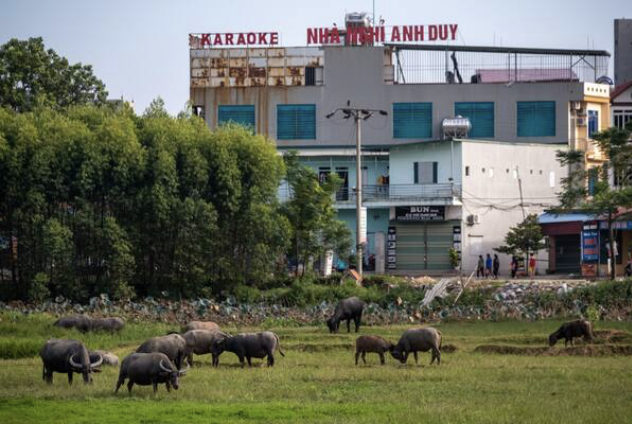
Buffaloes graze in front of a hotel and karaoke bar near the Van Trung Industrial Park in Bac Giang province, Vietnam, on Oct. 10, 2020. MUST CREDIT: Bloomberg photo by Linh Pham.

Buffaloes graze in front of a hotel and karaoke bar near the Van Trung Industrial Park in Bac Giang province, Vietnam, on Oct. 10, 2020. MUST CREDIT: Bloomberg photo by Linh Pham.

“Life is heaven now and it’s thanks to the factories,” said Nguyen Van Lanh, 64. His family, which once couldn’t afford to buy meat, runs boarding rooms for workers built with their factory salary savings. One relative with a loan business for plant employees drives a red Mercedes-Benz.

The boom in Bac Giang highlights how the shift in the world’s supply chains is touching regions previously left behind. Vietnam’s ability to attract more sophisticated manufacturing is accelerating with rising Chinese labor costs, the U.S.-China trade war and logistics vulnerabilities amid the epidemic, which the nation’s Communist leaders have so far successfully curtailed.

During the decades after the Vietnam War as the country opened its borders to foreign investors and trade, Bac Giang remained poor. Its 2010 per capita income was $650, about half that of the nation overall, according to government statistics. The region’s flood-prone plains produced low-yielding crops, so its residents looked for factory jobs some 1,700 kilometers from home in the south. Now the province is experiencing its first boom as per capita income is forecast at $3,000 this year.

Manufacturers are knocking on the doors of Vietnam’s northern provinces and committing billions of dollars to set up operations, including Samsung Electronics, where it is producing about half its smartphones. Apple assembly partner Pegatron plans to invest $1 billion in the northern port city of Haiphong, local media reported, following moves to Vietnam of other suppliers for the Cupertino, California company. Apple recently posted Vietnam job openings, including for a mechanical quality engineer, and managers for supply chain operations and government relations.

Vietnam’s success, though, is creating a swelling trade surplus with the U.S., its largest export market, reaching $34.8 billion by July. Driven in part by device shipments, the imbalance triggered tariff threats. U.S. Trade Representative Robert Lighthizer announced an investigation into Vietnam’s currency policy earlier this month.

For now, investments from electronics suppliers continue pouring in as other sectors struggle amid the pandemic. The country’s tourism revenue has been slashed by about 50% and garment and other factories are laying off tens of thousands of workers as exports in the trade-dependent economy stall. Economic growth is forecast to slow to 2%-3% in 2020 from last year’s 7.02%, though the government expects a recovery to 6%-7% between 2021 and 2025.

Vietnam’s low costs, political stability, investor-friendly policies, improving infrastructure and state-backed efforts to promote tech startups make the country appealing, said Gene Tyndall, a supply chain expert at Atlanta-based eMATE Consulting.

In the heart of Bac Giang, where cows still roam the streets, a six-lane thoroughfare now replaces a one-lane road. Almost two dozen industrial parks for factories are proposed as pile drivers and cranes dot the landscape. The local economy expanded by 10.9% in the first nine months of 2020 from a year earlier compared with 2.12% growth for the entire country during the same period.

“We are living the changing of the global supply chain,” said Nguyen Dai Luong, deputy chairman of the People’s Committee in Viet Yen district, where four of the province’s five operating industrial parks are located. The pace of manufacturers moving to Bac Giang has surged since 2016 as companies poured $3.8 billion into the province, a fourfold increase from the previous four years.

The government is building a river port for transporting parts and, at Apple’s request, provided land for workers’ housing near the 16-hectare complex of Luxshare Precision Industry, the world’s biggest manufacturer of AirPods, Luong said.

Bac Giang has nearly full employment, with residents of nearby provinces rushing in to chase the electronics gold rush at companies such as Luxshare. The Chinese company will hire 20,000 workers in the last four months of the year, bringing the total to 47,000 in his district, Luong said. The company employs 12,000 elsewhere in the province, he said.

Electronics assembly line workers can earn an after-tax salary of about $5,500 a year, including overtime and bonuses, more than the nation’s average annual salary of less than $3,000, Luong said.

Nguyen Thi Ha, 22, mixed concrete for a construction company before joining an assembly line making 10 million dong ($431) a month. “I used to earn about half of that working under the sun and sometimes in the rain,” said Ha, who declined to identify her Taiwanese employer.

Factory workers pack restaurants like Lao Chu Quan, downing pitchers of beer, plates of pork cooked on an outdoor rotisserie and fresh fish hot pot. “They spend freely,” said Nguyen Thi Ly, the 26-year-old manager whose family owns a Mazda automobile and five new motorbikes after having “almost nothing” before the factories came. “Our lives have changed, amazingly.”

The sudden growth comes with a cost: Electronics assembly lines are high-pressured. Hoang Phuong Duy, 30, participated in a brief September labor strike at Luxshare that was triggered by a change in overtime pay calculation, leading to tense standoffs between workers and supervisors who don’t speak Vietnamese.

Duy said the company quickly resolved the dispute to the workers’ satisfaction. “It’s very hard working on assembly lines,” he added. “We always have to be very fast with an intense concentration while working long hours.”

Vietnam’s challenge going forward is to ensure that education improves so the country can avoid the “middle-income trap” once factories leave as costs eventually rise and pivot to a high-skilled economy, said Scott Rozelle, a Stanford University development economist.

A high-quality education for future generations is the dream of Bac Giang residents such as boarding house owner Lanh, who as a child harvested rice from a “basket boat” on flooded fields where factories now rise up.

“We hardly had anything to eat and clothes to wear,” he said of his childhood. Gazing down at his 3-month-old granddaughter, he added: “She will have plenty of food to eat and the best clothes to wear. We will send her to a university so she can have more opportunities than we ever had.”

Push for pre-election stimulus checks fails as lawmakers head for the exits #SootinClaimon.Com

#SootinClaimon.Com : ขอบคุณแหล่งข้อมูล : หนังสือพิมพ์ The Nation.

Push for pre-election stimulus checks fails as lawmakers head for the exits

InternationalOct 28. 2020

By  The Washington Post · Erica Werner · NATIONAL, BUSINESS, CONGRESS 
WASHINGTON – President Donald Trump said Tuesday that the White House would approve a big stimulus package after the election and predicted that Republicans would retake control of the House of Representatives even though the GOP is widely expected to lose seats in the chamber next week.

“After the election, we’ll get the best stimulus package you’ve ever seen,” he said.

Trump’s comments came as the prospects of an economic relief deal appear to be withering after months of talks, a scenario that – combined with rising numbers of coronavirus cases – sent the stock market sharply lower Monday.

Congress left Washington until after the election without passing any new economic or health care relief measures even as the coronavirus pandemic surges and the economy sputters. Prospects for a stimulus deal remain in doubt and negotiations have largely been shelved after repeated failed attempts to broker a compromise.

Earlier Tuesday, Trump blamed House Speaker Nancy Pelosi, D-Calif., for the lack of an agreement, though his Twitter post had a grammatical mistake and it’s unclear what he meant.

“Pelosi only looking to Bail Out badly run Democrat Cities,” he wrote. “Tap, Tap, Taping us along. She has little interest in helping out the ‘people’.”

Talks faltered in part because the bipartisan urgency that the White House and Congress shared earlier this year evaporated over the summer as the November elections neared. Instead, the White House and Democratic leaders dug in during talks and never closed in on an agreement.

After days of bitterly partisan debate and a vote late Monday confirming Amy Coney Barrett to the Supreme Court, senators are headed back home to campaign for re-election. The House has been out of session for weeks, although Pelosi and Treasury Secretary Steven Mnuchin have continued to negotiate around a new $2 trillion relief bill.

Their talks showed scant evidence of progress, but neither Pelosi nor Mnuchin seems to want to be the one to say it’s over. Pelosi continues to insist she wants a deal before the election that would include another round of $1,200 stimulus checks, among other things. But at the same time, her rhetoric has shifted in recent days to emphasize the possibility of a bigger and better relief bill passing in future, with retroactive benefits — a scenario that would seem possible only under a Biden administration.

“The Democratic message to the American people is: ‘Help Is on the Way. It Will Be Safer, Bigger, Better and Retroactive,'” Pelosi wrote in a letter to House Democrats this week.

The inaction by Congress leaves the public without a lifeline, at a moment when covid cases and hospitalizations are on the rise in multiple midwestern states and elsewhere. An unprecedented $3 trillion stimulus Congress approved in the spring has largely run its course, with unemployment benefits, aid to small businesses, support for the airline industry, rental assistance and other programs expiring.

Despite fitful efforts at bipartisan talks, Congress has not acted since — ignoring pleas from economic leaders such as Federal Reserve Chairman Jerome Powell that more help was needed to boost the nascent recovery.

“As the covid pandemic surges again, the American people desperately need additional relief to deal with the economic fallout, but Speaker Pelosi’s intransigence and the Trump administration’s ineptitude have combined to deny it to them, at least until after the election,” said Michael Steel, a GOP strategist who was a top aide to former House Speaker John Boehner, R-Ohio.

There are multiple reasons for the collective failure. Trump’s approach was erratic, as he ping-ponged from calling off talks to demanding even more money than Pelosi. He never latched onto a consistent message, making it easier for congressional Republicans to ignore his haphazard directives as he lagged in polls. That added to Pelosi’s leverage at a moment when she’s expected to grow her majority in the November elections, eliminating any political imperative for her to make a deal.

In an interview on MSNBC late Monday, Pelosi pointed to White House chief of staff Mark Meadows’ comment over the weekend saying that “We are not going to control the pandemic.”

“This was big with Mark Meadows saying ‘We didn’t intend to control this.’ So, that gave us much more leverage, but the fact is we have to control the virus. We have to control the virus. But in addition to that, we cannot sell our souls,” Pelosi said. “I know, just say, ‘OK, well, let’s just do it, whatever way they want to do it. We’ll do it again.’ No. We’ve got to crush the virus.”

Senate Republicans under the leadership of Majority Leader Mitch McConnell, R-Ky., had little interest in the giant deal Pelosi and Mnuchin were negotiating, as they began to decouple their political fates from an unpopular president and eye future campaigns when a vote for enormous deficit spending could hurt more than it would help.

Throughout the debate on Barrett’s nomination, Democrats bashed McConnell and Republicans for jamming through a Supreme Court nomination instead of passing new covid relief. But the complaints fell on deaf ears as Republicans blamed Pelosi for the failure to act.

“Well, we’ve been working on coronavirus relief. Unfortunately, the speaker has not be able to agree to anything remotely reasonable,” McConnell said on Fox News Channel following the vote to confirm Barrett. “We can do two things at once. And we were trying to do two things at once. What we can do consistent with the Constitution, consistent with the fact there is a Republican president and a Republican Senate is confirm the vacancy to the Supreme Court.”

The next chance for action on Covid relief will come when Congress returns to Washington for a “lame duck” session following the election, though each sides negotiating position could change depending on the electoral results.

“We’ll come back in November,” said Senate Appropriations Chairman Richard Shelby, R-Ala. “The question might be, will there be something then?”

Chances for action in the lame duck are uncertain. Congress will be facing a Dec. 11 deadline when government funding will expire, requiring passage of new spending legislation to avoid a government shutdown. It’s possible new relief legislation could pass then.

If not, the country will likely have to wait until February for the next possible bill.

National Guard responds as protests over Walter Wallace killing engulf Philadelphia #SootinClaimon.Com

#SootinClaimon.Com : ขอบคุณแหล่งข้อมูล : หนังสือพิมพ์ The Nation.

National Guard responds as protests over Walter Wallace killing engulf Philadelphia

InternationalOct 28. 2020Demonstrators protest the fatal police shooting of Walter Wallace Jr. on Tuesday night in Philadelphia. Wallace Jr. was fatally shot by two Philadelphia police officers after refusing to drop a knife he was holding. MUST CREDIT: Washington Post photo by Joshua LottDemonstrators protest the fatal police shooting of Walter Wallace Jr. on Tuesday night in Philadelphia. Wallace Jr. was fatally shot by two Philadelphia police officers after refusing to drop a knife he was holding. MUST CREDIT: Washington Post photo by Joshua Lott 

By The Washington Post · Robert Klemko, Katie Shepherd, Maura Ewing · NATIONAL, POLITICS, COURTSLAW, RACE

PHILADELPHIA- On the second night of mass demonstrations over the fatal police shooting of a 27-year-old Black man, about 1,000 protesters marched through the streets of West Philadelphia on Tuesday demanding justice for Walter Wallace Jr.

Following a smaller protest that turned destructive on Monday, Pennsylvania Gov. Tom Wolf, a Democrat, authorized the National Guard to deploy troops Tuesday to help police protect property and quell unrest in the state’s largest city.

Monday’s demonstrations and looting left shops damaged and at least 30 officers injured, including one hospitalized with a broken leg after being struck by a truck. On Tuesday, police and protesters clashed again, but officers, aided by National Guardsmen, took a more aggressive tack, filling the streets with lines of riot cops who stopped marchers and made several arrests much earlier in the evening.

On Tuesday evening, a racially diverse crowd gathered at Malcolm X park in West Philadelphia, near the neighborhood where Wallace was shot and killed by police on Monday. The group wound through residential streets until their path collided with a line of police officers in riot gear. Protesters chanted directly to the police.

“Who killed Walter Wallace?” they asked. “No justice, no peace. No racist police.”

Wallace died Monday after two Philadelphia police officers shot him multiple times while responding to a call reporting a man with a knife. His family said he suffered from mental health issues, which his doctors had been treating with medication. A video of the fatal encounter raised questions about why officers approached an apparent mental health crisis with guns drawn and why they did not first attempt to subdue Wallace with a less lethal weapon, such as a Taser.

“We’re out here to decimate the system that’s meant to decimate us,” said Mikal Woods, a 24-year-old Black man who lives in the West Philadelphia neighborhood that has been rocked by the shooting and subsequent protests. “They shot that man to kill him. Fourteen times.”

“I’ve been afraid of the police every day of my life,” he added.

Some pockets of the city’s demonstrations remained calm as late evening turned to night. As protesters marched, a truck lit up with photos of Wallace rolled through a largely peaceful crowd in West Philadelphia. A neon message displayed on its rear doors read: “I don’t hate cops. I hate that cops don’t speak against the killing of Blacks by cops.”

Pascale Vallee, a 34-year-old graduate student studying Public Health, said that the killing of Wallace was “shameful.”

She said she saw his death as “the intersection of so many ‘-isms’: Racism, ableism.”

“He needed social supports,” she added, “not bullets.”

As the protests spread out from West Philadelphia into several other parts of the city and grew increasingly volatile late Tuesday, the Philadelphia Police Department issued a request for residents near the unrest to stay home and remain indoors.

“These areas are experiencing widespread demonstrations that have turned violent with looting,” the city’s Office of Emergency Management said in statement on Twitter Tuesday night.

According to a statement by the Philedelphia Police Department, people in the large crowd began to loot businesses near Castor and Aramingo Avenues in north Philadelphia just before 9 p.m.

Helmeted police armed with batons and cops with large riot shields clashed with protesters late Tuesday night. Officers tackled several people, hitting them with batons. It is unclear how many arrests had been made late Tuesday.

Tuesday night’s tension between protesters and police is nothing new, said Charles M, a local middle school math teacher who declined to give his last name.

“West Philly and the cops have had a problem for a long time,” he said.

The teacher, who is Black, stood to the side of the crowd, scanning it.

“My main reason for being out here is making sure people don’t mess it up,” he said.

He was on the lookout for “agitators,” who he said were generally white people dressed in all black with their faces covered. A cohort meeting this description did later wind through the crowd.

“They’re the ones that spray paint, they’re the ones that throw bricks,” he said. “When you talk with them, engage with them, they split.”

Carrie Lam to visit Beijing to discuss plans to revive economy #SootinClaimon.Com

#SootinClaimon.Com : ขอบคุณแหล่งข้อมูล : หนังสือพิมพ์ The Nation.

Carrie Lam to visit Beijing to discuss plans to revive economy

InternationalOct 28. 2020Hong Kong Chief Executive Carrie Lam Cheng Yuet-ngor meets the press at Central Government Offices on Oct 27, 2020. (PARKER ZHENG / CHINA DAILY)Hong Kong Chief Executive Carrie Lam Cheng Yuet-ngor meets the press at Central Government Offices on Oct 27, 2020. (PARKER ZHENG / CHINA DAILY) 

By Wang Zhan
China Daily/ANN

HONG KONG – Hong Kong’s Chief Executive Carrie Lam Cheng Yuet-ngor said on Tuesday she will travel to Beijing next week for a three-day visit to discuss plans to revive the global financial hub’s economy, which has been battered by the coronavirus crisis that came on the heels of anti-government protests.

Lam, speaking at a weekly news briefing ahead of an Executive Council meeting, said she would leave for Shenzhen next Tuesday before travelling to Beijing.

“My trip to Beijing this time is solely on the economic side that is in light of the economic situation, which of course is very serious in Hong Kong,” Lam said on Tuesday.

She will be accompanied by five principal officials – Secretary for Financial Services and the Treasury Christopher Hui Ching-yu, Secretary for Transport and Housing Frank Chan Fan, Secretary for Innovation and Technology Alfred Sit Wing-hang, Secretary for Food and Health Sophia Chan Siu-chee and Secretary for Constitutional and Mainland Affairs Erick Tsang Kwok-wai, as well as the Director of the Chief Executive’s Office Eric Chan Kwok-ki. 

Lam will call on Beijing for three days, and her stops at Guangzhou and Shenzhen on the return leg will focus on the development of the Guangdong-Hong Kong-Macao Greater Bay Area as well as cooperation plans between Hong Kong and Shenzhen. Lam’s trip to the mainland is estimated to last four to five days. The CE said the delegation will solely focus on economic issues during the visit. She added that the trip will not affect the scheduling of Policy Address, currently expected to be delivered by the end of November.

With inputs from Agencies

Nissan to increase output in China by 30% #SootinClaimon.Com

#SootinClaimon.Com : ขอบคุณแหล่งข้อมูล : หนังสือพิมพ์ The Nation.

Nissan to increase output in China by 30%

InternationalOct 28. 2020Nissan unveils its electric vehicle Ariya at the Beijing Motor Show in Beijing on Sept. 26. (Yomiuri Shimbun file photo)Nissan unveils its electric vehicle Ariya at the Beijing Motor Show in Beijing on Sept. 26. (Yomiuri Shimbun file photo) 

By The Japan News/ANN

Nissan Motor Co. will increase its production capacity in China by about 30% by the end of 2021, The Yomiuri Shimbun has learned. The capacity will be raised to 1.8 million cars per year from the current 1.4 million.

Nissan’s consolidated financial results for the fiscal year ending March 2020 showed a loss of about ¥670 billion in final profit. The company hopes to find a toehold to improve its business performance in China, where demand is quickly recovering among major countries hit by the coronavirus crisis.

The company confirmed at a board meeting held in mid-October that it will proceed with the plan. Nissan will open its own production lines in plants owned by its joint venture partner, Dongfeng Motor Group Co., in Wuhan, Hubei Province, and Changzhou, Jiangsu Province.

The number of Nissan’s passenger vehicle production sites in China will increase from four to six. When completed, Nissan will have a production capacity well over the 1.49 million units for Honda Motor Co. and the 1.27 million units for Toyota Motor Corp.

Nissan will also strengthen sales of new models. By 2022, seven models, including the new Ariya electric vehicle, will be successively launched in the China market. The company will also actively market models that use Nissan’s unique hybrid technology, the e-POWER system, which combines an electric motor with a gasoline engine that charges the vehicle’s battery.

China is the largest market for new vehicles. In 2019, 25.77 million new vehicles were sold there, which represented a 10% drop from 2017 but was still much higher than the second-largest market, the United States, where 17.48 million units were sold.

New vehicle sales have been making a notable recovery. Although they fell by 80% in February compared with the same month last year, they have recovered steadily since then. And since May, new vehicle sales have been exceeding the previous year’s level by more than 10%.

Automakers other than Nissan are also counting heavily on the China market.

This summer, Toyota began building two plants in Tianjin and Guangzhou, Guangdong Province, which it says will serve as production sites for EVs and plug-in hybrid vehicles (PHVs). Honda has added production lines at two plants in Wuhan and Guangzhou this year, increasing its production capacity by 240,000 cars.

Excessive focus on the Chinese market could be a risk because China is at odds with Japan’s main ally, the United States. Delicate balancing is required for Japanese automakers since they cannot ignore China or the U.S., which are the world’s largest and second-largest markets, respectively.

Metro Manila, 6 other areas to retain quarantine status until Nov. 30 #SootinClaimon.Com

#SootinClaimon.Com : ขอบคุณแหล่งข้อมูล : หนังสือพิมพ์ The Nation.

Metro Manila, 6 other areas to retain quarantine status until Nov. 30

InternationalOct 28. 2020QUARANTINE RESTRICTIONS President Duterte presents figures showing the COVID-19 situation in the country during a meeting with members of the Inter-Agency Task Force for the Management of Emerging Infectious Diseases at Matina Enclaves in Davao City on Monday. He approved the recommendation of the task force to keep Metro Manila and six other areas under general community quarantine. —MALACAÑANG PHOTOQUARANTINE RESTRICTIONS President Duterte presents figures showing the COVID-19 situation in the country during a meeting with members of the Inter-Agency Task Force for the Management of Emerging Infectious Diseases at Matina Enclaves in Davao City on Monday. He approved the recommendation of the task force to keep Metro Manila and six other areas under general community quarantine. —MALACAÑANG PHOTO 

By Jerome Aning
Philippine Daily Inquirer/ANN

MANILA, Philippines — President Rodrigo Duterte on Monday approved the recommendation of the government’s coronavirus task force to keep Metro Manila and six other areas under general community quarantine until Nov. 30.

The cities of Bacolod, Iloilo, Tacloban and Iligan, as well as the provinces of Batangas and Lanao del Sur will also be under the same restrictions up to the end of November.

In a televised address on Tuesday morning, Duterte said the retention of the restrictions was subject to appeal from the concerned local governments.

In his daily press briefing on Tuesday, presidential spokesperson Harry Roque said Oct. 29 was the deadline for the appeal.

Earlier, the Metro Manila Council said the mayors of the metropolis favored keeping the region under general community quarantine until year-end to contain COVID-19, although with eased restrictions on mobility, transport and business.

No tough restrictions

With the announcement of the extension, Malacañang said no region in the country was subject to stricter quarantine levels in November.

Meanwhile, Duterte said he favored government-to-government transaction, most likely with China, for the purchase of vaccines for COVID-19 to avoid corruption.

The President said Chinese pharmaceutical companies had already developed a vaccine for the severe respiratory disease and it would just be a matter of how to purchase and distribute it.

“But let me tell everybody that we will not beg for it. We will pay. So it would be good if the transaction is government to government. No corruption, because everything is government to government. I’m offering it to China because they already have it (vaccine),” he said.

He said Chinese Ambassador to the Philippines Huang Xilian also told him in a meeting that a vaccine was already available.

“He (Huang) said that the vaccine is there. It will be in a matter of … how to distribute it, and of course what kind of transaction would it be for them and for us,” he said.

In his briefing, Roque said he disagreed with the OCTA Research statement that easing restrictions on public transport would lead to a surge in coronavirus infections in Metro Manila in the next two weeks.

Health standards

Roque said respected doctors consulted by the Inter-Agency Task Force for the Management of Emerging Infectious Diseases, the temporary government body overseeing the administration’s coronavirus response, believed otherwise as infection could be avoided if commuters observed the minimum health standards.

“We disagree with the research group. I think Filipinos will [do] everything they have to do because it is important that they can go to their jobs again,” he said.

Food and Drug Administration (FDA) chief Rolando Enrique Domingo said at Roque’s briefing that foreign pharmaceutical companies that had completed clinical trials overseas for their vaccines would not need to conduct trials in the Philippines.

Domingo said the pharmaceutical companies just needed to register their vaccines with the FDA and submit documents showing they had complied with Philippine and Southeast Asian standards.

He said only FDA-licensed manufacturers or importers may distribute COVID-19 vaccines in the Philippines.

The FDA, Domingo said, would also meet with the World Health Organization to set standards for an acceptable COVID-19 vaccine.

New travel rules

In an online briefing on Tuesday, Police Lt. Gen. Guillermo Eleazar, chief of law enforcement for the government’s coronavirus response, said new travel rules would be issued soon as local governments had been given the option to continue requiring travel authority of people who were not allowed to go out and who were not stranded due to lockdowns.

Eleazar said these people must first determine if the local governments in their destinations and in the places they would pass through were enforcing travel restrictions.

If there are no restrictions, then the travelers do not have to get authorization to travel, he said.

Myanmar Elections: UN decries discrimination against the minorities #SootinClaimon.Com

#SootinClaimon.Com : ขอบคุณแหล่งข้อมูล : หนังสือพิมพ์ The Nation.

Myanmar Elections: UN decries discrimination against the minorities

InternationalOct 28. 2020

By The Daily Star/ANN

The UN has expressed serious concerns over the human rights violations, including the right to political participation of minority groups such as the Rohingyas and Rakhines, ahead of the general elections in Myanmar on November 8.

While the elections represent an important milestone in Myanmar’s democratic transition, the civic space is still marred by continuing restrictions on freedom of expression and access to information, it said in a statement yesterday.

“Myanmar’s discriminatory citizenship and electoral laws confer different sets of political rights to different classes of citizens, affecting most clearly the Muslim minorities who are largely excluded from citizenship,” Ravina Shamdasani, spokesperson for the UN High Commissioner for Human Rights, said in a briefing in Geneva.

Additionally, there has been significant disenfranchisement as the elections will not take place in 56 townships, including in Rakhine State. The Election Commission did not provide public justification for its decision, she said.

Also, an internet shutdown effectively remains in place in eight townships in Rakhine and Chin states, severely limiting the ability of residents to avail their right to receive and impart information, including on Covid-19 and the elections.

Blanket internet shutdowns may be counterproductive and contravene international law. Again, the measure disproportionately affects minority groups, including the ethnic Rakhine, Rohingya, Kaman, Mro, Daingnet, Khamis and Chin communities, Ravina Shamdasani said.

“While the restrictions on freedom of expression continue to mount, we deplore the unrelenting proliferation of hateful speech against Muslims on Facebook,” she said, calling on Myanmar to take action to denounce such hateful language publicly and to promote tolerance, non-discrimination and pluralism in speech by public officials and electoral candidates.

The UN said it is troubled by the intolerance of criticism against the government or the military.

Over the last two months, at least 34 student activists faced legal measures after they demanded an end to the conflicts in Rakhine and Chin states and reinstatement of 4G mobile internet services in those areas.

“We also call on the government to take measures to ensure that the right to political participation can be exercised by all, without discrimination of any kind,” Ravina said.

Seoul’s participation in ‘Quad’ may jeopardize regional security: S. Korean adviser #SootinClaimon.Com

#SootinClaimon.Com : ขอบคุณแหล่งข้อมูล : หนังสือพิมพ์ The Nation.

Seoul’s participation in ‘Quad’ may jeopardize regional security: S. Korean adviser

InternationalOct 28. 2020(Yonhap)(Yonhap) 

By The Korea Herald/ANN

WASHINGTON — South Korea’s participation in a NATO-like multilateral military alliance in the Indo-Pacific may destabilize, rather than promote security, in the region as China will treat Seoul as an enemy, a special adviser to South Korean President Moon Jae-in said Tuesday.

The adviser, Moon Chung-in, also insisted the US’ drive to form a regional coalition against China may prompt a counter-reaction from Beijing to form an alliance with Russia and North Korea.

“The United States is our number one ally while China is our strategic cooperative partner. Therefore, our priority goes to the United States, but in doing that we have some concerns,” the South Korean presidential adviser said in a webinar, co-hosted by the Atlantic Council in Washington and the East Asia Foundation in Seoul.

Washington is currently involved in a four-way dialogue, known as the Quad, that includes Australia, India and Japan, and is seeking to build upon the regional dialogue to form a multilateral structure that it says will counter aggression from the Chinese communist party in all domains.

The US is calling on its other regional partners, including South Korea, to join the forum, though Seoul says the US has yet to extend a formal invitation.

The South Korean adviser insisted such an invitation, if made, would create an “existential dilemma” for South Korea.

“If the United States forces us to join some kind of a military alliance against China, then I see that will pose a very existential dilemma to us,” Moon said at the virtual seminar.

“Suppose we joined a military exercise along the (inaudible) strait, as well as (in the) South China Sea, then China will treat us as an enemy,” he insisted.

The professor emeritus at Seoul’s Yonsei University also argued a coalition against China may encourage Beijing to resume its military assistance to North Korea under a tripartite alliance that would also involve Russia.

“China will be strengthening the northern tripartite alliance system involving China, Russia and North Korea. China has not provided North Korea with any military assistance and weapons and logistics support since 1958. But if that happens then, China will resume its assistance of military weapons, logistics support for North Korea, including oil,” said Moon.

“Then, the conventional threat from North Korea, in addition to nuclear set, will be further strengthened,” he added.

Instead, to promote peace and security on the Korean Peninsula, the special adviser said the countries must seek to declare a formal end to the Korean War as the start of North Korea’s denuclearization process.

“Dr. Park Jin argues that the end-of-war declaration should be an exit rather than entrance,” Moon said, referring to earlier remarks made at Tuesday’s webinar by Rep. Park from South Korea’s main opposition, the People Power Party.

“But I would argue in (a) different way. The end-of-war declaration should be an entrance that can facilitate the denuclearization of North Korea. as well as the overall peace process on the Korean Peninsula,” the adviser added.

His remarks highlight a recent controversy over Seoul’s intentions.

In a Sept. 22 speech at the UN General Assembly, President Moon called for international efforts to formally end the 1950-53 Korean War, saying the end-of-war declaration will open the door to North Korea’s “complete denuclearization.”

His call, however, prompted speculation that Seoul may be moving to make a concession to the communist North, despite Pyongyang’s refusal to denuclearize, let alone return to the negotiating table.

Seoul’s top national security adviser, Suh Hoon, earlier dismissed such concerns, saying the end-of-war declaration cannot be dealt with separately from North Korea’s denuclearization process, and that only remaining issue is when such a declaration should or could be made.

Moon also dismissed concerns that a declaration of the end of the Korean War may lead to a drawdown or change in the status of US Forces Korea.

“President Moon Jae-in made it very clear. The status of American forces in South Korea is a matter of alliance between Washington and Seoul. There is no room for North Korea to intervene in that issue,” said the adviser.

Should North Korea insist on changes to the status of USFK as a precondition to the end-of-war declaration, “then the end-of-war declaration may not be adopted,” he added. (Yonhap)

Uber and gig companies spend nearly $200 million to knock down an employment law they don’t like – and it might work #SootinClaimon.Com

#SootinClaimon.Com : ขอบคุณแหล่งข้อมูล : หนังสือพิมพ์ The Nation.

Uber and gig companies spend nearly $200 million to knock down an employment law they don’t like – and it might work

InternationalOct 27. 2020

By The Washington Post
Faiz Siddiqui

SAN FRANCISCO – As November’s general election enters its home stretch, Uber, DoorDash and other gig economy companies are bombarding TV airwaves, social media and even their own apps with ads and marketing materials promoting a ballot initiative that they say would improve drivers’ financial situation and working conditions but that would also deny them the right to be classified as employees in California.

The ballot measure, known as Proposition 22, would establish drivers as an independent class of workers with access to limited job benefits, along with wage and worker protections they’ve so far lacked under the gig economy model. Labor groups and many of driver advocates say the companies’ efforts, however, do not go far enough to protect workers and are merely an attempt, cloaked in friendly marketing materials, to quash a new law that would guarantee drivers access to the minimum wage, employer-provided health care and bargaining rights.

Drawing on a nearly $200 million campaign war chest that Uber, Lyft, food delivery app DoorDash and other tech companies have raised, they are seeking to convince California voters that the ballot initiative reflects the will of drivers. They’ve cited limited survey data saying the vast majority of drivers want to remain contractors.

But critics see the measure as a last-ditch effort to strong-arm a tough law.

The gig companies are following a long history in California of powerful groups “manipulating the way the public understands propositions,” said Veena Dubal, an associate professor at the University of California Hastings College of the Law, who focuses on the gig economy and is an advocate for classifying drivers as employees in California. “They are working to trick the public … into voting in favor of this. And they’re getting traction.”

The heated battle could well result in major implications for gig workers not just in California, but across the country.

Here’s what you need to know.

– – –

– What is the current status of drivers?

In most of the country, drivers are independent contractors who are able to work for Uber, Lyft, DoorDash, Instacart and others on demand. That comes with pros such as flexibility. But it also means there are no guaranteed hours or health care.

The companies have thrived on their ability to rapidly scale up their services by contracting as many workers as possible for maximum convenience, connecting an Uber passenger with a driver around the corner, for example. But they also avoid major expenses associated with an established employee base.

In California, lawmakers and a major court ruling have now classified drivers as employees. (The ruling has been appealed and a stay has been granted in the meantime, allowing Uber and Lyft to keep operating as usual. The appeals court sided with the state on Thursday, forcing Uber and Lyft to classify drivers as employees, but the order does not take immediate effect.)

The gig companies have argued that the new state law known as AB5 mandating them to convert drivers to employees would harm their business models and limit access to their services. And in Uber’s case, it has argued the law should not apply at all because as a technology firm it merely connects those in search of work with opportunities.

Their combined effort to oppose driver employment is the most expensive such proposition in history, the Los Angeles Times has said.

– What is Prop 22?

California Proposition 22, the App-Based Drivers as Contractors and Labor Policies Initiative, is a measure that would classify drivers as independent contractors under California state law.

It would provide workers limited benefits typically associated with employment but without the minimum wage, sick pay and job protections afforded to employees. For example, Prop 22 would guarantee drivers 120 percent of the minimum wage for “engaged time,” meaning time giving rides or en route, rather than time logged into a specific app. Drivers are also promised a payment of 30 cents per mile while on a trip or en route for expenses.

It also carries heavy protections against further action targeted at gig companies, requiring a seven-eighths supermajority of the legislature to amend it, according to the proposition’s text.

“It’s a very extreme proposition in that regard,” said Stanford University law professor emeritus William Gould, a labor lawyer whose research focuses on the gig economy. “And I think it would be virtually impossible to ever reverse it other than through another ballot.”

– Why was AB5 enacted?

Assembly Bill 5, the law that prompted Prop 22, aimed to correct years of instability and wage fluctuation and establish worker protections in the gig economy. Companies such as Uber and Lyft were once seen as promising start-ups offering flexibility and opportunity to the labor market. But as the gig economy ballooned to millions of workers and the companies came under increasing pressure to cut their losses, they demanded more and more out of workers for less money.

Stories emerged of workers juggling impossible schedules, barely scraping by. Those created pressure to provide workers with a living wage and benefits, such as health care, vacation, sick leave and unemployment. More recently, the pandemic has only exacerbated that pressure.

The law passed in 2019 and went into effect this year. The companies challenged the law in court before turning to voters.

But a San Francisco judge ruled in August that Uber and Lyft had to make their drivers full employees under the law, a ruling that was stayed while the companies appealed. On Thursday, the state appeals court sided with the lower court judge in ordering Uber and Lyft to stop classifying drivers as independent contractors. Uber and Lyft were given 30 days from an expected later filing, which typically takes about two months, to begin classifying drivers as employees. The companies are expected to explore further appeal options, including taking their case to the state supreme court, but the Prop 22 vote is likely to force the issue before that.

– What about health care?

Under an employment scenario, large companies such as Uber and DoorDash probably would have to provide health insurance to drivers working full time. That’s anyone working an average of at least 30 hours per week for more than 120 days a year, according to the Affordable Care Act.

Under Prop 22, drivers would receive a health care “contribution equal to 100 percent of the average employer payment” under the Affordable Care Act if they work 25 hours per week. Drivers who worked 15 hours would receive the equivalent of a 50% contribution. Hours would also again be measured by “engaged time.”

There’s a plus for some drivers, labor experts note.

“If you work between 15 to 25 hours under Prop 22 you are getting something that you wouldn’t have gotten if you were an employee under the employer mandate,” said Joanna Kim-Brunetti, vice president of regulatory affairs at the regulatory data firm Trusaic, who focuses on employer health-care compliance.

However, it’s difficult to tell how many real hours of driving would need to occur to collect 15 hours of “engaged time.”

“They have not really spelled that out,” she said.

– Why are Californians getting spammed with “Yes on 22” messages?

Uber, Lyft, DoorDash, Postmates and Instacart are spamming email inboxes with pro-Prop 22 messaging and, in some cases, using the apps to promote it directly. The messaging warns of the potential consequences such as higher fares, longer wait times and even service suspension in less-trafficked areas if the measure does not pass.

“Your ride prices and wait times are likely to substantially increase while most drivers will lose their incomes,” Uber said in one such notice.

Blasting people with text messages or in-app messages count as a “non-monetary contribution,” a required disclosure. Uber filed one Sept. 10 with the California secretary of state, for a contribution that was estimated to value nearly $850,000.

In short, the apps have become ground zero for a high-dollar political campaign and a way for companies to reach millions of eyes like never before. A group of gig workers sued Uber last week alleging the onslaught of pro-Prop 22 messages in the app violates their employment rights. The workers are seeking up to $260 million in penalties for what they regard as a campaign of illegal political coercion urging them to support the company’s position on the ballot measure. The plaintiffs include workers who are active in labor organizing and the campaign against Prop 22. Uber called the lawsuit “absurd” and “without merit,” questioning its motives in a statement issued through a spokesman last week.

– Who opposes it?

Labor advocates, unions supporting gig workers and many drivers themselves have come out against Proposition 22, which they say is an effort to maintain the status quo.

Legislators including state Assemblywoman Lorena Gonzalez, D-San Diego, who introduced the bill, oppose it. And it has garnered statewide and national attention. Vice-presidential candidate Sen. Kamala Harris, D-Calif., wrote on Twitter, “I urge Californians to join me in standing with these essential workers by voting NO on Prop 22.”

Joe Biden, the Democratic nominee for president, wrote a similar message in May: “I urge Californians to vote no on the initiative this November.” And Sens. Bernie Sanders, I-Vt., and Elizabeth Warren, D-Mass., are backing full employment.

On Monday, leaders of the campaign to oppose the proposition held a news conference taking aim at their opponents’ messaging, which has leaned on the notion that support of the measure would advance racial equity. The Yes on 22 campaign had garnered the support of several state and local conferences of the NAACP, including the state conference, along with Latino and Asian American advocacy groups.

Rep. Barbara Lee, D-Calif., took issue with the campaign’s framing, noting how 78 percent of app-based workers were people of color, according to a study looking at San Francisco’s gig economy. Lee argued the gig economy had failed them.

“You have very clearly crossed the line when you’re trying to claim the equity mantle for [multibillion dollar] corporations,” she said. “Prop 22 will make racial equity worse in California at the worst possible time.”

Gonzalez, the state assemblywoman, said the companies had whitewashed their platform, which omits a living wage, health care and the right to organize.

“This is just audacious what these companies are doing,” she said, later calling their efforts “outrageous.”

Meanwhile, Sanders voiced his objection to a piece of pro-22 campaign mail being distributed that implied an affiliation by featuring a campaign’s slogan of his, “Feel the Bern,” and promoting itself as a voter guide.

“This mailer in CA is a lie and I call on Uber and Lyft to publicly denounce the deception,” a message posted to Sanders’ Twitter account read. “I’m opposed to Prop 22 because people working full time deserve decent wages and good benefits.”

Still, those opposed to the measure face an uphill spending battle. By Monday, the effort to oppose Proposition 22 had raised $19.6 million, less than a tenth the figure of the campaign pushing the initiative. Its fundraising has accelerated, however.

Earlier this month the “Yes” campaign stood at more than $186 million compared to Monday’s more than $199 million, while the “No” effort had netted less than $15 million compared to Monday’s nearly $20 million.

The “Yes” campaign had a more $90 million head start dating back to last fall, when Uber, Lyft and Doordash pledged to take their fight against AB5 to the polls.

– Where do drivers stand?

There is no clear, scientific polling outlining drivers’ stance. The gig companies and the Yes on 22 campaign have repeatedly cited surveys that they say show the vast majority of drivers want to remain independent contractors.

Uber in particular cites two surveys, one unscientific and another it paid for, to support its argument that drivers favor being independent contractors.

“If Prop 22 doesn’t pass, there’s a really high likelihood that all of that flexibility will be gone, the ability to work across platforms will be lost and hundreds of thousands of jobs will be lost,” said Geoff Vetter, a spokesman for the Yes on 22 campaign.

The issue has illuminated a gulf within the gig economy between those who use the apps merely to cover expenses and generate discretionary income, and those who work for them as a full-time job. Uber says 91 percent of its drivers across the country work fewer than 40 hours per week.

Uber CEO Dara Khosrowshahi said in a blog post this week that if the company were forced to make all drivers across the country employees, for example, it could only support 260,000 full-time roles. That compares to 1.2 million active drivers the company was hosting on its app before the coronavirus pandemic.

– Will this have national implications?

California, home of Silicon Valley and the world’s fifth-largest economy overall, has a history of driving national policy when it comes to instituting regulations and reining in large corporations. Experts say if California’s effort to make drivers employees is successful, it won’t be long before other states and jurisdictions follow suit. And the gig companies probably would take similarly aggressive measures against them, seeking to codify drivers’ contract status.

Meanwhile, other areas have taken similar steps already – albeit less-sweeping ones. Seattle recently became the second U.S. city, following New York in 2018, to institute a minimum wage for ride-hailing drivers.

– – –

The Washington Post’s Scott Clement contributed reporting.

Airstrikes kill or injure dozens in camp for Turkish-backed rebels in Syria #SootinClaimon.Com

#SootinClaimon.Com : ขอบคุณแหล่งข้อมูล : หนังสือพิมพ์ The Nation.

Airstrikes kill or injure dozens in camp for Turkish-backed rebels in Syria

InternationalOct 27. 2020A funeral is held in Idlib, Syria, for 10 fighters with the Sham Legion, a Turkish-backed rebel group, who were killed in what the rebels said was a Russian airstrike Monday. (AP Photo)A funeral is held in Idlib, Syria, for 10 fighters with the Sham Legion, a Turkish-backed rebel group, who were killed in what the rebels said was a Russian airstrike Monday. (AP Photo) 

By The Washington Post
Sarah Dadouch, Kareem Fahim

BEIRUT – Airstrikes on a training camp for Turkish-backed rebels in northwestern Syria killed or injured dozens of fighters Monday, according to a rebel spokesman, who estimated that more than 170 people died or were wounded.

The strikes killed 35 fighters from the Sham Legion, a rebel group that falls under the Turkish-backed National Front for Liberation, an umbrella organization for rebels in northwestern Syria, a member of the group said. Another 77 were wounded.

The attack was one of the most serious breaches of a cease-fire struck between Turkey and Russia in March, said Maj. Yousef Hamoud, a spokesman for the rebel Turkish-backed National Army, which is part of the National Front for Liberation. Hamoud said the attack was carried out by a Russian aircraft that took off from Russia’s large Hmeimim air base in Latakia province in northwestern Syria. The Russian state-owned Sputnik news agency, however, said the raid was conducted by Syrian warplanes.

The airstrike came amid an escalating air campaign in northwestern Syria over the past week by both Syrian and Russian warplanes. On Friday, online videos circulated showing the bombardment of fuel tankers in the Syrian town of Jarabulus, killing seven civilians, according to the Syrian Observatory for Human Rights, a Britain-based war monitoring group. A few days earlier, a Turkish army withdrawal from Morek, a military post in northwestern Syria, was immediately followed by Russian airstrikes, Reuters and local Syria opposition media reported.

A rivalry between Russia and Turkey has heated up as Turkish President Recep Tayyip Erdogan expands his military reach abroad, including into areas where Moscow is also pursuing its own interests. Over the past few years, the primary area of Turkish-Russian competition has been Idlib, Syria’s impoverished and rebel-held northwestern province. Last year, Russia backed a Syrian government attempt to recapture the province, and Turkey countered by supporting rebel groups and deploying in its own military to prevent the Russian-Syrian advance.

Moscow and Ankara have backed opposing sides in Libya’s civil war, notably by sending Russian and Syrian mercenaries as proxy forces. The fighting between Azerbaijan and Armenia over the disputed Nagorno-Karabakh region has also caused friction between Russia, which has a security pact with Armenia, and Turkey, a strong military backer of Azerbaijan.

Russian officials have criticized Turkey for sending of Syrian mercenaries to fight on behalf of Azerbaijan, saying this could allow hard-line Islamist fighters to enter Russia. Turkey has repeatedly denied dispatching mercenaries.

– – –

Fahim reported from Istanbul.