Samsung DeX solution to offer Chicago police digital access

ศาสตร์เกษตรดินปุ๋ย : ขอบคุณแหล่งข้อมูล : หนังสือพิมพ์ The Nation

https://www.nationthailand.com/edandtech/30375288

Samsung DeX solution to offer Chicago police digital access

Aug 23. 2019
Chicago Police Department officers demonstrate Samsung’s DeX In-Vehicle Solution at a press conference in Chicago on Wednesday (Samsung Newsroom).

Chicago Police Department officers demonstrate Samsung’s DeX In-Vehicle Solution at a press conference in Chicago on Wednesday (Samsung Newsroom).
By The Korea Herald

220 Viewed

South Korean tech giant Samsung Electronics’ in-vehicle computing system DeX will be piloted by the Chicago Police Department in the United States, the company said Friday.

Dubbed as “DeX In-Vehicle,” the solution will provide police officers the ability to dock their Galaxy smartphones and access policing applications on a dash-mounted display and keyboard.

The officers in the pilot — taking place across the city’s 11th District this year — will be able to access computer-aided dispatch and other Chicago Police Department systems to conduct background checks and complete reports, according to Samsung.

Photo and video evidence captured on the smartphone will also be immediately accessible to attach to reports.

To announce the piloting, the Chicago Police Department held a press conference on Wednesday, local time.

“Nearly half of all Chicago Police officers have a department-issued Samsung smartphone already,” said CDP Superintendent Eddie Johnson. “The idea is to give officers everything they need to process a scene or respond to an incident in the palm of their hand.”

First introduced in 2017, Samsung DeX enables users to connect their smartphone to a display via an HDMI cable and access a PC-like experience, complete with paired monitor and mouse.

Users can multitask by accessing multiple apps with resizable windows and typical desktop features like drag-and-drop and keyboard shortcuts.

Beyond the vehicle, DeX can also be leveraged to replace computing terminals in the police station.

Returning to the report center, officers can connect their smartphone to a monitor, keyboard and mouse to complete paperwork.

“The solution will provide a seamless digital transition for police officers from the street, to the vehicle and to the station,” a Samsung official said.

Google Photos can identify text in images

ศาสตร์เกษตรดินปุ๋ย : ขอบคุณแหล่งข้อมูล : หนังสือพิมพ์ The Nation

https://www.nationthailand.com/edandtech/30375287

Google Photos can identify text in images

Aug 23. 2019
Google Lens' OCR – previously already able to identify objects in photos – now allows users to search their photos based on text embedded in the image or even convert that text into editable digital text. — Google.

Google Lens’ OCR – previously already able to identify objects in photos – now allows users to search their photos based on text embedded in the image or even convert that text into editable digital text. — Google.
By The Star

228 Viewed

Google Lens now lets users copy words found in photos and transform them into editable text, and also search images by text, using its optical character recognition (OCR).

Google Lens’ OCR – previously already able to identify objects in photos – now allows users to search their photos based on text embedded in the image or even convert that text into editable digital text. — Google

With the feature, users no longer have to memorise tricky cafe WiFi passwords and can simply deploy OCR to make short work of copying and pasting the password into their phones, for example.

The feature is useable within the Google Photos backup service, which now also lets users search their collections for a specific photo based on text found in the image, such as those found in signboards, posters or business cards.

Previously, Google Photos was already able to identify objects like people, pets or food and leverage the embedded GPS data to make location queries.

Former Google staff Hunter Walk noticed the otherwise unannounced feature and tweeted a step-by-step on how to use it.

Google Photo’s official Twitter account confirmed the find, tweeting that the feature was introduced early August and is meant to help users search for photos based on text embedded in the image.

9to5Googlereports that Google Photos is able to search even when the words are relatively small in the image or when the photo is taken at an angle. The feature performs better with screenshots.

The feature is already live and works on Android, iOS and its web client versions.

Pakistan on short list of 5G-ready countries with Zong’s successful trial’

ศาสตร์เกษตรดินปุ๋ย : ขอบคุณแหล่งข้อมูล : หนังสือพิมพ์ The Nation

https://www.nationthailand.com/edandtech/30375286

Pakistan on short list of 5G-ready countries with Zong’s successful trial’

Aug 23. 2019
PTA Chairman Amir Azeem Bajwa, IT Secretary Shoaib Ahmad Siddiqui, Zong Chairman and CEO Wang Hua, Chinese Embassy Economic & Commercial Counsellor Wang Zhihua & WiTribe Chairman Supervisory Board Shahid Malik pictured at the event held in Islamabad on Thursday to conduct the 5G trial. — CMPak

PTA Chairman Amir Azeem Bajwa, IT Secretary Shoaib Ahmad Siddiqui, Zong Chairman and CEO Wang Hua, Chinese Embassy Economic & Commercial Counsellor Wang Zhihua & WiTribe Chairman Supervisory Board Shahid Malik pictured at the event held in Islamabad on Thursday to conduct the 5G trial. — CMPak
By Dawn

245 Viewed

China Mobile Pakistan (CMPak, popularly known as Zong) on Thursday successfully conducted 5G trials in Pakistan, a press release issued by the company said.

By doing so, Zong has become “the first and only operator to officially test 5G services in the country”, the statement added.

An official from Zong while speaking to DawnNewsTVexplained that while 4G speeds cover a bandwidth of 50-100mb/s, 5G will deliver at least 1GB/s. He said that in today’s trials, a speed of 1.14 GB/s was achieved.

“This success marks an important milestone in Pakistan’s telecom sector,” said Zong CEO Wang Hua at an event in Islamabad held to conduct the test.

“5G will herald a new era in Pakistan’s social and economic sectors,” he added.

According to the company’s handout, “Zong believes that 5G will bring more profound and long-term changes to Pakistan’s economic transformation, social progress, and people’s livelihood improvement in future. It is expected that 5G will have an impact on health care, agriculture and education.”

The Zong CEO also announced that the company will establish a 5G innovation centre in Pakistan in collaboration with Huawei, for which a Memorandum of Understanding (MoU) was also signed at the event.

He reminded the audience that five years ago, it was CMPak that had first brought 4G technology to Pakistan. Hua said that the introduction of 5G services is an important pillar to meet future technological needs.

PTA chairman retired Maj Gen Amir Azeem Bajwa also spoke on the occasion. “The country will soon be able to enjoy 5G services which will be introduced for commercial purposes,” he said.

He said that the Authority was making efforts in this regard and recognises that the introduction of 5G services would bring in a technological revolution.

Telecommunication Division Secretary Shoaib Siddiqui lauded the efforts by PTA and congratulated CMPak on becoming the first to have the achievement under their belt.

“I would like to take this moment in congratulating Zong for becoming the first Pakistani telecommunications operator to have successfully conducted the 5G trial and putting Pakistan on a short-list of countries which are 5G ready,” he said.

“Zong is an important part of the ties that bind the two countries together,” added Siddiqui.

The IT secretary said that the government aims to bring in other major developments via the Information Technology sector as well. “It is the right of every Pakistani to be able to compete in terms of technology with the developed countries of the world,” he added.

LG Chem prioritizes sustainability in battery material suppliers

ศาสตร์เกษตรดินปุ๋ย : ขอบคุณแหล่งข้อมูล : หนังสือพิมพ์ The Nation

https://www.nationthailand.com/edandtech/30375224

LG Chem prioritizes sustainability in battery material suppliers

Aug 23. 2019
By The Korea Herald

96 Viewed

South Korea’s leading battery maker LG Chem has introduced sustainability as an evaluation factor for battery material suppliers to incorporate the rising importance of supply chain management and ethical purchases, the company said Thursday.

The company recently conducted the first assessment of its material suppliers, in which it evaluated the suppliers’ sustainability by examining working conditions, human rights of employees, safety of the work environment, management of material supplies and renewable energy use.

Sustainability accounts for 20 percent of the total evaluation score, which is equivalent to the proportion for product quality and development capabilities.

“As the importance of sustainable management of material supply chains, including ethics in purchasing battery materials, is on the rise globally, the company will value sustainability of suppliers as much as their product quality,” a company official said.

LG Chem had previously offered additional scores to suppliers with constant activities related to sustainable management.

The Korean battery firm will now demand improvements from suppliers that do not meet the sustainable management evaluation factor, it said.

In a bid to help underrated suppliers, LG Chem will provide educational programs and activities.

The move is in line with the growing global trend of prioritizing ethicality and sustainability.

Germany-based automaker Volkswagen has said it will introduce a sustainability rating system for assessing its contractors starting July. Under the assessment system, Volkswagen suppliers are rated through the whole process of manufacturing parts, ranging from purchasing raw materials in the initial stage to the final stage of finishing up their products.

Meanwhile, LG Chem has adopted a blockchain-based system in a consortium with IBM, Ford and Huayou Cobalt this year for a transparent evaluation and management system.

In 2016, the company enacted 10 assessment items in the fields of human rights, labor rights, ethical management and safe environment. It also banned use of unethically purchased raw materials in 2017.

“Sustainable innovation is the foremost aspect of the battery business throughout the entire process of securing raw materials to disposing the products,” said Shin Hak-cheol, vice chairman of LG Chem. “LG Chem’s solution will contribute to creating a circular economy.”

Four common myths about hybrid cloud

ศาสตร์เกษตรดินปุ๋ย : ขอบคุณแหล่งข้อมูล : หนังสือพิมพ์ The Nation

https://www.nationthailand.com/edandtech/30375195

Four common myths about hybrid cloud

Aug 22. 2019
Brendan Paget, director of portfolio management in the APAC Office of Technology, Red Hat

Brendan Paget, director of portfolio management in the APAC Office of Technology, Red Hat
By BRENDAN PAGET
SPECIAL TO THE NATION

298 Viewed

Hybrid cloud is set to become the norm for enterprises.

According to the Red Hat Global Customer Tech Outlook 2019, 30 per cent of the organisations surveyed have a hybrid cloud strategy, and 45 per cent of them are already using two or more cloud platforms.

Offering the flexibility and speed needed to address changing business demands effectively, hybrid cloud can help enterprises gain business agility and better compete in the increasingly volatile business environment.

Hybrid cloud provides a mixture of public and private (on-premises or managed/hosted) cloud environments that are connected and managed by a single management strategy.

With hybrid cloud, enterprises can choose the type of cloud that best suits each workload, as well as move workloads across IT environments as necessary. For instance, a retailer can host its e-commerce website on a public cloud but process payments made on the site in a private cloud to better protect customer data and comply with regulations.

Even though hybrid cloud can help organisations to become more agile, some are still hesitant to adopt it. Here are four common myths that hinder hybrid cloud adoption:

Myth 1: Hybrid cloud may cause organisations to lose visibility and control over their IT infrastructure

Since hybrid cloud is made up of more than one IT environment, it may be difficult for enterprises to have complete visibility of their entire IT infrastructure. The lack of visibility can make it challenging for organisations to monitor and control their environment for security and compliance, especially if this is conducted manually.

Organisations can counter this by ensuring that the foundation of their hybrid cloud provides predictive IT analytics capabilities. By using tools that provide ongoing in-depth analysis of the IT infrastructure, they can proactively identify vulnerabilities that could threaten the security, performance and stability of their hybrid cloud so as to stay ahead of them.

Myth 2: Adopting hybrid cloud may lead to a security headache

Traditionally, IT security focuses on fortifying, maintaining and policing the data centre perimeter. However, perimeter security is less effective in securing hybrid cloud. The highly connected multiple cloud environments open more doors to attackers and can bypass traditional perimeter defences. It can also be tedious to manually patch or configure systems from the mixed environments of hybrid cloud.

Another challenge here is that the need for security policies and plans does not end when an application is retired. Coupling this with the increased role that large numbers of short-lived “immutable” application instances play in a hybrid cloud environment, manually monitoring for configuration drift and correcting it as needed is no longer an option.

However, these challenges can be mitigated with the right tools in place, including automation tools to protect IT infrastructure. With automated patching and remediation, critical security risks can be resolved in a controlled manner and without delays.

Myth 3: Organisations that embrace hybrid cloud will be more vulnerable to supply chain risks

Just as in the saying “a chain is only as strong as its weakest link”, an organisation is only as secure as its weakest link. Since the hybrid cloud environment may include cloud platforms from multiple vendors, it can be challenging to ensure that all those solutions were built with security in mind and that the respective vendors will continue to update and patch them.

To address this concern, organisations should ensure that their hybrid cloud comes with a console that allows them to understand the IT risks they are facing, at a glance. It should list the critical issues prioritised by an overall risk assessment rating, and display the probability and potential impact of each issue to help companies focus on the issues that most impact risk reduction. It should also offer tailored resolution steps to help IT teams quickly and confidently address risks to avoid downtime.

Myth 4: Hybrid cloud will make it challenging to comply with regulations

Although most companies today are using cloud technology to a certain degree, those in highly regulated industries are still required to ensure that their distributed environments meet custom or regulatory security baselines for compliance and auditing requirements. Making changes to configurations manually can be a time-consuming, complex and error-prone process.

Those changes may also go undetected, which may prevent the organisation from passing a security audit.

As such, companies should look to enhance their hybrid cloud with tools that can provide centralised visibility across the entire heterogeneous infrastructure. Tools that automatically scan the IT environment for non-compliant configurations and remediate them can help too.

Adopting hybrid cloud may seem like a daunting task as it can introduce additional risks and complexities. However, organisations can overcome those challenges by moving away from being reactive to issues to taking a more proactive and intelligent approach to infrastructure management.

One way of achieving this is by ensuring that the foundation of their hybrid cloud provides them with knowledge about their infrastructure to accurately predict potential issues and pinpoint existing technical risks.

It should also offer tailored remediation steps along with automated resolution so that critical and configuration problems can be resolved quickly and before business operations are affected. With these capabilities, organisations can spend less time keeping the lights on, and instead sustain business success with hybrid cloud by developing and delivering innovation on a flexible and secure platform to meet business goals.

Brendan Paget is director of portfolio management in the APAC Office of Technology, Red Hat

Line launches brokerage service on smartphone app

ศาสตร์เกษตรดินปุ๋ย : ขอบคุณแหล่งข้อมูล : หนังสือพิมพ์ The Nation

https://www.nationthailand.com/edandtech/30375194

Line launches brokerage service on smartphone app

Aug 22. 2019
By The Yomiuri Shimbun

275 Viewed

Line Securities Corp. said it has launched a brokerage service on the Line free messaging app for smartphones.

The joint venture between Nomura Holdings Inc. and Line Financial Corp., a unit of Line Corp., lets users trade shares of 100 major companies and nine types of exchange traded funds, starting from buying one share worth only several hundred yen, for example, according to the company’s announcement on Tuesday.

Line Securities aims to win over beginner investors, such as young workers, by making the service available until 9 p.m. on weekdays.

Payments in the service can be made through the Line Pay online payment service, in addition to via bank accounts.

The service is currently available only on smartphones running on Google LLC’s Android operating system.

“We want even beginners to accumulate experience and knowledge in investing,” Line Securities Co-Chief Executive Officer Yoshikazu Yonenaga said at a press conference.

Line Financial has a 51 percent stake in Line Securities, while Nomura owns 49 percent.

PTTOR aims for a bright digital future with latest camp

ศาสตร์เกษตรดินปุ๋ย : ขอบคุณแหล่งข้อมูล : หนังสือพิมพ์ The Nation

https://www.nationthailand.com/edandtech/30375146

PTTOR aims for a bright digital future with latest camp

Aug 21. 2019
By The Nation

308 Viewed

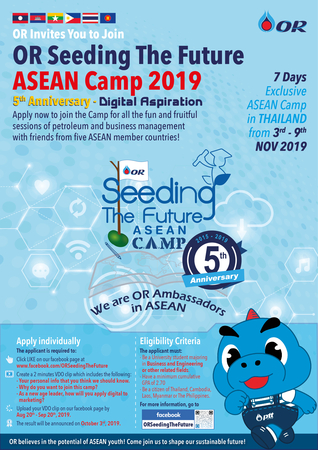
PTT Oil and Retail Business Co Ltd (PTTOR) is accepting entries for the “OR Seeding the Future Asean Camp”.

This junior camp, held for five consecutive years, aims to provide young people in the Asean region an opportunity to learn about different cultures and build a sustainable youth network. In a press statement, PTTOR stated that it believes in the potential of young people as they are the seeds for a sustainable and powerful future for their nations.

“The OR Seeding the Future Asean Camp is open to undergraduate students majoring in engineering, business and other related fields,” the press release said.

This year’s theme is “Digital Aspiration”, which will help applicants gain new experiences and network with their Asean friends. The participants will also get a chance to visit different OR businesses in Thailand for seven days and six nights from November 3 to 9 free of charge.

To qualify, interested students are required to:

Click “like” on the ORSeedingTheFuture Facebook fanpage;

Create a 2-minute-long introducing themselves, stating the reason for joining the camp and answer the question: “As a new-age leader, how will you apply digital technology to marketing?” Completed video clips can be posted on the page;

The deadline for posting videos is September 20;

Results will be announced on October 3.

Fujifilm to launch advance focus broadcast lens in spring 2020

ศาสตร์เกษตรดินปุ๋ย : ขอบคุณแหล่งข้อมูล : หนังสือพิมพ์ The Nation

https://www.nationthailand.com/edandtech/30375097

Fujifilm to launch advance focus broadcast lens in spring 2020

Aug 21. 2019
By The Nation

77 Viewed

Fujifilm has announced the development of the 4K-compatible broadcast lens FUJINON UA107×8.4BESM AF (UA107×8.4 AF). The box-type broadcast lens UA107×8.4 AF is the world’s first 4K-compatible broadcast lens to feature the AF function.

The UA107×8.4 AF 4K-compatible broadcast lens features a phase-detection AF sensor and its dedicated algorithm developed with technological expertise fostered with Fujifilm’s X Series and GFX series of digital cameras. It will offer the Advanced Focus AF function, achieving fast and accurate auto-focus with the response speed of 0.5 seconds and outstanding capability in tracking a moving subject, according to a release on Wednesday.

The lens offers a 107× ultra-high magnification zoom, covering a broad range of focal lengths from 8.4mm in wide-angle to 900mm in ultra-telephoto, giving it the ability to capture a subject at a long distance.

The lens uses the Floating Focus system, which controls multiple lens groups according to shooting distance, to minimise performance fluctuations based on differences in working distance, thereby delivering sharp footage from close-up to infinity.

The use of a nine-blade diaphragm achieves an aperture shape closer to a perfect circle. This creates beautiful soft lights and natural bokeh into the video expressions. The 4K-compatible broadcast lens UA107×8.4 AF is due to be released in the spring of 2020.

Taiwanese tech firms demonstrate support for smart cities

ศาสตร์เกษตรดินปุ๋ย : ขอบคุณแหล่งข้อมูล : หนังสือพิมพ์ The Nation

https://www.nationthailand.com/edandtech/30375083

Taiwanese tech firms demonstrate support for smart cities

Aug 21. 2019
VIPs on stage launching the Smart City Industry Forum.

VIPs on stage launching the Smart City Industry Forum.
By The Nation

153 Viewed

The System Integration Promotion Alliance (SIPA), a program from Taiwan’s Industrial Development Bureau (IDB) brought innovative smart city and IoT companies is in Bangkok this week to attend the Smart City Industry Forum and the Taiwan-Thailand Industrial Collaboration Summit (TTICS).

The summit is being hosted by the Ministry of Economic Affairs (MOEA) Industrial Development Bureau (IDB) in partnership with the Institute for Information Industry (III) and the Thai Internet of Things Association (TIOT) to foster collaboration between the two regions’ smart city sectors.

At TTICS, Sinotech Engineering Consultants signed a memorandum of understanding with AMATA Corporation to create development trials in Thailand around smart city projects. This cooperation will lead to the clustering of innovative technologies with strong commercial outcomes.

Vivian Huang, director general of the International Division at III, told participants about Taiwan’s capacity to support smart cities. “This time, SIPA has brought more than 10 market-ready system integration solutions ranging from transportation to farming. We are ready to work closely with our partners to help the world innovate on the future of cities and tech,” Huang said at the event.

Dr Lo Cheng-Fang, chairman and chief executive of GEOSAT Aerospace & Technology Inc, gave a keynote speech on the potential for drone technology to improve smart city applications. In addition to GEOSAT, six other companies are attending the smart city week in Bangkok, namely ACTi Corporation, Cal-Comp Electronics (Thailand), Chicony Power Technology, Forecraft USA, Galaxy Software Services Corporation and Guali Tech Inc. They can be found at the ASEAN Smart Cities Network (ASCN) conference and exhibition that runs from tomorrow (August 22) through Saturday.

The System Integration Promotion Alliance (SIPA) brings together the best technology in Taiwan to find the strongest partner projects around the world. Across six areas, including Smart Transportation, Smart Healthcare, Smart Security, Smart Energy Conservation, Smart Agriculture and Smart Retail, the SIPA platform brings together relevant partners to accelerate solutions.

Huawei continues to see growth, aims to launch new OS

ศาสตร์เกษตรดินปุ๋ย : ขอบคุณแหล่งข้อมูล : หนังสือพิมพ์ The Nation

https://www.nationthailand.com/edandtech/30375084

Huawei continues to see growth, aims to launch new OS

Aug 21. 2019
By Jirapan Boonnoon
The Nation

132 Viewed

Huawei expects to generate double-digit revenue growth in the Thai market by the end of this year, its country director announced on Tuesday, adding that the firm also launched a new operating system (OS) named HarmonyOS, which has cost more than Bt40 billion in research and development, by the end of this year.

Ingmar Wang, country director at Huawei Consumer Business Group (Thailand) said that Thailand is important tier 1 market for Huawei as evidenced by its record-breaking success with the P30 series in the first half of 2019. For the second half, it aims to maintain its position and bring technology, IOT products and devices to Thai consumers as well as smartphones.

“We want to maintain our position and our double-digit growth,” said Wang.

Huawei business in Thailand is divided into 3 categories: network carrier, enterprise and consumer products.

Wang noted that the top five products on the Thai market are smartphones, tablets, wearable devices, accessories and desktop computers respectively.

The new HarmonyOS is a microkernel-based, distributed operating system designed to deliver a cohesive user experience across all devices and scenarios and is anticipated to open new opportunities for the brand.

“We believe hundreds of devices will use HarmonyOS. We have a bright future,” said Wang, adding that the firm is not yet bundling its new OS with Huawei smartphone as it views the Android OS is priority.

“Huawei has made great contributions in Android. HarmonyOS is our second plan in case we cannot use Android in the future. HarmonyOS development has started in 2017 and we have a 5-year plan to develop the system. Last year, Huawei invested Bt6 billion (RMB 1 billion) in developing the foundation and supporting developers. This year, Huawei invested Bt34 billion (US$1 billion), 80 per cent of it outside China. I think the IT business will eventually be merged with the IOT business, which is why Huawei has developed HarmonyOS, which syncs everything together,” he said

The firm has also introduced a smart TV that works with HarmonyOS to the Chinese market and is considering introducing it to the Thai market next year.

James Lu, senior manager of EMUI product marketing at Huawei Consumer Business Group, said that HarmonyOS is a lightweight, compact operating system with powerful functionality, and it will first be used for smart devices like smart watches, smart screens, in-vehicle systems, and smart speakers. Huawei aims to establish an integrated and shared ecosystem across devices, create a secure and reliable runtime environment, and deliver a holistic intelligent experience across every interaction with every devices in the near future.

Moreover, the HarmonyOS also offers a shared communications platform, distributed data management, distributed task scheduling, and virtual peripherals.

The HarmonyOS will depend on a dynamic ecosystem of apps and developers. To encourage broader adoption, Huawei will release HarmonyOS as an open-source platform worldwide. Huawei will also establish an open-source foundation and an open-source community to support more in-depth collaboration with developers.

“In the future era of multiple scenarios and multiple devices, application developers need to change when the requirements are changed,” said Lu.