Detection tech may keep e-scooters off sidewalks #SootinClaimon.Com

#SootinClaimon.Com : ขอบคุณแหล่งข้อมูล : หนังสือพิมพ์ The Nation.

Detection tech may keep e-scooters off sidewalks

Oct 11. 2020

By The Washington Post · Luz Lazo · NATIONAL, BUSINESS, TECHNOLOGY, COURTSLAW, TRANSPORTATION 

Sightings of scooter riders zipping along packed sidewalks have become common in places from the nation’s capital to Lincoln, Neb., to the California beach town of Santa Monica, where rules barring the devices from pedestrian corridors have proved difficult to enforce.

That could soon change with the introduction of detection technology that would discourage sidewalk riding and promote safer operations, potentially reducing scooter-related injuries for riders and pedestrians, proponents say. 

Among the technology being tested is a system developed by the Cal Poly Digital Transformation Hub (DxHUB) that powers off a scooter when it is ridden on a sidewalk. 

If embraced, such technology could ease growing conflicts over sidewalk use that have overwhelmed cities since e-scooters arrived more than two years ago, transportation and industry leaders say. 

“If the companies put some effort behind it and continue to develop it, they could come up with a solution that is safe,” said Joseph Cevetello, chief information officer for Santa Monica, where the influx of scooters on sidewalks led the city to recruit DxHUB to develop a solution. The city is drafting regulations that would require scooter companies to employ sidewalk detection and other technology to help reduce sidewalk riding.

San Jose last year required companies operating in the city to come up with a sidewalk detection solution, prompting companies such as Bird, Lime, Lyft and Spin to come up with their own ideas. 

In the District of Columbia, one of the first cities in the United States to embrace scooters, the devices are banned from sidewalks downtown and the District Council is weighing legislation that would require better signage on streets to alert users about the prohibition against riding on sidewalks. 

But cities are finding that simply designating sidewalks off limits for scooters isn’t working. Although campaigns to educate riders have yielded some results, sidewalk riding remains a top concern. 

Scooter companies tell riders to avoid riding on sidewalks where prohibited through the use of in-app notifications, pre-ride education training and signage on the devices. They contend complaints have decreased as people have become more familiar with the services and the rules.

Some companies have been experimenting with technology such as GPS, sensors, Bluetooth beacons, onboard cameras and artificial intelligence, though none of the approaches have been fully incorporated into the services. Testing and deployment of the technologies would take time to prove their effectiveness, the companies say. 

It also could require significant investments in scooter upgrades, though some industry experts say early prototypes indicate the cost would not be prohibitive. 

In Santa Monica, where scooters are already banned from all sidewalks, officials last year recruited DxHUB to solve a growing problem: Despite a widespread public education program and law enforcement officers issuing tickets for violations, scooter users were still riding on sidewalks.

DxHUB, a partnership between Amazon Web Services and California Polytechnic State University, looked at potentially using GPS technology to help determine when a scooter was on a sidewalk or the street. They found that GPS wasn’t accurate enough to discern the difference of a few feet between the sidewalk and road. So the team got to thinking about how else it could differentiate between a sidewalk, a bike lane and a street, said Casey Johnson, a design and computer science student at MIT, who worked with DxHUB on the project.

“I thought about the cracks in the sidewalk and if there was some way that we could pick up on these cracks to then classify [the surface] of a sidewalk or road,” Johnson, 20, said.

Johnson wrote a surface categorization algorithm to detect the periodic cracks in a sidewalk. He then added an accelerator sensor – which costs less than $1 – to detect when the scooter is being used on an asphalt road versus a concrete sidewalk. 

“So the sensor would be able to pick up on these features of the ground,” Johnson explained. With the algorithm written into it, the scooter would function normally when on the road, but as soon as it hit the concrete of the sidewalk, the sensor would slow it to a stop.

DxHUB director Paul Jurasin said Johnson’s prototype proved a solution could be developed using readily available electronic parts, and could be inexpensively and easily modified to enhance safety.

The DxHUB concept was successfully tested in Santa Monica a few months ago and reviewed by some of the country’s top scooter companies, city and DxHUB officials said. 

The approach does raise safety concerns, some in the industry say. If the sensor failed and the surface was misidentified, for example, a sudden stop could cause a rider to crash.

Still, Bird is testing a similar tool that would immediately stop a scooter entering pedestrian spaces. Scott Rushforth, Bird’s chief vehicle officer, said the technology, which requires inserting a chip into scooters, will be incorporated into vehicles being built, though it will take some time to safely launch. 

Bird and other scooter companies said they have been working to develop sidewalk detection technology as part of their commitment to safe riding and to address concerns.

The companies said they hope the technology will not only educate riders, but also guide cities in making decisions about investing in infrastructure for scooter riding. In most cases, they said, riders are making their trips on sidewalks because they don’t feel safe riding in mixed traffic. 

“More than half of our riders say their number one place to ride is in a protected bike lane. But the reality is that our cities don’t have enough protected bike lanes,” said Sam Sadle, senior director of government relations at Lime.

Lime and Bird are testing a feature that tracks and informs scooter users how much of their trip was made on sidewalks and encourages them to use the road next time. 

Lime, one of the world’s largest scooter operators, deployed the technology as part of a pilot in San Jose earlier this year and plans to expand to other markets. Using artificial intelligence, an accelerometer and speed data on each ride, Lime said it can determine with up to 95 percent accuracy the type of road a user is traveling on. If the company determines a rider is on a sidewalk more than 50 percent of the ride, it sends them a push notification to remind them to abide by the law.

“To be considerate of others, please ride on the street in the future,” the alert says. 

Eventually, this tool could give the companies the ability to suspend repeat violators from using the services.

Although companies seem ready to embrace sidewalk detection systems for educational purposes, support for a system that powers down scooters while on sidewalks isn’t as broad.

Sadle said the company has no plans to incorporate technology. He said educating riders and providing cities with data to support more investment in infrastructure are the best ways to reduce sidewalk riding. 

“The last thing I want to have is somebody riding in the middle of the street and their system automatically stops because it thinks they’re on the sidewalk and then they get into an accident,” he said.

Spin, which is owned by Ford Motor Company, tested geofences to deter sidewalk riding in a pilot in San Jose.

Geofencing technology uses GPS signals to create geographic boundaries that restrict e-scooters from operating in specific areas. But while the technology has been used to enforce no-ride zones and virtual parking areas, it does not yet have the precision to prevent sidewalk riding.

The company, meanwhile, recently launched a navigation feature it says helps discourage sidewalk riding by directing riders to bike lanes. 

“We know riders use sidewalks because they feel safer than when they ride on the road,” a Spin spokesperson said. “By helping riders take advantage of existing infrastructure, we can create a safer and more comfortable experience for riders, while reducing sidewalk riding.” 

Rocket problem prompts NASA and SpaceX to delay next launch of astronauts #SootinClaimon.Com

#SootinClaimon.Com : ขอบคุณแหล่งข้อมูล : หนังสือพิมพ์ The Nation.

Rocket problem prompts NASA and SpaceX to delay next launch of astronauts

Oct 11. 2020NASA astronauts/File photoNASA astronauts/File photo 

By The Washington Post · Christian Davenport · NATIONAL, BUSINESS, TECHNOLOGY, SCIENCE-ENVIRONMENT
NASA announced Saturday that SpaceX’s next mission flying astronauts to the International Space Station will be delayed until early or mid-November after the company experienced a problem with the first stage of a booster rocket during a recent launch.

In a blog post, the agency said that the extra time would allow “SpaceX to complete hardware testing and data reviews” of an issue with an engine gas generator. NASA said it has “full insight into the company’s launch and testing data.” 

“We have a strong working relationship with our SpaceX partner,” Kathy Lueders, associate administrator of NASA’s human exploration and operations mission directorate, said in the post. “With the high cadence of missions SpaceX performs, it really gives us incredible insight into this commercial system and helps us make informed decisions about the status of our missions. The teams are actively working this finding on the engines, and we should be a lot smarter within the coming week.”

SpaceX did not respond to a request for comment.

Earlier this month, after the company had to delay a couple of launches because of mechanical issues, Elon Musk, SpaceX’s founder and CEO, said on Twitter he was going to Cape Canaveral to conduct a “broad review” of operations there.

The mission, which had previously been scheduled for Oct. 31, would launch NASA astronauts Michael Hopkins, Shannon Walker, Victor Glover as well as Japanese astronaut Soichi Noguchi to the space station for a stay of about six months.

It would be SpaceX’s first operational mission of flying full crews for extended stays after it successfully completed a shorter test mission with two astronauts in August to verify the performance of the Falcon 9 rocket and Dragon spacecraft.

NASA and SpaceX said that test mission, from launch, to docking to splashdown, went flawlessly. But since then SpaceX said that it had redesigned a portion of the capsule’s heat shield after noticing what Hans Koeigsmann, SpaceX’s vice president of build and reliability, said was “a little more erosion than we wanted to see.” The erosion was in a few small areas where the crew capsule joins the spacecraft’s trunk, an unpressurized cargo hold that is discarded before the spacecraft slams into the atmosphere.

The friction between the thickening air and the speeding spacecraft generates temperatures as high as 3,500 degrees Fahrenheit and engulf the capsule in a fireball. The heat shield covers the bottom of the spacecraft and keeps the crew safe.

Speaking to reporters recently, Koenigsmann stressed that there “was nothing to be concerned with at all times. The astronauts were safe, and the vehicle was working perfectly.”

Earlier this month, SpaceX scrubbed a pair of launches late in the countdown, prompting Musk’s plans for “a broad review of launch site, propulsion, structures, avionics & regulatory constraints this weekend.” He added that he would make a trip to Cape Canaveral “to review hardware in person.”

A launch on Oct. 2 of a GPS satellite for the U.S. Space Force was scrubbed two seconds before liftoff after what Musk described as an “unexpected pressure rise in the turbomachinery gas generator,” which helps power the rocket’s Merlin engines.

A day earlier, SpaceX scrubbed a launch of its Starlink satellites with 18 seconds to go in the count because of a problem with a ground sensor. After scrubbing the Starlink mission, SpaceX bounced back and launched the batch of 60 satellites on Tuesday. Still, SpaceX’s goal is to launch much more frequently, and Musk said on Twitter recently that: “We will need to make a lot of improvements to have a chance of completing 48 launches next year!”

The GPS launch has not yet been rescheduled.

The company’s Falcon 9 rocket has flown more than 90 times, the most of any U.S. rocket currently in operation and is considered a reliable workhorse. NASA uses it to fly cargo and supplies to the International Space Station and has certified it for human spaceflight as well.

But it has had problems. In 2015, a rocket carrying cargo to the station exploded some two minutes into flight after a steel strut failed, causing helium to overpressurize a second stage liquid oxygen tank. Then, in 2016, another exploded while being fueled on the launchpad ahead of an engine test after a helium tank buckled.

Last year, the company lost its Dragon spacecraft in an explosion ahead of an engine test fire. NASA and SpaceX investigated all three incidents and eventually cleared SpaceX to fly again.

Noguchi, a veteran of the three space missions, recently told reporters that it is important “to be diligent and don’t be complacent. We have to ask the right questions at the right time to make sure the space vehicle is safe enough. Of course we trust the system. But as a crew we have to persuade ourselves that this vehicle is safe to fly.”

Heavy rains, strong winds expected in Northeast of Thailand as storm arrives in Vietnam #SootinClaimon.Com

#SootinClaimon.Com : ขอบคุณแหล่งข้อมูล : หนังสือพิมพ์ The Nation.

Heavy rains, strong winds expected in Northeast of Thailand as storm arrives in Vietnam

Oct 11. 2020

By The Nation

Category 3 tropical storm “Linfa” made landfall over Quang Ngai, Vietnam at 10am on Sunday with sustained winds of 75 kilometres per hour (kph), the Thai Meteorological Department reported at 10am.

It is moving west at a speed of about 30kph and tending to weaken to a Category 2 tropical depression and a Category 1 active low-pressure cell, the department said.

Isolated heavy rains with strong winds will affect the eastern part of the lower northeastern provinces: Mukdahan, Yasothon, Roi Et, Amnat Charoen, Nakhon Ratchasima, Surin, Buriram, Sisaket and Ubon Ratchathani.

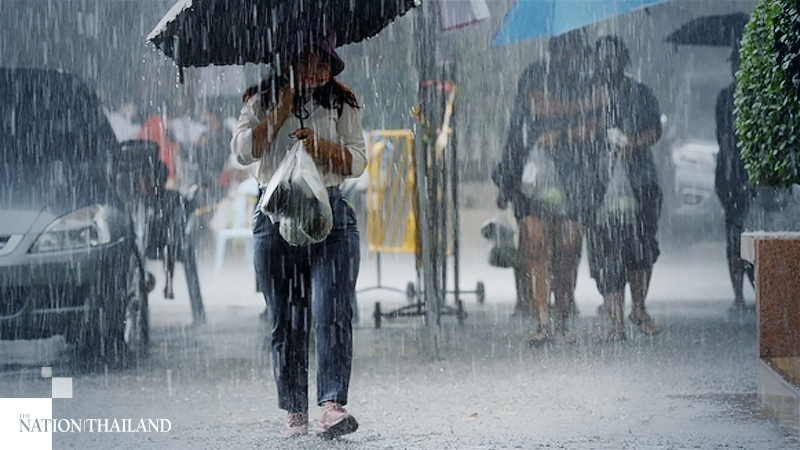
The strong southwest monsoon prevails over the Andaman Sea, Thailand and the Gulf of Thailand. On Sunday and Monday, continuous rainfall and some heavy showers are forecast for the lower central region, including Bangkok and its vicinity, the East and the upper south. 

People should beware of the severe conditions that may cause flash floods and water runoffs, the department warned.

In the Andaman Sea and the upper Gulf of Thailand, the strong winds will trigger waves up to 2-3 metres high and more than three metres high in thundershowers. All ships should proceed with caution, and small boats should stay ashore, the department said.

Storm-ravaged southwestern Louisiana takes stock of damage after Delta #SootinClaimon.Com

#SootinClaimon.Com : ขอบคุณแหล่งข้อมูล : หนังสือพิมพ์ The Nation.

Storm-ravaged southwestern Louisiana takes stock of damage after Delta

Oct 11. 2020Hurricane Delta rumbled ashore near the tiny town of Creole as a Category 2 storm, leaving behind debris and damaged homes. MUST CREDIT: Photo by Callaghan O'Hare for The Washington PostHurricane Delta rumbled ashore near the tiny town of Creole as a Category 2 storm, leaving behind debris and damaged homes. MUST CREDIT: Photo by Callaghan O’Hare for The Washington Post 

By The Washington Post · Dan Lamothe, Meryl Kornfield, Ashley Cusick, Paulina Firozi, Hannah Knowles · NATIONAL 
LAKE CHARLES, La. – Southwestern Louisiana began its cleanup Saturday of its second strong hurricane in six weeks, beset with flooding, 100-mph wind damage and a powerful storm surge even as wreckage from the first storm still needs to be cleared and repaired.

Hurricane Delta rumbled ashore near the tiny town of Creole on Friday night with Category 2 strength, six weeks after Hurricane Laura came ashore 15 miles to the west as a Category 4 storm, with screaming 150 mph winds and violent, sweeping storm surge. The dual storms made it difficult on Saturday to determine where the wreckage of one storm ended and the next one began.

Hurricane Delta overturned vehicles, knocked out power across a broad swath of Louisiana and flooded homes. Some people were only starting to recover from Hurricane Laura, which made landfall in August. MUST CREDIT: Photo by Callaghan O'Hare for The Washington Post

Hurricane Delta overturned vehicles, knocked out power across a broad swath of Louisiana and flooded homes. Some people were only starting to recover from Hurricane Laura, which made landfall in August. MUST CREDIT: Photo by Callaghan O’Hare for The Washington Post

In Creole, homes were ripped from foundations, windows were blown out by the wind, and scores of telephone poles were bent into swampy water. A church a few miles west sat with gaping holes in its side. In Lake Charles, a city of more than 70,000 that was already ravaged by Hurricane Laura in August, Delta unleashed winds of 95 mph, flooding some homes and leaving the city in darkness. It was the latest in a punishing series of storms: With the National Hurricane Center conventional naming list exhausted for 2020, Delta is the first Greek-letter-named hurricane to strike the lower 48 states.

“We already know that there will be damage in southwest Louisiana that will be very difficult to differentiate between what was caused by Hurricane Laura and what was caused by Hurricane Delta,” Gov. John Bel Edwards (D) said Saturday afternoon at a news conference. “But what we know is that tens of thousands of Louisianans as we speak, are in a very difficult situation.”

Nearly 10,000 Louisianans were in shelters as of Saturday morning, according to Edwards – 935 of them evacuees from the Delta and thousands more still displaced by Laura. Edwards said power outages peaked near 700,000 and surpassed those inflicted by Laura. That Category 4 hurricane may have been more powerful, the governor said, but Delta’s onslaught was “much bigger.”

Thousands of National Guard members are activated for rescue and recovery efforts, Edwards said. No deaths have been tied to the hurricane, he said, though search-and-rescue missions were still underway Saturday.

Delta weakened to a tropical depression over western Mississippi on Saturday and is set to decrease in forward speed and move north across the state and into the Tennessee Valley on Saturday night and into Sunday, according to the National Hurricane Center. Water levels along the Louisiana coast will continue to subside Saturday, according to the hurricane center, but the risk of flash-flooding still looms with heavy rains. 

The National Weather Service office in Lake Charles reported extreme rainfall in the two-day period since Thursday morning. A gauge in Calcasieu Parish recorded more than 17 inches of rain, the highest total the office has reported. 

Lynda LeBlanc, 68, and her husband, Wilson LeBlanc, 84, evacuated to Houston before Delta arrived. Laura had caused roof damage to their home, and they decided it was best to wait Delta out in safety. But they drove back to Lake Charles at 4 a.m., eagerly wanting to see how the house they have occupied for 32 years made out.

They found that where Laura brought wind to their Greinwich Terrace neighborhood, Delta brought on a new force of destruction: water.

Debris left over from Laura floated through thigh-high water across the LeBlancs’ neighborhood. Tarp-covered homes were submerged, and advertisements for tree removal drifted alongside signs of the lives lived here: Christmas decorations, prescription medications, stuffed animals and cloth masks.

Lake Charles Mayor Nic Hunter advised tens of thousands of residents who evacuated ahead of the storm on Saturday that if they don’t have to come back, they should wait at least a day.

“Though Delta may have been a ‘weaker’ storm than Laura, Delta has been more of a water event than a wind event,” Hunter wrote on Facebook. “Today is not the day to come back to LC, if you can avoid it..” 

Black Hawk helicopters from the Louisiana National Guard flew over a city already shrouded in blue tarps from Laura’s damage. On Saturday morning, the water was still too deep to drive through, and Lynda LeBlanc was afraid to enter it, knowing that snakes and alligators often frequent the nearby Kayouche Coulee River, from which she suspected the water came.

Her husband still wanted to see, though. He found the blue tarp he’d used to protect his damaged roof now flitting 20 feet above the house, wrapped around a backyard tree. Flood marks on the outside of the home showed it had taken on about six inches of water, and it seemed the motor of LeBlanc’s truck had probably been submerged as well.

“We knew it was going to get a little water, but we didn’t know it was going to be this much,” he said. “If it’s gone, it’s gone. That’s all I can say.”

Around the corner, Muriel Beaz, 31, also found water in her home. Many in the neighborhood sustained roof damage during Laura, but Delta brought a new threat.

“The house did great with Laura,” Beaz said. “But this is what killed it for us: flooding.”

Beaz and her 28-year-old husband, A.J. Shoell, rent their home and said they do not have insurance.

“Good luck trying to get renter’s insurance here,” Shoell said.

“They won’t cover us. We’ve tried,” said Beaz.

In downtown Lake Charles, Justin Roberts, 40, said he thinks Hurricane Laura directly contributed to Delta’s flooding by blocking storm drains with debris. Roberts, a former Army chaplain turned filmmaker, has been spending time with the Cajun Navy Foundation, documenting their efforts to help Lake Charles rebuild after Laura.

Friday night, he found himself on rescue missions as the group helped residents survive yet another major storm. Navy volunteers headed out with trucks and boats, pulling three families, including several children, from the water.

“Most of these people, they can’t afford to leave,” Roberts said. “They don’t have the finances to go somewhere else.”

Some, like Abbeville resident Stephanie Richard, are staring down the prospect of homelessness. Devastating winds early Friday night split a large oak tree outside Richard’s home, smashing the massive branches into her roof. 

But Richard took solace that the tree fell the way it did: If it toppled in the other direction, it would have crashed into the home of her neighbor, who did not evacuate, she said. She said she is grateful for her life – and her neighbor’s.

“This is just a house,” she said, wiping away tears. “I’m not going to let this affect me.” 

In Rayne, a small town of about 8,000 people about 15 miles outside of Lafayette, ferocious winds knocked over trees and tossed debris. After sunrise, officials counted at least 14 homes in the town that were no longer inhabitable due to damage, Councilwoman Curtrese Minix said. 

Charlie Loftlon, 74, who had lived in his home since he was 3 months old, said the damage was unlike anything he’s seen before.

Across the street, a large live oak flattened his neighbor’s house while no one was home.

The howling wind tore a limb from another neighbor’s tree, impaling Loftlon’s own roof while he was inside. But, he said, there was nothing he could do until morning.

“When I peeped outside, I saw the limbs waving,” he said. “It sounded like the devil was coming through here.”

By 8 a.m., Loftlon had already gathered the equipment he needed to clear his roof before helping others. Residents assessing the extent of the damage called out to each other, making sure others were safe.

In Jennings, about 20 miles west of Rayne, Mark Cina, 47, chopped apart large magnolia branches in the yard of his neighbor Tanya Gaudet, 49.

“Up and down this street, we’re helping each other,” Cina said.

Tropical storm ‘Linfa’ could make landfall in Vietnam today #SootinClaimon.Com

#SootinClaimon.Com : ขอบคุณแหล่งข้อมูล : หนังสือพิมพ์ The Nation.

Tropical storm ‘Linfa’ could make landfall in Vietnam today

Oct 11. 2020Credit :  Thai Meteorological DepartmentCredit : Thai Meteorological Department 

By The Nation

The category 2 tropical depression was intensifying to tropical storm “Linfa” over the middle of the South China Sea at 5am on Sunday, the Thai Meteorological Department said.

Centred at latitude 14.5 degrees north, longitude 111.2 degrees east, with sustained winds of 65 kilometres per hour (kph), the storm is moving west at a speed of about 20kph. The storm is expected to move ashore into Vietnam and make landfall in Vietnam on Sunday/Monday.

A monsoon trough lies across the lower Central, the upper South and the East of Thailand, the department said. The strong southwest monsoon prevails across the Andaman Sea, Thailand and the Gulf. Continuous rains are likely across the country. Isolated heavy rains with strong winds are possible in the East and the Central, including Bangkok and its vicinity, and the South. 

People in risky areas of the Northeast, the East, the Central and the South should beware of severe conditions, the department said.

Strong winds are forecast with waves in the Andaman Sea likely to rise 2-3 metres and more than three metres high in thundershowers. All ships should proceed with caution and small boats have been advised to keep off thundershowers. 

The weather forecast for the next 24 hours:

Bangkok and its vicinity: Very cloudy with fairly widespread thundershowers and isolated heavy rains; minimum temperature 23-24 degrees Celsius, maximum 28-30°C; easterly winds 10-25kph.

North: Cloudy with isolated thundershowers mostly in Tak, Kamphaeng Phet, Phithsanulok, Pichit and Phetchabun provinces; minimum temperature 20-24°C, maximum 29-32°C; northeasterly winds 10-25kph.

Northeast: Very cloudy with scattered thundershowers in Mukdahan, Amnat Charoen, Nakhon Ratchasima, Surin, Buri Ram, Si Sa Ket and Ubon Ratchathani provinces; minimum temperature 22-24°C, maximum temperature 27-30°C; northeasterly winds 10-30kph

Central: Very cloudy with fairly widespread thundershowers and isolated heavy rains in Ratchaburi, Samut Sakhon and Samut Songkhram provinces; minimum temperature 22-24°C, maximum 26-29°C; southwesterly winds 10-25kph.

East: Very cloudy with fairly widespread thundershowers and isolated heavy rains in Nakhon Nayok, Prachinburi, Sa Kaeo, Chachoengsao, Chonburi, Rayong, Chanthaburi and Trat provinces; minimum temperature 24-25°C, maximum 29-31°C; southwesterly winds 20-45kph; waves 2-4 metres high and above four metres in thundershowers.

South (east coast):Very cloudy with fairly widespread thundershowers and isolated heavy to very heavy rains in Phetchaburi and Prachuap Khiri Khan provinces; minimum temperature 23-25°C, maximum 27-34°C. Surat Thani northward: Southwesterly winds 20-35kph; waves about two metres high and above two metres in thundershowers. Nakhon Si Thammarat southward: Southwesterly winds 15-35kph; waves 1-2 metres high and above two metres in thundershowers.

South (west coast): Very cloudy with fairly widespread thundershowers and isolated heavy rains in Ranong, Phang Nga, Phuket, Krabi, Trang and Satun provinces; minimum temperature 22-24°C, maximum 29-32°C; southwesterly winds 20-40kph; waves 2-3 metres high and above three metres in thundershowers.

Forecast for the next seven days:

The monsoon trough lies across the lower Central, the upper South, and the East throughout the period while the moderate southwest monsoon prevails over the Andaman Sea, Thailand, and the Gulf of Thailand. Thundershowers and isolated heavy rains are expected in the lower Northeast, the lower Central, the East, and the South. 

Meanwhile, the high pressure area from China will extend to the North and the upper Northeast. From Oct 10-14, the low cell over the middle South China Sea will intensify and approach ashore of Vietnam before entering the Gulf of Tonkin, China. 

People in high-risk areas of Thailand should beware of the severe conditions. All ships in the Andaman Sea and the Gulf of Thailand should proceed with caution and keep off thundershower 

Google tries to turn YouTube into a major shopping destination #SootinClaimon.Com

#SootinClaimon.Com : ขอบคุณแหล่งข้อมูล : หนังสือพิมพ์ The Nation.

Google tries to turn YouTube into a major shopping destination

Oct 09. 2020YouuTube. MUST CREDIT: Bloomberg photo by Gabby Jones
Photo by: Gabby Jones — BloombergYouuTube. MUST CREDIT: Bloomberg photo by Gabby Jones Photo by: Gabby Jones — Bloomberg 

By Syndication Washington Post, Bloomberg · Mark Bergen, Lucas Shaw · BUSINESS, TECHNOLOGY, US-GLOBAL-MARKETS, RETAIL

Every toy, gadget and good you see on YouTube could soon be for sale online — not on Amazon, but right on YouTube itself.

The world’s largest video site recently started asking creators to use YouTube software to tag and track products featured in their clips. The data will then be linked to analytics and shopping tools from parent Google.

The goal is to convert YouTube’s bounty of videos into a vast catalog of items that viewers can peruse, click on and buy directly, according to people familiar with the situation. The company is also testing a new integration with Shopify Inc. for selling items through YouTube.

A YouTube spokesperson confirmed the company is testing these features with a limited number of video channels. Creators will have control over the products that are displayed, the spokesperson said. The company described this as an experiment and declined to share more details.

The moves have the potential to transform YouTube from an advertising giant into a new contender for e-commerce leaders such as Amazon.com Inc. and Alibaba Group Holding Ltd.

“YouTube is one of the least utilized assets,” said Andy Ellwood, president of e-commerce startup Basket. “If they decided they want to invest in it, it’s a huge opportunity for them.”

It’s unclear how YouTube will generate revenue from these sales. However, the service has begun offering subscriptions for creators and takes a cut of 30% from those payments.

Alphabet Inc.’s Google has taken multiple stabs at online commerce, with limited success. The company has mostly preferred to sell ads that send people to other digital stores, rather than selling products itself.

However, the pandemic has hammered marketing budgets, particularly in the travel and physical retail sectors that are major Google advertisers. Meanwhile, e-commerce has boomed as people stay home and order more products online. That’s left Google watching from the sidelines as rivals such as Facebook Inc. and its Instagram app become hotbeds of online shopping. Amazon, the U.S. e-commerce Goliath, has seen sales soar, while Google suffered its first ever revenue decline in the second quarter.

A recent RBC Capital survey of marketers revealed “social commerce” as a hot area that is “especially bullish” for Facebook and Pinterest Inc., a digital search and scrapbooking company. After Facebook boss Mark Zuckerberg unveiled an updated Shops feature for retailers in May, the company’s stock jumped. Google doesn’t want to miss out.

For months now, Google executives have signaled that YouTube will be central to their e-commerce strategy. On a recent earnings call, Chief Executive Officer Sundar Pichai suggested YouTube’s sea of popular product “unboxing” videos could be turned into a shopping opportunity. The video site is full of other popular categories, such as makeup and cooking tutorials, where creators tout commercial products on air.

The company has also revamped its e-commerce and payments division. In July, it announced a plan to lure merchants to Google Shopping, its online storefront, which included an integration with Shopify so that sellers could manage their inventory.

Late last year, YouTube began testing a similar Shopify integration for creators who can list as many as 12 items for sale on a digital carousel below their videos, according to the company. Merchandising is one of several strategies YouTube is pursuing to diversify revenue for creators beyond ads. At a minimum, the new measures could help YouTube deepen the data it collects from videos to strengthen its ads business.

Amazon and Walmart Inc. have tinkered with shoppable videos for several years. Thus far, neither retailer has shown much progress. In China, though, this business model has taken off. On Douyin, the Chinese version of TikTok, influencers use live streamed videos to hawk wares from lipstick to smartphones in real-time to hundreds of millions of users.

Waymo to launch fully driverless service to the public – a first just in time for the pandemic #SootinClaimon.Com

#SootinClaimon.Com : ขอบคุณแหล่งข้อมูล : หนังสือพิมพ์ The Nation.

Waymo to launch fully driverless service to the public – a first just in time for the pandemic

Oct 09. 2020File photo/ driverless carFile photo/ driverless car 

By  The Washington Post · Faiz Siddiqui · BUSINESS, TECHNOLOGY, TRANSPORTATION 
SAN FRANCISCO – Waymo is launching fully driverless vehicles to the public, a milestone achievement for Silicon Valley’s self-driving car industry that comes during a global pandemic where efforts to limit person-to-person contact have found a welcoming audience.

The company, a part of Google-parent Alphabet, said Thursday it is opening up driverless ride-hailing service to riders in the Phoenix metro area, enabling anyone in the region to download its app and hail a ride without a driver in the front seat. It follows an extended public trial for the company’s ride-hailing service where riders were able to use it for commutes, grocery runs and routine tasks such as bringing their kids to school. 

During that launch period, Waymo said, it gradually expanded its service and the capabilities of its vehicles – the vast majority of which were monitored by human drivers. Waymo spokeswoman Katherine Barna said the company was giving between 1,000 and 2,000 weekly rides before the covid-19 pandemic, five to 10 percent of which were fully driverless.

The company shut down its service earlier this year because of the pandemic. But “we expect to reach and exceed that volume as we ramp back up,” Barna said.

Previously, driverless trips were offered only to an exclusive group of early adopters. But in “the near term, 100% of our rides will be fully driverless,” Waymo CEO John Krafcik wrote in a blog post announcing the move.

Waymo said driverless service would initially be offered to existing users of its Waymo One ride-hailing app, but the service would be expanded to the broader public “over the next several weeks.”

Companies across Silicon Valley are racing to make self-driving cars a reality, a technological moonshot that would make the economics of ride-hailing much more lucrative by sparing the expense of human drivers. So far, progress has been slow as companies have delayed their rollouts and extended their timelines, confronted by the challenge of programming cars to respond to the near-infinite stream of scenarios a driver could face. The pandemic threw a further wrench into the companies’ plans.

Waymo has long been seen as the industry leader in the space, however, trailed by competitors such as ride-hailing services Uber and Lyft, Amazon-acquired Zoox, General Motors’ Cruise and automakers pursuing autonomy such as Tesla.

So far, companies have taken testing of self-driving vehicles to states with varied geographic landscapes and climates to test out how they react in a variety of situations. Prominent pilots have rolled out, for example, in California, Pennsylvania and Michigan.

Arizona’s lax regulatory landscape and arid climate in particular have made it a haven for driverless vehicles. But the experiments have not been without incident. In 2018, a self-driving Uber fatally struck a pedestrian crossing a darkly lit street with her bicycle in Tempe, Ariz. The driver monitoring the car was looking at her phone, authorities said.

Waymo relied on a process including a “riogorus review of our safety readiness” before making the decision to launch driverless cars to the public, Barna said. The company informed the state’s transportation department of its testing plans before the announcement, she said.

Krafcik said the company will gradually roll out its driverless service in the region, beginning with those who are already part of its self-driving car service Waymo One.

“Later this year, after we’ve finished adding in-vehicle barriers between the front row and the rear passenger cabin for in-vehicle hygiene and safety, we’ll also be reintroducing rides with a trained vehicle operator, which will add capacity and allow us to serve a larger geographical area,” he wrote.

Waymo said it cleans its vehicles multiple times throughout the day, in addition to temperature-screening its maintenance workers and regularly flushing the cars’ cabin air through their climate control systems. The cars are also remotely monitored “to make sure they are meeting our high standard of cleanliness,” the company said on its website.”If we have a reason to suspect otherwise, the vehicle returns to our facilities immediately for a full cleaning and disinfection,” Waymo added.

Google, Oracle square off on landmark copyright case at the Supreme Court #SootinClaimon.Com

#SootinClaimon.Com : ขอบคุณแหล่งข้อมูล : หนังสือพิมพ์ The Nation.

Google, Oracle square off on landmark copyright case at the Supreme Court

Oct 08. 2020The Google logo at the Dmexco digital marketing conference in Cologne, Germany, on Sept. 14, 2016. MUST CREDIT: Bloomberg photo by Krisztian Bocsi.The Google logo at the Dmexco digital marketing conference in Cologne, Germany, on Sept. 14, 2016. MUST CREDIT: Bloomberg photo by Krisztian Bocsi. 

By The Washington Post · Jay Greene · NATIONAL, BUSINESS, TECHNOLOGY, COURTSLAW 
Supreme Court justices pressed Google on Wednesday to explain why its use of software code to develop its Android mobile operating system didn’t amount to theft, in a closely watched case that could determine how copyright law applies to software.

Oracle has alleged in the decade-old case that Google infringed on copyrights related to using roughly 11,000 lines of code from the Java programming platform to develop Android. Oracle, which acquired Java in 2010 when it bought Sun Microsystems, has sought $9 billion in damages, arguing that Google used the code without its permission.

Google argued that weaving that code into Android was protected under the “fair use” doctrine that allows the unlicensed use of copyright-protected work in circumstances, such as this case, when there is no other way to do it. But at the start of Google’s presentation, Chief Justice John Roberts Jr. challenged that assertion.

“The only reason there is only one way to do it is because some of Oracle’s product expression was very successful,” Roberts said. “There were a lot of ways to do it when they did, and the fact that the programmers liked it and that is what everybody used – it seems a bit much to penalize them for that.”

The case, which has broad ramifications for the software industry, has bounced around various courts over the years. In 2016, jurors ruled Google’s use of the Java code was permitted as fair use under federal copyright law. Two years later, a federal appeals court overturned that, ruling that there is “nothing fair about taking a copyrighted work verbatim and using it for the same purpose and function as the original in a competing platform.”

The dispute centers on the technical way software developers use application programming interfaces, or APIs. That’s the computer code that enables websites and applications to work together. APIs also reduce the amount of basic computer coding developers need to write with each program.

Justice Sonia Sotomayor pressed Google on why it needed to use the Java code to develop its mobile operating system when Apple, which developed the competing iOS technology, did not.

“They spent the billions of dollars necessary. Presumably, you could have,” Sotomayor said.

But the code was so basic to the way applications interoperate with Android that Google had no other choice but to use the Java code, its lawyer Thomas Goldstein said.

“We couldn’t write a computer program that would respond to the developers’ instructions without reusing this limited set of instructions,” Goldstein said.

Justice Neil Gorsuch pressed Goldstein on a similar point, that because Java was more “particularly elegant, efficient or successful,” Google wanted to “ride on their innovation.”

Questioned later by Justice Elena Kagan, Goldstein described the Java code that Google used as “connective tissue between computer programs,” adding that “it is at the most barely creative.”

Google has won the support of several tech companies, including Microsoft, which argued in its own brief that the appeals court ruling in Oracle’s favor “risks upsetting long-settled expectations” that have allowed the tech industry to flourish by enabling programs to interoperate.

Oracle’s toughest questioning came from Justice Stephen Breyer, who wondered whether the code that Google used was more like the development of the “QWERTY” keyboard, something of a utility that isn’t deserving of copy protection and would disrupt the marketplace if companies needed to license it.

“At this point in time, it’s really tough, just like the QWERTY keyboard, to go backwards,” Breyer said. “And very bad consequences will flow if you don’t see that distinction.”

Oracle lawyer Joshua Rosenkranz countered that the analogy wasn’t apt.

“This is not like the QWERTY keyboard. There was never anything expressive in QWERTY,” Rosenkranz said. “It was purely mechanical.”

The solicitor general, who represents the federal government before the court, filed a brief in support of Oracle’s case and will present an oral argument on the company’s behalf today.

Breyer pressed the government on his QWERTY keyboard analogy, as well, asking if a ruling in Oracle’s favor would be akin to giving monopoly power over something that is already in wide use. Unlike the Java code Google used, the QWERTY keyboard is “not sufficiently creative,” deputy solicitor general Malcolm Stewart argued.

Oracle has long had a close relationship with the Trump administration, and separately is seeking to secure a stake in the popular video app TikTok, which has sought U.S. investors to stave off a ban in the country over President Donald Trump’s security concerns.

Nobel Prize in chemistry awarded to two women who developed CRISPR, the revolutionary gene-editing tool #SootinClaimon.Com

#SootinClaimon.Com : ขอบคุณแหล่งข้อมูล : หนังสือพิมพ์ The Nation.

Nobel Prize in chemistry awarded to two women who developed CRISPR, the revolutionary gene-editing tool

Oct 08. 2020

By The Washington Post · Ben Guarino · NATIONAL, WORLD, SCIENCE-ENVIRONMENT 
A pair of scientists – Jennifer Doudna, a biochemist at the University of California at Berkeley, and Emmanuelle Charpentier, a French microbiologist – won the 2020 Nobel Prize in chemistry Wednesday for their work developing a revolutionary gene-editing tool that can change the DNA of plants and animals with extraordinary precision.

The technique, called CRISPR -Cas9, is already being used as a cancer therapy and to cure inherited diseases.

“This year’s prize is about rewriting the code of life,” said Goran Hansson, secretary general of the Royal Swedish Academy of Sciences.

This was the first time two women jointly won a Nobel in chemistry. “I wish that this will provide a positive message, specifically, to young girls who would like to follow the path of science,” Charpentier told reporters Wednesday morning.

“I’m over the moon, I’m in shock, I couldn’t be happier,” Doudna said at a University of California news conference. She said she and Charpentier are “waving to each other across the Atlantic right now.”

Francis Collins, director of the National Institutes of Health, said this prize was a long time coming. The 2012 publication of the scientists’ paper describing CRISPR is one of the most-cited studies in modern science. “Every year we are like: ‘Okay, is this going to be the year?’ ” he said, adding that he was “absolutely thrilled at 5:30 in the morning” to see the Nobel committee recognize the two researchers.

Ancient microorganisms developed the first version of CRISPR as their immune system. Because bacteria use it to slice out foreign genetic material once viruses invade, CRISPR-Cas9 is frequently likened to molecular scissors.

It can hunt for specific sections of DNA and snip those out: The human cell contains about 6 billion chemical units of DNA, called base pairs. CRISPR’s tremendous power is that it can find and cut just one. What’s more, when manipulated by scientists, CRISPR has the flexibility of a word processor – with functions such as find-and-replace, find-and-delete or simply find.

“We can now change the genetic information in any cell in any organism,” said Claes Gustafsson, chairman of the Nobel Committee for Chemistry.

Since its discovery eight years ago, the tool has been widely deployed in research laboratories. It has transformed the patterns of butterfly wings and allowed scientists, for the first time, to mutate ants. It also has been used for plant breeding and is a cutting-edge medical therapy in clinical trials for inherited diseases such as sickle cell disease.

“This is definitely a very expected prize for me,” Luis Echegoyen, president of the American Chemical Society, said in an interview. “It’s going to change the world and how we treat diseases.”

Although gene-editing techniques existed before CRISPR, none were so easy to use or wereadoptedso rapidly. “If you walk into any lab, including mine at NIH, there’s a very high likelihood that CRISPR-Cas is in the middle of those experiments,” said Collins, whose research uses CRISPR to identify genetic risk factors in diabetes.

It would be difficult to find an NIH grant for microbiology research that didn’t involve CRISPR, he said. “It’s clearly billions of dollars a year that we’re investing in this.”

NIH-funded research also includes using a CRISPR system to diagnose coronavirus infections, with the goal of swiftly identifying viral genomes in the swirl of genetic material taken from a nasal swab. That has the potential to be a faster and more precise tool than the tests that use a technique called PCR, Collins said.

CRISPR’s great power has also spurred controversy. In 2018, a researcher in China used CRISPR to edit human embryosin an attempt to make them immune from HIV, an approach Doudna and other scientists condemned as reckless and unethical. Those embryos were carried to term, with twin babies. A Chinese court sentenced the scientist, He Jiankui, to three years in prison.

And the tool has sparked a long-running patent battle between two groups that claim ownership, one led by the University of California that includes the two prize winners,and the other by MIT and Harvard’s Broad Institute. A biochemist there, Feng Zhang, pioneered the use of CRISPR in animal and plant cells. Doudna said she did not think the Nobel award would affect the ongoing patent case.

Many scientists also considered Zhang a contender for the Nobel Prize. At Wednesday’s announcement, Gustafsson declined to answer whether the Nobel committee considered other CRISPR researchers for this year’s prize. “It’s a big field, and there’s a lot of good science. . . . I can only say that,” he said.

Geneticist Eric Lander, director of the Broad Institute, tweeted: “Huge congratulations to Drs. Charpentier and Doudna on the @NobelPrize for their contributions to the amazing science of CRISPR!”

Since 1901, the Nobel Committee has awarded 112 prizes in chemistry to 186 people. Seven, including Doudna and Charpentier, were women. “I’m proud of my gender,” Doudna said. “For many women there’s a feeling that, no matter what they do, their work will never be recognized as it might be if they were a man. I’d like to see that change.”

Last year, John Goodenough became the oldest person to win a Nobel – he was 97 – for his work developing lithium-ion batteries, an award he shared with chemists M. Stanley Whittingham and Akira Yoshino.

Charpentier and Doudna split a prize of 10 million Swedish kronor, or about $560,000 each. The University of California at Berkeley also awarded Doudna a free parking space on campus.

A Fat Bear Week champion has been crowned: 747 is 2020’s thickest king #ศาสตร์เกษตรดินปุ๋ย

#ศาสตร์เกษตรดินปุ๋ย : ขอบคุณแหล่งข้อมูล : หนังสือพิมพ์ The Nation.

A Fat Bear Week champion has been crowned: 747 is 2020’s thickest king

Oct 07. 2020Bear 747 emerged victorious in Fat Bear Week. MUST CREDIT: Courtesy of N. Boak/NPSBear 747 emerged victorious in Fat Bear Week. MUST CREDIT: Courtesy of N. Boak/NPS 

By The Washington Post · Natalie B. Compton · NATIONAL, FEATURES, ANIMALS 

After days of battling other corpulent contenders, 747 was crowned 2020’s Fat Bear Week champion, beating 32 “Chunk” in the finals on Fat Bear Tuesday.

It’s a fitting victory for the gargantuan first-time winner, who was the runner-up in 2019.

“Many staff who’ve worked at Katmai for many years say that [747] is the biggest bear they have ever seen,” says Naomi Boak, media ranger for Katmai National Park and Preserve, where the competing bears live. “It’s pure coincidence that he has the same name as a jumbo jet, but he is the size of a jumbo jet.”

According to his biography on Explore.org, 747 was first identified in 2004 when he was a few years old. As time went on, observers learned that the scar-covered brown bear enjoyed spending time in the Brooks River “Jacuzzi,” a fishing hot spot for dominant bears to feast on sockeye salmon. Last September, rangers estimated he (and his belly that almost touches the ground) weighted 1,400 pounds.

“I think he’s bigger this year,” Boak says, noting that recently 747 was spotted trying to get up a hill, but his massive belly got stuck on a rock so he had to back down and find a new route. “He worked it this competition.”

Fat Bear Week was born in 2014 as a way to “celebrate all the hard work that these bears do to survive and thrive and get through six months of starvation,” Boak says. Creator Mike Fitz started the tradition with Fat Bear Tuesday, and as the competition grew in popularity, it also grew in length. This year, the weeklong affair drew more than 550,000 online votes, more than doubling the number of voters for Fat Bear Week 2019.

Boak believes the competition’s combination of nature appreciation and humor is what drives Fat Bear Week’s increase in popularity.

“What a curative healing pleasure it is to, one, be able to laugh, and, two, be connected to nature by understanding the achievements of these individual bears,” Boak says. “I think such a cheerful release. And, quite frankly, how often does one get to celebrate fatness?”

While Boak isn’t sure if Fat Bear Week itself drives tourism to Katmai National Park, the bear cams do.

With more than 9 million unique views, the bear cams have inspired a passionate following, and Boak says they’ve compelled fans to make the difficult and pricey journey to Brooks River, where the fat bears spend much of their pre-hibernation feasting time.

“It’s expensive. And there are no cars. There are no roads, you have to walk, so not everyone can get here,” Boak says of the journey to Brooks River. “Most of the people who participate in Fat Bear Week and who watch the bear cams will never get here.”

That being said, the experience is popular, and accommodations sell out a year in advance. Those who want to stay at Brooks Lodge can only reserve a cabin through a lottery system, or can reserve one of the limited campsite spaces. If you can’t stay near the Brooks River overnight, Boak says travelers can come for a day trip, or visit other bear-watching destinations, like the McNeil River State Game Sanctuary and Refuge, where the largest known gathering of brown bears in the world takes place.

Boak hopes Fat Bear Week, and the park’s bear cams, will inspire more people to visit America’s largest state at some point in their lifetime.

“I’m a New Yorker and I just think that people need to come to Alaska. It will change your life,” she says. “The scale of everything in Alaska is different…it’s a very special place.”