Mahanakhon SkyWalk dangles ‘Love at first height’ to couples in love #ศาสตร์เกษตรดินปุ๋ย

#ศาสตร์เกษตรดินปุ๋ย : ขอบคุณแหล่งข้อมูล : หนังสือพิมพ์ The Nation

https://www.nationthailand.com/lifestyle/30382040?utm_source=category&utm_medium=internal_referral

Mahanakhon SkyWalk dangles ‘Love at first height’ to couples in love

Feb 12. 2020
By THE NATION

Mahanakhon SkyWalk, Thailand’s highest observation deck and rooftop, invites couples to experience “Love at First Height” from the 78th floor rooftop of the iconic pixelated building.

Couples can enjoy photo moments against colorful romance-inspired balloon and LED light decorations on the 74th floor indoor observation deck before sending a souvenir post-card from Bangkok’s highest postbox.

Enjoy DJ and live outdoor entertainment on Thailand’s highest rooftop from 5pm onwards. Experience an adventurous and exhilarating walk across a glass tray floor, and enjoy a panoramic 360-degree view of Bangkok’s sunset and skyline from 314 meters.

The “Love at first height” package includes entry for two adults, a limited-edition photo album and keychain souvenir, a postcard—to be sent from Bangkok’s highest postbox on the 74th floor, two mocktails and a traditional Thai snack on the 78th floor rooftop for the price of Bt2,200 per couple during 8-16 February 2020.

The iconic attraction is open daily from 10 am to midnight.

Journalist Ezra Klein: ‘The more you’re tied to the news cycle, the harder it is to actually step away from that’ #ศาสตร์เกษตรดินปุ๋ย

#ศาสตร์เกษตรดินปุ๋ย : ขอบคุณแหล่งข้อมูล : หนังสือพิมพ์ The Nation

https://www.nationthailand.com/lifestyle/30381974?utm_source=category&utm_medium=internal_referral

Journalist Ezra Klein: ‘The more you’re tied to the news cycle, the harder it is to actually step away from that’

Feb 11. 2020
Ezra Klein is a political journalist, blogger and co-founder of and editor-at-large at Vox. MUST CREDIT: Photo for The Washington Post by Chloe Aftel

Ezra Klein is a political journalist, blogger and co-founder of and editor-at-large at Vox. MUST CREDIT: Photo for The Washington Post by Chloe Aftel
By Special To The Washington Post · KK Ottesen 

Ezra Klein, 35, is a political journalist, blogger, commentator, and co-founder of and editor-at-large at Vox. He has also been a columnist for The Washington Post. His book “Why We’re Polarized” was published in January. He lives in Oakland, California.

Q. You were an early political blogger back when that was just starting out. What led to your interest in politics and to political journalism in the first place?

A. I had a history teacher once who said that there are certain moments when you feel the fists of history tightening around you. And I think 9/11 was a moment for me when I realized that whether or not I was interested in politics, it was going to be interested in me. So that was when I really started paying attention in a deeper way and trying to understand and figure things out. And I was doing this blog because I thought a lot about politics, and I wanted to talk to people about it, and blogging was a way to do that. I thought I would be a political staffer of some kind, work on the (Capitol) Hill or on campaigns. It was only later that it became clear that my path in politics was going to be in writing and in journalism, not working for candidates. Because I actually hated doing that.

Q. Why did you hate that? You worked on Howard Dean’s campaign, right?

A. I was an intern on Howard Dean’s campaign. Nothing against Howard Dean, who I respect greatly. And supporting candidates is, obviously, essential to make change in the system. But it just wasn’t my way. On campaigns, what you had to do was fall in line behind whatever some candidate said, thought or did. I was interested in trying to understand problems and solutions, and wanted to be able to honestly investigate, find conclusions, convey them to people and work toward them. I would be on the campaign, and they’d come out with a policy. And some other candidate would come out with a plan that I thought was better. And you can’t say, “Well, you know, John Kerry’s or John Edwards’ plan is really the way to go.” [Laughs.] But – and I cannot stress enough – I was an intern on this campaign. Nobody gave a s— what I thought. I was in the field office sending bumper stickers to people.

Q. In your book, you talk about the dangers of polarization, but obviously the media has had a large role in amplifying certain voices and increasing that polarization.

A. Something that I thought a lot about when starting Vox was that we wanted to make this argument that what’s most important isn’t always what’s new. But we also wanted to explain the news. And those two things have some amount of conflict to them. The more you’re tied to the news cycle, the harder it is to actually step away from that. And then, that begins being driven by social media and Donald Trump and trolls and other players and powers that make pretty bad decisions about what we should all be focusing on. Then all of a sudden you might be explaining news that would be better if you were simply ignoring in favor of other important topics. But that’s really hard to do when everybody else is covering something, and so it looks weird to your audience if you don’t cover it.

I’ve come to think a lot about the way we are trapped and manipulated by an incoherent definition of “newsworthiness.” And the way that we think in journalism that our power comes from covering things positively or negatively. But it actually comes from amplifying things. A lot of our power is just what we shine the spotlight on. And if other people understand how to make us shine the spotlight on the worst actors and things and controversies then, even if we’re doing good work about those bad actors and bad things and bad controversies, we might be adding to the toxicity of the system. So for me, a lot of my work was just trying to figure out ways that we can do good journalism adapting to the moment and the technology and how media manipulators are actually operating.

Q. You’ve pointed out that because of broken systems of accountability we can’t get bipartisan support for even really big challenges, like the impeachment process now.

A. There is a high school civics theory that the way American government is structured is competition between branches. You’ll still find that today is high school civics textbooks. And it just isn’t true. The way our government today is structured is competition between parties – two parties. And they compete across branches and enlist themselves in the other branches to help. So Donald Trump is being impeached by Democrats, functionally. And he’s enlisted congressional Republicans to help. And Mitch McConnell has been very clear that he is going to do everything he can to help Donald Trump out. The system is not built to work under those conditions. But that is how it works.

At the beginning of every single policy argument I’ve ever covered, I’ll sit in these rooms with people on the left and people on the right and people in the middle and people on the far left and Libertarians, and there’s a lot of agreement, ways to make almost anything a bit better for most people. And then, by the end of a highly public process, it’s just a party-line vote. It’s incredibly polarizing. Polarization makes you afraid of what the other party will do. And all of that zone of compromise is gone. We’re like Lucy with the football, where every time we restart, we think it’s going to be different. You know, Barack Obama with his massive grass-roots army and the aftermath of a financial crisis and his once-in-a-generation set of political talents. Well, surely, he can bring the country together. OK, maybe not. Well, Donald Trump, this disruptive force. A wrecking ball to the system. A populist Republican who will inaugurate this new era. Surely, he’ll change it. And then, no, he becomes the most polarizing president ever. And now either Joe Biden is going to heal our souls or Bernie Sanders is going to set off a political revolution. You know, name your theory.

At some point, we need an answer for why we seem to end up in the same place. It starts to become clear that if you just throw more people at the same system, they’re going to have more or less the same outcome. And so, the long generational project is somehow changing the system.

Q: On a personal level, why did you need to write a book on polarization?

A: What I was trying to do for myself, as a reporter and somebody who tries to understand these things, was rebuild a model of politics almost from the ground up. A model robust enough to explain Obama and Trump’s presidencies – how they’re connected to each other, and how they are symptoms and subject to these broader forces that are also affecting the media, affecting how we run campaigns, affecting even how we speak to and treat and love each other.

And so, the impetus was: I don’t understand this. I don’t understand why this is working this way. And for me, the great gift of journalism is being able to then say, “OK, I’m going to try to figure it out.”

After a woman’s bout with homelessness, she set up pop-up walls to share kindness and the basic necessities with others in need #ศาสตร์เกษตรดินปุ๋ย

#ศาสตร์เกษตรดินปุ๋ย : ขอบคุณแหล่งข้อมูล : หนังสือพิมพ์ The Nation

https://www.nationthailand.com/lifestyle/30381870?utm_source=category&utm_medium=internal_referral

After a woman’s bout with homelessness, she set up pop-up walls to share kindness and the basic necessities with others in need

Feb 10. 2020
Photo Credit: wallsoflove.com

Photo Credit: wallsoflove.com
By Special to The Washington Post · Cathy Free · NATIONAL, FEATURES, HEALTH 

In 1992, when Holly Jackson was homeless in Cleveland and six months pregnant, she often slept under a freeway bridge and wished there was a place nearby to find gloves, clean socks or a warm hat.

“I felt hopeless. It was such a dark time in my life,” she said. “A small kindness like a new coat or a toothbrush would have made a huge difference.”

Jackson got into an apartment after about two months on the street, but never forgot the desire to have quick access to toiletries, warm clothing and nonperishable food, she said. So in November 2018, she decided to make those basic necessities a reality for homeless people in Cleveland.

At first, Jackson said, she filled plastic-gallon-bags with toothpaste, deodorant, soap and socks donated by herself and co-workers, then handed them to homeless people she encountered to and from her job helping people to apply for government benefits.

Then she came up with the idea to hang the bagged items from fences in neighborhoods that have large homeless populations, said Jackson, 48. She gave her project a name: Walls of Love.

In the past 15 months, she estimates more than 37,000 people have had access to free items at 260 portable pop-up walls or fences in 56 Cleveland neighborhoods. Jackson has since taken her nonprofit program to other cities, including Denver, Fort Worth, Texas, and Lansing, Michigan. On Friday, a “Wall of Love” started in Richmond, Virginia, at Abner Clay Park, she said, and there will soon be one in Myrtle Beach, South Carolina.

“This is the kind of wall that helps people instead of shutting them out,” said Jackson, a mother of three adult daughters who devotes 40 hours a week to running the charity.

“I truly believe that people have good hearts,” she said, “and it doesn’t take much to change somebody’s life with something simple like a pair of socks, some soap or some hand warmers. It’s an easy way for anyone to help pay it forward.”

Jackson said she became homeless at age 20 after she had fled a domestic violence situation and had no family or friends who could take her in. Pregnant with her first daughter, she worked as a McDonald’s shift leader to save money for an apartment, but it took more than two months before she could afford one.

“Living on the streets was an eye-opener – I often slept under a bridge, and yes, I was afraid,” she said. “But I met other homeless people, and we looked out for each other. I learned that the stigmas about the homeless aren’t true. For the most part, they’re just people who have fallen on hard times like I did.”

In 2018, years after she had built a comfortable life, Jackson spotted a homeless family in downtown Cleveland in cold weather with no hats, gloves or socks. They were wearing flip-flops.

“I said to myself, ‘I really wish there was some kind of magic wall where people could come and get stuff that they needed,’ ” she recalled. Remembering her own situation in the early 1990s, Jackson thought, ” ‘Why can’t I put up a wall like that?’ ”

The next day, she contacted the mayor’s office about her plan and was given approval to hang items in bags on a bush outside a police station in suburban Cleveland. From there, she received permission from businesses to hang bags filled with snacks and warm-weather gear on fences across the town.

Jackson and a small band of volunteers now “refill” those walls with new donated items each month, even during the summer, when they put out bags filled with water, granola bars and flip-flops. At areas near homeless camps, they set up portable walls, making it easier for people who are cold and hungry to find small necessities to brighten their lives.

“Because Holly has seen hard times, she can relate to the people who come to the walls for these donations,” said Karen Marunowski, 29, who has volunteered with Walls of Love from the beginning. “She knows what it’s like to feel alone and not have anybody to help. When people pick up things at a Wall of Love, they’re so appreciative. It touches their lives in ways they don’t forget.”

Jackson said she rarely has problems with people taking more than they need from the walls.

“I trust people, and I put everything out with the hope that it will go to the people who need it,” she said. “Often, I go back to check on a wall, and there is still stuff there. So most people really are using it for its intended purpose. They usually take what they need and nothing more.”

Walls of Love also puts new lunchboxes, school supplies, snacks and toiletries on walls near schools.

“Whatever you put out into the universe is what you get back,” she said. “If you put out something good from your heart, that’s what you’ll get back. I truly believe that. I can’t think of a better way to spend my time. You never know when that small act of kindness might change somebody’s life.”

100-year-old Tuskegee Airman aims to inspire at annual Smithsonian event #ศาสตร์เกษตรดินปุ๋ย

#ศาสตร์เกษตรดินปุ๋ย : ขอบคุณแหล่งข้อมูล : หนังสือพิมพ์ The Nation

https://www.nationthailand.com/lifestyle/30381871?utm_source=category&utm_medium=internal_referral

100-year-old Tuskegee Airman aims to inspire at annual Smithsonian event

Feb 09. 2020
Brig. Gen. Charles McGee, 100, a veteran and Tuskegee Airman, attends an event honoring black pioneers at the National Air and Space Museum's Virginia facility Saturday. MUST CREDIT: Washington Post photo by Marvin Joseph

Brig. Gen. Charles McGee, 100, a veteran and Tuskegee Airman, attends an event honoring black pioneers at the National Air and Space Museum’s Virginia facility Saturday. MUST CREDIT: Washington Post photo by Marvin Joseph
By The Washington Post · Hannah Natanson · NATIONAL, FEATURES, ENTERTAINMENT, NATIONAL-SECURITY, MUSEUMS 

CHANTILLY, Va. – Across his long and barrier-bursting career, Tuskegee Airman and Brig. Gen. Charles McGee fought in three wars, flew 409 combat missions and – during World War II – helped rescue at least 1,000 prisoners of war in Romania.

But, on Saturday morning at the Smithsonian’s Steven F. Udvar-Hazy Center in Virginia, it was another number that most captivated Isaac Preston.

“He’s 100 years old,” Isaac, 9, told his (chuckling) parents, staring at the hand he had just used to shake McGee’s. “He’s 100 years old!”

In his other hand, Isaac clutched a copy of “Tuskegee Airman,” a biography of McGee that the man himself inscribed – in looping, turquoise cursive – with his name, the date and a message: “Seek excellence, Isaac!”

The boy’s book was one of roughly 70 that McGee would sign before delivering an impromptu speech in the early afternoon, all part of the Smithsonian’s annual African American Pioneers in Aviation and Space Family Day.

The free commemoration also featured a puppet show detailing the lives of African-American air and space adventurers, a display of African-American flight artifacts typically tucked away in National Air and Space Museum Archives and a panel discussion centered on careers in aviation and engineering. Elsewhere in the vast, airy Udvar-Hazy hangar, children could build colorful plastic planes or fashion rockets from straws and “Air-Dry Clay” before launching them, with much whooping and little guidance, in a museum corner.

Still – as evidenced by the line of grandparents, parents, teens, toddlers and babies massed beneath the yellow, baby blue and olive green aircraft that dangle from the Udvar-Hazy Center ceiling – the main attraction was indisputable.

“How are you doing in school?” McGee asked child after child, swallowing their small hands in his silken, wrinkled palms.

“School is so important,” he added, before offering the same parting injunction: “You are the future, you know.”

Leaning toward one little boy who wore his hair in braids, McGee whispered: “You could fly to Mars!”

The celebration was the latest in a string of high-profile events for McGee in recent weeks: Accompanied by three other centenarian World War II veterans, he opened Super Bowl LIV on Feb. 2 with a coin flip. On Tuesday, he sat in the audience for the State of the Union address, during which President Donald Trump dubbed him a “hero,” inspiring a rare moment of sustained, bipartisan applause.

Earlier, Trump had approved McGee’s honorary promotion from colonel to general, after Congress voted for the measure. The boost in rank capped a 30-year career in the Air Force that saw McGee become the first African-American to command a stateside Air Force wing and a base in the integrated Air Force.

His time with the Tuskegee Airmen was equally pathbreaking. The airmen, comprising more than 900 black pilots trained at the segregated Tuskegee airfield in Alabama, overcame racism and oppression to fly patrol, strafing and escort missions during World War II, the tails of their planes painted red.

Despite his crowded schedule, the only sign of fatigue McGee displayed Saturday was a half-finished cup of Dunkin’ coffee, taken black, which he tucked behind a rapidly dwindling stack of his books. The general, his clothes and voice equally crisp, said during a break from signings that he felt well rested.

Adults in line, watching and waiting their turn, muttered a shared disbelief.

A balding, middle-aged man in a blue-and-white-striped polo shirt said he wanted to start eating whatever McGee does. Standing a few places away, a gray-haired man in a maroon quarter-zip said he and his wife were so shocked to learn that McGee would be signing books in person Saturday that she almost tackled him from excitement.

As they got close, most everyone in line began by thanking the general for his service.

One man slowly spelled the name of his military daughter, Anne. A woman spoke at length, in low tones, about her family members in the Air Force. Another man, who said he was a colonel, got down on his knees and confided that he had always wanted to fly, but he was too tall.

Isaac’s mother, Shanna Preston, 36, saved her words until her son and her husband had already stepped away. She leaned over the table and mentioned the day that McGee was honored at the State of the Union: Feb. 4.

“That,” she said with a glance toward her 9-year-old, “was his birthday.”

McGee looked at Isaac, too, and nodded.

He pressed his palms together and pointed them at the boy, like a prayer.

Duterte’s lesson taught Philippine tycoon to toughen up #ศาสตร์เกษตรดินปุ๋ย

#ศาสตร์เกษตรดินปุ๋ย : ขอบคุณแหล่งข้อมูล : หนังสือพิมพ์ The Nation

https://www.nationthailand.com/lifestyle/30381846?utm_source=category&utm_medium=internal_referral

Duterte’s lesson taught Philippine tycoon to toughen up

Feb 09. 2020
Dennis Uy, Chief Executive Officer of Phoenix Petroluem Philippines Inc., in Manila, Philippines, on March 5, 2018. MUST CREDIT: Bloomberg photo by Veejay Villafranca.

Dennis Uy, Chief Executive Officer of Phoenix Petroluem Philippines Inc., in Manila, Philippines, on March 5, 2018. MUST CREDIT: Bloomberg photo by Veejay Villafranca.
By Syndication Washington Post, Bloomberg · Ian Sayson

Philippine tycoon Dennis Uy has built an empire spanning oil, shipping, casinos and telecommunications, but eight years ago his oil-trading business was in trouble over government allegations of fuel smuggling.

Uy went to see the local mayor, a family friend from childhood, for advice. The mayor was Rodrigo Duterte, the country’s current president.

“He said my image is soft, so I should practice before a mirror saying, “You son of a b****,’ 100 times,” Uy said in an interview in Manila. “He doesn’t like when a person is bullied.”

Uy says Duterte hasn’t played a direct role in his businesses, but the advice worked. He was cleared of the smuggling charges and went on to quadruple profit at his Phoenix Petroleum Philippines Inc. in the five years through the end of 2018. Along the way, he says, he gained the toughness Duterte had been trying to instill in him.

“If you survived petroleum and shipping, it trains you to be battle ready,” said Uy, 46. “In petroleum, to get your 1 peso margin, you watch everything from storage to trucking, and it’s common to give credit and deal with currency and oil price fluctuations.”

Before Duterte’s rise, the southern province of Davao was better known for its tropical fruit and an endangered species of monkey-eating eagle than for business powerhouses like Uy’s.

But in the past few years, Uy, who donated to Duterte’s presidential campaign, has spread far beyond the region, assembling assets that are eating into industries ruled by some of the country’s richest and oldest business dynasties.

In 2018, Uy’s teamed up with China Telecommunications Corp., to win a telecommunications license to challenge the duopoly of Smart Communications Inc.and Globe Telecom Inc. Uy had no previous experience as a carrier, but his company, now called Dito Telecommunity Corp., emerged as the sole bidder. Duterte has repeatedly called for greater competition in the industry, which has some of the highest mobile rates and slowest service in Southeast Asia.

After Duterte encouraged the Chinese wireless giant to join the competition, Norway’s Telenor and Austria’s Mobiltel, which had bought documents to participate, didn’t bid. Streamtech Systems Technologies, led by the Philippine’s richest person Manuel Villar, withdrew from the race.

Smart is owned by PLDT Inc., whose Chairman Manuel Pangilinan has been repeatedly criticized by Duterte as an out-of-touch elite. The carrier’s largest shareholders include JG Summit Holdings Inc., the banking, aviation and retail conglomerate now run by Lance Gokongwei, founder John Gokongwei Jr.’s son.

The other telecom operator, Globe, has Ayala Corp. as one of its largest shareholders. Ayala is led by Chairman Jaime Augusto Zobel de Ayala II, a frequent Duterte target.

Duterte has also been a strong critic of the current telecommunications duopoly.

“The Philippines has been gravely fooled by the rich people in the Philippines,” he said on Jan. 23. “Just like Ayala and Pangilinan who own Globe and Smart. They are all thieves, those sons of b******,” he said, according to the official transcript of his speech.

A spokesmen for Ayala Corp. said the company didn’t want to comment on Duterte’s speech. A PLDT spokesman, who also represents Pangilinan, said he wouldn’t comment. Duterte’s spokesman hasn’t responded to requests for comment.

Uy also lacked experience in the gambling resort business, but won the first such license offered after Duterte became president, gaining permission to build a $300 million casino complex on a resort island in Cebu.

With a casino, Uy will be in competition with Enrique Razon, a third-generation heir of a ports and cargo empire who founded Bloomberry Resorts Corp., developer of the Solaire Resort and Casino in Manila’s Entertainment City suburb. Razon, with a net worth of about $4.6 billion, is the country’s richest person after Villar, according to the Bloomberg Billionaire’s Index.

Uy’s gambling resort will also put him in competition with the family behind Belle Corp., which owns a stake in Manila’s City of Dreams casino. Belle is part of the family-controlled empire built by the late Henry Sy. The Sy group encompasses BDO Unibank Inc., Uy’s biggest creditor, and has a shipping and logistics venture with him, 2GO Group.

“You always have to look out for opportunities whether small or big or whether it’s aligned to what you’re doing or not,” Uy said. “We look at industries where we can be where we can be in the top 5, or where we have the means to compete or there is room to serve the customer better.”

Uy built his group on the foundation of Phoenix Petroleum, which he started in 2002, four years after the nation deregulated its oil industry. It is now the no. 3 Philippine gasoline retailer after taking market share from Royal Dutch Shell Plc’s local unit and Petron by offering round-the-clock service to business clients such as Cebu Air Inc., part of the Gokongwei group.

Uy said he is open to more acquisitions.

“We can’t say now I am full; for tomorrow, I may be hungry,” he said in the interview. “We have businesses that we need to grow organically or through acquisition.” He declined to name any targets to say how much he expects to spend on deals.

Phoenix Petroleum closed unchanged Monday in Manila. The stock has gained about 10% over the past 12 months. ISM Communications Corp., where Uy has a stake, fell 1.8%.

Uy’s surge into the ranks of Philippine conglomerates was largely financed by borrowing. Total debt has mushroomed from about 14 billion pesos ($275 million) to 111.5 billion pesos in the four years ended December 2018, based on the most recent regulatory filing from his Udenna Corp. holding company.

“His friendship with Duterte opened opportunities to enter into new business that he grabbed aggressively,” said Rachelle Cruz, an analyst at AP Securities Inc. in Manila. “Uy’s main challenge now is making these businesses work and turning Udenna into a holding that would last beyond Duterte.”

Uy says his connection to the president isn’t the reason for his success.

“I am not close to the president,” he said in the interview. “He isn’t involved in any of our deals. He only gets to know from what he reads from newspapers.”

Uy said his aggressive expansion under Duterte is partly from confidence that the president has created a level playing field that allows an outsider like him to do business.

“I’ve been always confident on the Philippines, but it’s different when you know the leadership and you are both from the same place,” Uy said

Diana Taylor doesn’t have a name for her relationship with Mike Bloomberg – she just wants him to win #ศาสตร์เกษตรดินปุ๋ย

#ศาสตร์เกษตรดินปุ๋ย : ขอบคุณแหล่งข้อมูล : หนังสือพิมพ์ The Nation

https://www.nationthailand.com/lifestyle/30381754?utm_source=category&utm_medium=internal_referral

Diana Taylor doesn’t have a name for her relationship with Mike Bloomberg – she just wants him to win

Feb 07. 2020
Diana Taylor is often called Mike Bloomberg's partner, but she has no name for their relationship:

Diana Taylor is often called Mike Bloomberg’s partner, but she has no name for their relationship: “I’m a unicorn in a unicorn campaign.” MUST CREDIT: Photo for The Washington Post by Nathan Morgan
By The Washington Post · Robin Givhan · FEATURES

NEW YORK -When campaigning for Mike Bloomberg, Diana Taylor is usually introduced as simply: Diana Taylor. This is a testament to her personal stature, her formidable résumé and her independence. It’s also a reflection of a peculiar cultural conundrum.

“I’m a unicorn in a unicorn campaign,” Taylor says.

She is unfettered by the sobriquets typically attached to the women who pound the hustings to rally support on behalf of a man who is running for president. She is not a “secret weapon,” “his better half,” “the closer,” “his lovely and talented wife” or even “the future first lady,” though a Bloomberg victory could force a reassessment of what that title even means. This is because Taylor and Bloomberg are a couple but they are not married, and so the familiar spousal nicknames and assumptions about East Wing duties do not apply.

Tennessee State Rep. London Lamar, left, introduces Diana Taylor during a meet-and-greet in Nashville. MUST CREDIT: Photo for The Washington Post by Nathan Morgan

Tennessee State Rep. London Lamar, left, introduces Diana Taylor during a meet-and-greet in Nashville. MUST CREDIT: Photo for The Washington Post by Nathan Morgan

She is simply described as the person who, aside from his two children, knows Bloomberg best. Their relationship is not new and it runs deep, but it isn’t bound by law or religion. Even at a time of greater equity within marriages, they have chosen not to partake.

Diana Taylor visits Nashville's Bloomberg campaign team at their field office. MUST CREDIT: Photo for The Washington Post by Nathan Morgan

Diana Taylor visits Nashville’s Bloomberg campaign team at their field office. MUST CREDIT: Photo for The Washington Post by Nathan Morgan

They don’t bill themselves as “two for the price of one.” The presidency is Bloomberg’s dream. And if he achieves it, perhaps, she can just continue being Diana Taylor, which would mean that although she hasn’t shattered a glass ceiling, she has at least destroyed a suffocating archetype.

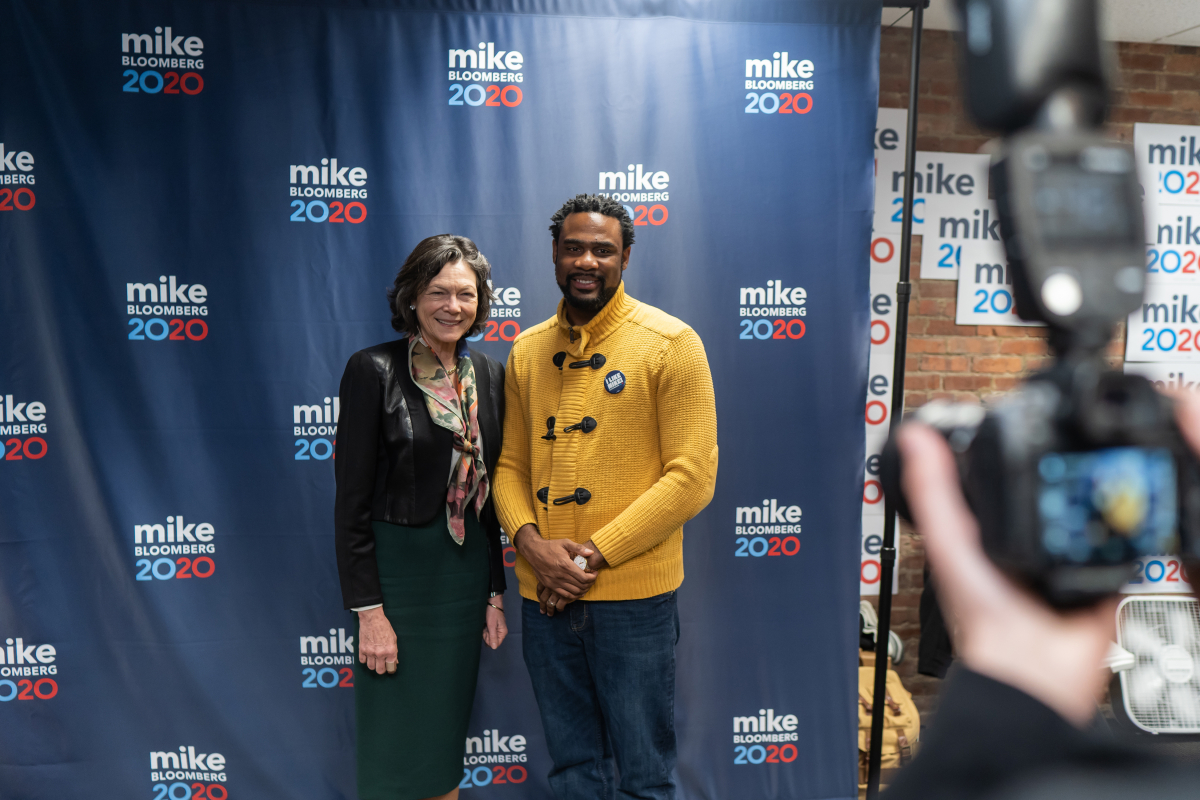
Diana Taylor poses with Rod Wright, a member of the Bloomberg campaign's staff in Nashville. MUST CREDIT: Photo for The Washington Post by Nathan Morgan

Diana Taylor poses with Rod Wright, a member of the Bloomberg campaign’s staff in Nashville. MUST CREDIT: Photo for The Washington Post by Nathan Morgan

Taylor has been traveling the country and explaining to voters why they should pick Mike. Her argument begins with his experience as the three-term mayor of New York City, his philanthropic efforts on behalf of gun control and climate change, and the problem-solving skills that transformed him into a “real” billionaire. As for the warm, fuzzy stuff: His favorite dinner is Shake ‘n Bake chicken, he hates it when you move his stuff around, and he never watched his cameos on “Law and Order.”

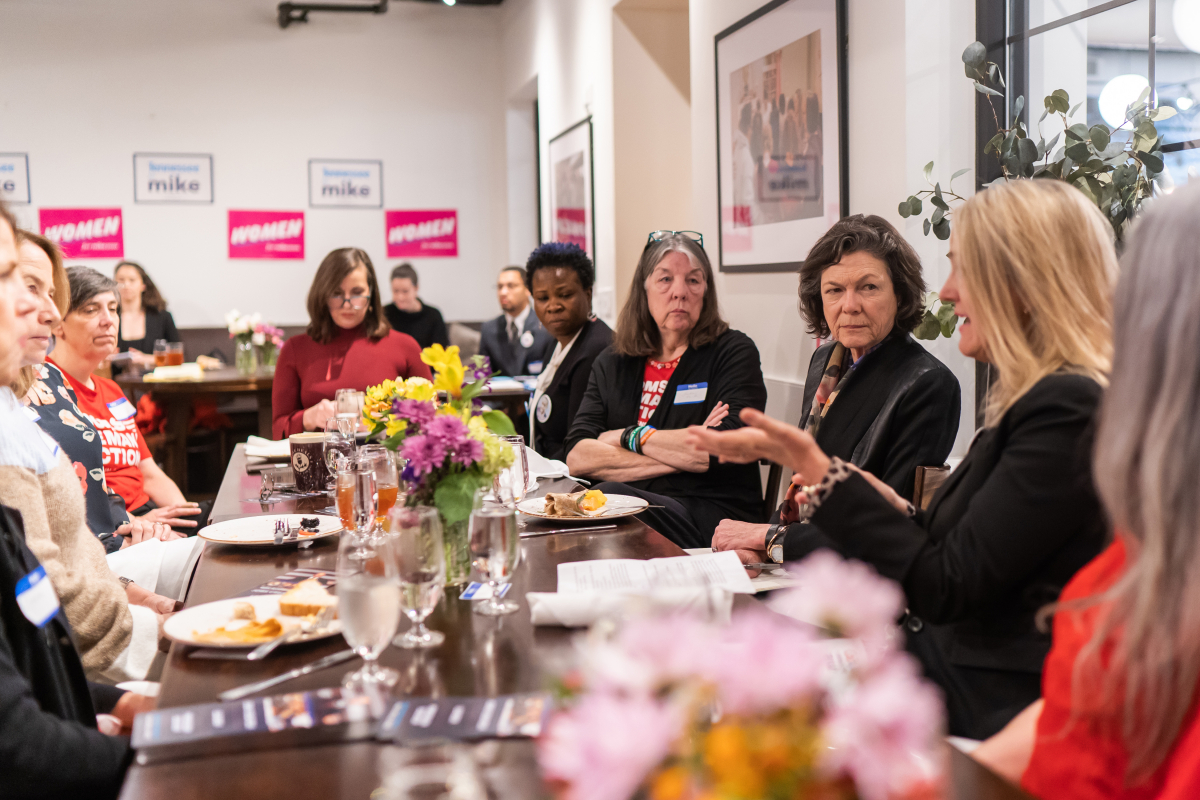
Diana Taylor meets with members of Moms Demand Action: For Gun Sense in America, a group of gun control activists, in Nashville at the Cafe at Thistle Farms. MUST CREDIT: Photo for The Washington Post by Nathan Morgan

Diana Taylor meets with members of Moms Demand Action: For Gun Sense in America, a group of gun control activists, in Nashville at the Cafe at Thistle Farms. MUST CREDIT: Photo for The Washington Post by Nathan Morgan

But by the time Taylor wraps up her always brief remarks, the Republican turned Democrat has unleashed her free-form anxiety over the state of the union, and her message has become less about installing Bloomberg specifically and more about installing anyone – any Democrat who can beat Trump.

Mike Bloomberg and Diana Taylor walk the red carpet at the 2015 White House Correspondents' Association dinner in Washington, D.C. MUST CREDIT: Washington Post photo by Jabin Botsford

Mike Bloomberg and Diana Taylor walk the red carpet at the 2015 White House Correspondents’ Association dinner in Washington, D.C. MUST CREDIT: Washington Post photo by Jabin Botsford

Taylor, 65, and Bloomberg, 77, have been together for 20 years. They did not meet cute. They sat together in 2000 at a business luncheon where he was speaking. He was a billionaire but not yet a politician. He was a Democrat; she was still a Republican. She left early. That evening, they happened to be dining at the same restaurant. “He looked at me and came over and said, ‘Would you like to have a drink after this?’ ” Taylor said yes.

Diana Taylor, left, listens to Brent Hyams, second to left, and Leigh Hendry at a meet-and-greet with supporters at the Ainsworth in Nashville.

Diana Taylor, left, listens to Brent Hyams, second to left, and Leigh Hendry at a meet-and-greet with supporters at the Ainsworth in Nashville.

They’ve been together ever since, which means that she has been around to witness his political affiliations shift from Democrat to Republican to independent and back to Democrat, as well as his ever-growing presidential ambitions, which he first articulated during the lead-up to the 2008 race. “He is a man of incredible capabilities and resources. I’ve always thought that he’d be a really good president,” she says.

It’s lunchtime in New York on Martin Luther King Jr. Day,and Taylor is settled into a roomy booth in a corner of Aretsky’s Patroon, a clubby restaurant on the city’s East Side. Her wardrobe is all tasteful textures and earth tones: a moss-colored suede blazer that’s neatly buttoned, slim trousers the color of yams. It’s not what one might describe as power dressing as much as it’s old money attire. The power is understood. She has wielded a significant amount of it.

Her career began on Wall Street at the dawn of the masters of the universe era of the 1980s. She survived it unscathed. In 2003, Gov. George Pataki appointed her New York State’s superintendent of banks, a financial watchdog who protects the public when bankers run amok. She sits on a host of boards, including Citigroup and Sotheby’s. She considered running for the Senate seat now filled by Kirsten Gillibrand, D-N.Y.

At the time, however, Bloomberg was mayor, and she didn’t want to come home to the townhouse the two still share on the Upper East Side and argue about the often conflicting interests of the city and the state over dinner. And besides, if she spent her weekdays in Washington, what would she do with her dogs, two labradors named Bonnie and Clyde? (They have since passed away, succeeded by Cody and Libby.)

“What was enticing about it was, I think I would have really enjoyed running,” she says. “You need to know what you stand for and what you want to do and what you want to accomplish. And you need to know what’s going on with the people that you would be representing because it’s a service job.”

“It is absolutely a service job,” she repeats, as if this fact has gotten muddled in recent years.

Taylor could be referred to in many different ways. And yet, the New York Post regularly called her Bloomberg’s “gal pal.”

“That one I hate,” Taylor says.

“I hate ‘girlfriend’ because it sounds so temporary,” Taylor continues. “It’s very junior high.” Partner implies that theirs is a business relationship; companion has shades of “the other woman”; consort is practically Victorian.

“Nobody’s come up with the language around what we are,” she says.

There’s the tendency to assume that an unmarried, childless woman is on her way to, in pursuit of, desirous of, marriage and children. Why isn’t Taylor married? She was married once and divorced. Why doesn’t she have children? “I never had kids because there was never anyone I wanted to have kids with.”

While wife and mother are two words that do not apply to Taylor, there are plenty others that do. “I define myself first and foremost as I’ve had a fairly successful career,” she says. “I define myself by my family: my parents or my brother or sister and their families.”

“And then obviously, as Mike’s partner or whatever you want to call it,” she says. “And sort of a step- whatever for Mike’s children – friend, I guess.”

Taylor is taking these identities, this highly relatable independence, on the campaign trail, where her message is focused on lifting up women as individuals – not as marital appendages, nurturing multitaskers or a voting bloc of uteri.

“Her famous boyfriend may be the least interesting thing about her,” says Vogue editor Anna Wintour, who has known Taylor for years and welcomed her into the magazine’s famed “closet” when her social life went into overdrive as the city’s “de facto first lady,” as she was called.

“She’s intelligent, independent – and completely her own person. Michael is lucky to have her.”

– – –

Taylor is an introvert who says she enjoys campaigning. Campaigning is showing up for dinners where you thoughtfully order the local specialty but take little more than a bite. At roundtables, people unfurl stories of their struggles, and you become saturated with their pain. You stand empty-handed at the center of a cocktail party where everyone else sips wine and wait for you to dazzle them. But will they even remember what you said after all the free booze?

Taylor encourages everyone to listen to Bloomberg’s Greenwood speech about economic justice. She points out that he’s a longtime supporter of Planned Parenthood. Meanwhile, listeners try to suss out just who she is: Oh really, they’re not married?

“We women are killing our careers and I really respect how she’s her own woman but still stands beside him,” says London Lamar, 29, a state representative from Memphis and a Bloomberg supporter. “Especially down South, we’re under such pressure to have a ring on your finger and have children. And there’s nothing wrong with that, but it’s not everyone’s path.”

Two days after lunch in New York, Taylor is road-tripping through Tennessee, even though voters in this red state don’t go to the polls until March 3, Super Tuesday. Because Bloomberg entered the race too late to compete in states that vote earlier, he’s running a national campaign with special emphasis on the March primaries and caucuses.

Taylor’s stump speech isn’t a barn burner with a dramatic crescendo. Her voice is pitched low and calm. She doesn’t hack at the air with her hand or jab at it with her thumb. She stands with her arms loosely folded in front of her – narrow shoulders drawn back in studiously erect posture – as if she’s always slightly chilled.

“I’m tired of waking up every morning to some demented tweet. The No. 1 objective we should all have is getting (Trump) out. And the way to do that is elect a candidate for the Democratic Party who can beat Trump,” Taylor says to a group of mostly young African American women at the black-owned restaurant Mahogany Memphis. “You all decide who that is. And we all need to get behind them.”

“I think it’s Michael Bloomberg,” she says. “I’m biased.”

Taylor listens more than she talks. She writes notes in a little journal. She doesn’t use notes when she speaks.

Candice Jones, a petite black woman with a cloud of dark hair framing her face, asks Taylor to explain Bloomberg’s thinking on the stop-and-frisk policing program in New York. Bloomberg has apologized for not recognizing its impact in minority communities.

“Kids were being killed on the street. In the short term, the way to solve that problem was to get guns off the street and that was the fastest way to do it,” Taylor says. “As time went on, he realized, talking to people, that stop-and-frisk had gone overboard and he cut it way back.”

“Yes, it was bad. It was horrible. It affected people’s lives in a very negative way,” she says. “But the reason he was doing it was to stop people from being killed.”

Her answer isn’t laden with statistics; she doesn’t have a heart-tugging story at the ready. “Diana gave a very legitimate response. He reacted to an immediate condition,” says Jones, 36, an executive committee member of the Shelby County Democrats. “Sometimes we react to issues because we want results.”

She describes Taylor as “relatable” – a squishy, fuzzy, often-repeated term. What makes this white, baby boomer New Yorker relatable to Jones, a black millennial from Memphis?

“There was one moment when her grammar slipped,” Jones says with a smile.

– – –

Taylor is often described as tall. What people really mean is that she is significantly taller than Bloomberg, who is 5-foot-7, according to his campaign. She has layered dark hair and a willowy physique of the sort that women seek through barre classes but that only genetics can produce. When Taylor’s face is at rest, the echoes of a lifetime of broad smiles spread out around her eyes and across her cheeks.

Taylor grew up in Old Greenwich, Connecticut, which is the tonier section of the supremely tony Greenwich. Her father, E. Douglas Taylor, was an executive at Union Carbide. Her mother, Lois, was a teacher at Greenwich Country Day, the private school Diana Taylor attended from first through ninth grade. She spent a year at Milton Academy in Massachusetts then graduated from Greenwich High School and went on to Dartmouth College.

Her world was rarefied and white, and one might assume she is missing full knowledge of what it means to be black, brown or poor. She describes her upbringing as middle class but from the vantage point of a blue-collar clock-puncher, it reads as well-to-do.

When she was in Detroit, a predominantly black city, to talk with female entrepreneurs, at least one of the guests was expecting “a pinkie up” lunch, as Taylor recalled. She presumed, incorrectly, an encounter with a snob.

“I was was never really exposed to anybody who wasn’t just like me until, basically, I went to college. And then I came to New York. The first Jewish person I really came across was somebody I worked with after I graduated,” she says. “She invited me to go to a seder. I had no idea what it was.”

“One thing that I found is that everybody has an interesting story,” she says. “You just have to get there and build a trust with the person to get them to talk.”

In between the bullet points of her well-heeled life, there’s the story of an ambitious woman coming of age personally and professionally in spaces where misogyny was as common – and as uncommented on – as oxygen. She faced roiling tides of sometimes-toxic masculinity at Dartmouth, where she was in the second class of women, and there were few black or openly gay students.

“The guys, when they were in big groups, they could be really obnoxious,” she says. “One-on-one, they were great.”

“It was all built around the fraternity,” Taylor says of the school’s social environment, which was part of the inspiration for the 1978 film “National Lampoon’s Animal House.” “One of the things you learned was when to be somewhere and when not to be. You do not go to fraternity basements at two o’clock in the morning, for instance.”

“I absolutely loved it; but it was hard.”

After finishing Dartmouth in 1977 with a degree in economics, she decided to go to Columbia University for business school. Her parents, rooted in a “Mad Men” mentality, were not pleased.

“It was the first fight I had with my father,” she says. ” My father basically said, why are you going to business school? You’re just gonna get married and have kids and you won’t use your degree. And it’s expensive,” Taylor recalls.

“We had a knockdown, drag-out fight, which was great. Yeah. In the driveway. My father said, ‘You’re on your own.’ So I financed it through student loans. I had two jobs,” she says. “So anyway, actually, it was a really good experience.”

“Anyway …” It’s a verbal tick, a way to ease out of a difficult subject, to refuse the temptation to navel gaze or complain. It’s a confident shrug: everything will be fine. “Anyway …”

She had a part-time job as an administrator at St. Vincent’s Hospital. She worked in the evenings and after her shift ended around midnight, she would take the subway back to the one-bedroom apartment she shared with two other women on the Upper East Side.

“It was in a really bad part of Brooklyn; St. Vincent’s was on the way down to the docks in Red Hook,” she says. “That was terrifying.” It was the late 1970s and the city had barely survived a fiscal crisis. A blackout had sparked mass looting and violence. And the son of Sam murders had terrorized residents. Anyway …

When Taylor began her career at Smith Barney, the company was thick with testosterone. One night she was typing at a secretary’s desk. “Morgan Murray ([Smith Barney’s head of public finance) came by and said, ‘I never want to see you typing again. You are an associate; you do not type.’ I said, ‘But I’ve got to get this done.’ He said, ‘Don’t type.’ ”

“Thinking back on it, that was really pretty amazing. He realized the women were secretaries and if you were a woman and you were typing, you’d be cast as a secretary – not as a professional.”

Taylor had faith that if she worked hard, she’d get ahead and for a while that seemed to be true. She was recruited by Lehman Brothers; she moved on to Donaldson, Lufkin & Jenrette, where she was a senior vice president and helped set up the public finance department.

“I found out that the guy sitting down the hall from me, who had the same title as I did and I did more than he did, his bonus was bigger than mine,” she says. ” And at that point, I got really angry.” Anyway.

She left the firm. It’s with that backstory of having been undervalued that she now chairs the board of the microlending nonprofit ACCION and the employment skills organization Hot Bread Kitchen.

“It could not have been easy to be a woman in that field at that stage,” says Michael Schlein, who worked at Smith Barney in the early 1980s and is now the president and CEO of ACCION.

“Did being a pioneering woman on Wall Street shape her views on empowerment? I don’t know what her motivation is,” Schlein says, “but I think her commitment is deep and sincere.”

– – –

Diana Taylor could use a drink.

In Memphis, she listened to the story of a pregnant woman who had been reassured at her doctor’s visit that her baby was fine only to have a stillbirth shortly thereafter. By lunchtime she was in Nashville, where she met with members of Moms Demand Action: For Gun Sense in America and spoke aloud the name of a man’s brother who was the victim of an unsolved shooting: Christopher. Taylor, who has a masters in public health, leaned in when a mother still grieving over her son’s shooting death explained how grief counseling isn’t covered by health insurance. The next morning, it was Knoxville where she heard a story of how the desperately hungry can be racist toward the very people trying to feed them.

But for now, it’s dinnertime in Nashville, and potential Bloomberg supporters, including several former Trump voters, are gathered at the Ainsworth restaurant. Everyone seems to be sipping campaign wine except Taylor, who is empty-handed but for her reading glasses. She has been listening all day. And really listening is exhausting. She meets and greets with a quiet voice that demands listeners lean in.

“I’m sort of a unique partner of a presidential candidate on a lot of different levels,” Taylor says. But “I think I have a pretty good idea of who I am at this point.”

Hunting is declining, creating a crisis for conservation #ศาสตร์เกษตรดินปุ๋ย

#ศาสตร์เกษตรดินปุ๋ย : ขอบคุณแหล่งข้อมูล : หนังสือพิมพ์ The Nation

https://www.nationthailand.com/lifestyle/30381498?utm_source=category&utm_medium=internal_referral

Hunting is declining, creating a crisis for conservation

Feb 03. 2020
Canada geese fly over the Middle Creek Reservoir as others rest on the ice in the Middle Creek Wildlife Management Area in Stevens, Pennsylvania, on Jan. 9, 2020. MUST CREDIT: Photo for The Washington Post by Kyle Grantham

Canada geese fly over the Middle Creek Reservoir as others rest on the ice in the Middle Creek Wildlife Management Area in Stevens, Pennsylvania, on Jan. 9, 2020. MUST CREDIT: Photo for The Washington Post by Kyle Grantham
By The Washington Post · Frances Stead Sellers · NATIONAL, SCIENCE-ENVIRONMENT 

STEVENS, Pa. – They settled, watchfully, into position – a retired couple armed with a long-nose camera and three men with shotguns.

Tom Stoeri balanced the hefty lens on his half-open car window, waiting to capture the Canada geese as they huddled on the frozen lake, fluttering up in occasional agitation before they launched into flight.

Nick Semanco, left, and Adam Saurazas set up their blind in the Middle Creek Wildlife Management Area in Stevens, Pennsylvania, on Jan. 9, 2020. MUST CREDIT: Photo for The Washington Post by Kyle Grantham

Nick Semanco, left, and Adam Saurazas set up their blind in the Middle Creek Wildlife Management Area in Stevens, Pennsylvania, on Jan. 9, 2020. MUST CREDIT: Photo for The Washington Post by Kyle Grantham

A little more than a mile away, John Heidler and two friends scanned the skies from a sunken blind, mimicking the birds’ honking and hoping their array of decoys would lure them within range – until, Pachow! Pachow! Pachow! Two geese dropped in bursts of gray-black plumage, and a third swung low across the snow-streaked landscape before falling to the jaws of Heidler’s chocolate lab.

Public lands such as these at the Middle Creek Wildlife Management Area are a shared resource, open to an unlikely mix of hunters and hikers, birdwatchers and mountain bikers.

Archery students retrieve their arrows at the Lancaster Archery Supply Academy range in Lancaster, Pennsylvania. on Jan. 9, 2020. MUST CREDIT: Photo for The Washington Post by Kyle Grantham

Archery students retrieve their arrows at the Lancaster Archery Supply Academy range in Lancaster, Pennsylvania. on Jan. 9, 2020. MUST CREDIT: Photo for The Washington Post by Kyle Grantham

“It’s a symbiotic thing,” said Meg Stoeri, Tom’s wife and fellow photographer.

But today, that symbiosis is off-kilter: Americans’ interest in hunting is on the decline, cutting into funding for conservation, which stems largely from hunting licenses, permits and taxes on firearms, bows and other equipment.

Adam Saurazas, left, and Nick Semanco haul sleds of hunting equipment tin the Middle Creek Wildlife Management Area in Stevens, Pennsylvania, on Jan. 9, 2020. MUST CREDIT: Photo for The Washington Post by Kyle Grantham

Adam Saurazas, left, and Nick Semanco haul sleds of hunting equipment tin the Middle Creek Wildlife Management Area in Stevens, Pennsylvania, on Jan. 9, 2020. MUST CREDIT: Photo for The Washington Post by Kyle Grantham

Even as more people are engaging in outdoor activities, hunting license sales have fallen from a peak of about 17 million in the early ’80s to 15 million last year, according to U.S. Fish and Wildlife Service data. The agency’s 2016 survey suggested a steeper decline to 11.5 million Americans who say they hunt, down more than 2 million from five years earlier.

“The downward trends are clear,” said Samantha Pedder of the Council to Advance Hunting and the Shooting Sports, which works to increase the diversity of hunters.

The resulting financial shortfall is hitting many state wildlife agencies.

In Wisconsin, a $4 million to $6 million annual deficit forced the state’s Department of Natural Resources to reduce warden patrols and invasive species control. Michigan’s legislature had to dig into general-tax coffers to save some of the state’s wildlife projects, while other key programs, such as protecting bees and other pollinating creatures, remain “woefully underfunded,” according to Edward Golder, a spokesman for the state’s natural resources department. Some states, including Missouri, are redirecting sales tax revenue to conservation.

Here in Pennsylvania – where the game commission gets more than 50% of its revenue from licenses, permits and taxes – the agency had to cancel construction projects, delay vehicle purchases and leave dozens of positions vacant, according to a 2016 report, even as it tackled West Nile virus and tried to protect rare creatures such as the wood rat.

“That’s what keeps me up at night,” Robert Miller, director of the Governor’s Advisory Council for Hunting, Fishing and Conservation, said of the inadequacies of the user-pay, user-play model that has funded conservation for decades.

A national panel has called for a new funding model to keep at-risk species from needing far costlier emergency measures. The crisis stands to worsen with as many as one-third of America’s wildlife species “at increased risk of extinction,” according to a 2018 report published by the National Wildlife Federation. In December, environmentalists and hunters united in Washington behind two bipartisan bills aimed at establishing new funding sources and facilitating the recruitment of hunters.

The needs are becoming more urgent as development eats into habitats and new challenges crop up, such as climate change and chronic wasting disease, a neurological condition infecting deer. The Trump administration’s recent rollback of pollution controls on waterways will put a greater burden on states to protect wetland habitats.

The financial troubles are growing as baby boomers age out of hunting, advocates say, and younger generations turn instead to school sports and indoor hobbies such as video games.

“Hunting and fishing are slowly dying off,” said Heidler, who described himself as “a fourth-generation waterfowler.”

While his children enjoy the lifestyle, he said very few of their friends do.

“They say there’s not time between school and after-school activities,” he said, adding that even archery rarely leads children into hunting anymore.

The sport is booming at Lancaster Archery Supply, where Kevin Sweigart takes his 14-year-old daughter for lessons. Sweigart said he grew up hunting, but the culture has changed and he hasn’t passed on the tradition to the next generation.

“My dad always told me stories about hunting,” said Norah Sweigart. “But for me it’s just target shooting.”

Many states are devising ways to reinvigorate hunting culture and expand the sport’s appeal to women, minorities, and the growing number of locavores – people who seek locally sourced food.

Colorado has a Hug a Hunter campaign to raise awareness of wildlife management and outdoor recreational opportunities. Pennsylvania, where the number of licensed hunters has dropped from 927,000 to 850,000 over the past decade, is trying to stall the decline with “R3 activities” – efforts to recruit, retain and reactivate hunters.

The state is relaxing its ban on Sunday hunting this year to increase opportunities for working families. The game commission plans to bring a food truck to community gatherings to familiarize people with eating wild game. And it will expand on mentored outings for young people and first-time female hunters.

In October, Derek Stoner, the commission’s hunter outreach coordinator, helped arrange a deer hunt for 20 newcomers, many from the city, with 14 trained mentors at the John Heinz National Wildlife Refuge in Tinicum, just south of Philadelphia.

Elena Korboukh, a teacher from South Philadelphia, recognized that the event was “a kind of PR campaign to promote hunting,” but she said she welcomed the chance to connect with nature – an opportunity she wishes she could offer her students.

“I had hiked the refuge for close to 20 years, but you don’t see a lot when you are moving,” said Korboukh, who killed a deer with a crossbow during the October event. “When you are sitting still, you see a lot, and it’s very, very exciting.”

Pat Oelschlager, one of the mentors at the Heinz hunt, continues to take out inexperienced hunters. On a dank January afternoon in Evansburg State Park, Oelschlager set out to stalk deer with Lenny Cohen, who said he wanted to get closer to his hunter-gatherer roots, which he felt distant from, growing up in the Philadelphia suburbs.

Neither targeted a deer that day but Oelschlager fielded Cohen’s questions about animal behavior, hunting etiquette and the names of native plants.

“Lots to learn!” Cohen said, smiling as he released cattail fluff into the air to watch which way the light breeze was carrying his scent.

A few states are bucking the trend. New Mexico, where the number of licensed hunters grew nearly 10% over the past four years, credits its successes to R3 strategies such as making license applications available online and seeking out Latino residents.

Many national hunting advocacy groups, such as Backcountry Hunters and Anglers, have made cultivating interest among people who have had little exposure to the outdoors key to their missions. The National Shooting Sports Foundation is seeking to turn what its research suggests is about 2.5 million “aspiring hunters” into actual hunters.

Other groups aim to create experiences that appeal to women, including BOW (Becoming an Outdoors Woman) and the National Wildlife Federation’s Artemis.

“I have had more dance parties in the field with women,” said Artemis’s leader, Marcia Brownlee. “And laughed more.”

But revamping the federal funding model has proved tough. A proposed tax on outdoor gear, for example, was killed by resistance from retailers and manufacturers.

The link between hunting and conservation dates back more than a century to when trigger-happy gunmen all but blasted the bison population to oblivion and finished off North America’s most abundant bird, the passenger pigeon. (Martha, the hapless final specimen, died in 1914 in the Cincinnati Zoo before being shipped, on ice, to Washington and put on display at the Smithsonian.)

Small wonder that hunters were asked to curb – and pay for – their excesses. Avid outdoorsmen such as Theodore Roosevelt put their stamp on an enduring ethos that combined sport with conservation and led to the 1937 passage of the Pittman-Robertson Act, which imposed an 11% excise tax on the sale of firearms that is apportioned annually to state agencies for conservation.

While critics say the system puts too much emphasis on hunted animals and birds, it has turned the tables for many species, including the now-ubiquitous Canada goose and whitetail deer, which had been in decline.

“The species that we have funded have done very well,” said National Wildlife Federation President Collin O’Mara, “which means it’s a fixable problem.”

In December, Congress modernized Pittman-Robertson as part of the Omnibus Appropriations Act, giving states greater discretion in their use of federal dollars for recruitment. House legislators also took bipartisan steps to advance the Recovering America’s Wildlife Act, which would provide states and tribes with $1.4 billion annually from the general fund to restore habitats and implement key conservation strategies. The bill now heads to the House floor for a full vote.

“It’s exciting to see sportsmen’s groups working with greener groups,” O’Mara said.

Still, at Middle Creek and beyond, conservation remains a constant balancing act – not only among the plentiful waterfowl, the returning bald eagles and rare bog turtles – but also among the people.

In a month or so, busloads of tourists will park along the lake, many having flown in from Asia, to see tens of thousands of snow geese stop over on their route north to their breeding grounds.

It’s a miraculous sight, free and open to everyone, that has inspired Tom and Meg Stoeri, the wildlife photographers, to bring along their grandchildren.

Tom Stoeri noted that the otter on their special license plate reflects their support of the state’s wild resources.

“I would pay more,” he said. “But I don’t know if the general population would.”

Amy Klobuchar was kicked out of the hospital 24 hours after giving birth. Her outrage fueled her political rise. #ศาสตร์เกษตรดินปุ๋ย

#ศาสตร์เกษตรดินปุ๋ย : ขอบคุณแหล่งข้อมูล : หนังสือพิมพ์ The Nation

https://www.nationthailand.com/lifestyle/30381403?utm_source=category&utm_medium=internal_referral

Amy Klobuchar was kicked out of the hospital 24 hours after giving birth. Her outrage fueled her political rise.

Feb 01. 2020
Sen. Amy Klobuchar, D-Minn., takes in the crowd during a town hall in Ames, Iowa, on Sunday. MUST CREDIT: Washington Post photo by Bonnie Jo Mount.

Sen. Amy Klobuchar, D-Minn., takes in the crowd during a town hall in Ames, Iowa, on Sunday. MUST CREDIT: Washington Post photo by Bonnie Jo Mount.
By The Washington Post · Marc Fisher

Amy Klobuchar was exhausted, exhilarated, shaken by a dizzying mindstorm of joy and pain. She’d been in labor for 18 hours, hadn’t slept in two nights, and now she’d given birth to Abigail and life was everything it could ever be. The baby “had all her fingers and toes and seemed quite healthy, except for some mucus in her throat,” Klobuchar recalled.

The new mother called her parents, filled out forms and finally dozed off.

Before long, someone woke her up: “Suddenly the nurse comes in and says ‘She can’t swallow. Everything comes out her nose,'” said Klobuchar, then a 35-year-old lawyer in Minneapolis, now a 59-year-old senator running for president. “And so from that moment on, it was like a disaster.”

The pediatrician on-call had news: “We think she needs emergency surgery.”

In her first day of life, Abigail was rushed into intensive care, subjected to a battery of scans and tests, and put under anesthesia so doctors could peer down her throat.

As that first day ended, though, a nurse plopped Klobuchar into a wheelchair and her husband, John, rolled her out of the building.

“Your time is up,” a nurse told her.

“And I go, ‘What?'” Klobuchar recalled. “And they said, ‘There’s just no way we can waive it.'”

In 1995, many American mothers faced that same arbitrary deadline: Insurance companies and hospitals, eager to trim costs, were sending women home after a maximum 24-hour stay, even when their babies required further treatment. Opponents of the practice called them “drive-through deliveries.”

Twenty-five years later, Klobuchar traces her political awakening to that moment, when the most fundamental fear any parent can face transformed her into a determined activist.

“I was obsessed with it, reading up on it,” she recalled. “I saw it as injustice for moms. I thought if men had babies, this would never happen. It was one of those one-size-fits-all policies that just didn’t allow for any humanity. You’ve been up for 48 hours, you’re a brand-new mom and you have no idea what you’re doing, and they kick you out. You don’t know if your child’s going to live.”

On that first day of Abigail’s life, Klobuchar’s friends and relatives called to find out when they could visit her in the hospital. You can’t, she had to tell them.

Klobuchar, who made her living representing big telecom companies, was told to sign forms saying she and John had watched the required videos on infant care, even though there’d been no time to see them.

“We lied and signed the forms,” Klobuchar said.

She rolled out of the maternity ward still wearing her hospital gown, heading to a $50-a-night hotel, where she would get precious little sleep. The hospital needed her to return every three hours to pump breast milk for struggling Abigail, who was being fed through a tube in her stomach.

Klobuchar stayed in the gown for three days, hurrying back and forth to the hospital all night long. Her baby would stay in the hospital for a week and then face a precarious and scary first year.

“Literally for the first six months, they thought she had cerebral palsy,” Klobuchar said. “They just didn’t know what was wrong. She had a nose tube for the first three months. That’s how we fed her, through a tube.”

– – –

Five months after the birth of her only child, Klobuchar made the short drive to St. Paul, Minnesota, to the state capitol, where she made her first appearance before a legislative committee. The case she argued was her own.

Klobuchar urged lawmakers to “pass a law to protect mothers’ and babies’ rights. . . . What happened to me after I gave birth should never happen to anyone again. It was barbaric.”

Politics was nothing new to Klobuchar: Her father was a prominent newspaper columnist, she wrote her thesis at Yale on a thorny political issue in Minneapolis, and she’d already been a campaign manager for a county commissioner.

“The incident wasn’t my first rodeo in terms of being interested in politics, but it was in terms of having this gut-wrenching experience and then matching it with action,” she said.

Klobuchar didn’t appear to be a novice at political stagecraft. She brought six visibly pregnant friends to the hearing to be a visual prod for the lawmakers. The idea was to outnumber the insurance companies’ lobbyists.

It worked. It forged a bond with Minnesota voters that has endured to this day – a connection she has thus far struggled to make in Iowa and elsewhere on the presidential campaign trail. And it created an indelible moment that she would use a decade later in a TV ad that some say played a major role in her win in a Senate race.

“She has been smarter at exploiting that story than the reality of how instrumental she was in getting the bill passed,” said Dave Schultz, a political science professor at Hamline University in St. Paul who focuses on Minnesota politics.

But Klobuchar and some of the lawmakers she testified before say her first public venture into the political fray was anything but calculated.

It was a moment when Klobuchar discovered her passion for politics – an early sign she would be a politician who aims, as her campaign slogans have put it, to “get things done.” She would be a practical moderate rather than someone who challenges the system, someone who devotes her energy to pushing for one more day in the hospital, not for a completely new approach to health care.

“It greatly affected how I viewed the world,” Klobuchar said, “because I felt, wow, you know, really bad things can happen to regular people that make no sense at all. And someone’s got to stand up and fight it.”

– – –

The fight she knew best was the one she’d taken on at home. Her father, Jim, was a household name in Minnesota, a writer at the Minneapolis Star Tribune who chronicled the struggles and triumphs of ordinary people. But as famous as he was, Jim was both a hero and an embarrassment to his daughter.

He was arrested several times for drunken driving; each time, the story appeared in the newspaper where he was a showcased columnist. After one arrest, Amy found the word “drunk” plastered across the front of her school locker.

Amy suffered the stings when her father missed birthdays, vanished on Christmas, went AWOL from her college graduation. She pushed back: She took away her father’s car keys. She did everything she could to impress him, to win back his attention: ran for and won a seat on the student council in high school, became valedictorian.

“I once called the newspaper to try to get their help,” she recalled. “‘Oh, no, it’s fine,’ they said. ‘We just celebrated his sobriety.’ No, it’s not fine.”

In 1993, she staged a full-scale intervention, took her father to an addiction counselor and told Jim she loved him but he had to change.

She was always trying to alter her father’s behavior. “That’s a common trait of a kid of an alcoholic,” she said. “And I always think it’s so interesting: Someday, studies should be done of how many kids of alcoholics or people with drug addictions get involved in politics. You see this wrong and you want to fix it your whole life, and in my case, I was successful, actually.”

Her father stopped drinking, but his daughter kept trying to fix things.

She took an express lane to success: Yale, University of Chicago Law School, a big law firm. Former vice president Walter Mondale became a mentor. And she began climbing the ladder of local politics – party activist, convention delegate, campaign worker.

“It was clear she was going into elective politics,” said Mark Andrew, the former Hennepin County commissioner whose reelection campaign Klobuchar ran in 1990.

Klobuchar devotes the single longest chunk of her presidential campaign stump speech to the tale of her fight against drive-through deliveries. She gets a big laugh from Iowa audiences with a line she first used in her maiden speech before Minnesota legislators a quarter century ago:

“I learned a very valuable lesson. Back then, it was almost all men on the committees, and if you talk about really embarrassing things like episiotomies, they would, like, let you pass the New Deal.”

Audiences adore her story about bringing pregnant friends to pack the hearing room. And they applaud when she takes credit for the win. “So that was how we passed one of the first laws in the country guaranteeing new mothers and their babies a 48-hour hospital stay,” she says.

Victory has a thousand fathers, the old saying goes.

Don Betzold, the state senator who proposed the bill to end the 24-hour limit on mothers’ hospital stays, recalled the effort as the highlight of his career in the legislature. He said he drafted the bill after his wife, Leesa, was required to leave the hospital one day after their son, Ben, was born. Leesa later brought her infant to sit with her in the gallery to watch the debate on her husband’s bill – a move that one legislative leader told her was “unfair.”

Joe Opatz, the sponsor on the House side, also said the drive-through deliveries bill was “the most significant legislation I was involved in.” He too was motivated by personal trauma – the birth of his son and the hospital’s decision to send his wife packing. “We got home and Simon was struggling and we had to take him back to the ER,” Opatz said.

It was Opatz who got the call from Klobuchar, offering herself as a witness.

“Amy packed the conference room with these pregnant women and they made a pretty big impression,” Opatz said. “She’d had a much more traumatic experience with her daughter than I had with our son. The lobbyists for the hospitals and insurance companies tried to delay the bill and kill it, but the public response was amazing.”

Like Opatz, Betzold recalls Klobuchar as “a compelling witness – she was great.”

But by the time the drive-through deliveries issue blossomed in Minnesota, it had swept through much of the nation, and the insurance companies and hospitals fighting to keep the 24-hour limit had taken their defense underground, making their arguments largely behind closed doors for fear of public confrontations with angry mothers and pregnant women.

The insurance industry’s arguments were never going to be popular; an internal memo from the Kaiser Foundation Health Plan defended “the Eight-Hour Discharge” of new mothers by saying it helped mothers because “hospital food is not tasty” and it helped employees because the policy would “reduce our overhead costs.”

Klobuchar talks about Minnesota’s law requiring a minimum 48-hour stay as one of the first, but in 1995, the rebellion against drive-through deliveries “was one of the fastest-moving issues I ever saw,” said Kathryn Moore, who runs state government affairs for the American College of Obstetricians and Gynecologists, which argued against the 24-hour limits.

The movement against those quick hospital exits was part of a nationwide backlash against managed care, the then-new system in which health-care companies put even stricter limits on patients’ access to care.

“New Jersey and Maryland were first,” Moore said. “Then it just took off.” Laws requiring a longer minimum stay passed in three states in 1995 and another 25 in 1996. “It was just a groundswell of pregnant women with their babies. We didn’t have to lobby on this – it was organic, spontaneous, the perfect storm. Motherhood and apple pie, David vs. Goliath.”

There was some pushback against change in Minnesota. A House member and family doctor, Richard Mulder, led the charge for keeping the 24-hour limit, saying he had delivered a thousand babies and had only rarely seen anyone who needed to stay more than a day in the hospital.

“I made sure my wife stayed in the hospital five days,” said Mulder, now 81, “but then she told me it was a waste of time and money. And I did some research and found that many mothers couldn’t afford the longer stay and in most cases, it just wasn’t necessary.”

Mulder, a Republican who says his defense of the 24-hour stay got him elected against an incumbent Democrat he portrayed as a big spender, scoffed at the show Klobuchar put on: “Heck, I could get a hundred mothers to come to a hearing to say that, but that’s not science.”

But Mulder was realistic enough to see that Klobuchar’s maneuver would likely succeed: “You always get more votes if you side with the little guy, in this case, the baby. Amy was easy to talk to, and she charmed them, but she didn’t know what she was talking about.”

Mulder’s lobbyist allies shied away from public battle, especially after, as Betzold recalled, an insurance company lobbyist testified that insurers shouldn’t have to pay for women “to take a vacation” after giving birth.

“His remark was not well received,” Betzold said.

“The lobbyists saw the handwriting on the wall,” Opatz said. “All they could do was try to delay implementation of the 48-hour requirement.”

Klobuchar spoke to legislators for 12 minutes. She was passionate, emotional, funny. “You could tell right away she had a knack for it,” Opatz said.

By a vote of 126-8, the Minnesota House passed the bill giving mothers and babies an extra day in the hospital.

The episode pushed Klobuchar into a new chapter of her career. As she puts it in her campaign stump speech this year, “the next thing that I did is just kind of start running for office.”

Actually, she had announced the year before Abigail was born that she was running for county attorney, the chief prosecutor position in the area around Minneapolis. But she had withdrawn immediately when the incumbent, an ally of hers, decided to seek another term. Now, she geared up to compete for the job in the 1998 election.

The push for the 48-hour law changed how she presented herself in politics: “Women’s and family issues rose up her list of priorities,” said Andrew, the county commissioner whose campaign she had run. “Before that, she was a do-gooder, very much a good government person, focused on transparency.”

But after the drive-through deliveries debate, Klobuchar’s focus shifted from opening up public records to kitchen table and family issues, especially those of importance to women. For Klobuchar, policy had hit home.

– – –

Klobuchar’s story was set. She won the prosecutor’s job with a get-tough appeal, under the slogan, “Safe Streets. Real Consequences.” But she talked to audiences “all the time about the experience with Abigail,” according to a person who was involved in the early campaigns and spoke on the condition of anonymity to maintain a relationship with Klobuchar. “It was how she humanized herself and demonstrated that she can get things done.”

Eight years later, running for Senate, her campaign ran a TV ad about the drive-through delivery fight. Over melancholic music and a heartbreaking image of newborn Abigail in an incubator, Klobuchar describes how her daughter was “hooked up to machines” while the hospital kicked the new mother out the door. The music swells and Abigail, a decade older, twirls around as she walks between her parents and her mother tells the story.

That joyful spin and Abigail’s double thumbs-up at the end of the ad were “just normal” for her, Klobuchar said. “They didn’t tell her to do that. And then we put that on our Christmas card. It became her signature thing.”

The ad was a hit, “one of the smartest political ads I’d ever seen in Minnesota,” said Schultz, the political scientist. “She was running maybe three points ahead, and she runs that ad and her lead jumps up to 13 or 14 points and she never has to look in the rearview mirror again. She got about 60% of the women’s vote. It was pinpoint accurate in hitting suburban women.”

But some Minnesota Republicans say that’s not how it happened, arguing that the election turned instead on the unpopularity of President George W. Bush and the Iraq War. “It’s a nice, after-the-fact narrative,” said a senior adviser to Mark Kennedy, Klobuchar’s opponent in that race, who spoke on the condition of anonymity.

Klobuchar hasn’t faced a serious challenge since that first Senate election. She has made her name in Washington on issues such as toy safety, swimming pool standards, anti-sex trafficking measures and clearing the backlog of rape kits in sexual assault cases – topics that sidestep the usual partisan divisions.

“She’s never really pushed on more controversial issues,” Schultz said.

Klobuchar sees herself as consistently pressing against “entrenched interests. And it started from that moment when I did the maternity bill,” she said. “Yes, it was about women and how women are treated in the health-care system. But I think at its core, it was about injustice.”

After the hospital stay debate, she said, she went from caring mainly about things like “What’s the best policy on recycling?” to “using the limited power that I have as one senator . . . to take on lead in toys” – issues people face at home every day.

“It’s always been a huge motivation for me when I think people have been basically screwed,” Klobuchar said.

Now, in the final days before the Iowa caucuses that could either propel her into the top rung of candidates or make it tough for her to continue in the race, Klobuchar is stuck in Washington, serving as a juror in President Donald Trump’s impeachment trial.

She’s had to leave much of her campaigning to surrogates, friends and relatives who talk about her tenacity and spell out her ideas. One of those surrogates also reveals Klobuchar’s recipe for hotdish, a Minnesota casserole, her version of which contains ground beef, tater tots, cream of mushroom and cream of chicken soups, and a load of cheese.

The surrogate does not twirl, but nonetheless steals the show. She’s a 24-year-old aide to a New York city council member. Her name is Abigail Klobuchar Bessler.


Son of Russian billionaire is renting a $500-a-month apartment #ศาสตร์เกษตรดินปุ๋ย

#ศาสตร์เกษตรดินปุ๋ย : ขอบคุณแหล่งข้อมูล : หนังสือพิมพ์ The Nation

https://www.nationthailand.com/lifestyle/30381267?utm_source=category&utm_medium=internal_referral

Son of Russian billionaire is renting a $500-a-month apartment

Jan 30. 2020
By Syndication Washington Post, Bloomberg · Alex Sazonov, Irina Reznik 
You wouldn’t know that Alexander Fridman is the child of Russia’s 11th-richest person. He rents a two-room flat on the outskirts of Moscow for $500 a month and uses the subway to get to work.

“I eat, live, sleep, dress in everything that I earned myself,” said Fridman, 19, whose father, Mikhail Fridman, has a $13.7 billion fortune, according to the Bloomberg Billionaires Index.

The junior Fridman returned to Moscow last year after graduating from a high school near London. Five months ago, he started SF Development, a distributor with five employees and $405,000 of revenue. Another business distributes hookah products to Moscow restaurants. And then there’s BloggerPass, an online marketing platform that’s set to debut next month.

While he’s striking out on his own without interference from his father, Alexander is certainly benefiting from his connections. SF Development distributes products to his father’s retail shops, in addition to other clients. Fridman doesn’t see it that way, saying managers won’t put goods on the shelves just because he’s the owner’s son.

This privileged form of entrepreneurship still stands out in a country where business titans often employ their children to teach them the nuances of doing business in Russia. Olga Rashnikova, 42, the daughter of steel tycoon Victor Rashnikov is on the board of his Magnitogorsk Iron & Steel Works. Andrey A. Guryev, 37, is chief executive officer of Phosagro, a fertilizer maker founded by his father, Andrey G. Guryev.

Then there are those who already are transferring fortunes to their heirs. Last year, steel magnate Alexey Mordashov, 54, handed $1.7 billion of his holdings to sons Kirill and Nikita. Vladimir Evtushenkov, 71, gave a 5% stake in publicly traded Sistema PJSC to his son Felix. Billionaire Leonid Fedun, 63, turned over $1.4 billion of his holding in Lukoil PJSC to his children, Anton and Ekaterina.

Globally, the ultra-rich are preparing to embark on the largest wealth transfer in history. Russia stands out because the country’s legal framework offers little support to those seeking to pass down fortunes. Instead, its business environment depends on informal agreements and guarantees.

“My father told me that in our country business and politics are deeply intertwined,” said Alexander, adding that his dad always told him that he plans to transfer his wealth to charity. “I lived with the understanding that I wouldn’t inherit any fortune.”

Mikhail Fridman is one of founders of Alfa Group, which he started with two college classmates, German Khan and Alexey Kuzmichev, in the last days of communism.

Now the investment company owns stakes in Alfa Bank, Russia’s fifth-largest lender, and X5, the country’s biggest food retailer. In 2013, he co-founded LetterOne to invest the $14 billion his company reaped from the sale of their oil venture with BP to Kremlin-controlled Rosneft PJSC.

Fridman is also known as one of Russia’s toughest businessmen.

“We run our business aggressively but fairly,” Alexander Fridman said in response to a question about what lessons he’s learned from his father. “My father also always said to me: ‘I have partners in every project. If you want to earn, you should be able to share.'”

The younger Fridman was planning to attend New York University’s Stern School of Business in September, but decided to take a gap year. Now he’s considering whether to forgo NYU entirely to devote himself to his companies full time.

“I have friends who graduated from Yale and are 23 years old now and who earn $80,000 to $100,000 working 16 hours a day,” he said. “You can earn more money, and in a more clever way.”

Martha Stewart Living’s Melissa Ozawa on going green at home #ศาสตร์เกษตรดินปุ๋ย

#ศาสตร์เกษตรดินปุ๋ย : ขอบคุณแหล่งข้อมูล : หนังสือพิมพ์ The Nation

https://www.nationthailand.com/lifestyle/30381263?utm_source=category&utm_medium=internal_referral

Martha Stewart Living’s Melissa Ozawa on going green at home

Jan 30. 2020
Pilea peperomioides. MUST CREDIT: Noe DeWitt/Martha Stewart Living

Pilea peperomioides. MUST CREDIT: Noe DeWitt/Martha Stewart Living
By The Washington Post · No Author · FEATURES, HOMEGARDEN 

Melissa Ozawa, features and garden editor at Martha Stewart Living, joined staff writer Jura Koncius for The Washington Post’s Home Front online chat. Here is an edited excerpt.

Q: What are your favorite house plants that are low maintenance, attractive and good for the home environment?

A: I love sansevieria, or snake plants. I have several at home. They are not at all fussy: They don’t require a lot of water, can handle different light conditions (though are best in partial light), and can handle some neglect. Chinese money plants (Pilea peperomioides) are also easy to grow and have been popping up at all the cool plant stores.

Peperomia caperata. MUST CREDIT: Noe DeWitt/Martha Stewart Living

Peperomia caperata. MUST CREDIT: Noe DeWitt/Martha Stewart Living

Q: My room doesn’t get much direct sunlight, but I’d like to get some plants to liven it up. I don’t have enough light for flowers. I know plants are huge now, but it seems like every Instagram, blog or magazine feature I look at includes things like snake plants, fiddle-leaf figs, etc. How do I find things that aren’t also in everyone else’s house?

A: The good news about the popularity of houseplants is that there are many more available. What about plants with colored foliage? If your room gets some light (four to five hours), try a begonia or peperomia. They have incredible foliage that looks great all the time.

Q: While visiting Longwood Gardens in Kennett Square, Pennsylvania, I fell in love with florist’s cyclamen. On a whim, I bought a pink one at the grocery store. The tag says to give it plenty of sun and to water it regularly. Other than that, do you have any more helpful advice about caring for my four-inch potted plant?

A: I love cyclamens; they offer a burst of color in the winter. But they can be a little demanding. A little like Goldilocks, they don’t like it too hot or too cold, preferring 60-degree temperatures, which I know is not ideal at home. Water it about once a week; test the soil, and if it’s wet, hold off a little longer. When you do water, bring the plant to the sink and give it a long drink until the water flows out the drainage hole.

Q: I live in Delaware. Are there certain species of trees that are better for the environment, besides native trees?

A: A native tree is often the best choice. They have adapted with your environment, so they don’t need a lot of extra fuss to thrive, they support pollinators and they’re beautiful. You can find a tree that works well in your area by plugging in your ZIP code at the Arbor Day Foundation’s website (arborday.org).

Q: Is there an eco-friendly cleaner for wood floors that can stand up to teenagers and a dog?

A: I’m a big fan of vinegar and water. I think it’s the best for cleaning floors.

Q: We just cleaned out a house that was occupied by the same family for 67 years. In the process, we found tons of photos of the children, the aunts, uncles, parents, grandparents, both maternal and paternal, and snapshots that fill boxes and boxes. What do we do with them? Should we digitize them and put them on CDs? If so, how do I digitize them? We can’t have 30 boxes of photos sitting around.

A: What a treasure trove of family history. Do you have access to a scanner? You could scan the photos and share them with your family.

Q: I’ve been stalling on buying reusable bags for the kids’ lunches, as they sometimes forget and throw them away. Do you have any recommendations for ones that are reasonably priced? We all take our lunches every day.

A: What about using reusable containers instead of bags for your kids? They might be less likely to throw them away. They have all different sizes for snacks – even ones that fit sandwiches.

Q: I use linen napkins for my household and for when guests come. We use napkin rings the old-fashioned way – so we can tell our napkins apart when we use them for more than one meal. They get washed every few days or after one use if they are particularly messy. But not everywhere has abundant water. How do you tell when it’s better to wash or use disposable? One of our nearby government complexes is heated in large part by trapped methane from a landfill, so it doesn’t seem as simple an equation as “reusable is always better.”

A: I like your idea about using napkin rings to differentiate napkins. There are some things you can do to cut back on resources for your reusables, such as collecting rainwater, making sure your dishwasher and washer are full before running them, and really watching how much water you use.

Q: Why are so many manufacturers of, for example, soy milk, now packaging in the rounded-at-the-bottom plastic containers instead of the old paper cartons? Even at Whole Foods I see nothing but plastic.

A: Why don’t you write the manufacturers to find out? Or start a social media campaign to encourage them to switch from plastic. They will listen to consumers; they depend on us.

Q: I make my own cleaner with white vinegar and next will tackle making laundry detergent. What other things can we do to cut down on toxins and plastic use?

A: There are BioBags that are compostable in an industrial composter. You could give them a try.