Cambridge Quantum Announce Largest Ever Natural Language Processing Implementation on a Quantum Computer
Mar 02. 2021
By THE NATION
Separate experiments, each of over 100 sentences, provide a strong proof of concept that Quantum Natural Language Processing is within reach
CAMBRIDGE, United Kingdom, March 2, 2021Cambridge Quantum Computing (CQC) announces the publication of a research paper on the online pre-print repository arxiv (available here) that provides details of the largest ever experimental implementation of Natural Language Processing (NLP) tasks on a quantum computer.
Titled “QNLP in Practice: Running Compositional Models of Meaning on a Quantum Computer,” the paper presents the first “medium-scale” implementation of common NLP tasks. Completed on an IBM quantum computer, the experiment, which instantiated sentences as parameterised quantum circuits, embeds word meanings as quantum states which are “entangled” according to the grammatical structure of the sentence.
The paper builds on prior proof-of-concept work (see here for the previous experiment) and, significantly, achieves convergence for the far larger datasets that are employed here. One of the objectives of the CQC team is to describe Quantum Natural Language Processing (QNLP) and their results in a way that is accessible to NLP researchers and practitioners thus paving the way for the NLP community to engage with a quantum encoding of language processing.
Bob Coecke, CQC’s Chief Scientist and also the Head of CQC’s QNLP project, commented, “We are working on an immensely ambitious project at CQC that is aimed at utilising quantum computers, as they scale, to move beyond expensive black-box mechanisms for NLP to a paradigm where we become more effective, more accurate and more scalable in an area of computer science that epitomises artificial intelligence. Having made considerable progress already on our ‘quantum-native’ brand of compositional NLP, we are now moving beyond our initial research and working on applications that can be developed in synch with timelines provided by quantum computing hardware companies such as IBM, Honeywell, Google and others.”
He added, “Equally, at a time when quantum computing is becoming a topic of general interest it is imperative that those of us who are working within this sector provide results that are verifiable. Our record of publication at CQC strives at all times to meet these exacting standards – we are science led and enterprise driven.”
Google is paying for more information in a break with its past
Mar 02. 2021A link to Google’s proposal to a workable news code on the company’s homepage, arranged on a desktop computer in Sydney, Australia, on Friday, Jan. 22, 2021. MUST CREDIT: Bloomberg photo by David Gray
By Syndication Washington Post, Bloomberg · Nico Grant
Google is under growing pressure to pay for information that, for two decades, the search provider snipped from the web — and made a mint from — without paying a penny.
Australian and French efforts to force Google to compensate news publishers are only the latest examples of a trend spanning the globe. Canada is considering a similar requirement and rival Microsoft has urged the U.S. to pass a comparable law.
“If Australia is successful, it could be a precedent for the rest of the world,” said Belinda Barnet, a senior lecturer at Swinburne University of Technology in Melbourne.
In response, Google has begun paying for more information, but on its own terms rather than rules imposed by strict new laws. In October, the company committed $1 billion to fund a News Showcase that lets users discover and read stories from a variety of sources. The company also recently agreed to pay News Corp. tens of millions of dollars over three years. Beyond news, Google has been licensing more information about weather, stocks and cryptocurrency that appear at the top of search results.
The world’s largest internet company made $40 billion last year, so these new payments are relatively small. But if more countries follow suit and other content creators ask for similar treatment, this threatens to undermine the company’s mission and change its main business model.
Google was founded in 1998 on the idea that information online should be freely accessible. “A well functioning society should have abundant, free and unbiased access to high quality information,” the founders wrote before the company’s 2004 initial public offering.
That early approach made Google so useful, the search service became a verb for finding what you need, remembering a salient fact or researching a homework project. Users type in a phrase and the company shows a link to relevant websites and snippets of the information the sites have gathered. To fund the operation, Google often shows targeted ads alongside these results.
The company was a scrappy upstart for many years, but Google now controls at least 80% of most online search markets, making it a powerful digital gatekeeper beset by antitrust lawsuits. Governments and some partners have grown skeptical, realizing the company isn’t providing information for free, but generating more than $100 billion in annual advertising revenue from it — without being responsible for most of the content. That’s coincided with slumping ad sales at publishers that rely on Google for traffic.
News indirectly generated $4.7 billion in revenue for Google in 2018, even though people often don’t click through from search results to publishers’ websites, according to estimates in a 2019 study by the News Media Alliance, a trade association representing more than 2,000 newspapers. Google called the estimate “totally wrong” and said fewer than 2% of Search queries are news related.
“This means that news organizations go uncompensated even while all this traffic fuels platforms that have become profitable tech gatekeepers on which businesses must advertise to reach consumers,” Brad Smith, Microsoft’s president and chief legal officer, wrote in a recent blog supporting regulatory moves to force Google to pay more for this content. Microsoft’s rival search engine, Bing, has less than 5% market share in Australia, and is far behind Google in other markets, too.
Richard Gingras, vice president of Google News, acknowledged that the internet “has caused disruptions in the news industry’s business models,” particularly for legacy publishers.
“We’re not against providing financial support to the industry,” he said. “The question is, what are we paying for? And are those arrangements structured in a way that is fair and equitable to the full ecosystem of publishers as well as to our commercial deals with those publishers?”
Gingras was particularly concerned by one part of Australia’s proposed News Media and Digital Platforms Mandatory Bargaining Code. It would have required a designated platform to pay for including links to news articles and snippet summaries in search results. He said that would “break the internet” because it challenges the notion of an open web, in which it’s free to link to other sites. Gingras argued this would undermine the trust of users, who wouldn’t know if information was being presented to them on the merits of its quality or because of commercial agreements.
At the discretion of Australia’s Treasury, the law makes platforms pay for stories by negotiating with every Australian publisher making more than A$150,000 ($119,000) in annual revenue. Collective bargaining rights would also help smaller news organizations band together to gain more leverage in negotiations. And if both sides can’t agree, a panel of arbitrators chosen by the parties selects a final price for the content based on final bids.
Google threatened to shut off its search engine in Australia if the country went ahead with the original version of the law. Facebook Inc. took a more aggressive stance, purging its social network of news in Australia, before reversing course.
The final version, passed by Australia’s parliament on Thursday, no longer designates Google or Facebook as platforms, leaving them free to decide which commercial deals to pursue. There is, however, a provision for the country’s treasurer to make that designation in the future if he feels the companies hold a significant power imbalance over publishers. He must give one month’s notice before forcing them to participate in negotiations with media companies.
As the legislation gathered steam, Google fought back in subtler ways, by offering to pay for news through individual deals that sometimes pit publishers against each other.
While some larger news organizations, including Rupert Murdoch’s News Corp. and Nine Entertainment, publisher of the Sydney Morning Herald, aggressively pushed the legislation, Google launched News Showcase in Australia and initially picked smaller rivals skeptical of the bill to join the effort.
“Some of these large players don’t like the internet the way it’s structured,” said Gingras. “Other platforms they’re successful on, like cable and satellite — where access to audiences and building audience share go to those with the most influence and financial wherewithal — has obviously been very good for them.”
Google is paying some smaller news publishers in Australia tens of thousands of Australian dollars a month to be part of its News Showcase, according to a person familiar with the situation, who asked not to be identified discussing private deals.
Private Media, which owns outlets Crikey, The Mandarin and SmartCompany, was one of the first outlets to negotiate a spot in the News Showcase.
“For other media organizations, this might be part of some wider game they are playing with those platforms,” said Will Hayward, Private Media’s chief executive officer. “For smaller publishers such as ourselves, who invest the vast majority of their resources into serious news journalism, this is a real big issue.” He was deeply concerned by the prospect of Google and Facebook pulling back from the Australian market.
Hayward described the News Showcase as a good first step toward Google supporting journalism. But he acknowledged the limitations. “If you’re a media business and you think Google Showcase is going to solve all your problems, I agree it’s probably a sideshow,” he said.
After bending to the spirit of Australia’s new law — without completely submitting — Google may now have to play a game of Whack-a-Mole in other countries.
France’s antitrust agency said in April that the tech giant must pay publishers for snippets of their news stories that appear in search results. This year, the regulator said Google was not complying with the order despite commercial partnerships with some French publishers. Google pledged to review the concerns and work with the regulator.
“Our priority is to comply with the law, and to continue to negotiate with publishers in good faith, as evidenced by the agreements we have made with publishers in the past few months,” Google said.
The company has employed hardball tactics to avoid paying for news before. In 2014, Spain passed a copyright law that let news organizations charge aggregators such as Google for including their stories. Rather than comply, the internet giant shut off its News service in the country.
Seven years later, Google is back in talks to revive the product in Spain — as long as it can pick which publishers it wants to pay rather than compensating all of them.
Facebook, Netflix face fresh scrutiny as India tightens grip
Feb 26. 2021A man uses a smartphone while leaning on a vehicle in Mumbai on Feb. 15, 2020. MUST CREDIT: Bloomberg photo by Dhiraj Singh.
By Syndication Washington Post, Bloomberg · Saritha Rai
India joined the global regulatory push to rein in Silicon Valley technology giants, tightening rules that govern how social media and streaming companies do business in the world’s biggest democracy.
The new rules will require the likes of Facebook and Twitter to take down unlawful content quicker, Minister Ravi Shankar Prasad said in an online briefing Thursday. Streaming services such as Netflix, YouTube and Amazon.com’s Prime Video face stricter rules over content.
Already under scrutiny from Australia and Europe to their home turf of the U.S., the tech giants can now add their most important emerging market to the list of countries whose regulators are paying closer attention. Policy changes have the potential to slow down the companies in a market that’s already the largest for some of them in terms of the number of users.
“Governments everywhere are trying to take control of the free flow of information and not relinquish it to any one social or technology company,” said Ashutosh Sharma, research director at Forrester Research Inc. “We’re moving towards a world where social media will be regulated in some form or the other.”
The new rules replace a previous code from 2011. Draft versions that have been circulating recently have attracted criticism from freedom-of-speech activists and technology trade groups concerned the rules will result in increased censorship and reduced user privacy. The rules take effect immediately, though social-media providers will get three months before they need to start complying.
India’s fast-growing digital economy is headed toward 1 billion users by 2025, prompting the deep-pocketed corporations to battle for market share in everything from online retail and digital payments to messaging and streaming.
Facebook’s namesake social network is used by 410 million people in India and its WhatsApp messaging service by 530 million, said Prasad, the minister of electronics and information technology. YouTube has 448 million users, Instagram 210 million and Twitter 17.5 million, he said.
Besides the global giants, the new rules — called Intermediary Guidelines and Digital Media Ethics Code — are set to affect a swath of Indian startups. Beyond streaming and messaging, the code will also set guidelines for digital publishers of news and current-affairs content.The rules require social-media companies to appoint a chief compliance officer, a grievance officer, and a nodal officer, all resident in India, and publish monthly compliance reports. They will be required to resolve user grievances within 15 days.
The new guidelines follow the Indian government’s dispute with Twitter over allegedly inflammatory tweets supporting farmer protests, with the messaging service refusing to comply with certain blocking orders. Meanwhile, an Amazon Prime Video original series “Tandav” was ordered by authorities to be re-edited following protests over its depiction of Hindu gods and goddesses.
Robots on Wall Street wrestle with confusing world of Reddit
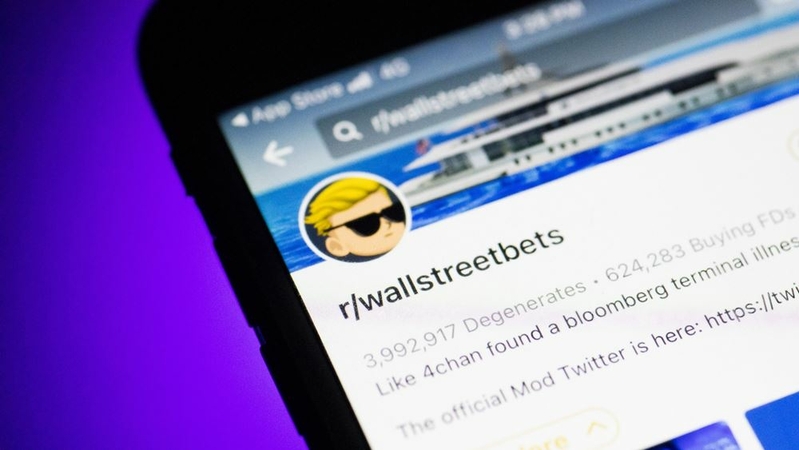
Feb 23. 2021The Reddit forum WallStreetBets on a smartphone arranged in Sydney, Australia, on Jan. 28, 2021. MUST CREDIT: Bloomberg photo by Brent Lewin.
By Syndication Washington Post, Bloomberg · Justina Lee
Rocket emojis for stock gains. “Tendies” as slang for profits. GIFs with company tickers.
Reddit forum WallStreetBets is hard for humans to follow at the best of times. But spare a thought for the machines.
After the retail stock frenzy last month caused unprecedented havoc, hedge funds trawling the platform with algorithms have a renewed sense of purpose in their mission to figure out the next market craze.
Yet it’s proving a massive pain. It’s not easy training computers to extract the amateur chatter on message boards into data that’s anywhere fit for trading in the real world.
Even for the very basic task of identifying securities, an algo has to learn how to match millennial-speak, memes and typos with the intended subject. And that’s only the start of it.
Just ask the people behind the Reddit robots like Stefan Nann.
“You cannot just apply the standard English library of words,” said the chief executive officer of Stockpulse, a social-media analytics firm in Germany. “We were reading through these comments and deciding ourselves if this comment is positive or negative — that’s how we train the machine.”
Sentiment analysis on WSB is the latest thing in the world of alternative data, which is projected to grow from last year’s $1.64 billion to $17.35 billion in vendor revenue by 2027. NN Investment Partners and PanAgora Asset Management are among systematic investors who scrape social media for trading signals, while more brokerages are offering clients tools to do just that.
For good reason in theory. A strategy of following the herd would have yielded big profits, in retrospect.
According to Stockpulse, an indicator measuring GameStop’s buzz on Reddit first peaked in early December, a solid month before its price started climbing. A strategy of simply buying the five companies most discussed on WSB in the previous week could have returned 61% in 2020, a backtest by data provider Quiver Quantitative showed.
This is roughly how it works. A Reddit user is waxing lyrical on why BlackBerry is worth more than four times its stock price. An algo trained by a vendor like MarketPsych then records the ticker and sweeps the post for trading sentiment signals.
It tries to figure out the intensity of bullish calls from cues like “market leader,” emojis, the use of future tense, even expletives. Then the process gets repeated across swaths of securities.
“Some are calling us because they’re trying to take advantage of the herd,” said Richard Peterson, a board-certified psychiatrist who founded MarketPsych. “Some are just trying to find ways to protect themselves.”
But for the form of artificial intelligence known as natural-language processing, message boards aren’t as straightforward as, say, figuring out signals from a corporate executive on an earnings call.
If a new slang emerges, the dictionary for the machines needs to be updated by the humans. Doing this worldwide is even harder. It took some time for MarketPsych’s team to figure out what different emojis mean in different cultures, or that British traders talking down a stock might use more subtle insults.
In one example cited by StockPulse, the computer has to learn the difference between “hold” as a verb versus an exchange-traded fund with a ticker containing the same characters.
These efforts are in big demand.
“At some point it starts to resemble a single hedge fund because they all behave at the same time in the same way,” said Francesco Filia, CEO of hedge fund Fasanara Capital, which started monitoring Reddit internally last month. “You need to be on top of it.”
Thinknum and Social Market Analytics are among the growing number of sentiment data providers who’ve recently rolled out products tallying up the stock chatter on Reddit in one form or the other. Bloomberg LP, the parent of Bloomberg News, provides access to alternative data sources on the terminal and via the Bloomberg Data License.
With individuals now accounting for about a quarter of U.S. equity trading volume, knowing where the retail cash heads next should in theory prove lucrative. Such insights would help the long-short crowd figure where the next market bombs land. The retail army in January famously inflicted a record industry squeeze as they crowded into some of the most hated names to hurt short sellers, or “shorties” in Reddit vernacular.
At NN Investment Partners, data scientist Melissa Lin says its signal tracking sentiment in news and social media has been performing better than simply chasing price momentum.
But particular forums like Reddit don’t have a sufficiently long history of stock-picking for the data crunching that quants like Lin do. And anecdotal evidence aside, retail investors don’t have a consistently strong track record, she says.
“It’s not a simple linear relationship between sentiment and stock returns,” Lin said. “You need a lot more research to filter out the noise to actually make it useful.”
Emmanuel Hauptmann says his quant team at RAM Active Investments has recently started monitoring stock babble on Twitter — which it sees as highly correlated with Reddit — but his expectations are low.
“For the moment we see it as a purely tail risk reduction,” the fund manager said. “We don’t use it as an alpha signal.”
Still, even with all the data in the world to track the ebbs and flows of retail sentiment, market timing is everything.
“Once people are all-out in your face — saying ‘I love this, death to the shorts!’ — that’s too late,” said Peterson at MarketPsych.
Video shows NASA’s Perseverance rover landing on Mars in HD
Feb 23. 2021Photo credit : NASA
By The Washington Post · Christian Davenport
NASA on Monday released stunning, high-definition footage of its car-sized rover landing on the Martian surface last week, the first-time that a spacecraft’s landing on Mars has been recorded in high-speed video.
In the short clip, several cameras mounted at various points on the spacecraft chronicle the descent of the Perseverance rover as it plunges through the Martian atmosphere, deploys its parachute and jettisons its heat shield. The red, dusty Martian atmosphere comes into view as the rover gets closer to the surface. Individual rocks can be seen, as well as entire craters, as the autonomous spacecraft guided its way to a flat landing site.
Then, a whirlwind of dust, as the descent stage fires its engines, and lowers the rover onto the surface with a series of cables.
NASA also released the first-ever sound recorded on the red plant, a small whoosh – a gust of wind traveling at five meters per second, or about 11 miles per hour, NASA estimated.
The sounds and the video “are the closest you can get to landing on Mars without putting on a pressure suit,” said Thomas Zurbuchen, the head of NASA’s science mission directorate.
Documenting the landing, one of the most perilous parts of the mission, known as the “seven-minutes of terror,” was not central to the spacecraft’s primary goal of searching for signs of ancient, microbial life on Mars.
But it was a way to inspire future generations of explorers, NASA said, as well as give engineers feedback on how the spacecraft operated.
“We have taken everyone along with us on our journeys across the solar system to the rings of Saturn, looking back at the pale blue dot and incredible panoramas on the surface of Mars,” said Michael Watkins, the director of NASA’s Jet propulsion Laboratory. “This is the first time we’ve been able to actually capture an event like the landing of a spacecraft on Mars. And these are pretty cool videos. And we will learn something, by looking at the performance of the vehicle in these videos, but a lot of it is also to bring you along on our journey.”
Because the atmospheric conditions are so different on Mars, NASA’s engineers can’t test the landing systems on Earth. “So this is the first time we’ve had a chance as engineers to actually see what we designed,” said Matt Wallace, the deputy project manager. “It’s hard for me to express just how emotional and how exciting it was for everybody.”
NASA had put together compelling animations of the landing that showed the spacecraft hurtling through the Martian atmosphere, then deploying its parachute and finally the skycrane that lowered the rover to the surface. In 2012, it stitched together 297 small images taken during the last two-and-a-half minutes of the Curiosity rover’s landing on Mars. Curiosity also has sent back selfies it has taken of itself on Mars’ barren landscape.
But those pale in comparison to what NASA released Monday.
Video coverage has long been a part of space travel. But with today’s technology, NASA and the growing commercial space sector are giving space exploration a Hollywood-like feel that is a giant leap from the flickering, grainy black and white footage of Neil Armstrong’s first step on the moon five decades ago.
For its next human lunar exploration mission, called Artemis, NASA is looking for a vast improvement, footage that will bring people along for the ride inside the capsule as well as on the surface.
It has put out a solicitation to partners “who will use innovative technologies, imagery applications and approaches” so that the “public can experience different segments” of the missions, including “‘riding along’ with the crew in Orion on their journey to the area around the Moon; visual exploration of the lunar surface; and on the return to Earth.”
The space agency is looking to use everything from 360-degree cameras, virtual reality, 4K and ultra high-definition cameras, “robotic ‘third-person’ views” and other concepts that would deliver “a uniquely-engaging spaceflight experience.”
Elon Musk’s SpaceX has been especially adept at using compelling video to tell the story of its journey – both the successes and failures. Videos posted to its YouTube channel have millions of views, helping it build an enormous fan base, which regularly tunes into launches in a way not seen since the early days of the Space Age.
Its videos have showcased major milestones, such as NASA’s first human spaceflight from United States soil since the Space Shuttle fleet was retired, the launch of SpaceX’s Falcon Heavy rocket, the landings of first-stage boosters, even how it catches the fairings, or nose cones, of its rockets on boats with giant nets like a centerfielder nabbing a pop fly.
Its videos of the flights of its Starship prototypes are enormously popular. They showcase not only the short test flights of the Starship spacecraft that Musk says will ultimately take people to the moon and Mars, but its crash landings that end in fireballs as the company figures out how best to get them back to Earth safely.
It even put together a compilation video from the early days of its Falcon 9 rocket test landings, when they too often ended up exploding as they came crashing to the ground. That video, “How not to land an orbital rocket booster,” set to the marching band tune used in Monty Python’s “Flying Circus,” had 25 million views.
For its major human spaceflight missions, NASA and SpaceX even won an Emmy in 2019 for their joint broadcast of a test flight of SpaceX’s Crew Dragon spacecraft to the International Space Station.
The video of the Perseverance landing gave engineers valuable feedback that showed, for the most part, the systems worked perfectly. But the footage showed there was a problem with one of the springs that helps jettison the heatshield.
“There’s no danger to the spacecraft here, but it’s something we didn’t expect and something we wouldn’t have seen if we didn’t have this camera system to show us what was going on,” said Al Chen, NASA’s lead engineer for the entry, descent and landing systems.
How the rich can escape America’s unreliable power grid
Feb 22. 2021
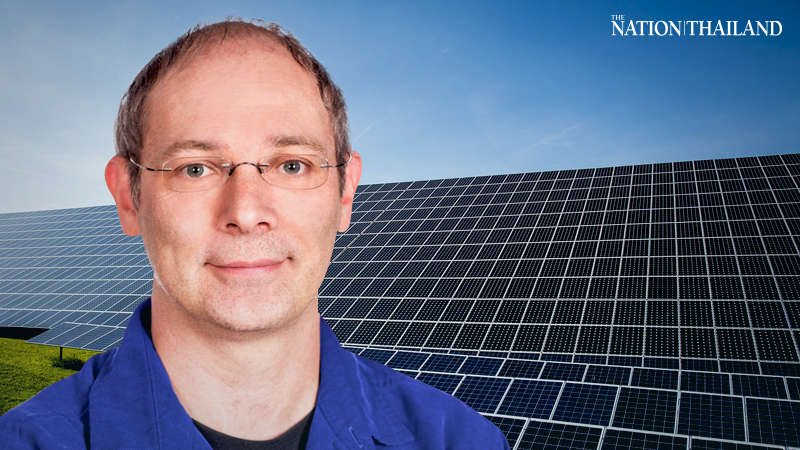
Wim Coekaerts
By Syndication Washington Post, Bloomberg · Dana Hull
When Wim Coekaerts bought a hillside lot to build his California dream house, there was an old horse barn, a grove of olive trees and lovely views of Silicon Valley. But there was no electricity, and the nearest utility pole to his bucolic acre was 550 feet away.
The town of Woodside requires new homes without utility service to pay for wires to be buried underground. Coekaerts faced a choice: pay PG&E Corp. roughly $100,000 for engineering work and foot the enormous additional cost of the trenching, or engineer a more personal fix.
Coekaerts, who grew up in Belgium, is a man who highly values reliable, stable electricity – something PG&E has not always provided in recent years amid increasingly ferocious wildfires. And it’s not just California: this week, a winter storm has paralyzed the grid in much of Texas, highlighting just how fragile the legacy system is. Coekaerts is senior vice president of software development at Oracle Corp., a legend in the open source community and is the longest serving board member of the Linux Foundation. We all want the lights to stay on; he needs to be able to run his servers and charge his electric Tesla Model S.
His house is the exact opposite of a small cabin: It was designed by an architect and spans 2,800 square feet. Coekaerts started puzzling through the engineering challenges: What if he cut ties with PG&E? What would it take to build his own self-sufficient energy system, with the electricity produced and stored on site? He started researching microgrids, a small energy grid with control capability, which typically means it can disconnect from the traditional grid. Coekaerts wanted to be autonomous from the beginning. He started looking at Tesla’s energy products: the home battery known as the Powerwall and larger systems called Powerpacks.
“This is not a tiny home,” says Coekaerts, as contractors put the finishing touches on the three-bedroom limestone house. “A lot of people say they are off grid, but they have a tiny house where they only need two solar panels. I didn’t want to have a lifestyle where I’m just getting by. This is a normal house with normal energy consumption, and I can charge my car if needed.”
In the developing world, microgrids may leap frog traditional utilities, much in the way that mobile phones made the need for landlines obsolete. In the U.S., military bases, universities, prisons and hospitals are turning to microgrids as a way to operate independently from the grid. The Santa Rita Jail in Alameda County, about a half-hour’s drive east of Oakland, has a microgrid that allows it to operate as an island for extended periods.
Individuals are also pursuing them. Larry Ellison, who serves on the board of directors of Tesla Inc. and is the chairman and chief technology officer of Oracle, has expressed interest in a microgrid for Lanai, the island in Hawaii that he bought in 2012. Tesla disclosed in a regulatory filing that director James Murdoch purchased a Powerpack system from the company for $600,000 in 2019 and that in 2020, a company affiliated with Ellison “entered into an agreement to obtain preliminary design services from us for an estimated $400,000, relating to the potential future implementation of a Tesla Energy system.”
PG&E has more than half a million residential solar customers, and at least 18,000 have installed battery energy storage systems. You hear a lot in California about “solar plus storage”: solar panels to harvest sunlight into electricity, paired with a home battery that can store the electricity for later use, like after the sun goes down. Tesla markets the Powerwall as a backup for when the grid goes down. The Powerpack is mostly sold to businesses and utilities.
Coekaerts didn’t want his system to function as a backup to the grid: He wanted to be independent of the grid. So through Luminalt, the San Francisco company that installed his solar system, he was able to get a Powerpack, which is about 17 times what a single Powerwall provides. Tesla representatives have told him it is the first residential Powerpack installation that they know of, though others are in the pipeline. The total cost, including permitting, labor for the installation and a federal tax credit for the solar system, was roughly $300,000.
His system, which was activated in November, combines 27 kw of photovoltaic solar panels with a 232kWh Tesla Powerpack. There are five ground-mounted arrays of 15 solar panels each, or 75 solar panels total, stretching across the yard. The Tesla Powerpack, which on the outside just looks like a massive white box with Tesla’s logo, emits a low hum and is protected and surrounded by a tasteful wooden fence. During long summer days, the system will probably generate far more electricity than he needs, and neighbors have joked that they’ll get out their extension cords.
PG&E has become something of a villain to many Californians in recent years. The state has staggered through increasingly devastating wildfire seasons, and some of the blazes were sparked by aging utility infrastructure. Faulty PG&E equipment ignited the November 2018 Camp Fire, an inferno that destroyed the town of Paradise and killed 85 people. In March, PG&E’s residential customers will see their rates increase as the utility, which recently emerged from bankruptcy, seeks to upgrade its equipment. When there’s high wind and fire danger, PG&E – which provides natural gas and electric service to roughly 15 million people from the Oregon border to Bakersfield – proactively shuts off power to tens of thousands of customers. Costs keep rising and outages are becoming more routine.
But it’s not just PG&E: Last week the Electric Reliability Council of Texas, which manages the flow of electric power to more than 26 million Texas customers, was crippled by a snow storm that froze wind turbines, kicked natural gas plants offline and resulted in widespread outages that left millions of people shivering in their homes. The climate crisis is here to stay, and finding ways to function independently of utilities is gaining traction.
“On the one hand, it’s an engineering marvel to produce all of the needs of a modern house with locally produced power,” says Rich Brown, a research scientist in the building technologies and urban systems division at the Lawrence Berkeley National Lab. “On the other hand, it’s still expensive.”
The future, says Brown, is aggregation: It is far more cost effective to build a microgrid if you’re serving multiple people, like an entire city block or a new subdivision. Brown and colleagues at the Berkeley Lab are working on a project called “Ecoblock,” in the Fruitvale neighborhood of Oakland, that will serve about 25 housing units.
“Low income neighborhoods tend to have more pollution, and the capital required to go solar or buy a battery is just too high,” says Brown. “There’s an equity issue. Ecoblock could be a model for how you could collectively take a neighborhood and make it more resilient, and do it cost effectively.”
Coekaerts agrees. “When it comes to apartment buildings and new homes, instead of using the normal power grid they should do something like this,” says Coekaerts. “It seems like a real scalable solution.”
Coekaerts knows that he is a rare early adopter. Besides being inherently tech-savvy, he has the willingness – and the ample financial resources – to prove the concept. He’s kept a detailed history of how his microgrid has performed over the last few months in hopes of sharing the information, maybe via a YouTube video, to educate others on the process. His main message is that it works: He has zero concern about running out of power.
“The climate is changing, and you see that every year it gets worse,” says Coekaerts. “I’m not a prepper, but I want to be self-reliant. And there’s a cool factor to this. If I can do this, other people can do it too. It’s nice to be on the forefront of something that is coming.”
Thai online learning platform plans international alliances
Feb 21. 2021
By The Nation
Thailand Massive Open Online Course (Thai MOOC), an online learning platform run by the Ministry of Higher Education, aims to its focus on curriculum and skill development while striving to go international.
Assoc Prof Dr Thapanee Thammametha, programme director of Thai Cyber University, said that this year Thai MOOC is entering its fifth year with more than 800,000 students at secondary and undergraduate levels. “We aim to make Thai MOOC a learning centre for Thai people and continuously invite Thai people of all ages to come and seek information and learning from here,” Thapanee said.
Thai MOOC is an online learning centre operating at the convenience of the learner. “We combine online courses from both domestic and international service providers. There is an an IDP [Identity Provider] system that allows students to access various systems that cooperate with Thai MOOC without having to apply for membership. It can be considered as a One Stop Service for online learners.”
Prof Dr Jintavee Khlaisang, deputy director of Thai Cyber University, said that education is a matter of importance for all sectors. “We want Thai people to have access to education thoroughly. Recently, there was an Asean meeting where we co-hosted an academic conference with South Korea to discuss standardised courses and platforms. Negotiations have begun to exchange courses with MOOCs in Asia such as J-MOOC [Japan] or K-MOOC [South Korea] or even European countries, like Italy.
In the future, subtitles will be added to the Thai language, and it is expected that there will be 20 foreign courses next year.”
NASA rover Perseverance lands on Mars in mission to search for past life
Feb 19. 2021
By The Washington Post · Joel Achenbach, Sarah Kaplan, Ben Guarino
NASA’s rover Perseverance landed safely Thursday on Mars to begin an ambitious mission to search for signs of past Martian life and obtain samples of soil and rock that could someday be hauled back to Earth for study in laboratories.
“Touchdown confirmed! Perseverance is safely on the surface of Mars, ready to begin seeking the signs of past life,” announced Swati Mohan, the guidance and control operations lead for the mission at the NASA Jet Propulsion Laboratory in Pasadena, Calif.
Cheers, clapping and fist-pumps erupted in the control room, which was half-empty because of the coronavirus pandemic. Someone shouted: “TRN, TRN,” referring to the “terrain relative navigation” system that allowed Perseverance to land in a rugged area full of natural hazards.
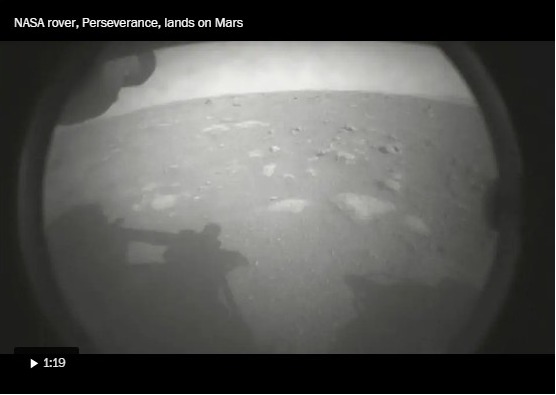
Perseverance, the first multibillion-dollar NASA mission to Mars in nine years, quickly produced two low-resolution images of the landing site – a forlorn landscape pocked with small craters. Dust kicked up by the landing covered the glass shields on the cameras. The pair of photos showed the rover casting a shadow on the Martian landscape.
Perseverance used its autonomous guidance system to avoid hazardous terrain in the target area, an ancient lake bed known as Jezero Crater. The touchdown followed the “seven minutes of terror” – in homage to the emotional state of engineers rooting for success. Mars is a notoriously difficult place to land a spacecraft.
Going back more than half a century, about half of all robotic missions to the planet have failed, although NASA appears to have mastered the feat over the past two decades. The rover Curiosity, which landed in 2012 far to the east of Perseverance’s location, remains operational. Perseverance is similar in scale but is slightly heavier and has about 50 percent more scientific instrumentation, according to NASA.
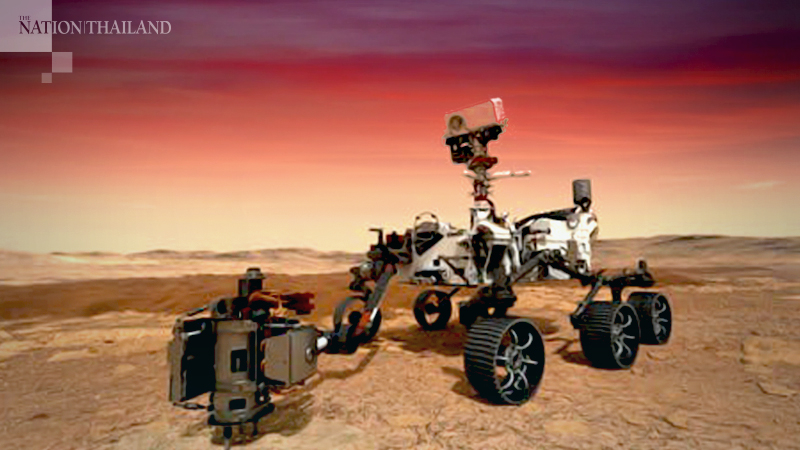
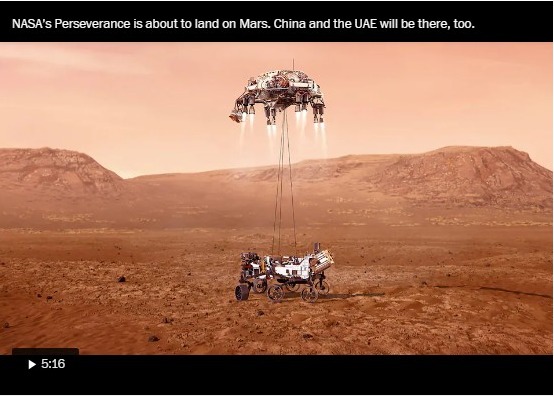
The vehicle carrying Perseverance entered the Martian atmosphere at 12,000 mph, used a heat shield to avoid burning up, then deployed a 70-foot-diameter parachute while still going nearly twice the speed of sound. Finally, the craft used rocket thrusters to slow down further and then a system known as a sky crane to lower the rover the final distance to the surface.
The landing on rough terrain is the most hazardous phase of the mission. The entry, descent and landing had to be accomplished entirely autonomously. Mars is too far from Earth to permit technicians to joystick the landing; a signal between the spacecraft and Pasadena takes 11 minutes at the speed of light.
For that reason, the spacecraft was loaded with navigation software to guide it to a safe spot in an area that features 200-foot cliffs, gullies, boulders and sand-filled craters that could potentially immobilize it.
The rover touched down in a relatively rugged area, about a mile southeast of the center of its target. In this treacherous environment, the autonomous navigation system proved “absolutely essential,” entry, descent and landing lead Allen Chen said at a news conference Thursday evening.
“We found the parking lot, and hit it,” Chen said, avoiding dangerous terrain all but certain to doom the rover. The vehicle is almost level, tilted only a matter of a degree.
Project scientist Ken Farley said the site is on the boundary between rock regions representing two important moments in Mars’ geologic history. Off in the distance, images seem to show the cliffs of the river delta.
“This is a great place to be,” he said.
But there is still a “ripple field” – sand dunes – between the rover and the delta that scientists want to explore. The rover may have to drive around those sand dunes to get to the delta formation.
Thursday’s landing was just the latest hurdle for a mission fraught with obstacles. The spacecraft’s journey to the launchpad had been complicated by the coronavirus pandemic, which pushed much of NASA’s workforce to go remote. Twenty minutes before Perseverance was scheduled to take off from Cape Canaveral, Fla., last July, an earthquake rocked mission control in Pasadena.
But after a six month, 293-million-mile journey, the spacecraft hit the Martian atmosphere at 3:48 Eastern time Thursday afternoon – exactly on schedule.
“Yes, yes, yes, yes,” someone could be heard quietly chanting over the NASA live stream.
Engineers briefly lost contact with the spacecraft amid the tremendous heat of its descent. At maximum deceleration, the craft experienced force 10 times the force of gravity on Earth.
A minute later came the first sign that this landing was going well: “Parachute deployed.”
There was a burst of applause, before engineers settled back to anxious silence.
The spacecraft jettisoned its heat shield. Its radar locked onto the ground. It turned on its navigation system and deployed the sky crane.
And then came the words they’d all been waiting for: “Tango Delta.” TD. Touchdown.
And, finally, “Nominal.”
Perseverance had arrived safely on Mars.
“The vehicle is going on a roller-coaster ride and you are too,” Chen said afterward. “You’re second guessing yourself as you go, even though it’s already happened.”
With the rover safely deposited at its landing site, the sky crane flew away and crash-landed elsewhere on the Martian surface.
Now begins the rover’s “commissioning” phase, when engineers examine every inch of the vehicle’s machinery to make sure it is ready for the mission. The rover will practice driving, test its robotic arm and update its software. Engineers who care for the vehicle will switch to “Mars time” – organizing their lives according to the Red Planet’s 24-hour, 37-minute day.
Roughly 30 Martian days (or “sols”) from now, Perseverance will drive to a flat area that can serve as the flight pad for Ingenuity, a tiny solar powered helicopter. NASA will take another 30 sols to fly Ingenuity around the area, testing out the never-before-used autonomous flight technology.
Next comes the central part of the rover’s mission: exploring Jezero Crater. Perseverance has automated driving technology that allows it to navigate obstacles without help from the ground. It is expected to cover more ground than any previous Mars rover – an average of about 650 feet per Martian day.
Typically, Mars landings are cause for great pomp and circumstance at the Jet Propulsion Laboratory. The Pasadena campus swarms with scientists, journalists and schoolchildren. Huge projectors show a live steam from mission control. A tradition dating to the 1960s demands that a jar of peanuts be on hand at the space flight operations facility – supposedly the snack brings good luck.
Thursday’s events were more subdued, with only a minimal crew of ground controllers on site for the landing.
But fans of the mission found socially distant ways to celebrate. In Switzerland, where NASA science chief Thomas Zurbuchen grew up and where the rover’s motors were produced, artist Gerry Hofstetter projected images of the rover, Mars and the NASA logo onto an Alpine mountaintop.
Though led by NASA, the mission is an international endeavor. The rover’s instruments are operated by scientists in three countries, and the Mars Sample Return program is a partnership with the European Space Agency.
Perseverance’s new home is a narrow band of flat terrain that lies along the cliffs that delineate the elevated remnants of a river delta – all within Jezero Crater. The river delta is considered one of the best places on Mars to search for signs of ancient life.
Today, the crater is a bleak expanse of rock canyons and windswept sand. With no magnetic field to protect it, the planet’s surface is bombarded by solar radiation. The air is thin and mostly carbon dioxide. Nighttime temperatures plunge to minus-100 degrees Fahrenheit. It is hardly a hospitable environment.
But roughly 4 billion years ago, Mars looked a lot like ancient Earth. It boasted volcanic activity, a thick atmosphere and temperatures balmy enough to maintain liquid water on its surface.
In those days, Jezero Crater contained a vast lake. The surrounding canyons were carved by mighty rivers. The feature that Perseverance is scheduled to inspect was a delta, where sediments from the surrounding watershed accumulated in layers of mud. On Earth, such sediments have preserved evidence of ancient life in the form of fossilized mats of microscopic pond scum called “stromatolites.”
“If we could find something like that on Mars, that would be the holy grail for astrobiology,” said Purdue University planetary scientist Briony Horgan, a member of Perseverance rover’s science team. Horgan has led satellite surveys of the landing site that showed it is rich with the kinds of molecules known to help preserve the signatures of living organisms.
Perseverance is armed with a battery of instruments designed to detect biosignatures. Two cameras will photograph the landscape and zoom in on tiny structures. A sensor will use X-rays to measure the chemical makeup of rocks while a machine mounted on the robot’s arm deploys lasers to detect organic molecules and other potential biosignatures. Ground-penetrating radar will map the subsurface, and a Martian weather station will take in data about temperature, wind and clouds of dust.
Many of these are more advanced versions of the instruments on the Curiosity rover, which has been exploring a spot far to the east of Jezero since 2012.
But Perseverance is the first NASA rover with the capacity to collect samples of soil and rock and cache them on the Martian surface. If and when the space agency is able to launch follow-up missions, those spacecraft will retrieve Perseverance’s samples and bring them back to Earth, where they can be analyzed with even more sophisticated tools in the world’s top labs.
“Finding a sample suite that is worth bringing back is really important,” said Ken Farley, project scientist for the mission. “What’s at stake is the ability to really make the first step in answering the question of whether life exists elsewhere.”
“Astrobiologists have been dreaming about this mission for decades,” said Mary Voytek, who directs NASA’s astrobiology program. Microbiologists like her have found life on Earth virtually wherever they’ve looked. Perseverance will play the role of robotic microbiologist on Mars.
It is unlikely images alone will be considered definitive proof of ancient life. Nor is it possible to miniaturize all the equipment necessary for the most detailed examinations of Martian samples. That’s why Perseverance is part of a broader project to gather samples of Mars that can eventually be returned to Earth.
There are dozens of sterilized tubes, designed to house chalk-size samples, tucked within the belly of the Perseverance robot. The rover will drill into Mars, secure rock and mineral samples in the tubes, seal the tubes and cache them for a future mission to retrieve.
A follow-up robotic lander assigned to retrieve the samples must descend to within 100 yards of where Perseverance deposits the sample cache, said Bobby Braun, the sample return program manager, on Wednesday. The retriever will, in turn, hand off samples to a cargo spacecraft in orbit over Mars. This will be the largest craft ever sent to the Red Planet, in part because it will have to carry enough propellant for a return trip.
Some of the scientists who will study those samples in the 2030s, in a facility that has not yet been built, may currently be students – or even children, said Elisabeth Hausrath, a University of Nevada Las Vegas astrobiologist who is assigned to represent the interests of those future scientists.
Detecting undisputed evidence of life in Martian rocks would be a spectacular scientific discovery – perhaps the most important humanity has ever made. It would suggest that still more life could exist somewhere else.
The discovery might also remind humanity that life is not indestructible. If a changed environment is what doomed organisms on Mars, it could happen here, too.
“These types of discoveries have the ability to affect people to their core,” said Kathryn Stack Morgan, deputy project scientist for the mission. “It becomes something you have to confront about yourself and your species and your place in the universe.”
Other members of the team had a more quotidian take on the day’s events. John McNamee, the mission’s project manager, told reporters Thursday that he slept soundly the night before; he knew his engineers would guide Perseverance to a smooth landing.
“Then I got up, had a little exercise, had breakfast and landed on Mars,” he said. “So, a pretty good day so far.”
Civil rights groups ask Biden administration to oppose facial recognition software
Feb 18. 2021
By The Washington Post · Drew Harwell
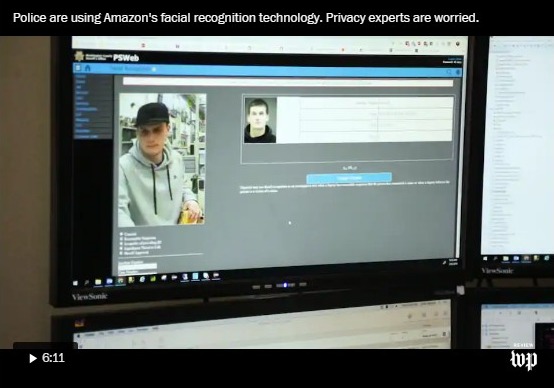
Civil rights groups are pushing the Biden administration to take a stand against facial recognition technology, saying the rapidly spreading software poses “profound and unprecedented threats” to Americans’ freedom and way of life.
The American Civil Liberties Union and more than 40 other groups urged President Joe Biden in a letter Tuesday to freeze federal use of facial recognition and block federal funds from being used by state and local governments to buy or access the artificial-intelligence tools.
The groups believe a Democrat-controlled government will be more receptive to their arguments of the software’s bias and privacy threats than the previous administration.
But the advocates are certain to face resistance from law enforcement and other facial recognition proponents who argue that a technology widely used to unlock phones and confirm travelers’ identities should also be made available to scan for wanted fugitives and investigate crimes.
The White House did not immediately respond to requests for comment.
The groups say the continued expansion of facial recognition runs counter to Biden’s inauguration-speech declaration that the government should work to advance “equity, civil rights [and] racial justice.” The technology has been shown in research to return inaccurate matches more often when assessing people of color, and it has been faulted in three separate wrongful arrests of Black men who were falsely identified by a police facial recognition search.
The technology’s developers and defenders argue that it is largely accurate and will improve over time. They caution that it should only be used as an investigative aid for officers looking for leads on whom to pursue, not as a primary piece of evidence.
But the letter’s signers say the software poses a clear threat to civil rights, regardless of its accuracy, because it could be used by government authorities to silently track innocent people or surveil protests.
“Even if the technology worked perfectly, it would facilitate the mass tracking of each person’s movements in public space – something intolerable in a free and open society,” the letter states. “We cannot allow its normalization.”
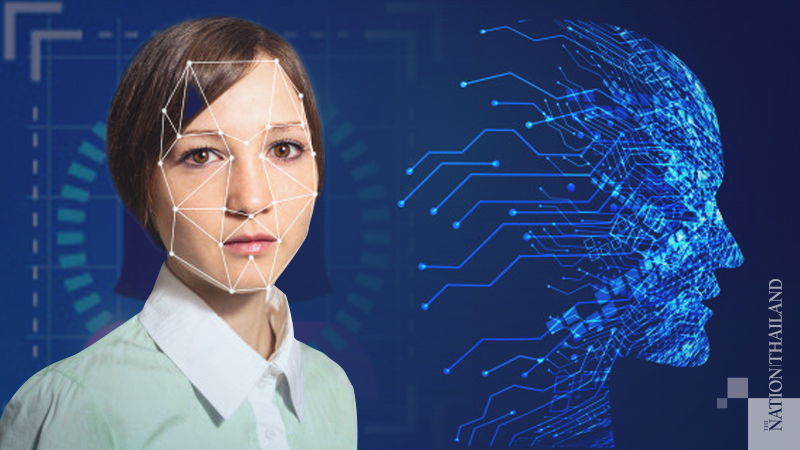
The face-scanning software can be used to identify people from afar without their knowledge or consent, and it works by quickly comparing a search photo against a vast database of driver licenses, mug shots and other images.
The software is widely used now to unlock phones, identify people in online photos and grant access at schools, stadiums and public housing complexes. Twenty of the country’s biggest airports also use facial recognition to scan travelers’ faces.
Federal investigators and police departments have used the software for years to help identify potential suspects, victims and witnesses on surveillance cameras and social media. Neither Congress nor state legislatures have authorized the development of such systems, and no clear federal oversight or regulations govern their use.
The technology has been banned or restricted by more than a dozen cities and states in the United States since 2019, including San Francisco, Boston, Portland, Ore., and Minneapolis. In December, New York became the first state to ban the technology’s use in schools until at least 2022, citing “serious and legitimate privacy concerns.”
But some cities have stuck by the systems. In Detroit, where the police chief said the system was useful even though it almost never returned a perfect match without human guidance, city leaders last year approved further use of the software, saying it helped protect the public while empowering the police. (Nearly all of the more than 100 people whose faces were run through a facial recognition search last year were Black, police data show.)
The backers of the letter urged Biden to sign an executive order halting federal facial recognition use “so long as bias pervades these systems and as long as Congress has not acted to authorize” its use.
They also pushed the White House to block state and local governments from using federal funds to buy or access the systems, and to lend its support to a bill introduced last year by Sen. Ed Markey, D-Mass., that would place a moratorium on federal deployment of facial recognition and other “biometric surveillance systems.”
The signers include Amnesty International, the Electronic Frontier Foundation, Freedom House and a number of left-leaning activists, human-rights organizations and tech advocacy groups. But facial recognition has faced bipartisan criticism in Washington, including from congressional Republicans such as Rep. Jim Jordan of Ohio, who has said it poses dystopian threats of government overreach.
Rohit Chopra, a former Federal Trade Commission head and Biden’s choice to lead the Consumer Financial Protection Bureau, said last month that he agreed with calls to restrict the technology because it “is fundamentally flawed and reinforces harmful biases.”
Local, state and federal law-enforcement officials have revealed few details about how widely they use such software, or how accurate the matches have been. A 2019 government audit found that the FBI’s facial recognition system, which analyzed more than 641 million photos from passports and other government databases, had been searched more than 390,000 times between 2011 and 2019.
The technology is also being increasingly deployed at U.S. travel hubs, with more than 23 million travelers scanned at 30 airports, seaports and land crossings last year, according to U.S. Customs and Border Protection (CBP) officials, who called it “the way of the future” in a report last week.
Fewer than 300 “impostors” have been caught by the systems since 2018, the agency said. Critics say the trade-off is not worth it, given that the mass data gathering can also backfire: Government auditors said last year that 184,000 images of travelers captured as part of a CBP facial recognition program were stolen by hackers during a 2019 breach of a CBP subcontractor, with some of them later posted to the dark Web.
The CBP has promoted facial recognition as a quick and contactless way to confirm identification during the pandemic. And the Jan. 6 insurrection led a wave of federal investigators and amateur sleuths to use the software in hopes of identifying rioters who stormed the Capitol.
But Kate Ruane, senior legislative counsel with the ACLU, said such uses may gloss over how the technology could further supercharge more surveillance in a “completely over-surveilled society,” where many already say they are under close government watch.
“The power of anything that is this dangerous, that is this biased, to track us across space and time for unknown periods,” she said, poses a threat to Americans’ liberty “to go to a protest, to go to a church, to go to your doctor without the government surveilling you.”
Chula students create website to match homeless animals with potential owners
Feb 18. 2021
By THE NATION
Veterinary students at Chulalongkorn University have developed a web platform to help find new homes for stray animals.
The RightBaan website enables potential owners to browse photos and profiles of stray animals for adoption.
Stray cats and dogs and the lack of a comprehensive and easy-to-use database for their adoption is a common problem in big cities.
In response, four sixth-year Chula veterinary science students – Kamonwan Sengsen, Vanitchakan Jaiboon, Pimpakarn Siengruengsaeng, Pimrumpa Kao-ian – developed RightBaan to match homeless animals from various shelters with potential owners.
The website features photos and stories for each animal along with their vaccination and sterilisation history. The aim is to give these animals a better quality of life in a loving home. Currently, only cats and dogs are available for adoption but other animals will be added in future, say the developers.
After creating a profile, users can choose their desired type of dog or cat by colour, breed, age, or need for extra care. They can then contact animal caregivers directly.
Users can also add animals to their list of favourites to view later.
The platform also features contact channels for potential sponsors or partners.
Additional functions to be added soon include a search box, notifications, and alerts. Users will be able to enter preferences such as colour and age, and get alerts/notifications when suitable animals become available.


 A link to Google’s proposal to a workable news code on the company’s homepage, arranged on a desktop computer in Sydney, Australia, on Friday, Jan. 22, 2021. MUST CREDIT: Bloomberg photo by David Gray
 A man uses a smartphone while leaning on a vehicle in Mumbai on Feb. 15, 2020. MUST CREDIT: Bloomberg photo by Dhiraj Singh.
 The Reddit forum WallStreetBets on a smartphone arranged in Sydney, Australia, on Jan. 28, 2021. MUST CREDIT: Bloomberg photo by Brent Lewin.
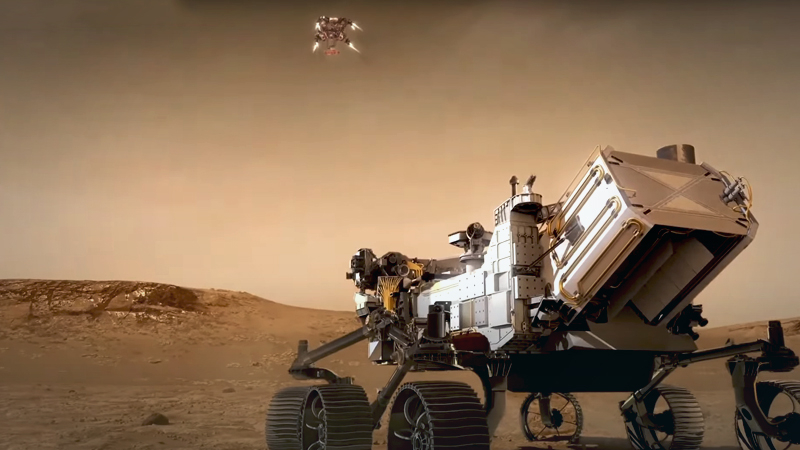 Photo credit : NASA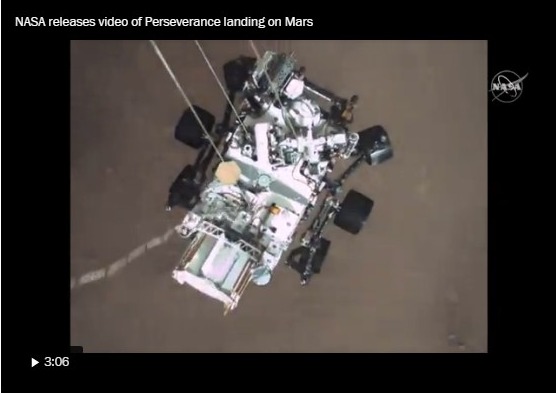




 SootinClaimon.Com