Facebook, Google ‘profit from doing customers harm,’ says Epic Games CEO Tim Sweeney #ศาสตร์เกษตรดินปุ๋ย

#ศาสตร์เกษตรดินปุ๋ย : ขอบคุณแหล่งข้อมูล : หนังสือพิมพ์ The Nation

https://www.nationthailand.com/edandtech/30382056?utm_source=category&utm_medium=internal_referral

Facebook, Google ‘profit from doing customers harm,’ says Epic Games CEO Tim Sweeney
Feb 13. 2020
By The Washington Post · Gene Park

LAS VEGAS – The platform wars need to end, and players must be able to connect with each other easier, said Epic Games CEO and founder Tim Sweeney. Otherwise, the 20s of the 21st century would be a “lost decade.”

Sweeney gave the keynote at the DICE Summit Wednesday, a talk that was pitched as a discussion of the future of the games industry. He took the opportunity to air his concerns about closed platforms – not just in gaming, but across the Internet.

“It’s a mind virus, this idea that publishers should ‘own’ the customer or have a monopoly on the customer relationship through some form of login or e-commerce,” said Sweeney. “We need to give up our attempts to each create our own private walled garden and private monopoly and agree to work together and recognize that we’re all far better off if we connect our systems to grow our social graphs together.”

Last year, Epic Games released its own new digital storefront. The store has stirred up controversy by offering exclusivity deals to game developers and publishers in what critics have described as an effort to undercut its direct competitor in the space, Valve’s Steam storefront. The Epic Games Store allows sign-in connectivity to a number of other platforms, including Xbox Live, PlayStation Network and Facebook.

Sweeney’s most biting comments were left for Facebook and Google, two companies he has not been shy about criticizing in the past.

“What we have now is a massive scale devolvement of industries that are based on adversarial business models, businesses that profit from doing customers harm, and doing their supportive ecosystems harm,” Sweeney said. “Facebook and Google have been leaders in this trend. They give you a service for free, and they make you pay for it in the form of currency that’s dearer than money . . . loss of privacy and loss of freedom.”

Sweeney said the games industry must lead in shifting Silicon Valley away from anti-consumer models and practices, such as loot boxes. He noted that the industry engages in predatory practices similar to Las Vegas’ gambling industry, except with zero promise of any money returning to the player.

“We have to ask ourselves as an industry: what do we want to be when we grow up? Do we wanna be Las Vegas, or do we want to be worldwide, highly respected creators of entertainment products customers can trust?” Sweeney said.

Sweeney also advocated for more open platforms and cross-platform economies. Fortnite, an Epic Games property, allows purchases on one platform (be it a game console like PlayStation or your smartphone) to be available on any other platform. Activision’s Call of Duty franchise introducing cross-platform play with its latest Modern Warfare title (allowing players on different gaming platforms to play together) was a sign of progress, he said, while also noting that players who bought the game on Xbox should have it available for play on other platforms as well.

Sweeney recalled the difficult conversations Epic had with Sony, Microsoft and Nintendo when asking them to work together to make Fortnite a universal, standardized experience. Developers big and small, he said, must be prepared to have more “uncomfortable conversations” if the industry is to achieve this vision.

Renee Gittins, executive director of the International Game Developers Association, said Sweeney’s comments about publishers and studios working together make a lot of sense.

“I think a lot of progress is based around uncomfortable conversations, and when you’re pushing forward to try to do new things, it is uncomfortable,” Gittins said.

Epic Games is still working to achieve these goals, said Sweeney. Fortnite hosted an in-game concert by the electronic musician Marshmello last year that was viewed by 10 million people. Sweeney described an ideal end goal as one where any performer or musician could host their own concert without significant coordination with Epic Games.

“We can go a lot further with the creation tools built into games, and where this is ultimately headed is games becoming more open platforms for creators to build their own stuff, independent of the companies,” Sweeney said. “In the future, we’d like for any musician to hold their concert of that sort without having to coordinate with us.”

He also called traditional display advertising obsolete. Display ads (such as 15-second ads before a YouTube video) distract from the content viewers actually want to engage with; Sweeney said he hoped for more natural cooperation with intellectual property holders that doesn’t detract from the core product. He pointed to Fortnite’s collaboration with Marvel and Star Wars, where players can simply use the characters from these respective brands without ever interrupting play.

Sweeney then dove into the topic of discourse around gaming companies. He briefly aired his bewilderment at the idea of people choosing where to buy chicken sandwiches based on a company’s politics, referring to Chick-fil-A’s support of anti-gay groups. To that end, he called for a separation of church and state as it pertains to politics and video game publishers.

“I think we’re seeing a lot of controversy of political censorship of social media. To get through that we need to divorce ourselves from politics,” Sweeney said. “When we’re making decisions on content moderation, we should very clearly establish rules as almost a judicial branch of the company.”

It’s unclear what prompted the comments. Epic Games was one of the few big publishers who said they’d stand by their player’s rights to express any political opinion in response to Blizzard’s controversial handling of a competitive Hearthstone player who broadcast his support for the protesters in Hong Kong last year.

Sweeney later took to Twitter to clarify his comments.

Samsung’s new phones bring 100-times zoom, folding screens, higher prices #ศาสตร์เกษตรดินปุ๋ย

#ศาสตร์เกษตรดินปุ๋ย : ขอบคุณแหล่งข้อมูล : หนังสือพิมพ์ The Nation

https://www.nationthailand.com/edandtech/30382001?utm_source=category&utm_medium=internal_referral

Samsung’s new phones bring 100-times zoom, folding screens, higher prices

Feb 12. 2020
The Samsung Galaxy S20 Ultra, left, contains an internal optical zoom lens not available on the Galaxy S20+.  Washington Post photo by Jonathan Baran

The Samsung Galaxy S20 Ultra, left, contains an internal optical zoom lens not available on the Galaxy S20+. Washington Post photo by Jonathan Baran
By The Washington Post
Geoffrey A. Fowler

SAN FRANCISCO – Samsung’s newest smartphones come in two flavors: expensive and more expensive.

Samsung's Galaxy S20 lineup includes the $1,000 S20 with a 6.2-inch screen, left, the $1,200 S20+ with a 6.7-inch screen and the $1,400 S20 Ultra with a 6.9-inch screen - the largest ever on a Galaxy S phone. Washington Post photo by Jonathan Baran

Samsung’s Galaxy S20 lineup includes the $1,000 S20 with a 6.2-inch screen, left, the $1,200 S20+ with a 6.7-inch screen and the $1,400 S20 Ultra with a 6.9-inch screen – the largest ever on a Galaxy S phone. Washington Post photo by Jonathan Baran

At its “Unpacked” event here on Tuesday, the world’s largest smartphone maker introduced a new model called the Galaxy S20 that touts ultrafast 5G and a camera with enough zoom for a spy. A second new smartphone called the Galaxy Z Flip opens and closes like a flip phone from 2003, using a cutting-edge folding-screen technology.

And with prices ranging from $1,000 to $1,400, either one is hard to justify as much more than a luxury.

I had a chance to spend a little time with the Galaxy S20 ahead of its launch. The flip phone, teased during an Academy Awards commercial, is expected to be announced later on Tuesday.

– – –

Z Flip

Samsung’s new phones showcase some sexy, if largely unproven, technology. But first we need to talk about runaway prices. Last year’s Galaxy S10 line started at $750. Just two years ago, the world gasped when Apple unveiled its top-of-the-line iPhone X for $1,000. But this year’s entry-level Galaxy S20, which goes on sale Feb. 21, starts at $1,000 – and then jumps to $1,200 for a model called the S20+. Then it hits $1,400 for the Z Flip and a version called the S20 Ultra with a maxed-out screen and camera features.

Sure, advanced technology can be expensive, and Samsung isn’t the only one raising prices. But the reality is that phonemakers are also desperate to prop up profits at a time more of us are choosing to just hold on to our old phones. Between 2016 and 2018, the average Galaxy S phone owner waited an additional four months to upgrade, according to Samsung. And for good reason: Recent smartphones have proved durable while Silicon Valley and South Korea’s best new product ideas have felt more like iterations.

Samsung’s pitch with the Z Flip, which arrives in stores Friday, is a smartphone that finally doesn’t look just like last year’s phone. Opened up, the Z Flip looks like a standard Samsung smartphone with a 6.7-inch screen. But then it folds down the middle without a seam, thanks to a special kind of folding OLED-screen technology. The appeal is that a smaller phone is easier to hold and stuff into a pocket. With a slightly stiff hinge, you can also sit the phone at a 90-degree angle to use it as two screens, or to take a selfie without a tripod or extended arm.

There’s also a retro appeal to having a phone that snaps shut. Motorola, which made the iconic Razr flip phone in 2003, also recently tried bringing it back as a folding-screen smartphone. Samsung tried this folding-screen trick last year with its Galaxy Fold, which switched between a tablet and skinny smartphone. But that $2,000 phone was marred by durability concerns and shipped to customers with a list of warning about how to not break it.

Samsung says it improved the durability of the Z Flip with a new kind of ultra-thin bending glass to protect it from scratches. (The Fold used plastic.) The Z Flip hinge has new fibers that Samsung says will keep dust and particles out. The company says the phone can withstand being opened at least 200,000 times – which sounds like a lot, but also means your smartphone comes with fixed lifespan.

– – –

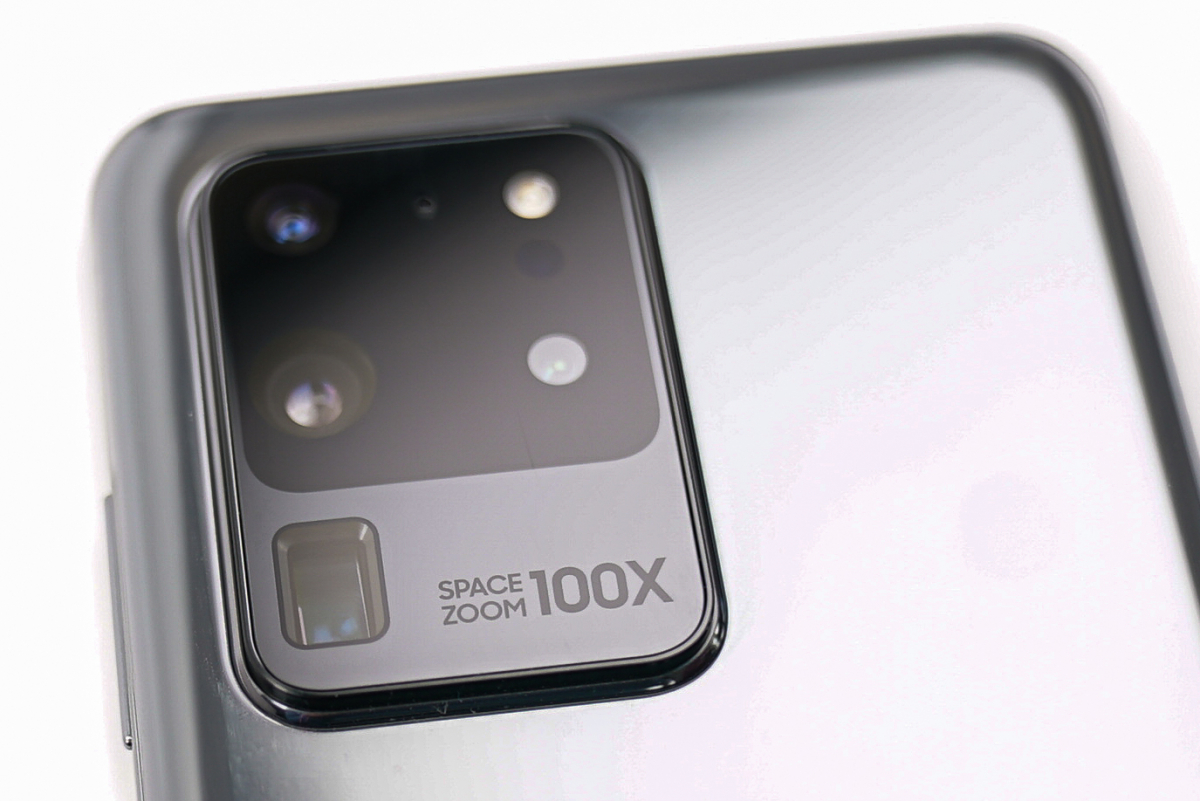
The Galaxy S20 Ultra features three back cameras, including one with an optical zoom buried sideways inside the phone. Next to them, on the right, there's also a flash and a depth sensor used to assist focus. Washington Post photo by Jonathan Baran

The Galaxy S20 Ultra features three back cameras, including one with an optical zoom buried sideways inside the phone. Next to them, on the right, there’s also a flash and a depth sensor used to assist focus. Washington Post photo by Jonathan Baran

Galaxy S20

For its 2020 flagship Galaxy S line, Samsung is trying to create a sense of upgrade urgency. It employed a hyperbolic naming convention, skipping from last year’s S10 right over the numbers 11 and 12 and all the teens to the S20. Take that, iPhone 11 . . . I guess?

The S20 lineup is also the first from Samsung to include support for 5G network service in all its models. That sounds like a reason to upgrade, but may be less than you’d think in the United States. I didn’t get to test the S20’s 5G capabilities in my preview of it, because I wasn’t in an area of San Francisco with 5G service. Chances are, you also don’t live or work in an area covered by 5G yet, either. Even in Manhattan, for example, Verizon’s coverage map shows it only works in a few blocks and parks. Everywhere else, you get 4G LTE service or less, depending on your carrier.

(Also, buyer beware: The entry-level S20 model doesn’t support a kind of 5G technology used in the United States by Verizon networks, so loyal Verizon customers should only consider the S20+ and Ultra models.)

You might justify buying a phone that supports 5G now as future-proofing. Or you could just wait another year for when the technology is improved. Perhaps by then apps and services will have invented some truly killer uses for the network tech on a smartphone, beyond faster movie downloads and gaming.

The tech leap we can actually use in the S20 is a new camera. All flagship phones these days have multiple lenses and improved night photography. So Samsung doubled down on a different skill in its camera war with Apple: zooming.

The specifications here are ludicrous. Both the S20 and S20+ can zoom up to 30 times, compared with 10 times on an iPhone 11 Pro. On the S20 Ultra, the zoom goes all the way up to 100 times. It’s enough to photograph the pupil in the eye of someone standing 10 feet away – or to snap Alcatraz Island while standing on a pier in San Francisco a mile and a half away.

This much magnification is impressive on a phone. Samsung accomplished its zoom feat by using new high-resolution sensors for its cameras. Most phones shoot 12 megapixels. The S20 and S20+ both capture up to 64 megapixels. That records any scene in more detail and lets the phone crop in on areas to simulate a zoom lens. The S20 Ultra sensor goes up to 108 megapixels. (Did I mention that these specs are ludicrous?)

On top of that, the S20 Ultra also has a periscope. Really: It’s hidden inside and expands sideways with a mirror to provide four-times optical zoom, similar to technology we’ve seen from Samsung rival Huawei.

Many photo buffs don’t think twice about spending a few hundred extra bucks on a camera. But I have serious questions about how all of this will perform in the real world. During my hands-on time with the S20, using all that zoom felt a bit like trying to press an elevator button with a 5-foot pole. You have to hold super still or prop the phone up against something. And for all of us who aren’t professional spies, how often do you actually need to zoom in that much?

The S20’s camera has one other useful trick up its sleeve: A mode Samsung calls “Single Take” does the shooting for you. Just hold up your camera for 10 seconds, moving around to different interesting angles. Then the phone uses artificial intelligence to pull out up to 14 of the best still shots and clips. I would have called this “Blowing Out Birthday Candle” mode.

There is one final bit of good news: If these features and prices sound a bit like overkill, Samsung will also be selling last year’s still-excellent Galaxy S10 line for $150 off. That means you can get one for as little as $600, and you won’t need a zoom lens to see all the money you saved.

Microsoft criticizes Amazon’s ‘sensationalist and politicized rhetoric’ in Pentagon cloud lawsuit #ศาสตร์เกษตรดินปุ๋ย

#ศาสตร์เกษตรดินปุ๋ย : ขอบคุณแหล่งข้อมูล : หนังสือพิมพ์ The Nation

https://www.nationthailand.com/edandtech/30381999?utm_source=category&utm_medium=internal_referral

Microsoft criticizes Amazon’s ‘sensationalist and politicized rhetoric’ in Pentagon cloud lawsuit

Feb 12. 2020
President Donald Trump greets Satya Nadella, chief executive of Microsoft, and Jeff Bezos, chief executive of Amazon and owner of The Washington Post, during an American Technology Council roundtable in June 2017. MUST CREDIT: Washington Post photo by Jabin Botsford

President Donald Trump greets Satya Nadella, chief executive of Microsoft, and Jeff Bezos, chief executive of Amazon and owner of The Washington Post, during an American Technology Council roundtable in June 2017. MUST CREDIT: Washington Post photo by Jabin Botsford
By The Washington Post · Aaron Gregg 

Seattle-based computing giant Microsoft has criticized its rival Amazon for employing “sensationalist and politicized rhetoric” in a lawsuit over a lucrative military contract known as JEDI, according to court records made public Monday.

Microsoft’s comments, included in a motion to partially dismiss a protest filed by Amazon, paint the clearest picture yet of how the company will defend its surprise win in the Joint Enterprise Defense Infrastructure procurement. Microsoft was awarded the contract in late October after an 11th-hour intervention by President Donald Trump prompted Defense Secretary Mark Esper to reexamine the Pentagon’s approach.

For weeks, Amazon has charged that Microsoft’s allegedly inferior cloud computing technology could not possibly have won in a fair competition. It argues that the results were skewed by “repeated public and behind-the-scenes attacks” from Trump and is seeking to depose Esper and the president, among others. (Amazon founder Jeff Bezos owns The Washington Post.)

Microsoft’s attorneys said Amazon’s claims are not supported by evidence and should be rejected.

“Without a compelling case on the merits of a traditional bid protest, [Amazon Web Services] tries to make this case all about President Trump,” Microsoft’s attorneys wrote in a filing unsealed Monday.

Amazon “has alleged zero facts – nothing – plausibly indicating that any DoD official involved in the JEDI procurement, at any level, was actually influenced by the alleged anti-Bezos statements in any way,” they wrote.

Amazon spokesman Drew Herdener said the company disagrees with Microsoft’s motion.

“AWS believes that all of its protest grounds are valid, and that it’s important that the numerous evaluation errors and blatant political interference that impacted the JEDI award decision be reviewed,” Herdener said in an email.

Trump’s interest in the contract came after a long-running legal and lobbying campaign by Oracle, whose federal business is threatened by the broader shift to cloud-based computing systems.

The company’s lobbying operations seemed to bear fruit on the eve of a planned contract award by the Pentagon last summer. Trump said in a July 18 news conference that he had received “tremendous complaints” from companies that compete with Amazon, specifically naming Oracle, IBM and Microsoft. Around that time an Oracle lobbying document labeled “A Conspiracy To Create A Ten Year DoD Cloud Monopoly” reached the president’s desk, The Post and CNN reported.

In late July during his first week on the job, Esper launched a review of the Pentagon’s broader approach to the JEDI contract, telling The Post that he wanted to “take a hard look” at the contract and that he had heard complaints from the White House and members of Congress.

As part of that review, Esper met with at least one person, whose name was redacted, who was closely involved in the bid evaluations, according to court records. Those briefings covered the JEDI program and the different options available to the Pentagon, a Defense Department spokeswoman said Tuesday.

Then, on Oct. 7, Esper completed paperwork recusing himself from the competition, forwarding major decisions on the contract to Deputy Defense Secretary David Norquist. His office has said the decision to recuse was made “out of an abundance of caution” to avoid any concerns regarding his impartiality, because his son was employed with one of the original bidders.

Despite Esper’s meetings with procurement officials, the Defense Department has insisted that his review was strictly limited to the broader strategy around JEDI and that it in no way touched on the evaluation of specific bids.

In its motion to depose Trump, the company is seeking information related to comments recounted in a recent book by a former speechwriter of former Defense Secretary James Mattis, retired Navy Cmdr. Guy Snodgrass, who wrote that Trump had sought to “screw” Amazon out of the contract and that Mattis had demurred. His claims have not been independently verified.

Amazon’s bid protest has relied primarily on the president’s own public statements. The company cited a February 2016 campaign rally in Texas, in which Trump said Amazon would “have problems” if he were elected. The company is also citing a Fox News segment against Amazon as well as Trump’s statement that he had heard “tremendous complaints” from Amazon’s competitors.

In its motion to dismiss, made public Monday, Microsoft called the president’s comments irrelevant, arguing that none of them directly mention the JEDI procurement.

“Virtually none of the public statements cited by AWS in its complaint mentions the JEDI procurement in any way,” Microsoft’s lawyers wrote. “Nor does the complaint make even a single factual allegation that President Trump ever spoke directly to any identified DoD procurement officers about the JEDI procurement, much less instructed them to award the contract to Microsoft.”

Microsoft further argued that Amazon should have raised its concerns over the Defense Department’s handling of the contract at the time that they occurred, rather than waiting for a contract to be awarded.

Also this week, two nonprofits, Protect Democracy and Citizens for Responsibility and Ethics in Washington, filed briefs in support of Amazon’s request to depose Trump.

“The plaintiffs in this case have credibly alleged that the President personally intervened in a government-contracting process to punish a critic,” Protect Democracy wrote in its legal brief. “If true, this would be a grave abuse of power in its own right that would be broadly chilling to anyone who wishes to exercise their right to dissent against the government.”

The Defense Department is expected to file a separate brief in the coming weeks explaining its position.

FTC will review past mergers by Facebook, Google and other big tech companies #ศาสตร์เกษตรดินปุ๋ย

#ศาสตร์เกษตรดินปุ๋ย : ขอบคุณแหล่งข้อมูล : หนังสือพิมพ์ The Nation

https://www.nationthailand.com/edandtech/30381991?utm_source=category&utm_medium=internal_referral

FTC will review past mergers by Facebook, Google and other big tech companies

Feb 12. 2020
By The Washington Post · Tony Romm

WASHINGTON – U.S. regulators on Tuesday said they would probe past mergers by Alphabet, Apple, Amazon, Facebook and Microsoft, seeking to study the ways that tech giants gobbled up their rivals – and if their acquisitions may have skirted federal antitrust laws.

The new effort by the Federal Trade Commission will require all five companies to provide information about the smaller players they’ve purchased over the past 10 years, including documents for deals that may not have been large enough to warrant deep, closer inspection by government watchdogs at the time.

The inquiry differs from a traditional investigation: Using its so-called 6(b) authority, the FTC can obtain documents from companies for reasons other than an immediate law enforcement action. Still, the records the FTC amasses could ultimately influence its thinking about Silicon Valley and the tech industry’s size, sparking investigations, resulting in tough punishments or prompting the commission to seek further enforcement powers from Congress once it concludes its work.

“This initiative will enable the Commission to take a closer look at acquisitions in this important sector, and also to evaluate whether the federal agencies are getting adequate notice of transactions that might harm competition,” FTC Chairman Joe Simons said in a statement.

Already, the FTC is specifically investigating Facebook, the company announced last year, and its prior purchase of Instagram and WhatsApp. More scrutiny of the social-networking giant’s past deals – and those of its competitors – could follow as a result of the new study.

Boston Dynamics robot dog goes on patrol at Norwegian oil rig #ศาสตร์เกษตรดินปุ๋ย

#ศาสตร์เกษตรดินปุ๋ย : ขอบคุณแหล่งข้อมูล : หนังสือพิมพ์ The Nation

https://www.nationthailand.com/edandtech/30381966?utm_source=category&utm_medium=internal_referral

Boston Dynamics robot dog goes on patrol at Norwegian oil rig

Feb 11. 2020
Spot stands on a stage in Oslo on Feb. 11, 2020. MUST CREDIT: Bloomberg photo by Mikael Holter.

Spot stands on a stage in Oslo on Feb. 11, 2020. MUST CREDIT: Bloomberg photo by Mikael Holter.
By Syndication Washington Post,  Bloomberg · Mikael Holter 

Meet Spot, the first robot to get its own employee number at Norwegian oil producer Aker BP.

Developed by Boston Dynamics Inc., the robot is set to start patrolling Aker BP’s oil and gas production vessel at the Skarv field in the Norwegian Sea this year, testing its ability to run inspections, detect hydrocarbon leaks, gather data and generate reports.

The upshot for Aker BP, which is seeking to be a front-runner in the digitalization of the oil industry, is to make offshore operations safer and more efficient, the company said as it presented the robot at its capital markets day in Oslo on Tuesday. Aker BP will run the tests with Cognite, the software venture controlled by the oil company’s main owner, Aker ASA.

“These things never get tired, they have a larger ability to adapt and to gather data,” Kjetel Digre, Aker BP’s senior vice president for operations, said in an interview. The company’s Chief Executive Officer Karl Johnny Hersvik said he was “pretty sure” Spot wouldn’t be the last robot to get an employee number.

Guided by a remote, Spot walked up to Hersvik on stage at the company’s event at an Oslo hotel on Tuesday. When asked whether it had detected any people in the audience that weren’t supposed to be there, the dog nodded, though it wasn’t clear who that was.

Retailers prefer hybrid cloud architecture to deliver flexibility, security: Nutanix report #ศาสตร์เกษตรดินปุ๋ย

#ศาสตร์เกษตรดินปุ๋ย : ขอบคุณแหล่งข้อมูล : หนังสือพิมพ์ The Nation

https://www.nationthailand.com/edandtech/30381952?utm_source=category&utm_medium=internal_referral

Retailers prefer hybrid cloud architecture to deliver flexibility, security: Nutanix report

Feb 11. 2020
By The Nation

The vast majority of retailers – 87.5 per cent – identified hybrid cloud as the ideal IT operating model, with many – 72 per cent – planning to move some public cloud applications back on-premises, a report by enterprise cloud computing firm Nutanix has found.

Retailers recognise that seamless customer experience is no longer a “nice-to-have” feature – it’s a critical factor in winning new customers and retaining existing ones – and flexible cloud infrastructure is critical to delivering it, according to the firm’s second Enterprise Cloud Index Report.

A recent IDC study noted that worldwide spending on customer experience technologies will reach $641 billion (Bt20.03 trillion) in 2022, demonstrating it is at the forefront of business leaders’ strategies. In line with broader IT industry trends, many retailers also recognise the full, long-term costs of the public cloud.

Additional findings of this year’s report include:

* Retailers focus most on agility: Unlike in the broader IT industry, where cost is the top driver, retailers ranked the ability to accelerate IT deployments (54.3 per cent) as the top factor in deciding the best cloud environment for each application.

* Security is top of mind: Nearly two-thirds of respondents (63.6 per cent) said security has significant influence on their future cloud deployments, with hybrid cloud specifically identified as the most secure (32 per cent).

* Retail leads in digital apps and IoT cloud deployments: Always innovating to keep pace with customers’ demands, retailers outpace averages in using the public cloud to run digital and Internet of Things (IoT) applications. They also run their business applications more often on the public cloud than other industries, with about 11 per cent current penetration of multiple public clouds and about 19 per cent penetration of a single public cloud.

“Staying relevant to today’s customers means having the necessary cloud infrastructure in place to embrace omnichannel retail experiences,” said Nutanix VP of Product Marketing Greg Smith.

“Retailers use data to connect the e-commerce and in-store shopping experiences, and the only way they can do this accurately and efficiently is through flexible, scalable technology. The rise of selling on social media platforms also means integrating payments into the user experience, bringing security and protection of customers’ data to the forefront of retailers’ minds. Hybrid cloud provides the portability and control needed to bring retailers into the new era of customer experience,” he added.

The 2019 respondent base spanned multiple industries and businesses around the globe – the Americas; Europe, the Middle East, Africa and the Asia-Pacific region.

For further information, visit https://www.nutanix.com/enterprise-cloud-index

Sprint’s fate: Either no T-Mobile deal or a lower deal price #ศาสตร์เกษตรดินปุ๋ย

#ศาสตร์เกษตรดินปุ๋ย : ขอบคุณแหล่งข้อมูล : หนังสือพิมพ์ The Nation

https://www.nationthailand.com/edandtech/30381924?utm_source=category&utm_medium=internal_referral

Sprint’s fate: Either no T-Mobile deal or a lower deal price

Feb 11. 2020
By Syndication Washington Post, Bloomberg · Scott Moritz 

Shares of Sprint Corp., meant to be acquired by T-Mobile US Inc. in a pending $26.5 billion takeover, spent the past year in a steady swoon — and that was fine with Deutsche Telekom AG, T-Mobile’s parent company.

Federal regulators have approved the combination of the two smallest national wireless carriers, but a group of state attorneys general has sued to block the deal, saying it could reduce competition and harm consumers. A federal judge has heard testimony from both sides and is expected to return with a decision within weeks.

Sprint’s value has eroded as the deal hangs in limbo. The carrier’s market capitalization has fallen to about $20 billion from last July’s peak of $33 billion, putting it back where it was on April 9, 2018, a day before reports that the companies had resumed talks. The stock fell as much as 3.7% on Monday.

Two factors are weighing on the stock: concerns about the deal’s completion, and the absence of a guaranteed price if the deal is approved. T-Mobile and Sprint haven’t renewed the merger agreement since it expired Nov. 1. And while there have been “not hostile” discussions of several issues, including price, Deutsche Telekom appears to be in no rush to stop Sprint’s free fall by drawing up a new agreement.

T-Mobile Chief Executive Officer John Legere was still optimistic that the deal would get final clearance, he said on an earnings conference call Thursday. Once it’s approved and the deal closes, the terms of the merger could change, he said. If the agreement needs to be amended, “including possibly price, we would handle that very swiftly after the deal was approved,” Legere said.

As far as negotiation leverage goes, Sprint’s in a tough spot, said Walt Piecyk, an analyst with LightShed Partners.

“Sprint has no alternative but to take whatever DT and T-Mobile offers them,” Piecyk said. “There’s really nothing else they can do.”

This is the third time T-Mobile and Sprint have made a run at a merger. The current attempt gained momentum after T-Mobile convinced antitrust officials at the Justice Department and regulators at the Federal Communications Commission that a combination with Sprint would make a more formidable competitor to larger rivals AT&T Inc. and Verizon Communications Inc.

The nod came after the companies agreed to divest Sprint’s Boost prepaid business as part of a package of assets that Dish Network Corp. would use to enter the wireless-service business as a new competitor.

For Sprint, the buyout is a lifeline. The company has said it would be unable to compete effectively on its own. Sprint has about $40 billion in debt and faces a costly network upgrade to catch up with rivals on service quality and next-generation 5G wireless technology.

It’s unclear whether the company can fund itself in the long run without help from its parent SoftBank Group or T-Mobile, according to Bloomberg Intelligence analyst Stephen Flynn.

Sprint continues to slide on the uncertainty of a merger, potentially improving the takeover terms for Deutsche Telekom, and yet the alternative for Sprint — no deal — is worse, Piecyk said.

“The downside for Sprint,” he said, “is that the stock goes to zero.”

Google heads to EU court in episode one of $9 billion trilogy #ศาสตร์เกษตรดินปุ๋ย

#ศาสตร์เกษตรดินปุ๋ย : ขอบคุณแหล่งข้อมูล : หนังสือพิมพ์ The Nation

https://www.nationthailand.com/edandtech/30381904?utm_source=category&utm_medium=internal_referral

Google heads to EU court in episode one of $9 billion trilogy

Feb 11. 2020
The Google logo displayed at the Google Playspace at CES 2020 in Las Vegas on Jan. 7, 2020. MUST CREDIT: Bloomberg photo by David Paul Morris.

The Google logo displayed at the Google Playspace at CES 2020 in Las Vegas on Jan. 7, 2020. MUST CREDIT: Bloomberg photo by David Paul Morris.
By Syndication Washington Post, Bloomberg · Stephanie Bodoni, Aoife White

Google’s decade-long antitrust fight with the European Union is set for more twists and turns this week as the internet giant battles the first in a trilogy of fines that cost the company nearly $9 billion.

The EU’s General Court in Luxembourg will host a three-day hearing starting on Feb. 12 as the Alphabet Inc. unit seeks to topple a 2.4 billion-euro ($2.6 billion) penalty in 2017 for thwarting smaller shopping search services.

Lawyers say the court clash will help set the scene for a broader crackdown on U.S. tech giants by Margrethe Vestager, the EU’s competition commissioner. Apple is separately battling her massive back-tax order and Amazon.com Inc. is currently being investigated for potentially favoring its own products over those of third-party sellers on its platform.

EU regulators will be hoping to repeat a 2007 victory against Microsoft, a narrow win in a contentious investigation that led the company to settle another probe into web browsers. The Microsoft case emboldened the EU’s small team of antitrust watchdogs to take on the likes of Intel Corp., Qualcomm Inc. and in 2010 to pick up complaints against Google.

Defeat for the EU “will be a blow to its attempt for a new enforcement approach in the high tech sector,” said Ioannis Kokkoris, a law and economics professor at Queen Mary University in London. “It will make it think twice how it can bring a successful case against conducts that are not clear cut in markets that are rapidly changing.”

The European Commission’s path to punishing Google was circuitous. The company argued that tiny comparison shopping services didn’t rank high in search because they provided poor quality, that competition was only “a click away.”

Regulators appeared to waver by seeking a settlement where Google would make changes to search display to end the probe without fines. That sparked furor from European publishers and politicians and led to the EU reversing direction and moving toward a penalty after Vestager took charge in 2014.

Since the first decision in 2017, the Dane has also levied separate fines for unfairly linking apps to Android software and for thwarting advertising rivals.

Google is set to argue that the EU decision “is wrong on the law, the facts, and the economics,” the Mountain View, California-based company said in an emailed statement. It will show “that we have improved quality and increased choice for customers” with shopping ads that aim to help people find the products they want and link retailers to potential customers.

The EU and a small army of companies and other organizations cheering it on will argue the opposite, that Google’s actions smothered or hobbled nascent competitors that didn’t appear prominently enough in Google’s search or shopping ads to ever gain the crucial traffic needed for commercial success. The EU has long been poised to move on similar complaints from local search service Yelp Inc., as well as travel and job search services.

“This case is important for the commission” because it will test a so-called self-preference theory of harm, whereby Google is accused of promoting its own services at the expense of those of rivals, said Aitor Ortiz, an analyst with Bloomberg Intelligence. It’s a “novel interpretation” of EU antitrust rules, and the final ruling may have implications not only for future probes against Google, such as searches in maps and restaurants, “but also for other platforms that may have a dual role and ‘self-prefer’ its own products.”

Google and the commission will kick off the hearings on day one, followed by arguments from each of the groups supporting their side. The Brussels-based EU authority has nine groups on its side, including Europe’s main consumer advocacy group, the German government and comparison sites such as Foundem, Kelkoo and Twenga. Google will call on only one flag-waver, the Computer and Communications Industry Association, which lobbies for the technology sector.

Fighting on can drag out legal proceedings for years. More than 10 years after its fine, Intel is still waiting for a final ruling after winning a round at the EU’s top court that told a lower tribunal to re-examine the case.

The judges’ decision in Google’s court challenge might only come next year. Before then, a busy 2020 may see the EU introduce “regulatory responses” where online platforms have effectively become “large private gatekeepers and rule-setters,” according to an EU document leaked recently.

“I can’t see the commission backtracking on its view on gatekeeper role of Google,” said legal academic Kokkoris. Even a loss “would still allow the commission to maintain its view of Google being gatekeeper in search, unless the judgment is an extensive rebuttal” of the EU case.

Verizon muscles into Europe’s 5G race with U.K. outpost #ศาสตร์เกษตรดินปุ๋ย

#ศาสตร์เกษตรดินปุ๋ย : ขอบคุณแหล่งข้อมูล : หนังสือพิมพ์ The Nation

https://www.nationthailand.com/edandtech/30381902?utm_source=category&utm_medium=internal_referral

Verizon muscles into Europe’s 5G race with U.K. outpost

Feb 11. 2020
By Syndication Washington Post,  Bloomberg · Thomas Seal 

A giant of U.S. telecommunications is muscling into Europe’s 5G race. Verizon Communications is opening a 5G tech showroom and production studio in London, its first outside of the U.S., complicating the push already underway among European counterparts like Deutsche Telekom and Vodafone Group to land business customers.


The so-called lab showcases services enabled by the next generation of wireless broadband and invites partners to collaborate on developing new ways to use it. The studio, opening in April, will use 5G to speed up data-intensive content production like motion-capture for entertainment and marketing. It’s all part of the company’s bet on the new tech.

“We’ve pretty much bet the company on this — it’s not like we’re dabbling,” said Toby Redshaw, vice president of innovation at Verizon’s business unit.

Carriers banking on a revenue surge from 5G aren’t likely to get it immediately from consumers, who are unlikely to pay extra for faster smartphones. They are instead pinning their hopes for sales growth on deals in industries such as logistics, automotive and manufacturing, a market that could ultimately be worth $4.3 trillion according to consultancy KPMG.

The outlook is still early, uncertain and competitive for these 5G services. And European carriers will have significant home field advantages: they already have relationships with the continent’s biggest businesses, local cultural and regulatory know-how, and own more local network assets.

But Redshaw says Verizon’s advantages include a head start from testing 5G in the field for years back in the U.S., and its larger scale. He was visiting London for the lab’s opening and to woo prospective clients, and said he’s had recent conversations with a Formula One team and other businesses. The company said the fresh London investment is “significant” but declined to give a number.

Examples of tech on display include cybersecurity visualization software, which lets a user fly around a virtual 3D landscape that represents their company’s network to spot potential anomalies. A service called BriefCam can instantly crunch reams of video and apply searches for a range of objects, such as all the red cars in a day’s worth of traffic footage, something a police force could find useful.

‘Nightmare’ for global tech: Virus fallout is just beginning #ศาสตร์เกษตรดินปุ๋ย

#ศาสตร์เกษตรดินปุ๋ย : ขอบคุณแหล่งข้อมูล : หนังสือพิมพ์ The Nation

https://www.nationthailand.com/edandtech/30381900?utm_source=category&utm_medium=internal_referral

‘Nightmare’ for global tech: Virus fallout is just beginning

Feb 11. 2020
File Photo: Syndication Washington Post, Bloomberg

File Photo: Syndication Washington Post, Bloomberg
By Syndication Washington Post, Bloomberg · Debby Wu, Gao Yuan 

As Chinese-based manufacturers begin to restart factories Monday, no one knows for sure when they’ll be back at full-speed — or what sort of chaos may ensue.

Tech producers led by Foxconn, which makes the majority of the world’s iPhones from Zhengzhou a few hundred miles from the coronavirus outbreak’s epicenter, had begun preparing investors for the potential bedlam when hundreds of thousands make their way back to factories.

Apple’s most important partner warned investors of the daunting task of securing enough workers despite widespread transport blockades, quarantining thousands, and the “nightmare” scenario of an on-campus epidemic that could shut down production altogether. Last week, it took the unprecedented step of warning workers to stay away from its Shenzhen headquarters till further notice as government inspectors vet its containment procedures, Bloomberg News reported. And it’s delayed the return of workers to its main iPhone-making plant in central China, people familiar with the matter said Monday.

“How we can make sure there will be no infection within our campuses will be the first priority, because if you put a lot of people together and one of them gets infected, that will be a nightmare,” Foxconn investor relations chief Alex Yang told investors on a Thursday call, according to a recording obtained by Bloomberg News. “We try very hard to make sure the possibility of any on-site infection will be as low as zero, although it will be challenging.”

The deadly virus has illustrated the increasingly central role China plays in global manufacturing, from clothing and chemicals to automobiles and especially technology. Just about every major piece of consumer electronics is made in China, from iPhones and gaming consoles to half the world’s liquid crystal display or LCD screens. The contagion has already shuttered plants across China for a week longer than anticipated after the Lunar New Year break — a disruption that could get much worse if rolling quarantines and suspended rail and air links prevent the return of the millions of blue-collar laborers at the heart of electronics assembly.

When they do make it back, untold numbers will get funneled into a quarantine of up to two weeks — a sequester of unknown scale. Any disruptions at Chinese plants can, in a worst-case scenario, freeze parts of the supply chain by triggering cascading shortages. Influential supply chain analyst Kuo Ming-chi of TF International estimates Foxconn’s main iPhone-making base will properly resume work only next week — and then at 40% to 60% capacity. Citigroup estimates just 30% of the entire Chinese semiconductor workforce is estimated to return to their workplaces as of Feb 11.

Foxconn said in a statement Saturday it’s working with local governments to prepare for the return of employees, without specifics. Shenzhen’s Longhua district said in a WeChat post it was helping the Taiwanese company fine-tune its plans. “To safeguard everyone’s health and safety and comply with government virus prevention measures, we urge you not to return to Shenzhen,” Foxconn wrote in a Feb. 5 text message to employees based in the southern city. “As for the happy reunion date in Shenzhen, please wait for further notice.”

On last week’s call, Yang spoke in depth about Foxconn’s virus-prevention measures and the need to comply with various regulations in the so-called “iPhone city” of Zhengzhou — just 300 miles from Wuhan, the origin of the outbreak — covering infection-fighting measures from quarantines to face mask and hand sanitizer inventories. “If you are talking about tens of thousands of people in a line, in a building, in a campus and we try to prevent a virus — and in the meantime you are asking for them to do their normal job — that’s very challenging.”

Apple and Foxconn, known also as Hon Hai Precision Industry Co., were among the first corporations to try and quantify the viral epidemic’s impact. Hon Hai slashed its 2020 outlook last week, anticipating disruptions to Apple’s carefully calibrated production chain centered on China, as well as dampening consumer demand and overall economic growth. As China’s largest private employer and a key partner to many of the world’s most recognizable consumer brands, the Taiwanese company has become a high-profile symbol of how the outbreak could disrupt Chinese manufacturing and hence the world’s supply of electronics.

The disruptions extend well beyond electronics or technology. Many auto plants in the world’s largest market remain idled. Toyota, which initially halted its Chinese plants until Feb. 9, said Friday it now plans to resume production as soon as Feb. 17. Honda said it will reopen its factory in Hubei on Feb. 14 with an eye toward restarting output the week of Feb. 17. And Volkswagen AG also delayed the resumption of production at some of its Chinese businesses until Feb. 17.

Expect the “supply chain situation to get worse before getting better,” wrote Jeff Pu of GF Securities.

One thing in the industry’s favor is that the first half of the year is often a lull period for a consumer electronics sphere driven by holiday sales and new iPhones in the fall. Yang stressed that the disruption was “manageable” and that Hon Hai would scramble to make up for any early 2020 production shortfall.

Several of the biggest names in tech including Sony Corp. and Samsung Electronics Co. have said they’ll restart production in China as scheduled. Production at Tesla Inc.’s new Shanghai factory — its first outside the U.S. — resumed on Feb. 10., it said. And Apple-assembler Pegatron Corp. on Monday said it’s gradually restarting operations.

But much depends on the extent and severity of the outbreak. Even if it peaks soon, the interconnectedness of just-in-time global supply means the entire system will go through an unprecedented upheaval. The shortage of just one component exerts a ripple effect on the entire chain by holding up production further down the line, rippling through the carefully choreographed networks that companies from Apple to Huawei Technologies Co. and display-maker BOE Technology Group Co. rely on.

“There will certainly be risks of on-site infections. Companies also do not have control over neighborhoods near their factories,” said Eric Tseng, chief executive officer of Taipei-based Isaiah Research. “Manpower levels for most manufacturers will still be low during the first two to three weeks of February due to the length of quarantines and the possibility that not many workers will return.”

Unlike in previous years, Foxconn hasn’t even begun the recruitment of the hundreds of thousands it employs annually to piece together gadgets like the Sony Corp. PlayStation and HP Inc. computers, according to people familiar with the matter. Local executives were awaiting clarity and trying to reconcile rapid-fire and sometimes conflicting virus-prevention measures announced by local governments.

As such, its main iPhone-making plant in Zhengzhou may start the week of Feb. 10 with just a small number of workers who didn’t decamp for their hometowns before the extended break, one of the people said. The majority of the plant’s workforce are expected to encounter immense travel obstacles, the person added, asking not to be identified talking about internal matters. Foxconn’s two biggest campuses in Shenzhen now also face a similar predicament given the warning to employees to stay away.

To make matters worse, the virus has shrunk the available labor pool. Foxconn will temporarily halt recruiting workers from Hubei, site of the outbreak’s epicenter in Wuhan, and other heavily affected areas in neighboring provinces, a second person said. It’s ordered workers currently in Hubei as well as from seven other cities in adjacent Henan, Zhejiang and Jiangsu provinces not to return to work, according to an internal document dated Feb. 4. obtained by Bloomberg. The company offered a 200 yuan ($28) reward to employees who report on co-workers violating that ban. While the picture remains murky, Foxconn is the most visible proxy for the confusion that now grips the broader supply chain.

More broadly, economists are still struggling to tote up the economic fallout of the outbreak. While SARS was bad economic news for China and its neighbors, which suffered from weaker exports and falling tourism, China’s small weight capped the global impact back then, when China’s GDP was 4% of the global total. That share now stands at 17%. That means, even if the outbreak peaks soon and producers impose double overtime to make up for lost production, the final end-demand in 2020 for gadgets of all stripes could take a severe beating.

At Huawei, China’s largest tech company and a global leader in smartphones and networking gear, executives are debating when to resume production for fear of angering Beijing by forcing large numbers of people into cramped dorms and factories, according to another person familiar with the matter. Then there’s the LCD makers from BOE to Tianma Microelectronics Co. that now crank out 50% or more of the screens for all TVs, phones and even car dashboards — much of that from Wuhan.

The city is an important base for FiberHome and other optical fiber makers as well, that Huawei and networking firms rely on. “These will get directly hit,” said Kevin Chen, an analyst at China Merchants Securities. ” Near-term, their production will be impacted even if they resume working they might have a problem getting enough workers resulting in lower utilization.”