Analysis: Trump makes clear his aversion to public schools #ศาสตร์เกษตรดินปุ๋ย

#ศาสตร์เกษตรดินปุ๋ย : ขอบคุณแหล่งข้อมูล : หนังสือพิมพ์ The Nation

https://www.nationthailand.com/edandtech/30381636?utm_source=category&utm_medium=internal_referral

Analysis: Trump makes clear his aversion to public schools

Feb 05. 2020
By The Washington Post · Valerie Strauss · NATIONAL, POLITICS, EDUCATION

If for some reason you haven’t been clear about what President Donald Trump thinks about traditional public schools, consider what he said about them in his State of the Union address Tuesday night.

There was this: “For too long, countless American children have been trapped in failing government schools.”

What’s a “government school” to Trump? A public school in a traditional public school district.

Then there was this, with a reference to a student in the audience: “Now, I call on the Congress to give 1 million American children the same opportunity Janiyah has just received. Pass the Education Freedom Scholarships and Opportunity Act – because no parent should be forced to send their child to a failing government school.”

Trump urged Congress to pass that legislation, which would create a $5 billion federal tax credit program that would fund scholarships to private and religious schools. The scholarships would be funded by individuals and businesses who want to privately donate but who would then receive a federal tax credit on a dollar-for-dollar basis.

Trump spent most of his education-related comments on the subject of “school choice,” which he and Education Secretary Betsy DeVos have put at the top of their schools agenda. DeVos has said her chief priority was to expand alternatives to traditional public schools, which she once called “a dead end.”

DeVos and like-minded school-choice supporters have long disparaged public schools as “government schools,” and they have been attempting to redefine “public education” to mean any school that receives any public funding. In this framework, a religious school that discriminates against LGBTQ students but accepts students who pay tuition with help from a program that uses public money would be considered “public.”

Much of the research on vouchers shows that private schools do no better and often worse in terms of student academic achievement than public schools. But DeVos has said her priority is in expanding school choice, not holding private schools to account for providing an excellent education.

Critics who oppose the privatization of public education slammed Trump’s education comments even before he finished delivering his speech Tuesday night.

Lily Eskelsen García, president of the National Education Association, the largest labor union in the United States, said in a statement: “Tonight, Donald Trump once again put the agenda of Betsy DeVos, the least qualified Secretary of Education in U.S. history, front and center in his State of the Union by renewing his push to divert scarce funding from the public schools that 90 percent of students attend into private school voucher programs.”

Randi Weingarten, president of the American Federation of Teachers, the second-largest teachers union, said in a statement: “Donald Trump and Betsy DeVos have made no secret of their antipathy for public education. Rather than strengthen the cornerstone of our democracy and the chief enabler of pluralism and opportunity, they choose to defund and destabilize it. No amount of rebranding vouchers and privatization as ‘choice’ and ‘freedom’ changes that.”

In his State of the Union address, Trump also called for more vocational and technical education in high school and mentioned the importance of the constitutional right for prayer in schools.

While his education comments were a small part of his speech, they were significantly more than he offered in his 2019 State of the Union, which mentioned education policy in a single sentence.

YouTube’s sales shock leaves Wall Street demanding growth #ศาสตร์เกษตรดินปุ๋ย

#ศาสตร์เกษตรดินปุ๋ย : ขอบคุณแหล่งข้อมูล : หนังสือพิมพ์ The Nation

https://www.nationthailand.com/edandtech/30381613?utm_source=category&utm_medium=internal_referral

YouTube’s sales shock leaves Wall Street demanding growth

Feb 05. 2020
By Syndication Washington Post, Bloomberg · Mark Bergen · BUSINESS

For years, analysts had to guess blindly at YouTube’s size. When the official numbers finally emerged this week, they were underwhelming. Now Google must persuade Wall Street it has a viable plan to keep YouTube growing.

On Monday, Google parent Alphabet disclosed YouTube sales for the first time. At $15.1 billion last year, that was well below most analysts’ projections, even including extra subscription revenue. Needham & Co., in an October report, put it at $30 billion.

“We believe buy-side estimates for YouTube ad revenue were higher than ours,” Jason Bazinet, an analyst at Citigroup, wrote in a research note. He thought the video service generated about $19 billion in sales last year. YouTube’s figures fell 30% short of Morgan Stanley’s estimates. Google “must continue to innovate to drive engagement and monetization,” Morgan Stanley analyst Brian Nowak wrote.

While most other stocks jumped on Tuesday, Alphabet shares dropped more than 3%, partly on disappointment with YouTube’s results.

The world’s largest online video service has been considered one of Google’s most exciting growth stories for years, giving the internet giant exposure to the buzzy trends of social media, user-generated content and TV cord-cutting.

But YouTube has spent the past three years struggling to limit the spread of toxic videos upsetting to regulators and advertisers, which has often meant restricting commercial messages. Unlike Google search, YouTube has a more complex business model, sharing more than half its ad sales with video creators. In social media, Instagram now rivals YouTube, with $15 billion in 2019 ad revenue, according to a recent estimate from research firm EMarketer. And the Facebook Inc. service is half a decade younger than YouTube.

“We were too optimistic on our YouTube revenue estimates,” Mark Shmulik, an analyst at Sanford C. Bernstein, wrote in a research note Tuesday. “We must ask some tough questions – especially given that the 31% 4Q growth rate is lower than the annual revenue growth rate of 36%.”

YouTube’s average revenue per user, a closely followed metric across the internet industry, is only about a third of Facebook’s, and is also lower than other competitors, Shmulik noted.

During a conference call late Monday, some analysts asked how Google will improve YouTube’s results. Executives gave a strong hint — and it’s a departure from the current approach.

“Try searching for Puma shoes review on YouTube,” Sundar Pichai, chief executive officer of Alphabet and Google, said. He outlined a strategy to turn YouTube into an e-commerce hub where video creators hawk merchandise and advertisers entice viewers into more valuable activities than just clicking.

“People can now easily buy products in YouTube’s home feed and in search results making it possible for advertisers to reach even more audiences,” Pichai said. “With all the related content on YouTube like unboxing and beauty videos — this is a format people love and it delivers a simple in video buying experience.”

A search for “Puma shoes review” inside YouTube’s mobile app late Monday showed a swipe-able carousel of 40 ads with photos, prices and “Shop Now” buttons that linked to Puma’s website and other merchant sites.

These types of ads aim to get people to download an app, purchase a ticket or buy something else. In the past, YouTube has mostly relied on more general branding-style commercials from the traditional TV industry.

Ruth Porat, Alphabet’s chief financial officer, said the new formats are growing at a “very substantial” rate, without sharing specific numbers.

That gave some analysts hope that YouTube can still turn its giant audience into an equally huge business.

“When you see that YouTube is only a $15 billion revenue business — despite touching over 2 billion users globally each month that collectively watch over a billion minutes daily — you realize just how large the long-term opportunity is,” said Richard Greenfield, an analyst at Lightshed Partners.

Wall Street has been so starved of real statistics to crunch from Google over the years, that many analysts were simply happy to have any new numbers at all.

“Delighted they disclosed for the first time!” Needham analyst Laura Martin wrote in an email.

UK most popular educational destination for Thai students, says British Council, points out Thai teachers are poor in English #ศาสตร์เกษตรดินปุ๋ย

#ศาสตร์เกษตรดินปุ๋ย : ขอบคุณแหล่งข้อมูล : หนังสือพิมพ์ The Nation

https://www.nationthailand.com/edandtech/30381591?utm_source=category&utm_medium=internal_referral

UK most popular educational destination for Thai students, says British Council, points out Thai teachers are poor in English

Feb 04. 2020
By The Nation

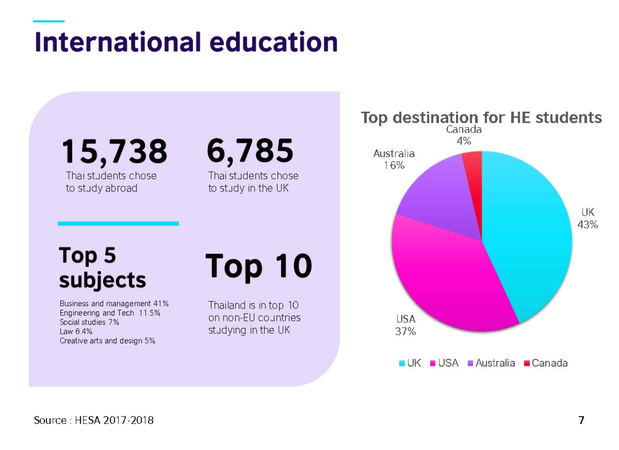
The United Kingdom is the number one destination for Thai higher education students, representing 6,785 or 43 per cent of the total Thai students choosing to study abroad, with the top five subjects being business and management, engineering and technology, social studies, law, and creative arts and design, the British Council said today (February 4).

The United States follows closely behind with 37 per cent, Australia 16 per cent and Canada 4 per cent. The number of postgraduate qualifications obtained the highest reach at 68 per cent, followed by undergraduate at 31 per cent.

The top five subjects Thai students choose to study in the UK are business and management at 41 per cent, engineering and technology 11.5 per cent, social studies 7 per cent, law 6.4 per cent, and creative arts and design 5 per cent, the council added.

“The British Council is an international organisation for cultural relations and educational opportunity,” said director Andrew Glass OBE. “By the end of 2020, two billion people are expected to be using or learning to use English. Our mission in 2020 is stronger than ever. We will continue to bring people together to change the world for the better and deepen relations between the UK and Thailand through our work in English, higher education and science, and creative industries.

“According to the report ‘Asean Youth Technology, Skills and the Future of Work’ from the World Economic Forum, Asean youth see language skills as one of the most valuable for the future. The challenges we face with English learning in Thailand mainly derive from inequality in education, teaching methodology, and assessment,” he said.

“From our experience, the challenges we face with English in Thailand can be divided into four areas: inequality, insufficient levels of English among teachers, teaching methodology, and testing and assessment. Digital disruption also changes the way people learn English. In 2020, the British Council is providing an end-to-end solution for teaching and testing English to support the needs of students and respond to digital changes.

“We are also introducing a new product for English learners in partnership with Academy Award-winning Aardman animation studios – Learning Time with Timmy – to Thailand. This innovative learning experience includes courses, apps, and a video series to help children aged from four to six learn English through play-based methodology. Using simple words, young learners will develop their English skills in a natural way, building strong fundamental skills in preparation to become global citizens,” Glass added.

The British Council continues to promote UK education through the Study UK Fair and launch of the GREAT scholarships and IELTS prize. Helped by the introduction of the New Graduate Route by the UK government, the UK aims to welcome 600,000 international students globally by 2030.

“There are more than 300,000 people in the crafts sector in Thailand. If we could bridge the skill gaps and change the perception of the craft sector in Thailand, this would not only help to drive the Thai economy but also sustain local wisdom and heritage,” he said.

“The British Council has been working with more than 3,000 crafts entrepreneurs and over 200 brands to enhance their design and social entrepreneurial skills. Building on this success, we will support a growing network of craft communities by strengthening social entrepreneurial skills and promoting the role of hubs and cities through creative economy partnerships,” Glass said.

“Today, the role of the university has changed from lectures in classrooms to becoming the forefront of research and innovation. The government has underlined the importance of collaboration and priorities with BCG; the bio-economy, circular economy, and green economy. There is a strong need for universities to reinvent themselves and reskill the Thai markets amidst the disruption in technology and growing global competition.

“In the last three to four years, the British Council has enabled 55 research collaborations and academic partnerships. The majority of research collaborations are in the areas of medical engineering, biological science, food and agriculture, and energy and engineering. In 2020, we aim to continue to internationalise higher education and science by enabling collaboration between universities and industry, developing research ecosystems and making science more accessible among the public through projects such as FameLab and Researcher Connect,” Glass added.

YouTube bans some misleading or doctored political videos #ศาสตร์เกษตรดินปุ๋ย

#ศาสตร์เกษตรดินปุ๋ย : ขอบคุณแหล่งข้อมูล : หนังสือพิมพ์ The Nation

https://www.nationthailand.com/edandtech/30381556?utm_source=category&utm_medium=internal_referral

YouTube bans some misleading or doctored political videos

Feb 04. 2020
By The Washington Post · Greg Bensinger 

YouTube said it will ban misleading or doctored videos that could impact elections, tightening its rules ahead of the presidential election.

The video-streaming site said in a blog post Monday that it will remove altered videos such as “deepfakes” and videos with patently false information, such as clips that report a living candidate is dead. It will also target videos that attempt to mislead the public about the voting or election process.

“We’ve increased our efforts to make YouTube a more reliable source for news and information, as well as an open platform for healthy political discourse,” Leslie Miller, YouTube’s vice president of government affairs and public policy, wrote in the blog post.

The moves come hours before voters in Iowa gathered to signal their support for presidential candidates in the Democratic field, the first tally of the 2020 primary season. Several primaries are scheduled for the coming weeks, including in strategically crucial states such as California and Virginia.

YouTube, a division of Google, has become a central advertising platform for candidates and source for voters seeking election information. But that has also brought bad actors who may willfully try to manipulate voters with incorrect information about hot-button political issues or even realistic-looking videos manipulated to give a false impression of a politician they oppose.

Last year, for instance, manipulated videos of House Speaker Nancy Pelosi (D-Calif.), slowed to make her appear to be drunkenly slurring her words, were spread widely on social media, including YouTube, which removed them.

The dissemination of manipulated videos, in particular, has been a complicated topic in Silicon Valley heading into the 2020 presidential election amid a deeply divided electorate and the advancement of digital tools that make altering content easier than ever. Tech companies have formed special fact-checking teams and employed technical experts to help identify misleading or manipulated content.

Still, false narratives can spread quickly and effectively. Right-wing activists took to Twitter over the weekend to push claims of voter fraud in Iowa, including claims of voter registration inaccuracies, that went viral on the social media site.

“It’s a huge technical challenge to detect these kind of videos. We just don’t have very effective algorithms for finding digitally altered videos at this scale,” said Siwei Lyu, director of computer-vision lab at the State University of New York’s University at Albany and a member of the Deepfake Detection Challenge’s advisory group. “I applaud the effort, but we’ll have to see how this can be implemented in an effective way.”

Facebook last month said it removed videos it determined had been digitally manipulated by technologies such as artificial intelligence in a way that average users would not easily spot, including attempts to make the subjects of videos say words that they never did. But the policy did not appear to apply to doctored videos such as the Pelosi clip, which Facebook allowed to remain on the site. The social media site has been criticized for allowing content that is false as long as it is distributed by politicians or candidates – content it says should be up to voters to judge.

Social media sites Pinterest and Twitter last week also announced policies to combat election misinformation. Twitter users will be able to more easily flag content that contains false information about the process of voting, while Pinterest said it will proactively pull down such posts.

YouTube said such misleading videos represent less than 1% of what is watched in the United States But with well over 1 billion hours of content streamed daily globally, that could still represent tens of millions of hours. Election watchdogs have argued that YouTube, Facebook and other social media sites were central repositories in the efforts to manipulate the 2016 U.S. presidential vote and other global elections.

Google-parent Alphabet on Monday disclosed for the first time advertising revenue for YouTube since acquiring the site in 2006. While the $15 billion in annual sales doesn’t account for payouts the site makes to video creators, Wall Street analysts praised the company for its newfound transparency, which included cloud computing revenue.

Still, investors sent shares down nearly 5% in after-market trading, as Alphabet missed expectations on key metrics such as operating income and companywide revenue and advertising sales.YouTube says viewers are spending less time watching conspiracy-theory videos. But many still do.

In December, YouTube said its efforts to combat conspiracy theories and other debunked theories on its site had led to a reduction in how much time viewers spent watching such content. But its claims of a 70% drop in average time U.S. viewers were watching “borderline” content such as flat-Earth or medical-cure videos was tempered by a lack of underlying data.

Also included in YouTube’s ban are attempts to artificially boost numbers of likes, views or comments on videos and channels that impersonate others or try to conceal their connection to a government actor, the company said.

YouTube said it promotes videos that it determines are authoritative on a subject, which should marginalize content that may be misleading or erroneous.

Google stuck between privacy, antitrust with ad data limits #ศาสตร์เกษตรดินปุ๋ย

#ศาสตร์เกษตรดินปุ๋ย : ขอบคุณแหล่งข้อมูล : หนังสือพิมพ์ The Nation

https://www.nationthailand.com/edandtech/30381553?utm_source=category&utm_medium=internal_referral

Google stuck between privacy, antitrust with ad data limits

Feb 04. 2020
The Google logo displayed at the Google Playspace at CES 2020 in Las Vegas on Jan. 7, 2020. MUST CREDIT: Bloomberg photo by David Paul Morris.

The Google logo displayed at the Google Playspace at CES 2020 in Las Vegas on Jan. 7, 2020. MUST CREDIT: Bloomberg photo by David Paul Morris.
By Syndication Washington Post, Bloomberg · Gerrit De Vynck, Mark Bergen

Google is limiting access to key tools that track ad spending, disrupting hundreds of marketers and underscoring the powerful role the search giant plays in the digital advertising industry.

One recent change affects ad-measurement companies — independent firms that monitor the performance of ads across Google, Facebook, Twitter and elsewhere. Last month, Google cut off those companies from analyzing a popular type of Google ad shown on iPhones and iPads. Instead, the company told advertisers to use its own measurement tools, something marketers have complained about in the past because they would rather trust neutral third parties.

The move focuses on ads that try to persuade people to install apps, a corner of the industry that generates billions of dollars a year in revenue for Google and other tech giants. One industry executive said the step was anticompetitive because Google is favoring its own services and unfairly elbowing out rivals. The person plans to complain to state attorneys general, who are investigating Google for potential antitrust violations. The person asked not to be identified discussing sensitive issues.

Google dominates search ads and, with Facebook, controls more than 60% of the broader digital ad market, according to one estimate. With data on billions of users, Google helps marketers target online messages and measure how many people clicked on ads and took other valuable actions, such as making purchases. The power of these offerings will be on show when parent Alphabet Inc. reports results after the market closes Monday.

The internet giant has been pressured for years to share more of this data with outside firms, so marketers can trust the metrics and easily compare how Google ads perform versus other providers. Access to this information is an emerging antitrust issue, especially in Europe, and Google has slowly opened up over the years.

But new privacy rules in California and Europe have raised the bar on what data companies are allowed to share. Google and other tech companies have responded by limiting the information that leaves their platforms. Apple Inc. has also cracked down on what can be shared for advertising.

Privacy laws have given Google “cover” to increasingly force advertisers to play by its rules, said Dina Srinivasan, a former ad-technology executive. “What we need in the U.S. is a privacy approach that solves competition problems and consumer privacy problems at the same time.”

Google executives have privately complained about being stuck in a “damned if you do, damned if you don’t” situation. If the company shares less data, advertising rivals and partners shout antitrust. If it opens up, privacy advocates cry foul.

A spokesman said Google changed the approach to app-install ads because it’s hard to accurately measure the performance of these ads when iPhone users are logged out of their Google accounts. Letting external firms track ads in these cases would rely on techniques that “don’t provide users with appropriate choice, transparency and control,” the spokesman added. AdWeek reported the iPhone and iPad ad changes earlier.

Google told partners that the restrictions affect ads representing at least 40% of the money spent with Google to promote apps on iPhones and iPads, according to a person familiar with the situation. The Google spokesman said the “vast majority” of app ads on iPhones will not be affected, but declined to site specific numbers.

A similar dynamic is playing out in other parts of Google’s vast business. By the third quarter of 2020, the company plans to stop advertisers from pulling data about who clicks on their web banner and video ads out of Google’s system. Marketers have used this information for years to fine-tune their messages. Google already made this change in Europe and has said it would be applied globally. But complaints from some partners prompted Google to delay the change until later this year.

“Customers pushed back pretty hard,” said Ari Paparo, head of digital ad firm Beeswax and a former Google executive. “With the increasing emphasis on privacy, it seems inevitable that they will make this change despite the negative impact.”

Earlier this month, the Alphabet unit also said it would phase out cookies — bits of software code that let advertisers track users around the web and send them targeted ads. This approach has sustained a major part of the online marketing industry, and advertisers are scrambling to prepare.

This “will force ad-tech companies to re-imagine their businesses and advertisers to fundamentally shift the digital buying strategies they have been honing for 20 years,” said Brad Nunn, an executive at Media Assembly, part of ad agency MDC Partners Inc.

The Association of National Advertisers and the American Association of Advertising Agencies both decried the move, saying it could “choke off the economic oxygen from advertising that startups and emerging companies need to survive.”

Virginia Tech names Cornell dean to be first chief of Innovation Campus #ศาสตร์เกษตรดินปุ๋ย

#ศาสตร์เกษตรดินปุ๋ย : ขอบคุณแหล่งข้อมูล : หนังสือพิมพ์ The Nation

https://www.nationthailand.com/edandtech/30381499?utm_source=category&utm_medium=internal_referral

Virginia Tech names Cornell dean to be first chief of Innovation Campus

Feb 03. 2020
Lance Collins, dean of engineering at Cornell University. MUST CREDIT: Cornell University photo by Lindsay France

Lance Collins, dean of engineering at Cornell University. MUST CREDIT: Cornell University photo by Lindsay France
By The Washington Post · Nick Anderson · NATIONAL, EDUCATION 

The campus that Virginia Tech plans for the Potomac riverfront, linking graduate education with high-tech industry, resembles a venture Cornell University built in New York for much the same purpose.

Now, the public university is hiring a senior official from Cornell to lead what Virginia Tech calls the Innovation Campus – a $1 billion project in Alexandria near the site of the new Amazon headquarters in northern Virginia.

Lance Collins, 60, Cornell’s dean of engineering since 2010, will become vice president and executive director of the campus in August, Virginia Tech announced Monday.

From that position, Collins will be a key player in forging partnerships among academia, business and government as the campus takes shape. He grew accustomed to such challenges after helping to conceive and launch Cornell Tech.

That project, a collaboration between Cornell and the Technion-Israel Institute of Technology, is devoted to applied sciences and engineering. Its campus opened in 2017 on Roosevelt Island in New York. The parallels to Virginia Tech’s initiative are numerous.

“This new Innovation Campus is really going to be focused on technology development – particularly technology that’s relevant to society,” Collins said in a telephone interview. “That’s a very different mission than a traditional academic campus.” He said he was “thrilled to be taking on this role.”

Collins will arrive along with the first graduate students recruited for the project. Starting in the fall, they will take classes in computer science and computer engineering at Virginia Tech’s satellite in Falls Church while the campus is being developed in the Potomac Yard neighborhood of Alexandria. The 15-acre project site lies just south of Reagan National Airport.

Plans call for the first campus building to open in August 2024. The state is supplying $167.7 million for its construction. Within a decade, Virginia Tech expects to have up to 750 master’s degree students on the campus and hundreds more doctoral students and postdoctoral fellows. The campus expects to hire about 50 research and teaching faculty members.

Several universities in the Washington region already supply talent for technology companies, including the public University of Maryland at College Park and public George Mason University in northern Virginia.

But demand for a highly skilled workforce is likely to intensify as the tech industry grows. The Alexandria campus of Virginia Tech and an expansion of George Mason’s operations in Arlington were selling points in the campaign to lure Amazon to northern Virginia. Based in Seattle, the online retailer announced in November 2018 that it would build a second headquarters in Arlington. (Amazon founder and chief executive Jeff Bezos owns The Washington Post.)

Collins emphasized that the campus will not cater to just one company. “There will be strong ties with Amazon,” he said, “but I want to be clear: It won’t be an exclusive relationship. There are a lot of companies that are going to be interested in this campus, and we want to be open to all of them.”

Businesses will be partners, he said, but they won’t dictate what the campus does. “The faculty and the administration set the agenda,” he said. “There’s no question about that. That’s not even up for discussion. Otherwise, it’s not academia.”

Collins holds a bachelor’s degree in chemical engineering from Princeton University and master’s and doctoral degrees in that discipline from the University of Pennsylvania. He will be a professor of mechanical engineering at Virginia Tech.

In the search for a campus leader, said Virginia Tech President Timothy Sands, Collins stood out in part because he had helped Cornell ensure close ties between its main campus in Ithaca, New York, and Cornell Tech. Sands wants to forge a similar connection between Virginia Tech’s main campus in Blacksburg, which lies more than 200 miles southwest of Alexandria, and the Innovation Campus. A central issue, he said: “How do you make it feel like one university?”

Sands said he was also impressed by what Collins accomplished as dean of a premier engineering school with 230 faculty members and about 5,000 students.

Under Collins, Cornell recently erased the gender gap in a field historically tilted toward men: Half its undergraduate engineering students are now women. The engineering school also has expanded enrollment of students from underrepresented minority groups, including African Americans and Latinos.

“To see that he had done that there gave us optimism that he will be able to broaden the pool of talent coming into the pipeline in the Washington region,” Sands said. “That’s dearly needed.”

Twitter bans Zero Hedge account after it doxxed Chinese researcher over coronavirus #ศาสตร์เกษตรดินปุ๋ย

#ศาสตร์เกษตรดินปุ๋ย : ขอบคุณแหล่งข้อมูล : หนังสือพิมพ์ The Nation

https://www.nationthailand.com/edandtech/30381452?utm_source=category&utm_medium=internal_referral

Twitter bans Zero Hedge account after it doxxed Chinese researcher over coronavirus

Feb 02. 2020
By The Washington Post · Derek Hawkins · TECHNOLOGY
Twitter on Friday permanently suspended the right-leaning finance blog Zero Hedge after it published a conspiracy theory suggesting that a Chinese scientist might be responsible for the deadly coronavirus outbreak.

A Twitter representative did not comment on what specifically prompted the suspension, saying only that Zero Hedge was removed for violating the social media giant’s platform-manipulation policy. Twitter defines platform manipulation as “using Twitter to engage in bulk, aggressive, or deceptive activity that misleads others and/or disrupts their experience.”

But Zero Hedge’s founder, who uses the pseudonym Tyler Durden, wrote in a Friday afternoon post that he received a notice from Twitter saying he violated the platform’s rules against abuse and targeted harassment.

“It is news to us that this website has (ever) ‘engaged in the targeted harassment of someone,’ ” Durden wrote.

Bloomberg News reported that it received an email from Durden saying he believed the suspension was “unjustified, and likely motivated by reasons other than the stated ones.”

According to Durden, the suspension appeared to be related to a Zero Hedge post from earlier in the week titled “Is This The Man Behind The Global Coronavirus Pandemic?”

BuzzFeed News published an article Friday debunking the post, which promoted the discredited claim that the new coronavirus could have emerged from biological weapons research at a virology institute in Wuhan, the city where the outbreak began. Zero Hedge listed the name, photograph and contact information for a researcher at the institute, and it called on readers to “pay [him] a visit” if they want to “find out what really caused the coronavirus pandemic.”

The article, as well as other Zero Hedge posts making unfounded claims about the coronavirus, were shared thousands of times on social media.

Zero Hedge’s claims were part of a wave of posts, photos and videos that have emerged in recent weeks peddling misinformation about the rapidly spreading coronavirus, which has infected nearly 12,000 people around the world. More than 250 people have died from the virus, all of them in China.

Twitter, Facebook and Google have scrambled to curtail the misleading content, pledging to boost accurate information about the outbreak and crack down on users who promote falsehoods.

Experts have rejected the idea that the virus could be man-made or the product of biological weapons research.

“Based on the virus genome and properties, there is no indication whatsoever that it was an engineered virus,” Richard Ebright, a professor of chemical biology at Rutgers University, told The Washington Post this week.

Zero Hedge launched in 2009, mostly featuring news and commentary about financial markets from a libertarian perspective. In recent years, the blog has amplified right-wing conspiracy theories on a range of topics. In November, Zero Hedge erroneously reported that the head of Burisma, the Ukrainian gas company at the center of the current impeachment trial, had been “indicted” by Ukraine’s prosecutor general.

Facebook’s first human rights chief seeks to tame digital hate #ศาสตร์เกษตรดินปุ๋ย

#ศาสตร์เกษตรดินปุ๋ย : ขอบคุณแหล่งข้อมูล : หนังสือพิมพ์ The Nation

https://www.nationthailand.com/edandtech/30381449?utm_source=category&utm_medium=internal_referral

Facebook’s first human rights chief seeks to tame digital hate

Feb 02. 2020
Miranda Sissons, Facebook's new human rights director, stands for a portrait at Facebook's offices in Menlo Park, California, Tuesday, January 14th, 2020.

Miranda Sissons, Facebook’s new human rights director, stands for a portrait at Facebook’s offices in Menlo Park, California, Tuesday, January 14th, 2020.
By Syndication Washington Post, Bloomberg · Joshua Brustein · BUSINESS, TECHNOLOGY

In July, Facebook Inc. quietly hired Miranda Sissons, a 49-year old human rights activist whose previous work has included stints at the Australian diplomatic service and the International Center for Transitional Justice. The hiring, which was never formally announced, is part of a broader effort by the company to atone for more than once failing to stop online abuse on Facebook from spilling over into real-world violence.

Human rights advocates in places like Sri Lanka, the Philippines, India and Brazil have long complained that the company has refused to acknowledge mounting evidence about the dangers of digital hate. As Facebook pursued world-changing growth, particularly in developing countries, it didn’t always have local staff there, or even employees who spoke the language. In Myanmar, a wave of online hate preceded a campaign of violence against the country’s Rohingya minority that led to thousands of deaths and the displacement of over 700,000 people. An independent report Facebook commissioned in 2018 found that it bore partial responsibility for fueling the conflict.

Immediately after taking the job, Sissons took a five-day trip to the country. “I was deeply, deeply aware of the criticism of Facebook’s inaction in Myanmar, and deeply aware of the struggles humankind is facing with the impact of social media,” Sissons told Bloomberg News earlier in her first press interview in her new role. “This is one of the greatest challenges of our time.”

Sissons work is part of a broader reckoning within the technology industry, which has been forced to reexamine its role in world conflicts. Several months before Facebook hired Sissons, Twitter Inc. brought on Cynthia Wong, a former researcher at Human Rights Watch, to be its human rights director. As with Facebook, Twitter never announced the hiring.

In discussions with more than a dozen people familiar with Facebook’s work on human rights, a picture emerges of a company that has been moving rapidly but, according to its skeptics, not always effectively. One Facebook employee, who asked not to be identified discussing private information, said its shortcomings have not always been the result of having too few people dedicated to human rights, but at times having so many people involved that they’re working at cross-purposes.

Human rights advocates outside the company acknowledge Facebook’s effort to hire experts, and say it has become far more responsive. But they worry that internal advocates like Sissons won’t be adequately empowered, and many are withholding praise until the company makes more concrete changes. “They are hiring people who have the right knowledge, experience and sensibility to tackle human rights problems,” said Matthew Smith, chief executive of Fortify Rights, a human rights group. “So far, though, that’s clearly not enough.”

Sissons’ human rights education started early. Her father was a prominent Australian historian who served in the occupation force of Hiroshima after World War II, then worked as an interpreter in the Australian-led tribunals of Japanese officials accused of war crimes. “My early childhood was completely taken up with discussions of war crimes, war criminals, the Second World War, and notions of justice,” she said.

After attending the University of Melbourne, Sissons spent time in East Timor, researched Middle Eastern issues and took several posts with the Australian diplomatic corps, including a frustrating stint answering phones at an Australian embassy in Egypt. “My Arabic wasn’t very good,” she confessed. “People would ring me up and shout at me about all kinds of things, and I would have to find a solution. ” Eventually, Sissons went on to work on her own high-profile tribunal as an independent observer of the trial of former Iraqi leader Saddam Hussein, and she did stints at Human Rights Watch and the Australian diplomatic corps.

In 2011 Sissons switched her focus to the relationship between human rights and technology. She had been working in the Middle East, where the Arab Spring was just getting underway, and many people believed social media could shift the balance of power between citizens and oppressive regimes. It was a time of unmatched optimism about the potential of social media in political organizing.

The good feelings didn’t last. As early as 2014 there were credible reports emerging of coordinated incitement on Facebook against the Rohingya in Myanmar. The online abuse foreshadowed a wave of violence that began in earnest in 2016.

By the time Facebook began looking for a human rights director in 2018, the conventional wisdom on tech from a few years earlier had effectively reversed. The killings in Myanmar and elsewhere, coupled with Russian-led disinformation campaigns in Donald Trump’s presidential election, had darkened popular opinion. Companies that were accustomed to being revered were suddenly being accused of simultaneously squelching free expression and tolerating active manipulation of their platforms.

The tech industry’s first halting steps to control the flow of abuse initially won few fans. In an online essay in late 2018 Cynthia Wong, then senior internet researcher for Human Rights Watch, said it was time for a “moral reckoning” in Silicon Valley. “If regulators, investors, and users want true accountability, they should press for a far more radical re-examination of tech sector business models, especially social media and advertising ecosystems,” she wrote.

In some cases, the companies started hiring their critics. Twitter brought on Wong as its legal director of human rights in April 2019. The company declined to make her available for an interview, and said in a statement that it was “uniquely positioned to help activist and civic-minded people around the globe make their voices heard.”

Other attempts at reform were wholly unsuccessful. In early 2019 Ross LaJeunesse, then Google’s global head of international relations, saw Facebook’s posting for a human rights director, and used it to argue for the creation of a similar structure at his company. He failed, and left the company soon after. LaJeunesse, who is currently running for the U.S. Senate in Maine, now says tech companies can’t handle these issues on their own. “There has to be government oversight,” he said.

Sissons, who reports to Facebook’s head of global policy management Monika Bickert, has over the last several months been quietly incorporating human rights protections into Facebook’s policies, and making sure that people with human rights training are in the meetings where executives sign off on new product features. She said the company had made progress before she arrived, including the reform of its 2018 decision to begin removing misinformation in situations where it could lead to physical harm.

“There are now a lot of resources in place,” Sissons said. The challenge is to quickly identify local signs of trouble, then block or slow the spread of certain content, or take swift action against particular users. “We are testing continuously in crisis environments to try and predict what resources we’ll need,” she said, “and to ensure they’re in place.”

When Sissons went to Myanmar with Facebook she made a stop in Phandeeyar, a tech hub and community center in downtown Yangon. Jes Kaliebe Petersen, its CEO, said he’s been meeting with Facebook employees for years – he helped the company develop local community standards almost five years ago. But the encounters have calcified into a depressingly predictable routine. “They send a bunch of people who have never been here before, and they talk to us,” said Petersen. “And we never hear from them again.”

A spokesman for Facebook said it has held many introductory meetings at the request of local advocates, and argued the company has taken significant strides in the country. Besides hiring Sissons, it shut down hundreds of pages and accounts, including that of the head of Myanmar’s army, for spreading misinformation and hatred. It has hired a Myanmar head of public policy for the first time. And it assembled a team of 100 content moderators who speak Burmese. That group will be able to “support escalations” in other languages used in the country as well, Sissons said.

The company also set up an independent review board for thorny content moderation issues, and in an unusual step, commissioned independent human rights assessments of what happened in Myanmar and other trouble spots. In November 2018, it published a 60-page report on Myanmar from the nonprofit group Business for Social Responsibility, in full. “They deserve praise for putting it out there,” said Dunstan Allison-Hope the lead author of the report. “You don’t see that.”

But Facebook has never made the results of a similar assessment in Sri Lanka public, despite calls to do so. Sissons declined to say whether it had plans to publish those results. And there are currently no Facebook staff members working in Myanmar full-time – something that many advocates have called for. Representatives for Facebook say its staff based in Singapore and elsewhere are regularly in Myanmar, and that it has spent well over a year taking hundreds of meetings with people in the country.

One person who said he’d never gotten an invitation to meet with Facebook is Nickey Diamond, a local advocate working for Fortify Rights. Diamond said he has been the target of harassing posts from the government for years, and still faces a menacing atmosphere online. “They’re sharing my picture with the word ‘traitor’ in Burmese,” he said. “Every human rights defender is in the same situation.”

The broader problem Facebook is confronting-the vigilant monitoring of an ever-evolving social network used by 2.3 billion people-can seem almost impossibly daunting. The company now has content moderators examining posts in approximately 50 languages, Sissons said, a number that is unchanged from its count last April, and is fewer than half of the languages that Facebook actively supports.

Facebook has said only technological improvements can combat problems at scale. It has automated tools that scan for hate speech, as well as image recognition technology monitoring for obscene content regardless of language. About 80% of the posts that Facebook acts on for violating its hate speech policies are now first identified by its automated filters, up from about 24% a year earlier.

Soon, the challenges of monitoring the spread of abusive posts could become even more difficult. Facing pressure to increase user privacy, Facebook has prioritized private communications, meaning more content is encrypted so that even the company itself won’t know what it says. In those cases, Sissons said the company is working on tools that will look for patterns associated with problematic content, so it can either remove such messages or impede them from spreading so rapidly.

Facebook is aware of the scope of its challenges, said Rebecca MacKinnon, the director of Ranking Digital Rights, an online advocacy group. “Facebook is making an effort to engage. Whether that will make a difference in the real world, we’ll see,” she said. “They’re dealing with some problems that no one knows how to solve.”

When Sissons met with members of the Phandeeyar team last November in Myanmar, they came prepared with a handful of suggestions for actions Facebook should take before the national elections there, which are expected to take place later this year. While Phandeeyar staffers had been deeply engaged in the specifics for months, Sissons was still just getting her feet under her, and there wasn’t enough time in the hour-long meeting to get much resolution, said Phandeeyar CEO Petersen.

“There’s always lots of goals for improvements. Hopefully Miranda has a sound plan for how to get there,” he said. “The thing is, we don’t really have that much time.”


Anti-Defamation League launches tool to track anti-Semitism #ศาสตร์เกษตรดินปุ๋ย

#ศาสตร์เกษตรดินปุ๋ย : ขอบคุณแหล่งข้อมูล : หนังสือพิมพ์ The Nation

https://www.nationthailand.com/edandtech/30381439?utm_source=category&utm_medium=internal_referral

Anti-Defamation League launches tool to track anti-Semitism

Feb 02. 2020
A woman leaves a candle in front of the Tree of Life Synagogue in Pittsburgh after a deadly attack there in 2018. MUST CREDIT: Washington Post photo by Salwan Georges

A woman leaves a candle in front of the Tree of Life Synagogue in Pittsburgh after a deadly attack there in 2018. MUST CREDIT: Washington Post photo by Salwan Georges
By The Washington Post · Souad Mekhennet 

On the 75th anniversary of the liberation of the Auschwitz-Birkenau death camp last week, incidents of anti-Semitic vandalism, harassment and assaults were reported in the United States.

As survivors, heads of states and members of Jewish organizations gathered at the site where the Nazis systematically murdered more than 1.1 million people, a letter declaring that Jews are fake and part of the “Synagogue of Satan” was sent to synagogues in Seattle, Springfield, Virginia, and the District of Columbia.

Swastikas were painted on City Hall in Pendleton, Oregon, and a home in Boulder City, Nevada. Walls inside an apartment building in New York were marked with profanity-laced graffiti targeting Jews.

For the Anti-Defamation League, one of the oldest U.S. organizations that collects data on hate and anti-Semitism around the world, such incidents have become increasingly common in the United States – so much so that it launched a new online project this week to track them.

“We are doing this because anti-Semitic incidents are more prevalent nationwide and we felt it was essential to provide immediate and reliable data to the public,” said Jonathan Greenblatt, the group’s chief executive and national director.

“This tool allows people, whether it’s the general public or journalists or students or law enforcement, to see the activity that has taken place, not just around the country but in localities potentially nearby,” he said.

The group collects information about anti-Semitic incidents from sources such as media reports, law enforcement and direct reporting at one of its 25 offices across the country. According to Greenblatt, the staff will investigate and validate the information it publishes as part of the new project.

“We are now using the tracker because the pace of incidents has grown so dramatically,” Greenblatt said.

In 2017, anti-Semitic incidents in the United States increased 57%, according to the group, the largest single-year increase the group has seen and the second-highest total in its history. In 2018, the overall number of incidents declined slightly but remained at near-historic levels, the group says.

The online activities of far-right and neo-Nazi groups have also spiked.

“This online activity is spilling out into the real world – not just through terrorist attacks, but brazen recruitment operations across campuses and other public spaces, providing contact information for whites to join local chapters of neo-Nazi groups and train for what they see as a pending race war,” said Rita Katz, executive director of the SITE Intelligence Group, a private firm that tracks online extremist activity.

In a December report, SITE found that the far right has had a presence on the Telegram messaging app since September 2016. But a majority of the 374 groups and channels sampled for the report were created on or after March 15, 2019, the date that a white supremacist killed 51 Muslims in two mosques in Christchurch, New Zealand.

Katz noted that college campuses are “a recurring factor” in many of the incidents listed in the tracker.

“This is not surprising as we at SITE have been seeing neo-Nazi and white supremacist groups like Feuerkrieg Division, The Base, and Atomwaffen Division place special emphasis on flying campaigns at college campuses throughout the country,” she said.

Greenblatt said the tracker was critical in a charged environment in which people are worried that the government doesn’t appear to have a solution and fear that stereotypes and scapegoating of Jews are spread easily. But he said his group faces challenges – extremist violence often happens in cities where it does not have offices and most people don’t report incidents.

Adding to this is the realization that memories of the Holocaust are fading, and survivors and witnesses are dying.

“People forget the most horrible act of the 20th century that showed what can happen when hate goes unchallenged,” Greenblatt said.

Denla British School Offers Scholarship Opportunities at the “DBS Scholarship Day” #ศาสตร์เกษตรดินปุ๋ย

#ศาสตร์เกษตรดินปุ๋ย : ขอบคุณแหล่งข้อมูล : หนังสือพิมพ์ The Nation

https://www.nationthailand.com/recommended/822?utm_source=category&utm_medium=internal_referral

Denla British School Offers Scholarship Opportunities at the “DBS Scholarship Day”

Jan 31. 2020
to Search for Top Students – Aiming to Nurture Year 3 – 10 Students to Access the World’s Top Universities. Please Register Before 21st February 2020.

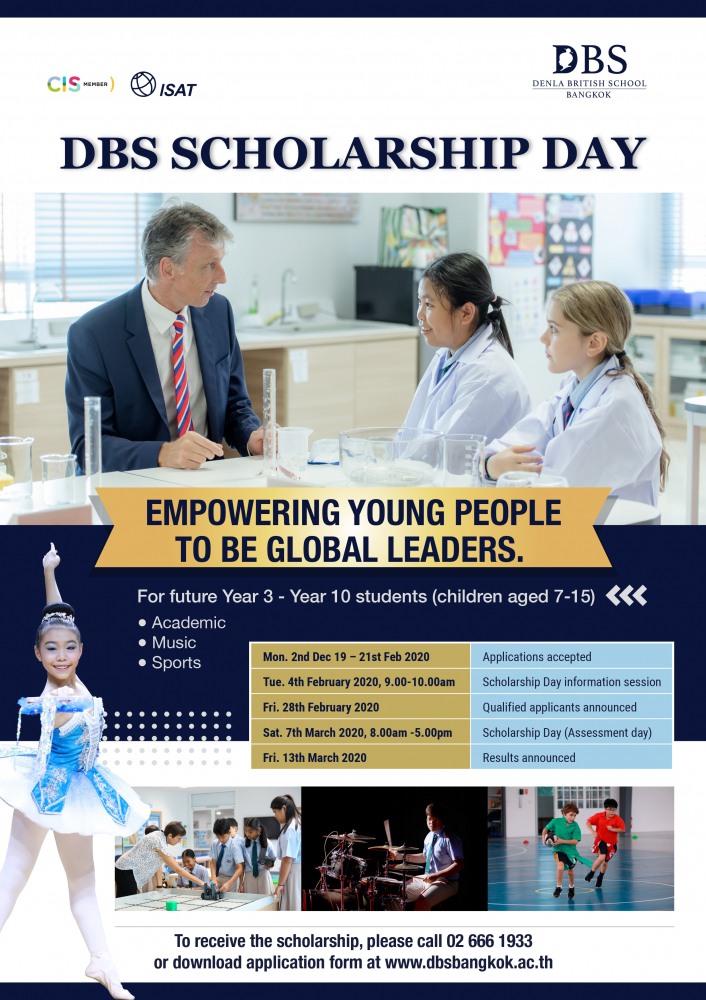
The opportunity to become part of the Denla British School (DBS) family is here for Year 3 to Year 10 students who excel in Mathematics, Science, English, Thai, Music, Sport, and all-round abilities! Denla British School (DBS) is a premium international school that implements the Enhanced British Curriculum modelled on the top independent schools in the UK, and it offers scholarship opportunities at the “DBS Scholarship Day” for students of Year 3 to Year 10. Interested students and parents can learn more about this at the scholarship information session at DBS on Tuesday 4th February 2020 from 9.00-10.00 am. Then, on Saturday 7th March 2020, selected candidates will be invited to take the scholarship assessment at DBS.

Mr Mark McVeigh, Principal of DBS said that the strength of the DBS unique vision in the core areas of an Enhanced British Curriculum, Academic Excellence for All, Entrepreneurship and Creative Thinking, and  Community and Global Perspectives, has encouraged DBS students to develop significantly in all areas – clearly shown from academic and non-academic awards – and that is why DBS is being recognised as the international school that nurtures global leaders and entrepreneurs.

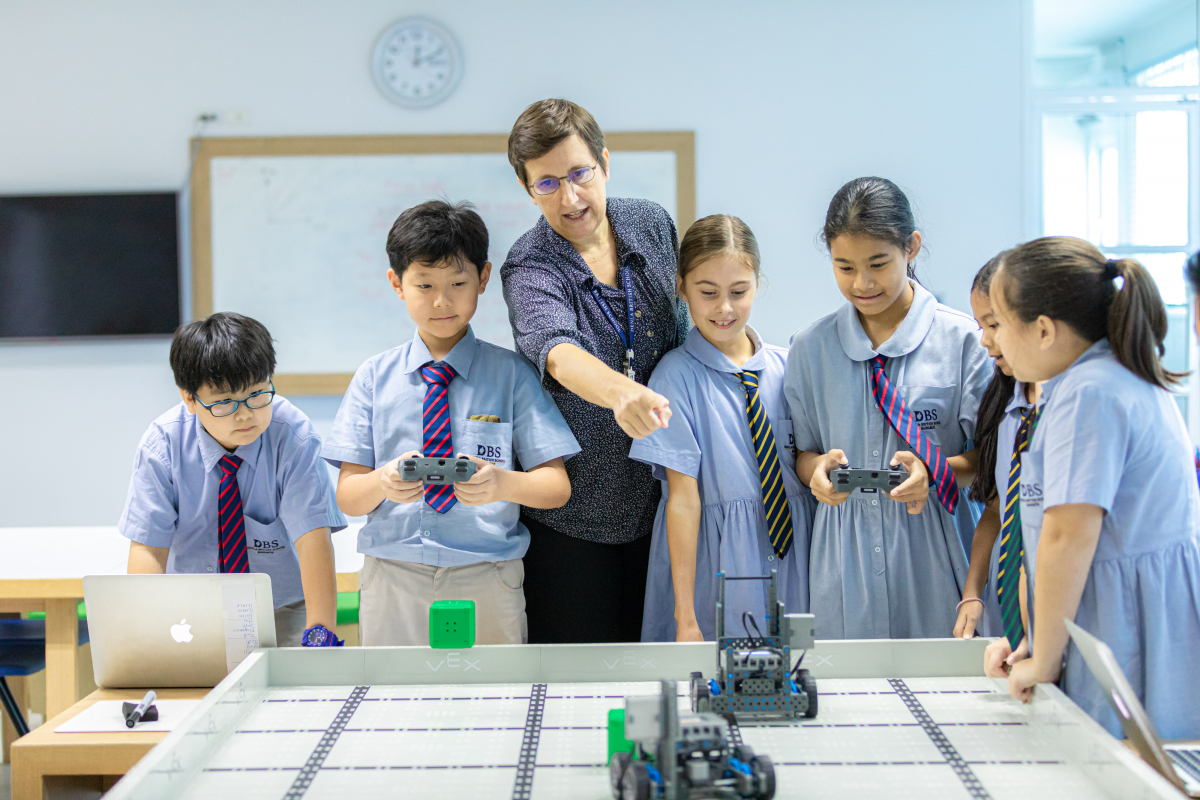
DBS Scholarship Day is one of the programmes that contribute to the vision of Academic Excellence for All, aiming to encourage students who excel in Mathematics, Science, English, Thai, Music, Sports, and all-round abilities, to enrol in DBS. DBS is a unique international school in Bangkok, which implements a UK independent school curriculum and its teachers are not only experienced, but are also 100% native English speakers (apart from Thai and Mandarin subjects). The curriculum of UK  independent schools is outstanding, with its Personalised Learning approach that concentrates on encouragement, and adapting the teaching method to each student, according to their skills and preferences. Approaches vary from specific teaching for each individual, to teaching in small groups, with teachers and their assistants supervising the entire process. The school is not only known for its academic excellence, but also encourages an all-round education so that children can explore and discover their own talents.

At the DBS Scholarship Day, there will be an academic examination using the UK education standard for all candidates. Additionally, scholarships for music and sports, will involve students taking auditions and exercises, and showing proven, recognised records of their abilities. And for those who have all-round abilities, the assessment for them will be a mixture of academic examinations and practical assessment.

When a student is awarded a DBS Scholarship, the school will nurture them so that they can access the world’s top universities using, for example, the Beacon Programme that is designed to cater for high attaining and greatly engaged learners. The programme values enthusiasm, creativity and passion, whilst facilitating additional opportunities to stretch and challenge students beyond the classroom. The Beacon Programme aims to further encourage excellent learning behaviour. It will involve practising problem solving, analysing, leading, communicating and logic, using lateral and critical thinking. The Beacon Programme encourages self-determination, self-direction, self-respect, and self-awareness. This will allow students to become independent learners who thrive in working outside of their comfort zones, and can adapt and participate in a rapidly changing society and economy.

Besides the Beacon Programme, DBS has launched other special programmes:

  • A Comprehensive ESL programme – to ensure that every DBS student is able to access the British curriculum, encouraging a good mastery of the English language for all.
  • The Accelerated Reader programme – to enable students to make excellent progress in their English language reading. Books are selected at an appropriate level for the individual, students answer questions to show that they have understood, and they can then move on to the next level at their own rate.
  • The Y10 and IGCSEs programme – to ensure that the school has the right teaching team in place for the start of the IGCSEs, and that the curriculum reflects the necessary IGCSE course specifications. Plans will be put in place so that individual students receive guidance on which of the optional subjects to choose, apart from the core English, Maths and Science.
  • The GL performance programme – assessments for English, Maths, and Science to measure against the world’s average. The Progress Test Series (PT Series) assesses students’ comprehension of the core subjects to identify which students need extra support and which will rise to more challenging targets. Results from GL Assessments help teachers to accurately plan for each student’s academic excellence.

There is also a Co-Curricular Activities (CCA) programme, where students spend time learning in an additional hour per day. DBS also initiates a Model United Nations programme – an advanced learning model based on the procedures at the United Nations, giving students the opportunity to debate, discuss, analyse ideas, and present to large groups of people. This is all very important in instilling leadership skills in accordance with the school’s vision, “Nurturing Global Leaders.”

“The DBS Scholarship Day is a special opportunity and the first step to being at the leading edge of the DBS community. It is open for application from today until 21st February 2020. Interested students and parents can attend the scholarship information session at DBS on Tuesday 4th February 2020 from 9.00-10.00 am. By Friday 28th February 2020, the school will announce the list of selected candidates who will be invited to take the assessment tests on Saturday 7th March 2020. The scholarship winners will be announced in the next week,” DBS Principal said.


Interested parents can fill in the form below

https://forms.gle/dYN9PM6XHRrWGrw2A

or contact 02 666 1933

Email: admissions@dbsbangkok.ac.th