What corporate america can learn from the Navys vaccine campaign #SootinClaimon.Com

#SootinClaimon.Com : ขอบคุณแหล่งข้อมูล : หนังสือพิมพ์ The Nation.

https://www.nationthailand.com/international/40005095

What corporate america can learn from the Navys vaccine campaign


The corporate world may want to take a page out of the U.S. Navys manual when it comes to boosting workforce Covid-19 vaccination rates.

The Navy is the pride of the U.S. military when it comes to inoculation: 76% of active duty members are fully vaccinated, the highest rate of the main four branches, according to data provided by each. And at a rate of 56%, the broader U.S. population has a ways to catch up.

The Navy has taken a more-stick-than-carrot approach with its members, eschewing the free gift cards or cash bonuses that some private employers are offering as incentives and instead making life more difficult for sailors who haven’t gotten their shots. It had been imposing long quarantines away from family and restricting port calls for unvaccinated sailors even before the Defense Department’s Sept. 15 inoculation mandate was announced.

“A lot of sailors join the Navy because they want to see the world,” said Cmdr. Wade Smith of the USS Sioux City. “I told the crew, if you get to 100% vaccinated, you’ll have that option.”

ADVERTISEMENTx

The Navy’s experience could be a useful roadmap for U.S. employers that are facing a delicate balancing act as they seek to ensure a safe return to office while not alienating certain workers by forcing them to get a jab. Some employers have recently imposed vaccine mandates as the delta variant spreads, but others like Amazon can’t enact such rules in the current labor market without the risk of losing employees.

Companies don’t have the same level of control over employees as officers do sailors on a ship, but they can create inconveniences for their workers’ daily lives and limit activities – like in-person trainings and meetings – that could give employees a leg up.

“What can companies learn from this? Incentives work,” said Mark Cancian, senior adviser at the Center for Strategic and International Studies and a retired Marine Corps colonel. “Putting out another pamphlet about how vaccination is safe and you should do it is not going to help.”

Covid outbreaks at big companies like Amazon – which saw 20,000 of its U.S. workers contract the virus over six months last year – have proven public relations disasters. And the Navy hasn’t been immune, either. Nearly 1,300 sailors were infected on the aircraft carrier USS Theodore Roosevelt in March 2020, forcing the crew to evacuate to Guam and sidelining the ship for more than a month.

Officers have clamored to avoid the same fate since the Defense Department began its vaccine rollout in mid-December. If sailors get sick while at sea, operations could be crippled for weeks, an especially costly problem for the Navy, which is the most expensive of the military’s branches to operate.

ADVERTISEMENT

For commanding officers, “not being effective is not an option,” said Katherine Kuzminski, director of the Military, Veterans, and Society Program at the Center for a New American Security.

In March, Smith’s crew on the USS Sioux City in Mayport, Florida, became the first in the Navy to reach 100% vaccination. Ten ships have rates of 95% or more.

“We tried to tell them all the time about the mission of the ship,” he said about convincing crew members to get the shot. “‘We’re about to deploy, and I only have 70 sailors. I need every one of you.'”

Smith said he first called his crew to the flight deck to emphasize the importance of the Covid vaccines, and the ship’s hospital corpsman then set up a table in the mess deck for 30 minutes every day to answer questions from individual sailors. Capt. John Gay, public affairs officer at the Navy Bureau of Medicine and Surgery, said officers across the country engaged each sailor personally about getting vaccinated.

“We have a unique environment that the other services don’t have, working in these close quarters,” he said. “So there’s been a lot of education, and that face-to-face leadership has really helped.”

ADVERTISEMENT

The newly imposed vaccine mandate requires that all military personnel be vaccinated by mid-September, and those who don’t comply could face punishments as extreme as removal from service. But before the shots became mandatory, the rollback of restrictions for vaccinated sailors in February convinced many to get the jab. Meanwhile, unvaccinated service members faced restrictions that impacted their personal and professional lives. Even now, those without a shot have to quarantine on the ship for at least two weeks before deployment, which means they’re sequestered in close quarters, away from family, before what will likely be a months-long absence at sea.

When docking at a foreign port, which can happen several times per tour, unvaccinated sailors may also be forced to stay on the ship while their vaccinated counterparts enjoy their time off in a new city.

Individual bases have the authority to impose additional rules, too. Mark Julian Martinez, a junior enlisted sailor on the USS Donald Cook, said unvaccinated sailors on the base in Rota, Spain, were prohibited from going anywhere outside the base besides their homes. It was “just another added incentive for people to get the vaccine,” he said.

In the corporate world, some companies have found success in encouraging vaccines by making life inconvenient for those without. Forcing masks and routine testing could be a hassle for unvaccinated workers, while not being able to return to the office or attend in-person events could impact those employees’ professional lives.

“You can choose to be unvaccinated, but then you also give up opportunities that would be beneficial to your career,” Kuzminski said. “At a certain point, that would catch up with you.”

Wall Street firms like Morgan Stanley and Citigroup now require their workers to be vaccinated to return to the office, skirting a mandate while still creating a strong incentive for inoculation. Other employers like AbbVie require only their unvaccinated employees to mask up and undergo weekly testing.

The Navy has allowed vaccinated sailors to go unmasked for the majority of its vaccination campaign, though the requirement was reintroduced at many bases for all sailors at the end of July in response to the delta variant.

Jaslyn Henyard, a junior enlisted sailor on the USS Whidbey Island, said that many people on her ship wanted to get the vaccine in order to “go back to normal life.”

“A lot of people were looking forward to getting out of those restrictions,” she said. “So once the vaccine hit the ship, a lot of people were very excited. They wanted to get it over with.”

Gay, the Bureau of Medicine and Surgery public affairs officer, said that if the rest of the country took notes from the Navy, the pandemic might soon be behind us.

“We have to remain really disciplined, and the Navy’s done a really good job with that by creating Covid-free bubbles of people,” he said. “If we can create that in our communities, I think the end would be near.”

Published : August 23, 2021

By : Syndication Washington Post, Bloomberg · Rebecca Torrence

Escalating U.S.-China solar rift threatens Biden green goals #SootinClaimon.Com

#SootinClaimon.Com : ขอบคุณแหล่งข้อมูล : หนังสือพิมพ์ The Nation.

https://www.nationthailand.com/international/40005094

Escalating U.S.-China solar rift threatens Biden green goals


The first big test of Joe Bidens lofty clean-power ambitions may not be congressional approval of sweeping climate legislation, but managing a solar supply chain thats being shaken by the seizure of imported Chinese panels.

Multiple companies have now had solar components detained at U.S. ports in the aftermath of a Biden administration ban on equipment using raw materials originally from Hoshine Silicon Industry Co., according to people familiar with the situation who asked for anonymity while discussing sensitive trade issues.

The seizures come amid a new push by some U.S. solar manufacturers to extend tariffs to China-linked factories in Vietnam, Malaysia and Thailand, the U.S.’s largest panel suppliers. Together the developments threaten to disrupt the U.S. solar market, potentially jeopardizing Biden’s goal of a carbon-free power sector by 2035.

“It is clear that the administration wants 40% of the nation’s electricity generation to be from solar,” Abigail Ross Hopper, president of the Solar Energy Industries Association, said in an interview Wednesday. “These kind of uncertainties and additional costs could have a material impact on the rapid deployment goals that they have.”

ADVERTISEMENTx

While the solar group isn’t aware of specific project delays, Hopper said the seizures have had a chilling effect on the industry. SEIA has heard about companies not wanting to contract for future shipments until they get more clarity on how the ban will be enforced.

Already, solar developers are scrambling to prove incoming goods — some of which may have been ordered months before the Biden ban — are free of Hoshine material. A major solar-panel maker warned this week that all imports from China risk being detained by U.S. Customs and Border Protection.

Manufacturer Canadian Solar said that four of its sample modules shipped from China to its U.S. office were held last week by officials due to a sourcing issue, and that all Chinese shipments were at risk of being stopped at the border.

Other companies have also been affected, with multiple containers seized at different ports, according to people familiar with the actions. The cost of having products detained at U.S. Customs facilities is prohibitive, making other companies question whether it’s worth the risk of trying to import to the U.S., one of the people said.

The Biden administration’s order is part of efforts to confront alleged human-rights abuses in the Xinjiang region. China denies the allegations, which it claims are an attempt to undermine successful businesses.

ADVERTISEMENT

Solar developers and manufacturers had spent months shuffling supply chains and preparing for an administration move against polysilicon, a prime ingredient in the panels that convert the sun’s rays into electricity. But the administration’s Customs order in June instead had far broader reach by targeting products containing metallurgical-grade silicon, which is used to make polysilicon. Hoshine is the world’s biggest producer of the metal.

The material is so many steps removed from completed panels that just about any module coming to the U.S. can’t yet prove it doesn’t contain Hoshine material, Philip Shen, an analyst at Roth Capital Partners, said in a research note.

U.S. solar advocates are appealing to the administration to refine its initial approach — so it still discourages human-rights abuses in Xinjiang without ensnaring imports. Hopper suggested a focus on polysilicon, not the metal from which it is formed. And some solar supporters are asking the administration to phase in future moves so companies aren’t caught flat-footed, according to two people familiar with the matter.

A White House spokesman didn’t address messages seeking comment and a Customs spokeswoman didn’t immediately address an email seeking comment.

In some respects, there has never been a brighter moment for solar power in the U.S. Installations are booming, and Biden appeared poised to deliver the most progressive climate presidency in history — on the heels of an administration steadfast on boosting fossil fuels. And yet, the industry’s supply chain has been battered by higher costs, including for modules and freight.

ADVERTISEMENT

Solar panels already cost about 40% more in the U.S. than the rest of the world, and expanded tariffs could lift prices further, according to Jenny Chase, BloombergNEF’s head of global solar research.

“Recent enforcement actions and international trade petitions go beyond the intended goal and risk significantly impacting U.S. solar deployment,” said Heather Zichal, chief executive officer of the American Clean Power Association, said by email.

Amid the seizures, a group called the American Solar Manufacturers Against Chinese Circumvention filed petitions with the Commerce Department seeking to extend tariffs to factories run by Chinese firms out of the three Southeast Asian countries.

The filings come at a time when some domestic solar manufacturers are seeking an extension of former President Donald Trump’s solar tariffs — and as Democrats advance a $3.5 trillion tax-and-spending plan that could benefit both solar developers and clean-energy manufacturers.

But while the seizures may hurt U.S. developers, any moves that make imports more expensive could help level the playing field for companies that want to manufacture solar equipment on U.S. soil. That would be a boost to another part of Biden’s agenda — union jobs.

“Trade actions against imported solar products may counter President Biden’s climate agenda,” Timothy Fox, a vice president of ClearView Energy Partners, said in an interview. “But they also could further his union and domestic manufacturing agenda.”

Published : August 23, 2021

By : Syndication Washington Post, Bloomberg · Brian Eckhouse, Jennifer A. Dlouhy

Pentagon hints at more rescues outside Kabul airport, as security worsens, evacuations slow #SootinClaimon.Com

#SootinClaimon.Com : ขอบคุณแหล่งข้อมูล : หนังสือพิมพ์ The Nation.

https://www.nationthailand.com/international/40005083

Pentagon hints at more rescues outside Kabul airport, as security worsens, evacuations slow


WASHINGTON – The Pentagon on Saturday strongly hinted that U.S. troops may stage further operations outside the Kabul airport to help evacuate stranded American citizens and Afghans who aided the war effort, as the threat of violence in the capital grows amid the return of the Talibans top political leader and increased concern about potential attacks by the Islamic State.

The signal that U.S. troops could undertake enhanced efforts to rescue people outside the airport came as the Biden administration scrambles to fly thousands of people per day out of Afghanistan, and amid signs there were still significant bottlenecks to doing so. Numerous gates at the Kabul airport were closed for much of Saturday, as crowds continued to swell inside and the U.S. government struggled to process people quickly enough to alleviate the issues, said three U.S. officials familiar with the issue, who spoke on the condition of anonymity to discuss the precarious and evolving situation.

“Look, without getting predictive here, we have troops in a very dynamic environment, a very perilous mission, and they understand that – and they also understand why they’re there, they’re there to help people,” Pentagon spokesman John Kirby said, after indicating there had been no U.S. military operations outside the airport perimeter over the past 24 hours. “I’m not going to rule out that if they see a moment, if they see an opportunity to do it, they won’t do it.”

ADVERTISEMENTx

Kirby’s comments followed the disclosure that U.S. troops, traveling aboard Chinook helicopters, left the airport Thursday to retrieve 169 Americans from a nearby hotel. European commandos have conducted such missions for days, leading some U.S. lawmakers and others to suggest the Biden administration should do more to help people reach the airport.

Several thousand American citizens – and likely far more Afghans who have worked on behalf of the United States – remain in Afghanistan as U.S. forces stare down President Joe Biden’s Aug. 31 deadline to complete the American withdrawal, though he indicated in recent days that time frame could stretch if necessary. Since the evacuation began a week ago, the U.S. military has managed to remove about 17,000 people from Kabul, including 2,500 Americans, Pentagon officials said Saturday – a fraction of the 10,000 to 15,000 U.S. citizens the Biden administration estimated last week still remained in Afghanistan.

On Saturday night, the White House announced that Spain had agreed to temporarily house transiting evacuees from Afghanistan at military bases in Rota and Moron.

In the last measured 24-hour period, amid increased violence outside the airport and new threats that the Islamic State might try to stage an attack, the military evacuated about 1,600 people aboard six C-17 transport aircraft, Maj. General William Taylor told reporters at the Pentagon. Although an additional 2,200 people left Kabul on charter flights, evacuations aboard military aircraft were down from the approximately 2,000 people they were removing in each of the past several days, already well below the Pentagon’s stated capacity of between 5,000 and 9,000 daily.

The Pentagon cited a backup at Al Udeid Air Base in Qatar as a reason for the slowdown. The base has been the first stop for many evacuees. On Friday, U.S. officials described overcrowding with thousands of evacuees inside Kabul airport and at Al Udeid, prompting a stoppage lasting at least six hours, officials said. As a result, the U.S. military has begun flying evacuees from Kabul directly to other military bases in the Persian Gulf, Europe and to Dulles International Airport on the outskirts of Washington, alleviating the bottleneck in Qatar.

ADVERTISEMENT

Thousands of evacuees were due to arrive in the United Arab Emirates on Saturday night en route to the United States, said a U.S. official familiar with the situation. Like other nations, the small Arab country, though a stanch U.S. ally, does not want to host Afghans indefinitely but is allowing its territory to serve as a weigh station.

Three planes landed at Dulles Airport on Saturday, the Pentagon said, noting that the Afghans onboard would be transferred to Fort Bliss, an Army post in Texas, for processing. Such changes, Taylor said, means it is likely the military will “get back into numbers we saw the day before.”

Officials acknowledged Saturday that time was of the essence.

“We know that we’re fighting against both time and space,” Kirby said. “That’s the race that we’re in right now, and we’re trying to do this as quickly and as safely as possible.”

Although the military insists it has control of the Kabul airport and that the gates are open to Americans who arrive with the proper credentials, the State Department on Saturday, citing an unspecified security threat, warned Americans there “to avoid traveling to the airport and to avoid airport gates at this time unless you receive individual instructions from a U.S. government representative to do so.”

ADVERTISEMENT

That warning appears to have been inspired, at least in part, by concerns that Americans could be targeted by fighters loyal to the Islamic State affiliate in Afghanistan. But Kirby also said Saturday that, although the United States has been communicating with the Taliban to guarantee safe passage for Americans and U.S.-sponsored Afghans, apparently “not every Taliban fighter either got the word or decided to obey the word.”

Meanwhile, the Taliban’s de facto leader, Abdul Ghani Baradar, returned to Kabul on Saturday to begin the process of setting up a new government, though north of the capital resistance fighters managed to push back Taliban forces in three districts of Baghlan province – raising the specter that the militant group may not have an absolute lock on power in the country, and that more violent battles for control could ensue.

Baradar appeared in Kabul with Abdullah Abdullah, a senior Afghan official who was a political rival of Ashraf Ghani, the Afghan president who fled the country as the Taliban seized control, according to photographs that Abdullah tweeted. They were joined by Afghanistan’s former president, Hamid Karzai, who was installed as the country’s leader after the U.S. military toppled the Taliban in 2001 and remained in charge through September 2014. Baradar founded the extremist group in 1994 along with three other men and went on to serve as a negotiator for peace talks in Doha, Qatar.

Inside the airport, uncertainty and hardship remains for those who have managed to make it through Taliban checkpoints. An Afghan American, speaking on the condition of anonymity due to security concerns about his family, said Saturday that his brother and other family members had been at the airport since Thursday night. The family, with three children, entered the military side of the airport after braving angry and desperate crowds. The brother was beaten by the Taliban while crossing through a checkpoint, the man said.

Many families inside the airport have been cloistered in tightly packed tents. Some opted to stay outside in the open air because of the smell inside, the Afghan American said. The families have received prepackaged meals and water, but there were no additional accommodations for infants, the man said.

The Afghan American who spoke with The Washington Post said his brother had been directed by U.S. Embassy staff to come to the airport as a special immigrant visa applicant. But when he attempted to find a staff member to talk to about his paperwork, he was told to sit down by U.S. Marines defending the facility and helping to coordinate evacuation flights, the Afghan American said. One Marine told the brother at the airport that the American service members were doing the best they could with limited resources, and that if the Afghans knew anyone who could contact members of Congress, they should, the Afghan American said.

The brothers were communicating in small bursts, with the one in Kabul bringing three cellphones with him to the airport and already burning through batteries on the first two of them.

“The moment your phone is dead, you’re disconnected,” the brother in the United States said.

The number of evacuees inside the Kabul airport has climbed from the estimated 10,000 who were there Friday, a defense official said. The official declined to say how much larger the crowd was Saturday, but noted that the increase had prompted the U.S. military to reduce the number of people it was allowing into the airport from the chaotic streets outside.

Logistically, the official said, it had been “impossible” to keep up with the evacuees entering the airport.

The departments of State and Homeland Security have faced criticism for the pace at which they are able to process non-American citizens. One U.S. official attributed the delays to the Department of Homeland Security’s process for assessing evacuees’ biometric data, which is run through various databases to determine whether an individual has a criminal record, has previously entered the United States illegally or has links to terrorist organizations.

A senior U.S. official said that the military playing catch-up on the bottleneck of people at the air base in Qatar and security screening of Afghans both were playing an issue.

When asked if it is responsible for delays in visas processing, a DHS spokesman said the agency is working alongside the FBI and other agencies to conduct the vetting, “which includes biometric and biographic screening.” The official said DHS personnel are working “around-the-clock” to ensure individuals are screened against U.S. government databases before arriving in the United States and upon arrival.

Another U.S. official familiar with the issue expressed frustration that the government did not appear to be relying more on screening the United States already has done with Afghan partners.

“Every day that the gates aren’t open at the airport is another day lost,” the official said. “We’re running out of time.”

Published : August 22, 2021

By : The Washington Post · Karoun Demirjian, Dan Lamothe, John Hudson

New Covid cases and deaths in Asean fall for second day in a row #SootinClaimon.Com

#SootinClaimon.Com : ขอบคุณแหล่งข้อมูล : หนังสือพิมพ์ The Nation.

https://www.nationthailand.com/international/40005072

New Covid cases and deaths in Asean fall for second day in a row


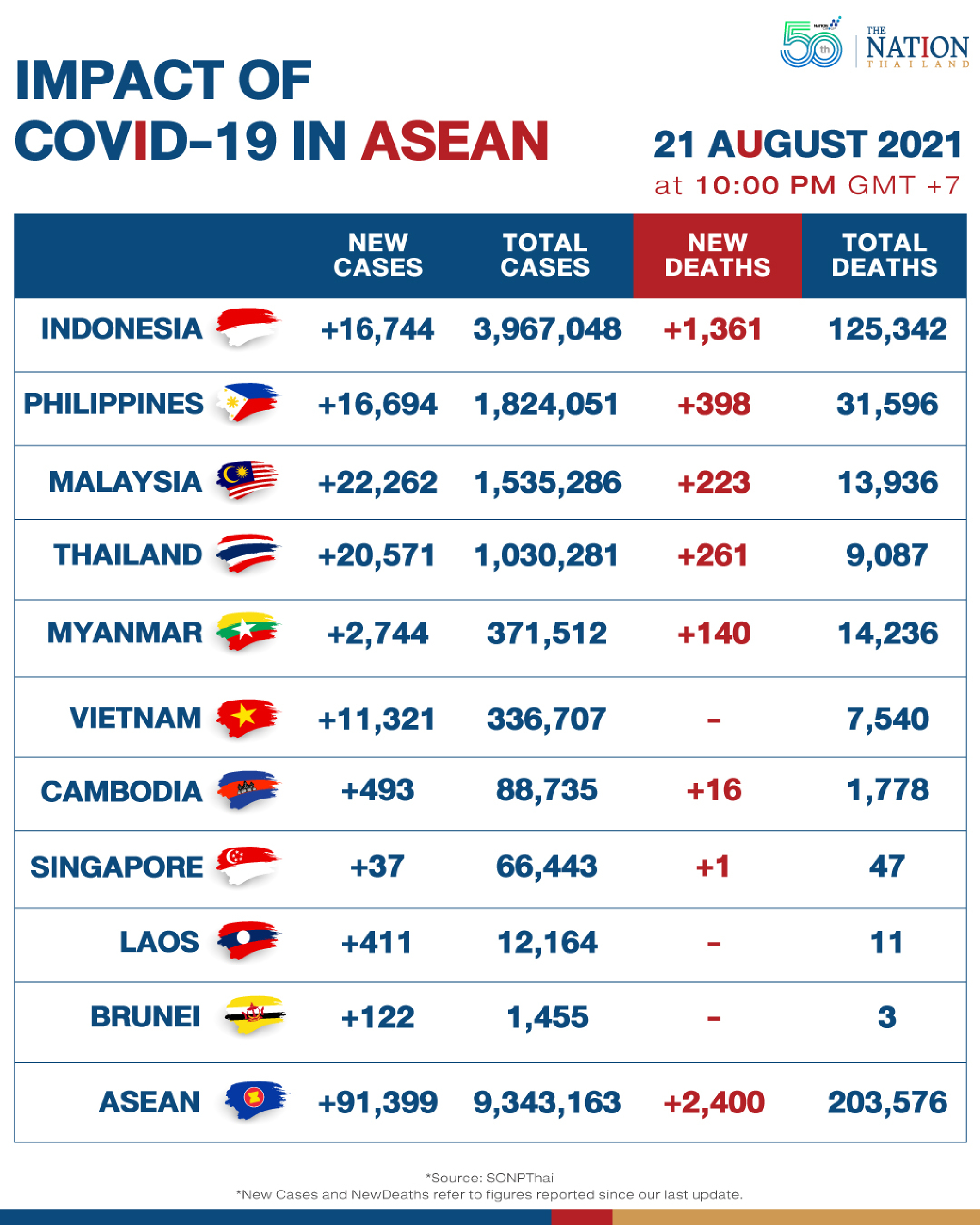
Southeast Asia saw a decrease in new Covid-19 cases and related deaths on Saturday for the second successive day, collated data showed.

Asean countries reported 91,399 infections and 2,400 deaths on Saturday, lower than 95,512 and 2,696 respectively on Friday.

Cambodia’s Prime Minister Hun Sen expected the government to vaccinate 12 million people, or 75 per cent of the total 16 million population, by the end of this year.

The Cambodian government has extended the enforcement of curfew measures in Phnom Penh for another seven days as the country’s daily Covid-19 cases continued to rise due to the outbreak of the Covid-19 delta variant.

The government has accelerated administering the third Covid-19 jab on frontline personnel, as well as the third AstraZeneca jab on people who had received two Sinovac or Sinopharm jabs, in a bid to stimulate their immunity.

ADVERTISEMENTx

The Vietnam government is preparing to enforce maximum lockdown measures in Ho Chi Minh City for two weeks in a bid to reduce the number of Covid-19 infections and deaths due to the Covid-19 delta variant.

Starting on Monday, over 9 million people will be banned from going outdoors unless necessary.

Meanwhile, the Vietnam government has deployed soldiers and police to publicise lockdown measures, deliver foods and necessities, and conduct proactive Covid-19 tests on people.

New Covid cases and deaths in Asean fall for second day in a rowNew Covid cases and deaths in Asean fall for second day in a row

Published : August 22, 2021

By : The Nation

UK records another 32,058 coronavirus cases #SootinClaimon.Com

#SootinClaimon.Com : ขอบคุณแหล่งข้อมูล : หนังสือพิมพ์ The Nation.

https://www.nationthailand.com/international/40005069

UK records another 32,058 coronavirus cases


The country also reported another 104 coronavirus-related deaths. The latest data came as the Medicines and Healthcare products Regulatory Agency (MHRA) approved Ronapreve as the first monoclonal antibody combination product indicated for use in the prevention and treatment of acute COVID-19 infection in Britain.

Another 32,058 people in Britain have tested positive for COVID-19, bringing the total number of coronavirus cases in the country to 6,460,930, according to official figures released Saturday.

ADVERTISEMENTx

The country also reported another 104 coronavirus-related deaths. The total number of coronavirus-related deaths in Britain now stands at 131,591. These figures only include the deaths of people who died within 28 days of their first positive test.

The latest data came as the Medicines and Healthcare products Regulatory Agency (MHRA) approved Ronapreve as the first monoclonal antibody combination product indicated for use in the prevention and treatment of acute COVID-19 infection in Britain.

Developed by Regeneron/Roche, the drug is administered either by injection or infusion and acts at the lining of the respiratory system where it binds tightly to the coronavirus and prevents it from gaining access to the cells of the respiratory system, according to a statement by the MHRA.

Liverpool's supporters are seen before the 2021-2022 season English Premier League first round match between Norwich City and Liverpool in Norwich, Britain, on Aug. 14, 2021.

Clinical trial data assessed by a dedicated team of MHRA scientists and clinicians has shown that Ronapreve may be used to prevent infection, promote resolution of symptoms of acute COVID-19 infection and can reduce the likelihood of being admitted to hospital due to COVID-19, the statement said.

“Ronapreve is the first of its kind for the treatment of COVID-19, and after a meticulous assessment of the data by our expert scientists and clinicians, we are satisfied that this treatment is safe and effective,” said Dr Samantha Atkinson, Interim Chief Quality & Access Officer at the MHRA.

England lifted almost all its remaining COVID-19 restrictions since July 19. More than 87 percent of people aged 16 and over in Britain have had their first dose of vaccine and more than 76 percent have received both doses, the latest figures showed.

To bring life back to normal, countries such as Britain, China, Germany, Russia and the United States have been racing against time to roll out coronavirus vaccines.  

People dine in the outdoor dining area of a restaurant in London, Britain, on Aug. 13, 2021.People dine in the outdoor dining area of a restaurant in London, Britain, on Aug. 13, 2021.


Published : August 22, 2021

By : xinhua

Washington national zoo celebrates panda cub Xiao Qi Jis 1st birthday #SootinClaimon.Com

#SootinClaimon.Com : ขอบคุณแหล่งข้อมูล : หนังสือพิมพ์ The Nation.

https://www.nationthailand.com/international/40005068

Washington national zoo celebrates panda cub Xiao Qi Jis 1st birthday


“The relationships that we develop with our Chinese colleagues, including the ambassador, working together to save this endangered species is one of the most incredible parts” of the giant panda conservation program, said Brandie Smith, acting director of the Smithsonians National Zoo.

Xiao Qi Ji, the giant panda cub born in the national zoo in Washington, D.C., turned one on Saturday, and the zoo held a big birthday party for the little cutie featuring ice cakes and other activities to celebrate the occasion with his avid fans coming for a visit.

ADVERTISEMENTx

Staff at the Smithsonian’s National Zoo and Conservation Biology Institute got Xiao Qi Ji’s tiered cake with a large number “1” topper set up just after 7:00 a.m., placing the delicacy at the center of the outdoor ground so that reporters could easily shoot the moment Xiao Qi Ji enjoys his birthday feast.

The cake is made from frozen dilute grape, apple juices and colored water and decorated with sweet potato, apple, carrot, pear, sugar cane, banana and bamboo. Xiao Qi Ji’s parents, mama Mei Xiang and papa Tian Tian, each got their own ice cakes in honor of their son’s birthday.

When Xiao Qi Ji and Mei Xiang stepped out of their house, they went straight toward mama’s cake. It was not until the “Xiao Qi Ji” inscript on the main cake melted that the mother-son duo finally turned their attention to the entree of the day, working on it as spectators cheered in the background.

It appeared that Xiao Qi Ji was more than satisfied with the cake, crushing the 1-shaped topper and then, after finishing the special breakfast, climbing onto his favorite tree to inspect those who came for the purpose of wishing him happy birthday.

Photo taken on May 20, 2021 shows the giant panda cub "Xiao Qi Ji" during a media preview at Smithsonian's National Zoo in Washington, D.C., the United States.

ADVERTISEMENT

“I’ve been here about four times already, even with the COVID and everything,” said Yolanda Reyes, a panda lover who couldn’t resist the innocence and charm of Xiao Qi Ji, and who could still vividly recall Tai Shan, Bao Bao and Bei Bei — three other cubs Mei Xiang gave birth to in the D.C. zoo who used to live here before returning to China.

“It’s been wonderful. They always have (Xiao Qi Ji) here, and you see the interaction with his mother and everything like that. It’s great,” said the Virginia resident.

“Xiao Qi Ji” is the Chinese expression of “little miracle” in English. People decided to name the adorable boy that way because his mother, at age 22, was the oldest giant panda to give birth in the United States. When she conceived Xiao Qi Ji, Mei Xiang had a less than 1 percent chance of having another baby.

After his miraculous birth, Xiao Qi Ji, who the keepers said is a quick learner, never stopped bringing surprise and joy to people caring for him, having not only reached a number of milestones in the past year — such as going through his first veterinary exam, his first steps, getting his first toys and having his first taste of sweet potato — but also adapted incredibly well to the harsh reality of the pandemic thanks to the love and caring from his keepers.

“Not only was (Mei Xiang’s) age a challenge, in the best case scenario, panda breeding is challenging,” said Bryan Amaral, the national zoo’s senior curator. “Due to the pandemic, we had a lot of tools not available to us that we would normally use to help us be successful.”

ADVERTISEMENT

Giant panda Mei Xiang is seen in a frame grab from a video feed at Smithsonian's National Zoo in Washington, D.C., the United States, Aug. 21, 2020.

“We had to take a little bit of a different approach this time,” Amaral said, noting that because of the extraordinary public health crisis, reproductive physiologists working with the giant panda conservation program had to share the lab space and, as a result, were unable to run samples in a timely fashion.

“I don’t know if we’ll use this (new approach) completely as a model in the future, but clearly the results speak for themselves,” he said.

Speaking of the cooperation around Xiao Qi Ji between the national zoo and its partners in China, Brandie Smith, acting director of the zoo, told Xinhua that since there are so many experts in China who know how to take care of pandas, people here at the zoo have been calling and writing to their Chinese counterparts on a regular basis, giving updates about Xiao Qi Ji’s care and growth.

“With the pandemic, we haven’t been able to meet in person, but we’re looking forward to doing that again as soon as we can,” Smith said.

To mark the joyous day, Chinese Ambassador to the United States Qin Gang expressed his birthday wishes to Xiao Qi Ji in a video and sent the adorable baby bear a gift.

“His arrival and every bit of his growth have given us joy and hope. For us, he is a miracle,” the ambassador said of Xiao Qi Ji, adding the cub “has truly added a splash of color to the exchanges between Chinese and American people.”

Smith, who had watched Qin’s video, said in comments to the ambassador’s remarks that “the relationships that we develop with our Chinese colleagues, including the ambassador, working together to save this endangered species is one of the most incredible parts” of the giant panda conservation program.

Celebratory events were held throughout the zoo on Saturday. General visitors attending Xiao Qi Ji’s birthday party received commemorative Xiao Qi Ji buttons, and registered members of the zoo were given reusable fans featuring Xiao Qi Ji’s picture.

“It’s nice to be able to open up and have something really fantastic to celebrate,” Amaral, the senior curator, said. 

Photo taken in November 2020 shows the giant panda cub "Xiao Qi Ji" at Smithsonian's National Zoo in Washington, D.C., the United States.

Published : August 22, 2021

By : xinhua

At least 8 dead, 3 missing after Hurricane Grace in Mexico #SootinClaimon.Com

#SootinClaimon.Com : ขอบคุณแหล่งข้อมูล : หนังสือพิมพ์ The Nation.

https://www.nationthailand.com/international/40005067

At least 8 dead, 3 missing after Hurricane Grace in Mexico


State police and the Mexican Army are engaged in rescue efforts and securing infrastructure after dozens of homes were flooded, sections of roads collapsed, and the electricity in parts of the area was cut.

At least eight people were dead and three missing after Hurricane Grace hit eastern Mexico, Cuitlahuac Garcia, governor of the state of Veracruz, reported on Saturday.

ADVERTISEMENTx

Grace, the second Atlantic hurricane of the season, made landfall in the early hours of Saturday with winds of up to 205 km per hour, leading to severe flooding in more than 20 municipalities in Veracruz.

State police and the Mexican Army are engaged in rescue efforts and securing infrastructure after dozens of homes were flooded, sections of roads collapsed, and the electricity in parts of the area was cut.

In the municipality of Nautla, a large number of crops were lost and roads were flooded during the storm.

According to the latest report from the National Water Commission (Conagua), Grace weakened during the early hours of the day and downgraded to a tropical storm, currently located 55 km northwest of Mexico City.

The tropical cyclone season in Mexico began on May 15 and is expected to end in November, according to Conagua. 

Published : August 22, 2021

By : xinhua

Man who claimed to have bomb near Capitol charged with threatening to use weapon of mass destruction #SootinClaimon.Com

#SootinClaimon.Com : ขอบคุณแหล่งข้อมูล : หนังสือพิมพ์ The Nation.

https://www.nationthailand.com/international/40005056

Man who claimed to have bomb near Capitol charged with threatening to use weapon of mass destruction


WASHINGTON – A man who prompted an evacuation Thursday of the U.S. Capitol and surrounding buildings by claiming to have a bomb inside his truck faces charges of threatening to use explosives and a weapon of mass destruction.

Man who claimed to have bomb near Capitol charged with threatening to use weapon of mass destruction

Floyd Ray Roseberry of North Carolina surrendered to authorities Thursday about five hours after he drove a truck onto the sidewalk outside the Library of Congress and launched a standoff with law enforcement officers, police said. He had demanded to speak to President Joe Biden about a range of grievances against the Democratic Party and claimed that if he was shot, his vehicle and four others would explode.

According to court documents, a relative of Roseberry’s reported to local law enforcement on Wednesday that he “had recently expressed anti-government views and an intent to travel to Virginia or Washington, D.C. to conduct acts of violence.”

Officials said they found no bomb in his car, but there were materials that could be used to make explosives.

In a court appearance Friday when the charges were made public, Roseberry said he went to school through the eighth grade before going to work but eventually returned and got his GED and a welding license. He also said he hadn’t taken his “mind medicine” for at least two days.

“My memory isn’t that well, sir,” he told U.S. Magistrate Judge Zia Faruqui. He said his wife has power of attorney over his medical care.

Faruqui said he would delay any substantive decisions until the medication was provided but told Roseberry he faces up to life in prison.

ADVERTISEMENTx

“I can tell you’re a good man,” Roseberry responded. “I’m willing to do whatever you ask.”

Faruqui ordered a competency screening for Roseberry at the request of the government, which also asked for him to remain jailed. Authorities said Roseberry was 49, but in court he said he was 51.

A federal public defender representing Roseberry declined to comment after the hearing.

Before he was taken into custody, Roseberry delivered a tirade over a Facebook Live video that circulated widely before the website and other social media platforms took it down. In the video, he repeated the false claim that the election was stolen from former President Donald Trump and called on Democrats to resign.

He also threw what he said was $3,000 in cash out of the windows of his truck.

Roseberry’s ex-wife, Crystal Roseberry, said he has had a history of mental instability and had a volatile temper during their decade-long marriage.

Roseberry’s father, Floyd Roseberry, said his son had experienced mental problems in the past and, at times, threatened violence. He said he thought his son had “gotten on his feet” in recent years, running an auto repair business and a mobile home park and had become more religious under the influence of his new wife.

Bishop Brady Jackson, who leads a church in Roseberry’s North Carolina community, said he was never a member and his wife stopped attending. “They’re both pretty good people,” Jackson said. “I never would have thought he would have done that.”

Roseberry’s threat came four months after a Capitol Police officer was killed by a man who rammed his car into the barriers around the U.S. Capitol grounds and seven months after a violent, pro-Trump mob overran law enforcement and took over the building.

Roseberry had been distraught over his mother’s death a few years ago, said Brenda and Charles Humphries, his aunt and uncle. But nothing seemed amiss when the couple last saw Roseberry about a month ago, they said.

Brenda Humphries they learned about the incident in Washington from a friend.

“Oh, my lord,” she said. “I don’t know what happened. Something must have happened to Ray.”

Roseberry’s son’s fiancee, Courtney Foster, said Roseberry would tell everybody how much he agreed with Trump and “the way that he spoke the truth to the people,” but she was not aware of him attending any political events in D.C.

Roseberry also does not “believe in” watching TV and would get his news on his phone, Foster said. She wasn’t sure what sources he relied on, she said, but he came away with a dislike for Biden and refused to get vaccinated against the coronavirus.

“He’s very big in politics and he’s very big in, you know, the way that things are right now. He keeps up with it,” Foster said. “And this is just a result of it.”

Published : August 21, 2021

By : The Washington Post · Rachel Weiner

Pierre Sprey, Pentagon analyst who battled brass to produce A-10 warplane, dies at 83 #SootinClaimon.Com

#SootinClaimon.Com : ขอบคุณแหล่งข้อมูล : หนังสือพิมพ์ The Nation.

https://www.nationthailand.com/international/40005055

Pierre Sprey, Pentagon analyst who battled brass to produce A-10 warplane, dies at 83


WASHINGTON – Pierre Sprey, a 1960s Pentagon “whiz kid” who was a formidable intellectual force in military analysis and weapons development and was sometimes an outspoken critic of Defense Department spending and war plans, died Aug. 5 at his home in suburban Glenn Dale, Md. He was 83.

Pierre Sprey, Pentagon analyst who battled brass to produce A-10 warplane, dies at 83

The cause appeared to be a sudden heart attack, said his son, John Sprey.

Sprey (pronounced “spray”) was considered a polymath whose interests encompassed history, engineering and French literature. In later years, he established a jazz record label, Mapleshade, and produced dozens of recordings known for their exquisite high-fidelity audio.

Former colleagues said he applied the same meticulous – and sometimes unconventional – principles to military matters. After working for the Grumman aircraft company early in his career, Sprey moved to the Pentagon in 1966 as part of a group of analysts and engineers dubbed the “Whiz Kids,” borrowing a term first used to describe then-Defense Secretary Robert S. McNamara and his former colleagues at Ford Motor Co.

“Even among McNamara’s Whiz Kids – the highly educated and extraordinarily bright young men brought into the [Pentagon] with the mandate to impose rational thought on both the military and the military budget – Pierre Sprey stood out,” author Robert Coram wrote in a 2002 biography of Sprey’s onetime Pentagon boss, John Boyd.

It was the height of the Cold War with the Soviet Union, and Sprey spent his first year working on a study of the Air Force budget and preparations for a potential war in Europe. His report, based on studies of World War II and information from the Joint Chiefs of Staff, stated that the Air Force’s existing plan to bomb bridges and infrastructure was useless and would not prevent Soviet troops from pouring into Europe.

ADVERTISEMENTx

By rejecting a long-held doctrine, Sprey quickly became persona non grata among top-ranking Air Force brass, many of whom had been fighter or bomber pilots and resented getting advice from a civilian who was barely 30.

“He was one of the most detested people by the United States Air Force,” Tom Christie, who spent decades as a Pentagon analyst, said in an interview, “because he was challenging a lot of sacred programs and strategies.”

Instead, Sprey advocated a primary mission of “close air support,” with Air Force planes flying low to support Allied ground troops and to attack enemy convoys and armored units. He made the startling assertion that the most important vehicles in warfare were not fighter planes, aircraft carriers or tanks – but ordinary trucks.

“I made myself pretty unpopular by pointing out that trucks were much more important than airplanes,” Sprey told the Baltimore Sun in 2002. “The tonnages moved by airplanes are tiny. Trucks are what count in the theater of war. Well, that wasn’t very glamorous for all those guys, so I got fired from that job.”

Sprey, Christie and a few others became part of a small group of analysts under the leadership of Boyd, a former fighter pilot who wanted to bring improved planning and efficiency to the Air Force. They adopted an almost furtive, underground approach, often working late at night, and came to be known as the “fighter mafia.”

In general, the group believed that simpler, cheaper weapons and aircraft worked better than complex, more expensive designs. Airplanes loaded down with electronics and other features, Sprey argued, were less maneuverable and harder to repair.

Sprey and his group faced a strong backlash from Pentagon officials and from manufacturers who stood to profit from defense contracts. According to Coram’s book on Boyd, the Air Force assigned a colonel to get Sprey fired. When the colonel presented doctored statistics to challenge Sprey’s calculations, Sprey replied, “Your numbers are a lie.”

The colonel demanded an apology, but Sprey responded by calling him a “slimy creature” who “oozed mendacity.”

“Unlike many civilians who worked in the Pentagon,” Coram wrote, “Sprey was not intimidated by rank; in fact, he thought there was an inverse relationship between the number of stars on a man’s shoulders and his intelligence.”

He stayed at the Pentagon as part of Boyd’s team and worked on two new airplane designs in the 1970s: one was a lightweight fighter that turned out to be the F-16; the other was a relatively slow, low-flying aircraft that became the A-10.

Sprey was particularly influential in the development of the A-10, a stubby plane with upright fins on the tail and two jet engines mounted over the body. Its central feature was a nose-mounted 30-mm Gatling gun that could fire 70 rounds a second. The plane could carry missiles and bombs under its wings.

Sprey insisted that the A-10 be durable and easy to repair. It was covered in a titanium shell that could withstand ground fire. Fuel tanks were insulated with nonflammable material to prevent explosions, and backup systems were in place for various hydraulic and mechanical components. Officially called the Thunderbolt, the A-10 looked so ungainly that pilots affectionately called it the Warthog.

The Pentagon sought repeatedly to kill the A-10 project or relegate the aircraft to the National Guard, even after testing proved that its gun and rockets could easily destroy armor-plated tanks. Sprey helped rally support for the plane among sympathetic military officials and members of Congress, and the program stayed alive.

During the Persian Gulf War in 1991, the A-10 was brutally effective, taking out 1,100 of the 1,500 Iraqi tanks lost during the conflict, plus more than 1,000 pieces of artillery. The A-10 was so rugged that stories and footage began to circulate of badly damaged planes landing safely after combat missions. The A-10 continued to be a useful warplane during the conflicts in Iraq and Afghanistan.

“The pilots love them,” Sprey said in 1999. “Any of our jet fighters can be shot down by a .22-caliber rifle. But you can punch an A-10 full of holes and it will come home with sky showing through the wings.”

Pierre Michel Sprey was born Nov. 22, 1937, in Nice, France. His Jewish parents had fled oppression in Germany in the early 1930s, then came to the United States in 1941, settling in the New York borough of Queens.

His father was a jeweler, and his mother a homemaker. Young Pierre grew up speaking German and sometimes French with his parents, who would discuss classical music at the dinner table.

Sprey studied engineering and French literature at Yale University, graduating in 1957 at age 19. He later received a master’s degree in systems engineering and statistics from Cornell University.

His eyesight was not sharp enough to allow him to be a fighter pilot, his son said, so he turned to aircraft design. After leaving the Pentagon in the 1970s, he continued to work on defense projects as a consultant for many years afterward.

While growing up in New York, Sprey often attended jazz clubs, and he began to record musical performances as a hobby. A fellow Pentagon engineer showed him a high-end turntable, spurring Sprey to take it apart and explore the mechanics of high-fidelity sound.

He devised a homemade recording system that employed extremely thin wires, battery-powered microphones and a two-track Sony reel-to-reel recorder weighted with lead. He had a restored 1911 Steinway piano in the front parlor of an old country house called Mapleshade in suburban Upper Marlboro, Md. He had made amateur recordings of Washington jazz singer Shirley Horn, who came to Sprey’s house to play his piano.

“One night she was sitting at my piano and fell in love with it,” he told The Washington Post in 1996. “She said, ‘P. baby, I want to do my next album on this piano and I want you to be my engineer’ . . . I enjoyed recording Shirley so much, I decided to hang out my shingle.”

Sprey named his record label Mapleshade and recorded primarily jazz and blues musicians, including saxophonists Clifford Jordan and Hamiet Bluiett and pianists Walter Davis Jr., John Hicks and Larry Willis. He placed rubber baffles on the walls and ceiling and turned off all the lights, refrigerators, furnaces and electronic devices to obtain as pure a sound as possible.

“Something important is happening in Upper Marlboro,” a CD Review critic wrote. “To sit down with a small stack of your very first Mapleshades is a revelation.”

A 1997 recording of New York’s Arc Choir singing the gospel tune “Walk With Me” was sampled on Kanye West’s hit “Jesus Walks.” Sprey said the royalties were enough “to support 30 of my money-losing jazz albums.”

Sprey later moved to two other “crumbling old wood and brick farmhouses” in Maryland, his son said, and often cooked for visiting musicians, who were welcome to stay overnight.

His wife of 40 years, Seana Covert, died in 2014. Survivors include a son, John Sprey, of Syracuse, N.Y.

During the 1980s, Sprey and some of his fellow defense analysts from the “fighter mafia” helped spearhead what was called the military reform movement, seeking to develop simpler, more efficient and less expensive weapons programs.

“Not all simple, low-cost weapons work, but war-winning weapons are almost always simple,” he said.

Sprey became a persistent critic of what he saw as wasteful spending and poorly conceived military efforts and often contributed to the website of an independent watchdog organization, the Project on Government Oversight.

“Very simply, I don’t think we should be going to war for oil companies,” he told The Post in 2006. Whether planning for war or setting up his studio for a jazz recording, Sprey followed the same precept: “The whole essence of this is to judge everything by outcomes.”

Published : August 21, 2021

By : The Washington Post · Matt Schudel

California judge rules unconstitutional the measure classifying Uber and Lyft drivers as contractors #SootinClaimon.Com

#SootinClaimon.Com : ขอบคุณแหล่งข้อมูล : หนังสือพิมพ์ The Nation.

https://www.nationthailand.com/international/40005054

California judge rules unconstitutional the measure classifying Uber and Lyft drivers as contractors


SAN FRANCISCO – A California judge ruled unconstitutional a ballot measure from last November defining Uber and Lyft drivers as independent contractors, throwing fresh uncertainty into the status of the hundreds of thousands of app-based workers.

California judge rules unconstitutional the measure classifying Uber and Lyft drivers as contractors

In a ruling issued Friday, Alameda County Superior Court Judge Frank Roesch declared that Proposition 22 is “unenforceable,” arguing several sections of the measure are unconstitutional under California state law. They included a section that required a seven-eighths legislative supermajority to amend the measure, which defied the legislature’s amendment power under the state constitution, according to the judge.

Roesch said that avenue for amendments ran counter to the state constitution, instituting a threshold that was “difficult to the point of near impossibility.”

In California, ballot measures are required to be limited to a single subject, and the provisions in the measures must be related. The judge found that the measure pitched to Californians in November overstepped that requirement by limiting the legislature’s ability to allow workers’ to collectively bargain. Proposition 22 passed by a 59% to 41% vote in November.

“A prohibition on legislation authorizing collective bargaining by app-based drivers does not promote the right to work as an independent contractor, nor does it protect work flexibility, nor does it provide minimum workplace safety and pay standards for those workers,” Roesch wrote. “It appears only to protect the economic interest of the network companies in having a divided, ununionized workforce, which is not a stated goal of the legislation.”

Uber criticized the ruling Friday and said it intended appeal.

“This ruling ignores the will of the overwhelming majority of California voters and defies both logic and the law,” Uber spokesman Noah Edwardsen said. “We will appeal and we expect to win. Meanwhile, Prop 22 remains in effect, including all of the protections and benefits it provides independent workers across the state.”

ADVERTISEMENTx

The hotly contested measure, driven by a $200 million campaign mounted by companies such as Uber, Lyft and DoorDash, followed a 2019 state law that defined Uber and Lyft drivers as employees. The companies and fellow apps mounted a vigorous defense, arguing the requirements of employment would impede the flexibility they offer drivers – and that the majority of drivers did not want to be employees.

Advocates for employment argued drivers should be entitled to a minimum wage and benefits such as health insurance, sick leave and job protections.

Prop 22 created a limited set of benefits such as an earnings guarantee and a health care stipend, but not the typical protections of employment under state law.

Geoff Vetter, a spokesman for the Protect App-Based Drivers & Services Coalition, said his pro-Prop 22 group would file an immediate appeal.

“This outrageous decision is an affront to the overwhelming majority of California voters who passed Prop 22,” he said in a statement. “We will file an immediate appeal and are confident the Appellate Court will uphold Prop 22.”

ADVERTISEMENT

Vetter noted the court ruling is not binding and said he expected it to be stayed as the group appeals.

Lyft did not immediately respond to a request for comment.

Veena Dubal, a Professor of Law at the University of California Hastings who co-wrote an amicus brief on behalf of the petitioners, said the companies erred in “trying to completely take away the right of legislatures and municipalities to do anything on behalf of workers, as well as trying to take the workers out from the state’s workers’ compensation scheme.”

“They were trying to do too much in one proposition,” she said.

Stanford University law professor emeritus William Gould, who also co-wrote on behalf of the petitioners, said the judge’s methodical arguments would be hard to defend against. The gig companies faced a steep road ahead, he said, potentially stretching beyond the Court of Appeal.

ADVERTISEMENT

“I think this is quite obviously important and precedential, and the final word is going to be with the Supreme Court of California,” he said.

Published : August 21, 2021

By : The Washington Post · Faiz Siddiqui