U.S. drops cases against five researchers accused of hiding ties to Chinese military
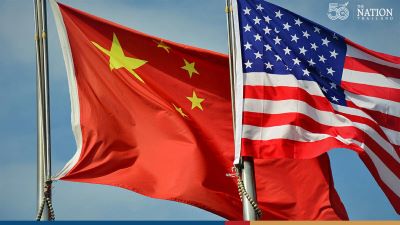
WASHINGTON – The Justice Department this week dropped prosecutions of five foreign researchers accused of concealing ties to Chinas military and who were arrested last year in a highly publicized sweep against alleged Chinese spying in the United States.
The moves came as one defendant, cancer researcher Tang Juan, was scheduled to stand trial on Monday in the Eastern District of California on charges of visa fraud. A court on Friday granted the department’s motion to dismiss her case. Motions to dismiss are pending in the other four.
Documents filed in Tang’s case this week, including an FBI analysis, raised questions that could not be resolved before the trial, officials said. And several weeks ago, a judge in Sacramento dismissed a portion of her case – a false statements charge – after finding that FBI agents had not properly informed Tang of her right against self-incrimination.
All five defendants were charged with visa fraud.
Senior department officials insist that dropping the cases is not a reflection of a lack of evidence.
“This is not the same as saying that we were wrong to charge the case a year ago or that the proof was insufficient,” said one senior official, speaking on the condition of anonymity under ground rules set by the department. “In fact, I think the cases have done a lot to advance our deterrent objectives.”
The official pointed to an exodus of more than 1,000 researchers, who department officials said had apparently hidden their ties to the Chinese People’s Liberation Army and fled the United States after the arrests last summer.
The cases were part of a high-profile initiative that the Justice Department says reflects a strategic priority of countering Chinese national security threats, particularly in the realm of economic espionage.
The arrests last year were part of an enforcement strategy that extends to what the department calls “non-traditional collectors” – or university and lab researchers who officials say are “coopted” into stealing American technology for China.
They came shortly after the State Department ordered the Chinese Consulate in Houston to be shut down, accusing it of being a hub for illegal spying and influence operations in the United States. The closure escalated tensions already heightened by U.S. displeasure with a strict new Chinese security law for Hong Kong and U.S. criticism of Beijing’s handling of the covid-19 pandemic.
ADVERTISEMENTx
Malcolm Segal, a lawyer who represented Tang, said he was pleased with the dismissal. He said Tang is returning to China to be reunited with her husband, mother and child.
“In all of our prosecutions, the Department of Justice evaluates the merits of a case as it prepares for trial,” spokesman Wyn Hornbuckle said in a statement. “Recent developments in a handful of cases involving defendants with alleged, undisclosed ties [to the PLA] have prompted the department to re-evaluate these prosecutions, and we have determined that it is now in the interest of justice to dismiss them.”
Prosecutors alleged that Tang, a researcher at the University of California at Davis, lied on her visa application, saying she had never served in the Chinese military, when in fact she was a uniformed PLA officer.
Tang, who initially sought refuge at the Chinese Consulate in San Francisco, was detained for about 50 days before being released on bail. Two other defendants were detained for about a year, and a fourth for about nine months, officials said.
The senior official said that the punishment for visa fraud typically does not exceed a year. That fact, combined with the prospect of prolonged litigation in several instances, led officials to assess that the interests of justice were best served by dropping the cases, the official said.
“At some point you ask what’s the right thing to do?” the official said. “And after a year given that we’ve achieved our objectives, rather than seek an adjournment of the trial, this was the right thing to do. And once you reach that judgment, in one case, it was logical to extend it to the other cases.”
The other cases involve defendants Guan Lei in the Central District of California, Xin Wang and Chen Song in the Northern District of California, and Kaikai Zhao in the Southern District of Indiana.
Published : July 24, 2021
By : The Washington Post · Ellen Nakashima, David Nakamura
What to know about track and field at the Tokyo Olympics
Among the glamour events of every Summer Olympics, track and field promises to provide a stage for dramatic competition and historic performances at the Tokyo Games. Concerns about the heat have been part of the story line leading into this summer, but for U.S. athletes, conditions probably will not be as severe as what they faced during their trials last month in Eugene, Ore., which experienced record temperatures that required some schedule modifications.
Here’s what you need to know about track and field at the Tokyo Olympics.
– – –
Who are the U.S. track athletes to watch?
– Rai Benjamin: A 23-year-old who attended the University of Southern California, Benjamin is already one of the greatest 400-meter hurdlers of all time. He still must prove he is the best in Tokyo. Norway’s Karsten Warholm downed Benjamin at the 2019 world championships. A week after Benjamin came within five hundredths of a second of breaking Kevin Young’s 29-year-old world record, Warholm did break it at a Diamond League meet, lowering the mark to 46.70 seconds. To win gold, Benjamin or Warholm will probably have to break the record again.
– Matthew Centrowitz: After becoming the first American man to win a gold medal in the 1,500 meters since 1908, Centrowitz returns still at peak form. At 31, Centrowitz is an old man at the distance – even back in 2016, he wondered if he would have to move up to 5,000 meters for the next Olympics. But he finished second by a hair to 20-year-old Cole Hocker at the Olympic trials. He may not be the fastest, but he has become one of America’s greatest middle-distance runners through tactical savvy that borders on sorcery.
– Allyson Felix: The only American track and field athlete with 10 medals is Carl Lewis. Felix could catch, or even surpass, Lewis in her fifth and final Olympics. Felix made the U.S. team in the 400 meters at age 35, less than three years after giving birth to her daughter, Camryn, via an emergency delivery that threatened both mother and child. Felix owns nine Olympic medals, six of them gold. Felix could also be chosen for the 4×400 relay, where the U.S. team would be a heavy favorite.
– Keni Harrison: Harrison entered the 2016 Olympics as the newly minted 100-meter hurdles world record holder – but she didn’t even compete in Rio de Janeiro, having finished sixth at the U.S. trials less than a month before running 12.20 seconds, a time that still stands. The Americans swept the medals in Rio and could do so again in Tokyo. This time, at 28, Harrison will be there. She will be looking for her first major international title, having won silver at the 2019 world championships and finishing fourth in 2017.
– Grant Holloway: Another world record threat going to his first Olympics, Holloway came within one hundredth of a second of breaking Aries Merritt’s world record of 12.80 seconds in the 110-meter hurdles at the trials – in a semifinal heat. Jamaican rival Omar McLeod failed to make the Games, but the push Holloway will receive in Tokyo could vault him toward a new world record. It would be his second world record this year, adding to the indoor 60-meter hurdles record he set in February.
– Isaiah Jewett: Clayton Murphy won the 800 meters at the trials and won bronze at the 2016 Games, but the most electrifying presence in the two-lap race that knocked favorite Donavan Brazier out of the Olympics was Jewett. One week after winning the NCAA championship for USC, Jewett set a wicked pace on the first lap, created a gap and had just enough stamina to hold on for a spot in Tokyo. Jewett’s zeal for racing is infectious. With a month of rest after a long college season, it will be worth watching whether he can repeat his trials surprise and land on the podium.
– Erriyon Knighton: Three years ago, Knighton was a high school football player with designs on earning a scholarship in that sport, and he took up track to improve his already explosive speed. He has no plans to ever play football again. At the Olympic trials, Knighton broke Usain Bolt’s 17-year-old junior record by running the 200 meters in 19.84 seconds and became the youngest Olympian since Jim Ryun in 1964. He turned professional in January, just before his 17th birthday, and is far ahead of schedule.
– Noah Lyles: He may have lost his goal of three gold medals when he did not qualify in the 100 meters, but Lyles remains one of the most electric figures in sprinting. The Alexandria, Va., product and alum of T.C. Williams High reestablished himself as the gold medal favorite in the 200 after a trying year by winning the trials in 19.74 seconds. He is the fourth-fastest man ever at the distance, which makes him a likely choice for the men’s 4×100 team, the other event in which he is a reigning world champion.
– Sydney McLaughlin: McLaughlin turned 17 during her first Olympics in Rio, where she gained experience but only reached the semifinals. She will enter her second as the newly minted world record holder in the 400-meter hurdles, having run it in 51.90 seconds at the Olympic trials, becoming the first woman to break 52 seconds in front of former record holder Dalilah Muhammad, who continues to challenge her. With the help of legendary coach Bob Kersee, McLaughlin is pushing her event forward. Women have long been taught to take 15 strides between hurdles, but McLaughlin has started taking 14, raising the ceiling on what times are possible.
– Athing Mu: Growing up in a track-crazed family in New Jersey, Mu started breaking youth records in her early teens. She hasn’t stopped. Mu set a collegiate record in the 400 this year at Texas A&M, then turned professional immediately after her season ended with multiple NCAA titles. At the trials, she blew away a strong field in the 800 meters, finishing acres ahead of a pack that included American record holder Ajee Wilson. Mu could be picked to run the 4×400, giving her two strong chances at gold medals in her first of probably many Olympics.
– Gabby Thomas: It wasn’t a surprise that Thomas made it to Tokyo, but it was stunning how she pulled it off – by running 21.61 in the 200 meters, making her the second-fastest woman ever at the distance, behind only Florence Griffith Joyner. Thomas, 24, balances her accomplishment with an equally impressive life off the track. She graduated from Harvard with a degree in neurobiology and is now studying for her master’s degree in public health, with an emphasis on epidemiology.
ADVERTISEMENTx
Who are the international track athletes to watch?
– Dina Asher-Smith, Britain: Just 25 and already the fastest British woman in history, Asher-Smith made her Olympic debut at just 20 years old, finishing fifth in the 200-meter final in Rio and winning bronze as part of Britain’s 4×100 relay. She has much greater aims in her second Games. Asher-Smith is ranked first in the world in the 200 and second in the 100. She won three medals at the 2019 world championships, claiming gold in the 200 while reaching the podium in the 4×100 and 100.
– Timothy Cheruiyot, Kenya: Cheruiyot, 26, finished second and first in the 1,500 meters at the past two world championships, and now he will run on the Olympic stage for the first time. At a Diamond League meet in July, Cheruiyot became the fastest 1,500-meter runner in the world this year and the seventh fastest of all time by running 3:28.28. Five of the seven fastest men ever at the distance are Kenyans, but Cheruiyot is the nation’s best hope to win Kenya’s first Olympic medal in the event since Asbel Kiprop’s gold in 2008.
– Letesenbet Gidey, Ethiopia: In June, Gidey ran 10,000 meters in 29:01.03, breaking the record Sifan Hassan of the Netherlands had set two days earlier. Their showdown could be one of the best in Tokyo. Gidey, only 23, will be appearing in her first Olympics two years after winning a silver medal in her first world championships, where she finished behind only Hassan.
– Shelly-Ann Fraser-Pryce, Jamaica: With Usain Bolt in retirement, Fraser-Pryce has picked up the mantle as Jamaica’s greatest sprinting star. At age 34, she will try to join Bolt as the only sprinters to win three Olympic gold medals in the 100 meters. Fraser-Pryce is both the fastest woman in the world this year in the 100 and the second fastest at 200 meters, the distance at which she won silver in 2012.
– Shaunae Miller-Uibo, Bahamas: Miller-Uibo delivered one of the lasting images of the 2016 Rio Games, diving at the line to beat Allyson Felix by 0.07 seconds and win the 400-meter gold. A towering and graceful runner, Miller-Uibo would be considered a threat to win in both the 200 and 400 this year, but the schedule does not allow for the double. Miller opted to run the 200, a distance at which she is unbeaten this season. The decision means she will miss out on a rematch against Felix, who made the U.S. team only in the 400.
– Karsten Warholm, Norway: The only thing keeping Warholm, 25, from being considered the best ever at the 400-meter hurdles is an Olympic gold. He has not lost in the event since the fall of 2018. He has two world championships. This month, he broke Kevin Young’s 29-year-old world record by finishing in 46.70 seconds. And yet, the presence of Rai Benjamin of the United States and Abderrahman Samba of Qatar – the third- and fourth-fastest men ever in the event – means Warholm will probably have to break his own world record to win gold at his first Olympics.
– Wayde van Niekerk, South Africa: After he broke Michael Johnson’s 17-year-old world record in the 400 meters at the 2016 Olympics by finishing in 43.03 seconds, van Niekerk’s road to superstardom hit a snag. He tore his ACL in a 2017 charity rugby game, knocking him out of the world’s elite for several years. His comeback hit a promising note when he ran 44.56 seconds in June, the 10th-fastest time this year. He’ll have to deal with American superstar Michael Norman and burgeoning threat Randolph Ross, but van Niekerk could use the Tokyo Olympics as a chance to announce his return.
Who are the U.S. field athletes to watch?
– Ryan Crouser: If Crouser wins his second consecutive Olympic gold medal, it still may be only his second-best accomplishment this year. At the U.S. Olympic trials, Crouser broke Randy Barnes’s 31-year-old shot put record by heaving the 16-pound iron ball 23.37 meters (76 feet 8¼ inches), the longest throw ever by almost 10 inches. Crouser’s best competition will probably come from countryman Joe Kovacs, who beat him at the 2019 world championships.
– JuVaughn Harrison: Any performance that evokes the name Jim Thorpe warrants notice. At the Olympic trials, Harrison became the first American man since Thorpe to claim a spot in both the high jump and long jump at the Olympics. Harrison, still competing in his LSU track suit, jumped 27 feet 9½ inches in the pit and 7 feet 7¾ inches over the bar to win both events.
– Deanna Price: A hammer thrower who joyfully – and often comically – wears her emotions on her sleeve, Price has emerged as one of the best in the world, winning the 2019 world championship and only improving since. She became the second woman to break 80 meters at the U.S. Olympic trials, where she also broke her own American record. Price could give the United States its first Olympic medal in the event, which women have contested at the Games only since 2000.
– – –
Who are the international field athletes to watch?
– Mutaz Essa Barshim, Qatar: Having won silver and bronze at the past two Olympics, this might be Barshim’s last, best chance at high jumping gold. He has finished no lower than fourth in the past five major international events, resulting in two world championships, one world championship second place and those two Olympic medals. American star Vashti Cunningham likes to study Barshim’s fluid style.
– Mondo Duplantis, Sweden: No athlete in the world stands further apart from his peers than pole vaulter Duplantis, a 21-year-old heading into his first Olympics. In February 2020, Duplantis broke Sergey Bubka’s world record by vaulting 6.18 meters (20 feet 3¼ inches). Since the start of 2019, no one other than American Sam Kendricks, the reigning world champion, has vaulted higher than 6.06 meters. Duplantis was born and raised in Lafayette, La., to an American father of Cajun descent and a Swedish mother, but Sweden offered a more certain path to the Olympics and greater financial incentives.
– – –
Who won the most track and field medals in Rio?
The United States led the medal table with 13 golds and 32 total podium finishes. Kenya finished second with 13 medals, six of which were gold, and Jamaica also won six golds but 11 total. No other nation finished with more than two golds or seven total medals.
– – –
Schedule of events
All times listed are United States Eastern.
July 29
8-11:30 p.m. NBC, USA (live)
Men’s 3,000-meter steeplechase, first round
Men’s high jump, qualifying
Men’s discus, qualifying
Women’s 800 meters, first round
Men’s 400-meter hurdles, first round
Women’s 100 meters, first round
July 30
6-8 a.m. Peacock (live)
Women’s 5,000 meters, first round
Women’s triple jump, qualifying
Women’s shot put, qualifying
Mixed 4×400-meter relay, first round
Men’s 10,000 meters final
8-11 p.m. NBC, USA (live)
Women’s 400-meter hurdles, first round
Women’s discus, qualifying
Men’s pole vault, qualifying
Men’s 800 meters, first round
Women’s 100-meter hurdles, qualifying
Men’s 100 meters, preliminary round
July 31
6-8:55 a.m. Peacock (live)
Men’s long jump, qualifying
Women’s 100 meters, semifinals
Men’s 100 meters, first round
Men’s discus, final
Women’s 800 meters, semifinals
Mixed 4×400-meter relay, final
Women’s 100 meters, final
8:10-11 p.m. USA (live)
Women’s hammer throw, qualifying
Women’s 3,000-meter steeplechase, first round
Women’s long jump, qualifying
Women’s shot put, final
Men’s 400 meters, first round
Aug. 1
6-10:55 a.m. Peacock (live)
Men’s high jump, final
Men’s 100 meters, semifinals
Women’s 100-meter hurdles, semifinals
Women’s triple jump, final
Men’s 800 meters, semifinals
Men’s 400-meter hurdles, semifinals
Men’s 100 meters, final
8-10:55 p.m. USA (live)
Men’s hammer throw, qualifying
Women’s 1,500 meters, first round
Men’s long jump, final
Women’s 200 meters, first round
Women’s 100-meter hurdles, final
NBC (recorded) 9:30 p.m.: Men’s 100 meters, women’s 100-meter hurdles and men’s long jump, finals; men’s 800 meters and men’s 400 meters, semifinals; women’s 200 meters, qualifying round
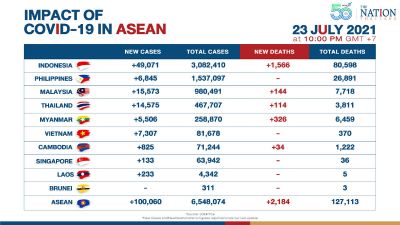
Asean hits 100,000 cases with record single-day death toll
The Covid-19 situation continued to worsen in Southeast Asia, hitting 100,000 cases on Friday, while fatalities also hit a record high.
Collated data showed 100,065 new cases on Friday, higher than Thursday’s 96,174, while 2,184 deaths were reported, increasing from the previous day’s 2,026.
The number of Covid-19 cases in the region crossed 6.54 million, and the death toll rose to 127,113.
Indonesia reported 49,071 new cases and 1,566 deaths on Friday, bringing cumulative cases in the country to 3,082,410 with 80,598 deaths. Indonesian communicable disease experts expressed concern at the country’s infection rate increasing to over 30 per cent of all the people getting tested, which indicated the possibility of a new variant of the virus spreading.
Malaysia reported a sharp rise with 15,573 new cases and 144 deaths on Friday, bringing cumulative cases in the country to 980,491 with 7,718 deaths. The infection rate reached a new high on Friday despite the country being in a nationwide lockdown for almost two months. Malaysian Prime Minister Muhyiddin Yassin insisted that the lockdown would not be relaxed until the infection rate reduced to less than 4,000 people per day.
China deploys UAV for telecom restoration in rain-hit Henan
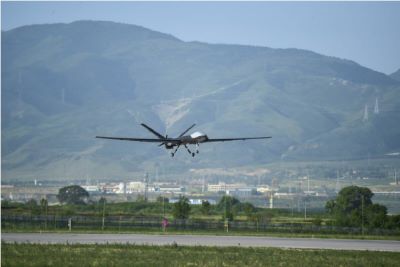
China on Wednesday deployed a large unmanned aerial vehicle (UAV) to restore telecommunications services in the central province of Henan, where heavy rain has wreaked havoc.
AChina-developed Wing Loong UAV took a 4.5-hour flight to Mihe Township in Gongyi City, one of the most seriously ravaged regions in the province, the Ministry of Emergency Management said.
ADVERTISEMENTx
At 6:21 p.m., the drone entered the areas where telecom services had been disrupted and started to provide a stable and continuous mobile signal coverage for an area of about 50 square kilometers.
As of Thursday morning, telecom services in Mihe Township had resumed, the Ministry of Industry and Information Technology said.
Torrential rains have struck large areas of Henan Province since last Saturday, with 33 reported dead and eight missing as of 4 a.m. Thursday, according to local authorities.
About 88 percent of adults in Britain have received the first jab of COVID-19 vaccine and more than 69 percent have received two doses, according to the latest figures.
Britain has reported another 39,906 coronavirus cases in the latest 24-hour period, bringing the total number of confirmed cases in the country to 5,602,321, according to official figures released Thursday.
ADVERTISEMENTx
The country also recorded another 84 coronavirus-related deaths. The total number of coronavirus-related deaths in Britain now standing at 128,980. These figures only include the deaths of people who died within 28 days of their first positive test.
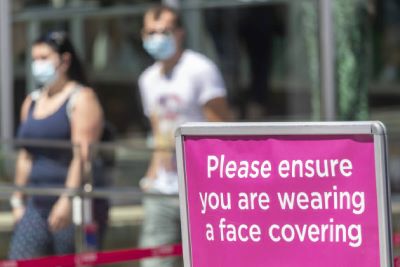
England has recently lifted most COVID-19 restrictions as part of the final step of the roadmap out of the lockdown. Scientists have warned that lifting all restrictions at this stage could increase likelihood of dangerous variants.
The average number of daily cases in England is around 41,000, and hospitalizations and deaths are rising too although at a much lower level than during previous waves, said Nadhim Zahawi, the minister for COVID-19 vaccine deployment. He made the remarks when updating members of the parliament on Thursday.
People dine at a cafe in London, Britain, on July 19, 2021.
Regarding the NHS (national health service) COVID-19 pass, he said:” Anyone can access a pass via the NHS app on the NHS website or by calling 119 and asking for a letter to demonstrate vaccine status. People will also be able to demonstrate proof of a negative test result.”
Although the government do not encourage its use in essential settings, like supermarkets, other businesses and organization in England can adopt the pass as a means of entry where it is suitable for their venue or premises and when they can see its potential to keep their clients or their customers safe, according to Zahawi.
But for proprietors of venues and events where large numbers are likely to gather and likely to mix with people from outside their households for prolonged periods deploying the pass is the right thing to do, he said.
About 88 percent of adults in Britain have received the first jab of COVID-19 vaccine and more than 69 percent have received two doses, according to the latest figures.
To bring life back to normal, countries such as Britain, China, Russia, the United States as well as the European Union have been racing against time to roll out coronavirus vaccines.
Passengers walk in an underground station during the morning rush hour in London, Britain, on July 19, 2021
Saudi Arabia attributed the success of this years Hajj season, free from contagious diseases, to its health measures and the limitation of the number of pilgrims in the holy sites.
Saudi Arabia announced on Thursday the successful conclusion of this year’s Hajj season, free from the COVID-19 and other contagious diseases, the Saudi Press Agency reported.
Saudi Health Minister Tawfiq Al-Rabiah attributed the success to an integrated system of health facilities in the holy sites, highly equipped ambulances and qualified teams, the report said.
ADVERTISEMENTx
The minister added that limiting the number of domestic pilgrims during this Hajj season to 60,000 also contributed to the success.
For the second year in a row, Saudi Arabia has allowed only domestic pilgrims to performed Hajj to prevent the spread of the COVID-19 pandemic.
A staff member issues NFC-enabled smart cards with built-in personal information to pilgrims in Mecca, Saudi Arabia, on July 15, 2021. The Saudi government used the latest information technologies to help control the spread of COVID-19 during the Hajj season.
WHO tells Indonesia to expand lockdown, as Asean reports over 96,000 Covid cases
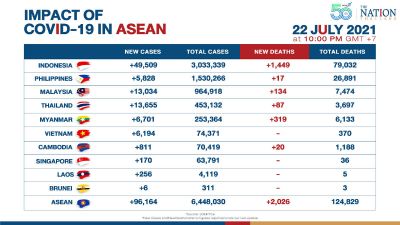
Southeast Asia saw a sharp jump in new Covid-19 cases on Thursday, while the death toll continued its upward trajectory, collated data showed.
Asean reported 96,164 new cases on Thursday, a big jump from Wednesday’s 77,915, mainly due to a spike in Indonesia, while 2,026 people died, up from the previous day’s 2,024.
The number of Covid-19 cases in the region crossed 6.44 million, while 124,829 people have died.
The World Health Organization (WHO) on Thursday urged Indonesia to immediately tighten measures and expand lockdown zones beyond Java and Bali islands to limit travel. WHO’s recommendation came after 13 out of 34 provinces of Indonesia have reported rapidly increasing infections at about 30 per cent of total people who have been tested, which is higher than the WHO’s limit of 20 per cent. The number of cases in Indonesia rose steeply from 33,772 on Wednesday to 49,309 on Thursday.
Meanwhile, Vietnam’s Vabioteh announced that it had successfully manufactured a trial lot of Sputnik V vaccine and had sent it to Gamaleya Research Institute of Epidemiology and Microbiology in Russia for quality testing. The project was funded by Russian Direct Investment Fund. The company expected that after getting approval it could manufacture the first lot of 30,000 doses within 30 days, and then increase manufacturing capacity to 5 million doses per month.
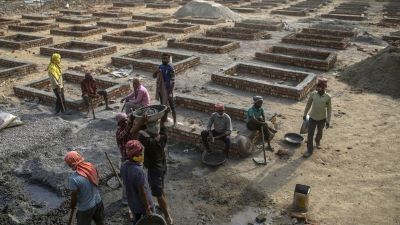
Covid may have claimed as many as 5 million lives in India
Indias actual death toll from covid-19 could range between 1.3 million to a staggering 5 million, with even the most conservative estimate putting its tally at more than double the U.S., the highest recorded in the world so far.
The numbers, derived from research models and local authority data, range from three to 10 times the country’s official count, adding to evidence that the true cost of India’s outbreak has been massively under-reported.
As corpses floated in the Ganges, a river sacred to millions of Hindus, and crematoriums and graveyards were overwhelmed, skepticism grew over the death toll of around 420,000 recorded by Prime Minister Narendra Modi’s government, which has used the ostensibly low mortality rate to defend India’s covid track record.
Bloomberg approached authorities in about half of India’s 28 states and territories seeking death data from April and May for the last two years and analyzed figures from researchers and experts. The result is clear: the real toll has been vastly underestimated because of a combination of under-counting, a backlog in the civil registration system and a lack of testing leading to covid deaths being classified as other conditions like heart disease.
The findings dovetail with estimates from researchers around the world. Bhramar Mukherjee, a professor at the School of Public Health at the University of Michigan, has devoted much of the past year to modeling India’s pandemic. Her studies suggest the death toll is around 1.3 million up to June 15.
Rukmini S, a leading data journalist, has written that the numbers she’s gathered suggest a death toll closer to 2.5 million.
A report from the Washington-based Center for Global Development think tank released Tuesday studied data from three different sources, finding that excess deaths – a term public health experts use to describe mortality from all causes during a crisis that is above what would have been expected in ‘normal’ conditions – likely ranged between 3.4 million to 4.9 million.
“Regardless of source and estimate, actual deaths during the covid pandemic are likely to have been an order of magnitude greater than the official count,” said the report, co-authored by Arvind Subramanian, former chief economic adviser to the Indian government and two other researchers. “True deaths are likely to be in the several millions, not hundreds of thousands, making this arguably India’s worst human tragedy since partition and independence.”
ADVERTISEMENTx
The federal Health Ministry in a July 14 press release called media reports on higher covid death counts “speculative.” India’s Health Minister Mansukh Mandaviya told Parliament Tuesday that “detailed guidelines for reporting of deaths have been issued by Union Health Ministry to all states and union territories.”
The ministry did not respond to written questions from Bloomberg – instead it released a statement Thursday saying reports of higher death tolls were misleading. “Given the robust and statute based death registration system in India, while some cases could go undetected as per the principles of infectious disease and its management, missing out on the deaths is unlikely,” it said.
Despite widespread reporting on oxygen shortages across India as the second wave of infections hit the country in April and May, the minister added that “no deaths due to lack of oxygen has been specifically reported” by local governments.
The states of Tamil Nadu, Karnataka, Kerala and Odisha combined have close to 300,000 excess deaths in the six months to June, according to all-cause mortality numbers analyzed by Bloomberg – more than 5.5 times their official covid death data of about 53,000.
That already represents three-quarters of India’s official toll, though they are just four among 28 states and territories and 17% of the nation’s 1.4 billion people.
State government officials say in most cases that people who had not been tested or had tested negative – but showed coronavirus symptoms – were not counted in the official toll. In rural areas, many people went untested, untreated and ultimately uncounted, contrary to federal government guidelines. At least six states did not respond to requests for all-cause death data.
The figures paint a very different picture to the narrative presented by Modi, who has said that India handled the outbreak better than any other country, pointing to its low mortality rate as evidence. Modi’s popularity has fallen as the country’s health infrastructure almost collapsed: his government’s approval ratings dropped from 75% in 2019 to 51% this year, according to polling company LocalCircles’s survey released May 29.
While under-reporting of covid fatalities is a global phenomenon, the problem is aggravated in India because deaths were already poorly counted before the pandemic. Only 92% of all deaths are registered and only a fifth of those are properly medically certified.
“Not capturing a death is dishonor to a life,” said Mukherjee. “Without relating the deaths and hospitalizations to vaccine and variant data, we will never be able to grasp the effectiveness of vaccines or clinical lethality of the variant.”
– – –
Historically India has published ‘all-cause’ mortality data every two years, Rukmini said, but noted that she and other reporters have recently accessed this data via local sources. It is “available and should be made public. We don’t need to wait for two years.”
Across some of India’s most populous states, local reporters and non-governmental organizations have pieced together a more accurate picture of the pandemic. The eastern state of Bihar saw nearly 75,000 unexplained deaths in the first five months of 2021, most during the deadly second wave of the pandemic. That represents almost 10 times the state’s official covid death figure, the news channel NDTV reported.
“In Madhya Pradesh, the state bulletin gives one figure, while the district bulletin gives an entirely different number, while crematoriums are telling a different story,” said Amulya Nidhi, the national co-convener of Jan Swasthya Abhiyan or People’s Health Movement. His organization’s data shows that in April and May, about 14,695 people lost their lives to covid-19 in 20 of the state’s 51 districts, while the official figure is only 2,425.
From January to May this year, Andhra Pradesh excess deaths may have jumped as much as 34 times, the Hindu reported, citing civil registration data. Unaccounted deaths also have been reported from Rajasthan and Chhattisgarh. Even the capital New Delhi and financial hub Mumbai, where record-keeping is generally better, have large unexplained death numbers.
In May and June, some states including Bihar and Maharashtra reconciled their death data, pushing the country’s cumulative mortality toll up.
Not all ‘excess deaths’ have to be covid-19 deaths, but most of them likely are because they occurred during the virus surge, said Chinmay Tumbe, assistant professor at the Indian Institute of Management in Ahmedabad and author of the book ‘The Age of Pandemics (1817-1920): How they shaped India and the World.’
“The problem of course is that the government is going to maintain that we have a great reporting system,” Tumbe said. “I’m afraid that what the data shows is that’s clearly not true.”
Published : July 23, 2021
By : Syndication Washington Post, Bloomberg · Bibhudatta Pradhan, Archana Chaudhary
China sets back search for covid origins with rejection of WHO investigation proposal
Chinese officials on Thursday rejected a World Health Organization proposal for next steps in the search for the origins of the coronavirus, deepening questions about if and how the roots of the pandemic will be fully investigated and complicating a standoff among the WHO, China and the United States.
After a visit to Wuhan in January, a joint China-international team concluded that the virus probably jumped naturally from an animal, determined that a market linked to early cases was not necessarily the source and all but dismissed the possibility of a lab leak.
In the months since, the methods and findings have come under intense scrutiny, including from WHO Director General Tedros Adhanom Ghebreyesus. In May, President Biden gave the U.S. intelligence community 90-days to redouble its own search and urged China to participate in a “full, transparent, evidence-based international investigation.”
But Chinese health officials on Thursday offered what may be the strongest signal yet that such an investigation is unlikely to happen on their soil, saying a WHO proposal that included audits of markets and laboratories in Wuhan was “impossible” for China to accept.
If China continues to limit – or outright blocks – outside investigators, the world will have little recourse, said Mara Pillinger, a senior associate in global health policy and governance at Georgetown’s O’Neill Institute for National and Global Health Law.
“Without Chinese cooperation, WHO’s hands are tied, international hands are tied, and our ability to identify the origins of the virus will be much reduced.”
Tedros last week announced a five-part plan for follow-up research on the origins of the coronavirus. It called for deeper study in geographical areas with early outbreaks, more research of animal markets in Wuhan, and audits of research labs near where the first cases emerged.
He also held a news conference in which he criticized China’s cooperation, saying the country’s government did not share “raw data” with the WHO team that visited Wuhan earlier this year to investigate the source of the initial outbreak.
On Thursday, Zeng Yixin, deputy head of China’s National Health Commission, fired back.
“To be honest, when I first saw the WHO’s second-phase traceability plan, I was very surprised,” he said. “Because in this plan, the hypothesis of ‘China’s violation of laboratory procedures causing virus leakage’ is one of the research priorities.
“From this point, I can feel the disrespect for common sense and the arrogant attitude toward science revealed in this plan.”
ADVERTISEMENTx
At the same Thursday news conference, Liang Wannian, head of the Chinese experts on the WHO-China team, acknowledged certain patient data was not supplied to the foreign experts and cited China’s patient privacy regulations – repeating an assertion that has drawn skepticism from outside experts.
“Just to protect the privacy of patients, we did not agree to provide original data, nor did we allow them to copy it or take photos,” Liang said. “At that time, the international experts also fully understood this.”
The joint China-international origin-tracing effort convened by WHO has been criticized for being slow, incomplete and politicized, with holes and inaccuracies in the limited data.
The WHO said last week it would be updating the joint report to fix “editing errors” after The Washington Post reported on discrepancies in the report’s profiles of early patients. A spokesman said the WHO could not resolve a discrepancy in the reported location of the first official case in Wuhan – a potentially significant detail, as it would determine whether all the earliest official cases were located near the Huanan seafood market or not.
The question of whether scientists should study the possibility of a lab leak remains particularly fraught.
Yuan Zhiming, a researcher from the Wuhan Institute of Virology (WIV), the main lab under scrutiny, spoke at Thursday’s news conference. He said the virus was of natural origin, calling it the “consensus in the academic community.”
Yuan said there have been zero coronavirus infections among the institute’s staff and that the institute’s high-containment P4 lab had not had any pathogen leaks or accidental staff infection since it began operation in 2018. The institute also runs lower-security labs and conducted some of its coronavirus research in them. The Post has reported that the WIV conducts some classified research and internally acknowledged unspecified safety lapses in November 2019.
Yanzhong Huang, a senior fellow for global health at the Council on Foreign Relations, said Chinese officials appear to be signaling Beijing’s red lines in an effort to shape the terms of reference for the next phase of the search – should it proceed.
“They are trying to be in a good negotiating position,” he said.
Beijing is also going on the offensive, lobbing unsubstantiated claims at the United States. On Wednesday, Chinese Foreign Ministry spokesman Zhao Lijian called for an investigation into the U.S. military-run infectious-disease research lab at Fort Detrick, Md., as part of coronavirus origin-tracing, saying 5 million Chinese Internet users signed a petition for such a probe.
In earlier months, Beijing officials pushed the theory that the coronavirus was brought to China from overseas on frozen food packaging – a theory largely dismissed by scientists outside of China due to the genetic similarity of SARS-CoV-2 to viruses previously found in bats in China.
Public health experts worry that the heated rhetoric will not only hurt the origins search, but efforts to prevent future crises.
“If all this suspicion will persists and it will create a long-term barrier to cooperation in various forms,” said J. Stephen Morrison, director of the Global Health Policy Center at the Center for Strategic and International Studies.
“Having a breakdown between the U.S. and China on health security is just bad news across the board.”
Torrential rain has affected about 3 million people in central Chinas Henan Province, with 33 reported dead and eight still missing as of 4 a.m. Thursday, local authorities said.
Atotal of 376,000 local residents have been relocated to safe places, said the provincial emergency management department. Rainwater has damaged more than 215,200 hectares of crops, causing a direct economic loss of about 1.22 billion yuan (about 188.6 million U.S. dollars).
ADVERTISEMENTx
The Henan provincial meteorological observatory activated the highest level of rainstorm alert at 11 a.m. Thursday, as rainfall is expected to continue for the next three hours in a number of cities including Anyang, Hebi, Xinxiang and Jiaozuo. The local accumulated precipitation is likely to exceed 100 mm, according to forecasts.
Downpours also lashed the city of Huixian between 8 a.m. Wednesday and 6 a.m. Thursday with precipitation reaching 400 mm.
Local authorities have mobilized 39,583 rescuers for disaster relief, and 37,953 people have so far been evacuated in Huixian.
Despite the heavy rain in the region, traffic has gradually resumed in the province.
Zhengzhou Xinzheng International Airport scheduled 397 flights on Thursday — 219 inbound and 178 outbound — an increase of 315 flights from the previous day.
As of 10 a.m., 204 of Henan’s 403 highway toll stations have opened, while 193 have partially opened with traffic control and six others remain closed due to water-logging and flood control.
Railway authorities are making every effort to ensure supply for passengers on 35 trains stranded in Zhengzhou, while workers are clearing railway tracks to restore the traffic.


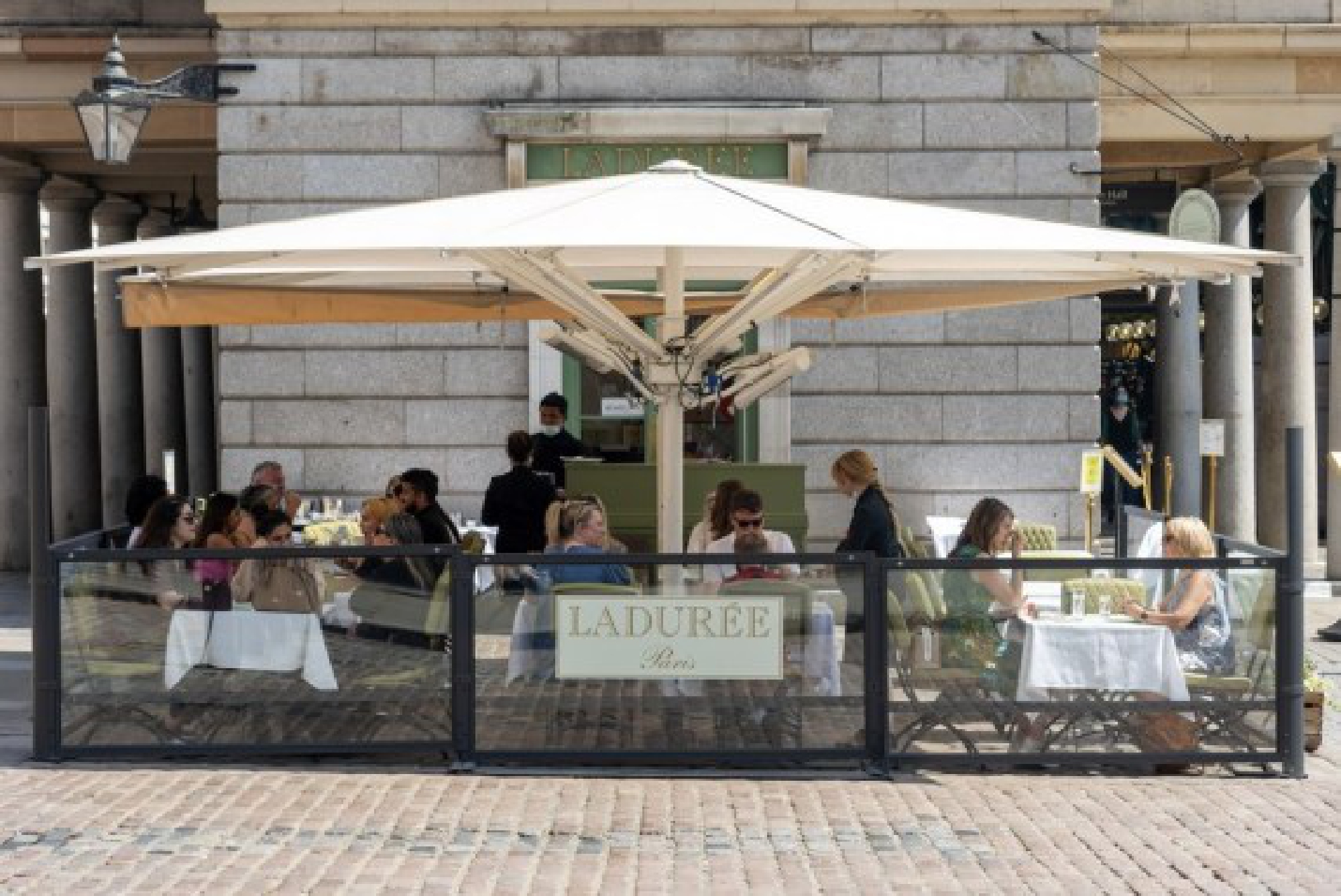 People dine at a cafe in London, Britain, on July 19, 2021.
 Passengers walk in an underground station during the morning rush hour in London, Britain, on July 19, 2021
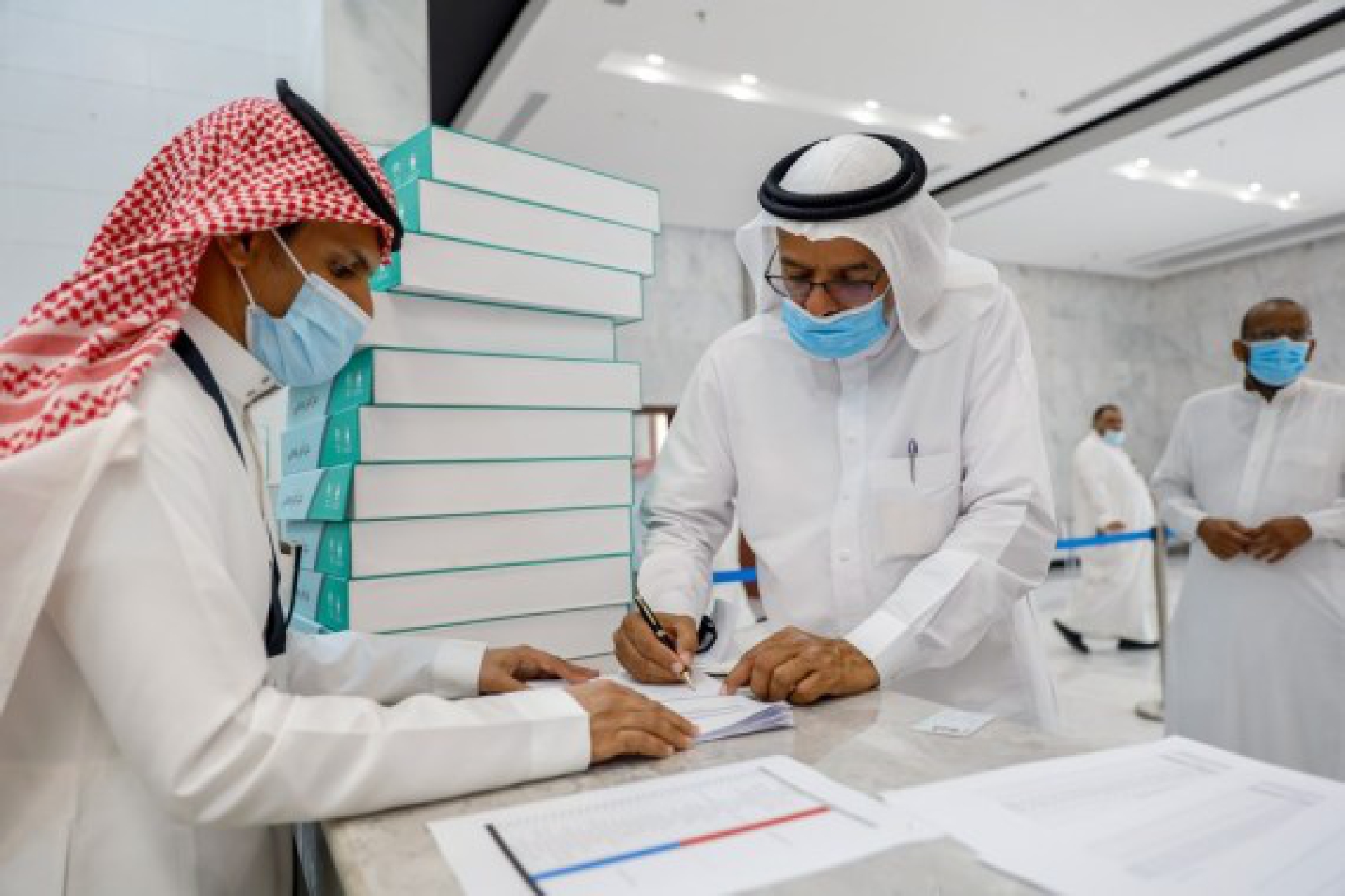 A staff member issues NFC-enabled smart cards with built-in personal information to pilgrims in Mecca, Saudi Arabia, on July 15, 2021. The Saudi government used the latest information technologies to help control the spread of COVID-19 during the Hajj season.