Brexit deal should answer concerns over economy, Sunak says
InternationalDec 28. 2020Rishi Sunak, U.K. chancellor of the exchequer, in London in September. MUST CREDIT: Bloomberg photo by Simon Dawson
By Syndication Washington Post, Bloomberg · Thomas Penny
U.K. Chancellor of the Exchequer Rishi Sunak said the trade deal reached with the European Union should reassure people worried about the economic damage of Brexit and can be an “enormously unifying moment for our country.”
London will continue discussions with Brussels over access and equivalence for financial services, the chancellor said on Sunday after Prime Minister Boris Johnson said the agreement did not go as far as he wants for the sector.
The deal, which will be voted on by lawmakers in Parliament on Wednesday, “gives us a strong platform to look forward optimistically and put the divisions of the past behind us,” Sunak said in a pooled TV interview. “For those who were anxious about the economic implications of leaving, they should be enormously reassured by the comprehensive nature of this free trade agreement.”
Johnson conceded in an interview with the Sunday Telegraph that the agreement “perhaps does not go as far as we would like” on financial services, though said it offers “access for solicitors, barristers” and a “good deal for digital.”
There is little clarity for financial firms and no decision on so-called equivalence, which would allow firms to sell their services into the single market from the City of London. The agreement only features standard provisions on financial services, meaning it doesn’t include commitments on market access.
Sunak said it gives a “stable regulatory co-operative framework” and “we will remain in close dialogue with our European partners when it comes to things like equivalence decisions.”
Anneliese Dodds, economy spokeswoman for the opposition Labour Party, said ministers should do everything possible to provide certainty for businesses.
“There are big areas, like financial services, where we need to see the Conservative government acting in a much more concerted way to get an agreement so we can ensure we keep jobs in our country,” she told Sky News. “They really need to focus on this far more.”
There was also a warning for Johnson’s government from across the Irish Sea, where Deputy Prime Minister Leo Varadkar said any reduction of standards in the U.K. could lead to reduced access to the EU market.
“They have agreed to a non-regression clause in all but name, so we said you can only have access to the market if you don’t reduce your standards when it comes to workers’ rights, the environment, health and safety, product standards, all of those things,” Varadkar told Newstalk radio.
“If they do reduce their standards, or if they don’t keep up with our standards, then that access to our market could be threatened,” he said. “So they do still have to largely follow European rules where they’re relevant.”
Some senior lawmakers from Johnson’s Conservative Party complained there will not be enough time to properly scrutinize the deal when Parliament debates and votes on it on Wednesday.
While the legislation is expected to pass easily as Labour has indicated it will back the deal rather than risk the economic damage of a no-deal divorce from the EU, dissent among Johnson’s rank-and-file lawmakers may spell trouble for the future.
“Whatever you think of this treaty, it is going to affect the rest of our lives,” former Brexit Secretary David Davis told the Observer. “It does require more than just a rubber stamp.”
By The Washington Post · Loveday Morris · WORLD, HEALTH, EUROPE, HEALTH-NEWS
BERLIN – In nursing homes and hospitals from Spain to Poland, the European Union began its official coronavirus mass vaccination program for its 450 million residents on Sunday amid concerns about supply and frustrations over the pace of the roll out.
Leaders of the 27-country bloc had aimed to ensure that the vaccine would be available to every country fairly, with every country beginning their vaccination with the Pfizer and BioNTech vaccine from Sunday.
At 8.30 a.m. in Guadalajara, Spain, Araceli Hidalgo, a 96-year-old nursing home resident, became the first person to be vaccinated in the country. In the Czech Republic, Prime Minister Andrej Babis was vaccinated live on television. In Italy, which emerged as the epicenter of the pandemic last spring, doctors and nurses at the Spallanzani hospital in Rome were the first to receive the vaccine.
“Today is a beautiful, symbolic day,” Domenico Arcuri, Italy’s emergency coronavirus commissioner told reporters outside the hospital according to the Associated Press. “All the citizens of Europe together are starting to get their vaccinations, the first ray of light after a long night.”
But despite the hopeful scenes across Europe, there has been mounting frustration as Europeans have watched Pfizer and BioNtech’s vaccine, developed in Germany with German federal government funding, roll out first in a string of countries, including the United States, United Kingdom, Israel and the United Arab Emirates. And while the bloc has ordered more than 2 billion vaccine doses as it aims to protect all its citizens against coronavirus, it has limited orders of the front running candidates.
“There is simply too little vaccine,” Markus Söder, the state premier of the German state of Bavaria, told the Bild newspaper on Sunday.
The 200 million doses of Pfizer/BioNTech vaccine ordered by the European Union will be equally divided between each of its member states according to population size, meaning that Germany, with 18 percent of the bloc’s population, would receive around 36 million doses – enough to vaccinate 18 million people, just over 20 percent of its population. The country has created a string of mass vaccination centers in sports arenas and exhibition centers.
The companies have said that delivery time frames depend on when orders were placed, and while the United States and the United Kingdom put in orders for the vaccine earlier in the summer, the European Union only finalized their order in November after months of negotiations.
That means that while the United States has a smaller initial order of Pfizer vaccines, it will receive 20 million from an initial bucket of 50 million that are available at the turn of the year, compared to 12.5 million for the European Union.
The delay in ordering was mostly due to haggling over the price, said one person with knowledge of the negotiations, who declined to be named to discuss closed door deliberations.
“Negotiating with 27 countries is not as easy,” the person said. “The advantage is that poorer countries will also receive vaccine. The downside is everything takes longer.”
Stefan De Keersmaecker, a spokesman for the commission, said he could not comment on negotiations but that the aim had been to build a diversified portfolio with different companies and talks had begun before results of trials were available. “There was no certainty that any of the vaccine candidates would be effective and safe,” he said, adding that contracts allow options for orders to be expanded.
However, while the United Kingdom and the United States have already used their options to order more vaccine, the European Union had not signed the contract for 100 million further doses as of Wednesday, according to two people familiar with the negotiations. That’s despite reports that it had come to an internal decision to do so more than a week earlier.
“This is a touching moment of unity,” European Union Commission President Ursula von der Leyen tweeted on Saturday ahead of the vaccination program’s start. “With vaccination, we will put this pandemic behind us.”
But despite a decision to show solidarity with a unified vaccine roll out, Hungary, Slovakia and Germany began vaccinations a day earlier. Karsten Fischer, a local health authority official in the Harz region of Saxony-Anhalt, told German media that he’d seen no reason to wait after vaccines arrived.
Germany is slated to receive 1.3 million Pfizer vaccines by the end of the year, and enough to vaccinate around 13 percent of its population by March. The vaccine was developed by BioNTech, a German firm based in the city of Mainz run by a husband-and-wife team of scientists in collaboration with Pfizer.
Berlin gave the German company $469 million in funding in September to help cover the costs of phase three trials and to expand manufacturing capacity.
The European Union also has a contract to buy 300 million doses of vaccine from AstraZeneca, which could be approved for emergency use in the United Kingdom as early as next week according to British press reports. The vaccine is cheaper and does not have the same complex cold storage requirements as Pfizer and Moderna’s offerings.
Pharmaceutical companies Sanofi and GlaxoSmithKline earlier this month said their vaccine would be delayed after showing a weak immune response.
By Syndication Washington Post, Bloomberg · Jacqueline Davalos · NATIONAL, HEALTH, HEALTH-NEWS
Workers at a leading commercial laundry firm that cleans sheets for some of New York City’s biggest hospitals say every day on the job places them at greater risk of covid-19 infection.
Industry CEOs from all over the U.S. voiced concern earlier this month about potential outbreaks, too. As a critical component of a health care system buckling under the strain of a nationwide surge, commercial laundry companies have become essential in the fight against the pandemic.
But their employees’ unions contend that while some operators have taken adequate measures to protect workers, others have not.
“Some of my representatives walk in to inspect, and hand sanitizer stations are empty. Workers are typically inches away from each other,” said Richard Minter, assistant manager at Philadelphia Joint Board Workers United. Unions complain that access to masks or gloves can be limited, leaving it to employees who make little more than minimum wage to buy their own.
Unitex Textile Rental Services is among the biggest players in a $3 billion industry that keeps hospitals, nursing homes and other medical facilities running by washing soiled linens, uniforms and gowns. Five Unitex laundry workers interviewed by Bloomberg News contend some workspaces have poor ventilation, or a lack of social distancing and limited access to personal protective equipment.
Brígida Vidal is a production worker at Unitex’s Med-Apparel facility in Perth Amboy, New Jersey, where she said workers are given only one mask a day, that gloves are doled out sparingly and that social distancing is rarely enforced. “We don’t have enough to protect us,” Vidal said. “There’s been times where I take gloves I find in the pockets of used scrubs because it’s all I can get.”
Vidal makes $12.50 an hour. A Mexican immigrant and the sole breadwinner for a family of four, she said going to work is a risk she “feels forced to take.” When the pandemic fell like a hammer on the New York metropolitan area last spring, Vidal said she reported symptoms including coughing, fatigue and a sore throat to her manager and Unitex’s company physician.
Instead of a two-week quarantine, she said she was expected to return to work a week later. At the time, covid-19 tests were hard to come by in the U.S. In September, Vidal said she tested positive for coronavirus antibodies. She recently bought face shields and shared them with a few co-workers. “It’s the company’s job to do this,” she said.
Maritza Garcia, another worker in Unitex’s Perth Amboy “soil room,” said managers brush off her requests for more protective equipment. “I’m told there’s not enough,” Garcia said. “I don’t feel safe. For the work we are doing, we deserve better.”
Unitex Chief Executive Officer Robert Potack denied allegations of unsafe working conditions. “Masks and gloves are provided daily and replenished upon request,” he said in an interview with Bloomberg. The company encourages social distancing and hand-hygiene, he said, and has “conducted thorough training on our covid-19 protocols and policies.”
In Unitex’s Mount Vernon facility, just north of New York City, Reynaldo Hernandez said he knew of four co-workers who fell ill with the virus this year. “In the summer, it was really bad,” he said. Sometimes management would provide him with a replacement mask, but other times he was told there weren’t enough.
Hernandez said that while he managed to stay healthy through the first infection wave, he fears this latest surge. “It’s coming back, and we are all crowded together with bad ventilation,” he said. “We are still kept in the dark about who is sick. I’m terrified.”
The catastrophic swell of coronavirus cases gripping the U.S. right now has overshadowed the initial outbreak that killed more than 50,000 in the Northeast last spring, and a second wave that killed tens of thousands more in the South and West following premature re-openings. Now, with more than 17 million confirmed infections and close to 320,000 dead, hospitals and health care facilities in every corner of the nation are filling up.
When it comes to soiled hospital laundry, Lisa Lockerd Maragakis, senior director of infection prevention at The Johns Hopkins Health System, said “evidence suggests that it’s harder to catch the virus from a soft surface (such as fabric) than it is from frequently touched hard surfaces like elevator buttons or door handles.”
But laundry employees contend that handling sheets and gowns used by Covid-positive patients is just part of a perfect storm of crowded workplaces and insufficient company precautions.
Erik Scott, chief executive officer of Soriant Solutions, a consulting firm specializing in health care support services, said linen companies were already busy before covid-19 appeared, thanks to a growing trend of outsourced laundry services. Unitex recently opened a 188,000-square-foot facility in Lawrence, Massachusetts, and said it expects to open another in 2021.
According to industry lobby group Textile Rental Services Association, commercial laundry firms are getting even more work now thanks to health care providers that are reluctant to let their workers wash their own uniforms.
“The grueling services provided by these essential workers have helped ensure the safety of patients.”
It wasn’t until New Jersey Congressman Frank Pallone Jr. and the Speaker of New Jersey’s General Assembly wrote Unitex CEO Potack on Dec. 1 that the company disclosed how many workers had been infected with covid-19, said Albert Arroyo, co-manager of the Laundry, Distribution and Food Service Joint Board, Workers United/SEIU. The union represents workers in 10 of Unitex’s 12 facilities.
“The grueling services provided by these essential workers have helped ensure the safety of patients, medical professionals, and so many others during the ongoing public health crisis,” Pallone wrote. He urged Unitex to “uphold critical covid-19 safety standards.”
On Dec. 3, Potack informed union leaders that 10% of the workforce at the Perth Amboy facility tested positive for covid-19 over the course of the pandemic, according to Arroyo. The union official also said Potack disclosed that in April, Unitex had been aware of eight positive cases among production workers at the facility.
Potack said in an interview that there have been only two cases of covid-19 at the Perth Amboy facility since April. The CEO said the infection rate at the location “is well below” national and state averages, though he declined to provide specific numbers. “There is no evidence to make any claim that the cases were transmitted at work,” Potack added.
The CEO said the company had made previous disclosures to union leaders, but added that he didn’t recall the dates or details. “We responded to and welcomed a conversation with members of Congress to explain the facts,” he said.
A fourth generation, privately owned family business, Unitex is one of the top health care laundry and linen supply providers in the country, according to Grand View Research Inc. It operates facilities across New York, New Jersey, Connecticut and Massachusetts, with 1,750 workers processing 300 million pounds of linen annually for hospitals including Manhattan’s Memorial Sloane Kettering, Mount Sinai Beth Israel and New-York Presbyterian. As of 2014, the company generated $150 million in revenue.
Unitex has been embroiled in collective bargaining negotiations over its Perth Amboy facility since July. Potack said he believed union complaints about coronavirus risks are part of a broader strategy to extract concessions. “They are hell-bent on trying to maintain a pension for future employees,” he said of the union.
Citing alleged bad faith, the union filed unfair labor practice complaints against Unitex in July and September with the National Labor Relations Board. Lawyers for both sides didn’t respond to requests for comment, but the case remains open, according to the NLRB.
On Dec. 10, workers gathered in front of Lincoln Hospital in the Bronx to demand a wage increase, the continuation of pension benefits and that Unitex commit to basic covid-19 protections, including providing two face masks daily and requiring six feet of social distance between employees. Potack said the company doesn’t “believe any more policies and procedures need to be included in the collective bargaining agreement.”
New York City Council member Ritchie Torres, who was just elected to Congress, also attended to support Unitex workers. An advocate for health protections in industrial laundries, Torres was a lead sponsor of the Clean Act, a local law which set sanitary standards for industrial laundries in 2016.
“I want to send a crystal clear message to hospitals,” Torres said. You “are judged by the company you keep, and you should hold your contractors accountable for respecting their workers.” Unitex hospital clients including Lincoln, Yale New Haven, Mount Sinai Beth Israel, New York Presbyterian, and Memorial Sloane Kettering didn’t respond to requests for comment.
“The grueling services provided by these essential workers have helped ensure the safety of patients.”
Outside of laundry rooms, Unitex’s truck drivers are also complaining about safety issues.
“It’s not easy work. I’m picking up soiled linens that sometimes aren’t sealed properly,” said Kevin Kucker, a driver for Unitex’s Newburgh, New York, facility, which isn’t the subject of contract negotiations. A lack of transparency around workers getting infected has compounded the anxiety, he said.
If the company said, “‘look-someone got sick [so] we’re going to have to get you guys tested to see if everything’s OK,’ that would show they cared,” Kucker said. “They never did that.”
Kathy Hanshew is a manager of the Chicago and Midwest Regional Joint Board, Workers United/SEIU union, which represents industrial laundry workers across 12 states. She said that, nationally, the union has seen cases where employers weren’t providing masks at all. But some laundry companies have indeed been working with unions and their members.
Pennsylvania commercial laundry company Clean Uniform Rental has responded positively to union demands, said Minter, of the Philadelphia Joint Board Workers United. The company gave out a version of hazard pay: $150 a week in addition to what it calls “hero pay,” which provided a week’s worth of wages to workers across all levels.
“Of course there’s a cost to all of this. But this is a crisis,” Clean Uniform Rental CEO Jim Wasserson said. While the company has had sporadic covid-19 infections, contact-tracing has helped avoid outbreaks, he said. “At least once a week we have a meeting to make sure everyone knows what’s going on,” Wasserson said. “Your employees need to feel safe.”
InternationalDec 27. 2020Kevin Euceda, an asylum seeker from Honduras, in detention at Farmville, Va. As the novel coronavirus sickened detainees in the facility, Kevin wrestled with the question of whether he was better off pursuing his asylum claim or asking to be deported. MUST CREDIT: Washington Post photo by Michael S. Williamson
By The Washington Post · Hannah Dreier · NATIONAL, WORLD, POLITICS, COURTSLAW, RACE, THE-AMERICAS
Kevin Euceda believed he was in imminent danger.
Down the hall in the immigration detention center where he was being held, a man whose psychiatric visits had been suspended because of the pandemic was hallucinating and screaming. Others were shivering and sweating, scared they were going to die. Surrounded by so much sickness, Kevin was growing desperate to find a way out.
A migrant who said he came to the United States when he was 17 years old to escape gang threats in Honduras, Kevin had been living for nearly three years in a place that was now being overrun by covid-19.
And so, last summer, after he was taken in shackles for his daily hour of outside time, he asked for a phone to be passed into his cell and called the pro bono legal clinic that had taken on his case in 2017, when it appeared that he was about to be granted asylum and freed. The lawyer who spoke to him that day remembered his voice sounding shaky, his words coming too fast to understand.
“Whatever you can do to get me out of here, please make it happen,” Kevin said.
The lawyer promised to call a deportation officer, the very person who for three years, Kevin, now 20, had been trying to avoid.
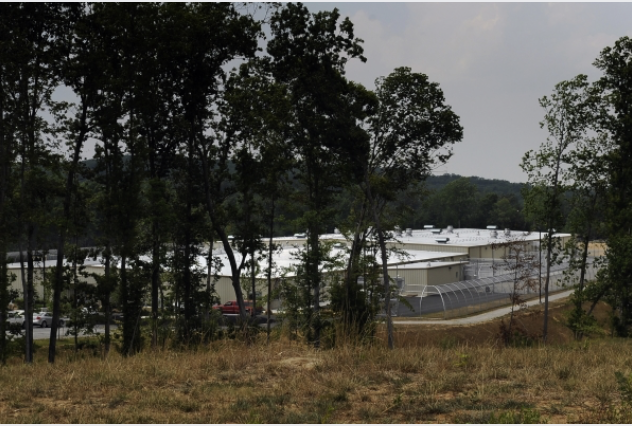
Outside the town of Farmville, Va., is a holding center for immigrants detained by federal authorities. The facility was the site of one of the largest outbreaks of the novel coronavirus in the immigration detention system. The picture above is from 2010. MUST CREDIT: Washington Post photo by Michael S. Williamson
In detention centers on the country, more and more people have been asking for the same thing, seeking their own deportation as the novel coronavirus has spread through facilities and sickened more than 8,000 detainees, according to government data.
The virus has collided with the Trump administration’s “zero tolerance” approach toward people looking for refuge and asylum in the United States. Those policies have led to a record number of immigrants being held in detention, including 7,000 people who had cleared the first steps of requesting asylum when the pandemic began and would normally have been released on bond while their cases were processed.
Some immigrants have been withdrawing cases against their lawyers’ advice, saying they’re more afraid of being in detention during a coronavirus outbreak than of what might be waiting in the places they fled. More than 2,500 detainees, most with no serious criminal history, have given up their cases since March, according to records from the Transactional Records Access Clearinghouse, a research group at Syracuse University. Those records also show that detainees put in deportation proceedings in July 2020 were twice as likely to opt for voluntary departure than those from a year before.
During 32 months at the Farmville detention center in Virginia, Kevin had held on through threats from dorm mates, protests about conditions that ended in guards using pepper spray, an outbreak of mumps and long periods of isolation. Again and again, his lawyers had assured him that his claim for asylum was a sound one and that, eventually, he was likely to win release. But now he explained to them that even when he had been targeted for death by gang members back in Honduras, he had at least been able to flee the country. At the detention center, he felt there was nothing he could do to escape the virus. “I’ve never been this scared,” he said.
– – –
Kevin had been living with different forms of danger for most of his life. He had been raised by a grandmother who attacked him when she drank and left him with a V-shaped scar on his forehead. She died when he was 12, and the gang MS-13 took over the house where they had been living, which was little more than a shack. Gang members slept in Kevin’s bed, tortured rivals on the patio, and put him to work selling drugs, he would later say in sworn testimony that was found credible by an immigration judge and also accepted by the government. One night, the leaders forced him to watch as they murdered his cousin for refusing to join the gang. Eventually, in 2017, they told Kevin he had to kill a stranger to prove his loyalty, and he fled to the United States to seek asylum.
After he crossed the Rio Grande on an inflatable raft, Kevin was processed by Border Patrol and sent to a shelter for migrant children. There, as documented earlier this year by The Washington Post, he went through an intake process that included a mandatory mental health therapy session. He told the therapist that he had fled MS-13 and that gang leaders had ordered him killed if he returned. The therapist assured him that their session was confidential, but, because of a new Trump administration policy, her notes were instead shared with Immigration and Customs Enforcement to be used in court proceedings about whether Kevin would be allowed to stay in the United States.
Lawyers for ICE, who argued that Kevin was a threat to the community and should be deported, cited these notes some half a dozen times to keep him from being released as he was moved through shelters and detention centers, ending with his transfer to Farmville, in a rural part of central Virginia.
Twice, a judge ordered Kevin released on bond, and twice ICE appealed. Kevin also was certified as a victim of forced labor and granted asylum. But ICE appealed that ruling, too, and also appealed after a judge granted Kevin protection from deportation under the United Nations Convention against Torture, finding that he would not be safe anywhere in Central America because of widespread MS-13 control and police corruption.
As a result of what the American Psychological Association would later call an “appalling” breach of the right to patient confidentiality, Kevin was still waiting in detention for his case to be settled when the novel coronavirus began to spread through the country.
He was living in a dorm of 100 men, with tables in one corner for meals and toilet cubicles without doors in another. At night, they slept head-to-head on beds bolted flush with each other, close enough to smell each other’s breath, “like husband and wife,” one detainee said.
Kevin’s one connection to the outside world was a shared computer he could use to text with students at Washington and Lee University’s law school, who earned class credits for taking on his case.
“We’re in a very, very strong position,” one of the students, Erick Resek, wrote in March, updating Kevin on their strategy to get him permanent asylum.
“OK, I’ll keep holding on here,” Kevin wrote back, in correspondence the legal team shared with his permission.
“Are you in quarantine?” Resek wrote.
“Quarantine?” Kevin wrote.
“I mean, is Farmville in quarantine yet? Outside, the whole country is in quarantine,” Resek wrote.
“Umm no, we’re not in quarantine at all here,” Kevin wrote.
“Hmm, that’s weird. The whole country is in a total panic,” Resek wrote.
Even as Resek gave Kevin reason for optimism about his case, he was careful to explain that a final ruling was likely to be many months away.
“What if this coronavirus thing lasts for a long time?” Kevin wrote, adding a frowning emoji. “Imagine if the virus got in here. I think we’d all die.”
Three months later, the virus arrived at Farmville when 74 detainees were transferred there from detention centers in Arizona and Florida. It happened in early June, a time in the pandemic when different agencies in charge of prison inmates and immigration detainees were developing different ways of dealing with viral spread. In the federal prison system, for instance, inmate transfers between institutions had been put on hold because of concerns about infection. But ICE was operating with limited restrictions at that point, which allowed a transfer to take place that, as The Post reported, was driven in large part by the Trump administration’s desire to bring federal agents in from other parts of the country to quell anti-racism protests in D.C. ICE agents are not allowed to travel on charter flights unless detainees also are aboard, so, to expedite the agents’ travel to the protests, the transfer was arranged to bring a group of detainees to Farmville, the ICE facility closest to the nation’s capital.
When the detainees arrived on June 2, at least two were feverish. Farmville initially housed the new detainees in separate dorms but then moved several of them into the general population, where they mixed with the 400 other men.
“We were touching their shoes, touching their clothes,” recalled a detainee named Sarafin Saragoza, a 36-year-old from Mexico who earned $1 a day for helping distribute uniforms. “There was no way to keep distance from them.”
Within weeks, 51 of the new arrivals tested positive for the virus, and whole dorm rooms began falling ill.
– – –
Among the first to get sick was Gerson Garcia, a 27-year-old asylum seeker from Honduras. He wrote, “I need to see the doctor” on a sick-call request form and dropped it into a box that was supposed to be checked daily. He was still waiting to see the doctor 10 days later and crying about body aches, when, medical records show, three guards lifted him down from his bed and took him to the center’s clinic.
After that, he was moved to a medical room where there was already another sick detainee. His fever spiked to 103. He lost 30 pounds because of diarrhea. He and the other man remember a night when Garcia felt he couldn’t breathe and pounded on the door until he was too dizzy to stand. “I was begging for help. Finally, the guard came and said there was no doctor at night and he would punish me if I kept banging,” Garcia said. That’s when he decided to ask for deportation.
Another detainee who fell ill was Frank Bauer, who is 39 and moved to the United States from Bolivia as a child. “My lungs hurt,” he wrote in one of a series of near-daily requests for medical attention. “I still haven’t seen a doctor,” he wrote on another. “Please help us – we need medication,” he wrote on another, because Farmville does not provide any medicine, even Tylenol, without a prescription. Then he wrote, “We don’t have any more sick call request forms in this dorm,” on the last form he could find. He, too, decided to ask for deportation.
Some detainees later sued the company that runs Farmville, Immigration Centers of America (ICA), accusing it of failing to protect their health and safety. In a sworn statement submitted in response to that lawsuit, Farmville director Jeffrey Crawford said he tried to slow the outbreak by giving everyone masks, instituting daily temperature checks and distributing hand sanitizer. ICA also posted signs encouraging social distancing, though investigators from the Centers for Disease Control and Prevention later found that the layout of the dorms, with beds inches apart, made viral spread “difficult to mitigate.”
Asked to comment for this story, ICA said in a statement that it was unable to answer questions “due to pending litigation.” The response continued that ICA has “worked hard” to “adhere to the continuously evolving science and medical recommendations from our local, state and federal health authorities.”
By the third week of June, dozens of people in Kevin’s room were sick. Their coughs echoed through the dorm at night, mixed, some remembered, with the quieter sounds of crying.
Kevin had learned as a child to keep to himself to avoid trouble. He was so polite with the guards that some detainees suspected he might be an informant. But it felt like he was running out of ways to stay safe.
“There are 27 cases of coronavirus here now,” he wrote in a text message to a recent law school graduate, Hollie Webb, who had represented him when she was a student.
“Wow, please be careful,” Webb wrote back.
“Yes, of course, I’m trying,” he wrote.
Farmville had nine medical isolation rooms for nearly 500 men, so most sick detainees had to stay in the dorms, where they were required to stand in front of their beds to be counted each morning. Saragoza, who had helped book in the transfers and was now sick himself, watched one day as his dorm mate passed out. “He fell straight on his face and his head bounced like a basketball,” he said.
There were multiple episodes of fainting, according to interviews with detainees. One man collapsed while waiting in line to see a nurse. Another while taking a shower. Another while walking back to his bed with a blanket around his shoulders. In his statement, Crawford acknowledged that in one dorm, six detainees had passed out over a single weekend.
ICA subcontracts medical care to a company called Armor Correctional Health Services, which has had several government contracts canceled because of recurring complaints that staffers ignore sick inmates. In 2018, Armor was criminally charged with falsifying records to give the appearance that staffers had been checking on a man as he died of dehydration in his cell. In other instances, Armor has hired medical staff with disciplinary records, including the sole doctor at Farmville, Teresa Moore, who had been reprimanded twice by the state medical board, and also had her license restricted, for overprescribing narcotics and misusing her prescription pad.
Citing pending litigation, Armor declined to answer specific questions for this story. In a statement, the company said that it has followed CDC and Virginia Department of Health guidelines for combating coronavirus spread. “We will continue to enhance our plan as new facts about the pandemic materialize,” the company said. Armor also addressed the ongoing criminal case about falsifying records, and said in a statement that its employees’ actions did not reflect a company policy and “the charges filed do not involve any allegations of misconduct or negligent supervision against Armor management.”
Farmville does not track sick-call response times, but a nurse named Jackie Rothwell said the center struggled with an unmanageable caseload after the June 2 transfer. “Most of the staff had never dealt with actual acute care, and the stipulations for care greatly overwhelmed the staff,” said Rothwell, adding that she retired this summer because she felt unsafe.
On June 18, Kevin made contact with Webb again.
“There are 38 people infected with the virus now,” he wrote. “It’s getting crazy.”
– – –
Soon, detainees started protesting the conditions at Farmville. They refused to stand for count and stopped eating meals. They told guards they needed Tylenol for their fevers and wanted the bunkmates who were coughing in their faces to be moved.
The guards also were becoming jumpy. More than two dozen had gotten sick, and some were quitting. “We were all terrified,” said a guard who spoke on the condition of anonymity because he still works for ICA. Another worker said supervisors were asking guards to come in if they had tested positive for the virus but were asymptomatic, because the center was so short-staffed. Crawford said in his statement that ICA directed its staff to “stay home with any sign of any illness.” A CDC assessment would later find that people were working through nausea, diarrhea and breathlessness.
As the protests continued and grew, guards began responding with pepper spray, which can make the respiratory tract more susceptible to infection. On July 1, guards used several cans of spray after detainees decided not to stand for count, according to Crawford’s statement. One of the men in the room was a 72-year-old Canadian doctor named James Hill, who was in Farmville awaiting deportation after serving a prison sentence for inappropriately prescribing narcotics. Hill began coughing uncontrollably, according to his family and bunkmate, and was taken to the hospital with shortness of breath. He died a month later on a ventilator.
The detainees in Kevin’s dorm decided to sit on their beds instead of standing for count as required after three people were taken away in wheelchairs. That afternoon, the men refused to eat lunch or dinner, and Kevin texted Webb that he was worried about what might happen next.
“People here are losing it and trying to protest,” he wrote. “They’ve locked us all in, and the guards don’t want to come give us any explanations. I think it’s going to get really ugly.”
In the evening, guards in body armor entered the dorm, according to Crawford’s statement. One fired a weapon that made a loud bang and sent everyone running.
The guards pulled Kevin and several others out and led them to a row of cells deep inside the detention center. Kevin sounded panicked when he called the professor supervising his case to report that he was being punished with 30 days in solitary confinement.
“How did you get in there?” the professor asked.
“I have horrible luck,” Kevin said, and explained that he had been lumped in with the protest leaders for, as he put it, “asking questions” when the riot squad came in.
Farmville ranks among the top 10 ICE detention centers nationwide for its use of solitary confinement, according to the nonprofit Project on Government Oversight. ICA declined to release Kevin’s discipline record, so his lawyers never knew why he was being punished.
With no natural light in his cell, Kevin began to tell time by the arrival of his three daily meals. He was allowed out once a day, shortly before dawn, to stand in an open-air cage for an hour. Men in the other cells passed time by shouting back and forth about their symptoms. Kevin rarely spoke, but he was getting sick, too. He told a nurse that he had a bad headache, chills and a sore throat. The other detainees sometimes noticed that his eyes were red and wondered if he had been crying.
“I’m in the hole and I hate it,” he wrote to Webb. “The conditions have gotten so hard. Everything is worse.”
By July 9, ICA had tested 286 detainees, and 267 were positive for the coronavirus. The center’s nursing director alerted the health department in an email, writing, “Dr. Moore said good news is that’s almost the whole facility, so can’t go over that much.”
Kevin was tested July 2. “They gave me a covid 19 test today and it was horrible, ha-ha,” he wrote to Webb. The next week, a notation went into his medical chart: “Positive covid result.” But it’s unclear whether Kevin was ever told. His lawyers think he was not informed, because he never mentioned getting his results and continued to call them frantic with worry. After years of arguing for his release into the United States, his lawyers began contacting his deportation officer daily, along with any other official they could think of, asking for Kevin to be removed from Farmville.
For Kevin’s part, he wanted out as quickly as possible. “Life has dealt me a lot of blows, a lot of suffering, and it’s sapped my strength and my will to fight,” he wrote to Webb. He told her he hoped to be deported before serving his full 30 days in solitary confinement.
– – –
Kevin wasn’t the only one who decided that returning to a dangerous place would be better than staying at Farmville. More than a dozen detainees said in interviews that they chose to give up their cases during the outbreak.
Bauer, the man who filed daily sick requests, asked for deportation without telling his wife or U.S.-citizen children, for fear they would try to persuade him to stay in a center where ultimately 339 detainees caught the virus. Now trying to recover from lingering symptoms in Bolivia, he wrote to a judge before being deported that he was abandoning his case because “after contracting covid-19 due to ICE and facility negligence, I fear for my life in this facility.”
A 22-year-old named Zack, who asked that his last name be withheld for his safety, had been seeking asylum because he was a gay man in a North African country where homosexuality is illegal. After being sent to solitary for inciting a hunger strike, he said he struggled to get care for covid symptoms. At one point, he tried covering the camera in his cell with wet toilet paper to attract help, he said, “but still no one came. Then, out of nowhere, the guard opened the slot in the door and pepper-sprayed me.” After a month, he gave up his case. He was assaulted within days of being deported, he said, and is now hiding in a third country from relatives who have threatened to kill him for shaming the family.
A man named Jose Rauda, who also was put in solitary confinement for protesting conditions, decided to request deportation soon after being removed from his dorm. He was killed in El Salvador two weeks after arriving back, according to his mother, by MS-13 members who thought he belonged to a rival gang.
The Farmville outbreak ended in August after the virus infected nearly everyone held there and a federal judge barred ICA from accepting new detainees. Recently, fewer Farmville detainees have been giving up their claims, especially as lawyers advise clients that the next administration is likely to roll back much of Trump’s immigration agenda, dramatically improving their odds of winning legal status and being released while they wait for an outcome.
It is advice Kevin never got to hear. At the end of July, his request for deportation was granted and he was flown back to Honduras in shackles. It was nighttime when he walked out of the airport, and Webb remembers him calling in tears to say how overwhelming it felt to see the stars for the first time in three years. Two days later, he crossed the border into Guatemala, where his 21-year-old sister was living. The gang MS-13 operates in Guatemala as well, but Kevin thought he could hide there, at least for a while.
His sister, who asked that her name not be used because she, too, fears being targeted by the gang, set up an extra bed in her rented room and threw Kevin a party with a cake and the fried fish he had been missing in detention. He continued to wake up before dawn as he had at Farmville, and got a job working at a grocery for $5 a day.
After a childhood spent in forced labor for gang leaders and an early adulthood spent in detention, Kevin began trying to live out some of his earlier daydreams. He adopted a stray cat. He bought a used motorcycle. He also started rebuilding a relationship with his mother, who had left him as a small child. He told her he forgave her and pledged to help support her in the coming years. Everyone was struck by how focused and confident the tall 20-year-old seemed. “He was scared that something might happen to him, but he was so happy,” his sister said.
After a few weeks, Kevin took a day off work to visit a river with his sister – he on his motorcycle, and she riding with a friend. When they got there, the water looked like it was moving too fast for swimming, so they leaned on a bridge and watched it pass. On the way back, his sister lost track of Kevin on the curving highway. When she caught up, he was sprawled on the side of the road, unconscious.
It wasn’t clear whether Kevin had had an accident or been attacked. No witnesses came forward. After an ambulance took him to the hospital, police claimed Kevin’s motorcycle as evidence, and the family says that was the last they heard about the case.
“We’ll never know what happened,” his mother, Erika Euceda, said. “There are lots of people who try to rob motorcycles here. Lots of people who make threats. Or watch people who have just been deported. But the police didn’t try to find any answers.”
At the hospital, doctors said Kevin needed to be sent to a bigger city for surgery. His sister was trying to find the money to have him moved when he suffered a massive brain hemorrhage. The doctors said there was nothing to be done, and so it was that three years after he was a 17-year-old asking for protection in the United States, two years after he was first granted asylum, and four weeks after he returned to Central America, Kevin Euceda died and was in danger no more.

 Rishi Sunak, U.K. chancellor of the exchequer, in London in September. MUST CREDIT: Bloomberg photo by Simon Dawson


 Kevin Euceda, an asylum seeker from Honduras, in detention at Farmville, Va. As the novel coronavirus sickened detainees in the facility, Kevin wrestled with the question of whether he was better off pursuing his asylum claim or asking to be deported. MUST CREDIT: Washington Post photo by Michael S. Williamson
 นักโบราณคดีค้นพบร้านอาหารและเครื่องดื่มริมทางในเมืองปอมเปอีพร้อมภาชนะและวัตถุดิบยังอยู่ครบ


 เปิดเผยข้อมูลแรงงานไทยเสียชีวิตในเกาหลีใต้จำนวนมาก ซ้ำเจอติดโควิดอีก 67 ราย สถานทูตไทยยันไม่ทอดทิ้ง
 ทางการฮ่องกงกำลังตามตัวนักเคลื่อนไหวเพื่อประชาธิปไตยที่หนีไปอยู่ต่างประเทศ 30 คน และจนถึงตอนนี้ถูกรวบไปแล้ว 40 คน
 กูร์บันกูลี เบอร์ดีมูคาเมดอฟ ประธานาธิบดีเติร์กเมนิสถานอ้างว่าชะเอมสามารถต้านไวรัสโคโรนาได้ผล
 ข้อเรียกร้องนี้เกิดขึ้นหลังจากแรงงานเมียนมาถูกนายจ้างไทยทิ้งไว้กลางทาง
 เคธี่ กง ตอกย้ำความความสำเร็จของเพศหญิงในวงการเกม ครั้งหนึ่งเธอเคยเขียนจดหมายรักหา ‘แจ็ก หม่า’ ด้วย

