The Trump administration has added prominent Chinese semiconductor and drone manufacturers to an export blacklist, continuing to exert pressure on the country in the final weeks of the Trump presidency.
The Commerce Department said it has placed Semiconductor Manufacturing International Corp., or SMIC, drone maker DJI; and dozens of other Chinese companies and universities on the Entity List, which bans the export of U.S. technology to the entities unless the exporter receives a government license.
The sanction follows “evidence of activities between SMIC and entities of concern in the Chinese military industrial complex,” Commerce said in a statement.
“We will not allow advanced U.S. technology to help build the military of an increasingly belligerent adversary,” Commerce Secretary Wilbur Ross said about SMIC in a statement. “Between SMIC’s relationships of concern with the military industrial complex, China’s aggressive application of military civil fusion mandates and state-directed subsidies, SMIC perfectly illustrates the risks of China’s leverage of U.S. technology to support its military modernization.”
The Commerce Department said it was adding DJI for enabling high-tech surveillance in China, which the agency called a human-rights abuse.
The additions also include several construction companies, including China Communications Construction Company, for helping China militarize and claim disputed territory in the South China Sea.
Commerce also added to the list several universities, in Beijing, Nanjing and Tianjin, for actions including trade-secret theft or “acquiring and attempting to acquire U.S.-origin items in support of programs for the People’s Liberation Army.”
The sanction shows that cutting trade ties with China remains a top priority for the Trump administration’s many China hawks, who view the country’s growing tech and military might with increasing alarm. Similar concerns have also taken root in Congress, among both Republicans and Democrats, and could continue during a Biden administration.
The Entity List has become a favorite Trump administration tool to punish China and now includes more than 300 Chinese entities.
The Commerce Department, which maintains the list, has previously used it against Chinese telecom company Huawei and against Chinese entities engaged in alleged human rights violations in China’s Xinjiang region.
Officials at SMIC and DJI, and at China’s embassy in Washington, D.C., didn’t respond immediately to requests for comment. SMIC has previously denied supporting China’s military.
It wasn’t immediately clear how much U.S. technology DJI uses to make its drones. The Shenzhen-based company is among the world’s biggest drone manufacturers.
The Trump administration already began restricting exports to SMIC in September by notifying some U.S. companies that they would need a license to export to the chip maker. Inclusion on the Entity List is a broader sanction.
Founded in 2000 in Shanghai, SMIC ranks among the top five semiconductor manufacturers in the world, according to a report from the United States International Trade Commission, or USITC.
Industry experts say that SMIC’s technology lags behind that of chip manufacturers in Taiwan and the United States but that Beijing is pouring billions into the industry to help SMIC and other Chinese companies catch up.
SMIC has enjoyed generous government financial support, including low-interest loans, tax breaks and investments to help build manufacturing facilities, the Organization for Economic Cooperation and Development in Paris said in a report last year.
Commerce said that the export ban will apply to technology needed to produce advanced semiconductors with silicon transistors sized at 10 nanometers or less. There are one billion nanometers in a meter.
Chip-industry experts say SMIC and other Chinese companies are not yet able to make such advanced semiconductors, and would for now need software and equipment from the U.S. and other Western countries to reach that capability.
SMIC started as a private company, but state ownership has steadily grown over time, to more than 45 percent of SMIC stock as of 2018, according to the OECD report.
SMIC’s shares used to trade on the New York Stock Exchange, but the company removed its stock from the NYSE last year. The shares now trade on the Shanghai and Hong Kong exchanges.
SMIC’s stock, held by some Western investors, fell 5% in Hong Kong trading on Friday.
The additions to the list also include some lesser known Chinese companies, such as NucTech, which makes luggage- and cargo-screening equipment. The Trump administration said it had determined that “NucTech’s lower performing equipment impair U.S. efforts to counter illicit international trafficking in nuclear and other radioactive materials.”
The administration also added several Russian entities, including OOO Sovtest Comp and Cosmos Complect, to the list, saying they appear to have used a front company to acquire “sensitive electronic components” for use in Russia, without obtaining required licenses.
By The Washington Post · Michael Birnbaum, Christopher Rowland, Quentin Ariès
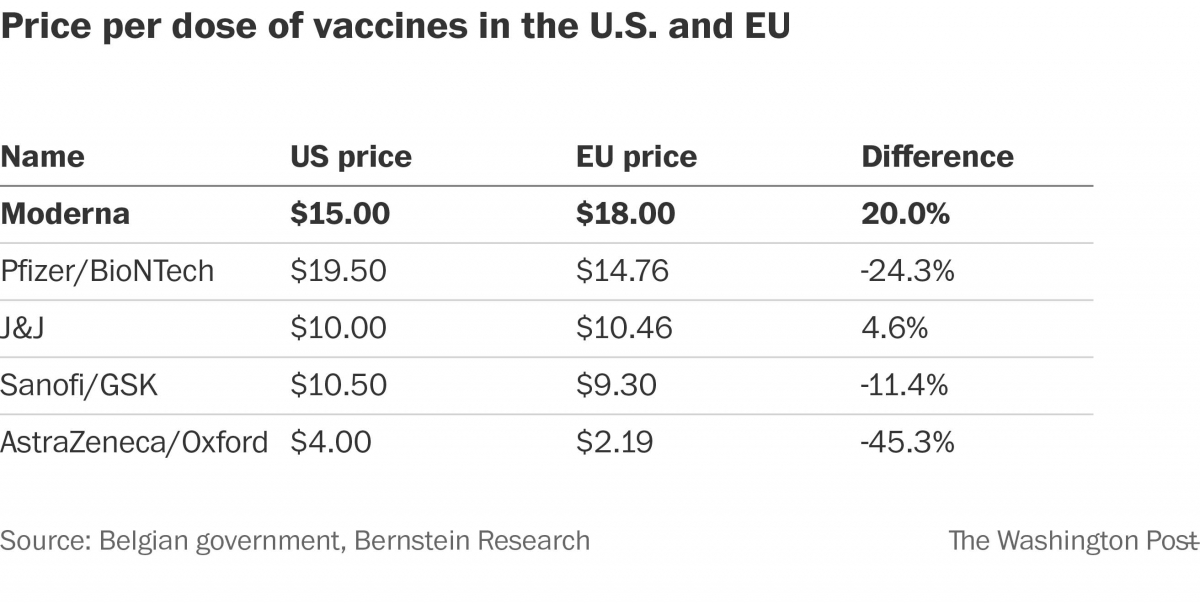
The European Union is paying less money than the United States for a range of coronavirus vaccines, including the Pfizer-BioNTech inoculation being rolled out across the country, according to a Washington Post comparison of the breakdowns.
The costs to the EU had been confidential until a Belgian official tweeted – and then deleted – a list late Thursday.
Comparing that list with U.S. calculations by Bernstein Research, an analysis and investment firm, it appears that the 27-nation union has a 24% discount on the Pfizer vaccine, paying $14.76 per dose relative to $19.50 in the United States. Some of the difference may reflect that the EU subsidized that vaccine’s development and the cost of shipping the European-made shots across the Atlantic.
According to the Belgian document, the bloc will pay 45 percent less than the United States for the AstraZeneca-Oxford vaccine currently under development. But it will pay 20 percent more than the United States for the Moderna vaccine, which is expected to be approved for U.S. use on Friday. Both of those vaccines were funded partly by the U.S. government as part of Operation Warp Speed, an effort to expedite their development. The AstraZeneca-Oxford team received $1.2 billion, and Moderna got $4.1 billion.
As in the United States, European countries generally plan to make the vaccines free for their citizens.
The per-dose prices of the vaccines are lower than most brand-name drugs, but the hundreds of millions of doses required to vaccinate entire populations will drive up costs significantly for individual countries. Disparities between the higher prices in the United States and Europe in overall drug prices have long driven outrage in Congress.
Asked about the price differences between the United States and Europe, Pfizer noted that the EU coronavirus vaccine purchase, 200 million doses, was double that of the United States.
“Pfizer and BioNTech are using a tiered pricing formula based on volume and delivery dates,” Pfizer said in a statement. “The agreement with the European Commission for the supply of 200m doses, and an option to request an additional 100m, represents the largest initial order of our candidate vaccine to date.”
It said it would not disclose further details.
“AstraZeneca is providing the vaccine at no profit during the pandemic and the price per dose varies depending on the supply chain. We are unable to comment on specific agreements,” the company said in a statement. The company has previously said it expected its vaccine to cost between $3 and $5 a dose, based on the cost of production. It was not clear why the Belgian figure was so much lower.
The U.S. Pfizer order has already been the subject of frustration, since Pfizer urged Operation Warp Speed over the summer to purchase double what the United States ultimately decided to order. By the time U.S. buyers asked for more doses earlier this month, the availability had been snapped up elsewhere – including by Europe.
Operation Warp Speed said that it had negotiated extensively with each drug manufacturer.
“Based on the significantly varying levels of developmental funding, distribution costs, and other contract terms, we are confident we negotiated the best possible price for the American taxpayer,”‘ the initiative said in a statement. It noted that the price of Pfizer’s vaccine included distribution across the United States and territories, including charter flights from manufacturing flights in Europe.
Most vaccines currently under development require two doses, although Johnson & Johnson’s – $10 in the United States and $8.50 in Europe – is a single shot.
The two vaccines that are first in line for approval – Pfizer-BioNTech and Moderna – are more expensive than others partly because they are more expensive to make, the result of a never-before-used approach that primes the immune system to defeat the coronavirus.
The EU’s finance arm offered a $122 million loan to BioNTech in June to help develop the vaccine, followed by an additional $458 million from the German government in September.
The other vaccine prices noted on the EU list were $9.30 for the one under development by Sanofi and GlaxoSmithKline, an 11 percent discount on the U.S. cost, and $12.30 for the one under development by CureVac, for which the United States has not signed contracts.
The EU has been secretive about the prices it negotiated for its 2 billion doses of various vaccines, drawing fire from transparency advocates who say the public and policymakers have a right to know how much their governments are paying for the inoculations.
The EU negotiated as a bloc, but most other countries, including the United States, are negotiating individual contracts with pharmaceutical companies. The confidentiality clauses presumably benefit the manufacturers, since they make it easier to vary the prices from country to country.
A spokesman for the European Commission, which negotiated the contracts for the vaccines on behalf of EU members, declined to comment about the pricing on Friday, other than to say disclosure was a breach of confidentiality clauses of the contracts.
The Belgian official, State Secretary for Budget Eva De Bleeker, posted the table of Belgium’s costs for vaccines on Twitter on Thursday, then deleted it shortly afterward. Because the EU has negotiated collectively for vaccines on behalf of its members, the same prices apply across all of its 27 nations.
A spokesman for De Bleeker confirmed the authenticity of the tweet, and said that it came after a Thursday evening discussion in the Belgian Parliament and opposition charges that there was no money to pay for the vaccines in the country’s 2021 budget.
“The communication team posted the tweet to close the discussion,” said Bavo De Mol, the spokesman. “We wanted to be as transparent as possible, but maybe we were a bit too transparent.”
The breach was first reported by HLN, a Belgian newspaper. Late Friday, Belgian media noted there was at least one error in the document – the number of doses of CureVac that the country planned to purchase was incorrect – but said that the prices per dose appeared to be accurate.
Drug pricing is linked to a number of factors, including volume discounts and other specific promises made by governments when they sign the contracts. Some governments have agreed to limit the liability drug manufacturers will face if side effects arise from the vaccines, for instance. In February, the Trump administration offered vaccine manufacturers protection from lawsuits until 2024.
Europe has spread its bets relatively evenly among six vaccines, reserving 200 million to 300 million doses of all of them except the one produced by Moderna, of which it purchased 80 million. A few countries, including Germany and Hungary, have purchased additional vaccines on the side.
The European Medicines Agency is likely to approve the Pfizer-BioNTech vaccine on Monday, with the vaccine expected to roll out across the EU the final week of this month.
The EU vaccines will be shared equally across the European Union based on each country’s population size.
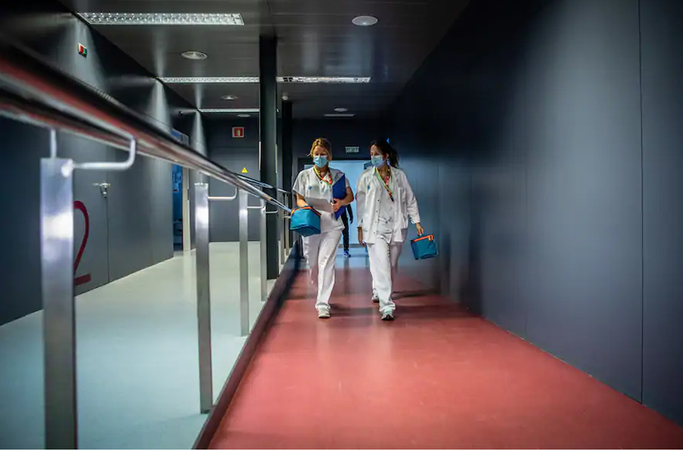
A multilateral effort to develop and distribute vaccines has secured almost 2 billion doses, potentially allowing some vulnerable groups in participating countries to get vaccinated in the first half of next year, the World Health Organization said Friday.
The announcement came in an end-of-year update on the Covax Facility, a plan to ensure that low- and middle-income countries are not cut out of a vaccine race that has seen rich countries snap up the majority of early doses, leaving the rest of the world to wait.
At a news conference on Friday, officials from the WHO, Gavi, the Vaccine Alliance, and the Coalition for Epidemic Preparedness Innovations, or CEPI, touted progress toward reversing that trend, at least a little, announcing deals with AstraZeneca and Johnson & Johnson.
Officials from Canada and France said they were working to develop and fund a mechanism for rich countries to eventually share surplus vaccine doses through Covax, though they did not offer details on when that might start.
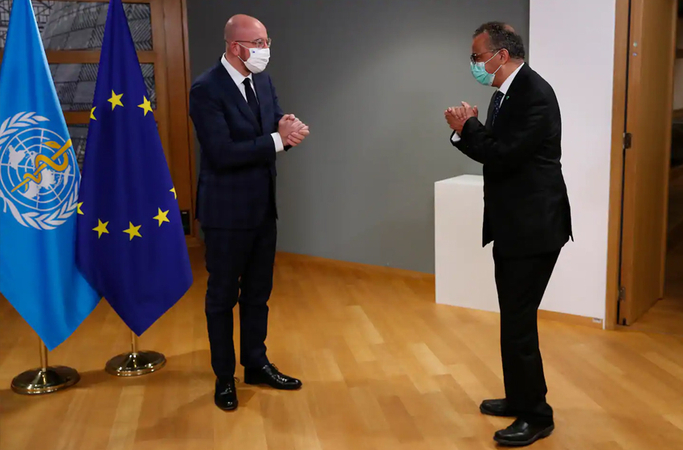
“The arrival of vaccines is giving all of us a glimpse of the light at the end of the tunnel,” WHO Director General Tedros Adhanom Ghebreyesus said Friday. “But we will only truly end the pandemic if we end it everywhere at the same time, which means it’s essential to vaccinate some people in all countries, rather than all people in some countries.”
Tedros cast the update as good news for an initiative that has struggled to secure funding and support from big players including the United States, which has declined to participate.
But his upbeat tone belied growing concern that hoarding by rich countries will leave much of the world without an adequate vaccine supply.
In recent weeks, as the United States, Britain and Canada have cheered the rollout of domestic vaccination campaigns, other countries have scrambled to secure doses of as-yet-unproven candidates.
By mid-November, wealthy nations had reserved 51 percent of various vaccine doses even though they are home to only 14 percent of the world’s population, according to a new study published by two Johns Hopkins researchers in the BMJ, a journal published by the British Medical Association.
An earlier study by researchers at Duke University estimated that people in low-income countries could be waiting for a coronavirus vaccine until 2024.
Covax on Friday announced new deals with drug companies, including an advance purchase agreement with AstraZeneca for 170 million doses and a memorandum of understanding for 500 million doses from Johnson & Johnson.
These deals will build on existing agreements with India’s Serum Institute for 200 million doses, plus options for up to 900 million doses more of either the AstraZeneca or Novavax candidates, as well as a statement of intent for 200 million doses from Sanofi/GSK, according to the WHO.
The U.N. health agency said Friday that at least 1.3 billion donor-funded doses will be made available to 92 relatively poor countries by the end of 2021.
But the figures are estimates. The WHO noted that vaccines are still being evaluated. As it waits for results, the agency will “continue developing” its vaccine portfolio, it said.
In the news conference, Canadian and French officials sketched out plans to share surplus doses through Covax, but details are still scarce.
Karina Gould, Canada’s minister for international development, pledged Canadian money and support for a mechanism to donate or exchange doses. The plan is “not about slowing anyone down, but speeding everyone up,” she said.
Pressed on when Canada will start sharing and whether Canada will vaccinate every Canadian before sharing with others, Gould declined to lay out a specific timeline. Canada, she said, is moving “one day at a time.”
Stéphanie Seydoux, France’s minister for global health, said her country will start sharing “as early as possible” and encouraged other wealthy countries to do the same.
All told, more than 190 countries, representing a large share of the world’s population, have signed on to participate in Covax.
It is seen as one of the only ways that low-income countries will be able to source vaccines. But questions about funding and supply persist.
“We still need more doses, and we still need more money,” Seth Berkley, chief executive of Gavi, said Friday. “But we have a clear path to securing what we need to end the acute stage of this pandemic.”
Up to 7 feet of snow slams Japan, stranding 1,000 motorists
InternationalDec 19. 2020Vehicles are stranded on the Kan-Etsu Expressway at 8 a.m. on Friday near the Yamato rest area in Minami-Uonuma, Niigata Prefecture. MUST CREDIT: Japan News-Yomiuri
By The Washington Post · Matthew Cappucci
While parts of the Northeast U.S. were getting buried by more than three feet (or around a meter) of snow earlier this week, the high terrain of Japan dealt with about twice that much. Extreme snowfall totaling seven feet (or about 2 meters) in spots snarled travel and buried roadways, trapping more than 1,000 motorists on a clogged highway overnight Thursday.
Drivers were encouraged to remain in their vehicles during the debacle, some forced to melt snow as a means of drinking water.
Several all-time snowfall records had been set as of Friday, 7.1 feet (2.2 meters) falling on the city of Fujiwara in three days’ time. Fujiwara is a community in Gunma Prefecture, a mountain region of central Honshu northwest of Tokyo. A number of ski resorts are located nearby, having experienced a significant accumulation of snow.
Nearly 70 inches (178 centimeters) of Fujiwara’s snow accumulated in just 48 hours, breaking the previous record of 57 inches (145 centimeters) set in 2010.
A record 72-hour December snowfall also occurred in nearby Tsunan, where 5.7 feet (1.9 meters) came down. Elsewhere along the spine of the Japanese Alps and Echigo Mountains, a broad 4 to 6 feet (1.2 to 1.8 meters) of snow fell, establishing a number of records.
At least 1,000 cars were stranded Thursday on the Kan-Etsu Expressway, which connects Tokyo with Nigata. Some vehicles had been stuck as early as Wednesday night. The traffic jam peaked in severity on Thursday night according to CNN Japan, the chain reaction of halted vehicles spanning nearly ten miles.
By then, snow was falling fast and furious, with conditions continuing to deteriorate as heavy bands of snow pivoted in from the northwest. Impressive snowfall rates, likely topping two inches (5 centimeters) per hour, accompanied the most fierce bands.
The episode was caused by “ocean-effect snow,” similar in dynamics to lake-effect precipitation that frequents the shores of the Great Lakes. A frigid air mass blowing from the northwest over much warmer waters, in this case between 55 and 60 degrees (12.8 to 15.6 Celsius), allowed heat and moisture from the Sea of Japan to be transported inland in the form of heavy snow.
Japan’s high terrain helped focus moisture too, concentrating it on the upslope, or windward side of the mountains. That meant snow could fall for days at a time unimpeded, the wintry blast maintained so long as the wind fetch remained from the northwest.
Japan’s climate routinely favors hefty snowfall in the mountains. Arctic wintertime cold fronts from Siberia surge south across northeast China and the Korean Peninsula, arriving in Japan after passing over the adjacent sea. The Sea of Japan is kept mild by the Kuroshio Current, akin to the Gulf Stream; a branch of it, called the Tshushima Current, meanders west of the Japanese island chain.
At least 600 vehicles remained stuck early Friday according to Japanese broadcaster NHK News; they were all freed late Friday local time.
Meanwhile, another 15 to 30 inches (38 to 76 centimeters) of snow could be on the way for hard-hit areas finally beginning to dig out as the ocean effect kicks in once again this weekend. The Japanese Meteorological Agency has issued warnings for heavy snow and avalanche advisories, anticipating an additional “traffic hindrance due to snowfall.”
Debate over the Federal Reserve’s emergency lending powers has ensnared frantic stimulus negotiations around a roughly $900 billion relief bill for the U.S. economy, and could have long-lasting implications for the central bank itself.
The fight centers on the Fed’s extraordinary actions to prevent an economic collapse. Back in March, the Federal Reserve moved quickly to slash interest rates, flood the financial markets and boost bond purchases. While Congress has struggled for months to extend federal aid programs, the Fed has stuck with its slate of emergency lending programs, and had no intention of winding them down before the recovery was complete.
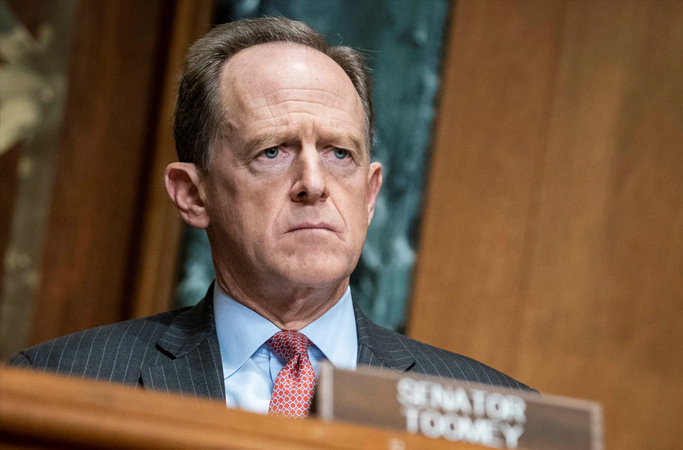
Some Republicans now want to pare back the Fed’s reach as part of a stimulus deal, wary that the Fed may use programs set up through the earlier stimulus effort, the Cares Act, to become something more akin to a lender of “first resort” instead of “last resort,” as Sen. Patrick Toomey, R-Pa., put it Thursday. By contrast, Democrats are concerned Republicans are slashing the Fed’s broader authority, which has been a stabilizing force for the economy, just weeks before the Biden administration takes over.
The Fed faced similar existential threats in the years after the 2008 financial crisis and recession, and lawmakers eventually did reshape the central bank’s oversight over the financial system to guard against another downturn. But now, the Fed is embroiled in a new battle over its powers and independence, just as the recovery is backsliding and the pandemic escalates into a wintertime surge. Jobless claims for the unemployed are rising again after trending downward, and retail sales slipped in November, a month that historically kicks off a strong holiday shopping season.
“What the current [Republican] proposal on the table appears to be is something that goes well beyond the Cares Act,” said Bharat Ramamurti, a Democratic member of the Congressional Oversight Commission, which focuses on the recovery efforts of the Fed and Treasury Department. “This proposal isn’t just, ‘let’s go back to the world as it existed the day before the Cares Act.’ It’s actually a significant reduction of the authorities that the Treasury and Fed had before the Cares Act.”
On Friday, Democratic lawmakers firmly rejected Toomey’s proposal, saying that the call to curb Fed powers is thwarting a relief bill, as well as threatening the Fed’s independence. With lawmakers likely to seek unanimous consensus on a stimulus vote, Toomey’s plan for the Fed programs, which on Thursday he called “the most important thing to me,” could hold up negotiations headed into the weekend.
“These authorities should be maintained to allow for the Federal Reserve to act to prevent hardship to families across the country,” Senator Michael Bennet, D-Colo., said in a statement. “If ever there is a time to put politics aside and do the right thing, it should be in the middle of a pandemic and corresponding economic crisis.”
Toomey defended his position Friday afternoon and emphasized that the emergency lending programs that received Cares Act money were always intended to close out at the end of the year.
“The language Senate Republicans are advocating for affects a very narrow universe of lending facilities and is emphatically not a broad overhaul of the Federal Reserve’s emergency lending authority,” Toomey said.
The coronavirus pandemic spurred the Fed into one of its most active years ever. In the pandemic’s early days, the Fed reached far beyond its playbook from the Great Recession in ways that economists say prevented an even deeper recession. As the coronavirus spread beyond China and U.S. stocks plunged into the red, the Fed quickly slashed interest rates to zero in March. A sprawling set of programs to flood the markets and boost bond purchases further helped reinvigorate the financial system. Plus, the Fed also rolled out loan programs to struggling businesses and local governments.
Federal Reserve Chair Jerome Powell has repeatedly said the slate of emergency lending programs propped up in the spring were not meant to be permanent.
“When the time comes, after the crisis has passed, we will put these emergency tools back in the box,” Powell said at a news conference Wednesday.
The Fed’s lending programs for businesses and local governments have not been blemish-free. Considering how much money was set aside, the Main Street lending program and municipal lending programs haven’t been well utilized, with critics saying the loans carry onerous requirements. Some Republicans have also bristled at Powell’s repeated calls on Congress to pass a stimulus bill that can fill the economy’s remaining gaps, although Powell stops short of making specific suggestions for what should go into legislation.
The Fed’s vast response has attracted some criticism. Some Republicans argue the Fed is venturing beyond its mandate, which strives for maximum employment and stable prices. Speaking to reporters on Thursday, Toomey said the Fed shouldn’t be engaging “in fiscal policy, social policy or allocating credit,” and instead should leave those decisions to elected leaders on Capitol Hill.
Meanwhile, Democrats have pushed the Fed in the opposite direction. Many wanted to widen the Fed’s lending programs so they could help more businesses and local governments on the brink. Liberal policymakers also want the Fed to put more focus on racial inequality and climate issues, arguing they pose risks to economic growth.
The Fed is one of the most powerful financial institutions in the world, and much of its reputation rests on its independence from the White House. The chair cannot be fired by the president over policy differences – a question which came up when Powell was on the receiving end of President Donald Trump’s routine attacks. Fed governors are unelected officials, subject to Senate confirmation, and can fill terms of up to 14 years.
But a highly-partisan climate in Washington, mixed with the Fed’s large footprint, have made for a fraught combination.
Brian Gardner, chief Washington policy strategist at Stifel Financial Corp, said there’s “always this give and take about Fed independence,” with the facilities emerging as the latest flash point.
“I think there are a lot of Republicans saying, ‘wait a second, what’s going on here?'” Gardner said. “This is a way to send a message to the Fed about who’s in charge.”
Tensions over the Fed’s lending programs ramped up last month when Treasury Secretary Steven Mnuchin announced the programs would wind down at the end of 2020 and requested that the Fed return hundreds of billions of dollars that went unspent. The move was met with a rare rebuke from the Fed and widespread disagreement from Democrats, who say the facilities are an important backstop and could have had more reach.
There’s agreement from both parties that some of the programs’ unused money could be put to more direct use. But the larger debate about the Fed’s own authority emerged when Toomey, the incoming leader of the Senate Banking Committee, said he is also pushing for a bill that prevents the expiring programs, or anything remotely similar to them, from being created in the future. For example, once the Main Street lending program expires, Toomey warned against a “Main Street lending program 2.”
Toomey insisted the Fed’s emergency lending powers “remain on the books” and that the door would still be open for Congress to approve entirely different programs “if in the future, some dire emergency occurs.”
“We’re not changing the role of the Fed at all,” Toomey said. “We’re saying these programs were meant to be temporary, and they’re going to be temporary.”
That argument was soundly rejected by Democrats, many of whom say Toomey’s proposal goes far beyond the nuts and bolts of a coronavirus relief bill. Democrats said the move cuts into lending powers the Fed had well before the Cares Act and handicaps the central bank’s ability to combat future crises.
“What’s happening here is a rewriting of the Fed’s emergency powers at the last minute, without any hearing, without any debate of what the implications are,” Ramamurti said.
Democrats argue that Toomey’s plan takes away any chance for the Biden administration to revamp the programs.
In a statement Friday, Brian Deese, Biden’s pick for director of the National Economic Council, said the stimulus package shouldn’t “include unnecessary provisions that would hamper the Treasury Department and the Federal Reserve’s ability to fight economic crises.”
“Undermining that authority could mean less lending to Main Street businesses, higher unemployment, and greater economic pain across the nation. Congress’s good faith effort to deliver immediate relief should not be delayed by provisions that could put our future financial stability at risk,” Deese said.
Democrats lawmakers also said Toomey is using the Fed as a political instrument in the final days of the lame duck session.
“It’s no surprise that Republicans are drawing a line in the sand over their ability to sabotage the economy, and tie the Biden administration’s hands,” Sen. Ron Wyden (Ore.), the ranking Democrat on the Senate Finance Committee said in a statement.
Toomey disputed the criticism, saying the Cares Act programs were always meant to be temporary, and that he’s held this view for months.

 ประธานาธิบดีก็ไม่รอด ชิลีเอาจริงปรับคนไม่สวมหน้ากากอนามัยในที่สาธารณะ
 สมเด็จพระราชาธิบดี-สมเด็จพระราชินีภูฏานเสด็จพระราชดำเนินฉลองวันชาติในกรุงทิมพู


 จีนมีแผนจะปล่อยยานอวกาศที่มีมนุษย์ควบคุม 4 ลำ ซึ่งเป็นส่วนหนึ่งของโครงการก่อสร้างสถานีอวกาศของประเทศภายใน 2 ปีข้างหน้า
 สวีเดนเป็นเพียงไม่กี่ประเทศที่ไม่บังคับให้ประชาชนสวมหน้ากากอนามัย
 เปิดยุทธศาสตร์ของสหรัฐตาม “ทฤษฎีวิวัฒนาการอย่างสันติ” หรือ Peaceful Evolution เพื่อทำให้จีนเชื่องให้ได้

 Vehicles are stranded on the Kan-Etsu Expressway at 8 a.m. on Friday near the Yamato rest area in Minami-Uonuma, Niigata Prefecture. MUST CREDIT: Japan News-Yomiuri