Saudi economy contracts for fifth straight quarter amid oil cuts
InternationalDec 18. 2020Men and women shop at the Al Yasmin mall in Jeddah, Saudi Arabia, on Aug. 6, 2017. MUST CREDIT: Bloomberg photo by Tasneem Alsultan.
By Syndication Washington Post, Bloomberg · Vivian Nereim
Saudi Arabia’s economy contracted for a fifth straight quarter as the kingdom curtailed crude production to fulfill its commitments to OPEC, though the non-oil sector — the engine of job creation — showed signs of improvement.
Gross domestic product shrunk 4.6% in the third quarter compared to the same period of last year, according to the statistics authority. In line with most other nations, that was an improvement from a 7% contraction between April and June as the worst effects of the coronavirus pandemic wore off.
The oil economy fell 8.2% — the biggest drop since at least the start of 2011, when Bloomberg began compiling such data — as OPEC curbed output to prop up prices. Brent crude has risen to about $51 a barrel since the cuts started, but the global benchmark is still down 22% this year.
The non-oil sector lost less steam. It declined by 2.1%, compared to 8.2% in the second quarter, as the government eased virus restrictions and businesses gradually reopened.
The overall figure was slightly worse than an estimated contraction of 4.2% released by the statistics body last month, which didn’t include a breakdown by sector.
The world’s largest oil exporter is facing a dual crisis this year as the pandemic and lower energy prices strain its finances and the private sector.
The kingdom pumped an average of 8.8 million barrels a day between July and September, down from 9.3 million in the previous quarter and 9.4 million a year earlier. While OPEC+ — an alliance between the Organization of Petroleum Exporting Countries and others such as Russia — started its cuts in May, Saudi Arabia’s second-quarter production numbers were skewed by its record output in April during a brief price war.
The improved non-oil performance reflects a partial return to normalcy for businesses in the Arab world’s biggest economy. Officials haven’t imposed any new restrictions since May, and the country — which has had more confirmed cases of the virus than anywhere in the Middle East aside from Iran and Iraq — has so far avoided another wave of infections.
Many restaurants, malls and gyms are bustling again and the government is preparing to start vaccinations this week.
Still, economists have said austerity measures including spending cuts and a tripling of value-added tax will continue to weigh on growth.
Finance Minister Mohammed Al-Jadaan said on Tuesday that the government is prioritizing fiscal discipline, with the budget deficit expected to narrow to 4.9% of GDP next year from 12% in 2020.
He stressed that government-controlled funds could spend money on behalf of the state. Officials have lent heavily on the sovereign wealth fund, known as the Public Investment Fund, to invest domestically.
The government projects an overall economic contraction of 3.7% this year and growth of 3.2% in 2021.
EU said to expedite covid vaccine for pre-Christmas rollout
InternationalDec 18. 2020Syringes for the Pfizer-BioNTech covid-19 vaccine at the University Of Louisville Hospital in Louisville, Ky., on Dec. 14, 2020. MUST CREDIT: Bloomberg photo by Scotty Perry.
By Syndication Washington Post, Bloomberg · Alberto Nardelli, Naomi Kresge, Jonathan Stearns
European authorities are pushing for a compressed approval timeline for the covid-19 vaccine from Pfizer and BioNTech, according to people familiar with the plan, which could enable a rollout on the continent before Christmas.
Should the vaccine win the backing of a key drugs oversight committee on Monday, the European Commission is planning for a sign-off as soon as the same day, two people said. That would enable shipping the first shots to vaccine centers as early as Wednesday, one of the people said.
The EU is pushing for speed after member countries’ leaders have struggled to explain to residents why they’re still waiting for shots already being rolled out in the U.S. and U.K. — a particular sore spot given that the Pfizer-BioNTech vaccine was pioneered in Germany. On Wednesday, the European drugs agency said the key advisory committee meeting, originally planned for as late as Dec. 29, would take place Monday.
Approval will depend on the timing of the European Medicines Agency’s announcement and the need for the assessment to be seen as independent from political interference, an EU official said. Still, the best-case scenario would compress three levels of EU bureaucracy into as little as a single day: review by the EMA’s drugs panel, EMA acceptance of the panel’s recommendation and finally the Commission’s seal of approval.
Vaccinations across the EU could begin Dec. 27, according to German Health Minister Jens Spahn.
“Our employees will be working over Christmas,” BioNTech Chief Executive Officer Ugur Sahin said during a conference call with German Chancellor Angela Merkel. “If we get approval from European authorities, we can begin deliveries of our vaccine soon. We’re optimistic that we can have a normal life again already by next winter.”
The first batches of vaccine can only be shipped after the Commission’s sign-off. The Commission signaled it would give the official go-ahead for the distribution of the Pfizer-BioNTech vaccine no later than Dec. 23.
“As soon as EMA has adopted a positive recommendation, the commission will take a decision authorizing the vaccine on the market within two days,” Stefan de Keersmaecker, health-policy spokesman at the Commission, the EU’s executive arm in Brussels, said on Wednesday. An EMA spokeswoman declined to comment further.
Unlike the U.S. and U.K., which conducted emergency authorizations, the EMA is reviewing the vaccine for a conditional marketing authorization. That process requires a higher evidence level, the EU commission’s directorate-general for health said this week.
Debate over the timing of the approval was long and at times heated during an EU summit last week, with several leaders demanding to know why the approval process was taking so much time compared to the U.K., according to three EU officials familiar with the discussion. One of the explanations given was that several national experts had been slow in getting back to the EMA, the officials said. No specific countries were named.
The European process means shipping millions of doses throughout the continent, where countries are making their own distribution plans. The EU has ordered up to 300 million vaccine doses on behalf of member states. It has also inked supply agreements with other front-runners including Moderna Inc., whose shot will be reviewed by a U.S. regulatory panel Thursday.
U.S. jobless claims unexpectedly jump to highest in three months
InternationalDec 18. 2020An employee wearing a protective mask assembles oil separators and condensers for ultra low temperature (ULT) freezers at the So-Low Environmental Equipment Co. manufacturing facility in Cincinnati on Dec. 9, 2020. MUST CREDIT: Bloomberg photo by Ty Wright.
By Syndication Washington Post, Bloomberg · Reade Pickert
Applications for U.S. state unemployment benefits unexpectedly jumped to the highest level in three months, suggesting the labor market’s recovery is faltering amid the surge in covid-19 cases and widening business restrictions.
Initial jobless claims in regular state programs rose by 23,000 to 885,000 in the week ended Dec. 12, Labor Department data showed Thursday. On an unadjusted basis, the figure fell by about 21,000.
Continuing claims for state programs declined by 273,000 to 5.51 million in the week ended Dec. 5. That figure roughly approximates the number of people receiving state unemployment benefits, but doesn’t include the millions of people who have already exhausted those benefits or are receiving assistance through federal pandemic jobless aid programs.
A Bloomberg survey of economists had called for 818,000 initial state claims and 5.7 million continuing claims on an adjusted basis.
The increase in initial claims reflects rising filings in California and Illinois, two states where governments have imposed particularly restrictive lockdowns in the wake of the latest covid-19 surge. That, paired with cooler weather, has led to additional job losses and growing risks for the economy in the months before widespread vaccine distribution.
With the outlook shaky, U.S. lawmakers are working out final details of a new relief package that would extend pandemic jobless aid, while the Federal Reserve on Wednesday pledged to maintain its massive bond purchases until employment and inflation make “substantial further progress.”
U.S. stock futures pared gains following the report, while 10-year Treasury yields fell.
The latest initial claims data also coincide with the reference period for the December jobs report, adding to signs that the month could show a weakening labor market after payrolls increased by 245,000 in November, less than half the October gain.
On top of regular state claims, about 455,000 initial claims for Pandemic Unemployment Assistance were filed last week. The program, which provides jobless benefits to those not typically eligible like the self-employed and gig workers, is set to expire later this month without congressional action. There were 9.24 million continued weeks claimed for PUA in the week ended Nov. 28, up about 689,000 from the prior week.
In the same week, there were 4.8 million continuing claims for Pandemic Emergency Unemployment Compensation, the federal program that provides up to 13 additional weeks of benefits to those who have exhausted their regular state benefits. That program is also set to expire.
While the labor market is struggling, housing remains a bright spot in the economy amid ultra-low interest rates and demand for more space. A separate government report on Thursday showed new home construction rose more than forecast to a nine-month high in November.
German coronavirus cases jump by most since outbreak began
InternationalDec 18. 2020The empty lanes of Otto-Braun-Strasse during the first day of a national lockdown in Berlin on Dec. 16, 2020. MUST CREDIT: Bloomberg photo by Liesa Johannssen-Koppitz.
By Syndication Washington Post, Bloomberg · Andrew Blackman
Germany recorded the most new coronavirus cases since the start of the pandemic, one day after the government imposed a hard lockdown on Europe’s biggest economy.
Infections surged by 45,113 in the 24 hours through Thursday morning, according to data from Johns Hopkins University. That easily exceeded the previous high of 32,734 recorded last week and brought the total to 1.42 million. Daily virus-related fatalities amounted to 729, after hitting a record 910 on Wednesday.
Chancellor Angela Merkel hinted this week that stringent restrictions, which are set to run until Jan. 10, will remain in place longer. Merkel told her parliamentary caucus that Germany faces a new peak of infections next month and predicted that the first two months of 2021 will be particularly tough, according to a participant in the virtual meeting Tuesday.
A strict lockdown began on Wednesday, with non-essential stores closed, employers urged to shutter workplaces and parents encouraged to keep children away from school.
Germany’s seven-day incidence rate has risen sharply in the past few weeks and currently is at a near-record of 179 per 100,000 inhabitants, according to the RKI public health institute. Officials have said the rate needs to come down to 50 and stay there to allow effective contact tracing.
The government is targeting so-called herd immunity, which means most people are resistant to the disease. To achieve that, at least 60% to 70% of the population will need to be vaccinated, Research Minister Anja Karliczek said in an interview with ZDF television on Thursday.
“Any vaccine needs to be safe and effective, that’s clear,” she said, adding that the government wants to avoid undermining confidence by rushing the approval process.
European authorities are pushing for a compressed approval timeline for the Covid-19 vaccine from Pfizer Inc. and BioNTech SE, according to people familiar with the plan. That could enable a rollout on the continent before Christmas.
The EU is pushing for speed after member countries’ leaders have struggled to explain to residents why they’re still waiting for shots already being rolled out in the U.S. and U.K. — a particular sore spot given that the Pfizer-BioNTech vaccine was pioneered in Germany.
Merkel is due to holds a video conference with executives from Mainz-based BioNTech later on Thursday. Health Minister Jens Spahn on Wednesday told state counterparts that the first patients in Germany are likely to get the vaccine on Dec. 27.
By The Washington Post · James McAuley, Michael Birnbaum
PARIS – French President Emmanuel Macron has tested positive for the coronavirus, the country’s presidential palace announced Thursday.
He was administered a test after he began to show symptoms associated with covid-19, the disease caused by the virus. The 42-year-old president will now isolate for the next seven days but will continue his work, the statement added. A spokeswoman for the palace told Reuters that all of the president’s upcoming trips – including a visit to Lebanon that was scheduled for next week – have been canceled.
Macron is the latest world leader to test positive for the virus, including President Donald Trump, Britain’s Boris Johnson and Brazil’s Jair Bolsonaro. All have recovered.
The French president’s itinerary in the last week has seen him interact with multiple heads of state, at least one of whom, Spanish Prime Minister Pedro Sánchez, is now self-isolating after dining with Macron on Monday at the Élysée Palace in Paris. French Prime Minister Jean Castex, who has also been in contact with Macron, said he would also be self-isolating, Agence France-Presse reported.
But Macron also met in person with the leaders of 24 E.U. countries on Thursday and Friday last week at a summit in Brussels. (Two leaders were absent: Croatia’s was sick with covid-19, and Estonia’s was quarantining.) Ahead of the summit, some diplomats were concerned about the health risks of an in-person meeting. An E.U. spokesman didn’t immediately respond to a question about whether the leaders who were present would now quarantine.
French authorities have informed the European Union that they believe Macron was a contagion risk starting Monday evening, meaning that the leaders who attended last week’s summit are not considered contacts, an E.U. official said, speaking on condition of anonymity to candidly discuss the health situation.
The official said that sanitary measures were taken at the summit and that no other participant has tested positive. It was not immediately clear why France believes Macron was contagious starting Monday evening.
In any case, not all European leaders appeared to trust the Élysée’s assurances that Macron was not contagious last week. Belgian Prime Minister Alexander de Croo said he was being tested for covid-19 and would quarantine until he receives the result, after sitting in a room with Macron – along with most of the rest of Europe’s leaders – for almost 24 hours straight starting the afternoon of Dec. 10.
This week, in addition to Sánchez, Macron has also met with European Council President Charles Michel on Monday and with Portuguese Prime Minister António Costa on Tuesday.
On Wednesday, the day before his diagnosis, Macron also met with all of his government ministers, although it was not immediately clear whether this meeting took place in person and, if so, whether all participants wore masks. The Élysée Palace did not immediately respond to questions about the details of that meeting.
Michel will quarantine “as a matter of precaution,” his spokesman said, after the Monday meeting with Macron. He tested negative on Tuesday and “is not considered to be a close contact,” his spokesman, Barend Leyts, wrote on Twitter.
French first lady Brigitte Macron is likewise self-isolating but currently has no symptoms, according to a statement from her office to AFP. She had tested negative for the coronavirus as recently as Tuesday, her office said, in advance to a visit to a pediatric ward at a Paris hospital.
In late October, a surge of infections prompted Macron to issue another national lockdown, the country’s second since the pandemic began. While nonessential shops began reopening late last month, bars and restaurants must stay closed into January and an evening curfew has remained in place.
Macron said that exceptions would be granted for Christmas Eve so that people could “share these moments together among family.”
While the number of new infections showed some improvement after the nearly month-long lockdown, hospitals appear to be more saturated than they were during a first wave in the spring.
Vaccination in France is set to begin in late December or early January and would not be mandatory, Macron has said.
Macron’s positive diagnosis raised immediate questions about the handling of Brexit negotiations, which need to be concluded within days if there is any chance of Britain and the European Union ratifying a trade deal by Dec. 31, the day London will sever its final ties with the bloc. Leaders had previously floated the possibility of an additional in-person summit in the next two weeks to finalize a deal.
European policymakers have complained that negotiations about thorny issues are nearly impossible when they are conducted virtually, as has mostly been the case since March.
Macron has been one of the most stubborn European leaders during Brexit talks, and his sign-off is crucial to any Brexit deal.
The Élysée did not provide details on the specifics of Macron’s condition, but a spokesperson said that he would still preside over a Thursday meeting on development via videoconference from isolation.
By Syndication Washington Post, Bloomberg · Arys Aditya, Grace Sihombing
Indonesia has decided to offer free Covid-19 vaccines to people after considering the state budget, said President Joko Widodo.
Jokowi, as he’s commonly known, has ordered the finance minister to reallocate spending from other matters to fund the free vaccines, he said in a cabinet secretariat statement. He will also be the first to be inoculated as a way to show people that the shots are safe.
“So there is no longer any reason for people not to get it,” he said.
The government is still studying how much the program will cost and which of the vaccines ordered by the country, which include China’s Sinovac Biotech, Novavax and AstraZeneca, would be covered. A shipment of 1.2 million doses from Sinovac arrived in Jakarta this month and is being evaluated by the local drug regulator before the government can start what’s set to be Southeast Asia’s earliest vaccination program.
“This is still being reviewed, with the calculation to be updated based on the newest and dynamic development from the health ministry,” said Askolani, finance ministry’s director-general of state budget.
The country that’s home to the world’s fourth-largest population previously laid out a plan to pay for nearly 74 million doses through its national health coverage, while the rest of its 270 million people would have to shoulder the cost themselves. The expense is a key concern for Indonesians, with only one-third of those who want to be vaccinated against the virus saying they would be willing to pay for the shots, according to a government survey in September.
“The vaccines will be made free so we can reach herd immunity as part of efforts to accelerate the handling of Covid-19 and see the pandemic end sooner,” said Wiku Adisasmito, a spokesman for the government’s coronavirus task force.
FDA says Pfizer vaccine contains extra doses, expanding nation’s supply
InternationalDec 17. 2020Health and Human Services Secretary Alex Azar speaks at George Washington University Hospital after the administration of some of the nation’s first doses of a vaccine to frontline healthcare workers there on Dec. 14, 2020, in Washington, D.C. MUST CREDIT: Photo for The Washington Post by Jahi Chikwendiu
By The Washington Post · Fenit Nirappil
WASHINGTON – The Food and Drug Administration said Wednesday that pharmacists can draw additional doses from vials of the Pfizer coronavirus vaccine, potentially expanding the country’s supply by millions of doses as the Trump administration negotiates with Pfizer to speed up the next round of vaccine deliveries.
The government’s existing supply of the first authorized vaccine can be stretched further after pharmacists began to notice that vials contain more than the expected five doses.
The FDA is in touch with Pfizer about how to handle this issue, the agency said. In the meantime, regulators say those extra doses from a single vial can be used.
“At this time, given the public health emergency, FDA is advising that it is acceptable to use every full dose obtainable – the sixth, or possibly even a seventh – from each vial, pending resolution of the issue,” an agency spokesman said, confirming news first reported by Politico.
That means the supply of remaining vaccine could be up to 40 percent greater, though the drugmaker cautions that it’s uncertain how many extra doses are available. The FDA and Pfizer also caution that any leftover vaccine from different vials that is smaller than a full dose should not be mixed together , which experts say risks cross-contamination.
“The amount of vaccine remaining in the multidose vial after removal of 5 doses can vary, depending on the type of needles and syringes used,” Sharon Castillo, a spokeswoman for Pfizer, said in a statement.
The Pfizer-BioNTech vaccine is also getting a boost from the White House this week with Vice President Mike Pence expected to receive a vaccination Friday, live on camera. Second lady Karen Pence and Surgeon General Jerome Adams are expected to be vaccinated as well.
Meanwhile federal health officials said Wednesday they are in talks with Pfizer to purchase tens of millions of additional doses this spring after the drug company said the United States probably would have to wait until summer.
Health and Human Services Secretary Alex Azar said he is “very optimistic” about negotiations in which federal officials are trying to help Pfizer ramp up production to meet the government’s demand for the second quarter of 2021.
“We are working with them to provide them whatever assistance, now that they have identified some of the production challenges,” Azar said at a Wednesday briefing.
The negotiations come after Pfizer told the Trump administration that other countries have rushed to buy most of the supply that will be available in the second quarter of the year. The federal government turned down an opportunity as recently as October to double its purchase of 100 million doses of the Pfizer-BioNTech vaccine, the first authorized for use in the United States, over disagreements on delivery dates.
Jeanne Marrazzo, director of the division of infectious diseases at the University of Alabama at Birmingham, said the potential for millions of extra doses is “incredibly good news,” especially in light of the dispute over additional Pfizer-BioNTech vaccines.
“If vaccine is as good as its been in the trials, it’s a silver lining of the fact that we didn’t get as much of the Pfizer vaccine as we originally could have,” she said.
Federal officials have insisted they have enough doses with other vaccines likely to receive emergency authorization, including the Moderna vaccine, which is expected to be cleared by regulators in the coming days.
Azar noted that the federal government has been more heavily involved in the development and manufacture of the five other coronavirus vaccines, which accepted government research funding. Pfizer declined the funding.
That made it harder for the federal government to intervene when Pfizer ran into production problems, health officials said.
“Part of our ongoing discussions is to remediate that and to get better visibility into what they are doing, what challenges they are facing, because they made significant commitments to us and others, ” Azar said.
Pfizer disputed Azar’s comments, saying through the spokeswoman that it does not “currently have manufacturing” issues and it has been transparent with the federal government on its production and distribution capabilities.
“They have visited our facilities, walked the production lines, and been a part of key decisions that have been made,” said Castillo.
Pfizer CEO Albert Bourla said Monday that the company could provide an extra 100 million doses in the third quarter of the year and confirmed the negotiations to deliver the additional vaccine sooner.
“We are working very collaboratively with them to make sure that we can find ways to produce more or allocate the doses in their second quarter as well, but we haven’t signed this agreement yet,” Bourla said in an interview with CNN’s Sanjay Gupta.
Trump administration officials on Wednesday defended their previous decision to decline to purchase additional Pfizer-BioNTech vaccine doses.
“You wouldn’t buy something before you knew it works if you had six opportunities to have one provider provide you with what you needed,” said Moncef Slaoui, chief science adviser to Operation Warp Speed, the initiative overseeing vaccine distribution.
Officials said they are on track to meet initial vaccine delivery targets this week, with deliveries to 636 facilities so far and an additional 886 planned for Thursday.
An additional 2 million Pfizer-BioNTech doses are scheduled for delivery next week, and 5.9 million Moderna doses are allocated if the vaccine clears regulatory hurdles in the coming days.
America’s biggest companies are flourishing during the pandemic and putting thousands of people out of work
InternationalDec 17. 2020Gary Walker was laid off from Salesforce in August after 12 years with the company. MUST CREDIT: Washington Post photo by Jahi Chikwendiu
By The Washington Post · Douglas MacMillan, Jonathan O’Connell, Peter Whoriskey, Chris Alcantara
As the coronavirus pandemic devastated small businesses and plunged millions of Americans into poverty this summer and fall, executives at some of the country’s largest corporations sounded surprisingly upbeat.
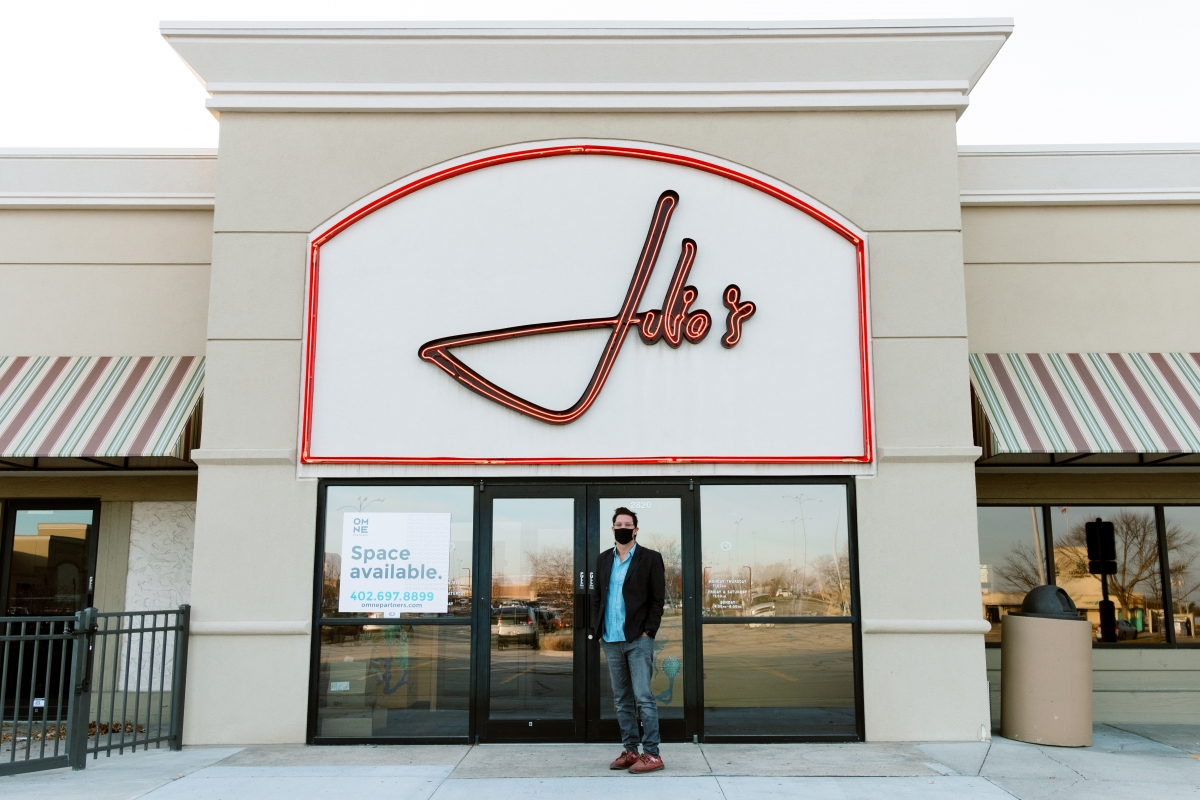
Restaurant owner David Mainelli stands in front of the former location of his family’s restaurant, Julio’s, in Omaha, Neb., earlier this month. The restaurant group has been a staple in the community since 1977, and announced they were closing their doors in June 2020. MUST CREDIT: Washington Post photo by Carley Scott Fields
“I don’t think we’ve ever been more excited or energized about our prospects,” PayPal finance chief John Rainey said on a November conference call.
“These are times when the strong can get stronger,” Nike chief John Donahoe told analysts in September.
“With all that’s happening around the world, it’s really unfortunate,” said Jensen Huang, chief executive of graphics chip maker Nvidia, during an August earnings call. “But it’s made gaming the largest entertainment medium in the world.”
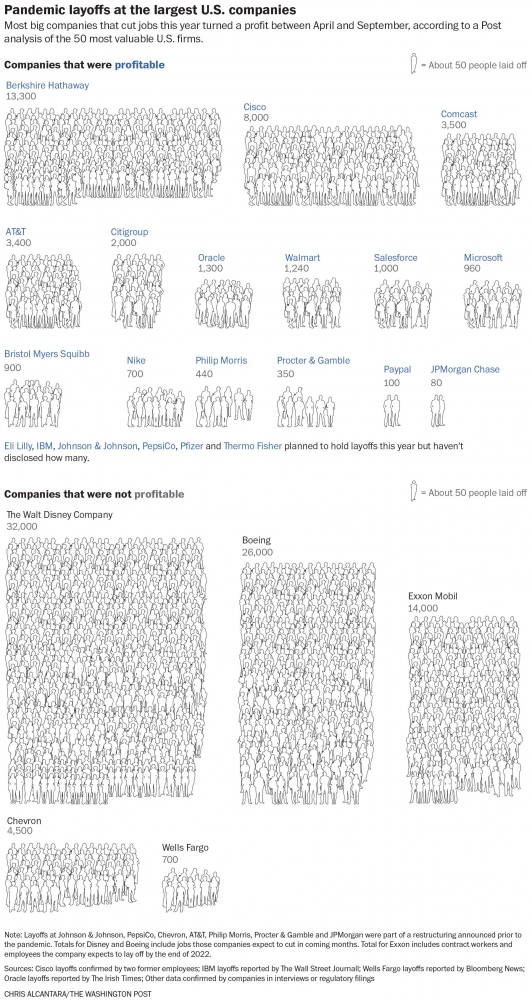
With few exceptions, big businesses are having a very different year from most of the country. Between April and September, one of the most tumultuous economic stretches in modern history, 45 of the 50 most valuable publicly traded U.S. companies turned a profit, a Washington Post analysis found.
Despite their success, at least 27 of the 50 largest firms held layoffs this year, collectively cutting more than 100,000 workers, The Post found.
The data reveals a split screen inside many big companies this year. On one side, corporate leaders are touting their success and casting themselves as leaders on the road to economic recovery. On the other, many of their firms have put Americans out of work and used their profits to increase the wealth of shareholders.
When the coronavirus struck, big companies promised to help battle the crisis. Dozens of prominent chief executives, who last year signed a public pledge to focus less on shareholders and more on the well-being of their employees and broader communities, appeared eager to make good on that promise. Many suspended payments to investors and vowed not to hold layoffs.
Then, 21 big firms that were profitable during the pandemic laid off workers anyway. Berkshire Hathaway raked in profits of $56 billion during the first six months of the pandemic while one of its subsidiary companies laid off more than 13,000 workers. Salesforce, Cisco Systems and PayPal cut staff even after their chief executives vowed not to do so.
Companies sent thousands of employees packing while sending billions of dollars to shareholders. Walmart, whose CEO spent the past year championing the idea that businesses “should not just serve shareholders,” nonetheless distributed more than $10 billion to its investors during the pandemic while laying off 1,200 corporate office employees.
Kirk Hanson, an author and longtime professor of business ethics, says it’s incumbent upon America’s top corporations to help pull the country through the worst recession in decades, particularly given the outsized profits they’re enjoying.
“There is an obligation on the part of the largest and most successful businesses to help buffer the human impact of the crisis,” said Hanson, now a senior fellow at Santa Clara University’s Markkula Center for Applied Ethics.
Instead, Hanson said, they have contributed to the country’s growing economic divide.
The Post contacted all 27 large firms that held layoffs this year. Many said the cuts were not related to the pandemic, but rather, a necessary part of broader “restructuring” plans, where companies shift spending from declining lines of business to growing ones. In some cases, these plans were decided before the pandemic.
Several emphasized that they hired more people this year than they let go. Anne Hatfield, a spokeswoman for Walmart, said everyone the retailer laid off during the pandemic was offered another job in the company, though she declined to say whether the new roles held the same level of pay and responsibilities as the jobs that were eliminated.
Others pointed to the work they have done to help ease the pain in their communities, such as expanding health and family benefits to employees and distributing personal protective equipment to front-line workers. Cisco gave $53 million in cash and PPE to vulnerable populations and PayPal pledged $530 million in investments in minority-owned small businesses.
In an email, Berkshire Hathaway chief executive Warren Buffett said he leaves all decisions at his subsidiary companies to the management of those companies. Airplane parts maker Precision Castparts, which Berkshire Hathaway acquired in 2015, was forced to cut staff due to a severe drop in demand for new planes, he said. Buffett added that he has given $2.9 billion of his personal wealth to charitable causes this year.
The majority of America’s largest corporations have prospered in the coronavirus economy.
Millions of consumers spent more time and money online during government-mandated lockdowns, watching Netflix, viewing ads on Google and Facebook pages, filling Amazon shopping carts and turning the video game business into a bonanza for Nvidia, Microsoft and others. (Amazon founder Jeff Bezos owns The Washington Post.)
Shoppers began splurging on cleaning supplies, hobbies, home cooking and home improvements, driving record growth at big-box stores including Home Depot and Walmart.
Even in the hardest-hit sectors, such as restaurants, travel and hospitality, the biggest companies were largely insulated from the worst of the virus’s reckoning. While independent restaurants struggled to survive, McDonald’s ramped up its takeout and drive-through operations, rolling out new apps and technology catering to on-the-go orders.
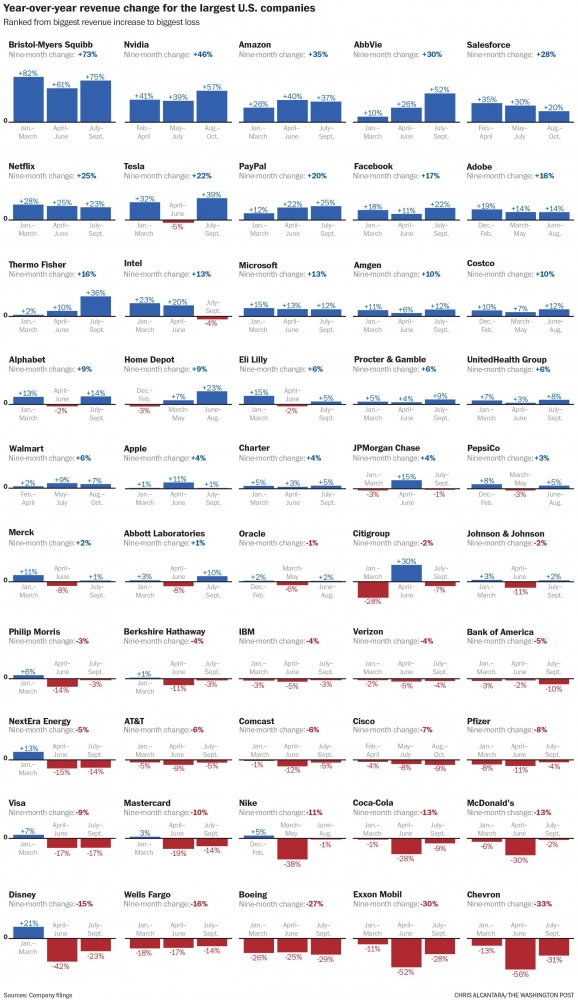
In many industries, the giants devoured market share ceded by small businesses, who lacked the resources to keep stores open during unpredictable swings in customer demand. While the 50 largest companies averaged 2% revenue growth over the first nine months of 2020, small business revenue shrank 12% over the same period, according to data collected by software provider Womply from thousands of small firms.
Economists estimate at least 100,000 small businesses permanently closed in the first two months of the pandemic alone.
“Once you kill competition, it’s always hard to restore it,” said Matt Stoller, director of research at the left-leaning American Economic Liberties Project. “This is an extinction-level event for small businesses.”
As the pandemic wore on, many companies kept their promises not to lay off staff. Others saw the recession as a good excuse for trimming labor costs.
In April, cigarette maker Philip Morris made a public commitment to forgo layoffs during the pandemic to help support the “job security and peace of mind” of its 73,000 workers.
“The company will not terminate the employment of any [Philip Morris] employee during this crisis period, unless for cause, and the company has also put on hold any restructuring plan,” Philip Morris said in a news release.
But in June, as infection rates continued to rise, Philip Morris said in a regulatory filing it would eliminate up to 440 workers in New York and Switzerland as part of a restructuring.
In a statement, Philip Morris spokesman Sam Dashiell said the company resumed the restructuring at its Swiss operations center because it determined “prolonging it further would be unfair to everyone.” He declined to explain why the New York layoffs resumed.
Current and former employees at some of these companies say they weren’t surprised to see their leaders renege on promises to retain staff through the pandemic. They didn’t put too much faith in those promises in the first place.
“The choices that they make are governed by, essentially, maximizing shareholder value,” said Gary Walker, a systems engineer who was one of 1,000 employees Salesforce cut in late August.
At the onset of the pandemic, Chuck Robbins described the need to keep workers employed as a moral imperative. The chief executive of Cisco, a $180 billion software and networking giant, said large companies like his shouldn’t lay off workers during a global crisis because, even in a bad year, they had the resources to maintain payrolls.
“Why would we contribute to the problem?” Robbins asked in an interview with Bloomberg News published in April. “To me, it’s just silly for those of us who have the financial wherewithal to absorb this, for us to add to the problem.”
Four months later, Cisco began implementing a plan to lay off at least 8,000 employees, according to two former employees briefed on the plan – the largest round of job cuts the San Jose, Calif.-based company has seen in years.
The majority of Americans who lost jobs this year were laid off from small businesses, many of which had no option but to cut workers to stave off financial collapse.
But larger companies actually laid off a greater portion of their workforces over that period – 9% for large firms versus 7% for smaller firms – despite having more resources to survive the downturn. Their layoffs were quietly acknowledged in regulatory filings and shrouded in corporate jargon, like an “involuntary reduction of associates” at Coca-Cola; and “operating model changes to streamline and speed up strategic execution” at Nike.
The Salesforce layoffs punctuated one of the software giant’s fastest periods of growth and followed frequent pledges by its chief executive to assist with coronavirus relief. Marc Benioff, a self-styled leader of the corporate philanthropy movement, said in a series of tweets in late March that Salesforce pledged “not to conduct any significant lay offs over the next 90 days.”
He suggested all CEOs should take a similar “90 day pledge” and encouraged all Salesforce employees to keep supporting hourly workers, such as housekeepers and dog walkers, who do work for them.
Making good on that pledge was not hard for Salesforce, a company sitting on more than $9 billion in cash and short-term investments. It generated $2.7 billion in profit during the first six months of the pandemic, as businesses flocked to Salesforce’s tools for helping them manage operations remotely.
The layoffs, about five months after Benioff’s tweet, were part of a plan to “reallocate resources” including “eliminating some positions that no longer map to our business priorities,” the company said in a statement. They were announced one day after the software giant announced its biggest quarter of profit and revenue in history, sending its stock soaring 30%.
“Of course I’m cheesed about it. How could you not be?” said Walker, who was laid off after 12 years at the company. “It’s not great timing.”
Walker, 48, who lives with his wife and two dogs in Herndon, Va., said he appreciates Salesforce giving him generous severance benefits and understands large companies sometimes have to cut labor costs to please investors.
Cheryl Sanclemente, a Salesforce spokeswoman, said in a statement the company offered to help all of the people who were affected find new jobs, including in some 12,000 openings it expects to fill over the next year. She added that the company has provided protective equipment to health-care workers throughout the pandemic and gave $30 million to organizations fighting the covid-19 crisis.
Salesforce declined to make Benioff available for an interview but pointed out that the company did make good on his promise not to hold layoffs within 90 days of his tweet.
Similarly, Wells Fargo explained that it never committed to a time frame when it pledged to pause layoffs – which the company referred to in a statement as “job displacements” – back in March.
“At that time, we said we would continue to evaluate and did not pledge to pause job displacements for a specific period of time,” spokeswoman Beth Richek said in an email. “Starting in early August, we resumed regular job displacement activity.”
She declined to comment on the number of workers who were affected, though sources told Bloomberg News the San Francisco-based bank was cutting the first 700 workers in what is expected to be a massive restructuring impacting tens of thousands of jobs over the coming years.
Then there’s Cisco, which started the year determined not to “add to the problem” of pandemic unemployment, in the words of its CEO. Despite benefiting from a quarantine-fueled boom in videoconferencing tools including its Webex software, the company lost ground to Zoom and reported slowing growth in its cloud computing business.
Robbins, who spent the first few months of the pandemic repeatedly reassuring staff that their jobs would be safe, by summer acknowledged a round of cost-cutting was needed, according to three former employees who were in meetings with Robbins this year and left the company within the past three months. The former employees – two who left voluntarily, one who was laid off – all spoke on the condition of anonymity while discussing their former employer.
Cisco began a restructuring plan to eliminate $1 billion in costs, including a campaign to ask employees to take voluntary retirement packages or a 20% pay cut in exchange for working four days a week, the people said. In addition to the voluntary departures, Cisco began conducting involuntary layoffs in the early fall with the goal of trimming at least 8,000 employees, or more than 10% of its workforce, said two of the former employees who heard this number directly from Cisco managers involved in the plan.
Jennifer Yamamoto, a Cisco spokeswoman, said the company is increasing its investments in certain business areas and reducing investments in others. She declined to specify the number of people Cisco laid off but said 8,000 was not accurate. Cisco was supporting employees who were transitioning out of the company, she said.
Asked about Robbins’s statements from earlier this year, Yamamoto said the CEO “did not commit to no layoffs, but rather said we would preserve what we could depending on how the pandemic played out, and he would then assess the needs of the business every 60 days before making any decisions. As the pandemic continued, things changed in the macro landscape and we had to make some tough choices.”
Nowhere has the disparity between big and small businesses ballooned during the pandemic the way it has for restaurants. Just ask Dave Mainelli.
For more than two decades Mainelli and his family have owned and run Julio’s Restaurant, a Tex-Mex joint in Omaha, Neb. His wife headed operations, his brother was a manager, and his son, a bartender. Customers held birthday parties and family reunions, plus wedding and funeral receptions there.
When the pandemic hit and business started to falter, Mainelli said he tried to keep Julio’s open because of the difficulty of telling many of his longtime employees that it was over. He cut back on hours and eventually on staff, dropping from 40 to a dozen as he tried to survive on delivery and pickup.
But with thin margins and debts beginning to mount, he closed Julio’s for good in June, after 25 years in business.
“There were a lot of tears. It was one of the hardest things I’ve ever been through and I’ve been through a lot of hard stuff,” he said.
While one in six restaurants permanently closed during the first months of the pandemic, according to the National Restaurant Association, big chains have ramped up their drive-through operations and rolled out new apps and menus catering to on-the-go orders.
Maybe no one has done this better than McDonald’s, which was battered by the pandemic in the spring but has since been gobbling up more business by the day, using its scale to outpace hundreds of thousands of competing restaurants.
Analysts say McDonald’s has leveraged its advantages by quickly simplifying its menu, allowing its locations to serve more customers in a shorter time without them having to enter its restaurants. Deliveries and mobile app use is growing. Drive-through orders grew to account for 90% of McDonald’s sales during the pandemic, up from two-thirds of sales before this year.
“The large companies have these asset bases that the smaller companies cannot compete with, particularly now,” said Lauren Silberman, an analyst at Credit Suisse.
Contrast that with the options available to Mainelli. To boost delivery sales he partnered with a local service in Nebraska, but it cut into profits dramatically. “When you rely on delivery, your margins get shrunk because you’re paying them a chunk,” he said.
McDonald’s and other chains have long focused on data analysis and app development, capabilities they are now employing during the pandemic. Its digital drive-through menus allow restaurants to customize menu items for factors such as time of day, the weather and current restaurant traffic.
It is also testing tools for tailoring menus more specifically to customers as they arrive. So, if you have been ordering a Big Mac meal with fries and a large Sprite since the beginning of the pandemic, McDonald’s could begin identifying you through the app running on your phone and start displaying that meal more prominently when you pull up to the drive-through.
Not every McDonald’s franchise has flourished. But for those facing a cash crunch, the company put up nearly $1 billion to allow franchise owners to defer rent and royalty payments until their business returned, a luxury few other restaurant owners enjoy. “Because of our scale and financial stability, we were able to quickly provide franchisees with financial support when they needed it most,” Kevin Ozan, McDonald’s chief financial officer, told investors in November. Company spokespeople declined to comment further.
The result for McDonald’s shareholders has been a gift better than the plastic toy at the bottom of any Happy Meal. In October, shares of its stock reached an all-time high – up 27% since the beginning of March – and the company increased its dividend 3%.
The gulf between McDonald’s and most independent restaurants is staggering. Restaurant employment is down 17% during the pandemic, according to the Independent Restaurant Coalition, with more than 2 million restaurant workers out of a job heading into winter. Many of the owners that are permitted to remain open are doing so by slashing staff and costs and focusing on takeout as much as possible.
At Kayla’s Kitchen and Closet, located in tiny Park Falls, Wis., the menu offers soups, salads and a spicy blackberry bacon panini. Owner Kayla Myers also operates a clothing store next door offering Levi’s jeans, Minnetonka moccasins, children’s clothing and tuxedo rentals.
She said she has been boosting sales with Facebook posts. But she closed off half of her six tables for social distancing measures and cut hours. “You don’t have any point in opening if people can’t even come in,” she said.
After closing Julio’s this year, Mainelli sold the brand and became a writing instructor at local colleges. He and his wife gawk at the long lines of cars at McDonald’s, and he predicts the same fate for independent restaurants that locally owned bookstores faced when Amazon first arrived.
“The same thing is going to happen to the restaurants,” he said. “It’s going to be Olive Garden, Applebee’s and Chili’s. There are not going to be any independents.”
– – –
When Apple announced its quarterly earnings in the spring, chief executive Tim Cook eagerly shared all the company was doing to combat the coronavirus, from manufacturing and distributing face shields to donating $15 million to relief efforts in the earliest days of the pandemic.
But those investments stood in stark contrast to the $50 billion Apple said it planned to spend on stock repurchases – an amount so closely watched by Wall Street that one analyst asked why it appeared slightly lower than previous years.
“The $50 billion share repurchase authorization is impressive enough in absolute terms, but it is a bit lower than the last couple of years,” Katy Huberty, a managing director at Morgan Stanley said during the April conference call. “Any context around the thought process of landing on $50 billion?”
The world’s largest companies have set extraordinary expectations for their annual cash payments to investors. After pausing dividends and share buybacks in the spring, many companies resumed investor payouts by the summer.
The top 50 firms collectively distributed more than $240 billion to shareholders through buybacks and dividends between April and September, representing about 79% of their total profits generated in that period. Except for the five companies that didn’t offer buybacks or dividends this year, no large firm came anywhere close to spending as much on coronavirus relief efforts as they did paying out investors.
Companies often buy their own stock during difficult economic periods to signal to the market that management still believes in their prospects. But those buybacks also mean companies are taking money that could have been invested into employees and innovation and giving it to shareholders, who tend to be high-income individuals and families.
“This is a global crisis but the big companies are not treating it as one – they haven’t skipped a beat,” said William Lazonick, an emeritus economics professor at the University of Massachusetts at Lowell. “Apple gave back tens of billions of dollars to shareholders,” he added. “It’s sick.”
Apple spent $41 billion buying shares and paying cash dividends between April and September, more than twice as much as the company with the next highest total, Microsoft. The tech giants top the list partly because they have come under pressure from shareholders to return some of their enormous stockpiles of cash.
Apple spokesman Josh Rosenstock said supporting worldwide covid-19 relief efforts has been the company’s top priority. Apple has donated “hundreds of millions of dollars” to supporting communities this year including distributing 30 million face masks and 10 million face shields, he said.
The computer maker also kept paying retail employees while its stores were closed, Rosenstock added, and is “working with our suppliers to ensure their staff, including janitors and shuttle drivers, are being paid as well.”
Giant companies across all sectors have raised their dividends and buybacks since 2017, when tax legislation championed by President Donald Trump and passed by Congress lowered the statutory corporate tax rate from 35% to 21%. As a result, many companies explicitly said they would spend some of their tax savings on higher payments to shareholders.
Pharmaceutical giant AbbVie achieved the lowest effective tax rate among all 50 largest firms, paying just 6.5% last year by structuring its business to take advantage of overseas tax havens, the company said in filings. According to Reuters, AbbVie holds dozens of patents for its best-selling rheumatoid arthritis drug Humira in Bermuda, which has no corporate income tax.
Shortly after the tax law was passed, AbbVie chief executive Richard Gonzalez said the company’s cash flow “far exceeds what we are able to use productively to support the business” and therefore would give larger sums to shareholders. This year, he delivered: AbbVie paid investors $4 billion during the first six months of the pandemic, more than twice the amount of profit the company generated in that period.
AbbVie did not appear to lay off any employees this year. The company did not respond to multiple requests for comment.

 Men and women shop at the Al Yasmin mall in Jeddah, Saudi Arabia, on Aug. 6, 2017. MUST CREDIT: Bloomberg photo by Tasneem Alsultan.
 Syringes for the Pfizer-BioNTech covid-19 vaccine at the University Of Louisville Hospital in Louisville, Ky., on Dec. 14, 2020. MUST CREDIT: Bloomberg photo by Scotty Perry.
 An employee wearing a protective mask assembles oil separators and condensers for ultra low temperature (ULT) freezers at the So-Low Environmental Equipment Co. manufacturing facility in Cincinnati on Dec. 9, 2020. MUST CREDIT: Bloomberg photo by Ty Wright.
 The empty lanes of Otto-Braun-Strasse during the first day of a national lockdown in Berlin on Dec. 16, 2020. MUST CREDIT: Bloomberg photo by Liesa Johannssen-Koppitz.

 คณะกรรมการจัดงานเคาท์ดาวน์นิวยอร์กไม่อนุญาตให้ประชาชนเข้าพื้นที่จัดงานย่านไทม์สแควร์ แต่จะถ่ายทอดสดให้ประชาชนได้ชมเพื่อป้องกันโควิดแพร่ระบาด
 กูเกิลออกแถลงการณ์ขอโทษผู้ใช้งานหลังระบบ Gmail เกิดปัญหาล่มซ้ำเป็นวันที่2 ในช่วงเช้ามืดวันนี้ตามเวลาในประเทศไทย ส่งผลกระทบต่อผู้ใช้ทั่วโลก
 Health and Human Services Secretary Alex Azar speaks at George Washington University Hospital after the administration of some of the nation’s first doses of a vaccine to frontline healthcare workers there on Dec. 14, 2020, in Washington, D.C. MUST CREDIT: Photo for The Washington Post by Jahi Chikwendiu
 Gary Walker was laid off from Salesforce in August after 12 years with the company. MUST CREDIT: Washington Post photo by Jahi Chikwendiu