Trump berated and baffled European allies. They aren’t sad to see him go.
InternationalNov 08. 2020President Trump leaves after speaking in a press briefing room at the White House on Thursday. MUST CREDIT: Washington Post photo by Jabin Botsford.
By The Washington Post Michael Birnbaum, Loveday Morris
President Donald Trump called Europe a “foe.” He said the continent’s cities were migrant-ridden, dangerous “no-go zones.” He threw leaders into a panic with threats to withdraw from NATO.
And as Europeans watched the United States elect Joe Biden as its next president, many embraced his promises to respect long-standing alliances and regain the world’s trust in his country.
Few Europeans expect Inauguration Day to repair all the damage – the close election suggests Trumpism will endure in some capacity, and the divergence of U.S. and European interests is part of a long-term trend. But policymakers here say they will be glad for summits without Trump there to dominate the agenda and burn valuable face-time complaining that Russian President Vladimir Putin had not been invited.
“It has been like a roller coaster,” said Margot Wallström, who was Sweden’s foreign minister until last year, including when Trump mysteriously warned his supporters “you look at what’s happening last night in Sweden.”
“It’s erratic behavior from the president and his team,” Wallström said, “so you never know how this might end.”
Trump spent four years dismantling U.S. policies that many Europeans consider key to their security interests. Sometimes, policymakers here felt, he made decisions specifically because he knew it would infuriate them. They were shattered when he pulled the United States out of the Paris climate accords. They have spent years holding together the Iran nuclear deal, which has been faltering ever since he denounced it and slapped new sanctions on Tehran. They have been exasperated by his admiration for authoritarian leaders and his distaste for them.
And when they have been the target of his funhouse mirror approach to distorting the truth, they have found it deeply disconcerting, such as when Swedes found themselves searching for what, exactly had happened the previous evening in their country.
“When we heard it, we wondered, ‘What? What happened last night?'” Wallström said. Trump later said he was referring to a misinformation-filled segment about Swedish migration that he had seen on Fox News.
Trump is not universally disliked in Europe. His 2016 election gave a jolt of energy to the continent’s populists. The right-wing leaders of Poland and Hungary – who have been sanctioned by the European Union for dismantling courts and undermining their opponents – get along well with him. The far-right prime minister of Slovenia fired off a tweet this past week declaring Trump’s victory.
But most leaders here will be glad to see Trump’s back and eager to trade him in for a more conventional counterpart.
“You had people working in the White House, all the way up to the national security adviser, who would sometimes be completely surprised by decisions the president had taken,” said Boris Ruge, who was Germany’s deputy ambassador in Washington until last year.
Once, Ruge said, he was at the White House discussing Iran policy when there was a “substantial” announcement from the president on the Iran nuclear deal that people working on the file weren’t aware of. “At the end of the day, on a whole range of issues, you could not be sure of U.S. policy until you had heard it from the president himself,” he said. “That was different.”
Biden’s “first-day” promises alone could fill a European wishlist. He has said he will immediately rejoin the World Health Organization by executive order. Same for the Paris climate accord, only he says he wants to make it tougher.
“Day 1, if I win, I’m going to be on the phone with our NATO allies saying we’re back,” he told Phoenix TV station KPNX in July. “We’re back and you can count on us again.”
Biden wants to return to the Iran nuclear deal, too, though that may take more time.
But with Trump allies still in control of the Senate, at least for now, and making gains in the House and in state legislatures across the country, some Europeans say a Biden presidency may only offer temporary respite from a United States that is more permanently inward-looking and skeptical about global entanglements. And there is bipartisan agreement in Washington on issues ranging from the need for greater European defense spending to fears about China’s role in the world, issues that have fueled tensions in the Trump era and won’t go away in a Biden presidency.
“The relief that many people feel here should not crowd out the fact that those people are there. Trump has created a movement that will continue,” Ruge said. Given Europe will still have to work with both sides of the aisle, some of the more gleeful comments from Berlin have been “not well advised,” he said.
Still, few European policymakers are likely to miss contorting themselves to mollify Trump’s moods. At NATO, diplomats carefully choreographed their summits to reduce the chances that, in a huff, the U.S. president would pull out of the alliance.
U.S. diplomats “would ask us not to compliment him too much when we met him in person at the summit,” said Tomas Valasek, a Slovak lawmaker who was his country’s ambassador to NATO ahead of the first summit with Trump in 2017. “His own diplomats didn’t want him to know too much about what his own administration was doing for NATO and against Russia, because they didn’t think the president would approve.”
After Trump deliberately avoided mentioning the foundational all-for-one, one-for-all defense pledge at the 2017 summit, diplomats the following year signed on to a wide-ranging set of agreements ahead of a second summit so that Trump couldn’t derail them. He still nearly did, by threatening not to defend countries if leaders didn’t up their military spending on the spot.
By last year, the NATO summit had been shortened to half a day – the better to avoid Trump’s mischief – and moved to London, so he wouldn’t be infuriated by NATO’s expensive new headquarters in Brussels, diplomats said.
“We know his instincts are to take the United States out of NATO, so there is a sense of relief,” Valasek said. “Whatever the Biden era can throw at us will be better than the uncertainty of whether the alliances will be around at all.”
In Germany, a main target of Trump’s anger about trade and defense spending, the close U.S. vote put a damper on the cork-popping.
The election shows a country “more divided than ever,” said Norbert Röttgen, chairman of the foreign policy committee in the German parliament and a contender to take over Christian Democratic party leadership from Chancellor Angela Merkel. “Overcoming these rifts will take a lot of time and energy for the Biden administration,” he said.
He said he welcomed a return to “multinational cooperation” and that he expected changes in climate and foreign policy. “But there will be no return to the good old days,” he said.
Among leaders who have dealt with Trump and his subordinates, there is excitement about a return to more conventional diplomacy. At a meeting last year of foreign ministers of the Arctic Council, which is composed of countries that ring the Arctic, Secretary of State Mike Pompeo disrupted the proceedings when he refused to mention climate change in the routine declaration that gives diplomats their marching orders after such gatherings, said Wallström, the former Swedish foreign minister.
Climate change “was of course part of every discussion, it was part of every story about what life is like for people who live in the Arctic zone,” she said. “This was totally absurd.”
In the end, the meeting broke up without an agreement.
“It was an insensitivity that I have almost never experienced,” she said. “It was just horrible, just awful. They just imposed their power onto everyone else.”
– – –
Birnbaum reported from Riga, Latvia, and Morris reported from Berlin. Luisa Beck in Berlin also contributed to this report.
Joe Biden triumphs over Trump as voters repudiate divisive, bullying president
InternationalNov 08. 2020Democratic presidential candidate Joe Biden addresses a crowd in Durham, N.C., on Oct. 18. Washington Post photo by Demetrius Freeman.
By The Washington Post Toluse Olorunnipa, Annie Linskey, Philip Rucker
Joseph Robinette Biden Jr. was elected the nation’s 46th president Saturday in a repudiation of President Donald Trump powered by legions of women and minority voters who rejected his handling of the coronavirus pandemic and his divisive, bullying conduct in office.
Biden’s victory, the culmination of four years of struggle for Democrats, came after a hotly contested election in which it took four days for a winner to be declared after the former vice president was projected to win a series of battleground states, the latest of which wasthe state where he was born, Pennsylvania.
Voters also made history in electing as vice president Kamala Devi Harris, 56, a senator from California and daughter of Jamaican and Indian immigrants who will become the country’s first woman, first Black person and first Asian American to hold the No. 2 job.
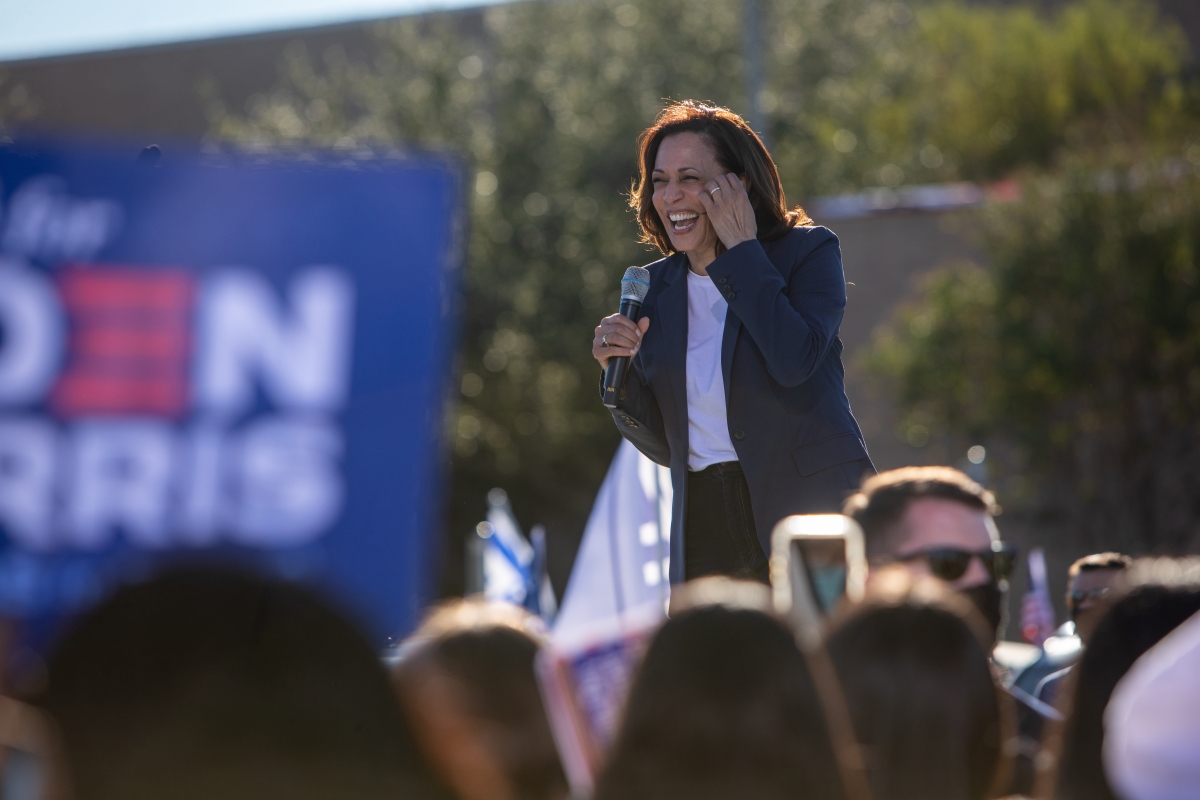
Sen. Kamala Harris, D-Calif., makes a campaign stop at the University of Texas Rio Grande Valley in Edinburg on Oct. 30. Photo for The Washington Post by (Julia Robinson.
Biden had no immediate comment, but late Thursday, he had declared that he had “a mandate” on a number of policy issues.
“I know watching these vote tallies on TV moves as slow as it gets and can be numbing,” he said in remarks from Wilmington, Del. “But never forget, the tallies aren’t just numbers. They represent votes and voters, men and women who exercised their fundamental right to have their voice heard.”
Biden won three swing states that Trump had claimed in 2016 – Michigan, Wisconsin and Pennsylvania – reconstituting the “blue wall” that had protected previous Democratic nominees. He also was leading in the formerly Republican terrain of Arizona and Georgia as he boosted Democratic votes across the Sun Belt, and he remained ahead in Nevada. By early Saturday, Biden had amassed a record 74.4 million votes, beating Trump by more than 4 million, a margin that was expected to increase once all ballots are certified.
The Trump campaign has called any “false projection” of a Biden victory “far from final.” It has filed multiple lawsuits since Election Day, and without detailing evidence
“From the beginning, we have said that all legal ballots must be counted and all illegal ballots should not be counted, yet we have met resistance to this basic principle by Democrats at every turn,” Trump said in a statement Friday, falsely characterizing the Democratic position in the statement released by his campaign. “We will pursue this process through every aspect of the law to guarantee that the American people have confidence in our government.”
By denying Trump a second term, a country convulsed by health, economic and social crises brought to an end a tumultuous presidency that polarized the nation and was characterized by attacks on undocumented immigrants, political adversaries and, at times, the rule of law.
After the voting, Biden had made repeated appearances at which he expressed his confidence in his eventual victory but counseled Americans to be patient as election workers tallied the ballots. He also vowed to be a president for all Americans, not just those who elected him.
“It’s been a long and difficult campaign,” Biden said Wednesday in Wilmington, Del. “But it’s been a more difficult time for our country, a hard time.”
“I know how deep and hard the opposing views are in our country,” he added. “But I also know this as well: To make progress, we have to stop treating our opponents as enemies. We are not enemies.”
Trump, meanwhile, continued to vent his frustration on Twitter and in a defiant speech from the White House on Thursday night. He and his aides alternately demanded that vote counting end or continue as they searched for dwindling opportunities for a path to 270 electoral votes. They filed multiple legal challenges over the election in several states.
Voters punctuated the extraordinarily ugly and disruptive campaign season by choosing as Trump’s successor his antithesis – a career Democratic politician who offered himself as a healer with the compassion and empathy he said was needed to usher in an era of civility and restore the soul of America. He won the presidency on the 48th anniversary of his first election to the Senate, on Nov. 7, 1972.
Biden, who will be 78 when he is sworn in on Jan. 20, will become the nation’s oldest president and will arrive with nearly a half-century in elected office, including eight years as vice president and 36 years representing Delaware in the Senate.
Harris’s ascent to one of the nation’s two highest offices marked a particularly momentous occasion in the history of women’s rights and came a century after the 19th Amendment guaranteed all women the right to vote – and four years after the first female presidential nominee of a major political party lost unexpectedly to Trump.
It came as a record number of women have been elected to offices across the country, amid the tenure of a president who has insulted women, demeaned their looks and belittled the #MeToo movement against sexual assault.
Biden’s win was powered by a record number of votes by women, with Black women providing an especially large boost, according to preliminary exit polls. More than 90 percent of Black women supported the Biden-Harris ticket, making for the widest margin in any voting bloc in the country.
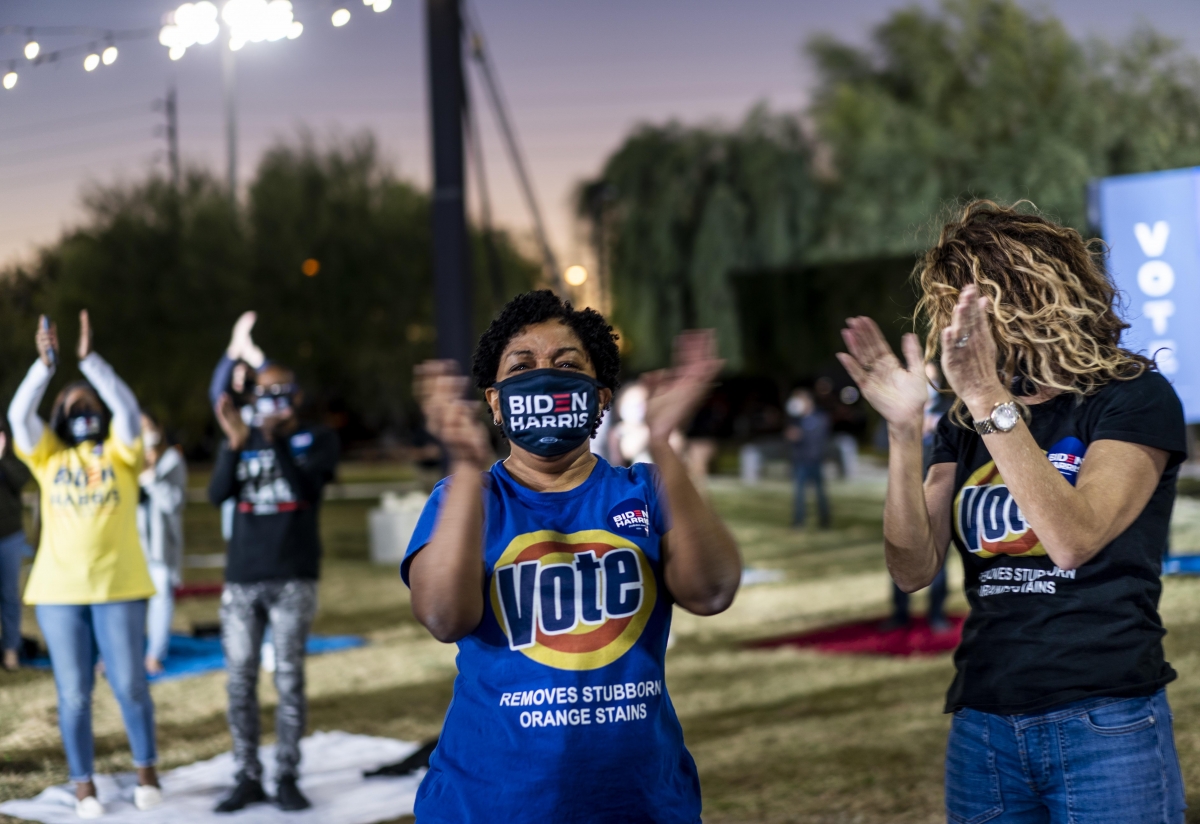
Nevada residents attend a socially distanced campaign event with Sen. Kamala Harris at Kianga Isoke Palacio Park in Las Vegas on Oct. 27. Washington Post photo by Melina Mara.
Harris, who attended Howard University in Washington, is also the first graduate of a historically Black university to be elected to serve in the White House.
Biden nodded to some of the history of his election during remarks Wednesday in his hometown of Wilmington, where he was awaiting final results in a close electoral college race.
Calling the voter turnout “extraordinary,” Biden said he and Harris were “on track to win more votes than any ticket in the history of this country.”
While Biden’s path to victory became clearer Wednesday after he secured wins in key battleground states, the apparently narrow margins in several states left the outcome in doubt for days. During that period, Trump made baseless claims of voter fraud and dispatched his campaign and legal team to file lawsuits in multiple states.
Trump has previously declined multiple opportunities to commit to a peaceful transition of power, saying he reserved the right to object to what he has defined as fraud despite the lack of evidence.
Throughout the campaign, Biden pitched himself to voters as a uniter who would restore the nation’s governing norms, respect long-standing institutions and reconnect relationships with international allies that have frayed as Trump embraced autocrats and brushed aside leaders of other democracies.
Unlike in his two other attempts at the White House, in the 1988 and 2008 contests, Biden entered the race at the top of the polls. He crafted a decidedly centrist pitch as many other candidates vied for attention from the energized liberal wing of the Democratic Party.
But his candidacy struggled in the early contests. He placed a dismal fourth in Iowa, then sank to fifth in New Hampshire.
Biden’s chances brightened in Nevada, where he was powered by a more diverse electorate. And then the race moved onto turf far more agreeable to a man who had long worked with Black elected officials and served the first African American president – South Carolina, and its predominantly Black Democratic electorate.
Boosted by support from Rep. James E. Clyburn, an influential Black Democrat in the state, he rallied to an easy victory, and he replicated it in a host of states over the next few weeks to effectively clinch the nomination just as the nation closed down under the explosion of the coronavirus.
Even in the general election, the campaign tried to maintain a low profile, with Biden avoiding showmanship and making a point to elevate others in the party.
He focused insistently on the coronavirus, keeping a card with an updated death count with him at all times and deploying his own personal story of loss to convey a sense of empathy that he said the president lacked. He hoped that his experience with the death of his first wife and their daughter in a 1972 car accident and the 2015 death from cancer of his son Beau would help him connect with a country in mourning.
Biden’s campaign also reflected his desire to model the guidance of public health officials in minimizing the spread of a virus that has killed more than 236,000 Americans. He wore a mask at all public appearances, at times for entire speeches, unless he was yards from anyone else, and urged Americans to follow suit. Even as the president resurrected mass gatherings, filled with maskless supporters who refused to socially distance, Biden held no large rallies, instead speaking before parking lots full of cars as supporters honked in agreement.
He rarely left his Wilmington home over the summer – occasionally holding news conferences at a nearby high school to announce new policies – even though it was just miles from the border of swing state Pennsylvania.
Until the final week of the campaign ushered in a few multiple-event days, the splashiest the campaign got was a day spent on a train ride through eastern Ohio and western Pennsylvania. Biden’s wife, Jill, frequently told supporters that during a Biden administration they would be a little bored as they flipped through newspapers.
The light, coronavirus-safe campaign schedule worried Democrats who grew concerned that Biden was not exciting voters or vigorously making a case for his candidacy. And the campaign’s decision to shut down an in-person door-knocking operation, a tactic long used by Democrats to motivate infrequent voters, was criticized as creating a huge disadvantage, especially as Republicans sent volunteers door-to-door to pitch Trump. Under pressure, Biden’s campaign partially restarted a field operation in October.
Clinching the nomination early offered advantages, affording Biden time to unite the Democratic Party. He rolled out back-to-back-to-back virtual endorsements by former rivals in which they would appear together on video, events that fostered a sense of Democratic bonhomie after a bruising primary. He worked with Sen. Bernie Sanders (I-Vt.) and his supporters to develop policies, effectively muting the criticism from the left that had hounded the 2016 nominee, Hillary Clinton.
Trump used the cooperation as an attack line, saying the “manifesto” that the two wings of the party developed showed that Biden was controlled by the left. To respond, Biden would point to his long record as a moderate. “The party is me. Right now, I am the Democratic Party,” Biden snapped to Trump as the president made a case that the Democratic Party is controlled by its liberal base.
Though Biden’s team largely avoided major shifts in his message and tended not to respond to news events, the campaign made a rare exception after the May 25 killing of George Floyd in police custody in Minneapolis and the accompanying unrest. Biden lifted his self-imposed travel ban to fly to Texas to meet with Floyd’s family to show solidarity with the burgeoning Black Lives Matter movement. But he also resisted pressure from the left to endorse defunding the police and highlighted his plans to increase funding to local law enforcement while also saying his sympathies were with peaceful demonstrators.
Biden, known historically for gaffes, made some self-inflicted errors. In May, toward the end of an interview on the radio show “The Breakfast Club,” he sounded as if he was taking Black voter support for granted when the topic turned to undecided listeners.
“If you have a problem figuring out whether you’re for me or Trump, then you ain’t Black,” Biden said to Charlamagne tha God, a host of the show. Biden quickly offered regret for the comments, but within hours the GOP – trying to drive a wedge between Black voters and Biden – plastered the comment on T-shirts, and it became a frequent attack line.
The GOP also tried to weaponize Biden’s authorship of the 1994 crime bill, which critics say led to mass incarceration. Biden never apologized for his role in shepherding the legislation, which also included a 10-year ban on assault weapons. But while the Republican effort appeared to have nominally boosted Trump’s support among Black men, Biden retained the overwhelming backing of non-White voting groups.
Biden’s ascent to the White House reflects a decades-long quest for the presidency and a remarkable rise from his roots in Scranton, Pa., a childhood he often references in his speeches.
His family moved to Delaware when he was a boy, but Biden maintained his ties to his native town. On Election Day, he made a campaign stop at his former home and wrote a note on the living room wall. “From this house to the White House with the grace of God,” Biden wrote.
His first White House campaign, in 1987, ended when he bowed out after being accused of plagiarizing. His second, in 2008, ended after a bad showing in Iowa but put him on the path to becoming vice president.
But Biden situated himself as an institutionalist and creature of the Senate, where he served for six terms. He chaired the Senate Foreign Relations and Judiciary committees, overseeing the hot-button Supreme Court confirmation hearings of Robert Bork and Clarence Thomas. His regrets over how Anita Hill was treated as a witness during the latter hearings led him to push to add women to the Judiciary Committee and ultimately to elevate Harris as his vice-presidential pick.
Trump is set to leave office with a tenuous legacy and a long string of unfulfilled promises. His final months in office aren’t likely to change that, with the country beset by a surging public health crisis.
Although he launched his first campaign promising to be “the greatest jobs president God ever made,” his loss all but ensures that he will be the first president since Herbert Hoover to leave office with fewer Americans employed than when he was sworn in. The 6.9 percent unemployment rate in October, while down from the pandemic high of more than 14 percent, is still significantly above the 4.7 percent rate when he took over in January 2017.
The national debt has soared, thousands of troops remain in overseas war zones and the kind of Washington influence-peddling Trump calls “the swamp” has only increased under his watch. Trade deficits persist, and the fence project on the border with Mexico has been neither completed nor, as Trump promised, financed by the Mexican government.
The president’s decision to sign hundreds of executive orders and bypass Congress rather than securing policy changes via legislation means that much of his legacy can easily be overturned. Yet while Biden campaigned on a promise to roll back Trump’s signature legislative victory – a tax cut passed in 2017 – he may not be able to do so if Republicans maintain their Senate majority.
Trump also will leave office with the country more divided and bitter than it was when he won in 2016, after using that unexpected victory to promise a return to unity but diverging constantly from that vow.
“Now it’s time for America to bind the wounds of division. We have to get together,” Trump said four years ago on the night of his 2016 victory. “To all Republicans, Democrats and independents across this nation, I say it is time for us to come together as one united people.”
Instead, Trump used his national platform to spew insults, denigrate foes and tweet about matters big and small.
Still, Trump’s term in office will be recorded in history books as turbulent, norm-shattering and consequential on numerous fronts. He was impeached by the House last year for alleged abuse of power and obstruction of Congress after he encouraged Ukraine’s president to investigate Biden and his son Hunter. He was ultimately acquitted by the Senate, but remains only the third president in American history to be impeached.
He has cemented his impact on the federal judiciary, appointing more than 200 judges and three Supreme Court justices. Their impact on American life will extend long past Trump’s term.
When Biden is sworn in, he will have an opportunity to leave his own stamp on a country he has served in public office for the vast majority of his adult life.
“What brings us together as Americans is so much stronger than anything that can tear us apart,” he said Wednesday. “We are campaigning as a Democrat. But I will govern as an American president. The presidency itself is not a partisan institution. It is the one office in this nation that represents everyone. And it demands a duty of care for all Americans. And that is precisely what I will do.”
White House chief of staff Mark Meadows has the coronavirus, official says
InternationalNov 07. 2020White House Chief of Staff Mark Meadows arrives to hear President Trump speak at the White House in the wee hours Wednesday morning. MUST CREDIT: Washington Post photo by Jabin Botsford
By The Washington Post · Amy B Wang, Josh Dawsey · NATIONAL, HEALTH, POLITICS, HEALTH-NEWS
WASHINGTON – White House chief of staff Mark Meadows has tested positive for the coronavirus, according to an official with knowledge of the situation.
The diagnosis comes a little more than a month after President Donald Trump and other members of his family and inner circle also tested positive for covid-19. About two weeks ago, Meadows appeared on CNN to say the administration had effectively given up on trying to slow the virus’s spread.
“We’re not going to control the pandemic,” Meadows said on CNN’s “State of the Union” on Oct. 25. “We are going to control the fact that we get vaccines, therapeutics and other mitigations.”
Meadows has for months openly brushed off the importance of wearing masks during the pandemic. On Election Day, Meadows visited the Trump campaign headquarters in Arlington, Va., where he was photographed without a mask.
Meadows was also among those in the East Room of the White House when Trump gave remarks around 3 a.m. Wednesday to a crowd of about 150 of his top aides, donors and allies. During that event, Meadows worked the room and stood near Trump campaign adviser Corey Lewandowski, one of the few people there who was wearing a mask.
Ben Williamson, a Meadows spokesman, could not be reached for comment. The White House declined to comment Friday night.
By The Washington Post · Annie Linskey · NATIONAL, POLITICS
WILMINGTON, Del. – On Day 4 of election night, outside the Chase Center here, a gathering place emerged from a state of suspended animation.
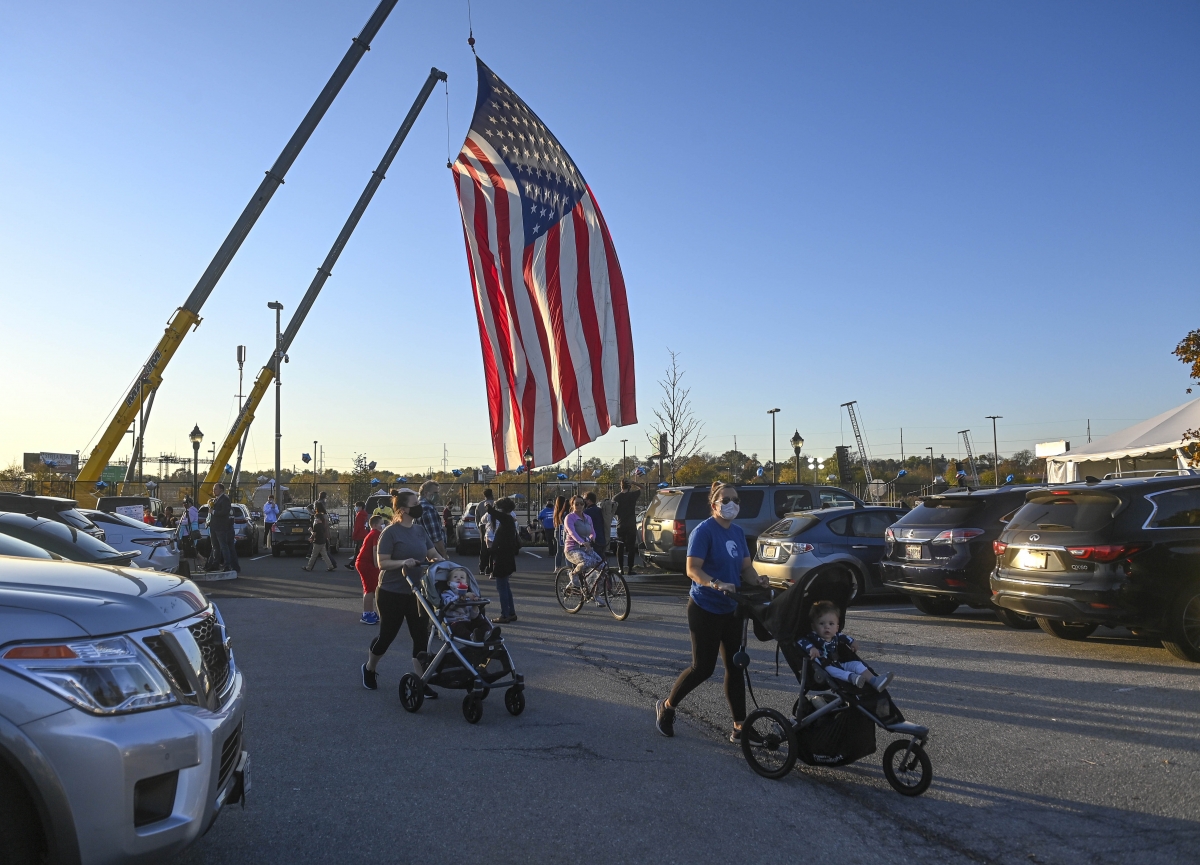
People arrive at the Chase Center in Wilmington, Del., on Friday. MUST CREDIT: Washington Post photo by Jonathan Newton
Cranes lifted massive lights into the sky. Forklifts moved concrete barriers. Workers yanked protective plastic off scaffolding. Balloons were tied to a metal fence, marking a perimeter.
It was Friday evening, and Joe Biden’s campaign was getting ready for a socially distanced celebration party.
Again.
But it was all for naught.
Rather than declare victory on a commanding and brilliantly lit stage, shortly before 11 p.m. Biden stood behind a plain lectern on a smaller space set up in an atrium of the Chase Center to urge patience.
“My fellow Americans, we don’t have a final declaration of victory yet,” Biden said, with his running mate, Sen. Kamala Harris, D-Calif., standing nearby. “But the numbers tell us it’s clear – tell us a clear and convincing story. We’re going to win this race.”
Biden said he’d work for all Americans, regardless of party. “We may be opponents but we’re not enemies. We’re Americans,” he said, with his senior staff watching from the back of the room. “I’ll work as hard for those who voted against me as I will for those who voted for me.”
For Biden’s staff, after 18 months of campaigning, being snubbed by party donors, enduring a fourth-place finish in Iowa, then sinking to fifth in New Hampshire, and after ultimately clinching the nomination and listening to Democrats complain about how they were running an overly cosseted campaign for months, they believed they had proved critics wrong.
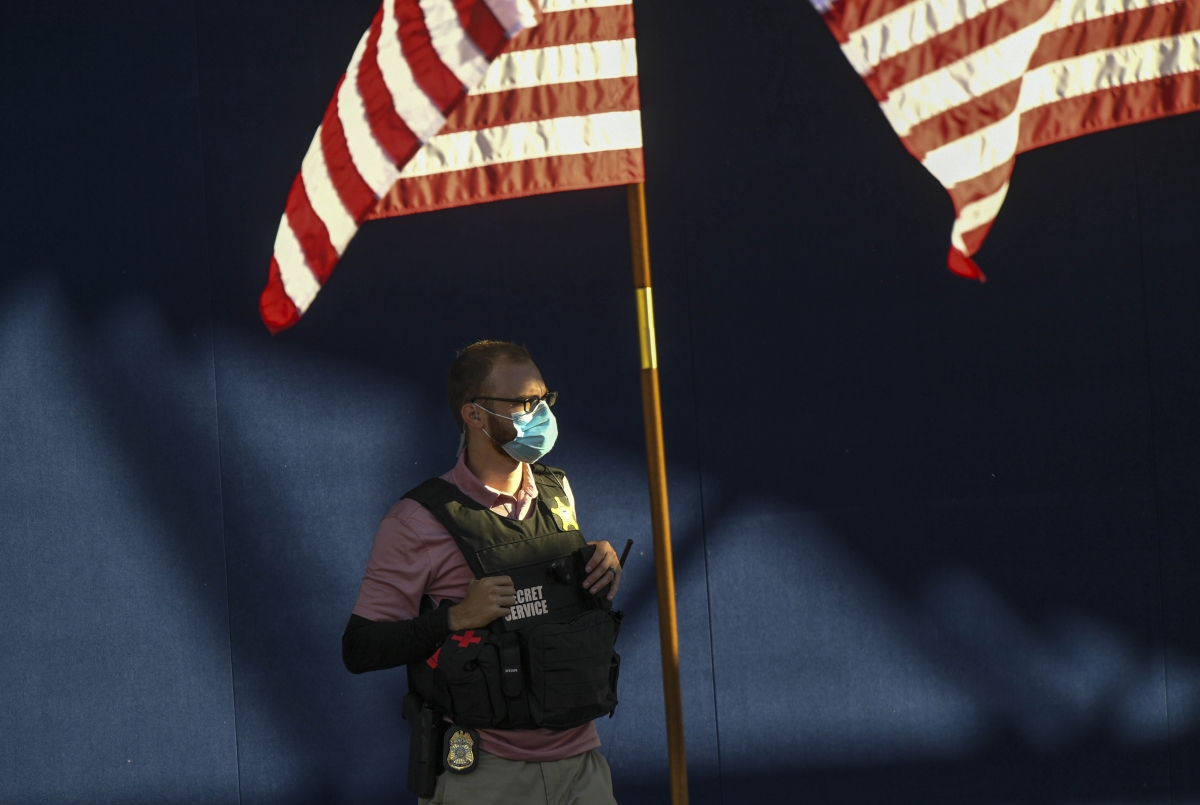
A Secret Service agent guards the stage at the Chase Center on Friday. MUST CREDIT: Washington Post photo by Jonathan Newton
Now all they needed was one or two networks to call the race and declare Biden president-elect. They needed a larger lead in Pennsylvania or bigger margins in Georgia or some more votes in Arizona and a call in Nevada.
As member of Biden’s team allowed themselves to absorb the news that they had nearly won, the landscape around them was changing. The next president might be in their midst. The Federal Aviation Administration posted temporary flight restrictions over Wilmington airspace starting 2 p.m. Friday through the following Wednesday.
The Secret Service sent reinforcements to Delaware to provide security fitting for a team that would soon lead the country. Officers already in Wilmington extended their occupation of coveted rooms in the Westin adjacent to the Chase Center, where Biden’s team set up its election-night headquarters.
Now they just needed a few more votes to make it official.
Local supporters began arriving at the Wilmington riverfront area by early afternoon, taking advantage of the unseasonably warm, 70-degree weather to get a glimpse of history.
Ron Ozer, a chemical engineering professor at Villanova University, set up a picnic with his wife just outside a black fence blocking off a secure area. They had an iPad to listen to MSNBC. They had crackers. They had folding chairs. They were ready to wait.
They didn’t come down Tuesday night, and they said as the evening wore on they became “disappointed” to see so much support for President Trump.
“We kind of knew, logically, that there were a lot of ballots to count,” Ozer said. “But it didn’t really sink in.”
Justin Smith, 16, drove from New Jersey to Wilmington with his family to see Biden on Friday. “He has the positive demeanor to make America whole again,” Smith said. “Not so much great, because I feel like America can never be great again because of the racial [tension] and the bad politics in the justice system,” added Smith, who is African American.
Nathan Jenkins sold blue T-shirts and sweatshirts that read “I survived Covid-19” and “virus 45,” a reference to Trump. Jenkins said the extended election aftermath was “a little nerve-wrecking.”
“Sometimes you think it is going to be 2016 all over again,” he said. “But as things started to progress, I was feeling better. Election night I was a little nervous, to be honest.”
As the day wore on, Biden allies shifted their tone about the potential for festivities – with networks not calling results, the Biden campaign contemplated the possibility that it could wait one more day before sending Biden and his running mate, Sen. Kamala Harris, D-Calif., out to declare victory.
There were mixed signals about what the evening would hold.
By around 4 p.m., some top Biden staffers were spotted walking out of the Chase Center, back to their hotel rooms. It was the wrong direction for a celebration.
Then around 5:20 p.m., a van used to transport the press that follow Biden’s every move pulled up to the Westin. Was this a sign that Biden would soon be collected from his nearby home?
As longtime Biden watchers chatted, many agreed that the tardy results seemed to be a fitting coda for a campaign operation that itself was chronically (and often inexplicably) late.
Election night had unofficially started around 3 p.m. Tuesday, when Biden aides recommended reporters show up at the Westin hotel and set up in a second-floor conference room to wait for results. Somebody delivered dozens of white roses to the Biden staff, to honor the work they had done.
It was a skeleton crew, with just a few staff members, a small handful of journalists and production-crew staffers prepared to see Biden and Harris deliver a victory speech.
Instead Biden and his wife emerged briefly, promising an update the following day.
In the harshly lit Westin hotel lobby around 1 a.m. Wednesday, Biden strategist Mike Donilon waited for a van to shuttle him elsewhere. He fended off reporters eager for some snippet.
About eight hours later, in the same lobby, top strategist Anita Dunn briefly chatted with reporters after taking her daily coronavirus test. She’d had just one hour of sleep. “You guys cannot stand this close to me,” she told journalists as she outlined why the team was confident.
“We always said the goal was to get 270 electoral votes,” Dunn said. “We feel very confident that after the votes have been counted that’s where we’re going to be.”
Biden came to the Chase Center on Wednesday, too, speaking briefly to reporters, with Harris at his side, to urge patience. “Power can’t be taken or asserted,” Biden said. “It flows from the people.”
By Thursday, as results kept dripping in, the resources on the Wilmington riverfront were showing strain. A Starbucks ran out of most pastries. A nearby restaurant at the Hotel Du Pont ran out of butternut squash soup. Hotel rooms disappeared. Biden and Harris received briefings on the pandemic and the economy. Secret Service agents began knowing the regulars going in and out of the secure area by face.
Dunn and her husband, Bob Bauer, a top election lawyer for the campaign, were spotted walking along the Christina River, a tributary to the Delaware River.
Friday began with a sense of new excitement among top Biden campaign staffers as they began gathering at the Westin midmorning for their daily coronavirus tests. Overnight the campaign had taken a slight lead in Georgia. And by 8:45 a.m. counts also showed Biden ahead in his native Pennsylvania.
“When we took the lead in Pennsylvania, it felt more real than it has,” said one aide who sipped an iced coffee near a security checkpoint. “Twitter lit up. Signal lit up,” the aide said, referring to the secure texting platform many in politics use.
The aide was coy about exactly when a Biden victory speech might happen, but many had expected it to be Friday evening.
The aide, who was not authorized to comment publicly and spoke on the condition of anonymity, previewed Biden’s message. “Joe Biden from the day he announced his candidacy has been about bringing people together and about ending that sort of toxic, chaotic divisive mood of the country,” the aide said, adding that Biden “would want to go out and continue to deliver that message.”
But as the sun set in Wilmington on Friday, the likelihood of a victory speech from Biden faded.
And as for those white roses that had arrived on Election Day, they had wilted.
สำนักข่าว The New York Times รายงานว่า ก่อนหน้านี้ทีมของไบเดนได้ระดมเงินสนับสนุนแบบเงียบๆ สำหรับใช้จ่ายในกระบวนการรับโอนอำนาจได้ราว 7 ล้านเหรียญสหรัฐ และทีมยังเตรียมพร้อมรับมือกรณีที่ทรัมป์ไม่ยอมรับความพ่ายแพ้และไม่ยอมถ่ายโอนอำนาจไว้ด้วย

 President Trump leaves after speaking in a press briefing room at the White House on Thursday. MUST CREDIT: Washington Post photo by Jabin Botsford.
 Democratic presidential candidate Joe Biden addresses a crowd in Durham, N.C., on Oct. 18. Washington Post photo by Demetrius Freeman.
 White House Chief of Staff Mark Meadows arrives to hear President Trump speak at the White House in the wee hours Wednesday morning. MUST CREDIT: Washington Post photo by Jabin Botsford

 แม้การนับคะแนนในหลายรัฐยังไม่แล้วเสร็จ แต่ โจ ไบเดน ก็มั่นใจว่าจะคว้าชัย โดยเริ่มตั้งทีมเตรียมรับโอนอำนาจจากทรัมป์แล้ว
 รัฐบาลสเปนเตรียมออกกฎหมายเก็บภาษีจากบริษัทที่ให้บริการสตรีมมิ่งรายใหญ่อย่างเน็ตฟลิกซ์ 5% เพื่อนำมาเป็นเงินทุนช่วยเหลืออุตสาหกรรมผลิตภาพยนตร์ในประเทศ
 รั้วรักษาความปลอดภัยชั่วคราวด้านนอกทำเนียบขาวเต็มไปด้วยป้ายข้อความไล่ โดนัลด์ ทรัมป์ เรียกร้องให้รีบออกจากห้องทำงานรูปไข่


 แม้เส้นทางสู่ทำเนียบขาวจะเลือนราง แต่ทรัมป์ก็ยังไม่มีทีท่าว่าจะยอมแพ้ง่ายๆ
 โจ ไบเดน จากพรรคเดโมแครต แถลงข่าวจากเมืองวิลมิงตัน รัฐเดลาแวร์ หลังจากมีคะแนนนำทิ้งห่าง โดนัลด์ ทรัมป์ ในรัฐเพนซิลเวเนียถึง 27,000 คะแนน ซึ่งหากไบเดนชนะที่รัฐนี้จะปิดโอกาสการเป็นประธานาธิบดีสมัยที่ 2 ของทรัมป์
 ชาวอเมริกันและผู้คนทั่วโลกยังเฝ้าจับตาการนับคะแนนในรัฐสำคัญที่จะชี้ชะตาว่าทรัมป์หรือไบเดนใครจะอยู่ใครจะไป

