Once a billionaire factory, Korea’s beauty industry turns ugly
InternationalDec 29. 2020A customer tries an eyeliner at an Amorepacific store in Seoul, South Korea, on Sept. 12, 2018. The pandemic has made cosmetics less central to women’s daily routines, ending the wealth created by the rapid rise in popularity of Korean beauty products. MUST CREDIT: Bloomberg photo by SeongJoon Cho
By Syndication Washington Post, Bloomberg · Yoojung Lee
Three years ago, Suh Kyung-Bae was the second richest person in South Korea. Today he’s barely Top 10, a stark reversal in a K-beauty boom known for minting billionaires, not breaking them.
Suh’s $3.6 billion fortune — down from roughly $8 billion in 2017 — is largely comprised of shares in his family’s cosmetics conglomerate, Amorepacific Group, which have fallen more than 40% from a mid-January high. The parent of brands like Innisfree, Laniege and Sulwhasoo, Amorepacific was struggling even before covid-19, and the pandemic has ushered in a slew of lifestyle changes that have made cosmetics less central to women’s daily routines.
That’s brought a halt to the wealth created by the rapid rise in popularity of Korean beauty products and the dealmaking frenzy that followed. From 2010 to 2014, foreign companies spent at least $215 million to acquire cosmetics firms there, according to a September report by Samjong KPMG. In the five years that followed, the country became the world’s fourth-largest exporter of beauty products, and the deal volume ballooned to $5 billion, not including transactions for undisclosed sums.
Estee Lauder Cos. made Have & Be Co., widely known for its Dr. Jart+ line, its first acquisition of an Asian beauty brand in November 2019. That deal, worth $1.1 billion, turned founder ChinWook Lee into a billionaire. Goldman Sachs Group Inc. bought a minority stake in GP Club Co., best known for face masks, making founder Kim Jung-woong one of the country’s richest people. Unilever Plc, L’Oreal SA and other multinational companies also got stakes in Korean cosmetics firms, creating massive windfalls for their founders.
But the pandemic has taken a double hit on K-beauty. Social distancing and remote work have lessened demand for makeup and led to store closures. Beauty retail sales in the U.S., the No. 3 market for Korean exports, will be down more than 7% in 2020, according to market research firm Mintel.
For Korea, coronavirus travel restrictions have also cut off the flow of big-spending Chinese tourists and individual merchants who buy tax-free goods in bulk and sell them back home. Meanwhile, China’s customers have more access to global brands and are increasingly interested in products made locally.
“Now it’s naive to think that cosmetic products with made-in-Korea tags would simply win over Chinese customers,” said Lina Oh, a Seoul-based analyst at Ebest Investment & Securities Co.
Neither Have & Be nor GP Club have released financial information for 2020; GP Club’s plan for an initial public offering in 2019 hasn’t been rescheduled.
A store employee applies a foundation in a Laneige sore in Singapore on Sept. 12, 2017. The pandemic has taken a double hit on K-beauty, with social distancing and remote work lessening demand for makeup, and travel restrictions cutting off big-spending Chinese tourists. MUST CREDIT: Bloomberg photo by Nicky Loh
For Amorepacific, consolidated revenue for the first nine months of the year fell 23% to $3.4 billion (3.7 trillion won) from the same period in 2019, according to a company filing. For the first time in its history, the group announced last month a plan to offer voluntary retirement targeting employees who have worked for more than 15 years. The company declined to comment on its plans or on Suh’s personal fortune.
At the same time, the pandemic has accelerated the shift to online in the beauty industry. Amorepacific’s revenue for the segment has seen substantial growth, pushing it to prioritize that part of the business. Cosmetics giant L’Oreal, whose sales dropped 12% in the first half of 2020, launched 300 digital services this year, including live beauty tutorials.
Amorepacific plans to reduce the number of Innisfree stores in China but anticipates that overall, digital sales will make up half its business there next year, according to Yuanta Securities Korea. In the domestic market, the company sees the share of online revenue growing to 30% from 20%.
“Spending on cosmetics was already down before covid,” said Hye-mi Kim, an analyst at Cape Investment & Securities Co. in Seoul. “covid made it even less necessary. Only must-have items like skin care products or those for facial problems are doing okay.”
Meanwhile, South Korea has new billionaires rising, like Seo Jung-jin, founder of pharmaceutical firm Celltrion Inc., which is developing a covid-19 antibody treatment. Seo’s wealth has almost tripled this year to $14.6 billion, making him the country’s new second-richest man.
InternationalDec 29. 2020Heavy machinery operates at the Fimiston Open Pit mine, operated by Kalgoorlie Consolidated Gold Mines Ltd. in Kalgoorlie-Boulder, Western Australia, Australia, on Aug. 8, 2018. MUST CREDIT: Bloomberg photo by Carla Gottgens
By Syndication Washington Post, Bloomberg · Aoyon Ashraf
The good times for gold miners are expected to continue next year, especially for those that are able to tighten spending and increase returns to investors.
The rally in gold prices has helped miners expand their margins and generate record levels of free cash flow, allowing many to pass on profits to shareholders already, Scotiabank analyst Tanya Jakusconek said.
“With miners’ balance sheets in great shape, we believe investors will benefit from much higher dividends over the coming years,” Jakusconek wrote in a note to clients. Kinross Gold Corp., for example, offers “particularly compelling value,” as long as it continues to demonstrate sustainable cash flow over the coming quarters.
With the outbreak of the coronavirus, the price of gold hit a record in 2020 after demand for safe-haven assets surged against a backdrop of “lower-for-longer” interest rates, trillions of dollars in stimulus spending and a weaker U.S. dollar.
With none of those factors expected to change anytime soon, Credit Suisse analyst Fahad Tariq said he expects next year to be another “banner year for gold” with prices heading to an average of $2,100 per ounce.
The “key differentiator” among mining stocks will be those with strict spending habits, Tariq said. If miners keep on a path of returning capital to shareholders, and continue to generate significant free cash flow, their valuation multiples should expand, he said.
Spot gold prices are down from an all-time high in August after the rollout of coronavirus vaccines reduced demand for havens, but they remain up about 24% for the year. While the FTSE World Index of equities is on track to return 13% in 2020, the NYSE Arca Gold Miners Index has climbed 23%.
The sell-off in the second half of the year likely facilitated a “shakeout of weaker names” that had participated in the first-half rally, Delbrook Capital founder and portfolio manager Matthew Zabloski wrote in a letter to investors. But now he expects a “big rebound” in precious metal prices, which could again lift the sector. He sees interest rates remaining low as swelling liabilities around the globe make rapidly increasing rates “intolerable,” he said.
Top picks by Credit Suisse’s Tariq include Newmont Corp., Barrick Gold Corp., Agnico Eagle Mines Ltd., Yamana Gold Inc. and Endeavour Mining Corp.
“The economy remains fragile and the post-pandemic recovery will be gradual at best,” Tariq said. “We think any near-term pullback in gold prices due to Covid vaccine approvals and rollout is a good entry point.”
By Syndication Washington Post, Bloomberg · Davide Scigliuzzo
It was a year like no other in credit.
Markets plunged at the onset of the pandemic, sending entire sectors teetering toward oblivion. Once solid companies were suddenly paying double-digit yields in a mad scramble for liquidity, while venerable household names could be scooped up for pennies on the dollar.
Then, just as quickly, the Federal Reserve’s unprecedented efforts to support corporate-debt markets set off a surge in prices that turned risky bets into winning wagers virtually overnight. A flurry of trading activity ensued, generating billions of dollars in additional Wall Street revenue and boosting bonuses.
Amid the banner year, a few select wagers have stood out among the rest. From travel and tech to Tupperware, here are some of the top credit trades in a year that has had no shortage of memorable deals.
Airbnb
Silver Lake and Sixth Street Partners more than doubled their money on a $1 billion lifeline they threw Airbnb Inc. in April. The second-lien loan they underwrote for the company came with warrants, which delivered outsized returns once the company completed its initial public offering. In just eight months, the two firms are sitting on paper gains well over 100%.
Less adventurous investors who preferred to stick to more senior debt were still able to take part in the rally. Airbnb’s first-lien loan, also syndicated in April, has returned about 17% over the span.
Fresh Market
Before businesses were ordered shut across the U.S. in March, Fresh Market Inc. was struggling under the weight of $1 billion in debt it had accumulated after its takeover by Apollo Global Management Inc. in 2016. Its bonds were already trading at roughly half of their face value.
But as homebound consumers began stocking up on groceries en masse, the company experienced a 25% increase in revenue in the second quarter. The company’s 9.75% notes due 2023, which dropped to as low as 39 cents on the dollar at the end of March, have since recovered to 103. That’s a total return of more than 175% for investors who timed it right.
Tupperware
A boom in home cooking and an aggressive cost-cutting plan pushed by new Chief Executive Officer Miguel Fernandez gave Tupperware Brands Corp. a much-needed boost in 2020, pulling the company back from the brink.
Tupperware’s shares have soared more than 300% this year, but its debt has also been a boon for investors. The company’s $600 million of 4.75% bonds due 2021 traded as low as 30.125 cents in May after it announced plans to buy back only some of the notes at deeply discounted prices.
Investors who scooped up the securities on the cheap and held out were handed a windfall in December, when Tupperware obtained a new loan from Angelo Gordon & Co. and JPMorgan Chase & Co., and called the remaining bonds at around par, for a total return of over 230%.
Cruise Lines
As the pandemic took hold, few industries were in more desperate need of capital than cruise lines. Not only had travel across the globe ground to a halt, but vessels had emerged as a key hot spot for contagion, casting doubts as to when sailing would be allowed to resume.
Carnival Corp. was the first to raise capital in the bond market, offering $4 billion of three-year bonds secured by ships and intellectual property with a coupon of 11.5%, one of the highest ever by an investment-grade company. The debt, which was issued at 99 cents, has returned around 25%.
Secured bonds that lower-rated Norwegian Cruise Line Holdings Ltd. and Royal Caribbean Cruises Ltd. offered in May have returned around 29% and 27% respectively.
Golden Nugget
Houston billionaire Tilman Fertitta was among the first to tap debt markets when credit began flowing again in April. But Golden Nugget, the umbrella company for much of his restaurant and casino empire, had to offer investors one of the highest yields ever seen in the U.S. leveraged loan market to get a deal done.
The loan was issued at 96 cents and pays annual interest of 12 percentage points over Libor. Two months later, half of it was repaid at a dizzying premium of 116 cents via proceeds from the sale of Golden Nugget’s online betting business to a blank-check company. The remaining outstanding amount has returned over 30%.
By Syndication Washington Post, Bloomberg · Laura Millan Lombrana, Charlie Devereux
Spain became the fourth European country to record more than 50,000 coronavirus deaths as nations across the region start to roll out a vaccine.
Fatalities from the disease rose to 50,122 on Monday, according to Health Ministry figures. Some 408 people have died of the virus in the past week. Cases diagnosed over the last 24 hours amounted to 2,822, bringing the total to 1.88 million.
Spain is one of the countries in Europe to be hit hardest by the pandemic, forcing the government to impose a state of emergency in March. When it emerged from a strict national lockdown three months later, management of the pandemic was placed in the hands of regional governments.
While some regions ordered restrictions on movement and curfews as cases increase again, Spain hasn’t reimposed a strict lockdown like those seen in the U.K. and France in recent weeks.
The number of people dying from the virus has been slowing since November, according to Fernando Simon, the head of Spain’s medical emergency response center. However, data gathered over the holiday period can have gaps in reporting, he said at a news conference.
“We had a death rate of 1% to 1.5% in the past few weeks and in the last few days we’ve seen a rate of 0.8%, which is a good indicator that we’re making a significant effort to guarantee detection” of the virus, Simon said.
The infection rate is higher than desired, but recent data suggests that the number of cases is stabilizing, as are hospitalizations, Simon said.
Still, authorities are telling Spaniards to avoid travel between regions and gatherings of more than 10 people over the holiday season. Spain’s economy is lagging behind major euro-area peers, with a contraction of 12% expected this year. Debt is mounting and unemployment is expected to remain around 20% for at least the next two years.
TAIPEI, Taiwan – A citizen journalist who documented the desperation of residents in Wuhan at the height of China’s coronavirus outbreak was sentenced to four years in prison on Monday in a case that underlined Beijing’s extreme sensitivity to criticism of its pandemic response.
In a closed-door trial that lasted less than three hours, authorities in Shanghai handed down the sentence to Zhang Zhan, 37, for “picking quarrels and provoking trouble,” a charge often used against dissidents.
Zhang, a former lawyer turned activist, traveled to Wuhan in February, where she filmed from overwhelmed hospitals, neighborhoods and community centers, providing a rare window into the locked-down city. Her critical reports accusing the government of suppressing the voices of regular citizens and failing to inform residents of the reality of the situation contrasted with rosy state media coverage, one of the few sources of information. Zhang was detained in May.
Chinese authorities often hold sensitive trials involving human rights activists during the holiday season when much of the rest of the world is distracted. The proceedings, usually announced with little notice, are almost always held in secret. In another such case, 10 of the so-called “Hong Kong 12” protesters caught at sea while trying to flee the crackdown in their city were put on trial in the Chinese city of Shenzhen on Monday.
During Zhang’s proceedings on Monday, which rights advocates deemed little more than a show trial, the activist was given a chance to speak.
“The government should not censor the speech of its citizens,” she said, according to her lawyer, Zhang Keke.
Human rights groups and friends of Zhang are especially worried about her health in custody. On hunger strike since June, she has been force-fed via a tube and placed under restraints. She has pledged to continue her hunger strike, according to her lawyer, despite pleas from family and friends. Advocates say she has been treated more harshly because of her refusal to cooperate or admit guilt.
Zhang is one of several citizen journalists detained for reporting on Wuhan, but the first to be sentenced to prison. Her verdict comes ahead of a mission to China led by the World Health Organization to investigate the origins of the virus, a politically fraught topic as the Trump administration and other critics say Beijing should bear responsibility for the pandemic that has now claimed more than 1.7 million lives.
“It shows that we will never know the truth about the pandemic,” said Leo Lan, a research and advocacy consultant at Chinese Human Rights Defenders. “Zhang Zhan’s heavy sentence will have a deterrent effect of silencing others who witnessed what happened in Wuhan earlier this year.”
Outside the Shanghai Pudong New District People’s Court where Zhang was tried, police pushed reporters and supporters away from the building, detaining at least nine people. On social media, activists posted pictures of Zhang and signs that read: “Zhang Zhan not guilty,” calling on the international community to pay attention to her case.
“The handling of Wuhan is very sensitive. Many people in China are still very angry at the initial coverup and downplaying,” said Yaqiu Wang, China researcher at Human Rights Watch.
Separately, a notice released on Monday from the People’s Court of Yantian district in Shenzhen said a hearing for the Hong Kong residents had taken place that afternoon. The court said it would choose a future date for announcing its ruling.
The group of 12 was caught in Chinese waters in August as they tried to escape to Taiwan by speedboat after the introduction of a draconian national security law in their city. Eight of the group have been accused of illegally crossing China’s border, while two have been accused of organizing the border violation. Two minors in the group will be tried in a separate hearing.
Barricades surrounded the courthouse in Shenzhen on Monday, where foreign diplomats from the United States, Britain, Australia, Canada, Portugal and other countries were blocked from entering.
Ahead of the trial, the U.S. Embassy in China called for the detainees’ release. “Their so-called ‘crime’ was to flee tyranny. Communist China will stop at nothing to prevent its people from seeking freedom elsewhere,” the embassy said in a statement.
Human rights campaigners and lawyers have warned that the detained Hong Kongers, between the ages of 16 and 33, held incommunicado in Shenzhen for the past four months, are at risk of torture and almost certain conviction in China’s politicized justice system.
The detainees’ relatives called the hearing a “de facto secret trial.” While the notice from the Shenzhen court said lawmakers, journalists and relatives attended the trial, family members said they were denied access. Foreign reporters were also barred and told the courtroom was full.
“The unfair court proceedings [are] evidence of an obvious, draconian political persecution,” the families said in a statement Monday. “The families of the 12 have been in great agony throughout their detention. They are now only asking for the safety of their children and their earliest return to Hong Kong.”
Campaigners in Hong Kong accused the Chinese court of delaying sentencing to keep the 12 in custody for longer. At a news conference, some family members called for immediate sentencing so that they would be able travel to China to see their detained relatives.
“I want to see my son as soon as possible,” said the mother of Wong Wai-yin, one of the defendants, who did not disclose her name. “I only want to see him.”
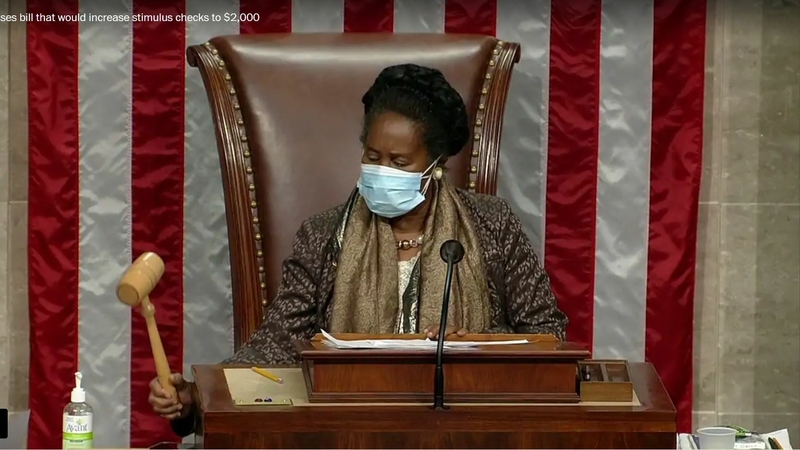
WASHINGTON – The House on Monday voted to beef up stimulus checks set to go to American households in the coming weeks from $600 to $2,000. The chamber acted swiftly after President Donald Trump demanded the larger payments in the past week, but passage of the measure is uncertain because Senate Republicans have not unified behind the idea.
On Sunday, Trump signed into law a $900 billion emergency relief package that included $600 checks. His advisers had advocated for these payments, but Trump later called the check size “measly” and demanded that it be increased. After he signed the law, he pledged to continue pushing for the larger payments, something many Democrats also support.
Forty four Republicans joined the majority of Democrats on Monday in passing the bill on a 275-134 vote. It needed a two-thirds vote to pass, so it was narrowly successful. The measure’s fate is much less certain in the Senate, which is controlled by Republicans.
Approving stimulus checks of $2,000 would cost $464 billion, the Joint Committee on Taxation said Monday. This would be in addition to the $900 billion package Trump signed into law on Sunday. Congressional Republicans had sought to keep the total cost under $1 trillion, but that was before Trump began a push in the past week to make the stimulus payments larger.
The support is growing because the economy is weakening and the pandemic has led to rising numbers of people seeking unemployment benefits and turning to food banks for help.
Since Trump first demanded the larger checks on Tuesday, House Speaker Nancy Pelosi, D-Calif., and other Democrats have tried to push the idea into law. They have ignored his other complaints about the new spending law, however, particularly his calls for reductions in foreign aid and environmental programs.
“It’s not exactly what we would put on the floor if Republicans were in control,” said Rep. Tom Reed, R-N.Y., who supported the larger checks. “But I think it recognizes the fact that, [Pelosi is] the speaker and as a Democratic speaker, they’re going to have an input as to what that package is going to look like in regards to the terms and conditions of the direct checks. I’m willing to take half a loaf, and I think the president recognizes that.”
Monday’s vote took place after House Republican leaders blocked an attempt last week to pass the larger checks by unanimous consent in the House. The measure now goes to the Senate, where it is unclear whether Majority Leader Mitch McConnell, R-Ky., will move to consider it in the closing days of the current Congress. It is clear that some Senate Republicans support larger checks. The idea has been championed by Sen. Josh Hawley of Missouri, and Sen. Marco Rubio of Florida said he supported larger payments.
“I am concerned about the debt, but working families have been hurt badly by the pandemic,” Rubio wrote on Twitter on Monday. “This is why I supported $600 direct payments to working families & if given the chance will vote to increase the amount.”
In a statement Sunday, Trump said the Senate would “start the process for a vote that increases checks to $2,000, repeals [liability protections for tech companies], and starts an investigation into voter fraud.”
McConnell has not signaled precisely what he will do with the measure once it is sent over from the House. A McConnell spokesman declined to comment Monday.
Senate Minority Leader Chuck Schumer, D-N.Y., said Sunday that he would attempt to pass the bill in the Senate himself as soon as Tuesday morning, but any senator could block the measure from proceeding. McConnell could seek to package the larger checks with other Trump demands, but that probably would generate Democratic objections and prevent a vote before the new Congress is seated on Jan. 3.
In March, Congress passed the Cares Act, a $2 trillion measure that included a round of $1,200 stimulus checks for more than 100 million Americans. The program had mixed results, according to several studies. Many people used to money to pay rent or buy groceries. But others saved the money or used it to pay down debt.
Congress has designed the stimulus checks so most people would qualify for them, but not everyone. Americans with income up to $75,000 would qualify for the full amount, but people who earn more than that would receive less or nothing.
Trump got Christmas plea on aid from Georgia senator worried about chances in runoff, sources say
InternationalDec 29. 2020Sen. David Perdue, R-Ga., speaks during in Augusta, Georgia, on Dec. 10, 2020. MUST CREDIT: Bloomberg photo by Elijah Nouvelage
By Syndication Washington Post, Bloomberg · Nancy Cook
Sen. David Perdue, R-Ga., lobbied Donald Trump last week to sign the pandemic relief bill he’d criticized, concerned that the president’s delay would harm his and Sen. Kelly Loeffler’s prospects in the Jan. 5 runoff elections, according to people familiar with the matter.
In a Christmas-Day phone call to Trump, Perdue argued that the bill was vital for unemployment benefits, coronavirus-vaccine distribution and a moratorium on evictions. Perdue also contacted White House allies including National Economic Council director Larry Kudlow and the president’s daughter, Ivanka Trump, to try to pressure the president, the people said.
Perdue and Sen. Lindsey Graham, R-S.C., who visited Trump at his Mar-a-Lago resort in Florida over Christmas, also argued in favor of Trump sending Congress a list of spending items in the bill to eliminate, known as rescissions, after he signed it. Lawmakers are expected to ignore the request.
The people familiar with the matter asked not to be identified because the conversations were private. A spokesman for Perdue’s campaign declined to comment.
Trump grudgingly signed the $2.3 trillion bill late Sunday, a delay that caused a one-week lapse in unemployment benefits for millions of American workers. He has demanded that Congress increase direct payments to Americans to $2,000 each, from $600, and pass legislation eliminating or limiting a liability shield for social media companies that have censored or fact-checked some of Trump’s election-related tweets.
Control of the Senate — and Republican hopes of obstructing President-elect Joe Biden’s agenda next year — rests on the outcome of the two Georgia runoff elections. It isn’t clear whether Loeffler also personally lobbied Trump to sign the stimulus.
A White House spokesperson didn’t immediately respond to requests for comment.
Perdue’s opponent, Democrat Jon Ossoff, has tried to hang Trump’s delay in signing the relief bill around the Republican senator’s neck. Over the weekend, his campaign asked Atlanta TV stations to pull a Perdue ad claiming the senator “delivered” the $908 billion relief package because Trump hadn’t signed it, according to the Atlanta Journal-Constitution.
Ossoff’s campaign noted that Perdue has repeatedly said he opposes direct payments to Americans as part of stimulus measures, as well as expanded unemployment benefits, at one point calling it “an incentive not to come back to work.”
“David Perdue hasn’t spent a single second making a public case for his constituents to get direct relief, but when it comes to a Hail Mary to save his collapsing campaign, he’s willing to call the president directly to save himself. Those are his priorities,” an Ossoff spokeswoman, Miryam Lipper, said in a statement.
Perdue hasn’t said whether he would support raising payments under the new relief bill to $2,000, as Trump has demanded. Ossoff has promised to support the $2,000 payments.
Covid surge sidelines health workers when they’re needed most
InternationalDec 29. 2020A nurse wearing personal protective equipment administers medication to a patient inside the covid-19 ward at PeaceHealth Southwest Medical Center in Vancouver, Wash., on April 30, 2020. MUST CREDIT: Bloomberg photo by Nathan Howard
By Syndication Washington Post, Bloomberg · John Tozzi
Covid-19 hospitalizations in the U.S. reached new highs this week, testing the nation’s health-care workforce as the virus sidelines medical workers.
More than 118,000 people — roughly equivalent to the population of Lansing, Mich. — have been in hospitals with covid on average over the past seven days. That’s a record, according to data from the covid Tracking Project.
While record covid admissions strain emergency rooms and intensive care units, the crisis squeezes smaller clinics, too. Uncontrolled infections mean more patients coming in, even as staff exposed to the virus must stay home.
Four of the six nurses who work at Klamath Health Partnership, a nonprofit clinic in Klamath Falls, Oregon, were out last week after exposure to covid. About 16 of the clinic’s patients were hospitalized, double the typical number, so the clinic’s doctors spent twice as much time making rounds at the hospital.
Because so many people are out, the clinic’s chief operations officer, Amanda Blodgett, has been wearing scrubs and swabbing patients coming in for coronavirus tests. She estimates that roughly 20% of the 135-member staff were sick or quarantining the week before Christmas, everyone from clinicians to front-desk workers to call-center employees.
“I haven’t been doing very many COO things,” Blodgett said. “I do that stuff at home at night.”
Blodgett has an MBA and isn’t a medical provider. She went through the same training the clinic gives to medical assistants so she could backstop front-line workers when cases started to mount. “Swabbing a patient is incredibly stressful,” she said. She canceled plans to take time off during the holidays and expects to be filling in until it’s safe for quarantined staff to return.
Klamath Health Partnership is a federally qualified health center, designated by the government to care for people in underserved areas. It typically sees 12,000 patients a year in a county of about 68,000. Many are migrant or seasonal farmworkers.
The county has recorded more than 1,700 cases, a tally that’s roughly doubled since the last week of November.
The expanding epidemic has strained all aspects of the clinic’s operations. Klamath Health Partnership contracted with an assisted-living facility to conduct weekly tests of residents and staff as required by the state. With case rates up, they now have to test twice a week. “That takes staff out of my clinic,” said Blodgett, who’s collected the swabs herself.
To relieve the local hospital this fall, Klamath Health Partnership also turned part of its space into a “transition” clinic. Patients from the emergency room who weren’t sick enough to be admitted to the hospital could be taken there to get oxygen and IV drugs.
“Our goal was to help them turn rooms faster,” Blodgett said.
She closed it in December because she didn’t have enough workers to keep it open.
While the U.S. has been dealing with widespread covid cases since March, the crisis has escalated in the past month. The U.S. has almost 19 million cumulative cases to date. December alone has accounted for more than 5 million, according to covid Tracking Project data.
That means roughly three out of every 10 cases has been recorded this month. In California, which added more than 900,000 cases so far in December, the proportion is higher: 43% of all the state’s covid cases so far have been recorded this month.
Nationally, the tally of new positive cases declined in recent days, though it’s not clear how much is due to the Christmas holiday slowing testing and data reporting. The U.S. reported an average daily increase of almost 180,000 cases over the last week, compared with 213,000 a week ago.
Even if cases decline, hospital admissions and deaths lag new diagnoses, and will likely keep climbing for weeks. Holiday travel and gatherings this week could ignite new chains of transmission, driving cases, hospital admissions and deaths higher next month.
In Klamath, some of Blodgett’s staff is expected back this week, but she’s worried about what might happen after Christmas and New Year’s.
The clinic asked state officials for help finding staff, she said, and was told to contact other clinics and hospitals.
“My organization is the backup plan to our hospital,” she said. “Sometimes the folks in the metropolitan areas forget that in rural Oregon, in rural America, we don’t have backup plans.”
More than 333,000 U.S. residents have died of the pandemic, according to Johns Hopkins University.
covid cases increased 7.1% over the past seven days, according to the covid Tracking Project. The West is bearing the heaviest burden, with the Tracking Project reporting 41% of the nation’s cases over the past seven days.
Isolated residents and an overwhelmed hospital: Covid-19 hits Western Maryland
InternationalDec 29. 2020When the pandemic finally hit the farthest-flung Maryland county this fall, Garrett Regional Medical Center ran out of ICU beds, had to abandon its testing operation and saw 10 percent of its staff infected or in quarantine. MUST CREDIT: Washington Post photo by Erin Cox
By The Washington Post · Erin Cox
OAKLAND, Md. – Mark Boucot learned the rural hospital he runs would be left out of the initial vaccine distribution a few days before covid-19 killed his first staff member.
It seemed hope would be slow to reach the Garrett County mountains, just like everything else.
The pandemic initially skirted this eastern edge of Appalachia, but arrived with a vengeance in November. Case rates soared to four times the state average. The small emergency room at Garrett Regional Medical Center, where Boucot is president, was hammered. Coronavirus patients consumed nearly half the hospital’s beds and all of its four-bay intensive care unit.
Isolated in the farthest stretch of Western Maryland, residents did what they could to prepare for the virus, even when the pandemic seemed impossibly far away. But their community was overwhelmed when it materialized. The region’s treasured independent streak didn’t help matters. Locals have been reluctant to distance themselves from family members, slow to admit they are weakened with infection, and – in seven out of 10 cases – unwilling to get a vaccine.
All spring, summer and into the fall, Garrett County saw the pandemic on national news but not at home. It welcomed tourists escaping virus-laden cities and spent federal aid on infrastructure and economic relief rather than testing sites or an intensive campaign to warn skeptics about the coronavirus.
But as Christmas approached and the first shipments of vaccine rolled into bigger towns and cities across the country, the small hospital in Oakland was in distress. Ten people had died in 10 days, doubling the death toll in a county of 29,000. The positivity rate was 17.75%, the state’s highest.
Ten percent of the hospital staff was out with the virus or quarantined, and the hospital was deploying third- and fourth-year nursing students from a nearby community college to help.
“I feel like we’re a bunch of rusty tools in the garage that no one cares about,” said Jeffrey Bernstein, a semiretired emergency room physician whose part-time schedule ballooned in December to more than 40 hours a week.
The hospital had provided coronavirus testing for the county since March, when the pandemic began. Now Boucot decided he no longer had the staff to both treat the sick and detect the infected.
The county had to create a new testing method, and settled on a new state-run site that operates two days a week on an isolated stretch near the airport, staffed by school nurses whose classroom buildings had been shut down a few weeks earlier.
“We had people laying around the lab testing area waiting,” Boucot said. “We’re overrun at this point. We can’t keep up with it.”
Jessica Carey, a school nurse, swabs an asymptomatic child at Garrett County’s public testing site. Carey will be among the first to get the vaccine so she can compose a blog to help persuade a reluctant community to get vaccinated. MUST CREDIT: Washington Post photo by Erin Cox
Garrett’s economy relies on agriculture, small business and tourism that draws Washington- and Baltimore-area residents to its wooded back country, state parks with waterfalls, ski resorts and Deep Creek Lake. The pandemic brought more people than ever to rent houses and buy vacation homes; county officials say 2020 set a record for both hotel taxes and real estate sales.
But some locals resented the stay-at-home orders and mask mandates, given the more-lax rules in neighboring counties in Pennsylvania and West Virginia. Television news here comes from those states, and residents missed forceful warnings about the virus from Maryland Gov. Larry Hogan (R) and others closer to Washington. Telework requirements and closed schools also caused greater hardship in Garrett than elsewhere, since fewer than 40 percent of households have reliable broadband.
While public health workers waited anxiously for the pandemic to hit, many others relied on Facebook and social media for virus-related information, plus their own observations that the county – with fewer than three dozen cases in four months – didn’t seem to have a covid-19 problem at all.
“It was something we saw on TV happening in other places,” said Becky Aiken, who manages the nurses for the public school system.
Garrett County Health Officer Bob Stephens said some visitors to businesses located along Interstate 68 acted “really nasty” when told to wear masks or leave. A few got physical; many were outraged.
“We have a lot of people who don’t believe covid is a serious thing,” Stephens said.
When cases started to rise in October, locals wanted to blame the tourists, even though Stephens insisted there was no evidence that they were responsible.
“Every time I talk to the health officer, every time, I ask him . . . Is there any data to show that the virus is being spread via the vacation industry in Garrett County?” Edwards said. “And every time I ask that, the answer is ‘no.’ “
Stephens said outbreaks started in two nursing homes, where 150 people got sick in two weeks, and spread from there. It seems probable that the Autumn Glory festival in mid-October followed by Halloween fueled the spike, but it’s hard to tell, he added: “We went into this downward spiral because we couldn’t keep up with the contact tracing.”
By the end of November, the number of confirmed cases had more than tripled in just 18 days, to 755, helping to drive a statewide surge in virus cases that is disproportionately concentrated in three western counties.
The number of confirmed cases in Garrett probably understates the prevalence of the virus, officials said, given the stigma a positive test result holds in the community and the reluctance of people – in a county with one of the lowest median incomes in Maryland – to quarantine.
“Less people want to identify themselves as covid-positive, so they tend to avoid getting testing,” Boucot said. “There’s a little bit of an independent streak: ‘That’s private, that’s my business.’ And besides, if you’re out of work for two weeks, that’s it. You have no income.”
Public officials sounded alarms and encouraged people to avoid Thanksgiving dinners, but the conventional wisdom is that those warnings went unheeded. Family and social gatherings are now the primary infection sources in Garrett.
“A lot of people out here are more conservative-leaning and they’re not interested in the government telling people not to have family gatherings,” said longtime state Sen. George C. Edwards, R, whose son, Paul Clayton Edwards, R, chairs the Garrett County Board of Commissioners. “They say – well, I can’t tell you what they say, since it’s not printable.”
The annual Christmas display at Garrett Regional Medical Center greets patients and staff in the lobby. MUST CREDIT: Washington Post photo by Erin Cox
Jeff Hinebaugh, director of emergency services at the hospital and a 35-year employee, was among those who fell ill. His symptoms stayed mild – no worse than a common cold – but he was nonetheless sidelined from the busy emergency room, left fretting at home about his depleted team.
“At what point is my staff going to crumble?” Hinebaugh said. “How in the world are we going to take care of our staff? How do we deal with the stress?”
Day after day, the emergency room was filled with familiar faces. Neighbors. Parents of friends. The dad from the soccer field. A co-worker.
“The last few months have been horrible,” Hinebaugh said. “When you’ve been here as long as I have, I know a lot of these people personally. They’re looking at my eyes. . . . They’re wanting to know, ‘Am I going to make it?’ And I don’t have an answer.”
The hospital, part of a two-hospital system run by Boucot and affiliated with West Virginia University, has 55 beds, 20 of which are reserved for maternity and short-term rehabilitation. In mid-December, 15 beds had covid patients. Every day, Chief Operating Officer Kendra Thayer scanned upcoming outpatient appointments and surgeries, looking for relief valves. Who was getting a knee surgery that could wait? Who could be treated at home with virtual specialists?
“We’re not going to put off someone who needs cancer treatment,” she said.
Several times each day, she visited the intensive care unit to see if anyone had improved enough to be transferred to a normal bed. Garrett Regional doesn’t have a pulmonologist or other specialists on-site; doctors rely on remote experts at West Virginia University Medicine. An iPad and speaker attached to a pole is wheeled into ICU bays so faraway doctors can to assess breathing and collaborate on treatment plans.
“It’s the things we don’t always do in a rural hospital, but we can with their assistance,” Thayer said of the virtual specialists. “Even when we lose someone, they say there’s nothing we could have done differently.”
It’s at least an hour by ambulance to someplace with specialized in-person care. Thayer doesn’t want members of the community to assume they’ll be transferred away if they’re sick; she worries it might deter people from seeking care.
“If we can keep them here, that’s really for the best,” she said.
It was in the tiny, quiet intensive care unit that Debra Wilt, a 30-year human resources employee at the hospital who loved to dance, died early in the morning of Dec. 12. Wilt, 59, was the first hospital staffer to die, and the third covid death in the ICU that week.
“Everybody knew and loved her,” Boucot said.
He directed his grieving employees to lower the state flag to half-staff in her honor. Not long before that, he’d told them to find time to assemble the usual Christmas decorations at the hospital entrance.Santa towered over the lobby, lights wrapped the concrete posts by the receiving bay, and garland draped the gift shop, where visitors were no longer allowed.
“It was important for us to demonstrate normalcy for the staff and the community,” Boucot said.
Jeff Hinebaugh, director of emergency services, inside of one of two negative pressure rooms for covid-19 patients at Garrett Regional Medical Center. MUST CREDIT: Washington Post photo by Erin Cox
Part of the reason Garrett was among the last places in Maryland with a state-financed testing site is that no one asked for help until cases spiked.
“It’s a cultural thing,” Stephens, the health officer, said. “We’re in Appalachia. We’ll take care of our own.”
When it came to vaccines, however, Garrett officials were hoping to be first, only to learn the logistics of distributing the Pfizer-BioNTech drugs meant the small county would be left out.
“It seems counterintuitive,” said Edwards, the county commissioner. “It would seem that the area of the state that has the highest positivity and highest case rate would be first in line.”
But the vaccine was packaged in 975-dose batches that must be kept at subarctic temperatures until used. The hospital has only 250 front-line workers, so they had to wait for the Moderna vaccine, which came in smaller shipments and would not arrive for more than a week.
Once vaccines become available to the general public, Stephens and Boucot know they will have another battle. A health department survey conducted this fall suggested as few as three in 10 people would be willing to get vaccinated.
“We have trouble convincing people to get the regular flu vaccine, which is tried and tested,” Boucot said.
The job of persuading them will fall to people like Jessica Carey, an elementary school nurse who spends two days a week at the coronavirus testing site about 25 minutes from the hospital, past the one-runway airport and inside the shell of a building constructed for an economic development project that never arrived.
She and the other school nurses developed a plan with county health workers that involves Carey videotaping herself getting the shot and launching a blog diary about her experience over the following weeks.
“It’ll be a video walk-through of the entire process,” Carey said. “We’ll educate people, because there’s a lot of misinformation out there. We’ll have a Q& A, and talk about the side effects we’re having.”
The county health department, meanwhile, will ask all the primary-care doctors in the county to make a list of patients they think should get the vaccine first, then work on registering them to getting them to the testing and vaccination site.
“They know their patients, and we don’t,” Stephens said. “We have to rely on our partnerships, because none of the agencies can do it on their own.”
Georgia Senate races near finish with Trump a central player
InternationalDec 29. 2020President Donald Trump speaks during a rally in Valdosta, Ga., on Dec. 5. MUST CREDIT: Bloomberg photo by Elijah Nouvelage
By Syndication Washington Post, Bloomberg · Billy House, Eric Martin
The two Georgia runoffs that will decide control of the U.S. Senate begin their final stretch, with President Donald Trump again putting himself in the middle of the campaign.
Trump ignited controversy last week by holding up pandemic relief and government funding. Although he signed the legislation Sunday night, a week after it cleared Congress, his late action will end up delaying the stimulus payments he criticized as too low and cutting a week’s worth of expanded benefits for the jobless.
The outgoing president is also headed back to Georgia, where has has lashed out at the governor and other Republicans officials. He will appear with the two incumbent Republican senators, David Perdue and Kelly Loeffler, on the eve of their Jan. 5 runoffs.
Both GOP incumbents had been promoting their votes for the bill with more limited aid. Trump’s complaints about the $600 stimulus payments echo those of Democrats, who had pushed for higher amounts during negotiations, undermining his own party and adding to a sense of crisis in Washington.
At an event outside the Impact United Methodist Church in East Point, Ga., on Sunday, Democratic candidate Raphael Warnock told the crowd to pay attention to “the kind of dysfunction in our government” as seen in the turmoil over the aid and spending bill.
The unusual dual runoff in Georgia pits Warnock against Loeffler and Perdue against Democrat Jon Ossoff after none of the candidates managed more than 50% of the vote in November.
Public polling shows both races essentially dead heats, and the outcome likely will depend on which party can best energize it’s voters. Roughly 2 million people have cast early ballots, according to state data compiled by the nonpartisan Georgia Votes website.
In November Perdue finished less than 2 percentage points ahead of Ossoff. Warnock got about a third of the vote in the 20-candidate scrum for the other seat. The Republican vote in that race was divided primarily between Loeffler and Representative Doug Collins, who together accounted for about 46% of the vote.
GOP supporters gather for a rally on Dec. 10, 2020, for Vice President Mike Pence and Sen. David Perdue in Augusta, Ga. MUST CREDIT: Washington Post photo by Melina Mara
President-elect Joe Biden narrowly won the state by 12,670 votes out of almost 5 million cast. He and Trump both have campaigned in the state ahead of the runoff.
Interest in both parties is high. Ossoff and Warnock each took in more than $100 million in campaign contributions over the last two months, a record-breaking amount. Perdue raised $68.1 million and Loeffler raised $64 million.
The Senate is currently divided 52-48 in favor of Republicans. Democrats would need to win both Georgia seats to gain nominal control, with incoming Vice President Kamala Harris providing a tie-breaking vote. Investors are bracing for a potential increase in stock market volatility as a result of the contests. If Democrats snatch back the majority it would help Biden’s legislative agenda get through Congress.
As the candidates stumped over the weekend, they kept a wary eye on Trump, who spent the holiday golfing at his Florida club.
Warnock and Ossoff on Sunday urged supporters to bear down in the last nine days of the campaign, and do everything they can to get the vote out.
At the event in East Point, Warnock called the election a “turning point.”
“This is one of the moments when the people have got to straighten out what the government has gotten wrong,” he said. “Don’t be like those people who shout in church, but don’t listen to what the preacher says.”
During a campaign appearance Sunday with supporters in Columbus, Loeffler described herself and Perdue as business people and “political outsiders just like Donald Trump.” Afterward she skipped without explanation a planned session to answer questions from reporters.
Loeffler and Perdue have tied their fortunes closely to Trump, who continues to have a tight grip on Republican voters. After the president signed the relief and funding bill, they put out a joint statement lauding the president and criticizing Democrats as “hellbent on a socialist agenda.”
“Thanks to President Trump’s leadership, COVID relief is again on its way to the millions of Georgia families and businesses who need it most,” they said.
Trump has also created a rift among Georgia Republicans that could reverberate in the runoff. He’s harshly criticized Governor Brian Kemp and Secretary of State Brad Raffensperger while making unfounded claims of fraud in the November election. Loeffler and Perdue have called on Raffensperger to resign.
Veteran Republican pollster Frank Luntz said his data show that Warner has caught up to Loeffler and Ossoff moved ahead of Perdue over the past week or 10 days. Trump’s recent actions had caused the shift, he said, and are depressing Republican turnout.
“They had a four-point generic ballot advantage. That is gone, because the president — it’s amazing,” Luntz said Sunday on ABC’s “This Week” program. “We know it’s affecting turnout already. We can see on the ground.”

 A customer tries an eyeliner at an Amorepacific store in Seoul, South Korea, on Sept. 12, 2018. The pandemic has made cosmetics less central to women’s daily routines, ending the wealth created by the rapid rise in popularity of Korean beauty products. MUST CREDIT: Bloomberg photo by SeongJoon Cho
 Heavy machinery operates at the Fimiston Open Pit mine, operated by Kalgoorlie Consolidated Gold Mines Ltd. in Kalgoorlie-Boulder, Western Australia, Australia, on Aug. 8, 2018. MUST CREDIT: Bloomberg photo by Carla Gottgens


 Sen. David Perdue, R-Ga., speaks during in Augusta, Georgia, on Dec. 10, 2020. MUST CREDIT: Bloomberg photo by Elijah Nouvelage
 A nurse wearing personal protective equipment administers medication to a patient inside the covid-19 ward at PeaceHealth Southwest Medical Center in Vancouver, Wash., on April 30, 2020. MUST CREDIT: Bloomberg photo by Nathan Howard
 When the pandemic finally hit the farthest-flung Maryland county this fall, Garrett Regional Medical Center ran out of ICU beds, had to abandon its testing operation and saw 10 percent of its staff infected or in quarantine. MUST CREDIT: Washington Post photo by Erin Cox


 President Donald Trump speaks during a rally in Valdosta, Ga., on Dec. 5. MUST CREDIT: Bloomberg photo by Elijah Nouvelage
 SootinClaimon.Com