The Japan Business Federation (Keidanren) will call on its member companies to provide more support for female employees in balancing work and family life in the 2022 shunto spring labor-management negotiations.
Keidanren has included this proposal in its shunto policy draft, with the aim of reducing the number of women who find themselves forced to quit their jobs for the sake of providing childcare or nursing care for their parents. It also aims to increase the number of female directors and section chiefs who are candidates for executive positions.
It further seeks to address the issue of “double care” situations in which women cope with raising a child while simultaneously caring for an elderly parent.
Keidanren usually releases a report from its Committee on Management and Labor Policy in January, suggesting management policies for shunto labor-management negotiations.
According to the draft of the committee report, top management is requested to state a policy to support balancing work and childcare, and to create a workplace environment that makes it easy for their employees to take leave and return to work.
The report also called for considering the improvement and expansion of systems such as providing temporary allowances and setting up career consultation services. This is intended to encourage women who have been away from the workplace for a long time due to childcare or other reasons to return to work.
One issue is that female employees tend to lose interest in taking on management positions within a few years after joining a company.
In addition, there are many cases in which women quit their jobs to raise children or care for their parents while at the level of director or section chief, before becoming executives.
To achieve the goal of women accounting for 30% or more of executives by 2030, which Keidanren has included in its growth strategy, it urges companies to encourage women to develop the careers they need.
According to a 2016 estimate by the Cabinet Office, there are approximately 250,000 people nationwide shouldering double-care responsibilities. About 170,000 of them are women, half of whom also work to earn an income.
In June, Keidanren, a federation of Japan’s leading major corporations, had its first female vice chairperson.
And in October, the Japanese Trade Union Confederation (Rengo), the nation’s largest organization of labor unions, elected Tomoko Yoshino as its first female president.
In the basic concept for the 2022 labor-management negotiations, Yoshino set “promotion of gender equality and diversity” as a priority item.
The promotion of women’s activities will likely become a major point of discussion in the shunto negotiations, where management and labor unions discuss wage increases and work style reforms.
THE Malaysia Education Blueprint 2015–2025 (Higher Education) envisions welcoming 250,000 international students to the country by 2025 but what was once an achievable goal is now a journey fraught with challenges with Covid-19 putting an abrupt stop to cross-border movements globally.
New and existing students have only been allowed to come to Malaysia since January this year, said Malaysian Association of Private Colleges and Universities (Mapcu) president Datuk Dr Parmjit Singh.
“The spurt of arrivals was in the first two months. Subsequent arrivals were affected by the the rise in Covid-19 infections and the movement control orders imposed from March onwards,” he said, adding that their return was also hampered by issues related to the borders being closed in some countries, the availability and cost of flights, issues surrounding the cost of quarantine after arrival, and parents’ lingering concerns regarding the safety of their children.
“Nevertheless, the number of arrivals has seen an increase since the reopening of campuses in October, as well as the reduced infection rates. We expect the rate of arrivals to rise in the coming months,” he added.
National Higher Education Research Institute (IPPTN) senior research fellow Prof Datuk Dr Morshidi Sirat said the average expenditure of an international student in Malaysia is about RM46,000 per annum, and this increases to RM88,000 per annum if the student brings his family along.
He said Malaysia made an average of RM7.2bil per year from revenue sources like tuition fees, living expenses and other services during a student’s course of study here.
So, we will lose a substantial contribution to the national economy if they continue to stay away, he said during the “2020s: Transnational Education and the Option for Malaysia” webinar organised by the Academy of Professors Malaysia in June.
According to the Higher Education Ministry’s website, there were 95,955 international students enrolled in Malaysia’s higher education institutions and polytechnics in 2020, up from 93,570 in 2019 – a far cry from the number we want to see in four years.
But despite Covid-19 derailing the targeted number of international student enrolment, the country continues to attract international students with more applying to enter the country compared to previous years.
In March, the number of new applications increased by 120% compared to the same month last year.
Education Malaysia Global Services (EMGS) recorded 3,254 applications compared to 1,473 and 2,654 received in March 2020 and March 2019, respectively, according to data from the Higher Education Ministry body that manages international students in Malaysia.
These numbers, The Star reported in April, show that the country is still a popular destination among international students.
National Association of Private Educational Institutions (Napei) president Elajsolan Mohan, however, said he does not think the 250,000 target is achievable as the pandemic has greatly impacted the education sector.
“We have to be realistic. Even before Covid-19, we were already falling behind the target,” he said.
Elajsolan said this was due to a lack of pull factors to attract international students.
The pandemic, he added, only compounded the problem.
“We are losing to other countries in the region,” he said, adding that Australia was mulling study visa flexibility, which includes extending post-study work rights, to entice students to its shores.
As a significant portion of the country’s gross domestic product is dependent on international students arriving on our shores, failing to get back on track can prove costly for our economy.
COVID-19 has changed the world’s landscape, and Brunei Darussalam is no exception. There is no denying that the pandemic has been a huge impact on various aspects of life.
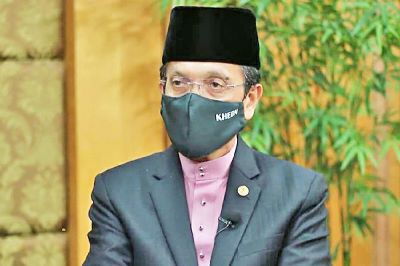
This was said by Minister of Home Affairs Pehin Orang Kaya Seri Kerna Dato Seri Setia (Dr) Haji Awang Abu Bakar bin Haji Apong in his capacity as the Co-chairman of the Steering Committee for the Knowledge Convention 2021 held to mark the 75th birthday celebration of His Majesty Sultan Haji Hassanal Bolkiah Mu’izzaddin Waddaulah ibni Al-Marhum Sultan Haji Omar ‘Ali Saifuddien Sa’adul Khairi Waddien, Sultan and Yang Di-Pertuan of Brunei Darussalam.
The theme of the Knowledge Convention 2021 is ‘COVID-19: A Lesson’, to which the minister said, “COVID-19 has demanded that the government makes changes to policies and legislation to meet the challenges brought on by the pandemic and beyond, including transparency in our communication with the public.”
Pehin Orang Kaya Seri Kerna Dato Seri Setia (Dr) Haji Awang Abu Bakar commended Minister of Health Dato Seri Setia Dr Haji Mohd Isham bin Haji Jaafar for briefing the populace on COVID-19 developments on a daily basis in a manner that is both informative and transparent.
He noted the shift in Brunei Darussalam towards a Smart Nation with the increasing use of innovative means in education, enterprise and security, inching the Sultanate closer to realising the Digital Economy Masterplan 2025.
“In terms of education,” the minister said, “we see teachers and students adapting to online learning and teaching. Alhamdulillah, we have had a lot of public support in ensuring that underprivileged students are not left behind in the online learning platform”.
He saw a positive trend towards financial planning in the workforce, especially for those who have been working from home since the second wave of COVID-19, as well as a makeover in the business landscape, where retailers and restaurateurs embrace technologies to help them work around the restrictive measures.
Another positive shift in the COVID-19 era, Pehin Orang Kaya Seri Kerna Dato Seri Setia (Dr) Haji Awang Abu Bakar said is in international relations. The minister believed that the pandemic strengthened cooperation between regional and global partners through the donation of vaccines and medical equipment.
“These contributions clearly showcase the close friendly and diplomatic ties between Brunei Darussalam and other ASEAN member countries as well as the commitment of the region in jointly addressing the COVID-19 crisis,” he said.
Pehin Orang Kaya Seri Kerna Dato Seri Setia (Dr) Haji Awang Abu Bakar said the COVID-19 Steering Committee will continue to monitor the pandemic situation and formulate strategies under the National COVID-19 Recovery Plan Framework ahead of the transition to the endemic phase.
He added that plans are being drawn up to ease restrictive measures, such as the re-opening of mosques, suraus and religious halls when 70 per cent of the population is fully vaccinated, and re-opening of other public places when the vaccination rate reaches 80 per cent.
“COVID-19 is a discourse that unites every member of the society, regardless of age, race and religion,” the minister said. “Insya Allah, with cooperation, we will be able to put the lid on its spread.”
TAIPEI – Mr Tseng Ying-chi has not gone to work in nearly two years. Before the pandemic, the 37-year-old was a tour guide who led groups of Taiwanese tourists through Europe, and was overseas for more than 200 days a year.
Now, he is waiting for the government to relax border and travel restrictions so that tour groups from Taiwan can travel abroad again.
He has been spending time exploring the island and dabbling in the stock market.
“I’ve enjoyed this year travelling all around Taiwan and even going to all of its outlying islands, but I don’t see the border control being beneficial in the long run. The government’s goal to keep daily Covid cases to zero is unrealistic,” said Mr Tseng, who added that many of his colleagues are doing side jobs as food delivery staff.
Taiwan has sealed off its borders to tourists except those from the tiny Pacific nation of Palau and a majority of business travellers since Covid-19 breached its doors last year. The first major local outbreaks in May this year saw tighter restrictions for residents and Taiwanese returning from overseas.
The rules are still in place even though daily case numbers have dropped to mostly single digits. With a slow vaccination roll-out, the health authorities remain cautious. All Taiwanese returning from overseas must still go through a mandatory 14-day quarantine in a hotel or facility.
With borders largely shut to foreign travellers, Taiwan’s tourist hotspots and businesses have had to rely on local visitors. But despite a quick uptick in local tourist numbers last year after Covid-19 outbreaks were under control, the year still saw an NT$45 billion (S$2.18 billion) drop in Taiwanese tourist spending compared with 2019, the Tourism Bureau said.
According to Mr Huang Wei-chen, director of the Ministry of Labour’s Department of Labour Standards and Equal Employment, Taiwan saw a growth in the number of furloughed workers after the local tourism industry, including travel agencies like the one where Mr Tseng worked, was hit hard by the pandemic.
Travel Agent Association chairman Yao Ta-kuang estimated that in last year alone, Taiwan’s tourism sector – including travel agencies, transportation companies and restaurants – suffered a loss of NT$400 billion.
Mr Wu Sheng-ta, whose family owns a tour bus company that previously catered to many Chinese and Japanese tourists in Kaohsiung, said: “We’ve had to lay off several of our drivers because no more foreign tourists are coming.”
Even as nearby Asian countries set up two-way travel lanes that allow vaccinated visitors to forgo quarantine, there is still no sign of Taiwan’s health authorities allowing more foreign visitors besides those from its travel bubble with Palau, which has only eight confirmed Covid-19 cases so far and no deaths.
Some companies have also urged the government to ease its strict border measures that they say are hurting the running of their businesses. For example, after-school tuition centres are unable to get foreign teachers into Taiwan.
But the authorities have said that adjustments in border control hinge on the island’s vaccination rate.
Taiwan’s vaccine roll-out has been slower than that of countries in the region due to an initial struggle to obtain enough vaccines and long waiting periods between shipments. Currently, some 74 per cent of Taiwanese have received at least one shot of Covid-19 vaccine, and about 30 per cent have received both shots.
Health Minister Chen Shih-chung, who also heads the Central Epidemic Command Centre (CECC), said last month: “We will be discussing opening borders only when over 70 per cent of the population have received (at least) one dose and 60 per cent have had both shots.”
CECC’s Deputy Director-General Chuang Jen-hsiang said on Thursday (Nov 5) that he believes Taiwan can reach the goal of fully vaccinating 60 per cent of its people by the year end.
His comments have raised hopes among those in the tourism industry.
“Many travel agencies are already talking to their counterparts overseas to be ready to launch tours soon,” said Mr Tseng.
National Taiwan University’s professor of public health Chen Hsiu-hsi suggested allowing travellers from countries with extremely low Covid-19 numbers and a high vaccination rate to skip quarantine in Taiwan.
“If a country has a vaccination rate of over 70 per cent, then we can consider giving it a ‘green light pass’, and for low-risk countries with a 40 per cent to 70 per cent vaccination rate, it might be possible to cut back on their time in quarantine,” he added.
Mr Tseng predicted that the health authorities will wait until after Chinese New Year to see if all the festive gatherings and outings will bring a new bout of outbreaks.
“If numbers (of Covid-19 cases) remain low, then it’s possible that border restrictions will ease,” he said.
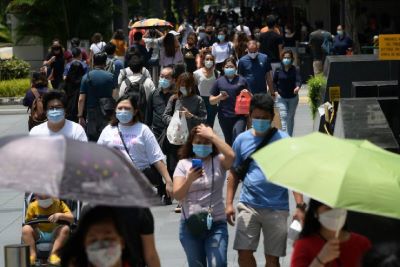
SINGAPORE – Singapores overall death rate has not increased despite more deaths from Covid-19, and this is because those who died from the virus would likely have otherwise perished from other medical conditions.
In fact, a closer look at the mortality numbers here shows that the Republic’s death rate in 2021 is lower than the rates in 2016, 2017 and 2018 – before the Covid-19 pandemic began – and is only slightly higher than 2019 and 2020.
Singapore’s death rate per 100,000 population stood at around 530 in 2021, marginally lower than the death rates in 2016 to 2018, which ranged from 547 to 563 deaths per 100,000 population.
This is known as the concept of mortality displacement, two infectious disease experts here – Professor Teo Yik Ying, dean of the Saw Swee Hock School of Public Health; and Associate Professor Vernon Lee, who heads the Ministry of Health’s contact tracing centre, wrote in a commentary published on Saturday (Nov 6).
Older people with pre-existing conditions make up the vast majority of Covid-19 deaths here, and it is likely that this same group of people would have otherwise died from other medical conditions.
Mortality displacement often happens during crises such as epidemics, famine and war. These shocks take a toll on people who are sick and already frail – especially the very old.
This hastens some deaths, and produces a temporary forward shift in mortality.
Covid-19 may be doing this to those with severe underlying illnesses, aggravating these illnesses and, in turn, triggering heart failures and deaths, the experts wrote.
A good amount of time – almost two years – has also passed since the pandemic started here, and the fact that Singapore’s overall death rate did not spike due to Covid-19 could also be because its public health policies have borne fruit.
Professor Paulin Tay Straughan, a sociologist from Singapore Management University, said she attributes this to the nation’s sound public health policies and holistic pro-health and active ageing approach.
For instance, the privileges given to the Pioneer and Merdeka generations have helped to encourage older folk to seek help earlier and participate in preventive health programmes, she added.
But moving forward, as Covid-19 fatigue is felt more heavily, the mental and emotional well-being of those who are isolated will be a greater concern.
“We worry about the older adults who remain socially isolated this period, those who live alone, in particular. Their well-being has been negatively impacted due to the safe management measures, so it is important for us to look for opportunities to reconnect with them,” Prof Straughan said.
As Singapore transitions to accept Covid-19 as endemic, the number of deaths attributed to the virus will inadvertently rise.
Asked if Singapore’s death rate would spike, Associate Professor Alex Cook, vice-dean of research at the Saw Swee Hock School of Public Health, said: “While we don’t know how many Covid-19 deaths we will experience over the months ahead, the number mentioned in the commentary seems quite plausible: 2,000 a year.”
He added: “At that level, it would equate to about 30 to 40 deaths per 100,000 population. If we add 30 to 40 to the annual counts, it would be noticeable but not by any means a ‘spike’. Rather it would be about a 5 per cent to 10 per cent increase over the usual numbers.”
SK On, the battery arm of South Koreas SK Innovation, plans to invest 3 trillion won ($2.53 billion) to build a new electric vehicle battery production base in China, and has signed an agreement with Yancheng in Jiangsu province, Yonhap News Agency reported on Thursday.
The new factory is expected to begin construction next year and produce more than 10 gigawatt hours of batteries a year when it puts into operation, according to Yonhap.
It will be the fourth battery factory and the first wholly owned plant for SK in China. Its other three factories are located in Changzhou and Yancheng in Jiangsu province and Huizhou in Guangdong province.
The company had said in September it planned to build a new battery factory in China with an initial investment of 1.2 trillion won.
SK On said last week that it has an order backlog of about 1.6 terawatt hours of batteries worth some 220 trillion won, which could power about 23 million electric vehicles.
SK Innovation is the world’s sixth largest battery cell manufacturer and has around 40 GWh of production capacity with plants in South Korea, China, the United States and Hungary.
By 2023, the capacity is to increase to 85 GWh, and by 2025 to 200 GWh. By 2030, SK Innovation wants to be able to produce 500 GWh.
The company supplies its electric car batteries to Ford Motor, Volkswagen and Hyundai Motor.
Myanmars economy remains one of the worst-hit economies in Asia in 2021, according to the HIS Markit Myanmar Manufacturing PMI released on November 1.
“Myanmar’s economy remains one of the hardest hit in Asia by 2021. Despite the strong decline at the beginning of the last quarter, there are indications that the rate of decline may be the weakest since the beginning of next year. Firms will hope that global shortages subside, which should reduce prices and stimulate demand growth, though supply pressures are likely to persist into 2022,” said economist Shreeya Patel.
In October, Myanmar’s manufacturing PMI stood at 43.3, up from 41.1 last September. However, no significant change was reported, with a significant drop below 50 points.
In October, production inflation hit a five-month high, the second-highest on record.
In addition to the rising costs of raw materials and transportation, a weaker exchange rate has put pressure on production costs. Historically elevated price inflation for raw materials forced firms to raise their selling prices at a near-survey record rate, the third-largest increase in survey history.
In addition, Myanmar’s economy was hit by weakened demand, shortage of raw materials and skilled workers in October.
Global material shortages also contributed to the record rise in backlogs. Supply chains were disrupted by the pandemic and showed signs of deterioration, with lead times for inputs lengthening in October to the third-greatest extent in the series.
Manufacturing conditions have now deteriorated in each month since September 2020, according to the survey.
Five indicators of the Purchasing Manager Index (PMI) are production, new orders, workplace, suppliers’ delivery time and stockpiles.
The survey is based on survey data collected from the industries by the HIS Markit and sponsored by Japan-based Nikkei Media Group.
HÀ NỘI — Việt Nam demands that China withdraw its ships out of the Bãi Ba Đầu (Whitsun Reef) in Việt Nam’s Trường Sa (Spratly) archipelago, and respect Việt Nam’s sovereignty.
Deputy spokesperson of the Vietnamese Ministry of Foreign Affairs Phạm Thu Hằng made the statement regarding the reports of the operation of many Chinese vessels at Bãi Ba Đầu, during the regular press conference held virtually by the ministry on Thursday.
“As we have affirmed multiple times, Việt Nam has full legal basis and historical evidence to testify to its sovereignty over the Trường Sa archipelago in accordance with international law; to be entitled to sovereignty, sovereign rights and jurisdiction over its waters defined in accordance with the 1982 United Nations Convention on the Law of the Sea (1982 UNCLOS),” she said.
Hằng reiterated that Việt Nam resolutely and persistently takes measures under international law to protect such legal and legitimate rights.
The operation of Chinese vessels inside the waters of the Sinh Tồn Đông (Grierson Reef) in Việt Nam’s Trường Sa archipelago has seriously violated Việt Nam’s sovereignty and stipulations of the 1982 UNCLOS, and runs counter to the spirit and wording of the Declaration on the Conduct of Parties in the South China Sea (DOC), the deputy spokesperson stressed.
Việt Nam calls on China to implement the 1982 UNCLOS with goodwill and seriously observe the DOC, creating a favourable environment to reach a Code of Conduct in the South China Sea (COC) between the Association of Southeast Asian Nations (ASEAN) and China, and contributing to maintaining peace, security, stability and legal order in regional waters. — VNS
TOKYO (Jiji Press) — Japan will reopen its borders for business travelers and students Monday, easing its border restrictions aimed at preventing the spread of the novel coronavirus, the government said Friday.
Foreigners making business trips, foreign students and technical interns from abroad will be able to enter Japan on condition that host organizations, such as companies and universities, that accept them manage their movements thoroughly.
Short-term business travelers planning to stay for up to three months will see their quarantine period shortened from 10 days to three days at the shortest on condition that they are vaccinated against COVID-19.
Since January, the government has been limiting entry by foreigners to those with special reasons in principle.
The business community was asking the government to ease the restrictions following progress in vaccinations and improvements in infection situations in Japan and abroad.
Deputy Chief Cabinet Secretary Seiji Kihara told a press conference that the government will check the effectiveness of measures to manage the activities of foreigners within this year at the earliest and consider reopening the borders also for tourists.
But he was quick to add, “We’ll act flexibly if the situation deteriorates due to the spread of a new variant or other reasons.” Kihara thus indicated the possibility of tightening the restrictions again if necessary.
Vaccinated short-term business travelers will be allowed to go out if they test negative for the coronavirus on the third day from arrival and their host organizations submit the travelers’ activity plans to the government and obtain approval.
Those meeting the requirements will be allowed to go to work, attend training seminars and travel on public transportation using reserved seats, for example, government officials said.
Longer-term business travelers, students and technical interns will be allowed to enter Japan on condition they undergo 14 days of quarantine.
The period will be shortened to 10 days if they were inoculated with any of the coronavirus vaccines designated by the government, namely the products of Pfizer Inc., Moderna Inc. and AstraZeneca PLC. The designated products do not include Chinese vaccines.
The government will keep the daily limit on the number of foreigners entering Japan at around 3,500 for the time being.
HÀ NỘI — Although the pandemic has disrupted industries all over the globe, some think it could be a catalyst that accelerates the digital transformation and opens a new era for the digital economy. Việt Nam is well placed to take advantage of this change, if enough experts can be trained in the field.
According to international research organisations, the Vietnamese economy has been one of the best performing during the pandemic, in part thanks to an adaptation to a digital economy. A study by Alphabet Temasek Holdings and Bain & Co suggests that the digital economy in Việt Nam may grow to US$52 billion by 2025, an annual increase of 29 per cent compared to 2020.
The Vietnamese government is targetting 10 per cent of retail sales being online by 2025, and up to 50 per cent in Hà Nội and HCM City. This will create many avenues and opportunities in the digital economy.
Appota‘s research said Việt Nam’s current digital infrastructure provides the country with a competitive advantage. Việt Nam is in the top 12 countries for the cheapest internet charges in the world, at about US$11.27 per month per subscriber. This low price and wide accessibility make internet usage common across the country.
Smartphones are the main connection device, thanks to convenience and popularity. Mobile internet speed has significantly improved, ranking second in Southeast Asia overall.
Thanks to these advantages the country has a thirst for IT human resources, and many young people are starting business ventures that harness the power of the internet.
As a result, the IT industry is growing quickly, which in turn creates more job opportunities. In the past five years, the demand for IT human resources in Việt Nam has continuously increased.
According to TopDev’s 2020 IT market report Việt Nam needs 450,000 IT workers to meet the current demand. However, as of the first quarter of 2021, it was estimated that there were only 430,000 IT programmers in Việt Nam, a shortfall of 20,000, said Trương Như, COO of TopDev.
Như told Việt Nam News, “This number included freelancers, unemployed programmers and those employed who do not work local enterprises so, in reality, the shortfall in IT staff is much higher.”
In 2022, when the market is forecast to need 530,000 programmers, Việt Nam could be short by 150,000, according to TopDev.
This shortfall stems from the disparity between the programmer’s qualifications and business requirements. Currently, only about 16,500 students, accounting for nearly 30 per cent of the total 55,000 students majoring in IT, meet the skills and requirements of enterprises.
Nguyễn Văn Vũ, founder and CTO of Appota Group, told Việt Nam News, “The current market is not just limited by national borders, but also the trend of digital transformation in companies, leading to the higher need to recruit human resources with IT majors.”
In the pandemic, when remote working became more commonplace, many businesses in the US, Singapore, Europe began recruiting high-quality personnel from Việt Nam, allowing them to work locally and receive international rates of pay, said Vũ.
He said: “This situation creates fierce competition between domestic and international enterprises. Globalisation and digital transformation are having a strong impact. In that context, IT human resources are increasingly sought after with high salaries.”
The increasing demand for IT experts provides great opportunities for young people joining the industry, if they are qualified.
According to experts, the shortfall in the numbers of high-quality IT experts is mainly caused by a lack of qualifications, but also a lack of critical skills, knowledge of technical products and equipment, and language skills.
Lê Cao Tuấn, CTO of A-Level Education Company (AEC), specialising in English solutions for enterprises said, “Most of the local IT experts are great at their IT skills but not that good in English, which is the major language they work with. Developing their English language skills is vital to developing their standing on the international stage.”
Tuấn told Việt Nam News: “AEC has provided English Scrum, a specialised English training course for staff at top IT firms, and achieved good results. When the firms’ owners see the benefit of giving suitable training to their staff, their teams’ competitiveness and readiness in the outsourcing and service providing market reached new heights.”
Vũ, from Appota, said that in order to have suitable personnel, he often worked with universities to build internship programmes for students, meaning more graduates meets industry requirements in experience, initiative and creativity.
According to experts in the IT industry, the development of the industry requires programmers to learn and develop new skills to react to changes in the fast-changing and sometimes volatile market.
Many IT companies welcome university studies to practise and get acquainted with programming and creativity, increasing their workplace experience.
According to a recent survey on the future of the IT industry, AI and Cloud technology will be the most popular field, followed by Fintech/Payment, e-commerce and retail. Other up-and-coming fields in the technology race are Big Data, Data Science, Machine Learning and AI, said the experts.
They also said demand for cybersecurity would increase in the post-pandemic period, posing problems in management, security, stability and privacy of data and systems. In particular, Crypto and Blockchain are emerging trends in recent times.
In October, the Ministry of Science and Technology (MoST) was collecting comments from relevant ministries, experts, institutions, branches, and localities to submit a draft strategy on science, technology & innovation (STI) in the period 2021 – 30 for approval.
To provide analytical support for MOST’s STI, the World Bank has just launched a new report highlighting the importance of technology adoption and innovation for business resilience as well as for productive growth, especially needed as the COVID-19 triggered economic shock impacts the country.
The report considered new technologies associated with industry 4.0. It forecasts that digitalisation, automation, and artificial intelligence will reshape local low-cost, labour-intensive, manufacturing-led export strategies. — VNS
![[Malaysia] International students slowly returning post-pandemic](https://media.nationthailand.com/default.jpg?x-image-process=style/lg)