Asia-Pacific seen rebounding from pandemic in 2021 #SootinClaimon.Com

#SootinClaimon.Com : ขอบคุณแหล่งข้อมูล : หนังสือพิมพ์ The Nation.

https://www.nationthailand.com/international/40008574


The Asia-Pacific region expects to rebound this year from last year’s economic slump, but countries with higher vaccination rates will recover faster compared to those lagging behind, the Pacific Economic Cooperation Council (PECC) said on Monday.

Asia-Pacific seen rebounding from pandemic in 2021

“In the year-and-a-half since the global pandemic started, the Asia-Pacific economy has undergone an extraordinary decline but is set to post a sharp recovery this year thanks to unprecedented policy support and the remarkable innovation and manufacture of vaccines,” the nonprofit, policy-oriented regional organization PECC said in its State of the Region 2021-2022 report.

PECC expects Asia-Pacific as a whole to expand its GDP by 6.1 percent this year and 5.1 percent next year, better than the growth estimates of 5 percent for 2021 and 4 percent for 2022 projected last year.

PECC said stimulus measures as well as mass vaccination augured well for regional economic recovery, even as a recent resurgence in infections due to the more contagious Delta variant plus global supply-side constraints tempered growth expectations for this year.

“While all economies are expected to bounce back from last year’s nadirs, the robust recovery this year comes largely from those economies in the region that have been able to move ahead with vaccinating a large portion of their populations, notably China and the United States. Due to their economic weight and relatively rapid recoveries from the crisis, they are expected to account for 72 percent of the region’s growth this year,” PECC said.

As of early October, the highest vaccination rates among the member-states of the Asia-Pacific Economic Cooperation (Apec) were in Singapore, Chile, China, Canada and Cambodia, PECC noted.

The share of fully vaccinated people to the population was the lowest in Papua New Guinea, Myanmar, Vietnam, Taiwan and India. As of Oct. 1, the Philippines’ 21.6-percent vaccination rate was the seventh lowest in the region.

“It is also the nature of a pandemic shock where economies are temporarily shut down to stymie transmission and then re-opened. This recession is where the taps are turned off by lockdown and closed borders, and the waters of economic activity flow again quickly when the taps are turned on so long as there is no structural damage. The imperative for governments is to enable, and not impede, recovery,” PECC added.

Citing a survey it conducted from Aug. 12 to Sept. 17, PECC said the regional policy community deemed the COVID-19 pandemic as still the top risk to Asia-Pacific’s growth prospects.

“Dealing with the COVID-19 crisis must be a priority and [survey respondents] also believe that time is ripe to work out how to safely open borders to travel,” according to PECC.

By Ben O. de Vera

Published : November 09, 2021

By : Philippine Daily Inquirer
SCG sales surge in Vietnam through Q3 #SootinClaimon.Com

#SootinClaimon.Com : ขอบคุณแหล่งข้อมูล : หนังสือพิมพ์ The Nation.

https://www.nationthailand.com/international/40008541


HÀ NỘI — Southeast Asian conglomerate SCG posted a sales revenue of over VNĐ6.89 trillion (US$301 million) in the Vietnamese market in the third quarter, up 4 per cent year-on-year, mainly due to export sales from Thailand to Việt Nam.

In Q3, SCG’s total assets in Việt Nam topped $5.98 billion, an increase of 57 per cent year-on-year thanks to its chemicals business, according to the company’s business results published on Thursday. 

In Việt Nam, during the surge of the pandemic, SCG continued to extend resources and support to the government and the communities in hot-spot areas including HCM City, Đồng Nai, Bình Dương, Long An, Quảng Bình, Bà Rịa -Vũng Tàu, and Hà Nội.

SCG handed over about 4,000 paper field hospital beds, 53 modular bathrooms, real-time PCR test kits and medical equipment, amounting to over VNĐ30 billion. It also donated VNĐ10.6 billion to the Government to be allocated for vaccine procurement purposes.

Amid the pandemic, SCG’s subsidiaries strictly complied with the safety measures instructed by the Government. This included the ‘three-on-site’ measures, which required companies to facilitate employees to work and reside in a single location, isolated from the surrounding communities. This has helped to support business operations and protect lives in the community.

The company said it hoped that after the country’s reopening, purchasing power would return as businesses and consumers adapt to living with COVID-19, as in many other countries.

“SCG is preparing to seize opportunities for long-term growth through green and wellness products such as SCG Green Choice, which reduces the use of natural resources while saving energy and promoting good hygiene, and CPAC Green Solution, which uses digital technology to increase construction speed, reduce dust pollution, and cut construction waste. Furthermore, it continues to invest in environmentally friendly businesses, such as the production of bioplastics,” the company said in a statement. — VNS

Published : November 08, 2021

By : Vietnam News

Drive-by shootings kill five including one monk, wound eight at tea shop in Hopin #SootinClaimon.Com

#SootinClaimon.Com : ขอบคุณแหล่งข้อมูล : หนังสือพิมพ์ The Nation.

https://www.nationthailand.com/international/40008540


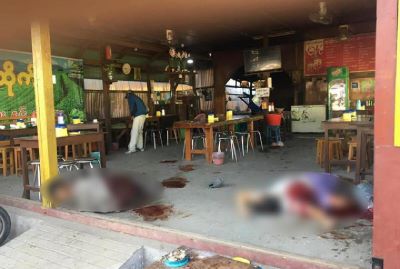
A group of gunmen in a car opened fire on Htoo Htike San Tea Shop in Hopin, Monyin Township, Kachin State, this morning killing five people and wounding eight others.

“Five people died and eight were injured. The dead are a monk from Nantyin, three men and a young woman from Shwe Pwint Hlwa Printing House. Preparations are being made for their cremations,” said U Myo Aung of a local free funeral service society.   

The shootings occurred after 9 am today. The gunmen arrived in a van before the tea shop, shot those sitting at the tea shop and drove away to Myitkyina.

“We heard around five rounds of gunfire. The incident happened very fast. The car they were riding seemed to be a van. The whole tea shop was stained with blood. The workers and children were also wounded. The tea shop and all the nearby shops have closed,” said a local resident.

The driver of an ambulance said the five injured were sent to Myitkyina Hospital and one was is in critical condition because of a bullet wound in the head.

In Kachin State, 33 administrators, village heads and civilians have been killed since May 9.

By Tun Lin Aung (Myitkyina)

Published : November 08, 2021

By : Eleven Media

Japanese companies pitch decarbonization tech at COP26 #SootinClaimon.Com

#SootinClaimon.Com : ขอบคุณแหล่งข้อมูล : หนังสือพิมพ์ The Nation.

https://www.nationthailand.com/international/40008539


■Monitoring from space

At the COP26 venue, participating countries have set up pavilions to showcase their environmental initiatives. At the Japan Pavilion organized by the Environment Ministry, 16 Japanese companies and organizations are promoting their technologies and products. At this year’s COP26, some business seminars and events are also being held online for the first time, making it possible for about 30 companies to participate from Japan.

Technologies for capturing and monitoring greenhouse gas emissions have attracted attention at the pavilion.

Mitsubishi Heavy Industries, Ltd. pitches its carbon dioxide capture and storage technology. The technology is designed to collect CO2 from exhaust gas generated by thermal power plants and other factories by using a special liquid, which absorbs CO2, and then to compress and store the captured CO2 underground or in the deep sea. The company said this technology has the capability to capture more than 90% of the CO2 in exhaust gas. The technology has been adopted at 13 locations around the world, holding a 70% global share. MHI aims to take COP26 as an opportunity to expand its market further.

Reuven Carlyle, a member of the Washington State legislature who visited the Japan Pavilion, expressed his surprise at such advanced technology, saying it could contribute to decarbonization efforts around the world.

Sumitomo Forestry Co. and IHI Corp. have jointly promoted their system to monitor areas of land that are prone to generate greenhouse gases, observing them from space and on the ground. The two companies have developed the world’s first system to better conserve forests by monitoring soil moisture and vegetation, using a space satellite and other means. The system is currently in operation on 125,000 hectares of land in Indonesia. The companies hope to expand their initiative to other countries and regions.

■ Longer drive range

Energy sources that do not emit greenhouse gases and energy-saving technologies also have drawn strong interest among COP26 participants.

Panasonic Corp. is presenting its fuel-cell system that uses hydrogen at factories and commercial buildings. Combined with solar power generation, this system aims to generate up to 10,000 kilowatts or more of electricity without emitting greenhouse gases. The company intends to put it to practical use in 2030 or later with an eye toward adoption of the system in locations such as large semiconductor factories and storage battery plants.

“There has been strong interest [in the system] mainly from oil-producing countries that are trying to shift their industry focus,” said Shoji Kusumoto, director of Panasonic’s Environmental Management Department.

Hitachi, Ltd., which became a COP26 sponsor this year in a first for the company, is exhibiting its in-wheel motor system, in which a motor is built into the wheel of an electric vehicle. As the in-wheel motor directly powers the wheels, the vehicle has better energy efficiency than conventional EVs, which use axles to transmit power to the wheels, increasing the range on a single charge by about 50%.

According to the International Energy Agency, annual investment of $4 trillion (about ¥450 trillion) in clean energy is required worldwide to achieve decarbonization. Japan is also likely to see a growing need to sell decarbonization technologies overseas from the viewpoint of its growth strategy.

By Ryosuke Terunuma / Yomiuri Shimbun Staff Writer

Published : November 08, 2021

By : The Japan News

[South Korea] 2,844 people caught drunk driving in 1st week of living with COVID-19: police #SootinClaimon.Com

#SootinClaimon.Com : ขอบคุณแหล่งข้อมูล : หนังสือพิมพ์ The Nation.

https://www.nationthailand.com/international/40008537


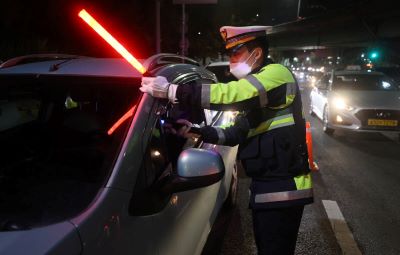
A total of 2,844 people were caught drunk driving in the first full week last week since the country eased virus curbs to gradually return to normalcy under its “living with COVID-19” scheme, police said Monday.

Of them, 514 were caught Saturday, 427 on Friday and 417 on Sunday, and total of 2,091 people had blood alcohol content levels high enough to have their license revoked while the remaining 753 with levels warranting license suspension, according to the National Police Agency.

South Korea began the first of three stages to gradually phase out coronavirus restrictions Monday last week, as more than 70 percent of the population had been fully vaccinated.

Under the first phase, operation hour curfews on cafes and restaurants have been fully lifted, while ceilings on private gatherings have been raised to a maximum of 10 people in the greater Seoul area and 12 in other regions.

The authorities also adopted the “vaccine pass” system, in which visitors have to show they have been fully vaccinated or have a negative test result when they enter high-risk facilities, like nightlife establishments, allowed to operate until midnight under the first phase. (Yonhap)

Published : November 08, 2021

By : The Korea Herald

China completes RCEP preparations #SootinClaimon.Com

#SootinClaimon.Com : ขอบคุณแหล่งข้อมูล : หนังสือพิมพ์ The Nation.

https://www.nationthailand.com/international/40008536


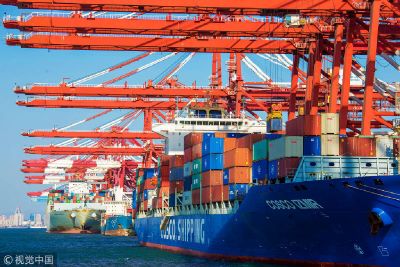
Chinas readiness to fully implement the Regional Comprehensive Economic Partnership agreement will encourage free trade and create new space for win-win cooperation, government officials and business leaders said on Sunday.

The Ministry of Commerce announced over the weekend that the country has completed all due preparations for implementing committed tariff reductions, adjustments on the rules of origin for goods, and software system updates at customs authorities to ensure smooth tariff reductions under the RCEP framework.

China will be able to fully meet its obligations when the RCEP comes into effect at the start of next year, said Yu Benlin, director-general of the ministry’s department of international trade and economic affairs.

The ministry confirmed last week that six member countries of the Association of Southeast Asian Nations, including Singapore, Thailand and Vietnam, and four non-ASEAN countries-China, Japan, New Zealand and Australia-had formally submitted their RCEP ratifications to ASEAN’s secretariat, meeting the conditions for the deal to come into force in those 10 countries at the start of next year.

Yu said the RCEP-the world’s biggest trade pact by GDP-is designed to remove as much as 90 percent of the tariffs on goods traded between signatories within a decade of coming into effect. It is set to significantly boost trade and foster wider market access in finance, transportation, education and tourism services.

The Ministry of Commerce and other government agencies have completed preparations for the implementation of all 701 binding obligations involving China under the RCEP, Yu added.

A total of 166,000 Chinese entrepreneurs, trade and customs officials and related personnel have completed RCEP training in over 600 training sessions and online training courses.

The RCEP will further stabilize industrial and supply chains in the Asia-Pacific region when it comes into effect, ensure free trade and regional connectivity and contribute to the world’s economic recovery, said Dang Yingjie, deputy director-general of the national office of port administration at the General Administration of Customs.

China’s foreign trade volume with other RCEP participants surged 19.3 percent year-on-year in the first three quarters of this year, data from the administration showed.

Lensey Chen, president of the China arm of Novozymes, a Danish biological solutions provider and a second-time exhibitor at the ongoing China International Import Expo, said the company exports a large number of products manufactured at its factories in Tianjin and the provinces of Jiangsu and Liaoning to other RCEP economies.

“For example, our products applied in the detergent industry are exported to many RCEP countries, like Indonesia, Malaysia, the Philippines, Thailand, Vietnam, Japan and South Korea,” Chen said, adding that the company is studying RCEP policies and hopes to make full use of the favorable policies brought about by the framework.

“We are pleased to see the RCEP is about to take effect, especially as global trade has been under a severe impact from the pandemic,” said Deserine Lim, assistant general manager of branding and strategic marketing (North Asia) at Singapore-based health product company OSIM.

Implementation of the RCEP will create a better business environment and more opportunities for Singaporean companies, with reduction in trade costs, facilitation of customs clearance and more transparency in government policies, she said.

The RCEP was officially signed on Nov 15 last year.

Its 15 member countries have a total population of 2.27 billion and a total GDP of $26 trillion. Their combined exports stand at $5.2 trillion, accounting for around 30 percent of the world’s total economic output, data from the Ministry of Commerce showed.

By ZHONG NAN

Published : November 08, 2021

By : China Daily

Vietjet, Airbus ink a strategic cooperation agreement for 119 aircraft #SootinClaimon.Com

#SootinClaimon.Com : ขอบคุณแหล่งข้อมูล : หนังสือพิมพ์ The Nation.

https://www.nationthailand.com/international/40008511


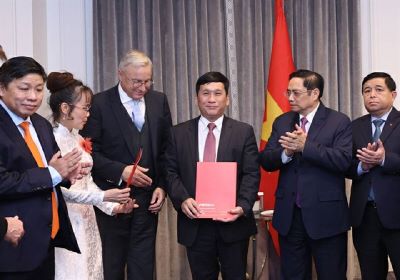
PARIS  – Vietjet and Airbus have inked a strategic partnership agreement on the delivery timeline for 119 aircraft of the airline’s existing backlog and cooperation for the development of Vietjet’s wide-body fleet together with other supporting terms for the airline post COVID-19 period.

Both sides have agreed on further support and training for the airline’s technicians and engineers while accelerating Vietjet’s Training Academy development for simulators, safety management programmes, and flight management training.

The agreement was announced during the official visit of Việt Nam’s Prime Minister Phạm Minh Chính and high-ranking dignitaries’ delegation to France. 

Vietjet will take delivery and operate up to three leased A330 aircraft in November as part of the airline’s wide-body fleet development plan under its LCC model operation, the airline said in a statement. 

“We are pleased to reach this agreement with Vietjet,” said Christian Scherer, Airbus Chief Commercial Officer and Head of International.

“It’s another example of how we have worked together with our customers to find solutions to adapt to the impact of the pandemic. With its modern and efficient Airbus fleet Vietjet will be well equipped to benefit from the rebound in air travel in Asia, where we see strong pent-up demand,” he said. 

“Our cooperation today again acknowledges both parties’ long-term and sustainable relationship, which is now elevated to a strategic and comprehensive partnership. I believe that the add-on of the A330s will surely enhance our fleet’s technical reliability, operational efficiency and flight range to better meet travel demand of our flyers in the future,”  Vietjet Managing Director Đinh Việt Phương said.

The agreement also covers a variety of other aspects such as aircraft’s equipment supply and services, comprehensive aviation training, consultation, and development of MRO facilities for Vietjet and in the region together with other initiatives for fuel efficiency and sustainable development. — VNS

Published : November 07, 2021

By : Vietnam News

M’sia, Australia to work closely on cybersecurity #SootinClaimon.Com

#SootinClaimon.Com : ขอบคุณแหล่งข้อมูล : หนังสือพิมพ์ The Nation.

https://www.nationthailand.com/international/40008510


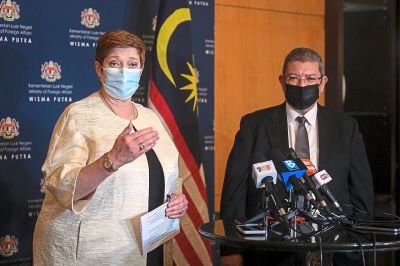
KUALA LUMPUR: The importance of cooperation in cybersecurity was among the issues discussed at the 4th Malaysia-Australia Annual Foreign Ministers’ Meeting (AFMM) here.

Foreign Minister Datuk Saifuddin Abdullah said cybersecurity is now the leading non-traditional security threat in the world, involving many sectors such as corporate, government and defence.

“There was a general understanding, between the two of us, that our people should start talking to each other on some of these issues.

“I offered the professional agency that we have – Cybersecurity Malaysia – as probably the organisation to start the discussion rolling,” he told a joint press conference after co-chairing AFMM with his Australian counterpart Senator Marise Payne.

The meeting was the first AFMM after the Prime Ministers of Malaysia and Australia launched the Comprehensive Strategic Partnership (CSP) on Jan 27 this year.

Payne said Australia launched an International Cybersecurity and Critical Technologies Engagement Strategy earlier this year, and the country wants to work closely with Malaysia on that.

“We are both very conscious that our communities need to be safe online. That includes through the good and the bad of the impact of social media on our communities, particularly on girls and women.

“This is something that I look forward to working together with Malaysia,” she said.

On bilateral trade, Payne acknowledged that there has been some decline, but added that Australia and Malaysia have the advantage of the CSP, which enables both countries to work under its pillar of economic prosperity, reported Bernama.

“We have a high degree of complementarity between our two economies and using this CSP to maximise (it) is the key,” she said.

Apart from the existing free trade agreements involving both countries, namely the Malaysia-Australia Free Trade Agreement and the Asean-Australia-New Zealand Free Trade Area, Payne said Australia had also ratified the Comprehensive and Progressive Agreement for Trans-Pacific Partnership that would be part of driving trade and economic recovery.

Payne is on a three-day working visit to Malaysia until today.

During her visit, she is also scheduled to hold meetings with Defence Minister Datuk Seri Hishammuddin Hussein and Health Minister Khairy Jamaluddin.

Published : November 07, 2021

By : The Star

Myanmar jade traders squeezed between junta and rebels #SootinClaimon.Com

#SootinClaimon.Com : ขอบคุณแหล่งข้อมูล : หนังสือพิมพ์ The Nation.

https://www.nationthailand.com/international/40008509


Myanmar jade traders are running from junta troops and dodging rebel attacks to sell dwindling volumes of the green gemstone, as the billion-dollar industry loses its shine months on from the coup.

Myanmar jade traders squeezed between junta and rebels

The Southeast Asian country has been mired in chaos since the February putsch, with the military trying to crush widespread democracy protests and the economy in crisis.

Fighting around the Hpakant jade mine in northern Kachin state — the largest in the world — has squeezed digging already hampered by the pandemic, cutting supplies of one of the country’s most lucrative exports.

Myanmar is the world’s biggest source of jade, with the industry largely driven by insatiable demand for the translucent gem from neighbouring China.

Most stones pass through the second city of Mandalay, home to the 23-metre (75-feet) high Kyauksein Pagoda, a Buddhist shrine built using thousands of kilograms of the precious stone.

Now the complex is quiet, with just a handful of worshippers praying at its gleaming turquoise and red dome.

“Business is not good at all,” said one jade trader, who spent months trying to sell his stones on Mandalay’s roadsides as the pandemic and unrest closed its main jade market.

“Sometimes, people panic when soldiers come patrolling, and they run … If one person runs, others start running. Then soldiers fire warning shots to control the situation.”

‘Your lives are in danger’

Two days later the market re-opened and authorities began collecting fees again — one of the many levied on the gem that finance both sides of a decades-long civil war between armed ethnic groups and the military.

It is “nearly impossible” to purchase Myanmar jade without providing money to the military and its allies, according to watchdog Global Witness.

With widespread and often violent resistance against the generals — who regularly appear in public sporting rings set with high-quality jade — working with the stone has taken on a new danger.

“If you continue doing your trading business… We strongly warn that your lives are in danger,” read one notice posted by Generation Z Power, a local dissident group, days before the market re-opened.

A bomb exploded near the market a week after the traders returned and while there were no casualties the same group promised to set off more if people continue trading there.

Despite the threats, the market is regaining some of its former bustle. 

Sitting at a small camp table examining a fist-sized rock with a flashlight, one man talks into a smartphone in Mandarin. 

Beijing has shuttered its border with Myanmar because of the pandemic and sporadic fighting along the frontier, but demand is still huge — and Chinese buyers are using the unrest to drive a hard bargain.

“Because of Covid and the political situation, they are giving very low price,” said one 62-year-old dealer who did not want to give his name.

“But we have no choice. We need them for the market. If they do not buy or if we do not sell, we have no place to rely on for this business,” he added.

Fear of next blast

“The price is going down,” said Myo Min Zaw, who also spent his months outside the market traipsing around hotels frequented by Chinese buyers in search of a sale.

“A stone worth 10 lakh (US$550) only sells for around 5 lakh nowadays.”

Before the coup, 70 to 90 percent of all jade mined in Hpakant was smuggled to China without ever entering the formal system in Myanmar, according to Global Witness.

Since the putsch, and with fighting flaring around the mines, figures from the shadowy world are even harder to come by, says Hanna Hindstrom, senior campaigner for Myanmar at the group.

“We’ve heard that prices in China have risen as demand is high and supply reduced,” she said — increasing competition between the rebel groups and military-aligned militia who stock the emporiums with high-quality jade.

For Thandar, who runs a small jade bead workshop across the river from Mandalay, selling her modest wares to local customers has just got more dangerous.

“We worry if we have to go to the market,” she told AFP.

“We all are afraid of when the blast will come… We cannot avoid going there because of our living.”

A second blast hit the market on Thursday, killing a police officer, local media reported, and sending traders fleeing.

The same day authorities announced that any shop in the complex that failed to re-open by November 5 would be “temporarily seized”. 

“We are stuck in the middle,” said Aung Aung, using a pseudonym.

“The market said they will take the shops if owners do not open. People’s Defence Forces have asked us not to do business in the market.”

Published : November 07, 2021

By : The Jakarta Post

Political dynasties ‘not bad’ and are here to stay – Duterte #SootinClaimon.Com

#SootinClaimon.Com : ขอบคุณแหล่งข้อมูล : หนังสือพิมพ์ The Nation.

https://www.nationthailand.com/international/40008508


MANILA, Philippines — Political dynasties are “not bad” and are here to stay — unless the Consitution and culture are changed, President Rodrigo Duterte said in his speech on Saturday at the inauguration of the Siargao Island Sports and Tourism and the Catangnan-Cabitoonan Bridge in Surigao del Norte.

The event was aired by government channel PTV.

Duterte made the remark as he noted that the politicians in Surigao del Norte bear the same surname — Matugas.

He was referring to 1st District Rep. Francisco Jose Matugas II, Gov. Francisco Matugas ,and Provincial Administrator Sol Matugas.

“You know, no offense intended, we are all the same,” Duterte said, referring to being a part of a political dynasty. Three of his children hold elective positions in Davao City — Sara Duterte-Carpio and Sebastian Duterte as mayor and vice mayor, respectively, and Paolo Duterte as 1st District representative.

“But the provision in the Constitution about political dynasty, it will never push through no matter how hard they try,” the president added.

“Unless you change the whole picture, unless you change the constitution, unless you change the culture — then maybe you can. But if we stay like this, we will have dynasties. And dynasties are not bad,” he continued.

Duterte noted that there was a strong consensus among the people of Davao City to elect his relatives.

“When I stepped down as mayor, I had three terms. I told the people, I called the barangay leaders: ‘It’s time to choose who would replace me’,” Duterte recalled.

“You know, even the leader of our group, Hugpong, unanimously they wanted Inday [Sara]. Then for congressman, majority of the barangay captains wanted Pulong [Paolo]. And there’s one vice mayor, it’s decided by his elder sister, Inday,” he continued.

Published : November 07, 2021

By : Philippine Daily Inquirer