Beijing Yuannian Technology Co Ltd, a provider of financial management software and services designed for enterprise information management, is speeding up efforts to help accelerate the digital transformation of Chinese enterprises.
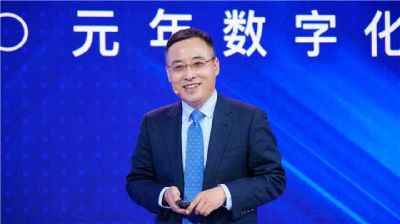
The digital transformation is driven by a new generation of information technologies, including big data, cloud computing, artificial intelligence and internet of things, said Han Xiangdong, CEO of Yuannian Technology, while highlighting the importance of the data-driven transformation in enterprise management.
Han said digitization has greatly helped companies optimize the business process and improve management efficiency, and also revolutionized the communication modes between customers and enterprises as well as the internal management and operation model of enterprises, thus creating new business models.
Nowadays, more and more companies have recognized that digital technologies have become an important driving force for the transformation of enterprises.
According to Han, Yuannian Technology has established its own Platform as a Service (PaaS), which plays a vital role in promoting the digital transformation of enterprises, and solving the problems of the management of several cloud platforms. It has been applied in the fields of real estate, retail, finance and energy.
PaaS is a cloud computing model in which a third-party provider delivers hardware and software tools — usually those needed for application development — to users over the internet. A PaaS provider hosts the hardware and software on its own infrastructure.
Han said the biggest problem for enterprises is how to combine technologies, such as the underlying cloud platform and artificial intelligence algorithm technology with business management.
Yuannian Technology has been engaged in management accounting for nearly 20 years, and stepped up efforts to expand its presence in the digitization of enterprise management in recent years.
According to market consultancy International Data Corporation, the worldwide public cloud Infrastructure as a Service (IaaS) and PaaS market is forecast to have revenues of $400 billion in 2025 with a compound annual growth rate of 28.8 percent during the 2021-25 forecast period.
By 2022, IDC anticipates that almost half of an enterprise’s products and services will be digital or digitally delivered, increasing business reliance on infrastructure such as computing, storage and networking, to support more than just traditional business applications.
Netflixs runaway hit “Squid Game” will be back for a second season, its writer-director Hwang Dong-hyuk has said in a media interview.
“There’s been so much pressure, so much demand and so much love for a second season, so I almost feel like you leave us no choice, but I will say there will indeed be a second season,” Hwang said in an interview with the Associated Press at an event in Los Angeles on Tuesday (US time).
The South Korean director had previously hinted at the possibility for another season in media interviews but had not confirmed the plan.
“It’s in my head right now. I’m in the planning process currently,” Hwang said. “But I do think it’s too early to say when and how that’s going to happen. So I will promise you this, Gi-hun will be back, and he’ll do something for the world.”
The Korean-language thriller is about contestants competing in deadly Korean children’s playground games to win 45.6 billion won ($38.5 million) in prize money. Released in September, the nine-part series became the most popular Netflix original show in any language, attracting more than 140 million households over the first four weeks of release. (Yonhap)
DAVAO CITY, Davao del Sur, Philippines — Davao City Mayor Sara Duterte on Tuesday backed out from her reelection bid, raising fresh expectations from her supporters that she would seek a national post in the 2022 general elections despite her recent denials.
Astatement by Sen. Bong Go that there might be changes in his own plans to run as the candidate for vice president of a faction of the ruling Partido Demokratiko Pilipino-Lakas ng Bayan (PDP-Laban) hardened speculation that she would run either for president or for vice president.
Duterte went to the local office of the Commission on Elections (Comelec) on Tuesday afternoon to withdraw her certificate of candidacy (COC) for mayor that she filed on Oct. 2 under the regional party Hugpong ng Pagbabago (HnP), which she heads.
Earlier in the day, her brother, Sebastian “Baste” Duterte, withdrew his own COC for vice mayor, telling journalists that it was upon her instruction so that he could substitute for her as candidate for mayor. He made the substitution an hour after she withdrew her COC. Councilor Jay Melchor Jr., son of chief presidential legal counsel Melchor Quitain, in turn substituted for him as candidate for vice mayor.
“This afternoon, I am withdrawing my candidacy for mayor of Davao City. [Vice Mayor] Baste will replace me. This is all for now. Thank you very much,” Duterte said in a brief announcement on social media that did not provide details about her political plans.
Go: Politics ‘very dirty’
Speaking at the opening of a Malasakit Center in Antipolo City also on Tuesday, Go, a longtime aide of President Rodrigo Duterte, said changes about who will be running for certain positions were now affecting his own political plans.
“You know, politics is messy. There were many things that happened in the past days that I didn’t like, that you wouldn’t understand. My candidacy for vice president may change,” he said in an emotional speech
He said politics “is very dirty.”
He spoke around noon, hours after the president’s son withdrew from the vice mayoral race in Davao City and before the mayor announced her withdrawal from the race for a third term.
“You are here willing to serve your fellow Filipinos, yet there are changes that I have no control over,” he said, tearing up.
He said he had wanted to serve as vice president, which the president had desired, but there were things he had to keep away from.
“You will know about that in the coming days,” he added.
He said that if it were up to him, he would run for vice president “100 percent,” but the PDP-Laban may have other plans.
Family plans
“It’s possible the party will have decisions in the coming days. Changes are possible,” he said, adding that plans could change due to substitutions.
Asked to comment about the withdrawal of the Duterte siblings’ COCs, he said he didn’t want to speculate on “the plans of the family.”
“I belong to a party with President Duterte. It is his decision and the decision of the party for me to run as vice president,” he said.
There has been a strong clamor by supporters of the President for his daughter to succeed him supposedly to continue his “legacy.” She has topped surveys for the preferred president.
A national movement such as the Sara All Philippines 2022 has been consistently pushing her to heed their call to run for president.
As the Oct. 8 deadline for the submission of candidacy documents drew near amid expectations that she would withdraw her mayoral bid and go for the presidency, Duterte didn’t show up on the last day of the filing of COC.
Sen. Ronald dela Rosa, who filed his COC as PDP-Laban’s presidential bet, has openly said he preferred Duterte to run instead of him.
‘National caravan’
On Oct. 25, the two met but Duterte remained tight-lipped about her plans and next moves. She said she thanked the former chief of the Philippine National Police for his “advice and words of wisdom” during their meeting.
Last week, she asked Sara All to drop a planned national caravan from Mindanao to Manila in a last-ditch effort to convince her to run for president.
Duterte told the organizers that the plan was unwise because of the pandemic and money spent for it could be used to help the poor. Besides, she said, her decision not to run for president was already made as early as Sept. 10 when her father accepted PDP-Laban’s nomination as its bet for vice president. The President later announced that he wasn’t running after all.
She explained that her family agreed that only one member should seek a national post in 2022.
On Aug. 25, as the President and Go seemed to have made their own political moves contingent on her still unknown plans for 2022, the Davao mayor indicated reservations about running for the presidency.
“I am not a ‘last two minutes person.’ I think, I organize and I implement accordingly,” she said in a statement then.
Team-up with Marcos?
Duterte first talked about plans for 2022 in July following a meeting with Cebu Gov. Gwendolyn Garcia. She told reporters in Cebu that she was already open to the idea of seeking the presidency.
At that time, HnP and other so-called parallel groups appeared all set for her presidential run.
In June, HnP secretary general Anthony del Rosario admitted to the Inquirer that even as Duterte had not made up her mind to run for president, the party had already firmed up alliances with other parties, among them the Lakas-Christian Muslim Democrats, National Unity Party, Nacionalista Party, Pwersa ng Masang Pilipino and the People’s Reform Party.
After Duterte disclosed her decision on Tuesday to withdraw as mayoral candidate, the President’s supporters speculated she would either run in tandem with Ferdinand Marcos Jr. or against him and the other presidential contenders.
When the president accompanied Go on Oct. 2 to file a COC for vice president, he said the administration ticket for 2022 is “Sara-Go.”
The mayor has disclosed that Go had sought to be her running mate should she run for president in 2022.
Last month, she met Marcos in Cebu. She admitted their discussions included how HnP could help his presidential bid.
The statement has fueled another round of speculation that she would run as Marcos’ vice president, which would pit her against Go.
—WITH REPORTS FROM LEILA B. SALAVERRIA AND DAPHNE GALVEZ
HANOI/JAKARTA — The lifting of Japan’s ban on some new foreign arrivals opens the door to Southeast Asian workers who have been waiting to fly to the country for the government’s technical intern training program.
Of the 350,000 trainees in Japan as of the end of June, most came from Southeast Asian countries — about 200,000 hailed from Vietnam.
“I want to make money quickly so I can send funds back to my family,” said Nguyen Thi Huong, 19, who plans to work at a seafood processing plant in Aichi Prefecture.
Nguyen had been working at a garment factory in northern Hai Duong Province while waiting for the entry ban to end, but the factory closed due to the impact of the pandemic.
Trinh Tuan Anh, another trainee, had to change his plans when the company he was supposed to work at in Japan went bankrupt in November last year.
Trinh, 26, was later hired by a construction company but was not able to travel to Japan because of the entry ban. “If I can’t go to Japan now, I may not have another chance,” he said.
Since the start of Japan’s pandemic-related entry restrictions in January, a Hanoi agency that dispatches trainees has sent more than 1,000 applicants back to their hometowns and made them take Japanese language lessons online.
An agency official said, “Business has been tough because the entry ban meant fewer trainees,” adding that the agency would start sending trainees to Japan again by the end of this month at the earliest.
About 30,000 trainees in Japan hail from Indonesia, where preparations are underway to start sending workers again.
Twenty people were practicing Japanese on Friday at an agency in Bekasi, West Java, that dispatches trainees.
Muammar Fikri, 23, who was hired by a dairy company in Japan in January, said he studied Japanese for three hours a day.
“I want not only to learn dairy farming skills [in Japan] but also expand my network of contacts in preparation for when I return home.”
By Shinsuke Yasuda and Daisuke Kawakami / Yomiuri Shimbun Correspondents
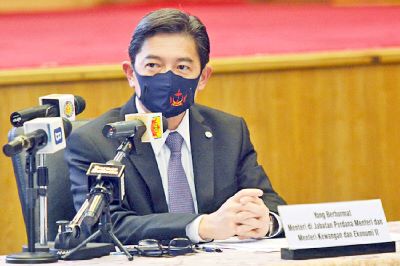
Businesses such as restaurants, cinemas and salons will be allowed to re-open for fully vaccinated individuals on November 19, as the country moves into the Transition Phase, said Minister at the Prime Minister’s Office and Minister of Finance and Economy II Dato Seri Setia Dr Awang Haji Mohd Amin Liew bin Abdullah yesterday.
The minister said the Transition Phase will begin as soon as the Sultanate achieves full vaccination coverage of 70 per cent of the total population of the country on November 19.
“During this Transition Phase, we need to constantly work together and remain cautious as we adhere to the policies, the law and established guidelines, so as to curb COVID-19, while at the same time ensuring that the security agencies continue their monitoring on any protocol violations.
“This is because studies have found that this virus cannot be wiped out, and could again spread rapidly if we do not adhere to directives,” said the minister.
Gatherings in public places, such as sport facilities will be allowed, and commercial premises such as restaurants, cafes, food courts, cinemas, arcades, indoor playgrounds, beauty premises (such as salons and barber shops), markets and tamu will be permitted for individuals who are fully vaccinated.
Government offices will also be re-opened, said the minister and will be staffed by personnel who have completed their vaccinations.
Office hours are set from 8am to 2pm. Employees will have to undergo Antigen Rapid Test (ART) screening every two weeks.
Mosques, suraus and religious halls nationwide will also be re-opened for individuals who have completed their vaccinations, with attendance limits to be determined by suitable numbers based on physical distancing.
Business and other premises will still have capacity limits of 50 per cent or no more than 200 people, whichever is the lesser number.
The capacity limits also apply to places of worship for other religions.
The management of premises is required to ensure that their employees are to be fully vaccinated, as well as to update the list of workers in the Bruhealth app.
QR code requirements remain in effect, with premises still needing to register their QR codes and to ensure all individuals entering scan the code with their BruHealth app.
This includes all staff, personnel or volunteers.
The minister reminded premises must ensure only individuals with green or yellow Bruhealth codes are allowed to enter; and to ensure the wearing of face masks except when eating and drinking. Other protocols such as physical distancing of at least 1.5 metres, self-health monitoring and occasional ART testing, as well as ensuring that premises have adequate ventilation remain in effect.
Gatherings in private homes during the Transition Phase, is permitted for individuals who have completed their vaccinations and is limited to only 10 to 30 people depending on the size of the residence, said the minister.
Some schools will also re-open for individuals who have completed their vaccinations and are conducting ART screening tests at regular intervals of every two weeks such as higher education institutions, technical and vocational schools, and driving schools.
The minister said mandatory vaccination requirements also extend to the teaching workforce, non-teaching school staff, guardians at school, children’s daycare centres, trainers and so on, except those who have been exempted due to health conditions such as allergies.
Those who have been medically exempted from taking vaccinations are not allowed to enter the above mentioned premises during this phase.
Procedures for the re-opening of schools, children’s daycare centres and other learning institutions will be announced at a later date, said the minister, adding individuals aged 12 to 17 are still being vaccinated and children below 12 have yet to be vaccinated.
“Every business premise allowed to open during the Transition Phase is required to abide by guidelines and protocols that have been introduced,” said the minister.
He said that the use of ART prior to entering premises is also encouraged. The minister hoped that sufficient time will be accorded to stakeholders to make logistical preparations prior to the start of the de-escalations.
He also advised individuals who are able to receive the second dose to get it as soon as possible so as to help reach the target of 70 per cent of the population who have completed two doses of vaccination.
Meanwhile, as preparation for the implementation of the endemic phase, the steering committee is looking into the proposal to impose a fee for the ART test for individuals that have not completed their vaccinations but who intend to enter government or business premises.
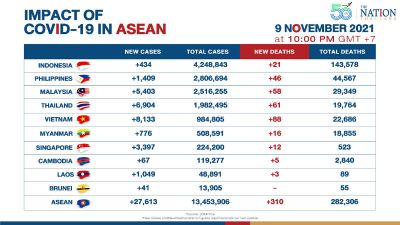
The number of Covid-19 cases crossed 13.45 million across Southeast Asia, with 27,613 new cases reported on Tuesday (November 9), higher than Monday’s tally at 26,859. New deaths are at 310, increasing from Monday’s number of 286. Total Covid-19 deaths in Asean are now at 282,306.
Laos’ Public Health Ministry announced that it will provide at least 70,000 doses of booster shot to health professionals during January and February next year, as people in this group have the highest risk of contracting Covid-19 from treating infected patients. The country reported 1,049 new cases and 5 deaths on Tuesday, bringing cumulative cases in the country to 48,891 patients and total 89 deaths.
Meanwhile, Singapore’s Ministry of Health said that from Dec 8, all Covid-19 patients who are unvaccinated “by choice” will have to pay their own medical bills if they are admitted to hospitals or Covid-19 treatment facilities. The new rule will apply to patients who are eligible for vaccination but choose not to do so. Those who are partially vaccinated will have their medical bills paid for by the government until December 31 to allow them time to be fully vaccinated.
BEIJING — The 19th Central Committee of the Chinese Communist Party started its sixth plenary session Monday behind closed doors in Beijing.
The committee is expected to adopt on Thursday, the final day of the session, a resolution on the party’s 100 years of history titled “the resolution on the major achievements and historical experience of the Party’s 100 years of endeavors.” Chinese President and CCP General Secretary Xi Jinping, who is seeking to launch a third term in office at next year’s CCP national congress, is making strategic moves to strengthen his authority.
Resolutions related to history carry heavy weight within the party. In the past, only national founder Mao Zedong and Deng Xiaoping, who promoted polices of reform and opening up, have led the adoption of such resolutions.
By leading the resolution, only two of which have been compiled in the past, Xi has been given the authority to sum up the party’s history, granting him even more prestige as the party leader.
The current plenary session will be the first since October last year to discuss the party’s key policies and personnel affairs. Held behind closed doors, it will be attended by the seven members of the party’s Politburo Standing Committee — China’s highest-ranking leadership team, of which Xi is a member — as well as members of the Politburo, ministers and top local leaders. On the final day, the results of the discussions will be announced through the state-run Xinhua News Agency and other media.
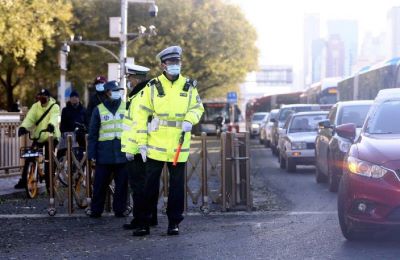
Vehicles were restricted Monday morning in the vicinity of the Jingxi Hotel guesthouse in central Beijing, which is believed to be the venue of the session. More than 20 police vehicles were deployed and officers kept an eye on passersby.
■ ‘Core figure’
“On the new journey, Xi is undoubtedly the core figure in charting the course of history,” Xinhua said about Xi in an article released Saturday. It referred to poverty eradication and anti-corruption campaigns and the Belt and Road Initiative as examples of his achievements.
Xinhua also emphasized Xi’s leadership, saying he has dealt with trade tensions between China and the United States and been personally involved in regular patrols in the waters off the Senkaku Islands in Okinawa Prefecture.
After the new resolution is adopted, a propaganda campaign is expected to begin to position Xi as a leader following Mao and Deng.
■ Shifting personnel
The sixth plenary session will serve as a platform for Xi’s third term in office, which he is expected to launch, in a break with custom, at the 20th party national congress slated for next year. The party is also expected to begin reshuffling its top officials after the session.
The Hong Kong daily Ming Pao quoted a source as saying that Shanghai Party Secretary Li Qiang and Guangdong Party Secretary Li Xi, both close aides to Xi, will be transferred to Beijing after the plenary session.
Xi intends to put staunch supporters in key posts such as the premiership in the next CCP leadership. There is speculation within the party that by appointing Li Qiang and others to such crucial posts as vice premier, Xi is seeking to help them develop a track record.
■ Not according to plan
In 2016’s sixth plenary session during his first term in office, Xi was given special status as the “core” leader. He has since solidified his system of individual dominance based on that authority. In addition to adopting a history resolution at the current session, Xi is expected to demonstrate his intention to lead an extended regime by touting a long-term policy goal of “common prosperity,” aimed at enriching the entire population after the eradication of poverty.
However, not everything may go as hoped. A clampdown on private enterprises, the acceleration of decarbonization and the tightening of regulations on cram schools for elementary and junior high school students — all policies on which Xi is said to have taken the initiative — have led to turmoil in corporate activities and many unemployed people.
The U.S.-led coalition against China has grown stronger in response to Xi’s hard-line stance toward Taiwan, creating domestic troubles and external threats.
A Chinese government official said “some in the party and the government are skeptical” about Xi’s new policies. Some senior party members who are still influential despite their retirement are said to be concerned about the excessive concentration of power in Xi.
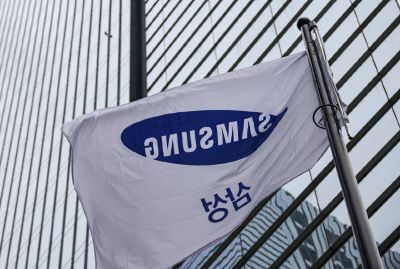
Samsung Electronics Co. and SK hynix Inc. on Tuesday submitted information on their chip businesses to the United States but withheld some key data considered trade secrets in an apparent delicate balancing act.
The two South Korean chipmakers made the filings about two months after the US Department of Commerce requested data on the ongoing chip crisis that has hobbled global automakers and other electronic product manufacturers.
Washington had asked major chipmakers to “voluntarily” share business information by Nov. 8 to address the issue, following President Joe Biden’s executive order that directed “several federal agency actions to secure and strengthen America’s supply chains” for key products.
“After discussing with the Commerce Department, we did not submit customer information because contract terms do not allow us to disclose it,” Samsung said.
SK hynix also said they closely consulted with the department and shared information “in a way that we can protect the trust relationship with our customers.”
The comments by Samsung and SK hynix were not made immediately available for public viewing on the US government website on federal decision making as of Tuesday morning.
The two companies said they minimized the submission of sensitive information on customers, sales and inventory details.
Israel’s foundry firm Tower Semiconductor also refrained from disclosing some data, such as backlog specifics, product attributes and past month sales, citing “non-disclosure agreements with our customers.”
The US information request had spawned concerns about the possible leak of what chipmakers consider major trade secrets, as questions touch upon a wide range of issues, including investment, inventories, pricing, capacity expansion plans, customers and sales.
It also had raised questions on how to answer those sensitive questions while complying with filings and information disclosure rules required for publicly traded companies.
While the US government said the information sharing is “voluntary,” South Korean companies were under pressure to file the information as requested.
US Commerce Secretary Gina Raimondo had warned if companies did not respond to the request, “then we have other tools in our tool box that require them to give us data. I hope we don’t get there. But if we have to, we will,” according to Reuters.
Samsung and SK hynix dominate the global memory chip market with a combined market share of more than 70 percent. Samsung is also the world’s No. 2 contract chip manufacturer.
Industry Minister Moon Sung-wook left for the US on Tuesday to discuss semiconductor supply chains, steel tariffs and other pending issues.
During a three-day stay, the minister plans to meet with US Commerce Secretary Gina Raimondo and Energy Secretary Jennifer Granholm. Chip supply chains are expected to be one of their key agenda items.
Seoul and Washington have recently decided to establish a new director-level dialogue channel for regular discussions on semiconductor issues.
“We’ve fully explained the concerns to the US, and the two sides agreed to continue close consultations down the road,” the Ministry of Trade, Industry and Energy said in a statement last month. (Yonhap)
SINGAPORE – Passengers arriving from Indonesia, Vietnam, Thailand and the Philippines are among those who will see more relaxed border measures from Nov 11, the authorities in Singapore announced on Monday (Nov 8).
Travellers from these countries will be allowed to present a negative, professionally administered antigen rapid test (ART) taken within two days prior to departure for Singapore.
It is an alternative to the reverse transcription polymerase chain reaction tests currently required.
The Government on Monday also announced that 23 countries previously deemed by Singapore to be of the highest risk of Covid-19 infections, including Laos and India, will have more border restrictions relaxed.
From Nov 11, travellers from these countries will be allowed to serve a 10-day stay-home notice (SHN) at home or at a hotel of their choice. They are currently required to do so at an SHN dedicated facility.
Singapore will also add three new vaccinated travel lanes (VTLs), with Malaysia, Sweden and Finland, and increase the daily quota to 6,000 travellers in total from Nov 29. The current daily quota is 4,000 travellers.
VTL travellers will also be allowed to present a professionally administered negative ART test before flying to Singapore.
Vaccinated travellers will be able to take flights between Changi Airport and Kuala Lumpur International Airport without quarantine from Nov 29.
There will be six designated flights for quarantine-free travel between the countries for a start. Applications for the scheme will start from Nov 22.
Travellers from Sweden and Finland can also apply for VTL travel from the same date, for quarantine-free travel from Nov 29. Both Sweden and Finland already allow entry to people travelling from Singapore.
Health Minister Ong Ye Kung, who co-chairs the multi-ministry task force tackling the pandemic, said that despite rising cases in Europe, infection rates there are “not out of control” and remain lower than Singapore’s 46 cases out of every 100,000 people.
Denmark and Germany are seeing about 28 cases per 100,000 people and in Spain, the rate is below five per 100,000.
Transport Minister S. Iswaran said Singapore’s VTL experience thus far has given it the confidence to further expand the programme.
He pointed out that as at Nov 7, close to 18,000 people have entered Singapore via the VTL scheme. Of this, 17 have tested positive – about one in every 1,000.
“We will reopen in a careful and calibrated manner, with essential safeguards to protect public health,” he said.
By Clara Lock
Singapore eases border measures for more South-east Asian countries; new VTLs launched with Finland and Sweden
JOHOR BARU: After more than a year of anticipation, Malaysia and Singapore will reopen their mutual border with a special Vaccinated Travel Lane (VTL) between the Kuala Lumpur International Airport (KLIA) and Changi Airport from Nov 29.
In a joint statement, the prime ministers of both countries said the decision followed the significant progress in vaccinating their citizens and in managing the Covid-19 pandemic.
They agreed that it was timely to progressively resume cross-border travel between both countries in a safe manner.
Datuk Seri Ismail Sabri Yaakob and Lee Hsien Loong said they recognised that Covid-19 had disrupted people-to-people connections between both sides and had separated families for many months.
Under the VTL, fully-vaccinated travellers will be able to travel between Singapore and Malaysia and be subjected to Covid-19 tests in lieu of serving quarantine or a stay-at-home notice.
The joint border has been closed since March 18, 2020.
Ismail Sabri and Lee, who spoke on the phone yesterday, said they also looked forward to restoring travel across land links between both countries in the near future.
They were happy to note the good progress in the ongoing detailed discussions for a similar vaccinated travel scheme to reopen travel across the Causeway and Second Link, taking into account the public health situation in Johor and Singapore.
Ismail Sabri said the VTL was another important milestone in the longstanding Malaysia-Singapore cooperation.
“The VTL will allow travel as our two countries gradually reopen our borders responsibly by balancing the need to recover our economies while ensuring the safety and health of our peoples from Covid-19.
“I look forward to effective implementation of this travel scheme, adding to those we already have developed previously to facilitate the movement of people and goods between Malaysia and Singapore,” he added.
Lee said Singapore and Malaysia enjoyed deep, warm and multi-faceted relations and was very happy that both countries were finally able to restart cross-border travel through the VTL.
“This will help revive our economies, restore our people-to-people ties, and strengthen our bilateral relationship,” he added.
Transport Minister Datuk Seri Dr Wee Ka Siong said the announcement is welcome news for Malaysians, especially for those involved in the air travel industry, including cabin crews and airport employees.
“Hopefully the SOP, including mandatory quarantines and home quarantines, can be relaxed as there has been great progress made by both countries in terms of managing the Covid-19 pandemic and vaccination efforts,” he posted on Facebook.
Johor Baru Chinese Chamber of Commerce and Industry president Low Kueck Shin said the body hoped that the Johor-Singapore road links will reopen soon as local businesses were still reeling from a lack of visitors.
“For land travel, perhaps both governments can limit the numbers by only allowing essential travellers, to better control the situation,” he said.
Malaysia Budget Hotels Association Johor chapter chairman Jarod Chia said the VTL gave a glimmer of hope to the state’s hospitality industry, especially in the Johor Baru city area.
“While interstate travel has enabled domestic tourists to visit tourism hotspots like Langkawi, Melaka and other parts of Johor like Mersing and Desaru, the Johor Baru area is still not doing well.”

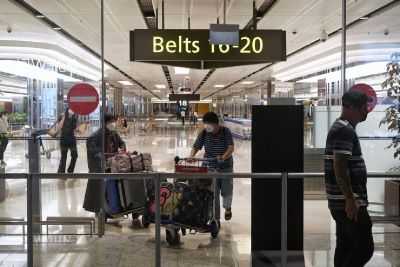
 Singapore eases border measures for more South-east Asian countries; new VTLs launched with Finland and Sweden

