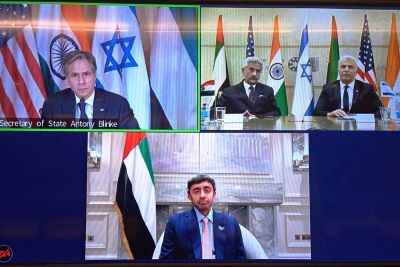
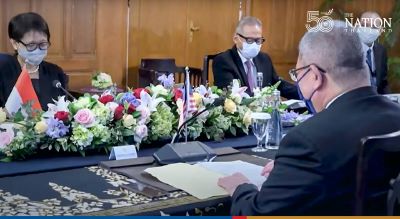
The foreign ministers of India, Israel, US and the UAE last night held the first of its kind virtual meeting to discuss the possibilities for joint infrastructure projects in the fields of transportation, technology, maritime security and economics and trade, as well as for additional joint projects.
The meeting, described in strategic circles as a ”New Quad”, was attended by External Affairs Minister S Jaishankar, who is currently in Jerusalem, Israeli Foreign Minister Yair Lapid, US Secretary of State Antony Blinken and UAE Foreign Minister Sheikh Abdullah bin Zayed Al Nahyan.
”A fruitful first meeting with Israeli APM and FM @YairLapid, UAE FM @ABZayed and US Secretary of State @SecBlinken this evening. Discussed working together more closely on economic growth and global issues. Agreed on expeditious follow-up,” Jaishankar tweeted after the meeting.
The four ministers decided to establish an international forum for economic cooperation.
The Israeli minister, who initiated the meeting, said, “Around this virtual table – there is a unique set of capabilities, knowledge, and experience that can be used to create the network that we all want to see created.”
He said, ”(I) think the word we’re looking for here is synergy, because this is what we’re going to try and create starting with this meeting. Synergy that will help us work together on infrastructure, digital infrastructure, transport, maritime security and other things that preoccupy us all.”
During the meeting, the ministers discussed a range of issues, including climate change, energy cooperation, maritime security, and expanding economic and political cooperation in the respective regions, US Department of State Spokesperson Ned Price said.
It was decided that each minister will appoint senior-level professionals to a joint working group that will formulate options for cooperation in the identified areas.
The four ministers indicated that they would hold an in-person meeting in the coming months at Expo 2020 in Dubai.
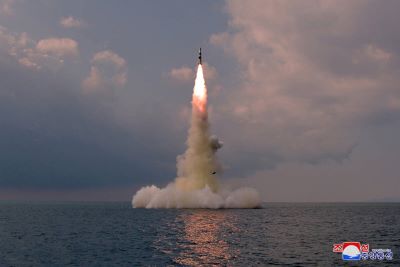
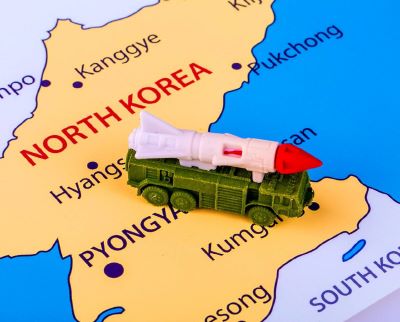
North Korea test-fired what appeared to be a submarine-launched ballistic missile into the East Sea, the Joint Chiefs of Staff said Tuesday, as South Korea, the US and Japan step up efforts to bring Pyongyang back to nuclear talks.
“We’re closely monitoring the situation and maintaining our readiness,” the JCS said, adding that South Korean and US intelligence were analyzing the launch, which took place at Sinpo, a port city along the east coast where North Korea runs a major shipyard to build submarines.
The military suspects Pyongyang used a small submarine to test the missile, dismissing speculation that the regime mobilized its latest 3,200-ton ship, which is believed to be under development.
The missile, however, could be a new mini-SLBM shown at the North’s defense exhibition a week earlier, the military said, noting it flew about 590 kilometers at an altitude of 60 kilometers, demonstrating a much shorter flight range than that of the Pukguksong-5 series, Pyongyang’s latest SLBM lineup.
North Korea last tested an SLBM in October 2019, but has never openly carried out a full SLBM test using a submarine large enough to fire multiple missiles.
Experts said the launch, which marks the eighth weapons test this year, was a follow-up on the regime’s plan to improve its weapons. The launch had less to do with projecting strength in the face of a three-way gathering of nuclear envoys from South Korea, the US and Japan this week, they added.
“This kind of test takes months, not days, to prepare in advance. This is Kim following through on his promise at the January party congress that he would reveal better weapons,” said Shin Jong-woo, a senior analyst at the Korea Defense and Security Forum, referring to the North’s leader Kim Jong-un.
It is clear that Kim intends to continue in this way until his demands are met for any resumption of talks, Shin added.
Kim, who said Seoul and Washington were not the “enemy,” insists that the two allies meet his conditions for dialogue. They mainly involve granting Pyongyang sanctions relief and allowing the regime to run its weapons tests, which it says are part of self-defense and not a provocation.
Cheong Seong-chang, director of the Center for North Korean Studies at the Sejong Institute, said North Korea will see to more weapons tests until February next year, when speculation over peace talks runs high as China opens its Winter Olympics.
“That’s when Kim Jong-un would most likely return to offering half-hearted peace overtures to the outside world on the sidelines of the Olympics. Kim knows how to work the event to his advantage,” Cheong said, referring to the 2018 PyeongChang Games.
The two Koreas started a string of talks in April 2018, two months after the Olympics. But they failed to translate the momentum for diplomacy into concrete action as they found themselves at odds over which step to take between denuclearization and sanctions relief.
Cheong added the Moon Jae-in administration, which is looking to sign an end-of-war declaration to succeed the 1950-53 Korean War armistice as part of revitalizing peace efforts, would not be able to bring North Korea back to table, because the regime is not interested in the proposal.
North Korea has said South Korea should honor peace deals first before signing the declaration, referring to agreements the two Koreas reached at the 2018 summits that the two neighbors would stop all hostilities.
Choi Kang, acting president of the Asan Institute for Policy Studies in Seoul, said the Moon government should stop doubling down on efforts to offer a deal North Korea would find least attractive.
Cheong Wa Dae, which convened a National Security Council meeting, expressed deep regret over North Korea’s missile test, urging the regime to return to dialogue. The Unification Ministry, which handles inter-Korean affairs, said it will carry on with work to defuse tension.
WASHINGTON – The International Monetary Fund on Tuesday revised down its 2021 economic growth forecast for Asia to 6.5 percent, down by 1.1 percentage points from its April projection, according to a newly released regional economic outlook.
“The resurgence of the pandemic, amid initially low vaccination rates, slowed the recovery in the Asia-Pacific region, especially in emerging market and developing economies,” Chang Yong Rhee, director of the IMF’s Asia and Pacific Department, said at a virtual press conference.
Noting that Asia-Pacific remains the fastest growing region in the world, Rhee said as vaccination rates accelerate, the region is expected to grow by 4.9 percent in 2022, 0.4 percentage points faster than projected in April.
For advanced economies, the latest IMF forecast is broadly unchanged for 2021 with upgrades in South Korea and New Zealand and downgrades in Japan and Australia, according to the report.
Most of the downgrades in the region come from emerging market and low-income countries, led by India and the Association of Southeast Asian Nations.
“The divergence between Asian advanced economies and developing economies is deepening, with output levels in the emerging market economies and low-income countries expected to remain below pre-pandemic trends in the coming years, reflecting differences in policy support and vaccination rollout,” Rhee said.
The IMF official noted the increase in inflation in Asia has been more “subdued” than in other regions so far, reflecting the low pass-through of producer prices to consumer prices, and monetary policies have remained broadly accommodative.
“While we expect these supply chain inflationary pressures to be transitory, they could last longer, and feed more strongly into inflation expectations,” he said.
Toyota Motor Corp. on Friday began selling a seat cushion that is intended to reduce car accidents caused by mistakenly pressing the accelerator instead of the brake.
The cushion supports safe driving for elderly drivers by maintaining proper driving posture. It keeps the legs from opening too wide, which is said to be one of the causes of such errors. The product will be sold at Toyota dealers nationwide.
The cushion is placed on the car seat and has raised sides to support the thighs. The design means that the foot naturally move toward the brakes.
The cushions are compatible with 43 Toyota models. Two types are available: a knit material for ¥4,290 including tax, and a suede-like material for ¥6,160 including tax.
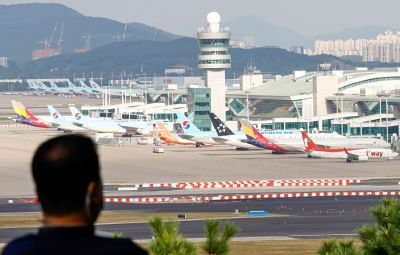
South Korea inked a travel bubble agreement with Singapore on Oct. 8, the country’s second following a similar deal with Saipan. The deal is to allow those who are vaccinated to travel freely without the need for quarantine starting on Nov. 15. Their COVID-19 vaccination certificates will also be mutually recognized.
While travelers from both sides have expectations for going on sightseeing tours like they had before the pandemic hit in early 2020, Noh Hyung Rae, 36, a lawyer at a private corporation in northern Seoul, was looking for his work to get back to a normal routine as well.
“The past two years of pandemic have been extremely hard for me and my colleagues coping with videoconferencing with foreign clients,” Noh told The Korea Herald on Monday. Noting that Singapore has always been a preferred seat for high-profile international arbitrations, Noh welcomed the government’s signing of the travel bubble deal.
“We are looking forward to more face-to-face meetings with business clients from Singapore and relevant industries that have seen vibrant growth during the past decade,” Noh said.
Choi Won-joon, 37, a current affairs and documentary show producer for one of the major broadcasters in Korea, is also looking forward to stretching the realm of documentary content in working with neighboring Asian countries, especially Singapore, which has been at the top of his list.
“When producers search for vast amounts of Asia’s trend-related data and content from multiple angles, we turn our eyes to Singapore,” Choi said during a phone call with The Korea Herald on Monday. expressing excitement on the news of free travel being opened between the two countries.
The pandemic era has led broadcasters to come up with new ways to outsource content that needs to be filmed abroad, including in Singapore, to local practitioners residing in the region. But most producers in the field much prefer to be there in person to work on their stories, according to Choi.
With the rising popularity of Korean content, Choi added that “flying producers” — those who go to a foreign country to train the production crew for a localized version of the original show — will also see their field revitalized due to the travel bubble deal.
Meanwhile, both the government and travel industry expect a resurgence in inbound travel, mainly as travelers from Singapore seek to visit Korea.
“Singapore ranks 12th in the number of annual travelers to Korea, recording some 200,000 people each year,” an official from the Culture Ministry’s International Tourism Division said. Southeast Asian countries used to have high demand for travel to Korea especially during the winter season and Korea could see a big wave of Singaporean tourists at the end of the year, the official added.
Despite the uptick in demand, the Korea Association of Travel Agents said that some crucial hurdles remain concerning guidelines for inbound travelers.
“Local travel agencies in Singapore continue to ask us for accurate guidelines regarding ‘safe travel.’ When we made inquiries to the relevant authorities, we found out that guidelines on many matters, such as accommodations and PCR test procedures, are still ambiguous,” Seo Dae-hun, directing manager of the KATA, told The Korea Herald.
Seo urged swift action in developing and distributing travel-related manuals, since the upcoming weeks will likely leave a lasting impression on inbound travelers as they start arriving in mid-November.
JAKARTA – Indonesia and Malaysia have agreed to allow those conducting essential business to resume travelling between the two countries.
This was disclosed by the foreign ministers of the two countries at a joint press conference after a meeting on Monday (Oct 18) in Jakarta.
They told newsmen that they also agreed to expedite negotiations on their maritime borders and shared views on Asean’s firm stance against the military regime in Myanmar.
“We have agreed to push for a travel corridor for those on essential business from both countries and this will be among the issues that will be discussed ahead of a visit by the Malaysian Prime Minister,” said Indonesian Foreign Minister Retno Marsudi. No date was given for the visit.
“The framework of this agreement will indeed complement the implementation of the Asean travel corridor arrangement framework which will be launched soon,” Ms Retno added.
Bilateral trade between Indonesia and Malaysia reached US$13 billion (S$17.6 billion) between January and August this year, and this was US$4 billion more or a 44 per cent jump from the same period in 2020.
“Even amid the pandemic we could still increase bilateral trade… To keep the momentum and boost economic recovery in both countries, we see it is important to facilitate the mobility of business travellers safely,” Ms Retno said.
Her Malaysian counterpart, Mr Saifuddin Abdullah, said: “We will gradually reopen… the travel from one point to another point, moving towards normalcy.”
He added that both countries wanted to encourage business travellers first and this would be followed by academics and then tourists.
“We agree that this has to be an important agenda item in the upcoming Asean summit between Oct 26 and Oct 28 so, if we may, expand it region-wide,” he added.
On maritime borders, Mr Saifuddin said boundaries between the two countries on the southernmost point of the Malacca Strait and on the Sulawesi Sea had yet to be resolved.
Both sides had agreed to allow technical teams to begin advanced talks on these matters, he said.
Indonesia reopened Bali and the Riau Islands to foreign visitors from 19 countries last week in a bid to revive its tourism industry.
Singapore and Malaysia were not among the approved countries, which Jakarta said were selected because they had low levels of transmission of Covid-19 based on World Health Organisation guidelines.
The airports in Bali and the Riau Islands – where popular tourist islands Batam and Bintan are located – reopened on Oct 14.
Bali and the Riau Islands have among the highest vaccination coverage in Indonesia and, even with the reopening, visitors will still need to serve quarantine on arrival, but for a shortened period of five days.
Previously only foreigners with diplomatic or employment visas were allowed to enter Indonesia by air at two points in Jakarta and North Sulawesi.
Medical workers on humanitarian missions and shipping cargo crew were also among those granted the special dispensation to enter on arrival.
North Korea may resume long-range ballistic missile tests next year, the US Defense Intelligence Agency said, warning that the regime is unlikely to renounce its weapons of mass destruction as it believes they are critical to the country’s survival.
The DIA, which provides intelligence to the Defense Department, released a report Friday examining Pyongyang’s military program, strategy and intentions, stressing that the North will continue to pose a “critical security challenge” for the US and its allies.
“North Korean leaders view nuclear arms as critical to regime survival,” the report said, noting that the regime retains its WMD capabilities. It is unlikely to give up all of its WMD stockpiles, delivery systems and production capabilities, it continued.
“Integrating a nuclear weapon with a ballistic missile and enabling that nuclear-armed missile to function reliably as a system is North Korea’s ultimate operational goal,” it said. “It is possible we could see a test of a long-range missile over the next year.”
The DIA also said the regime could conduct further nuclear tests to validate its weapons capabilities.
The North announced in 2018 that it would suspend all nuclear and long-range missile tests. This was in hopes that an upcoming summit with the US could yield substantial results, such as the US easing sanctions on the North. But after the nuclear talks collapsed in Hanoi, Vietnam, in 2019, Pyongyang said it no longer felt bound by the self-imposed moratorium and warned of new “strategic weapons.”
The North hasn’t conducted any nuclear or ICBM tests since September 2017. But it has carried out smaller tests and developed new types of missiles, with a flurry of activities recently. In September alone, the North tested a cruise missile, short-range ballistic missiles and a new hypersonic missile.
The report added that the North would also work to improve its newer solid-fueled ballistic missiles, which can be prepared for launch more quickly than liquid-fueled missiles.
“Even if additional flight tests of longer range systems do not occur in the near term, Pyongyang will probably focus on training and improving its missile forces which are increasingly central to North Korea’s deterrence strategy,” the agency said.
The North’s weapons development is in line with the country’s national security strategy, which has two main objectives, it said. They are to “ensure the Kim regime’s long-term security” — by remaining a sovereign, independent country ruled by the Kim family — and to retain the capability to exercise a dominant influence over the Korean Peninsula.
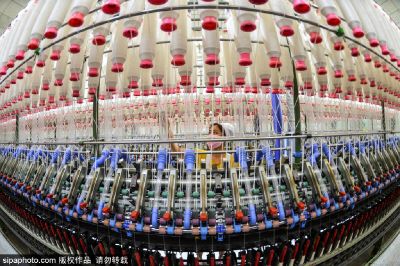
Chinas GDP grew by 9.8 percent year-on-year in the first three quarters of the year to 82.31 trillion yuan ($12.79 trillion), compared with 12.7 percent in the first half, the National Bureau of Statistics said on Monday.
In the third quarter, China’s economic growth came in at 4.9 percent both on a yearly basis and on a two-year average basis, compared with 7.9 percent and 5.5 percent in the second quarter, respectively, the NBS said.
The NBS said the economy has managed to withstand the multiple pressures such as the COVID-19 resurgence and heavy rainfall in the first nine months, sustaining its recovery with major economic indicators falling in a reasonable range.
The tight supply of electricity and coal in China is periodic and its impact on the economy can be controlled, said Fu Linghui, spokesperson of the National Bureau of Statistics.
On a quarter-on-quarter basis, China’s GDP expanded by 0.2 percent in the July-September period, versus 1.3 percent in the April-June period.
Industrial output rose by 11.8 percent year-on-year over the first three quarters of the year, putting the two-year average growth to 6.4 percent, the NBS said.
Retail sales grew by 16.4 percent on a yearly basis in the first three quarters and 3.9 percent on the two-year average basis.
The growth in fixed-asset investment came in at 7.3 percent on a yearly basis in January-September period, sending the two-year average growth to 3.8 percent.
Surveyed urban jobless rate came in at 4.9 percent last month, compared with 5.1 percent in August, the bureau said.
Nevertheless, the bureau said the country’s economic recovery remains uneven and unstable, and more efforts will be made to boost market vitality, release demand potential and keep the economy running within the reasonable range.
Stung by its employees‘ first collective action, Starbucks Korea said Sunday that it will hire 1,600 more baristas and store staff by the end of this year and improve working conditions.
The hiring plan is part of the firm’s package of measures announced in response to recent complaints from in-store staff that they were overworked and underpaid.
“We plan to hire in order to secure more staff and enhance work efficiency at stores nationwide. The company is also reviewing potential changes to the wage structure, which would include a pay raise for store managers, improved incentive plans and differentiated hourly wages based on experience,” the company said in a press release Sunday.
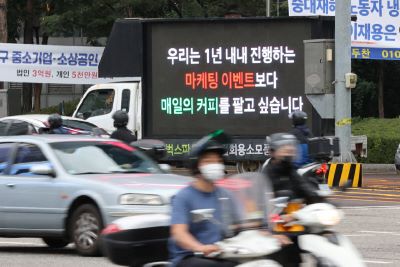
From Oct. 7-8, store employees and baristas mobilized two trucks in Seoul emblazoned with words of protest in the first collective action in 22 years at Starbucks Korea, where there is no labor union.
The action, organized through Blind, an anonymous social media app, was triggered by a reusable cup marketing event that drew long lines of customers at Starbucks stores.
Announcing the measures, Starbucks also said it would look for ways to prevent marketing and promotional events from putting too much pressure on employees and that it would form a special task force dedicated to the effort.
The team will predict customer demand and provide real-time support for difficulties faced during such promotions, Starbucks said.
As for the pay, the main complaint of employees was that they were getting paid a flat 9,200 won ($7.80) per hour, regardless of experience or job performance. Starbucks vowed to address the issue with an ongoing pay structure review.
Starbucks also said it would form a facilities and equipment team to improve the employees’ area and other working environments at Starbucks locations.
The chain said it would regularly communicate with store partner representatives to listen to their opinions and identify areas for improvement.
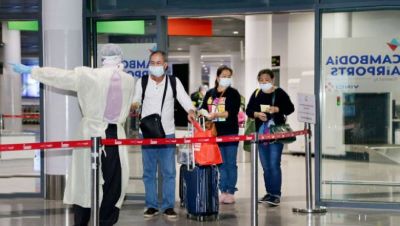
The government has modified Covid-19 quarantine requirements, shortening the duration for, among others, Cambodian officials, foreign diplomats and delegations, investors and inbound travellers in general.
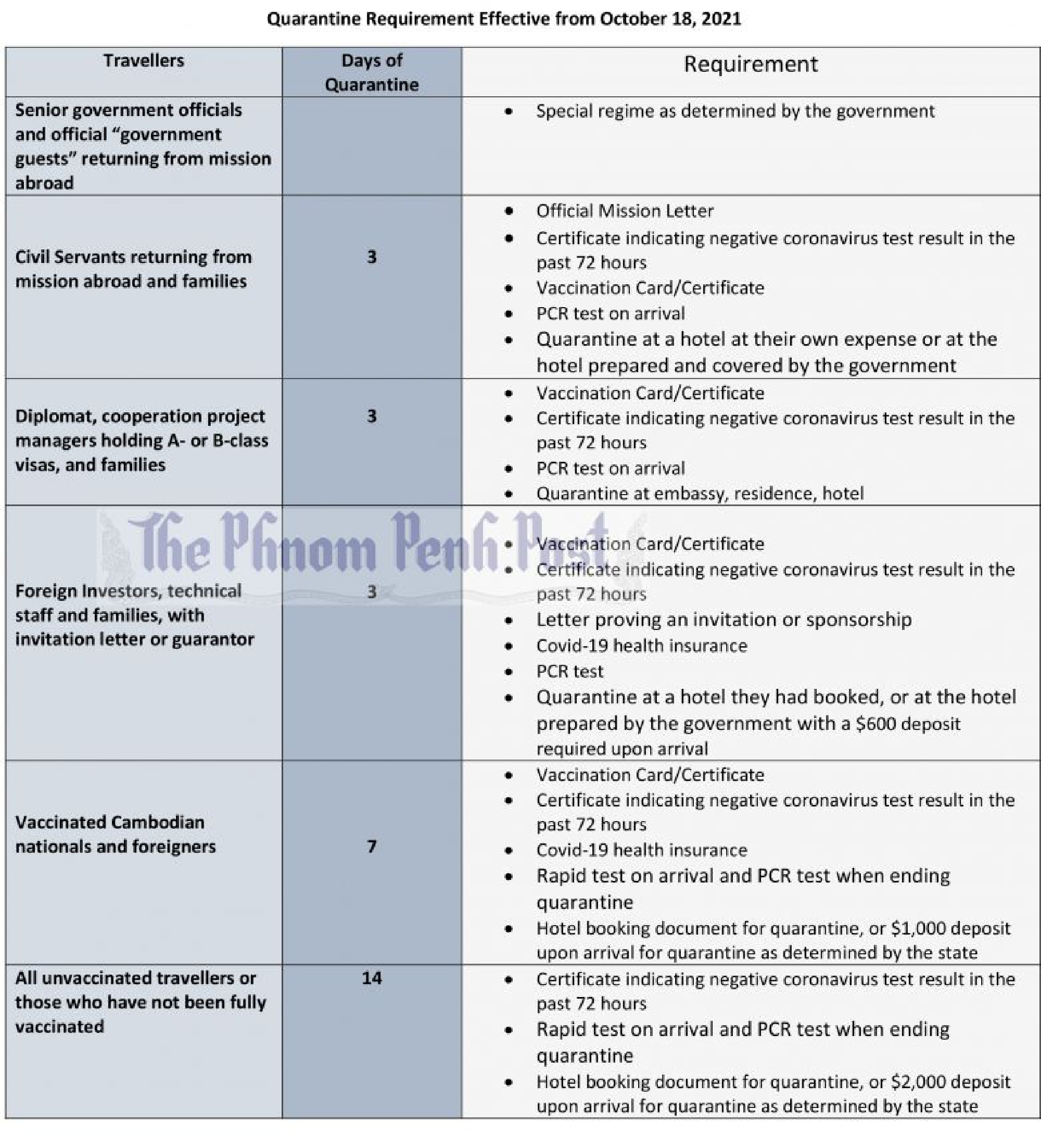
According to an official notice signed by Minister of Health Mam Bun Heng late on October 16, quarantine length for Cambodian officials returning from overseas missions, foreign diplomats, technical experts, cooperation project managers and coordinators, as well as businesspeople and investors with a guarantor or invitation letter has been reduced from two weeks to just three days. Their accompanying family members will also have to undergo a three-day quarantine if they have been fully vaccinated, or two weeks otherwise.
Cambodia unveils new quarantine regulations
General inbound passengers, both Cambodians and foreign nationals, will now undergo quarantine for just seven days, while unvaccinated travellers or those who have not been fully vaccinated must go through a 14-day quarantine.
According to the nine-page notice, the new quarantine measures will take effect from October 18. The decision is aimed at protecting public health and easing burdensome restrictions for fully vaccinated people.
For high-level Cambodian and foreign delegations, the Cambodian government will determine a suitable quarantine time as warranted by the individual circumstances.
“Inbound senior national and international delegations have to follow health measures and special quarantine requirements as determined by the government on a case-by-case basis,” said the notice.
Cambodian officials returning from overseas missions must undergo a three-day quarantine and have the mission letters issued by their respective institutions in hand as well as medical certificates determining that they are negative for the novel corona virus 72 hours prior to their arrival in Cambodia.
They must also carry vaccination cards or certificates indicating the make of vaccine and date of vaccination. They must also have proof of accommodation during quarantine stay.
Upon arrival, officials must produce all the above-mentioned documents and provide samples for polymerase chain reaction (PCR) tests. After the tests, they will be sent to the pre-determined quarantine site. But in case they cannot afford the accommodation, they will be sent to a designated quarantine facility with the costs covered by the state.
“In case the PCR tests show that they are Covid-19 positive, they will be sent to a treatment centre designated by the health ministry. But if the result is negative, they can end their quarantine on their third day,” it said.
It noted that officials who have proper residence for self-isolation can submit a request three days prior to the quarantine sub-commission that will decide whether to grant it.
Similar measures apply to foreign diplomats and cooperation project managers holding A- or B-class visas. They can undergo a three-day quarantine at their embassy or detached residence, or at hotels approved by the health ministry, including Himawari, Sokha Phnom Penh Residence, Courtyard by Marriott, Raffles Hotel Le Royal and Sofitel Phnom Penh Phokeethra, with the obligations on costs borne by the individual.
The notice said transportation from the airport to a quarantine centre must be organised by the respective embassies or NGOs, while transport from the quarantine site to their residence must be provided by the hotel.
“In case they are Covid-19 positive, as confirmed by the Institut Pasteur du Cambodge, they have to be treated at certified treatment facilities with permission from the health ministry at their own expense.
Foreign businesspeople and investors, as well as technical staff and their family members have to possess an invitation letter issued by locally registered companies that have fulfilled their tax obligations.
A sample invitation can be obtained from the Cambodia Data Exchange (CamDX) through registrationservices.gov.kh.
The ministry said the invitation letter must indicate that the guarantor will be responsible for personal expenses. They have to put down a deposit of $600 when arriving in Cambodia to be used for quarantine – or treatment if they are positive for the coronavirus.
They also need to hold a Covid-19 insurance policy issued by Forte Insurance (Cambodia) Plc, which is currently the insurance consortium.
Upon their arrival, they must produce their booking receipts and take PCR tests.
Cambodians who hold a Cambodian or foreign passport with a K-class visa must possess health certificates certifying that they are coronavirus negative for 72 hours prior to their arrival in Cambodia and produce full vaccination cards or certificates proving they have received the jabs. They will have to take Covid-19 antigen rapid tests upon arrival and PCR tests on day 6 of their quarantine before ending their quarantine on day 7, the notice said.
Foreigners who work in Cambodia – including travellers and technical staff and their family members who have no invitation letter – have to go through similar procedures set for foreign businesspeople and investors. But they need to have $1,000 in hand upon arrival to ensure their expenses on quarantine in Cambodia.
Travellers who have not been fully vaccinated have to take rapid tests upon arrival and PCR tests on day 13 of their isolation period before being permitted to leave their two-week quarantine on day 14. For foreign nationals, they need to have $2,000 in hand, or proof of funds, to be used while in quarantine.
The ministry emphasised that all visas must be requested at Cambodian embassies abroad, as visas on arrival will not be offered.


 Cambodia unveils new quarantine regulations
