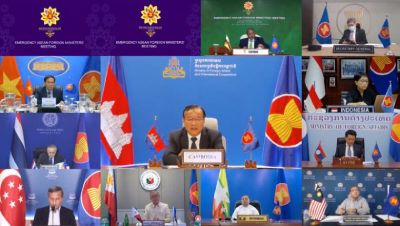
Practical and realistic steps must be taken to build constructive dialogue over the ongoing Myanmar coup standoff, Cambodian Minister of Foreign Affairs and International Cooperation Prak Sokhonn affirmed on October 15.
Sokhonn was addressing an emergency virtual meeting of the ASEAN foreign ministers called to address the ruling junta’s reluctance to abide by a five-point peace roadmap – reached by the bloc in April – on how to tackle Myanmar’s complex and ever-deepening political crisis.
The meeting comes a day after the junta announced that an ASEAN special envoy had abruptly cancelled a visit to Myanmar scheduled for this month after the military administration refused to allow him to meet ousted elected civilian leader Aung San Suu Kyi.
The bloc appointed Bruneian second foreign minister Erywan Yusof as its special envoy to try to facilitate political dialogue.
But Sokhonn emphasised to his ASEAN counterparts that it is crucial that Erywan visit Myanmar sooner rather than later, calling “for practical and realistic steps to be taken so as to engender a constructive dialogue among relevant parties in Myanmar crisis”, the Cambodian foreign ministry said in a statement on October 15.
During the meeting, the bloc’s foreign ministers exchanged views on the developments in Myanmar and the progress of the Erywan’s work concerning the implementation of the ASEAN Five-Point Consensus.
“The ministers encouraged Nay Pyi Taw to facilitate a fruitful visit to Myanmar by the special envoy on an early date.
“The ministers had an extensive and in-depth discussion on ASEAN Community building efforts, enhancement of engagement with external partners and on ensuring successful preparation and outcomes for the 38th and 39th ASEAN Summits and its Related Summits scheduled to take place on 26-28 October 2021,” the statement said.
However, the meeting decided that Myanmar junta chief Senior General Min Aung Hlaing would not be invited to the summits, sources told Reuters.
ASEAN chair Brunei on October 16 said a “non-political representative from Myanmar” would be invited to the events, without elaborating further.
Myanmar has been embroiled in political and civil strife since the junta ousted Suu Kyi in a February 1 putsch, bringing the country’s 10-year experiment with democracy to a sudden halt, and triggering a tide of fury and protests that persist to date, pushing some civilians to form armed groups to take on the military.
Local monitoring group Assistance Association for Political Prisoners reported on October 15 that 1,178 people have been killed by the junta and 7,341 have been arrested, charged or sentenced.
The Shenzhou XIII mission crew entered the Tiangong space station on Saturday morning, embarking on their six-month journey inside the station in the countrys longest spaceflight.
The three-member crew — mission commander Major General Zhai Zhigang, Senior Colonel Wang Yaping and Senior Colonel Ye Guangfu — floated into the station’s core module, named Tianhe, or Harmony of Heavens, at 9:58 am, around three hours after their spacecraft docked with the module, which is the first and central section of the permanent space station — Tiangong, or Heavenly Palace.
Their Shenzhou XIII spacecraft was lifted by a Long March 2F carrier rocket that blasted off at 12:23 am at the Jiuquan Satellite Launch Center in northwestern China’s Gobi Desert.
During their flight, the astronauts are tasked with a wide range of assignments, such as performing two to three spacewalks to install a small robotic arm onto a larger one; verifying key procedures and technologies like manual control of the robotic arms and robotic arm-assisted movement of station modules; checking the performance and capability of devices inside the station; and testing support instruments for astronauts’ life and work in long-term flights, according to Lin Xiqiang, deputy director of the China Manned Space Agency.
The astronauts will conduct scientific experiments and technology demonstrations in space medicine, microgravity physics and other fields. They will also deliver educational lectures that will be televised for Chinese students, the official said.
Shenzhou XIII is the fourth spacecraft to visit the Tiangong station and the second crewed ship to transport astronauts to the orbiting outpost.
Chinas spacecraft crew steps into space station
The mission is expected to become the longest crewed spaceflight by China, doubling the time spent in the Shenzhou XII mission. It will also see the first spacewalk by a Chinese woman.
Mother of a 5-year-old girl, Wang is China’s second female astronaut to take part in a spaceflight. She took part in the Shenzhou X mission in June 2013. In the Shenzhou XIII flight, she will become the first Chinese woman to enter a space station and also the first Chinese woman to carry out a spacewalk.
One of China’s most challenging and sophisticated space endeavors, Tiangong will eventually consist of three main components-the Tianhe core module attached to two large space labs-with a combined weight of nearly 70 metric tons. The entire station is set to operate for about 15 years in a low-Earth orbit about 400 kilometers above the planet.
When you tuck into your next meal, spare a thought for those going hungry on World Food Day across Asia today.
Asia accounts for the bulk of people who are undernourished around the world today, with 418 million people making up over half of the hungry mouths worldwide.
The majority are in South Asia, which accounts for 305.7 million people. South-east Asia follows with 48.8 million people, and West Asia with 42.3 million, according to the State of Food Security and Nutrition in the World 2021 report by the United Nations’ Food and Agriculture Organisation (FAO).
In 2019, before the Covid-19 pandemic erupted, Asia was assessed to have 361.3 million undernourished people.
“Being in a state of acute food insecurity means that families are faced with really tough decisions – they may be forced to skip meals, eat less nutritious foods, prioritise children over adults at mealtimes, fall into debt to buy food, (or) sell off key assets to make ends meet,” the UN’s World Food Programme (WFP) spokesman James Belgrave told The Straits Times.
“Their nutrition will likely suffer. Children may become wasted – too thin, or stunted, too short – with impacts that will last their whole lives,” he added.
Mr Belgrave said most countries in Asia where the WFP operates have seen increased food insecurity due to the socio-economic fallout and economic impact of the pandemic, and extreme weather events such as droughts, floods and storms.
“This may have affected particular segments of the population, in particular urban centres, slums in major cities in the region,” he said.
Professor of applied economics Prabhu Pingali, director of the Tata-Cornell Institute at Cornell University, noted that global food production has not been affected by the pandemic and so hunger is being caused by loss of incomes.
“None of the major food exporting countries has seen a drop in production. India has seen record harvests of food grains in 2020 and 2021. Food supplies have not been a problem in most Asian countries.
“The primary problem has been access to food due to loss of employment, primarily among low-wage migrant workers who were forced to return to their home villages,” he said.
Prof Pingali also cautioned against over-reliance on hunger estimates.
“Global hunger estimates are best for looking at long-term trends but not for assessing the number of people affected by an immediate shock. Moreover, the hunger numbers provided by the UN agencies are based on calorie adequacy rather than a measure of a balanced diet which includes proteins, minerals and vitamins. So it does not measure ‘hidden hunger’ or micronutrient malnutrition,” he said.
Hunger pangs
The situation in some countries looks increasingly desperate. Over 20 million Filipinos – or one in five people – said they went hungry in the first three months of the year, twice as many before the pandemic, according to a survey by Social Weather Stations.
They said there were days when they did not have anything to eat, or they had just one meal a day.
“We can’t provide food for an entire family. Yet, people line up for food, even if they’ll just be getting enough for one serving. That means they’re desperate,” Mr Jomar Fleras, executive director of the non-profit Rise Against Hunger, told The Straits Times.
His organisation has the largest network of soup kitchens and feeding programmes in the Philippines.
Housewife Lara Villalon, 33, said her family went through a food security scare when her husband, a casino worker, lost his job during the pandemic.
“Luckily, we had our savings and a backyard garden. I also began to sell food online. Those helped tide us over,” she said.
The poverty rate in Malaysia has also considerably worsened after repeat lockdowns that have badly affected income streams for many informal workers.
The government revealed last month that Malaysia’s absolute poverty rate rose to 8.4 per cent last year compared to 5.6 per cent in 2019. This translated into 580,000 households slipping into the lower-income bracket.
Economist Muhammed Abdul Khalid, the managing director of research outfit DM Analytics, said that Malaysia is already facing a national crisis in terms of food access and malnutrition among vulnerable households. “20 per cent of Malaysian children are malnourished, this is the biggest issue that will impact us in the long run,” said Dr Muhammed.
Hunger is particularly acute in India, which slipped seven spots to be ranked 101 among 116 countries in the Global Hunger Index 2021 released this week.
It was placed in the “serious” hunger category and ranked behind Nepal (76), Pakistan (92) and Bangladesh (76). The report stated that 15.3 per cent of India’s population is undernourished and 17.3 per cent of children under five suffer from child wasting.
“People have been severely hit by Covid-19 and by pandemic-related restrictions in India, the country with the highest child wasting rate worldwide,” the report said.
Millions of people remain excluded from the public ration distribution system because the government uses outdated population data to calculate beneficiaries. A recent analysis showed that over 100 million people entitled to food rations are not getting them.
Another event that affected food security for some in India was the swarms of locusts that invaded several parts of the country and Iran, as well as neighbouring Pakistan, last year. Scientists say that extreme temperatures in the region assisted the breeding of the insects, which also devoured crops on a large-scale in Africa.
Sharing is caring
For a number of low-income families in Thailand, food or daily necessities distributed by non-government organisations (NGOs) have been a godsend.
“Without them, we wouldn’t have anything to eat,” said Madam Somporn Boonnoi, 46, a widow who has two children aged 10 and 15.
Gesturing to the bags of instant noodles and dry food in her home in the Klong Toey slums, Madam Somporn added: “It’s the only way we can survive.”
The pandemic pushed almost 800,000 more Thai people into poverty last year, a study by the Thailand Science Research and Innovation found.
And with Covid-19 curbs – only recently lifted – that locked down cities, shuttered businesses and restricted travel and movement, thousands have lost their jobs or had their working hours and wages cut.
While the government has implemented measures to cushion the financial blow, many grassroots groups and NGOs have been plugging the gaps by distributing food and necessities to the needy.
In Indonesia, the centuries-old, widely-believed notion that it is “a major sin to leave your neighbour hungry” has long made the country relatively resilient against hunger, but undernourishment affects a large swathe of the population.
“Indonesia doesn’t have any cases of famine. Our problem is undernourishment, which accounts for about 8 per cent of the population,” said Mr Agung Hendriadi, the head of Indonesia’s food security agency.
“Our challenge is distribution, not availability, of food. We are more than 17,000 islands and there are regions with surplus of food and others with deficits. We are consistently monitoring to fill any gap.”
Nevertheless, observers noted that unreported food shortages in the world’s largest archipelagic nation could be possible from time to time.
Complex issue
Hunger is also a growing issue in Myanmar as it grapples with both the pandemic as well as the political and economic free fall triggered by the Feb 1 military coup.
Financial institutions have been debilitated by the run on banks and the junta has tried to staunch this by limiting cash withdrawals.
WFP country director Stephen Anderson warned last month that more people could face “extreme deprivation” in Myanmar.
In April, the UN agency projected that the number of people going hungry could double to 6.2 million in the next six months.
Most at risk are villagers displaced by armed conflict flaring up between the military regime and “people’s defence forces” resisting its rule. In areas where it faces the strongest resistance, the military inflicts collective punishment by destroying homes, food supplies and livestock.
Global charity Save The Children warned on Oct 4 that a large portion of the over 76,000 children forced to flee their homes since the coup are living in the jungle and many families are sharing just one meal each day.
In urban areas and where the armed conflict is not that intense, residents are struggling with unemployment and inflation.
Mr Lay Win, 43, was forced to stop driving his taxi last month because he couldn’t find any customers. He has withdrawn all his savings and spends only on necessary meals for his family of three.
“We can only spend a little each time as I am jobless,” he told ST. “We have seen and heard about a lot of other families in difficulty, who have had to sell their possessions to buy food.”
The food situation in sanctions-hit North Korea – ranked 96th in the Global Hunger Index – is also dire.
Leader Kim Jong Un in April told his people to prepare for “another more difficult Arduous March”, using the term for the deadly famine of the 1990s to refer to the severe economic difficulties faced by the country.
He admitted that North Korea is facing the “worst-ever situation” – severe floods that ruined farmland and blistering heat that killed crops, unrelenting UN sanctions, as well as trade and aid from China cut off due to pandemic-induced border closures.
North Korea monitoring groups have not reported signs of mass starvation, but anecdotal evidence suggests people are suffering from the lack of food.
The FAO and WFP had also warned in July that North Korea would face a food shortage of around 860,000 tonnes this year, equivalent to about 2.3 months worth of food.
Hidden hunger
Even in wealthy Japan, food banks are being run for the poor in many major municipalities.
However, the societal stigma of losing pride or face has been a major hurdle stopping many who need help from asking for it. Some NGOs have stepped in to fill the gap and help ensure that food reaches those in need.
In a report by Agence France-Presse earlier this year, one former construction worker said: “This doesn’t get reported much in the media, but many people are sleeping at train stations and in cardboard boxes. Some are dying of hunger.”
Poverty statistics from the Ministry of Health, Labour and Welfare indicated that 15.4 per cent of the population were living below the income threshold of 1.27 million yen (S$15,000) assessed as the poverty line.
Meanwhile, China has ostensibly come a long way from the devastating famine of 1959 to 1961 that starved tens of millions of people to death.
According to the WFP, the country has helped cut the global hunger rate by two-thirds after hitting its Millennium Development Goal of halving the number of hungry people by 2015.
The latest Global Hunger Index ranks China, along with 18 other countries, as having the lowest hunger levels among 116 nations.
But there remains a large nutritional gap between the rural poor and the urban middle-class in China. The WFP says nearly 150.8 million people are malnourished.
In South Korea, there is a low level of malnutrition at just 2.5 per cent.
The country runs some 450 food banks to help the needy, especially the elderly aged 66 and above, of whom 44 per cent are poor.
However, with 197 of these free food outlets shut down due to social distancing restrictions, a growing number of people are left stranded.
Official data showed that 345 people died of malnutrition last year, most of them elderly. This is higher than the 231 in 2019 and marks the first time in 20 years that the figure exceeded 300.
DongA Ilbo newspaper said in an editorial that it is “shocking” to see hundreds of people dying of starvation in such an advanced country and called on the government to “close the gap” in the welfare system.
A global problem
On a global level, the economic hardship caused by the Covid-19 pandemic pushed 83-132 million more people into chronic hunger last year, said FAO.
Currently, between 720 million and 811 million people are going to bed hungry almost every day.
According to the Global Hunger Index, the nations facing the most severe nutritional concerns are Somalia, Syria and South Sudan.
Hunger worldwide stemmed from three main causes: economic shocks such as those caused by Covid-19), adverse weather events such as flooding or droughts, or conflicts and insecurity as seen in Myanmar.
While some of these events can be averted or mitigated, many are impossible to prevent.
While there has been a steady increase in moderate food insecurity (being unable to eat a balanced diet) or severe food insecurity (going without eating for a day or more) around the world since 2014, the rise last year was equal to the previous five years combined, according to FAO.
Moderate or severe food insecurity had been rising from 22.6 per cent in 2014 to 26.6 cent in 2019.
But as the coronavirus rampaged across the globe, nearly one in three people worldwide (30.4 per cent) – or a total of 2.37 billion – do not have adequate food. That is an increase of 320 million people in just a year.
“The pandemic has had a huge impact on food security globally. Measures put in place to control the spread of Covid-19 had a massive ripple effect across economies globally, jobs dried up, food prices shot up, and livelihoods vanished. Food supply chains were also affected meaning less food was available on the market,” said Mr Belgrave.
“Because of this, families are finding it harder to put healthy food on a plate, child malnutrition is threatening millions, and famine is still looming,” he said.
“Covid-19 has also ushered hunger into the lives of more urban communities while placing the vulnerable, such as refugees, people caught in conflict, and those living at the sharp end of climate change, at higher risk of starvation,” he added.
MANILA, Philippines — While he believes that the Philippines should fight for its maritime territories in the West Philippine Sea, presidential aspirant and Senator Manny Pacquiao said Friday that it is better for the Philippines to be in good terms with China.
“’Yang usapin sa West Philippine Sea, kailangan natin panindigan, ipaglaban kung ano ‘yung atin at huwag tayo makipag-away. Hindi natin kailangan awayin ang China,” he said when interviewed on ABS-CBN News Channel’s Headstart.
(We have to fight for what is ours in the West Philippine Sea and not quarrel. We do not need to fight China.)
“In fact, mas mabuti pang kaibiganin natin para makatulong sa ating bansa at pag-usapan [na] kung ano ‘yung atin, atin, kunin natin, ipaglaban natin, at kung ano ang makakatulong sa ating bansa, makaambag sa mga Pilipino at makaunlad sa ating bansa ay doon tayo,” Pacquiao said.
(In fact, it is better to befriend them so that they can help our country. Discuss what is rightfully ours. We will go with what is good for the country.)
‘No bullying’
But Pacquiao also said that the Philippines should not let itself be bullied by China.
“Hindi naman tayo basta basta magpapabully lang. Gusto natin kaibigan lahat ng mga bansa,” he added.
(We will not let ourselves be easily bullied. We want to be friends with all countries.)
Back in May, Pacquiao said he finds President Rodrigo Duterte’s stance on Chinese incursions in the West Philippine Sea inadequate.
Duterte, in response, advised the senator to study and gather more information on the issue first before commenting on the same.
South Korea and Japan should work out their wartime disputes before it is too late, President Moon Jae-in said in his first phone call with Japanese Prime Minister Fumio Kishida since he took office last week, Cheong Wa Dae said Friday.
But the talks, which came amid worsening ties over disagreements on virtually every issue between the two neighbors, did little to close the widening gap.
“We should leave open our communication channels and continue to engage each other for a way out of the box we’re in. Especially for sex slave victims, we do not have much time left to bring closure,” Moon said, referring to South Koreans who were forced to work for Japanese firms and brothels during World War II.
South Korea and Japan reached two deals in 1965 and 2015 respectively. Tokyo describes them as settling all damages owed to Seoul. The Moon Jae-in administration maintains Japan could do more for the victims until they are given the right consolation, other than the monetary compensation.
But Kishida said Korea should suggest ways to work out the disagreement. According to Kyodo News, Kishida told reporters that he asked Moon to roll out “appropriate response” on the wartime disputes, essentially repeating what his predecessors had said.
Kishida did not elaborate on what he meant by an appropriate response. Experts said Kishida was referring to concessions, commensurate with upholding the two deals signed earlier. But that is not likely to happen anytime soon, they said.
“Moon just said diplomacy on disputes in the call. That’s where he’s stood since he came to office in 2017 and I don’t see any signs of a shift in the position,” said Park Cheol-hee, a professor of international studies at Seoul National University.
The call showed Moon and Kishida were at loggerheads over their approach to North Korea as well, Park added.
Kishida supported resuming nuclear talks and Moon Praised his open willingness to broach the North Korea issue. But Kishida stood firm on enforcing sanctions over the regime. The Moon government is willing to compromise on them to open talks and is working to make that happen.
Park said mending ties would be a hard sell for Moon, who has neither time nor political capital for a last-minute breakthrough. Moon, who leaves office in May next year, cannot risk being seen as soft on Japan when he wants his successor to carry on with his legacies.
Meanwhile, Moon said South Korea and Japan should work together to fight COVID-19 and deal with the disruptions the pandemic has brought to the global economy.
Foreign Minister Dr Tandi Dorji and the Assistant Minister of Foreign Affairs of the People’s Republic of China Wu Jianghao signed a Memorandum of Understanding on a Three-Step Roadmap to expedite the Bhutan-China boundary negotiations yesterday. The two sides had agreed on the Three-Step Roadmap at the 10th Expert Group Meeting held in Kunming, China in April this year.
Officials from the foreign ministry said that the Three-Step Roadmap is a positive development in the boundary talks between Bhutan and China and that it will help the two sides to have more focused and systematic discussions on the boundary issues towards bringing the boundary negotiations to a successful conclusion that is acceptable to both governments.
Earlier, the two countries signed the Guiding Principles for the Settlement of the Boundary in 1988 and the Agreement on the Maintenance of Peace,
Tranquility and Status Quo in the Bhutan-China Border Areas in 1998. The boundary talks between Bhutan and China began in 1984. The two sides have so far held 24 rounds of boundary talks and 10 rounds of meeting at the expert group level.
According to the foreign ministry, the talks have been always guided by the 1988 Guiding Principles and the 1998 Agreement and have always been held in a frank and friendly atmosphere.
“The MoU on the Three-Step Roadmap will provide a fresh impetus to the Boundary Talks,” a press release from the foreign ministry stated.
Senior officials from the foreign ministry and international boundaries secretariat were present at the signing.
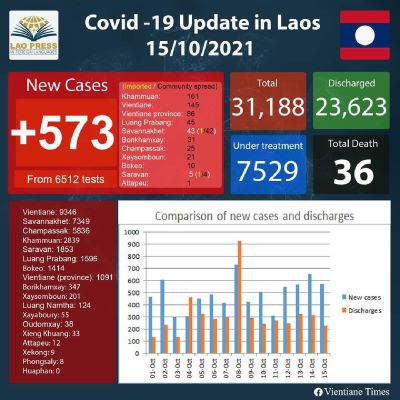
The number of new locally-transmitted Covid cases recorded over the past five days remains high, especially in the provinces of Vientiane, Khammuan, Savannakhet and Luang Prabang.
The observation was made as the National Taskforce for Covid-19 Prevention and Control on Friday announced another 573 new cases of the virus, bringing the total to date to 31,188, with 36 people having died from the illness.
Of the new cases, 571 were locally transmitted and 2 were reported among people entering Laos.
Khammuan reported the highest number with 161, followed by Vientiane with 145, Luang Prabang province with 45 cases, Savannakhet province 42, and Vientiane province 86.
Another 25 cases were reported in Champassak, 21 in Xaysomboun, 31 in Borikhamxay, 4 in Saravan, and 10 in Bokeo.
With significant virus transmission occurring in many communities and current levels of vaccination lower than needed to stop the spread of infection, it is essential that public health and social measures continue to be rigorously adopted, the taskforce said.
While vaccination uptake is increasing, more people are dying from Covid, none of whom have been vaccinated.
BANGKOK – Asean foreign ministers met online on Friday (Oct 15) after the Myanmar junta made clear it rejected a key plank of the blocs road map to resolving the countrys crisis.
According to a Reuters report citing sources, the ministers agreed that Myanmar’s military chief Min Aung Hlaing – who seized power in a Feb 1 coup – would not be invited to attend the online Asean summit from Oct 26 to 28.
The report also said Asean’s special envoy Erywan Yusof would not visit Myanmar this month.
Indonesia’s Foreign Minister Retno Marsudi tweeted after the emergency meeting that Indonesia had proposed that Myanmar “should not be represented at the political level” at the summit until it restores democracy “through an inclusive process”.
Brunei, which chairs Asean this year, is expected to issue a statement on Saturday.
Letting Senior General Min Aung Hlaing join the summit without any concessions from the junta would risk legitimising a regime that has killed over 1,000 people and imprisoned some 7,000 since throwing out the elected National League for Democracy government.
Among those detained are State Counsellor Aung San Suu Kyi and President Win Myint, who are being put through what are widely perceived to be show trials for incitement, sedition and other alleged offences.
Yet, leaving Myanmar unrepresented at the summit would require more resolve than usual from the consensus-driven bloc, which abides by a policy of non-interference.
Asean has yet to formally engage the National Unity Government (NUG), a shadow Cabinet comprising ousted legislators and civil society leaders that is rivalling the junta for international recognition.
But Malaysia has said it was prepared to talk to the NUG if dialogue with the junta goes nowhere. Singapore and Indonesia have also voiced disappointment with the lack of progress on Myanmar.
General Min Aung Hlaing last met Asean leaders during a special in-person summit in Jakarta on April 24, when the bloc reached a “Five-Point Consensus” to address Myanmar’s crisis.
It called for an end to violence and constructive dialogue among all parties. An Asean special envoy – who was eventually picked in August – was meant to visit Myanmar and try to facilitate the dialogue process. Asean would also send Myanmar humanitarian aid.
So far, only the aid portion has been fulfilled.
Special envoy Erywan Yusof, who is also Brunei’s second foreign minister, has yet to visit Myanmar amid repeated rebuffs of his requests to meet Ms Suu Kyi.
The junta says that is because she is facing criminal charges.
In a press statement on Thursday, it said: “Myanmar has demonstrated flexibility in any possible ways and means to facilitate the special envoy’s visit to Myanmar. As Myanmar has been prioritising peace … in the country, some requests which go beyond the permission of existing laws will be difficult to be accommodated.”
Philippine foreign minister Teodoro Locsin was in favour of Asean keeping firm with the Myanmar junta.
“If we relent in any way, our credibility as a real regional organisation disappears,” he said in an interview with Lowy Institute on Thursday.
“All my colleagues in Asean and the leaders themselves, they know that, they share that view.”
The Health, Labor and Welfare Ministry has begun to consider recommending that males under 30 be vaccinated against COVID-19 with the vaccine made by U.S. pharmaceutical giant Pfizer Inc., citing a rare risk of heart inflammation from the vaccine made by U.S. biotechnology firm Moderna, Inc.
The matter will be discussed at an expert panel meeting on Friday.
The health ministry is considering recommending Pfizer vaccinations not only for those who are not yet vaccinated, but also for those who have already received the first dose of Moderna vaccine.
According to a summary of suspected side effects, up to Sept. 12 there were 21.6 reported cases of myocarditis or pericarditis per 1 million male patients under 20, and 17.06 for those in their 20s, for Moderna vaccine recipients.
After receiving the Pfizer vaccine, the numbers were 1.87 cases per million for the younger group and 13.08 cases per million for those in their 20s.
The result shows that the frequency of post-vaccination myocarditis and pericarditis was higher with the Moderna vaccine.
The expert panel meeting on Oct. 1 concluded that “the benefits of vaccination are much higher” than not being vaccinated, even for the Moderna vaccine, because the frequency of myocarditis and pericarditis is still low. However, the health ministry has begun to consider recommending the Pfizer vaccine “just in case.”
Overseas, Sweden has suspended vaccination of people under 30 with the Moderna vaccine, and Denmark has decided to specify the Pfizer vaccine for people under 18.
■ Lower infectivity
At an Oct. 13 meeting of an advisory body to the health ministry, Wakayama Prefecture reported that 80% of those who became infected after receiving two doses of a COVID-19 vaccine did not transmit the virus to others.
According to the survey, out of 235 fully vaccinated people who were infected between July 11 and Sept. 10, a total of 191, or 81%, did not transmit the disease to others. Among 2,111 infected people who were unvaccinated or received only one dose, 1,515, or 72%, did not pass on the infection.
In response to the survey, Wakayama Prefecture officials have indicated that “two doses of the vaccine are effective in preventing the spread of infection in the region.”
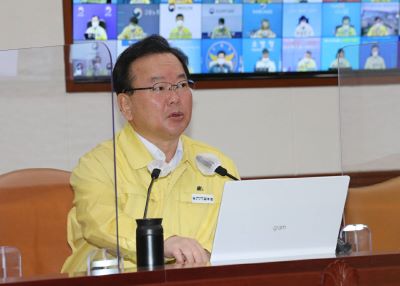
The government decided Friday to raise the private gathering size limit to eight people for the capital area and 10 for elsewhere before the country shifts to a “living with COVID-19” scheme next month, Prime Minister Kim Boo-kyum said.
Under the renewed plan that will go into effect Monday, the greater Seoul area will remain under the toughest social distancing of Level 4, while the rest of the country will be under Level 3, Kim said during an interagency meeting on the government’s coronavirus response.
However, Kim added that some virus curbs will be eased for fully vaccinated people as the country tries to bring people’s virus-hit lives back to normal on a gradual basis with the inoculation rate increasing.
“We hope that this will be our last adjustment in social distancing so that we can start a gradual return to normalcy in phases in November,” Kim said. “To relieve the pain of small business owners and merchants, we will make some changes to the virus curbs.”
Starting next week, social gatherings of a maximum of eight people, up from the current cap of six, will be allowed in the capital area after 6 p.m. if four of them are fully vaccinated.
Such a relaxed curb will be applied to all multiuse facilities in addition to cafes and restaurants, Kim added.
With the national college entrance exam approaching, the country will allow study cafes to operate until midnight. Sports events that have been played behind closed doors will now have an admissions cap of 30 percent.
The adjustments came as the country prepares for a “living with COVID-19” scheme, in which COVID-19 will be treated as an infectious respiratory disease like seasonal influenza with eased distancing, starting in early November.
The government earlier launched a committee involving experts from private sectors to discuss ways to smoothly carry out the envisioned transition in phases. (Yonhap)

 Chinas spacecraft crew steps into space station