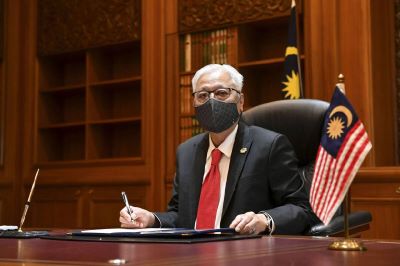
PETALING JAYA: Malaysia has won a seat in the United Nations Human Rights Council for the 2022 – 2024 term, says Prime Minister Datuk Seri Ismail Sabri Yaakob (pic).
“Malaysia has won a seat with 183 votes on the UN Human Rights Council 2022-2024. We are ready to play an active role – to be the facilitator for conciliation, enabler for cooperation, and builder of consensus.
“Malaysia will work closely with UN Member States to advance the global human rights agenda, as enshrined in the Universal Declaration of Human Rights.
“As our nations lay the groundwork for a sustained and inclusive recovery post #COVID19, human rights must be kept at the centre of all our efforts. In unity, for humanity,” he tweeted on Thursday (Oct 15) night.
SINGAPORE – Singapore has slipped three places in a global ranking of rule of law and fallen outside the top three spots in the region for the first time since 2015.
This is based on an index compiled by the World Justice Project (WJP), an independent advocacy group founded in the United States.
The Republic’s 17th position out of 139 territories worldwide – and fourth out of 15 in East Asia and the Pacific – comes amid declining rule of law scores across most of the globe, with the Covid-19 situation accentuating trends in weakening institutional checks and diminishing civic space.
Pandemic measures also contributed to delays and access issues in civil and criminal justice systems – areas where Singapore recorded dips in performance, according to the WJP report released on Thursday (Oct 14).
Still, Singapore’s performance has remained relatively stable over the years, with its overall score of 0.78 a 1 per cent drop from 2020, and down from 0.81 in 2015.
The annual index measures how rule of law is experienced and perceived in practical, everyday situations across the world.
Performance is determined using 44 indicators across eight main rule of law factors, each scored and ranked globally and regionally.
The factors are constraints on government power, government openness, corruption, fundamental rights, order and security, regulatory enforcement, and criminal and civil justice systems.
Singapore was the world leader in order and security last year, but dropped to third this time. It fared worse in the areas of fundamental rights (38th), open government (34th) and constraints on government power (32nd), but was in the top 10 for the other factors.
This year, the top three global places for overall rule of law went to Denmark, Norway and Finland, while the Democratic Republic of Congo, Cambodia and Venezuela rounded off the bottom.
Ratings are based on survey responses to over 500 questions, from more than 138,000 households and 4,200 legal practitioners and experts across 139 jurisdictions – up from 128 last year.
The data was collected between October 2020 and May this year.
Regionally, Singapore finished third overall in 2020 but was overtaken by Japan this year, with New Zealand the top performer, followed by Australia.
The Philippines, Myanmar and Cambodia registered the lowest scores in the region. Eleven out of the 15 East Asia and Pacific countries declined in the past year, with Myanmar in particular registering a major dip of 6.3 per cent, second only to Belarus (7.5 per cent) among all countries globally.
Singapore remained top of the regional table in five of the eight factors, including absence of corruption, order and security, and civil and criminal justice systems.
The WJP, which has offices in Singapore and Mexico, noted that globally 74.2 per cent of countries covered by its report – accounting for 84.7 per cent of the world’s population – declined in their overall rule of law performance.
This was the fourth straight year where more countries deteriorated than improved.
WJP chief research officer Alejandro Ponce told The Straits Times: “In the majority of countries, the Covid-19 pandemic and the sanitary measures to contain it had a negative effect on the rule of law.”
For instance, the stress imposed on justice institutions around the world led to 94 per cent of countries in the index experiencing delays in civil, criminal, and administrative justice systems, along with problems of access.
Against a backdrop of lowered trust in governments, 82 per cent of the countries registered diminishing dimensions of civic space such as in freedom of opinion, expression and assembly; while 70 per cent reported weakened constraints on government powers.
Another effect was a perceived rise in discrimination against vulnerable groups, “due partly because measures were not implemented equally or did not affect everybody equally”, said Dr Ponce.
Taken together, these widespread negative trends signal an “opening of the door” to growing authoritarianism, warned the WJP in a press release.
“This year’s WJP rule of law index should be a wake-up call for us all,” said project co-founder and chief executive Bill Neukom. “Rule of law is the very foundation of communities of justice, opportunity and peace.
“Reinforcing that foundation should be a top priority for the coming period of recovery from the pandemic.”
Rule of law the foundation of Singapore: MinLaw
In response to the WJP report, the Ministry of Law told The Straits Times that Singapore’s consistently good performance in the index attests to how rule of law is a core principle of the nation, and the foundation on which it is built.
A spokesman pointed out that in response to Covid-19 disruptions and limitations such as safe distancing measures, Singapore had swiftly put in place measures to address the impact and to ensure continued access to justice.
For instance, a temporary remote hearing framework was introduced in April last year, which allowed cases to continue to be heard through the circuit breaker period, which curtailed social gatherings and most activities for almost two months.
The Law Ministry spokesman noted that the Courts reported high clearance rates for civil and criminal matters in 2020, with most cases that were delayed eventually dealt with by January this year.
Vulnerable groups were assisted through a specialist Protection from Harassment Court which commenced in June.
And when it came to implementing measures to manage the pandemic, institutional checks and relevant parliamentary processes continued to be observed, such as when a series of legal reliefs for individuals and businesses under the Covid-19 (Temporary Measures) Act was passed through Parliament.
Pointing to Singapore’s low Covid-19 death rates, high rate of vaccination, and forecast economic growth, the spokesman said: “Such positive outcomes, even during a crisis like the pandemic, are testament to how our adoption of rule of law in Singapore is ultimately premised on achieving good governance and improving the lives of all Singaporeans.”
Whether people are masters of country is true yardstick, he says at meeting
President Xi Jinping has underlined further promoting whole-process democracy that enables the Chinese people to be broadly involved in national governance, saying that whether a country is democratic or not depends on whether it is truly run by the people.
Xi, who is also general secretary of the Communist Party of China Central Committee and chairman of the Central Military Commission, made the remark while addressing a central conference on work related to people’s congresses, which was held from Wednesday to Thursday in Beijing.
He called for upholding and improving the system of people’s congresses, a political system fundamental to the Party’s leadership, the running of the country by the people, and law-based governance. He said that such a system ensures the realization of whole-process democracy in the country.
In China’s political system, the people exercise State power through the National People’s Congress, the country’s top legislature, and local people’s congresses at different levels, ensuring their interests are reflected in the decision-making process.
Xi called Chinese democracy “whole-process people’s democracy” for the first time in November 2019 during an inspection tour of Shanghai. This enables the Chinese people to broadly and continuously participate in day-to-day political activities, including democratic elections, political consultation, decision-making and oversight.
“Democracy, a shared value of humanity, is a key tenet unswervingly upheld by the CPC and the Chinese people,” Xi emphasized.
Democracy is not an ornament to be used for decoration, it is to be used to solve the problems that the people want to solve, he said.
The key to a country’s democracy lies in whether the people run the country, depending on if the people have the right to vote and more importantly, whether the people have the right to broad participation, he said.
Xi: Democracy a key tenet
“If the people are awakened only for voting but enter a dormant period soon after, if they are given a song and dance during campaigning but have no say after the election, or if they are favored during canvassing but are left out in the cold after the election, such a democracy is not a true democracy,” Xi said.
Judging whether a country is democratic or not, Xi said, should also take into account what political procedures and rules are stipulated by the systems and laws. More importantly, it is also a question of whether these systems and laws are implemented well, he added.
Xi said democracy is a right that all people around the world enjoy, not a privilege reserved to a small minority of countries. Whether a country is democratic or not should be judged by its own people, not by a handful of people from outside it, Xi said, adding that whether a member of the international community is democratic or not should be judged together by the international community, not by a self-righteous minority.
There are many ways to achieve democracy, and there is no one-size-fits-all model, Xi pointed out. It is undemocratic in itself to use a single yardstick to measure the world’s various political systems and examine the rich political civilization of mankind with a monochrome eye, he added.
Whole-process people’s democracy in China not only has a complete set of institutions and procedures, but also full participation, Xi said.
He also called for focusing on whether the rules and procedures for the operation of power are democratic while stressing that the key issue lies in whether power is really supervised by the people.
While highlighting that whole-process people’s democracy in China is “the broadest, most genuine, and most effective socialist democracy” safeguarding the fundamental interests of the people, Xi called for efforts to further promote the principle of the running of the country by the people in national governance and reflect this in specific efforts to meet people’s aspirations for a better life.
The people’s congress system has provided an important institutional guarantee for the Chinese people, led by the CPC, to create the miracles of fast economic growth and long-term social stability over the past 60 years, particularly over the four decades of reform and opening-up, Xi said.
He required efforts to strengthen and improve work related to people’s congresses in the new era, saying that the Constitution must be fully implemented and its sanctity and authority must be upheld.
Efforts should be stepped up to improve the legal system with Chinese characteristics to ensure that lawmaking contributes to the country’s development and ensures good governance, Xi said.
He stressed the need to strengthen the overall leadership over legislative work by the Party, and called for expanding the people’s participation in political affairs, as well as increasing legal protection for human rights to ensure that the people enjoy extensive rights and freedoms as prescribed by law.
The people’s right to be informed, participate and heard, and to supervise, must be guaranteed in every aspect of the work related to people’s congresses, Xi said.
He also said that people’s congresses should properly and effectively exercise their power of supervision in accordance with the law, and deputies to people’s congresses should fully exercise their duties.
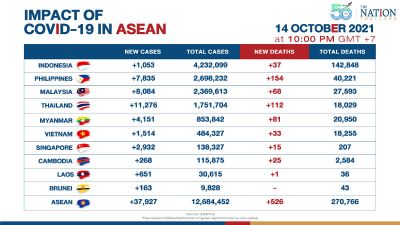
The number of Covid-19 cases crossed 12.68 million across Southeast Asia, with 37,927 new cases reported on Thursday (October 14), higher than Wednesday’s tally at 35,693. New deaths are at 526, decreasing from Wednesday’s number of 574. Total Covid-19 deaths in Asean are now at 270,766.
Restaurants and other food and beverage establishments (except businesses that sell alcohol) in Hanoi, Vietnam are allowed to offer on-site dining at half their maximum capacity starting Thursday morning. The city also opens public transport services, museums and public parks provided that these places have no more than 10 people gathering.
Meanwhile, Brunei has extended the Covid-19 night curfew for another two weeks until October 31, with harsher punishments imposed on individuals and employers who flout the directive. Residents are banned from leaving their homes during 8pm to 4am except for emergencies or essential work under the night curbs. The government has raised the fine from $100 to $500 following hundreds of violations in nine days. Companies will also be issued a $500 fine if their workers were caught leaving their homes without a valid authorisation letter during the curfew.
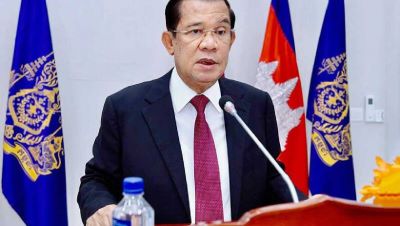
Luy David, secretary of state for the Ministry of Foreign Affairs and International Cooperation, told reporters on October 12 that Hun Sen had already sent invitations to the 52 ASEM partner leaders, 14 of whom have confirmed their participation. He said Cambodia would receive confirmations from other leaders around a month prior to the summit.
“So the confirmations are still coming in because we have about a month and a half left. Among the leaders who have already confirmed are prime ministers and presidents of Asia and Europe. The presidents of the European Council and European Commission have also confirmed their participation,” he said.
According to David, the meeting will be arranged via a video system and will not require a lot of preparation.
“We have a video system, we use the Zoom platform. In the past I have chaired all the ASEM senior officials meetings via Zoom as well. It went smoothly. Therefore, I think it’s not a problem for our summit next month,” said David.
David said at a press conference on ASEM13 hosted by the Club of Cambodian Journalists via video on September 16 that Cambodia had prepared three documents to be adopted at ASEM13 – the Phnom Penh statement on socio-economic recovery after Covid-19, the ASEM13 chair statement, and the ASEM13 statement on connectivity.
He said the Phnom Penh statement was authored by Cambodia’s senior leadership and was aimed at confirming the broader Asia-Europe leadership’s commitment to assist the developing world with socio-economic recovery post Covid-19.
He mentioned that the meeting would also discuss managing the challenges posed by Covid-19 and quickening economic recovery after the pandemic.
Cambodia will host the ASEM13 via video conference under the theme “Strengthening Multilateralism for Shared Growth” for two days from November 25-26 following two prior postponements in 2020 due to the Covid-19 outbreak.
International Relations Institute of the Royal Academy of Cambodia director Kin Phea said Cambodia’s hosting of the meeting demonstrates the country’s important role in regional and global affairs within the framework of multilateral roles. Cambodia can also show its capabilities in terms of roles and human resources, as well as information that can be spread about Cambodia’s image on the international stage.
“Through this meeting, we see that the most important thing is that we can benefit from joint efforts to fight Covid-19 and economic recovery, and it is also an important driving force for multilateralism in the region as well as in the world today,” he said.
KUALA LUMPUR: Next week the country will move into the endemic stage of the Covid-19 and all Malaysians have to be prepared to adapt to new norms.
More restrictions imposed during the pandemic are slowly being lifted for this purpose, one of which is the resumption of interstate and overseas travels.
Businesses, including hoteliers, are already making the necessary preparations to face this transition with new strategies in place.
Stakeholders have decided to strictly adhere to standard operating procedure to prevent Covid-19 clusters and another lockdown, which could hit hard their respective industries all over again.
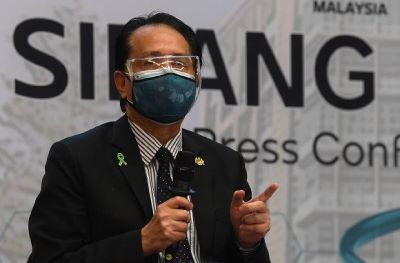
Advising the public to take precautions when the endemic stage starts, Health director-general Tan Sri Dr Noor Hisham Abdullah, in his Facebook post, said everyone must adapt to new norms and understand that the world would not be the same anymore.
According to Bernama, he said the onus was on the people to play their roles to keep the Malaysian Family safe from Covid-19.
Anticipating that many people would be travelling to their hometowns this weekend, Dr Noor Hisham advised all to take time to plan and do what was necessary to comply with the respective SOP.
“We have been successful thus far in averting a national disaster, as seen currently in many other countries.
“But we are not out of the woods yet, as next week, we will fight on a new battlefield with new strategies in place.
“We can only win this war if all of us, all Malaysians, collectively come together as part of our social responsibility to embrace standard operating procedures and guidelines set by the government,” he said.
Dr Noor Hisham said Malaysians must have social discipline, especially in embracing physical distancing, taking all precautionary measures, and maintaining good personal hygiene.
Business premises, he added, should address the ventilation of spaces with regular sanitisation of common areas such as pantries or surau, and to only allow a limited number of people to congregate in a particular place at any one time.
“We must all learn that every individual’s action has a ripple effect on how we manage Covid-19 in our community. We have to adapt, adjust and accommodate the new norms in our lives,” he said.
Meanwhile, business stakeholders have pledged to follow all the SOP imposed by the government to ensure smooth business.
Johor South SMEs Association adviser Teh Kee Sin said Covid-19 would be part of them for a long period of time and that they would need to work to put food on the table.
“Self-discipline is very important and the majority of Malaysians are following the guidelines and instructions imposed by the government as it is for our own good,” he said.
Malaysian Association of Hotels (MAH) Sabah and Labuan chairman Hafizan Wong said MySejahtera check-ins, temperature checks and full vaccination requirements were in place.
Employees must be fully vaccinated, while guests must fill in health declaration forms upon check-in, he said, adding that sanitation was consistently conducted in rooms.
“Our staff have been trained on all steps that are to be taken,” Hafizan said, adding that some hotels had even minimised its usage capacity despite the government allowing a 50% capacity for their in-house facilities such as pools, playgrounds and gyms.
New committee to review ‘vaccine pass’ despite controversy
South Korea is positively considering a “vaccine pass” system to incentivize people to get vaccinated against COVID-19 as officials look to start the normalization process next month.
The system would entail providing benefits and exemptions to virus rules for those who have completed their COVID-19 vaccinations. The discussion has gained steam as officials believe such a system could boost the nationwide vaccination program and increase the likelihood of successful normalization.
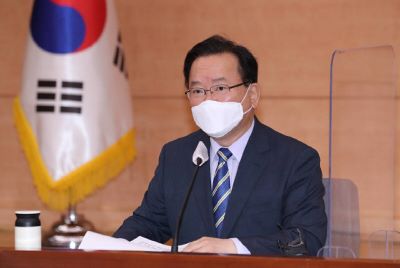
“We will prepare to change COVID-19 from a mysteriously fearful virus to a controllable infectious disease and thereby give back normal lives to people,” Prime Minister Kim Boo-kyum said Wednesday during a meeting of a new committee on normalization after the COVID-19 pandemic.
“We also have to review new virus control measures like introducing a ‘vaccine pass’ while revamping the medical sector.”
Kim’s comments were made during the first meeting of the government-civilian committee, launched Wednesday to set up guidelines and hold discussions before beginning the normalization process in early November.
Eight government officials and 30 experts from the private sector convened for the first meeting to draw up a road map for normalization in various sectors.
Kim and Choe Jae-chun, distinguished chair professor of EcoScience at Ewha Womans University, are jointly chairing the committee.
The committee has four subcommittees. One is concerned with the economy, one with society and culture, one with administration and safety, and one with the medical and quarantine sectors.
The meeting ran from 9:10 a.m. to 10:50 a.m., and participants evaluated the progress of Korea’s COVID-19 response to date and drew up plans for future measures.
The committee also agreed to have its subcommittees establish plans on the continuation of vaccination efforts, the review of adverse effect response plans, revision of the current social distancing system, and reform of the medical and quarantine sectors.
The general plan set out so far is aimed at carrying out normalization on a gradual basis with ideas gained from countries such as Israel, Germany and Portugal, which have already launched normalization efforts based on high COVID-19 vaccination rates.
The committee aims to announce an official road map for normalization later this month. Even after starting the normalization process in November, the committee plans to hold at least one meeting every month and its subcommittees are to meet at least twice a month.
As of Tuesday’s end, 31.2 million people throughout the country, or 60.8 percent of the population, were fully vaccinated. More than 78 percent of the population had received initial COVID-19 shots. The national vaccination program began Feb. 26.
The authorities are hoping 70 percent of the population will have had second shots by Oct. 23 before the normalization process officially starts next month. Officials have emphasized that herd immunity is essential to the normalization plan.
While some oppose the introduction of a vaccine pass system out of concern about discrimination against unvaccinated people, polls have shown that the majority of the population is in favor of its introduction.
A Realmeter survey of 500 people aged 18 or above showed early this month that 64.4 percent of respondents were in favor of introducing vaccine passes, while 29 percent were opposed.
The country has been reporting new COVID-19 case numbers in the quadruple digits since July 7.
Korea reported 1,584 new cases by Tuesday’s end — 1,571 locally transmitted and 13 imported from overseas — raising the total number of cases to date to 335,742, according to the Korea Disease Control and Prevention Agency.
It was expected that the daily new case count would rise after the three-day weekend that ended Monday.
KUNMING – The Kunming Declaration was adopted Wednesday at the ongoing 15th meeting of the Conference of the Parties to the Convention on Biological Diversity (COP15) in Kunming, southwest Chinas Yunnan Province.
Chinese Minister of Ecology and Environment Huang Runqiu declared the adoption of the declaration at the High-Level Segment of the first part of COP15.
“The declaration will send a powerful signal, showing the world our determination to solve the problem of biodiversity loss, and our stronger actions on the issues discussed at this high-level meeting,” Huang said.
The Kunming Declaration is a political declaration and the main achievement of this conference.
The declaration commits to ensuring the formulation, adoption and implementation of an effective post-2020 Global Biodiversity Framework to reverse the current loss of biodiversity and ensure that biodiversity is on the path to recovery by 2030 at the latest, so as to fully meet the 2050 vision of “Living in Harmony with Nature.”
The declaration took note of the theme of the UN Biodiversity Conference 2020: “Ecological Civilization: Building a Shared Future for All Life on Earth.” Ecological civilization is a philosophy proposed by China.
It declared that putting biodiversity on a path of recovery is a defining challenge of this decade, requiring strong political momentum to develop, the adoption and implementation of an ambitious and transformative post-2020 global biodiversity framework and putting forward the 17 commitments.
“The Kunming Declaration details some of the key elements needed for success: mainstreaming, redirection of subsidies, rule of law, full and effective participation of indigenous people and local communities,” said Elizabeth Maruma Mrema, executive secretary of the Convention on Biological Diversity.
SINGAPORE – As the coronavirus and its variants continue to keep businesses and borders shut and halt economic growth, thousands of people in Asean have digitalised to stay afloat.
The speed at which they did so was blistering – but it was not fast enough. And many believe they will need to digitalise further to build on incomes and savings in the coming years.
Widespread recognition of the crucial role of digitalisation for economic recovery emerged as one of the key findings of one of the largest surveys of Asean youth, conducted by the World Economic Forum (WEF) and Singapore-based Sea, which owns e-commerce platform Shopee and digital financial services firm SeaMoney.
Nearly 86,000 people in six countries were surveyed in July and August for the Asean Digital Generation Survey: Pathway To Asean’s Inclusive Digital Transformation And Recovery report.
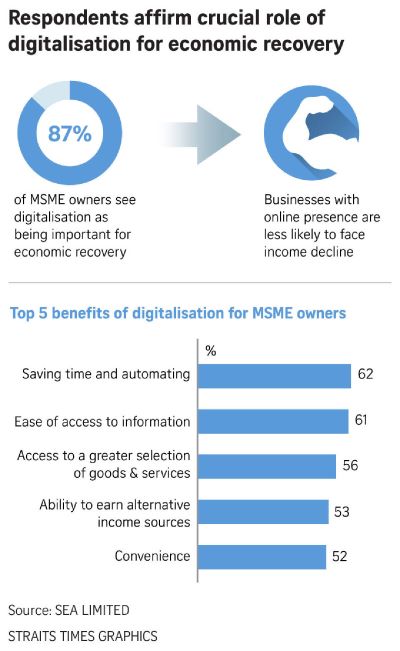
Eighty-five per cent of the respondents and 87 per cent of the MSME (micro, small and medium enterprise) entrepreneurs surveyed saw digitalisation as the way forward for economic recovery – which many believe will take quite a while.
Furthermore, the survey also showed that those who were “more digitalised” tended to be more economically resilient while grappling with the pandemic.
Most MSME owners agreed that digitalisation would help them save time and automate production processes, and that it provides ease of access to information, more options to select goods and services as well as the ability to generate an alternative income.
“Reaching the post-pandemic world will be no easy feat,” wrote the authors of the report, Dr Santitarn Sathirathai, Sea’s group chief economist, and Mr Joo-Ok Lee, head of the WEF’s regional agenda for the Asia-Pacific and a member of its executive committee.
“Nearly 70 per cent of respondents expect the pandemic to last beyond 2021, with 39 per cent expecting it to last for three years or longer and 13 per cent believing the pandemic would never end.
“However, once it does, nearly two-thirds think that life will be significantly different compared with pre-pandemic times,” they added.
The results of the survey were released in partnership with The Straits Times at a webinar on Wednesday (Oct 13).
The survey results come as many countries of South-east Asia are still grappling with Covid-19 following the rapid spread of the Delta variant of the virus.
“Some 60 per cent of people reported a decline in income and savings, with over 40 per cent saying it was a significant deterioration,” said the authors.
“Beyond its economic impact, many respondents, particularly women, reported declines in social, mental and physical health outcomes during the pandemic.”
In terms of adapting to restrictions and the new economic climate, 64 per cent of those polled said they digitised more than half their business tasks. For MSME owners, this was 74 per cent.
Amid the pandemic, 27 per cent of those polled created a new business, 12 per cent created employment for another individual and 25 per cent started a new job.
Nearly 50 per cent of those in the wholesale and retail trade sector started a new business, while the logistics sector had the highest share of people finding new jobs at 36 per cent.
Looking ahead, 43 per cent to 66 per cent of respondents want to increase digitalisation even further. The figures are even higher for MSME owners – ranging from 51 per cent to 75 per cent.
Survey results show nearly two-thirds identify payments as a key area for further digitalisation, while 43 per cent wanted further digitalisation of the loans/financing process.
A key deterrent remains access to digital infrastructure and digital devices. There were also concerns about digital trust and security.
Dr Sathirathai and Mr Lee said there is a continuing strong need for the reskilling and upskilling of the Asean workforce.
“Technology use, creativity and innovation, self-discipline, and resilience and adaptability were considered to be the most important skills to succeed in the post-pandemic world,” they noted.
However, less than half of those polled consider themselves proficient in the skills they deemed important.
“The complexity and cross-cutting nature of challenges require joint efforts and collaboration across sectors and countries to address the gaps,” the authors said, adding that policies are needed to enable a more sustainable, inclusive recovery for Asean as a whole.
This is the fourth year that the Asean Digital Generation Survey has been conducted to understand aspirations and perspectives of youth in the Asean region.
Respondents were from Indonesia, Malaysia, the Philippines, Singapore, Thailand and Vietnam.
WASHINGTON – Washington National Cathedral on Tuesday dedicated the fourth of the planned “quartet” of human rights carvings in the buildings vestibule, honoring the late Elie Wiesel with prayer and discussion of the Holocaust survivors legacy of pursuing justice, hope and faith in the face of humanitys darkest crimes.
The dedication marked the first time a modern Jew has been memorialized at the huge, Gothic-style cathedral, which houses hundreds of images in its carvings, stained glass and other art inside and outside in an effort to be a multifaith institution addressing modern issues. The cathedral is part of the Episcopal Church.
Wiesel, the famous author of the Holocaust memoir “Night,” a teacher and a human rights activist, joins Rosa Parks, Mother Teresa and slain civil rights activist and seminarian Jonathan Daniels as the four busts in the four corners of the vestibule that, in pre-pandemic times, greeted hundreds of thousands of visitors each year. (The cathedral is in the process of reopening and is scheduled to resume allowing sightseers on Oct. 18.) The four are called “The Quartet,” said cathedral spokesman Kevin Eckstrom.
Also in the Human Rights Porch, or vestibule, are statues of the Salvadoran Bishop Oscar Romero, Eleanor Roosevelt and Bishop John Walker, the first Black Episcopal bishop of Washington and a cathedral dean.
Speaking at a Tuesday afternoon prayer service to dedicate the carving, the Very Rev. Randolph Marshall Hollerith, the cathedral’s current dean, recalled reading “Night” as a White Protestant growing up in the South and being jarred by his first encounter with the Holocaust.
“‘Night’ changed my life. Here was a description of evil in its rawest form. Human evil of unspeakable proportions,” Hollerith told a small crowd that included Wiesel’s 90-year-old widow and his children.
ADVERTISEMENT
Hollerith quoted Wiesel’s writings on the complicated relationship between despair and memory and how they intertwine with faith and hope to refuel one another.
“What amazed me more about Elie Wiesel’s writings was that he went on praying. In spite of everything. The extermination of his mother and sister, the slow death of his father, he went on praying. Angry with God, taking God to task, but never letting go,” Hollerith said.
Today the struggle for human rights goes on, whether it’s the Muslim Rohingya in Myanmar, the Yazidis of the Middle East, the Uyghurs in China “or the treatment of migrants and refugees on our own Southern borders,” Hollerith said. “There is much work still to be done. . . . It’s my hope this likeness, carved in limestone, will remind all who enter this sacred space that the struggle for faith, to find hope, to stand against evil and hatred are struggles worth undertaking. It’s my hope his presence here, as long as this stone stands, inspires people to struggle for what’s best about humanity. While never forgetting the worst humans can do to one another.”
Leading an evening program about Wiesel’s legacy, historian Jon Meacham told audiences in the cathedral and online that the carving should be a beacon to something specific and also to something overarching: the failure of most Christian Americans to “say and do what should have been said and done in the face of evil” during the Holocaust, and the need in the modern day to “close the gap between our profession of ideals and the practice of those ideals.”
Speakers and panelists spoke about enduring antisemitism, Islamophobia, racism and “the perennial and pernicious forces that lead to genocide, hunger, oppression and injustice,” Meacham said. “We must pray America is ready to remember, ready to learn and ready to act. Elie Wiesel remembered. He learned, he acted.”
The bust sits about 10 feet in the air, in an arch doorway. The dedication, and an evening discussion program about Wiesel’s legacy, were organized by the cathedral, the U.S. Holocaust Memorial Museum and the Elie Wiesel Foundation for Humanity.
Cathedral stonemason Sean Callahan used medieval techniques to create the carving. He also did the depictions of Mother Teresa, Parks, Daniels and subjects of other sculptures throughout the cathedral. The original model was sculpted by North Carolina artist Chas Fagan, whose other works include the official White House portrait of former first lady Barbara Bush and statues of Ronald Reagan and Billy Graham at the U.S. Capitol.
Wiesel wrote dozens of books, was a professor at Boston University and the founding chairman of the Holocaust Museum, and won numerous awards, including the Nobel Peace Prize. He died in 2016.

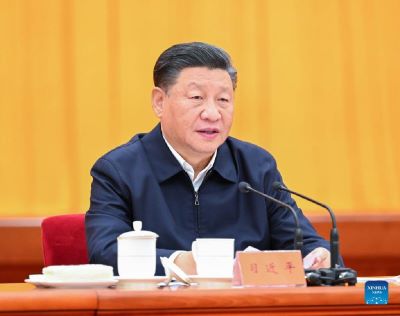
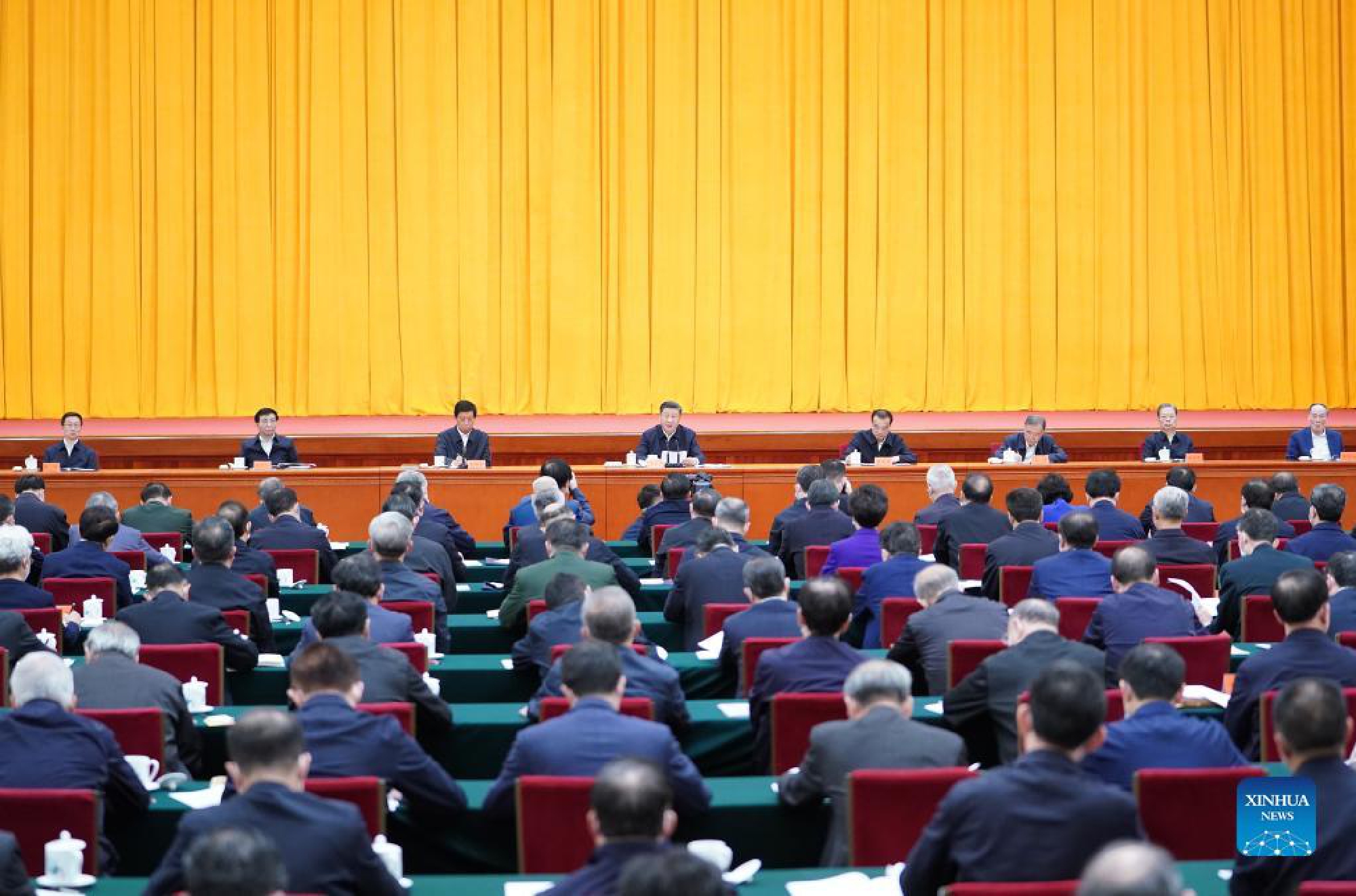 Xi: Democracy a key tenet