China urges investigation of massacre of Afghans by US
BEIJING – Although the US military has withdrawn from Afghanistan, the massacre of civilians by the US military and its allies in Afghanistan in the past 20 years must be investigated thoroughly, and the murderers brought to justice, a Chinese Foreign Ministry spokesperson said Wednesday.
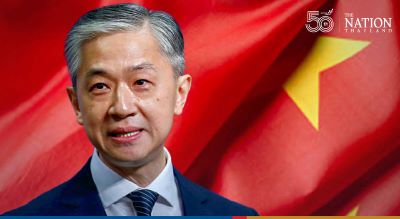
Spokesperson Wang Wenbin made the remarks at a daily news briefing in response to a question on the recent civilian killings by US troops during their withdrawal from Afghanistan.
According to reports, on Aug 26, a terrorist attack near Kabul’s airport caused hundreds of casualties. Some wounded people claimed that the US military fired at people after the explosion, causing more casualties.
Reports also said that on Aug 29, the US military in Afghanistan used drones to attack a residential building in Kabul on the grounds of anti-terrorism actions, killing ten civilians, the youngest of whom was only two years old.
Wang said that China noticed these reports. He said reports show the killing of civilians by the US military in Afghanistan occurred frequently. For instance, in 2002, a US military airstrike hit a wedding banquet in Uruzgan province, causing dozens of deaths and more than 100 injuries.
These attacks continued. A US military airstrike in 2008 hit a village in Herat province, killing nearly 100 civilians, including 50 children and 19 women.
In 2010, a NATO (North Atlantic Treaty Organization) airstrike hit Dekundi province, killing at least 33 people.
In 2012, the British Daily Telegraph released a video showing four US soldiers assaulting the remains of Taliban personnel in a reprehensible manner.
In 2015, the Afghan anti-narcotics police force was attacked by NATO fighters during its mission, and 15 policemen were killed.
In 2019, US drones launched an attack in Nangarhar province, killing at least 30 Afghan farmers.
Wang said that the number of civilian deaths in Afghanistan caused by US airstrikes far exceeds the official US government announcement. Statistics show that as of April 2020, at least 47,245 Afghan civilians have been killed in the war in Afghanistan launched by the United States.
He stressed that although US troops exited Afghanistan, its massacre of civilians must be investigated thoroughly.
“The lives and the human rights of the Afghan people should be safeguarded. This is about the international rule of law, justice, and the progress of human rights,” said the spokesperson.
Thai retail conglomerate CP All Pcl debuted Cambodia’s first 7-Eleven convenience store in up-and-coming Prek Leap commune of northeastern Phnom Penh’s Chroy Changvar district on August 30, as part of the company’s plans to expand across ASEAN.
The first outlet of the US-based convenience store chain is located in Prek Leap village, one of the most bustling areas of the district, on National Road 6, an arterial road that carries considerable commercial traffic.
CP All Pcl said in a press release: “This is an important step for CP All in growing into ASEAN, highlighting the strength of service from Thailand to Cambodian consumers [with a] focus on doing business, along with creating value for society according to the aspirations – create and share opportunities.”
Its senior vice-president Chairoj Tiwatmuncharoen noted that CP All (Cambodia) Co Ltd, an indirect subsidiary of CP All Pcl, entered into a master franchise agreement with 7-Eleven Inc last year and is solely authorised to develop and operate stores in Cambodia.
He said: “The opening of the first 7-Eleven store in Cambodia … is an important symbol of friendship, and good relations between the two countries – both at the government and people’s levels – and quality services.
“What is important to emphasise is … respect for the law and the practices of the society that we are part of. At the same time, we have adopted the same approach [that we use in] Thailand.
“In addition to the quality of products and services, we will endeavour to contribute to value-delivery – whether it [concerns] human resource development, promotion of small entrepreneurs,[or] conducting business with environmental considerations – to enhance the Cambodian economy.
“We hope to be well received by the Cambodian people,” Chairoj added.
As corroborated by a 7-Eleven Inc statement, the first 7-Eleven outlet is situated in the ground floor of an office building, at No 41, 43 National Road 6, across the road from Prek Leap National Institute of Agriculture (GPS Coordinates: 11.6418N, 104.9176E).
CP All executives have hinted at plans to open at least six stores this year, including a branch at a PTT petrol station in northern Phnom Penh’s Prek Pnov district that was reportedly scheduled to open in mid-June, according to Cambodian ambassador to Thailand Ouk Sorphorn.
He told The Post that the inaugural branch of 7-Eleven mark a new milestone for CP All’s business expansion into Cambodia.
He also suggested that the Thai conglomerate’s entry into the Cambodian market is in the line with Cambodia’s Economic Diplomacy Strategy, which is implemented by Minister of Foreign Affairs and International Cooperation Prak Sokhonn with support from Prime Minister Hun Sen.
According to plans, products from local small- and medium-sized enterprises (SME) sold in 7-Eleven in Cambodia will comprise at least 50 per cent of stock, he said, stressing that the franchise would create many jobs for locals.
“This is a great opportunity for Cambodian SMEs to partner with CP All, the company [operating] the world’s largest chain of stores” in Cambodia, he said.
The Bangkok-listed 7-Eleven franchise operator, the retail arm of Charoen Pokphand Group Co Ltd, granted CP All Cambodia franchising rights for 30 years in the establishment and operation of 7-Eleven branches, according to Thai local media reports.
On the Stock Exchange of Thailand, CP All’s share price rose 2.05 per cent, 3.21 per cent and 1.17 per cent respectively over August 27, 30-31, with 43.35 million, 49.35 million and 47.16 million shares traded, to close at 65.00 baht ($2.02) on August 30 for a market capitalisation of 583.90 billion baht.
Vientiane bans night travel, closes businesses and schools as virus spreads
Vientiane authorities have introduced new restrictions, including a ban on night travel and closure of some businesses and schools, as the community outbreak of Covid-19 widens.
The capital’s mayor, Atsaphangthong Siphandone, issued an order on August 30 imposing 10 prohibitions and closures as follows: Travel on roads is prohibited across the capital from 10pm to 5am. Exceptions are made for essential trips such as the transport of goods, food and medical equipment, ambulances, fire-fighting trucks, rescue vehicles, and vehicles owned by officials. Closure of all schools, with entrance exams to tertiary education institutions suspended. Closure of traditional and local border checkpoints. Passenger transport via the first Laos-Thailand Mekong Friendship Bridge is suspended. Exception is given to the transport of goods and people given permission by the Covid-19 taskforce. Karaoke and entertainment venues, tourist sites, night markets, food gardens, liqour outlets including grill shops where alcoholic beverages are sold, theatres, snooker clubs, massage and spa services, beauty salons, internet cafés and gaming shops must close. Meetings, training courses and other activities involving more than 20 people are banned. Any kind of party or gathering in any location is prohibited. Those infringing the rule will be placed in quarantine at a quarantine centre or designated hotel. Rule-breakers will be fined and held responsible for any costs incurred. All indoor and outdoor sports are prohibited. Residents living in Vientiane’s red zones are prohibited from travelling to the provinces. Meanwhile, people living in red zones outside of Vientiane are not permitted to enter the city, unless given permission by the Covid-19 taskforce. Circulation of fake news is prohibited.
Rises in product prices and the stockpiling of goods is not allowed. These measures will be in place until the community outbreak of the virus is brought under control. The intensified measures came after the capital recorded an increase in locally-transmitted cases in recent days, triggering fears of a further outbreak. On Tuesday alone, Vientiane recorded 24 locally-transmitted cases – the highest in the country. In addition, special restrictions have been introduced in red zones, including the following: Travel from and to red zones is prohibited for 14 days. Violators will be quarantined and held responsible for any costs incurred, except where permitted by the Covid-19 taskforce. Meetings, trainings, traditional festivals and other activities are completely banned. Wholesale and retail shops, supermarkets, department stores, minimarts, fresh markets, restaurants, coffee shops, barber shops and beauty salons must remain closed. Factories must close except for those that have dormitories to house their employees or those providing transport for employees. Outside of red zones, wholesale and retail shops, supermarkets, department stores, minimarts, fresh markets, restaurants and coffee shops may remain open, but staff must be fully vaccinated. All businesses must close by 9pm. Factories whose employees have been fully vaccinated are permitted to continue to operate.
China’s Covid-19 resurgence leaves Muse, northeastern door of Myanmar, and returning migrant workers in limbo
The second China (Lancang)-Myanmar (Lashio) Border Business and Expo took place both online and offline on August 26 with a view to enhancing the bilateral border cooperation and facilitating the Belt and Road Initiative and China-Myanmar Economic Pivot, said a statement issued by the Chinese Embassy in Myanmar.
Secretary of Lancang City Committee of Communist Party Mr Yang Haodong said: “With support from Myanmar as well as a bilateral effort, a China Yunnan-Myanmar Yangon-Indian Ocean Container Maritime-Motor Road-Railroad Transport route has been successfully opened.”
A first batch of containers loaded with goods from a third country will arrive at Chinshwehaw border gate via Yangon port and then go to China, he added.
He quoted Secretary General Mr Xi Jinping as saying that the inauguration of a China-Myanmar-Indian Ocean route was a milestone for sustainable development of Lancang. It is the important achievement to further strengthen China-Myanmar trade, he said. He also expressed his belief that holding the expo would forge cooperation between businesspeople of the two countries and bring close contacts between the two peoples.
Mr Yang Haodong continued that China hoped for a new page on Paukphaw relations by working together with Myanmar.
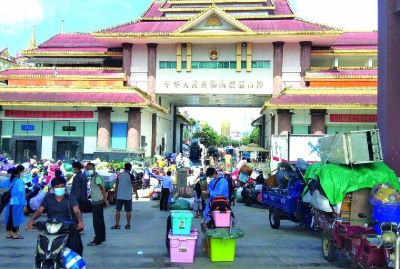
And it has set alarm bells ringing for Muse, the northeastern door of Myanmar, which is seeking most of the State revenues in border trade. Muse is carrying out border trade activities with Kyel Gaung, Ruili and Wangtain, border towns of China, yielding economic benefits for both sides.
Since its establishment, Muse has been busy with shopkeepers, buyers and merchants. But dark days came to the town when it started experiencing the Covid-19 pandemic in early March 2020.
After reports of first Covid-19 cases in Mansi and Ruil, China and Muse, Myanmar in March 2020, China started close monitoring and imposed lockdowns in the whole towns by adopting Covid prevention policies.
On June 8, 2020, China closed Nandaw and Hsinphyu border gates, affecting local people from both regions and their socio-economy.
In April, all the border gates in Muse were closed but Kyinhsankyawt border gate was reopened. Flow of commodities except Covid-19 protective equipment came to a stop.
According to the data from the ministry of commerce, Myanmar’s foreign trade value over the past 10 months this fiscal year has declined by US$6.740 billion when compared to the same period of last fiscal.
In the period, export value was just US$12.843 billion and import value US$12.881 billion.
Border trade value was just over US$8.7 billion with a decline of over US$880 million, compared to the same period of last fiscal year.
Muse has seen changes resulting from the current political situation, healthcare situation in the Covid-19 resurgence and low trade.
The town has experienced the Covid-19 third wave since June 26 reporting 1,633 cases, 1,462 recoveries and 59 deaths till August 26.
In a bid to ensure regular trade at Muse 105th Mile Border Trade Zone on the border between Myanmar and China, a public company is building a 1,000-bed hospital for Covid-19 treatment center and a quarantine center in the field used for buying and selling fruit.
“Construction is going on. If we can control Covid-19, we will be able to resume trade as regularly as ever. Cargo truck drivers and assistants will receive testing. For those testing positive, they will be sent to the hospital. For negative results, they will get vaccinated,” said U Sai Khin Maung, vice chairman of Muse 105th Mile Fruit Wholesale.
Construction started on August 16 with Chine technology and equipment support. It has now completed by 80 percent.
The project is expected to cost about K100 million, and two doctors and 10 nurses are to be appointed. But, reports say the number of healthcare staff is not enough.
“At a meeting, the medical superintendent of Muse Township People’s Hospital said due to staff shortages, one doctor and about five nurses would be sent for healthcare. The hospital construction is being financed by cash donations from some well-wishers. But now, infection and death rates are decreasing significantly,” said U Kyaw Than, chairman of Parami Social Aid Organization.
However, a medical team comprising doctors and nurses led by District People’s Hospital medical superintendent Dr Han Naing Soe, civil society organizations and auxiliary fire brigade members will reportedly be giving a helping hand to the hospital and quarantine center. Meanwhile, Chinese Myanmar businesspeople and donors will provide medicines and meals, according to the Muse Township Covid-19 Prevention, Control and Treatment Committee.
Myanmar migrant workers are among those suffering the Covid-19 crisis. They have migrated to China to work in its border towns such as Kyel Gaung and Ruili. They help increase production capacity in China and send their salaries back to their families in Myanmar. So, the workforce of Myanmar migrants produces mutual benefits.
In the lockdown period, China allowed Myanmar workers to leave for their motherland from July 26 to August 10 through the Nandaw border gate in Muse, northern Shan State, which is a town bordering China. Then, the border gate was closed again but workers were allowed to leave only on August 16.
They are returning to their country as they have difficulty with their living conditions in China after lockdowns were imposed and shops and factories closed in Kyel Gaung and Ruili.
There are seven border gates on the border between Muse District and the regions close to Yunnan Province. Since earlier July 2020, China has closed them due to the Covid-19 pandemic causing difficulties for Myanmar workers.
On June 15, 44 Myanmar workers wishing to return to their country were allowed to go home through an illegal route.
After that, Myanmar workers reported their difficulties to social organizations in Ruili and Kyel Gaung. The issue was raised with Muse authorities, who then sought coordination with Chinese authorities.
Then, a plan came to allow tens of thousands of Myanmar citizens in China to return to their motherland with dignity through the official routes.
From August 26 to August 26, 3,630 men and 3,260 women totaling 6,890 re-entered Myanmar.
According to the Muse Township Red Cross Society and charity organizations, some Myanmar workers in those Chinese towns became jobless after the lockdown and closures of shops and factories. As they could not afford house rents, they had to stay roadside or on vacant land. They faced various hardships such as poor living conditions and mugging.
All in all, responsible officials and organizations should work together with a humanitarian spirit to help the citizens through efforts to improve the country’s political, health and socio-economic situations.
After the US completed its withdrawal from Afghanistan, Taliban initiated dialogue with India in Qatar over safety, security and early return of Indian nationals stranded over there, the Ministry of External Affairs said on Tuesday.
For the first time, India has made public a meeting held between the two sides.
The ministry stated that Ambassador of India to Qatar, Deepak Mittal, met Sher Mohammad Abbas Stanekzai, the Head of Taliban’s Political Office in Doha.
“The meeting took place at the Embassy of India, Doha, on the request of the Taliban side,” said the ministry.
Discussions focused on safety, security and early return of Indian nationals stranded in Afghanistan. The travel of Afghan nationals, especially minorities, who wish to visit to India also came up.
Ambassador Mittal raised India’s concern that Afghanistan’s soil should not be used for anti-Indian activities and terrorism in any manner.
Stanekzai assured the Ambassador that these issues would be positively addressed.
Stanekzai, known as Sheru, received military training in the Indian Military Academy in the 1982, rose to the ranks of Deputy Health Minister during the Taliban regime and later served as a chief peace negotiator in Doha.
He was also Deputy Minister of Foreign Affairs of the Taliban regime. The 58-year-old Pashtun comes from the Stanekzai clan. He can speaks five languages and he served as Taliban’s Political Office chief between 2015-2019.
Taliban had seized the war-ravaged country’s capital Kabul on August 15 after then President, Ashraf Ghani fled the country.
On August 30, the United Nations Security Council adopted a resolution on Afghanistan, aiming to prevent the use of Afghan soil by terrorist organisations against any country.
The resolution was adopted with 13 votes in favour while Russia and China preferred to abstain.
Korea becomes first country to regulate Google’s in-app commission policy
Divisive bill seeks to level playing field by curbing global IT titans
The South Korean parliament passed a controversial bill on Tuesday that could break the app store duopoly of Google and Apple, in a move watched closely by the world for its potentially radical implications.
The so-called anti-Google bill, endorsed by the National Assembly with 180 votes in its favor, amends the Telecommunications Business Act to stop the US-based IT titan from requiring local app developers to use its payment system for in-app sales. It is set to take effect immediately after promulgation.
In a statement released immediately after the bill’s passage, Google said it was seeking measures to comply with the new regulation.
“The commissions are used to provide Android for free, while enabling developers to reach customers around the world through various tools and global platforms,” the statement said. “It is a business model that allows customers to use devices at affordable prices and helps both developers and platforms become financially successful. Just as developers incur costs to develop apps, Google incurs costs to establish and maintain the app market.
“Google, while maintaining the business model that supports a high-quality operating system and app market, is seeking measures to comply with the regulation.”
The legislation was pushed by President Moon Jae-in’s liberal Democratic Party, which holds a parliamentary majority. Its lawmakers took issue with Google’s new in-app commission policy, announced last year, calling it an example of a large platform operator abusing its market dominance.
But the bill was highly divisive, pitting local app developers and IT companies who see the need to regulate global IT titans against conservative politicians and experts who fear a trade dispute with the US government.
Not only local but also global app developers and IT companies hailed the bill’s passage in Korea.
Match Group, an American internet and technology company headquartered in Dallas, Texas, immediately released a statement through its Asia Pacific office after the passage.
“Today’s historic action and bold leadership by South Korean lawmakers mark a monumental step in the fight for a fair app ecosystem,” the group’s spokesperson said. “The legislation passed today by the Assembly will put an end to mandatory IAP in South Korea, which will allow innovation, consumer choice, and competition to thrive in this market.”
“We look forward to the bill being quickly signed into law and implore legislative bodies around the globe to take similar measures to protect their citizens and businesses from monopolistic gatekeepers that are restricting the internet,” the official added.
Google and Apple together control 90 percent of the global app store market. The former runs its Play Store on Android, while the latter operates its App Store on iOS.
In Korea alone, Google earned nearly 6 trillion won ($5.15 billion) in revenue from Play Store in 2019, according to a government report published last year.
Both Google and Apple have faced criticism in countries around the world because they require software developers to use their billing systems, paying commissions of up to 30 percent on all in-app purchases.
Last September, Google sparked criticism across the world when it announced it would expand the payment system starting in October 2021, making it apply to almost all digital content ranging from webtoons to music and video, instead of just the gaming segment.
This led to a backlash in many countries. Last year, the European Union proposed the Digital Markets Act, taking aim at the commissions forced by large US tech giants.
Earlier this month in the United States, a bill was introduced to rein in app store companies that hold too much market control, apparently targeting Google and Apple.
Responding to the criticism, Google, earlier this year, said it would lower the commission from 30 percent to 15 percent on the first $1 million it earns in annual revenue.
Apple halved the fee rate for developers with less than $1 million in revenue, and announced last week that it would allow developers to inform their customers of other payment options — part of a settlement proposal for a group of developers who sued Apple in a class action.
Regarding the bill in Korea, Apple remains concerned.
“The proposed bill will put users who purchase digital goods from other sources at risk of fraud, undermine their privacy protections, make it difficult to manage their purchases, and features like Ask to Buy and Parental Controls will become less effective,” it said in a statement issued last week before the bill’s passage.
“We believe user trust in App Store purchases will decrease as a result of this proposal — leading to fewer opportunities for the over 482,000 registered developers in Korea who have earned more than 8.55 trillion won to date with Apple.”
Sharp spike in new Covid cases in Philippines, Vietnam
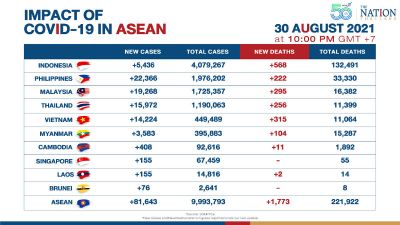
Southeast Asia saw an uptick in new Covid-19 cases and deaths, mainly due to a sharp increase in cases in the Philippines and Vietnam, collated data showed.
Asean countries reported 81,643 new cases on Monday, higher than Sunday’s 79,833, and 1,773 patients died, up from the previous day’s 1,663.
Cumulative cases in the region crossed 9.99 million, and total deaths rose to 221,922.
Indonesia reported 5,436 new cases on Sunday, down over 25 per cent from the previous day, although deaths were slightly higher at 568. Cumulative cases in the country increased to 4,079,267 with 132,491 deaths.
Children in Jakarta began to re-enter classrooms on Monday, as Indonesia eased restrictions in some areas. Some 610 out of over 10,000 schools in Jakarta will be ready for in-class schooling, with classes held at 50 per cent of the usual size.
The governor of Jakarta revealed that 91 per cent of children aged 12-18 had been vaccinated at two doses while 85 per cent of teachers had already received two jabs.
Philippines reported a sharp jump in new cases to 22,366 on Sunday from 18,528 on Saturday, topping the list in Asean, while deaths more than doubled to 222 from 101.
Meanwhile, Malaysian Prime Minister Ismail Sabri Yaakob is under quarantine following close contact with a Covid-19 patient. His office said in a statement on Monday it was unclear how long he would be in quarantine and did not indicate any results for a coronavirus test. Ismail Sabri was sworn in as prime minister on August 21, succeeding Muhyiddin Yassin who resigned after failing to hold on to a narrow majority in parliament.
[Vietnam] More than 85,000 businesses leave market amid pandemic
HCM CITY — Around 85,500 businesses across the country have suspended operations in the first eight months of the year, a year-on-year increase of 24.2 per cent, according to the General Statistics Office.
The major COVID-19 outbreak and social distancing severely affected business activities, especially in the south, it said.
Of the number, half have temporarily suspended operations while the rest are quitting for good and are completing or have completed dissolution procedures.
The GSO also said 81,600 enterprises have registered to do business in the period, down 8 per cent.
Another 32,400 resumed business.
In HCM City, industrial production, retail sales and service revenue all dropped sharply in August from the same period last year and last month, according to the city Statistics Office.
The index of industrial production in the first eight months of the year decreased by 6.6 per cent, it said.
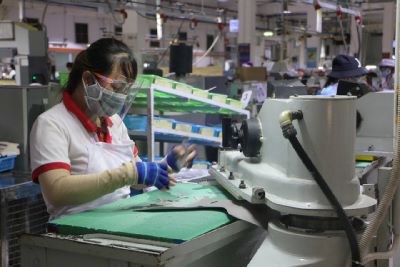
This was due to many factories having to reduce their capacity or stopping work, a disruption of raw material supply and difficulties involved in the domestic and export markets.
Factories in green zones (COVID-free areas) are helped with maintaining production, while workers, especially in industrial parks and high-tech zones, are given priority for vaccination.
The prolonged pandemic has caused difficulties for the operation of companies in the trading and service sectors, it said, adding that people’s incomes have decreased, resulting in low demand.
Retail sales and services in the first eight months dropped by 10.6 per cent year-on-year to VNĐ609.4 trillion (US$26.7 billion).
The pandemic has greatly affected the investors’ sentiments.
Foreign direct investment was down by 43.6 per cent to $2.18 billion. — VNS
ASEAN remains a fast growing region despite the pandemic
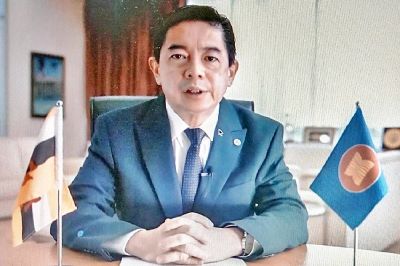
Despite the COVID-19 crisis, ASEAN is one of the fastest growing regions in the world, said Minister at the Prime Minister’s Office and Minister of Finance and Economy II Dato Seri Setia Dr Awang Haji Mohd Amin Liew bin Abdullah during the ASEAN Business and Investment Roundtable 2021 on Fintech and Financial Literacy held virtually yesterday.
The minister also said, Bain and Company’s e-Conomy Southeast Asia report noted that the Covid-19 pandemic has led to big shifts across Southeast Asia, highlighting that 40 million people came online for the first time last year, bringing the total number of Internet users in the region to 400 million.
“The Economic Research Institute for ASEAN and East Asia points out that ASEAN consumers are global leaders in terms of e-wallets and digital payment adoption.
“This offers great opportunities but also challenges as we must keep inclusivity in mind and ensure that with the rapid rate of technological change it does not leave anyone behind.
“Financial literacy plays a critical role on inclusivity.
“Not only is it important to understand money and the changing nature of transactions, both for personal and business purposes but digital financial literacy has become essential if we are to achieve our goals of ensuring that everyone can benefit from the advancements in fintech.
“ASEAN governments are continuing to meet virtually to discuss what steps can be taken to help our region continue to be vibrant as we draw closer to the Summit in October,” said the minister.
Dato Seri Setia Dr Awang Haji Mohd Amin Liew also said that as Chair of ASEAN, Brunei has developed 13 priority economic deliverables that have been guided by the strategic thrusts of ‘Recovery, Digitalisation and Sustainability’. “I am delighted to see that the programme for roundtable reflects both the strategic thrusts and a number of our priority economic deliverables.
“The discussions contribute towards our work on e-commerce, cybersecurity, the ASEAN Framework Agreement on Services that focusses on financial services liberation and specifically on financial literacy where we have a summit planned at the end of this year in conjunction with ASEAN Savings Day 2021.”
In its foreword, the organiser of Asean Business Investment Roundtable said the pandemic has significantly impacted lives and livelihoods across ASEAN.
It has changed the way people work, travel, access payments, use of cash and highlighted the financial inclusion gaps.
The region has seen a surge in online banking as limited movements and the gig economy have accelerated digital adoption and greater use of e-wallets. The potential for growth and benefits of adoption are significant. Fitch Ratings calculated that there are around 290 million unbanked and underserved people in Southeast Asia.
Those using online banking tend to use it for smaller frequent purchases, bigger spending remains with credit and debit cards, according to Kagan research.
Financial literacy is essential for fintech to be adopted. Greater financial literacy ensures greater use but also inclusiveness as communities are able to better understand how to manage and move money in the digital world. As ASEAN is the fastest growing Internet market in the world, fintech and financial literacy are set to play key roles in the future.
The Roundtable on Fintech and Financial Literacy explored how innovative digital financial solutions can ensure an inclusive sustainable recovery and is part of a series of events under the ASEAN Business and Investment Summit 2021.
NK appears to have reactivated Yongbyon nuclear reactor: IAEA
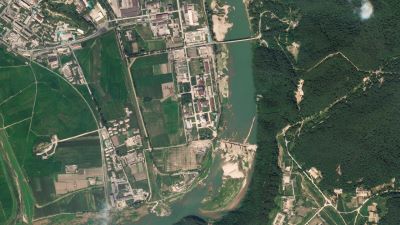
North Korea appears to have restarted operations at its main Yongbyon nuclear reactor in July, a UN nuclear watchdog said, raising the alarm that the reclusive regime could be increasing its nuclear arsenal.
The International Atomic Energy Agency, in an annual report dated Friday, said it detected “deeply troubling” indications that the 5-megawatt nuclear reactor at the Yongbyon nuclear complex — the country’s main source of weapons-grade plutonium — has been reactivated.
“Since early July 2021, there have been indications, including the discharge of cooling water, consistent with the operation of the reactor,” the report said, noting this was the first sign of activity detected since December 2018.
The report also said that there are also indications that a nearby radiochemical laboratory was operating from mid-February to early July this year. This five-month period is longer than the usual time needed for waste treatment or maintenance activities, and is consistent with the duration of previous reprocessing campaigns, it said. The laboratory is used to extract plutonium by reprocessing spent fuel rods from the reactor for use in nuclear weapons.
“The DPRK’s nuclear activities continue to be a cause for serious concern. Furthermore, the new indications of the operation of the 5-megawatt reactor and the radiochemical laboratory are deeply troubling,” it said, referring to the North’s official name, the Democratic People’s Republic of Korea.
The IAEA called the North’s nuclear activities “deeply regrettable” and a “clear violation” of relevant UN Security Council resolutions.
Pyongyang expelled IAEA inspectors in 2009, and since then the agency has monitored the country’s nuclear program through open-source information and satellite imagery. North Korea’s last and largest nuclear test was in 2017, when it claimed to have successfully tested a hydrogen bomb.
The Yongbyon complex has been at the center of the North’s nuclear program, which produced the fissile material for the North’s six nuclear tests from 2006 to 2017.
North Korean leader Kim Jong-un offered to dismantle the Yongbyon complex in return for sanctions relief during a summit with US President Donald Trump in 2019. But the US rejected Kim’s offer because giving up Yongbyon would only be a partial concession, as the North is believed to have other enrichment facilities.
In response to the report, Lee Jong-joo, spokesperson for the Unification Ministry, said Seoul was closely monitoring the North’s nuclear and missile activities alongside the US, but declined to comment on whether Seoul is detecting signs of activities at the North’s nuclear complex.
The Defense Ministry also said the military is closely tracking the North’s nuclear situation in close coordination with the US, without providing further details.
The resumption of nuclear activities comes as the North on Sunday slammed the recent South Korea-US military exercise, vowing to bolster “war deterrence” strong enough to tackle and remove external threats.
Pyongyang has long said it will not give up its nuclear program until the US withdraws its “hostile policy” on the North, an apparent reference to US-led sanctions.