Year two of pandemic: What’s in store for Korea #SootinClaimon.Com

#SootinClaimon.Com : ขอบคุณแหล่งข้อมูล : หนังสือพิมพ์ The Nation.

Year two of pandemic: What’s in store for Korea

Jan 04. 2021The sunrise is seen at Incheon Airport on Thursday. Hopes for a return to normalcy are echoed around the world upon the New Year after a year of an unprecedented health disaster and devastating disruptions across societies and economies. (Yonhap)The sunrise is seen at Incheon Airport on Thursday. Hopes for a return to normalcy are echoed around the world upon the New Year after a year of an unprecedented health disaster and devastating disruptions across societies and economies. (Yonhap)

By Korea Herald
Much of 2021 will be a repeat of 2020. But as vaccines enter the scene, experts say some degree of normalcy might begin to return by the year’s end.

Infectious disease expert Dr. Kim Woo-joo of Korea University Medical Center said the second year of the pandemic will be characterized by the “vaccine divide” at a global level.

“You might need to be vaccinated if you want to travel this year, for instance,” he said. As of Thursday, around 25 countries have reported their first inoculations against COVID-19.

He said South Korea should aim to “keep pace with its neighbors so that cross-border exchanges can resume at around the same time.” The Summer Olympics in Tokyo, he said, may become a showcase for how successful each government has been in inoculating its people.

Once Korea receives its share of vaccines, the rollout could proceed faster than in other parts of the world because of its vaccine acceptance among the public, he said. According to a recent poll by Gallup Korea, 87 percent of Koreans said they were willing to get the jabs when they become available here.

How the next phase of the pandemic might play out “depends on the government’s ability to secure enough vaccines in time,” said Dr. Jun Byung-yool, who was the Korea Centers for Disease Control and Prevention’s director from 2011 to 2013.

“It is the government’s responsibility to do everything in its power to ensure vaccinations can begin as promptly as possible,” he said, adding that failing to do so would be “one of the gravest errors the government can make in a pandemic.”

Key details are missing from the vaccine announcements so far, making it difficult to predict how far away Korea might be from the goal of herd immunity, according to public health policy expert Dr. Jung Jae-hun of Gachon University.

The very first doses of COVID-19 vaccine will reach Korea in February, the presidential office said Tuesday. Still, it’s unclear exactly how many people will be covered in each stage of distribution.

“We have a tentative date for when the vaccinations will kick off. But what really matters is when we will have sufficient doses to meet the immunization targets,” he said.

“For all we know, we may only have a small, symbolic amount brought in in February, with subsequent supplies put off until later. It might take several months before we have access to quantities necessary to vaccinate a meaningful proportion of the Korean population.”

The vaccines will be delivered in phases, prioritizing essential workers and people at risk. The Korea Disease Control and Prevention Agency plans to complete vaccination of priority groups by November.

And until there is widespread immunity, social distancing and mask-wearing will likely remain in place, said respiratory disease specialist Dr. Chun Eun-mi of Ewha Womans University Medical Center. During this period, intermittent restrictions of varying intensity may be unavoidable.

“To draw sustained compliance with the public health measures for another year and possibly longer, we need more funding to pay people to stay home and businesses to stay closed — which were lacking in our response thus far,” she said.

Another possible strategy to offset the pandemic fatigue is clearer communication regarding the vaccination timeline.

“The government should give concrete dates on the vaccination scheme and let people know for how much longer they will have to endure social distancing,” she said.

Dr. Jung Ki-suck, who led the KCDC from 2016 to 2017, predicts an exit from the pandemic may not necessarily entail the disease going away.

“Eradication can be defined in several different ways. With COVID-19, the virus is not likely to become extinct, but rather its threat may become reduced to more manageable levels,” he said.

Preventive medicine professor Dr. Choi Jae-wook of Korea University said there was still potential for Korea to speed up the process after the vaccines are shipped here.

“Getting the hard-earned vaccines into people’s arms in the most efficient ways will require a lot of planning in advance,” he said. Among those considerations are how to distribute the supplies across the country, and where and how the vaccination services will take place.

The latest clearance for AstraZeneca’s vaccine by the UK regulatory authorities also offer hope of advancing the clock, according to virologist Dr. Paik Soon-young of the Catholic University of Korea.

“In the most auspicious scenario, we can start AstraZeneca inoculation in February and then Janssen in April or May,” he said.

Korea’s allotment of the AstraZeneca vaccine, which can be manufactured locally, will start rolling out in Korea in about two months. Janssen’s is to be doled out in the following months. Pfizer’s is slated for fall, with the deal with Moderna still being finalized.

Paik added there were concerns supply issues or other unforeseen hurdles may arise and interfere with the plans.

The emergence of new variants should be taken seriously, but there is no cause for panic, according to viral immunologist Dr. Shin Eui-cheol of the Korea Advanced Institute of Science and Technology.

“The mutant strain first identified in the UK is reported to be more transmissible. There is no evidence yet to suggest it is associated with worse outcomes,” he said.

“All viruses mutate. It’s what they do,” he said. But only a tiny fraction change in a way that can be considered “immunologically and medically significant.”

He said based on the data so far, that does not appear to be the case with the variant discovered by the UK scientists. “The vaccines should still work against it,” he said.

Dr. Rhee Chul-woo, a research scientist at the International Vaccine Institute, said in an email response that the mutations include “changes to the part of virus that plays an important role for the vaccine to be effective (i.e., receptor binding domain of spike protein).”

The “spike” protein is how the virus gains entry into human cells, he explained.

“The good news is emergency use authorized vaccine platforms such as mRNA vaccines can be recalibrated for new variant much quicker, if needed.”

Medical laboratory scientist Dr. Lee Hyuk-min of Severance Hospital said the emergence of new variants signaled a need for boosting surveillance.

“Korea has done around 1,640 genomic sequencing tests to date. To track and monitor new variants more effectively, we should be doing more,” he said. He added that the variant will still be picked up by the current tests.

On the persistent, most pressing question of when things will return to normal, most projections fell sometime in the latter half of the year. All of the experts stressed there were too many uncertainties at play, and that the pandemic could take different trajectories.

“If everything works out well, Korea could approach herd immunity by winter 2021,” said Jung of Gachon University.

“Given the vaccination schedule, we may be able to begin to wean off of social distancing before the year is over, I can give you that,” said KAIST’s Shin.

Once vaccination efforts are underway, the situation will gradually improve, even before herd immunity is achieved, according to Choi of Korea University.

“When we are at a point where about 20 to 30 percent of the population is vaccinated, infection rates will probably start to fall,” he said.

Korean GDP to grow 3.6%, Kospi to hit 2,850 in 2021: Nomura #SootinClaimon.Com

#SootinClaimon.Com : ขอบคุณแหล่งข้อมูล : หนังสือพิมพ์ The Nation.

Korean GDP to grow 3.6%, Kospi to hit 2,850 in 2021: Nomura

Jan 04. 2021Stacks of import-export cargo containers at South Korea's largest seaport, located in Busan (Yonhap)Stacks of import-export cargo containers at South Korea’s largest seaport, located in Busan (Yonhap)

By Korea Herald

Driven by the development of COVID-19 vaccines and their eventual distribution, South Korea’s economy will steadily recover in 2021, growing at 3.6 percent followed by a 0.8 percent contraction this year, according to Japan’s Nomura Securities on Thursday.

“Amid the global capex (capital expenditures) recovery, current IT export products and new export products such as electric vehicles and biohealth will play a leading role in driving South Korea’s economic recovery next year,” said Jung Chang-won, head of equity research for South Korea at Nomura Securities, at a conference.

With export growth to lead Asia’s fourth-largest economy’s recovery in the first half of next year, consumption recovery is anticipated to be followed in the second half of the same year on the back of the wider distribution of vaccines from the second half of next year.

The brokerage suggested its won-dollar currency target next year at 1,030 won, along with setting the yearly upper-end target for Korea’s main bourse Kospi to 2,850, mentioning the market already entered the recovery phase in the second half of this year.

“We believe the Kospi market will appreciate factors such as high sustainable growth of the fourth industrial revolution, bio and environment, strong earnings from cyclical sectors such as memory and displays, and earnings recovery from sectors that were directly hit by COVID-19,” said Park Jeong-woo, chief economist for South Korea at Nomura Securities.

Buoyed by improving corporate governance and shareholder returns on an environmental, social and governance responsibility boom and enhancing regulations on corporate governance, he further mentioned that the “Korea discount” — the market term describing foreign investors’ lower equity valuation of local stocks — is also anticipated to narrow.

Park added that small domestic investors’ massive investing into the stock market is at the beginning phase and is likely to continue, citing data that Korean investors’ stockholdings among their total assets marked less than 10 percent, while retail investors in advanced economies came to 30-40 percent.

Singapore economy tipped to grow 5.5% next year; vaccines could push growth higher #SootinClaimon.Com

#SootinClaimon.Com : ขอบคุณแหล่งข้อมูล : หนังสือพิมพ์ The Nation.

Singapore economy tipped to grow 5.5% next year; vaccines could push growth higher

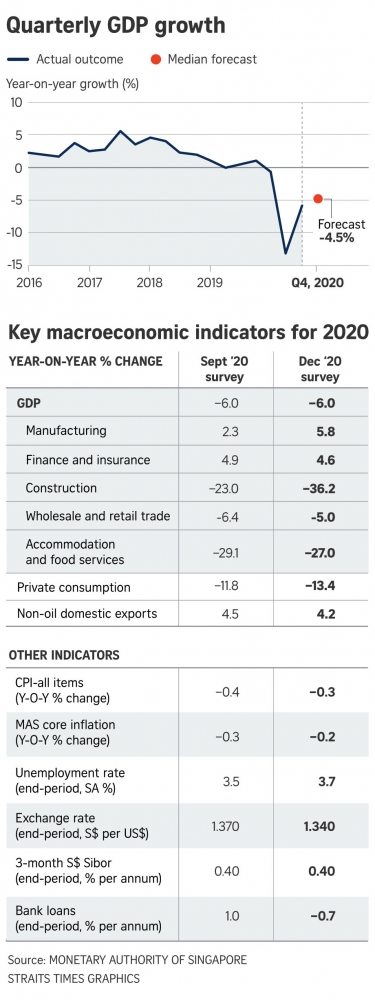
Jan 04. 2021The economists also expect GDP to shrink by 4.5 per cent year on year in the fourth quarter of this year.ST PHOTO: KUA CHEE SIONGThe economists also expect GDP to shrink by 4.5 per cent year on year in the fourth quarter of this year.ST PHOTO: KUA CHEE SIONG
By The Straits Times

SINGAPORE – Singapore’s economy will grow by 5.5 per cent in 2021 to end the nation’s worst recession ever, induced by the coronavirus pandemic, according to a central bank survey of professional forecasters.

The pace of growth can be even higher if the pandemic is contained by a successful deployment of vaccines worldwide, they said.

The prediction made by 23 economists and analysts in the Monetary Authority of Singapore (MAS) quarterly survey was unchanged from the previous forecast made in September.

However, their forecast range for 2021 growth narrowed to 5 per cent to 5.9 per cent from 4 per cent to 5.9 per cent, the MAS survey report released on Wednesday (Dec 9) showed.

The private forecast comes after the Ministry of Trade and Industry (MTI) in November forecast growth rebounding by 4 per cent to 6 per cent in 2021 – the most since at least 2011 when the economy expanded by 6.3 per cent.

For 2020, the private forecasters expect gross domestic product (GDP) to decline by 6 per cent, also unchanged from the previous survey. That compares to MTI’s forecast of a 6.5 per cent to 6 per cent contraction in 2020.

The economists also expect GDP to shrink by 4.5 per cent year on year in the fourth quarter of this year, after contracting by 5.8 per cent in the September to October period – a smaller decline than their forecast of a 7.6 per cent drop in the previous survey.

For the jobs market, they expect the unemployment rate to reach 3.7 per cent at the end of 2020, up from their estimate of 3.5 per cent in the previous survey.

Inflation as measured by the consumer price index and the MAS core inflation in the fourth quarter of this year are expected to come in at minus 0.3 per cent and minus 0.2 per cent respectively.

Three-quarters of the respondents in the MAS survey expect private residential property prices to pick up in the October to December period compared with the previous quarter, while the rest believe these will remain stable.

Looking ahead, the containment of the pandemic, attributable primarily to the widespread global deployment of a vaccine, again emerged as the most frequently cited upside risk to Singapore’s growth outlook – with 77.8 per cent ranking it as the top upside risk.

The prospect of reopening borders to international travel was seen as a potential upside by 44.4 per cent of the respondents who also identified stronger-than-expected manufacturing sector performance led by electronics and pharmaceuticals production, as well as fiscal stimulus, in support of Singapore’s recovery.https://www.youtube.com/embed/1a7MWOfTNfw?rel=0

On the downside, a further deterioration in the Covid-19 situation – due to new outbreaks or delays in vaccine development – once again topped the list of downside risks to Singapore’s growth outlook in the survey.

The threat was identified by 88.9 per cent of survey respondents and 72.2 per cent of them ranked it as the most important downside risk.

The economists were also concerned about risks stemming from an earlier-than-expected pullback in macroeconomic policy support globally, resulting in a premature tightening in global financial conditions and weaker demand due to fiscal consolidation.

This risk was identified by 44.4 per cent of respondents, up from 20 per cent in the previous survey.

An escalation in United States-China tensions was identified by 27.8 per cent as a downside risk, compared with 60 per cent in the previous survey.

BPI forecast: GDP growing by 7%, jobless rate easing to 7% in 2021 #SootinClaimon.Com

#SootinClaimon.Com : ขอบคุณแหล่งข้อมูล : หนังสือพิมพ์ The Nation.

BPI forecast: GDP growing by 7%, jobless rate easing to 7% in 2021

Jan 04. 2021

By Inquirer Business

The Philippine economy may grow by 7 percent next year after shrinking by 11 percent this year as mobility improves alongside the migration to digital platforms, Bank of the Philippine Islands (BPI) lead economist Emilio Neri Jr. said.

However, a full recovery to the same level of output as that prior to the coronavirus pandemic will not likely happen until 2022, the economist said.

The country attained a P19.37-trillion gross domestic product (GDP) in 2019. Coming from a lower base assumed by BPI for this year, a 7-percent growth rate will only bring the country’s total output to about P18.4 trillion next year.

Neri issued the research note after the Bangko Sentral ng Pilipinas (BSP) decided to keep its overnight borrowing rate steady at 2 percent, as expected by most analysts.

The BSP has so far slashed its key interest rates by a total of 200 basis points this year, on top of the 200 basis points shaved off its reserve requirement on banks.

“With inflation inching higher, cutting the policy rate at this time would pull down real interest rates further to negative territory,” Neri said.

The country’s November inflation rose at a faster pace of 3.3 percent year-on-year from 2.5 percent year-on-year in October, as basic food prices shot up due to the recent spate of typhoons.

Neri said the BSP had already done so much to support the economy, adding that additional rate cuts might only produce marginal benefits.

“Interest rates have been low for many months, and yet loan growth continues to slow down and may soon stop growing. Cutting interest rates does not address the underlying problem or the main reason why loan growth is deteriora­ting,” he said.

“The lack of expansion activities on the part of the private sector owing to demand uncertainty has dampened the demand for loans. Businesses have been conservative in their capital expenditures given the decline in consumer demand. Expanding their operations will not yield acceptable returns if consumer spending continues to be weak,” he explained.

Negative real interest rates are difficult to reverse as po­licy makers tend to overreact to volatility by the time policy needs to be reversed, Neri said, reiterating that low rates for an extended period could also lead to property, asset bubbles and more income inequality.

Moreover, Neri said negative real interest rates would affect the profitability of financial institutions, making it difficult to maintain the capital they needed for financial stability.

This year, the economist sees the country’s inflation settling at an average of 2.6 percent but moving higher at 2.9 percent in 2021, with upward pressure seen from oil and swine flu.

Philippine inflation will stay within the 2 to 4 percent target of the BSP in the coming months, but there are risks to this outlook, Neri said. If oil moves higher to $50 per barrel next year, Neri said this would translate to a 200 percent year-on-year increase in April and then 20 percent year-on-year increase in the succeeding months.

“Meanwhile, flood and swine flu-related risks remain elevated and can keep us at negative real yields for the policy rate. Should this happen we might see a scenario where the BSP is compelled to hike rates at a time the economy continues to see year-on-year GDP declines. However, if fiscal stimulus can complement monetary easing, BSP can hike rates with minimal interruption on the growth recovery, and may limit the damage on markets especially when carried out with credibility,” he said.

On the labor market, Neri sees the country’s jobless rate easing gradually to 7 percent of the labor force in 2021 from 8.7 percent in October 2020.

With the economy slowly reopening, the economist expects imports to recover further in the coming months in line with the expected improvement in local demand. Hence, US dollar demand is seen to pick up, bringing the peso-dollar exchange rate closer to the 49 level by early 2021 from low 48 levels at present.

“A risk to this outlook is government underspending, especially in infrastructure. With businesses still struggling, the lack of fiscal support and public construction may stall the recovery and dampen the demand for capital goods,” he said.

Meanwhile, a decline in remittances amid the recession in other countries—such as the threat of a double dip recession in the Eurozone on renewed lockdowns—may exert additional pressure on the local currency, Neri said.

Some Malaysians uncertain of Covid-19 vaccine: Survey #SootinClaimon.Com

#SootinClaimon.Com : ขอบคุณแหล่งข้อมูล : หนังสือพิมพ์ The Nation.

Some Malaysians uncertain of Covid-19 vaccine: Survey

Jan 03. 2021People have cast doubts on the vaccine, with some claiming that it may contain porcine elements.PHOTO: REUTERSPeople have cast doubts on the vaccine, with some claiming that it may contain porcine elements.PHOTO: REUTERS

By The Straits Times

KUALA LUMPUR – As the arrival of the first batch of Covid-19 vaccines in Malaysia nears, Mr Abdullah Salleh finds himself in two minds about receiving an immunisation shot.

Despite being pro-vaccine, the 37-year-old videographer said he is hesitant about taking a shot due to the possibility of experiencing a lethal adverse reaction, as he is allergic to certain drugs.

“I’m actually worried because I’m allergic to Augmentin-based drugs. I hope the substance is not included in the vaccine,” he said. Augmentin is an antibiotic used to treat bacterial infections.

“At the moment, I’m honestly not sure if I should get it or not. I’ve been reading up a lot on the available vaccines but my near-death experience due to my allergy has made me very sceptical,” he said.

Mr Abdullah is among the 17 per cent of respondents in a Health Ministry survey who are unsure of the vaccine, with over 83 per cent of them expressing fear of possible side effects.

The survey, which was done online between Dec 21 and 28, was held to gauge the interest of Malaysians in getting the Covid-19 vaccine.

People have cast doubts on the vaccine, with some claiming that it may contain porcine elements and others questioning the trustworthiness of the manufacturers.

Up to 78 per cent of those in the uncertain group also had less confidence that the vaccines would work, while 71 per cent felt they would be unsafe for use.

Meanwhile, about 16 per cent of respondents stated that they would not agree to being vaccinated. Of this group, over 96 per cent said side effects were the main reason for opposing vaccination, while close to 85 per cent were suspicious of its ingredients.

Based on the result, which was released on Thursday, only 67 per cent of the total of 212,006 people sampled said they would accept the Covid-19 vaccine.

Healthcare analyst Heikal Rosnan, director of Bower Group Asia, said he understood the public’s concerns, but noted that what governments have done is to help speed up the vaccine-making process, compressing it from possibly more than a decade, without taking shortcuts.

He added: “More importantly, the Health Ministry has stated that each Covid-19 vaccine will have to go through five phases of tests and trials before it can be approved for use in Malaysia. There will be hiccups given the unprecedented nature of this pandemic, but overall, the country’s immunisation track record is sound.”

Ms S. Kalamathy, 41, however, plans to reject any Russian and Chinese-made vaccines. “I just don’t trust them,” said the legal administrative assistant.

Mr Heikal said people may be distrustful of the Russian and Chinese governments rather than the vaccine itself, and have less confidence in their approval processes, which are not as transparent and stringent as in the United States and Europe.

“Ultimately though, if it works, then it works, but Malaysia may take a wait-and-see approach, compared with the US vaccines,” he said.

Malaysia’s high-speed rail project without Singapore stop is redundant: Transport experts #SootinClaimon.Com

#SootinClaimon.Com : ขอบคุณแหล่งข้อมูล : หนังสือพิมพ์ The Nation.

Malaysia’s high-speed rail project without Singapore stop is redundant: Transport experts

Jan 03. 2021Transportation consultant YS Chan said unless Malaysia has a huge population like China, a domestic high-speed rail network would not work.PHOTO: EDELMANTransportation consultant YS Chan said unless Malaysia has a huge population like China, a domestic high-speed rail network would not work.PHOTO: EDELMAN

By Straits Times

KUALA LUMPUR – A domestic high-speed rail network in Malaysia alone is not feasible and likely to end up a white elephant if it is built, transport analysts said.

The Malaysian government had, prior to the expiry of the suspension period of the Kuala Lumpur-Singapore high-speed rail (HSR) project, announced that it will conduct a study on the viability of a domestic HSR network, with the line ending in Johor Baru in Malaysia instead of Jurong East in Singapore.

Transportation consultant YS Chan said that unless Malaysia has a huge population like China, a domestic HSR network would not work.

Mr Chan, who was previously with the Tourism Ministry, told The Straits Times: “There are no issues with current air, rail and road connectivity (to Johor Baru).

“But if we need to spend to spur the economy and prepare for the future, extending the West Coast Expressway, now from Taiping to Banting (yet to be completed), all the way down the west coast to cover Port Dickson, Melaka, Muar, Batu Pahat, Pontian and Johor Baru would be a better option.

“As for rail, the double-tracking from Gemas, Negeri Sembilan to Johor Baru would be completed next year and we can have fast trains all the way from Padang Besar, at the Thai border, down to JB.”

In double-track systems, trains run in both directions instead of sharing one track.

“Another railway line would be redundant… It is likely to become a white elephant or a long python stretching from KL to JB,” added Mr Chan.

Malaysia and Singapore had on Friday (Jan 1) announced that the KL-Singapore HSR project was terminated.

It came after both countries failed to reach an agreement on changes proposed by Malaysia before the end of the suspension period on Dec 31 last year.

Singapore’s Ministry of Transport said in a separate statement that Malaysia had allowed the HSR bilateral agreement to lapse, and has to compensate Singapore for costs already incurred in accordance with the agreement.

The 350km link between KL and Singapore would have cost an estimated RM60 billion to RM80 billion (S$19.7 billion to S$26.2 billion).

Slated for completion in 2031, it would have slashed travel time between the countries, ramped up trade and boosted tourism.

Towns situated at key stops along the line in Malaysia had been expecting to welcome millions of ringgit in development and investment.

Explore alternatives

In a statement on Friday, Minister in the Prime Minister’s Department Datuk Seri Mustapa Mohamed said the Malaysian government will conduct a detailed study to explore all alternatives, including the viability of a domestic high-speed rail network.

Former transport minister Anthony Loke labelled the idea as “nonsensical” and “redundant”, adding that there is already a train line running from JB to KL.

Chiming in, former prime minister Najib Abdul Razak called on the government to be more transparent of its plans for alternatives to the KL-Singapore HSR, without using Covid-19 or the economy as an excuse.

Meanwhile, the DAP branch in Johor is urging Putrajaya to propose a replacement transport infrastructure project to drive the state’s economic growth and enhance regional connectivity.

Public transport researcher SM Sabri SM Ismail said the government should now reset and explore alternatives to a domestic HSR network.

These could include an upgrade to the existing national Keretapi Tanah Melayu (KTM) railway network, and an extension of the inter-city Electric Train Service (ETS) system, to run from KL to JB.

“The study should of course include comparisons of the viability of a KL-JB HSR (with revised alignment in Johor) system versus upgrading the KL-JB current metre-gauge double-track railway.

“I don’t see any good terminal location in JB for a separate KL-JB HSR (but) if a ‘higher’ speed rail is really needed in JB, upgrading KTM’s ETS and the KL-JB metre-gauge tracks would make more sense,” he told ST.

Like Mr Chan, Mr Sabri said that even without an upgrade to the ETS network, to allow for high-speed trains, the completion of the Gemas-JB electric double-tracking project will enable ETS trains to run from KL to JB.

“It would provide much easier train service for passengers from KL to JB, without having to change trains at Gemas (in Negeri Sembilan).

“If both options (revised HSR alignment and an ETS upgrade) are not financially or economically viable, then we don’t really need it,” he added.

The Gemas ETS project, at a cost of RM10 billion, would link Johor’s capital city to KL and all the way north to Padang Besar in Perlis.

Samsung Electronics Q4 earnings estimate cut on weak dollar, virus resurgence #SootinClaimon.Com

#SootinClaimon.Com : ขอบคุณแหล่งข้อมูล : หนังสือพิมพ์ The Nation.

Samsung Electronics Q4 earnings estimate cut on weak dollar, virus resurgence

Jan 03. 2021This photo, provided by Samsung Electronics Co. on May 21, 2020, shows the company's chip plant in Pyeongtaek, 70 kilometers south of Seoul. (Samsung Electronics Co.)This photo, provided by Samsung Electronics Co. on May 21, 2020, shows the company’s chip plant in Pyeongtaek, 70 kilometers south of Seoul. (Samsung Electronics Co.)

By Korea Herald

Samsung Electronics Co., the world’s largest memory chip maker, is expected to report a smaller-than-earlier operating income estimate due to the weakness of the US dollar, industry sources said Sunday.

According to the sources, Samsung, also the world’s largest smartphone vendor, is likely to report an operating income of 9.74 trillion won ($8.95 billion) during the fourth quarter of last year, up 36.8 percent from a year earlier.

But the latest estimate is slightly lower than the 10.16 trillion won projected a month earlier.

Samsung reported an operating income of 12.35 trillion won during the third quarter of last year, the highest in over two years, driven by rising chip demand and a recovery in smartphone demand.

But during the October-December period, the global resurgence in virus cases and the weaker dollar may hurt the tech giant’s profitability.

“Samsung may have racked up 4.3 trillion won in operating income during the last quarter, smaller than the third quarter’s 5.5 trillion won because of the weak dollar,” said Lee Seung-woo, an analyst at Eugene Investment & Securities.

The analyst said lockdowns in Europe had reduced demand for smartphones.

Going forward, Samsung may rack up decent profit this year on the back of a continued boom in the semiconductor sector and a recovery in the smartphone segment.

Shinhan Investment Corp. projected this year’s operating income for Samsung at 47.51 trillion won, up 31.7 percent from last year.

Aided by rosy earnings estimates, a slew of brokerages raised their target prices for Samsung Electronics to a 90,000 won range.

Shares in Samsung closed at 81,000 won Wednesday, the last trading day of 2020, moving up 3.45 percent from the previous session’s close. (Yonhap)

Experts say Xi’s speech sets key goals for 2021 #SootinClaimon.Com

#SootinClaimon.Com : ขอบคุณแหล่งข้อมูล : หนังสือพิมพ์ The Nation.

Experts say Xi’s speech sets key goals for 2021

Jan 03. 2021President Xi Jinping delivers a New Year speech Thursday evening in Beijing to ring in 2021. [Photo/Xinhua]President Xi Jinping delivers a New Year speech Thursday evening in Beijing to ring in 2021. [Photo/Xinhua]

By China Daily

President Xi Jinping’s New Year’s address has emphasized the importance of people and set important national development and economic goals for 2021, global experts said.

Christopher Bovis, a professor of international business law at the University of Hull in the United Kingdom, said Xi welcomed the New Year by praising the resilience and courage of the Chinese people and their efforts to combat the pandemic over the past year.

He appreciated that Xi reaffirmed China’s commitment to international cooperation, multilateralism, and continuous reform of domestic systems which will focus on economic growth without losing touch with policies destined to promote human development and the protection of individuals.

Rana Mitter, a professor of the history and politics of modern China at the University of Oxford, said that the COVID-19 pandemic has been an economic blow to the entire world.

“China can take a lead by making it clear that mutual trade, open markets, and a genuine willingness to exchange human capital and talent across borders will create a high-value global economy for all,” he said.

Noting that Xi put an emphasis on revitalizing rural China in his address, Joe Thomas Karackattu from the China Studies Centre at the Indian Institute of Technology Madras said it seems to be a strong directional message and is crucial for the 14th Five-Year Plan (2021-25).

Xi’s statement that China should create more “stories of spring” is inextricably linked to fostering more interdependence with the rest of the world, he said.

“The economic dimension is also paired with the societal dimension of ‘a shared future for mankind’. Clearly, China’s outreach to the world is being projected as a multidimensional effort,” said Karackattu.

“It is interesting to note Xi’s stress on a new pattern for development for China, built on the cornerstone of ‘high-quality’ development,” Karackattu said.”Clearly the direction for the Chinese economy to focus on innovative growth is underlined in his message.”

Gerald Mbanda, founder of Africa China Review, a website focusing on news reports and commentary on China-Africa cooperation, said Xi’s speech dwelt much on the COVID-19 pandemic, in which he lauded the country’s efforts in the fight against COVID-19 and took time to thank different institutions, professionals and ordinary citizens for their hard work and sacrifice.

He said that Xi’s advocacy for a community with a shared future for mankind was more significant and relevant in 2020, as no single country could claim to win the war against the pandemic without working together with other countries.

Jon Taylor, professor and chair of the Department of Political Science and Geography at the University of Texas at San Antonio, said Xi’s speech set important national development and economic goals while also noting some significant milestones that will take place in 2021, such as the 100th anniversary of the founding of the Communist Party of China.

He said there was also a quote that was notable for its recognition of the hard work of the average Chinese citizen in 2020: “Greatness is forged in the ordinary. Heroes come from the people. Every person is remarkable.”

Adhere Cavince, a scholar of international relations focusing on China-Africa relations, said that due to the resilience and sacrifice of the Chinese people, the successful fight against the pandemic enabled China to resume economic activity and register positive growth while sharing its epidemic control experience, commodities and medical personnel with the rest of the world.

“The donation of millions of essential commodities including ventilators, face masks, protective clothing and medicine to developing economies, especially in Africa, set China apart as a major country that values global cooperation and solidarity against the biggest threat to the international community,” he said.

Another key point from Xi’s speech that resonated with the rest of the world was the transition of China to a moderately prosperous society. By kicking extreme poverty out of its borders, Beijing has shown that the war against poverty, as outlined in the United Nations Sustainable Development Goals, is attainable.

Sikhumbuzo Zondi, a research assistant at the Institute for Global Dialogue, which is associated with the University of South Africa, said Xi’s speech highlighted the fact that the sudden rise of the coronavirus pandemic has emphasized the importance of valuing human life by putting people at the center of government action.ang Han in Hong Kong, Han Baoyi in London, Liu Hongjie and Chen Yingqun in Beijing contributed to this story.

Việt Nam eyes high-quality coffee exports #SootinClaimon.Com

#SootinClaimon.Com : ขอบคุณแหล่งข้อมูล : หนังสือพิมพ์ The Nation.

Việt Nam eyes high-quality coffee exports

Jan 02. 2021A production line in Trung Nguyên Instant Coffee Corp's factory in Bắc Giang Province. Coffee is among the 10 key export products of Việt Nam. — VNA/VNS Photo Danh LamA production line in Trung Nguyên Instant Coffee Corp’s factory in Bắc Giang Province. Coffee is among the 10 key export products of Việt Nam. — VNA/VNS Photo Danh Lam

By Viet Nam News

HÀ NỘI — Việt Nam is working to develop high-quality Vietnamese coffee as a national product to expand its added value for exports.

Coffee exports brought the country US$2.7 billion from an estimated 1.7 million tonnes in 2020, accounting for more than 10 per cent of the world’s coffee value and 18 per cent of market share, according to the Ministry of Agriculture and Rural Development (MARD).

Coffee is among the 10 key products of Việt Nam and the top six products with export value topping $3 billion each year.

The country has 664,000 hectares of coffee plantations with a yield of 1.5 million tonnes per year, 93 per cent of which is robusta with the remainder arabica. Vietnamese coffee has been shipped to 80 countries and territories worldwide.

However, experts at a conference this week to review national high-quality coffee development said although Việt Nam is renowned for its coffee volume, the country has not gained a reputation for coffee quality due to the low proportion of high-added-value products.

To help the coffee sector improve export value and maintain its position as the world’s second coffee producer and exporter amidst fierce competition, Prime Minister Nguyễn Xuân Phúc approved Decision No.787/QD-TTg dated June 5, 2017, listing coffee in the programme to develop national products until 2020.

The project aimed to develop a coffee industry that produces high quality, competitive and high added value products by employing new varieties, advanced cultivation techniques and post-harvest technologies, while building brands, develop markets and enhance productivity, quality and efficiency of coffee production and business.

Deputy Minister of Agriculture and Rural Development Lê Quốc Doanh said the coffee industry has received great attention from the Government and developed in a more sustainable and effective manner in recent years, particularly after the ministry approved a coffee re-plantation project.

The project aimed at 120,000 hectares of coffee under re-plantation by 2020, however, more than 150,000 hectares have been re-cultivated so far. 

The World Bank-funded project ‘Việt Nam Sustainable Agriculture Transformation’ worth $300 million has also been effective, Doanh said.

He said there is a huge workload to ensure the coffee sector’s sustainable development, including choosing the best varieties, promoting mechanisation, intercropping plants and improving the management of varieties.

Besides achievements, many shortcomings were identified at the conference including a lack of business involvement in the programme, poor product variety and low competition for Vietnamese coffee brands, weak connection among the market participants and research-production-chain-branding activities.

According to Vũ Đức Côn, deputy director of Đắk Lắk Department of Agriculture and Rural Development, the province has about 208,000 hectares of coffee with an output of more than 476,000 tonnes. Because many coffee gardens are old and low-yield, the province replanted more than 35,000 hectares.

The replanted coffee area is mainly made up of new varieties, gradually improving yield and quality of the area, especially in the context of climate change. 

To develop high-quality Vietnamese coffee, he said provinces need to continue reviewing plans for replanting old coffee gardens with low yield and poor quality, even for partial plantation in some gardens.

In addition, it is necessary to develop stable material areas through stronger links with farmers, providing adequate and transparent information for exporting enterprises to reduce unfair trade among buyers and sellers, Côn said.

Experts agreed the coffee sector has huge export opportunities as Việt Nam has signed 15 free trade agreements (FTAs) so far, including the EU – Việt Nam FTA and the newest UK-Việt Nam FTA which are expected to help expand markets for the Vietnamese staple. — VNS

First case of new coronavirus variant detected in Việt Nam #SootinClaimon.Com

#SootinClaimon.Com : ขอบคุณแหล่งข้อมูล : หนังสือพิมพ์ The Nation.

First case of new coronavirus variant detected in Việt Nam

Jan 02. 2021Health workers at a hospital in Hà Nội collect specimens to be tested for COVID-19. — VNA/VNS Photo Minh QuyếtHealth workers at a hospital in Hà Nội collect specimens to be tested for COVID-19. — VNA/VNS Photo Minh Quyết

By Viet Nam News

HÀ NỘI — Việt Nam detects first COVID-19 case carrying the newly found, highly contagious variant of coronavirus on Saturday.

The patient is a 45-year-old Vietnamese woman repatriated from the UK in a flight landing at Cần Thơ International Airport on December 22 but was quarantined on arrival.

The flight has 305 passengers on board, 147 of them were quarantined in Trà Vinh Province, 137 in Vĩnh Long Province, 17 in Cần Thơ City and 4 in HCM City.

The HCM City Pasteur Institute have conducted genetic sequencing on the six COVID-19-positive cases detected among the 305 arrivals and Patient No.1,435 was found to have been infected with the new strain of SARS-CoV-2.

The woman has a 10-year history of high blood pressure.

Prior to her return to Việt Nam, her health was reportedly stable.

One day after being placed under quarantine, typical COVID-19 symptoms like sore throat and light fever developed and her specimens were sent to lab for testing.

The results returned positive on December 24 and she was moved to Trà Vinh Province’s Hospital for Tuberculosis and Lung Diseases.

As of December 31, the patient only suffered from light coughing, no sore throat or breathing difficulties, while X-ray scans show mild damages to her lungs.

Her husband, who currently remained in the UK, has also tested positive for the virus.

HCM City Pasteur Institute has asked the health ministry for further guidelines in research and anti-epidemiological responses.

 The new coronavirus variant, first detected in the UK and thought to be responsible for the rise in cases in the country, is deemed to be much more transmissible than other variants but does not seem to be resulting in more serious diseases or deadlier, and approved COVID-19 vaccines could still be effective against it.

Other than Việt Nam, 33 countries have reported infections with the variant, mostly among recent arrivals from the UK.

To head off the spread of the new virus variant, many countries and regions have imposed bans on entry from the UK, or foreign arrivals altogether. — VNS