Dtac sets low growth estimate for this year #ศาสตร์เกษตรดินปุ๋ย

#ศาสตร์เกษตรดินปุ๋ย : ขอบคุณแหล่งข้อมูล : หนังสือพิมพ์ The Nation

https://www.nationthailand.com/business/30381192?utm_source=category&utm_medium=internal_referral

Dtac sets low growth estimate for this year

Jan 28. 2020
By THE NATION

Total Access Communication (dtac) has announced its growth estimate of service revenue excluding interconnection charge (IC) for 2020, at a low single-digit with mid single-digit EBITDA (Earnings Before Interest Tax Depreciation and Amortization).

The company has set Bt13 – 15 billion in capital expenditure for this year, according to its statement on Tuesday (January 28).

At the end of 2019, dtac’s subscriber base stood at 20.6 million after the loss of 560,000 users during the year.

Net profit for 2019 amounted to Bt5.9 billion, increasing 69.4 per cent year on year, mainly due to lower regulatory and amortization expenses of assets under concession.

Energy Absolute introduces sustainable business management model #ศาสตร์เกษตรดินปุ๋ย

#ศาสตร์เกษตรดินปุ๋ย : ขอบคุณแหล่งข้อมูล : หนังสือพิมพ์ The Nation

https://www.nationthailand.com/business/30381187?utm_source=category&utm_medium=internal_referral

Energy Absolute introduces sustainable business management model

Jan 28. 2020
By The Nation

Energy Absolute Pcl (EA), the first Thai energy innovation firm, is introducing a new business model under the corporate social innovation (CSI) concept to develop the organisation to sustainable integrated management.  It is pioneered with production innovation prototype, PCM (Phase Change Material) from crude palm oil, for which it is seeking a global patent. It aims to have a production capacity of 130 tonnes a day within 2020 and expects to have additional revenue of more than Bt800 million

The company also has transformed the Thai palm industry with “Palm Yang Yuen” (sustainable palm) application, the world’s first online platform with blockchain technology to verify all trading transactions, which make it transparent, fair and can return extra profit sharing to suppliers including palm farmers.

This innovation is raising standards of production, transaction and quality to add value to Thai palm to become an innovative product for export to the global market.

Amorn Sapthaweekul, deputy CEO of EA, said that the company operates a green energy business and energy innovation technology for the future through various businesses comprising solar-wind farm, lithium-ion battery factory, biodiesel from palm oil, electric vehicle (EV) car and ferry produced by Thai and EV charging stations, focusing on business related to the need of energy in the future and energy efficiency for the best benefit.

The company emphasises intensive research and development in technology and invented new innovations to extend and add value to existing businesses, he said. The company has implemented the concept of CSI.

“We want to share our knowledge, innovation and technology we use in our organisation for the benefit of society and relevant communities to grow and be strong for mutual benefit in the long run.

“It is a foundation leading to community development in all dimensions of sustainability eventually, pioneered with PCM or Phase Change Material produced from crude palm oil for the first time in the world. With blockchain innovation, it develops an online platform to record, verify and facilitate additional profit-sharing. This is the company’s CSI prototype with an investment budget of more than Bt1 billion to solve the price and volume fluctuation of palm. It will also add value to palm, boosting the income of farmers and stakeholders in the supply chain. PCM is a substance with a high heat of fusion which, melting and solidifying at a certain temperature, is capable of storing and releasing heat. Heat is absorbed or released when the material changes from solid to liquid and vice versa. PCMs are classified as latent heat storage units and applied in many industries such as building and construction, textile, packaging and logistics.

PCM developed from crude palm oil base or bio-PCM is a new innovation, created for the first time by EA, which has put its PCM under the patent registration process in the global market. The PCM market size is estimated at around US$1 billion, which is expected to triple in the next five years. EA’s PCM production plant is in Rayong with a production capacity of 130 tonnes a day. The first phase of production will start in the second quarter of this year. All the output will be exported to Germany and Japan to be used in construction of buildings and residences.

“This is a significant role in energy conservation as PCM can provide a more stable temperature to reduce energy consumption from air-conditioners or heaters. By the end of the year, revenue from PCM will be around Bt800 million, accounting for 3 per cent of the company’s total revenue. The second phase of PCM production line will be completed by the end of the year and the company aims to expand production capacity to 1,000 tonnes a day within five years.

EA has also transformed the Thai palm industry with the launch of ‘Palm Yang Yuen’ (sustainable palm) application, the world’s first palm platform with blockchain technology, to help farmers and related partners.

They can register by entering personal information, transaction data and quality of raw materials for examination. Additional benefits will be shared if the raw materials meet quality standards to be produced as high-quality PCM. This will be a key driver to promote farmers to produce good-quality raw materials. Consequently, pricing will be led by market mechanism with the practice of transparency which can be examined in every process.

Farmers will get paid quickly through money transfer to their registered account. The application can help prevent trading in smuggled palm and also can be applied widely.

Supalai sets year’s targets, looks to larger share in provinces #ศาสตร์เกษตรดินปุ๋ย

#ศาสตร์เกษตรดินปุ๋ย : ขอบคุณแหล่งข้อมูล : หนังสือพิมพ์ The Nation

https://www.nationthailand.com/business/30381183?utm_source=category&utm_medium=internal_referral

Supalai sets year’s targets, looks to larger share in provinces

Jan 28. 2020
Tritecha Tangmatitham

Tritecha Tangmatitham
By THE NATION

Property developer Supalai Plc has set this year’s pre-sales and total revenue targets at Bt26 billion and Bt24 billion respectively, the company’s managing director Tritecha Tangmatitham said on Tuesday (January 28).

The company will launch 30 new projects worth a total of Bt30 billion this year, comprising 25 horizontal development and five condominiums, according to its statement.

The company will explore new markets showing potential demand in the provinces. Also, it will continue launching new mobile applications to boost customer satisfaction.

Bt8 billion is earmarked for land bank purchases this year.

The developer introduced 24 projects with a total value of Bt34.380 billion in 2019, of which 19 are horizontal development.

JPMorgan keeps bonuses flat for bankers, traders #ศาสตร์เกษตรดินปุ๋ย

#ศาสตร์เกษตรดินปุ๋ย : ขอบคุณแหล่งข้อมูล : หนังสือพิมพ์ The Nation

https://www.nationthailand.com/business/30381153?utm_source=category&utm_medium=internal_referral

JPMorgan keeps bonuses flat for bankers, traders

Jan 28. 2020
Signage is displayed outside a Chase bank branch in Chicago in 2019. MUST CREDIT: Bloomberg photo by Daniel Acker

Signage is displayed outside a Chase bank branch in Chicago in 2019. MUST CREDIT: Bloomberg photo by Daniel Acker
By Syndication Washington Post, Bloomberg News · Michelle F. Davis

JPMorgan Chase & Co. is keeping annual bonuses at its corporate and investment bank roughly flat for 2019 as workers across Wall Street brace for a drop in payouts.

The biggest U.S. bank’s decision, described by people briefed on the matter, came after the unit notched its best year since at least 2011. Most of the workers were told about their payouts last week, said one of the people.

Compensation expense rose 4% to $10.6 billion for the corporate and investment bank in 2019 as headcount climbed 3%, the bank said earlier this month. The unit accounts for about a third of the firm’s revenue. Total compensation costs as reported by U.S. banks don’t always directly show changes to the bonus pool.

Consultant Johnson Associates predicted in November that year-end incentives would be down 5% across Wall Street, with investment bankers probably taking in more, and equities traders faring the worst. In Europe, recruiters had forecast that shrinking revenues would translate into double-digit percentage declines for many trading and investment banking teams.

Top executives on JPMorgan’s operating committee received small boosts to compensation – of 1.6% to 2.4% – for their work in 2019, Bloomberg reported last week. Chief Executive Officer Jamie Dimon’s compensation package increased 1.6% to $31.5 million – smaller than the bump he got in 2018.

JPMorgan notched the highest profit in U.S. banking history for the second year in a row with $36.4 billion, spurred in part by a 56% surge in stock and bond trading in the fourth quarter. Trading revenue for the full year rose 6.7%, while revenue from advising on M&A and bond and stock offerings rose 1.4%.

Still, JPMorgan has been tightening its belt more than in previous years amid a growing number of potential pitfalls for the economy. It’s been building up its employee presence in lower-cost locations and was considering relocating several thousand New York-based employees out of the area, Bloomberg reported in October.

Thailand among world’s top 10 for mobile payments by Chinese tourists #ศาสตร์เกษตรดินปุ๋ย

#ศาสตร์เกษตรดินปุ๋ย : ขอบคุณแหล่งข้อมูล : หนังสือพิมพ์ The Nation

https://www.nationthailand.com/business/30381149?utm_source=category&utm_medium=internal_referral

Thailand among world’s top 10 for mobile payments by Chinese tourists

Jan 28. 2020
By The Nation

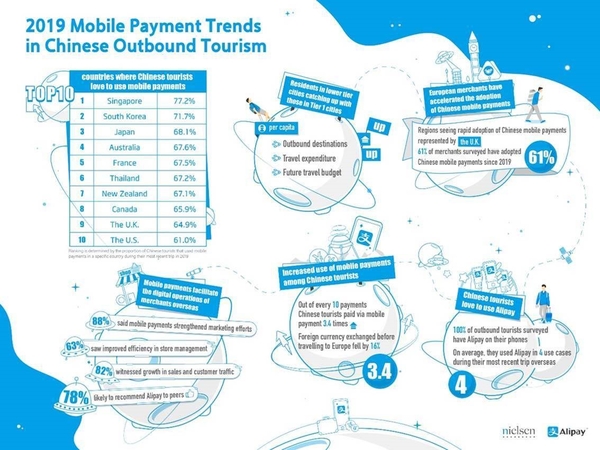
Thailand ranked among the global top 10 for mobile payments by Chinese tourists, fuelled by the country’s “maturity” in mobile payment solutions, a joint report by Nielsen and Alipay said.

The study reported the latest trends in Chinese outbound tourism and the consumption habits of these travellers for the third consecutive year.

Thailand and Singapore were among the top 10 overseas destinations visited by Chinese tourists in 2019 and are among the top 10 countries for overseas travel plans in 2020.

Surveying 4,837 Chinese travellers and 547 overseas merchants, the report found that the Southeast Asia region maintained its leadership in mobile payments by Chinese travellers, with Singapore and Thailand positioned at number 1 and 6 respectively in global ranking. Other nations on the list of “Top 10 countries where Chinese tourists love to use mobile payments” include South Korea, Japan, Australia, France, New Zealand, Canada, the UK and the US.

In Singapore, an early adopter of Chinese mobile payment solutions, almost all merchants (97 per cent) indicated steady improvement compared to the previous year in terms of mobile payment usage and the amount of mobile spending by Chinese tourists.

In Thailand, Singapore, Malaysia, Japan and South Korea, the usage rate of mobile payments among Chinese tourists was high, reaching 70 per cent in both 2018 and 2019, the report stated.

The total amount spent by Chinese tourists increased by 14 per cent in Singapore and Thailand and 23 per cent in Japan and South Korea between 2018 and 2019.

These results are encouraging more overseas merchants to deepen the use of Chinese mobile payment platforms as they go digital. Nearly 7 out of 10 (66 per cent) surveyed merchants in Singapore, South Korea and the UK hope to carry out more digital store operations through Chinese mobile payment platforms and hope to further their promotional and marketing activities leveraging Chinese mobile payment platforms.

In 2019, destinations located a four-hour flight away such as Thailand, Japan, South Korea and Singapore remained the most popular choices for Chinese tourists.

In addition, the US, Australia, UK and Canada were also among the top 10 countries, which indicated that Chinese tourists were fairly keen on travelling to English-speaking countries.

The top three factors affecting Chinese tourists’ overseas shopping habits are payment methods accepted by merchants (37 per cent), product variety and quality (36 per cent), and product price (36 per cent).

In 2019, compared to last year, Chinese tourists born in the 1990s spent nearly 12 per cent more on a single overseas trip, while those born in the 1980s spent 15 per cent more. An underlying reason for the increased travel expenditure may be the desire for more in-depth experience of local cultures. Around 70 per cent of millennials would proactively search for information on places to eat, stay and visit even after arriving at their travel destinations. More than 50 per cent of those born in the ’90s chose to stay at local homestays and B&Bs rather than hotels. Some 34 per cent of the post-1990 generation attended concerts or stage performances at their travel destinations, while 26 per cent experienced local outdoor sporting activities.

“The Chinese mobile payment engagement level [the proportion of mobile payment transactions by Chinese tourists overseas] and the depth of usage [total spending via mobile payments] continued to increase, indicating a more in-depth development of Chinese mobile payment solutions globally,” said Nielsen China president Justin Sargent.

“The trend of more overseas merchants going beyond payment to adopt more digitalised services is a promising one, as it helps brick-and-mortar businesses become better integrated with the digital economy while bringing more personalised experiences for consumers around the world,” commented Angel Zhao, Ant Financial’s International Business Group president. “Alipay, as part of the Alibaba ecosystem, aims to support the digital transformation of businesses and we will continue to innovate and help merchants around the world benefit from the rise in global tourism.”

Some of the key findings:

* Among the countries surveyed, the usage of Chinese mobile payments in Singapore, South Korea and Japan was highest, with Singapore in the leadership position.

* Some 77% of Chinese tourists in Singapore used mobile payments for their transactions.

* Total spending by Chinese tourists via mobile payments increased significantly in countries where Chinese mobile payment adoption is relatively mature.

* More overseas merchants intend to deepen the use of Chinese mobile payment platforms as they go digital.

Mobile payment insights

* The proportion of Chinese tourists using mobile payments when travelling abroad in 2019 remained stable compared to 2018.

* In 2019, 3.4 out of every 10 payments made by each Chinese tourist overseas were mobile payments, a slight increase from the previous year (3.2 payments).

* The per capita total amount of mobile payments made by outbound Chinese tourists increased by 18% compared to the previous year.

Department stores are betting on booze to boost retail #ศาสตร์เกษตรดินปุ๋ย

#ศาสตร์เกษตรดินปุ๋ย : ขอบคุณแหล่งข้อมูล : หนังสือพิมพ์ The Nation

https://www.nationthailand.com/business/30381095?utm_source=category&utm_medium=internal_referral

Department stores are betting on booze to boost retail

Jan 26. 2020
Martini at the Goodman's Bar in the Bergdorf Goodman department store in Manhattan.. MUST CREDIT: Bloomberg photo by Kate Krader.

Martini at the Goodman’s Bar in the Bergdorf Goodman department store in Manhattan.. MUST CREDIT: Bloomberg photo by Kate Krader.
By Syndication Washington Post, Bloomberg · Kate Krader, Kim Bhasin · BUSINESS, RETAIL 

On a recent mid-January afternoon, the eight seats at the Shoe Bar in Nordstrom’s new women’s store were empty. “It’s Dry January. People are broke,” a bartender observed.

And yet, within a half-hour, most of the stools had filled up. “There’s a bar here!” a woman said happily. She ordered the gin-based signature cocktail called Husband Daycare and showed off a pair of gloves she’d bought upstairs. She planned to do more shopping after she finished.

“A round of drinks is a second pair of shoes,” says David Bruno, a former buyer for Bergdorf Goodman and now a consultant on the elegant new Goodman’s Bar, tucked into the second floor of the men’s store a few blocks east of Nordstrom. “A bar means people are spending more time within your walls. The more time they spend and the more loose they are, the easier the sale on everyone’s side.”

Goodman’s Bar, which opened in early January, is the newest in a growing number of watering holes inside Manhattan’s higher-end department stores. Nordstrom introduced its Shoe Bar and Broadway Bar when its women’s store opened in late October. Across the street, the men’s store has a café with a similarly strong bar program. Saks Fifth Avenue, which underwent a $250 million renovation in 2019, is home to the Alpine-themed drinks lounge Le Chalet. Across town, inside Hudson Yards, Neiman Marcus has Bar Stanley, which features its own ambitious cocktails.

Destination dining inside luxury department stores is nothing new. Freds has been bringing ladies who lunch and shop into Barneys New York since it opened in 1996. More recently, Tiffany & Co. introduced the Blue Box Cafe, a made-for-social-media stop with robin’s-egg blue upholstered seats and a towering tea service that had hourslong waits. But as Barneys prepares to shutter, and the Blue Box Cafe is closed for two years during Tiffany’s renovation, there’s a previously untapped form of refreshment for sustenance-seeking shoppers in Midtown: cocktails.

An in-store bar has several benefits. Besides the potential for additional purchases and the opportunity to keep shoppers inside a store, alcohol has high margins. Plus, the locations naturally attract customers, said Sucharita Kodali, a retail analyst at Forrester Research. Unlike their suburban counterparts, urban department stores draw a combination of domestic and international tourists, as well as the after-work commuter crowd from Wall Street through Madison Avenue.

“The advantage that these bars can have is that they’re in flagship locations,” Kodali said. “There’s already a lot of traffic, and they’re in department stores that are thriving.” Likewise, stores are now more willing to devote in-house real estate that might have once been reserved for clothing and accessory displays to an area that can serve cocktails.

Nordstrom’s Shoe Bar is straight out of Sex and the City: a curved, stone-topped bar in the thick of the Ted Baker and Jeffrey Campbell display shoes. Thirsty shoppers can order an old-fashioned or signature drinks such as the bourbon-based Billionaire off the menu. Coffee drinks and snacks are available, too.

A lot of the drinking at Shoe Bar takes place among the velvet sofas, where customers try on, say, a pair of Freda Salvador combat boots. And the bartenders stay busy. Vincent Rossetti, vice president for restaurant operations at Nordstrom, said that one in every four transactions at Nordstrom is food or drinks. The Shoe Bar alone sold more than 400 drinks on the Saturday before Christmas.

Down a curved staircase from L’Avenue on the top floor of Saks is Le Chalet. The Philippe Starck-designed bar evokes an Austrian après-ski palace and has a cocktail program that includes unconventional choices such as Baby It’s Cold Outside-gin, Campari, sweet vermouth, and coffee. Hidden farther away from the clothing racks and handbag shelves than its kin at other department stores, it serves more as a hideaway from the bustling city than a shop-till-you-drop pit stop.

Goodman’s Bar sits in an alcove on Bergdorf’s second floor. The art deco space, from the store’s in-house design team, has Tom Dixon wingback chairs, custom backgammon tables, and a bar-to-ceiling mural of Central Park. The beverage program is the most ambitious in a Manhattan store, overseen by master sommelier Dustin Wilson. “It’s no longer enough to put out a shingle and open up a bar,” says Bergdorf’s men’s fashion director, Bruce Pask. “It has to be a destination.”

On Goodman’s menu, alongside the gougères and truffled tagliatelle from chef Austin Johnson, is a short, curated list of wines almost all available by the glass. The bestselling drinks are the grower’s Champagne Dhondt-Grellet and old-fashioneds, which aren’t even on the menu. (The $22 Goodman’s Manhattan also sells well.)

Bergdorf’s is also working on an app that allows customers to order drinks while they peruse Kiton on the second floor. “You’re getting fitted for an evening jacket and have a hankering for an old-fashioned-we trust that our customers can manage both,” Pask said. Nordstrom has even given customers the option to order chicken tacos and martinis while shopping, but Pask doesn’t anticipate delivering food to shoppers at Bergdorf’s. “We’ll keep the gougères and silk ties away from each other,” he says.

Across town, one of the most crowded spots at the three-floor Neiman Marcus is Bar Stanley. On a Friday night before Christmas, all the seats at the bar were filled; the store, not so much. “This feels like the busiest place here,” said a customer, glancing around.

The leather apron-clad bartender responded, “We get that a lot.”

The world’s most-profitable hedge fund is now a climate radical #ศาสตร์เกษตรดินปุ๋ย

#ศาสตร์เกษตรดินปุ๋ย : ขอบคุณแหล่งข้อมูล : หนังสือพิมพ์ The Nation

https://www.nationthailand.com/business/30381092?utm_source=category&utm_medium=internal_referral

The world’s most-profitable hedge fund is now a climate radical

Jan 26. 2020
By Syndication Washington Post, Bloomberg · Edward Robinson, Nishant Kumar 

The hedge fund industry has no shortage of aggressive, in-your-face players, but few are as tough as Chris Hohn. The British billionaire takes the typical playbook to new levels-scuttling deals, pushing to remove bosses, and battering companies with litigation and threats.

One opponent was so peeved after losing a boardroom battle with Hohn that he titled a book about the experience Invasion of the Locusts. That approach made Hohn’s TCI Fund Management the world’s best-performing, large hedge fund last year.

Now Hohn is bringing his hardball tactics to the fight against global warming. The money manager, with $30 billion in assets, is pushing portfolio companies to dramatically reduce greenhouse gas emissions and disclose their carbon footprint. If they don’t, he says he’ll oust their boards or dump their shares. Just in case anyone doubts his commitment, last fall Hohn and his charity donated £200,000 ($260,000) to Extinction Rebellion, the radical climate change movement whose members have blocked traffic in London and glued themselves to jetliners.

“In the war against fossil fuels, you can’t be super-picky about your allies,” says Jeremy Grantham, co-founder of Boston money manager GMO, a legendary investor who has long warned of climate catastrophe. Hohn “has shown you can make a big impact on companies with a lot of arm-twisting.”

For Hohn, 53, a cerebral and deeply private financier who’s worth $2 billion, his campaign is just a first step in shaking up an asset management industry he says has ignored a planetary crisis. He’s calling on investors to fire money managers who don’t press companies to reduce their carbon footprint, and he wants banks to stop lending to companies that ignore climate change.

Still, for all of Hohn’s zeal, his crusade is fraught with the inconsistencies of green investing. TCI once held a big stake in an Indian coal producer; even now, it owns shares in three railroads that burn tons of diesel and ship fossil fuels, including from oil sands, one of the worst sources of greenhouse gases. Another key holding: Ferrovial SA, the Madrid-based conglomerate that runs airports that include London’s Heathrow.

“On the one hand, he’s trying to be green-and on the other, he makes money out of polluters,” says Jacob Schmidt, chief executive officer of Schmidt Research Partners, a London investment firm. “The question is, how committed are you in actually following your principles?”

Hohn says it’s far more productive to engage with carbon-heavy companies than to ignore them. On Nov. 30, TCI sent letters to the CEOs of the 17 companies in his portfolio with specific instructions on shortcomings that must be fixed. TCI said it will vote against directors of companies that don’t hit its targets, as well as auditors who fail to report “material climate risks,” and it may even sell all its shares in a company.

In a letter to Ferrovial, Hohn acknowledged that “de-carbonizing” airports is a massive challenge and lauded the company’s A grade for disclosing its greenhouse gas emissions. Yet TCI said Ferrovial’s target of cutting emissions almost a third by 2030 could be increased, and he called on the company to support measures such as a carbon tax and a mandate that airlines shift to greener jet fuel.

He told Canadian Pacific Railway that its method of disclosing emissions got a C grade by the nonprofit Carbon Disclosure Project, and that its plan to boost that to a B would still be “unsatisfactory.” TCI, the railroad’s No. 1 stockholder, with an 8% stake, said it requires the company to have a “credible, publicly-disclosed plan” to reduce emissions that meets seven objectives, including offsetting emissions from corporate travel and making facilities more energy efficient. Canadian Pacific says it engages in dialogue with stockholders on topics including sustainability, and that it has long reported its emissions to improve its practices. Hohn declined to be interviewed for this story.

Hohn launched TCI and an affiliated charity, the Children’s Investment Fund Foundation, in 2004 after earning a reputation as a gifted stockpicker in the London office of Perry Capital, a New York-based hedge fund. His wife, Jamie Cooper, whom Hohn met at Harvard in the early ’90s, ran the foundation, and they became a London power couple as TCI pumped money into the charity.

Thanks to Hohn, the foundation has $5.1 billion that it uses to fund programs such as strengthening nutrition for youngsters in deprived communities, protecting adolescents from slavery and human trafficking, and expanding pediatric HIV treatment in Africa. Hohn and Cooper regularly traded notes with Bill and Melinda Gates, and in 2012, David Cameron, then Britain’s prime minister, invited Hohn to speak at a summit on malnutrition at No. 10 Downing Street.

At TCI, the vibe was decidedly more mercenary. Hohn developed an investment strategy predicated on his own “personal, intellectual, and emotional makeup,” as he put it to Justice Jennifer Roberts, who presided over his 2014 divorce, which resulted in a 337 million-pound settlement for Cooper. Hohn’s approach meant conducting meticulous analysis and searching for weak management teams that other investors avoid. “Think of it like the damaged goods department of a department store where you can get 80 to 90% off because most people won’t buy,” Hohn said in a video interview with Institutional Investor magazine in 2013.

When he settles on a target, Hohn takes highly concentrated stakes; a single stock can account for more than 15% of his portfolio. Then he goes to work agitating for changes in the company’s strategy. In 2005, he took a sizable stake in Deutsche Boerse in Frankfurt to stop what he called a “value-destructive acquisition” of the London Stock Exchange. Rebuffed, he called on shareholders to remove CEO Werner Seifert and kill the deal. The board acquiesced, and after Seifert left the company, he characterized Hohn and other shareholder activists as locusts.

Hohn was the catalyst for one of the most disastrous banking deals in memory. In 2007, TCI bought 1% of ABN Amro and started calling for a sale of the Dutch lender. After stockholders supported TCI, ABN Amro was sold to a consortium led by Royal Bank of Scotland Group in the biggest European banking merger ever. TCI pocketed $1 billion, but the global financial crash of 2008 poleaxed the newly combined institution and led to its nationalization by the British government.

TCI has also exploited scandals such as the 2011 crisis at Rupert Murdoch’s News Corp. The company’s U.K. newspapers had hacked mobile telephones and voice mail accounts of celebrities, royals, and a murdered 13-year-old girl. As the media giant’s stock plunged, Hohn purchased almost $1 billion in shares. After News Corp. settled lawsuits in the affair, Murdoch bought back shares and broke up the company. The stock rallied over the next two years, earning a 57% return for TCI-and, for Hohn, reinforcing his reputation as a gifted money manager.

Yet he has suffered defeats that show the limitations of his activism. In 2012, TCI sought to force Coal India, a state-controlled producer, to boost dividends and stop selling super-cheap coal to nearby power plants. But the government had little interest in seeing energy prices rise; in 2014, TCI gave up and bailed out of the stock, which had fallen 19% during the campaign. Four years later, the London Stock Exchange Group Plc spurned Hohn’s demands to oust its chairman and renew the CEO’s contract. After that effort was rebuffed, TCI sold most of its 5% stake in the company, only to see its shares almost double the following year.

Hohn is rolling out his green efforts as the asset management industry struggles to find a way to address climate change while delivering the kind of returns investors demand. Index fund giants have long used an investing style dubbed ESG-based on environmental, social, and governance criteria-but they maintain that investment stewardship is ultimately about maximizing value, not imposing social “values” on companies.

But amid mounting anxiety about record-breaking global temperatures, Larry Fink, chief executive officer of BlackRock Inc., acknowledged on Jan. 14 that climate change has become a “defining factor” in the long-term prospects of companies worldwide. BlackRock, the world’s biggest investment firm, with $7.4 trillion in assets, will start cashing out of firms with “high sustainability-related risk” and plans to make emissions a fundamental consideration in investments.

Tackling global warming will test Hohn’s approach as never before. First, he’s betting that companies will heed his demands, and then that he won’t dampen returns by destabilizing companies that reject them. In tying TCI’s fortunes to a climate change agenda, Hohn is wagering that the economic risks from the mounting crisis are so great that it would be foolish not to spur companies to get real on emissions.

“Green investing and hedge funds are not terms many investors would put in the same sentence,” says Marc de Kloe, a partner at Theta Capital Management in Amsterdam and an investor in TCI’s fund. “However, we have been proponents of the idea that hedge funds are in some way best suited to implement strong green policies, given their unconstrained nature and ability to deploy activist tactics.”

Climate change activists say it’s about time, given the confusion around ESG, which has become a megatrend in the investing world. More than $30 trillion was held in assets classified as sustainable or green in 2018, up more than a third from 2016, according to the Global Sustainable Investment Alliance, a group that tracks money flows.

But critics contend that ESG is often little more than a public relations gimmick to “greenwash” a firm’s credentials. There’s no standard definition of ESG, so it’s virtually impossible to compare companies against a universal benchmark. Moreover, subscribing to the approach doesn’t mean institutional investors will actually pressure portfolio companies to reduce emissions. In November, ShareAction, an advocacy group in London, released a study finding that Capital Group, T. Rowe Price, and BlackRock supported fewer than 7% of the shareholder resolutions on climate risks in 2017 and 2018, even though they all subscribe to ESG.

While it might be odd to look to hedge funds for support in the fight against climate change, that’s where the story is going, says Catherine Howarth, CEO of ShareAction. “Historically, large institutional investors have encouraged companies to do the right thing in vague, bland terms, and the whole asset management field is finally waking up,” Howarth says. “Now we need activist investors like Chris Hohn to push like crazy for what they want.”

A $46 billion bad-loan mirage hints at flaw in U.S. bank rule #ศาสตร์เกษตรดินปุ๋ย

#ศาสตร์เกษตรดินปุ๋ย : ขอบคุณแหล่งข้อมูล : หนังสือพิมพ์ The Nation

https://www.nationthailand.com/business/30381061?utm_source=category&utm_medium=internal_referral

A $46 billion bad-loan mirage hints at flaw in U.S. bank rule

Jan 25. 2020
By Syndication Washington Post, Bloomberg · Yalman Onaran 

An early warning system for bad bank loans is taking effect this year. Beware false alarms.

U.S. banks are starting to book provisions for potential loan losses under a new system regulators devised eight years ago to avoid the kind of catastrophic surprise that caught the industry and regulators off guard during the financial crisis. The idea is to force banks to boost reserves based on models that factor in the economy, rather than wait for loan payments to stop.

But mighty swings in estimated loan losses in recent years show how the system also has the potential to raise concerns prematurely or to even send mixed signals. When the rule, known in the industry as CECL, was initially written in 2012, regulators and analysts estimated the provision increase for the four largest U.S. banks would be $56 billion. Last week, banks said it’s a mere $10 billion.

That $46 billion gap at JPMorgan Chase, Bank of America, Citigroup and Wells Fargo . shows how economic shifts and the lenders’ assumptions can have a significant impact on estimates — a level of discretion that could allow executives to delay higher reserves or set off a surge in provisions if they are too conservative heading into the next economic slump. It’s also possible assumptions will diverge among firms, leading to confusion.

“We expect higher volatility in provisions under the new rule,” Maria Mazilu, an accounting analyst at Moody’s Investors Service, said in an interview. “We will only find out how good the models at predicting losses are in the next downturn though.”

The rule was prompted by widespread criticism of global banks for being too slow to recognize potential loan losses heading into the 2008 crisis. It’s meant to alert shareholders earlier to any brewing trouble by essentially amplifying expected loan losses based on the stages of the economic cycle.

When it was first proposed, the U.S. was still climbing out of the worst recession since the Great Depression, and projections were grim. Banks have reshaped their lending books over the years. And today, after a long run of economic growth, few in finance are expecting a downturn soon, leaving reserves far lower. Yet all that could change anew when the economy starts heading south.

The old rule allowed less discretion: Banks set aside provisions when borrowers stopped making payments. The new rule requires lenders to model losses from the day a loan is made. Because that standard gives so much more discretion to banks’ internal models, it will decrease comparability among peers, Moody’s has warned.

But if the rule works as envisioned, big banks will head into the next bout of turmoil with larger loan-loss reserves — a buffer in addition to their underlying capital, which has also been increased by post-crisis regulations.

Bank regulators gave firms up to four years to absorb the initial impact on their capital from the accounting rule change. But regulators stopped short of reducing capital requirements to balance out the jump in reserves. That means when reserves do rise further on the risk of a downturn, big banks would need to replenish capital eroded by the hit to earnings.

“If you’re not overcapitalized, then CECL’s impact on reserves will be higher capital,” said Warren Kornfeld, an analyst at Moody’s covering consumer finance companies. “Reserves will go up by x, but capital won’t be allowed to go down by x.”

JPMorgan, Bank of America and Citigroup noted while posting earnings last week that initial implementation will reduce their capital by about 0.2 percentage points.

Wells Fargo lowered its loan-loss provisions because the new rule allowed the bank to write up the value of some collateral backing soured loans. The company didn’t say how much positive impact the reduction would have on its capital.

Smaller banks also have expressed concern about the volatility CECL may cause. And because they lack resources to handle projections internally, some have noted the risk of relying on models and economic forecasts from third parties, such as Moody’s. Community banks and credit unions were given a reprieve last year when their deadline for compliance was extended to 2023. But mid-size banks like Wintrust Financial Corp., Illinois’s biggest publicly traded bank, weren’t included.

“CECL is going to be all over the board on this,” that bank’s chief executive officer, Ed Wehmer, said on his company’s earnings call this week. “And if the guy at Moody’s has a bad day or a hangover or his hemorrhoids act up, he could take the banking business down because everybody’s basically using Moody’s baseline as their basis for this.”

Amazon Web Services to build data centers in Jakarta: Minister #ศาสตร์เกษตรดินปุ๋ย

#ศาสตร์เกษตรดินปุ๋ย : ขอบคุณแหล่งข้อมูล : หนังสือพิมพ์ The Nation

https://www.nationthailand.com/business/30381029?utm_source=category&utm_medium=internal_referral

Amazon Web Services to build data centers in Jakarta: Minister

Jan 24. 2020
Industry Minister Agus Gumiwang Kartasasmita (The Jakarta Post/Jerry Adiguna)

Industry Minister Agus Gumiwang Kartasasmita (The Jakarta Post/Jerry Adiguna)
By Eisya A. Eloksari
The Jakarta Post

Amazon Web Services (AWS) will build an infrastructure “region” in Jakarta by the end of next year or early 2022 in the biggest investment in Indonesia’s the information and technology sector, a high-ranking official has said.

Jakarta will also have three Availability Zones consisting of several interconnected data centers, according to the Industry Ministry.

An AWS region is a physical location where its data centers are clustered. Each region consists of multiple, isolated and physically separate Availability Zones within an area.

An Availability Zone is one or more discrete data centers with redundant power, networking and connectivity in an AWS region, according to the company’s website.

“This investment can boost Indonesia to become a strategic digital hub,” Industry Minister Agus Gumiwang said after a meeting with AWS global public policy vice president Michael Punke during the 2020 World Economic Forum (WEF) in Davos, Switzerland, as quoted in a statement on Thursday.

The development of an ASW region, he added, could also accelerate the transformation of the nation’s small and medium companies as well as big corporations in various sectors toward industry 4.0.

“The AWS region in Indonesia will certainly support the startup ecosystem so it can grow rapidly,” Agus added. “It can also help create more jobs and companies in the technology sector.”

The value of the country’s digital economy was projected to reach US$40 billion in 2019, up from $27 billion a year before, according to the annual e-Conomy SEA 2019 report by technology giant Google, Singaporean holding company Temasek and management consulting firm Bain & Company. The value is expected to triple to $130 billion by 2025.

The ministry’s metal, machinery, transportation and electronics director general, Harjanto, said that AWS’ investment was “the biggest investment realization in the ICT [information and communication technology] sector to date,” although he did not disclose the figure.

AWS is a subsidiary of United States-based technology company Amazon that offers analytics technology, artificial intelligent, Internet of Things (IoT) and machine learning services, among other services.

Jakarta will join Hong Kong, Beijing and Ningxia in China, Mumbai in India, Seoul in South Korea, Singapore, Tokyo in Japan and Sydney in Australia as AWS regions in the Asia-Pacific. There are 14 other regions across the globe.

The government will also partner with AWS to provide cloud computing training for “hundreds of thousands of Indonesians” by 2025.

Indonesia has been looking to secure investments from multinational corporations at the WEF, such as Singaporean ride-hailing giant Grab, Japanese financial services firm Mizuho, state-owned Japan Bank for International Cooperation (JBIC) and Chinese dairy giant Yili Group, to boost the country’s economic growth.

Investment Coordinating Board (BKPM) data showed that overall realized investment totaled Rp 601.3 trillion ($44 billion), a 12.3 percent increase year-on-year (yoy), from January to September 2019.

While domestic investment grew 17.3 percent to Rp 283.5 trillion, foreign direct investment (FDI) rose 8.2 percent yoy to Rp 317.8 trillion.

GH Bank budgets Bt100 bn for new loan packages #ศาสตร์เกษตรดินปุ๋ย

#ศาสตร์เกษตรดินปุ๋ย : ขอบคุณแหล่งข้อมูล : หนังสือพิมพ์ The Nation

https://www.nationthailand.com/business/30381028?utm_source=category&utm_medium=internal_referral

GH Bank budgets Bt100 bn for new loan packages

Jan 24. 2020
Finance Minister Uttama Savanayana, left, announces policy direction of the Government Housing Bank on Friday (January 24). At right is the bank's president Chatchai Sirilai.

Finance Minister Uttama Savanayana, left, announces policy direction of the Government Housing Bank on Friday (January 24). At right is the bank’s president Chatchai Sirilai.
By THE NATION

Government Housing Bank (GH Bank) has budgeted Bt100 billion for a new mortgage campaign, according to its statement released on Friday (January 24).

The bank president Chatchai Sirilai said the new packages fell in line with the Finance Ministry’s policy to widen loan access to homebuyers.

The first package involves Bt30 billion in lending, carrying an annual interest rate of 3.25 per cent in the first year before rising to 4 per cent in the second, 5 per cent in third year and 0 per cent during the 37th to 42th months.

Borrowers, eligible for 0 per cent rate, are those who have signed up for GHB All mobile financial service application. They will have to pay installments via the app.

For the 43th month until the end of the loan term, interest rates are set at MRR-0.75 per year for retail clients, and MRR-1 per cent a year for borrowers whose employers have entered into an agreement with GHB under which their salaries will be deducted for the monthly installmet payments to the bank.

Maximum lending is capped at Bt3 million with collaterals. Eligible borrowers must have a maximum monthly salary of Bt35,000. This loan package is available until December 30, 2020.

The other package “Dream Homes by GHB” comes with Bt10 billion in loans, carrying an interest rate of 3.25 per cent during the first to third years and MRR-2 per cent a year (equivalent to 4.50 per cent per year as of the present level ) for the fourth and fifth years.

The rate from the 61th to 66th month is 0 per cent per annum.

The rate from 67th month until the end of loan term is MRR-0.50 per cent per annum for retail clients and MRR-0.75 per cent per annum if the employer of the borrower had signed an MoU with GHB under the Corporate Synergy project.

Eligible borrowers must be free of any mortgage agreement with GHB or other banks. This package is available until December 30 this year.

The bank will also issue savings lotteries worth Bt50 billion next month. It will use the proceeds to develop a low-interest mortgage package offering Bt50 billion in loans.

In addition it will help clients who are state officials and state personnels restructure their debt.

Chatchai said that the bank is ready to support the government’s policies.

He added that GHB targeted Bt209 billion in new loans this year compared to Bt215.301 billion last year. Currently, its outstanding loan amount stands at more than Bt1.209 trillion, up 8.37 per cent from 2018.