ADB loan unlocks long-term financing for VN’s solar power #ศาสตร์เกษตรดินปุ๋ย

#ศาสตร์เกษตรดินปุ๋ย : ขอบคุณแหล่งข้อมูล : หนังสือพิมพ์ The Nation

https://www.nationthailand.com/business/30380920?utm_source=category&utm_medium=internal_referral

ADB loan unlocks long-term financing for VN’s solar power

Jan 22. 2020
By The Nation

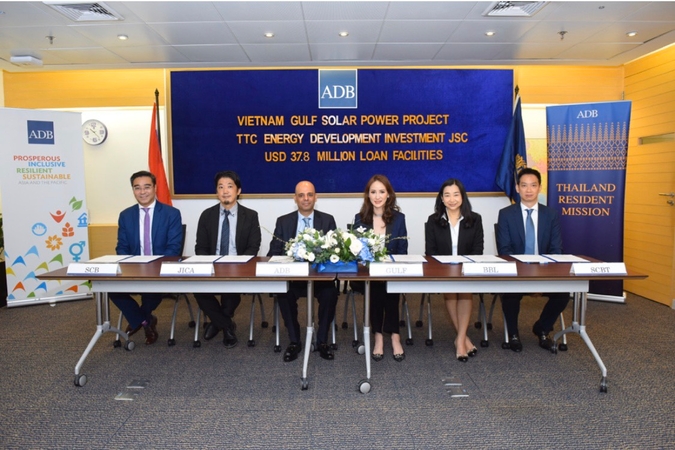
The Asian Development Bank (ADB) signed a US$37.8-million loan deal with TTC Energy Development Investment Joint Stock Company on Wednesday (January 22) to develop and operate a 50-megawatt photovoltaic solar power plant in Vietnam’s Tay Ninh province.

ADB’s assistance for the Gulf Solar Power Project was provided through an innovative financing structure that ensures its bankability. It will help catalyse commercial financing for one of the first such large-scale transactions in the country involving solar power.

The loan is divided into an $11.3-million A loan and a B loan of up to $18.9 million.

An additional $7.6 million was provided by the Leading Asia’s Private Infrastructure Fund, which is supported by the Japan International Cooperation Agency.

The B loan will be funded by Bangkok Bank PCL, Siam Commercial Bank PCL and Standard Chartered Bank (Thai) PCL.

“ADB is excited about this transaction because the project will have a significant impact on the sustainability and security of Vietnam’s energy sector for years to come,” said Jackie B Surtani, director of the Infrastructure Finance Division in ADB’s Private Sector Operations Department.

“Apart from providing much-needed financing to develop solar power in Vietnam, the project will help reduce perceived risks in the country’s renewable energy sector.”

Gulf Energy Development executive director Yupapin Wangviwat said the project fundamentals were “improved significantly as a result of its competitive financing structure and longer tenure led by ADB”.

The government plans to increase the share of renewable energy sources such as hydropower, solar, wind and biomass as a percentage of total installed capacity to 21 per cent by 2030 to meet rapidly growing energy needs and reduce greenhouse gas emissions by up to 25 per cent by 2030.

The project will develop and operate the 50MW solar plant and associated facilities in Tay Ninh northwest of Ho Chi Minh City.

The plant will directly serve the residents and businesses of Ho Chi Minh City and surrounding areas and reduce annual carbon dioxide emissions by 29,760 tonnes by 2020.

TTC, established in 2017, is 90 per cent-owned by GED. GED is a private power generation company and has the largest portfolio of gas-fired power projects in Thailand.

Established in 1966, ADB is owned by 68 members, 49 from the region.

KBank’s KGP makes online transactions a snap #ศาสตร์เกษตรดินปุ๋ย

#ศาสตร์เกษตรดินปุ๋ย : ขอบคุณแหล่งข้อมูล : หนังสือพิมพ์ The Nation

https://www.nationthailand.com/business/30380918?utm_source=category&utm_medium=internal_referral

KBank’s KGP makes online transactions a snap

Jan 22. 2020
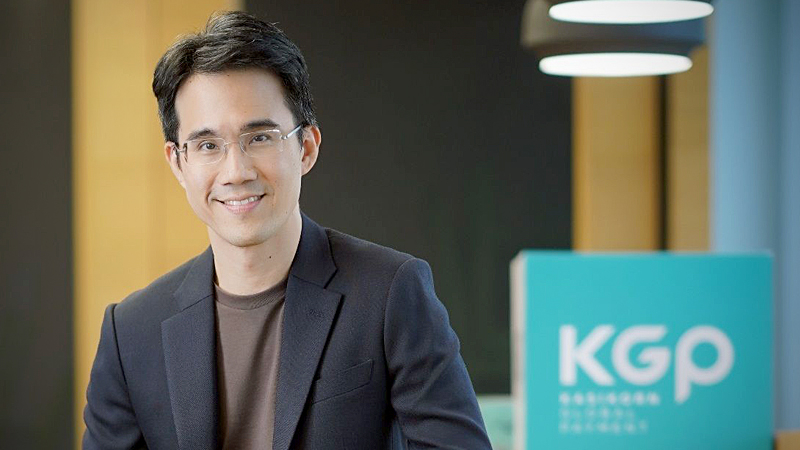
KGP managing director Takerng Osirichaivet

KGP managing director Takerng Osirichaivet
By THE NATION

Kasikornbank (KBank) has launched Kasikorn Global Payment Company Limited (KGP) to provide both merchants and online shoppers with the PayDii digital payment system.

The system allows merchants to conduct transactions without having to switch from one application to another. The version for online merchants is now available on Facebook.

KGP chairman Poramate Minsiri said it is a company that KBank has invested in with registered capital of Bt200 million.

The has its own board of directors, with an independent working team and work structure, and plans to extend its reach to other Southeast Asian and partner countries in the future.

PayDii, which is KPG’s first project, can accommodate links with the greatest number of mobile banking applications under acceptable security standards.

According to the Electronic Transactions Development Agency (ETDA), the value of Thailand’s e-commerce market in 2018 reached Bt315 billion and the e-commerce market is expected to grow average of 22 per cent by 2022.

KGP managing director Takerng Osirichaivet said online merchants can directly collect the requested payment by sending buyers a screenshot of the payment amount.

Buyers then tap the “Payment” button on their mobile banking application, or they can make payment by credit or debit card without providing their bank account number to the merchant, since such accounts are already linked with the system.

LINE MAN launches Mart Service for door-to-door grocery delivery #ศาสตร์เกษตรดินปุ๋ย

#ศาสตร์เกษตรดินปุ๋ย : ขอบคุณแหล่งข้อมูล : หนังสือพิมพ์ The Nation

https://www.nationthailand.com/business/30380916?utm_source=category&utm_medium=internal_referral

LINE MAN launches Mart Service for door-to-door grocery delivery

Jan 22. 2020
  Waranan Chuangcham,left, and Jayden Kang.

Waranan Chuangcham,left, and Jayden Kang.
By The Nation

LINE MAN, the leading “daily life assistant” in Thailand, officially launched Mart Service on Wednesday (January 22) – a new service to promote its role as a shopping assistant that delivers your grocery orders to your doorsteps.

It has formed partnerships with Happy Fresh, a leading online grocery delivery service in the region and Naver/LINE Ventures to strengthen its service offerings.

The new service targets LINE MAN’s current users living in condominiums, apartments and small restaurant owners with three core benefits: Caring, Crafted and Controllable.

This is another big step of LINE MAN in 2020 which will solidify its position as the No 1 “daily life assistant” in response to the growth of online grocery service. Users are offered free delivery and special deals from Betagro, Diageo and Thonglor Pet Hospital.

Jayden Kang, Chief Strategy Officer of LINE Thailand and head of LINE MAN said: “In 2020, LINE MAN is further focusing on strengthening its position as the No 1 ‘daily life assistant’. This includes further enhancement of food delivery service and launches of new services in 2020, starting with Mart Service as the sixth of the application. In order to provide grocery-shopping service from leading supermarkets and specialty stores, we partner with Happy Fresh, a leading online grocery shopping service provider with strong network of supermarkets and operation capabilities. Happy Fresh is one of the startups that Naver, a parent company of LINE Corporation, and LINE Ventures, the corporate venture arm of LINE Corporation, invested in to build a strong ecosystem for business and develop stronger services for LINE MAN. We believe  this new service will help furthering the growth of omni-channel of retail supermarkets in Thailand, which is still in its initial stage.”

Waranan Chuangcham, head of Business Development and Marketing of LINE MAN said:”With Mart Service, we intend for it to be an assistant shopper that delivers the products right to your doorsteps. Based on a study of LINE MAN’s current users and online grocery shopping behaviour, we have found a new generation of people living in condominiums and  apartments who work and take care of their family, and small restaurants. So, we focus on providing Mart Service as an assistant for people purchasing grocery for both their home and food shops. The service provides three  core benefits that make it more convenient and worthwhile than ever, especially with free-delivery promotions.

• Caring – Users no need to carry the items themselves. The door-to-door delivery service will be operated by Happy Fresh.

• Crafted – Personal shoppers of Happy Fresh are skillful at selecting and recommending the best items for customers.

• Controllable – Purchasing and planning are made easy, allowing users to control their budget and make it more efficient than ever. Payment can be made with credit cards or cash on delivery. There are also special promotions throughout the year, starting with deals from Betagro, Diageo and Thonglor Pet Hospital. Users can also choose delivery time, allowing them to better plan and manage their daily schedule.

“The online channel of supermarkets makes up only about 2-3 per cent of overall sales. However, it is expected to grow continuously in the future. People are familiar with using delivery service application in daily life and food delivery service also gained a lot of popularity in past few years. Along with the growth of urbanisation rate, we believe that LINE MAN Mart Service can be a middleman to help propel the growth of online supermarket in the near future,” Waranan concluded.

CPF anticipates higher-than-expected results from HK operations #ศาสตร์เกษตรดินปุ๋ย

#ศาสตร์เกษตรดินปุ๋ย : ขอบคุณแหล่งข้อมูล : หนังสือพิมพ์ The Nation

https://www.nationthailand.com/business/30380877?utm_source=category&utm_medium=internal_referral

CPF anticipates higher-than-expected results from HK operations

Jan 21. 2020
By The Nation

Charoen Pokphand Foods (CPF) reported better-than-expected financial results of CP Pokphand (CPP), its Hong Kong-based subsidiary, in a filing to the Stock Exchange of Thailand.

CPP, listed on the Hong Kong Stock Exchange, just released its profit results as required by the SET, saying it projected preliminary net profit for 2019 at US$330 million (approximately Bt10 billion) to $350 million compared to $282 million the previous year, said CPF corporate secretary Kobboon Srichai. The firm attributed the increase to higher pork prices in Vietnam.

CPF directly and indirectly owns 52.24 per cent of CPP’s total issued shares, or 49.74 per cent of total issued common shares.

Huawei executive, facing extradition to the United States, argues the allegations aren’t crimes in Canada #ศาสตร์เกษตรดินปุ๋ย

#ศาสตร์เกษตรดินปุ๋ย : ขอบคุณแหล่งข้อมูล : หนังสือพิมพ์ The Nation

https://www.nationthailand.com/business/30380854?utm_source=category&utm_medium=internal_referral

Huawei executive, facing extradition to the United States, argues the allegations aren’t crimes in Canada

Jan 21. 2020
By Special To The Washington Post · Amanda Coletta 

VANCOUVER – Lawyers for the Huawei executive wanted by the U.S. Justice Department for alleged fraud argued Monday that authorities should not send her to the United States because the allegations do not amount to crimes in Canada.

The extradition hearing of Huawei Chief Financial Officer Meng Wanzhou, whose detention by Canadian authorities at the behest of the United States 13 months ago has left Canada caught in a conflict between Washington and Beijing, opened Monday morning in a packed courtroom of the British Columbia Supreme Court.

The Justice Department alleges that Meng, the daughter of Huawei founder Ren Zhengfei, committed bank and wire fraud by misleading HSBC about the company’s relationship with a subsidiary, SkyCom, effectively tricking it into clearing more than $100 million in transactions that violated U.S. sanctions on Iran from 2010 to 2014.

Under Canadian law, to “commit” Meng for extradition, the allegations must meet the test of “double criminality,” meaning that the charges of which she is accused in the United States must also be considered crimes in Canada.

Meng’s legal team told Associate Chief Justice Heather Holmes that the alleged misrepresentations do not amount to fraud, and that the case is really about the United States trying to enforce its sanctions against Iran – sanctions that did not exist in Canada at the time Canadian officials agreed to begin extradition.

“The requesting state has cast this matter as a case of fraud against a bank,” said Richard Peck, the Vancouver-based lawyer leading Meng’s defense team. “In our respectful submission, this is an artifice. In reality, sanctions violations is the essence of the alleged misconduct.”

Canadian prosecutors have called that argument a “complete red herring.”

China has cast Meng’s arrest as an effort to stunt the country’s growth. Asked about the hearing in Beijing on Monday, Chinese foreign ministry spokesman Geng Shuang said China’s position was “consistent and clear.”

“The U.S. and Canada abused their bilateral extradition treaty and arbitrarily took compulsory measures against a Chinese citizen without cause,” according to remarks posted on the foreign ministry’s website. “This is entirely a serious political incident that grossly violates the legitimate rights and interests of the Chinese citizen. . . .

“Once again we urge the Canadian side to take China’s position and concerns seriously, release Ms. Meng and ensure her safe return to China at an early date.”

Meng attended the hearing Monday in a black dress with polka dots and black heels that showed off the GPS monitor adorning her ankle. She sat at a table with a translator.

A standing-room-only crowd filled the large basement courtroom in downtown Vancouver for the long-anticipated hearing.

At the heart of Meng’s alleged deception is a 2013 meeting at a Hong Kong teahouse, where she delivered a PowerPoint presentation to the bank.

According to the U.S. indictment, the presentation included “numerous misrepresentations” about Huawei’s ownership and control of SkyCom, putting the bank at risk of financial harm and criminal liability. Had HSBC known about the alleged sanctions violations, U.S. authorities allege, it would have “reevaluated” its banking relationship with Huawei.

Huawei and Meng deny the allegations. She is out on bail, living in the slightly larger of her two mansions here, where she says she has been passing the time reading and painting.

As the hearing opened Monday, a spokesman for Huawei said it would be “inappropriate for us to give specific comments on the ongoing legal proceeding.”

“We trust in Canada’s judicial system, which will prove Miss Meng’s innocence,” spokesman Benjamin Howes said in a video statement. “Huawei stands with Miss Meng in her pursuit of justice and freedom. We hope Miss Meng will be together with her family and colleagues and friends as soon as possible.”

If the judge finds that the double criminality test is not met, Meng will be freed, though prosecutors will have an opportunity to appeal. If the test is met, the process will advance to a second stage in June, when Meng’s lawyers are expected to argue that the case against her is politically motivated.

Meng has filed a separate lawsuit against the Canada Border Services Agency, the Royal Canadian Mounted Police and the Canadian government, alleging that her constitutional rights were breached when she was detained at Vancouver’s airport in December 2018.

The arrest of Huawei’s “princess” has touched off a chain of events that has left Canada caught in the middle of a standoff between the United States and China.

China arrested two Canadians, former diplomat Michael Kovrig and businessman Michael Spavor, and charged them with stealing state secrets in a move widely viewed as retaliation. They are being held in cramped prisons and have not had access to a lawyer or their families. It also imposed restrictions on several Canadian agricultural imports.

Canadian officials up to and including Prime Minister Justin Trudeau have prevailed on the United States for help securing the release of “the two Michaels.” U.S. officials up to and including President Trump have raised their detention with their Chinese counterparts, to no avail so far.

Geng, the foreign ministry spokesman, said Monday that China and Canada “have stayed in touch.”

BGRIM-Energy China consortium to build world’s largest hydro-floating solar project for Egat #ศาสตร์เกษตรดินปุ๋ย

#ศาสตร์เกษตรดินปุ๋ย : ขอบคุณแหล่งข้อมูล : หนังสือพิมพ์ The Nation

https://www.nationthailand.com/business/30380841?utm_source=category&utm_medium=internal_referral

BGRIM-Energy China consortium to build world’s largest hydro-floating solar  project for Egat

Jan 21. 2020
The consortium of BGRIM Power – Energy China , comprising  B Grimm Power Plc (BGRIM) and China Energy Engineering Group Shanxi Electric Power Engineering Co Ltd. (Energy China) has signed a EPC contract to build the world's largest hydro-floating solar hybrid project for the Electricity Generating Authority of Thailand (Egat).

The consortium of BGRIM Power – Energy China , comprising  B Grimm Power Plc (BGRIM) and China Energy Engineering Group Shanxi Electric Power Engineering Co Ltd. (Energy China) has signed a EPC contract to build the world’s largest hydro-floating solar hybrid project for the Electricity Generating Authority of Thailand (Egat).
By The Nation

The consortium of BGRIM Power – Energy China , comprising  B Grimm Power Plc (BGRIM) and China Energy Engineering Group Shanxi Electric Power Engineering Co Ltd. (Energy China) has signed a EPC contract to build the world’s largest hydro-floating solar hybrid project for the Electricity Generating Authority of Thailand (Egat).

Under the Power Development Plan BE 2561-2580 (PDP2018), the first hydro-floating solar hybrid project has been implemented by Egat at Sirindhorn Dam. BGRIMM Power – Energy China consortium as selected bidder with the deal worth over Bt842 million, will construct and install a 45-MW solar power plant on water surface combining with existing hydropower of Egat.

Implementing this project is an important co-friendly energy scheme that will encourage and strengthen the kingdom’s security of power supply.

Egat’s Director Gen Somsak Rungsita, Deputy Permanent Secretary for Defence, representing Egat’s board of directors presided over the signing ceremony attended by Thepparat Theppitak, Egat Deputy Governor (Power Plant Development and Renewable Energy), BGRIM Chairman Dr Harald Link, BGRIM CEO Preeyanart Soontornwata, and  Wang Xinping, Chairman of Energy China at the Centara Grand at Central Plaza Ladprao Bangkok.

Gen Somsak said the project creates synergy between solar and hydro power, representing an important step in the development of green energy in Thailand and resolve an uncertain electricity supply from renewable energy.

This project’s development is consistent with the government’s policy to support electricity production from renewable energy and reduce dependence on fossil fuels for electricity generation according to the current Power Development Plan of Thailand (PDP2018).

Thepparat said the hybrid hydro-floating solar for Sirindhorn Dam and the  solar power plant generate power from sunlight during the day, along with output control  by the Energy Management System (EMS), allow continuous generation of electricity which will enhance reliability of the country’s overall power supply.

In the future, an energy storage system would potentially be applied with the project to increase  reliability  for renewable energy production.

The solar panels selected for the project are crystalline double glass module which is suitable for being installed on the surface of water, also the solar panels, inverters and cables will be installed on HDPE plastic floating platform, with UV resistance ability. It is eco-friendly, not dangerous to the environment and aquatic animals. The project will be installed on  a surface area of 450 rai at low cost of investment by sharing facilities with the existing transmission system, transformers, and high voltage substations etc.

The project is expected to complete within 12 months from now and commercial operation date (COD) was set in December 2020.

BGRIM Chairman Dr Link said that entering into this contract marks another milestone for BGRIM to demonstrate its potential in engaging all dimensions of energy development.

He noted that the hydro-floating solar hybrid project at Sirindhorn Dam is regarded as a major step in the development of renewable energy in Thailand.

It also enables BGRIM to increase the potential and standards in the development of robust renewable energy business and serving government’s policies. Our participation in this project will open up opportunities for other floating solar projects.

In partnership with a global partner, Energy China,  one of the world’s largest comprehensive energy solutions provider and a major state owned- conglomerate of the People Republic of China with high potential and cost-effective advantages in procurement, allows the highest standard of engineering and of construction. We, the consortium, is confident that the project will achieve COD with international benchmark, Dr Link added.

PTT, Mitsui join up for robotics, AI development #ศาสตร์เกษตรดินปุ๋ย

#ศาสตร์เกษตรดินปุ๋ย : ขอบคุณแหล่งข้อมูล : หนังสือพิมพ์ The Nation

https://www.nationthailand.com/business/30380836?utm_source=category&utm_medium=internal_referral

PTT, Mitsui join up for robotics, AI development

Jan 20. 2020
By THE NATION

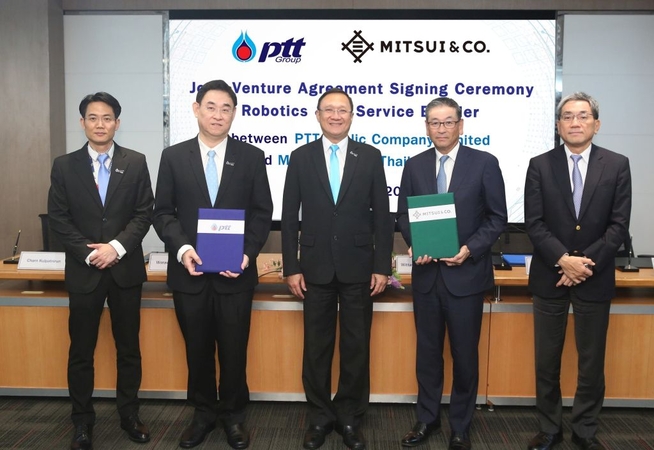
PTT Plc and Mitsui & Co (Thailand) Ltd have signed a cooperation agreement on the development of robotics and artificial intelligence (AI).

The joint venture focuses on creating a value-based economy that is driven by innovation, digital systems, and high-tech automation in the industrial sector.

Wittawat Svasti-xuto, Chief Technology and Engineering Officer at PTT, revealed that the agreement was a significant milestone for PTT’s new business investment strategy to foster sustainable growth while addressing challenges of the digital transformation.

With a strong determination to promote the use of robot technology, automation and intelligent solutions in the industrial sector, this business partnership would emphasise the expertise of the two partners that would be beneficial to industrial development.

In the initial phase, PTT and Mitsui & Co will focus on developing a System Integrator (SI) capability to help local players and potential customers create added value throughout the business chain, based on technology and digital expertise.

Mitsui & Co Ltd is one of the largest and most prominent global trading and investment companies while Mitsui & Co (Thailand) Ltd, an affiliate of Mitsui & Co, has a long presence in the country.

Since the 1950s, Mitsui & Co has built a diverse portfolio of businesses in Thailand covering oil & gas, steel, infrastructure, machinery, vehicles, chemicals, food and ICT.

“Today’s cooperation will be a mechanism that drive our country’s economy by encouraging the industrial sector to use robotics and artificial intelligence in response to the government’s Thailand 4.0 policy. Therefore, the expansion of production will occur, leading to a growing robotics industry and widespread automation that is aligned with the New S-Curve industries, the country’s strategic industries.

The collaboration will play a part in driving Thailand’s economic development through innovation. It can also increase the potential to expand business opportunities to the world market in the future,” added Wittawat.

Unique Construction to offer Bt3 billion, 3-year debentures #ศาสตร์เกษตรดินปุ๋ย

#ศาสตร์เกษตรดินปุ๋ย : ขอบคุณแหล่งข้อมูล : หนังสือพิมพ์ The Nation

https://www.nationthailand.com/business/30380828?utm_source=category&utm_medium=internal_referral

Unique Construction to offer Bt3 billion, 3-year debentures

Jan 20. 2020
Unique SVP of accounts and finance Toemphong Mohsuwa

Unique SVP of accounts and finance Toemphong Mohsuwa
By THE NATION

Construction firm Unique Construction and Engineering Plc is preparing to issue and offer up to Bt3 billion of three-year debentures to the public, the firm said in a statement on Monday (January 20).

The debentures, with 3.70 per cent annual return, was rated BBB by Tris Rating.

It will be available for subscription to the public from February 11-13 via Krungthai Bank.

Interest will be paid quarterly. Minimum investment is Bt100,000.

The key purpose of the issuance is to raise funds for the construction of the SRT Light Red Line Project in the suburban area of Bang Sue-Rangsit and other future projects.

The company appointed Krungthai Bank to be the underwriter of the Bt3-billion debentures, Unique senior vice president of accounts and finance Toemphong Mohsuwa said.

Unique is poised for growth from the much-anticipated public transportation infrastructure projects in the years ahead, the statement added.

Krungsri and companies post record high net of Bt32.7 bn in 2019 #ศาสตร์เกษตรดินปุ๋ย

#ศาสตร์เกษตรดินปุ๋ย : ขอบคุณแหล่งข้อมูล : หนังสือพิมพ์ The Nation

https://www.nationthailand.com/business/30380825?utm_source=category&utm_medium=internal_referral

Krungsri and companies post record high net of Bt32.7 bn in 2019

Jan 20. 2020
Krungsri President and Chief Executive Officer Seiichiro Akita

Krungsri President and Chief Executive Officer Seiichiro Akita
By THE NATION

Bank of Ayudhya (Krungsri) and its business units posted a record net profit of Bt32.7 billion in 2019, representing a surge of 32 per cent year on year.

The outstanding performance was attributed to significantly higher non-interest income, and higher interest income, supported by a healthy loan growth of 8.7 per cent.

Its net profit increased to Bt32.7 billion, a 32-per cent jump from 2018. Excluding the one-off items in 2019, the normalised net profit for the year stood at Bt26.9 billion, a 8.6 per cent increase from 2018.

Krungsri President and Chief Executive Officer Seiichiro Akita said: “Notwithstanding the weakening operating environment, buoyed by the strong fundamentals, Krungsri delivered a record net profit of Bt32.7 billion, a 32 per cent increase from the year before. Loan growth was also robust at 8.7 per cent, exceeding the bank’s target range of 6 – 8 per cent. These reflected the bank’s agility in realigning our loan portfolio towards high-yield segments, thus moving Krungsri closer to the target optimal portfolio mix between retail and commercial loans at a 50:50 ratio”.

Commenting on the overall business outlook for 2020, Akita said:” Despite the improved outlook on the global economy, uncertainties pertaining to trade tensions and geopolitical risks remain high. Continued accommodative monetary policy together with fiscal stimulus measures as well as the expected acceleration in public investment will provide support required to maintain Thailand’s economic growth momentum for 2020 at around 2.5 per cent. Consequently, Krungsri prudently sets a loan growth target of 5 – 7 per cent for the year”.

Goldman readies a hiring spree and capital to meet its China ambitions #ศาสตร์เกษตรดินปุ๋ย

#ศาสตร์เกษตรดินปุ๋ย : ขอบคุณแหล่งข้อมูล : หนังสือพิมพ์ The Nation

https://www.nationthailand.com/business/30380808?utm_source=category&utm_medium=internal_referral

Goldman readies a hiring spree and capital to meet its China ambitions

Jan 20. 2020
David Solomon, chief executive officer of Goldman Sachs, speaks during a panel discussion at the Bloomberg New Economy Forum in Beijing on Nov. 21, 2019. MUST CREDIT: Bloomberg photo by Takaaki Iwabu.

David Solomon, chief executive officer of Goldman Sachs, speaks during a panel discussion at the Bloomberg New Economy Forum in Beijing on Nov. 21, 2019. MUST CREDIT: Bloomberg photo by Takaaki Iwabu.
By Syndication Washington Post, Bloomberg · Cathy Chan

The news swept through Goldman’s offices around China, changing everything.

On a Friday afternoon in late 2017, an official in Beijing announced that the world’s most populous nation would let Wall Street banks expand across its markets. Goldman had spent more than a decade waiting in frustration for that chance. Regional bosses including James Paradise and Todd Leland urgently worked the phones, pinning down details to inform headquarters in New York.

Since then, Goldman Sachs has spoken publicly only in broad strokes about its strategy for China as the gates come down this year. But inside the firm, a massive effort is taking shape. Three months ago, a team of executives presented a five-year plan for China to the board, calling for the bank to take control of a joint venture it set up with a Chinese securities firm in 2004. Infused with hundreds of millions of dollars in new capital, the unit would embark on a hiring spree to double its workforce to 600 and ramp up a wide variety of businesses.

The strategy — described by senior Goldman executives and others familiar with the plan — shows how Chief Executive Officer David Solomon and President John Waldron are taking up the mantle once carried by former CEO Hank Paulson, betting China will finally make the world’s second-largest economy a more level playing field for foreign investment banks. Last year, they traveled to China seven times to meet senior officials, laying the groundwork. Another round of visits is set for 2020.

“We’re increasingly optimistic that we’re going to have the opportunity to actually move more in the right direction, maybe even faster than we thought,” Waldron said in an interview last week. “If you’re going to have a successful business in China, you need to have an appropriate relationship with the government because so much happening in China relates to the government.”

Global investment banks have been stymied from expanding in China amid its economic rise this century. Its laws required foreign firms do local securities business through joint ventures with Chinese partners, who kept controlling stakes. That put U.S. and European firms in the uncomfortable position of risking their capital without the final say on strategy or deals.

Now, a growing number of banks are seeking permission to take over those entities. Goldman applied in August to increase its stake in Goldman Sachs Gao Hua Securities Co. to 51% from 33%. Internally, executives talk about owning the entire business as soon as possible.

China is opening at a key moment for Goldman, offering the bank another frontier as it faces mounting pressure to find ways to boost revenue. Analysts estimate the bank will confirm this week that revenue fell in 2019. It’s expected to brief investors on its broader strategy in coming weeks.

Still, its plan to ambitiously ramp up the venture is striking after a decade in which top executives said they didn’t want to “overinvest” in winning investment banking mandates from China amid its restrictions. In that time, JPMorgan Chase and UBS Group both established a larger presence than Goldman inside the country.

Goldman intends to add to its advisory, markets and merchant banking operations on the mainland. And in a twist, its executives are especially excited about what Waldron calls the potential for “gigantic” growth in its nascent business of tending wealth there. “The biggest opportunity in China is actually not in investment banking,” he said. “The biggest opportunity in China is to be an asset manager for all the savings.”

It would be understandable if the bank were less enthusiastic about expanding in China, given how long it’s waited.

As the country’s economy took off in the 1990s, Goldman was among global banks that seized the opportunity, reaping fees by advising government-backed entities on billions of dollars of stock listings. A decade later, the bank made another bundle as China desperately sought to recapitalize its lenders. By 2006, Paulson arranged what was then Goldman’s biggest-ever principal bet — a $2.58 billion investment in Industrial & Commercial Bank of China Ltd. that produced an estimated $12 billion in dividends and proceeds by the time the firm unloaded it in 2013.

But hopes of running a wholly owned securities division inside China kept getting thwarted.

Paulson made at least 70 trips to China as the firm’s leader, for a time becoming the most famous foreigner there who wasn’t either a head of state or pop star. When he set up the bank’s joint venture with Beijing Gao Hua Securities in 2004, he declared the company was entering “an exciting new chapter.”

But not too long after Paulson stepped down in 2006, cracks started forming in markets that led to a global credit crisis in 2008. Goldman’s star in China faded and officials became highly skeptical of all foreign banks’ practices, products and advice, people familiar with their thinking said.

Paulson’s successor, Lloyd Blankfein, didn’t travel to China as often. Instead, he spent much of his tenure guiding the firm through the fallout of the crisis, adjusting strategy for an era of stiffer regulation and capital requirements. While Blankfein publicly proclaimed this as China’s century, he and other bank chiefs struggled to persuade reluctant Beijing officials to open their market. After the government took some steps, its suspicions of banks such as Goldman flared anew in 2015 when the nation’s stock market swooned. The expansion Paulson sought to set up for Blankfein never materialized.

The result is that Goldman has booked relatively paltry profits onshore, instead focusing mainly on helping Chinese clients tap markets abroad. Inside China, the bank’s best year was 2015, when it generated roughly $120 million in revenue from investment banking, asset management and brokerage operations with its Chinese partner, according to filings by Gao Hua Securities Co. Its onshore revenue in 2018 equates to far less than 1% of what the country’s entire securities industry generated that year.

Blankfein happened to be in Beijing with President Donald Trump in November 2017 as China prepared to make its surprise declaration about opening its market for financial firms. Somewhat famously, Trump didn’t know it was coming. Blankfein boarded a plane before the announcement, and if he knew about it, he didn’t let on. Inside Goldman, executives who had worked directly with the government and suspected something was afoot were caught off guard.

“There was an instant reaction internally,” Paradise recalled in an interview, snapping his fingers. He and Leland oversee Goldman’s businesses in the Asia-Pacific region except for Japan. “And the first people to see and read that news were people in this time zone.”

Banks such as Goldman are hoping that breakthrough will be followed by a regulatory and legal framework in China that will let them sell more sophisticated products and services on the mainland, akin to what’s available in other parts of the world. Offering ways to hedge or diversify investments, for example, can be lucrative for securities firms, but it could also help make China’s capital markets more robust. The pace of Goldman’s expansion will depend on how that develops, Paradise said.

For years, Goldman had been lobbying the government and soliciting regulators’ thoughts on proposed products, Leland said. But the conversation has since reversed as officials show interest in giving Chinese companies access to more capital and financial tools. “Now, it’s them asking us: ‘Would you do this, could you do that?'” Leland said. “That encourages us to move quicker.”

The bank has been working with authorities to teach them about financial products not yet widely available in China, such as derivatives. The thinking is that young Chinese companies will need to shift from focusing solely on grabbing market share to generating reliable profits to attract foreign shareholders. And for that, they will need to hedge risks.

The country’s burgeoning wealth makes asset management a priority, too. High-net-worth people there still have relatively few investment options.

Should China continue its reform pace, Goldman estimates its private bankers will be able to grow the assets they manage at an average percentage rate in the mid-teens over the next five years, which would potentially double onshore revenue, according to Ron Lee, Asia Pacific head of investment management. “If we add bankers, and there’s a growth rate, we can grow even faster,” he said. “We’re looking to do both.”

Once it gains control, the bank will rebrand its wealth business to feature only its own name, rather than including Gao Hua. It also plans to expand its footprint outside of Beijing and Shanghai to the surging metropolis of Shenzhen, home to legions of factories and more than 20 million people. The firm is already interviewing bankers and finding office space there, Lee said. Yet there are limits to how quickly it can add private bankers.

“The reality is we’re finding that because the wealth management landscape is relatively nascent in China, the talent pool is relatively limited, so we have to be a little more patient,” Lee said. “We’re looking for a high, but steady, growth rate.”