The price of gold dropped by THB100 per baht weight in morning trade on Wednesday due to a rising US bond yield. Meanwhile, investors delayed immediate stock and gold purchases as they awaited results of a US Federal Reserve meeting on Tuesday and Wednesday.
AGold Traders Association report at 9.27am showed the buying price of a gold bar at THB27,300 per baht weight and selling price at THB27,400, while gold ornaments cost THB26,802.88 and THB27,900, respectively.
At close on Tuesday, the buying price of a gold bar was THB27,400 per baht weight and selling price THB27,500, while gold ornaments cost THB26,909 and THB28,000, respectively.
The spot gold price on Wednesday was US$1,855 (THB57,827) per ounce after the Comex gold price on Tuesday dropped by $9.50 to $1,856.40 per ounce.
The Hong Kong gold price on Wednesday fell by HK$60 to $17,180 (THB69,004) per tael, the Chinese Gold and Silver Exchange Society reported.
Fed poised to crawl onto knife edge to rein in record largesse
The Federal Reserve is inching toward the start of a long road to normalizing its relationship with the rest of Washington and Wall Street.
After spending the past 15 months providing unprecedented help to the federal government and investors via trillions of dollars of bond purchases, it could start preliminary discussions about scaling back that support at a pivotal two-day policy meeting that kicks off on Tuesday.
Even so, actual steps in that direction by Chair Jerome Powell and his colleagues are likely still months off.
Weaning Wall Street and Washington off the Fed’s extraordinary largesse won’t be easy. Since Covid-19 struck the U.S. in March 2020, the central bank has brought more than $2.5 trillion of U.S. Treasury debt, effectively covering more than half of the federal government’s red ink over that time.
That buying — together with about $870 billion in purchases of mortgage-backed securities — has flooded the financial markets with liquidity, contributing to a doubling of the stock market from its pandemic low.
“It will be like crawling along a knife-edge ridge,” former Bank of England policy maker Charles Goodhart said of the task facing the Fed. “If you do too little you’ll find inflation will just go on accelerating. If you do too much you get into a financial crisis and a recession.”
Fed officials have said they want to see “substantial further progress” toward their goals of maximum employment and average 2% inflation before reducing current asset purchases of $120 billion per month. None are suggesting that they’re close to achieving that, though some have pressed for discussions to begin on a plan for tapering that buying.
As Powell has pointed out more than once, payrolls are still substantially below where they were pre-pandemic — some 7.6 million jobs short, according to the May employment report. And while inflation recently has proven surprisingly rapid — consumer prices climbed 5% in May from a year earlier — Powell and other Fed officials have argued that the rise is mostly transitory, the result of temporary bottlenecks as the economy reopens and low readings a year ago when it shut down.
“Why would the Fed try to fix bottleneck-driven inflation by signaling earlier rate hikes and hitting demand?” Julia Coronado, president of MacroPolicy Perspectives, asked in a June 14 tweet.
Instead, after years of falling short of their inflation goal, policymakers will “err on the side of patience” in scaling back stimulus, said former Fed official David Wilcox, who is now at the Peterson Institute for International Economics.
Powell’s past and potential future also argue for patience. As a Fed governor in 2013, he was among those pushing then-Chairman Ben Bernanke to roll back quantitative easing, only to see the financial markets throw a “taper tantrum” at the mere suggestion such a policy shift was coming.
With his own term as Fed chair up next February, Powell has an extra incentive to avoid a repeat of such turbulence.
“While the Fed is an independent institution, its leadership, up for reappointment next year, could not totally ignore the dim view the administration and Democratic Congress would take toward a shift to a more pre-emptive policy stance,” Deutsche Bank chief economist David Folkerts-Landau and colleagues wrote in a June 7 report.
Some three-quarters of economists surveyed by Bloomberg last week said they expect the Fed to announce between August and year-end that it will begin paring its purchases, with one-third forecasting it won’t fire the starting gun until December.
It’s not just the timing of the taper that’s up for discussion. So too are its composition and pace.
The Fed has faced criticism from within and outside the organization for continuing to buy $40 billion of mortgage-backed securities per month while house prices are surging. Vice Chair Randal Quarles said last month that the Fed would “certainly” look at that issue in the context of its taper discussions.
The last time the Fed wound up a quantitative easing program, in 2014, it shrank its asset purchases at a steady pace.
“Investors may be lulled into a false sense of security by that experience,” former Fed official William English told a June 8 Deutsche Bank webinar. Given all the uncertainty surrounding the post pandemic economy, “it’s not necessarily going to be the case that the Fed is going to taper in steady steps.”
Much may depend on the financial markets. American Enterprise Institute resident fellow Desmond Lachman said the ultra-easy monetary policy being pursued by the Fed and other major central banks has led to an “everything asset price bubble,” with stock, credit and housing markets all frothy.
“The chance of the bubble bursting is all the greater if the Fed is behind the curve,” he said.
English, who is now at the Yale School of Management, said it’s going to be politically hard for the Fed to wind up its asset purchases and increase interest rates because that will boost the government’s borrowing costs.
ADVERTISEMENT
“The Fed is going to come under a lot of criticism for raising rates and making budget choices for the Congress considerably tougher,” he said, adding, “At some level, the Fed needs to both normalize policy but also normalize its relationship with the government.”
Published : June 16, 2021
By : Syndication Washington Post, Bloomberg · Rich Miller
Bitcoin network approves privacy update as scrutiny increases
Bitcoin is gaining more privacy features as concern increases over the use of the cryptocurrency during a recent spate of ransomware attacks.
The most significant update in four years to the computer software that underpins the world’s largest digital token was approved this past weekend with little fanfare. In past years, fights among the groups known as miners who run the network were characterized as a civil war and led to offshoots such as Bitcoin Cash.
While the main advance makes the network easier to use for certain big embedded applications called smart contracts, the so-called Taproot update could also let more people use privacy wallets and services that make it harder to figure out who paid whom. That could enhance the anonymity features prized by advocates of the currency, which law enforcement says is often used for illicit purposes. The U.S. has recently linked cyberattacks against Colonial Pipeline Co. and meat producer JBS SA to groups in Russia that used the cryptocurrency.
“Things will be less fingerprintable — which use-case or wallet they are,” Adam Back, chief executive officer of crypto services developer Blockstream, which helped code Taproot, said in an interview.
Proponents of Bitcoin, who have long called the taint of illicit use overblown, said the changes could improve how payments to hundreds of people are sent, and how crypto derivatives or bets are made on the network.
Today, the vast majority of smart-contract applications are being built elsewhere, on networks like Ethereum. Taproot won’t quite make the Bitcoin network a direct competitor since Ethereum has more developer activity and features, and is easier to use. But it’s a step in that direction, and it could make Bitcoin more attractive to more users and developers.
“It could in principle allow them to make practical things which are today too big, or complicated programs, so they get expensive,” Back said. “It would allow them to be used more widely.”
The exact new applications Taproot will enable could take a while to determine.
“It will honestly take years for the developers to figure out how they are going to implement these new transaction types,” said Nic Carter, general partner at Castle Island Ventures. “But it’s definitely a scope for creativity. I definitely see it as a driver in as much as it proves that Bitcoin can still innovate and can upgrade itself.”
The Taproot update was approved last weekend by the majority of miners, whose computers verify transactions and are awarded Bitcoin. It will take place in November.
“We obviously support anything that will grow demand for new uses of Bitcoin and the Bitcoin network,” said Fred Thiel, CEO of Marathon Digital Holdings, a Bitcoin miner that’s in favor of the upgrade. “What this does is it ensures long-term viability for the Bitcoin network and mining.”
Taproot will be a soft fork, meaning that the upgrade will be compatible with prior versions of the software.
One key feature is so-called aggregated public key multi-signature, which effectively hides some of the complexities of a transaction posted to the Bitcoin network. Not only does it ensure greater privacy of transactions, it also allows for cheaper transactions by reducing the amount of data to be recorded on the blockchain.
Leading blockchain investigative services like Chainalysis and Elliptic said they should still be able to figure usage out anyway.
“Taproot has little impact on the traceability of Bitcoin,” said Tom Robinson, co-founder of Elliptic. “However there is a push to introduce other privacy features into Bitcoin, which would make it far more challenging to track criminal funds. I believe that Bitcoin has been able to grow over recent years partly because its traceability has assuaged concerns from regulators about its illicit use.”
The lower fees could also potentially provide a boost to efforts like RSK and Stacks, which are making it easier for developers to build decentralized applications, or dapps, for Bitcoin — such as yield services that let people holding the digital currency earn interest on the coins.
Published : June 16, 2021
By : Syndication Washington Post, Bloomberg · Olga Kharif
U.S. stocks dropped from all-time highs as investors mulled the consequences of a drop in retail sales and an uptick in producer prices while the Federal Reserve holds a two-day policy meeting. Crude oil traded at the highest level since 2018.
The real estate and technology sectors weighed on the benchmark S&P 500 index, which snapped a three-session winning streak. Exxon Mobil and Chevron lifted the energy sector with oil rallying. The Treasury 10-year note yield lingered near 1.5% for most of the day after Commerce Department figures showed retail sales declined in May.
“After nearly a year of anti-climactic FOMC meetings, tomorrow’s meeting has the potential to move markets because it will likely start the process of the Fed communicating tapering of this historic accommodation,” wrote Tom Essaye, a former Merrill Lynch trader who founded “The Sevens Report” newsletter. “That’s going to be a tricky minefield for the Fed to navigate.”
The prevailing mood was calm for much of the day before the Fed’s next policy decision – and possible hints about when the central bank will slow the pace of emergency asset purchases. The statement is set to include updated forecasts, and expectations are that officials would broadcast any taper plans well in advance.
“The one show in town this week is the Fed, so investors have been weighing the possibility of whether the Fed will start to introduce the theme of reining in this ultra loose policy,” said Fiona Cincotta, senior financial markets analyst at City Index. “That’s the big question – will they introduce that debate or will they let it push over until August?”
Economists expect the so-called dot plot to point to an interest-rate increase in 2023, while the bank is unlikely to signal a scaling back of bond purchases until later this year.
Elsewhere, European equities were led higher by chemical firms, while Asian stocks were mixed. West Texas Intermediate crude traded around $72 a barrel as investors weighed the outlook for rising demand against extended anti-virus curbs in some economies.
Bitcoin continued to gyrate amid a barrage of comments, briefly climbing above $41,000 only to pull back.
Here are some key events to watch this week:
– The Federal Open Market Committee rate decision comes on Wednesday, with a news conference from Jerome Powell after
– U.S. President Joe Biden and Russia’s Vladimir Putin meet Wednesday in Geneva
– U.S. Treasury Secretary Janet Yellen testifies before a House panel Thursday on the federal budget
– Rate decisions come from Switzerland and Norway on Thursday
– The Bank of Japan’s monetary policy decision is on Friday
These are some of the main moves in markets:
ADVERTISEMENT
– – –
– The S&P 500 fell 0.2% as of 4:01 p.m. New York time
– The Nasdaq 100 fell 0.7%, more than any closing loss since June 3
– The Dow Jones Industrial Average fell 0.3%, more than any closing loss since June 9
– The MSCI World index fell 0.1% at 4:01 p.m. New York time, the most since June 9
– – –
– The Bloomberg Dollar Spot Index rose 0.1%, climbing for the third straight day, the longest winning streak since March 25
– The euro was little changed at $1.2126
– The British pound fell 0.2% to $1.4081
– The Japanese yen was little changed at 110.06 per dollar
– – –
– The yield on 10-year Treasuries was little changed at 1.49%
– Germany’s 10-year yield advanced two basis points to -0.23%
– Britain’s 10-year yield advanced two basis points to 0.76%
– – –
– West Texas Intermediate crude rose 1.9% to $72.25 a barrel
– Gold futures fell 0.3% to $1,860.10 an ounce
Published : June 16, 2021
By : Syndication Washington Post, Bloomberg · Vildana Hajric, Claire Ballentine
Thai stocks lose ground as mass vaccination stumbles
The Stock Exchange of Thailand (SET) Index closed at 1,622.31 on Tuesday, down 10.75 points or 0.66 per cent. Transactions totalled THB90.03 billion with an index high of 1,636.10 and a low of 1,618.60.
In the morning session, Krungsri Securities expected today’s SET Index to fluctuate between 1,625 and 1,645 points amid hopes of Thailand reopening after mass vaccination launched last week, and the rising oil price.
However, it said the index could be pressured by investors monitoring the US Federal Reserve’s meeting on June 15-16 and news of many hospitals in Thailand postponing their vaccination drive.
The 10 stocks with the highest trade value today were KBANK, GUNKUL, PTT, TASCO, PTTGC, JAS, SCB, STA, INTUCH and CPF.
Other Asian indices were mixed:
ADVERTISEMENT
Japan’s Nikkei Index closed at 29,441.30, up 279.50 points or 0.96 per cent.
China’s Shanghai SE Composite Index closed at 3,556.56, down 33.19 points or 0.92 per cent, while the Shenzhen SE Component Index closed at 14,673.34, down 127.90 points or 0.86 per cent.
Hong Kong’s Hang Seng Index closed at 28,638.53, down 203.60 points or 0.71 per cent.
South Korea’s KOSPI closed at 3,258.63, up 6.50 points or 0.20 per cent.
Taiwan’s TAIEX closed at 17,371.29, up 157.77 points or 0.92 per cent.
SET expected to move sideways as investors watch US Fed meeting
The Stock Exchange of Thailand (SET) Index rose by 1.79 points, or 0.11 per cent, to 1,634.85 on Tuesday morning. The volume of total transactions was THB3.65 billion with an index high of 1,636.10 and a low of 1,632.72.
The SET Index closed at 1,633.06 on Monday, down 3.50 points or 0.21 per cent. Transactions totalled THB85.11 billion with an index high of 1,642.80 and a low of 1,629.33.
Krungsri Securities predicted that the SET Index would fluctuate between 1,625 and 1,645 points amid hopes of Thailand reopening after mass vaccination commenced nationwide last week, as well as the rising oil price.
“Investors keeping a watch on the US Federal Reserve’s meeting on June 15-16 and news of many hospitals in Thailand postponing the vaccination drive could pressure the index,” Krungsri Securities said.
It recommended that investors buy:
▪︎ PTT, PTTEP, TOP, IVL, BANPU, PSL and TTA, which benefit from the global economic recovery.
▪︎ BCH, CHG, BDMS, MINT, CENTEL, ERW, AOT, CPALL, HMPRO, CPN, CRC, AAV, AMATA and WHA, which would benefit from the country’s reopening.
▪︎ KCE, IRPC, STA and STGT, expected to be listed on the SET50 Index in mid-June.
▪︎ AAV, BLA, ICHI, PSL, PTL, SINGER, STARK, STGT and SYNEX, expected to be listed on the SET100 Index in mid-June.
Baht opens stronger but could be pressured by vaccine issues
The baht opened at 31.12 to the US dollar on Tuesday, strengthening from 31.13 at close on Monday.
The Thai currency is likely to move between 31.05 and 31.20 during the day, Krungthai Bank market strategist Poon Panichpibool said.
He said the baht would tend to move sideways, while players in the market were awaiting the outcome of the US Fed’s meeting.
Poon added that the baht would weaken from sale of stocks by foreign investors, after seeing the problems in vaccine procurement and distribution in Thailand.
Gold steady as market awaits US Fed meeting outcome
The price of gold in Thailand on Tuesday morning was unchanged from Mondays close due to rising US bond yield. Meanwhile, investors delayed investment to follow the US Federal Reserve meeting on June 15-16.
The Gold Traders Association report at 9.29am showed the buying price of a gold bar at THB27,350 per baht weight and selling price at THB27,450, while gold ornaments were priced at THB26,863.52 and THB27,950, respectively.
The price had dropped by THB100 per baht weight compared to the opening trade on Monday.
Spot gold price on Tuesday fell further to US$1,862 (THB57,960) per ounce compared to Monday when it dropped by $13.7 to $1,865.9 per ounce, the lowest in a month.
Hong Kong gold price on Tuesday dropped by HK$240 to $17,280 (THB69,298) per tael, the Chinese Gold and Silver Exchange Society reported.
Young workers fear they must return to offices to save their careers
Managers hoping to lure employees into offices may find their youngest and newest staff are their strongest allies.
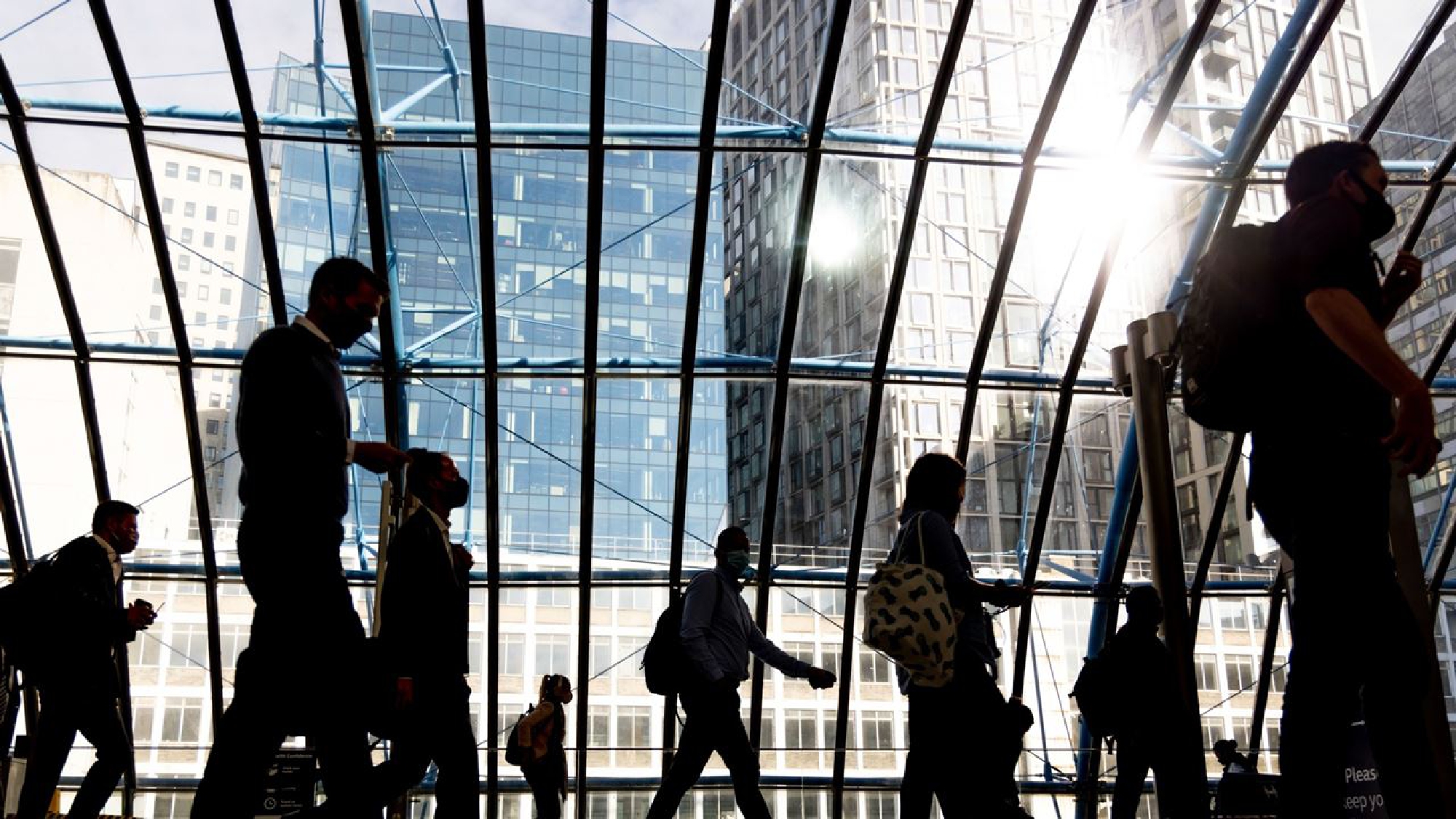
Young white-collar staff feel caught between a rock and a hard place – they value quality of life over old-fashioned 9-to-5 commuting, but are even more worried about seeing their careers stall unless they head back into an office. That’s encouraging many to be among the first to return to their desks.
While experienced employees often have established professional networks and dedicated home offices, younger staff say the pandemic has left them under-informed and cut off from their teams. There are now growing concerns that they are missing out on career opportunities older colleagues took for granted.
Well over half of staff ages 21 to 30 stressed the importance of being able to meet and work with colleagues in person again, according to a 6,000-person survey carried out for Sharp Corp., results of which were shared with Bloomberg. Nearly 60% said working in a modern, collegiate office environment has become more important to them over the past year.
Despite a majority under 30 saying remote work made them more productive, over half of the survey’s respondents across Europe – ranging in age from 18 to 45 – say they feel anxious about a lack of training and career opportunities when thinking long-term about the future of work.
Sophia McCully, a 28-year-old working in public policy research, has worked from home ever since starting her current role. She believes the enforced isolation has had a significant impact on her professional development.
“I think the ability to make those connections and network has been more difficult,” McCully said. Starting a new job in a virtual setting also made it “harder to get yourself across,” at least at first.
Still, while young workers may crave in-person connections and relief from pressures on their health and well-being, they remain skeptical of returning to the status quo before covid-19. Instead they are looking for value and purpose in office-based activities while retaining the right to work remotely. McCully said working from home allowed her to spend time with her young child while remaining professionally productive, and wants that to remain an option.
In fact, more than 60% of employees aged 18-40, who have spent all their adult lives in a tech-centric environment, favor some kind of hybrid arrangement, according to a global survey of 2,000 people by workplace technology provider Citrix.
Offices of the future are seen as “hubs for collaboration, innovation and connection” while staff believe the option of working remotely – not just at home – remains crucial to well-being, the Citrix survey shows. Separately, almost half of millennial and Gen-Z staff say they may even quit their jobs without that option, Bloomberg reported recently.
“I think the office is critical. They key question is why and what for?” said Michael Smets, Professor of Management at Oxford’s Saïd Business School.
“If we think that coming to the office is about learning, we need not everyone but people who want to learn and those they want to learn from in the office at the same time.”
Navigating this terrain presents major challenges for executives puzzling over how to design the workplace of the almost-here future. While Wall Street banks including Goldman Sachs Group Inc. and JPMorgan Chase & Co. are pushing ahead with plans to fill offices up again, other companies across a host of sectors are experimenting with hybrid arrangements they hope will offer staff the flexibility many now expect.
Some companies are refitting offices, while others are focusing on upgrading digital infrastructure. Some companies, such as Apple, are telling staff to come in on certain days, a move that led to criticism from the tech giant’s staff.
Few companies claim to have fully solved the puzzle, yet early career professionals stand to lose out the most if disconnection and “artificial silos” are reinforced once offices reopen, Smets said.
“Socialization into the organizational culture, making connections, understanding the soft tissue – the unwritten rules – of the organization, that is where time together is also really, really important. To build and feel the culture of the organization, that is particularly critical for younger people,” he said.
Specific groups of employees – notably those with young families or caring responsibilities, who are likely to aim to work from home more often – are at greater risk if they are excluded from organizational culture, said Smets. That could stall or reverse progress made against gender, racial and other inequalities.
As organizations become more mindful of these challenges, they may need to become more disciplined in ensuring information and opportunities are available to all staff, to avoid exacerbating old inequalities or opening up new ones, Smets said.
Helen Jamieson, managing director of human resources consultancy Jaluch, who has focused on hybrid solutions for over a decade, says young workers who may still wish to work mostly at home “don’t understand what they may be missing” in terms of long-term career development.
Jamieson advocates dedicated “collaboration days,” and suggests that new hires and young staff could work mostly from offices during their first six months, before opening up work-from-home options.
The calculus, Jamieson says, is to set aside personal preferences and focus on balancing business needs with a strategy for staff engagement and retention. “Because quite frankly if companies don’t look after young people, they’ll lose them.”
Organizational psychologist Viola Kraus, who worked on Sharp’s European survey, says firms should engage with staff on how they fared over the last year and identify critical needs.
“I’d advise them to really take a step back, review the learning, then have a cross-generational talk within your organization,” she said.
“Companies don’t have to satisfy every employee’s wish, but they need to retain that talent, so they need to open that line of dialogue.”
Published : June 15, 2021
By : Syndication Washington Post, Bloomberg · Marc Daniel Davies
After the pandemic, a wave of spending by older consumers
The worlds emergence from the coronavirus pandemic is set to unleash a wave of spending by older consumers, with increasing opportunities for investors in aging-linked stocks.
That’s the view of money managers who see huge pent-up demand from wealthy seniors for medical services and luxury goods. They also expect that the forced adoption of the internet by older people during lockdown will open up this demographic permanently to e-commerce companies and social networks.
The number of people ages 65 and over is projected to double to more than 1.5 billion by 2050, greatly increasing their economic impact. The total spending power of the older population globally was about $8.4 trillion in 2020, according to World Data Lab. That’s expected to grow to $14 trillion over the next decade.
“The pandemic has accelerated many of the issues related to aging populations and has highlighted the urgency of resolving them,” said Christopher Rossbach, chief investment officer at J. Stern & Co. “We think they will be significant drivers for growth and investment.”
Underpinning the thesis are global fertility rates that are forecast to keep falling as life expectancy rises, even as the virus takes a staggering human toll. China’s decision last month to allow three-child families may have only limited impact on the aging trend in the most populous country.
Here are some key focuses of investors who argue that the aging theme will be even more important as economies move past the pandemic.
– Pent-Up Medical Demand
From cancer screening to hip replacements and cataract surgery, countless medical procedures have been postponed since the virus took hold. As this changes, global health-care spending is projected to bounce back in 2021, rising 5.8% to $8.8 trillion, according to IHS Markit.
Rossbach expects shares of medical device manufacturers to benefit and cited Thermo Fisher Scientific Inc., Medtronic Plc, Becton Dickinson & Co. and Alcon Inc.
Shares of all four companies have underperformed the global stock benchmark so far this year, with U.S.-listed Becton Dickinson down 3% versus the MSCI AC World Index’s 11% gain.
Mirabaud Asset Management Ltd. also likes Medtronic, as well as Edwards Lifesciences Corp. for exposure to the cardiovascular diseases sector, said global equities head Anu Narula.
Hearing aids are another market hurt by fewer in-person consultations, with Morgan Stanley estimating sales will normalize this year, following a 15% decline in the market in 2020. Among businesses in this field, it has an overweight recommendation on Copenhagen-listed GN Store Nord A/S and equal-weight on Demant A/S, which have both surged this year.
“The large contingent of developed countries that have universal health coverage is being joined by an increasing number of developing markets that are establishing and/or expanding universal health-care systems, especially in emerging Asian markets,” said Mirabaud’s Narula.
– Yearning for Luxury and Travel
As well as long-delayed holidays, the travel sector is poised to pick up with support from cashed-up seniors. “Older or richer people tend to want to visit relatives more,” said Sanjiv Bhatia, founder of Pembroke Emerging Markets.
Rossbach also has his eye on a rebound in luxury spending, with LVMH and liquor makers Pernod Ricard SA and Diageo Plc among his preferred reopening bets.
“A general point is that as people age their purchasing power increases and they become more concerned with quality, not quantity, of their consumption,” he said.
– Getting Online and Insured
Insurers stand to benefit too, as a surge in unplanned early retirements since the emergence of covid-19 raises awareness of unforeseen health and employment risks.
Strategists at Credit Suisse Group AG expect growth potential for insurers, particularly in markets with relatively low penetration such as China.
Juliana Hansveden, a fund manager at Nordea Asset Management, sees insurance, medical and the internet all coming together to create investment opportunities.
She is expressing confidence in the theme with a bet on loss-making Ping An Healthcare & Technology Co., which is helping patients in China avoid long waiting time at hospitals by providing online medical consultations. It is also working with parent company Ping An Insurance Group Co. to bundle its health-care offering with insurance policies, she said.
J. Stern’s Rossbach expects growth across the board for companies that can tap seniors and their newfound confidence online.
“Think of all the parents and grandparents who have used social networks or video conferencing apps for the first time to stay in touch with their loved ones, or have bought their first products through e-commerce or ordered their groceries or meals through delivery services,” he said.
Published : June 15, 2021
By : Syndication Washington Post, Bloomberg · Ishika Mookerjee, Lisa Pham