Thailand’s manufacturing index rises on back of improving global economy
Thailand’s manufacturing production index (MPI) jumped to 91.88 in April, rising 18.46 per cent compared to the same period last year, Industry Minister Suriya Juangroongruangkit said on Monday.
“April’s MPI jumped due to an increase in exports owing to the improving global economy. The government’s economic stimulus campaigns have also helped create demands for the manufacturing sector,” he added.
“The third wave of Covid-19 [which kicked off in late March] has had no significant impact on the country’s industrial manufacturing sector and supply chain.”
Thongchai Chawalitphichet, director-general of the Office of Industrial Economics (OIE), added that the automotive industry has contributed the most to the expansion of MPI in April, expanding by 288.06 per cent year on year.
“This jump is due to the fact that last year, many manufacturers had to halt their production due to lockdown measures, especially in the production of pick-up trucks, small passenger cars and diesel-run vehicles,” he added.
“The production of beer also rose 515.18 per cent year on year because no lockdown measures were announced during this year’s Songkran festival.”
Manufacturing of air conditioners and components also recorded a 57.38 per cent rise year on year because many countries have eased their lockdown measures and are facilitating the export of products from Thailand.
Thongchai added that Thailand netted US$16.17 billion from the export of industrial products, expanding 45.69 per cent year on year and 13.09 per cent from March.
“This makes industrial exports in April the highest in the past 36 months, while products that saw a significant increase include cars, electrical appliances, electronic components, rubber products and chemicals,” he added.
The Stock Exchange of Thailand (SET) Index fell by 2.57 points, or 0.16 per cent, to 1,579.41 on Monday morning. The volume of total transactions was THB10.93 billion with an index high of 1,585.41 and a low of 1,578.61.
Krungsri Securities predicted the index would fluctuate between 1,575 and 1,595 points despite hopes of a global economic recovery as well as the Thai Public Health Ministry announcing mass vaccinations from June 7.
The US Federal Reserve, meanwhile, is likely to maintain interest rate at a low level and continue using quantitative easing.
However, uncertainty over rising inflation after US personal consumption expenditure in April increased by 0.6 per cent, plus the outflow of foreign funds, would pressure the index, Krungsri Securities said.
It recommended that investors buy:
▪︎ BDMS, BCH, CHG, MINT, CENTEL, AOT, CPALL, HMPRO, CPN and CRC, which have gained positive sentiment from the mass vaccination plan.
▪︎ PTT, PTTEP, PTTGC and IVL, which benefit from the rising oil price.
The SET Index closed at 1,581.98 on Friday, down 0.98 points or 0.06 per cent. Transactions amounted to THB99.50 billion with an index high of 1,595.45 and a low of 1,579.53.
Limited downside for baht even if dollar strengthens
The baht opened at 31.26 to the US dollar on Monday, unchanged from Friday’s close.
The Thai currency is likely to move between 31.20 and 31.30 during the day and between 31.15 and 31.45 within this week, Krungthai Bank market strategist Poon Panichpibool said.
The baht would tend to move sideways in line with the dollar and funds flow of foreign investors, he said, adding that the Thai currency was still pressured by the Fed’s statement on quantitative easing.
The market strategist added that the baht would not weaken sharply even if the dollar strengthened, as exporters aimed to sell the US currency. Gold trade was another factor to support the baht, he said.
Negative factors hampering investments in Thailand were the Covid-19 crisis and vaccine procurement.
Gold price up as inflation fears push up demand for precious metal
The price of gold in Thailand rose by THB100 per baht weight in morning trade on Monday, buoyed by mass buy-ups of the precious metal to prevent risks from inflation after US personal consumption expenditure in April increased by 0.6 per cent.
The Gold Traders Association report at 9.30am showed tye buying price of a gold bar at THB28,100 per baht weight and selling price at THB28,200, while gold ornaments were priced at THB27,591.20 and THB28,700, respectively.
At close on Saturday, the buying price of a gold bar was THB28,000 per baht weight and selling price at THB28,100, while gold ornaments were priced at THB27,500.24 and THB28,600, respectively.
The price of gold in Thailand had risen by THB200 per baht weight last week.
Spot gold price on Monday was US$1,908 (THB59,610) per ounce compared to Friday when it rose by $6.8 to $1,905.3 per ounce.
Hong Kong gold price on Monday rose by HK$110 to $17,620 (THB70,926) per tael, the Chinese Gold and Silver Exchange Society reported.
Workers return to weirder offices with moveable walls and touchless elevators
Masked, desk-bound and unable to recognize their colleagues in an elevator, people are starting to return to offices in cities around the world where the pandemic is receding. Many will find their offices transformed, too.
In the challenge to make offices both Covid-safe and attractive places to work, firms have been experimenting with working arrangements and space while employees toiled at home. Some gave up floor space to adjust to less rigid schedules, others introduced movable walls to create flexible areas. Many installed safety innovations such as touchless lifts and worked to improve air quality.
Lockdowns have provided a “fantastic opportunity to create and recreate a new world for each of us, which may, for each company, be slightly different,” said Neil McLocklin, a Knight Frank partner.
Employees of Arcadis, a design and engineering consultancy, will be able to choose one of 20 different types of workspace via an app when they move into new offices in the City of London next month. The company’s Building Intelligence app, developed during the pandemic, provides options for meeting spaces, focused work and collaboration, as well as social and wellbeing areas such as a winter garden.
The app will help monitor the number of people using different spaces, ensuring capacity limits designed to prevent the spread of infection are never exceeded. The limit will initially be set to about one-third of the company’s 1,200 London office users, as it shifts to more work from home. That also means less space is needed: its London office is about 30% smaller than before.
“The app is the critical enabler,” Arcadis’ U.K. Chief Executive Officer Mark Cowlard said. “It helps us understand when people are using meeting spaces so they can be cleaned afterward.”
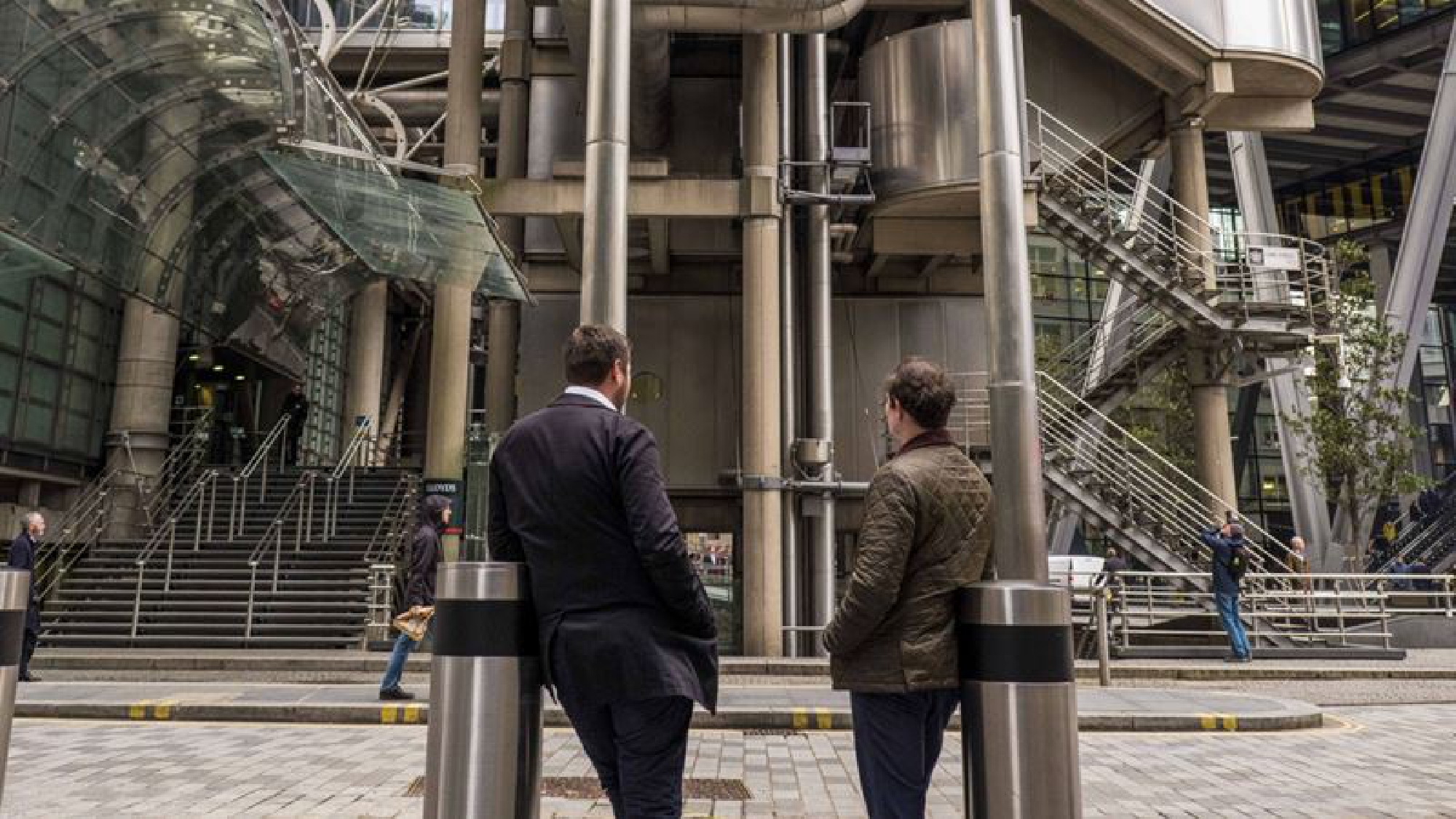
At the Lloyd’s Building, the iconic home of the 300-year-old insurance market, the externally-clad ventilation ducts inject fresh air from the ground-up and ejects it after it’s risen through the floors.
“That way of keeping the air fresh in the space is the best,” said Ivan Harbour, senior design partner at Rogers Stirk Harbour + Partners, who cut his teeth on the Lloyd’s building project as a young architect in the 1980s. “Our projects since Covid have really brought that home.”
But ventilation isn’t enough on its own. As the building reopens, face coverings are now a requirement in most of it, underwriters sit at desks bordered by perspex screens and use an app to order their lunch to-go.
The importance of making the space accessible and interesting to be in isn’t lost on HR departments. Bringing staff back to the office is already a retention issue: almost 30% of people said they’d look for another job if they need to come back to the office five days a week, according to a global McKinsey & Co. survey.
“It’s like a Rubik’s Cube. You are solving for so many different things at the same time,” said Andrea Alexander, associate partner at McKinsey in Houston, who advises some clients to take a team-based approach so employees are only expected to come in when their close colleagues are too. “It requires you to really think through what are those moments that matter that should be in person.”
Broker CBRE Group Inc. is advising its Fortune 500 clients on a range of issues, from short-term concerns around keeping people safe to longer-term considerations on what the office of the future needs to look like, according to Kate Smith, head of workplace for the U.K.
It’s advising companies on how to “magnetize” their spaces to lure staff back, adding perks like live music that have been among the things people missed most during lockdowns, Smith said.
That’s assuming you can actually fit people in your office. HSBC Holdings Plc has scrapped its London headquarters executive floor as it reduces office space by 40% globally and gives employees more choice to work from home. But in the skyscraper, elevators are the biggest hurdle. Just two people are allowed in a lift at a time, in line with government social-distancing guidelines, keeping office capacity at about 3%, according to a company spokesperson.
The co-working industry — not long ago thought to be on the verge of collapsing — is cashing in on the demand for flexibility. Deloitte LLP has moved its entire Manchester office in the U.K. to 35,000 square feet (3,250 square meters) in a WeWork building in the city center.
WeWork is also trying to make Zooming a little less two-dimensional, signing a deal with ARHT Media Inc. to integrate hologram technology in 16 of its offices around the world.
And bit by bit, the silver-lining amenities are coming back at London’s quirkier offices. At London’s White Collar Factory, as many as 30 employees, policed by a traffic light system, can use the rooftop running track. At WeWork’s U.K. sites, beer taps are reopening after running dry for months to follow government hospitality guidelines.
The experiments should keep going, CBRE’s Kate Smith said.
“It is too early for most organizations to see what it means,” she said. “They are in test-and-learn mode.”
Published : May 31, 2021
By : Syndication Washington Post, Bloomberg · Todd Gillespie, Jack Sidders
Women are getting more jobs than ever in changing Saudi Arabia
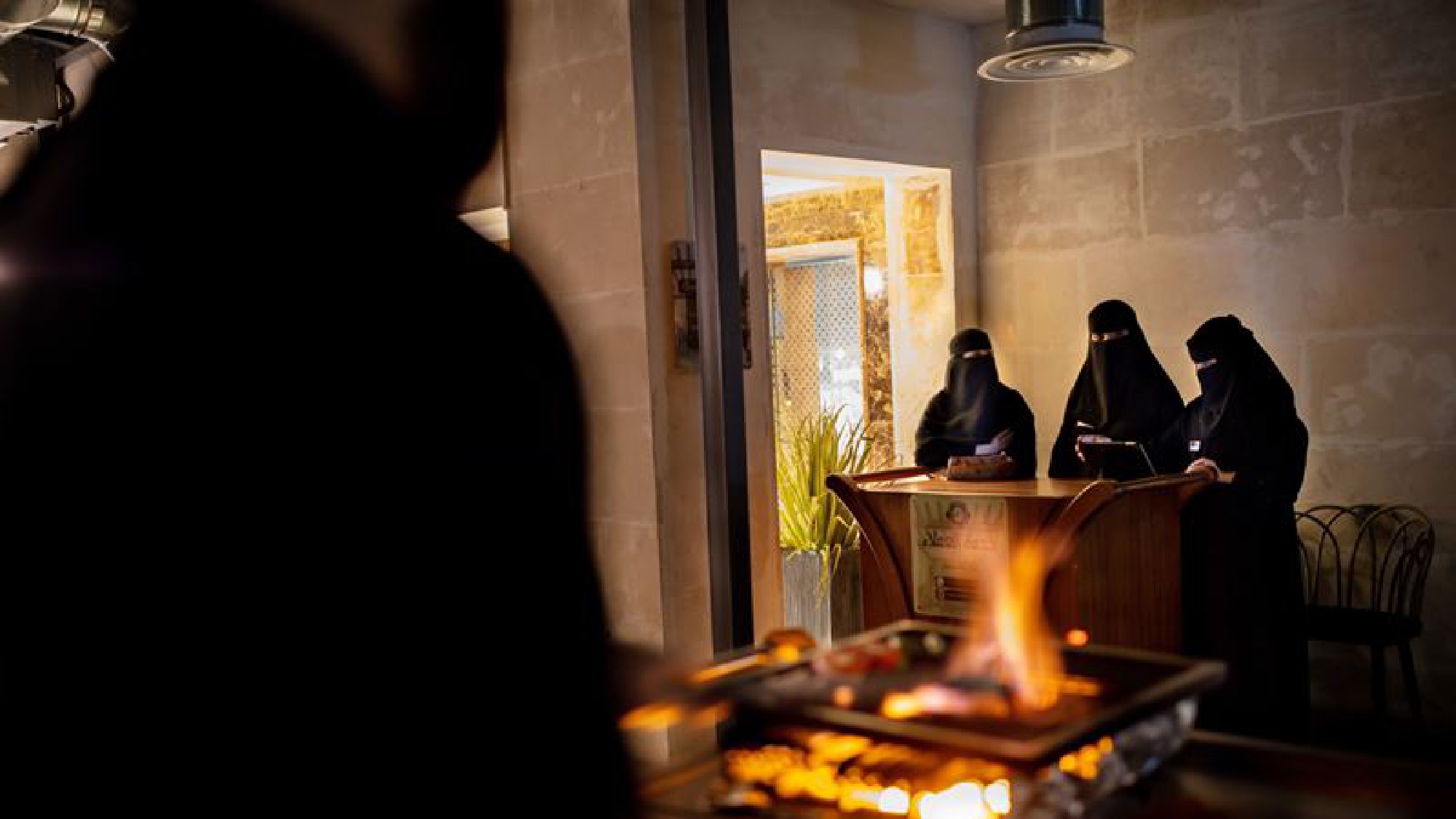
It looks like a womans world on the 29th floor of Tamkeen Tower, where a call center for Saudi Arabias General Authority for Statistics overlooks the beige sprawl of Riyadh. Past frosted glass doors, the few men to one side of the room are vastly outnumbered by female colleagues sitting at desks spread across the office.
The scene is the opposite of what most workplaces in the conservative Islamic kingdom looked like a few years ago, reflecting the growing influx of women into the job market. “Look where we were and where we are now,” says Reem Almuhanna, 31, who oversees the call center’s 74 employees as they gather data on households and businesses.
Keeping women at home is a luxury the world’s largest exporter of crude can no longer afford. Crown Prince Mohammed bin Salman, 35, is overhauling the economy to prepare for a post-oil future and striving to create jobs amid sputtering economic growth. With the cost of living on the rise as the government cuts gasoline and electricity subsidies and introduces new fees and taxes, including a 15% value-added tax, Saudi households increasingly depend on women working.
As a result, social and economic changes are ripping through the country-upending traditions, changing women’s lives all across the class spectrum, and stirring resentment among some conservative Saudis. The state, facing pressure from foreign governments and human-rights groups over its clampdowns on dissent, recognizes that the narrative of female empowerment may help burnish its reputation abroad. But the changes are not illusory.
Gender segregation-once strictly enforced by religious police-is gradually dissolving, not just among the metropolitan elites, but even in conservative provinces such as Qassim. Men and women who aren’t related can mingle openly at restaurants now. Many offices are mixed, as are music festivals and business and professional conferences.
Although decision-making remains largely in the hands of men, female participation in the workforce increased from 19% in 2016 to 33% last year, according to the statistics authority’s Labor Force Survey. “The government’s strong commitment to Saudi female empowerment has been the main driver,” the Ministry of Human Resources and Social Development said in a statement to Bloomberg News in March.
Increased female participation in the labor force was the only goal set out in Prince Mohammed’s Vision 2030 framework to be met a decade early, with Saudi women taking jobs as waitresses, cashiers, and police officers. In the process, the dress code for women has loosened; jeans and uncovered hair are now tolerated alongside traditional floor-length black abayas.
The shift began under King Abdullah, who died in 2015, but it’s quickened dramatically under Prince Mohammed, now the de facto ruler. In the past five years, the government has curtailed the power of the religious police, ended the ban on women driving, and eased rules that kept women beholden to male guardians. “There is this recognition that we cannot keep going-it’s economically not sustainable-without utilizing 50% of the population,” says Salma AlRashid, chief advocacy officer at Alnahda, an independent nonprofit focused on women’s empowerment.
The changes have come at a cost. As social liberties have expanded, political freedoms have retreated for men and women alike, leaving little room for the citizenry to debate policies that are transforming one of the world’s most socially restrictive countries. Prince Mohammed’s crackdown on domestic critics has ensnared female activists, writers, and academics alongside male ones.
Campaigners such as Loujain al-Hathloul and Aziza al-Yousef, who spent years advocating for changes such as allowing women to drive, were arrested in 2018 and accused of undermining state security. (Al-Hathloul, sentenced to a nearly six-year prison term that was partly suspended, was freed in February, and al-Yousef was released in 2019, though both are banned from travel abroad. Human-rights groups say they were tortured, which the government denies.) Other dissenters have fallen silent out of fear.
As Saudi society evolves, some men worry that women are taking their jobs and subverting their traditional role as the head of the household, responsible for their families financially and otherwise. “I’m against the fact that women are prioritized in getting jobs while men are left behind,” says Yazeed, a 25-year-old Saudi dentist, asking that his last name be withheld so he can speak openly in a country where the government limits free speech. “I believe women’s employment is a necessity only when she can’t find someone to provide for her.”
Prince Mohammed has said it’s time for women to take a bigger role. He rarely gives interviews, but he told Bloomberg in 2016: “Women are half of this society, and we want it to be a productive half.” More than two-thirds of unemployed Saudi women hold a bachelor’s degree or higher, compared with just a third of male job seekers. Getting the kingdom’s educated women into the workforce is seen as essential to the success of the Vision 2030 plan.
The logic of female empowerment is straightforward, says Rasha Alturki, Alnahda’s chief executive officer. The government has invested for generations in educating Saudi women, she says. “There has to be a return on your investment. Otherwise what’s the point?”
Few people have lived the changes in Saudi Arabia as viscerally as Ahlam Eisa, a 32-year-old mother of four who works in a women’s clothing shop in Riyadh and drives for Uber Technologies Inc. and other ride-sharing companies to make extra cash, all while studying for her high school diploma.
Born in the south, Eisa got married and moved to the capital when she was 19, living the kind of closed-off life typical for many Saudi women. Her divorce three years ago jolted her into an alternative universe where women worked and unmarried couples ate together in cafes. “I didn’t know what the world outside was,” she says. “I was in a bubble.”
Today, Eisa drives around Riyadh in a silver Hyundai Accent, her short hair styled beneath a gray hooded robe. The car, which a local charity helped her buy, has transformed her life, she says. Now her focus is to finish school and then train as a nurse. One of her daughters wants to be a flight attendant; the other, a makeup artist. “I realized that with or without a man, I’m making my life beautiful,” Eisa says. “Everything in this era is available for women.”
Nawal Alunaizi is similarly elated at her newfound choices. The 42-year-old mother of five says she endured a bad marriage for two decades, afraid to lose custody of her children under a patriarchal system where only men were considered legal guardians. Reforms that made it easier for women to file for divorce and get custody of their children emboldened her to leave the relationship four years ago.
“I’m living a new life,” says Alunaizi, who works in human resources at a real estate company. “At first when I’d come and say to my daughters, ‘Be strong, face life,’ I’d be embarrassed. Now I say it, and I look them in the eye.”
The changes that have come to the Saudi workforce have been uneven (and completely bypassed some foreign women in the kingdom, including 1 million female domestic workers who have limited rights and are largely at the mercy of their employers). Many traditionally male-dominated industries-such as manufacturing and construction-remain so. There are roughly 18 Saudi men in the mining sector for every Saudi woman. That ratio narrows to about 1 to 1 in fields like health care, social work, arts and entertainment, and the hospitality industry.
When the pandemic struck, the General Authority for Statistics, where Almuhanna works, switched from all-male enumerators knocking on doors to mostly women surveyors working the phones, who ended up reaching more women directly by not having to go through male heads of households. Among other things, the data they gathered suggested more women were already working outside the home than previously thought.
Job creation is Prince Mohammed’s most pressing domestic challenge. The double blow of last year’s decline in oil prices and the Covid-19 pandemic underscored the importance of diversifying the economy. In the fourth quarter of 2020 the unemployment rate was 12.6% for Saudis overall and almost double that for women.
With more women entering the workforce and a youth bulge changing the shape of the labor market, it’s been hard for the economy to keep up. This is particularly true now that economic growth is sputtering. Gross domestic product shrank by 4.1% last year; this year, according to the International Monetary Fund, it’s expected to grow by 2.9%, which is relatively weak compared to the oil boom years.
Many of the jobs opening up for women are lower-paid and include roles once filled by workers from Asia and other Arab countries. For a decade, Saudi Arabia has sought to tackle high unemployment among its citizens by encouraging companies to hire them over foreigners, who remit much of their earnings to family members in their home countries.
These efforts have intensified under the crown prince. The government has imposed levies on employers that hire foreigners, fees that expatriates pay to allow their dependents to reside in Saudi Arabia, and minimum quotas for Saudi hires in certain sectors, such as retail.
“Yes, finding a job for us women is easy, but finding a good job is difficult,” says Sahar, 23, a saleswoman in a clothing store. Her salary of 3,500 riyals ($933) per month goes toward supporting her family following the death of her father. To go to work she had to drop out of college, and she isn’t sure she’ll be able to go back. “I don’t think I’ll ever advance in my career,” says Sahar, who asked that her last name be withheld so she could speak freely.
Alnahda’s research has found gender gaps not just in workforce participation but also in career development and compensation, with Saudi women earning 57 riyals for every 100 riyals earned by Saudi men-even after adjusting for differences in education and experience. The gap is starkest at the top. There are few women on company boards and none in the Saudi cabinet. Prince Mohammed’s closest advisers are all men.
But as mixed as the picture is for Saudi women in the workplace, it’s a world away from what it was. When Noha Kattan became one of the first women to work at what’s now the Ministry of Sports in 2016, there wasn’t even a women’s bathroom in the building. Now she’s a deputy minister for national partnerships and development at the Ministry of Culture, where 49% of the 667 employees are female.
Behind the culture ministry’s stone-and-glass facade, women wearing colorful abayas sit at open-floor-plan desks alongside men-a far cry from the sealed-off women’s sections, often dark, cramped, and hidden away, that still exist in some government institutions. What’s more, women no longer worry they’ll be reported to the religious police and punished for taking a five-minute coffee break with male colleagues.
Speaking with a reporter in her spacious, glass-walled office, Kattan considers the changes she’s lived through. To go from having no bathroom fewer than five years ago to “having this conversation now,” Kattan says, is “mind-blowing.”
Published : May 31, 2021
By : Syndication Washington Post, Bloomberg · Vivian Nereim
The Bangkok Metropolitan Administration (BMA) plans to hire an adviser by June this year to study the Public-Private Partnership project for the first phase of the 19-kilometre MRT Grey Line from Watcharapol to Thong Lor.
The move is a result of the adviser’s document details submitted so far not meeting the authority’s conditions.
The BMA said it would allow private agencies to participate in the bidding for the estimated THB30 billion PPP project between 2022 and 2023, expecting to find the contractor by 2024.
The BMA added that the construction of a monorail would take three years.
“Regarding Environmental Impact Assessment, the Office of Natural Resources and Environmental Policy and Planning has not replied to our proposal yet, but we believe that it would be okay,” the BMA said.
“We will conduct land expropriation assessment together with public hearing, which will take about 200 days.”
Construction of the MRT Grey Line is divided into three phases:
The first phase (Watcharapol to Thong Lor) links MRT Watcharapol station (Pink Line), Lat Phrao 83 Station (Yellow Line), Wat Phra Ram 9 station (Orange Line) and BTS Sukhumvit line.
The second phase (Phra Khanong to Lumpini) links BTS Phra Khanong station, MRT Queen Sirikit National Convention Centre, Khlong Toei and Lumpini stations.
The third phase (Lumpini to Tha Phra) links BTS Chong Nonsi station and BRT Sathorn to Ratchaphruek.
The Stock Exchange of Thailand (SET) Index closed at 1,581.98 on Friday, down 0.98 points or 0.06 per cent. Transactions amounted to THB99.50 billion with an index high of 1,595.45 and a low of 1,579.53.
In the morning session, Krungsri Securities expected the index on Friday to rise to between 1,595 and 1,600 points as the number of US jobless claims continued to fall and US President Joe Biden prepared to deliver his $6-trillion budget plan for 2022 on Friday.
It added that the index had also gained positive sentiment from the rising oil price.
However, investors should beware of mass sell-offs due to the outflow of foreign funds, Krungsri Securities said.
The 10 stocks with the highest trade value today were KBANK, KTC, CBG, ITD, RCL, STGT, BANPU, CPALL, PTT and AOT.
Other Asian indices were mixed:
Japan’s Nikkei Index closed at 29,149.41, up 600.40 points or 2.10 per cent.
China’s Shanghai SE Composite Index closed at 3,600.78, down 8.07 points or 0.22 per cent, while the Shenzhen SE Component Index closed at 14,852.88, down 44.31 points or 0.30 per cent.
Hong Kong’s Hang Seng Index closed at 29,124.41, up 11.21 points or 0.039 per cent.
South Korea’s KOSPI closed at 3,188.73, up 23.22 points or 0.73 per cent.
Taiwan’s TAIEX Index closed at 16,870.86, up 269.25 points or 1.62 per cent.
Agency launches contest for new Thai rice varieties in bid to boost exports
The Thai Rice Exporters Association is holding a contest to find new rice varieties to feed the global market, as well as strengthen Thailand’s competitiveness.
Innovators have until June 30 to register, before planting their variety between July and November. The winner will be chosen in December when the rice is harvested and tasted.
The association’s president Charoen Laothamatas said Thailand exported 1.45 million tonnes of rice in the first four months of this year, a fair bit lower than the target of 2 million tonnes.
He put the drop down to the price – Thai rice is more expensive compared to Vietnam or Pakistan – and an improvement in the quality of rice from other countries.
He added a similar contest will be held next year as well.
SET bullish as US jobless numbers decline, Biden plans $6-trillion budget
The Stock Exchange of Thailand (SET) Index rose by 8.93 points, or 0.56 per cent, to 1,591.89 at 10am on Friday. The volume of total transactions was THB9.05 billion with an index high of 1,593.83 and a low of 1,590.07.
Krungsri Securities expected the index on Friday to rise to between 1,595 and 1,600 points as the number of US initial jobless claims continued to decrease, while US President Joe Biden will unveil a $6-trillion budget plan for fiscal year 2022 on Friday.
It added that the index had also gained positive sentiment from the rising oil price.
However, investors should beware of mass sell-offs of shares due to the outflow of foreign funds, Krungsri Securities said.
It recommended that investors buy:
▪︎ BDMS, BCH and CHG, which gained positive sentiment from the mass vaccination.
▪︎ PTT, PTTEP, PTTGC and IVL, which benefit from the rising oil price.
▪︎ EA, GPSC, BPP and ROJNA, which benefit from the Thai government’s move to promote electric cars.
The SET Index closed at 1,582.96 on Thursday, up 14.38 points or 0.92 per cent. Total transactions leapt to THB175.27 billion, from their normal level below THB100 billion, with an index high of 1,587.54 and a low of 1,568.89.