Steel consumption is expected to grow by 5-8 per cent, the Iron and Steel Industry Club of the Federation of Thai Industries (FTI) predicted.
Domestic steel consumption this year will grow by 5-8 per cent, or around 17-18 million tonnes, as the Thai economy has started to recover.
Steel demand will also grow under the “Made in Thailand” policy announced recently in the Government Gazette by the Comptroller-General. Under the policy, government agencies have to procure not less than 60 per cent from domestic produce and the FTI has included steel in the list. The policy is expected to be effective in February and will give an impetus to use of local steel in construction work. Although the new regulation allows imports if necessary, government agencies are expected to follow the regulation.
However, the steel industry still has to be closely monitored vis-a-vis global steel price, which has been steadily rising since the end of 2020, especially due to increasing Chinese demand despite the Covid-19 situation. Demand from China increased by 8 per cent in 2020, compared to 2019, forcing China to import every type of steel.
Meanwhile, many countries faced economic recession, both in Europe and Japan, causing many steel furnaces to be shut down, pushing all types of global steel prices, including construction steel, up by 10 per cent.
Nava said global steel prices will continue to rise until the first quarter of 2021 and should fall in the second quarter as steel companies that were shut down due to Covid-19 gradually reopen.
The extension of moratorium offered to debtors to mitigate the impact of the second Covid-19 wave would have limited impact on commercial banks’ turnover, experts said.
To help debtors cope with the recent Covid-19 outbreak, the Bank of Thailand (BOT) had instructed financial institutions to extend the debt moratorium until June 30 this year from December 31 last year.
Tanawat Ruenbanterng, an analyst at Tisco Securities, said the extension of BOT’s measures would only affect commercial banks’ interest income, effective interest rate and net interest margin (NIM).
He said the banks would benefit from the decline in non-performing loans (NPLs), as they don’t have to set up more reserve fund.
He didn’t expect these measures to erode banks’ net profit because they would not be issuing measures to cut the interest rate as much as in the previous year.
“However, investors should monitor the banks’ moves to set up a reserve fund, as the number of NPLs would increase if the Covid-19 situation is prolonged,” he said.
He added that commercial banks’ fourth-quarter net profit would recover as their share price had risen from the influx of foreign funds.
“However, bank shares are still not attractive among investors,” he added.
An analyst at Capital Nomura Securities said the extension by BOT of the moratorium would have less effect on commercial banks because the measures aim to enable debtors to restructure debt.
He added that debt restructuring would enable banks to realise interest revenue in line with the Thai Financial Reporting Standard and reduce NPLs.
“Therefore, we still advise investors to buy bank shares,” he said.
An analyst at Asia Plus Securities expected the number of debtors participating in BOT’s measures this year to be lower than last year because the new Covid-19 outbreak is likely to cause less impact on the economy.
Although the debt restructuring will affect banks’ NIM, they have more time to manage asset quality of debtors with high risk,” he said.
The Stock Exchange of Thailand (SET) Index rose by 11.10 points, or 0.74 per cent, to 1,521.23 in the morning session on Tuesday.
An analyst at Krungsri Securities forecasts the day’s index to rebound to between 1,515 and 1,520 after China’s fourth-quarter gross domestic product in 2020 rose by 6.5 per cent compared to 4.9 per cent in the previous quarter.
“However, investors should beware of volatility due to tight SET valuation and the decline in foreign funds inflow,” he said, adding the index price-to-earnings ratio was 30 times.
He recommended that investors buy:
▪︎ PTTGC, TOP, IVL, EPG, SCGP, CBG, ROJNA, TVO, CPF, RCL, SYNEX, XO, WICE, JMT, MTC and SAWAD whose fourth-quarter turnover is expected to improve.
▪︎ ADVANC, INTUCH, AP, SIRI and WHAUP, which pay high dividends.
The SET Index closed at 1,510.13 on Monday, down nine points or 0.59 per cent. Total transactions amounted to Bt74.43 billion with an index high of 1,515.51 and a low of 1,503.04. The index was down for a third successive day of trading, after dropping 0.73 per cent on Thursday and 0.84 per cent on Friday.
The price of gold rose by Bt100 per baht weight in morning trade on Tuesday, the Gold Traders Association reported.
As of 9.25am, the buying price of a gold bar was Bt26,150 per baht weight and selling price Bt26,250, while gold ornaments were priced at Bt25,681.04 and Bt26,750, respectively.
At close on Monday, the buying price of a gold bar was Bt26,050 per baht weight and selling price Bt26,150, while gold ornaments were Bt25,574.92 and Bt26,650, respectively.
Spot gold price moved to US$1,843 (Bt55,413) per ounce in the morning. The Comex market on Monday was closed for Martin Luther King Jr Day.
Hong Kong gold price rose by HK$40 to $17,010 (Bt65,972) per tael, the Chinese Gold and Silver Exchange Society reported.
Co-payment scheme planned for low-salaried tourism workers
EconJan 19. 2021Tourism and Sports Minister Phipat Ratchakitprakarn
By The Nation
Tourism and Sports Minister Phipat Ratchakitprakarn said he will meet with Labour Minister Suchart Chomklin this week to seek ways of shielding the hard-hit tourism sector from fresh Covid-19 fallout.
He said he might propose that the government co-pay the monthly salaries of employees in the sector. The planned measure will cover workers with salaries of up to Bt15,000, though the co-payment period has yet to be finalised.
“A number of tourism business operators are suffering and might have to shut down. Helping them retain jobs is a move that must be taken immediately without waiting for the end of the outbreak,” Phipat said.
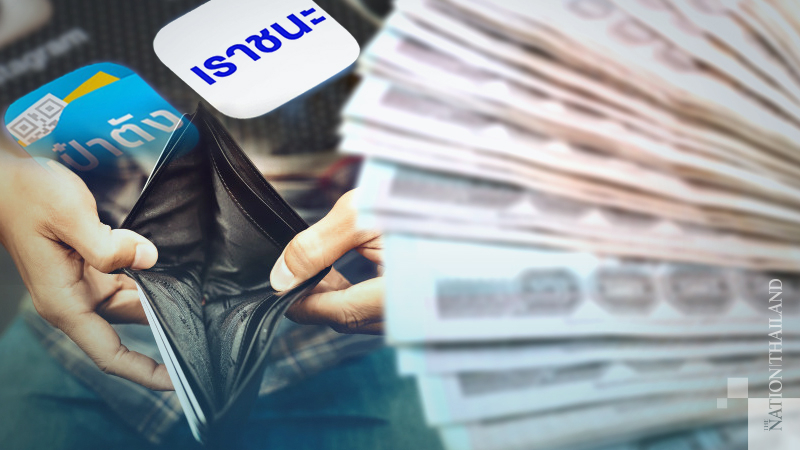
The Finance Ministry will ask the Cabinet to approve the government’s “RaoChana” (We Win) cash handouts scheme on Tuesday (January 19), to mitigate the impact of the new Covid-19 outbreak, said Kulaya Tantitemit, acting director of the Fiscal Policy Office (FPO).
The scheme will hand two monthly payments of Bt3,500 to the self-employed, farmers and welfare card holders whose savings do not exceed the eligibility criteria.
About 31 million people will be eligible for the scheme, which will cost an estimated Bt210 billion.
After Cabinet approval, the ministry will open the scheme to applicants.
By The Washington Post · Gerry Shih · BUSINESS, WORLD, US-GLOBAL-MARKETS, ASIA-PACIFIC
TAIPEI, Taiwan – A year ago, the coronavirus began spreading rapidly in China. Today, China’s economy is bouncing back hard, and expanding faster than it did before the pandemic.
Economic data published Monday showed that China logged 2.3% growth for 2020, becoming the only major economy that grew during a year that exacted a generational toll on swaths of the world. As other major nations and geopolitical competitors, from the United States to Europe to India to Japan, struggle to beat back a winter wave, China’s containment success has buoyed its economy and the ruling Communist Party’s claims to global leadership in the post-pandemic world.
In a sign of how quickly China has managed a turnaround, the National Statistics Bureau said gross domestic product rose 6.5% during the fourth quarter of 2020, exceeding the 6% pace at the end of 2019, before the pandemic took hold.
As President-elect Joe Biden enters office this week, he’ll be confronted with a China that does not seem at all diminished in economic health or international stature. Xi Jinping, the Chinese leader, struck a bullish tone during his New Year’s Eve address, when he told his countrymen that he was “proud of his great motherland” and the sacrifice and unity its people displayed to quickly beat back the coronavirus through lockdown measures and a mobilization of medical and manufacturing workers.
In recent weeks, Chinese state media and the nation’s globe-trotting foreign minister, Wang Yi, have told world leaders from Myanmar to the European Union, as well as global investors, that China’s fast recovery could lift the rest of the world. Under Xi’s leadership and through his diplomacy through online video calls, Wang claimed this month, China “has brought hope for the world economy to step out of the doldrums.”
“China’s economy continues to power ahead with remarkable momentum, leaving other major economies, most of which are still struggling to register some semblance of growth, in the dust,” said Eswar Prasad, a professor at Cornell University and former China director for the International Monetary Fund. “With its outstanding growth performance, China has cemented its position as the primary driver of what has so far been a dismal global economic recovery.”
Last week, Chinese officials said exports reached a new all-time high of $2.6 trillion in 2020. Despite a bitter trade war with President Donald Trump, China’s surplus with the United States reached a record of $316.9 billion for the year.
Employment was also picking up as the economy created 11.86 million jobs during the year, the statistics bureau said.
China’s economy dipped into negative territory once, during the first quarter of 2020, when authorities locked down Hubei Province and its capital, Wuhan, and enforced softer lockdown measures in cities across the country.
The Chinese Academy of Social Sciences predicted this month that China could grow 7.8% in 2021 as it fully bounces back, a whopping rate reminiscent of China’s explosive growth in past decades. But it’s not guaranteed that China can continue its late-2020 surge if coronavirus cases take hold again.
The Chinese government is trying to prevent a resurgence; it reinforced a lockdown over about 20 million residents in northern China, including several large cities near Beijing, after several small outbreaks.
Although the measures will help prevent new cases from spiraling out of control, they may crimp economic activity in industries such as travel in the short term.
Chinese officials have canceled public events, large gatherings such as weddings, and unfurled street signs and publicity campaigns urging workers not to travel home during the Lunar New Year period, when hundreds of millions of citizens usually crisscross the country to visit family members.
In northern Hebei Province, which surrounds Beijing, authorities have reported almost 700 cases since the beginning of January, the biggest flare-up since the spring.
The Stock Exchange of Thailand (SET) Index closed at 1,510.13 on Monday, down 9.00 points or 0.59 per cent. Total transactions amounted to Bt74.43 billion with an index high of 1,515.51 and a low of 1,503.04. The SET was down for a third successive day of trading, after dropping 0.73 per cent and 0.84 per cent on Thursday and Friday.
In Monday’s morning session, an analyst at Krungsri Securities forecast the index would drop to between 1,500 and 1,510 due to uncertainty over whether US President-elect Joe Biden’s pledge to raise corporate tax would pressure companies’ turnover.
“The SET will also be under pressure from its tight valuation, the decline in foreign fund flows and falling oil price in response to countries’ lockdowns,” he said.
The 10 stocks with the highest trade value today were PTT, TASCO, CPF, GPSC, CBG, EA, KBANK, CPALL, PTTEP and NER.
As of 4.30pm, the price of oil dropped by US$0.03 or 0.06 per cent to $52.33 per barrel, while gold rose by $1.30 or 0.07 per cent to $1,831.20 per ounce.
Other Asian indices were mixed:
Japan’s Nikkei Index closed at 28,242.21, down 276.97 points or 0.97 per cent.
China’s Shang Hai SE Composite Index closed at 3,596.22, up 29.85 points or 0.84 per cent, while Shenzhen SE Component Index closed at 15,269.27, up 237.57 points or 1.58 per cent.
Hong Kong’s Hang Seng Index closed at 28,862.77, up 288.91 points or 1.01 per cent.
South Korea’s KOSPI Index closed at 3,013.93, down 71.97 points or 2.33 per cent.
Taiwan’s TAIEX Index closed at 15,612.00, down 4.39 points or 0.028 per cent.
The Stock Exchange of Thailand (SET) Index fell by 7.18 points, or 0.47 per cent, to 1,511.95 in the morning session on Monday.
An analyst at Krungsri Securities expected the index to drop to between 1,500 and 1,510 due to uncertainty over US President-elect Joe Biden’s measures to raise the tax rate as it would pressure companies’ turnover.
“Besides, the SET would be under pressure from its tight valuation, the decline in foreign funds flows and falling oil price in response to countries’ lockdowns,” he said.
He recommended that investors buy:
▪︎ PTTGC, TOP, IVL, EPG, SCGP, CBG, ROJNA, TVO, RCL, SYNEX, XO, WICE, JMT, MTC and SAWAD, whose fourth-quarter turnover is expected to improve.
The SET Index closed at 1,519.13 on Friday, down 16.85 points or 1.10 per cent. Total transactions amounted to Bt101.41 billion with an index high of 1,544.11 and a low of 1,513.48.



 Tourism and Sports Minister Phipat Ratchakitprakarn