Deputy PM outlines govt strategies to revive Thai economy in wake of Covid-19 outbreak #SootinClaimon.Com

#SootinClaimon.Com : ขอบคุณแหล่งข้อมูล : หนังสือพิมพ์ The Nation.

Deputy PM outlines govt strategies to revive Thai economy in wake of Covid-19 outbreak

EconOct 26. 2020Deputy PM Supattanapong Punmeechaow outlines strategies of reviving the flagging economy.Deputy PM Supattanapong Punmeechaow outlines strategies of reviving the flagging economy. 

By Nakarin Srilert

The Nation

Deputy Prime Minister Supattanapong Punmeechaow, who is also energy minister, has outlined strategies to boost national revenue next year in a bid to reinvigorate the economy in the fallout of Covid-19.

He said the government will continue wooing targeted foreign investors to the much-touted Eastern Economic Corridor (EEC).

The EEC has already made progress in launching mega infrastructure projects, including the development of a high-speed railway linking the country’s three main international airports and the development of the U-Tapao International Airport and the Eastern Airport City.

The government will also soon clarify the criteria of reopening the country to foreign tourists and foreign investors.

He added that the authorities should come up with clear cut answers within this month on whether the quarantine period for new arrivals will be reduced from 14 days. The reduction should be applied to travellers from low-risk countries, he said, adding that this will be one way of wooing more foreigners to visit Thailand.

The Public Health Ministry will come up with a list on countries with high, medium and low risk of infection for the government to consider if the quarantine period should be reduced.

The minister added that the government will also devise measures to encourage foreigners to spend at least Bt100,000 per person from the current average of Bt50,000.

Thailand welcomes some 40 million tourists per year on average, generating a revenue of Bt3 trillion. However, these numbers have plunged after entry was restricted as part of efforts to curb the outbreak.

He said the Board of Investment and related agencies are also working on measures to woo foreigners to buy properties in Thailand via special measures.

Last month, the government’s Centre for Economic Situation Administration (CESA) approved in principle amendments to the criteria of granting permanent residence and smart visa to foreigners in a bid to lure more investment.

The centre is considering the option of granting permanent residence to buyers of condominium units, provided applicants do not mortgage, sell or transfer this asset for five years after purchase.

The Prayut Chan-o-cha administration is continuing to launch stimulus measures to boost the subdued economy.

Recently it launched tourism promotion and personal income tax deduction measures to boost people purchasing power, which are estimated to generate Bt200 billion in the last three months of this year.

BOT extends debt clinic scheme until June next year #SootinClaimon.Com

#SootinClaimon.Com : ขอบคุณแหล่งข้อมูล : หนังสือพิมพ์ The Nation.

BOT extends debt clinic scheme until June next year 

EconOct 25. 2020

By The Nation

The central bank has just evaluated its debt clinic scheme, which offered a rate cut and debt moratorium from April to September, and the committee in charge of the project was satisfied with the outcome, Thanyanit Niyomkarn, Bank of Thailand (BOT) assistant governor, said on Saturday.

About 94 per cent of retail debtors were still able to pay their debt instalments while only 6 per cent had to avail of a debt moratorium.

Looking ahead, the economic outlook for Thailand is not bright and subject to uncertainty. The committee has, therefore, decided to extend the debt clinic until June next year, she said.

Regarding the debt clinic operation, Thanyanit said that the 2 per cent rate cut incentive had encouraged the majority of debtors to continue their debt payments between April and September. Nearly 74 per cent of them could fully pay the instalments, while 20 per cent could pay partially.

The rate cut and debt moratorium helped lessen the burden on people hit hard by the Covid-19-induced crisis, she said.

The committee predicted that those who face declining income or lost their jobs would enter the debt cycle if the central bank and financial institutions did not provide them financial aid.

So those who were unable to repay their debt could register for help with the debt clinic on website: http://www.คลินิกแก้หนี้.com by November, she said.

They will be allowed a debt holiday until June next year.

Those could pay partial instalments would receive a rate cut between 1 to 2 per cent in order to enhance their ability to repay the debt.

Those who can pay up to 80 per cent of the debt amount in the next nine months will get a rate cut at 2 per cent. Those who repay between 40 to 79.99 per cent of the debt will get a rate cut of 1 per cent.

New debtors who owe money on their credit cards, or personal loans, could apply for help between now and June next year, and will receive a rate cut in the range of 1 to 2 per cent too.

As of September, the debt clinic operation covered 24,000 credit cards, covering 8,300 debtors. Each on average has three credit cards. Each has debt of about Bt240,000. Some 900 are waiting for the signing of contracts with financial institutions and 1,200 are in the process of entering the debt clinic at financial institutions. This year, debtors participating in the debt clinic are estimated to be over 10,000, she added.

Lifting of state of emergency opens doors for economic recovery despite ongoing protests, says academic #SootinClaimon.Com

#SootinClaimon.Com : ขอบคุณแหล่งข้อมูล : หนังสือพิมพ์ The Nation.

Lifting of state of emergency opens doors for economic recovery despite ongoing protests, says academic

EconOct 25. 2020Pro-democracy protesters gather at the Ratchaprasong intersection in Bangkok’s shopping district on Sunday. Photo by Korbphuk Phromrekha

Pro-democracy protesters gather at the Ratchaprasong intersection in Bangkok’s shopping district on Sunday. Photo by Korbphuk Phromrekha 

By The Nation

The government’s lifting of the state of emergency in Bangkok would ensure positive sentiment for economic recovery from the Covid-19 fallout, Anusorn Tamajai, a lecturer in economics at Rangsit University, said on Sunday.

The government imposed a severe state of emergency in Bangkok on October 15, aimed at cracking down on pro-democracy protesters who are demanding the resignation of PM Prayut Chan-o-cha, want a new Constitution and reform of the monarchy.

But Prayut had to lift the state of emergency on October 22 after the government came under heavy pressure from local civic groups and the international community.

Anusorn said that lifting the state of emergency would boost consumer confidence to some extent and he forecast that the government’s stimulus packages would inject about Bt81 billion into the economy during the rest of the year. The cash handouts for state welfare card holders worth about Bt 21 billion would boost consumption, and tax deductions of up to Bt30,000 for each shopper would increase household consumption, he said.

He, however, played down the effectiveness of the domestic tourism package, as it has not drawn as many people as expected. He was cautious about the recovery of tourism as the government has started to open for a small number of foreign tourists. There is still uncertainty whether the government can contain the virus outbreak and create confidence among local people that foreign tourists will not spread the coronavirus again.

Anusorn predicted the economy would shrink by 8 per cent this year, but it could contract more than 8 per cent if the political tensions erupted in violence.

Apart from the parliamentary extraordinary session on Monday and Tuesday for dealing with the current crisis, Anusorn proposed additional talks between protesters, the government and other parties.

Protesters gathered at the Ratchaprasong intersection on Sunday ahead of Monday’s planned march to the Embassy of Germany in Bangkok.

Protesters had issued an ultimatum to PM Prayut to resign before October 24. As Prayut had ignored their demand, the protesters vowed to continue staging protests in Bangkok and other provinces.

At the Ratchaprasong shopping district, protesters shouted: “Prayut get out..Prayut get out”. They also repeated HM the King’s words: “very brave, very good, thank you”.

The King, on Friday, while greeting royalists who had gathered to commemorate Chulalongkorn Day, praised a man who had held up a portrait of the late King Rama IX during the pro-democracy protests against the establishment in front of Patapinklao shopping mall. The King’s words: “Very brave, very brave, very good, thank you”, have sparked a heated debate on social media since Friday. The #23OctEyesOpened hashtag was trending on Twitter, a short statement implying that the King was taking sides with the supporters of the monarchy, abandoning neutrality in politics in line with the constitutional provision. Royalists, however, argued that the incident was not about politics.

Thai gold price drops slightly despite rise in global market #SootinClaimon.Com

#SootinClaimon.Com : ขอบคุณแหล่งข้อมูล : หนังสือพิมพ์ The Nation.

Thai gold price drops slightly despite rise in global market

EconOct 25. 2020

By The Nation

The price of gold in Thailand dropped by Bt50 per baht weight in morning trade on Saturday, the Gold Traders Association reported.

The buying price of a gold bar was Bt28,100 per baht weight and selling price Bt28,200 while gold ornaments were priced at Bt27,591.20 and Bt28,700, respectively.

At close on Friday, the buying price of a gold bar was Bt28,150 per baht weight and selling price Bt28,250 while gold ornaments were Bt27,636.68 and Bt28,750, respectively.

Comex (Commodity Exchange) gold price to be delivered in December rose by 60 cents, or 0.03 per cent, closing at $1,905.20 (Bt59,700) per ounce on Friday.

Gold price rose slightly in response to the weakening dollar and uncertainty over the rollout of US economic stimulus measures.

Latest sign of Venezuela’s oil collapse is 84% surge in stockpiles #SootinClaimon.Com

#SootinClaimon.Com : ขอบคุณแหล่งข้อมูล : หนังสือพิมพ์ The Nation.

Latest sign of Venezuela’s oil collapse is 84% surge in stockpiles

EconOct 25. 2020

By Syndication Washington Post, Bloomberg · Lucia Kassai · BUSINESS 
Venezuelan crude inventories have surged 84% over the last three weeks as the threat of U.S. sanctions ward away buyers of the nation’s most important commodity.

That raises the risk that state-run PDVSA will have to start shutting in production again, and is the latest sign that Venezuela’s oil industry is on the verge of collapse.

The port of Jose, the main gateway of the country’s oil exports, has been empty for a week as importers of Venezuelan crude including India’s Reliance Industries Ltd, Spain’s Repsol SA and Italy’s Eni SpA skipped oil purchases this month, according to internal reports seen by Bloomberg. The three companies last month took a combined 9.7 million barrels, accounting for more than half of September’s exports.

Oil stored at the Jose terminal and nearby facilities known as upgraders almost doubled to 10.6 million barrels since the end of September, reversing a 3-month decline. At these levels inventories are dangerously close to volumes that in the past have prompted the state oil company Petroleos de Venezuela SA to shut-in wells because it didn’t have anywhere else to store its crude.

While U.S. sanctions have crippled Venezuela’s oil export trade, so-called crude-for-diesel swaps between PDVSA and Asian and European refiners were permitted for humanitarian reasons. The Trump administration was reported in August to be considering additional measures to cut off these remaining fuel transactions. Last month, Reliance bought 12 million barrels of Canadian oil, possibly a precursor to a more permanent shift away from Venezuela.

The Trump administration is zeroing in on the diesel swaps because it’s running out of options to pressure the regime of President Nicolas Maduro. Just last month, an influential Trump administration official secretly met with a representative of Nicolas Maduro’s regime in Mexico City to try to negotiate the Venezuelan leader’s peaceful exit from power.

The last time an oil tanker loaded at the Jose terminal was on Oct. 16, according to ship-tracking data. There are no other vessels scheduled for the rest of the month, preliminary reports seen by Bloomberg show. That’s a sharp contrast from 3 years ago, when the terminal was loading one vessel every 17 hours.

With the big European and Indian refiners sitting out of the Venezuelan market, little-known companies including Retino Maritime, Kalinin Business, Xiamen Logistic Grass and Wanneng Munay have taken over, the internal reports show. Together they loaded so far 4.6 million barrels of oil, a far cry from September, when loadings totaled 17.4 million barrels.

Mnuchin downbeat on economic relief talks with Pelosi as clock runs out ahead of election #SootinClaimon.Com

#SootinClaimon.Com : ขอบคุณแหล่งข้อมูล : หนังสือพิมพ์ The Nation.

Mnuchin downbeat on economic relief talks with Pelosi as clock runs out ahead of election

EconOct 24. 2020

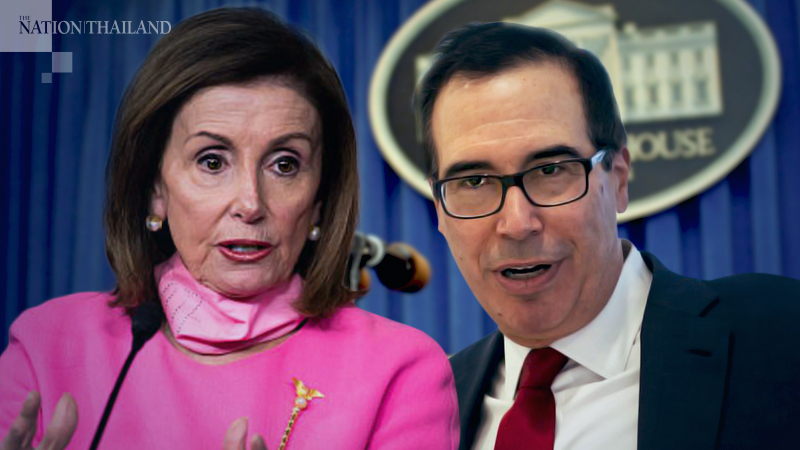
Left: Nancy Pelosi. Right: Steven Mnuchin

Left: Nancy Pelosi. Right: Steven Mnuchin

By The Washington Post · Erica Werner, Jeff Stein · NATIONAL, BUSINESS, POLITICS, CONGRESS, WHITEHOUSE 

WASHINGTON — Treasury Secretary Steven Mnuchin delivered a downbeat assessment Friday about his economic stimulus talks with House Speaker Nancy Pelosi, saying the speaker had “dug in” and “significant differences” remain.

Mnuchin’s comments came at the end of a week Pelosi had established as an informal deadline for getting agreement on an approximately $2 trillion spending bill in order for legislation to pass before the election. There was no agreement in sight, although Pelosi insisted that she remained optimistic.

“You have to be optimistic in a negotiation,” the speaker said on MSNBC.

Mnuchin said that if Pelosi wanted to compromise, they could get a deal. Pelosi said essentially the same thing about President Donald Trump.

For his part, Trump repeated his accusation that Pelosi just wants to “bail out” poorly run blue states, even though governors of both parties have sought additional federal assistance. Trump accused Pelosi of trying to put off a deal until after the election in order to score political points, which he predicted would backfire.

“I’d like to see the people get the money,” Trump said. “I don’t think she wants the people to get the money before the election. I don’t think that’s a good point for her.”

The finger-pointing came as multiple factors aligned against the possibility of congressional action ahead of the election, despite multiple Federal Reserve officials warning that more fiscal stimulus is needed to boost the recovery. Millions remain out of work, reliant on food banks or at risk of eviction.

Congress has not passed any relief legislation since a $3 trillion burst of bipartisanship at the outset of the pandemic in the spring. Many of the programs approved then – including enhanced unemployment benefits, payroll support for the airline industry and small business assistance – have since expired.

But Senate Republicans do not support a giant new spending bill along the lines of what Pelosi and Mnuchin have been discussing, and Senate Majority Leader Mitch McConnell, R-Ky., has given no indication he would bring such a bill to the floor before the legislation. Instead, he is focused on confirming Amy Coney Barrett to the Supreme Court, and then sending members home to campaign for reelection.

Earlier this week McConnell tried to advance a much smaller $500 billion bill on the Senate floor, but Democrats blocked it. Senate Republicans have been chafing at the compromises Mnuchin has been making in order to strike a much bigger deal with Pelosi.

Pelosi said the key to a deal would be Trump applying pressure to Senate Republicans, something he’s not yet done in any significant way.

“The fact is that the president has been back and forth: ‘Stop the negotiations,’ ‘Oh, I want more money than Nancy,’ ‘I hope she’ll agree with me,'” Pelosi said. “But he has to talk to the Senate Republicans.”

At the same time, a number of House Democrats are reluctant to come back into session to vote on a deal that’s not going to pass the Senate before the election, a viewpoint Pelosi discussed with House Democratic leaders in a meeting Thursday afternoon, according to a person familiar with the discussion who recounted it on condition of anonymity. The conversation was first reported by Politico.

All these factors suggest that the soonest Congress is likely to act would be in the “lame duck” session following the election. Lawmakers will be facing a Dec. 11 government shutdown deadline, and will have to pass a new spending bill. It’s possible some coronavirus relief measures could be attached.

“I don’t think Speaker Pelosi has any intention of doing a deal before the election but hopefully we can do one shortly thereafter,” Sen. John Cornyn, R-Texas, told reporters Friday.

Despite months of on-again off-again talks, Mnuchin and Pelosi have been unable to get agreement on some critical issues, including the level of support for state and local governments, and liability protections for businesses sought by the administration but opposed by Democrats.

Pelosi has been touting progress toward agreement on a national strategic testing plan demanded by Democrats – but she suggested Friday that even that had not been entirely finalized.

A variety of White House officials appeared in public Friday to downplay odds of a stimulus deal ahead of the election.

“The ball is not moving much right now,” Larry Kudlow, the president’s chief economic adviser, told Bloomberg TV. “It’s very difficult. The clock is ticking … Even if you had a deal in the next few days, you have to go through committee print and have votes in House and Senate. It’s not going to be easy.”

White House spokeswoman Kayleigh McEnany accused Democrats of being “fundamentally unserious” and said the latest Democratic offer included immigration provisions that are non-starters for the administration.

U.S. stocks fluctuate, bonds rise amid aid talks #SootinClaimon.Com

#SootinClaimon.Com : ขอบคุณแหล่งข้อมูล : หนังสือพิมพ์ The Nation.

U.S. stocks fluctuate, bonds rise amid aid talks

EconOct 24. 2020

By Syndication Washington Post, Bloomberg · Todd White · BUSINESS

Most U.S. stocks rose after the Trump administration resuscitated hopes for a spending package. Treasurys remained higher.

The S&P 500 edged higher to pare a weekly decline. It erased losses after White House Chief of Staff Mark Meadows said he expects a deal in a day or so. Tech shares underperformed after Intel Inc. plunged more than 10%, dragging chipmakers lower. American Express Co. also faltered following earnings. Gilead Sciences Inc. rose after its antiviral therapy become the first drug formally cleared to treat covid-19. The 10-year Treasury yield slipped to 0.83%.

Investors remain focused on Washington, where lawmakers are haggling over a financial spending bill to prop up the economy before the Nov. 3, though optimism that a deal will come at some point this year has helped drive Treasury rates higher in recent days. Concerns remain that rising virus cases will force additional business closures. The final presidential debate appeared to do little to alter the trajectory of a race that Democrat Joe Biden leads according to polls.

Europe’s equities market notched its first increase this week. Barclays Plc jumped after reporting improved stocks trading, lifting U.K. banking shares. Carmakers climbed after Daimler AG raised its profit forecast and Renault SA topped revenue estimates, the latest signs the global auto industry is emerging from its worst slump in decades.

“The focus is shifting toward de-risking,” said Eleanor Creagh, a market strategist at Saxo Capital Markets, on Bloomberg TV. “There’s a range of outcomes from the elections that could have a huge capacity to change market sentiment and dynamics very quickly.”

Growing coronavirus infections around the world continued to weigh on markets. U.S. cases exceeded 70,000 for the first day since late July. In Europe, governments have started deploying curfews and other restrictions more widely.

Elsewhere, China’s yuan climbed after an official with the country’s foreign exchange watchdog said Friday the currency’s appreciation has been “relatively moderate.”

Here are the major moves in markets:

Stocks

– The S&P 500 Index rose 0.1% as of 2:54 p.m. EDT.

– The Nasdaq 100 Index lost 0.1%.

– The Stoxx Europe 600 Index gained 0.6%.

– The MSCI Asia Pacific Index was little changed.

Currencies

– The Bloomberg Dollar Spot Index dipped 0.1%.

– The British pound decreased 0.4% to $1.3037.

– The Japanese yen strengthened 0.1% to 104.79 per dollar.

– The Turkish lira weakened 0.4% to 7.9673 per dollar.

Bonds

– The yield on 10-year Treasurys fell less than two basis points to 0.83%.

– Germany’s 10-year yield fell one basis point to -0.58%.

– Britain’s 10-year yield was little changed at 0.28%.

– Australia’s 10-year yield increased five basis points to 0.85%.

Commodities

– West Texas Intermediate crude fell 1.4% to $40.09 a barrel.

– Gold fell 0.4% to $1,896.61 an ounce.

Gold price slumps due to stronger dollar, rising US bond yield #SootinClaimon.Com

#SootinClaimon.Com : ขอบคุณแหล่งข้อมูล : หนังสือพิมพ์ The Nation.

Gold price slumps due to stronger dollar, rising US bond yield

EconOct 23. 2020

By The Nation

The price of gold dropped by Bt100 per baht weight during the morning trade on Friday, the Gold Traders Association reported.

As of 9.26am, the buying price of gold bar was Bt28,150 per baht weight and selling price Bt28,250, while gold ornaments cost Bt27,636.68 and Bt28,750, respectively.

On Thursday’s close, the buying price of a gold bar was Bt28,250 per baht weight and selling price Bt28,350, while gold ornaments cost Bt27,742.80 and Bt28,850, respectively.

The Comex (Commodity Exchange) gold price to be delivered in December dropped by US$24.9 or 1.29 per cent, closing at $1,904.6 (Bt59,621) per ounce on Thursday.

The price of gold has dropped sharply due to the strengthening dollar and rising US bond yields, which has cut down on investors’ interest in gold as a safe-haven asset.

Banks lead U.S. stocks higher with yields climbing #SootinClaimon.Com

#SootinClaimon.Com : ขอบคุณแหล่งข้อมูล : หนังสือพิมพ์ The Nation.

Banks lead U.S. stocks higher with yields climbing

EconOct 23. 2020

By Syndication Washington Post, Bloomberg · Vildana Hajric, Anchalee Worrachate · BUSINESS 
U.S. stocks rose as banks rallied on a jump in Treasury yields jumped, while lawmakers in Washington continue to haggle over a spending bill.

The S&P 500 pared its weekly decline as financial firms rallied almost 2%. The 10-year Treasury yield popped to 0.84%, its highest since June. Energy producers also surged, rebounding with oil from a prior-day sell-off. Small caps rose 1.5%.

Investors remained fixated on Washington, where lawmakers continue to work toward a package to bolster the economy. While House Speaker Nancy Pelosi, D-Calif., signaled optimism on a deal with the administration, opposition remains in the Republican-controlled Senate, making a pact before the election less likely.

Tech shares underperformed. AT&T Inc. rallied after the phone giant added more wireless subscribers than analysts estimated. Data showed a drop in jobless claims, suggesting the labor market is still gradually recovering.

“Earnings are heating up and they are generally coming in healthy and better than expected. But with the stimulus saga dragging on and the election looming, macro influences will continue to dominate market internals until there’s some clarity,” Tom Essaye, a former Merrill Lynch trader who founded “The Sevens Report” newsletter, wrote in a note.

In Europe, the Stoxx Europe 600 Index was lower. Luxury handbags and scarves house Hermes International rose after surpassing analysts’ sales estimates on a rebound in demand from Asia. The MSCI Asia Pacific Index slid. Gold declined, and copper slipped after topping $7,000 a ton for the first time in more than two years.

With no meaningful progress on fiscal policy, markets “are reacting to the heightened political instability that comes with the confirmation of efforts to manipulate the presidential race,” said Eleanor Creagh, a Sydney-based strategist at Saxo Capital Markets. “The ability for either candidate to seize upon accusations of foreign interference is heightened and raises the probability of a contested outcome, particularly as the race could be closer than polls currently indicate.”

Around the world, there is also increasing evidence that the pandemic is worsening. German infections have jumped to a record and Spain’s heath minister said the spread of coronavirus is out of control in certain parts of the country. U.S. hospitalizations for covid-19 have reached a two-month high.

These are some of the main market moves:

Stocks

– The S&P 500 Index rose 0.5% as of 4 p.m. EDT.

– The Nasdaq 100 ended lower by 0.02%.

– The Stoxx Europe 600 Index dropped 0.2%.

– The MSCI Asia Pacific Index decreased 0.8%.

– The MSCI Emerging Market Index fell 0.4%.

Currencies

– The Bloomberg Dollar Spot Index gained 0.2%.

– The euro fell 0.3% to $1.1822.

– The British pound decreased 0.4% to $1.3093.

– The Japanese yen weakened 0.2% to 104.83 per dollar.

Bonds

– The yield on 10-year Treasurys added two basis points to 0.84%.

– The two year rate added one basis point to 0.15%

– Germany’s 10-year yield rose one basis point to -0.58%.

– Britain’s 10-year yield climbed three basis points to 0.27%.

Commodities

– West Texas Intermediate crude increased 1.4% to $40.60 a barrel.

– Gold futures weakened 1.4% to $1,902.20 an ounce.

Covid triggers jump in Thai household debt #SootinClaimon.Com

#SootinClaimon.Com : ขอบคุณแหล่งข้อมูล : หนังสือพิมพ์ The Nation.

Covid triggers jump in Thai household debt

EconOct 23. 2020

By The Nation

The Covid-19 crisis has driven up household debt as job losses and falling income weaken the ability to make payments, new Bank of Thailand (BOT) governor Sethaput Suthiwartnarueput said on Thursday.

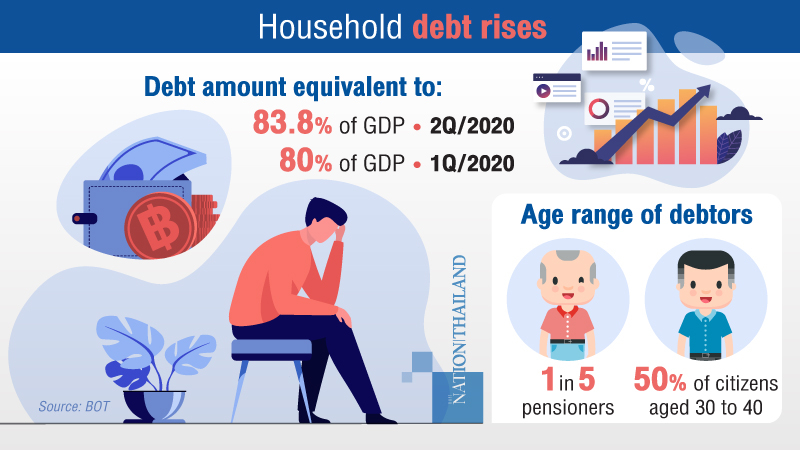
Thailand’s household debt jumped this year from 80 per cent of gross domestic product (GDP) in the first quarter to 83.8 per cent in the second quarter.

“Falling income caused by the virus impact has contributed to a rise in household debt,” Sethaput said.

He explained that although Thailand’s unemployment rate is relatively low, many workers had moved from higher-paying jobs in manufacturing, services and tourism, into agriculture. Many are also working fewer hours. 

According to a BOT study, the same debtors account for 80 per cent of Thailand’s household debt over the past nine years. One in five pensioners is in debt, with those aged 61-65 owing an average Bt100,000.

More younger people are also entering the borrowing cycle, with 50 per cent of those aged 30-40 now in debt, mostly via personal loans and credit cards.

Looking forward, household debt will continue to rise for the next two years, with the economy projected to recover to pre-Covid levels in the third quarter of 2022, he warned.

The central bank would launch more measures to deal with long-term problems, Sethaput said, without revealing any details.

The BOT has urged banks to continue providing support for companies and individuals struggling with debt when its current measures, including debt-payment suspension, end this month.  

The central bank is also keeping a close eye on debt restructuring, added Sethaput.