The Stock Exchange of Thailand (SET) Index rose by 6.79 points, or 0.56 per cent, to 1,217.46 in the morning session on Wednesday.
An analyst at Krungsri Securities expected the index to fluctuate between 1,200 and 1,220 points despite news that Democrats and the White House could reach an agreement on a fresh dose of economic stimulus measures by the end of this week.
“Uncertainty amid Thailand’s political unrest, weak third-quarter performance by banks and foreign fund flows would pressure the index,” the analyst said.
He recommended investors buy shares of:
> PTTGC, IVL and Top that benefit from the rising oil price.
– TU, STGT, CBG, SCC, IVL, Com7, Asian, Delta and Hana, whose third-quarter performance is expected to grow.
The SET Index closed at 1,210.67 on Tuesday, up 1.92 points, or 0.16 per cent. Total transactions amounted to Bt59 billion, with an index high of 1,219.16 points and a low of 1,202.03.
The price of gold rose by Bt100 per baht weight in morning trade on Wednesday, the Gold Traders Association reported.
As of 9.28am, the buying price of a gold bar was Bt28,200 per baht weight and selling price Bt28,300, while gold ornaments cost Bt27,697.32 and Bt28,800, respectively.
At close on Tuesday, the buying price of a gold bar was Bt28,100 per baht weight and selling price Bt28,200, while gold ornaments cost Bt27,591.20 and Bt28,700, respectively.
The spot gold price moved to US$1,916 (Bt59,822) per ounce in the morning after the price rose by $3.70 to $1,915.40 per ounce at close on Tuesday, thanks to the weakening dollar and progress in discussions on a fresh dose of US economic stimulus measures.
The Hong Kong gold price rose by HK$130 to $17,700 (Bt71,307) per tael this morning, the Chinese Gold and Silver Exchange Society reported.
By The Washington Post · Jeff Stein, Erica Werner · NATIONAL, BUSINESS, POLITICS, COURTSLAW, CONGRESS, WHITEHOUSE
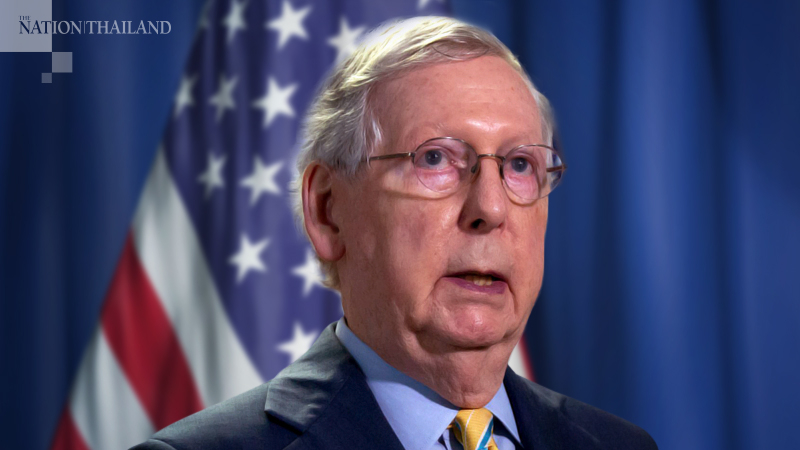
WASHINGTON – Prospects for an economic relief package in the next two weeks dimmed markedly on Tuesday after Senate Majority Leader Mitch McConnell revealed that he has warned the White House not to strike an agreement with House Speaker Nancy Pelosi before the the Nov. 3 election.
In remarks at a closed-door Senate GOP lunch, McConnell, R-Ky., told his colleagues that Pelosi, D-Calif., is not negotiating in good faith with Treasury Secretary Steven Mnuchin, and that any deal they reach could disrupt the Senate’s plans to confirm Judge Amy Coney Barrett to the Supreme Court next week. Republicans have voiced concerns that a stimulus deal could splinter the party and exacerbate divisions at a time when they are trying to rally behind the nominee. The comments were confirmed by three people who spoke on the condition of anonymity to discuss them.
McConnell’s attempted intervention came as Pelosi and Mnuchin continued negotiating over the roughly $2 trillion economic relief package. Pelosi spokesman Drew Hammill said the “conversation provided more clarity and common ground as they move closer to an agreement.” But no deal can become law without McConnell’s blessing, and his direct warning to the White House imperils the chances of any bill becoming law in the next two weeks.
McConnell told reporters Tuesday that if a deal were reached and passed by the House with President Donald Trump’s support he would put it on the Senate floor “at some point” – but did not commit to doing so before the election.
McConnell has not been part of the Pelosi-Mnuchin talks, which have jumped around in chaotic fashion, and had already made his opposition to an enormous new bill clear. Republicans could lose control of the Senate in November’s elections, and senators have made clear to the White House that voting on a huge stimulus deal could mean the end of their majority if it scares away fiscally conservative voters. Mnuchin and Pelosi have continued dancing around a deal for weeks, particularly amid signs that the economic recovery is weakening.
The deal under discussion would provide another round of $1,200 stimulus payments, more unemployment benefits, aid for small businesses, money for coronavirus testing, and support for airlines and hospitals, among other things.
In a Bloomberg interview on Tuesday, Pelosi adamantly denied that she was stringing the White House along and said she wouldn’t be negotiating if she didn’t want a deal. But McConnell’s remarks show the raw political calculations that both parties are dealing with two weeks before the Nov. 3 elections.
The comments emerged amid escalating tensions between some Republican members of Congress and Trump over stimulus negotiations. Trump has in recent days downplayed or dismissed conservative opposition to spending trillions more on a stimulus, saying he wants to spend even more money than Pelosi’s latest $2.2 trillion proposal. Many Republicans already balked at spending more than $1 trillion on this round of relief. Asked about McConnell’s reluctance to the stimulus, Trump said on Tuesday morning: “He’ll be on board if something comes. . . . Not every Republican agrees with me, but they will.”
Pelosi and Mnuchin continued their negotiations Tuesday, talking for 45 minutes as they wrangled over sticking points including liability protections for businesses and state and local aid. Pelosi had said that if they are going to vote on a deal by the end of next week, they need to agree on specific language by the end of this week.
Asked after her conversation with Mnuchin whether that could happen, Pelosi replied: “I hope so. That’s the plan. That’s what I would hope. That’s the hope, let me say that.”
Hammill, her spokesman, laid out the next steps.
“On several open questions, the speaker and the secretary called for the committee chairs to work to resolve differences about funding levels and language,” he said. “With this guidance, the two principals will continue their discussions [Wednesday] afternoon upon the Secretary’s return.” Mnuchin has been traveling in the Middle East as part of a trip to formalize parts of the Trump administration’s policies there.
White House Chief of Staff Mark Meadows told CNBC on Tuesday afternoon that Mnuchin and Pelosi have made “good progress” and that negotiations would continue Wednesday. Still, he said, major hurdles remain, with the negotiators “several hundred billion” dollars apart and at odds over the extent of state and local money.
Meadows also said that he had several conversations with Trump about stimulus negotiations on Tuesday and that the president is “very bullish” about not letting a difference in dollar amounts stand in the way of a deal.
“I want to stress: We’re not just down to a difference of language and a few dollars. We still have a ways to go,” Meadows said. “But I would say the conversations today were productive enough to have conversations tomorrow.”
McConnell declined to tell reporters whether he’d spoken with Trump about the issue or whether Republicans would support what Trump wanted.
“We’d have to see what it was first,” McConnell told reporters after the Senate GOP lunch.
Many Senate Republicans oppose a massive new spending bill, and McConnell is not eager to hold a vote that would divide his conference just before the election, when most Senate Republicans want attention focused on the Barrett nomination.
The scrambling comes amid numerous concerns about the economy. The unemployment rate remains high, the travel industry is in rough shape, and there are growing concerns about problems in the commercial real estate sector. Many restaurants are still struggling, and some continue to go out of business seven months after the pandemic floored the American economy.
On the Senate floor Tuesday, Republicans and Democrats battled over competing views of what should happen with stimulus legislation, trying to score political points with a series of procedural maneuvers. McConnell called a symbolic vote on a bill to inject $260 billion into the small business Paycheck Protection Program. A vote to effectively kill the legislation failed, 40-57, with five Democrats crossing over to vote with Republicans.
Senate Minority Leader Chuck Schumer, D-N.Y., bristled at the move, accusing McConnell of holding “show votes on coronavirus relief,” and countered with several procedural moves of his own that Republicans defeated.
On Wednesday, in a rejection of Trump’s desire for a big new bill, McConnell will try to advance an approximately $500 billion bill that will include jobless benefits for the unemployed, funding for schools and the health-care system, and new small-business assistance. But that bill will exclude many provisions sought by Democrats and Trump, including a new round of $1,200 stimulus payments.
Senate Democrats have lambasted McConnell for trying to advance what they describe as “emaciated” bills that would provide political cover to Republicans without really solving any problems. The approximately $500 billion bill is nearly identical to a piece of legislation McConnell tried to advance last month, which Democrats opposed.
McConnell’s Tuesday remarks indicate that even if Pelosi and Mnuchin do manage to reach a deal, any vote in the Senate would wait until after the election. If Democrats win a number of seats in the November elections, they could seize control of the Senate beginning in January.
Congress earlier this year approved roughly $3 trillion in aid to try and contain the economic fallout. Some of the funds appeared to help numerous sectors of the economy, but problems remain, particularly as certain programs expired.
A poll released Tuesday by The New York Times and Siena College found support for a $2 trillion stimulus package, and many economists have urged policymakers to approve additional fiscal relief.
“The recovery has slowed and without more help it is at risk of backsliding. Neither the virus nor the economic damages it has wrought are gone, and policymakers would be making a serious mistake to act as if they were,” said Adam Ozimek, chief economist at Upwork.
Congress has not passed relief legislation since April. House Democrats passed two far-reaching bills, but Senate Republicans rejected them. A significant minority of Senate Republicans believe that enough money already has been spent and that nothing more needs to be done.
By Syndication Washington Post, Bloomberg · Todd White · BUSINESS
U.S. stocks rose as lawmakers negotiated the size of a potential spending bill to bolster the economic recovery. The dollar weakened.
The S&P 500 bounced back from Monday’s sell-off even as any deal brokered by House Speaker Nancy Pelosi, D-Calif., and the White House likely to face stiff opposition in the Republican-controlled Senate. The index had gotten a boost when Pelosi signaled a compromise remained possible and after Federal Reserve Bank of Chicago President Charles Evans said he’s “somewhat optimistic” about a 2021 economic recovery.
Tech shares mostly shook off the U.S. Justice Department’s decision to sue Google for allegedly abusing its power. Netflix Inc. reports after the market closes. Treasurys slumped, along with government bonds in Europe. Oil climbed toward $41 a barrel.
A rally built on stimulus hopes has investors weighing Pelosi’s deadline of striking a deal today against speculation that the looming election will prove too much of a hurdle to overcome. Yet with Federal Reserve policymakers urging for more fiscal support to complement unprecedented monetary aid, many in the market may be willing to let the deadline come and go.
“The behavior of markets is reflecting optimism that there’s going to be big stimulus by January,” said John Normand, head of cross-asset fundamental strategy at JPMorgan Chase & Co. “I don’t think it’s necessarily a faith that Pelosi and Mnuchin and McConnell will agree to anything substantive by Pelosi’s deadline of today. It’s more of a look-through dynamic.”
In Europe, stocks edged lower. UBS gained after the Swiss firm’s traders performed better than most of their Wall Street rivals in the third quarter.
Leaders in Europe intensified efforts to slow coronavirus contagion, reviving lockdowns in some areas after piecemeal curbs made little impact on a disease that has infected 4.9 million people regionally.
Meanwhile, global cases exceeded 40 million, with the pandemic showing no signs of slowing. In the U.S., surges in Wisconsin and other battleground states pose a challenge for President Donald Trump two weeks before he stands for reelection.
Here are some of the main market moves:
Stocks
– The S&P 500 Index gained 0.8% as of 3:47 p.m. EDT.
– The Nasdaq 100 Index gained 0.4%.
– The Stoxx Europe 600 Index decreased 0.4%.
– The MSCI Asia Pacific Index was little changed.
Currencies
– The Bloomberg Dollar Spot Index fell 0.4%.
– The British pound was little changed at $1.2945.
– The Japanese yen was little changed at 105.48 per dollar.
Bonds
– The yield on 10-year Treasurys increased two basis points to 0.79%.
– Germany’s 10-year yield increased two basis points to -0.61%.
– Britain’s 10-year yield increased two basis points to 0.185%.
– Italy’s 10-year yield rose one basis point to 0.73%.
Commodities
– West Texas Intermediate crude rose 0.9% to $41.19 a barrel.
State-run banks will extend financial aid to those unable to resume their payments when the central bank’s aid package for retail borrowers and small and medium-sized enterprises (SMEs) expires on Thursday (October 22), Finance Minister Arkhom Termpittayapaisith said on Tuesday.
The Bank for Agriculture and Agricultural Cooperatives (BAAC) has agreed to extend the debt holiday until March next year for debtors unable to make payments.
The Government Savings Bank and Government Housing Bank are also considering doing the same, he said.
The debt-repayment suspension covers 12 million accounts with combined debt of Bt5.5 trillion. Four million of those accounts are at state-run banks, accounting for Bt1.9 trillion or 30 per cent of total suspended debt.
Commercial banks are being urged by the central bank to provide support for customers who can’t make debt payments, estimated at about 10 per cent of all debtors.
The other 90 per cent are expected to resume debt payments following full (60 per cent) or partial (30 per cent) recovery of their businesses.
Of the remainder, 4 per cent have liquidity problems while 6 per cent have cut contact with banks and their combined debts of about Bt100 billion.
Meanwhile, new central bank governor Sethaput Suthiwartnarueput said he would leave commercial banks to solve the problem by themselves rather than issuing them with orders.
Deputy Prime Minister Supattanapong Punmeechaow said Thailand’s economy is slowly recovering from a sharp downturn in the second quarter, when it was hit hard by fallout from Covid-19.
The International Monetary Fund now projects the Thai economy will contract 7.1 per cent this year, an improvement on its earlier forecast of a 7.7 per cent contraction.
Meanwhile the World Bank is optimistic that Asia will recover faster than the rest of the world.
Thailand’s National Economic and Social Development Council (NESDC) recently forecast the economy will shrink 7.8 per cent.
Asked whether ongoing political unrest will drag the economy down further, Arkhom said that it would depend on how the situation developed.
The government is under mounting pressure after tens of thousands of protesters held rallies across the country this week to demand that the Prayut-led administration step down.
Thai Chamber of Commerce to meet as concern over political conflict grows
EconOct 21. 2020The Thai Chamber of Commerce chairman Kalin Sarasin
By The Nation
The Thai Chamber of Commerce has called a meeting to evaluate the country’s political and economic situation and seek ways to resolve the brewing political conflict, said its chairman Kalin Sarasin.
He said a number of foreign businesses had expressed concerns about Thailand’s safety and whether the government would declare martial law. He assured them that the current political situation would not affect their businesses here.
Kalin also voiced support for recalling Parliament for an extraordinary session to seek ways out of the conflict.
The Cabinet on Tuesday approved the plan but did not set a date for the extraordinary session.
Thai economy can survive shocks, but political unrest worrisome: new BOT governor
EconOct 21. 2020Bank of Thailand governor Sethaput Suthiwartnarueput meets the press for the first time on Tuesday after recently taking leadership at the central bank.
By The Nation
New central bank governor Sethaput Suthiwartnarueput said he is concerned about the ongoing political unrest, but added that the economy is resilient enough to survive any shock.
The central bank has forecast that the economy will contract 7.8 per cent this year and will only start expanding in the second quarter of next year.
“It [the political unrest] will affect consumption, investment and confidence,” he said at his first press meeting on Tuesday.
“And problems with actual execution of policies will make things tougher,” he said referring to the government’s usual difficulty with policy execution rather than planning.
Anti-government protesters have intensified their rallies across the country demanding that the government step down, while the government has responded with crackdowns on protest leaders and censorship of the press.
Businesses, meanwhile, are worried that the state of emergency imposed by the government will have an adverse impact on the economy.
Thailand’s economy has already been crippled by the Covid-19 outbreak and taking far too long to recover.
“The state of the economy now can be compared to a patient who is slowly coming out of intensive care,” he said.
The outbreak resulted in a sharp drop of tourists from about 40 million to 6.7 million, which translated to an income loss of 10 per cent of the gross domestic product. Thai exports in the second quarter shrank to the lowest level in 11 years, like a gravely ill person who needs intensive care, he continued.
Recovery, he said, is uneven among different sectors and the economy will take at least two years before it returns to pre-Covid levels, especially since it is still uncertain when a vaccine will be available and how much the tourism sector will recover.
In a bid to adapt to the changing environment, the Bank of Thailand (BOT) has recently shifted its policy from providing blanket financial aid to a more targeted, comprehensive and flexible scheme, he said.
However, he said, there are no new measures planned.
He also voiced confidence that the Thai economy is resilient to shocks brought on by the virus or other factors.
“The public debt is manageable, the country is financially stable and the labour market is flexible,” he said.
As for the strengthening of the baht, he said this was due to the high current account surplus, which comes in at US$30 billion (Bt938.3 billion) annually.
He said Thailand is not able to recycle this money for investment overseas because few Thai listed companies are investing abroad. This is unlike South Korea and Taiwan, which have been successfully recycling their large current account surplus by investing overseas.
Over the past five years, BOT has learned that external factors such as the US dollar and regional currencies account for 85 per cent of the impact on the baht exchange rate, while domestic factors represent only 15 per cent. Hence, the central bank is not able to have much of an influence on the currency’s exchange rate.
Thai exporters have long complained that a stronger baht is eroding their competitiveness, and have recently suggested that the currency be brought down to Bt34 against the dollar from the current rate of Bt31.
When asked how the central bank will help boost economic growth, he admitted that the fiscal policy was the key driver with the monetary policy playing a supporting role.
Thailand is among few countries in Asia to have brought its policy rate down to 0.5 per cent, which is so low that it leaves limited room to bring it down further.
Sethaput said as central bank governor, he faces five key challenges, with the most important one being solving the debt crisis so households and businesses can survive and recover from the Covid-induced crisis.
The second is to maintain financial stability to support recovery, third is ensuring a stable macroeconomic level, so it is resilient to the impact of coronavirus and the fourth is to enhance public confidence. He said the fifth challenge is to ensure BOT works as a unified entity because it is fragmented and has so many small departments that its potential is restrained.
He said he will take a performance-based approach, allowing everyone to work together and deliver a good outcome.
Thai stock market gurus have suggested ways investors can escape the impact of prolonged political unrest.
Wijit Arayapisit, a research department strategist at Maybank Kim Eng Securities, said the Stock Exchange of Thailand (SET) is currently weaker than regional peers due to political turmoil that has driven out foreign investors and delayed investment by locals.
“If the situation prolongs, the stock market will sink further,” he said.
He advised investors to beef up their portfolios with assets unaffected by the unrest. He said these included electronics stocks which benefit from the rise in technology shares, food shares that benefit from the weakening baht, and retail shares boosted by government stimulus measures.
“We recommended buying KCE, TU, COM7, RS and SINGER,” he added.
An analyst at Asia Plus Securities said political unrest always caused the baht to weaken and the stock market to fall.
“Last week, the baht weakened by 0.65 per cent and SET Index fell over 2.64 per cent as more than Bt4.1 billion in foreign funds flowed out from the stock market,” he said.
“Meanwhile, the pro-democracy protests are likely to be prolonged and expand throughout the country, so investors should monitor the situation closely.”
With negative sentiments pressuring the Thai stock market, he advised investors to hold 35 per cent in cash and invest 65 per cent in stocks that pay high dividends – such as DCC, JMART and MCS – and multinationals such as TU and PTTGC.
Nuttachart Mekmasin, assistant managing director at Trinity Securities, said the political unrest had hit the value of certain stocks.
He recommended that investors buy small- and medium-cap stocks in companies with growing profits, adding that foreign and institutional investors would not sell these stocks.
“However, we advise investing only 10 per cent in stocks,” he said, adding that stocks capable of escaping impact from political unrest included electronics, food and agriculture shares.
Supachai Wattanavitheskul, senior director at Yuanta Securities, said the price of electronics shares on Tuesday rose despite ongoing political unrest because these global stocks have good long-term prospects and benefit from the weakening baht.
“We advise investors to buy KCE because the price of other electronic shares is currently high,” he said.
The Stock Exchange of Thailand (SET) Index closed at 1,210.67 on Tuesday, up 1.92 points or 0.16 per cent. Total transactions amounted to Bt59 billion with an index high of 1,219.16 and a low of 1,202.03.
In the morning session, an analyst at Krungsri Securities expected the day’s index to fall below 1,200 points, as hopes receded that US economic stimulus measures would be launched before the November 3 presidential election.
“Also, uncertainty over Thailand’s political unrest, as protesters hold rallies across the country, will pressure the market,” he said.
However, he said that planned extraordinary parliamentary session to address the unrest should help relieve political tensions.
The 10 stocks with the highest trade value today were STGT, KBANK, STA, PTT, SCC, AOT, CPALL, NER, IVL and PTTEP.
As of 4.30pm, the price of oil dropped by US$0.10 or 0.24 per cent to $40.73 per barrel, while gold dropped by $2.50 or 0.13 per cent, to $1,909.20 per ounce.
Other Asian indices were mixed:
Japan’s Nikkei Index closed at 23,567.04, down 104.09 points or 0.44 per cent.
China’s Shang Hai SE Composite Index closed at 3,328.10, up 15.44 points or 0.47 per cent, while the Shenzhen SE Component Index closed at 13,603.88, up 182.69 points or 1.36 per cent.
Hong Kong’s Hang Seng Index closed at 24,569.54, up 27.28 points or 0.11 per cent.
South Korea’s KOSPI Index closed at 2,358.41, up 11.67 points or 0.50 per cent.
Taiwan’s TAIEX Index closed at 12,862.37, down 45.97 points or 0.36 per cent.
Assets under management (AUM) of the Super Savings Funds (SSFs) scheme totalled Bt1.05 billion on October 14, Morningstar Research said on Tuesday.
Chayanee Juengmanon, a Morningstar senior analyst, said the funds’ assets in the third quarter hit Bt908 million, up more than three times from around Bt200 million in the previous quarter.
She said the group of SSFs with the highest growth was large-cap equities, which more than tripled to Bt312 million, from Bt100 million in the previous quarter.
“Meanwhile, global equities rose to Bt264 million, up 4.5 times from Bt48 million in the previous quarter,” she said.
“Currently, there are 81 SSFs, while the market share of the top five asset management companies is 82 per cent, led by Kasikorn Asset Management with 28 per cent of the market and AUM of Bt254 million.”
She said SSFs have a chance to grow from investment abroad, as investors are paying attention to China’s economic recovery and the rise in technology shares, while the Thai stock market is being pressured by Covid-19’s impact on the economy and political unrest.
“As SSFs were designed for long-term investment, investors should focus on asset allocation and study information on each SSF before investing because there are differences in investment policies and fees,” she added.
The SSFs are a government-led initiative to boost savings and investment by offering a 30 per cent tax deduction on contributions, capped at Bt200,000 a year.




 The Thai Chamber of Commerce chairman Kalin Sarasin
  Bank of Thailand governor Sethaput Suthiwartnarueput meets the press for the first time on Tuesday after recently taking leadership at the central bank.