EconOct 16. 2020Thai Chamber of Commerce chairman Kalin Sarasin
By The Nation
Foreign investors need more details of what they can or cannot do in Thailand under the state of emergency imposed on Thursday, said Thai Chamber of Commerce chairman Kalin Sarasin.
He added that foreign investors had inquired whether they can go ahead with holding seminars and meetings in Thailand, after the emergency ban on gatherings was imposed on Thursday.
Chambers of commerce in the provinces had also asked him if they will be able to continue with planned activities, he said.
He added that it would take a few days to judge whether emergency rule will hit foreign-investor confidence. He believes the economy could escape damage from political turmoil if the anti-government protests end soon.
Meanwhile, Japanese faith in Thailand remains high, according to Japan External Trade Organisation (Jetro) president Atsushi Taketani.
Japanese investors were still confident in Thailand and remain committed to driving its economy regardless of current political situation, he said.
The country’s core economic policies – including development of the Eastern Economic Corridor – would not be affected by escalating political protests, the Industrial Estate Authority of Thailand said on Thursday.
Attapon Jirawatjanya, deputy governor of the authority, predicted that ongoing anti-establishment protests would be a short-term problem.
Industrial estate operators are ploughing ahead with development plans in the Eastern Economic Corridor (EEC), unfazed by the impact of Covid-19, said Industrial Estate Authority of Thailand deputy governor Attapon Jirawatjanya.
The authority recently approved the launch of three new industrial estates, including the Rojana Industrial Park in Nong Yai, Chonburi and the Egco Rayong Industrial Estate. Attapon expects them to inject about Bt80 billion in investment and generate around 50,000 jobs for the local economy.
He said that at least three more operators are consulting on plans to set up industrial estates in the EEC.
5G infrastructure to support automation and robotics will be installed within the next five years at the authorities’ five industrial estates – at Map Ta Phut, Laem Chabang, Bang Pu, Lat Krabang and the Northern Region Industrial Estate, he added.
The Stock Exchange of Thailand (SET) Index closed at 1,242.96 on Thursday, down 21.03 points or 1.66 per cent. The volume of total transactions was Bt54 billion with an index high of 1,258.09 and a low of 1,240.75.
In the morning session, an analyst at Krungsri Securities expected the day’s index to fall to between 1,255 and 1,260 points amid escalating political turmoil in Thailand that and dispute in the US over economic stimulus measures.
The analyst added that uncertainty over Thai commercial banks’ weak third-quarter performance would also pressure the index.
The 10 stocks with the highest trade value today were KBANK, PTT, CPF, HANA, CPALL, PTTGC, IVL, STGT, DELTA and MINT.
As of 4.30pm, the price of oil dropped by US$0.70 or 1.71 per cent to $40.34 per barrel, while gold dropped by $10.90 or 0.57 per cent, to $1,896.40 per ounce.
Other Asian indices were on the fall:
Japan’s Nikkei Index closed at 23,507.23, down 119.50 points or 0.51 per cent.
China’s Shang Hai SE Composite Index closed at 3,332.18, down 8.60 points or 0.26 per cent, while the Shenzhen SE Component Index closed at 13,624.89, down 66.15 points or 0.48 per cent.
Hong Kong’s Hang Seng Index closed at 24,158.54, down 508.55 points or 2.06 per cent.
South Korea’s KOSPI Index closed at 2,361.21, down 19.27 points or 0.81 per cent.
Taiwan’s TAIEX Index closed at 12,827.82, down 91.49 points or 0.71 per cent.
Trinity Securities is advising investors to allocate 10 to 20 per cent of their portfolios to Thai shares and 10 per cent to shares in China and Vietnam in order to cope with volatility next year.
Trinity Securities’ director Dr Visit Ongpipattanakul said the economy next year will face a double-dip recession if the second Covid-19 outbreak emerges.
He said the International Monetary Fund (IMF) expects economic growth to be below 1 per cent next year down from the previous growth of over 4 per cent due to Covid-19 fallout. IMF expects the economy to only grow by 2 per cent in 2024.
As for the impact on the Thai stock market, Visit said the Stock Exchange of Thailand (SET) will fall in the first quarter of 2021 before recovering in the second quarter, because the country’s gross domestic product (GDP) has contracted in the second quarter of this year.
“Hence, diversifying investment to maintain returns is an important strategy for next year,” he said.
“In 2019-2020, assets that generated high returns were the NASDAQ Index, which grew 35 per cent in 2019 and 20 per cent in 2020, Bitcoin 95 per cent in 2019 and 46 per cent in 2020, gold 18 per cent in 2019 and 25 per cent in 2020, and Chinese stocks 22 per cent in 2019 and 7 per cent in 2020,” he said, adding that Thai stocks generated returns of 1 per cent in 2019 and -20 per cent in 2020.
He said he expects the asset market to face volatility in the fourth quarter as foreign investors are waiting for the results of the US presidential election. However, he believes, the Thai stock market and emerging markets will benefit from the US policy after election.
As part of the investment strategy for next year, he said, investors should assign 10 to 20 per cent of their portfolio to small- and medium-cap Thai stocks, 10 per cent to Chinese and Vietnamese stocks, 10-20 per cent in developed stock markets, 5-10 per cent in gold, 1-5 per cent in alternative assets, and hold 35 per cent cash to deal with volatility.
He said Vietnamese shares gained thanks to the country’s V-shaped economic recovery in which the country’s GDP is expected to grow by 2.7 to 3 per cent this year and 6 to 8 per cent next year, while the country’s foreign exchange reserve was over US$80 billion.
“Meanwhile, Vietnamese stock market’s status in MSCI Frontier Market and its regulations adjustment will draw more investment from foreign investors at the end of this year. The market will also be listed in MSCI Emerging Market in mid-2022,” he said
“We advise investors to start investing in Vietnamese shares from October this year, while that they can use dollar-cost averaging [DCA] investment strategy to manage cost.”
He added that Trinity Securities’ SSI Sustainable Competitive Advantage Fund (SSI-SCA) is investing in Vietnamese stocks in Ho Chi Minh Stock Exchange and Hanoi Stock Exchange.
“This fund is managed by a Vietnamese fund manager, so there is no limit on foreign investors’ shareholding,” he added.
Too early to predict emergency decree’s effects on economy: Arkhom
EconOct 15. 2020Finance Minister Arkhom Termpittayapaisith
By The Nation
Finance Minister Arkhom Termpittayapaisith said on Thursday that it was too early to tell how the state of emergency will affect the economy.
He added that the authorities have deemed it necessary to take control of the situation or extensive rallies could have an impact on the business sector.
Prime Minister Prayut Chan-o-cha declared a state of emergency in Bangkok effective from 4am on Thursday to control the escalating pro-democracy protest.
The premier has also reportedly called a special Cabinet meeting on Friday to review the declaration of the state of emergency.
Under related laws, the declaration has to be considered within three days.
Academics predict the automotive industry will see a reduced workforce and use more robots and automation after the Covid-19 crisis, pointing to an unskilled workforce and noting that opportunities for new graduates to enter the automotive manufacturing sector are still low due to an obvious lack of experience.
Dr Saowanee Chantapong, a researcher at the CU-ColLar centre, and Dr Chadatan Osatis, a lecturer at the College of Population Studies at Chulalongkorn University, said in article titled “Turn over the Thai automotive crisis by enhancing labour skills” that entrepreneurs, labour workers and others would be forced to leave the automotive industry as it steers through this crisis caused by the coronavirus.
Thailand’s automotive industry is a world top producer of vehicles and parts, accounting for 14 per cent of total industrial production and employing 800,000-900,000 personnel. However, the Covid-19 pandemic has significantly affected the industry.
Car production falls sharply, SMEs hit hard
The country produced 1.9 million to 2.17 million vehicles, or an average of 160,000-180,000 vehicles per month, from 2015-2019, with half of the total production being exported. The industry began to slow in 2019 due to the declining Thai demand for cars, while the economy also slowed down from the result of an international trade war.
According to the Automotive Industry Association of Thailand and The Federation of Thai Industries, total vehicle production in the first half of 2020 decreased by about 40 per cent compared to the same period in 2019 to around 100,000 units per month, while exports declined by 33 per cent.
According to a seminar “Thai labour market after Covid-19: impact, trends and solutions”, SMEs – tier 2 and 3 auto parts manufacturers – are considered vulnerable and will be severely affected.
This group carries the risk of being replaced by technology as orders and production continued to decline in February, down 18 per cent, March, down 25-30 per cent, and April, down 50 per cent.
Employment and work patterns affected
A survey and interviews with workers in the industry, conducted by the Labour Ministry’s Department of Employment together with the Centre for Coordination of Labour Research, Chulalongkorn University (CU-ColLaR) from December 2019 to May 2020, found that those with high school education working on production lines would be most affected, especially in assembly-line quality checks and technical work due to gaps in computer and English skills. If a company makes use of new technology and innovation, these workers will not be able to continue their jobs, the survey showed.
The second group, aged 45 years and over with an education lower than a bachelor’s degree, work on production lines with an average monthly income of Bt55,000. If they are unable to develop skills to keep up with technology changes, they may receive a lump sum amount of about Bt2 million to Bt3 million from being laid off or on early retirement as a scholarship to continue working in other fields.
The third comprises a workforce aged 45 years and over with a bachelor’s degree in engineering. This group of workers will not be affected much. Even if they are laid off, they are more likely to find a new job easily.
Sluggish market conditions mean the automotive manufacturing sector does not want to accept new graduates or unskilled labour. Therefore, it is quite difficult for these groups to join the industry.
The employment outlook after the Covid-19 crisis will change as more workers will be replaced by robots and increased automation will come into play. The industry needs to prepare people to support the digital age, the researchers argued.
Lessons and challenges
The health crisis has presented the auto industry with lessons and challenges.
The first is the diversification of auto parts supply chain risks. Lockdowns in China have affected the global automobile and parts-supply chain. Although Thailand does not rely much on auto parts from China, there are some important parts that need to be imported from the Asian giant. Therefore, manufacturers have to rely on parts from Japan. This is a lesson that relying on a single production base can be risky.
Second is the just-in-time production downgrade. This crisis has disrupted global economic activity, resulting in inadequate raw materials, although Thailand has an advantage over other production bases in the region due to a cluster of domestic parts manufacturers. But complex auto parts need to be imported, requiring more inventory management.
Third, foreign investment is increasingly going to neighbouring countries instead as the domestic market becomes saturated, resulting in a domestic sales decrease.
Fourth, the speed of electric vehicle technology and this CASE (connected, autonomous, shared, electric) era, especially in European countries, has resulted in a change in production technology that focuses on choosing clean energy that is environmentally friendly. As a result, entrepreneurs and workers in the Thai automotive industry need to restructure to meet these challenges in the future.
The lesson for entrepreneurs is to reduce costs, increase productivity and product quality. This will benefit the supply chain as well as the service and social sectors, the researchers said.
Meanwhile, improving the technical skills of automotive industry workers must be accelerated during the transition to modern automobile manufacturing that includes demand for computer skills and foreign languages.
For those who have to leave the industry, the government should have proactive measures that focus on development and training to support workers changing occupations.
If all parties cooperate to help each other, it will help everyone overcome this crisis, the researchers added.
Domestic factors including politics weighing on Thai economic recovery: StanChart
EconOct 15. 2020Standard Chartered Bank (Thai) economist Tim Leelahaphan
By The Nation
But bank eyes potential upside in 2021 and says focus must be placed on attracting increased foreign investment.
Domestic factors have weighed on Thailand’s slow economic recovery and an urgent boost is needed to restore local confidence, Standard Chartered Bank said on Thursday, warning it will take 3-5 years for the country’s key economic driver – tourism – to return to pre-Covid levels and adding that attracting increased foreign investment must be the focus for 2021.
“The economy has bottomed out from the peak of the Covid-19 impact at the beginning of the year,” said Standard Chartered Bank (Thai) economist Tim Leelahaphan. “However, the pace of recovery has been slow. Although exports have seen an uptick, the local political situation needs to be closely monitored. And while the Covid situation in Asia has improved, the situation in Europe and the United States remains a significant concern.”
Thailand is also adjusting to the government’s new economic team, Tim said, while the disbursement of funds from the government’s and the Bank of Thailand’s stimulus measures is far from fully utilised.
“Financial markets are in a wait-and-see mode as there are so many issues which could impact the extent of the recovery: they want to see a clearer direction from the Finance Ministry, details surrounding budget disbursement and new government investment, which can spur fresh private investment, the developing political situation, border reopening and the development of a Covid-19 vaccine,” Tim said.
Standard Chartered Bank has “10 observations” for Thailand’s 2020 economy and the potential upside to boost the country in 2021:
1. The economy has bottomed out. Standard Chartered Bank expects Thai GDP to contract 8 per cent in 2020 before rebounding to grow 2 per cent in 2021. The country is paving the way for a recovery, but the pace has been dragged by domestic factors and lingering uncertainties in external markets.
2. Exports from emerging markets and Asia, including Thailand, have shown signs of recovery. However, Thailand’s key economic driver – tourism – remains in the doldrums. While there has been an uptick in exports, overall economic growth cannot be sustained unless the tourism sector recovers.
3. Eyes are now on how the newly appointed finance minister will restore confidence to financial markets.
4. Regarding political developments, prospects of a resolution remain unclear. With the Thai economy expected to contract significantly this year, this may impact the pace of recovery.
5. As the market awaits a fresh stimulus policy from the new economic team while taking a wait-and-see approach on domestic politics, there will be limited impact on the dollar and baht. The bank expects the baht-dollar exchange rate to be 31 at the end of 2020.
6. Foreign investors not only consider short-term factors but also assess Thailand with a longer-term view. The crucial question they ask is when can the Thai economy make a significant recovery and when will the number of international visitors return to pre-Covid levels of 40 million annually.
7. We believe that Covid-19 has disrupted the country’s tourism strategy. Thailand is shifting its focus from the volume of tourists to value, while decreasing its dependency on a single market.
8. Overall, the market is watching Thailand’s fiscal front, budget disbursement, the political situation, the reopening to international visitors, and the development of a Covid-19 vaccine. Currently, there is nothing that can significantly restore confidence. Financial markets may regain more confidence if they detect positive signs of government budget disbursements. Government investment could also trigger new private investment to help recovery.
9. We believe the Bank of Thailand is also taking a wait-and-see approach. If the situation remains unchanged but there are some positive signs detected, the central bank is expected to keep its policy rate unchanged at 0.5 per cent. However, if there is no economic uptick or the situation is dampened this quarter, BoT may cut its policy rate to 0.25 per cent.
10. We believe financial markets are keen to know if the central bank will offer additional stimulus tools in 2021. Will QE [quantitative easing] or yield-curve control or measures targeting SMEs be on the table? How effective would those tools be and how would they fit into Thailand’s economic environment? What is the expected result and anticipation? This should be the factor that financial markets and investors focus on in 2021.
The price of commercial banks’ shares fell sharply due to uncertainty following a weak third-quarter performance, experts said on Thursday.
On Wednesday, the share price of Siam Commercial Bank (SCB) fell by Bt2.50, or 3.75 per cent, to Bt64.25 per share, Kasikorn Bank (KBank) fell by Bt2.75, or 3.67 per cent, to Bt72.25, and Krungthai Bank fell by Bt0.20, or 2.23 per cent, to Bt8.75.
Kasikorn Securities assistant director of research Korakot Sawetkruttamat expected banks to see a collective third-quarter profit of Bt24.8 billion, down 9.6 per cent quarter on quarter and 45.2 per cent year on year.
He also expected their net interest margin to drop because they had granted low-interest loans to corporations.
Meanwhile, he said, reserves for doubtful debts are expected to rise after the expiration of a debt moratorium on October 22.
“The securities company expects banks excluding KBank to set up reserves for doubtful debts at Bt50.6 billion in the third quarter. The figure is expected to rise to Bt54 billion in the fourth quarter. These Bt54 billion of reserves comprise SCB’s Bt14 billion, KTB’s Bt14 billion, BAY’s Bt10 billion, BBL’s Bt6 billion, TMB’s Bt7 billion, KKP’s Bt1 billion and Tisco’s Bt2 billion,” he said.
CGS CIMB Securities senior vice president of research Kitichan Sirisukarcha said the decline in bank shares was due to uncertainty over the expiration of the debt moratorium.
He said banks’ non-performing loans in the next three months were expected to increase if the debt moratorium period was not extended.
“Also, we expect banks’ reserves for doubtful debts in the fourth quarter to be the highest of the year and would affect their fourth-quarter performance, while their performance would drop even further due to a decline in loan requests amid the economic slowdown,” he said.
“We expect banks’ profit this year to be Bt96.87 billion, down 41 per cent from Bt164.74 billion during the same period of the previous year, while their profit is expected to increase to Bt97.73 billion and Bt133.03 billion in 2021 and 2022, respectively, but still lower than before the Covid-19 outbreak emerged.”
Kitichan added that the securities company still weighs investment in bank shares the same as the market even though its price was currently at a low level due to a lack of positive sentiment.
He advised people to invest in other shares that have gained positive sentiment.
UOB Kay Hian Securities senior director of research Tanadech Rungsrithananon said the price of bank shares dropped due to various negative sentiments, such as Bank of Thailand’s order to hold off paying interim dividends, the expiration of the debt moratorium and uncertainty over weak banks’ third-quarter performance.
“Separately, bank shares have been pressured by the escalating political unrest,” he added.
The Stock Exchange of Thailand (SET) Index fell by 10.16 points, or 0.80 per cent, to 1,253.83 in the morning session on Thursday.
An analyst at Krungsri Securities expected the index to fall to between 1,255 and 1,260 points due to the escalating political situation in Thailand and a US conflict on the rollout of economic stimulus measures in that country.
“After the anti-government protest in front of Government House ended, Khana Ratsadon 2563 [People’s Party 2020] announced it would continue their rally at 4pm on Thursday at Ratchaprasong Intersection. Meanwhile, the government declared a state of emergency in Bangkok to control the situation,” he explained.
The analyst added that uncertainty over weak commercial banks’ third-quarter performance would also pressure the index.
He recommended investors buy shares of:
> CRC, HMPro, JMart, Com7, and KTC that benefit from the government’s “Shop Dee Mee Kuen” (Shop and Payback) scheme.
> TU, PlanB, STGT, Com7, Asian and CBG, whose third-quarter performance is expected to grow.
The SET Index closed at 1,263.99 on Wednesday, down 9.44 points, or 0.74 per cent. Total transactions amounted to Bt51 billion, with an index high of 1,271.10 points and a low of 1,257.84.
The price of gold was unchanged in morning trade on Thursday, the Gold Traders Association reported.
As of 9.24am, the buying price of a gold bar was Bt27,900 per baht weight and selling price Bt28,000, while gold ornaments cost Bt27,394.12 and Bt28,500, respectively.
At close on Wednesday, the association announced a change in the precious metal price, causing the price to drop sharply by Bt350 per baht weight.
The spot gold price moved to US$1,895 (Bt59,064) per ounce in the morning after the price rose by $12.70 to $1,907.30 per ounce at Wednesday’s close in response to a weakening dollar, uncertainty amid the Covid-19 crisis and the upcoming US presidential election.
The Hong Kong gold price meanwhile dropped by HK$30 to $17,510 (Bt70,418) per tael on Thursday morning, the Chinese Gold and Silver Exchange Society reported.

 Thai Chamber of Commerce chairman Kalin Sarasin
 Finance Minister Arkhom Termpittayapaisith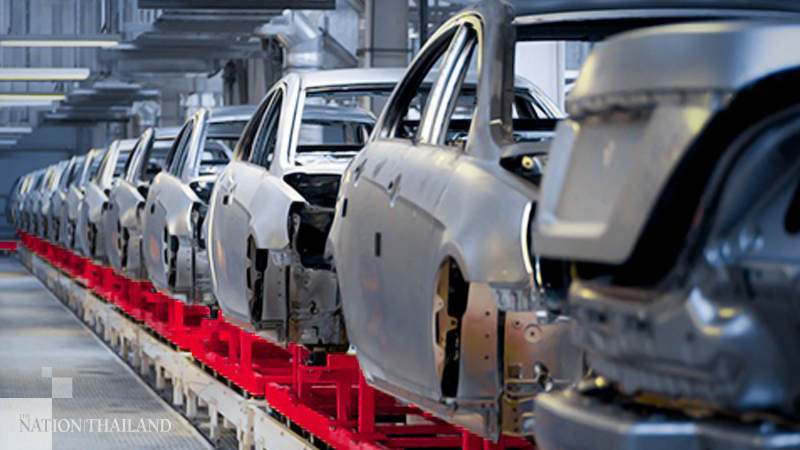
 Standard Chartered Bank (Thai) economist Tim Leelahaphan