Who will lead the WTO and help it avoid collapse? #SootinClaimon.Com

#SootinClaimon.Com : ขอบคุณแหล่งข้อมูล : หนังสือพิมพ์ The Nation.

Who will lead the WTO and help it avoid collapse?

EconOct 08. 2020A logo stands on the wall outside the World Trade Organisation (WTO) headquarters in Geneva, Switzerland, on March 2, 2020. MUST CREDIT: Bloomberg photo by Stefan Wermuth.A logo stands on the wall outside the World Trade Organisation (WTO) headquarters in Geneva, Switzerland, on March 2, 2020. MUST CREDIT: Bloomberg photo by Stefan Wermuth. 

By Syndication Washington Post, Bloomberg News · Bryce Baschuk · BUSINESS, WORLD, US-GLOBAL-MARKETS, AFRICA, ASIA-PACIFIC

The campaign to lead the World Trade Organization during the most turbulent period of its 25-year existence has entered its final stage.

Playing out against the backdrop of a pandemic, a worldwide recession, the U.S.-China battle for trade supremacy and the American presidential election, there couldn’t be more at stake. But the decision by Brazilian Roberto Azevedo to step down as director-general at the end of August, a year before his term ends, also offers an opportunity for the U.S., the European Union and other nations to reshape the organization.

1. What’s at stake?

The Geneva-based WTO’s mission of economic integration is under threat from protectionist policies around the globe, and without reform it risks being sidelined during the biggest economic crisis in a century. The world’s largest economies agree that the organization must evolve to address the shifts in technology and the global trading system that have occurred since 1995. If members can align behind a candidate committed to modernization, it could break bureaucratic logjams and help unleash a wave of global growth at a time when it is needed most. If that isn’t possible, the WTO risks receding further into irrelevance.

2. What’s precipitated the crisis?

The WTO’s appellate body, the main forum for settling worldwide trade disagreements, lost its ability in December 2019 to rule on new dispute cases. That resulted from a U.S. refusal over the previous two years to consider any nominees to fill vacancies on the panel. WTO members can still bring disputes to the trade body and receive an initial ruling, but that can be appealed into legal limbo. The U.S. imposition of hundreds of billions of dollars worth of tariffs against China, and use of the WTO’s national security loophole to levy duties on steel and aluminum, have also weakened the organization.

3. What is the WTO’s selection process?

The chairman of the WTO general council launched a selection procedure in June to confirm the trade body’s next director-general. The WTO general council has been narrowing the field of candidates by holding confidential consultations with each of the WTO’s 164 members. The second phase of consultations, with five candidates still in contention, was completed on Oct. 8, when the WTO announced the two finalists. The last phase of the selection process runs until Oct. 27, after which the WTO will seek to name a consensus winner.

4. Who is still in the running?

Two women, which is significant since the WTO has never had a female leader in its 25-year history. They are Nigeria’s Ngozi Okonjo-Iweala, who served two stints as finance minister and one term as foreign affairs minister, and South Korea’s trade minister Yoo Myung-hee. Okonjo-Iweala, 66, has experience working at international governance bodies as a former managing director of the World Bank and as a chair at the Global Alliance for Vaccines and Immunization. She is running as an outsider, arguing that she can bring a “clear set of eyes” to a deeply dysfunctional organization.

Yoo, 53, has had a 25-year career in government, during which she helped expand her country’s trade network through bilateral accords with China, the U.K. and the U.S. Yoo told Bloomberg TV in September that she wanted the WTO to offer a meaningful platform for the U.S. and China to discuss their trade disputes. She vowed to play the role of mediator, if chosen to lead the organization and to work as a force for multilateralism.

5. What kind of leader are nations looking for?

Governments hope the next director-general can persuade members to complete much-needed reform of the organization. Trade officials in Geneva broadly argue that Azevedo’s successor should have sufficient leadership authority and capability to marshal broad support around the WTO’s reform agenda. The remaining contenders are current or former ministers, something that trade officials had previously said was an important characteristic for a future director general.

6. Is there a nationality requirement?

Other than being a national from a WTO member country, no. However, the issue of nationality can be a key factor for some WTO members who may view a candidate’s citizenship status as a plausible reason to oppose them. In July, China opposed an American nominee to serve as the interim director-general and as a result the organization is now leaderless.

7. Are there any other considerations?

The candidate must also thread a narrow diplomatic needle by displeasing neither the U.S. nor China, whose bitter conflict over a growing array of issues including technology and the pandemic is testing their fragile economic truce. The administration of President Donald Trump has actively sought to undermine the WTO’s ability to function, saying it has infringed on American sovereignty and enabled China to become a big economic player globally at the expense of U.S. jobs and manufacturing. Adding to the unpredictability factor, Trump — who has called the WTO the worst trade deal the U.S. has ever signed — is up for re-election in November, so America’s tolerance for a candidate who looks too favorably on China might be tested. Meanwhile, China has engaged in a multi-year campaign to expand its diplomatic influence by installing key personnel at the top levels of international decision-making bodies.

8. What happens if no candidate is selected?

The WTO will remain leaderless until members select a permanent director-general. That’s because governments failed to choose an interim caretaker prior to Azevedo’s departure on Sept. 1 and the WTO’s four deputy directors-general are jointly overseeing the organization’s housekeeping matters. If WTO members are unable to select a leader by consensus, a vote requiring a qualified majority could be held as a last resort — an unprecedented step in the organization’s history.

Lifting lockdowns amid high infections won’t boost GDP, IMF says #SootinClaimon.Com

#SootinClaimon.Com : ขอบคุณแหล่งข้อมูล : หนังสือพิมพ์ The Nation.

Lifting lockdowns amid high infections won’t boost GDP, IMF says

EconOct 08. 2020People wearing protective masks exit the Brighton Beach subway station in in the Brooklyn borough of New York on Oct. 5, 2020. MUST CREDIT: Bloomberg photo by Mark Kauzlarich.People wearing protective masks exit the Brighton Beach subway station in in the Brooklyn borough of New York on Oct. 5, 2020. MUST CREDIT: Bloomberg photo by Mark Kauzlarich. 

By Syndication Washington Post, Bloomberg · Eric Martin · BUSINESS, US-GLOBAL-MARKETS 

Lifting lockdowns is unlikely to lead to a decisive and sustained economic boost as long as covid-19 infections remain elevated, because people will probably keep avoiding social interactions out of fear of contracting the virus, the International Monetary Fund said.

New IMF research shows that while government lockdowns contributed significantly to the global recession, the slowdown was also driven in large part by people continuing to exercise voluntary social distancing, the fund said in a blog post Thursday accompanying a chapter from its updated World Economic Outlook. The fund will publish new forecasts on Oct. 13 during its annual meeting with the World Bank.

The findings, using high-frequency mobility data from Google and job openings from Indeed Inc., should warn policy makers against lifting lockdowns amid elevated infections in the hope of jump-starting economic activity, IMF said. The findings call for reconsidering the idea that lockdowns involve a trade-off between savings lives and supporting the economy, the fund said.

“Addressing the health risks appears to be a pre-condition to allow for a strong and sustained economic recovery,” IMF economists Francesco Grigoli and Damiano Sandri wrote.

The IMF and World Bank will hold their annual meetings next week, moving to a virtual format due to the outbreak rather than their usual in-person gatherings in Washington. While the IMF will make a small upward revision to its 2020 forecast and the global picture is less dire than three months ago, the recovery will be long and uneven, Managing Director Kristalina Georgieva said earlier this week.

Governor, BMA officials check on progress of BTS Gold Line #SootinClaimon.Com

#SootinClaimon.Com : ขอบคุณแหล่งข้อมูล : หนังสือพิมพ์ The Nation.

Governor, BMA officials check on progress of BTS Gold Line

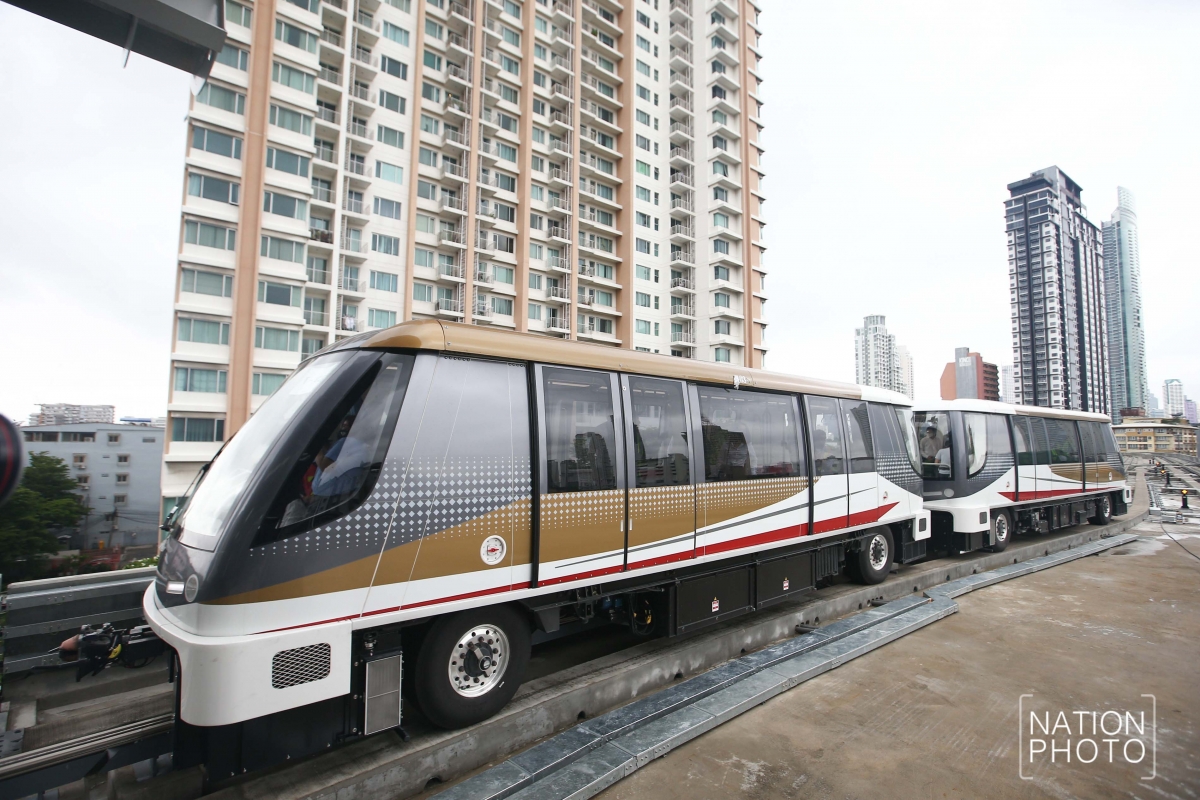
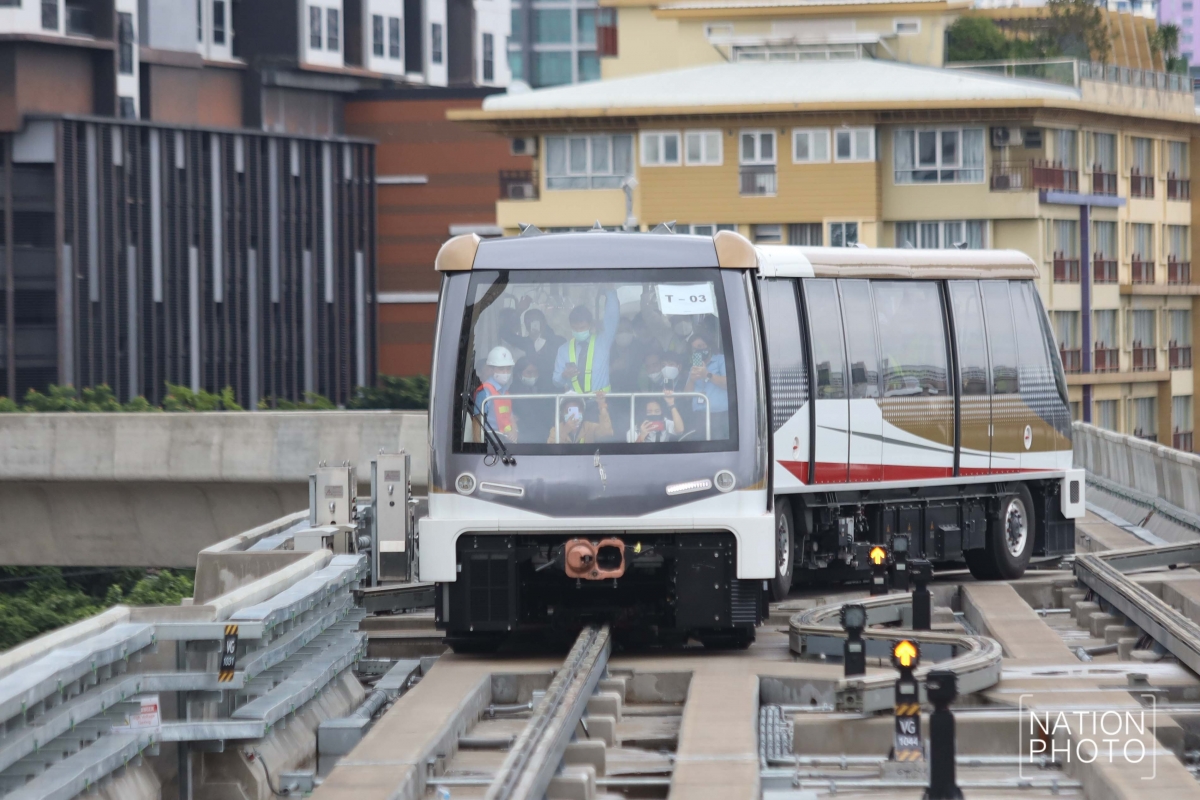
EconOct 08. 2020Photo Credit: Nation Photo by Tanachai PramarnpanichPhoto Credit: Nation Photo by Tanachai Pramarnpanich 
By The Nation

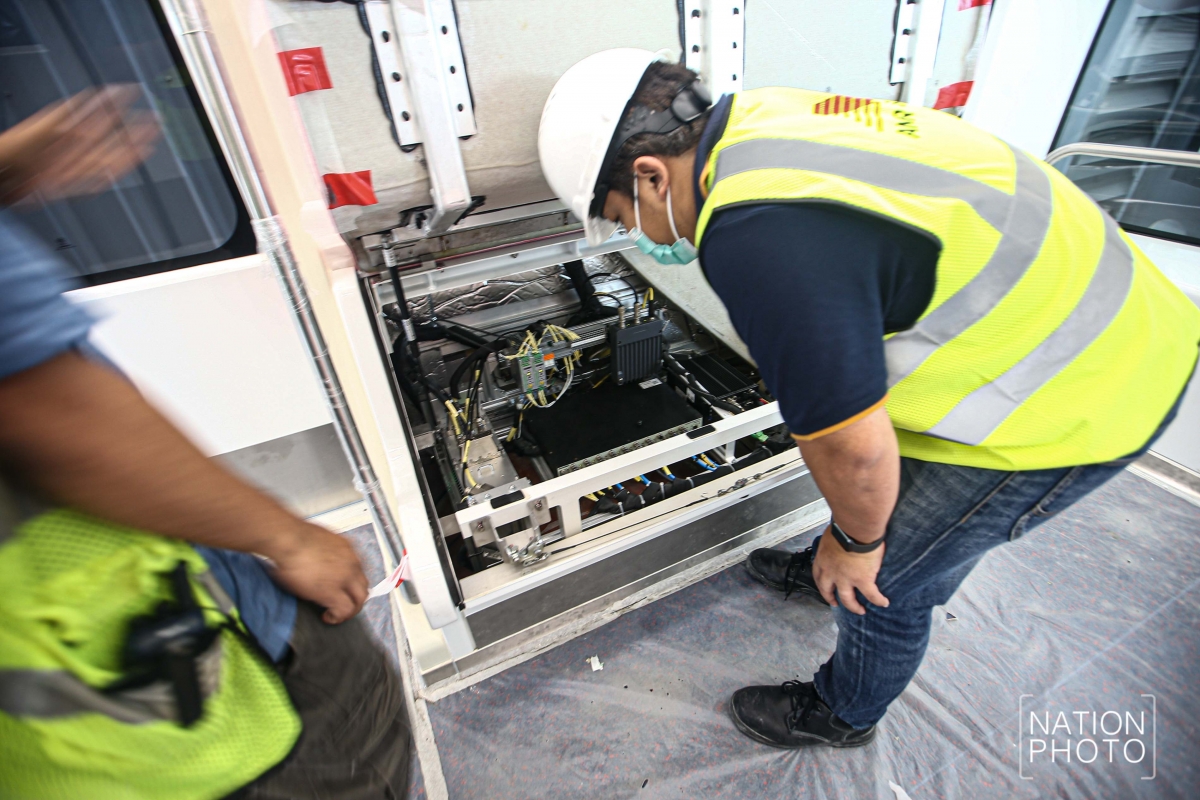
Bangkok governor Pol General Aswin Kwanmuang, accompanied by Bangkok Metropolitan Administration officials, visited the Bangkok Mass Transit System (BTS) Gold Line’s Krung Thonburi station on Thursday to check its progress.

The line’s construction began in 2018, and 96 per cent has been completed.

The Gold Line was initially scheduled to go into operation this month, but that has been postponed to December due to a delay in the delivery of bogies and improvement of its entrances.

The construction of the 2.75-kilometre Gold Line, which has four stations, is divided into two phases. The first phase covering 1.8km comprises three stations – Krung Thonburi, Charoen Nakhon and Klong San.

The line will be operated using an automated guideway transit system and will feature three unmanned Bombardier Innovia APM 300 trains that can reach a maximum speed of 80km per hour.

Each train comprises two passenger bogies that can contain 276 passengers. Approximately 42,000 commuters per day are expected to use the Gold Line when it opens.

SET boosted by Trump’s U-turn on stimulus measures #SootinClaimon.Com

#SootinClaimon.Com : ขอบคุณแหล่งข้อมูล : หนังสือพิมพ์ The Nation.

SET boosted by Trump’s U-turn on stimulus measures

EconOct 08. 2020

By The Nation

The Stock Exchange of Thailand (SET) Index closed at 1,274.83 on Thursday, up 11.12 points or 0.88 per cent. The volume of total transactions was Bt56 billion with an index high of 1,282.65 and a low of 1,269.50.

In the morning session, a Krungsri Securities analyst said he expected the index to rise to between 1,270 and 1,275 points before falling in response to news that President Donald Trump has made a U-turn and is moving again to promote economic stimulus measures as well as inject cash to help the aviation industry and small businesses. Another positive factor is Thailand’s Centre for Economic Situation Administration approving measures to stimulate consumer spending from October 23 to December 31.

However, the analyst warned investors to beware of mass sell-offs by foreign investors as this would pressure the index.

The top 10 stocks with the highest trade value today were DELTA, PTT, CRC, KBANK, MINT, AOT, IVL, STGT, TU and ADVANC.

As of 4.30pm, the price of oil rose by US$0.61 or 1.53 per cent to $40.56 per barrel, while gold rose by $5.70 or 0.30 per cent, to $1,896.50 per ounce.

Other Asian indices were mixed:

Japan’s Nikkei Index closed at 23,647.07, up 224.25 points or 0.96 per cent.

Hong Kong’s Hang Seng Index closed at 24,193.35, down 3.78 49.51 points or 0.20 per cent.

South Korea’s KOSPI Index closed at 2,391.96, up 5.02 points or 0.21 per cent.

Taiwan’s TAIEX Index closed at 12,887.19, up 140.82 points or 1.10 per cent.

China’s stock markets were closed for the Moon Festival.

Asean still attractive for European businesses, survey shows #SootinClaimon.Com

#SootinClaimon.Com : ขอบคุณแหล่งข้อมูล : หนังสือพิมพ์ The Nation.

Asean still attractive for European businesses, survey shows

EconOct 08. 2020Chris Humphrey, executive director of the councilChris Humphrey, executive director of the council 

By The Nation

The EU-Asean Business Council on Thursday released its sixth Business Sentiment Survey, which showed that most European businesses based in the region see Asean as offering the best economic opportunities and most expect to expand in the next five years.

However, they cite supply chain barriers, Asean Economic Integration and FTAs as crucial areas to address. Among the key highlights of this year’s survey are:

• 56 per cent of EU businesses plan to enter Asean markets, a slight drop from 61 per cent in 2019.

• 65 per cent of respondents favour Thailand as the second-best alternative for expansion and EU-Asean free-trade agreement, similar to previous years.

• 59 per cent of respondents in Thailand are satisfied with the government’s Covid-19 response.

• 53 per cent see Asean as the region with the best economic opportunity compared to 63 per cent last year.

• 47 per cent are considering reorganising supply chains post-Covid-19, with Asean, Europe and China seen as top destinations

• 73 per cent expect to expand current levels of trade and investment in Asean in the next five years, compared to 84 per cent last year.

• Only 2 per cent feel the Asean Economic Integration is progressing fast enough, versus 6 per cent last year.

• Only 4 per cent find Asean customs procedures speedy and efficient, versus 8 per cent in 2019.

• 62 per cent of respondents who use supply chains reported facing many obstacles to the efficient use of supply chains in Asean, compared to 78 per cent last year.

• 98 per cent said they want EU to accelerate FTA negotiations with the grouping, slightly higher than 96 per cent in 2019.

Donald Kanak, chairman of the EU-Asean Business Council, said: “This year’s survey confirms that Asean is still seen as the region of best economic opportunity, but as would be expected during the Covid-19 crisis, the outlook for increased trade and investment shows signs of softening.”

This year’s survey asked which regions in the post-Covid era would attract more investment on supply chains. While Asean received the most votes, Europe and China also received many.

“Almost half expect supply chains to be reorganised following Covid-19. That makes the unfinished business on the Asean economic integration and progress on trade facilitation crucial to the region’s sustainable recovery from the economic downturn,” Kanak continued.

Chris Humphrey, executive director of the council, said: “The message from the survey is clear: Asean Economic Integration appears to be at a standstill. Asean and its members need to pick up the pace to meet the AEC Blueprint 2025 goals.

“European businesses are now adjusting their strategy according to local environments, rather than waiting for substantial progress in regional economic integration. European businesses are also very concerned about the lack of progress on further FTAs with the Asean region, and in particular the long talked about region-to-region FTA which eight out of 10 see as potentially delivering more benefits that a series of bilateral FTAs.”

The survey was conducted from April to July during the height of the pandemic and lockdowns in the region. In total, 680 respondents were recorded from European businesses in the 10 Asean member states. Respondents were either in the services or manufacturing industries, ranging from hospitality and tourism to the manufacture of pharmaceuticals and medical equipment.

Thai banks, corporates will take time to recover in wake of pandemic #SootinClaimon.Com

#SootinClaimon.Com : ขอบคุณแหล่งข้อมูล : หนังสือพิมพ์ The Nation.

Thai banks, corporates will take time to recover in wake of pandemic

EconOct 08. 2020

By The Nation

Thailand’s recovery after the Covid-19 outbreak is likely to be weighed down by the country’s high reliance on tourism and weak domestic demand, Fitch Ratings analysts said at the agency’s annual conference.

The two-day conference, which started on Wednesday, focused on the credit impact of the pandemic.

Fitch still expects Thailand’s sovereign ratings to be resilient in light of its strong public and external finance buffers. However, the country’s banking and corporate sector face significant financial and operating risks into 2021.

James McCormack, managing director and global head of sovereigns at Fitch Ratings, said there is a sequential economic recovery underway globally, led by China where the virus appears to have been contained and production levels have rebounded.

However, Fitch does not forecast a “V-shaped” recovery for Thailand, as the services sector, including tourism, will be slow to gain traction amid prolonged restrictions on movement and new social distancing norms.

Thailand is among the countries most exposed to tourism, and Fitch forecasts an economic contraction of 7.8 per cent this year, followed by an expansion of 3.9 per cent in 2021, both below the global average. Even so, Thailand’s (BBB+/Stable) sovereign rating is still supported by comparatively robust public and external finances.

Both the US and Europe are still tackling Covid-19 infections, though Fitch does not expect a return of economy-wide lockdowns. Fiscal support will continue as long as effects of the pandemic linger, and the surge in global government debt levels is the primary reason for the record number of “negative outlooks”, which currently stand at 40.

The United States’ “AAA” rating has been given negative outlook and near-term uncertainties may rise with the upcoming election. A number of European sovereigns are also on negative outlook, and rating outcomes will be guided in part by medium-term fiscal consolidation strategies. The same is true of Japan (A/Negative), which has the highest government debt burden of any Fitch-rated sovereign.

In his presentation on the banking sector, Parson Singha, senior director of financial institutions at Fitch Ratings Thailand, pointed out that the pandemic has raised the level of credit risk globally, leading to a significant deterioration in the operating environment for banks.

In the longer run, Thai banks may suffer the adverse impact of a period of low interest rates and poor economic growth, which make finding earnings drivers more difficult. Rapid changes in technology and consumer behaviour also pose risks, but could also present opportunities to nimble players.

Obboon Thirachit, director of corporate ratings at Fitch Ratings Thailand, said the agency expects the pandemic to cause aggregate EBITDA (earnings before interest, taxes, depreciation and amortisation) of Thai corporates drop by 24 per cent, with median leverage increasing 4.4 times this year, compared to 2.8 times last year.

Fitch expects a gradual earnings recovery and deleveraging in 2021, subject to the continued containment of the pandemic in Thailand.

Oil, gas and petrochemicals are among the hardest-hit sectors amid the plunge in oil price and weak product margins. International travel restrictions and higher unemployment will remain a constraint to the recovery of hotel, airline, residential property and non-food retail industries. The more resilient sectors are telecoms, utilities and food retail.

With several Thai corporates on negative outlook, further downgrades are possible if the expected economic recovery falters.

Siew Wai Wan, senior director of insurance ratings at Fitch Ratings, said operating challenges from the pandemic have exacerbated the impact from the low interest rate environment and recent catastrophes. Insurance companies are expected to increasingly focus on capital and risk management to withstand the volatile operating landscape as well as stricter regulatory regimes.

Gulf Energy expects Bt700m dividend boost from hiking its stake in Intouch #SootinClaimon.Com

#SootinClaimon.Com : ขอบคุณแหล่งข้อมูล : หนังสือพิมพ์ The Nation.

Gulf Energy expects Bt700m dividend boost from hiking its stake in Intouch

EconOct 08. 2020

By The Nation

Gulf Energy Development (Gulf) is expected to reap dividends of around Bt700 million per year after securing a 10-per-cent stake in Intouch Holdings, experts said.

Recently, Gulf became the second-largest shareholder in Intouch after approved spending of up to Bt19 billion to boost its shareholding from 7.99 per cent to 10 per cent.

Also, Gulf’s board of directors approved the setting up of Gulf 1 to operate all forms of solar energy businesses, such as solar farms and solar rooftop panels, as well as providing maintenance services for the said renewable energy systems. The new company will have a registered capital of Bt100 million in which the holding company will have a 99.99 per cent stake.

Theethanat Jindarat, an analyst at Yuanta Securities, expected Gulf to receive dividend of approximately Bt700 million per year from investment in Intouch shares. Meanwhile, he expected Gulf to increase its shareholding in Intouch shares if Gulf has a strong financial position, and Intouch aims to expand its business in other infrastructure areas.

“At the end of July, Gulf’s electricity production capacity was 6,409MW, while electricity production capacity according to the company’s shareholding was 2,959MW in which 46 per cent of production capacity came from independent power producers, 42 per cent from small power producers, and 12 per cent from alternative energy,” he explained

“Meanwhile, 90 per cent of Gulf’s domestic electricity production capacity is being distributed to the Electricity Generating Authority of Thailand (Egat) and 10 per cent is being distributed to the private sector. Gulf will distribute 95 per cent of electricity to Egat from 2027.”

According to Gulf’s plan to open power plants for commercial use, he said electricity production capacity according to the company’s shareholding would increase by 42 per cent to 4,200MW in 2021 and increase by approximately 22 per cent yearly from 2020 to 2025.

“Gulf’s profit in 2021 is expected to increase sharply by 76 per cent from two phases of GSRC’s power plants with production capacity totalling 2,650MW, which will be operated in 2021 and 2022. The company’s profit is expected to increase continuously until 2027 from the opening of new power plants,” he said

He added that Gulf’s share price was currently around Bt31 per share, with price to earnings in 2021 at 46.3 times.

“However, the company’s price/earnings to growth ratio in 2021 is expected to be at 0.61 times due to the 76 per cent increase in profit forecast and acquisition of power plants, so this is a chance to invest in the company’s shares,” he said.

“Also, we assumed the company’s natural gas price at Bt260 per million British Thermal Unit. When natural gas price drops every Bt10 from the assumption, the target price of the company’s share will increase by Bt1.50 per share.”

DITN selects 20 dairy businessmen for trade talks with Guangzhou #SootinClaimon.Com

#SootinClaimon.Com : ขอบคุณแหล่งข้อมูล : หนังสือพิมพ์ The Nation.

DITN selects 20 dairy businessmen for trade talks with Guangzhou

EconOct 08. 2020DITN director-general Auramon SupthaweethumDITN director-general Auramon Supthaweethum 
By The Nation

The Department of International Trade Negotiations (DITN) aims to lead 20 selected dairy entrepreneurs out of a total of 81 to Guangzhou, China, for discussions in a plan to expand the kingdom’s overseas markets under free-trade agreements, DITN director-general Auramon Supthaweethum said.
The department had two years ago taken dairy businessmen on a similar trade trip to Shanghai and Singapore, with a successful penetration both markets.

“We are assessing the Covid-19 situation. If possible, we will go. If this is not possible, we must adjust to conduct business negotiations online instead,” Auramon said.

“But I believe that Thailand will be able to expand sales of its milk and dairy products to China as these have been developed in terms of quality and innovation, such as edible milk tablets that do not decay, milk tablets mixed with fruit, or pasteurised milk that can be stored for 40-45 days, making it possible to meet the needs of the market,” she said.

Under FTA deals, Thailand has reduced taxes to 0 per cent for almost all dairy products. The items that are expected to see a tax cut in 2021 and 2025 for Australia and New Zealand include milk powder products containing 1.5 per cent fat (not for raising babies), milk products, whey, butter, fat, cheese and cream products, milk-flavoured beverages and skimmed milk powder.

According to Auramon, Thai products have been recognised for their quality, an advantage in terms of export especially to Asean and Chinese markets.

In the first eight months of the year, Thailand exported cow’s milk and processed cow’s milk worth US$382 million (Bt11.92 billion) to world markets, an increase of 7.9 per cent.

Major dairy exports include UHT ready-to-drink milk, yoghurt and fresh milk, with the main markets being Asean (Cambodia, Philippines, Myanmar, Laos, Singapore), 82.7 per cent, China, 5.4 per cent, and Hong Kong, 3.4 per cent.

PTT flagships synergise oil, trading activities #SootinClaimon.Com

#SootinClaimon.Com : ขอบคุณแหล่งข้อมูล : หนังสือพิมพ์ The Nation.

PTT flagships synergise oil, trading activities

EconOct 08. 2020

By The Nation

PTT Group’s three flagships, Thai Oil, PTT Global Chemical and IRPC, have drawn up a plan to synergise their activities with the aim of adding value to the group’s international trading business and enhancing the group’s competitiveness in the global market.

Project One will allow the three companies to jointly manage and procure crude oil, which will increase their bargaining power in the global market, said Disathat Panyarachun, PTT’s senior executive vice president for International Trading Business Unit.

Joining forces will also allow them to avoid redundant investment in the petrochemical and refinery businesses.

Meanwhile they plan to launch joint international trading activities next year.

SET rises on hopes of economic stimulus measures #SootinClaimon.Com

#SootinClaimon.Com : ขอบคุณแหล่งข้อมูล : หนังสือพิมพ์ The Nation.

SET rises on hopes of economic stimulus measures

EconOct 08. 2020

By The Nation

The Stock Exchange of Thailand (SET) Index rose by 10.13 points, or 0.80 per cent, to 1,273.84 in the morning session on Thursday.

An analyst at Krungsri Securities expected the index to rise to between 1,270 and 1,275 points before falling in response to the news that US President Donald Trump made a u-turn and is moving again to promote economic stimulus measures and inject cash to help the aviation industry and small businesses. Another positive factor is Thailand’s Centre for Economic Situation Administration (CESA) approving measures to stimulate expenses from October 23 to December 31.

However, the analyst warned investors to beware of mass sell-offs of shares by foreigners as this would still pressure the index.

He recommended investors buy the shares of:

> CRC, HMPro, JMart, Com7, KTC, Centel and Mint that will benefit from the CESA’s measures.

> Banpu and Age that are benefiting from a rising coal price in response to strong Chinese demand.

> TU, PlanB, STGT and Com7, whose third-quarter performance is expected to grow.

The SET Index closed at 1,263.71 on Wednesday, up 13.56 points, or 1.08 per cent, while transactions amounted to Bt52.31 billion, with an index high of 1,264.29 points and a low of 1,245.09.