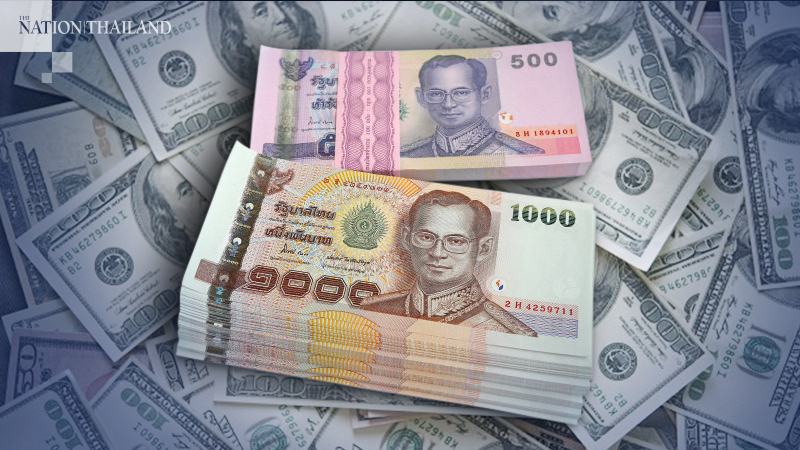
The baht opened at Bt31.25 to the US dollar this morning (August 27), strengthening from yesterday’s close of Bt31.36.
The Thai currency is expected to move between Bt31.10 and Bt31.30, said Jitipol Puksamatanan, head of Markets Strategy at SCB Securities.
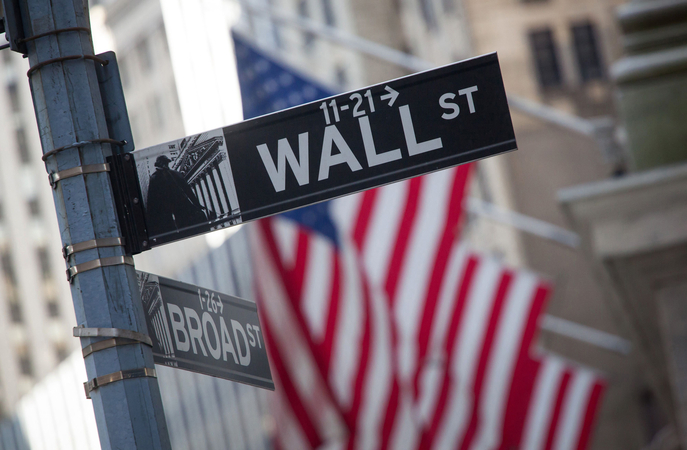
The US capital market hit another new high on Wednesday night (Thailand time). The S&P 500 Index rose by 1.0 per cent, while Europe’s Stoxx Euro 600 was up 0.9 per cent over positive news of a Covid-19 vaccine and US monetary policy, which is likely to be eased for the long term, Jitipol said.
Meanwhile, the bond market did not gain much positive sentiment from a relaxed US monetary policy. The US Ten-Year bond was unchanged at 0.68 per cent, causing the dollar to weaken slightly, by 0.1 per cent, as the Australian and New Zealand dollars strengthened by 0.6 and 1.0 per cent on belief that inflation could be higher than what central banks expected.
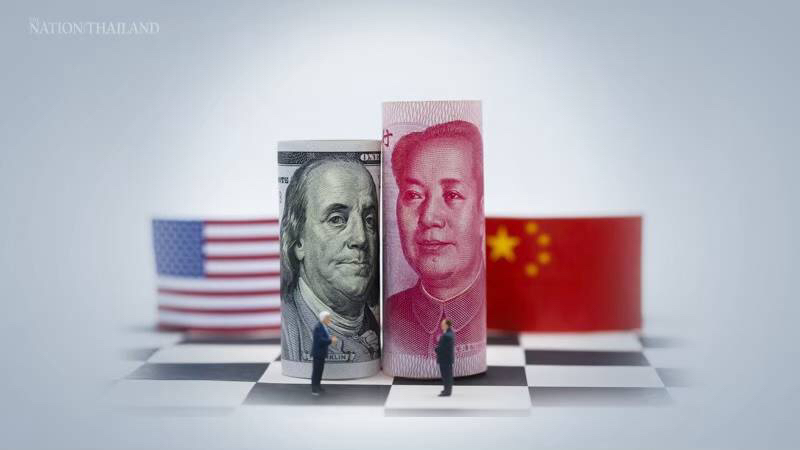
The baht continued to gain more liquidity in response to a global trade recovery and foreign investors’ mass buy-ups in the bond market. If the US and China reach an agreement on the first phase of trading, the baht and other Asian currencies will strengthen further, Jitipol added.
By The Washington Post · Jeanne Whalen · NATIONAL, BUSINESS, WORLD, ASIA-PACIFIC WASHINGTON – The Trump administration added another 24 Chinese companies to a trade blacklist for helping China build artificial islands in the South China Sea, a construction program the U.S. has labeled an illegal attempt to control an important shipping route.
The blacklist, known as the Entity List, has become a favorite Trump administration tool to crack down on China, and now includes more than 300 Chinese entities.
The Commerce Department, which maintains the list, has used it against Chinese telecom company Huawei and against Chinese entities allegedly engaged in human-rights violations in China’s Xinjiang region.
The trade sanction bars U.S. companies from exporting products to the targets without a government license. The entities joining the list include Chinese state-owned defense contractors that engage in little trade with the United States – total U.S. exports to the companies amounted to $5 million over the last five years, senior administration officials said Wednesday, speaking anonymously to discuss sensitive trade matters.
But the officials said they hoped the sanctions would have a wider impact by discouraging other countries from engaging with the companies through China’s Belt and Road program, which builds infrastructure in developing countries.
The newly listed companies, including China Communications Construction Company (CCCC) and China Electronics Technology Group, are big contractors in the Belt and Road initiative, which in building bridges, dams and digital infrastructure around the world has come under international criticism for saddling recipient countries with debt.
By listing the latest companies, the U.S. has “various aims, including, of course, to impose costs on bad actors and to encourage all sorts of parties and institutions and governments around the world to assess the risk and reconsider business deals with the sort of predatory Chinese state-owned enterprises we have identified here,” a senior State Department official said.
In the South China Sea, the companies have helped Beijing dredge and construct more than 3,000 acres of artificial islands featuring anti-ship missiles and other military equipment, the Commerce Department and State Department said in separate statements Wednesday.
China has used these islands to assert new maritime claims in the region, and to “bully” the Philippines and other countries out of their rights to fishing waters and offshore energy deposits, the State Department said last month, calling China’s actions “completely unlawful.”
In addition to listing the companies, the U.S. on Wednesday also imposed visa restrictions on executives at those companies, and on other individuals responsible for the island building.
China “must not be allowed to use CCCC and other state-owned enterprises as weapons to impose an expansionist agenda,” Secretary of State Mike Pompeo said in a statement Wednesday. “The United States will act until we see Beijing discontinue its coercive behavior in the South China Sea, and we will continue to stand with allies and partners in resisting this destabilizing activity.”
The Chinese companies could not immediately be reached for comment. China’s embassy in the U.S. did not respond to a request for comment.
Several years ago, the Philippines filed a case with the Permanent Court of Arbitration, an international tribunal in the Netherlands, claiming that China’s activities in the South China Sea violated the United Nations Convention on the Law of the Sea.
In 2016, the court sided with the Philippines, determining among other things that China “had violated the Philippines’ sovereign rights” by “interfering with Philippine fishing and petroleum exploration,” by “constructing artificial islands” and by “failing to prevent Chinese fishermen from fishing in the zone.”
The court also found that Chinese law enforcement vessels had created a “serious risk of collision when they physically obstructed Philippine vessels.” And it ruled that China, through its island construction, “had caused severe harm to the coral reef environment and violated its obligation to preserve and protect fragile ecosystems.”
By Syndication Washington Post, Bloomberg · Vildana Hajric, Sarah Ponczek · BUSINESS, US-GLOBAL-MARKETS Stocks extended a streak of record gains amid rising expectations for loose monetary policy while the economy shows signs of recovering from the coronavirus pandemic. The dollar weakened and Treasurys pared losses.
Surging technology shares pushed the S&P 500 and Nasdaq Composite indexes to fresh highs for a fourth straight day, while the MSCI All-Country World Index climbed to a record. The S&P has jumped about 55% from its March lows. Salesforce.com Inc. leaped as much as 29% after the software developer’s revenue easily beat estimates, signaling clients responded to the pandemic by upgrading technology systems. U.S. orders for durable goods rose in July by more than double estimates, indicating factories will help support the economic rebound in coming months.
“The continued market juggernaut is certainly impressive,” said David Donabedian, chief investment officer of CIBC Private Wealth Management. “The idea that we’re going to have a rip-roaring rebound in the third quarter has been supported by the data.”
Gains in Germany’s stocks pulled European equities higher as the country extended a program that has kept millions of people from losing their jobs in the region’s biggest economy. Shares fell in Shanghai and Sydney. Crude oil traded near its most costly in five months as Hurricane Laura bore down on key refining facilities on the U.S. Gulf Coast.
As global economies reopen, investors are focusing on the progress of a coronavirus vaccine while showing cautious optimism about controlling fresh outbreaks. Traders are also awaiting Federal Reserve Chairman Jerome Powell’s speech on Thursday about the central bank’s monetary policy framework review, which is expected to entail a new inflation strategy.
“We’re in a slow melt-up sort of driven by Fed liquidity and backstops in the fixed income markets,” said Marc Chaikin, founder of Chaikin Analytics. “It’s giving people with money on the sidelines almost no opportunity to get in comfortably.”
Elsewhere, soybean futures climbed to a seven-month high in Chicago after people familiar with the matter said China is set to buy a record amount from America this year.
These are the main moves in markets:
Stocks
The S&P 500 Index climbed 1% to 3,478.81 as of 4:01 p.m. EDT, hitting the highest on record with its fifth consecutive advance and the largest increase in two weeks.
The Dow Jones industrial average climbed 0.3% to 28,332.53, the highest in six months.
The Nasdaq Composite Index increased 1.7% to 11,665.06, hitting the highest on record with its fifth consecutive advance and the largest increase in two weeks.
The Stoxx Europe 600 Index increased 0.9% to 373.12, the highest in two weeks.
Currencies
The Bloomberg Dollar Spot Index declined 0.2% to 1,169.69, the lowest in more than a week.
The euro decreased 0.1% to $1.1827.
The Japanese yen strengthened 0.4% to 106 per dollar, the largest rise in more than a week.
Bonds
The yield on 10-year Treasurys climbed one basis point to 0.69%, the highest in more than a week.
Germany’s 10-year yield increased two basis points to -0.42%, the highest in almost two weeks.
Britain’s 10-year yield gained four basis points to 0.302%, the highest in 11 weeks.
Commodities
West Texas Intermediate crude climbed 0.1% to $43.38 a barrel, the highest in almost six months.
Gold strengthened 1.2% to $1,952.28 an ounce, the highest in more than a week on the biggest climb in more than a week.
Copper rose 1.2% to $2.99 a pound, the largest advance in a week.
The number of newly registered companies in July stood at 5,667, down 1 per cent month on month and 12 per cent year on year due to potential investors’ concerns over the Covid-19 fallout, said the Department of Business Development.
However, the situation is better than at the onset of the outbreak, added its deputy director-general Sorada Lertharpachit.
Registered capital of newly founded companies in July was Bt16.714 billion, up 13 per cent month on month but down 27 per cent year on year.
Most of the new companies are in construction, followed by real estate and logistics.
Normally, restaurants and eateries rank third, but that changed in May when they were replaced by logistics and e-commerce businesses as consumers switched to online retail channels during lockdown.
The number of dissolved companies in July was 1,261, down 6 per cent from June and 21 per cent year on year. Their registered capital was Bt7.668 billion, down 49 per cent month on month and 7 per cent year on year.
Prime Minister Prayut Chan-o-cha said on Wednesday he was in talks with state agencies on how to open the country to foreign tourists after the Covid-19 situation improves.
Being discussed are the timing for reopening and which provinces will be the first to open for foreign tourists.
The first phase may only see a small number of tourists allowed into the country and their areas of possible travel limited, he added.
The Thai Hotel Association (THA) recently urged the government to reopen the country to foreigners, as hotels struggle with near-zero occupancy rates and some small operators are forced to close.
THA chairwoman Marisa Sukosol Nunbhakdi said the government should focus on specific countries or cities and come up with promotions to bring back tourists.
Meanwhile, Commerce Minister Jurin Laksanawisit said Thailand is focusing on online trade and boosting border trade.
The ministry’s public-private committee will meet next week to seeks ways to boost exports and border trade volume.
The Stock Exchange of Thailand (SET) Index closed at 1,322.55 today (August 26), up 6.56 points or 0.5 per cent. Total transactions amounted to Bt48.652 billion with an index high of 1,323.97 and a low of 1,311.14.
In the morning session, a stock analyst at Krungsri Securities expected the index to fluctuate between 1,310 and 1,325 on the rising oil price and ongoing US-China trade talks.
“The price of oil rose after the US cut oil production in the Gulf of Mexico due to a hurricane,” he explained.
“However, investors would delay trading to follow the US Federal Reserve’s announcement on Thursday for signs of US economic direction and monetary policy.”
The 10 stocks with the highest trade value today were STGT, SAWAD, AOT, PTT, KBANK, SCC, MTC, CPALL, MINT and PTTEP.
As of 4.30pm, the price of oil had fallen by US$0.01 or 0.02 per cent to $43.34 per barrel, while gold rose by $4.70 or 0.24 per cent, to $1,927.80 per ounce.
Other Asian indices were mixed:
Japan’s Nikkei Index closed at 23,290.86, down 5.91 points or 0.025 per cent.
China’s Shang Hai SE Composite Index closed at 3,329.74, down 43.84 points or 1.30 per cent, while the Shenzhen SE Component Index closed at 13,428.40, down 241.01 points or 1.76 per cent.
Hong Kong’s Hang Seng Index closed at 25,491.79, up 5.57 points or 0.022 per cent.
South Korea’s KOSPI Index closed at 2,369.32, up 2.59 points or 0.11 per cent.
Taiwan’s TAIEX Index closed at 12,833.29, up 75.04 points or 0.59 per cent.
The Energy Conservation Promotion Fund Committee agreed to earmark Bt2.06 billion for 1,035 energy-conservation projects in a meeting with Energy Minister Supattanapong Punmeechaow at the Energy Ministry on Wednesday.
The 1,035 are divided into two groups:
The first group includes 16 energy efficiency projects valued at Bt535.79 million, and 1,019 projects related to renewable energy valued at Bt1.53 billion.
As for off-grid power-generation projects, operators are required to apply for permission to use allocated areas in line with relevant laws and licences are expected to be granted by September 15.
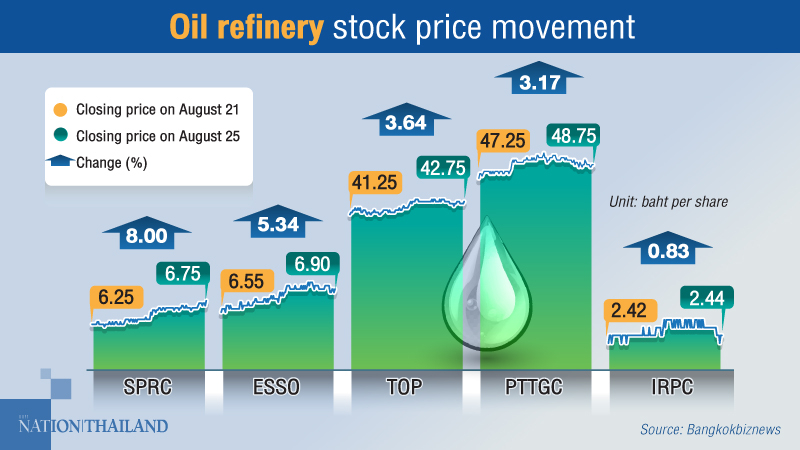
Oil-refinery shares rose in response to news of hurricanes Marco and Laura recently hitting the US coast on the Gulf of Mexico, experts said.
An analyst at CGS-CIMB Securities (Thailand) said this may be the best time to buy shares in oil-refineries, such as Thai Oil (TOP), Star Petroleum Refining (SPRC), Esso (Thailand) (ESSO), PTT Global Chemical (PTTGC) and IRPC, for short-term speculation.
“The hurricanes forced oil firms to evacuate employees from 114 out of 643 oil rigs and also cut down on the production of oil and natural gas by 57.6 per cent and 44.6 per cent, respectively,” the analyst said.
“The cost of refining oil will be high for a while in the wake of the hurricanes, which can be seen in the increase of fuel prices yesterday.”
Meanwhile, Jakapong Chawengsri, senior director at Kasikorn Securities said, if the hurricanes had hit the Texan capital of Houston directly, the cost of refining oil would have risen sharply.
“Oil refinery stocks that would gain the most benefit SPRC and ESSO because these companies have a lot of petrol, and the demand for petrol in the US is very high, so we recommend buying their shares for short-term speculation,” he said.
“However, oil refinery shares will be pressured from an excess in supply next year.”
Some 20 per cent of Thai corporations have permanently shifted to working from home to curb the spread of Covid-19 and save costs, PwC Thailand said.
Dr Pirata Phakdeesattayaphong, consulting partner for PwC Thailand, said the pandemic has forced companies to embrace social distancing, prompting work-from-home policies to become the new normal.
“We estimate that 20 per cent of Thai companies currently have a policy that allows their employees to work from home permanently to not just protect them from Covid-19, but to also save themselves some operating costs such as rent, utility bills and other maintenance costs,” she said.
More Thai firms are also expected to outsource or hire highly skilled contingent workers, including freelancers for non-permanent roles, if the pandemic persists. This will give them better flexibility in managing their workforce and cost-cutting strategies.
“They’re also using a hybrid work model where staff have the option of working from home or coming to the office for meetings or workshops. Working from home for extended periods of time can be stressful, causing employees to struggle to find their work-life balance. Our data shows that most people prefer working from home at least two days a week,” she said.
According to PwC’s CEO Panel Survey, which canvassed some 699 CEOs in 67 countries between June and July on emerging business models and key trends resulting from the pandemic, a majority of the respondents (78 per cent) expect remote working and collaboration to have a lasting impact after Covid-19. That was followed by shifts towards automation (76 per cent) and low-density workplaces (61 per cent).
Challenges of working remotely
Remote work is not without its challenges. The quality of work and overall productivity are among key issues many business leaders are facing when assessing work-from-home policies.
Dr Pirata suggested it’s essential that organisations provide best practices for remote working and use the right tools to measure staff performance. This includes adopting digital solutions to help managers track work progress, helping team members solve problems quickly and prioritising automation for certain types of work.
Motivating and encouraging employees who work remotely is also a top priority for leaders. Human resources functions need to adjust the employee experience, including providing opportunities for employees to meet, connect and build communities so they are more engaged. Companies also need to have a clear policy on time-out/vacation for employees and protocols for break times during the day.
Even as the pandemic changes the daily work life of employees in one way or another, it’s critical for them to develop new skills while adapting to new situations. Flexibility and adaptability will be important skills to increase efficiency and allow them to stay agile in a world full of rapid and unprecedented changes, she added.
As Thailand gradually reopens its borders, new findings from a global study suggests that four out of five Thais are confident that the country is well prepared to deal with an influx of tourists.
The study also found that tourists from Hong Kong, Singapore, Philippines, Indonesia and India are all targeting Thailand as their first destination once their countries’ borders reopen.
Jointly conducted by Blackbox Research, data provider Dynat and language partner Language Connect, the report “Unravel Travel: Fear and Possibilities in a Post Covid-19 World”, examines the sentiments, preferences and expectations of 10,195 people across 17 countries regarding travel after the pandemic.
Thailand is heavily dependent on tourism, with tourist dollars contributing around 11 per cent to the national economy. The vast majority or 93 per cent of Thais recognise the importance of the tourism sector. In fact, 22 per cent of the respondents agreed that there is an urgent need to promote tourism for economic reasons.
Saurabh Sardana, chief operating officer of Blackbox Research, said both regional interest and citizen sentiment towards restarting local tourism have been encouraging, especially given the country’s phased approach in reopening to business and medical tourists. Sardana noted that establishing traveller’s trust in health and safety protocols is key, and that Thailand needs to capitalise on its success in containing the Covid-19 outbreak.
“It is evident from our findings the immense value tourism contributes to Thailand’s economy. As Thailand progressively opens its borders to international visitors, its immediate priority will be to regain traveller confidence.”
In Southeast Asia, Thailand has the strongest domestic appeal. Most or 91 per cent of Thais are keen to support local destinations in the next 12 months – a positive sign given Thailand’s recent investment of Bt22.4 billion to stimulate its domestic tourism.
Sardana noted that while the financial aid will definitely play a part in encouraging locals to travel domestically, the government needs to also take into consideration how travel priorities have shifted in response to the pandemic.
“Our study has found that price is not necessarily the highest priority for their next trip – instead, visitor safety measures overwhelmingly ranked top of the list for most Thai travellers.”
Commenting on the significance of the study’s findings, Sardana said, “The study has shown us that the pandemic has unequivocally shifted how we see travel. In order for travel industry players to stay relevant, they need to change the way they approach every aspect and touchpoint in the traveller experience, emphasising safety and rebuilding trust.”
Other key findings from the survey were:
• Overall, international leisure travel in the short term is off the schedule for most people, with 44 per cent of respondents still keen to avoid international vacations.
• Notably, Japanese (32 per cent), Filipinos (42 per cent), New Zealanders (43 per cent) and Australians (52 per cent) are least eager to take long-haul trips.
• Australia and Japan emerged as the two most popular destinations for Asian travellers, while Spain is on the top of the list of European travellers given the downward trend in Covid-19 cases since June.
• The countries whose tourism appeal took the biggest hit during the pandemic are China, Italy and the US.
• Globally, 80 per cent are willing to pay more for safer accommodation, and 74 per cent are open to paying a higher premium for travel insurance in exchange for protection against pandemics.
• 76 per cent of respondents indicated that their preferred travel destinations will be countries that offer more contactless experiences.
• An overwhelming 66 per cent prefer to travel in their own vehicles for road trips between cities or countries, compared to travelling on a plane (18 per cent), rented or private-hire car or taxi (9 per cent), and buses and trains (7 per cent).
• In terms of what the future of travel looks like, the study found that e-boarding passes (44 per cent), touchless lavatories (43 per cent), contactless journeys from airports to hotels (40 per cent), no more middle seats in transportation (36 per cent), and digital health passports (35 per cent) are some of the new ideas which global travellers hope to see implemented in the near future.


 Prime Minister Prayut Chan-o-cha

 Dr Pirata Phakdeesattayaphong

