Trump finalizes drilling plan for iconic Arctic National Wildlife Refuge #ศาสตร์เกษตรดินปุ๋ย

#ศาสตร์เกษตรดินปุ๋ย : ขอบคุณแหล่งข้อมูล : หนังสือพิมพ์ The Nation.

Trump finalizes drilling plan for iconic Arctic National Wildlife Refuge

EconAug 18. 2020The coastal plain of the Arctic National Wildlife Refuge, with the Brooks Range as a backdrop. CREDIT: U.S. Fish & Wildlife Service photoThe coastal plain of the Arctic National Wildlife Refuge, with the Brooks Range as a backdrop. CREDIT: U.S. Fish & Wildlife Service photo

By The Washington Post · Juliet Eilperin · NATIONAL, BUSINESS, SCIENCE-ENVIRONMENT 
WASHINGTON – The Trump administration will open up the Arctic National Wildlife Refuge to drilling, a move that will auction off oil and gas rights in the heart of one of the nation’s most iconic wild places. Achieving a goal Republicans have sought for 40 years, it marks a capstone for an administration that has ignored calls to reduce fossil fuel consumption in the face of climate change.

The move will allow leasing on the 1.6 million-acre coastal plain, part of a nearly pristine wilderness that is home to migrating caribou and waterfowl as well as polar bears and foxes that live there year-round. It marks a major step toward reviving fossil fuel development in an area that has been untouched for three decades.
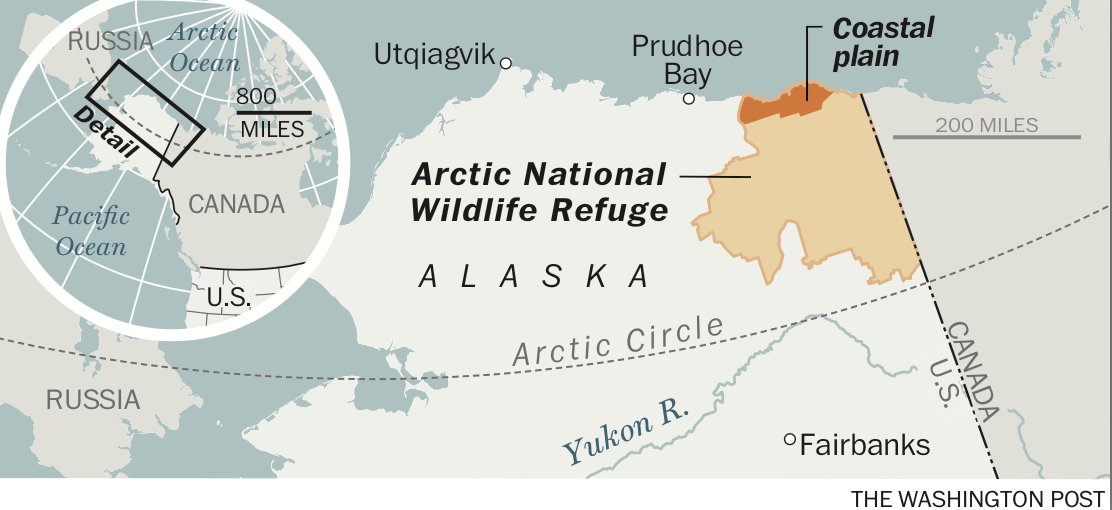
Arctic National Wildlife Refuge, ANWR, Alaska Photo by: The Washington Post — The Washington Post

Arctic National Wildlife Refuge, ANWR, Alaska Photo by: The Washington Post — The Washington Post

In a conference call with reporters, Interior Secretary David Bernhardt said that his department was following through on the 2017 budget bill that instructed the federal government to conduct oil and gas leasing on the refuge.

“President [Donald] Trump’s leadership brought more than three decades of inaction to an end,” he said, adding that the plan was “carefully tailored” to minimize its impact on the surrounding environment. “This is no ordinary oil and gas program on public lands.”

The push to grant rights to drill on the refuge represents one of the most significant energy policy decisions Trump will make before his first term ends in January. He has doggedly worked to expand fossil fuel production in the United States, even as the climate impacts of burning those fuels – scorching temperatures, increased flooding and more-intense storms – have battered the country. In recent months, the administration has expanded oil and gas drilling, weakened gas mileage standards and rolled back energy efficiency standards for appliances.

According to an analysis by the Center for American Progress, a liberal think tank, the lease sales would result in the release of more than 4.3 billion metric tons of carbon dioxide over the projected life of the field. That total, which includes the impact of oil and gas once it is burned, is equal to roughly three-quarters of U.S. annual emissions.

Environmentalists and some Alaska Natives – including the Gwich’in, who live outside the refuge but rely on the Porcupine Caribou Herd, which migrates through it – have pledged to fight the drilling plan in court. Under the 2017 law, the federal government must conduct two lease sales of 400,000 acres each by December 2024.

The first auction would be held by Dec. 22, 2021, according to the plan, though Bernhardt said it was possible that it could take place by the end of this year. “I am confident that we can move forward quite promptly after this decision is rendered,” he said.

Bernhardt estimated that drilling could begin in roughly eight years and that the operations could last for about half a century.

Stretching into the Arctic Ocean’s frigid waters and 200 miles south on land, the refuge encompasses rolling tundra, jagged mountains and boreal forest. It provides habitat for more than 270 different species, including 900 denning polar bears, 250 musk oxen and 300,000 snow geese. While Congress authorized drilling on the coastal plain in 1980, opponents have managed to block energy development there for decades.

The move opens up all of the coastal plain’s polar bear denning habitat to energy exploration. In 2010, according to the U.S. Fish and Wildlife Service, there were 900 Southern Beaufort Sea polar bears left in the world. The overall number of bears, some of whom den on land, has declined 50% since 1980.

In issuing a “record of decision,” officials at the Interior Department’s Bureau of Land Management concluded that establishing a network of well pads and pipelines would not pose an undue threat to the wildlife that depend on the refuge for survival. The plan calls for the construction of as many as four airstrips and major well pads, 175 miles of roads, vertical supports for pipelines, a seawater-treatment plant and a barge landing and storage site.

Adam Kolton, executive director of the Alaska Wilderness League, said in a statement that the administration ignored science and the law in making this decision.

“Our climate is in crisis, oil prices have cratered, and major banks are pulling out of Arctic financing right and left. And yet the Trump administration continues its race to liquidate our nation’s last great wilderness, putting at risk the indigenous peoples and iconic wildlife that depend on it,” Kolton said. “We will continue to fight this at every turn, in the courts, in Congress and in the corporate boardrooms.”

Bernhardt said that while Democrats might want to scuttle the lease sale after taking office, they must contend with the fact that Congress has legally mandated auctions there. “They can’t just simply unduly delay. So that is a reality that Congress created.”

But if Democrats win control of the White House and both the House and Senate, experts said, they could pass new legislation overriding the 2017 law. 

David Hayes, who served as Interior deputy secretary under both Bill Clinton and Barack Obama, said he believes the administration’s decision is legally vulnerable because it restricted its environmental analysis to the leasing stage and said it would only affect 2,000 acres on the surface. The 2017 law, he noted, instructs Interior to conduct an oil and gas program that covers “the leasing, development, production and transportation of oil and gas in and from the Coastal Plain area within the Arctic refuge.”

“You can’t just take the first step of the program,” Hayes said. “I think that statutory language is a real tripwire for these guys.”

Bernhardt, who noted that he had significant experience litigating cases related to Interior’s oil and gas leasing programs, said the department had crafted the decision within the confines of the law. “I would not be going forward if I was not very comfortable with the lines that we drew in this case.”

Alaska Republicans hailed the decision as an economic boost for their state. Gov. Mike Dunleavy said in a statement that the vision of Trump and Bernhardt “will lead to the responsible development of Alaska’s abundant resources, create new jobs, support economic growth and prosperity.”

Sen. Lisa Murkowski agreed. “This is a capstone moment in our decades-long push to allow for the responsible development of a small part of Alaska’s 1002 area.”

Frank Macchiarola, senior vice president of policy, economics and regulatory affairs at the American Petroleum Institute, said in a statement that the oil and gas industry has proven it can drill on Alaska’s North Slope safely. 

“The industry has a well-established record of safe and environmentally responsible development of Alaska’s energy resources and has been recognized for its success in being respectful of Alaska’s wildlife and surrounding communities,” he said.

It is unclear which companies will bid on leases in the refuge and risk a potential backlash from conservation groups and the public. In an April poll, Yale and George Mason universities found that 33% of registered voters supported drilling for oil there, while 67% opposed it. And the low price of oil has made projects on Alaska’s North Slope, where operations are more costly, less attractive recently.

Some major banks, including JPMorgan Chase and Goldman Sachs, have already announced they will not finance projects in the refuge, and other financial institutions are under pressure to follow suit.

The government estimates there could be 7.8 billion barrels of recoverable oil on the coastal plain, though seismic surveys have not been conducted since the 1980s. Initially the administration projected that leasing would generate $1.8 billion in revenue over a decade, but it has subsequently cut that estimate in half.

One of the unanswered questions is how much oil lies beneath the refuge’s surface. There has not been seismic testing to identify potential deposits since the 1980s, and the results of any new testing will not be released before companies are asked to make bids on leases there.

But Bernhardt said he did not think that would deter bidders. “I think a lot of people will bid for leases without seismic data.”
S&P 500 gains, fails to eclipse its all-time high #ศาสตร์เกษตรดินปุ๋ย

#ศาสตร์เกษตรดินปุ๋ย : ขอบคุณแหล่งข้อมูล : หนังสือพิมพ์ The Nation.

S&P 500 gains, fails to eclipse its all-time high

EconAug 18. 2020

By Syndication Washington Post,

U.S. stocks climbed amid a rally in technology companies, while failing to top their February closing record as big banks sold off. Treasurys rose, while the dollar fell.

For a third time in the past week, the S&P 500 popped above the closing record during the session, but ended below it. The American equity benchmark was still buoyed by fresh Chinese stimulus overnight and gains in giants such as Amazon.com Inc. and Google’s parent Alphabet Inc., which drove the NYSE FANG+ Index up about 3%. The Nasdaq 100 outperformed amid a jump in Tesla Inc. and Nvidia Corp. as well as strong results from online retailer JD.com Inc. Big banks sank after Warren Buffett’s Berkshire Hathaway Inc. pared stakes in many of the industry’s top names. Boeing Co. weighed on the Dow Jones industrial average. Dow Jones closed at 27,844.91, or  0.31 % down, Nasdag closed at 11,129.73, or 1 % up and S&P 500 climed 0.27 % to close at 3,381.99. 

The relentless rally in stocks has pushed the S&P 500 up more than 50% from its March lows amid large stimulus injections and better-than-expected economic and earnings data. Goldman Sachs Group Inc.’s David Kostin boosted his year-end price target for the gauge to 3,600 from 3,000, citing the firm’s above-consensus U.S. growth expectations keyed off positive news on the vaccine front. He joined the likes of Yardeni Research founder Ed Yardeni and RBC Capital Markets’ Lori Calvasina who’ve raised their forecasts in recent weeks.

“The path of least resistance remains higher for stocks,” Paul Nolte, a portfolio manager at Kingsview Investment Management, wrote in a note. “The easy monetary policy, low interest rates and better economic data have been the fuel pushing stocks ever higher. Many of the historical supports, like earnings and strong balance sheets do not matter today. The speculative fervor has investors in its grip.”

Despite the rally, the fact that S&P 500 keeps failing to pierce its record could be a sign that gains may get harder to come by now. Chances for a deal in Congress on a new, comprehensive stimulus package before September diminish with each passing day. Democrats and Republicans are focused on their party presidential nominating conventions this week and next. Meanwhile, the almost daily drumbeat of tensions between the U.S. and China shows little sign of letting up.

“Don’t bet against this bull market just yet,” Ryan Detrick, chief market strategist at LPL Financial LLC, said in a blog post about U.S. stocks. This year marked the 10th time that the S&P 500 peaked with a 100-day gain of more than 25% since 1957, according to data compiled by Bloomberg. After the earlier highs, the S&P 500 rose an average of 8.8% in the next 12 months. The index advanced all but once, in 1987-88.

These are some of the main moves in markets:

Stocks

The S&P 500 climbed 0.3% as of 4 p.m. EDT.

The Stoxx Europe 600 Index advanced 0.3%.

The MSCI Asia Pacific Index increased 0.4%.

Currencies

The Bloomberg Dollar Spot Index fell 0.2%.

The euro climbed 0.2% to $1.1868.

The Japanese yen appreciated 0.6% to 105.98 per dollar.

Bonds

The yield on 10-year Treasurys declined two basis points to 0.69%.

Germany’s 10-year yield declined three basis points to -0.45%.

Britain’s 10-year yield dipped three basis points to 0.216%.

Commodities

The Bloomberg Commodity Index gained 1.7%.

West Texas Intermediate crude increased 1.9% to $42.82 a barrel.

Gold strengthened 1.9% to $1,982.05 an ounce.

Govt must inject another Bt1tn to revive economy, says top banker #ศาสตร์เกษตรดินปุ๋ย

#ศาสตร์เกษตรดินปุ๋ย : ขอบคุณแหล่งข้อมูล : หนังสือพิมพ์ The Nation.

Govt must inject another Bt1tn to revive economy, says top banker

EconAug 18. 2020Banyong Pongpanich, Kiatnakin Phatra Bank's executive committee chairman.Banyong Pongpanich, Kiatnakin Phatra Bank’s executive committee chairman.

By The Nation

One of Thailand’s top bankers has urged the government to inject another Bt1 trillion to revive the subdued economy as the existing Bt1.9-trillion stimulus package is not enough to combat the severe Covid-19 fallout.

Banyong Pongpanich, Kiatnakin Phatra Bank’s executive committee chairman, made the remark on Monday at a seminar on the pandemic’s impact hosted by the House committee on fiscal and monetary issues, financial institutes and Thammasat University’s Economics Faculty.

However, the government must a have clear revenue-making plan before it injects more stimulus money, he cautioned.

The government should also raise corporate income tax to 25 per cent from the present 20 per cent to boost state revenue, Banyong urged.

Moreover, it should raise assets tax, which would not hurt the poor as they have little or no assets.

It should also privatise state enterprises, he added.

Juthathip Jongwanich, an associate professor at Thammasat University’s Economics Faculty, said the government should raise taxes and use digital technology to tax a greater number of people.

Moreover, the government should rely less heavily on the export and tourism sectors and balance them with domestic the economy by seeking ways to reduce household debt and boost purchasing power.

Bad debt rises to 3.09% but banks remain resilient, says BOT #ศาสตร์เกษตรดินปุ๋ย

#ศาสตร์เกษตรดินปุ๋ย : ขอบคุณแหล่งข้อมูล : หนังสือพิมพ์ The Nation.

Bad debt rises to 3.09% but banks remain resilient, says BOT

EconAug 18. 2020Tharith Panpiemras, senior director at the central bank’s Banking Supervision and Risk Assessment DepartmentTharith Panpiemras, senior director at the central bank’s Banking Supervision and Risk Assessment Department
By The Nation

Non-performing loans (NPLs) rose to 3.09 per cent of total lending in the second quarter, up slightly from 3.04 per cent in the first quarter, to a total Bt509 billion, the Bank of Thailand (BOT) said on Monday (August 17).

The rise stemmed mostly from the deteriorating performance of big businesses, according to Tharith Panpiemras, senior director at the central bank’s Banking Supervision and Risk Assessment Department.

Bank lending to large businesses increased in the second quarter. However, significant increase in credit risk (SICR) dropped to 7.48 per cent, from 7.69 per cent in previous quarter.

Combined bank profits were worth Bt31 billion, down from Bt53.3 billion in the first quarter. The sharp drop in profits was caused by a rise in reserve coverage against risk assets, resulting from the Covid-19 fallout.

This saw return on assets (ROA) fall to 0.57 per cent from 1.03 per cent in the first quarter. Meanwhile the interest rate margin dropped to 2.6 per cent from 2.9 per cent, due to falling interest revenue. Commercial banks cut lending rates in line with the central bank’s low interest rate policy, noted Tharith.

Despite the poorer performance, banks’ combined capital remains solid at Bt2.9 trillion, with a capital adequacy ratio of 19.2 per cent. Total banks’ reserves also remain high at Bt743.7 billion, with an NPL coverage ratio of 144.1 per cent. Banks had ample of liquidity, with liquidity coverage ratio at 183.4 per cent.This will enable banks to continue supporting the economy via lending, debt restructuring and other financial relief measures for borrowers, he said.

Total bank lending in the second quarter rose 5 per cent year on year, compared to a 4.1 per cent rise in the first quarter.

Business loans grew 5.1 per cent to account for 65.2 per cent of all lending, supported by government policy and lending to support small businesses via the central bank’s soft loan scheme. Lending for consumption representing 34.8 per cent, up 4.8 per cent but decelerating from the previous quarter, while mortgage lending also increased in line with rising demand for homeownership, according to the central bank.

Economists earlier projected that bad debt might be much larger than official figures, since nobody knew exactly the state of asset quality due debt moratoriums for both corporate and individual bank borrowers.

Brokerages to cut share forecasts after poor Q2 results #ศาสตร์เกษตรดินปุ๋ย

#ศาสตร์เกษตรดินปุ๋ย : ขอบคุณแหล่งข้อมูล : หนังสือพิมพ์ The Nation.

Brokerages to cut share forecasts after poor Q2 results

EconAug 18. 2020

By The Nation

Securities companies will cut their forecasts of SET-listed companies’ profits and earnings per share (EPS) this year, following worse than expected second-quarter performances.

Wijit Arayapisit, a research department strategist at Maybank Kim Eng Securities (Thailand), said 90 per cent of companies listed on the Stock Exchange of Thailand (SET) had announced their second-quarter performances.

“Listed companies’ [combined] net profit was at Bt118 billion, down about 46 per cent year on year from Bt200 billion – lower than the company’s expectation of Bt150 billion,” he said. “However, their quarter-on-quarter net profit increased by 34 per cent from Bt90 billion.”

Listed companies in three sectors saw their profits increase both year on year and quarter on quarter, namely electronic parts, construction materials, and agricultural products, he said. However, companies in retail, medical and real estate saw their profits fall over 50 per cent.

“Large companies, such as energy and petroleum companies, performed as we expected as their second-quarter profits rebounded from first-quarter loss from oil storage,” he said.

“Meanwhile, commercial banks’ profit dropped more than we expected after they made allowances for doubtful debts.”

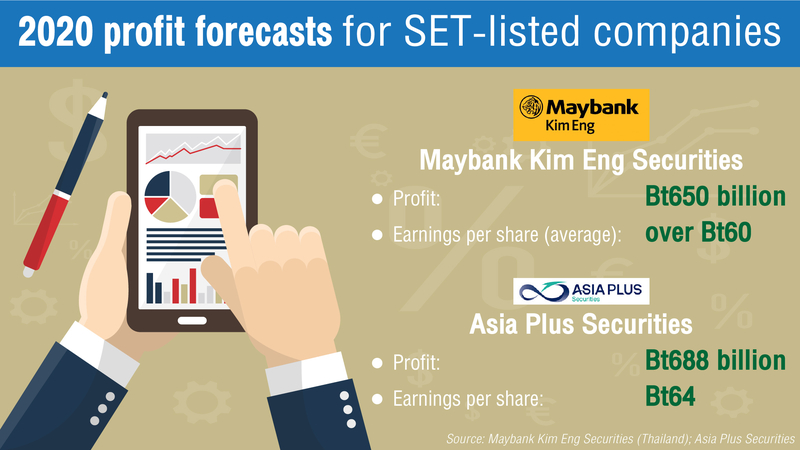
He expected weak second-quarter profits would cause other analysts to review their EPS forecast this year, adding that his own company’s EPS forecast was approximately Bt60 per share.

“Bloomberg Consensus recently cut the Thai stock market’s EPS forecast this year and next year to Bt59.8 per share and Bt76 per share, respectively,” he said.

“We may cut our EPS forecast once all of the listed companies have announced their second-quarter performances.”

He expected listed companies’ performances to gradually improve this year as the impact from energy companies’ oil storage loss and Covid-19 were resolved, adding that the combined third-quarter performance would exceed Bt150 billion.

“We expect listed companies’ performance this year to be at Bt650 billion, down 31 per cent year on year from Bt946 billion to the lowest level since the Asian financial crisis,” he said. “The performance is expected to recover at the beginning of 2021 because it is currently at its lowest point.”

Therdsak Thaveeteeratham, executive vice president for research at Asia Plus Securities, said it will cut its forecast for listed companies’ EPS this year to below Bt60 per share from the current of Bt64.

He advised investors to closely follow the intensifying political situation in the country.

“From the economic view, the current situation is extremely risky because if any factor forces the government to hold off issuing economic stimulus measures, it will hit an economy already under recession, resulting in an impact on the SET Index,” he said.

SET loses ground as US-China trade talks, $1trn stimulus delayed #ศาสตร์เกษตรดินปุ๋ย

#ศาสตร์เกษตรดินปุ๋ย : ขอบคุณแหล่งข้อมูล : หนังสือพิมพ์ The Nation.

SET loses ground as US-China trade talks, $1trn stimulus delayed

EconAug 17. 2020

By The Nation

The Stock Exchange of Thailand (SET) Index closed at 1,320.91 today (August 17), down 6.14 points or 0.46 per cent. Total transactions amounted to Bt47.812 billion with an index high of 1,331.80 and a low of 1,315.89.

In the morning session, a stock analyst at Krungsri Securities expected the index to fall to 1,320 due to lack of positive sentiments to boost investment.

“Also, the index will be under pressure from uncertainty over the $1-trillion US economic stimulus package and postponement of US-China trade talks last week,” he said.

The 10 stocks with the highest trade value today were STGT, CPALL, KBANK, MINT, AOT, CPF, NER, TU, TRUE and STA.

As of 4.30pm, the price of crude oil dropped by US$0.02 or 0.05 per cent to $41.99 per barrel, while gold rose by $10.00 or 0.51 per cent, to $1,959.80 per ounce.

Other Asian indices were mixed:

Japan’s Nikkei Index closed at 23,096.75, down 192.61 points, or 0.83 per cent.

China’s Shang Hai SE Composite Index closed at 3,438.80, up 78.70 points, or 2.34 per cent, while the Shenzhen SE Component Index closed at 13,742.23, up 253.22 points, or 1.88 per cent.

Hong Kong’s Hang Seng Index closed at 25,347.34, up 164.33 points, or 0.65 per cent.

Taiwan’s TAIEX Index closed at 12,956.11, up 160.65 points, or 1.26 per cent.

South Korea’s KOSPI Index was closed for Liberation Day.

Govt eyes sustainable economic stimulus measures #ศาสตร์เกษตรดินปุ๋ย

#ศาสตร์เกษตรดินปุ๋ย : ขอบคุณแหล่งข้อมูล : หนังสือพิมพ์ The Nation.

Govt eyes sustainable economic stimulus measures

EconAug 17. 2020Supattanapong PunmeechaowSupattanapong Punmeechaow

By The Nation

The government is planning to launch stimulus measures especially for people and businesses who are in trouble due to the Covid-19 outbreak.

“The measures will aim to make the economy more sustainable in line with the prime minister’s policy. The budget allocated will remain the same, but will be disbursed in a better manner,” Deputy Prime Minister Supattanapong Punmeechaow, who is also energy minister, said.

Finance Minister Predee Daochai said his ministry’s role will be to support government measures within the framework of financial discipline. The economy is facing problems because investments have all but disappeared and exports have contracted due to slowdown in other economies.

“The Thai economy is affected more than others because the economic structure is different. We rely on exports and tourism, and recovery will not be seen until there is an end to Covid-19,” he said.

Predee admitted that the government measures to stimulate the economy will be limited financially, though the administration’s finances are still strong.

Gold price slumps as US bond yield rises #ศาสตร์เกษตรดินปุ๋ย

#ศาสตร์เกษตรดินปุ๋ย : ขอบคุณแหล่งข้อมูล : หนังสือพิมพ์ The Nation.

Gold price slumps as US bond yield rises

EconAug 17. 2020

By The Nation

The price of gold dropped by Bt50 per baht weight in morning trade on Monday (August 17), the Gold Traders Association reported.

As of 9.25am, the buying price of a gold bar was Bt28,450 per baht weight and selling price Bt28,550, while gold ornaments cost Bt27,939.88 and Bt29,050, respectively.

At close on Saturday (August 15), the buying price of a gold bar was Bt28,500 per baht weight and selling price Bt28,600, while gold ornaments cost Bt27,985.36 and Bt29,100, respectively.

The Comex (Commodity Exchange) gold price to be delivered in December dropped by US$20.6 or 1.05 per cent to $1,948.8 (Bt60,686.98) per ounce at Friday’s close.

Gold price dropped for the first time in 10 weeks after rising for two consecutive days due to pressure from rising US bond yields.

The Chinese Gold and Silver Exchange Society said that the Hong Kong gold price dropped by HK$160, opening at $17,890 (Bt71,872.30) per tael on Monday morning.

Thailand’s GDP contracts 12.2 per cent in second quarter under impact of Coved-19 #ศาสตร์เกษตรดินปุ๋ย

#ศาสตร์เกษตรดินปุ๋ย : ขอบคุณแหล่งข้อมูล : หนังสือพิมพ์ The Nation.

Thailand’s GDP contracts 12.2 per cent in second quarter under impact of Coved-19

EconAug 17. 2020Thosaporn Sirisumphand, secretary-general of the NESDCThosaporn Sirisumphand, secretary-general of the NESDC

By The Nation

The Thai economy shrank by 12.2 per cent in the second quarter year on year, the National Economic and Social Development Council said on Monday.

“It is the most severe contraction since the second quarter of the 1998 Asian financial crisis, when GDP had sank by 12.5 per cent,” Thosaporn Sirisumphand, secretary-general of the NESDC, announced on Monday (August 17).

The GDP contraction was largely due to the impact of the Covid-19 pandemic and every country had suffered a downturn except China and Vietnam, which grew 3.2 per cent and 0.4 per cent respectively. Most countries had imposed lockdown restrictions which affected economic activities, he said.

Exports, production, private investment, consumption and tourism have been hard hit, and only public spending played a key role in shoring up the economy from April to June, he said.

The economy bottomed out in the second quarter, as businesses have recently reopened and boosted economic activities, he noted.

For the full year, the Thai economy is expected to shrink by 7.5 per cent, based on the assumption of new infections of coronavirus being at manageable levels and the world economy contracting 4.5 per cent as forecast by the International Monetary Fund.

Risk factors include threat of escalating trade war between the United States and China and Thailand’s domestic political situation.

“Should the country face political turmoil, it would worsen the economic downturn,” he said in response to large numbers of anti-government protesters rallying on streets.

The unemployment rate in the second  quarter rose 1.95 per cent, as 745,000 people were unemployed. Of workers protected by the Social Security Fund, 420,000 were laid-off and received jobless benefits from the fund while 1.76 million workers were furloughed. “Should the economy not get better, then 1.76 million workers would be laid-off, but if the economy improves , they will be able to keep their jobs,” he added.

SET rises, but hampered by lack of positive sentiment #ศาสตร์เกษตรดินปุ๋ย

#ศาสตร์เกษตรดินปุ๋ย : ขอบคุณแหล่งข้อมูล : หนังสือพิมพ์ The Nation.

SET rises, but hampered by lack of positive sentiment

EconAug 17. 2020

By The Nation

The Stock Exchange of Thailand (SET) Index rose by 2.78 points, or 0.21 per cent, to 1,329.83 in the morning session on Monday (August 17).

However, a stock analyst at Krungsri Securities expected the index to fall to 1,320 due to lack of positive sentiments to boost investment.

“Besides, the index would be under pressure from uncertainty over the $1-trillion US economic stimulus package and postponement of US-China trade talks last week,” he said.

The SET Index closed at 1,327.05 on Friday (August 14), down 19.64 points or 1.46 per cent. Total transactions amounted to Bt58.050 billion with an index high of 1,347.63 and a low of 1,324.97.

He recommended that investors buy:

▪︎Energy stocks that benefit from rising crude oil price, such as PTTEP, PTTGC, TOP and IVL.

▪︎ Retail stocks that benefit from the Centre for Covid-19 Situation Administration’s sixth phase of lockdown easing, such as CRC, CPN HMPRO, GLOBAL, COM7 and DOHOME.