Investment in Thailand’s industrial estates will return to normal in the post-Covid-19 era, as companies from China and Taiwan are likely to relocate production bases to Thailand in response to the US-China trade war, said Industrial Estate Authority of Thailand (IEAT) governor Somchint Pilouk.
The easing of the lockdown will also bring new investment in the estates, she added.
The IEAT has launched promotional campaigns to draw more investment to the zones.
Two new estates opened recently – the Pinthong Industrial Estate 6 in Rayong and World Food Valley Thailand in Ang Thong – while two more are set to launch in Chonburi, namely the Rojana Industrial Park 2 and Asia Clean Industrial Park.
The opening of the Chonburi parks will bring the total land occupied by industrial parks to 177,261 rai, of which 39,332 rai is operated by the IEAT and the rest is jointly operated.
Of the total, 114,852 rai is allocated for lease and sales, of which 92,019 rai has already been leased or sold.
Accumulated investment in these zones is Bt4 trillion, with 6,112 factories and 515,962 jobs.
Jul 10. 2020Tada Phutthitada president of the Thai Bond Market Association
By The Nation
Investors are starting to return to the bond market amid signs Thailand is winning the battle to contain Covid-19, say Thai Bond Market Association executives.
Outstanding debt in the Thai bond market in the first half of 2020 stood at Bt13.69 trillion, a 1.25 per cent rise fuelled largely by the issuance of government bonds. However, issuance of corporate bonds in the first half plunged by 43 per cent year on year due to the Covid-19 impact, Tada Phutthitada president of the Thai Bond Market Association, said on Thursday (July 9). Bond transactions in the secondary market increased 5 per cent year on year.
However, signs of a bond market recovery have emerged as the number of Covid cases remains relatively low in Thailand, he added.
Recent debenture issuances were welcomed by investors and sold out, even those corporate bonds with a credit rating below investment grade, including high-yield bonds, he said.
Corporate bonds with a credit rating of BBB- to BBB+ sold out in June, after issuances in April and May sold only 41.4 per cent and 93 per cent of their targets respectively.
Issuances of high-yield bonds also secured 100 per cent investor subscriptions in June, up from 34.6 per cent in April and 87.6 per cent in May, he said.
About 10 companies have restructured and rescheduled debenture debt payments worth a total Bt7.2 billion in the first half of this year. These corporate bonds are rated at BB+ or not-rated. Their redemption periods have been extended to between six months and two years. Tada was optimistic that insurers will not default on their debt obligations this year.
“In most cases issuers plan to meet bond redemption [deadlines], rather than placing hope on bond rollovers. Issuers and bankers have reassured me that the problem is manageable and defaults are unlikely this year,” said Tada.
He projects that companies will raise Bt800 billion from the bond market this year, down from the previous projection of Bt850 billion.
In the first half of 2020, issuers raised Bt323 billion via corporate bonds, down 43 per cent year on year, or 22 per cent on average for five-year bonds.
Energy firms are expected to raise Bt160 billion to finance their mergers, acquisitions and expansion abroad in the second half of this year, he said.
Foreign investors sold government and central bank bonds worth about Bt108.5 billion in the first half. They held government and central bonds worth Bt811.1 billion, representing 9 per cent of total government outstanding bonds, down from 10.45 per cent at the end of last year.
However, they bought Bt23.3 billion in government bonds in June and Bt11.7 billion in early July after seeing progress in containing the spread of Covid-19. Foreign investors, however, will be cautious due to concerns over tourism and export contraction as the economy recovers, he said.
Bond yields were also volatile in the first half of the year. Yields for two-year and 10-year bonds dropped 69 basis points and 18 basis points respectively from early this year to 0.45 per cent and 1.28 per cent at the end of second quarter. It was a new record low for two-year bonds.
Tada expects the Bank of Thailand’s Money Policy Committee to maintain the historically low policy rate at 0.5 per cent until the end of this year in order to accommodate economy recovery, adding that the central bank might implement extra measures to support the economy.
The Stock Exchange of Thailand (SET) Index rose 3.35 points or 0.25 per cent to close at 1,365.81 today (July 9), with total transactions hitting Bt72.680 billion with an index high of 1,370.80 and a low of 1,358.03.
During the morning session, a stock analyst at Krungsri Securities said he expected the index to fluctuate between 1,355 and 1,370 due to a lack of new factors to stimulate the economy.
“The market gained positive sentiment over hopes of a V-shaped recovery as US, European and Chinese economic data showed a significant rise last month and there was speculation in stocks whose second-quarter performance was expected to show a big improvement,” the analyst said.
“However, the market was under pressure from uncertainty following the Covid-19 outbreak, as the number of new cases in the US continues to increase by approximately 61,000 patients per day.”
The top 10 stocks with the highest trade value today were STGT, AOT, PTT, STA, PTL, MINT, EA, ADVANC, TOP and BAM.
As of 4.30pm, the price of crude oil dropped by US$0.18 or 0.44 per cent to $40.72 per barrel, while gold rose by $2.80 or 0.15 per cent to $1,823.40 per ounce.
Asian indices were on the rise:
Japan’s Nikkei Index closed at 22,529.29, up 90.64 points, or 0.40 per cent.
China’s Shanghai SE Composite Index closed at 3,450.59, up 47.15 points, or 1.39 per cent, while Shenzhen SE Component Index closed at 13,754.74, up 348.37 points, or 2.60 per cent.
Hong Kong’s Hang Seng Index closed at 26,210.16, up 80.98 points, or 0.31 per cent.
South Korea’s KOSPI Index closed at 2,167.90, up 9.02 points, or 0.42 per cent.
Taiwan’s TAIEX Index closed at 12,192.69, up 22.50 points, or 0.18 per cent.
New technology to collect tax on beer will boost government revenue by Bt6 billion per year, says the Excise Department. The technology will be trialled next year to tax alcohol, before being rolled out to cigarettes, oil and other products.
Patchara Anuntasilpa, head of the Excise Department, revealed today (July 9) that the new system will replace manpower and outdated technology, helping to close flaws in existing tax collection.
The new “Direct Coding” technology will collect tax on canned beer and domestic bottled beer produced at all plants in the next year. It will then be extended to taxation of other products.
“We are using it first on beer products because beer is currently subject to tax on the 15th day of the month after it emerges the production plant. More importantly, no stamps or tax payment marks are displayed on the products, only a label on the side that says ‘tax already paid’, by which we cannot clearly verify whether tax has been paid or not. Our study shows that the new taxation method will help to boost tax revenue on beer by Bt6 billion per year,” said Patchara.
Beer is currently taxed under a flow meter system installed in the brewery production line. This costs the department Bt100 million, has a limited lifetime and maintenance costs of Bt15-20 million per year. However, the flow meter system is not capable of measuring the amount of beer produced daily or the median losses for accurate tax calculation.
State enterprises and agencies to which the Finance Ministry holds a less than 50-per-cent stake have contributed Bt156 billion in revenue to state coffers from October 2019 to June 2020, said Prapas Kong-led, director general of the State Enterprise Policy Office (Sepo).
This amount accounts for 83 per cent of the total targeted earnings of Bt188 billion. In June alone, these enterprises contributed Bt7.19 billion.
As of June, the top 10 contributors to the state coffers are the Government Lottery Office with a contribution of Bt34 billion, followed by PTT Bt29 billion, the Electricity Generating Authority of Thailand Bt28.6 billion, Government Savings Bank Bt18 billion, Airports of Thailand Bt10 billion, Government Housing Bank Bt5.9 billion, Provincial Electricity Authority Bt5.7 billion, Port of Thailand Bt4 billion, CAT Telecom Bt3.8 billion, and Expressway Authority of Thailand Bt3.8 billion
The price of gold rose by Bt100 per baht weight in morning trade on Thursday (July 9), the Gold Traders Association reported.
As of 9.28am, the buying price of a gold bar was Bt26,550 per baht weight and selling price Bt26,650, while gold ornaments cost Bt26,075.20 and Bt27,150, respectively.
At close on Wednesday (July 8), the buying price of a gold bar was Bt26,450 per baht weight and selling price Bt26,550, while gold ornaments were priced at Bt25,969.08 and Bt27,050, respectively.
Spot gold price moved to US$1,809 (Bt56,421) on Thursday morning after the price rose by $10.7 to $1,820.6 (Bt56,783) per ounce at close on Wednesday, the highest in almost nine years as investors expected governments and central banks worldwide to issue economic stimulus measures to mitigate the Covid-19 impact.
Meanwhile, gold gained from the weakening dollar as well.
Hong Kong gold price rose by HK$85, opened at $16,695 (Bt67,184) per tael Thursday morning.
The Stock Exchange of Thailand (SET) Index rose by 6.51 points, or 0.48 per cent, to 1,368.97 in the morning session on Thursday (July 9).
A stock analyst at Krungsri Securities expected the index to fluctuate between 1,355 and 1,370 due to a lack of new factors to stimulate the economy.
“The market gained positive sentiment from hopes over the V-shaped economic recovery as the US, Europe and China economic data rose significantly last month and there was speculation in stocks whose second-quarter performance, was expected to show big improvement,” the analyst said.
“However, the market would be under pressure from uncertainty following the Covid-19 outbreak, as the number of new cases in the US continues to increase by approximately 61,000 people per day.”
He recommended that investors buy:
▪︎ Food and Electronic stocks that benefit from the weakening baht, such as TU, CPF, GFPT, TFG, KCE, DELTA and HANA.
▪︎ Stocks whose second-quarter performance will improve, such as TOP, PTTGC, SPRC, BGRIM, CKP, TASCO, STA and SPALI.
▪︎ Defensive stocks, such as INTUCH, TTW and DIF.
The Stock Exchange of Thailand (SET) Index fell 10.76 points or 0.78 per cent, closing at 1,362.46 on Wednesday (July 8). Total transactions stood at Bt66.274 billion with an index high of 1,379.71 and a low of 1,361.24.
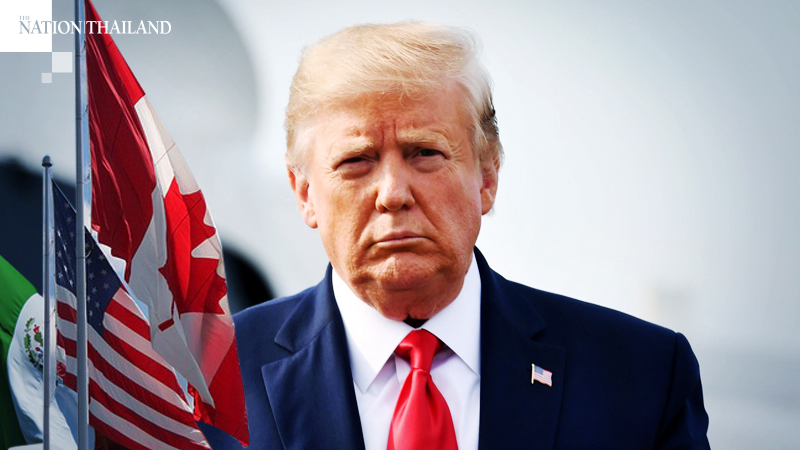
By The Washington Post · David Nakamura, David J. Lynch · NATIONAL, BUSINESS, WORLD, POLITICS, THE-AMERICAS WASHINGTON – President Donald Trump on Wednesday marked the start of a three-nation regional trade deal in a Rose Garden ceremony with Mexican President Andrés Manuel López Obrador that took on a celebratory tone discordant with the widespread economic damage of the novel coronavirus pandemic.
The two populist-leaning presidents, from opposite ends of the political spectrum, signed a joint proclamation hailing the U.S.-Mexico-Canada Agreement, which took effect at the start of July, as the beginning of a new chapter in North America’s economic partnership.
The event represented an attempt by the White House at counterprogramming as Trump has faced tumbling public approval over his handling of the pandemic and the mass demonstrations for racial justice across the country. And it served as a reminder that the president had hoped to cruise to reelection on a strong economy – a strategy dashed as tens of millions of Americans have been forced out of work since March.
Canada was not represented at the signing after Prime Minister Justin Trudeau reportedly turned down an invitation. But Trump, who said he spoke with Trudeau by phone, and López Obrador lavished praise on one another and touted their unlikely partnership. Bilateral relations had frayed over immigration tensions before the leftist Mexican leader took office 18 months ago.
Trump thanked his counterpart for responding to U.S. pressure to help curb a major spike in unauthorized immigration last year, saying border control has “been very, very tight, and you’ve done a great job.” Border crossings began falling last year after Mexico adopted stronger new policies and the Trump administration took measures to speed deportations and try to block asylum seekers. The numbers continued to drop until last month, when they rose slightly.
López Obrador responded that Trump has “honored our position as an independent nation” and “behaved with kindness and respect.”
The positive comments from the two leaders on Wednesday were striking when compared to the tensions between the neighboring countries in recent years.
Trump was elected on an anti-immigration platform and said he would build a wall along the U.S.-Mexico border and force Mexico to pay for it. Mexico rejected that idea outright and U.S. taxpayers have funded the barrier, which is under construction. Last year, Trump also threatened to impose tariffs on Mexico if its leaders didn’t do more to prevent migrants from entering the United States. A deal was struck to avoid a trade war, but not without hard feelings on both sides.
On Wednesday, Trump and López Obrador did their best to avoid any appearance of friction between the two countries.
The bonhomie at the event did little to mask Trump’s political struggles. The president and his White House allies spent a second consecutive day on a public campaign to reopen schools this fall despite public health concerns from local jurisdictions and medical experts as nationwide virus infection rates have spiked to a record high of more than 50,000 per day. Trump and his aides disputed school reopening safety guidelines set by the Centers for Disease Control and Prevention as too muscular and suggested they would be rewritten.
During his Rose Garden remarks, Trump offered an upbeat but inaccurate assessment of the administration’s response to the virus.
“We’re safely reopening the country and, more importantly, we’re safely reopening our schools,” he said, even though experts said that infection rates have spiked as states have begun to reopen businesses.
The three North American nations signed the USMCA in late 2018 after more than a year of negotiations that began when Trump threatened to pull the United States out of the North American Free Trade Agreement, a deal that had been in effect since 1994.
Analysts have said the new pact represents a modest reworking of the old deal, but Trump has touted it as a major improvement that would bolster American manufacturing.
“We’re already seeing the fruits,” Trump said.
The deal aims to reshape North American auto production by requiring more work be performed in high-wage factories in the United States. But an independent assessment last year concluded the agreement would have a limited effect on the overall U.S. economy.
In a 379-page report, the International Trade Commission said USMCA would boost output in the $21 trillion U.S. economy by just 0.35 percent. And modest gains in auto industry production and employment would come at the expense of other sectors, with production in the U.S. becoming more expensive and exports declining.
At the time, the administration disputed those findings, saying it was privy to confidential auto industry investment plans that promised greater rewards.
In a briefing for reporters, White House press secretary Kayleigh McEnany called the deal “good for businesses as President Trump rebuilds the strongest, most inclusive economy in history . . . It will help jump-start our economy.”
López Obrador’s decision to join Trump provoked some criticism in Mexico City that the trip – the Mexican leader’s first outside his country since taking office – could appear as an endorsement the conservative U.S. president in an election year. He took a commercial flight to Washington, sitting in coach and making a connection in Atlanta, a sign of López Obrador’s effort to distance himself from the perks enjoyed by past Mexican presidents.
“We had a good debate in my country about the convenience of this trip,” he said through an interpreter in the Rose Garden. “I decided to come because it’s very important to be launching this agreement. I also wanted to be here to thank the people of the United States and its government, and thank you, President Trump, for being increasingly respectful with” Mexico.
Though the two expressed confidence that the pact would pay dividends, experts have raised questions over how well some of the new trade deal’s core provisions will work out.
The Trump administration last year agreed to modify the deal under pressure from House Democrats, who were delaying ratification. New language was added at the 11th hour to make sure that Mexico implemented a range of domestic labor reforms, including granting workers the right to form independent unions.
In congressional testimony last month, Robert Lighthizer, the president’s chief trade negotiator, called USMCA “the best trade agreement in U.S. history,” but acknowledged that enforcing the labor provisions would be difficult.
The agreement includes a novel provision that would allow the U.S. to temporarily block exports from specific Mexican factories if it believes worker rights were being violated there while awaiting a decision from an independent panel of experts.
Even as López Obrador arrived at the White House, there were signs of trouble on the labor front. Susana Prieto, a Mexican attorney representing workers in maquiladora factories near the U.S. border, accused the Mexican government of seeking to intimidate her with a prosecution on trumped-up charges.
Prieto, who has sought higher wages and reforms to make factory work safer amid the coronavirus pandemic, was released from a Mexican jail on July 1. She had been imprisoned for three weeks on charges that included inciting a riot, after seeking to register an independent union. The terms of her release required her to leave the border region near Texas for the state of Chihuahua, hundreds of miles away. But prosecutors there also have warrants for her arrest, she says.
At a news conference, Prieto called López Obrador’s visit to Washington “completely inappropriate.”
Also on Wednesday, thousands of miles from the White House, officials in Florida detained the former governor of Chihuahua state, Mexican officials said – in what amounted to a coup for López Obrador. While Trump didn’t mention the arrest of Cesar Duarte, it was widely seen in Mexico as a good will gesture from the White House. The Mexican president had promised to win the extradition of the notorious politician, wanted on corruption charges.
“A gift from the U. S – the capture of Cesar Duarte” read the headline on the website of the daily Reforma. Duarte has been a fugitive since 2017.
By Syndication Washington Post, Bloomberg · Vildana Hajric, Sarah Ponczek · BUSINESS U.S. stocks rose as investors looked past tensions between Washington and Beijing and sought out tech companies thought to be insulated from rising coronavirus infections.
The S&P 500 Index climbed to a one-month high, while advances in highflying megacaps like Apple Inc. and Amazon.com Inc. sent the Nasdaq Composite to a record. HSBC Holdings Plc slumped after a report that some of President Donald Trump’s advisers proposed a move to destabilize Hong Kong’s currency peg to punish China. Banks led European stocks lower.
Gold topped $1,800 an ounce, while Treasury yields inched higher and the dollar slumped.
Analysts are debating what comes next for the U.S. economy as states allow businesses to reopen, but with much of the world stuck at home, investors have been bidding up tech shares. That pattern appeared again Wednesday, with pandemic-sensitive sectors like airlines sinking even as online names held up.
“While the market largely reflects investor optimism, the covid situation is seemingly evolving by the hour and we’ve also reintroduced trade tensions to the mix, so there’s a bunch to digest,” said Mike Loewengart, managing director of investment strategy at E*Trade Financial.
Tensions between the U.S. and China have been growing after Beijing asserted broad new powers to rein in opposition in Hong Kong, pouring cold water over hopes the world’s largest economies will patch up relations soured by a lingering trade spat.
Stocks in Shanghai powered ahead for a seventh day. Investors have been drawn to China’s markets amid efforts by regulators to boost the attractiveness of stocks and hopes for an economic recovery.
Signals pertaining to the coronavirus have been mixed in recent days and weeks. The number of confirmed cases in the U.S. surpassed 3 million Wednesday, with data showing a 2% increase in cases nationally. However, the fatality rate has remained low, a data point flagged by optimists.
“We’re sitting here kind of saying, ‘Well what comes next?’ And it’s not really clear,” said Kathy Jones, chief fixed-income strategist for the Schwab Center for Financial Research. “There’s a lot of question marks about how will this play out in the second half.”
These are the main moves in markets:
Stocks
– The S&P 500 Index rose 0.8% as of 4 p.m. EDT.
– The Stoxx Europe 600 Index declined 0.7%.
– The MSCI Asia Pacific Index rose 0.7%.
Currencies
– The Bloomberg Dollar Spot Index dipped 0.5%.
– The euro advanced 0.5% to $1.1329.
– The Japanese yen gained 0.3% to 107.24 per dollar.
– The British pound rose 0.6% to $1.2612.
Bonds
– The yield on 10-year Treasurys rose one basis point to 0.65%.
– Germany’s 10-year yield declined one basis point to -0.44%.
– Britain’s 10-year yield was little changed at 0.18%.
Commodities
– West Texas Intermediate crude rose 0.6% to $40.84 a barrel.
Airports of Thailand (AOT) is looking into the option of signing a joint venture with Thai Airways International (THAI) for the operation of three main services at Suvarnabhumi Airport, namely ground services, aircraft repair and the cargo centre.
“The running of these three units cannot be disrupted, because that would affect the operations of Suvarnabhumi Airport,” AOT president Nitinai Sirismatthakarn said on Wednesday (July 8).
After the airline applied for rehabilitation through the Central Bankruptcy Court, he said the AOT board has set up a panel to come up with policies in line with the rehab plan.
This committee will study the effects the rehab plan may have on the airport’s operations, as well as solutions to these problems.
THAI has had to suspend all flights since June after entering rehabilitation.
Nitinai, meanwhile, said AOT was ready to enter a joint venture with THAI in the running of the three operations to ensure continuous service and to ensure there is no adverse effect. Once THAI returns to normal, he said, AOT will be happy to let the airline buy back shares of the three operations.
However, he added, before any moves can be made, AOT has to wait for the court’s investigation hearing on August 17. If THAI’s rehab plan goes ahead without any objections, AOT can formally enter negotiations with the airline.
Meanwhile, THAI owes AOT around Bt3 billion, Bt2 billion of which it owes to technicians at Don Mueang Airport, which has been under dispute for a long time. However, Nitinai said AOT is not too concerned about this debt because the amount is not high, adding that it is more concerned about airport operations going ahead without hinderance.
THAI’s rehabilitation plan reportedly includes the possibility of separating business units, such as the aviation kitchen department, products and mailing department as well as mechanics department, so they are open for private investment.

 Tada Phutthitada president of the Thai Bond Market Association