SET falls due to uncertainty about second wave of Covid-19 cases #ศาสตร์เกษตรดินปุ๋ย

#ศาสตร์เกษตรดินปุ๋ย : ขอบคุณแหล่งข้อมูล : หนังสือพิมพ์ The Nation.

https://www.nationthailand.com/business/30389506?utm_source=category&utm_medium=internal_referral

SET falls due to uncertainty about second wave of Covid-19 cases

Jun 12. 2020
By The Nation

The Stock Exchange of Thailand Index slid to 1,361.62, down 35.15 points, or 2.52 per cent, on Friday morning (June 12).

A stock analyst at Krungsri Securities expected the index to fall to between 1,350 and 1,365 due to uncertainty following the second wave of Covid-19 outbreak after several countries eased lockdown measures.

“Investors are also worried about the US economy after the Federal Reserve forecast US gross domestic product this year would contract by 6.5 per cent and the unemployment rate would be 9.3 per cent,” the analyst said.

“In addition, energy stocks would be under pressure after the price of crude oil dropped sharply due to uncertainty following the decline in demand for petrol if the second wave of Covid-19 outbreak emerges.”

He recommended investors buy:

▪ Stocks that would be added to the SET50 and SET100 calculation, such as BPP, TTW, ACE, DOHOME, RBF, SIRI, SISB, TVO and WHAUP.

▪ Stocks whose second-quarter performance will improve, such as CKP, TASCO, STA and RS.

▪ Defensive stocks, such as INTUCH, TTW and DIF.

The SET Index on Thursday fell by 22 points, or 1.55 per cent, closing at 1,397 the same as other Asian indices due to uncertainty following the second wave of Covid-19 cases.

Total transactions were worth Bt8.3 billion. Foreign investors made net sell of Bt753 million in stocks, but also net buy of Bt1.951 billion in the bond market. There were 3,210 Net Short TFEX SET50 contracts.

CAT, Symphony sign MoU to leverage their telecom strengths #ศาสตร์เกษตรดินปุ๋ย

#ศาสตร์เกษตรดินปุ๋ย : ขอบคุณแหล่งข้อมูล : หนังสือพิมพ์ The Nation.

https://www.nationthailand.com/business/30389505?utm_source=category&utm_medium=internal_referral

CAT, Symphony sign MoU to leverage their telecom strengths

Jun 12. 2020
By The Nation

State telecom firm CAT has joined hands with Symphony to provide telecommunication networks and services to meet the needs of customers in the digital age.

CAT Telecom Pcl has signed a memorandum of understanding in business cooperation with Symphony Communication Pcl to integrate current and future telecommunication networks and services of both parties to enhance services to customers and also to maximise the potential for telecommunication network usage and services, the companies said.

Dhanant Subhadrabandhu, senior executive vice president, marketing and service, at CAT Telecom said in a joint statement with Symphony that CAT’s mission is not only providing telecommunications network services infrastructure with the highest efficiency of landing and submarine cable systems, CAT also seeks cooperation with telecommunications operators both locally and internationally to increase the potential of telecommunications to meet the needs of customers at all levels, including the exchange of technology and knowledge to jointly push Thailand to the centre of telecommunications technology in the Asean region.

The scope of the MoU is to consolidate both companies’ expertise towards leveraging, sharing and collaborating the existing systems and networks to effectively provide services such as Metro Ethernet, Direct Internet, Voice Service and other services.

Alex Loh, chief operating officer of Symphony, said: “I am delighted to have this strategic collaboration with CAT Telecom, one of the leading national telecommunication and digital service provider in Thailand. “This collaboration intends to have both providers to leverage and optimise our network infrastructure together and expand more services throughout the country. Both companies are also able to share and leverage our strengths in our resources, expertise and infrastructures that will maximise our business growth in the future,” he said.

Dow slides more than 1,800 points on fears of coronavirus resurgence, more economic pain #ศาสตร์เกษตรดินปุ๋ย

#ศาสตร์เกษตรดินปุ๋ย : ขอบคุณแหล่งข้อมูล : หนังสือพิมพ์ The Nation.

https://www.nationthailand.com/business/30389476?utm_source=category&utm_medium=internal_referral

Dow slides more than 1,800 points on fears of coronavirus resurgence, more economic pain

Jun 12. 2020
By The Washington Post · Rachel Siegel, Thomas Heath, Jeff Stein · BUSINESS, US-GLOBAL-MARKETS 

The stock market slid sharply Thursday, with the Dow Jones industrial average shedding 1,861.82 points, or 6.9%, as suddenly renewed fears about the coronavirus’s impact on the economy startled Wall Street and the White House.

President Donald Trump and his top economic aides fanned out quickly to try to beat back the growing concern. They assailed the Federal Reserve for its recent projection that the unemployment rate will remain elevated well into next year. The Trump administration also pushed back on the idea that it would allow the economy to shut down again in the face of rising cases.

Over three days, the Dow has lost roughly 9%. The index peaked in mid-February at 29,551 before falling sharply to 18,592 over more than a month. It had rebounded strongly before this week’s slide, and there was a sense Thursday that perhaps the stock market had come back too far, too fast, without the economic underpinnings to justify such a climb.

“The market had become more optimistic and more enamored over a V-shaped recovery in recent weeks,” said Jeffrey Kleintop, chief global investment strategist at Charles Schwab. “Anything that would disrupt that view was a vulnerability. And that’s exactly what we’ve seen in the last day and a half. The potential for a second virus wave and another lockdown is a worry. And there is concern over a possible slower pace of recovery.”

The stock market has risen sharply since late March in part because of extraordinary assistance from the Fed and Congress to flood the U.S. economy with money in an attempt to arrest the downturn caused by the coronavirus pandemic. Trump follows the stock market closely and views it as a measure of his presidency’s success, and he had recently dubbed Fed Chair Jerome Powell, whom he had derided, as the “most improved player.”

Trump turned on the Fed on Thursday after the stock market’s slide picked up in velocity. He tried to dispute Powell’s assertion Wednesday that the economy could take a long time to heal and need substantial government help.

“The Federal Reserve is wrong so often,” he tweeted. “I see the numbers also, and do MUCH better than they do. We will have a very good Third Quarter, a great Fourth Quarter, and one of our best ever years in 2021.”

His top economic adviser, Larry Kudlow, during remarks in a Fox News interview, attacked the manner in which Powell spoke about the economy.

“I do think Mr. Powell could lighten up a little when he has these press offerings. You know, a smile now and then, a little bit of optimism, OK?” he said. “I’ll talk with him, and we’ll have some media training at some point.”

Trying to push back on fears that the White House might have to urge some businesses to close again, Treasury Secretary Steven Mnuchin on Thursday said there was very little chance that would ever happen.

“It’s my expectation we will make medical progress between now and the end of the year,” Mnuchin told reporters. “I don’t expect we will need to shut down the economy again. Could there be some rare extreme scenario that occurs that based upon medical advice the president does [shut down the economy]? I think that’s extremely unlikely.”

There are concrete signs that the U.S. economy has stabilized from the worst of the recession, but economists are split in terms of where it will go from here. The U.S. economy added 2.5 million jobs in May, the Labor Department said last week, but the unemployment rate remains higher than at any point since the Great Depression. There are also signs that consumers are spending more as more businesses are reopening, but many remain closed or are open at only partial capacity, and some have no plans to reopen.

Some of the stock market’s biggest losers Thursday were companies that would be negatively affected if the virus’s grip on the U.S. economy tightened again. United Airlines, American Airlines and Delta all dropped more than 14% Thursday. Boeing led the Dow slide, falling 16%. Norwegian Cruise Line tumbled 16%, and Carnival Corp. sank 15%. Walt Disney Co., which is preparing to open some parks, was down nearly 8%.

The retreat began Tuesday but picked up steam Wednesday after Powell made plain that the recovery would be slow and that more aid would be needed from Congress and the central bank to lessen the pain, particularly as jobs for millions of Americans may never return. The Fed plans to keep the benchmark U.S. interest rate at zero, most likely through 2022. But critics say that approach widens economic inequality and lifts Wall Street over Main Street.

Concerns about a second surge of infections have taken on new urgency since states have begun easing restrictions on gatherings and commercial business. Hospitalizations rose sharply in several states after Memorial Day, and more than 2 million total cases have been reported in the United States.

“Fears of a second wave are beginning to cause anxiety in the stock market,” said Torsten Slok, chief economist at Deutsche Bank Securities. “Powell did what he could to be dovish, but there is nothing the Fed can do about the risk of a second wave of the virus.”

Coronavirus hospitalization and infection rates have jumped in many parts of the country, with more than a dozen states setting new highs this week, according to Washington Post data. Coronavirus-related hospitalizations have risen by at least 35% since Memorial Day in Arizona, Arkansas, Montana, Texas and Utah. Other states – including Nevada and North Carolina – also reached new highs in their seven-day case averages, the Post data shows.

The seven-day moving average of deaths has fallen steadily from its peak in April, but it has not halted as some White House officials had predicted. As of Thursday, 112,000 people in the United States had died of covid-19, the disease caused by the coronavirus, including more than 2,600 over three days this week.

Wayne Wicker, chief investment officer at Vantagepoint Investment Advisers, noted that the latest jobs report – which unexpectedly showed that the economy added 2.5 million jobs in May – boosted confidence that the economy was plowing ahead. But those hopes “ignored the fact that the issues with coronavirus responsible for the market decline in the first quarter have not been resolved.”

“With rapid escalation of transmission rates in several states this week, investors are beginning to recognize that their enthusiasm for a rapid return to normal is premature,” Wicker said.

Oil prices fell more than 8% Thursday, taking major U.S. companies with them. Dow components Chevron and ExxonMobil were down more than 8%. Oil fell after Powell’s outlook and reports of record inventories in U.S. petroleum reserves in the week ending June 5. The U.S. Energy Information Administration also reported that gasoline stockpiles grew. Stocks in the energy and industrial sectors, which are often pegged to the health of the economy, also dropped.

The Fed predicts that the unemployment rate will fall to 9.3% by the end of this year and to 6.5% by the end of 2021. An additional 1.5 million workers filed for unemployment insurance for the first time last week as pandemic-era totals topped 40 million.

Powell has pledged to do everything within the central bank’s power to steer the economy toward recovery, and the Fed’s unprecedented response could expand its balance sheet to $10 trillion by the end of the year. But he acknowledged that the tools at Congress’s disposal may be more designed to directly help individuals, households and companies desperate to stay afloat.

“My assumption is there will be a significant chunk . . . well into the millions of people, who don’t get to go back to their old job . . . and there may not be a job in that industry for them for some time,” Powell said Wednesday.

Stocks were down around the world. In Europe, Britain’s FTSE 100 dropped 4%, and Germany’s DAX fell 4.5%. In Asia, Japan’s Nikkei 225 closed the day down 2.8%, and Hong Kong’s Hang Seng closed 2.3% in the red.


Sukhumvit Line extension keeps BTS financially strong despite Covid crisis #ศาสตร์เกษตรดินปุ๋ย

#ศาสตร์เกษตรดินปุ๋ย : ขอบคุณแหล่งข้อมูล : หนังสือพิมพ์ The Nation.

https://www.nationthailand.com/business/30389466?utm_source=category&utm_medium=internal_referral

Sukhumvit Line extension keeps BTS financially strong despite Covid crisis

Jun 12. 2020
By The Nation

BTS Group Holdings expects its operating revenue this year to rise by 40 per cent from the previous year thanks to the extension of the Green (Sukhumvit) Line.

The group’s total revenue is expected to hit Bt38.8 billion this year.

Surayut Thavikulwat, the group’s chief financial officer, said the Mo Chit-Khu Khot extension, which is due to open in full by the end of this year, will boost the company’s operating revenue by 40 per cent from Bt3.7 billion last year to Bt5.2 billion.

The company also expects to generate approximately Bt6 billion from additional carriages, as well as interest revenue from the Bt2.6 billion investment in the BTS Rail Mass Transit Growth Infrastructure Fund (BTSGIF).

However, the company has suffered an immediate impact from the Covid-19 crisis, with income from passengers dropping by about 10 per cent. The number of passengers in April stood at 100,000 people per day, believed to be the lowest ever. However, numbers rose to 350,000 to 400,000 passengers per day and is expected to rise once schools open and people start going to work.

“We expect passenger numbers for this year to be 170 million, or a 20 per cent drop from the previous year. Also, BTS Group’s media arm, VGI, and real-estate business U City Plc, will be affected by a drop in outdoor media advertising as well as the closure of hotels and delays in the opening of new real-estate projects,” he said.

He went on to say that the company does not have any confirmed plans to purchase shares in Kerry Express (Thailand) Co, as VGI already has a 23-per-cent stake in the company.

EEC panel comes up with guidelines on letting foreign investors back in #ศาสตร์เกษตรดินปุ๋ย

#ศาสตร์เกษตรดินปุ๋ย : ขอบคุณแหล่งข้อมูล : หนังสือพิมพ์ The Nation.

EEC panel comes up with guidelines on letting foreign investors back in

Jun 12. 2020
By THE NATION

The Eastern Economic Corridor (EEC) Policy subcommittee on Thursday (June 11) produced guidelines on relaxing rules governing the entry of foreign businesses that have invested in the EEC, said Kanit Sangsubhan, EEC Office secretary-general.

The subcommittee will seek approval from the Public Health Ministry and the EEC Policy Committee, which is chaired by Prime Minister Prayut Chan-o-cha.

Foreign chambers of commerce that are related to investments in the EEC have called on the government to relax rules governing their entry into Thailand on business purposes. This includes the dispatch of staff to conduct maintenance on machines used in their EEC-based businesses.

Meanwhile, the EEC Office is talking to the Foreign Ministry about creating a medical network in foreign countries so businesspeople wanting to come to Thailand can be tested and issued a “fit to fly” certificate.

Kanit added that many foreigners wanted to come and work in the EEC projects and they are willing to adhere to related regulations such as the 14-day quarantine. However, he said, they want to be quarantined in Bangkok’s Sukhumvit zone and are willing to shoulder related costs.

Related story: Japan considers entry of up to 250 business travelers per day

Gold set for biggest gain in a month #ศาสตร์เกษตรดินปุ๋ย

#ศาสตร์เกษตรดินปุ๋ย : ขอบคุณแหล่งข้อมูล : หนังสือพิมพ์ The Nation.

https://www.nationthailand.com/business/30389473?utm_source=category&utm_medium=internal_referral

Gold set for biggest gain in a month

Jun 12. 2020
Freshly cast gold ingot bars sit in the foundry at the JSC Krastsvetmet non-ferrous metals plant in Krasnoyarsk, Russia, on Nov. 5, 2019. MUST CREDIT: Bloomberg photo by Andrey Rudakov.

Freshly cast gold ingot bars sit in the foundry at the JSC Krastsvetmet non-ferrous metals plant in Krasnoyarsk, Russia, on Nov. 5, 2019. MUST CREDIT: Bloomberg photo by Andrey Rudakov.
By Syndication Washington Post, Bloomberg · Justina Vasquez, Ranjeetha Pakiam, Elena Mazneva · BUSINESS, US-GLOBAL-MARKETS 

Gold futures headed for the biggest gain in more than a month after the Federal Reserve vowed to hold interest rates lower for longer and investors tracked signs of a resurgence in infections in some U.S. states.

The haven pushed higher after Chairman Jerome Powell said Wednesday the Fed is committed to “do whatever we can, for as long as it takes” to help the economy mend from the coronavirus pandemic. Almost all officials forecast keeping rates near zero through 2022, and the central bank also said it will at least maintain the current rate of bond purchases.

“You almost couldn’t come up with a better script for a strong fundamental environment for gold than what we saw from the Fed yesterday,” Matt Weller, global head of market research at Gain Capital Group, said by phone. “It’s really an environment of rampant monetary stimulus, and historically that’s exactly the type of environment in which gold has thrived.”

Comex gold futures for August delivery rose 1.8% to $1,752.10 an ounce at 10:46 a.m. in New York. A close at the price would mark the biggest gain since May 7.

Holdings in exchanged-traded funds backed by gold advanced for the first time in five sessions on Wednesday.

The metal is also getting support as alarm grows over the possibility of a second wave of coronavirus cases in the U.S. Localized surges of new infections in states including Texas, Florida and California have raised concern among health experts even as the nation’s overall case count early this week rose just under 1%, the smallest increase since March.

“Gold prices are going to steadily climb higher as we see more political headlines, unrest and Covid-19 headlines,” George Gero, a managing director at RBC Wealth Management, said by phone.

Ahead of the Fed gathering, Goldman Sachs forecast bullion would rise to $1,800 an ounce over 12 months and may even see a breakout beyond $2,000 if inflation expectations outpace a rise in nominal rates — similar to what happened in the third quarter of 2009.

“The conditions are here for gold still going to $1,800,” Dominic Schnider, head of commodities & Asia Pacific currencies at UBS Group, told Bloomberg Television. The metal has support “with rates staying where they are for longer, and real rates expectations potentially shifting more negative,” he said.

Even with recent advances, futures haven’t yet reached this year’s peak of about $1,789 seen in April, which was the highest since 2012. There’s probably some disappointment among investors that the Fed stopped short of embracing the yield-curve control, which would be a strong trigger for gold, according to Ole Hansen at Saxo Bank, who is still bullish on gold.

“So being the devil’s advocate, I worry a bit why the metal hasn’t responded better than it did,” Hansen said.

Baht’s rise worries govt; BOT blames it on a weaker dollar #ศาสตร์เกษตรดินปุ๋ย

#ศาสตร์เกษตรดินปุ๋ย : ขอบคุณแหล่งข้อมูล : หนังสือพิมพ์ The Nation.

https://www.nationthailand.com/business/30389469?utm_source=category&utm_medium=internal_referral

Baht’s rise worries govt; BOT blames it on a weaker dollar

Jun 12. 2020
By The Nation

Though the Finance Ministry is worried about the fast rising baht, the central bank assures that the baht is only strengthening in line with regional currencies.

Finance Minister Uttama Savanayana said on Thursday (June 11) that the Bank of Thailand understands that the currency exchange rate is necessary to support economic recovery.

“The central bank knows that the baht exchange rate should move in line with the Finance Ministry’s and government economic plan for recovery, and that it is responsible for the range of the baht’s movement,” he said.

His comments came after the baht passed the Bt31 to the dollar mark to rest at its strongest point of Bt30.82 before closing at Bt30.95 on Thursday closing.

The Bank of Thailand (BOT), however, is saying the baht is moving in line with regional currencies.

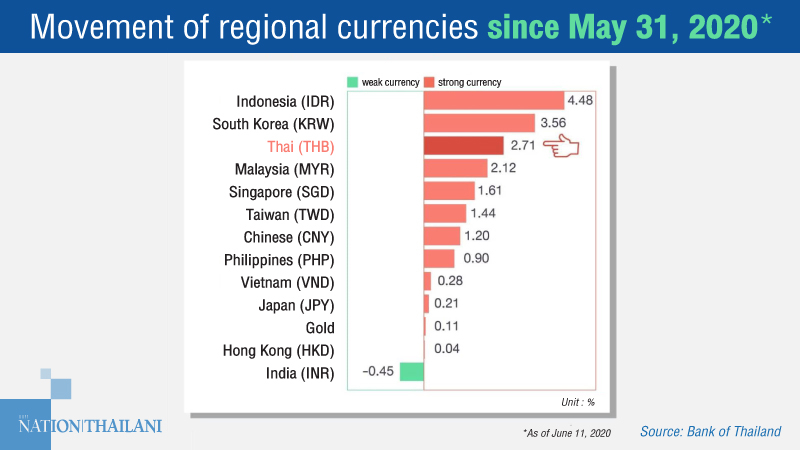
“As of June 11, the baht has risen 2.71 per cent against the US dollar since the end of May,” assistant BOT governor Chantawan Sutcharitkul said, pointing out that the baht is the third strongest currency in the region after Indonesia’s rupiah and South Korea’s won.

The actual reason for Asian currencies rising against the greenback is that the US currency is weakening, she said.

Also, capital is flowing back into Thailand as investors who previously moved money out to invest overseas are now bringing the money back, while foreign investors have returned to the equity and Thai bond markets, but their net buys are not that much, she said.

She also warned of exchange rate volatility due to uncertainty in the global economy, financial markets and Thai economy. Businesses that have engaged in international trade have to regularly hedge their risks where the exchange rate is concerned.

She added that importers and exporters should not rely solely on the dollar when quoting a price for their goods and services, they should also use other currencies, especially when trading within the region.

Naris Sathaphondecha, senior director at TMB Analytics, said the baht rose on Thursday after the US Federal Reserve predicted slow recovery saying it may take two to three years and signalled that it was maintaining low key policy rates until 2022.

Also, global financial markets have been flooded by liquidity injected by central banks in Japan, US and Europe. Besides, money is flowing into Thailand as the economy is showing signs of improvement as the government is easing the Covid-19 lockdown measures.

Since early June, foreign investors have made net purchases of Thai equities and bonds worth Bt6.5 billion and Bt23 billion respectively, he said, adding that the dollar’s weakening was also contributing to the baht’s rise.

“The dollar over the past three days fell by 0.85 per cent, but the baht rose by 1.6 per cent. The baht was the strongest in the region followed by the Japanese yen, which rose 1.4 per cent, and the South Korean won, which rose 0.68 per cent in the same period,” he said.

The baht may stay within the Bt30.5 and Bt31 range and is likely to rise until the end of this month.

However, it may fall to Bt31.5 to a dollar in the third quarter in line with economic fundamentals. The current account is expected to be at a deficit of 3 to 4 per cent of the GDP, reversing from the usual 6 to 8 per cent surplus to the GDP in recent years.

The government’s efforts to curb the spread of Covid-19 has demonstrated an outstanding performance in relation to neighbouring countries, which has also pushed the baht up. He expects the central bank to introduce extra measures to curb the baht’s rise and the Finance Ministry to launch additional stimulus packages.

Jitipol Puksamatanan, chief of market strategy at SCB Securities, said the baht rose on Thursday because exporters sold off their dollars out of panic over the baht’s fast appreciation. Early this year, most companies had estimated one dollar to cost Bt30, so selling their dollars now, they will only be making a small profit, not a loss from the exchange rate, he added.

Oil plummets with economic jitters surging through markets #ศาสตร์เกษตรดินปุ๋ย

#ศาสตร์เกษตรดินปุ๋ย : ขอบคุณแหล่งข้อมูล : หนังสือพิมพ์ The Nation.

https://www.nationthailand.com/business/30389470?utm_source=category&utm_medium=internal_referral

Oil plummets with economic jitters surging through markets

Jun 12. 2020
A crew member walks on the deck of an oil tanker anchored in the Pacific Ocean off Long Beach, Calif., on May 1, 2020. MUST CREDIT: Bloomberg photo by Patrick T. Fallon.

A crew member walks on the deck of an oil tanker anchored in the Pacific Ocean off Long Beach, Calif., on May 1, 2020. MUST CREDIT: Bloomberg photo by Patrick T. Fallon.
By Bloomberg · Hailey Waller, Alex Longley · BUSINESS, US-GLOBAL-MARKETS

Crude futures plunged by the most in more than two weeks as jitters reverberated through markets a day after the Federal Reserve provided a gloomy outlook for the U.S. economy.

The rally that’s brought West Texas Intermediate crude from negative territory to the high $30-a-barrel range this month due to production cuts by OPEC and its allies and the easing of lockdowns is showing signs of fading. Federal Reserve Chairman Jerome Powell said Wednesday that the coronavirus pandemic continues to pose considerable risks to the economy. WTI futures tumbled as much as 8.7% Thursday.

Plus, oil inventories in the U.S. are at record-high levels and a true demand recovery remains shaky given the risk of a second wave of coronavirus cases in some U.S. states.

“The surprisingly bearish stats, particularly on crude, the relatively dour comments by the Fed yesterday and fears of a resurgence of the coronavirus have all added up to the price weakness today,” said Thomas Finlon, director of the Energy Analytics Group in Wellington, Florida.

Many in the oil market are too optimistic that the impacts of coronavirus will be a short-term blip, Standard Chartered analysts Emily Ashford and Paul Horsnell wrote in a report.

On the supply side, higher crude prices have pushed some producers to turn on the taps. U.S. crude stockpiles rose last week to 538.1 million barrels, according to the Energy Information Administration. That’s the highest level in data compiled by Bloomberg since 1982.

In a more positive sign, data showed that oil demand in the United Kingdom has been steadily recovering in recent weeks. Despite that, there’s still a massive glut to be cleared globally, including more than 180 million barrels of crude stored at sea, according to Vortexa data.

Jerome Powell sees long road ahead for jobs market #ศาสตร์เกษตรดินปุ๋ย

#ศาสตร์เกษตรดินปุ๋ย : ขอบคุณแหล่งข้อมูล : หนังสือพิมพ์ The Nation.

https://www.nationthailand.com/business/30389472?utm_source=category&utm_medium=internal_referral

Jerome Powell sees long road ahead for jobs market

Jun 11. 2020
Fed chairman Jerome Powell speaks during a virtual news conference on June 10, 2020. MUST CREDIT: Bloomberg photo by Andrew Harrer.

Fed chairman Jerome Powell speaks during a virtual news conference on June 10, 2020. MUST CREDIT: Bloomberg photo by Andrew Harrer.
By Syndication Washington Post, Bloomberg · Rich Miller · BUSINESS, US-GLOBAL-MARKETS, CAREER-WORKPLACE 

President Donald Trump says the U.S. economy will be back and better than ever next year. Federal Reserve Chairman Jerome Powell begs to differ.

In an almost hour-long virtual press conference Wednesday after the Fed left interest rates pinned near zero, Powell repeatedly played down the surprise, welcome news of a pick-up in jobs growth in May that Trump hailed last week as the “greatest comeback in American history.”

Instead, the Fed chairman spotlighted the many millions of American still out of work and suggested it would take years for a return to anything like the strong labor market that the U.S. enjoyed before the coronavirus pandemic.

“We have to be honest that it’s a long road,” Powell said. “It’s — depending on how you count it — well more than 20 million people displaced in the labor market.”

Just how long a road it will be was seen in the forecasts that policy makers released after their two-day meeting. While they expect the economy to begin to recover from its government-imposed lockdown in the second half of the year, they see unemployment falling slowly — to 9.3% at the end of this year from May’s 13.3% — and don’t envisage it returning to anywhere near its pre-Covid-19 rate of 3.5% by the end of 2022.

That dour outlook didn’t stop Trump from telling reporters that the Fed delivered “some good news today” while the president again touted May’s jobs numbers. He appeared to revise that judgment with a tweet on Thursday.

“The Federal Reserve is wrong so often,” he wrote. “I see the numbers also, and do MUCH better than they do. We will have a very good Third Quarter, a great Fourth Quarter, and one of our best ever years in 2021.”

Faced with sagging opinion-poll ratings, Trump has seized on last week’s report of a fall in joblessness — from April’s post Great Depression high of 14.7% — to make his case for re-election in November.

“We’re going to actually be back higher next year than ever before,” Trump said in triumphant remarks at the White House on June 5, setting aside a week of turmoil over his hostility toward nationwide protests against police brutality following the death of George Floyd. “The only thing that can stop us is bad policy.”

Trump even invoked the memory of Floyd, the black man who died at the hands of Minneapolis police last month, as he touted the U.S. economic recovery from the coronavirus pandemic.

“Hopefully, George is looking down right now and saying there’s a great thing happening for our country,” Trump said in remarks at the White House on Friday. “It’s a great day for him, it’s a great day for everybody.”

That drew an immediate rebuke from former Vice President Joe Biden, the president’s presumed opponent in the November election. Not only did he take Trump to task for his comments on Floyd, Biden criticized the president for crowing about the May jobs number while millions of Americans are still unemployed.

In an unusual comment for the apolitical Fed, Powell also alluded to Floyd’s death in his opening statement at the press conference — to condemn racism in the U.S.

“There is no place at the Federal Reserve for racism, and there should be no place for it in our society,” Powell said. “Everyone deserves the opportunity to participate fully in our society and our economy.”

Prior to the pandemic, Powell had taken particular pride in the success the Fed had achieved pushing down unemployment to a half-century low and in the process spreading the benefits of the recovery to black and other workers who’ve historically been left behind.

That success had come in the face of withering criticism from Trump that the Fed was needlessly holding back the economy by keeping interest rates too high. It was only after the central bank cut rates effectively to zero in March that the president allowed that Powell had finally gotten policy right.

The Fed chairman expressed concern at Wednesday’s press conference about the disproportionate loss of jobs among women, black and Latino workers as a result of the coronavirus, saying that the central bank wants to return these groups to pre-crisis levels of low unemployment.

“Unemployment has gone up more for Hispanics, more for African-Americans, and women have borne an extraordinary and notable share of the burden beyond their percentage in the workforce,” he said. “That’s really, really, really unfortunate.”

Kathleen Bostjancic, an economist at Oxford Economics in New York, said the Fed’s heightened awareness of the advantages to society from a tight jobs market will help convince officials to keep interest rates low even as the economy recovers and unemployment falls.

“The recent protests likely highlight for the Fed the importance of trying to ensure a broader spread of economic gains, which means running the labor market hot,” she said in a note to clients.

Indeed, Powell pledged Wednesday that the Fed would do whatever it takes for as long as it takes to get the jobs market back to full health, even holding out the possibility that it would cap yields on Treasury securities — a strategy it last employed during World War II and its immediate aftermath.

“We’re not even thinking about raising rates,” he told reporters, after the Fed released forecasts showing that almost all officials expect to keep rates effectively at zero through 2022.

He also suggested that the Fed, Congress and the Trump administration might need to do more to help the economy recover from its steepest downturn in almost a century.

Speaking on Capitol Hill on Wednesday, Treasury Secretary Steve Mnuchin said the U.S. needs additional fiscal stimulus — particularly for businesses struggling to reopen from coronavirus-related closures — even as he said the economy has started to recover.

Powell acknowledged that the jobs market may have bottomed out. But he seemed under no illusion that heralded a quick return to the super-healthy labor market that prevailed at the start of the year.

There could be “well into the millions of people who don’t get to go back to their old jobs” or to the industry they used to work in, he said. “It could be some years before we get back to those people finding jobs.”

U.S. jobless claims extend gradual decline, remain elevated #ศาสตร์เกษตรดินปุ๋ย

#ศาสตร์เกษตรดินปุ๋ย : ขอบคุณแหล่งข้อมูล : หนังสือพิมพ์ The Nation.

U.S. jobless claims extend gradual decline, remain elevated

Jun 11. 2020
Pedestrians walk through Brookfield Place shopping center in New York on June 10, 2020. MUST CREDIT: Bloomberg photo by Sarah Blesener.

Pedestrians walk through Brookfield Place shopping center in New York on June 10, 2020. MUST CREDIT: Bloomberg photo by Sarah Blesener.
By Syndication Washington Post, Bloomberg · Reade Pickert · BUSINESS, US-GLOBAL-MARKETS 

Applications for U.S. unemployment benefits extended their slow decline despite a stream of business reopenings, underscoring the longer-term labor-market challenges caused by the coronavirus pandemic.

Initial jobless claims for regular state programs totaled 1.54 million in the week ended June 6, down from 1.9 million in the prior week, Labor Department figures showed Thursday. Applications for unemployment insurance have fallen consistently each week since peaking at the end of March, but the volume of weekly filings is still more than double the worst week during the Great Recession.

The median estimate in a Bloomberg survey of economists called for 1.55 million initial claims in the latest week.

Continuing claims — the total number of Americans claiming ongoing unemployment benefits in state programs — decreased by less than estimated to 20.9 million in the week ended May 30. Those figures are reported with a one-week lag. The four-week average of continuing claims declined for a second week, to 22 million.

When paired with the May employment report out last week, which showed employers added 2.5 million workers to payrolls in the month, Thursday’s data underscore the dichotomy in the labor market. Millions of Americans are returning to work, businesses are reopening and many restaurants are once again serving dine-in customers.

At the same time, companies continue to face diminished demand and are laying off workers as a result of the financial strain. The worst of the coronavirus-related layoffs is likely over, but the secondary effects of what may ultimately be the deepest recession in almost a century could persist for much longer.

While the May employment numbers spurred optimism, “we have a long road ahead of us and jobless claims are still clearly sending a sign that layoffs are still enormous,” said Ryan Sweet, head of monetary policy research at Moody’s Analytics.

“Jobless claims have been declining, but still remain at extraordinarily high levels. … Continuing claims have been choppy, but are down-shifting, sending a more consistent signal that reduced slack in the labor market is forming,” Bloomberg economist Eliza Winger said.

Federal Reserve Chair Jerome Powell on Wednesday expressed concern about longer-term unemployment challenges in the wake of the pandemic. “My assumption is that there will be a significant chunk, well, well into the millions of people who don’t get to go back to their old jobs and there may not be a job in that industry for them for some time. It could be some years before we get back to those people finding jobs,” he said.

Yields on 10-year Treasuries extended their decline following the report, while U.S. stocks plummeted amid concern about the virus and the speed of the economic recovery.

While many states saw declines in continuing claims, several saw significant increases including California, Florida and Oregon — potentially reflecting the processing of a backlog of claims.

California announced on May 27 that it planned to hire about 1,800 additional staff to bolster efforts to deliver unemployment benefits. About 700 people volunteered to work Memorial Day weekend in a concentrated push in processing.

Florida, which announced on June 1 that around 80,000 users could use its platform at the same time — compared to the 1,000 that it was designed to have — saw an increase of about 306,000 from the prior week.

Given the unprecedented surge of claims in recent months, many economists look to the non-seasonally adjusted figures for a more accurate read on claims. Unadjusted initial claims fell by about 83,000 last week, compared with the seasonally adjusted decline of 355,000.

Twenty-four states recorded increases in initial claims, the most since late March. Among them: California with about 29,000, Massachusetts at about 17,000 and New York with about 12,000. Florida recorded the largest decrease, at about 97,000.

“It is astounding to me that we are still seeing over 1.5 million claims in the first week of June,” Stephen Stanley, chief economist at Amherst Pierpont Securities, wrote in a note to clients. Numerous states posted week-to-week increases in claims, which “may reflect the fact that the prior period was holiday-shortened, but given the magnitude of the flows, I would not have expected that to be a meaningful factor.”

In the week ended June 6, states reported 705,676 initial claims for Pandemic Unemployment Assistance, the federal program that extends unemployment benefits to those not typically eligible like the self-employed. The total number of unadjusted continuing claims in all programs fell slightly to 29.5 million in the week ended May 23.