
The next big problem: Businesses can’t or won’t pay their rent. It’s setting off a dangerous chain reaction. #ศาสตร์เกษตรดินปุ๋ย

#ศาสตร์เกษตรดินปุ๋ย : ขอบคุณแหล่งข้อมูล : หนังสือพิมพ์ The Nation.

https://www.nationthailand.com/business/30389018?utm_source=category&utm_medium=internal_referral

The next big problem: Businesses can’t or won’t pay their rent. It’s setting off a dangerous chain reaction.
Jun 04. 2020

Rents Photo by: The Washington Post — The Washington Post

Rents Photo by: The Washington Post — The Washington Post
By The Washington Post · Heather Long · NATIONAL, BUSINESS, HEALTH, RETAIL
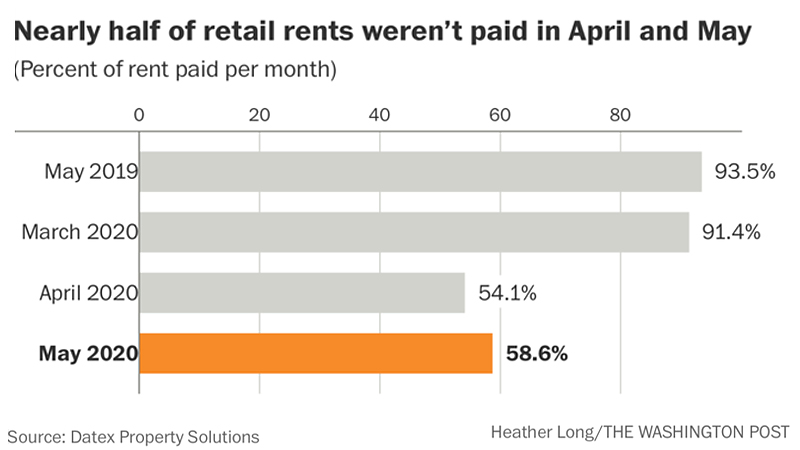
Nearly half of commercial retail rents were not paid in May, as companies as big as Starbucks say the financial devastation from the shutdown has left them unable to pay their full property bills on time. Some companies warn they will not be able to pay rent for months.

The problem for the broader U.S. economy is that when businesses like Ross Stores and T.J. Maxx stop paying rent, it sets off an alarming chain reaction. Landlords are now at risk of bankruptcy, too. Commercial real estate prices are falling. Jobs at property management companies and landscapers face cuts. Banks and private investors are unwilling to lend to most commercial real estate projects anymore, and cash-strapped city and local governments are realizing the property taxes they usually rely on from business properties are unlikely to be paid this summer and fall.

The situation is especially dire for owners of hotels and malls. Such retailers as Bed Bath & Beyond, Famous Footwear, H&M, and the Gap, movie theaters AMC and Regal and gyms like 24 Hour Fitness stopped paying rent entirely in May, according to Datex Property Solutions. Starbucks paid May rent but also sent a letter to landlords requesting landlords to make concessions starting June 1 and continuing for 12 months. Overall, Datex found that 58.6% of retail rents were paid in May. Office and warehouse tenants are still paying rent for now, but there remain concerns about whether tenants will renew leases as working from home gains in popularity.

“Social distancing means financial Armageddon for commercial real estate and municipalities in coming months,” warned R. Christopher Whalen, head of Whalen Global Advisors, on his blog for investors. He predicted defaults could be worse than the peak losses of the early 1990s commercial real estate bust “by a wide margin.”

The crisis is particularly threatening for tens of thousands of small businesses, some of whom operate on such small margins that they say they won’t survive the pandemic recession if they have to pay rent right now. Many small companies are asking landlords for a break, but commercial properties often have a complex chain of owners. Getting them all to agree quickly is proving difficult.

Will Eastman has a lot of nightmares lately that he’s going to be the owner who closes down the iconic U Street Music Hall forever. Eastman said he has tried everything to save the independent music venue and club in Washington, D.C., but it’s hard to generate revenue when U Street Music Hall has been shut since March 13 and doesn’t expect to host live shows until the fall, at the earliest.

“Right now my biggest challenge is with rent. We have had a back-and-forth with our landlord that is kind of mind-boggling,” said Eastman, who hasn’t paid April, May or June rent. “We have no shows scheduled for summer.”

Eastman is in talks with his landlord, but finding a solution has been difficult. Real estate experts say at least U Street Music Hall knew who to pick up the phone and call because his landlord and the property’s mortgage holder are nearby in the D.C. area. For many other businesses, the ownership of their property is far more complex.

“It’s not just the landlord and the tenant that have to talk. Many properties are owned by a number of investors,” said David Ling, a real estate professor at University of Florida. “A lot of this is going to have to be sorted out via lawsuits and the courts.”

Fewer than 40% of commercial property loans are owned by banks, according to the Mortgage Brokers Association. The rest are in the hands of various life insurers, real estate investment trusts (REITs) and investors in commercial mortgage-backed securities, which is known as CMBS.

Dozens and sometimes hundreds of commercial mortgages are packaged together into CMBS, which are typically purchased by a bunch of investors. This complex structure is supposed to spread out the risks and rewards, but it adds multiple layers of ownership to properties.

The commercial real estate market ballooned in the past decade to $20 trillion, as investors hunted for high, yet seemingly safe, returns.

“This really is a tale of who is your lender?” said Andrew Little, a partner at real estate investment bank John B. Levy & Co. in Virginia. “If you have a bank lender or an insurance company lender, you can probably get through this and hopefully get to a point where things start bouncing back. If your lender is a Wall Street CMBS lender, you are in trouble.”

Typically, when businesses stop paying their rents and the building is ultimately owned by the investors of CMBS, the tenants have to call a management company known as the special servicer. Already, $32 billion in CMBS loans have gone to special servicers, according to Moody’s, and almost all have been hotel and retail properties. These servicing firms have little incentive to give tenants a break, Little says, because they make money by tacking on extra fees and penalties.

What this all means is that hotel and retail properties are under severe strain to pay the rent and could collapse in a wave of defaults and foreclosures, warn real estate experts. Already, big investment firms are preparing to scoop up cheap properties. Blackstone and Oaktree have raised massive funds to plunge into the distressed commercial market, much as they did with residential homes after the Great Recession.

Lawmakers are trying to figure out how to prevent businesses – as well as their landlords – from going out of business, but government leaders are struggling to figure out how to help.

Some landlords are asking local governments to delay property tax collections, but many municipalities are already financially strained as tax proceeds plunge and costs skyrocket during the pandemic.

Small-business advocates are pushing Congress to change the rules on Paycheck Protection Program loan forgiveness qualifications, so more than 25% of the money can be used for rent and other overhead costs. A House bill that passed last week would allow up to 40% of the money to go toward rent, but the Senate has not agreed to the changes yet.

Washington passed emergency legislation in May requiring commercial retail landlords to agree to rent payment plans. California is debating an even more aggressive proposal to force landlords with tenants that have been severely affected by coronavirus closures to renegotiate leases. Landlords say this upends the very basis of contract law.

“It’s not appropriate policy to have blanket rent forgiveness. It could really create some chaos,” said John Worth, executive vice president for research at the National Association of Real Estate Investment Trusts.

Lawmakers behind these initiatives say the goal here is to avoid a massive loss of small businesses.

“Businesses and individuals are hurting because of this crisis and it is no one’s fault. We’re trying to make sure people can survive,” said D.C. Council member Mary M. Cheh (D-Ward 3), who sponsored the emergency legislation. “In the end, the rents will be paid.”

Perhaps the most effective intervention so far has come from the Federal Reserve, which has purchased about $9 billion of CMBS and told banks they won’t be penalized for making reasonable concessions on loans. The Fed’s actions have helped unfreeze the commercial real estate market for investors, although it has done little to help small businesses unable to pay rent.

For U Street Music Hall in Washington, paying the rent looms large. The venue has sold more than a thousand T-shirts to fans to make money during the pandemic. An online donation campaign to help U Street workers has raised over $20,000, and Eastman managed to get $120,000 from the federal government’s Paycheck Protection Program for small businesses. But to have this loan forgiven, he has to use $90,000 of the funds to pay his workers.

The remaining funds can be used to pay rent and other expenses, but there’s barely enough leftover to cover the $21,000 rent each month. Eastman has not paid April or May rent and doesn’t expect to pay June, either. He recently asked his landlord for a payment plan.

U Street Music Hall’s landlord is Hanny Chan, owner of JRC Standard Properties, a small commercial real estate company in Washington. Despite the pandemic, Chan still has to pay the mortgage, taxes, insurance, utilities and trash collection for the property where U Street Music Hall is located. His bills have not stopped, either.

Chan spoke with his lender, Industrial Bank, about relief on the mortgage, but Chan found the terms were too onerous, according to his lawyer.

JRC, as the landlord of music hall, “has not received any mortgage relief from its lender. After the public health emergency was declared and U Street Music Hall was shuttered, it withheld rent for April and May without any request for any rent relief,” said Ian Thomas, a lawyer at Offit Kurman who represents JRC. He said JRC has asked U Street Music Hall for more detailed financial information, including about its PPP loan, but the documents were not provided.

Industrial Bank prides itself on serving the D.C. community, said chief executive B. Doyle Mitchell Jr. He said the bank has provided “probably 30%” of its commercial real estate clients with some sort of workout plan.

“We have come to the aid of our customers and some non-customers quickly during this pandemic time,” Mitchell Jr. said. “Some borrowers looked at the [forbearance] program and decided they did not need it. All of our borrowers know it’s available.”

Chan and Eastman are headed to court to work it out. Their situation is further complicated by the fact Eastman and Chan have been in a legal dispute for the past year over management fees and the lease extension.

For now, U Street Music Hall’s full rent is still due.

“We are not asking for free rent. We are not asking for a handout. We are just asking for a reasonable payment plan because our entire industry has been eviscerated by this crisis,” Eastman said. “Our 2020 plans are to survive.”

Stocks soar as investors look past civil unrest to home in on economic high notes #ศาสตร์เกษตรดินปุ๋ย

#ศาสตร์เกษตรดินปุ๋ย : ขอบคุณแหล่งข้อมูล : หนังสือพิมพ์ The Nation.

https://www.nationthailand.com/business/30389016?utm_source=category&utm_medium=internal_referral

Stocks soar as investors look past civil unrest to home in on economic high notes

Jun 04. 2020
By  The Washington Post · Thomas Heath, Taylor Telford · BUSINESS, US-GLOBAL-MARKETS 
Wall Street on Wednesday wrapped up one of its most remarkable 50-day runs, posting a 40% advance that telegraphs optimism against the three-pronged downward pull of disease, civil unrest and economic deterioration.

The Standard & Poor’s 500 closed at 3,122.87, a 42-point or 1.4% gain. The broad market’s comeback from its March 23 low marks its best 50-day performance since 1933, according to Howard Silverblatt of S&P Dow Jones Indices.

The Dow Jones industrial average swelled more than 527 points, a 2% advance that places the blue chips at 26,269.89. The Nasdaq composite rose 74 points, or 0.8%, to finish at 9,682.91. The tech-heavy index is up 8% on the year and within 2% of its all-time high.

All three indexes are 40% above their pandemic lows after chalking up two straight months of gains, despite Depression-era unemployment numbers, a relentless virus that has killed more than 105,000 Americans and a week of upheaval in American cities following the death of another black man in police custody.

“Despite the turbulence and turmoil in our economy from the health crisis, the resulting economic downturn, and civil unrest, the market is anticipating we will get through these problems and the underlying strength of the economy will emerge intact,” said Ed Yardeni, president of Yardeni Research. “It’s a ray of sunshine. We should all be heartened. It’s better than seeing investors selling stocks, betting that we can’t solve our problems and we are headed into a depression.”

Global policymakers in the United States, Europe and Japan have rushed trillions in stimulus into their economies in an effort to forestall a depression due to the steep drop in business and social activity due to the pandemic. Economies have begun to revive, and fear appears to be receding as the number of coronavirus deaths slow and hopes for a treatment rise.

Positive news have started filtering through the economy. Personal incomes rose 10.5%, thanks largely to federal stimulus checks. First-time unemployment filings have leveled off. The housing market is on the rise, helped by record-low interest rates. Private payrolls shed 2.76 million jobs in May, ADP reported Wednesday, well below the 8.75 million that economists surveyed by Dow Jones had expected.

Energy, financials and industrials have led the S&P stock sectors for more than a week on investor belief that the economy is on the road to recovery and will cure everything from low oil prices to empty cruise ships and airplanes.

“Investors are embracing renewed signs of life in consumer spending as we see restaurants, airlines, hotels and real estate all appearing to turn a little bit of a corner,” said Nicole Tanenbaum, chief investment strategist at Chequers Financial Management.

But storm clouds remain due to the recent flare-up in U.S.-China tensions and widespread protests since George Floyd died May 25 in Minneapolis. And the economy is a long way from its pre-pandemic momentum, with 40 million unemployed, airline travel at a crawl and health officials cautioning that the virus could surge in the fall.

The U.S. unemployment rate stood at 14.7% in April – the worst since the Great Depression – and is expected to push toward 20% when the Labor Department releases May data on Friday.

Analysts signaled caution.

“Unrealistic expectations for a V-shaped economic and earnings recovery is driving stocks higher,” said Daniel Wiener, chairman of Adviser Investments.

Overseas investors were equally enthusiastic. Every index in Asia and Europe was positive, with most European markets pushing more than 3% higher. Continued declines in coronavirus cases in some of the hardest-hit countries, amid gradual steps toward normalcy, have raised confidence that an economic revival is underway.

Manufacturing showed signs of stabilizing after four months of contraction, according to the Institute for Supply Management’s May report. Timothy Fiore, the ISM’s chair of the business survey committee, wrote that May was a “transition month” and a signal the country was getting back to work. Demand, however, “remains uncertain.”

Oil prices retreated after Saudi Arabia and Russia agreed to maintain production cuts through July. Energy consumption has been rising as lockdowns unwind around the world, spurring more driving and air travel. Oil futures prices for U.S. crude fell 20 cents to $36.61, a .5% drop. World benchmark Brent crude slid .73% to $39.27. Oil prices have surged in the past month as production cuts chewed into a supply glut, but prices remain far below what most producers need to make a profit.

The OPEC-plus alliance agreed in April to cut output by 9.7 million barrels a day, after a sharp decline in global oil demand amid the pandemic.

Plans hatched for Thai version of Netflix #ศาสตร์เกษตรดินปุ๋ย

#ศาสตร์เกษตรดินปุ๋ย : ขอบคุณแหล่งข้อมูล : หนังสือพิมพ์ The Nation.

https://www.nationthailand.com/business/30389004?utm_source=category&utm_medium=internal_referral

Plans hatched for Thai version of Netflix

Jun 03. 2020
Buddhipongse Punnakanta

Buddhipongse Punnakanta
By The Nation

A government minister has unveiled his bid to create a Thai-owned content platform to compete with Netflix, which is popular in the Kingdom.

Digital Economy and Society Minister Buddhipongse Punnakanta revealed the plan during “RoLD Virtual Forum: Living with Covid-19”, a videoconference event on empowering digital citizenship held by the Thailand Institute of Justice on Wednesday (June 3).

“Currently, international content platforms in countries such as China buy Thai content to generate big profits,” he said. “If we create our own content platform, it will become a channel to market and sell [Thai] content to other countries.”

Buddhipongse said the private sector would need to help create the Thai-owned platform, since state-owned platforms had failed to gain popularity with viewers in the past.

“For example, three international online shopping platforms are more popular than platforms run by the ministries of Commerce and Interior, and Thailand Post, because state-owned platforms do not meet the people’s needs,” he said.

“Therefore, the government should provide a budget and allow the private sector to create a platform, conduct research, run a publicity campaign and sell content.”

Buddhipongse added that a Thai-owned platform would be able to expand to the regional level within one year.

Ministry teams up with Grab, Alibaba to tap online potential for Thai agricultural products #ศาสตร์เกษตรดินปุ๋ย

#ศาสตร์เกษตรดินปุ๋ย : ขอบคุณแหล่งข้อมูล : หนังสือพิมพ์ The Nation.

https://www.nationthailand.com/business/30388978?utm_source=category&utm_medium=internal_referral

Ministry teams up with Grab, Alibaba to tap online potential for Thai agricultural products

Jun 03. 2020
By The Nation
The Ministry of Agriculture and Cooperatives is joining hands with Grab and Alibaba to tap the potential of the online market, aiming to woo 260 million customers from 190 countries.

Alongkorn Ponlaboot, the adviser to the Minister of Agriculture and Cooperatives, said the ministry has joined hands with Grab Thailand to expand online channels. This is a part of the domestic economic and consumption promotion policy under the campaign “Eat Thai First’ and opening the farmer market on Grab platform, starting from June 1.

The ministry is also coordinating with Alibaba company for the development of small and medium-sized agricultural entrepreneurship, farmers’ institutions and farmers to do business and sell Thai agricultural products to foreign markets on the Alibaba platform.

The “Farmer Mart” project was launched on Grab on June 1. The project will offer five types of fruits from three provinces — Golden Nam Dok Mai mango from the Ban Rong San agriculture cooperative of Phayao province, Hong Hui lychee and Chakkraphat lychee from the Mae Sauk agriculture cooperative of Phayao province, mangosteen and durian from Wang Sai Nikom Cooperative of Rayong province, and Gros Michel banana from Ban Lat agriculture cooperative of Phetchaburi province. The project will further expand the type of agricultural products, sources of agricultural products and service areas within two weeks, the ministry said.

The ministry has also collaborated with Alibaba to launch the project, “Thai Agriculture going Forward to the World Market with Alibaba.com“. The project aims to strengthen and increase the online trading potential to reach the global market through the Alibaba platform with over 260 million buyers from 190 countries around the world. There are many successful entrepreneurs in Thailand using the Alibaba platform as a channel to sell Thai products to the world market, and more than half of them are Thai agricultural products such as cassava, rice, black garlic, pineapple, corn, as well as processed agricultural products from black garlic, sugar etc, the ministry said.

Stocks rise for 3rd day on outlook for reopening #ศาสตร์เกษตรดินปุ๋ย

#ศาสตร์เกษตรดินปุ๋ย : ขอบคุณแหล่งข้อมูล : หนังสือพิมพ์ The Nation.

https://www.nationthailand.com/business/30388967?utm_source=category&utm_medium=internal_referral

Stocks rise for 3rd day on outlook for reopening

Jun 03. 2020
By Syndication Washington Post, Bloomberg · Katherine Greifeld · BUSINESS, US-GLOBAL-MARKETS

U.S. stocks rose alongside equities in Europe and Asia amid new bouts of stimulus and positive economic signals as coronavirus lockdowns ease. The dollar slumped for a fourth consecutive day.

Two shares rose on the S&P 500 Index for every one that fell, lifting the benchmark to its highest since March 4. Gunmakers extended rallies in the wake of President Donald Trump’s promise to deploy large numbers of troops if cities and states don’t act to contain violence from protests over police brutality.

Stocks are hovering near their highest in three months as businesses reopen around the world and manufacturing gauges show economies stabilizing following coronavirus shutdowns. That’s despite a slew of risks still on the horizon, including tense U.S.-China relations that may jeopardize a hard-won trade deal. The sometimes violent demonstrations across U.S. cities over the killing by police of George Floyd, an unarmed black man, aren’t yet seen as a major drag on the economy and corporate profits.

“Everyone who is assessing what they’re seeing on the news every night is recognizing things getting worse, and yet the markets are focusing on things that they believe are getting better,” said Brian Levitt, a global market strategist at Invesco. Coronavirus “cases have plateaued in aggregate and compressed in some of the hardest hit areas. Mobility is starting to pick up, reopenings are starting to pick up.”

Stimulus hopes powered Europe’s Stoxx 600 to a 12-week high as Chancellor Angela Merkel sought to thrash out a second aid package for Germany. Oil gained as investors eyed a potential extension of record production curbs by OPEC+. Treasurys edged lower, while the pound gained on positive news in trade negotiations between Britain and the EU.

Elsewhere, emerging-market stocks rallied alongside currencies. Australia’s dollar rose to its highest level since January. In Asia, Tokyo equity benchmarks outperformed.

These are the main moves in markets:

Stocks

–The S&P 500 Index rose 0.8% at the close of trading in New York for its third straight gain.

–The Stoxx Europe 600 Index advanced 1.6%.

–The MSCI Asia Pacific Index increased 1%.

–The MSCI Emerging Market Index gained 1.7%.

Currencies

–The Bloomberg Dollar Spot Index decreased 0.3%.

–The euro increased 0.3% to $1.1169.

–The British pound gained 0.4% to $1.2546.

–The Japanese yen weakened 1% to 108.66 per dollar.

Bonds

–The yield on 10-year Treasurys rose two basis points to 0.68%.

–Germany’s 10-year yield declined one basis point to -0.42%.

–Britain’s 10-year yield fell one basis point to 0.22%.

Commodities

–West Texas Intermediate crude increased 4% to $36.84 a barrel.

–Gold fell 0.7% to $1,728.12 an ounce.

Johnson revamps agenda to meet worst British recession in 300 years #ศาสตร์เกษตรดินปุ๋ย

#ศาสตร์เกษตรดินปุ๋ย : ขอบคุณแหล่งข้อมูล : หนังสือพิมพ์ The Nation.

https://www.nationthailand.com/business/30388966?utm_source=category&utm_medium=internal_referral

Johnson revamps agenda to meet worst British recession in 300 years

Jun 03. 2020
Boris Johnson

Boris Johnson
By Syndication Washington Post, Bloomberg · Tim Ross, Kitty Donaldson · BUSINESS 

Boris Johnson plans to reset his government’s agenda with a major speech and a financial statement to prepare Britain for the new reality after the coronavirus pandemic.

Amid forecasts of the worst recession in 300 years, Chancellor of the Exchequer Rishi Sunak is drawing up options to bolster the economy as the government withdraws its vast package of financial support in the months ahead, according to people familiar with the matter.

For Johnson, the priority will be to focus on reasserting his broader political mission in the age of the virus, one person said. The Conservative Party leader and public face of Brexit, Johnson was elected with a large majority just six months ago on a promise to “level up” the forgotten parts of the country.

Yet his plans have been derailed by the global pandemic, with his government’s agenda put on ice as the coronavirus crisis took over. For Johnson and his administration, which is already facing criticism for its response to the public health emergency, minimizing the economic hit will be vital to its hopes of reelection by the time the next election is held in 2024.

The U.K. has already spent $70 billion (56 billion pounds) on virus support measures since the crisis hit in mid March, and is now paying the wages of 8.7 million jobs, according to figures released on Tuesday.

Work has begun on preparing for Johnson to set out a key speech, expected at the end of June, one person said.

On Monday, Health Secretary Matt Hancock promised more details on the “economic response” later this summer after he was asked about government preparations for a recession amid fears of bankruptcies and job losses.

“The economy’s going to have to change,” Hancock told the government’s daily virus briefing in London. “We’re going to have to be a different type of economy as we come out of this and you’re going to hear more of that from the chancellor and the prime minister, who’ve been working so hard on this, in the weeks and months to come.”

Officials privately confirmed work is underway on a fiscal event but said it is too early to be precise about the detailed policy proposals, or about the date, though one person said it is likely to be in July.

Among the questions that have been discussed among Johnson’s allies include whether there is potential to raise income tax or national insurance specifically to pay for investment in the National Health Service. Business taxes may also rise, as internal polling suggests there is public support for increases in corporation tax.

Other options could include a windfall tax on sectors that have profited during the pandemic — such as supermarkets or technology companies, one person familiar with discussions said.

Sunak, who has spent unprecedented amounts supporting the U.K. economy during the coronavirus crisis, kept the spending taps firmly on last week as he announced plans to taper his job support program, unveiling an incremental withdrawal in a bid to avert a mass wave of unemployment this summer.

The self-employed will be offered a grant of as much as $8,205 (6,570 pounds) in August to cover another three months of earnings, while furloughed workers will continue to receive 80% of wages through October. Employers will only start taking the burden of their National Insurance and pension contributions in August, before paying 10% of workers’ wages in September, and 20% the following month, the chancellor said.

The two jobs’ plans are currently supporting 10.7 million jobs, and have come at a cost of almost 22 billion pounds. The cost of both programs could easily breach 100 billion pounds, about 11% of total government spending in a normal year and equivalent to the amount spent on the National Health Service, according to the Institute for Fiscal Studies.

106 development projects proposed for EEC #ศาสตร์เกษตรดินปุ๋ย

#ศาสตร์เกษตรดินปุ๋ย : ขอบคุณแหล่งข้อมูล : หนังสือพิมพ์ The Nation.

https://www.nationthailand.com/business/30388962?utm_source=category&utm_medium=internal_referral

106 development projects proposed for EEC

Jun 03. 2020
By THE NATION

The Office of Transport and Public Policy and Planning has proposed 106 projects for the consideration of the working panel tasked with drawing up the second phase of infrastructure development in the Eastern Economic Corridor (EEC).

The Transport Ministry’s permanent secretary Chaiwat Thongkamkoon said the proposals are designed to support mega projects that will be in operation soon, such as the high-speed train network linking the country’s three main international airports.

The proposed projects for the second phased, estimated to cost Bt252 billion, will be developed between 2022 and 2027, and will also include the projects in the first phase that cannot be completed next year.

He added that the meeting had ordered related agencies to review the budget of their projects in the second phase in order to save development costs. The revision will be submitted to the EEC Policy Committee next month to seek funds.

The projects for the second phase include a tram network in Pattaya, which will be linked with the high-speed trains linking the three airports.

Senate approves Bt1.9tn stimulus package #ศาสตร์เกษตรดินปุ๋ย

#ศาสตร์เกษตรดินปุ๋ย : ขอบคุณแหล่งข้อมูล : หนังสือพิมพ์ The Nation.

https://www.nationthailand.com/business/30388960?utm_source=category&utm_medium=internal_referral

Senate approves Bt1.9tn stimulus package

Jun 02. 2020
By THE NATION

The Senate today (June 2) endorsed the three emergency decrees for an economic stimulus package worth Bt1.9 trillion after two days of vetting.

The first decree empowers the Finance Ministry to borrow Bt1.1 trillion to revive the economy after the toll taken on business by the Covid-19 pandemic.

The second decree will trigger soft loans of Bt500 billion for small and medium sized enterprises (SMEs) hit by the outbreak.

Spending under the third decree is aimed at stabilising the country’s financial system and economic security.

Related story: MPs push Bt1.9-trillion Covid-19 aid package through Parliament

SET rises despite renewed US-China tensions, shaky political situation in Thailand #ศาสตร์เกษตรดินปุ๋ย

#ศาสตร์เกษตรดินปุ๋ย : ขอบคุณแหล่งข้อมูล : หนังสือพิมพ์ The Nation.

https://www.nationthailand.com/business/30388956?utm_source=category&utm_medium=internal_referral

SET rises despite renewed US-China tensions, shaky political situation in Thailand

Jun 02. 2020
By The Nation

The Stock Exchange of Thailand (SET) Index rose 21.81 points or 1.61 per cent, closing at 1,374.18 today (June 2).

Total transactions amounted to Bt70.987 billion with an index high of 1,374.29 and a low of 1,357.23.

During the morning session, a stock analyst at Krungsri Securities said he expected the index to fluctuate between 1,345 and 1,365 points due to uncertainty over renewed tensions after China suspended imports of soybean in response to United States’ threat to terminate trade ties with Hong Kong.

“Thailand’s political situation and tight SET valuation will also pressure the index,” the analyst predicted, citing the fact that 18 members of the core coalition party Palang Pracharat’s board members had officially resigned on Monday.

He added that energy and petroleum stocks continued to gain from positive sentiment over rising crude oil, as investors expect the economy to recover after several countries have eased their lockdown measures.

The top 10 stocks with the highest trade value today were AOT, KTC, KBANK, PTT, GULF, BBL, PTTEP, GPSC, PTTGC and BGRIM.

As of 4.30pm, crude oil price rose by US$0.90 or 2.54 per cent to $36.34 per barrel, while gold rose by $0.60 or 0.03 per cent to $1,750.90 per ounce.

The global indices were on the rise:

Japan’s Nikkei Index closed at 22,325.61, up 263.22 points, or 1.19 per cent.

China’s Shanghai SE Composite Index closed at 2,921.40, up 5.97 points, or 0.20 per cent, while Shenzhen SE Component Index closed at 11,112.50, up 10.35 points, or 0.093 per cent.

Hong Kong’s Hang Seng Index closed at 23,995.94, up 263.42 points, or 1.11 per cent.

South Korea’s KOSPI Index closed at 2,087.19, up 22.11 points, or 1.07 per cent.

Taiwan’s TAIEX Index closed at 11,127.93, up 48.91 points, or 0.44 per cent.

App launched to match businesses with millions of unemployed #ศาสตร์เกษตรดินปุ๋ย

#ศาสตร์เกษตรดินปุ๋ย : ขอบคุณแหล่งข้อมูล : หนังสือพิมพ์ The Nation.

https://www.nationthailand.com/business/30388944?utm_source=category&utm_medium=internal_referral

App launched to match businesses with millions of unemployed

Jun 02. 2020
By The Nation

Concerned at the toll Covid-19 is taking on jobs, the Thai Chamber of Commerce (TCC) has launch an unemployment solution app, while also asking the state to revise its national strategy to tackle the aftermath of the virus crisis.

TCC chairman Kalin Sarasin said the private sector was still concerned about unemployment caused by Covid-19 and government restrictions that had hit businesses. Many methods were being used to keep businesses open, including reducing salaries, automating human jobs, and staff layoffs, he said. Meanwhile a TCC survey conducted two months ago found that the virus crisis may push unemployment up to 7 million, though the National Economics and Social Development Council (NESDC) projects up to to 8.4 million will be jobless and 2 million will be unemployed all this year.

To tackle the problem, the TCC has partnered with Accenture Thailand to launch the “People + Work Connect” platform. Launched today (June 2), the platform’s first phase links workforce data from different companies to form a pool of labour to match their needs. So far, 29 corporations have joined the project, which helps to slow down unemployment and provide opportunities to laid-off workers.

Kalin added that the private sector is worried about what economic shape Thailand will be in once the virus crisis is over. As such, the TCC has gathered concerns and suggestions from businesses as a basis for consultations with all government agencies. The key challenge, he said, is finding a new strategy to pave the way for Thailand, since Covid-19 had changed everything. The government must review its national strategy, ranking plans and guidelines according to new priorities and rethinking national spending.

However, the private sector is confident the economy will improve in the the second half of 2020, as the government start to unlock the business lockdown. About 90 per cent of private and state enterprises would reopen, to drive purchasing power and investment again. But GDP this year is still forecast to shrink by 5 per cent.

The TCC estimates total revenue in the economy is now around Bt100 billion while the third phase of lockdown easing should double that figure. The chamber believes that if the number of new virus cases remains low and the state gradually allows remaining businesses to reopen, businesspeople and investors from Japan, China, the United States and Europe will return to boost the Thai economy.

“The ‘unlocking’ period has two parts. In the first, some businesses need to be opened fully and fast while the others need to be opened more gradually according to virus preventive measures and numbers of new cases. The private sector considers that any business equipped with standard protection should be opened, especially for investors and foreign workers,” said Kalin.

He added that the curfew should remain to prevent a second-wave outbreak, but its hours should be gradually cut.

Supawan Tanomkieatipume, president of the Thai Hotels Association, said that hotel revenue had dropped to zero during the pandemic outbreak. About 90 per cent of hotels had closed temporarily, which had affected 1.6-1.7 million staff. Hotels are expected to reopen in July but operate at only 30-40 per cent capacity to comply with government measures, for which hotels must bear the cost.

“Seventy per cent of Thailand’s tourism revenue comes from foreign tourists, while 30 per cent is domestic. In 2019, there were 38 million tourists yielding revenue of about Bt12 trillion. That figure is expected to fall by more than half this year. But we should see clear [positive] results from the government’s stimulus measures in the fourth quarter,” said Supawan.