U.S. stock futures soar on positive results from Moderna vaccine trial, assurances of Fed support #ศาสตร์เกษตรดินปุ๋ย

#ศาสตร์เกษตรดินปุ๋ย : ขอบคุณแหล่งข้อมูล : หนังสือพิมพ์ The Nation.

https://www.nationthailand.com/business/30388072?utm_source=category&utm_medium=internal_referral

U.S. stock futures soar on positive results from Moderna vaccine trial, assurances of Fed support

May 18. 2020
By The Washington Post · Taylor Telford · BUSINESS, US-GLOBAL-MARKETS 

U.S. markets were poised for recovery Monday as good news out of Moderna’s coronavirus vaccine trials spurred optimism in investors, with Dow futures calling for a more than 650-point, or 2.7%, jump at opening bell.

Biotechnology company Moderna reported Monday that early human trials for its coronavirus vaccine successfully produced covid-19 antibodies in all participants. The company plans to launch a large clinical trial in July aimed at showing whether the vaccine works. Moderna’s shares soared 30% in early trading.

Investors also found comfort in comments Federal Reserve chair Jerome Powell made during a “60 Minutes” interview. He said the central bank is “not out of ammunition by a long shot” in its resources to support the economic recovery – which he warned could stretch into 2021.

David Rosenberg, chief economist of Rosenberg Research, said investors were being rewarded with a “triple whammy of good news” after two weeks of flux.

“For one, there is palpable relief that the majority of the states are reopening their economies, including 75% of California,” Rosenberg in an email to The Washington Post. “Second, there is growing hope that a vaccine is coming our way sooner, rather than later. Lastly, Fed Chairman Jay Powell told investors over the weekend that the central bank’s checkbook remains wide open, strongly hinting that more monetary policy stimulus is on its way.”

Last week, fresh economic data revealed the pandemic’s mounting economic toll: The U.S. Labor Department on Thursday reported weekly jobless claims of 3 million, bringing the two-month total to more than 36 million unemployed. April retail sales plummeted 16.4%, a drop that was worse than analysts had predicted as consumers stayed home amid the pandemic lockdown. The darkening retail picture prompted some economists to issue even graver predictions for second quarter gross domestic product, with some calling for a contraction of more than 40%.

“The economic collapse has taken a dangerous turn where now it is consumer prices that are being pulled down into the abyss as consumers sitting at home have postponed their purchases,” Chris Rupkey, chief financial economist and MUFG Union Bank wrote in commentary. “The danger is that consumers will see that prices are falling and actually stop buying goods and services to wait for even cheaper prices and a better deal which will only serve to prolong the recession and reinforce the economy’s downward spiral into the unknown.”

But Monday’s good news saw investors leave safe havens for riskier ground. The yield on the 10-year U.S. Treasury note to ticked upward to .665% in early trading. Bond yields rise as prices drop.

Continued recovery in oil markets added to the positive sentiment, as the gradual removal of lockdown restrictions around the world also eased fears of a global oil glut. Brent crude, the global oil benchmark, was up 9.6% to trade at $32.36 per barrel.

“The supply cuts of the last month combined with gradual reopening of various countries around the world has put a significant dent in the supply/demand imbalance and alleviated capacity concerns that led to last months panic,” Craig Erlam, an analyst with OANDA, wrote in commentary Monday.

Bonds may be back in demand if there is no second wave of infections, expert says #ศาสตร์เกษตรดินปุ๋ย

#ศาสตร์เกษตรดินปุ๋ย : ขอบคุณแหล่งข้อมูล : หนังสือพิมพ์ The Nation.

https://www.nationthailand.com/business/30388065?utm_source=category&utm_medium=internal_referral

Bonds may be back in demand if there is no second wave of infections, expert says

May 18. 2020
Thiti Tantikulanan, head of KBank’s Capital Markets Business Division

Thiti Tantikulanan, head of KBank’s Capital Markets Business Division
By The Nation

Demand for corporate bonds with high credit rating is set to rise as investors continue hunting for higher returns, an expert said, but warned that Covid-stricken industries and companies with a lower credit rating may find it difficult to roll over their own debt instruments or issue new debentures.

Kasikornbank (KBank), meanwhile, forecast that the debt market will remain volatile in the fallout of the pandemic. Over the first four months of 2020, the issuance of corporate bonds dropped 41 per cent, while newly issued debentures for the entire year are expected to be worth no more than Bt900 billion, versus over Bt1 trillion last year.

“Demand for bonds with sound rating scores for the rest of the year is set to recover, assuming there is no second wave of infections,” Thiti Tantikulanan, head of KBank’s Capital Markets Business Division, said on Monday (May 18).

Given that banks offer low interest, institutional investors and high-net worth individuals will continue searching for high yield, while bond issuers offering high returns will find it easy to win back investors, he said.

KBank is also expecting the Bank of Thailand to lower its policy rate by another 25 basis points from the current 1 per cent when it meets with the Monetary Policy Committee on Wednesday.

Thiti recounted that the pandemic has sent shockwaves through financial markets, with bond prices nosediving first and denting the net asset value (NAV) of mutual funds, which in turn derailed the confidence of unit holders, who then dumped their units in mid-March.

As a result, asset-management companies rushed to sell their debt instruments at any price in secondary markets to obtain cash for unit holders seeking to redeem their units. Then these companies cut the volume of their newly issued debentures in order to maintain their liquidity. Under these circumstances, market demand slumped.

In the first quarter of this year, the NAV of the Thai mutual fund system sharply dropped Bt800 billion or 15.30 per cent from Bt5.4 trillion as of December 31, 2019. This figure is now close to that seen in 2016.

In March alone, the NAV plunged a staggering Bt700 billion, while fixed-income funds recorded redemption of Bt45 billion. However, the pressure on mutual funds has eased of late and the market has steadily stabilised as regulators worldwide are implementing both fiscal and monetary policy measures to mitigate the fallout, he said.

Meanwhile, the volume of the issuance of new long-term corporate bonds dropped sharply over the first four months of 2020, or 41 per cent year on year, from Bt310 billion to Bt180 billion, due to many issuers holding off on issuing bonds pending market improvement.

Some businesses have also resorted to bank loans at a time when bond issuance is facing rising challenges, due to plummeting demand among institutional investors, especially asset management firms, which have adopted a more cautious stance.

As for individual investors, they are now focusing on bonds with sound credit scores, though their returns may be lower. Hence, bonds that are not rated or that have lower rating scores have not met their sales targets, even though the yields are quite high.

Recently investors’ concerns have eased somewhat thanks to governments and central banks worldwide launching measures to boost public confidence. Investors are returning to the markets, but only for quality assets.

As for bonds, those winning interest are those from well-known organisations as well as those that have high-credit scores, like the government’s special savings bond “Thailand Stays Strong” as well as the debentures of Berli Jucker Plc and Charoen Pokphand Foods Plc, of which KBank is an underwriter and which are scheduled for public offering from May to early June. These bonds are expected to be received warmly by investors, Thiti said.

However, though the overall situation has improved somewhat, the bond issuance costs have not dropped and are now standing at a “new normal” level that reflects rising risks. Such high costs are passed on to the credit spreads, which are 0.20 to 1.75 per cent higher than in the pre-Covid-19 period.

These increases in credit spreads are relative to the bonds’ series, terms, credit ratings and anticipated degree of impact on the economic downturn or the Covid-19 pandemic on the issuers’ respective industries, Thiti said.

This year, KBank expects about Bt900 billion worth of long-term debentures to be issued, versus more than Bt1 trillion worth issued in 2019. This is the first decline since 2015, chiefly due to the delay or cancellation of debenture issuers’ investment plans, which brought about a delay in fund mobilisation.

Concurrently, debenture issuers in some industries, namely tourism and property, may have seen lacklustre interest from investors.

Meanwhile, KBank aims to maintain its status as a top-ranked underwriter with the highest underwritten amount and a market share of about 20 per cent of all debentures offered for sale.

However, it will continue to closely monitor and assess the impact the Covid-19 outbreak has had on the overall economy, debenture issuers and the bond market.

As for risks, approximately Bt600 billion worth of long-term corporate debentures (not including the more than Bt100 billion of commercial bank debentures) will mature this year. These include Bt180 billion worth of debentures with a BBB+ rating or lower. Some companies may find it difficult to roll over these maturing debentures, while debenture issuers in Covid-19 stricken industries may face challenges in rolling over or issuing new debentures due to insufficient demand.

Either way, risk will likely increase. At this time, some debenture issuers have postponed their redemption date, though both KBank and the public sector have come up with measures to ease any impact on capital, maintaining financial market liquidity and financial system stability. Two of these measures are the Corporate Bond Stabilisation Fund (BSF) and the Mutual Fund Liquidity Facility (MFLF) introduced by the Bank of Thailand to reduce the pandemic’s impact on the economy.

The objective of the BSF is to provide affected bond issuers a temporary fund reserve as a last resort, which KBank believes has had a positive effect on market psychology. However, since its mechanism is relatively complicated, the number of corporate bond issuers that will ultimately seek assistance via this channel is expected to be limited.

Meanwhile, aid through the MFLF measure peaked in late April with an outstanding value of Bt56 billion, which recently dropped to Bt50 billion, suggesting a more relaxed state of liquidity.

In the near future, uncertainty rising from Covid-19 will remain a key variable that determines market direction, as well as bond yields, for the rest of the year. Once the spread of the virus begins showing signs of permanent containment, and the life returns to normal – especially if a cure or vaccine is found – the bond market is expected to see a turnaround as investors return to risky assets, he added.

SET lifted by rising oil price, second phase of lockdown easing #ศาสตร์เกษตรดินปุ๋ย

#ศาสตร์เกษตรดินปุ๋ย : ขอบคุณแหล่งข้อมูล : หนังสือพิมพ์ The Nation.

https://www.nationthailand.com/business/30388064?utm_source=category&utm_medium=internal_referral

SET lifted by rising oil price, second phase of lockdown easing

May 18. 2020
By The Nation

The Stock Exchange of Thailand (SET) Index closed at 1,286.53 today (May 18), up 5.77 points or 0.45 per cent. Total transaction volume was Bt55.905 billion with an index high of 1,295.94 and a low of 1,283.60.

A Krungsri Securities’ stock analyst expected the index to rise to 1,290 points, as energy stocks gained positive sentiment from the rising crude oil price, before falling back.

“The price of crude oil rose more than US$30 per barrel due to increasing demand after several countries eased their lockdowns and Opec+ moved to cut oil production,” he noted.

“In addition, retail stocks gained positive sentiment after the Centre for Covid-19 Situation Administration approved the second phase of lockdown easing.”

The analyst said the index would fall due to concern of a renewed US-China trade war after Washington halted export of microchips to China’s Huawei, risking retaliation from Beijing.

“We advised investors to beware of mass sell-offs due to a drop in the first-quarter performance of corporates,” he added.

The 10 stocks with the highest trade value today were PTT, PTTEP, BANPU, BAM, CPALL, MINT, PTTGC, GULF, ADVANC, and GPSC.

As of 4.30pm, the price of crude oil rose by $1.67 or 5.67 per cent to $31.10 per barrel, while gold rose by $14.70 or 0.84 per cent, to $1,771 per ounce.

Meanwhile, Asian indices had a mixed day:

Japan’s Nikkei Index closed at 20,133.73, up 96.26 points, or 0.48 per cent.

China’s Shang Hai SE Composite Index closed at 2,875.42, up 6.96 points, or 0.24 per cent, while the Shenzhen SE Component Index closed at 10,921.15, down 43.75 points, or 0.4 per cent.

Hong Kong’s Hang Seng Index closed at 23,934.77, up 137.3 points, or 0.58 per cent.

South Korea’s KOSPI Index closed at 1,937.11, up 9.83 points, or 0.51 per cent.

Taiwan’s TAIEX Index closed at 10,740.55, down 74.37 points, or 0.69 per cent.

Recovery could drag through 2021, Powell says #ศาสตร์เกษตรดินปุ๋ย

#ศาสตร์เกษตรดินปุ๋ย : ขอบคุณแหล่งข้อมูล : หนังสือพิมพ์ The Nation.

https://www.nationthailand.com/business/30388040?utm_source=category&utm_medium=internal_referral

Recovery could drag through 2021, Powell says

May 18. 2020
Jerome Powell, chairman of the U.S. Federal Reserve, pauses while speaking during a news conference in Washington, D.C., on March 3. MUST CREDIT: Andrew Harrer/Bloomberg
Photo by: Andrew Harrer — Bloomberg

Jerome Powell, chairman of the U.S. Federal Reserve, pauses while speaking during a news conference in Washington, D.C., on March 3. MUST CREDIT: Andrew Harrer/Bloomberg Photo by: Andrew Harrer — Bloomberg
By Syndication The Washington Post, Bloomberg · Alister Bull

The U.S. economy will recover from the coronavirus pandemic, but the process could stretch through the end of next year and depend on the delivery of a vaccine, said Federal Reserve Chairman Jerome Powell.

“Assuming there’s not a second wave of the coronavirus, I think you’ll see the economy recover steadily through the second half of this year,” the U.S. central bank chief said in a television interview conducted Wednesday, parts of which were aired on CBS’s “Face the Nation” and “60 Minutes” shows on Sunday.

“For the economy to fully recover people will have to be fully confident, and that may have to await the arrival of a vaccine,” said Powell, seated in the Fed’s stately boardroom at the long table used to deliberate monetary policy. His interviewer was seated at a socially safe distance at the end of the table.

More than 36 million Americans have lost their jobs since February as the economy shuttered to limit virus spread. Countless companies, especially small businesses, are hurtling toward bankruptcy, while states and cities are confronting gaping budget shortfalls that could provoke a massive second wave of layoffs from the public sector.

To limit the harm, Powell and his colleagues have slashed interest rates to zero, flooded financial markets with trillions of dollars in liquidity, and unveiled nine emergency lending facilities to keep credit flowing in the economy.

Some investors have bet the Fed may be pushed to follow other central banks in adopting negative interest rates, which President Donald Trump has repeatedly called for in the U.S.

Fed officials including Powell have consistently batted this idea away, and he did so again on Sunday.

“I continue to think, and my colleagues on the Federal Open Market Committee continue to think, that negative interest rates is probably not an appropriate or useful policy for us here in the United States,” he said, according to a transcript of the full interview. “There’s no clear finding that it actually does support economic activity on net. And it introduces distortions into the financial system, which I think offset that.”

The Fed chief said people should never “bet” against the American economy and firmly played down suggestions that if faced a second Great Depression. But he took care not to promise a swift, so-called V-shaped rebound.

“This economy will recover. It may take a while,” he said. “It could stretch through the end of next year. We really don’t know.”

Powell also stressed that the central bank hadn’t exhausted its options for aiding the economy.

“There’s a lot more we can do. We’ve done what we can as we go. But I will say that we’re not out of ammunition by a long shot,” he said. Powell noted the Fed can increase its emergency lending programs and make monetary policy more supportive through forward guidance and by adjusting the Fed’s asset-purchase strategy.

That could be a veiled reference to yield curve control, where the Fed undertakes to hold yields out to a certain maturity at a certain level, as the Bank of Japan already does. Some analysts expect the Fed to move in that direction later this year.

Powell’s remarks follow his grave warning Wednesday that the U.S. economy faces lasting harm from the pandemic if the government doesn’t step up. The comments add support to calls for more congressional spending as Democrats push for a fresh $3 trillion in virus aid on top of a record $2.2 trillion package agreed in March. On Friday, the House passed the measure, though it has no future in the Republican-led Senate.

Powell can expect questions on the scale and timing of additional fiscal relief when he appears before the Senate Banking Committee on Tuesday.

Pressed on the question during the CBS interview, Powell said providing more congressional support to state and local governments was “something that deserves a careful look,” and also cited the need for policies to limit business insolvencies and keep workers in their jobs and homes.

He also declined to be drawn into the debate on when the U.S. economy should reopen, beyond saying it should happen carefully to minimize the risk of sparking more infections.

But he opened up when it came to the next time he’d feel safe sitting in a crowd to watch his hometown’s Stanley Cup-winning hockey team, the Washington Capitals.

“Certainly no sooner than next season,” he said. “Public sporting events, public concerts and things like that – those will be among the last things that can be resumed.” The National Hockey League’s 2020-2021 season is scheduled to start in October, 2020.

Gold price rises on weak US economic data, US-China trade war worries #ศาสตร์เกษตรดินปุ๋ย

#ศาสตร์เกษตรดินปุ๋ย : ขอบคุณแหล่งข้อมูล : หนังสือพิมพ์ The Nation.

https://www.nationthailand.com/business/30388039?utm_source=category&utm_medium=internal_referral

Gold price rises on weak US economic data, US-China trade war worries

May 18. 2020
By The Nation

The price of gold rose by Bt250 per baht weight in morning trade today (May 18), the Gold Traders Association reported.

As of 9.24am, the buying price of a gold bar was Bt26,400 per baht weight and selling price Bt26,600, while gold ornaments were priced at Bt25,923.60 and Bt27,100, respectively.

At close on Saturday, the buying price of a gold bar was Bt26,150 per baht weight and selling price Bt26,350, while gold ornaments were priced at Bt25,681.04 and Bt26,850, respectively.

The Gold Spot Index price this morning moved to around US$1,763 (Bt56,483) per ounce after the price rose by $15.4 to $1,756.3 per ounce at close on Friday.

Investors were buying gold as a safe haven asset due to weak US economic data and uncertainty following a renewed US-China trade war.

Meanwhile, the Hong Kong gold price rose by HK$180 to $16,050 (Bt66,333) per tael.

SET gains from rising crude oil price, 2nd phase of lockdown easing #ศาสตร์เกษตรดินปุ๋ย

#ศาสตร์เกษตรดินปุ๋ย : ขอบคุณแหล่งข้อมูล : หนังสือพิมพ์ The Nation.

https://www.nationthailand.com/business/30388038?utm_source=category&utm_medium=internal_referral

SET gains from rising crude oil price, 2nd phase of lockdown easing

May 18. 2020
By The Nation

The Stock Exchange of Thailand (SET) Index opened at 1,290.32, up 9.56 points, or 0.75 per cent, this morning (May 18).

A Krungsri Securities’ stock analyst expected the index to rise to 1,290 points before falling as energy stocks gained positive sentiment from a rising crude oil price.

“The price of crude oil rose more than US$30 [Bt961] per barrel due to increasing oil demand after several countries eased their lockdowns and Opec+ moved to cut oil production,” he noted.

“In addition, retail stocks gained positive sentiment after the Centre of Covid-19 Situation Administration approved the second phase of lockdown easing.”

The analyst said the index would fall due to uncertainty following a renewed US-China trade war after the United States tightened chip export rules to ban the shipping of chips to Huawei, while China might retaliate as well.

“We advised investors to beware of mass sell-offs due to a drop in the first-quarter performance of corporates,” he added.

He recommended investors buy these stocks:

● Energy stocks, such as PTT, PTTEP, TOP, PTTGC and SPRC, due to a rise in the price of crude oil.

● Retail stocks, such as CRC, CPN, HMPro, Global, Com7, and DoHome, due to the second phase of lockdown easing.

● Stocks whose second quarter performance would increase, such as CKP, Tasco and EPG.

Economy sinks 1.8% in Q1: NESDC #ศาสตร์เกษตรดินปุ๋ย

#ศาสตร์เกษตรดินปุ๋ย : ขอบคุณแหล่งข้อมูล : หนังสือพิมพ์ The Nation.

https://www.nationthailand.com/business/30388037?utm_source=category&utm_medium=internal_referral

Economy sinks 1.8% in Q1: NESDC

May 18. 2020
By The Nation

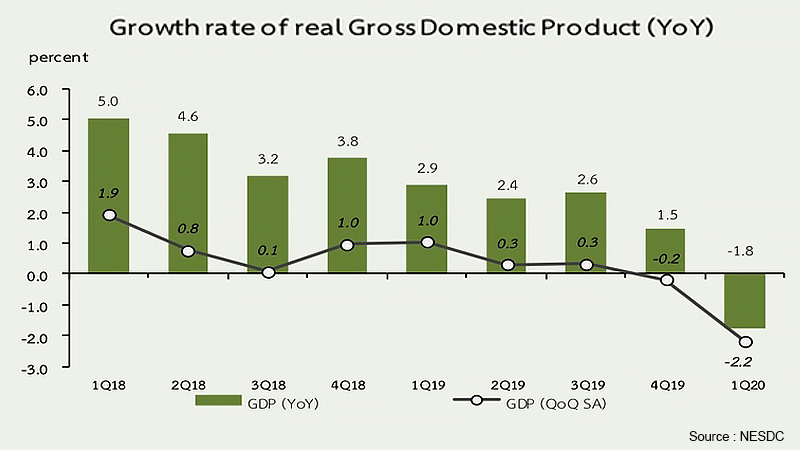
The economy sank by 1.8 per cent year on year in the first quarter, state think-tank the National Economic and Social Development Council (NESDC) said today (May 18).

The economic contraction in the first quarter was largely due to the Covid-19 fallout, said secretary-general Thosaporn Sirisumphand.

In it’s full-year forecast, the Council said the economy would drop by 5 to 6 per cent, close to the 7.6 per cent contraction during the 1997 financial crisis.

The Gross Domestic Product in the first quarter dropped by 1.8 per cent, compared to a rise of 1.5 per cent in 2019 Q4, as a result of the decrease in exports of goods and services, private and public investments and the government’s final consumption expenditure. However, the private final consumption expenditure grew at a decelerated rate, according to the NESDC.

On the production side, the agricultural sector decreased by 5.7 per cent, due mainly to the drought. The non-agricultural sector decreased by 1.4 per cent, in contrast to a rise of 2.0 per cent in 2019 Q4, resulting from the manufacturing sector falling by 2.7 per cent and a reduction of the services sector by 1.1 per cent , compared to a drop of 2.2 per cent and a rise of 4.1 per cent in the previous quarter, respectively. The services sector reduction was mainly because of the decreased number of tourists, which has hit related sectors, particularly affecting transportation and storage, and accommodation and food service activities.

Meanwhile, key services sectors such as wholesale and retail trade, vehicle and motorcycle repair, information and communications, and real estate showed decelerated growth.

As for expenditure, private final consumption expenditure grew by 3.0 per cent, compared to a 4.1 per cent growth in 2019 Q4. However, government final consumption expenditure, gross fixed capital formation, exports and imports of goods and services contracted by 2.7, 6.5, 6.7 and 2.5 per cent, respectively.

After seasonal adjustment, the economy declined by 2.2 per cent in the first quarter of 2020, the NESDC added.

NESDC report expected to project bleak economic outlook for the year #ศาสตร์เกษตรดินปุ๋ย

#ศาสตร์เกษตรดินปุ๋ย : ขอบคุณแหล่งข้อมูล : หนังสือพิมพ์ The Nation.

https://www.nationthailand.com/business/30388025?utm_source=category&utm_medium=internal_referral

NESDC report expected to project bleak economic outlook for the year

May 18. 2020
Some workers have returned to work at department stores and other businesses started to reopen on May 17 after the government implemented the second phase of easing of restrictions.  A full reopening of the economy is a long way off as the international flight ban has been extended to June 30.

Some workers have returned to work at department stores and other businesses started to reopen on May 17 after the government implemented the second phase of easing of restrictions. A full reopening of the economy is a long way off as the international flight ban has been extended to June 30.
By The Nation

The National Economic and Social Development Council (NESDC) is expected to revise downward its economic projections for the year when it releases its quarterly economic report on Monday (May 18).

The NESDC, a government think-tank, is expected to report Thailand’s worst economic performance in the past 22 quarters, a source said.

The economy in the first quarter is expected to fall from a growth rate of 1.6 per cent in the fourth quarter of last year. Previously the NESDC had predicted GDP growth rate at between 1.5 to 2.5 per cent for 2020. The Bank of Thailand expected the economy to contract by 5.3 per cent, but others predict up to a 10 per cent contraction.

The Covid-19 crisis started to impact the economy in January, and had a more severe impact in the following months as it spread to Europe, the United States and other countries, forcing most countries to impose lockdowns, said the source.

The lingering impact on the economy will continue as nobody knows how long the Covid-19 crisis will drag on. The Thai tourism industry, one of the main economic drivers, would be hit hard, as the number of foreign tourists are expected to plummet by at least 70 per cent this year compared to 2019, he said.

The government has extended its ban on international flights until the end of June, as a precaution against a second wave of infections, making a recover for tourism unlikely this year.

The manufacturing sectors, such auto and parts are also down, auto and beverage production declined by 20 per cent in March alone.

The world economy is expected to contract by 2 to 3 per cent.

Thailand’s tourism industry employs about four million people. Laid-off workers totalling 1.2 million have asked for compensation from the Social Security Fund, while 23 million self-employed have asked for Bt5, 000 cash handouts from the government.

The virus pandemic has impacted both consumption, private investment, manufacturing, services and exports, added the source at the NESDC.

The virus sent millions of European workers home – some forever #ศาสตร์เกษตรดินปุ๋ย

#ศาสตร์เกษตรดินปุ๋ย : ขอบคุณแหล่งข้อมูล : หนังสือพิมพ์ The Nation.

https://www.nationthailand.com/business/30388012?utm_source=category&utm_medium=internal_referral

The virus sent millions of European workers home – some forever

May 17. 2020
Shoppers wearing protective face masks while browsing fruit and vegetable stalls at an open air market in Bucharest, Romania, on May 5, 2020. MUST CREDIT: Bloomberg photo by Ioana Epure.

Shoppers wearing protective face masks while browsing fruit and vegetable stalls at an open air market in Bucharest, Romania, on May 5, 2020. MUST CREDIT: Bloomberg photo by Ioana Epure.
By Syndication Washington Post, Bloomberg · Andra Timu · WORLD, EUROPE 

After covid-19 killed the elderly woman Mihaela Danaila had been taking care of for nine years in northern Italy, she joined a rush of about 1.3 million Romanians working abroad and headed home.

The 37-year-old had been part of a steady exodus west after the continent’s ex-communist contingent joined the European Union. Open borders allowed doctors, engineers and builders to garner higher salaries elsewhere, escaping corruption and poor health care in the process. The shift helped richer countries struggling with aging populations but left the workers’ homelands scrambling to fill jobs.

Seasonal foreign farm workers harvest asparagus at a farm in Hurcott, England, on May 5, 2020. MUST CREDIT: Bloomberg photo by Hollie Adams.

Seasonal foreign farm workers harvest asparagus at a farm in Hurcott, England, on May 5, 2020. MUST CREDIT: Bloomberg photo by Hollie Adams.

The virus has reversed a chunk of the migrant flows almost overnight: eastern countries now have an abundance of workers. The question is whether they’ll stay. While wages haven’t caught up, the region suffered far fewer Covid-19 deaths than western Europe and governments in Romania, Ukraine and Serbia are keen to retain at least some of those who’ve come back. People like Danaila may stick around.

“I don’t want to return to Italy because life among strangers is hard,” she said. “I’ll see what happens in the next few months. If I manage to get a job here, that would be great.”

Looking for employment right now is tough as eastern Europe’s boom of recent years becomes what’s shaping up to be its deepest slump since the fall of the Iron Curtain. But despite hitting records, unemployment isn’t seen reaching the levels of places like Italy and Spain.

Romania — which lost at least 4 million citizens to emigration since joining the EU in 2007, more than any other member-state — reckons at least a third of those who have returned are actively looking for jobs and can help power construction, agriculture and industry in the coming years. One initiative is targeted at them: a 40,000 euro ($43,350) grant to start a farm.

“It’s a priority for the government to retain these people — we’ll do it through investments, by creating new jobs,” Finance Minister Florin Citu said. “Before the crisis, many companies complained that they can’t find workers. Now, the workforce is here and we need to support it.”

In Ukraine, President Volodymyr Zelenskiy has longed to lure back those who left after the EU granted visa-free travel in 2017. As many as 1 million were in Poland alone before the crisis struck.

While there’s been less of a rush home than in Romania, Ukraine’s central bank estimates that about 300,000 people returned during lockdown — 10% of the total. One program will offer them cheap loans to start businesses. A ‘Great Construction’ project to upgrade roads will add 170,000 jobs.

Companies looking to fill seasonal positions in the U.K., Finland and Germany with Ukrainians are also facing a tougher time. They must provide medical insurance and contracts of at least three months.

In Serbia, President Aleksandar Vucic says about 400,000 workers have arrived home amid the pandemic, most having lost temporary jobs and social and health insurance. The inflow is equivalent to 6% of the population and a fifth of the workforce. Officials have urged them to take jobs in agriculture.

Not all eastern European nations have seen big influxes. Poles, who make up the biggest foreign group in the U.K., are largely settled and have remained where they are. It’s a similar story for the Baltic region, which has been among the worst-affected by mass emigration since the collapse of the Soviet Union.

And those who have come back did so for an array of reasons — Easter being a big one. Bulgaria is a case in point. While 360,000 citizens returned since February, 285,000 have left again. Data later this year on remittances, which reached $12 billion in Ukraine in 2019, will paint a clearer picture.

“In the short term, the impact will be on higher social spending for the state because the economy won’t be able to absorb everyone,” said Dan Bucsa, an economist at UniCredit Bank. “It’s very likely most will leave again once the situation calms down.”

Romania, like most countries, has enough to worry about with the virus, having suffered more than the other eastern EU members. But if officials can find time and resources to reach out to people like Danaila, it may be better off once the economy overcomes its slump.

“I have a 12-year-old son who’s the main reason I want to stay,” she said. “Being away from him has been the most difficult thing I ever did but when I look at the things he has now — a computer, clothes, everything he needs — I realize that with the wages in Romania I’d never have afforded it all. People say things have changed here as well. I’ll see.”

Bike, scooter services ready to fill transit gap #ศาสตร์เกษตรดินปุ๋ย

#ศาสตร์เกษตรดินปุ๋ย : ขอบคุณแหล่งข้อมูล : หนังสือพิมพ์ The Nation.

https://www.nationthailand.com/business/30387989?utm_source=category&utm_medium=internal_referral

Bike, scooter services ready to fill transit gap

May 17. 2020
A bicyclist with a mask rides a bike from Capital Bikeshare as he crosses town in the District of Columbia. MUST CREDIT: Washington Post photo by Matt McClain

A bicyclist with a mask rides a bike from Capital Bikeshare as he crosses town in the District of Columbia. MUST CREDIT: Washington Post photo by Matt McClain
By The Washington Post · Luz Lazo · NATIONAL, BUSINESS, TRANSPORTATION

While it’s unclear when Americans will return to life as normal following the coronavirus pandemic, experts are fairly certain work habits will change dramatically, with more people returning to solo car commuting and more teleworking to protect against infection.

Bikeshare and e-scooter companies are hoping to capitalize on the public’s need for social distancing and come back stronger than before the pandemic when the devices were ubiquitous on streets and sidewalks around the country.

Cities are hoping for a resurgence in the modes to avoid a return to pre-pandemic traffic levels and to help fill gaps left as most public transit systems continue to provide reduced service.

“Given the choices we have, [bikes and scooters] seem to be the much safer modes of transportation. You are able to social distance yourself and still have a means to get to where you need to get to without a car,” said Ashish Kabra, a professor at the University of Maryland School of Business who studies shared transportation.

There are early indications that use of bikes and scooters is already increasing. Bike and scooter sales are up, according to reports, and operators of rental services are reporting ridership has picked up and new riding patterns: People are using the bikes and scooters to make longer trips, rather than shorter rides to connect to transit.

Once people return to work, industry leaders and experts are projecting that commuters may feel a greater sense of protection against the virus using personal and shared bikes and scooters than taking public transit or services such as Uber or Lyft.

Industry officials say they, like those in other transportation sectors, have taken extra cleaning measures and will maintain more rigorous disinfecting routines. They also plan frequent reminders to users about good hygiene practices while riding, such as washing their hands after their trips.

Subsidized bikeshare programs, such as the popular Citi Bike in New York and Capital Bikeshare in the Washington, District of Columbia, region, continued to supply transportation during the pandemic, and some systems including Citi Bike have seen such increased demand during the pandemic that they are planning expansions.

The District Department of Transportation is planning to add 30 new Capital Bikeshare stations this year, though officials declined to say whether the service faces any budget uncertainties as a result of the health crisis.

DDOT Director Jeff Marootian said Capital Bikeshare remains a central piece of the city’s transportation system and plans to expand its access to as many people as possible. Marootian also said the city is ready to be flexible to allow private rental services to expand if demand grows.

The city also plans to continue to promote the use of car alternatives to avert increases in vehicle traffic and setbacks to environmental and traffic safety goals.

Several cities around the country, including Seattle and Oakland, are encouraging bike, scooter and pedestrian traffic by shutting down some streets to vehicles.

Some cities are also easing regulations on scooter and bike operators. Portland is offering incentives for residents to use scooters through a partnering with Spin. The city allowed Spin to add more scooters to its fleet and temporarily waived fees in exchange for Spin cutting the cost of its rides by half.

Across the Atlantic, the United Kingdom earlier this month announced a multibillion-pound plan to boost cycling and walking during and after the lockdown and fast-tracked a program to allow e-scooters on U.K. roads as early as next month – nationwide – instead of in just a few cities. Montreal, Paris and Milan have built temporary bicycle and pedestrian facilities as part of their coronavirus response.

“This is the moment really to encourage as many people who are interested and are willing to try bikes or scooters to do it and to set up the infrastructure and support them,” said Greg Billing, executive director of the Washington Area Bicyclist Association. He said there is already a renewed interest in biking amid the pandemic.

David Spielfogel, chief of policy at Lime scooters, said the company is working closely with cities to beef up their operations and ensure access and availability is widespread when commuters return.

“Cities are demanding change more quickly,” Spielfogel said. “Local governments are desperate for open air mobility options that allow for social distancing, and they’re quickly turning to bikes and scooters.”

Most private rental operations shut down amid the health crisis, and while some have returned, they are in only a fraction of their pre-pandemic markets.

The pandemic has driven some of the scooter and bike start-ups to the brink of financial ruin. And for some of the bigger companies that hoped to turn a profit, those plans have been derailed, too. Lime, which had already announced layoffs early in the year, laid off 13 percent of its global workforce in late April. Its competitor, Bird, laid off nearly one-third of its 1,400 employees in late March, giving workers the bad news in a 2-minute message via Zoom, according to The Verge.

Uber and Lyft have also laid off hundreds of employees combined, affecting their scooter and bikeshare operations.

Last week, Uber offloaded Jump, its bike and scooter business, to Lime as part of a $170 million investment. The deal ensures Lime has “the resources to not just weather covid, but to have the runway to reach full company profitability, which we expect to do in 2021,” Spielfogel said. And by absorbing Jump into its operations, Lime’s fleet will grow significantly. However, it remains to be seen whether that’s a benefit to the company when Jump was losing $60 million a quarter.

Even before the crisis, scooter and bike rental companies had started to pull out of some markets. Officials with Lime and Bird said they are now evaluating what markets they will return to as demand grows.

“My guess is some of the smaller companies, if they don’t go out of business, they’ll be acquired,” said Sarah Catz, a research associate at the University of California at Irvine’s Institute of Transportation Studies. As a whole however, the industry, she said, “will be a survivor from the pandemic and come out stronger.”

In places where private scooter and bike operators remained or have resumed service, officials said they are seeing promising ridership trends. In South Korea, Lime ridership is up 14 percent compared to pre-pandemic levels, according to the company.

Lime is operating in 20 of the about 120 global markets – including cities and college campuses – where it was operating before the pandemic.

In Columbus, Oklahoma City and the District, companies report users are taking scooters for longer rides, signaling that riders are making their full commutes on the devices rather than for first-mile, last-mile trips.

Bird, which returned to the streets of the nation’s capital this month after weeks weathering the pandemic, said demand is in-line with pre-pandemic numbers.

The District is one of a few markets where Bird has resumed operations; the company was in more than 100 locations before the health crisis.

Rebecca Hahn, chief corporate social responsibility officer for Bird, said the company is planning to resume service in more cities as demand rises.

“We’re able to limit or decrease the number of individuals using public transit while at the same time providing an option that is a responsible social distancing mechanism. You’re one individual on one vehicle at one time,” Hahn said. “And that allows us to adhere to these social distancing guidelines that I imagine will be in place for quite some time.”

Those in the industry say they want to support local governments in their goals, and work with cities during society’s reopening and after public transit comes out of the crisis. Cities and the industry agree that micromobility options can alleviate some of the crowding on trains and buses. Some transit systems, including Metro, have said they don’t plan to resume normal operations for months while they look to enforce social distancing aboard trains and buses.

“We’re well poised to provide transportation service during reopening,” said Samantha Herr, executive director of the North American Bikeshare Association.

If the early days of the crisis offer any lessons, she said, it is that people in major cities turned to bikes and scooters to get around as transit systems began to reduce service and more people grew concerned about riding in crowded trains and buses.

“Shared mobility continued to be a viable option for those people that had to move around” at the onset and during the pandemic, she said, noting that bikeshare and scooter systems that remained in operation during pandemic were critical to support hospital and other essential workers.

“It is a great transportation option for folks as states and localities start to reopen.”