Hong Kong’s leader warns city’s recession will last ‘long time’ #ศาสตร์เกษตรดินปุ๋ย

#ศาสตร์เกษตรดินปุ๋ย : ขอบคุณแหล่งข้อมูล : หนังสือพิมพ์ The Nation.

https://www.nationthailand.com/business/30387948?utm_source=category&utm_medium=internal_referral

Hong Kong’s leader warns city’s recession will last ‘long time’

May 15. 2020
By Syndication Washington Post, Bloomberg · Eric Lam, Natalie Lung · BUSINESS, WORLD, US-GLOBAL-MARKETS, ASIA-PACIFIC 

Hong Kong’s leader said the Asian financial hub’s economy will probably be submerged in a slump for a “long time,” joining the growing chorus of warnings that the fallout from the coronavirus and resurgence of anti-Beijing protests will hobble the city’s businesses for the foreseeable future.

“Even if the virus eases slightly, I believe Hong Kong’s economy will be deep in recession for a rather long time,” Chief Executive Carrie Lam said during a Friday briefing.

The comments came shortly after the government confirmed its economy in the first quarter contracted by a record 8.9% from a year ago. It was the worst reading in four decades of data.

While Hong Kong emerges from restrictions to control the coronavirus outbreak, residents and businesses are bracing for continued economic distress from renewed political protests. Months of unrest that preceded the pandemic pushed Hong Kong into a recession in the second half of last year.

Financial Secretary Paul Chan has described Hong Kong’s economic challenges as unprecedented, forecasting an annual decline in growth of as much as 7%, the worst on record after the economy contracted 1.2% in 2019.

“While our economy is able to earn some breathing space as the pandemic subsided, social incidents are bouncing back and posing threat to the economic recovery,” Chan said in a May 10 blog post. “The outlook for Hong Kong’s Q2 economic performance is still gloomy.”

Chan expressed optimism the economy will show signs of improvement in the third quarter as the government continues to roll out about HK$287.5 billion ($37 billion) in relief measures announced this year, including a HK$10,000 cash handout to permanent residents age 18 and older.

Brexit talks head to brink with key disagreements unresolved #ศาสตร์เกษตรดินปุ๋ย

#ศาสตร์เกษตรดินปุ๋ย : ขอบคุณแหล่งข้อมูล : หนังสือพิมพ์ The Nation.

https://www.nationthailand.com/business/30387947?utm_source=category&utm_medium=internal_referral

Brexit talks head to brink with key disagreements unresolved

May 15. 2020
By Syndication Washington Post, Bloomberg · Edward Evans, Ian Wishart · WORLD, EUROPE 

Britain and the European Union’s talks about their future relationship are stumbling toward the brink, with few signs of progress being made ahead of a key deadline next month.

As the latest round of negotiations end Friday, the U.K. is refusing to compromise in key areas — most notably on the conditions the EU wants the country to accept in return for a trade deal, but also on fisheries and on the role of the bloc’s courts.

Meanwhile, the two sides are trading blows over promises they have both already signed up to. On Thursday, the European Commission threatened the U.K. with a lawsuit for breaking the bloc’s rules on freedom of movement. Downing Street warned that the EU is at risk of failing to honor commitments it made in the Brexit Withdrawal Agreement to protect the rights of U.K. citizens living in the bloc.

Just one more round of talks remains before politicians meet in June to decide if it’s worth carrying on. British Prime Minister Boris Johnson has threatened to walk away if insufficient progress has been made by then. If he follows through on that threat, Britain could end its post-Brexit transition period on Dec. 31 without a free-trade deal, putting more pressure on an economy already reeling from the coronavirus pandemic.

The pound, already the worst-performing Group-of-10 currency over the past month, fell for a fifth day against the dollar on Friday, and options signal more pain ahead.

David Frost, Johnson’s chief Brexit negotiator, briefed the cabinet on the status of talks at a meeting Thursday and told ministers the bloc was asking for too much.

“David reiterated that we weren’t and never had asked for anything special bespoke or unique from the EU,” Johnson’s spokesman, James Slack, told reporters. “We are looking for a free-trade agreement based on precedent and similar to those the EU has already got with other countries like Canada.”

Frost told ministers the EU “has asked far more from the U.K. than they have from other sovereign countries with whom they have reached free-trade agreements,” Slack said. The bloc’s excessive demands include access to fishing waters and a commitment for Britain to abide by EU rules on areas such as workers’ rights, he said.

After the last round of negotiations, EU chief negotiator Michel Barnier accused the U.K of failing to engage “substantially” in several key areas while refusing to extend the deadline to reach a deal. The EU argues that geographic proximity dictates it has to seek guarantees that the U.K. won’t try to undercut the bloc’s economy.

In a further escalation of tensions, Cabinet Office Minister Michael Gove pressed the EU to honor the pledge it made in the Withdrawal Agreement to protect the rights of U.K. citizens living in the bloc. In a letter to Maros Sefcovic, co-chair the EU-U.K. Joint Committee, Gove complained that member states haven’t contacted British citizens or told them what they need to do to obtain residency rights or health coverage.

“When viewed cumulatively these themes amount to a serious risk that the EU will not fulfill its obligations under the Withdrawal Agreement,” Gove wrote.

Meanwhile, the European Commission threatened the U.K. with a lawsuit over what it called breaches of rules on the free movement of people. Officials say the U.K. failed to notify the EU about new laws banning people it deported from applying for re-entry as well as rules making it harder for EU citizens to claim welfare.

Migration was a key battleground in the 2016 Brexit referendum, with the Leave campaign claiming that quitting the EU would enable the U.K. to take back control of its borders.

The Commission gave the U.K. four months to rectify its shortcomings. If the U.K. fails to take the necessary measures, the bloc will move to the next stage of the legal process, which could eventually see fines being levied.

“The rights of EU citizens resident in the U.K. after the end of the transition period, as set out in the Withdrawal Agreement, are built on the rights that they currently enjoy in the U.K. under EU rules,” the commission said.

The move underscores how Britain remains tied to the bloc’s rules during the transition period despite formally leaving the EU four months ago.

Tokyo discusses reopening as virus cases drop to single digits #ศาสตร์เกษตรดินปุ๋ย

#ศาสตร์เกษตรดินปุ๋ย : ขอบคุณแหล่งข้อมูล : หนังสือพิมพ์ The Nation.

https://www.nationthailand.com/business/30387942?utm_source=category&utm_medium=internal_referral

Tokyo discusses reopening as virus cases drop to single digits

May 15. 2020
Morning commuters walk through a commercial district in Tokyo on May 14, 2020. MUST CREDIT: Bloomberg photo by Soichiro Koriyama

Morning commuters walk through a commercial district in Tokyo on May 14, 2020. MUST CREDIT: Bloomberg photo by Soichiro Koriyama
By Syndication Washington Post,  Bloomberg · Gearoid Reidy, Lily Nonomiya · WORLD, ASIA-PACIFIC 

Tokyo unveiled a road map to reopening the economy in the world’s largest metropolitan area, as the city of almost 14 million people was reported to have just nine coronavirus cases on Friday.

From a peak of more than 200 cases a day in mid-April, Tokyo has managed to reduce new infections to a level where the restrictions, already much looser than other nations, could shortly be lifted. Earlier predictions that virus cases would explode as they have in New York and other Western cities have now turned to discussions over how Tokyo will begin to remove current restrictions and fully reopen its economy.

“Since Japan doesn’t have the ability to force a lockdown, it’s pretty amazing that we were able to get the results we have just through asking for people’s cooperation,” Tokyo Governor Yuriko Koike said at a press briefing Friday. “But we can’t ease up now.”

Japan first declared the state of emergency in early April for Tokyo and other prefectures, giving local governments more power to request businesses to close and to urge residents to stay in their homes. But there are no penalties for failure to comply, with bars, restaurants and hairdressers among businesses staying open on reduced hours.

Despite the lack of a hard lockdown seen in other parts of the world, Prime Minister Shinzo Abe on Thursday was able to lift the state of emergency on much of the country, with new infections having dropped to zero in many prefectures. While the emergency remained in place for Tokyo, with cases under 30 or fewer every day for almost a week, residents have begun to ask what criteria must be met for life to begin to fully return to normal.

In an outline of a fuller plan to be announced next week, Koike on Friday unveiled seven criteria that the city will use to monitor the virus, even after the state of emergency is lifted. These include fewer than 20 new virus cases a day, with more than half of those able to be traced, and infections not rising from the previous week. Koike also said she would track the number of patients of the virus and those in critical condition, as well as PCR testing data.

If Tokyo fails in any of the metrics, a notice Koike called a “Tokyo Alert” will be issued to residents. The metrics will serve as a reference point to determine if the city will need to restrict activity again.

Koike also cautioned people that they should continue to stay home until the end of May, saying Tokyo was not at the exit yet, noting the city reported 10 cases Wednesday only to see the count rise to 30 the next day.

Tokyo will also implement in stages the easing of requests for businesses to close or shorten their hours. Restrictions on museums and libraries will be the first to be lifted, followed by easing of shortened hours for bars and restaurants, and finally the holding of medium-sized events.

It remains unclear exactly what factors account for Japan’s performance compared to other countries, particularly the U.S. Asked Thursday at a news conference, Shigeru Omi, the deputy head of the government’s advisory panel on the virus, pointed to three reasons: Japan’s health-care system, which the authorities had been able to protect from collapse; the country’s “cluster” response to tracking down groups of infections, especially in the early stage of the outbreak; and the people themselves.

“Citizens’ health awareness is comparatively high,” he said. “This might be the most important factor.”

High levels of personal hygiene, low levels of obesity and other underlying factors have been posited as possible reasons Japan’s case and mortality level has been lower than other nations.

Abe said Thursday he hopes to end the emergency nationwide before the end of May, with a panel of experts set to make a decision next week. Abe didn’t provide any further guidelines on how that decision would be reached.

The national government has met with criticism for failing to detail the criteria it used to lift the state of emergency. In contrast, Osaka Governor Hirofumi Yoshimura has won widespread praise for his “Osaka Model,” which much earlier in the crisis laid out clear criteria for the reopening of businesses. Those included the numbers of cases, the positive infection rate and the number of hospital beds in use.

Yoshimura, an adept ad-lib speaker who has frequently appeared on television throughout the pandemic, was ranked highest in a Nikkei survey asking respondents to rate regional leaders’ steps to tackle the coronavirus.

Majority of Americans going to work fear exposing their household to the coronavirus #ศาสตร์เกษตรดินปุ๋ย

#ศาสตร์เกษตรดินปุ๋ย : ขอบคุณแหล่งข้อมูล : หนังสือพิมพ์ The Nation.

https://www.nationthailand.com/business/30387936?utm_source=category&utm_medium=internal_referral

Majority of Americans going to work fear exposing their household to the coronavirus

May 15. 2020
A pedestrian wearing a mask and blooming flowers are reflected in an office building as a large screen displays nature scenes on April 16, 2020 in Arlington, Va. MUST CREDIT: Washington Post photo by Matt McClain

A pedestrian wearing a mask and blooming flowers are reflected in an office building as a large screen displays nature scenes on April 16, 2020 in Arlington, Va. MUST CREDIT: Washington Post photo by Matt McClain
By The Washington Post · Tim Craig, Emily Guskin · NATIONAL, BUSINESS, RACE, US-GLOBAL-MARKETS, CAREER-WORKPLACE

Even as most Americans spent the past two months hiding indoors, Damion Campbell has been rushing into retail and grocery stores in Columbia, South Carolina, each day.

The 45-year-old owns an information technology company, and his clients rely on him to keep their cash registers operating. Just a few months ago, Campbell didn’t think much about touching surfaces that may not have been washed for days or longer, or chatting with employees while he does his work.

But now, Campbell finds himself applying his military training to his civilian job. In the age of the novel coronavirus, that means stocking up on disinfectant wipes, always wearing a mask and never staying in one location for more than an hour, he said.

“You keep your head at the swivel, be aware of your surroundings, and avoid patterns,” said Campbell, referring to lessons he learned as a Marine deployed to Iraq nearly two decades ago. “You are constantly looking over your shoulder.”

With tens of millions of Americans preparing to return to work as more states relax stay-at-home orders, Campbell’s experiences offer a preview of the new challenges that businesses and employees will soon face as commerce begins reopening in a new era of anxiety and apprehension.

A Washington Post-Ipsos poll of more than 8,000 adults in late April and early May found that nearly 6 in 10 Americans who are working outside their homes were concerned that they could be exposed to the virus at work and infect other members of their household. Those concerns were even higher for some: Roughly 7 in 10 black and Hispanic workers said they were worried about getting a household member sick if they are exposed at work.

Nearly 1 in 3 Americans – and over half of those with jobs – have continued to leave the house for work at least once a week as the virus has spread and states have issued stay-at-home orders, the poll found. More than one-third of people still going to work said they or a household member has a serious chronic illness, and 13% said they lack health insurance themselves.

Nearly 8 in 10 Americans leaving home to work said their employers were doing enough to keep them safe, with a similar majority saying their work is “essential” and about 7 in 10 feeling appreciated for it.

But more than a third said they had probably been exposed on the job already.

“I was really sick, with all the symptoms back in late January,” said Bud Benedix, 60, a truck driver from suburban Chicago who was never tested for coronavirus, but believes it was circulating in the United States far earlier than official estimates. “Where I could have got it? I have no idea.”

The Post-Ipsos poll found that amid stay-at-home orders, people who continued to commute each day worked in a wide array of industries. Health-care workers accounted for 10% of people still leaving for work, 7% apiece worked in sales and office and administrative support, and another 6% prepared food. Blue-collar workers left home for work at higher rates than others, including those performing installation, maintenance and repair, transportation and construction.

Of the nearly half of employed Americans who were not going to an office or job site, nearly 9 in 10 are in white-collar industries.

As those workers now prepare to start leaving their homes, follow-up interviews with poll respondents revealed a host of concerns about how they will stay safe on the job. They worry about using mass transportation, how they will interact with colleagues and clients, and whether they could bring the virus home to other family members, including those who suffer from preexisting health conditions.

Denise Gonzalez, a 34-year-old landscape designer in Santa Ana, California, has been largely isolated in her house with two elderly parents, including her diabetic mother, since Gov. Gavin Newsom, D, ordered residents to stay home in early March.

Gonzalez wonders whether her office will establish protocols for the field crews who used to frequently come in and out of the office in between jobs.

“I think there is going to have to be more regulations at the office, like not everybody can come in at once, or only one from the crew can come inside, or we will have to meet them outside,” Gonzalez said. “And if we implement that, there is going to have to be somebody who makes sure we stick by it and make it the new norm for a while.”

In Wisconsin, preschool teacher Andrea Velasquez has also been staying home due to the closure of schools in her state, making only brief excursions to pick up supplies.

Velasquez, 42, does not think she will have to return to work until at least the fall, but she already wonders how her job will be different when she is back in the classroom.

Some things, Velasquez expects, won’t be that different. Most preschool teachers are already diligent about frequently washing their hands and sanitizing, she noted.

But when it comes to other fundamental parts of the job, such as interacting with parents and other teachers, Velasquez is still waiting for state and local educational associations to issue extensive guidelines for how to stay safe.

“In the past, a lot of teachers have gone to work sick because they feel guilty if they stay home,” Velasquez said. “Some kids have, too, and we all have to learn how to change that and follow new protocols.”

Some Americans who have already gone to work caution that those about to follow them should be prepared for added stress.

Hannah Rodriquez, 23, has been reporting to her job as a lab technician in Minneapolis. Her employer has implemented additional safeguards, such as checking employees’ temperatures when they arrive.

But Rodriquez said working around colleagues amid a pandemic has proved to be “more exhausting” than she would have expected. In addition to the heightened concern about how to best to protect her own health, Rodriquez said she finds it challenging to sift through the varied opinions that her co-workers have about whether the virus is dangerous.

“You have some people really anxious and really upset about what is going on, and others who think it’s a huge overreaction,” Rodriquez said. “That makes it even more stressful for everybody.”

Although there has been at least one coronavirus case reported in most U.S. counties, Americans have different perspectives on returning to work.

In Fargo, North Dakota, Stephanie Pearson, 30, noted her county has had only 76 confirmed coronavirus cases, and it has lower density than many major American cities. And as a healthy, young adult, the engineer said she may be among the first to be called back to work when her office reopens.

“I think we all will just have to use our best judgment, as to what is right for our personal situations,” Pearson said. “I sit in a fairly large cubicle, so I do not have any concerns about returning.”

But in northern Virginia, a government employee who would identify himself only by his first name, Olufemi, is worried that he won’t be able to safely get to his job in the Washington. Olufemi already had a fever earlier this year, which he believes he could have contracted while riding the subway to work.

“I worry if you take the Metro, you run a high risk of being exposed to it,” said Olufemi, adding he could not afford to drive to work every day when he factors in the cost of parking downtown. “And even if you don’t take the Metro, when you go into buildings, how many people are you going to come into contact with on the elevator on a daily basis?”

In recent weeks, many cities and states have begun urging, and in some cases mandating, that residents wear a protective face covering when outdoors. Some employers are also expected to require employees to wear face masks in office settings.

The Post-Ipsos poll found mask-wearing is scattershot at workplaces: 35% of people leaving home to go to work reported wearing a mask at all times, 39% said they wore a mask some of the time or occasionally, and 26% never wore one.

More than 4 in 10 women said they wore a mask all the time at work, compared with about 3 in 10 men.

An 81% majority of Americans said workers at businesses that are open should be required to wear masks, a figure that dips to 73% among those who have been leaving home for work during the outbreak. Almost as many support mask requirements for customers.

Brett Giordano, 47, works as a commercial helicopter pilot in Trophy Club, Texas, and he still flies clients a few times a week.

Giordano said he will wear a face mask while flying if a client asks him to, but he usually doesn’t see the virus as a major threat to his health. He believes state governments are overreacting by shutting down business and mandating mask use.

“If someone came aboard sneezing and coughing, I might say, ‘I think you need to get looked at,’ ” Giordano said. “But it’s kind of hard to fly with a mask on, because talking into the microphone with one is kind of hard.”

The poll also provides the first nationally representative look at what actions employers are taking to protect workers.

Over 8 in 10 Americans going to work said they approved of how their employer was handling the coronavirus outbreak. Another wide majority, 85%, said their employers encouraged workers to stay home if they were feeling ill. A smaller majority, 59%, said their employers reduced the numbers of workers required to come into work since the outbreak began.

Just over 7 in 10 said their employer provided them with face masks, more than 8 in 10 were provided hand sanitizer, and roughly 9 in 10 had access to soap and water for hand-washing.

Rikki Johnson, 58, works in the records unit of a prison in central Virginia that holds about 700 inmates.

Although prisons nationwide have struggled with large outbreaks in recent weeks, Johnson said his facility so far has no reported cases.

Prison administrators have been diligent in making “people wear face masks, stay socially distanced” and give employees staggered or limited shifts to reduce the chances that they could come in contact with the virus, said Johnson, who lives in Orange County in the Shenandoah foothills.

Johnson worries, however, that too many other businesses will try to reopen too quickly, potentially endangering essential workers like himself who have been commuting to work each day.

“I think governors and federal officials need to map out a better plan, including more testing,” said Johnson, 58. “I think our plan right now is a bit like ‘Helter Skelter’ and like gambling with dice.”

Johnson is African American, and the poll found that black and Latino Americans were more worried than white workers about the conditions they will face in the workplace. Nearly half of black men think they may have already been exposed to the virus at work, compared with just over 3 in 10 white men.

Campbell, the former Marine, believes he may have been exposed to coronavirus when he took a series of work-related trips in February, including to New York.

But he never developed symptoms, was never tested, and isn’t about to let down his guard down now.

“The biggest thing you got to learn is that you can’t control somebody else,” said Campbell, who has been stocking up on gallon-sized jugs of hand sanitizer.

What do bikes and toilet paper have in common? Both are flying out of stores amid the coronavirus pandemic. #ศาสตร์เกษตรดินปุ๋ย

#ศาสตร์เกษตรดินปุ๋ย : ขอบคุณแหล่งข้อมูล : หนังสือพิมพ์ The Nation.

https://www.nationthailand.com/business/30387933?utm_source=category&utm_medium=internal_referral

What do bikes and toilet paper have in common? Both are flying out of stores amid the coronavirus pandemic.

May 15. 2020
Customers wait outside City Bikes this month in Washington. MUST CREDIT: Washington Post photo by Bill O'Leary.

Customers wait outside City Bikes this month in Washington. MUST CREDIT: Washington Post photo by Bill O’Leary.
By The Washington Post · Emily Davies · BUSINESS, RETAIL

The coronavirus could have been the last straw for City Bikes, an independent bike shop in Washington that was on fragile financial ground before the pandemic struck. But last weekend, Charles McCormick found himself in his shop after midnight, assembling bike after bike. Sales had more than quadrupled.

“We have really gotten into the toilet-paper-flying-off-the-shelves phase over here,” said McCormick, who launched City Bikes 32 years ago. “I finally feel like the bike is getting recognized for the awesome tool that it is.”

Liliana Maslog, left, purchased a new bicycle at City Bikes. MUST CREDIT: Washington Post photo by Bill O'Leary. Photo by: Bill O'Leary — The Washington Post Location: Washington United States

Liliana Maslog, left, purchased a new bicycle at City Bikes. MUST CREDIT: Washington Post photo by Bill O’Leary. Photo by: Bill O’Leary — The Washington Post Location: Washington United States

The bicycle industry has emerged as one of the few beneficiaries of the coronavirus pandemic as people search for ways to stay active, entertain children and commute to work. The unprecedented demand has sent shock waves through the supply chain and left customers in a race to get their hands on a bicycle before they sell out.

Bikes waiting for repair at City Bikes. MUST CREDIT: Washington Post photo by Bill O'Leary.

Bikes waiting for repair at City Bikes. MUST CREDIT: Washington Post photo by Bill O’Leary.

Andrea Hewitt, a 38-year-old living in Arlington, Virginia has purchased two bikes since the pandemic struck. She needed a break, she said, from the daily grind of full-time work and part-time home schooling that grew more tedious, isolating and tiresome by the day.

“It felt like there was nothing we could do but walk outside, but then we got the bikes and I felt free,” she said of her early days in quarantine. “It was like some sense of normalcy had returned to our lives.”

Hewitt and her two children, ages 7 and 10, have quickly grown addicted to the new bicycles the family purchased from a local store in late March. Four times a week, the three of them strap on their helmets, mount their bicycles and meet with cousins down the block. The “bike gang of six,” as they now call themselves, then rides a mile to wave to their grandparents.

“My parents get a kick out of it when all of us pull up in our bikes,” Hewitt said. “It has allowed us to make extended family time a part of our weekly routine.”

Hewitt snagged the bicycles early in the pandemic, but many are now struggling to find an affordable bicycle available for purchase.

Bicycle sales nationwide surged by 50% in March, according to the NPD Group, a market research company. It reported a 121% increase in adult leisure-bike sales and a 59% uptick in children’s bike sales compared with the same time last year.

Industry names such as Trek Bikes are sold out of some lower-priced models, and businesses with inventory left are seeing it quickly dry up. Jamis Bicycles, a midsize brand that sells equipment to 600 independent bicycle dealers nationwide, shipped as many bicycles in April as it did in the three months prior. The company says it is on track to eclipse that total in May.

“We do still have inventory, but it is dwindling quickly,” said Dave Rosen, marketing and creative director at Jamis.

Spring typically marks the busiest time of year for the bicycle industry, and many sellers were behind schedule before orders started pouring in mid-March. Countries across Asia, where most bicycle parts are produced and assembled, were part of the earlier wave of coronavirus shutdowns. The shutdowns, combined with the Lunar New Year, stalled deliveries for about a month in February, according to Rosen and other manufacturers. Industry experts warn that low-priced and children’s bicycles will become more difficult to find until the next production cycle wraps up in late July.

Meanwhile, longtime cyclists are hoping the unexpected bike boom results in lasting changes to city infrastructure, such as protected bike lanes and regional networks of trails that allow for safe commutes. Last month, Montgomery County in Maryland and other local jurisdictions closed select streets to vehicles to make more room for walking, jogging and cycling.

“This pandemic is fundamentally going to have to change the way we use public space to keep people safe,” said Colin Browne of the Washington Area Bicyclist Association. “And that ultimately means making more space for people to walk and bike.”

It is unclear, however, how long the cycling surge will last. Some speculate the craze will fizzle out when the weather turns cold and cities reopen parks, restaurants, movie theaters and other businesses. Others say it is here to stay, as a recreational activity and a vital form of transportation, with ride-hail services and public transit less appealing than before.

Logan Buzzell, a 28-year-old who works for an international development organization in Washington, expects his recent bike purchase to change the way he commutes to his office when it eventually reopens. He had relied on Metro, Uber and bike-sharing services to get around in the city. But since the quarantine began, he has realized how much he enjoys riding his own bicycle.

“I had been lazily taking shared city bikes around town for two years,” he said. “But with the quarantine and the incentive of a stimulus check, I decided it was time to hunker down and get a bike.”

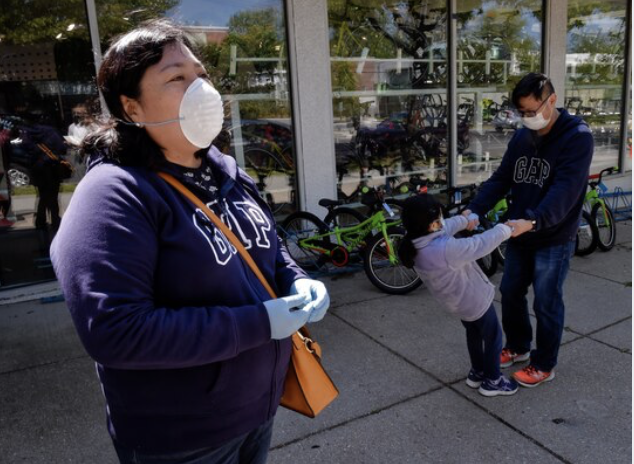
The newfound excitement around bicycles was palpable on Mother’s Day, when dozens of masked customers gathered outside City Bikes in Washington. One line flowed from the repair shop, and another formed from the bike purchasing window, where an employee behind caution tape beckoned customers into the building one by one.

Charlotte Maslog, 7, peered inside the store’s window waiting to see whether her mom would finally have a new bike to ride with her. Liliana Maslog, 46, had tried to purchase a new bicycle three times in the past few weeks. But each time, City Bikes had been sold out of bikes in her size and price range.

A few moments later, Liliana Maslog emerged from the building and triumphantly threw her hands above her head.

“That was not a bad way to spend my Mother’s Day,” she said, with a receipt for a new road bike in hand. “It’s finally my turn to ride, too.”

The coronavirus is upending cash economies. Mobile money could emerge as the winner. #ศาสตร์เกษตรดินปุ๋ย

#ศาสตร์เกษตรดินปุ๋ย : ขอบคุณแหล่งข้อมูล : หนังสือพิมพ์ The Nation.

https://www.nationthailand.com/business/30387931?utm_source=category&utm_medium=internal_referral

The coronavirus is upending cash economies. Mobile money could emerge as the winner.

May 15. 2020
By The Washington Post · Miriam Berger · BUSINESS, WORLD, US-GLOBAL-MARKETS 

When Lagos went into lockdown last month, banks in Nigeria’s bustling financial hub shut their doors. But many agents who offer financial services informally, crucial commerce for the city’s impoverished communities, continued to work using mobile payment apps on their phones, helping customers transfer money and pay bills.

“We’re a country where people live day-to-day and barely have savings,” said Tayo Oviosu, CEO of Paga, a Nigerian mobile money company. He estimated 75 percent of Paga’s agents active in March worked through the city’s five-week lockdown, which lifted on May 4.

In the United States and elsewhere, mobile money services like Apple Pay, Google Pay and PayPal, along with its subsidiary Venmo, are rising in popularity by offering mobile wallets that allow users to send money digitally. A similar model has taken off in developing countries, particularly in Africa, targeting those with no or limited access to the banking and financial system. Experts and members of the industry say the pandemic is likely to escalate that trend.

Oviosu described Paga as a “PayPal for emerging markets,” with 15 million users in Nigeria, who do not need bank accounts to use the service. Agents – often in mom-and-pop street-corner shops – collect cash from people and then add it as credit to accounts connected to phones.

As the coronavirus spreads, businesses and governments, struggling under the weight of the pandemic, are looking to limit cash exchanges, which the World Health Organization has warned could transmit the virus. Mobile money has emerged as an alternative.

Companies and industry experts told The Washington Post they have seen overall rises in new mobile money users globally over the past six weeks, even as the total value of transactions have fallen amid economic duress. Over a dozen countries have also reduced barriers for private transactions, for instance by lowering fees and raising daily limits, and some have used mobile money to deliver emergency funds.

“Leveraging that channel during times of redress is really a lifeline to those who are most vulnerable and sadly impacted by the covid crisis,” said Sabine Mensah, the regional digital lead for the United Nations Capital Development Fund (UNCDF).

The economic downturn has already hit hard. The International Labor Organization warned that around 1.6 billion people working in informal economies – or up to half of the world’s workforce – are at risk of losing their livelihoods as a result of the pandemic.

– – –

Since Vodafone and Safaricom in Kenya launched the M-Pesa mobile money model in 2007, the industry skyrocketed to service nearly a billion registered accounts and close to $2 billion in daily transactions in 2019, according to the London-based GSMA, a group that represents the interests of mobile operators. The services have found traction in East Africa, and increasingly across the rest of the continent, South Asia, and the Middle East – regions in which many people do not have bank accounts.

Despite the pandemic and shutdowns, the industry is still making inroads. Over the last two months, Paga doubled to some 14,000 the number of merchants, such as restaurants and shops, that accept payments on the platform, Oviosu said. The company says it has also seen a more than 200 percent quarterly increase in users. (The company would not provide an exact figure.)

Orange Money, a mobile money service provided by the French telecommunications company Orange and active 17 countries, has seen a 20 percent rise in merchant payment transactions worldwide since the last week of March, said Cedric Lemaire, an executive in the company’s Middle-East and Africa division. User growth aside, transaction are down some 10 percent globally, which Lemaire attributed to pandemic economic pressures. During a three-day lockdown in Sierra Leon last month, Orange Money saw a 90 percent drop in transactions, he said.

Ruan Swanepoel, the head of GSMA’s Mobile Money program, said he had also observed a decline in “cash-in, cash-out” transactions during lockdowns. While exact figures that reflect the current state of the industry are not yet available, he said he expected an overall increase in the number of mobile money account holders, transactions, and merchants once more countries reopen.

The trend is not limited to the developing world: Dan Schulman, the CEO of PayPal, which is available in more than 200 countries and regions, told Fortune magazine that the pandemic had given his business “a tremendous surge.”

– – –

More than a dozen countries have taken steps to increase the use of mobile money during the pandemic.

The first to do so was Kenya. In mid-March Safaricom – the country’s largest telecommunications company, which runs the popular M-Pesa service – waived fees on all person-to-person transactions under 1,000 Kenyan Schillings, or about $10, and raised the daily transaction limit for small and medium-sized businesses.

In Pakistan, where mobile wallet use remains limited, the government in mid-March waived all online banking charges to promote digital transactions during the pandemic.

Ghana went one step further.

Creating a mobile wallet is in theory easy: A user needs no more than a phone, a little money and a sim card. To obtain the latter, however, governments often require an official form of identification. These regulations are intended to prevent financial crimes and provide state oversight, but they serve as barriers for populations less likely to have documents and more likely to be poor, such as migrants, refugees, women and people living in rural areas. So in mid-March, the country’s central bank changed criteria to allow any mobile phone subscriber to establish a mobile wallet and transfer up to $170 daily. To transfer more by phone, however, they will need to provide further identification.

Across Africa there’s talk of harnessing these services to transfer emergency aid, but for now cash distributions remain the norm, said Mensah of UNCDF. A handful of countries already had the mechanisms in place before the pandemic, however, and are now making use of them.

As part of Bangladesh’s coronavirus relief efforts, the government is providing $30 a month to around 5 million impoverished families using one of the country’s four mobile financial services. Cambodia, Chile, Colombia, India, Peru and Thailand are also transferring emergency funds to bank or mobile money accounts, to bypass the possibilities for corruption and contamination inherent to cash.

– – –

Mobile money platforms provide a much-needed service, but they are no quick fix for institutionalized structures, which the coronavirus has only exacerbated, that keep the world’s most destitute and vulnerable people poor.

“Those people who have been [financially] left behind before the crisis,” such as women, refugees and migrants, “are now hit even harder,” said Alfred Hannig, the executive director of the Malaysia-based Alliance for Financial Inclusion, a think tank.

Participation in mobile money markets require consistent Internet and a steady flow of cash. There are also cultural barriers. In conservative Pakistan, for example, most mobile money agents are men, which means it can be difficult for lone women to interact with them, said Hanning.

Obstacles aside, Oviosu of Paga said that mobile money services are likely to emerge from the pandemic stronger than they were before.

“One of the trends that will come out of this is the world moving toward a more digital financial system,” he said.

Pandemic may cost global economy nearly $9 trillion in losses: ADB #ศาสตร์เกษตรดินปุ๋ย

#ศาสตร์เกษตรดินปุ๋ย : ขอบคุณแหล่งข้อมูล : หนังสือพิมพ์ The Nation.

https://www.nationthailand.com/business/30387928?utm_source=category&utm_medium=internal_referral

Pandemic may cost global economy nearly $9 trillion in losses: ADB

May 15. 2020
By The Nation

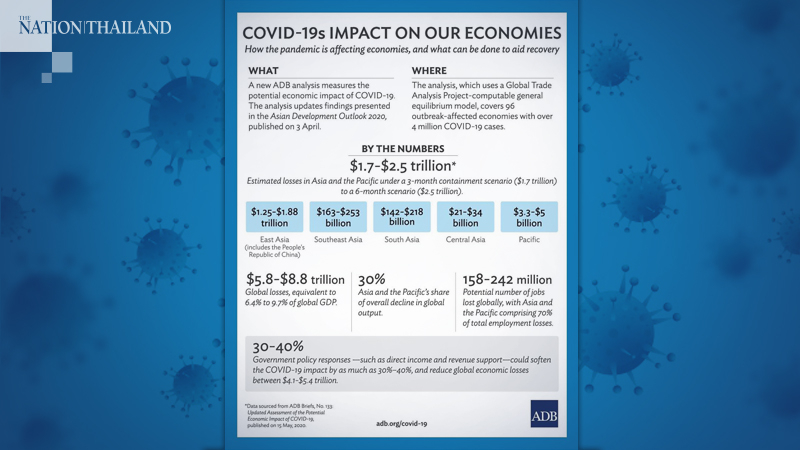
The global economy could suffer between US$5.8 trillion and $8.8 trillion (Bt186.24 trillion and Bt282.57 trillion) in losses, equivalent to 6.4 to 9.7 per cent of the global GDP, as a result of the Covid-19 pandemic, a report released by the Asian Development Bank says.

The report, “Updated Assessment of the Potential Economic Impact of Covid-19”, which was released on Friday (May 15), shows that economic losses in the Asia-Pacific region could range from $1.7 trillion in a three-month scenario, and up to $2.5 trillion in a six-month scenario, with the region accounting for 30 per cent of the overall decline in global output.

China alone could suffer losses of $1.1 trillion to $1.6 trillion. The new report updates findings presented in the Asian Development Outlook (ADO) on April 3, which estimated that Covid-19’s global cost would range between $2 trillion and $4.1 trillion.

However, governments worldwide have been quick in responding to the impact of the pandemic by implementing fiscal and monetary easing measures, increasing health spending and providing support to cover losses in income and revenue. Such sustained efforts could soften Covid-19’s economic impact by as much as 30 to 40 per cent, and thus reduce global losses to between $4.1 trillion and $5.4 trillion.

The analysis covered 96 outbreak-affected economies with over 4 million Covid-19 cases and found that in addition to delivering shocks to tourism, consumption, investment, as well as trade and production links, the pandemic has also increased trade costs affecting mobility and other industries as well as supply-side disruptions that adversely affect output and investment.

“This new analysis presents a broad picture of the very significant potential economic impact of Covid-19,” ADB chief economist Yasuyuki Sawada said.

“It also highlights the important role policy interventions can play to help mitigate damage to economies. These findings can provide governments with a relevant policy guide as they develop and implement measures to contain and suppress the pandemic, and lessen its impacts on their economies and people.”

ADB’s Covid-19 Policy Database provides detailed information on the key economic measures that ADB members are taking to combat the outbreak.

Under the short and long-term scenarios, the report notes that border closures, travel restrictions, and lockdowns that outbreak-affected economies implemented to arrest the spread of Covid-19 will likely cut global trade by $1.7 trillion to $2.6 trillion. Global employment decline will be between 158 million and 242 million, with Asia-Pacific region comprising 70 per cent of total job losses. Labour income across the world will drop by $1.2 trillion to $1.8 trillion – 30 per cent of which will be felt by economies in the region, or between $359 billion and $550 billion.

SET buoyed by rising crude oil, further easing of restrictions #ศาสตร์เกษตรดินปุ๋ย

#ศาสตร์เกษตรดินปุ๋ย : ขอบคุณแหล่งข้อมูล : หนังสือพิมพ์ The Nation.

https://www.nationthailand.com/business/30387922?utm_source=category&utm_medium=internal_referral

SET buoyed by rising crude oil, further easing of restrictions

May 15. 2020
By The Nation

The Stock Exchange of Thailand (SET) Index closed at 1,280.76 today (May 15), up 0.36 points or 0.03 per cent.

Total transactions stood at Bt50.659 billion with an index high of 1,289.24 and a low of 1,278.86.

A Krungsri Securities stock analyst expects the index to rise to 1,290, as crude oil prices climbed by 9 per cent US$27 per barrel after US oil stock was reduced by 700,000 barrels.

“The International Energy Agency expects oil stocks worldwide to reduce by about 5.5 million barrels per day during the second half of this year,” the analyst said, adding that the index also gained from positive sentiment about further easing of restrictions this week.

The government recently decided to lift more restrictions as of May 17.

“However, the index will be under pressure as investors are selling stocks due to the drop in the first-quarter performance of corporates and uncertainty over a second wave of Covid-19 infections,” the analyst added.

The top 10 stocks with the highest trade value today were PTT, CPALL, CBG, BAM, PTTEP, GULF, PTTGC, STA, AOT and ADVANC.

As of 4.30pm, the price of crude oil rose by $0.68 or 2.47 per cent to $28.24 per barrel, while gold rose by $3.60 or 0.21 per cent, to $1,744.50 per ounce.

Indices in the US and Europe were on the rise, though Asian indices had a mixed day:

Japan’s Nikkei Index closed at 20,037.47, up 122.69 points, or 0.62 per cent.

China’s Shanghai SE Composite Index closed at 2,868.46, down 1.88 points, or 0.066 per cent, while Shenzhen SE Component Index closed at 10,964.89, up 2.74 points, or 0.025 per cent.

Hong Kong’s Hang Seng Index closed at 23,797.47, down 32.27 points, or 0.14 per cent.

South Korea’s KOSPI Index closed at 1,927.28, up 2.32 points, or 0.12 per cent.

Taiwan’s TAIEX Index closed at 10,814.92, up 34.04 points, or 0.32 per cent.

SET gains from rising crude oil price and hopes of further lockdown easing #ศาสตร์เกษตรดินปุ๋ย

#ศาสตร์เกษตรดินปุ๋ย : ขอบคุณแหล่งข้อมูล : หนังสือพิมพ์ The Nation.

https://www.nationthailand.com/business/30387902?utm_source=category&utm_medium=internal_referral

SET gains from rising crude oil price and hopes of further lockdown easing

May 15. 2020
By The Nation

The Stock Exchange of Thailand (SET) Index opened at 1,288.08, up 7.68 or 0.60 per cent, on Friday morning (May 15).

A Krungsri Securities stock analyst expected the index to rise to 1,290 before falling as crude oil price rose by 9 per cent to US$27 per barrel after US oil storage dropped by 700,000 barrels.

“The International Energy Agency expected oil storage worldwide to drop by approximately 5.5 million barrels per day during the second half of this year,” the stock analyst said.

The analyst added that the index also gained positive sentiment from hopes of the second phase of lockdown easing during this week.

“However, the index would be under pressure as investors were selling stocks due to the decline in the first quarter performance of corporates and uncertainty over the second wave of the Covid-19 outbreak,” the stock analyst said.

The analyst recommended investors to buy stocks as follows:

● Energy stocks, such as PTT, PTTEP, TOP, PTTGC, and SPRC, due to rising crude oil price.

● Retail stocks, such as CRC, CPN, HMPRO, GLOBAL, COM7, and DOHOME, due to the likely easing of more lockdown measures.

● Stocks calculated in the MSCI Thailand Index were AWC, BAM, and KTC.

Gold price rises amid rising US unemployment welfare claims #ศาสตร์เกษตรดินปุ๋ย

#ศาสตร์เกษตรดินปุ๋ย : ขอบคุณแหล่งข้อมูล : หนังสือพิมพ์ The Nation.

https://www.nationthailand.com/business/30387892?utm_source=category&utm_medium=internal_referral

Gold price rises amid rising US unemployment welfare claims

May 15. 2020
By The Nation

The price of gold rose by Bt150 per baht weight in morning trade on Friday (May 15), the Gold Traders Association reported.

As of 9.24am, buying price of a gold bar was Bt26,050 per baht weight and selling price Bt26,250, while gold ornaments were priced at Bt25,574.92 and Bt26,750, respectively.

At close on Thursday (May 14), buying price of a gold bar was Bt25,900 per baht weight and selling price Bt26,100, while gold ornaments were priced at Bt25,438.48 and Bt26,600, respectively.

The Gold Spot Index price on Friday morning moved to around US$1,733 (Bt55,610) per ounce after the price rose by $24.5 to $1,740.9 per ounce at close on Thursday.

Investors were buying gold as a safe-haven asset after the US revealed that the number of unemployment welfare registrants rose to over 2.9 million people due to the Covid-19 outbreak.

Meanwhile, the Hong Kong gold price rose by HK$120 to $15,980 (Bt66,153) per tael.